# AP Environmental science
APES class 2026-2027
# Heat lab: save the thermobacteria!
**Challenge**:
You are a researcher of volcanic geysers who has just discovered a new species of hot water bacteria, and need to transport a sample of 100°C water from the geyser to the lab. You have the following supplies to achieve your mission:
- several sheets of aluminum foil, one side is shiny, one is dull
- two styrofoam cups
- napkins from a local restaurant
- plastic wrap
- a few plastic bags
- access to toilet paper
- your geyser thermal camera
You will gather a sample of hot bacteria water, then measure the temperature when you reach your lab hours away. The hotter the water, more bacteria have survived for your research.
Create a diagram of your "thermobacteria transport device" so others can learn from you!
**Lab questions:**
1. how did you stop convection, conduction and radiation of heat from your sample?
2. which side of the shiny foil was facing the hot water and why?
3. if you were later studying DO (dissolved oxygen) in a cool water sample, what would you do differently?
4. does the hot water cool at the same rate through your trip? Explain
5. could the thermobacteria be aerobic or anaerobic? Explain
6. why do people warm their thermos with hot water before putting in their hot drink?
7. why do people blow on their hot soup to cool it off?
8. some other folks wrap their cold drinks in foil-is this helpful? explain
In our next class, we'll fill your container with hot water (100°C) and at the end of class, we'll see whose container can retain heat the best.
The extremes (best-worst) will be part of our study of exponential heat decay, just like in radioactivity
##### Exponential heat decay section:
- The rate of heat transfer changes over time: hot soup may lose several degrees every minute, but later only after several hours.
- This is exactly the same process we use to study radioactive decay, e.g. half lives
- While a radioactive sample is made of countless atoms, and never really decays to zero, a hot object effectively cools to room temperature, only to zero if the room temperature is zero.
- This is used in forensics to determine TOD or time of death: coroners assume that a body is at 37°C, so the first thing they do on a crime scene is measure the body temp and room temp.
- The calculation of decay rate is also useful when you are designing a sustainable home, since insulation is rated as R value, which is the inverse of the decay rate (better insulated houses lose less heat).
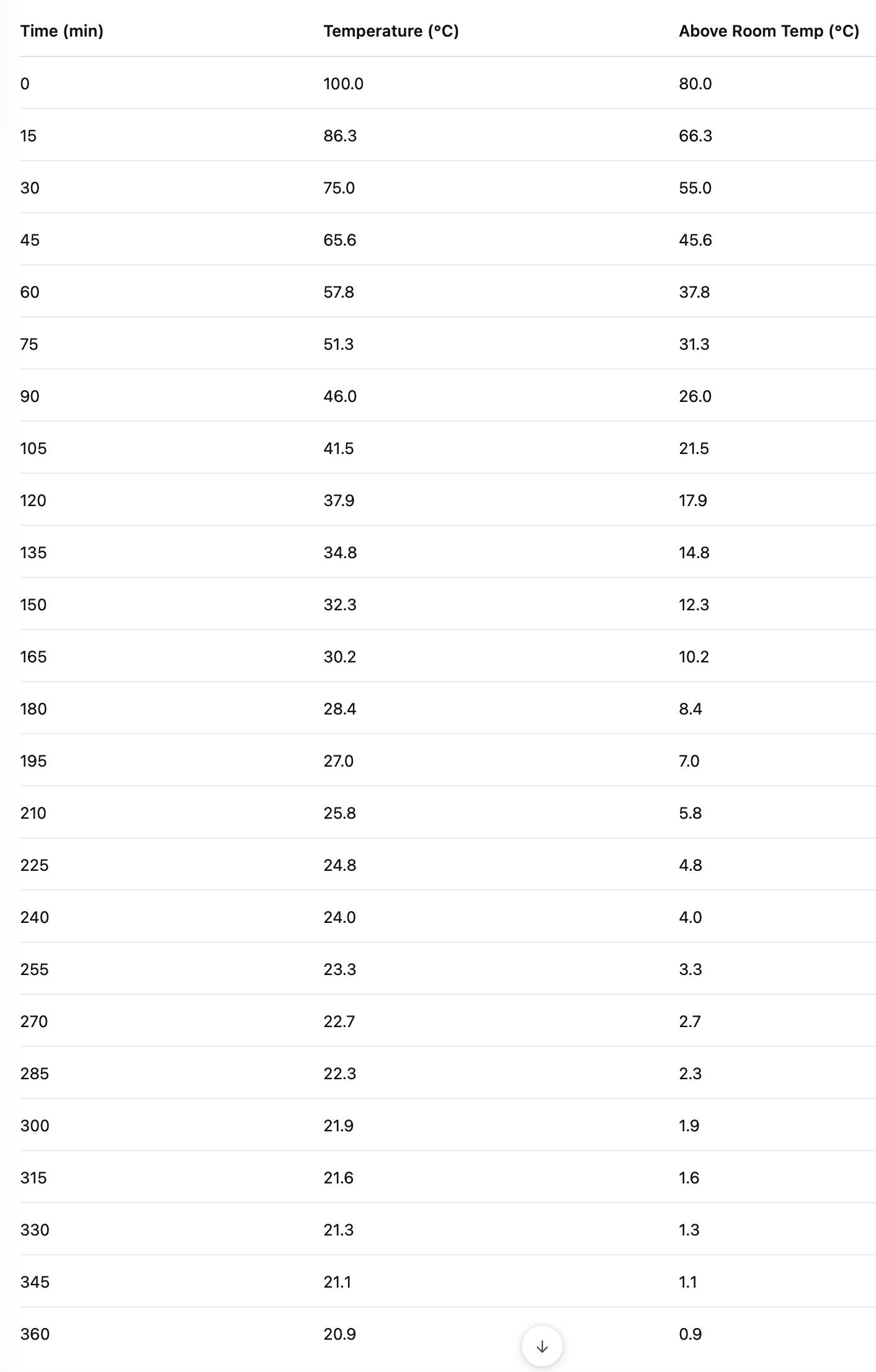
- Below is a chart of the heat decay of a hot cup of coffee in a 20°C room:
[](https://bookstack.kamuela.org/uploads/images/gallery/2026-09/KfLCnvDfnWxSxRdU-screenshot-2026-09-09-at-7-29-55-am.png)
1. about what is the half-life for this coffee?
2. why do we need to use the third column instead of the middle one?
3. graph the data
# Chemistry review
**APES 2026-27 notes**
**APES 2026-27 notes**
HW: 9.4.26
1. the coffee cup you pick up at the coffee shop has three modes of reducing heat loss. describe each with a diagram and explain how each reduces the transfer of heat energy
2.
8.24.26 quiz E
1. How many protons, neutrons and electrons in each of these: C13/6, Sr90/38, U234/92
2. What is the new and old name of these symbols: Pb, Na, Fe, Au
3. If a sample of carbon is found to have 25% of the natural amount of C14/6 in it, how old is it? (C14 half life is about 5000 years)
4. List three anomalies from your 8 countries work
**8.19.26 Wednesday**
quiz:
1. give an example in your life of a positive feedback loop
2. and a negative feedback loop
3. thinking of your body as a system, is it open or closed? explain
4. name two things you found about the country you chose that surprised you
HW notes:
stable orbitals
pool-joule
sun-big bang
steady state?
negative feedback
pos feedback: banana
8 countries summation
Chem review:
3 main characters: proton, neutron, electron (they draw on their notes w/ relative size and charge)
periodic table (print in color):
names
columns
compounds vs. elements
ionic bonds (common)
covalent bonds (copilot)
isotopes: Sr90/38
half-lives
physical properties:
4 states of matter (s, l, g, plasma)
—————————
Homework: 8.19.26
1. what is the connection between geysers and pressure cookers?
2. why would brewing tea be weaker up on Mauna Kea summit?
3. what could carbon change in its electron structure to be stable?
4. which conducts electricity better: ionic or covalent compounds and why? (think of salt water)
5. pick three other isotopes we did not cover in class and list their protons, neutrons and electrons
6. pick six elements that have a name that does not match their symbol, and explain why
7. A dish is found at an ancient ruin that has 1/8 of the background level of C14/6. Look up the half life for C14/6 and determine the age of the relic.
8. if you wanted to dissolve CO2 into water, would you warm or cool the water-explain
9. why does an air conditioner drip water out of the back if it is working?
10. what enables a glacier to move along very rough rock? explain.
———————
collgative properties: bp, mp, depression——
reglation
geysers——
freeze dried coffee
gas->liquid solubility
capillary action
chemical properties:
pH
carbonic acid
fossil fuels-ocean acidification
methionine->acid rain
cause and effect
8.17.26 notes-systems-HW
[https://www.bozemanscience.com/ap-es-002-environmental-systems](https://www.bozemanscience.com/ap-es-002-environmental-systems)
1. look up the Aral sea on google earth now, how does it compare with the photo in the video?
2. what is the difference between the energy and matter systems on our planet?
3. give an example in your life of an open system and a closed system (could be money, you name it)
4. thermodynamics uses the term “energy tax”, explain
5. what makes elements reactive?
6. why are noble gases stable?
7. a friend tells you that swimmers warm up the pool two ways-is he crazy?
8. go ALL the way back: where does all of our energy come from?
9. before we started burning fossil fuels was earth a steady state? explain.
10. give an example in your life of a positive and a negative feedback loop
If any of these are really strange to you, make sure to look over the videos at the bottom of the page: “resources”
8.17 Monday
HW: [https://www.bozemanscience.com/ap-es-002-environmental-systems](https://www.bozemanscience.com/ap-es-002-environmental-systems)
8 countries summation
quiz: 8 countries
periodic table
names
formulas: MgCl?
half lives
Sr90
pH
capillary action
collgative properties: bp, mp, depression
reglation
geysers
freeze dried coffee
fossil fuels-ocean acidification
carbonic acid
gas->liquid solubility
methionine->acid rain
It is May 2027, and you have been successful in this course.
What does success look like?
What did you do to be successful?
survey questions:
1. what is wrong with this: MgCl
2. explain any of the laws of thermodynamics
3. what is a negative feedback loop?
4. how many protons, neutrons and electrons are in Sr90/38?
5. how many electrons in Na+?
6. how much stronger is pH 3 than pH 5?
7. are these acids or bases?
8. the half life of Sr90 is about 30 years, so how much of an original sample is left after 60 years?
9. what are the boiling point and melting point for water in °C?
10. what gas in the atmosphere causes ocean acidification?
11. you put 1000J of energy into your car gas tank, and get 1200J of energy out of your car-what is wrong with this?
12. is sweating a negative or positive feedback loop? explain
13. if Kona is 60 km away, how many cm is this?
14. what are the names of these symbols: Hg, Na, Fe, K
15. what are the charges on an electron, a neutron and a proton?
16. what is osmosis?
17. if a person’smass is 220 lb and each kg is 2.2 lb, how many kg are they?
18. what is the square root of 144?
19. what is the log10 of 1000?
20. what is the difference between radiation, conduction and convection?
(change for second section)
8.13.26
8 countries: how would you pair the countries?
why were they chosen?
need science base HW survey
video:
planetary boundaries
pie chart: climate change red
apes different from other courses:
ecological footprint
quiz::
1. from the video, why is apes different from other science courses?
2. what was your global footprint (earths)
3. why do we use “earths” as a measure? what does it mean?
4. create two fictional students at HPA: one with very low footprint, one with very high footprint-explain why
class:
review video
8 countries-how would you pair them?
science survey HW-weekend
in-class calculators-show
hw:
science survey questions (no ai)
============
1. FedEx sign: can’t NOT see it now, APES will change how you think
2. I will do my best to read everything you write
3. I bring my A game. I know you are busy, but I expect you to bring yours as well, and I'll let you know when I think you are not.
60-30-10 quiz, hw, lab
delete one HW per semester
AI Policy; research helper, if your name is on it, it has to be YOUR thoughts
metaphor: sending a robot to the gym for you vs. robot training partner
I read everything and comment
Early is better, due date midnight?
AP exam-iPad prep
cause and effect
show your work
demonstrate understanding, not canonical learning
this course will change how you think: FedEx icon
Round grades to whole number, not decimals
34 classes per semester
labs: you come up with question, then research it
case studies: deepwater horizon
How we teach in HS is about recall. college is about synthesis and context
derivation…
Homework:
Email
1. where is home besides HPA?
2. what are you most interested in?
3. tell me something few people know about you
HW: bozeman intro. **cause and effect**
[elab.hpa.edu](http://elab.hpa.edu)
login is hpa/papaya77
[https://elab.hpa.edu/apes/videos/bozeman\_science/Intro.mp4](https://elab.hpa.edu/apes/videos/bozeman_science/Intro.mp4)
(ap exam has changed since this video)
Your global footprint—
8 countries mystery
Aether demo——planetary boundaries
seeding project:
[https://terraformation.maps.arcgis.com/apps/dashboards/bcd940d84e4b474d96d9f504ab96a555#](https://terraformation.maps.arcgis.com/apps/dashboards/bcd940d84e4b474d96d9f504ab96a555)
look up bluetooth icon: why runes?
[https://www.livescience.com/planet-earth/nasa-satellite-captures-wave-of-warm-water-hundreds-of-miles-long-that-signals-a-devastatingly-strong-el-nino](https://www.livescience.com/planet-earth/nasa-satellite-captures-wave-of-warm-water-hundreds-of-miles-long-that-signals-a-devastatingly-strong-el-nino)
Footprint investigation:
[https://data.footprintnetwork.org/#/countryTrends?cn=5001&type=BCtot,EFCtot](https://data.footprintnetwork.org/#/countryTrends?cn=5001&type=BCtot,EFCtot)
Questions:
- check out the vertical axes
- where would be a good place to live when you are 40?
- when did they move from surplus to debt?
===============
Ask any math professor why hundreds of thousands of STEM majors fail Calculus I every fall, and they’ll share a secret: students aren't actually failing calculus. They're failing algebra.
This foundational weakness is one of three systemic hurdles that turn this course into a gatekeeper:
**The Algebra Deficit**
A typical problem involves one step of actual calculus—such as applying the power rule or the chain rule—followed by multiple steps of algebraic simplification. Students arriving from high school often harbor fundamental weaknesses in factoring, manipulating rational functions, or deploying trigonometric identities. When they encounter a complex derivative, they execute the new calculus concept correctly but lose points on the algebraic mechanics required to finish the problem.
**The Rote Memorization Trap**
High school mathematics is frequently taught as a set of algorithms to memorize. Students learn how to execute formulas without necessarily understanding the underlying logic. University calculus demands conceptual understanding and mathematical rigor. A student who expects to pass by recognizing patterns and memorizing templates will struggle with university exam questions designed to test the application of concepts to novel, unfamiliar scenarios.
**The "Weeder" Environment**
Calculus I is often structured as a gatekeeper course for competitive engineering, physics, and computer science programs. Instruction typically occurs in massive lecture halls where the pace is unforgiving. A topic that a high school teacher might spend three weeks covering is often compressed into a few days at the university level. Because the material builds cumulatively, a student who fails to grasp limits in week two is almost certain to fail integrals in week ten.
To address these attrition rates, mathematics departments are rethinking how the course operates:
- **Co-requisite Remediation:** Instead of diverting students into zero-credit remedial algebra courses, universities place them directly into calculus with a simultaneous "just-in-time" support lab. Instructors review trigonometric identities in the exact week the main lecture covers derivatives of trigonometric functions.
- **Active Learning:** Institutions are replacing passive lectures with active learning models. Flipped classrooms—where students watch video lectures as homework and spend class time solving problems in small groups guided by teaching assistants—consistently yield lower failure rates.
- **Reformed Assessment:** Exams are being redesigned to test core calculus competencies rather than algebraic stamina. If a question intends to test the quotient rule, instructors simplify the surrounding algebra so that a minor arithmetic error does not obscure the student's grasp of the calculus concept.
# 24.09.12 apes-main wiki
## APES Resources 2023-2024
- [Weblog](http://10.14.4.85:6875/books/ap-environmental-science/page/240912-apes-main-wiki)
- [Documents](http://10.14.4.85:6875/books/ap-environmental-science/page/240912-apes-main-wiki)
- [Texts](https://bookstack.kamuela.org/apes/texts)[](https://elab.hpa.edu/apes/texts)
- [Videos](https://bookstack.kamuela.org/apes/videos)
- [Labs](https://bookstack.kamuela.org/apes/labs)
- [Audio](https://bookstack.kamuela.org/apes/audio)
- [AP exam prep ](https://bookstack.kamuela.org/apes/ap_exam_prep)
- [PDF archive ](https://elab.hpa.edu/apes/_pdf)
- [Weblog modules archive ](https://bookstack.kamuela.org/apes/apes_modules21_22)
- [Physics server weblogs 2002-2022](http://physics.hpa.edu/groups/apenvironmentalscience/blog)
- [Physics server APES resources](http://physics.hpa.edu/physics/apenvsci)
- [Download Glosario.pdf (application/pdf, 10.6 MB)](https://bookstack.kamuela.org/attachments/220)
## Additional migrated files
Files present in the Apple export but not embedded in a page:
- [Download 9c868.png (image/png, 298.0 KB)](https://bookstack.kamuela.org/attachments/36)
- [Download b09f2.png (image/png, 104.6 KB)](https://bookstack.kamuela.org/attachments/37)
- [Download d801c.png (image/png, 199.2 KB)](https://bookstack.kamuela.org/attachments/38)
- [Download c9859.png (image/png, 304.2 KB)](https://bookstack.kamuela.org/attachments/39)
- [Download cde08.png (image/png, 382.0 KB)](https://bookstack.kamuela.org/attachments/40)
- [Download f7fc8.png (image/png, 357.8 KB)](https://bookstack.kamuela.org/attachments/41)
- [Download 9fd63.png (image/png, 347.0 KB)](https://bookstack.kamuela.org/attachments/42)
- [Download 1fa06.png (image/png, 384.0 KB)](https://bookstack.kamuela.org/attachments/43)
- [Download 0a66f.png (image/png, 179.0 KB)](https://bookstack.kamuela.org/attachments/44)
- [Download 15ce7.png (image/png, 521.6 KB)](https://bookstack.kamuela.org/attachments/45)
- [Download Screen Shot 2022-10-23 at 6.47.27 AM.png (image/png, 1.3 MB)](https://bookstack.kamuela.org/attachments/50)
- [Download Screen Shot 2022-10-23 at 6.50.03 AM.png (image/png, 1.5 MB)](https://bookstack.kamuela.org/attachments/51)
- [Download Screen Shot 2022-12-02 at 3.38.37 PM.png (image/png, 1.1 MB)](https://bookstack.kamuela.org/attachments/52)
- [Download Screen Shot 2023-01-29 at 12.18.43 PM.png (image/png, 127.1 KB)](https://bookstack.kamuela.org/attachments/57)
- [Download Unit7 air pollution.pdf (application/pdf, 18.5 MB)](https://bookstack.kamuela.org/attachments/58)
- [Download Screen Shot 2023-02-26 at 4.56.17 PM.png (image/png, 436.3 KB)](https://bookstack.kamuela.org/attachments/59)
- [Download Screen Shot 2023-02-26 at 5.04.56 PM.png (image/png, 368.8 KB)](https://bookstack.kamuela.org/attachments/60)
- [Download photochemical smog.png (image/png, 743.3 KB)](https://bookstack.kamuela.org/attachments/61)
- [Download Screen Shot 2023-02-26 at 5.24.26 PM.png (image/png, 353.7 KB)](https://bookstack.kamuela.org/attachments/62)
- [Download Screenshot 2023-03-22 at 11.03.29 AM.png (image/png, 1.1 MB)](https://bookstack.kamuela.org/attachments/63)
- [Download Screenshot 2023-03-22 at 11.08.19 AM.png (image/png, 945.6 KB)](https://bookstack.kamuela.org/attachments/64)
- [Download Screenshot 2023-03-22 at 11.09.37 AM.png (image/png, 851.5 KB)](https://bookstack.kamuela.org/attachments/65)
- [Download 3b413.pdf (application/pdf, 633.5 KB)](https://bookstack.kamuela.org/attachments/66)
- [Download Screen Shot 2023-04-02 at 4.20.06 PM.png (image/png, 719.2 KB)](https://bookstack.kamuela.org/attachments/67)
- [Download eb2f2.png (image/png, 279.9 KB)](https://bookstack.kamuela.org/attachments/68)
- [Download eb2f2.png (image/png, 279.9 KB)](https://bookstack.kamuela.org/attachments/69)
- [Download thinking about forever.pdf (application/pdf, 262.3 KB)](https://bookstack.kamuela.org/attachments/70)
- [Download fr3e\_ch1.pdf (application/pdf, 12.2 MB)](https://bookstack.kamuela.org/attachments/72)
- [Download Screenshot 2023-09-23 at 10.24.31 AM.png (image/png, 676.0 KB)](https://bookstack.kamuela.org/attachments/74)
- [Download Screenshot 2023-10-16 at 5.30.17 PM.png (image/png, 932.2 KB)](https://bookstack.kamuela.org/attachments/75)
- [Download Screenshot 2023-10-16 at 5.31.18 PM.png (image/png, 498.1 KB)](https://bookstack.kamuela.org/attachments/76)
- [Download Screenshot 2023-10-16 at 5.32.13 PM.png (image/png, 408.5 KB)](https://bookstack.kamuela.org/attachments/77)
- [Download Screenshot 2023-10-16 at 5.32.35 PM.png (image/png, 431.7 KB)](https://bookstack.kamuela.org/attachments/78)
- [Download Screenshot 2023-10-16 at 5.32.56 PM.png (image/png, 438.3 KB)](https://bookstack.kamuela.org/attachments/79)
- [Download Screenshot 2023-10-16 at 5.33.28 PM.png (image/png, 1.3 MB)](https://bookstack.kamuela.org/attachments/80)
- [Download Screenshot 2023-10-16 at 5.34.05 PM.png (image/png, 570.5 KB)](https://bookstack.kamuela.org/attachments/81)
- [Download Screenshot 2023-10-16 at 5.34.28 PM.png (image/png, 340.4 KB)](https://bookstack.kamuela.org/attachments/82)
- [Download Screenshot 2023-10-16 at 5.34.28 PM.png (image/png, 340.4 KB)](https://bookstack.kamuela.org/attachments/83)
- [Download Screenshot 2023-10-16 at 5.34.59 PM.png (image/png, 1.1 MB)](https://bookstack.kamuela.org/attachments/84)
- [Download Screenshot 2023-10-16 at 5.34.59 PM.png (image/png, 1.1 MB)](https://bookstack.kamuela.org/attachments/85)
- [Download Screenshot 2023-10-16 at 5.35.59 PM.png (image/png, 508.5 KB)](https://bookstack.kamuela.org/attachments/86)
- [Download Screenshot 2023-10-16 at 5.36.31 PM.png (image/png, 1.4 MB)](https://bookstack.kamuela.org/attachments/87)
- [Download Screenshot 2023-10-16 at 5.36.58 PM.png (image/png, 1.7 MB)](https://bookstack.kamuela.org/attachments/88)
- [Download Screenshot 2023-10-16 at 5.37.21 PM.png (image/png, 2.1 MB)](https://bookstack.kamuela.org/attachments/89)
- [Download Screenshot 2023-10-16 at 5.37.46 PM.png (image/png, 2.0 MB)](https://bookstack.kamuela.org/attachments/90)
- [Download Screenshot 2023-10-16 at 5.38.23 PM.png (image/png, 418.9 KB)](https://bookstack.kamuela.org/attachments/91)
- [Download Screenshot 2023-10-16 at 5.38.49 PM.png (image/png, 407.2 KB)](https://bookstack.kamuela.org/attachments/92)
- [Download Screenshot 2023-10-16 at 5.39.12 PM.png (image/png, 408.9 KB)](https://bookstack.kamuela.org/attachments/93)
- [Download Screenshot 2023-10-16 at 5.41.14 PM.png (image/png, 1.6 MB)](https://bookstack.kamuela.org/attachments/94)
- [Download Screenshot 2023-10-16 at 5.41.39 PM.png (image/png, 1.3 MB)](https://bookstack.kamuela.org/attachments/95)
- [Download Screenshot 2023-10-16 at 5.41.39 PM.png (image/png, 1.3 MB)](https://bookstack.kamuela.org/attachments/96)
- [Download Screenshot 2023-10-16 at 5.42.24 PM.png (image/png, 2.1 MB)](https://bookstack.kamuela.org/attachments/97)
- [Download Screenshot 2023-10-16 at 5.30.17 PM.png (image/png, 932.2 KB)](https://bookstack.kamuela.org/attachments/98)
- [Download Screenshot 2023-10-17 at 8.30.00 AM.png (image/png, 476.7 KB)](https://bookstack.kamuela.org/attachments/99)
- [Download Screenshot 2023-10-17 at 8.31.55 AM.png (image/png, 596.5 KB)](https://bookstack.kamuela.org/attachments/100)
- [Download Screenshot 2023-10-17 at 8.33.36 AM.png (image/png, 965.7 KB)](https://bookstack.kamuela.org/attachments/101)
- [Download Screenshot 2023-10-17 at 8.34.04 AM.png (image/png, 1.5 MB)](https://bookstack.kamuela.org/attachments/102)
- [Download Screenshot 2023-10-17 at 8.36.12 AM.png (image/png, 388.1 KB)](https://bookstack.kamuela.org/attachments/103)
- [Download solarsystem-snap\_8.5x11.pdf (application/pdf, 10.9 MB)](https://bookstack.kamuela.org/attachments/104)
- [Download Screenshot 2023-10-17 at 8.41.53 AM.png (image/png, 1.8 MB)](https://bookstack.kamuela.org/attachments/105)
- [Download Screenshot 2023-10-17 at 8.46.22 AM.png (image/png, 311.9 KB)](https://bookstack.kamuela.org/attachments/106)
- [Download Screenshot 2023-10-17 at 8.46.45 AM.png (image/png, 180.4 KB)](https://bookstack.kamuela.org/attachments/107)
- [Download Screenshot 2023-10-17 at 8.47.20 AM.png (image/png, 197.5 KB)](https://bookstack.kamuela.org/attachments/108)
- [Download Screenshot 2023-10-17 at 8.50.06 AM.png (image/png, 657.5 KB)](https://bookstack.kamuela.org/attachments/109)
- [Download Screenshot 2023-10-17 at 8.50.25 AM.png (image/png, 195.9 KB)](https://bookstack.kamuela.org/attachments/110)
- [Download Screenshot 2023-10-17 at 8.52.46 AM.png (image/png, 3.4 MB)](https://bookstack.kamuela.org/attachments/111)
- [Download Screenshot 2023-10-17 at 8.52.46 AM.png (image/png, 3.4 MB)](https://bookstack.kamuela.org/attachments/112)
- [Download Screenshot 2023-10-17 at 8.54.18 AM.png (image/png, 358.6 KB)](https://bookstack.kamuela.org/attachments/113)
- [Download Screenshot 2023-10-17 at 8.55.30 AM.png (image/png, 1.4 MB)](https://bookstack.kamuela.org/attachments/114)
- [Download Screenshot 2023-10-17 at 8.56.58 AM.png (image/png, 822.6 KB)](https://bookstack.kamuela.org/attachments/115)
- [Download Screenshot 2023-10-17 at 8.59.36 AM.png (image/png, 196.9 KB)](https://bookstack.kamuela.org/attachments/116)
- [Download Screenshot 2023-10-17 at 9.07.18 AM.png (image/png, 1.1 MB)](https://bookstack.kamuela.org/attachments/117)
- [Download Screenshot 2023-10-17 at 9.08.27 AM.png (image/png, 2.3 MB)](https://bookstack.kamuela.org/attachments/118)
- [Download Screenshot 2023-10-17 at 9.09.32 AM.png (image/png, 1.1 MB)](https://bookstack.kamuela.org/attachments/119)
- [Download Screenshot 2023-10-17 at 9.12.59 AM.png (image/png, 92.7 KB)](https://bookstack.kamuela.org/attachments/120)
- [Download Screenshot 2023-10-17 at 9.16.33 AM.png (image/png, 1.4 MB)](https://bookstack.kamuela.org/attachments/121)
- [Download Screenshot 2023-10-17 at 9.16.48 AM.png (image/png, 2.1 MB)](https://bookstack.kamuela.org/attachments/122)
- [Download Screenshot 2023-10-17 at 9.19.32 AM.png (image/png, 772.9 KB)](https://bookstack.kamuela.org/attachments/123)
- [Download Screenshot 2023-10-17 at 9.18.08 AM.png (image/png, 2.0 MB)](https://bookstack.kamuela.org/attachments/124)
- [Download Screenshot 2023-10-17 at 9.18.08 AM.png (image/png, 2.0 MB)](https://bookstack.kamuela.org/attachments/125)
- [Download Screenshot 2023-10-17 at 9.22.09 AM.png (image/png, 416.5 KB)](https://bookstack.kamuela.org/attachments/126)
- [Download Screenshot 2023-10-17 at 9.24.10 AM.png (image/png, 79.4 KB)](https://bookstack.kamuela.org/attachments/127)
- [Download Screenshot 2023-10-17 at 9.24.10 AM.png (image/png, 79.4 KB)](https://bookstack.kamuela.org/attachments/128)
- [Download Screenshot 2023-10-17 at 9.23.52 AM.png (image/png, 635.4 KB)](https://bookstack.kamuela.org/attachments/129)
- [Download Screenshot 2023-10-17 at 9.26.10 AM.png (image/png, 1.1 MB)](https://bookstack.kamuela.org/attachments/130)
- [Download Screenshot 2023-10-24 at 8.33.56 AM.png (image/png, 1.3 MB)](https://bookstack.kamuela.org/attachments/131)
- [Download Screenshot 2023-10-24 at 8.45.13 AM.png (image/png, 875.8 KB)](https://bookstack.kamuela.org/attachments/132)
- [Download Screenshot 2023-10-25 at 3.03.19 PM.png (image/png, 2.5 MB)](https://bookstack.kamuela.org/attachments/133)
- [Download Screenshot 2023-10-25 at 3.10.36 PM.png (image/png, 601.2 KB)](https://bookstack.kamuela.org/attachments/134)
- [Download Screenshot 2023-10-25 at 3.11.10 PM.png (image/png, 544.2 KB)](https://bookstack.kamuela.org/attachments/135)
- [Download Screenshot 2023-10-25 at 3.14.50 PM.png (image/png, 2.9 MB)](https://bookstack.kamuela.org/attachments/136)
- [Download Screenshot 2023-10-25 at 3.26.19 PM.png (image/png, 690.4 KB)](https://bookstack.kamuela.org/attachments/137)
- [Download Screenshot 2023-10-25 at 3.36.54 PM.png (image/png, 2.4 MB)](https://bookstack.kamuela.org/attachments/138)
- [Download Screenshot 2023-10-25 at 3.40.28 PM.png (image/png, 1.2 MB)](https://bookstack.kamuela.org/attachments/139)
- [Download Screenshot 2023-10-25 at 3.40.55 PM.png (image/png, 554.1 KB)](https://bookstack.kamuela.org/attachments/140)
- [Download Screenshot 2023-10-25 at 3.43.45 PM.png (image/png, 2.5 MB)](https://bookstack.kamuela.org/attachments/141)
- [Download Screenshot 2023-10-28 at 7.06.05 PM.png (image/png, 618.7 KB)](https://bookstack.kamuela.org/attachments/142)
- [Download Screenshot 2023-10-28 at 7.07.35 PM.png (image/png, 806.7 KB)](https://bookstack.kamuela.org/attachments/143)
- [Download Screenshot 2023-10-28 at 7.10.31 PM.png (image/png, 838.8 KB)](https://bookstack.kamuela.org/attachments/144)
- [Download Screenshot 2023-10-28 at 7.18.06 PM.png (image/png, 447.0 KB)](https://bookstack.kamuela.org/attachments/145)
- [Download Screenshot 2023-10-28 at 7.18.50 PM.png (image/png, 288.0 KB)](https://bookstack.kamuela.org/attachments/146)
- [Download Screenshot 2023-10-28 at 7.20.06 PM.png (image/png, 2.7 MB)](https://bookstack.kamuela.org/attachments/147)
- [Download Screenshot 2023-10-28 at 7.20.52 PM.png (image/png, 1.3 MB)](https://bookstack.kamuela.org/attachments/148)
- [Download Screenshot 2023-10-28 at 7.25.03 PM.png (image/png, 564.3 KB)](https://bookstack.kamuela.org/attachments/149)
- [Download Screenshot 2023-10-31 at 12.09.50 PM.png (image/png, 1.4 MB)](https://bookstack.kamuela.org/attachments/150)
- [Download Screenshot 2023-10-31 at 12.16.31 PM.png (image/png, 1.5 MB)](https://bookstack.kamuela.org/attachments/151)
- [Download Screenshot 2023-11-01 at 8.59.06 AM.png (image/png, 2.0 MB)](https://bookstack.kamuela.org/attachments/152)
- [Download Screenshot 2023-11-01 at 8.59.21 AM.png (image/png, 2.0 MB)](https://bookstack.kamuela.org/attachments/153)
- [Download Screenshot 2023-11-01 at 8.59.31 AM.png (image/png, 2.1 MB)](https://bookstack.kamuela.org/attachments/154)
- [Download Screenshot 2023-11-01 at 8.59.50 AM.png (image/png, 786.7 KB)](https://bookstack.kamuela.org/attachments/155)
- [Download Screenshot 2023-11-03 at 11.27.12 AM.png (image/png, 365.2 KB)](https://bookstack.kamuela.org/attachments/156)
- [Download Screenshot 2023-11-03 at 11.34.13 AM.png (image/png, 380.9 KB)](https://bookstack.kamuela.org/attachments/157)
- [Download Screenshot 2023-11-03 at 11.37.17 AM.png (image/png, 1.4 MB)](https://bookstack.kamuela.org/attachments/158)
- [Download Screenshot 2023-11-03 at 11.38.05 AM.png (image/png, 594.6 KB)](https://bookstack.kamuela.org/attachments/159)
- [Download Screenshot 2023-11-03 at 11.38.05 AM.png (image/png, 594.6 KB)](https://bookstack.kamuela.org/attachments/160)
- [Download Screenshot 2023-11-03 at 11.38.05 AM.png (image/png, 594.6 KB)](https://bookstack.kamuela.org/attachments/161)
- [Download Screenshot 2023-11-03 at 11.38.05 AM.png (image/png, 594.6 KB)](https://bookstack.kamuela.org/attachments/162)
- [Download Screenshot 2023-11-03 at 11.40.36 AM.png (image/png, 500.0 KB)](https://bookstack.kamuela.org/attachments/163)
- [Download Screenshot 2023-11-04 at 2.02.30 PM.png (image/png, 617.6 KB)](https://bookstack.kamuela.org/attachments/164)
- [Download Screenshot 2023-11-04 at 2.03.18 PM.png (image/png, 834.9 KB)](https://bookstack.kamuela.org/attachments/165)
- [Download Screenshot 2023-11-04 at 2.24.14 PM.png (image/png, 1.6 MB)](https://bookstack.kamuela.org/attachments/166)
- [Download Screenshot 2023-11-04 at 2.24.41 PM.png (image/png, 1.6 MB)](https://bookstack.kamuela.org/attachments/167)
- [Download Screenshot 2023-11-04 at 2.27.42 PM.png (image/png, 157.2 KB)](https://bookstack.kamuela.org/attachments/168)
- [Download Screenshot 2023-11-05 at 5.09.43 PM.png (image/png, 987.1 KB)](https://bookstack.kamuela.org/attachments/169)
- [Download Screenshot 2023-11-05 at 5.14.22 PM.png (image/png, 239.9 KB)](https://bookstack.kamuela.org/attachments/170)
- [Download Screenshot 2023-11-05 at 5.22.16 PM.png (image/png, 329.7 KB)](https://bookstack.kamuela.org/attachments/171)
- [Download Screenshot 2023-11-05 at 5.26.27 PM.png (image/png, 295.3 KB)](https://bookstack.kamuela.org/attachments/172)
- [Download Screenshot 2023-11-05 at 5.27.25 PM.png (image/png, 400.6 KB)](https://bookstack.kamuela.org/attachments/173)
- [Download Screenshot 2023-11-05 at 5.36.33 PM.png (image/png, 813.9 KB)](https://bookstack.kamuela.org/attachments/174)
- [Download Population Growth Model.numbers (text/html, 740.6 KB)](https://bookstack.kamuela.org/attachments/175)
- [Download Population Growth Model.xls (text/html, 61.5 KB)](https://bookstack.kamuela.org/attachments/176)
- [Download Screenshot 2023-11-05 at 5.43.00 PM.png (image/png, 2.1 MB)](https://bookstack.kamuela.org/attachments/177)
- [Download Screenshot 2023-11-05 at 5.43.00 PM.png (image/png, 2.1 MB)](https://bookstack.kamuela.org/attachments/178)
- [Download Screenshot 2023-11-05 at 5.43.00 PM.png (image/png, 2.1 MB)](https://bookstack.kamuela.org/attachments/179)
- [Download Population Growth Model.numbers (text/html, 799.7 KB)](https://bookstack.kamuela.org/attachments/180)
- [Download Population Growth Model.xls (text/html, 61.5 KB)](https://bookstack.kamuela.org/attachments/181)
- [Download Screenshot 2023-11-09 at 5.54.05 AM.png (image/png, 11.5 KB)](https://bookstack.kamuela.org/attachments/182)
- [Download Screenshot 2023-11-09 at 5.52.24 AM.png (image/png, 1.0 MB)](https://bookstack.kamuela.org/attachments/183)
- [Download Screenshot 2023-11-09 at 5.59.32 AM.png (image/png, 429.8 KB)](https://bookstack.kamuela.org/attachments/184)
- [Download Screenshot 2023-11-09 at 6.08.43 AM.png (image/png, 54.6 KB)](https://bookstack.kamuela.org/attachments/185)
- [Download Screenshot 2023-11-12 at 10.37.07 AM.png (image/png, 1004.1 KB)](https://bookstack.kamuela.org/attachments/186)
- [Download Screenshot 2023-11-12 at 10.46.31 AM.png (image/png, 1.1 MB)](https://bookstack.kamuela.org/attachments/187)
- [Download Screenshot 2023-11-12 at 10.48.14 AM.png (image/png, 983.6 KB)](https://bookstack.kamuela.org/attachments/188)
- [Download Screenshot 2023-11-12 at 10.48.48 AM.png (image/png, 1.4 MB)](https://bookstack.kamuela.org/attachments/189)
- [Download Screenshot 2023-11-12 at 10.49.44 AM.png (image/png, 2.3 MB)](https://bookstack.kamuela.org/attachments/190)
- [Download Screenshot 2023-11-12 at 10.52.19 AM.png (image/png, 849.4 KB)](https://bookstack.kamuela.org/attachments/191)
- [Download Screenshot 2023-11-12 at 11.00.39 AM.png (image/png, 1.5 MB)](https://bookstack.kamuela.org/attachments/192)
- [Download Screenshot 2023-11-12 at 11.04.17 AM.png (image/png, 685.4 KB)](https://bookstack.kamuela.org/attachments/193)
- [Download Population Growth Model.numbers (text/html, 785.1 KB)](https://bookstack.kamuela.org/attachments/194)
- [Download Population Growth Model.numbers (text/html, 785.1 KB)](https://bookstack.kamuela.org/attachments/195)
- [Download Population Growth Model 09.numbers (text/html, 157.4 KB)](https://bookstack.kamuela.org/attachments/197)
- [Download Screenshot 2023-11-21 at 7.45.25 AM.png (image/png, 466.5 KB)](https://bookstack.kamuela.org/attachments/199)
- [Download Screenshot 2023-11-21 at 7.47.14 AM.png (image/png, 451.2 KB)](https://bookstack.kamuela.org/attachments/200)
- [Download Screenshot 2023-11-21 at 7.47.29 AM.png (image/png, 145.3 KB)](https://bookstack.kamuela.org/attachments/201)
- [Download Screenshot 2023-11-25 at 5.32.20 PM.png (image/png, 1.4 MB)](https://bookstack.kamuela.org/attachments/202)
- [Download Screenshot 2023-11-25 at 5.32.52 PM.png (image/png, 1.7 MB)](https://bookstack.kamuela.org/attachments/203)
- [Download Screenshot 2023-11-25 at 5.48.18 PM.png (image/png, 1.2 MB)](https://bookstack.kamuela.org/attachments/204)
- [Download Screenshot 2023-11-26 at 11.42.10 AM.png (image/png, 735.2 KB)](https://bookstack.kamuela.org/attachments/205)
- [Download Screenshot 2023-11-26 at 11.45.14 AM.png (image/png, 554.2 KB)](https://bookstack.kamuela.org/attachments/206)
- [Download Screenshot 2023-11-26 at 4.28.47 PM.png (image/png, 800.2 KB)](https://bookstack.kamuela.org/attachments/207)
- [Download Screenshot 2023-11-26 at 4.36.55 PM.png (image/png, 945.8 KB)](https://bookstack.kamuela.org/attachments/208)
- [Download Screenshot 2024-01-29 at 1.09.49 PM.png (image/png, 197.4 KB)](https://bookstack.kamuela.org/attachments/212)
- [Download pv prices.jpeg (image/jpeg, 41.8 KB)](https://bookstack.kamuela.org/attachments/214)
- [Download POISONED\_WATERS audio\_otter\_ai.pdf (application/pdf, 192.7 KB)](https://bookstack.kamuela.org/attachments/215)
- [Download AI-Overview\_042224.pdf (application/pdf, 6.5 MB)](https://bookstack.kamuela.org/attachments/217)
- [Download Sustainability - Thinking about Forever'.png (image/png, 279.9 KB)](https://bookstack.kamuela.org/attachments/218)
- [Download Screenshot 2024-09-01 at 7.48.55 AM.png (image/png, 1.1 MB)](https://bookstack.kamuela.org/attachments/219)
- [Download Screenshot 2024-09-22 at 1.06.21 PM.png (image/png, 1.2 MB)](https://bookstack.kamuela.org/attachments/221)
- [Download Screenshot 2024-09-22 at 1.07.53 PM.png (image/png, 3.8 MB)](https://bookstack.kamuela.org/attachments/222)
- [Download Screenshot 2024-09-22 at 1.08.35 PM.png (image/png, 160.0 KB)](https://bookstack.kamuela.org/attachments/223)
- [Download Screenshot 2024-09-22 at 1.09.23 PM.png (image/png, 33.6 KB)](https://bookstack.kamuela.org/attachments/224)
- [Download Screenshot 2024-09-22 at 1.12.12 PM.png (image/png, 46.3 KB)](https://bookstack.kamuela.org/attachments/225)
- [Download Screenshot 2024-09-22 at 1.11.57 PM.png (image/png, 84.1 KB)](https://bookstack.kamuela.org/attachments/226)
- [Download cffbb.png (image/png, 414.6 KB)](https://bookstack.kamuela.org/attachments/227)
- [Download 86a5a.png (image/png, 159.6 KB)](https://bookstack.kamuela.org/attachments/228)
- [Download 9139d.png (image/png, 160.3 KB)](https://bookstack.kamuela.org/attachments/229)
- [Download de227.png (image/png, 157.1 KB)](https://bookstack.kamuela.org/attachments/230)
- [Download Screenshot 2024-10-25 at 5.32.36 AM.png (image/png, 353.2 KB)](https://bookstack.kamuela.org/attachments/234)
- [Download Screenshot 2025-08-19 at 3.36.13 PM.png (image/png, 640.4 KB)](https://bookstack.kamuela.org/attachments/239)
- [Download Biomes: Climate and Relative Biodiversity.png (image/png, 136.5 KB)](https://bookstack.kamuela.org/attachments/241)
- [Download Biomes: Climate and Relative Biodiversity.png (image/png, 136.5 KB)](https://bookstack.kamuela.org/attachments/242)
- [Download World-Physical-Map.jpg (image/jpeg, 299.5 KB)](https://bookstack.kamuela.org/attachments/243)
- [Download Marine Biome Zonation.png (image/png, 48.9 KB)](https://bookstack.kamuela.org/attachments/244)
- [Download Aquatic\_Biome\_Zones\_Summary.csv (text/html, 768 B)](https://bookstack.kamuela.org/attachments/245)
- [Download Screenshot 2026-03-24 at 6.41.10 AM.png (image/png, 2.6 MB)](https://bookstack.kamuela.org/attachments/250)
- [Download 90.webp (image/webp, 241.0 KB)](https://bookstack.kamuela.org/attachments/255)
- [Download Screenshot 2026-08-25 at 12.38.18 PM.png (image/png, 3.5 MB)](https://bookstack.kamuela.org/attachments/256)
---
Migrated from Apple Server Wiki. Original page ID: Z8c7v2z2z
# test page one
test
one
Screen Shot 2022-09-29 at 4.23.07 AM.png---
Migrated from Apple Server Wiki. Original page ID: U4q2r36
# test two
another page
two
three
---
Migrated from Apple Server Wiki. Original page ID: G6C8q9q
# Chapter 4 outline: weather
APES notes atmosphere, weathersee also frog book 15.1 (atmosphere) and 6.1 (biomes)Three ways heat energy moves:
- Radiation: no medium needed, e.g. light
- Conduction: contact
- Convection: matter in motion
Summary:
- Solar radiation passes through the atmosphere
- Radiation hits the earth surface, conducts to air
- Hot air rises, (convection) cooler air comes in to take its place
- This is the basis for wind (air along the surface) and weather (condensation and precipitation)
\--------------n.b. (nota bene, "note well")--------------
- Tilt of the earth: Basis for seasons : tilt away=winter
- equinox=equal night, solstice=extremes
- Equator is hottest, so greatest convection there, also ocean less salty there (why?)
Three global convective cells, cause winds, climates and all weather:Hadley, Ferrel, Polar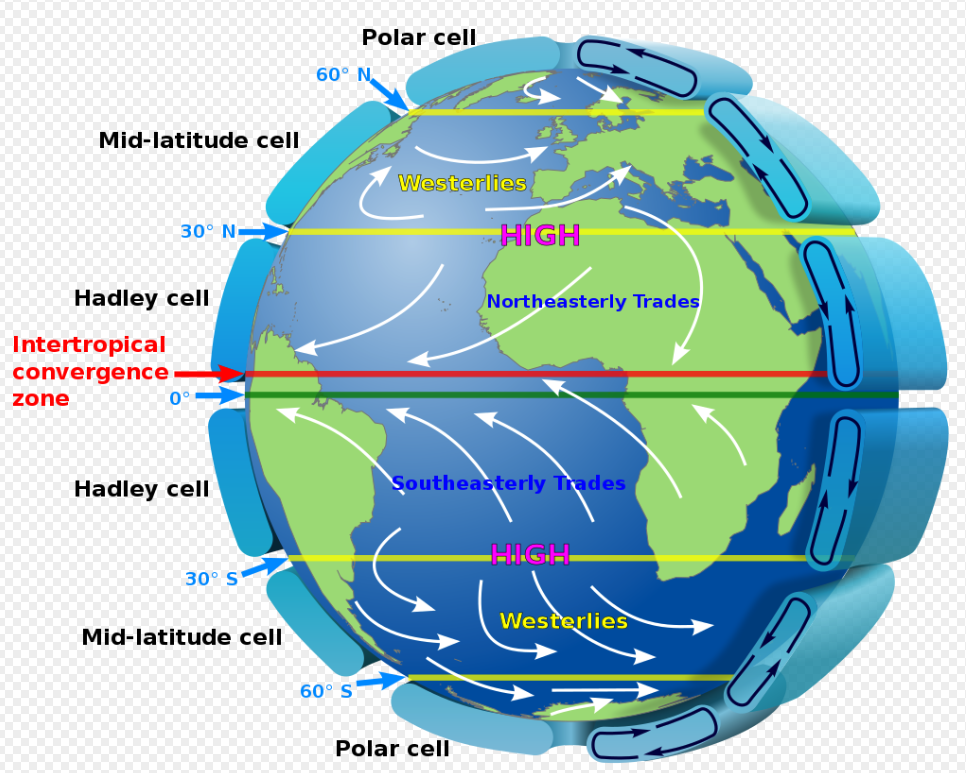Screen Shot 2022-10-04 at 11.03.12 AM.png
- Ocean currents follow the winds, clockwise in N hemisphere
- Cells converge at rainy spots, diverge at deserts
- Why? Clouds lift at convection spots, cooling them = rain
- Dry air dropping from space = warm, dry air (deserts)
Layers: spheres bottom to top
- tropo: at the surface, where all weather happens, conduction to air from surface, convection to other layers, albedo is how much energy it reflects (albus=white)
- strato: higher, drier air, cooler, air travel is here, also ozone layer (stops UV)
- meso: middle
- thermo: hot, charged particles, also ionosphere, bounces radio waves
- exo: outer
- magneto; even further, deflects solar wind, protects surface (none on Mars)
\-----------------
Air stuff:
- compress air and it heats (bicycle pump)
- uncompress air (e.g. altitude) it cools (spray can too)
- warmer air holds more water (more energy to keep molecules in gas phase)
- cooler air holds less water
- humidity measures how much water in how much air
- relative humidity: compared to how much it can hold at that temp
- absolute humidity: total amount of water
- dew point: temp where water condenses
- rising air condenses (rain) “adiabatic cooling” rain carries the heat away
- falling air heats (e.g deserts) “adiabatic heating” absorbs energy from the surroundings
- rain shadows=dry areas after mountains
- moon shadow=a cool song by Cat Stevens
- saturated 100% RH air is fog, then rain or snow
Cells:
ITCZ: at the equator, inter-tropical-convergence-zone
Hadley cell: equator to 30°N or 30°S
Ferrel cell: 30-60°
Polar cell: 60-90°
- since earth is spinning, as air flows south, it also falls a bit west=tradewinds
- if air flows north, it also flows a bit east=westerlies (weather describes wind from source direction)
- this change of direction creates the coriolis effect
- Hurricanes are low pressure systems, rising air creates a counter-clockwise flow (L on the weather maps)
- High pressure systems create clockwise flow (H on the weather map)
Oceans:
- winds carry surface water along, so N hemisphere has clockwise currents (cool water off CA coast)
- a special current from Greenland melt flows to Hawaii, called the thermo (heat) haline (salt) current.
- ENSO is a big deal: normally winds carry water off-shore of chile, bringing up food from the deep ocean (happy fisherpeeps).
- El Niño reverses this, so sad fisherpeeps
- La nada is no flow at all
##
---
Migrated from Apple Server Wiki. Original page ID: K8x1N5i3
# Chapter 3 outline: energy and matter
Chapter 3 Modules 6-8 Movement of energy and matter
Module 6: Movement of energyBiosphere-all life
Producer (also primary producer) gets energy from sun or heat directly, also known as autotrophexample: grass
Photosynthesis: CO2 + water + energy (heat or light) -> sugars (CHO)Reverse process is respiration: Sugars + O2 -> energy + CO2 + water
**Unavailable Apple Wiki media:** the exported data did not include file 05a89973-d852-48ba-9829-ff21a598671a.
Anaerobic respiration (e.g. bacteria) don't use O2, less efficient, older primitive source of energy (pre-oxygen)
Consumer (heterotroph) consumes other primary autotrophs
- Primary consumers eat plants (e.g. herbivores)
- Secondary consumers eat them (carnivores)
- Tertiary consumers eat other carnivores (algae->zooplankton->fish->eagles)
Trophe = "nourishment"Trophic levels = food levels, see also food web
- Scavenger-eats dead stuff
- Detritovore-eats dead stuff that is decaying
- Decomposers-break down into basic elements
GPP gross primary productivity= Total amount of solar energy into the system: like gross income in a businesse.g. all of the money coming into your business
NPP net primary productivity = GPP minus respiration (think of Maui onions):gross income-expenses=net income
Biomass-total mass of all living things in an ecosystem-odd fact: rain forest soil is the lowest in nutrients and biomass-why?
Standing crop-total plant biomass (e.g. forest)Efficiency is low (around 10%)
Trophic pyramid: 10x reduction in energy for each level (why?)-vegetarians vs. meat eatersSo, carnivores (us, wolves) are eating harvesting devices (cows) for autotrophs (grasses):
**Unavailable Apple Wiki media:** the exported data did not include file 9aa3d3ea-e5d7-4018-9604-5e587fa9c258.
Not very efficient, unless you can't digest grass, or it takes too much energy to walk around all day. This IS, however a good argument for global sustainable survival, as the sun will not go away soon, and as long as we have arable (farmable) land to grow plants, we could survive with a global population of 8-10 billion.But we'd need access to fresh water...Recall: energy->water->food->culture
**Unavailable Apple Wiki media:** the exported data did not include file 83426d04-4f93-4ad1-bb17-e1aa5769faa6.
Module 7: Movement of MatterBiogeochemical cycles: bio=life geo = minerals chemical = chemical cycle = something that rotates
Hydrologic (water) cycle:Heat provides energy for evaporation,
Plants secrete water as transpiration,
Condensation is collection of water vapor to drops,
Precipitation is the falling of these drops as rain, snow, hail etc.
ETO evapotranspiration: amount of water moving through an ecosystem, usually plants.Farmers need to know EtO to know how much water to supply to their crops.Eto depends on sunlight, humidity, wind and temperature (think of how these impact transpiration)
**Unavailable Apple Wiki media:** the exported data did not include file 126d4911-26b2-41e9-88c0-34fcb2aa09e7.
Runoff-just like it soundsYou will need to know about "transit time" which is the time it takes rain to reach a water body after hitting the groundWhy is this crucial?(you will see this mentioned in the Poisoned Waters video this weekend)
Carbon cycle: photosynthesis, respiration, exchange, sedimentation, burial, extraction, combustionair<->water<->land
photosynthesis-CO2 to sugar (air to plant structures or fruits-e.g. corn)
respiration-sugar to CO2
acidification or exchange-HCO3 (carbonic acid) e.g. seawater changing pH, remember?
sedimentation-CaCO3 (seashells, limestone) most efficient long term carbon sink (solids are dense)burial-just like it sounds, oil, coal, nat gasextraction-mining fossil fuelscombustion-burning fossil fuels with oxygen to release CO2
**Unavailable Apple Wiki media:** the exported data did not include file a28f9b78-8090-4962-8845-d223ecb1a94d.
Nitrogen cycle:6 macronutrients needed by plants: N,P,K, Ca, Mg, S (sulfur becomes part of Methionine, an amino acid)NPK from fertilizersN is a limiting nutrient
N fixation is when you can't get Nitrogen off your mind
Questions:
1. Define N, P, K and how each impacts plants
2. Define evapotranspiration, condensation and precipitation
3. Which biogeochemical cycle only has a solid phase in the environment?
4. What element replaces oxygen in chemosynthesis?
It also means bringing N2 gas from the atmosphere into the biome, biotically or abiotically (without life)
abiotic: lightning or burning fossil fuels (high temps) direct to nitrate (NO3) (that interesting smell after rainstorms)
biotic: nitrogen fixing bacteria: N2 ->NO2 ->NO3 ->NH3 ->NH4 ion (used by producers, it is aqueous)
commercial N fixation: petrochemicals to form fertilizers (NH3, anhydrous ammonia, ammonium nitrate NH4NO3, which is used in ANFO bombs)
nitrification: NH4+ ->NO2- ->NO3-nitrite kills bacteria (used in preserving meats), but nitrate is a good plant fertilizer (ANFO bombs, [Beirut harbor explosion](https://www.youtube.com/watch?v=LNDhIGR-83w))
assimilation: producing amino acids and then proteins (chains of AA)
Dead stuff: mineralization or ammonification (dead fish smell: NH4+ and amines)
Vitamins = "vital amines"
denitrification: NO3- goes to N2O to N2 gas (anaerobic bacteria, swamps)
Leaching: washing N out of soil
**Unavailable Apple Wiki media:** the exported data did not include file b5b0106e-e8cf-4fb1-b450-b4b1761ffb84.
Phosphorus cycle:Mainly rocks, between land and waterONLY SOLIDS, NO LIQUID OR GAS PHASE
biotic: animals uptake PO4--- (see also phosphoric acid H3PO4), turn it into bones, teeth as CaPO4, then back to soil
abiotic: phosphate sediments in ocean-> become rocks, erosion on land dissolves into watershed
Algal bloom: PO4 -> lots of algae on surface (light) -> these die, fall to the bottom, and as they decompose, they take all O2 from the water (hypoxia)Arsenic in bananas---why we cannot use greywater for irrigation
**Unavailable Apple Wiki media:** the exported data did not include file fcf124e5-49c2-4e12-8ebd-e2c8630e3094.
Ca, Mg and K: dust (Kauai dependent on Gobi desert dust for K)
Sulfur cycle:rocks -> SO4, can become part of methionineSee also SO2 (vog, acid rain, pollution)
**Unavailable Apple Wiki media:** the exported data did not include file b9ad679f-d851-403f-8f52-ab46e87f2fa0.
Here's something interesting:Find Sulfur below:
**Unavailable Apple Wiki media:** the exported data did not include file bfa775c1-5d37-4151-b3b2-510bd442faed.
Ok, now find Oxygen.Hydrothermal vents use sulfur instead of oxygen for a thermal (heat) version of photosynthesis called chemosynthesisModule 8: Response to disturbances
Recall negative feedback (stable ships, relationships): greater the disturbance, the greater the restoring force (pendulums too)
Resistance is how hard it is to move the pendulum (ecosystem) away from center
Resilience is how fast the pendulum (ecosystem) returns to normal
Biodiversity and disturbances:This is strange stuff:Rare disturbances = competition, so only a few species dominateCommon disturbances = only fast reproducers survive, so low biodiversityIntermediate disturbances = highest biodiversity
Watershed: drainage basin usually leading to a large body of water (Chesapeake watershed is huge):[https://www.cbf.org/about-the-bay/chesapeake-bay-watershed-geography-and-facts.html](https://www.cbf.org/about-the-bay/chesapeake-bay-watershed-geography-and-facts.html)
**Unavailable Apple Wiki media:** the exported data did not include file 3d0e8527-360f-4ec0-b479-da632541a44a.
Questions:
1. How do you think this impacts the water quality, phosphates, nitrates and silt in the Chesapeake bay?
2. Why are we not allowed above the fences behind Pu'u La'e La'e?
3. On Oahu, the watershed is guarded by a barbed wire fence-why?
4. How are the Himalayas acting as a watershed?
5. why is the soil on Kauai so poor, and how does it get its Potassium?
6. how does the size of the Cheseapeake watershed impact eutrophication in the Chesapeake bay?
7. what is the difference between resistance and resilience in natural systems?
8. why do rotting fish smell so bad?
Summary notes:Systems
- systems are usually connected, exchange matter and/or energy
- main energy source is our sun, or past suns (e.g. uranium)
- feedback loops (again)
- spheres: litho=stone, bio=living, hydro=water, atmo=above
- geosphere: crust-mantle-core-inner core (spins, no way!)
- plates-who thought this up? need to understand convection
- where are oldest parts of crust? trick question
- subduction zones, mid atlantic ridges (atlantis?)
- eq: deep near subduction zones, shallow in transform faults
- mid atlantic ridge: how do we know this? submarines
- himalayas-how? matterhorn-what?
- water cycle: evaporation and transpiration (eTO)
- precipitation-condensation is first (condensation nuclei, e.g. vog)
- aquifers-underground lakes, low turnover rate (pesticides) Oglalla
- water can be ground water: aquifer, water table, water lens or surface water
Cycles
- conservation of matter (neglect E=mc2)
- nutrient cycles: carbon, oxygen, phosphorus, nitrogen COPN
- primary producers-photosynthesis: CO2, water and light/heat
- create sugar as stored food, structural element
- consumers-eat primary producers, decomposers break down waste/detritus
- cellular respiration (flowers in hospitals) at night
- carbon also in HCO3- ion (seawater) and CaCO3 (seashells, limestone)
- greenhouse effect from CO2 captured as plants->oil/coal "carbon bank"
- phosphorus: rocks and water (stone and sea), erosion, very limited supply in biosphere (Waterloo bones)
- P only absorbed in aqueous form (aq)
- too much = eutrophication (also nitrogen) see dead zones
- eutrophication: too much of a good thing, when algae dies, decomposes, creates hypoxic zones
- aerobic vs. anaerobic bacteria-wounds
- nitrogen cycle-NPK
- N2 to life: lightning and bacteria (N2 to ammonia NH3 then to NO2 and NO3 (plants absorb NO3)
- denitrifying bacteria change NO2 back to N2 (gas)
- Haber process
- See figure 3.30-nitrogen uptake
- golf courses-Mauna Kea, iBoat
---
Migrated from Apple Server Wiki. Original page ID: 56W7\_50
# Semester 1 notes
Chapter 3 Modules 6-8 Movement of energy and matter
Module 6: Movement of energyBiosphere-all life
Producer (also primary producer) gets energy from sun or heat directly, also known as autotrophexample: grass
Photosynthesis: CO2 + water + energy (heat or light) -> sugars (CHO)Reverse process is respiration: Sugars + O2 -> energy + CO2 + water
**Unavailable Apple Wiki media:** the exported data did not include file 05a89973-d852-48ba-9829-ff21a598671a.
Anaerobic respiration (e.g. bacteria) don't use O2, less efficient, older primitive source of energy (pre-oxygen)
Consumer (heterotroph) consumes other primary autotrophs
- Primary consumers eat plants (e.g. herbivores)
- Secondary consumers eat them (carnivores)
- Tertiary consumers eat other carnivores (algae->zooplankton->fish->eagles)
Trophe = "nourishment"Trophic levels = food levels, see also food web
- Scavenger-eats dead stuff
- Detritovore-eats dead stuff that is decaying
- Decomposers-break down into basic elements
GPP gross primary productivity= Total amount of solar energy into the system: like gross income in a businesse.g. all of the money coming into your business
NPP net primary productivity = GPP minus respiration (think of Maui onions):gross income-expenses=net income
Biomass-total mass of all living things in an ecosystem-odd fact: rain forest soil is the lowest in nutrients and biomass-why?
Standing crop-total plant biomass (e.g. forest)Efficiency is low (around 10%)
Trophic pyramid: 10x reduction in energy for each level (why?)-vegetarians vs. meat eatersSo, carnivores (us, wolves) are eating harvesting devices (cows) for autotrophs (grasses):
**Unavailable Apple Wiki media:** the exported data did not include file 9aa3d3ea-e5d7-4018-9604-5e587fa9c258.
Not very efficient, unless you can't digest grass, or it takes too much energy to walk around all day. This IS, however a good argument for global sustainable survival, as the sun will not go away soon, and as long as we have arable (farmable) land to grow plants, we could survive with a global population of 8-10 billion.But we'd need access to fresh water...Recall: energy->water->food->culture
**Unavailable Apple Wiki media:** the exported data did not include file 83426d04-4f93-4ad1-bb17-e1aa5769faa6.
Module 7: Movement of MatterBiogeochemical cycles: bio=life geo = minerals chemical = chemical cycle = something that rotates
Hydrologic (water) cycle:Heat provides energy for evaporation,
Plants secrete water as transpiration,
Condensation is collection of water vapor to drops,
Precipitation is the falling of these drops as rain, snow, hail etc.
ETO evapotranspiration: amount of water moving through an ecosystem, usually plants.Farmers need to know EtO to know how much water to supply to their crops.Eto depends on sunlight, humidity, wind and temperature (think of how these impact transpiration)
**Unavailable Apple Wiki media:** the exported data did not include file 126d4911-26b2-41e9-88c0-34fcb2aa09e7.
Runoff-just like it soundsYou will need to know about "transit time" which is the time it takes rain to reach a water body after hitting the groundWhy is this crucial?(you will see this mentioned in the Poisoned Waters video this weekend)
Carbon cycle: photosynthesis, respiration, exchange, sedimentation, burial, extraction, combustionair<->water<->land
photosynthesis-CO2 to sugar (air to plant structures or fruits-e.g. corn)
respiration-sugar to CO2
acidification or exchange-HCO3 (carbonic acid) e.g. seawater changing pH, remember?
sedimentation-CaCO3 (seashells, limestone) most efficient long term carbon sink (solids are dense)burial-just like it sounds, oil, coal, nat gasextraction-mining fossil fuelscombustion-burning fossil fuels with oxygen to release CO2
**Unavailable Apple Wiki media:** the exported data did not include file a28f9b78-8090-4962-8845-d223ecb1a94d.
Nitrogen cycle:6 macronutrients needed by plants: N,P,K, Ca, Mg, S (sulfur becomes part of Methionine, an amino acid)NPK from fertilizersN is a limiting nutrient
N fixation is when you can't get Nitrogen off your mind
Questions:
1. Define N, P, K and how each impacts plants
2. Define evapotranspiration, condensation and precipitation
3. Which biogeochemical cycle only has a solid phase in the environment?
4. What element replaces oxygen in chemosynthesis?
It also means bringing N2 gas from the atmosphere into the biome, biotically or abiotically (without life)
abiotic: lightning or burning fossil fuels (high temps) direct to nitrate (NO3) (that interesting smell after rainstorms)
biotic: nitrogen fixing bacteria: N2 ->NO2 ->NO3 ->NH3 ->NH4 ion (used by producers, it is aqueous)
commercial N fixation: petrochemicals to form fertilizers (NH3, anhydrous ammonia, ammonium nitrate NH4NO3, which is used in ANFO bombs)
nitrification: NH4+ ->NO2- ->NO3-nitrite kills bacteria (used in preserving meats), but nitrate is a good plant fertilizer (ANFO bombs, [Beirut harbor explosion](https://www.youtube.com/watch?v=LNDhIGR-83w))
assimilation: producing amino acids and then proteins (chains of AA)
Dead stuff: mineralization or ammonification (dead fish smell: NH4+ and amines)
Vitamins = "vital amines"
denitrification: NO3- goes to N2O to N2 gas (anaerobic bacteria, swamps)
Leaching: washing N out of soil
**Unavailable Apple Wiki media:** the exported data did not include file b5b0106e-e8cf-4fb1-b450-b4b1761ffb84.
Phosphorus cycle:Mainly rocks, between land and waterONLY SOLIDS, NO LIQUID OR GAS PHASE
biotic: animals uptake PO4--- (see also phosphoric acid H3PO4), turn it into bones, teeth as CaPO4, then back to soil
abiotic: phosphate sediments in ocean-> become rocks, erosion on land dissolves into watershed
Algal bloom: PO4 -> lots of algae on surface (light) -> these die, fall to the bottom, and as they decompose, they take all O2 from the water (hypoxia)Arsenic in bananas---why we cannot use greywater for irrigation
**Unavailable Apple Wiki media:** the exported data did not include file fcf124e5-49c2-4e12-8ebd-e2c8630e3094.
Ca, Mg and K: dust (Kauai dependent on Gobi desert dust for K)
Sulfur cycle:rocks -> SO4, can become part of methionineSee also SO2 (vog, acid rain, pollution)
**Unavailable Apple Wiki media:** the exported data did not include file b9ad679f-d851-403f-8f52-ab46e87f2fa0.
Here's something interesting:Find Sulfur below:
**Unavailable Apple Wiki media:** the exported data did not include file bfa775c1-5d37-4151-b3b2-510bd442faed.
Ok, now find Oxygen.Hydrothermal vents use sulfur instead of oxygen for a thermal (heat) version of photosynthesis called chemosynthesisModule 8: Response to disturbances
Recall negative feedback (stable ships, relationships): greater the disturbance, the greater the restoring force (pendulums too)
Resistance is how hard it is to move the pendulum (ecosystem) away from center
Resilience is how fast the pendulum (ecosystem) returns to normal
Biodiversity and disturbances:This is strange stuff:Rare disturbances = competition, so only a few species dominateCommon disturbances = only fast reproducers survive, so low biodiversityIntermediate disturbances = highest biodiversity
Watershed: drainage basin usually leading to a large body of water (Chesapeake watershed is huge):[https://www.cbf.org/about-the-bay/chesapeake-bay-watershed-geography-and-facts.html](https://www.cbf.org/about-the-bay/chesapeake-bay-watershed-geography-and-facts.html)
**Unavailable Apple Wiki media:** the exported data did not include file 3d0e8527-360f-4ec0-b479-da632541a44a.
Questions:
1. How do you think this impacts the water quality, phosphates, nitrates and silt in the Chesapeake bay?
2. Why are we not allowed above the fences behind Pu'u La'e La'e?
3. On Oahu, the watershed is guarded by a barbed wire fence-why?
4. How are the Himalayas acting as a watershed?
5. why is the soil on Kauai so poor, and how does it get its Potassium?
6. how does the size of the Cheseapeake watershed impact eutrophication in the Chesapeake bay?
7. what is the difference between resistance and resilience in natural systems?
8. why do rotting fish smell so bad?
Summary notes:Systems
- systems are usually connected, exchange matter and/or energy
- main energy source is our sun, or past suns (e.g. uranium)
- feedback loops (again)
- spheres: litho=stone, bio=living, hydro=water, atmo=above
- geosphere: crust-mantle-core-inner core (spins, no way!)
- plates-who thought this up? need to understand convection
- where are oldest parts of crust? trick question
- subduction zones, mid atlantic ridges (atlantis?)
- eq: deep near subduction zones, shallow in transform faults
- mid atlantic ridge: how do we know this? submarines
- himalayas-how? matterhorn-what?
- water cycle: evaporation and transpiration (eTO)
- precipitation-condensation is first (condensation nuclei, e.g. vog)
- aquifers-underground lakes, low turnover rate (pesticides) Oglalla
- water can be ground water: aquifer, water table, water lens or surface water
Cycles
- conservation of matter (neglect E=mc2)
- nutrient cycles: carbon, oxygen, phosphorus, nitrogen COPN
- primary producers-photosynthesis: CO2, water and light/heat
- create sugar as stored food, structural element
- consumers-eat primary producers, decomposers break down waste/detritus
- cellular respiration (flowers in hospitals) at night
- carbon also in HCO3- ion (seawater) and CaCO3 (seashells, limestone)
- greenhouse effect from CO2 captured as plants->oil/coal "carbon bank"
- phosphorus: rocks and water (stone and sea), erosion, very limited supply in biosphere (Waterloo bones)
- P only absorbed in aqueous form (aq)
- too much = eutrophication (also nitrogen) see dead zones
- eutrophication: too much of a good thing, when algae dies, decomposes, creates hypoxic zones
- aerobic vs. anaerobic bacteria-wounds
- nitrogen cycle-NPK
- N2 to life: lightning and bacteria (N2 to ammonia NH3 then to NO2 and NO3 (plants absorb NO3)
- denitrifying bacteria change NO2 back to N2 (gas)
- Haber process
- See figure 3.30-nitrogen uptake
- golf courses-Mauna Kea, iBoat
by [admin](http://physics.hpa.edu/groups/apenvironmentalscience/search/?q=admin&fields=lastModifiedAuthor)
## [e2: Portland-sense of place](http://physics.hpa.edu/groups/apenvironmentalscience/weblog/ce634/e2_Portlandsense_of_place.html)
e2: Portland-sense of place
[http://physics.hpa.edu/physics/apenvsci/videos/e2\_videos/e2%20transport/5%20Portland-sense%20of%20place.m4v](http://physics.hpa.edu/physics/apenvsci/videos/e2_videos/e2%20transport/5%20Portland-sense%20of%20place.m4v)
1. Morgan Freeman or Brad Pitt?
2. What is urban sprawl and what technologies enable it?
3. Portland was one main shipyard producing “Liberty Ships” in WWII. What drove their economy after that?
4. Portland was on the path of suburban sprawl in the 1960's. What happened?
5. What does this have to do with “Food Deserts”?
6. 1973 was a pivotal year there, what happened, driven by which group?
7. What was the initial reason for the mandate, and what was the final result according to Charlie Hales?
8. Look up Charlie Hales, what was his job after this film (2009).
9. How many years before his tram project was the last urban streetcar project in the US?
10. Explain an urban growth boundary (UGB).
11. Accessibility vs. mobility is the choice they made, like in Switzerland, as well as other European cities. What do you see in the video that you might also see in Europe?
12. What things in the video do you recognize that show a bike friendly city?
13. Who is the first class passenger in Portland, and how does this compare to Los Angeles or other similar city?
14. What is a “sustainable urban lifestyle”?
15. Cities in Europe have vibrant city centers, and are great cities to walk around. How is this done in Portland?
16. Explain "trip behavior".
17. How much did property values increase in the Pearl district after the trolley went in? Why? (note the amount of glass in each trolley). [http://www.explorethepearl.com/](http://www.explorethepearl.com/)
18. Michael Powell of Powell’s books compares buses (“tire-d” transportation) with permanent tracked transportation-what are the differences according to him?
19. How did he sell this idea to the property owners there? Was he right?
20. For what reasons would an electric tram or trolley be greener than a fossil fuel car or even a standard bus?
21. Portland required that every building have street level shops, and limited parking-why?
22. Why would people want to live along a trolley line? Why is quiet key to this?
23. Where in Europe do they also have aerial trams, and do you notice a trend?
24. How does an aerial tram like at OHSU enable different growth trends?
25. If the annual growth rate there is 4%, what is the doubling time in years? (Remember the rule of 70)
26. This film was made in 2009, so what year will the population be doubled from then?
27. What would be different without the tram (parking, traffic, time in car, development)?
28. The young mom says “we did not want to spend all that time in the car”. What is she talking about?
29. Explain "lifestyle migrants".
30. What is "gentrification"? Where else have you seen this? (hint: look up the term "landed gentry") [https://en.wikipedia.org/wiki/Gentrification](https://en.wikipedia.org/wiki/Gentrification)
31. What does the man mean about a "burlap future”?
32. What is the difference between aspiration and acquisition?
33. How does the concept of choice resonate with values in this country? What do you think?
34. Bring this home: what would you do at HPA to make it more sustainable? What about Waimea? Hawaii in general? Your home?
by [admin](http://physics.hpa.edu/groups/apenvironmentalscience/search/?q=admin&fields=lastModifiedAuthor)
## [APES Sem 2 2021-2022](http://physics.hpa.edu/groups/apenvironmentalscience/weblog/0083e/APES_Sem_2_20212022.html)
APES Sem2Housekeeping items:
- Syllabus reminder: FIRST missed homework is dropped
- HW fixed at 20% (no effective change for you)
- Please bring iPads to class
Overview:
The biggest challenges your generation will face are sustainability, pollution/climate change and resource constraints
Recall: energy->water->food->culture
In semester one, we learned about the building blocks of these concepts.
In semester two, you will see them integrate more and more...
Consider:
Europeans -> The New World
Earth 2022 -> Mars
"go west young man"
Sustainability 2022: Semester two
1. Conservation/Land use
2. Energy
3. Pollution/climate change
Challenge:
How can you describe a round staircase to someone without using your hands?
How can you describe deep nature to someone who has never seen it?
National parks: positive, motivated by joy of the wilderness and nature
Sustainability/climate change: negative, based on fear
Tito: "the climate crisis is the biggest business opportunity in the history of mankind"
Land Use: Chapter 10, modules 29-30
Homework: Chapter 10 PQ and chapter questions
Three main points: Living together, thinking of forever...1. Tragedy of the Commons2. Conservation movement3. Urban Sprawl
email: GPS ranching-why is this closer to pre-contact buffalo herds?
Tragedy of the commons (old idea, new article) 1968 Garret Harding KNOW THIS...An old 1833 concept from farming villages, article updated in 1968 this to include rivers, streams, ocean, air...[https://en.wikipedia.org/wiki/Tragedy\_of\_the\_commons](https://en.wikipedia.org/wiki/Tragedy_of_the_commons)
Econ students may know this one:Externalized costs, externality: shedding financial responsibility for your impact the the wholee.g. Minamata: [https://en.wikipedia.org/wiki/Minamata\_disease](https://en.wikipedia.org/wiki/Minamata_disease)
Conservation movement: Important peepsRalph Waldo Emerson-"Nature" "behind nature, throughout nature, spirit is present" 1837[https://en.wikipedia.org/wiki/Ralph\_Waldo\_Emerson](https://en.wikipedia.org/wiki/Ralph_Waldo_Emerson)
Henry David Thoreau-Walden "truth in nature and wilderness over the deceits of urban civilization". 1845[https://en.wikipedia.org/wiki/Henry\_David\_Thoreau](https://en.wikipedia.org/wiki/Henry_David_Thoreau)
Ansel Adams: Photographer championed the National Parks: 1920-1980[http://physics.hpa.edu/physics/apenvsci/videos/ansel\_adams.mp4](http://physics.hpa.edu/physics/apenvsci/videos/ansel_adams.mp4)0:00-8:00
"More than any other artist of the century, he would help transform the meaning of "wilderness" in America and change what people thought and felt about their own land"
"it's a place that you step into, and you don't know what's going to happen, a place that can surprise you, it's a place where you are small, where being small is not a bad thing, where being small is actually a wonderful thing"-Carl Pope, Sierra Club
"...the world is beautiful, that humanity is part of this larger world, that the concerns of the moment are part but not separate from a larger system of forces that that connect us to all of creation"Jonathan Spaulding, Biographer
Question: How did his photographs change the awareness of the public? People usually care about what they know...
Aldo Leopold-environmental ethics, wildlife management, conservation, Sand County Almanac (Wisconsin) [https://en.wikipedia.org/wiki/Aldo\_Leopold](https://en.wikipedia.org/wiki/Aldo_Leopold)
John Muir-started the Sierra Club: "wilderness mirrors divinity, nourishes humanity and vivifies the spirit"[https://en.wikipedia.org/wiki/John\_Muir](https://en.wikipedia.org/wiki/John_Muir)
Rachel Carson-silent spring DDT (persistent pesticide, weakens bird egg shells), 1963:[https://en.wikipedia.org/wiki/Rachel\_Carson](https://en.wikipedia.org/wiki/Rachel_Carson)[https://en.wikipedia.org/wiki/Dichlorodiphenyltrichloroethane](https://en.wikipedia.org/wiki/Dichlorodiphenyltrichloroethane)
MSY: maximum sustainable yield: max renewable output without compromising futureSee: native peoples: "seventh son of seventh son"Also: "Sustainability = thinking about forever"See diagram in chapter, greatest growth is at 50% of carrying capacity (there's that word again!)
Protected lands:
Public lands: often victim of economic predation (e.g. Burma illegal logging)Other side: NRDC and others, purchase lands to protect them from predatory practices (e.g. Amazon basin)In the US: National Parks are one example of a national recognition of several things:1. Spiritual/psychological benefit to nature2. Preservation of resources for future generations3. Recreation4. Habitat preservation for species (can be land, ocean, islands, etc.)
See also Amboseli in Kenya, Serengeti in Tanzania (Tanganyika+Zanzibar), Kruger park in S. Africa (Afrikaans)Public LandsIn the US, we classify public lands as Rangelands-open range, enables some ranching with leases National forests-old growth and new growth, limited forestry National parks-national treasures, limits on visitors, infrastructure (e.g. Denali)National wildlife refuges-usually associated with an endangered species or transit/migration path (e.g. wolves)Wilderness areas-no development, often noise abatement as well (think of helicopters in Waipio or Haleakala)
We have several of these here in Hawaii:Kilauea Volcano (Madame Pele)Haleakala ("House of the sun")Honokohau ("City of Refuge")Pearl Harbor Pu'u Kohola (Whale Heiau)Papa hanau moku a kea-Northwest Hawai'ian Islands NWHI
Federal lands: owned by the people, but can be leased to individuals
Two ethics are in competition:Resource conservation ethic-maximum use based on greatest good for everyone, usually preservationMultiple use lands-designated lands for grazing, timber, minerals, leased to individuals or companies for profitLand Management in the US:BLM: Bureau of land managementGrazing, ranching, monitors rangeland health, erosion
USFS: Us Forest ServiceManges timber harvesting, where, how, what treesOld growth vs. new growth, replanting, clear cut?
FSC: Forest stewardship council:FSC certification: no clear cut, no damage to land, replanting, selective cutting, underbrush considerationsHUGE debate over underbrush, USFS believes in regular forest fires to deplete the amount of underbrush (as in nature)See also California and Australia wildfires: drought, no regular fires, buildup of underbrushSee Yellowstone fire of 1988-result of overgrowth of underbrush
Forests: clear cut vs. selective cutFSC wood-how different?[https://en.wikipedia.org/wiki/Forest\_Stewardship\_Council](https://en.wikipedia.org/wiki/Forest_Stewardship_Council)
Fire management: Yellowstone fire 1988[https://www.northcountrypublicradio.org/news/npr/94114095/series-overview-yellowstone-s-evolution](https://www.northcountrypublicradio.org/news/npr/94114095/series-overview-yellowstone-s-evolution)
USFS prefers many small fires, removing flammable underbrush
NPS: National park serviceManages parks for recreation, multiple use ethic, preservation of timber, minerals and "natural curiosities"Also significant native peoples monuments (see above)
FWS: Fish and wildlife serviceManages fishing and hunting on all public lands
Know these:BLM: Bureau of Land Management USFS: US Forest Service NPS: National Park Service FWS: Fish and Wildlife Service
NEPA: National Environmental Policy Act 1969 (why then?) mandates an EIS for all developmentEIS (environmental impact statements) are new standard for any projectESA endangered species act-often brought in where development could impact ES
Solution: Urban Growth Boundary (UGB) ex. Portland, OR
UGB (Urban Growth Boundary)-see PortlandPrevents Urban Sprawl (richer folks move to the suburbs, commute, need parking, city dies from the inside, food deserts, etc.)Portland Example of urban planning:Tom McCall Governor of Oregon, 1967-1975
Charlie Hales Mayor of Portland 2013-2017
Videos:[e2: Portland sense of place](http://physics.hpa.edu/physics/apenvsci/videos/e2_videos/e2%20transport/5%20Portland-sense%20of%20place.m4v)
[e2: The green apple](http://physics.hpa.edu/physics/apenvsci/videos/e2_videos/e2%20design%201/1%20green%20apple.mov)
Frog book: Chapter 10: land use, urbanization, sustainable cities
5 steps to a 5 review:

[e2: Portland sense of place](http://physics.hpa.edu/physics/apenvsci/videos/e2_videos/e2%20transport/5%20Portland-sense%20of%20place.m4v)
[e2: The green apple](http://physics.hpa.edu/physics/apenvsci/videos/e2_videos/e2%20design%201/1%20green%20apple.mov)
Three main points: Living together, thinking of forever...1. Tragedy of the Commons2. Conservation movement3. Urban Sprawl
email: GPS ranching-why is this closer to pre-contact buffalo herds?
Tragedy of the commons (old idea, new article) 1968 Garret Harding KNOW THIS...An old 1833 concept from farming villages, article updated in 1968 this to include rivers, streams, ocean, air...[https://en.wikipedia.org/wiki/Tragedy\_of\_the\_commons](https://en.wikipedia.org/wiki/Tragedy_of_the_commons)
Econ students may know this one:Externalized costs, externality: shedding financial responsibility for your impact the the wholee.g. Minamata: [https://en.wikipedia.org/wiki/Minamata\_disease](https://en.wikipedia.org/wiki/Minamata_disease)
Conservation movement: Important peepsRalph Waldo Emerson-"Nature" "behind nature, throughout nature, spirit is present" 1837[https://en.wikipedia.org/wiki/Ralph\_Waldo\_Emerson](https://en.wikipedia.org/wiki/Ralph_Waldo_Emerson)
Henry David Thoreau-Walden "truth in nature and wilderness over the deceits of urban civilization". 1845[https://en.wikipedia.org/wiki/Henry\_David\_Thoreau](https://en.wikipedia.org/wiki/Henry_David_Thoreau)
Ansel Adams: Photographer championed the National Parks: 1920-1980[http://physics.hpa.edu/physics/apenvsci/videos/ansel\_adams.mp4](http://physics.hpa.edu/physics/apenvsci/videos/ansel_adams.mp4)0:00-8:00
"More than any other artist of the century, he would help transform the meaning of "wilderness" in America and change what people thought and felt about their own land"
"it's a place that you step into, and you don't know what's going to happen, a place that can surprise you, it's a place where you are small, where being small is not a bad thing, where being small is actually a wonderful thing"-Carl Pope, Sierra Club
"...the world is beautiful, that humanity is part of this larger world, that the concerns of the moment are part but not separate from a larger system of forces that that connect us to all of creation"Jonathan Spaulding, BiographerQuestion: How did his photographs change the awareness of the public? People usually care about what they know...-----Land use:MSY: maximum sustainable yield: max renewable output without compromising futureSee: native peoples: "seventh son of seventh son"Also: "Sustainability = thinking about forever"
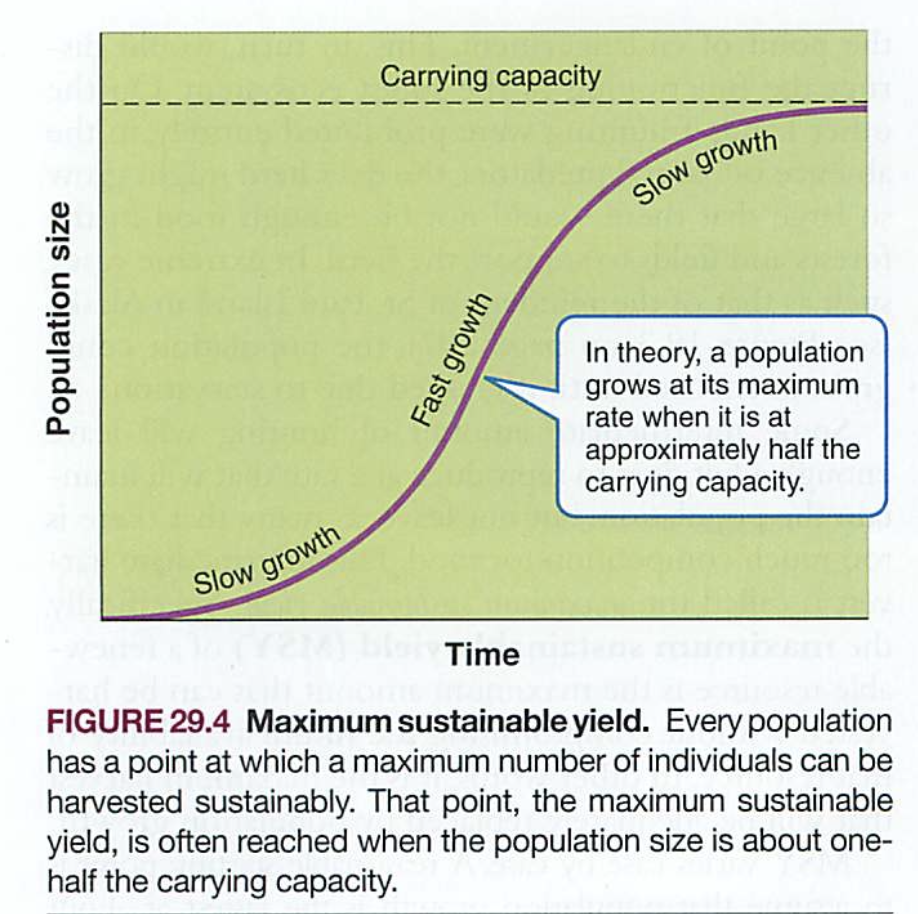
Public lands: often victim of economic predation (e.g. Burma illegal logging)Other side: NRDC and others, purchase lands to protect them from predatory practices (e.g. Amazon basin)In the US: National Parks are one example of a national recognition of several things:1. Spiritual/psychological benefit to nature2. Preservation of resources for future generations3. Recreation4. Habitat preservation for species (can be land, ocean, islands, etc.)
See also Amboseli in Kenya, Serengeti in Tanzania (Tanganyika+Zanzibar), Kruger park in S. Africa (Afrikaans)Public LandsIn the US, we classify public lands as Rangelands-open range, enables some ranching with leases National forests-old growth and new growth, limited forestry National parks-national treasures, limits on visitors, infrastructure (e.g. Denali)National wildlife refuges-usually associated with an endangered species or transit/migration path (e.g. wolves)Wilderness areas-no development, often noise abatement as well (think of helicopters in Waipio or Haleakala)
We have several of these here in Hawaii:Kilauea Volcano (Madame Pele)Haleakala ("House of the sun")Honokohau ("City of Refuge")Pearl Harbor Pu'u Kohola (Whale Heiau)Papa hanau moku a kea-Northwest Hawai'ian Islands NWHI

Two ethics are in competition:Resource conservation ethic-maximum use based on greatest good for everyone, usually preservationMultiple use lands-designated lands for grazing, timber, minerals
Changes:
Let's check out these guys again:English folks might recall Emerson, Thoreau and WhitmanConservation movement: Important peepsRalph Waldo Emerson-"Nature" "behind nature, throughout nature, spirit is present"[https://en.wikipedia.org/wiki/Ralph\_Waldo\_Emerson](https://en.wikipedia.org/wiki/Ralph_Waldo_Emerson)
Henry David Thoreau-Walden "Truth in nature and wilderness over the deceits of urban civilization"[https://en.wikipedia.org/wiki/Henry\_David\_Thoreau](https://en.wikipedia.org/wiki/Henry_David_Thoreau)
Teddy Roosevelt- ca. 1900, National Parks[https://en.wikipedia.org/wiki/Theodore\_Roosevelt](https://en.wikipedia.org/wiki/Theodore_Roosevelt)
[http://physics.hpa.edu/physics/apenvsci/videos/national%20parks/](http://physics.hpa.edu/physics/apenvsci/videos/national%20parks/)
First two minutes, start again at 7:00-10:00Note influence of railroads in parks as well as all lands in the west (Leland Stanford, for example)"Americans think 100 years is a long time, and Europeans think 100 miles is a long distance..."
Aldo Leopold-environmental ethics, wildlife management, conservation, Sand County Almanac (Wisconsin) [https://en.wikipedia.org/wiki/Aldo\_Leopold](https://en.wikipedia.org/wiki/Aldo_Leopold)
John Muir-started the Sierra Club: "wilderness mirrors divinity, nourishes humanity and vivifies the spirit"[https://en.wikipedia.org/wiki/John\_Muir](https://en.wikipedia.org/wiki/John_Muir)
Rachel Carson-silent spring DDT (persistent pesticide, weakens bird egg shells), 1963:[https://en.wikipedia.org/wiki/Rachel\_Carson](https://en.wikipedia.org/wiki/Rachel_Carson)[https://en.wikipedia.org/wiki/Dichlorodiphenyltrichloroethane](https://en.wikipedia.org/wiki/Dichlorodiphenyltrichloroethane)
Land Management in the US:BLM: Bureau of land managementGrazing, ranching, monitors rangeland health, erosion
USFS: Us Forest ServiceManges timber harvesting, where, how, what treesOld growth vs. new growth, replanting, clear cut?
FSC: Forest stewardship council:FSC certification: no clear cut, no damage to land, replanting, selective cutting, underbrush considerationsHUGE debate over underbrush, USFS believes in regular forest fires to deplete the amount of underbrush (as in nature)See also California and Australia wildfires: drought, no regular fires, buildup of underbrushSee Yellowstone fire of 1988-result of overgrowth of underbrush
Forests: clear cut vs. selective cutFSC wood-how different?[https://en.wikipedia.org/wiki/Forest\_Stewardship\_Council](https://en.wikipedia.org/wiki/Forest_Stewardship_Council)
Fire management: Yellowstone fire 1988[https://www.northcountrypublicradio.org/news/npr/94114095/series-overview-yellowstone-s-evolution](https://www.northcountrypublicradio.org/news/npr/94114095/series-overview-yellowstone-s-evolution)
USFS prefers many small fires, removing flammable underbrush
NPS: National park serviceManages parks for recreation, multiple use ethic, preservation of timber, minerals and "natural curiosities"Also significant native peoples monuments (see above)
FWS: Fish and wildlife serviceManages fishing and hunting on all public lands
Know these:BLM: Bureau of Land Management USFS: US Forest Service NPS: National Park Service FWS: Fish and Wildlife Service
NEPA: National Environmental Policy Act 1969 (why then?) mandates an EIS for all developmentEIS (environmental impact statements) are new standard for any projectESA endangered species act-often brought in where development could impact ES
Urban sprawl:
UGB (Urban Growth Boundary)-see PortlandPrevents Urban Sprawl (richer folks move to the suburbs, commute, need parking, city dies from the inside, food deserts, etc.)Portland Example of urban planning:Tom McCall Governor of Oregon, 1967-1975
Charlie Hales Mayor of Portland 2013-2017E2 video: Portland: Sense of Place....listen for Brad Pitt:[http://physics.hpa.edu/physics/apenvsci/videos/e2\_videos/e2%20transport/5%20Portland-sense%20of%20place.m4v](http://physics.hpa.edu/physics/apenvsci/videos/e2_videos/e2%20transport/5%20Portland-sense%20of%20place.m4v)
weblog withgott 6.6
[http://physics.hpa.edu/groups/apenvironmentalscience/weblog/19b82/Withgott\_66\_Sustainable\_Development.html](http://physics.hpa.edu/groups/apenvironmentalscience/weblog/19b82/Withgott_66_Sustainable_Development.html)
[0 comments](http://physics.hpa.edu/groups/apenvironmentalscience/weblog/2ca78/Land_Use_Modules_2930.html#comments)
November 29, 2021
by [admin](http://physics.hpa.edu/groups/apenvironmentalscience/search/?q=admin&fields=lastModifiedAuthor)
[e2: Food miles](http://physics.hpa.edu/physics/apenvsci/videos/e2_videos/e2%20transport/3%20Food%20miles.m4v)
e2: Food miles
1. Look up Michael Pollan: what books has he written?
2. What is the fossil fuel to food ratio he cites?
3. Why is this so high?
4. What did it used to be?
5. What does he mean by “sustainable agriculture”?
6. Why did WWII give us a new form of agriculture?
7. Look this up: in 1895, what portion of our workforce in our country was farmers? What is it today?
8. Look up Lancaster PA, and who lives there?
9. Local farmers may not be able to sell to Foodland and other grocery stores because of guarantees of supply. Where can the farmers then sell their produce, and what does this imply?
10. When you go into Foodland and see the sandwiches and other wrapped foods, where were these prepared? Why? Why is this so nasty?
11. Starbucks baked goods used to be baked here in Waimea (Mamane Bakery, behind the Montessori school). They are now baked on the mainland and shipped here frozen. Why does this make sense for Starbucks, and what impact does this have on you?
12. McDonalds gets their food products from the mainland in huge truck and air shipments. Why do they do this?
13. In the video, why is a restaurant that buys local food better than the examples above?
14. Do you know of a restaurant here in Waimea that does this? What about our cafeteria?
15. Why would Amish farmers be more sustainable farmers than other modern farmers?
16. How many miles does the average food item travel in the video? Add 2500 miles for us, what is the new total?
17. Why would they fly salmon to China and back?
18. Local farmers can supply “food baskets” also known as a “CSA”. What are these and why are they more sustainable? [https://en.wikipedia.org/wiki/Community-supported\_agriculture](https://en.wikipedia.org/wiki/Community-supported_agriculture)
19. Is “eating local” always a good thing? What are these folks known as?
20. What is the difference between a solar and a fossil fuel food supply?
21. What percentage of our income do we spend on our food? Is this the same in Hawaii? In Waimea? Why?
22. Where does most of the cost of food go?
23. Why do you think folks do not cook the way Pollan suggests?
24. Contrast the amount of each dollar going to a farmer in the past and now. How does localization change this?
25. Ok, now think of your home. What could you do differently?
by [admin](http://physics.hpa.edu/groups/apenvironmentalscience/search/?q=admin&fields=lastModifiedAuthor)
## [Food: Modules 31-33](http://physics.hpa.edu/groups/apenvironmentalscience/weblog/71a3f/Food_Modules_3133.html)
Weekend: Unit 4 ZipgradeNext week: review week, finals (using zipgrade forms)Modules 29 and 30 on land in January Recall our main themes: energy->water->food->cultureFood!Three main groups: Proteins: always include NitrogenCarbohydrates: CHO in chains (starches) or simple (sugars)Fats: CHO again, but in a special branch structure (glycol backbone) that is good for energy storage and insulation (e.g. killer whales, eskimos)
Proteins: complex molecules of CHO and N. Look up amino acids, note the common structure.Now look up the amino acid methionine. What element does it contain as well? Why do rotten eggs, swamps (and Kilauea volcano) stink?
CHO=carbohydrates (clever name), usually in a chain, short chains are sugars (used for fuel), longer ones are starches and can be used for structures (e.g. cellulose in plants) or pasta...smallest: sugars, all end in -ose (glucose, sucrose) LOOK THESE UP, CHECK OUT THEIR MOLECULE SHAPEglucose is a "monosaccharide" created by photosynthesis (next chapter)longer chains: starches (rice, pasta) slowly digested (see diabetics, and glycemic index)structural CHO: cellulose-little boxes with goo inside, need enzymes to break these down (cows)ENZYMES ALL END IN -ASE
Fats/lipids: same chemical structure as CHO, but built along a glycol (alcohol) backbone. If the fats have long carbon chains with only single bonds, they are saturated (lots of Hydrogen atoms) and can hold together (e.g. animal fat)[https://en.wikipedia.org/wiki/Saturated\_fat](https://en.wikipedia.org/wiki/Saturated_fat)
If the long chains have double bonds and don't fit together, they melt easier (e.g. oils) and are called "unsaturated", usually better for your health.n.b. McDonalds® got into real hot water a while ago for frying all of their stuff in "supersaturated fats". Ugh...
Notes: Chapter 11 FR Overview:
- Frog 12.3 Agriculture
- Frog 12.4 Food Production
- Ch. 12 assessment
- FR ch. 11 feeding the world
- mod 31 nutritional needs
- mod 32 industrial ag-insecticides, GMO
- mod 33 sustainable farming
Big picture:
- Trophic pyramids in nature are sustainable
- Planet is nearing carrying capacity (K)
- Think of how many "earths" your global footprint represents
- To meet this food demand, current farming and fishing is industrial, not sustainable
Mod 31: Nutritional needs-what humans on our planet need, and what they lackRead the case study p. 373-how is this like a trophic pyramid in nature?Undernutrition: lack of caloriesMalnutrition: lack of critical part of diet, usually protein (Kwashiorkor)[https://en.wikipedia.org/wiki/Kwashiorkor](https://en.wikipedia.org/wiki/Kwashiorkor)
Food security: not just in lesser developed countries ("LDC"), also in the US"Food deserts"-what are these?Famine: one of these impacting a large group, often from crop failure, drought or war/displacementOvernutrition: common in the US, look up the US obesity rate-how is this determined? Why? Seen any food ads lately?Look up US obesity rate-----Meat diet: high in protein, also in fat (energy store) and cholesterol-these contribute to heart diseaseWait-Eskimos eat lots of blubber, why don't they have heart disease? How is this different from Kalahari bush tribes?ClimateWait, wait-what happened to Japanese health care system when they moved from their traditional diet?What impact does this have globally?Diet for a small planet 1971: planet can sustain population using fewer calories while supplying protein, vitamins and calories. Not by relying on meat.Vitamins="vital amines"Food energy subsidy (cost factor):20 kg of grain to produce 1 kg of beef (20:1 factor, or subsidy factor 20x)2.8 kg of grain to produce 1 kg of chicken (2.8:1 factor, or subsidy factor of 2.8)Better to eat beef, chicken, fish or tofu? (you need protein in some form)
Food miles:Average 1240 miles from farm to table (more here, unless you shop at the farmer's market)[e2: Food miles](http://physics.hpa.edu/physics/apenvsci/videos/e2_videos/e2%20transport/3%20Food%20miles.m4v)
Mod 32: Industrial Farming (and fishing)Agribusiness: just what it sounds like, the larger conglomerates taking over instead of smaller privately owned family farms. Often use monoculture crops to increase profits (economy of scale), as well as patented seeds and herbicides (e.g. "roundup ready corn")
Hybrid crops vs. GMO crops:Started as a good thing: Hybrid crops"Selective breeding" works for animals (dogs, etc.) and crops called "hybrid crops" created by mixing pollen from one breed of plant (e.g. large kernel corn) with another breed of the same plant (e.g. short stalk corn) to form a "hybrid".
Green Revolution, Norman Borlaug-Mexican famine averted by development of hybrid (not GMO) wheat, called dwarf wheat (large kernel, short stalk).[dwarf wheat](https://en.wikipedia.org/wiki/Wheat)
GMO crops:in the beginning were just to withstand frost, now into a larger patent issue with GMO seeds and "round up ready crops"What is the impact on lesser developed countries of this business model?
[Genetically modified organisms (GMO)](https://en.wikipedia.org/wiki/Genetically_modified_organism) are different: they are done by splicing one part of a gene from an organism (like a frost resistant bacteria) into a totally different species (like a tomato) to make it frost resistant."IP" means intellectual propertyMonsanto spends money creating GMOs, so they patent the process, meaning using their seeds requires an IP license from them (just like software).If your farm has these seeds, intentionally or by accident, you have to pay them.You also cannot "re-use" seeds in the next season without paying for them.This is just like software in that you could buy the software or pay a monthly fee to use it.Which makes more money for the company?What is the impact on poorer countries?Roundup ready corn: seeds genetically modified to resist roundup (a herbicide)Result: plant their seeds, spray their herbicide and save money on weeding, more crops, more money (to whom?Issue: exposure to roundup (a carcinogen) and possible impacts of mutated foodLabeling? Where is this done so far?[GMO from Food inc.](http://physics.hpa.edu/physics/apenvsci/videos/food_inc/food%20inc-GMO.m4v)
High Fructose Corn Syrup: HFCSCorn Lobby is very powerful (Iowa=presidential primaries)Corn: HFCS (food, meat, fish) and Corn Ethanol (energy, fuel)HFCS is in everythingCorn is used to feed cattle, pork, poultry, even fishCattle are not used to metabolizing corn, it makes them sickBad for humans, increases incidence of diabetes[HFCS from Food inc.](http://physics.hpa.edu/physics/apenvsci/videos/food_inc/food%20inc-corn.m4v)
Main problems:
- Irrigation-desertification
- Pesticides-persistent organic pollutants (POPs)-like in your water hunt
- Fertilizers-eutrophication
Waterlogging: too much water in the soil, roots die (see hydroponics demo at elab, cycles water and air)Salinization/desertification: using well water for irrigation, salts build up in the soil, infertile soil resultsSoil degradation:[Dirt 00-8:00](http://physics.hpa.edu/physics/apenvsci/videos/dirt/dirt_0-8.m4v)Look up Wangari Maathai
Pesticides and herbicides: can be persistent or not (DDT, round up)Invented during WWII to kill humans (nerve gases, nazis), ("homicides")Modified to kill pests ("pesticides") or insects ("insecticides")Special cases include rodent poisons ("rodenticides") and others, like plants ("herbicides")
Pesticide resistance-much like COVID: genetic variation in a rapidly multiplying pathogen will eventually overcome the stress (recall evolution) by replicating only those with immunity to the stress (vaccine, pesticide, drug resistant TB)
Here's one pesticide that changed malaria around the world: DDT:[https://en.wikipedia.org/wiki/Dichlorodiphenyltrichloroethane](https://en.wikipedia.org/wiki/Dichlorodiphenyltrichloroethane)
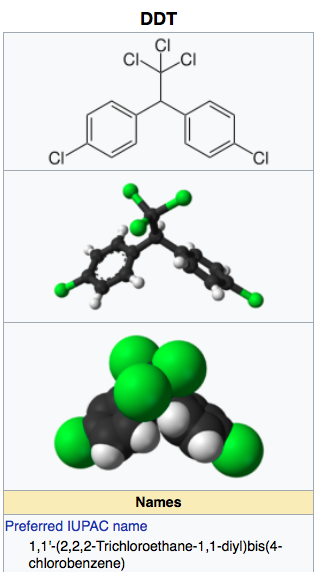
Inorganic fertilizers: also something from war (Haber process, WWI)Haber process enabled nitrogen from the air to be chemically grouped with other compounds like Ammonium nitrate: NH4NO3This process uses huge amounts of petrochemicals, so these fertilizers are attached to the cost of oil (not coal)Ammonium nitrate and fuel oil (diesel) can also be combined to make explosives, look up [ANFO bombs](https://en.wikipedia.org/wiki/ANFO) and terrorism.
Fishing:Aquaculture means fish or other water animal farmed in the oceanHydroponics means growing plants in a water/air mediumFisheries: population of fish, look up [Atlantic Cod](https://en.wikipedia.org/wiki/Atlantic_cod) fisheries collapse in 1990Bycatch: unnecessary death of animals caught in fishing nets/traps (dolphins, sharks, etc.)
Mod 33: Sustainable agriculture (fishing too)Desertification (see above)intercropping vs. monocropping, see ["the three sisters"](https://en.wikipedia.org/wiki/Three_Sisters_(agriculture))Contour cropping: saves space, reduces runoff, preserves top soil (e.g. our garden, most of Asia)No-till ag: same idea, retains organic material in topsoil, reduces erosion by wind and waterIPM: integrated pest management (see Lalamilo Farmers)Organic agriculture (also mentioned in [Portlandia and Colin the Chicken](https://www.youtube.com/watch?v=G__PVLB8Nm4))More than just N-P-K, also micronutrients, slower release time, low salinityCAFO: concentrated animal feed operation (e.g. chickens, pigs, cattle)Usually inorganic feed (purines), hormones and other drugs
Methyl xanthines: caffeine, theobromine, theophyllineevolved plant poisons for insects:
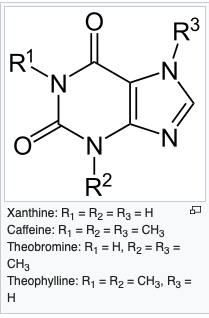
- Xanthine: group name
- Caffeine: energy drinks, coffee, soft drinks (to offset drowsiness from insulin spike)
- Theobromine: chocolate
- Theophylline: tea (also a bronchodilator-helps breathing)
Actually, almost anything that ends in -ine is usually a plant poison evolved to kill insects:
- nicotine: tobacco
- caffeine: coffee, tea
- cocaine: coca plants
[0 comments](http://physics.hpa.edu/groups/apenvironmentalscience/weblog/71a3f/Food_Modules_3133.html#comments)
November 19, 2021
by [admin](http://physics.hpa.edu/groups/apenvironmentalscience/search/?q=admin&fields=lastModifiedAuthor)
## [Poisoned Waters, part Deux](http://physics.hpa.edu/groups/apenvironmentalscience/weblog/6c360/Poisoned_Waters_part_Deux.html)
Poisoned Waters-Frontline Video
Video is here:
[http://physics.hpa.edu/physics/apenvsci/videos/poisoned\_waters/POISONED\_WATERS.mp4](http://physics.hpa.edu/physics/apenvsci/videos/poisoned_waters/POISONED_WATERS.mp4)
High quality version is here:
[http://physics.hpa.edu/physics/apenvsci/videos/poisoned\_waters/poisoned\_waters.m4v](http://physics.hpa.edu/physics/apenvsci/videos/poisoned_waters/poisoned_waters.m4v)
You may find it helpful to download this into your own computer: hold the option key while clicking on the link.
Context:
- Water Pollution-air pollution-climate change
- Watersheds, transit time
- water pollution:continuity, local until ocean,
Segments:
Segment 1: Chesapeake bay: 00-45:00
> - Chesapeake watershed
> - EPA CWA 1970
> - Perdue/hog Ag farms, Eutrophication
Segment 2: Potomac River: 45:00-54:00
> - Endocrine disrupters-drinking water
Segment 3: Puget Sound: 54:00-1:33:00
> - Bioaccumulation-PCB Killer Whales
> - Boeing-PCBs from runways
> - Runoff-water transit time King County
Segment 4: FairFax County, VA: 1:33:00-1:54:00
> - Tyson’s corner-transit time, sediment runoff
> - Loudon county-traffic planning
> - Arlington-urban planning
Questions:Chesapeake Bay
1. Why is it useful to get the historical view of the craggy old fishermen?
2. How are the fish an indicator species?
3. How large is the Chesapeake watershed?
4. Why is this bay uniquely vulnerable?
5. What causes dead zones in the film?
6. What is the global trend in dead zones? where?
7. What three basic functions of the bay will likely be lost to your generation?
8. What was different 40 years ago?
9. What was the cause and effect process of Earth Day and the EPA?
10. Did Nixon back the clean water act? Explain.
11. What were the key tenets of the CWA?
12. What were the initial actions of the EPA?
13. RFK jr. says he could not swim in the Hudson, Charles or Potomac. Where are these?
14. Why did you have to take a shower if you fell into these rivers?
15. What was the Potomac point source pollution source described in the film?
16. What is BNR and how does it work?
17. What is not removed from human wastewater with BNR that concerns us?
18. How did Reagan’s policies impact the EPA and pollution regulation?
19. What is “voluntary compliance” and did it work? explain.
Factory farms
1. What is the biggest danger with concentrated animal farms/ CAFOs (poultry, pigs, cows)?
2. Look up why we have different names for the same animals: cow/beef,chicken/poultry, pig/pork
3. Why is it advantageous for Perdue to subcontract chicken operations?
4. What is vertical integration?
5. What was the national response to cheap chicken?
6. If you were to put chicken manure on your garden, you could burn your plants. why?
7. On the way downhill to the coast, there is an egg factory that went out of business, who now sells “manure compost”. Where did this come from, and how is it a good deal for them?
8. Why does not Perdue own the chicken waste, if they own the chickens? How does the Perdue guy dodge the problem?
9. What is the difference between city waste and ag waste?
10. What does the chicken guy say about deer?
11. What did the chicken lobby in Maryland (Eastern shore) do about pollution regulation? why?
12. How is this similar to the Iowa corn ethanol lobby?
13. RFK Jr. describes two things: externalized costs and subsidies. What does he mean by these?
Endocrine disrupters
1. Why are not endocrine disrupters part of the clean water act?
2. What is intersex in the male bass? what causes this?
3. How does the concept of river continuity impact endocrine disrupters?
4. Do they need to be very concentrated to be effective?
5. A person flushes birth control pills (hormones) or other drugs down the drain. How can this impact someone living many miles downstream?
6. Why are these hormones not filtered by water treatment plants?
7. What is “synergism”? Why is it critical here?
Puget Sound
1. How cold is the water in Puget Sound? Why is this relevant?
2. Why do the apex predators have the highest concentration of PCB?
3. What is a sentinel species? why is this relevant?
4. Which population of humans is now showing similar health effects?
5. What is Superfund, who funds it?
6. What is the biggest liability problem with the Boeing dioxin situation?
7. What is the concept of “deep pockets”?
8. Why would native Americans be the indicator species in the Duomish river?
9. Is South Park (not the tv show) upper income or lower, immigrant or not? Why is this important?
10. On the AP exam, you will be expected to know all about Love Canal. How is this similar?
11. What do you think is coming out of the pipe underwater in the video?
12. Why are “impervious surfaces” so bad for the Puget Sound?
13. Why do folks get upset about oceanic oil spills and not the stuff you see in the video?
14. What is the difference in "transit time" for rain water hitting concrete vs. soil?
15. Ron Sims has enemies in King county. Who?
16. How is the Growth Management Act/Critical Areas Ordinance (CAO) similar to the Urban Growth Boundaries (UGB) concept in Portland Oregon (we'll see this in the Portland e2 video)
17. Look up the CAO now. How is it going?
Fairfax
1. Look up Tyson’s corner. What did it look like in 1945?
2. Would Tyson’s corner have been successful without cars?
3. How is Tyson’s corner like Los Angeles?
4. How is Arlington different from Tyson’s corner?
5. In a sense, US cities are learning to become more like older European cities. Why are they different?
6. What is the meaning of the phrase “canary in the coal mine” and where did this term come from?
7. According to the narrator and Governor of Washington, what is a necessary part of the solution?
8. What is your part in this future?
Summary questions:
1. You have chosen the water treatment manager for a small town in Doofania that gets its water from a river, with Uglyopolis upstream and Ya-ya town downstream. What steps would you take to make sure you and the other towns are getting clean water, and describe impact of an upstream sewage plant in Uglyopolis and a nuclear power plant on the river in Ya-ya town.
2. From the Poisoned Waters Frontline video, choose one of the stories and explain why it is important to you, what it explained, and how it relates to your work.
by [admin](http://physics.hpa.edu/groups/apenvironmentalscience/search/?q=admin&fields=lastModifiedAuthor)
## [Modules 26-28 Water ch. 9](http://physics.hpa.edu/groups/apenvironmentalscience/weblog/e0b7f/Modules_2628_Water_ch_9.html)
Recall:
Energy->Water->Food->Culture(Also Chapter 12 in Froggie book)
Water: key points
> Section one: What is it, where is it:
> Freshwater, saltwater, how it moves, aquifers and reservoirs, impact of climate change, water wars
> Section two: Pollution:
> Often human driven (anthropogenic): Nutrient, thermal, BOD, sediment
> Almost always human driven: Pathogens, inorganic chemicals, organic chemicals, radioactive chemicals
> Section three: Water Quality index:
> DO, BOD, pH, temp, turbidity, conductivity, nitrates (NO3), phosphates (PO4)
Section one: What is it, where is it?Where is the water? Note: 97% salt water
Huge [Ogallala aquifer](https://en.wikipedia.org/wiki/Ogallala_Aquifer)-note recharge time is in centuries, pesticides in Nebraska, cancer rates there are very high...
Two emerging critical issues for China due to climate crisis:
- Pearl river delta and salt intrusion (sea level rise): gradual slope, so 1 meter of sea-level rise is many km of salt intrusion, so no more rice farming in that area
- Vanishing Himalayan Glaciers: no farming in western China, no annual flow through their two main rivers
[Glaciers](http://physics.hpa.edu/physics/apenvsci/videos/glaciers.mov)
Glaciers are the "water towers" for all of Asia...Rivers impacted:Ganges, Yangtze, Yellow, Mekong, Brahmaputra, Irrawaddy, Indu, Salween,
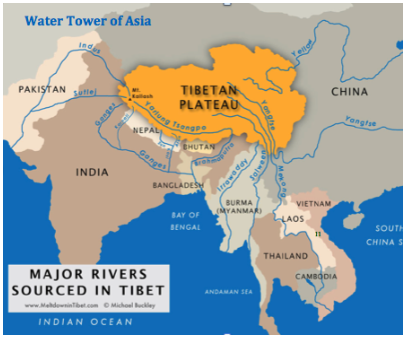
Section two: Water PollutionBig ideas:
1. Rivers are continuous, so easier to find sources along the route (continuity analysis: all sources add to total)
2. Groundwater is harder to determine point sources, as flow is over larger area (not confined by river banks) and there is no continuity analysis possible (we don't know sources and sinks)
3. Oceans are the hardest to trace, and impact everyone eventually, just like the atmosphere, only without the rain, and it is wetter. And full of fish.
Major Water Pollution categories:
Note that temperature changes DO (dissolved oxygen) content, so does physical agitation (aeration).Section three:Water Quality Index:[http://www.water-research.net/index.php/water-treatment/water-monitoring/monitoring-the-quality-of-surfacewaters](http://www.water-research.net/index.php/water-treatment/water-monitoring/monitoring-the-quality-of-surfacewaters)
[http://www.water-research.net/watrqualindex/index.htm](http://www.water-research.net/watrqualindex/index.htm)
[http://www.pathfinderscience.net/stream/cproto4.cfm](http://www.pathfinderscience.net/stream/cproto4.cfm)
Calculation worksheet:
[http://www.pathfinderscience.net/stream/forms/WQI\_worksheet.pdf](http://www.pathfinderscience.net/stream/forms/WQI_worksheet.pdf)
Main case studies-each related to a form of human pollution:Case 1: High turbidityCauses: erosion of topsoils, till farming, no cover crops, e.g. dustbowl in the USImpact: poor light transmission, so low photosynthesis, low DO
Case 2: Low Dissolved Oxygen (DO)Causes: Thermal pollution, e.g. power plants on rivers
Case 3: Eutrophication (high N and/or P)Causes: Fertilizers, animal waste, e.g. Mississippi dead zone, Chesapeake bay
Chesapeake bay is the perfect storm of these three: 1. Warm water: shallow, so no cool lower zone away from sunlight, dissolved solids turn visible light into heat2. High Turbidity: watershed runoff from rivers to the Appalachian range and north to NY state3. Eutrophication: chicken and pig farms, runoff from farms along watershed
See also point source and non-point source pollution (from Poisoned Waters video, remember the Deer?)
Important: cooler water holds dissolved oxygen better (fishermen know this, so do the fish).
Water Quality Lab:Tests: Probe sets
- Turbidity sensor: passes light through a small vial, measures light that passes, low light=high turbidity
- Conductivity: passes electric current through sample, proportional to salt content
- Temperature: warmer water has lower DO
- Dissolved Oxygen: amount of oxygen dissolved in the sample
- pH: acid/base tendency
Tests: dip strips:
- Alkalinity
- pH
- Hardness (calcium/mineral content)
- Iron
- Copper
- Lead
- Nitrate
- Nitrite
- Chlorine
Lab samples
1. Post waterfall
2. Post power plant
3. Everglades close to ocean
4. Post sewage plant
5. Best fishing spot
6. Mine tailings runoff
7. Snow melt river
8. Mississippi river
9. Chesapeake river
10. Flood after monsoon rains
11. Golf course runoff
12. Eutrophied lake
Metrics:
- DO
- BOD
- pH
- temperature
- turbidity
- conductivity
- nitrates
- phosphates
Title: what the lab is about
Background: some information to give context to your reader
Purpose: what you hope to study
Materials: everything needed for the experiment
Procedure: what you do with these things to study the purpose
Data: any numbers, charts, tables or information using numbers
Observations: anything not explained by your numbers above
Error Analysis (optional, but required in college): what went wrong, possible reasons or explanations, when proving something or synthesizing something, what is your yield, percent error, and why
Conclusions: think back to your purpose-what did you discover, how would you improve upon this in the future, what lessons could be shared with others?
Example:
Title: Making Chocolate chip cookies
Background: Home made chocolate cookies are the best, so making them at home is a necessary skill
Purpose: To make chocolate chip cookies at home
Materials: flour, sugar, butter, sugar, vanilla, sugar, chocolate chips (nuts optional, but yucky)
Procedure: Pre-heat oven to 550°F, mix ingredients, test for taste, put blobs on greased cookie sheet and bake for 45 minutes.
Data: 12 totally burned cookies, 25 grams each
Observations: cookies were burnt to a crisp, inedible and quite stinky
Error analysis: temperature was too high, baking time was too long
Conclusions: next time we try this, we should reduce temp and cooking time
by [admin](http://physics.hpa.edu/groups/apenvironmentalscience/search/?q=admin&fields=lastModifiedAuthor)
## [Modules 24-25 earth and soils](http://physics.hpa.edu/groups/apenvironmentalscience/weblog/f85d9/Modules_2425_earth_and_soils.html)
Module 24: Earth ScienceKey points:
- All elements up to Iron on the periodic table came from the big bang
- Earth was formed from materials created by first generation stars going supernova
- The core of the earth is made up of a rotating solid core surrounded by a liquid core
- The inner core creates our magnetic field, which reverses periodically
- Layers: crust-mantle-outer core-inner core
- Uranium in the core produces heat that travels to the surface by convection
- Tectonic plates on the surface move on top of the sticky asthenosphere because of this convection
- Spreading zones are were these plates are created, subduction zones are where they dive under others
- Subduction zones create trenches in the ocean and andesitic volcanoes (sticky lava, pointy cones)
- Hot spots in the crust can create basaltic volcanic islands like the one we are on (runny lava, broad cones)
- Earthquakes include P (primary, compression) waves and S (secondary, shear) waves
- P waves are faster and go through solids and liquids, S waves only travel through solids
First, there was the big bang (see the cute video here: [https://www.youtube.com/watch?v=xzAOhyOtfqc](https://www.youtube.com/watch?v=xzAOhyOtfqc))The only thing at first was Hydrogen, which is just a proton and an electron, sometimes a neutron making isotopes of HydrogenStars formed from this hydrogen, and through fusion created all of the elements up until Iron (Fe)Look this up on your periodic table------[https://ptable.com/#Properties](https://ptable.com/#Properties)Eventually, these stars expanded and then collapsed...Smaller stars became neutron stars or various versions of theseHuge ones (15x our sun size) exploded and created all of the elements after Fe (check the periodic table again)so,Any element in you below Fe on the table came from an exploding starcool...NASA and other folks are really interested in two things now: exoplanets (planets outside our solar system) and asteroids[https://www.cnn.com/2020/10/23/world/asteroid-bennu-sample-update-scn-trnd/index.html](https://www.cnn.com/2020/10/23/world/asteroid-bennu-sample-update-scn-trnd/index.html)
Why?Well, if we know what asteroids are made of, we have a clue about what materials (e.g. water) that were around when the solar system formed.From this info, we can look for those elements in other solar systems, and look for life there.Back to our earth...
This is how our solar system formed. Our earth was molten for a long time, then cooled to become solid-mostly.Since it is also made up of Uranium and other things that combine to create heat, our planet is still really hot deep down.A minister named Ussher ([https://en.wikipedia.org/wiki/Ussher\_chronology](https://en.wikipedia.org/wiki/Ussher_chronology)) worked backwards from the molten state to solid state of the earth to guess that the earth was created one Sunday afternoon in 4004 BC.We was not stupid, he just did not know about Uranium, and our molten core...Here's what we know the earth to look like (check this out on your globes too):Layers: (onion boy)Core-Mantle-Crust-think of an apple
The core is actually two bits: solid inner iron and nickel, liquid outside that bit. It spins, giving us a weak magnetic field which switches direction every few thousand years. Remember this, it comes up later...How do we know this? Nuclear bomb testing and our global seismic sensor network.How?Two key clues about the earth came from military conflict: one from WWII and another from the cold war, when everyone was building bigger and bigger bombs.First the cold war part:We set up seismic sensors called seismographs all over the world to spy on Russian and Chinese nuclear ("A-Bomb", fission) and thermonuclear ("H-Bomb", Fusion) bomb testing to see how powerful they were.You next need to know that there are two main types of earthquake wave: P or "primary" waves which are compression waves. and S waves "secondary waves" that are transverse, like shaking a slinky.P waves are faster, and go through solids or liquids, but at slightly different velocities.S waves are slower, and can only travel through solids.So,Here's what they saw:
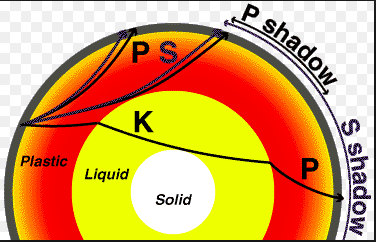
This data was found by spying on atomic bomb tests in the 1950s, not because we wanted to know about the guts of our planet...
Now, to the WWII part...Submarines like to hide underwater, so planes and ships can't find them.So, during WWII, our side tried dragging little magnetic sensing torpedo thingys from behind their ships, hoping to detect submarines. (they later used airplanes too).Here's what they found:What the heck is this?
Ok, let's break this down: between England and the US, they found stripes of North then South weak magnetic fields.When they got to the middle of the Atlantic (about where Iceland is on the map above), the pattern reversed.Huh?That's what they said too...Remember the shifting magnetic field every few thousand years?As the magma came out of the earth in the molten state, it solidified in the magnetic field of that time, so the newest lava was along the center of the ocean (under Iceland too).
Ok, now shift quickly to a meteorologist named Alfred Wegener. Meteorologist is a fancy name for a person who studies the weather.He cut out the continents on a map (like, with scissors) and noticed that South America and Africa fit nicely together. Try this on your globe----Everyone in the geology community told him he was nuts.He later froze to death in Greenland, but I digress...
Then, these strange magnetic stripe thingys showed up from the ships dragging those [magnetic torpedoes](https://en.wikipedia.org/wiki/Magnetic_anomaly_detector)....and it proved he was RIGHT:Remember how hot is was in the earth core?That heat rises to the surface as magma (say like Dr. Evil), just like the Hadley, Ferrel and Polar cells do:
So, connecting all of these dots, the plates are floating on the magma, some created at the mid-Atlantic ridge, others diving down under others in subduction zones....what about those subduction zones?What mountains are in Chile?Volcanoes are the key:Two kinds of volcanoes: Andesitic (pointy), Basaltic (runny, look out your window)Andesite-from pressure and heat as plates subduct (sticky, high silica content, e.g. Andes mountains)Basalt-from ocean crust, lots of water, makes for weak, runny magma, formed as magma pushes through watery ocean platesSubduction zones:
Note the sticky stuff boiling up in red-this is why the Andesitic volcanoes are sticky, and always found near subduction zones (Andes, Cascades, Japan, Italy, etc.)Note also the trench where the subduction zone goes down: this is the origin of the Chilean/Peruvian trench we covered in the El Nino notes, as well as the deepest part of the ocean: the Marianas Trench, which is 7 MILES deep. Whoa!
Let's review the geological players:Magma-(Dr. Evil voice here: [https://www.youtube.com/watch?v=yVo1S52xdpI](https://www.youtube.com/watch?v=yVo1S52xdpI))Asthenosphere-"sticky rock" (from [Greek](https://en.wikipedia.org/wiki/Greek_language "Greek language") ἀσθενής asthenḗs 'weak' + "sphere")Lithosphere-floating rock (litho = stone) ([Ancient Greek](https://en.wikipedia.org/wiki/Ancient_Greek "Ancient Greek"): λίθος \[lithos\] for "rocky", and σφαίρα \[sphaira\] for "sphere")Continents-even more floaty, made of lighter rock (granite) that formed from the interaction of magma with oceans
Plates are large, float on the AsthenosphereContinents are like rafts on the Asthenosphere, more buoyant than the platesThe plates can slide under each other (subduction zones), crash into each other (Himalayas), next to each other (transform faults), and are formed at spreading zones (divergent boundaries)
Neato. What about those earthquakes?Check this out:
Historic data shows subduction zone quakes that would create a tsunami 1000' high or more on the Pacific northwest coast, flooding everything west of I-5.
Look at all of the earthquakes (red dots) as the plate subducts
Two things to take-away about subduction zones:1. subduction zones create ANDESITIC (pointy) volcanoes, which are high in silica, and sticky like thick pancake batter.2. subduction zones create lots of deep-focus earthquakes.
We are lucky enough to live on an island with several active or dormant volcanoes. We live on top of a "hot-spot":
Hot spots:Usually in the middle of an oceanic plate, but can also be mid-continent (e.g. Yellowstone supervolcano caldera)Hot spots-basalt-low silica content which melts easier (e.g. look out the window)
Look at the Hawaii island chain on google earth (underwater version)While you are at it, look for the Nuuanu landslide that created a 4000' tsunamiYou can also look at the Mauna Loa simulated tsunami on youtube...
This is what happens to a shield volcano when it "calves" one side, in this case, the northeast side, in the [Nuuanu](https://en.wikipedia.org/wiki/Nu%CA%BBuanu_Slide) landslide, one of the largest landslides on earth, causing a tsunami that deposited coral on the top of Mt. Kaala, 4055 ft. high...
The epicenter is the place ON THE SURFACE above the hypocenter (true origin) or earthquake FOCUS. Deeper hypocentric quakes often feel "longer", while shallow hypocentric quakes feel "sharp".
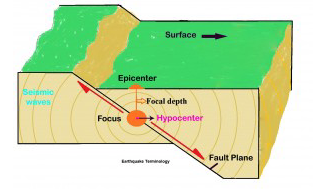
How do we find these?Seismographs:P waves travel by compression (comPression). These are longitudinal waves, like sound. They can travel through liquid or solid.S waves travel by shear (Shear). These are transverse waves, like a slinky. They can only travel through solids.Remember this?

Ok, back to earthquakes.Suppose you have a house on posts (called "post and pier" construction). An earthquake happens some distance away. First, your house moves back and forth (P wave, much faster at 8 km/sec). After a time, your house bounces up and down from the S waves (slower at 3 km/second).If you are far away, these are separated by different arrival times.If you are near the epicenter, they hit at the same time...up, over, down=your house is demolished
We use this difference to calculate distance from the epicenter (and hypocenter if you are interested) using delay times on the seismograph
Look at the HPA seismograph here:[http://www.fdsn.org/networks/detail/PT/](http://www.fdsn.org/networks/detail/PT/)
and our Hawaii quakes here:[https://volcanoes.usgs.gov/observatories/hvo/hvo\_earthquakes.html](https://volcanoes.usgs.gov/observatories/hvo/hvo_earthquakes.html)
Click on some earthquakes and note the depth and the seismic image.
Next: Rocks Module 25Igneous (fire)Sedimentary (layers)Metamorphic (Kafka rocks, just kidding: changed by heat and pressure)
Igneous= directly from magma, and can be either basalt (low melting point, like our island or oceanic plates) or granite (lighter, what continents are made of)Granite breaks down into light-colored sand, makes for fertile soil. Basalt (like us) can make sand too, but less fertile (e.g. black sand beach).
Sedimentary= just like it sounds, from mud, sand, or dust, usually in layers.
Metamorphic= changed by heat and/or pressure (slate, marble, or coal)
Soil-formed by weathering (chemical or physical) of parent rockErosion can be by water or air (wind)
Soil Horizons:
Our Soil Sieve has 4 filters, with 5 layers:mesh 5 = 4 mmmesh 10 = 2 mmmesh 60 = .25 mmmesh 230 = 0.063 mm
Basically, most of what you find is silt and clay...[0 comments](http://physics.hpa.edu/groups/apenvironmentalscience/weblog/f85d9/Modules_2425_earth_and_soils.html#comments)
October 28, 2021
by [admin](http://physics.hpa.edu/groups/apenvironmentalscience/search/?q=admin&fields=lastModifiedAuthor)
## [Populations Mods 23-24](http://physics.hpa.edu/groups/apenvironmentalscience/weblog/952b2/Populations_Mods_2324.html)
First of all a flow diagram:
Note that this is for a country, not the planet, since people (so far) are not leaving the planet...or arriving from elsewhere.National version as a formula:
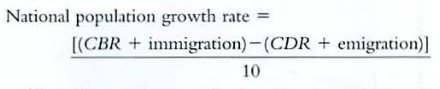
If you look at the planet as a whole (sans aliens or Elon Musk):

so, there is a neat shorthand formula for this:
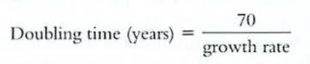
Which is an estimate, the real number is 69.3 (why? look below if you want to know)Here is an example:
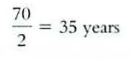
Note that as the growth rate increases, the doubling time decreases.Look for this on the AP as multiples/fractions of 70: 14, 28, 35, and so on...
You can also see this by using our previous formula: Nt = Noe^rtSet N to 100, try with a 7% growth rate (0.07 is r) and set time to be 10 years (70/10)Calculate NtHere's what this might look like:
When calculating growth rates, always use the CHANGE in population divided by the base population, e.g. 7/100 is 7% growth rate, so this population would go from 100 to 107, like in the chart above.
Now, to babies: TFR is the total number of babies a woman will have in her lifetime.Replacement level fertility (RLF) is just above 2.0, (usually 2.1, as some babies don't reproduce or make it to reproductive age).What does this mean in Japan, where young people are not having babies?
RLF depends on developed/developing nations as well (clean water, medical care, access to food, war)Life expectancy: depends on these as well...Infant mortality: under age 1 (reason for big Hawaiian one year birthdays)child mortality: under 5
Look up life expectancy in 1900...Look up the average family size and how many made it to age of 5 in 1900What portion of the US population was farmers then?
Age structure diagrams/population pyramids-check these out: UAE, Japan, Sudan, Iraq/Iran, Russia----WHY?See also baby boom and boom echoes...Check this out:[https://www.populationpyramid.net/world/2021/](https://www.populationpyramid.net/world/2018/)
...and look these up:
1. Go to 1950 and look at the US population. Look again in 1960. Where is the baby boom? Why were there so few babies born during 1940-45?
2. If you were a 42 year old American in 2000, when were you born? How old are your kids? Find the "boom echo".
3. Find the impact of the Iran/Iraq war of 1980-89, which side had the biggest impact? If you were a 35 year old Iraqi man in 1995, how old were you during this war?
4. If you are a 30 year old German man in 1950, when were you born? How old were you in WWII (1936-1945)?
5. If you were a 35 year old woman in Japan in 1960, why are there so few men to choose from?
6. Look at the UK in 1960. Where are the casualties of WWII, and are they both male and female? Explain.
7. What the heck is going on in UAE?
8. Look at Russia in 1960. What gaps do you see? Why?
9. Information about China is very spotty-why would this be? See if you can find the impact of the one-child policy from 1979-2021.
10. Compare present day Japan to Africa. What issues will they need to address?
11. Look at present day Italy, Japan and Germany. What is common?
12. Compare present day India and China. What do you see?
Terms to know: Human Populations-----------------------------Fecundity: the ability to reproduce
Fertility: production of offspring
CBR: crude birth rate: births per 1000 people
TFR: total fertility rate: total kids per woman in her lifetime (25-30!)
ZPG: zero population growth: 5+ where infant mortality is high, 2.1 is normal
China: was 6 -> 1.8 (below replacement level since 1979, one child policy)
China has a 140/100 male to female ratio: why?
Global TFR is 2.6
CDR: crude death rate: deaths per 1000
Why is there a life span? mitochondrial DNA...
1900 Indian man had life expectancy of 23! Trace this to now...
Not now, reasons: nutrition CLEAN WATER, sanitation, education
75 men, 85 women (testosterone, war, "hold my beer and watch this!", Darwin Awards)
Dependency ratio; baby boomers and your future: how many workers to retirees
imagine your life at your age in other countries...
Russia low TFR: alcoholism and antibiotic resistant Tuberculosis
Module 23 Demographic Transition
Things to notice:1. in phase 1, lots of babies, lots of death (infant mortality and short lifespans), so population is low 2. as clean water, sanitation and health care improve, deaths drop, so population rises3. as women gain reproductive rights and/or education, the birth rate drops (many factors here), while death rate stays low, so the population growth curve flattens a bit (hard to see on this diagram)4. as industrialization includes more women, esp. as professionals, they may delay pregnancy later in life, so there is actually a population drop. Examples are Italy, Japan and Germany, where the dependency ratio (number of people depending on social retirement divided by number of people in the workforce paying into the system) is greater than 1.0.
Make sure you can cite at least one example country for each...1. Sub-Saharan Africa, most of the world before the industrial revolution2. Afghanistan3. US4. Japan
Another view:

Imagine two scenarios: Case 1: A sustainable pacific island community, no phones, internet or electricity. Food sources are local, there is little affluence (tribal community), also less poverty, and a self-limiting population, limited by K, in this case food.Case 2: Urban community, large population, lots of affluence (think NYC or SF), everyone has an iPhone or similar device, a computer, a car, a refrigerator, TV, and a wide selection of clothing, food and housing.
IPAT: the impact on an ecosystem = population x affluence x technology
Why is Apple using a robot ("Daisy") to take apart iPhones? How does this impact iPAT?[https://www.apple.com/newsroom/2018/04/apple-adds-earth-day-donations-to-trade-in-and-recycling-program/](https://www.apple.com/newsroom/2018/04/apple-adds-earth-day-donations-to-trade-in-and-recycling-program/)
Which parts of the iPAT formula does this impact, and in which ways?
Think also of electric vehicles: great for the environment, but use materials (Lithium, Neodymium, etc.) that need to be mined. Gasoline/Diesel cars need steel, glass, plastic and some rare materials for electronics, but are much worse for the environment, both in production, use and disposal. More on this later.-------------------[https://www.gapminder.org/tools/#$chart-type=bubbles&url=v1](https://www.gapminder.org/tools/#_chart-type=bubbles)
[https://www.ted.com/talks/hans\_rosling\_on\_global\_population\_growth](https://www.ted.com/talks/hans_rosling_on_global_population_growth)--------------------GDP vs. GNP (nationalism, global economy)GDP is global domestic product, or the sum of all goods and services delivered inside a countryThis was the standard growth metric until recently...GNP is the same thing, but includes multinational companies, or companies "off shore"
Urban areas, UGB (Portland)

See also Ecological Footprint Calculator:
[http://www.footprintnetwork.org/resources/footprint-calculator/](http://www.footprintnetwork.org/resources/footprint-calculator/)
[https://www.ted.com/talks/hans\_rosling\_shows\_the\_best\_stats\_you\_ve\_ever\_seen](https://www.ted.com/talks/hans_rosling_shows_the_best_stats_you_ve_ever_seen)(9 minutes)
Play with these:
[https://www.gapminder.org/](https://www.gapminder.org/)
[https://www.gapminder.org/tools/#$chart-type=bubbles&url=v1](https://www.gapminder.org/tools/#_chart-type=bubbles)
Rule of 70, er 69.3...The TRUTH!We know that Nt =Noe^rtWhen Nt/No = 2, this is the doubling timeln (Nt/No) = ln (e^rt)ln(e^x) = x just like square root of x squared is x. They are reverse of each other...ln (2) = 0.693 = rtSo...0.693/r = t2, the "doubling time"But wait! we saw 70, not .693...Growth rates are in percent (part/100) so the percents cancel out, meaning you can just use percent as a number, like 14%.You will certainly see this on an AP exam, usually as a multiple or fraction of 70: 14, 28, 35, 7, 3.5...Rule of 70 rules! (or actually the rule of 69.3)....
Next: earth and soils:[https://www.youtube.com/watch?v=xzAOhyOtfqc](https://www.youtube.com/watch?v=xzAOhyOtfqc)
[0 comments](http://physics.hpa.edu/groups/apenvironmentalscience/weblog/952b2/Populations_Mods_2324.html#comments)
October 18, 2021
by [admin](http://physics.hpa.edu/groups/apenvironmentalscience/search/?q=admin&fields=lastModifiedAuthor)
## [Mod 18-21 Population Ecology](http://physics.hpa.edu/groups/apenvironmentalscience/weblog/c3170/Mod_1821_Population_Ecology.html)
See also chapter 5 in Withgott: Evolution, species interaction, communities and species interactionsLab: Predator prey phase delayModule 18-abundance and distributionStart with this:
A crude example of this might be:individual-youpopulation-HPA studentscommunity-HPAecosystem-educationbiosphere-the world
or:some rabbit individualsome of the rabbit's friends, a population of rabbitsrabbits and the things they eat and eat them-communityecosystem-the plants that support both ends of this processbiosphere-the planet
We covered ecosystem energy and matter a few weeks ago, this chapter is about population ecology.
--------------------
Population dynamics
Notation: Population size is represented as N (note not "n"): population size within a defined area at a specific time (brings in migration).So, we could say the student population of HPA would be all students here this year, 2020-2021
Check out the diagrams on population distribution: random, uniform and clumped. Important vis a vis biodiversityStructures: age and gender (sex)
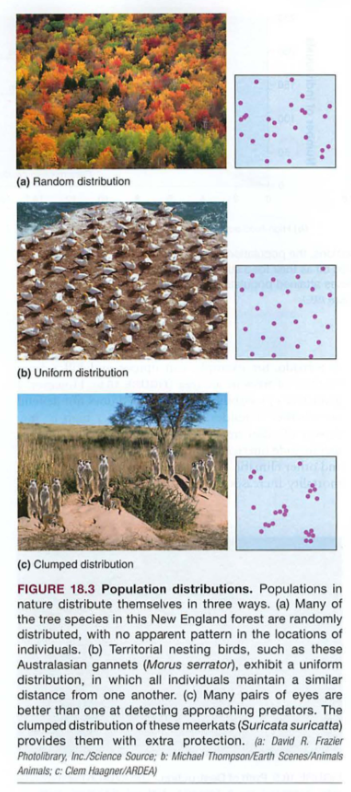
Density dependent factor: e.g. food or reproductive rate in rats (more rats, lower fecundity)Something that influences reproduction or survival...
Density independent factors: storms, disasters, fires (note density independent: one bambi or 100 bambi all perish in the same fire)
Limiting resource: usually food, but could include space, nutrients, etc.
Carrying capacity: K (note not "k"): how many individuals an environment can support
Module 19: growth modelsImagine you are a happy bacteria, or rabbit, with lots of food, land and no predators. Your population growth curve might look like this:
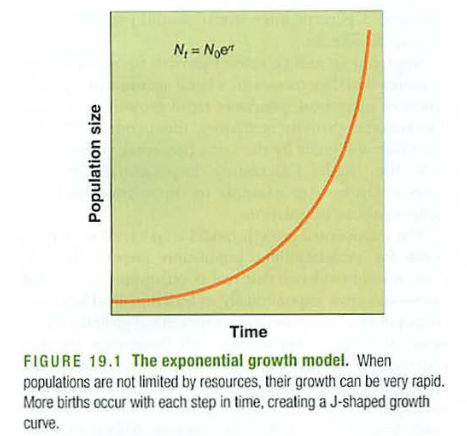
This is called exponential growth, or "J shaped growth"Note that it has no end, or limiting factor.
Small r is the growth rate. If you have had physics (yay!) this is usually "k" in some examples, or related to RC decay/growth.Learning this equation is VERY useful.Note that it depends on two things: the starting amount in the population (No) and the growth rate (r)Here is an example:
You might also find this link useful:[https://www.khanacademy.org/science/ap-biology/ecology-ap/population-ecology-ap/a/exponential-logistic-growth](https://www.khanacademy.org/science/ap-biology/ecology-ap/population-ecology-ap/a/exponential-logistic-growth)
Many systems follow J shaped exponential growth until they run out of food or space, then there is overshoot and die-off:
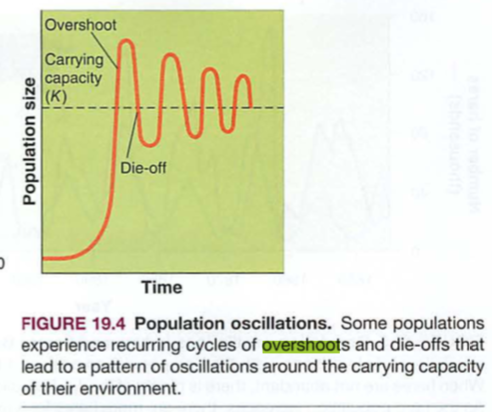
A more ideal version of this is the S shaped curve, called logistic growth:
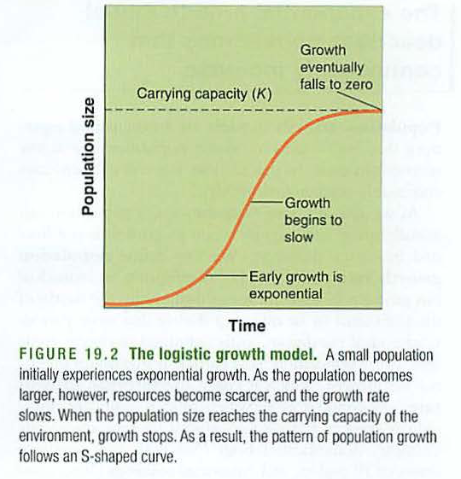
Here is a formula for logistic growth that we'll discuss:
Don't be intimidated by this formula...dN/dt is just delta N over delta t, or the ∆ in number over the ∆ in time,or the rate of population growth (some of you may see this as the slope of the S curve)Note that when the ratio N/K is very small or close to zero, the stuff in the parentheses becomes 1, so the formula is rate = rN, or J curved exponential growth.As N/K nears one (number of critters equals carrying capacity) the term in the parentheses becomes zero, so no growth.Note also that if N/K is GREATER than one, the growth rate (slope of the curve) become negative. This is overshoot and die off.
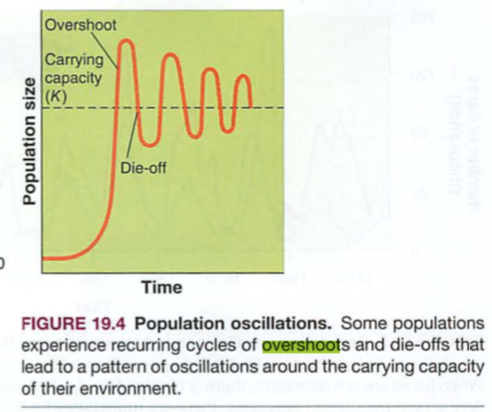
------Logistic growth worksheetFirst: exponential growth:
Imagine 10 imaginary rabbits (No=10)
Assume r = 0.5 (50 percent growth rate, or each rabbit makes 0.5 rabbits per year)
Find the population 2 years later:
Nt = Noe^rt
Nt = 10e^0.5\*2
Nt = 27 rabbits
After 4 years:
After 10 years:
———
Next, use the logistic growth formula, same data, with a carrying capacity (K) of 100:
Small population: 10 rabbits
∆N/∆t = rN(1-N/K)
= 0.5\*10(1-10/100)
= 5(1-0.1)
= 5(0.9)
= 4.5 rabbits per year
Find the rabbits per year for these populations:
Medium population: 27 rabbits
Near K: 74 rabbits
Above K: 1489 rabbits
quiz (you may use your worksheet only)
1. 30 rabbits live on an island with carrying capacity 200. They reproduce at a rate of 0.5 per year. How many rabbits will be on the island after 3 years? (hint: you would do the calculation three times-this is only an estimate though, the true formula would be a bit more complex)
2. What will be the slope of the growth curve at this point?
Next: predator/prey phase diagramsCheck this out:
Now we can discuss generalizations of r and K strategists:Note: r comes from small r (growth rate) in the growth formula, while K comes from large K in the same formula (carrying capacity):
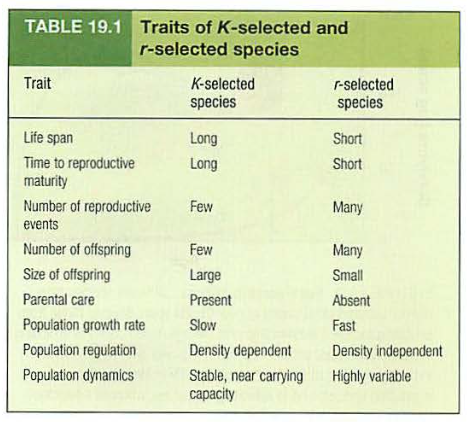
Where do you fit in? How about Nemo?
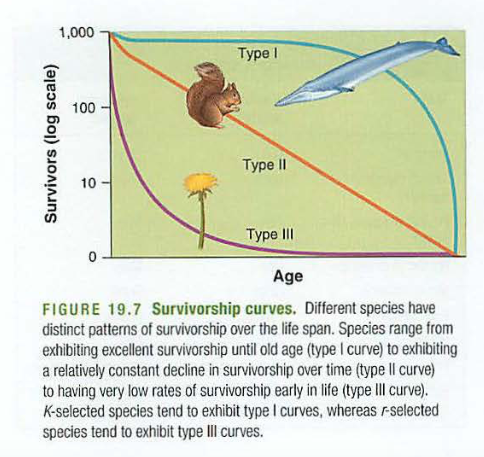
Birds also fall into type II (no pun intended), as they randomly crash into stuff...There is a fourth type: deer. How would you imagine this curve?Related:Another reason why genocides are so damaging to cultures: If an oral tradition (e.g. Hawaiians) are decimated by smallpox for example, it is the very old (the holders of the legends and history) and the very young (those who have time to listen, not work, and will then grow up and tell their kids) that are gone. This is a sort of cultural bottleneck...
Module 20: Community ecologyCompetitive exclusion principle: two species competing for the same resources cannot co-exist, leads to...Resource partitioning: time, space, type of food (one species picks one, the other survives)Relationships:Predation: predator and prey, one lives, the other diesSymbiotic:Mutualism: both benefitCommensalism: one benefits, no harm to the otherNon-symbiotic:Parasitism: one benefits, harm to other
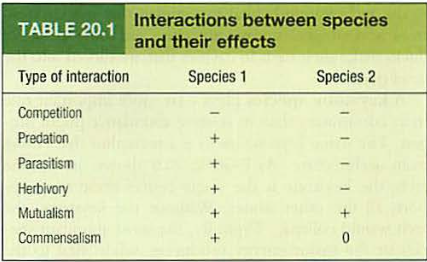
[quizlet review](https://quizlet.com/144858427/ecological-relationship-flash-cards/)
keystone species vs. indicator speciesKeystone species-many others depend on it, removal has an impact much greater than their relative population
e.g. beavers: create habitat for others (dams), so they are also "keystone engineers", only they don't wear funny hats.
Here's what a keystone looks like:
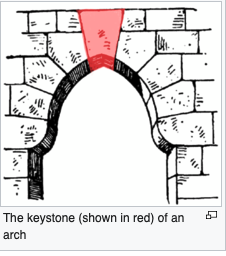
In architecture, if you remove the keystone, the arch collapses. Cool term, right?
This is different from a capstone (seniors might like this): a capstone is what you put on top of a finished structure
Another example: "keystone predators" e.g. sea stars, which eat mussels, clearing space on rocks for other species
Indicator species-signal health of a system, like some fish or worms signify water quality, also known as "bioindicators"
Succession: one species takes over another in time
Module 21: Community SuccessionPrimary succession: From bare rock, no soil: (e.g. lichen)
These hold moisture and some sort of matrix (e.g. soil) so that others can then grow
You might imagine driving from the Kohala coast up to Waimea, seeing bare lava along the coast, then fountain grass, then small bushes, then trees along the stream, then larger trees away from the stream. Water is the key to life, so anything that can trap and hold water (e.g. soil) can support life.
Secondary succession: from disturbed area with soil (e.g. after a fire)-there is soil, but no plants, growth here might be quicker than primary sucession.
Pioneer species: arrives first, sets up reliable system of water and matrix
Climax community: stable, well evolved ecosystem, e.g. old growth forest, able to survive disasters (e.g. fire)
Aquatic succession: from stream (flowing water) to pond (less flow) to shallow pond (even less flow) to marsh (mostly mud)
Island biogeography (like here in Waimea): habitat size AND distance from others influences diversity (e.g. birds)
This was Darwin's whole gig, also some folks off the coast of Chile, often with birds involved.
Check out an alternate presentation of these in the Withgott text, with a special section about our island:
[http://physics.hpa.edu/physics/apenvsci/texts/withgott/withgott%206e/3-4.pdf](http://physics.hpa.edu/physics/apenvsci/texts/withgott/withgott%206e/3-4.pdf)
Frog book chapter 5:
Questions:
1. What three things in order are necessary for evolution to succeed?
2. What are the characteristics of an r specific species. Give an example.
3. What are the characteristics of a K specific species. Give an example as well.
4. The population of wolves may rise and fall along with rabbits, but not at the same time. Explain why.


Northern Lights over Scotland: space weather.comCME event: coronal mass ejection[https://en.wikipedia.org/wiki/Coronal\_mass\_ejection](https://en.wikipedia.org/wiki/Coronal_mass_ejection)
------------------------------Mod 14: Biodiversity: (see also chapter 7 in Froggie book)
Mod 15: EvolutionThree conditions must be met:1. genetic variation (mutation)2. some stress that favors this variation (adaptation)3. survivors procreate, pass on the variation (reproduction)
Genotype: set of genes (dominant and recessive)Phenotype: traits expressed in a living creature
Genetic drift-pretty much what it sounds likeBottleneck effect-VERY important: when a species is almost extinct, there is little variation in the gene pool of the survivors, even if their population rebounds (e.g. whales hunted almost to extinction, the entire gene pool is limited to the diversity of the sole survivors)Founder effect: random selection of survivors, creating a new gene pool (birds, gilligan)
Questions:1. If the early atmosphere of our planet was thinner and less developed, it might have allowed more cosmic radiation to reach the surface. How would this impact the natural mutation/evolution rate?2. what would be the impact on an ecosystem of rampant mutation rates?
Mod 16: speciationGeographic isolation (e.g. Galapagos) also found where we disturb natural habitats with roadsThis causes Allo (other) Patric (father) speciationEventually reproductive isolation will result: different breeds will not be able to procreate
There is another more rare form of speciation: Sympatric ("same father"), from polyploidy, ("many chromosomes")
GMO: see roundup ready corn and wheat, freeze proof tomatoes and others.Not to be confused with Dwarf Wheat and Norman Borlaug (see population chapters for more on this).Dwarf wheat was a simple hybrid, not a GMO.Look up "gene guns" and CRISPR
Mod 17: niches and species distributionCheck this out:
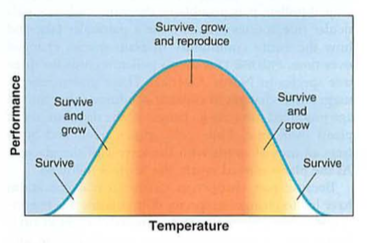
You'll see another like this in population distributions...Range of tolerance-where it can surviveFundamental niche-happy placeRealized niche-de facto placeDistribution-areas where they live (we'll see more of this in the chapter on population distributions: random, scattered, patterned)Global Biodiversity:Note biodiversity increases closer to the equator:
Labwash your handspour out a random number of different colored goldfish on your plate (your "pond")determine the number of distinct populations by color, using chopsticksdetermine the proportion for each population (e.g. 5 red ones out of 20 total would be 5/20 or 0.25)calculate Shannon's index (H) for this "pond"repeat the experiment with a very low biodiversity, calculate Hrepeat with a very high biodiversity, calculate Heat the contents of your "pond", representing a catastrophic eventQuestionswhat is the value of biodiversity in any community?what are the benefits and drawbacks of a low biodiversity?how does this play into competition (next chapter)why is it important to determine the number of "distinct populations"?what is the impact of this on a human population, e.g. the census?
Check-in review:Unit 2 from Cliff notes 2011: Delete this content
Unit 2 practice exam p. 190-----NEXT: Population ecology-----------

NPP: biomass after respiration(rate which primary producers convert energy to biomass)
tropical rain forest-canopy (layers)--------
poor soil nutrient levels (all in trees)
Delete this content
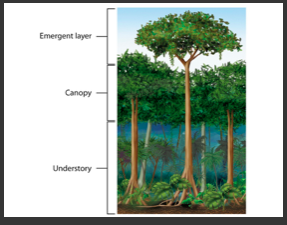
shallow roots, big leaves, lots of rainpitcher plants-eat animalsepiphytes-grow on other plants (e.g. orchids)air rootsspecialized animals
tropical dry forest——
deciduous forest: warm, but variable rain (e.g. monsoon)autumn leaves-loss to protect plant, changes in photosynthesiswaxy leaves (e.g. pine needles) if over winter plantsestivation: hibernationmigration: birds (why birds and not other animals?)
savanna——
very dry, few trees, seasonal grasses, firesporous soils (like Kona), often coffee locations (s. america)waxy leaves, deep roots
desert——
under 25 cm (250 mm) of water per year (10 inches)dry dry dry, so dramatic temp variations (opposite of ocean biomes)few plants, low nutrient levels in soilnocturnal animals (e.g. rats, snakes)succulents: store water (e.g. cacti)large, shallow roots, also taproots (160 ft. deep)temperate rain forest——not too warm, not too cold, just rightrainy, warm, mossy, foresty (e.g. washington, oregon, BC)coniferous-have pine cones, conifers: oily needles (don’t freeze)lumber
temperate forest——
eastern US: oak etc. seasonal loss of leaveshibernating animals
temperate (mild) grassland——
prairie, steppe (russia)moderate rain, but not enough for trees. grass only.grass grows from below, so can be eaten by cattle and still liveroots capture moisture, hold soil together (kikuyu grass)
chaparral——
California, mediterranean (middle of the earth, contrast with chinese translation of the word “china”: middle earth kingdom)dry, seasonal rain, drought (like now)
Boreal (north) forest———
taigaacidic soils (from conifers/pine needles as competition)very coldconifer shape sheds snow, preserves branches (christmas trees)when ground freezes, no water for roots, all water stored as sap in trees (oily compound, very sticky, makes retsina in Greece)
tundra——
russia, alaska, canadavery cold-study the climatograph (-220 °C!) right….permafrost-permanently frozen ground, so only shallow roots
polar ice—
not really a biome, but stuff lives there (aquatic mammals, fish, very small rocks, churches, mud, but no ducks)Notothenioids-antifreeze fishblubbery mammals
mountains—
another non-biome, but look at this!
Delete this content
Recall terrestrial biomes are defined by temperature and precipitation (rain)Aquatic biomes are by definition underwater, so they are defined by We separate aquatic biomes into freshwater (lakes, rivers, streams) and saltwater (oceans, estuaries):Riparian=riverLimnotic=lakes:Shallow shore area=littoral (means shallow), see the "littoral Navy", photosynthesis here (shallow, light shines through)Open water area=limnetic zone, no rooted plants (too deep), phytoplankton here, only as deep as sunlight can penetrateDeep water=profundal ("profound") or deep zone: no light penetrates, bacterial decomposition.Bottom=benthic zone: mud, dark, cloudy
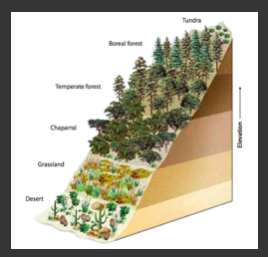
how cool is that?
aquatic ecosystems—
salinity, depth, standing or flowing watersalt water = 30-50 ppt (parts per thousand)ppt, ppm, ppbfresh water = 0.5 pptin between 0.5-30 ppt = brackish (anchialine ponds in Kona)study the fishies in the picturesDEPTH!!!!determines amount of light, tf. photosynthesisphotic zone=lightaphotic=no lightbenthic=really no light, never, ever ever. don’t even think about it.aquatic mammals must surface for airfishies don’t-gillsDO dissolved oxygen (very important) depends on plants (so depth) and temp (cooler water can hold more O2)warm water has low O2 generally.best place to fish: cool water after a waterfall (why?)flowing water: riversstanding water: pondslakes can become inland seaslittoral=shore, limentic=away from shore benthic=botttomwetlands:marshes, swamps, bogs and fensmarshes marshes marshes!-tall grassesswamps-some treesbogs-acidic, poor decomposition, floating stufffens-spring underneath, less acidic, better nutrientsbogs decay slowly-ancient cheese story, peat mossrivers-oxbow lake and meandersource, tributary (continuity concept), mouth (delta)slope exponential as distance from sourcedeposition rates (rapids vs. plains)silt carrying capacity, turbidityestuaries-like deltastidal estuary: hudson river: deeper than the body it serves
oceans——
200 ft. of salt if all oceans evaporatedoceans were red (iron) then ppt out (iron range in WI, MI)salinity, wind and temperature determine flowupwelling (recall Peruvian fisherpersons)also downwellingphotic zones-intertidal zone-makes sense, between tidesneritic zone-close to shore, less than 200 ft. deep (not in Hawaii, we have no continental shelf-boo hoo)open ocean (pelagic) zonekelp forests-e.g. california coastcoral reefs-away from fresh water, coastal, photicopen ocean-scary stuff
[admin](http://physics.hpa.edu/groups/apenvironmentalscience/search/?q=admin&fields=lastModifiedAuthor)[Mod 13 Aquatic Biomes](http://physics.hpa.edu/groups/apenvironmentalscience/weblog/9e540/Mod_13_Aquatic_Biomes.html)Depth: how deep is the deepest part, how much photosynthesis is possibleDistance from shore: shallow water has more life, more things to attach to, more biodiversity
Freshwater biomesLakes
Delete this content
: note usually related to photosynthesis (plants)Oligo (few) trophic=low productivityMeso (middle) trophic=mediumEutrophic (eu=good trephien=food)=lots of productivity (sometimes too much, like in "Poisoned Waters")Freshwater wetlands-submerged most of the time (swamps, marshes, bogs) this is the history of all coal and oil we now use usually connected to the sea, act as a coastal buffer for Hurricanes, very productive, many nutrients, lots of organic materialp: special version of this in Tropical areas (e.g. Florida) area between high and low tide or seasonal variationsCoral reefs-see coral bleaching, pH, temperature and salinity sensitive (see Hamakua coast vs. Puako)Intertidal zone: between high and low tidePhotic (light) zone-shallow, photosynthesis, kelp, othersAphotic (dark) zone-too dark for photosynthesisChemosythesis/thermosynthesis: deepwater steam vents, based on Sulfur instead of Oxygen, bacteria generate energy with methane (CH4) and H2S (instead of H20)Benthic=deep oceanPelagic=open ocean (think of big sailing ships, whales, stuff like that)Hadal zones: like Hades: deepest, darkest zones. Weird fish, no light...
[admin](http://physics.hpa.edu/groups/apenvironmentalscience/search/?q=admin&fields=lastModifiedAuthor)[Mod 12 Terrestrial Biomes](http://physics.hpa.edu/groups/apenvironmentalscience/weblog/e83e7/Mod_12_Terrestrial_Biomes.html)
Delete this content
Now look at this map, and compare with your trusty globe:
Delete this content
See the pattern?Pay close attention to cause and effect:There are about 9 Biomes, usually defined by (rain, fog, others) and . Big Island has 8 of the 9 biomes, or in the 12 biome model, we have 11/12, or 9 of 13, or 10 of 14 in another model. Many models...Traveling up a mountain is like crossing biomes. Check this out:
onshore moist air from the Pacific ocean hits the mountains near Seattle=rainy thereonshore moist air from the lower Atlantic ocean hits the amazon basin=rainy theredry air moving down from the Mediterranean moves over the Sahara Desert=dry there
precipitationtemperature[https://www.hawaiimagazine.com/content/hawaii-has-10-worlds-14-climate-zones-explorers-guide-each-them](https://www.hawaiimagazine.com/content/hawaii-has-10-worlds-14-climate-zones-explorers-guide-each-them)Delete this content
Imagine driving from Hamakua or Hilo up to the summit of Mauna Kea: tropical rain forest to temperate (mild) rain forest to boreal (north) forest to tundra. There is even a glacier up on Mauna Kea. Cool.This would be like starting in the upper right corner of the diagram and moving diagonally down and to the left.Now check out the planet again:
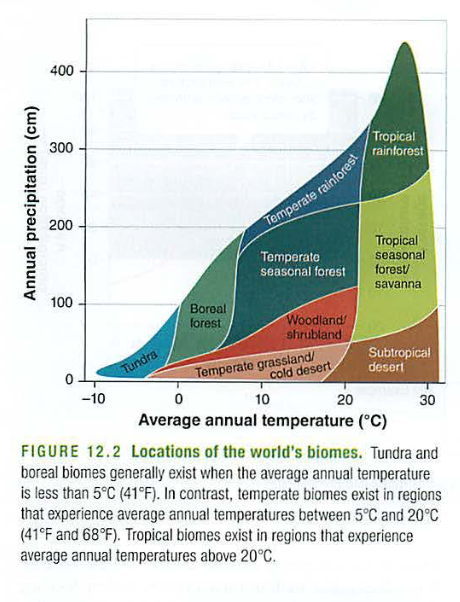
Delete this content
Notice the horizontal bands. If you've read "Guns Germs and Steel" you know that humans migrated horizontally, so their crops and livestock would thrive in similar biomes. See? Migrating north to south is tough.How is this changing?Now look at this:
[https://climate.nasa.gov/interactives/climate-time-machine](https://climate.nasa.gov/interactives/climate-time-machine)
Delete this content
These diagrams are how climatologists describe biomes without a cool map. The blue line is the amount of rainfall, with units on the RIGHT side of the graph. The red line is the temperature, with units on the LEFT side of the graph. The shaded region in the months below (jfmamjjasond) is the growing season when temperatures are above freezing. When the precipitation line is above the temperature line, growth is limited by temperature (e.g. freezing). When the blue line is below the red line, growth is limited by precipitation (e.g. the desert).Start with the north: Tundra is what you'd see in Alaska. Permafrost is soon to be in the news. It is made of permanently frozen ground a few feet below the surface. Even roots cannot penetrate it, so some trees grow in a stunted fashion. It is also composed of frozen organic matter, which when it melts will decompose, releasing CO2 and CH4 (methane), which is 20x as powerful as CO2 as a greenhouse gas.
Tundra:
Delete this content
Note the cool temp, so growth is determined by temp, not rainfall. Lots of snow here, and little liquid water for plants, so yeah, mainly snow and glaciers.
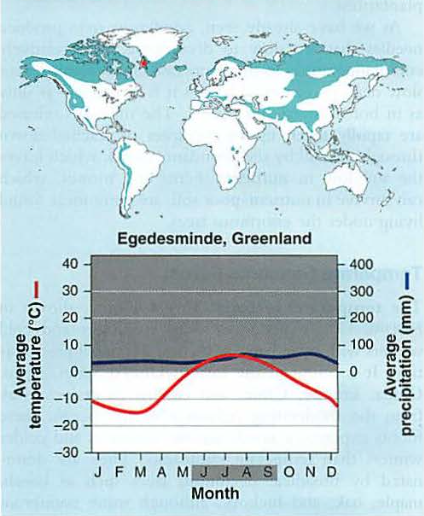
Contrast that with the boreal (north) forest:
Delete this content
Note the short growing season. Any plants that survive usually have an oily sap (pine trees, evergreens) that does not freeze. Also note the serious cold in the winter-animals have to adapt to these (fur, hibernation, etc.) are nicer, longer growing season, and rarely freeze. They are usually near the ocean, so they do not freeze (ocean is a huge heat sink). The often have lots of rain (think of Seattle). You may recall these are places where the surface parts of Ferrell and Polar cells converge, bringing in clouds and as these clouds rise into the atmosphere, they release their water as precipitation.

Temperate (mild) forests
Delete this content
Temperate (mild) seasonal forest actually has seasons:

Delete this content
Deciduous trees can live here, like maple and oak. It gets close to freezing, but no real dry season. is like much of southern California, or the Mediterranean. Wine can grow here. It is also known as the mediterranean (medi=middle, terra=earth) biome.

Woodland/shrubland
Delete this content
Note it never really freezes, but growth is determined by precipitation (blue line is below the red line). This is also known as "chaparral" or the "fynbos" or "nice forest" in Afrikaans (South Africa). Look up the main wine regions of the world, they will fit this biome. Also consider how many Italians could start vineyards in northern California... is a dry, grassy area, like Oklahoma, although it does get very cold there, so think more of Texas, or the Gobi desert. Again, growth is rain limited: (you may recall these are near Hadley/Ferrel cell subsidence, so dry air from space falls here). These areas tend to be far from large bodies of water, so they have more extreme temperatures than similar latitudes near water (e.g. Italy, France, California)
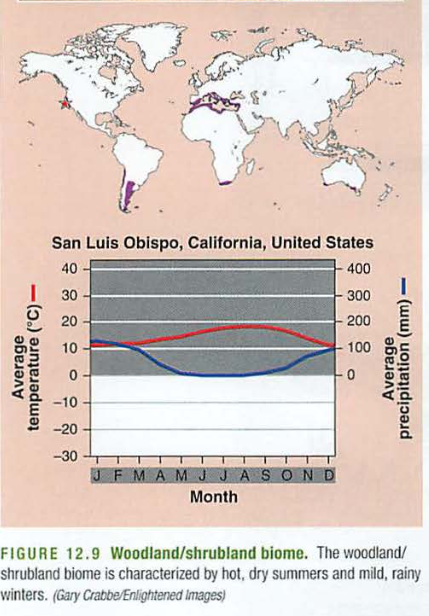
Temperate grassland/cold desert
Delete this content
is the rainiest of them all, and much of our island has this near the shore. Warm temperatures, and paradoxically poor soil nutrition (all of the nutrients are in the plants). On Mt. Waialeale on Kauai, the rainfall is 480 INCHES per year, 2.5 times as high as the high point on the chart below:
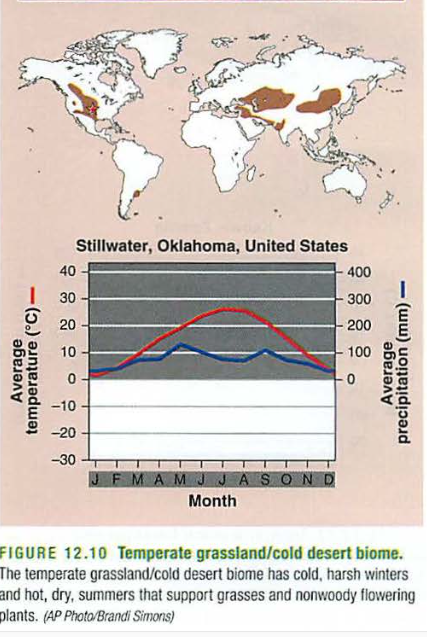
Tropical rainforest
Delete this content
Africa and Brazil hold the next biome: . Think of Madagascar (the film): not many large trees, room for animals to roam, lots of grass, happy lions, maybe a bossy penguin or two...Growth dependent on rainfall: (blue line below red one)
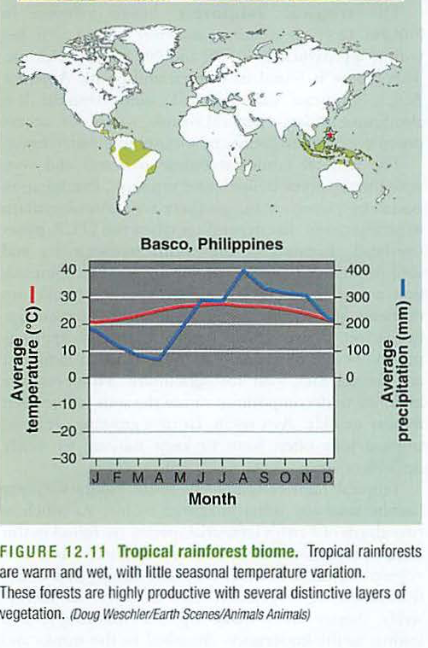
Savanna or tropical seasonal forest
Delete this content
Finally, the , like what you'd see in the Sahara desert (another film), or most of Australia, the Atacama in Chile, the Mojave desert in California, and some of Mexico. Note the Gobi desert is not on this list-too cold. Again, note these areas are where dry air subsides (falls) from the Hadley and Ferrell cells.
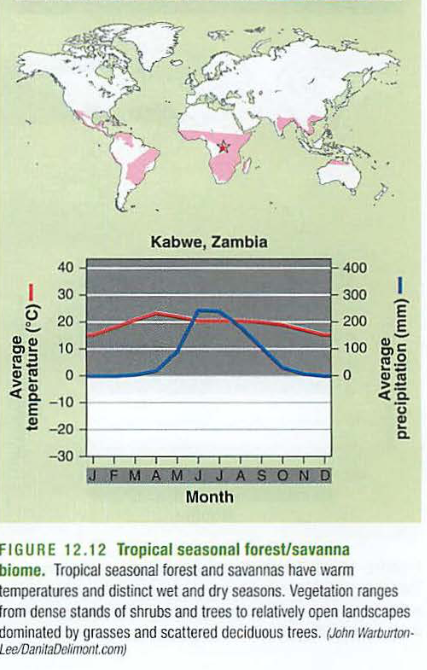
subtropical desert biome
Delete this content
Clues:

## Biome Game:
Delete this content
Philadelphia, PennsylvaniaSan Diego, CaliforniaBelem, Brazil
## LAB: Gambling with biomes
Gambling with biomes
Below is a list of locations around the world. Roll the dice and using your vast knowledge of biomes and the high tech globes on your desk, determine the biome and type of life you might find there.In the next round reverse the process with the biome list below, determining the locations around the globe.
Locations:
ChileZambiaPhilippinesOklahomaSan Luis ObispoGermanySeattleGreenlandOntario CanadaTunisiaNorth PoleKamuela
Biomes:
tundraboreal foresttemperate rain foresttemperate seasonal forestwoodlandstemperate grasslandtropical rain forestsavannahdesertcold deserttaigatropical seasonal forestDelete this content
[admin](http://physics.hpa.edu/groups/apenvironmentalscience/search/?q=admin&fields=lastModifiedAuthor)[APES notes: atmosphere, weather](http://physics.hpa.edu/groups/apenvironmentalscience/weblog/4583d/APES_notes_atmosphere_weather.html)APES notes atmosphere, weathersee also frog book 15.1 and 6.1Three ways heat energy moves:: no medium needed, e.g. light
Radiation
: contact
Conduction
: matter in motion
ConvectionSummary:
Solar passes through the atmosphere
radiation
Radiation hits the earth surface, to air
conducts
Hot air rises, () cooler air comes in to take its place
convection
Tilt of the earth: Basis for seasons : tilt away=winter
equinox=equal night, solstice=extremes
Equator is hottest, so greatest convection there
Three cells based on convection, cause winds
Hadley, Ferrel, Polar
Ocean currents follow the winds, clockwise in N hemisphere
Cells converge at rainy spots, diverge at deserts
Why? Clouds lift at convection spots, cooling them = rain
Dry air dropping from space = warm, dry air (deserts)
Layers: spheres bottom to top
: at the surface, where all weather happens, conduction to air from surface, convection to other layers, albedo is how much energy it reflects (albus=white)
tropo
: higher, drier air, cooler, air travel is here, also ozone layer (stops UV)
strato
: middle
meso
: hot, charged particles, also ionosphere, bounces radio waves
thermo
: outer
exo
; even further, deflects solar wind, protects surface (none on Mars)
magnetoAir stuff:
compress air and it heats
uncompress air (e.g. altitude) it cools
warmer air holds more water
cooler air holds less water
humidity measures how much water in how much air
relative humidity: compared to how much it can hold at that temp
absolute humidity: total amount of water
dew point: temp where water condenses
rising air condenses (rain) “adiabatic cooling” rain carries the heat away
falling air heats (deserts) “adiabatic heating” absorbs energy from the surroudings
rain shadows=dry areas after mountains
saturated 100% RH air is fog, then rain or snow
Cells:
ITCZ: at the equator, inter-tropical-convergence-zone
Hadley cell: equator to 30°N or 30°S
Ferrel cell: 30-60°
Polar cell: 60-90°
since earth is spinning, as air flows south, it also falls a bit west=tradewinds
if air flows north, it also flows a bit east=westerlies (weather describes wind from source direction)
this change of direction creates the coriolis effect
Hurricanes are low pressure systems, rising air creates a counter-clockwise flow (L on the weather maps)
High pressure systems create clockwise flow (H on the weather map)
Oceans:
winds carry surface water along, so N hemisphere has clockwise currents (cool water off CA coast)
a special current from Greenland melt flows to Hawaii, called the thermo (heat) haline (salt) current.
ENSO is a big deal: normally winds carry water off-shore of chile, bringing up food from the deep ocean (happy fisherpeeps).
El Niño reverses this, so sad fisherpeeps
La nada is no flow at all
[0 comments](http://physics.hpa.edu/groups/apenvironmentalscience/weblog/4583d/APES_notes_atmosphere_weather.html#comments)
September 27, 2021
by
[admin](http://physics.hpa.edu/groups/apenvironmentalscience/search/?q=admin&fields=lastModifiedAuthor)[Modules 9, 10, 11 circulation](http://physics.hpa.edu/groups/apenvironmentalscience/weblog/64d6b/Modules_9_10_11_circulation.html)Circulation modules:Module 9: Heating of the earthModule 10: Air circulationModule 11: Ocean circulationModule 9 heating of the earth
Delete this content
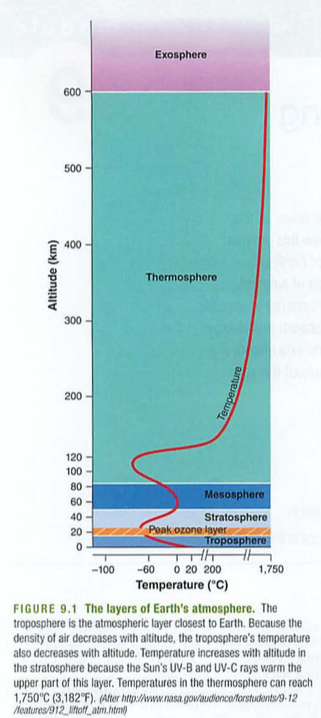
(top) sphere-heated by contact with earth, where most weather occursTropo (high) sphere-cooler, where commercial aircraft travel, more radiation thereStrato (middle) sphere-higher, but does not contain charged particlesMeso (hot) sphere-also known as the ionosphere, charged particles from interaction with the solar wind (charged protons and others), "hot" because of these particles slowing down, but so little atmosphere it would freeze you if you were there. Three layers: D, E and F, with F being the highest, all three reflect radio waves, but only the lower ones conduct/reflect in sunlightThermo (outer) sphere-where space begins, freezing cold about one hydrogen molecule per square meterExo: between the troposphere and stratosphere, this absorbs UV radiationOzone: way out there, deflects solar wind, particles then spiral into the north and south poles creating the auroras.MagnetosphereIf no magnetosphere, we'd cook like in a microwave oven (Film: The Core), a serious issue for Mars explorationif no ozone layer, all plants would die, DNA would be mutated, life would cease except for deep thermal vents (possible origin of terrestrial life)HOT AIR RISES, COOLER AIR MOVES IN TO TAKE ITS PLACE-THIS IS THE BASIS FOR WEATHERGlobe DemoSeasons, tilt vs. perihelion (AUS)counterclockwiseequinoxes, solsticeshadley, ferrel polar cellsdeserts, rain foreststradewindslongitude vs latitudeGMT-why? layers
Atmosphere slice:
RH, AH
Air currents:
radiation, convection, conduction
3 energy modes:Delete this content
Seasons
4 seasons (not just a hotel), equinox means "equal night”, solstices are the extremes (why sacred?)Earth spins counter clockwise when viewed from north pole (think: sun rises in the east)Latitudes are like a ladder, go horizontally (east to west), some short (near the poles), some long (equator)Longitudes are all long, go vertically (north to south), all the same lengthSeasons are determined by earth tilt, by distance to the sunnotAlthough, Australia (southern hemisphere) summer happens when we are closer to sun in our elliptical orbit, so more extreme summers (tilt + proximity)Albedo-think of Albus (white) Dumbledore, means reflectivity. Earth is about 30%, snow is 95%Delete this content
Module 10 Air currents and Water stuff the amount of water in the air at a certain temperature, relative to the maximum it could hold at that temperature (RH). Look this up here: Relative humidity:[http://10.14.30.1](http://10.14.30.1/)You can blow on the room sensor and see this rise.: true amount of water in percent water in that parcel of air (AH)Absolute humidityDelete this content
You can look this up, it is called the "comfort curve" or psychrometric chart:
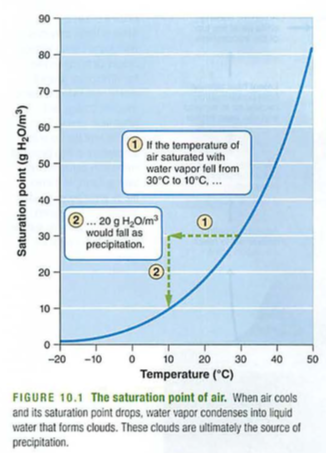
the max amount of water air can hold at that temp (rises with temperature, note how this compares with gases dissolved in liquids, like your dissolved oxygen (DO) lab. You may know this as fog.Saturation point:You may feel more comfortable with high temp and low humidity because your body can evaporate and cool more effectively. Conversely, humid, hot weather is ugly. Cold, humid air insulates poorly, so feels chilly, so running your air conditioner when it is humid and cool may actually make you feel warmer. Why?Delete this content
weather term for the temp that water will condense from air, depends on humidity (think of cool mornings, wet grass, or water vapor condensing on a cool drink)Dew point: think of Waimea canyon, or the mountains of the Andes, Olympics, Coastal range, Himalayas, etc. As air rises, the reduced pressure makes it cooler. Opposite of pumps, which get hot (compression). You might feel see this with aerosol spray cans (cooler when you spray something).Adiabatic cooling:
Delete this content
Questions:You see a circular flow in the counter-clockwise direction in the Northern Hemisphere on . Is this low or high pressure?[windy.com](http://windy.com/)Why is the ocean less salty near the equator?As a parcel of air rises (like Waipio or the Himalayas), what happens to the absolute and relative humidity? What happens next?What level of the atmosphere has most of the weather and why? reverse of this: think of Puako or Kawaihae: as air descends, it is compressed and gets hotter.Adiabatic heating:when vapor condenses from gas to liquid, it releases energy. Opposite of evaporation or boiling, which both require energy.Latent (hidden) heat release: one of three means that energy moves from place to place: Convection:radiation (like light, can be reflected), conduction (contact), convection (movement of mass, usually air or water). between 30N and 30S, convergence at the equator (hot air rises there), descends after shedding heat to space and water as it rises (rain), descending dry air forms deserts at 30N and 30S. Winds from the north to south at the surface, opposite in the stratosphere.Hadley cells:Delete this content
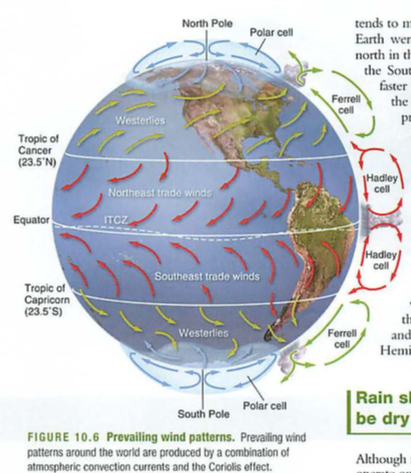
[https://www.windy.com/?20.002,-155.533,5](https://www.windy.com/?20.002,-155.533,5) intertropical convergence zone: the place near the equator where this convergence occurs, lower salinity in equatorial oceans (rains all the time, good AP question).ITCZ:Hadley Cells: Between the equator and 30N or 30S. between 30N and 60N, also on the southern hemisphere: deserts at the bottom, northward wind at the surface, opposite in space (stratosphere), which is why commercial flights usually have a headwind where they'd have a tailwind at the surface. Also why when trades are strong, mainland flights are faster/shorter.Ferrell cells: southward wind from 60N to 90N, creates dry desert at the north pole.Polar cells: spinning of earth makes air near the equator rotate faster around the axis than polar air. This difference creates hurricanes and ocean currents, therefore diagonal winds (see fig 10.6)Coriolis effect; think of the coast near Mahukona or Lapakahi, between Kawaihae and Hawi: very dry as all moisture has been wrung out of the air by ascending above mount Kohala. Think also of Eastern Washington, or the Desert in Chile, where the Andes dry out the air. Many more-find some!Rain shadow:
Delete this content
Verify on windy.com again:
[https://www.windy.com/?20.002,-155.533,5](https://www.windy.com/?20.002,-155.533,5)
Notice that the north pacific currents flow clockwise, south pacific counter clockwise. why?There are places with little forward current, so they become islands of debris, e.g. the so called "Pacific Gyre", which is about the size of Texas, and made up of floating trash.Gyres describe the circular flow, some refer to the islands of debris as gyres (not accurate), gyres are the circles, most equatorials move west (arrows match)Difference between flotsam and jetsam: one floats, the other is jettisoned from boatsThermohaline (thermo=heat, haline=saltwater) circulation:
Delete this content
This upwelling of 2000 year old water off the Kona coast is the bases for Koyo water near the airport (why is this water so precious?)Upwelling off the peruvian/chilean coast-Andean trench=great fishing when in normal conditions (not el niño)ENSO= el nino southern oscillation-a really big deal, reverses the normal ocean circulation, impacts weather around the planetEl niño and La niña (ENSO)Note: top diagram has strong OFFSHORE wind, pulling up nutrients from below, note also that it is one big box from Peru to Indonesia, with a strong warm, dry subsidence around the coast of Peru (good for beach folks), known as La Niña, or the little girl,
Delete this content
Note: lower diagram (El Niño) has main convection moving to the middle of the ocean basin, weakening the offshore wind around Peru, so sad fisher-folk. El Niño was often associated with Christmas, so the "little boy" reference.
Though ENSO is a single climate phenomenon, it has three states, or phases, it can be in. The two opposite phases, “El Niño” and “La Niña,” require certain changes in both the ocean the atmosphere because ENSO is a coupled climate phenomenon. “Neutral” is in the middle of the continuum, also known as “La Nada” or “the nothing”.
andEl Niño: A warming of the ocean surface, or above-average sea surface temperatures, in the central and eastern tropical Pacific Ocean. Over Indonesia, rainfall tends to become reduced while rainfall increases over the tropical Pacific Ocean. The low-level surface winds, which normally blow from east to west along the equator (“easterly winds”), instead weaken or, in some cases, start blowing the other direction (from west to east or “westerly winds”). This makes for sad fisher-people off the coast of Peru. Named for "the boy" or the Christmas child since it was first seen around December (winter solstice again).La Niña: A cooling of the ocean surface, or below-average sea surface temperatures, in the central and eastern tropical Pacific Ocean. Over Indonesia, rainfall tends to increase while rainfall decreases over the central tropical Pacific Ocean. The normal easterly winds along the equator become even stronger. Happy fisher-people off the coast of Peru due to nutrient upwelling from the Peruvian trench. Named after "the girl", just the opposite of "the boy".Neutral: Neither El Niño or La Niña. Often tropical Pacific sea surface temperatures are generally close to average. However, there are some instances when the ocean can look like it is in an El Niño or La Niña state, but the atmosphere is not playing along (or vice versa).Delete this content
Figure 11.3 below——
Top: La Nada or La Niña: happy fisher-people off the coast of Peru (nutrient upwelling)
Delete this content
-all life (also primary producer) gets energy from sun or heat directly, also known as autotrophexample: grass: CO2 + water + energy (heat or light) -> sugars (CHO)Reverse process is : Sugars + O2 -> energy + CO2 + water
Bottom: El Niño: sad fisher-people off the coast of Peru
[0 comments](http://physics.hpa.edu/groups/apenvironmentalscience/weblog/64d6b/Modules_9_10_11_circulation.html#comments)
September 21, 2021
by
[admin](http://physics.hpa.edu/groups/apenvironmentalscience/search/?q=admin&fields=lastModifiedAuthor)[Chapter 3: modules 6-8 energy and matter cycles](http://physics.hpa.edu/groups/apenvironmentalscience/weblog/a5baf/Chapter_3_modules_68_energy_and_matter_cycles.html)Module 6: Movement of energyBiosphereProducerPhotosynthesisrespirationDelete this content
(e.g. bacteria) don't use O2, less efficient, older primitive source of energy (pre-oxygen) (heterotroph) consumes other primary autotrophsTrophe = "nourishment"Trophic levels = food levels, see also food web gross primary productivity= Total amount of solar energy into the system: like gross income in a businesse.g. all of the money coming into your business net primary productivity = GPP minus respiration (think of Maui onions): gross income-expenses=net income-total mass of all living things in an ecosystem-odd fact: rain forest soil is the lowest in nutrients and biomass-why?-total plant biomass (e.g. forest)Efficiency is low (around 10%) 10x reduction in energy for each level (why?)-vegetarians vs. meat eatersSo, carnivores (us, wolves) are eating harvesting devices (cows) for autotrophs (grasses):
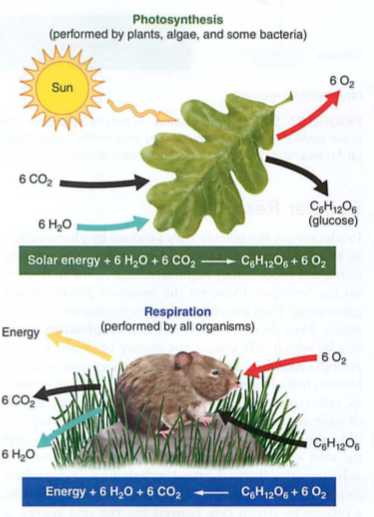
Anaerobic respirationConsumerPrimary consumers eat plants (e.g. herbivores)Secondary consumers eat them (carnivores)Tertiary consumers eat other carnivores (algae->zooplankton->fish->eagles)Scavenger-eats dead stuffDetritovore-eats dead stuff that is decayingDecomposers-break down into basic elementsGPPNPPBiomassStanding cropTrophic pyramid:Delete this content
Not very efficient, unless you can't digest grass, or it takes too much energy to walk around all day. This IS, however a good argument for global sustainable survival, as the sun will not go away soon, and as long as we have arable (farmable) land to grow plants, we could survive with a global population of 8-10 billion.But we'd need access to fresh water...
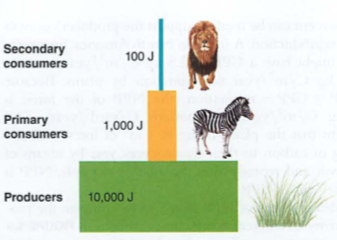
Recall: energy->water->food->culture
Delete this content
Biogeochemical cycles: bio=life geo = minerals chemical = chemical cycle = something that rotatesHeat provides energy for , Plants secrete water as , is collection of water vapor to drops, is the falling of these drops as rain, snow, hail etc. amount of water moving through an ecosystem, usually plants.Farmers need to know EtO to know how much water to supply to their crops.Eto depends on sunlight, humidity, wind and temperature (think of how these impact transpiration)
Module 7: Movement of MatterHydrologic (water) cycle: evaporationtranspirationCondensationPrecipitationETO evapotranspiration:Delete this content
-just like it soundsYou will need to know about "transit time" which is the time it takes rain to reach a water body after hitting the groundWhy is this crucial?(you will see this mentioned in the Poisoned Waters video this weekend) photosynthesis, respiration, exchange, sedimentation, burial, extraction, combustionair<->water<->land-CO2 to sugar (air to plant structures or fruits-e.g. corn)-sugar to CO2-HCO3 (carbonic acid) e.g. seawater changing pH, remember?-CaCO3 (seashells, limestone) most efficient long term carbon sink (solids are dense)burial-just like it sounds, oil, coal, nat gasextraction-mining fossil fuelscombustion-burning fossil fuels with oxygen to release CO2
RunoffCarbon cycle:photosynthesisrespirationacidification or exchangesedimentationDelete this content
6 macronutrients needed by plants: N,P,K, Ca, Mg, S (sulfur becomes part of Methionine, an amino acid)NPK from fertilizersN is a limiting nutrientN fixation is when you can't get Nitrogen off your mindIt also means bringing N2 gas from the atmosphere into the biome, biotically or abiotically (without life): lightning or burning fossil fuels (high temps) direct to nitrate (NO3) (that interesting smell after rainstorms): nitrogen fixing bacteria: N2 ->NO2 ->NO3 ->NH3 ->NH4 ion (used by producers, it is aqueous): petrochemicals to form fertilizers (NH3, anhydrous ammonia, ammonium nitrate NH4NO3, which is used in ANFO bombs): NH4+ ->NO2- ->NO3-nitrite kills bacteria (used in preserving meats), but nitrate is a good plant fertilizer (ANFO bombs): producing amino acids and then proteins (chains of AA) mineralization or ammonification (dead fish smell: NH4+ and amines) = "vital amines": NO3- goes to N2O to N2 gas (anaerobic bacteria, swamps): washing N out of soil
Nitrogen cycle: quiz Define N, P, K and how each impacts plantsDefine evapotranspiration, condensation and precipitationWhich biogeochemical cycle only has a solid phase in the environment?What element replaces oxygen in chemosynthesis?
abioticbioticcommercial N fixationnitrificationassimilationDead stuff:VitaminsdenitrificationLeachingDelete this content
Mainly rocks, between land and waterONLY SOLIDS, NO LIQUID OR GAS PHASE: animals uptake PO4--- (see also phosphoric acid H3PO4), turn it into bones, teeth as CaPO4, then back to soil: phosphate sediments in ocean-> become rocks, erosion on land dissolves into watershed: phosphate detergents, fertilizers (Dead zones) PO4 -> lots of algae on surface (light) -> these die, fall to the bottom, and as they decompose, they take all O2 from the water (hypoxia)Arsenic in bananas---why we cannot use greywater for irrigation
Phosphorus cycle:bioticabioticHumansAlgal bloom:Delete this content
dust (Kauai dependent on Gobi desert dust for K)rocks -> SO4, can become part of methionineSee also SO2 (vog, acid rain, pollution)
Delete this content
Ok, now find Oxygen. Hydrothermal vents use sulfur instead of oxygen for a thermal (heat) version of photosynthesis called Recall negative feedback (stable ships, relationships): greater the disturbance, the greater the restoring force (pendulums too) is how hard it is to move the pendulum (ecosystem) away from center is how fast the pendulum (ecosystem) returns to normalThis is strange stuff:Rare disturbances = competition, so only a few species dominateCommon disturbances = only fast reproducers survive, so low biodiversityIntermediate disturbances = highest biodiversity: drainage basin usually leading to a large body of water (Chesapeake watershed is huge):
chemosynthesisModule 8: Response to disturbancesResistanceResilienceBiodiversity and disturbances:Watershed[https://www.cbf.org/about-the-bay/chesapeake-bay-watershed-geography-and-facts.html](https://www.cbf.org/about-the-bay/chesapeake-bay-watershed-geography-and-facts.html)
Delete this content
How do you think this impacts the water quality, phosphates, nitrates and silt in the Chesapeake bay?Why are we not allowed above the fences behind Pu'u La'e La'e?On Oahu, the watershed is guarded by a barbed wire fence-why?How are the Himalayas acting as a watershed?:On campus try these:Systems
Poisoned waters:Video[http://physics.hpa.edu/physics/apenvsci/videos/poisoned\_waters/POISONED\_WATERS.mp4](http://physics.hpa.edu/physics/apenvsci/videos/poisoned_waters/POISONED_WATERS.mp4)
[http://physics.hpa.edu/physics/apenvsci/videos/poisoned\_waters/poisoned\_waters.m4v](http://physics.hpa.edu/physics/apenvsci/videos/poisoned_waters/poisoned_waters.m4v)
Weblog page:[http://physics.hpa.edu/groups/apenvironmentalscience/weblog/973c4/Poisoned\_Waters\_videoPBS.html](http://physics.hpa.edu/groups/apenvironmentalscience/weblog/973c4/Poisoned_Waters_videoPBS.html)
[http://physics.local/physics/apenvsci/videos/poisoned\_waters/POISONED\_WATERS.mp4](http://physics.hpa.edu/physics/apenvsci/videos/poisoned_waters/POISONED_WATERS.mp4)
[http://physics.local/physics/apenvsci/videos/poisoned\_waters/poisoned\_waters.m4v](http://physics.hpa.edu/physics/apenvsci/videos/poisoned_waters/poisoned_waters.m4v)[http://physics.local/groups/apenvironmentalscience/weblog/973c4/Poisoned\_Waters\_videoPBS.html](http://physics.local/groups/apenvironmentalscience/weblog/973c4/Poisoned_Waters_videoPBS.html)
quiz why is the soil on Kauai so poor, and how does it get its Potassium?how does the size of the Cheseapeake watershed impact eutrophication in the Chesapeake bay?what is the difference between resistance and resilience in natural systems?why do rotting fish smell so bad?
Summary notes:systems are usually connected, exchange matter and/or energymain energy source is our sun, or past suns (e.g. uranium)feedback loops (again)spheres: litho=stone, bio=living, hydro=water, atmo=abovegeosphere: crust-mantle-core-inner core (spins, no way!)plates-who thought this up? need to understand convectionwhere are oldest parts of crust? trick questionsubduction zones, mid atlantic ridges (atlantis?)eq: deep near subduction zones, shallow in transform faultsmid atlantic ridge: how do we know this? submarineshimalayas-how? matterhorn-what?water cycle: evaporation and transpiration (eTO)precipitation-condensation is first (condensation nuclei, e.g. vog)aquifers-underground lakes, low turnover rate (pesticides) Oglallawater can be ground water: aquifer, water table, water lens or surface water
Cycles
conservation of matter (neglect E=mc2)nutrient cycles: carbon, oxygen, phosphorus, nitrogen COPNprimary producers-photosynthesis: CO2, water and light/heatcreate sugar as stored food, structural elementconsumers-eat primary producers, decomposers break down waste/detrituscellular respiration (flowers in hospitals) at nightcarbon also in HCO3- ion (seawater) and CaCO3 (seashells, limestone)greenhouse effect from CO2 captured as plants->oil/coal "carbon bank"phosphorus: rocks and water (stone and sea), erosion, very limited supply in biosphere (Waterloo bones)P only absorbed in aqueous form (aq)too much = eutrophication (also nitrogen) see dead zoneseutrophication: too much of a good thing, when algae dies, decomposes, creates hypoxic zonesaerobic vs. anaerobic bacteria-woundsnitrogen cycle-NPKN2 to life: lightning and bacteria (N2 to ammonia NH3 then to NO2 and NO3 (plants absorb NO3)denitrifying bacteria change NO2 back to N2 (gas)Haber processSee figure 3.30-nitrogen uptakegolf courses-Mauna Kea, iBoat[0 comments](http://physics.hpa.edu/groups/apenvironmentalscience/weblog/a5baf/Chapter_3_modules_68_energy_and_matter_cycles.html#comments)←1-20 of 501[](http://physics.hpa.edu/groups/apenvironmentalscience/blog/?startIndex=20 "Next")
---
Migrated from Apple Server Wiki. Original page ID: W1j374b3
# Import
Chapter 3 Modules 6-8 Movement of energy and matter
Module 6: Movement of energyBiosphere-all life
Producer (also primary producer) gets energy from sun or heat directly, also known as autotrophexample: grass
Photosynthesis: CO2 + water + energy (heat or light) -> sugars (CHO)Reverse process is respiration: Sugars + O2 -> energy + CO2 + water
**Unavailable Apple Wiki media:** the exported data did not include file 05a89973-d852-48ba-9829-ff21a598671a.
Anaerobic respiration (e.g. bacteria) don't use O2, less efficient, older primitive source of energy (pre-oxygen)
Consumer (heterotroph) consumes other primary autotrophs
- Primary consumers eat plants (e.g. herbivores)
- Secondary consumers eat them (carnivores)
- Tertiary consumers eat other carnivores (algae->zooplankton->fish->eagles)
Trophe = "nourishment"Trophic levels = food levels, see also food web
- Scavenger-eats dead stuff
- Detritovore-eats dead stuff that is decaying
- Decomposers-break down into basic elements
GPP gross primary productivity= Total amount of solar energy into the system: like gross income in a businesse.g. all of the money coming into your business
NPP net primary productivity = GPP minus respiration (think of Maui onions):gross income-expenses=net income
Biomass-total mass of all living things in an ecosystem-odd fact: rain forest soil is the lowest in nutrients and biomass-why?
Standing crop-total plant biomass (e.g. forest)Efficiency is low (around 10%)
Trophic pyramid: 10x reduction in energy for each level (why?)-vegetarians vs. meat eatersSo, carnivores (us, wolves) are eating harvesting devices (cows) for autotrophs (grasses):
**Unavailable Apple Wiki media:** the exported data did not include file 9aa3d3ea-e5d7-4018-9604-5e587fa9c258.
Not very efficient, unless you can't digest grass, or it takes too much energy to walk around all day. This IS, however a good argument for global sustainable survival, as the sun will not go away soon, and as long as we have arable (farmable) land to grow plants, we could survive with a global population of 8-10 billion.But we'd need access to fresh water...Recall: energy->water->food->culture
**Unavailable Apple Wiki media:** the exported data did not include file 83426d04-4f93-4ad1-bb17-e1aa5769faa6.
Module 7: Movement of MatterBiogeochemical cycles: bio=life geo = minerals chemical = chemical cycle = something that rotates
Hydrologic (water) cycle:Heat provides energy for evaporation,
Plants secrete water as transpiration,
Condensation is collection of water vapor to drops,
Precipitation is the falling of these drops as rain, snow, hail etc.
ETO evapotranspiration: amount of water moving through an ecosystem, usually plants.Farmers need to know EtO to know how much water to supply to their crops.Eto depends on sunlight, humidity, wind and temperature (think of how these impact transpiration)
**Unavailable Apple Wiki media:** the exported data did not include file 126d4911-26b2-41e9-88c0-34fcb2aa09e7.
Runoff-just like it soundsYou will need to know about "transit time" which is the time it takes rain to reach a water body after hitting the groundWhy is this crucial?(you will see this mentioned in the Poisoned Waters video this weekend)
Carbon cycle: photosynthesis, respiration, exchange, sedimentation, burial, extraction, combustionair<->water<->land
photosynthesis-CO2 to sugar (air to plant structures or fruits-e.g. corn)
respiration-sugar to CO2
acidification or exchange-HCO3 (carbonic acid) e.g. seawater changing pH, remember?
sedimentation-CaCO3 (seashells, limestone) most efficient long term carbon sink (solids are dense)burial-just like it sounds, oil, coal, nat gasextraction-mining fossil fuelscombustion-burning fossil fuels with oxygen to release CO2
**Unavailable Apple Wiki media:** the exported data did not include file a28f9b78-8090-4962-8845-d223ecb1a94d.
Nitrogen cycle:6 macronutrients needed by plants: N,P,K, Ca, Mg, S (sulfur becomes part of Methionine, an amino acid)NPK from fertilizersN is a limiting nutrient
N fixation is when you can't get Nitrogen off your mind
Questions:
1. Define N, P, K and how each impacts plants
2. Define evapotranspiration, condensation and precipitation
3. Which biogeochemical cycle only has a solid phase in the environment?
4. What element replaces oxygen in chemosynthesis?
It also means bringing N2 gas from the atmosphere into the biome, biotically or abiotically (without life)
abiotic: lightning or burning fossil fuels (high temps) direct to nitrate (NO3) (that interesting smell after rainstorms)
biotic: nitrogen fixing bacteria: N2 ->NO2 ->NO3 ->NH3 ->NH4 ion (used by producers, it is aqueous)
commercial N fixation: petrochemicals to form fertilizers (NH3, anhydrous ammonia, ammonium nitrate NH4NO3, which is used in ANFO bombs)
nitrification: NH4+ ->NO2- ->NO3-nitrite kills bacteria (used in preserving meats), but nitrate is a good plant fertilizer (ANFO bombs, [Beirut harbor explosion](https://www.youtube.com/watch?v=LNDhIGR-83w))
assimilation: producing amino acids and then proteins (chains of AA)
Dead stuff: mineralization or ammonification (dead fish smell: NH4+ and amines)
Vitamins = "vital amines"
denitrification: NO3- goes to N2O to N2 gas (anaerobic bacteria, swamps)
Leaching: washing N out of soil
**Unavailable Apple Wiki media:** the exported data did not include file b5b0106e-e8cf-4fb1-b450-b4b1761ffb84.
Phosphorus cycle:Mainly rocks, between land and waterONLY SOLIDS, NO LIQUID OR GAS PHASE
biotic: animals uptake PO4--- (see also phosphoric acid H3PO4), turn it into bones, teeth as CaPO4, then back to soil
abiotic: phosphate sediments in ocean-> become rocks, erosion on land dissolves into watershed
Algal bloom: PO4 -> lots of algae on surface (light) -> these die, fall to the bottom, and as they decompose, they take all O2 from the water (hypoxia)Arsenic in bananas---why we cannot use greywater for irrigation
**Unavailable Apple Wiki media:** the exported data did not include file fcf124e5-49c2-4e12-8ebd-e2c8630e3094.
Ca, Mg and K: dust (Kauai dependent on Gobi desert dust for K)
Sulfur cycle:rocks -> SO4, can become part of methionineSee also SO2 (vog, acid rain, pollution)
**Unavailable Apple Wiki media:** the exported data did not include file b9ad679f-d851-403f-8f52-ab46e87f2fa0.
Here's something interesting:Find Sulfur below:
**Unavailable Apple Wiki media:** the exported data did not include file bfa775c1-5d37-4151-b3b2-510bd442faed.
Ok, now find Oxygen.Hydrothermal vents use sulfur instead of oxygen for a thermal (heat) version of photosynthesis called chemosynthesisModule 8: Response to disturbances
Recall negative feedback (stable ships, relationships): greater the disturbance, the greater the restoring force (pendulums too)
Resistance is how hard it is to move the pendulum (ecosystem) away from center
Resilience is how fast the pendulum (ecosystem) returns to normal
Biodiversity and disturbances:This is strange stuff:Rare disturbances = competition, so only a few species dominateCommon disturbances = only fast reproducers survive, so low biodiversityIntermediate disturbances = highest biodiversity
Watershed: drainage basin usually leading to a large body of water (Chesapeake watershed is huge):[https://www.cbf.org/about-the-bay/chesapeake-bay-watershed-geography-and-facts.html](https://www.cbf.org/about-the-bay/chesapeake-bay-watershed-geography-and-facts.html)
**Unavailable Apple Wiki media:** the exported data did not include file 3d0e8527-360f-4ec0-b479-da632541a44a.
Questions:
1. How do you think this impacts the water quality, phosphates, nitrates and silt in the Chesapeake bay?
2. Why are we not allowed above the fences behind Pu'u La'e La'e?
3. On Oahu, the watershed is guarded by a barbed wire fence-why?
4. How are the Himalayas acting as a watershed?
5. why is the soil on Kauai so poor, and how does it get its Potassium?
6. how does the size of the Cheseapeake watershed impact eutrophication in the Chesapeake bay?
7. what is the difference between resistance and resilience in natural systems?
8. why do rotting fish smell so bad?
Summary notes:Systems
- systems are usually connected, exchange matter and/or energy
- main energy source is our sun, or past suns (e.g. uranium)
- feedback loops (again)
- spheres: litho=stone, bio=living, hydro=water, atmo=above
- geosphere: crust-mantle-core-inner core (spins, no way!)
- plates-who thought this up? need to understand convection
- where are oldest parts of crust? trick question
- subduction zones, mid atlantic ridges (atlantis?)
- eq: deep near subduction zones, shallow in transform faults
- mid atlantic ridge: how do we know this? submarines
- himalayas-how? matterhorn-what?
- water cycle: evaporation and transpiration (eTO)
- precipitation-condensation is first (condensation nuclei, e.g. vog)
- aquifers-underground lakes, low turnover rate (pesticides) Oglalla
- water can be ground water: aquifer, water table, water lens or surface water
Cycles
- conservation of matter (neglect E=mc2)
- nutrient cycles: carbon, oxygen, phosphorus, nitrogen COPN
- primary producers-photosynthesis: CO2, water and light/heat
- create sugar as stored food, structural element
- consumers-eat primary producers, decomposers break down waste/detritus
- cellular respiration (flowers in hospitals) at night
- carbon also in HCO3- ion (seawater) and CaCO3 (seashells, limestone)
- greenhouse effect from CO2 captured as plants->oil/coal "carbon bank"
- phosphorus: rocks and water (stone and sea), erosion, very limited supply in biosphere (Waterloo bones)
- P only absorbed in aqueous form (aq)
- too much = eutrophication (also nitrogen) see dead zones
- eutrophication: too much of a good thing, when algae dies, decomposes, creates hypoxic zones
- aerobic vs. anaerobic bacteria-wounds
- nitrogen cycle-NPK
- N2 to life: lightning and bacteria (N2 to ammonia NH3 then to NO2 and NO3 (plants absorb NO3)
- denitrifying bacteria change NO2 back to N2 (gas)
- Haber process
- See figure 3.30-nitrogen uptake
- golf courses-Mauna Kea, iBoat
by [admin](http://physics.hpa.edu/groups/apenvironmentalscience/search/?q=admin&fields=lastModifiedAuthor)
## [e2: Portland-sense of place](http://physics.hpa.edu/groups/apenvironmentalscience/weblog/ce634/e2_Portlandsense_of_place.html)
e2: Portland-sense of place
[http://physics.hpa.edu/physics/apenvsci/videos/e2\_videos/e2%20transport/5%20Portland-sense%20of%20place.m4v](http://physics.hpa.edu/physics/apenvsci/videos/e2_videos/e2%20transport/5%20Portland-sense%20of%20place.m4v)
1. Morgan Freeman or Brad Pitt?
2. What is urban sprawl and what technologies enable it?
3. Portland was one main shipyard producing “Liberty Ships” in WWII. What drove their economy after that?
4. Portland was on the path of suburban sprawl in the 1960's. What happened?
5. What does this have to do with “Food Deserts”?
6. 1973 was a pivotal year there, what happened, driven by which group?
7. What was the initial reason for the mandate, and what was the final result according to Charlie Hales?
8. Look up Charlie Hales, what was his job after this film (2009).
9. How many years before his tram project was the last urban streetcar project in the US?
10. Explain an urban growth boundary (UGB).
11. Accessibility vs. mobility is the choice they made, like in Switzerland, as well as other European cities. What do you see in the video that you might also see in Europe?
12. What things in the video do you recognize that show a bike friendly city?
13. Who is the first class passenger in Portland, and how does this compare to Los Angeles or other similar city?
14. What is a “sustainable urban lifestyle”?
15. Cities in Europe have vibrant city centers, and are great cities to walk around. How is this done in Portland?
16. Explain "trip behavior".
17. How much did property values increase in the Pearl district after the trolley went in? Why? (note the amount of glass in each trolley). [http://www.explorethepearl.com/](http://www.explorethepearl.com/)
18. Michael Powell of Powell’s books compares buses (“tire-d” transportation) with permanent tracked transportation-what are the differences according to him?
19. How did he sell this idea to the property owners there? Was he right?
20. For what reasons would an electric tram or trolley be greener than a fossil fuel car or even a standard bus?
21. Portland required that every building have street level shops, and limited parking-why?
22. Why would people want to live along a trolley line? Why is quiet key to this?
23. Where in Europe do they also have aerial trams, and do you notice a trend?
24. How does an aerial tram like at OHSU enable different growth trends?
25. If the annual growth rate there is 4%, what is the doubling time in years? (Remember the rule of 70)
26. This film was made in 2009, so what year will the population be doubled from then?
27. What would be different without the tram (parking, traffic, time in car, development)?
28. The young mom says “we did not want to spend all that time in the car”. What is she talking about?
29. Explain "lifestyle migrants".
30. What is "gentrification"? Where else have you seen this? (hint: look up the term "landed gentry") [https://en.wikipedia.org/wiki/Gentrification](https://en.wikipedia.org/wiki/Gentrification)
31. What does the man mean about a "burlap future”?
32. What is the difference between aspiration and acquisition?
33. How does the concept of choice resonate with values in this country? What do you think?
34. Bring this home: what would you do at HPA to make it more sustainable? What about Waimea? Hawaii in general? Your home?
by [admin](http://physics.hpa.edu/groups/apenvironmentalscience/search/?q=admin&fields=lastModifiedAuthor)
## [APES Sem 2 2021-2022](http://physics.hpa.edu/groups/apenvironmentalscience/weblog/0083e/APES_Sem_2_20212022.html)
APES Sem2Housekeeping items:
- Syllabus reminder: FIRST missed homework is dropped
- HW fixed at 20% (no effective change for you)
- Please bring iPads to class
Overview:
The biggest challenges your generation will face are sustainability, pollution/climate change and resource constraints
Recall: energy->water->food->culture
In semester one, we learned about the building blocks of these concepts.
In semester two, you will see them integrate more and more...
Consider:
Europeans -> The New World
Earth 2022 -> Mars
"go west young man"
Sustainability 2022: Semester two
1. Conservation/Land use
2. Energy
3. Pollution/climate change
Challenge:
How can you describe a round staircase to someone without using your hands?
How can you describe deep nature to someone who has never seen it?
National parks: positive, motivated by joy of the wilderness and nature
Sustainability/climate change: negative, based on fear
Tito: "the climate crisis is the biggest business opportunity in the history of mankind"
Land Use: Chapter 10, modules 29-30
Homework: Chapter 10 PQ and chapter questions
Three main points: Living together, thinking of forever...1. Tragedy of the Commons2. Conservation movement3. Urban Sprawl
email: GPS ranching-why is this closer to pre-contact buffalo herds?
Tragedy of the commons (old idea, new article) 1968 Garret Harding KNOW THIS...An old 1833 concept from farming villages, article updated in 1968 this to include rivers, streams, ocean, air...[https://en.wikipedia.org/wiki/Tragedy\_of\_the\_commons](https://en.wikipedia.org/wiki/Tragedy_of_the_commons)
Econ students may know this one:Externalized costs, externality: shedding financial responsibility for your impact the the wholee.g. Minamata: [https://en.wikipedia.org/wiki/Minamata\_disease](https://en.wikipedia.org/wiki/Minamata_disease)
Conservation movement: Important peepsRalph Waldo Emerson-"Nature" "behind nature, throughout nature, spirit is present" 1837[https://en.wikipedia.org/wiki/Ralph\_Waldo\_Emerson](https://en.wikipedia.org/wiki/Ralph_Waldo_Emerson)
Henry David Thoreau-Walden "truth in nature and wilderness over the deceits of urban civilization". 1845[https://en.wikipedia.org/wiki/Henry\_David\_Thoreau](https://en.wikipedia.org/wiki/Henry_David_Thoreau)
Ansel Adams: Photographer championed the National Parks: 1920-1980[http://physics.hpa.edu/physics/apenvsci/videos/ansel\_adams.mp4](http://physics.hpa.edu/physics/apenvsci/videos/ansel_adams.mp4)0:00-8:00
"More than any other artist of the century, he would help transform the meaning of "wilderness" in America and change what people thought and felt about their own land"
"it's a place that you step into, and you don't know what's going to happen, a place that can surprise you, it's a place where you are small, where being small is not a bad thing, where being small is actually a wonderful thing"-Carl Pope, Sierra Club
"...the world is beautiful, that humanity is part of this larger world, that the concerns of the moment are part but not separate from a larger system of forces that that connect us to all of creation"Jonathan Spaulding, Biographer
Question: How did his photographs change the awareness of the public? People usually care about what they know...
Aldo Leopold-environmental ethics, wildlife management, conservation, Sand County Almanac (Wisconsin) [https://en.wikipedia.org/wiki/Aldo\_Leopold](https://en.wikipedia.org/wiki/Aldo_Leopold)
John Muir-started the Sierra Club: "wilderness mirrors divinity, nourishes humanity and vivifies the spirit"[https://en.wikipedia.org/wiki/John\_Muir](https://en.wikipedia.org/wiki/John_Muir)
Rachel Carson-silent spring DDT (persistent pesticide, weakens bird egg shells), 1963:[https://en.wikipedia.org/wiki/Rachel\_Carson](https://en.wikipedia.org/wiki/Rachel_Carson)[https://en.wikipedia.org/wiki/Dichlorodiphenyltrichloroethane](https://en.wikipedia.org/wiki/Dichlorodiphenyltrichloroethane)
MSY: maximum sustainable yield: max renewable output without compromising futureSee: native peoples: "seventh son of seventh son"Also: "Sustainability = thinking about forever"See diagram in chapter, greatest growth is at 50% of carrying capacity (there's that word again!)
Protected lands:
Public lands: often victim of economic predation (e.g. Burma illegal logging)Other side: NRDC and others, purchase lands to protect them from predatory practices (e.g. Amazon basin)In the US: National Parks are one example of a national recognition of several things:1. Spiritual/psychological benefit to nature2. Preservation of resources for future generations3. Recreation4. Habitat preservation for species (can be land, ocean, islands, etc.)
See also Amboseli in Kenya, Serengeti in Tanzania (Tanganyika+Zanzibar), Kruger park in S. Africa (Afrikaans)Public LandsIn the US, we classify public lands as Rangelands-open range, enables some ranching with leases National forests-old growth and new growth, limited forestry National parks-national treasures, limits on visitors, infrastructure (e.g. Denali)National wildlife refuges-usually associated with an endangered species or transit/migration path (e.g. wolves)Wilderness areas-no development, often noise abatement as well (think of helicopters in Waipio or Haleakala)
We have several of these here in Hawaii:Kilauea Volcano (Madame Pele)Haleakala ("House of the sun")Honokohau ("City of Refuge")Pearl Harbor Pu'u Kohola (Whale Heiau)Papa hanau moku a kea-Northwest Hawai'ian Islands NWHI
Federal lands: owned by the people, but can be leased to individuals
Two ethics are in competition:Resource conservation ethic-maximum use based on greatest good for everyone, usually preservationMultiple use lands-designated lands for grazing, timber, minerals, leased to individuals or companies for profitLand Management in the US:BLM: Bureau of land managementGrazing, ranching, monitors rangeland health, erosion
USFS: Us Forest ServiceManges timber harvesting, where, how, what treesOld growth vs. new growth, replanting, clear cut?
FSC: Forest stewardship council:FSC certification: no clear cut, no damage to land, replanting, selective cutting, underbrush considerationsHUGE debate over underbrush, USFS believes in regular forest fires to deplete the amount of underbrush (as in nature)See also California and Australia wildfires: drought, no regular fires, buildup of underbrushSee Yellowstone fire of 1988-result of overgrowth of underbrush
Forests: clear cut vs. selective cutFSC wood-how different?[https://en.wikipedia.org/wiki/Forest\_Stewardship\_Council](https://en.wikipedia.org/wiki/Forest_Stewardship_Council)
Fire management: Yellowstone fire 1988[https://www.northcountrypublicradio.org/news/npr/94114095/series-overview-yellowstone-s-evolution](https://www.northcountrypublicradio.org/news/npr/94114095/series-overview-yellowstone-s-evolution)
USFS prefers many small fires, removing flammable underbrush
NPS: National park serviceManages parks for recreation, multiple use ethic, preservation of timber, minerals and "natural curiosities"Also significant native peoples monuments (see above)
FWS: Fish and wildlife serviceManages fishing and hunting on all public lands
Know these:BLM: Bureau of Land Management USFS: US Forest Service NPS: National Park Service FWS: Fish and Wildlife Service
NEPA: National Environmental Policy Act 1969 (why then?) mandates an EIS for all developmentEIS (environmental impact statements) are new standard for any projectESA endangered species act-often brought in where development could impact ES
Solution: Urban Growth Boundary (UGB) ex. Portland, OR
UGB (Urban Growth Boundary)-see PortlandPrevents Urban Sprawl (richer folks move to the suburbs, commute, need parking, city dies from the inside, food deserts, etc.)Portland Example of urban planning:Tom McCall Governor of Oregon, 1967-1975
Charlie Hales Mayor of Portland 2013-2017
Videos:[e2: Portland sense of place](http://physics.hpa.edu/physics/apenvsci/videos/e2_videos/e2%20transport/5%20Portland-sense%20of%20place.m4v)
[e2: The green apple](http://physics.hpa.edu/physics/apenvsci/videos/e2_videos/e2%20design%201/1%20green%20apple.mov)
Frog book: Chapter 10: land use, urbanization, sustainable cities
5 steps to a 5 review:

[e2: Portland sense of place](http://physics.hpa.edu/physics/apenvsci/videos/e2_videos/e2%20transport/5%20Portland-sense%20of%20place.m4v)
[e2: The green apple](http://physics.hpa.edu/physics/apenvsci/videos/e2_videos/e2%20design%201/1%20green%20apple.mov)
Three main points: Living together, thinking of forever...1. Tragedy of the Commons2. Conservation movement3. Urban Sprawl
email: GPS ranching-why is this closer to pre-contact buffalo herds?
Tragedy of the commons (old idea, new article) 1968 Garret Harding KNOW THIS...An old 1833 concept from farming villages, article updated in 1968 this to include rivers, streams, ocean, air...[https://en.wikipedia.org/wiki/Tragedy\_of\_the\_commons](https://en.wikipedia.org/wiki/Tragedy_of_the_commons)
Econ students may know this one:Externalized costs, externality: shedding financial responsibility for your impact the the wholee.g. Minamata: [https://en.wikipedia.org/wiki/Minamata\_disease](https://en.wikipedia.org/wiki/Minamata_disease)
Conservation movement: Important peepsRalph Waldo Emerson-"Nature" "behind nature, throughout nature, spirit is present" 1837[https://en.wikipedia.org/wiki/Ralph\_Waldo\_Emerson](https://en.wikipedia.org/wiki/Ralph_Waldo_Emerson)
Henry David Thoreau-Walden "truth in nature and wilderness over the deceits of urban civilization". 1845[https://en.wikipedia.org/wiki/Henry\_David\_Thoreau](https://en.wikipedia.org/wiki/Henry_David_Thoreau)
Ansel Adams: Photographer championed the National Parks: 1920-1980[http://physics.hpa.edu/physics/apenvsci/videos/ansel\_adams.mp4](http://physics.hpa.edu/physics/apenvsci/videos/ansel_adams.mp4)0:00-8:00
"More than any other artist of the century, he would help transform the meaning of "wilderness" in America and change what people thought and felt about their own land"
"it's a place that you step into, and you don't know what's going to happen, a place that can surprise you, it's a place where you are small, where being small is not a bad thing, where being small is actually a wonderful thing"-Carl Pope, Sierra Club
"...the world is beautiful, that humanity is part of this larger world, that the concerns of the moment are part but not separate from a larger system of forces that that connect us to all of creation"Jonathan Spaulding, BiographerQuestion: How did his photographs change the awareness of the public? People usually care about what they know...-----Land use:MSY: maximum sustainable yield: max renewable output without compromising futureSee: native peoples: "seventh son of seventh son"Also: "Sustainability = thinking about forever"

Public lands: often victim of economic predation (e.g. Burma illegal logging)Other side: NRDC and others, purchase lands to protect them from predatory practices (e.g. Amazon basin)In the US: National Parks are one example of a national recognition of several things:1. Spiritual/psychological benefit to nature2. Preservation of resources for future generations3. Recreation4. Habitat preservation for species (can be land, ocean, islands, etc.)
See also Amboseli in Kenya, Serengeti in Tanzania (Tanganyika+Zanzibar), Kruger park in S. Africa (Afrikaans)Public LandsIn the US, we classify public lands as Rangelands-open range, enables some ranching with leases National forests-old growth and new growth, limited forestry National parks-national treasures, limits on visitors, infrastructure (e.g. Denali)National wildlife refuges-usually associated with an endangered species or transit/migration path (e.g. wolves)Wilderness areas-no development, often noise abatement as well (think of helicopters in Waipio or Haleakala)
We have several of these here in Hawaii:Kilauea Volcano (Madame Pele)Haleakala ("House of the sun")Honokohau ("City of Refuge")Pearl Harbor Pu'u Kohola (Whale Heiau)Papa hanau moku a kea-Northwest Hawai'ian Islands NWHI

Two ethics are in competition:Resource conservation ethic-maximum use based on greatest good for everyone, usually preservationMultiple use lands-designated lands for grazing, timber, minerals
Changes:
Let's check out these guys again:English folks might recall Emerson, Thoreau and WhitmanConservation movement: Important peepsRalph Waldo Emerson-"Nature" "behind nature, throughout nature, spirit is present"[https://en.wikipedia.org/wiki/Ralph\_Waldo\_Emerson](https://en.wikipedia.org/wiki/Ralph_Waldo_Emerson)
Henry David Thoreau-Walden "Truth in nature and wilderness over the deceits of urban civilization"[https://en.wikipedia.org/wiki/Henry\_David\_Thoreau](https://en.wikipedia.org/wiki/Henry_David_Thoreau)
Teddy Roosevelt- ca. 1900, National Parks[https://en.wikipedia.org/wiki/Theodore\_Roosevelt](https://en.wikipedia.org/wiki/Theodore_Roosevelt)
[http://physics.hpa.edu/physics/apenvsci/videos/national%20parks/](http://physics.hpa.edu/physics/apenvsci/videos/national%20parks/)
First two minutes, start again at 7:00-10:00Note influence of railroads in parks as well as all lands in the west (Leland Stanford, for example)"Americans think 100 years is a long time, and Europeans think 100 miles is a long distance..."
Aldo Leopold-environmental ethics, wildlife management, conservation, Sand County Almanac (Wisconsin) [https://en.wikipedia.org/wiki/Aldo\_Leopold](https://en.wikipedia.org/wiki/Aldo_Leopold)
John Muir-started the Sierra Club: "wilderness mirrors divinity, nourishes humanity and vivifies the spirit"[https://en.wikipedia.org/wiki/John\_Muir](https://en.wikipedia.org/wiki/John_Muir)
Rachel Carson-silent spring DDT (persistent pesticide, weakens bird egg shells), 1963:[https://en.wikipedia.org/wiki/Rachel\_Carson](https://en.wikipedia.org/wiki/Rachel_Carson)[https://en.wikipedia.org/wiki/Dichlorodiphenyltrichloroethane](https://en.wikipedia.org/wiki/Dichlorodiphenyltrichloroethane)
Land Management in the US:BLM: Bureau of land managementGrazing, ranching, monitors rangeland health, erosion
USFS: Us Forest ServiceManges timber harvesting, where, how, what treesOld growth vs. new growth, replanting, clear cut?
FSC: Forest stewardship council:FSC certification: no clear cut, no damage to land, replanting, selective cutting, underbrush considerationsHUGE debate over underbrush, USFS believes in regular forest fires to deplete the amount of underbrush (as in nature)See also California and Australia wildfires: drought, no regular fires, buildup of underbrushSee Yellowstone fire of 1988-result of overgrowth of underbrush
Forests: clear cut vs. selective cutFSC wood-how different?[https://en.wikipedia.org/wiki/Forest\_Stewardship\_Council](https://en.wikipedia.org/wiki/Forest_Stewardship_Council)
Fire management: Yellowstone fire 1988[https://www.northcountrypublicradio.org/news/npr/94114095/series-overview-yellowstone-s-evolution](https://www.northcountrypublicradio.org/news/npr/94114095/series-overview-yellowstone-s-evolution)
USFS prefers many small fires, removing flammable underbrush
NPS: National park serviceManages parks for recreation, multiple use ethic, preservation of timber, minerals and "natural curiosities"Also significant native peoples monuments (see above)
FWS: Fish and wildlife serviceManages fishing and hunting on all public lands
Know these:BLM: Bureau of Land Management USFS: US Forest Service NPS: National Park Service FWS: Fish and Wildlife Service
NEPA: National Environmental Policy Act 1969 (why then?) mandates an EIS for all developmentEIS (environmental impact statements) are new standard for any projectESA endangered species act-often brought in where development could impact ES
Urban sprawl:
UGB (Urban Growth Boundary)-see PortlandPrevents Urban Sprawl (richer folks move to the suburbs, commute, need parking, city dies from the inside, food deserts, etc.)Portland Example of urban planning:Tom McCall Governor of Oregon, 1967-1975
Charlie Hales Mayor of Portland 2013-2017E2 video: Portland: Sense of Place....listen for Brad Pitt:[http://physics.hpa.edu/physics/apenvsci/videos/e2\_videos/e2%20transport/5%20Portland-sense%20of%20place.m4v](http://physics.hpa.edu/physics/apenvsci/videos/e2_videos/e2%20transport/5%20Portland-sense%20of%20place.m4v)
weblog withgott 6.6
[http://physics.hpa.edu/groups/apenvironmentalscience/weblog/19b82/Withgott\_66\_Sustainable\_Development.html](http://physics.hpa.edu/groups/apenvironmentalscience/weblog/19b82/Withgott_66_Sustainable_Development.html)
[0 comments](http://physics.hpa.edu/groups/apenvironmentalscience/weblog/2ca78/Land_Use_Modules_2930.html#comments)
November 29, 2021
by [admin](http://physics.hpa.edu/groups/apenvironmentalscience/search/?q=admin&fields=lastModifiedAuthor)
[e2: Food miles](http://physics.hpa.edu/physics/apenvsci/videos/e2_videos/e2%20transport/3%20Food%20miles.m4v)
e2: Food miles
1. Look up Michael Pollan: what books has he written?
2. What is the fossil fuel to food ratio he cites?
3. Why is this so high?
4. What did it used to be?
5. What does he mean by “sustainable agriculture”?
6. Why did WWII give us a new form of agriculture?
7. Look this up: in 1895, what portion of our workforce in our country was farmers? What is it today?
8. Look up Lancaster PA, and who lives there?
9. Local farmers may not be able to sell to Foodland and other grocery stores because of guarantees of supply. Where can the farmers then sell their produce, and what does this imply?
10. When you go into Foodland and see the sandwiches and other wrapped foods, where were these prepared? Why? Why is this so nasty?
11. Starbucks baked goods used to be baked here in Waimea (Mamane Bakery, behind the Montessori school). They are now baked on the mainland and shipped here frozen. Why does this make sense for Starbucks, and what impact does this have on you?
12. McDonalds gets their food products from the mainland in huge truck and air shipments. Why do they do this?
13. In the video, why is a restaurant that buys local food better than the examples above?
14. Do you know of a restaurant here in Waimea that does this? What about our cafeteria?
15. Why would Amish farmers be more sustainable farmers than other modern farmers?
16. How many miles does the average food item travel in the video? Add 2500 miles for us, what is the new total?
17. Why would they fly salmon to China and back?
18. Local farmers can supply “food baskets” also known as a “CSA”. What are these and why are they more sustainable? [https://en.wikipedia.org/wiki/Community-supported\_agriculture](https://en.wikipedia.org/wiki/Community-supported_agriculture)
19. Is “eating local” always a good thing? What are these folks known as?
20. What is the difference between a solar and a fossil fuel food supply?
21. What percentage of our income do we spend on our food? Is this the same in Hawaii? In Waimea? Why?
22. Where does most of the cost of food go?
23. Why do you think folks do not cook the way Pollan suggests?
24. Contrast the amount of each dollar going to a farmer in the past and now. How does localization change this?
25. Ok, now think of your home. What could you do differently?
by [admin](http://physics.hpa.edu/groups/apenvironmentalscience/search/?q=admin&fields=lastModifiedAuthor)
## [Food: Modules 31-33](http://physics.hpa.edu/groups/apenvironmentalscience/weblog/71a3f/Food_Modules_3133.html)
Weekend: Unit 4 ZipgradeNext week: review week, finals (using zipgrade forms)Modules 29 and 30 on land in January Recall our main themes: energy->water->food->cultureFood!Three main groups: Proteins: always include NitrogenCarbohydrates: CHO in chains (starches) or simple (sugars)Fats: CHO again, but in a special branch structure (glycol backbone) that is good for energy storage and insulation (e.g. killer whales, eskimos)
Proteins: complex molecules of CHO and N. Look up amino acids, note the common structure.Now look up the amino acid methionine. What element does it contain as well? Why do rotten eggs, swamps (and Kilauea volcano) stink?
CHO=carbohydrates (clever name), usually in a chain, short chains are sugars (used for fuel), longer ones are starches and can be used for structures (e.g. cellulose in plants) or pasta...smallest: sugars, all end in -ose (glucose, sucrose) LOOK THESE UP, CHECK OUT THEIR MOLECULE SHAPEglucose is a "monosaccharide" created by photosynthesis (next chapter)longer chains: starches (rice, pasta) slowly digested (see diabetics, and glycemic index)structural CHO: cellulose-little boxes with goo inside, need enzymes to break these down (cows)ENZYMES ALL END IN -ASE
Fats/lipids: same chemical structure as CHO, but built along a glycol (alcohol) backbone. If the fats have long carbon chains with only single bonds, they are saturated (lots of Hydrogen atoms) and can hold together (e.g. animal fat)[https://en.wikipedia.org/wiki/Saturated\_fat](https://en.wikipedia.org/wiki/Saturated_fat)
If the long chains have double bonds and don't fit together, they melt easier (e.g. oils) and are called "unsaturated", usually better for your health.n.b. McDonalds® got into real hot water a while ago for frying all of their stuff in "supersaturated fats". Ugh...
Notes: Chapter 11 FR Overview:
- Frog 12.3 Agriculture
- Frog 12.4 Food Production
- Ch. 12 assessment
- FR ch. 11 feeding the world
- mod 31 nutritional needs
- mod 32 industrial ag-insecticides, GMO
- mod 33 sustainable farming
Big picture:
- Trophic pyramids in nature are sustainable
- Planet is nearing carrying capacity (K)
- Think of how many "earths" your global footprint represents
- To meet this food demand, current farming and fishing is industrial, not sustainable
Mod 31: Nutritional needs-what humans on our planet need, and what they lackRead the case study p. 373-how is this like a trophic pyramid in nature?Undernutrition: lack of caloriesMalnutrition: lack of critical part of diet, usually protein (Kwashiorkor)[https://en.wikipedia.org/wiki/Kwashiorkor](https://en.wikipedia.org/wiki/Kwashiorkor)
Food security: not just in lesser developed countries ("LDC"), also in the US"Food deserts"-what are these?Famine: one of these impacting a large group, often from crop failure, drought or war/displacementOvernutrition: common in the US, look up the US obesity rate-how is this determined? Why? Seen any food ads lately?Look up US obesity rate-----Meat diet: high in protein, also in fat (energy store) and cholesterol-these contribute to heart diseaseWait-Eskimos eat lots of blubber, why don't they have heart disease? How is this different from Kalahari bush tribes?ClimateWait, wait-what happened to Japanese health care system when they moved from their traditional diet?What impact does this have globally?Diet for a small planet 1971: planet can sustain population using fewer calories while supplying protein, vitamins and calories. Not by relying on meat.Vitamins="vital amines"Food energy subsidy (cost factor):20 kg of grain to produce 1 kg of beef (20:1 factor, or subsidy factor 20x)2.8 kg of grain to produce 1 kg of chicken (2.8:1 factor, or subsidy factor of 2.8)Better to eat beef, chicken, fish or tofu? (you need protein in some form)
Food miles:Average 1240 miles from farm to table (more here, unless you shop at the farmer's market)[e2: Food miles](http://physics.hpa.edu/physics/apenvsci/videos/e2_videos/e2%20transport/3%20Food%20miles.m4v)
Mod 32: Industrial Farming (and fishing)Agribusiness: just what it sounds like, the larger conglomerates taking over instead of smaller privately owned family farms. Often use monoculture crops to increase profits (economy of scale), as well as patented seeds and herbicides (e.g. "roundup ready corn")
Hybrid crops vs. GMO crops:Started as a good thing: Hybrid crops"Selective breeding" works for animals (dogs, etc.) and crops called "hybrid crops" created by mixing pollen from one breed of plant (e.g. large kernel corn) with another breed of the same plant (e.g. short stalk corn) to form a "hybrid".
Green Revolution, Norman Borlaug-Mexican famine averted by development of hybrid (not GMO) wheat, called dwarf wheat (large kernel, short stalk).[dwarf wheat](https://en.wikipedia.org/wiki/Wheat)
GMO crops:in the beginning were just to withstand frost, now into a larger patent issue with GMO seeds and "round up ready crops"What is the impact on lesser developed countries of this business model?
[Genetically modified organisms (GMO)](https://en.wikipedia.org/wiki/Genetically_modified_organism) are different: they are done by splicing one part of a gene from an organism (like a frost resistant bacteria) into a totally different species (like a tomato) to make it frost resistant."IP" means intellectual propertyMonsanto spends money creating GMOs, so they patent the process, meaning using their seeds requires an IP license from them (just like software).If your farm has these seeds, intentionally or by accident, you have to pay them.You also cannot "re-use" seeds in the next season without paying for them.This is just like software in that you could buy the software or pay a monthly fee to use it.Which makes more money for the company?What is the impact on poorer countries?Roundup ready corn: seeds genetically modified to resist roundup (a herbicide)Result: plant their seeds, spray their herbicide and save money on weeding, more crops, more money (to whom?Issue: exposure to roundup (a carcinogen) and possible impacts of mutated foodLabeling? Where is this done so far?[GMO from Food inc.](http://physics.hpa.edu/physics/apenvsci/videos/food_inc/food%20inc-GMO.m4v)
High Fructose Corn Syrup: HFCSCorn Lobby is very powerful (Iowa=presidential primaries)Corn: HFCS (food, meat, fish) and Corn Ethanol (energy, fuel)HFCS is in everythingCorn is used to feed cattle, pork, poultry, even fishCattle are not used to metabolizing corn, it makes them sickBad for humans, increases incidence of diabetes[HFCS from Food inc.](http://physics.hpa.edu/physics/apenvsci/videos/food_inc/food%20inc-corn.m4v)
Main problems:
- Irrigation-desertification
- Pesticides-persistent organic pollutants (POPs)-like in your water hunt
- Fertilizers-eutrophication
Waterlogging: too much water in the soil, roots die (see hydroponics demo at elab, cycles water and air)Salinization/desertification: using well water for irrigation, salts build up in the soil, infertile soil resultsSoil degradation:[Dirt 00-8:00](http://physics.hpa.edu/physics/apenvsci/videos/dirt/dirt_0-8.m4v)Look up Wangari Maathai
Pesticides and herbicides: can be persistent or not (DDT, round up)Invented during WWII to kill humans (nerve gases, nazis), ("homicides")Modified to kill pests ("pesticides") or insects ("insecticides")Special cases include rodent poisons ("rodenticides") and others, like plants ("herbicides")
Pesticide resistance-much like COVID: genetic variation in a rapidly multiplying pathogen will eventually overcome the stress (recall evolution) by replicating only those with immunity to the stress (vaccine, pesticide, drug resistant TB)
Here's one pesticide that changed malaria around the world: DDT:[https://en.wikipedia.org/wiki/Dichlorodiphenyltrichloroethane](https://en.wikipedia.org/wiki/Dichlorodiphenyltrichloroethane)

Inorganic fertilizers: also something from war (Haber process, WWI)Haber process enabled nitrogen from the air to be chemically grouped with other compounds like Ammonium nitrate: NH4NO3This process uses huge amounts of petrochemicals, so these fertilizers are attached to the cost of oil (not coal)Ammonium nitrate and fuel oil (diesel) can also be combined to make explosives, look up [ANFO bombs](https://en.wikipedia.org/wiki/ANFO) and terrorism.
Fishing:Aquaculture means fish or other water animal farmed in the oceanHydroponics means growing plants in a water/air mediumFisheries: population of fish, look up [Atlantic Cod](https://en.wikipedia.org/wiki/Atlantic_cod) fisheries collapse in 1990Bycatch: unnecessary death of animals caught in fishing nets/traps (dolphins, sharks, etc.)
Mod 33: Sustainable agriculture (fishing too)Desertification (see above)intercropping vs. monocropping, see ["the three sisters"](https://en.wikipedia.org/wiki/Three_Sisters_(agriculture))Contour cropping: saves space, reduces runoff, preserves top soil (e.g. our garden, most of Asia)No-till ag: same idea, retains organic material in topsoil, reduces erosion by wind and waterIPM: integrated pest management (see Lalamilo Farmers)Organic agriculture (also mentioned in [Portlandia and Colin the Chicken](https://www.youtube.com/watch?v=G__PVLB8Nm4))More than just N-P-K, also micronutrients, slower release time, low salinityCAFO: concentrated animal feed operation (e.g. chickens, pigs, cattle)Usually inorganic feed (purines), hormones and other drugs
Methyl xanthines: caffeine, theobromine, theophyllineevolved plant poisons for insects:

- Xanthine: group name
- Caffeine: energy drinks, coffee, soft drinks (to offset drowsiness from insulin spike)
- Theobromine: chocolate
- Theophylline: tea (also a bronchodilator-helps breathing)
Actually, almost anything that ends in -ine is usually a plant poison evolved to kill insects:
- nicotine: tobacco
- caffeine: coffee, tea
- cocaine: coca plants
[0 comments](http://physics.hpa.edu/groups/apenvironmentalscience/weblog/71a3f/Food_Modules_3133.html#comments)
November 19, 2021
by [admin](http://physics.hpa.edu/groups/apenvironmentalscience/search/?q=admin&fields=lastModifiedAuthor)
## [Poisoned Waters, part Deux](http://physics.hpa.edu/groups/apenvironmentalscience/weblog/6c360/Poisoned_Waters_part_Deux.html)
Poisoned Waters-Frontline Video
Video is here:
[http://physics.hpa.edu/physics/apenvsci/videos/poisoned\_waters/POISONED\_WATERS.mp4](http://physics.hpa.edu/physics/apenvsci/videos/poisoned_waters/POISONED_WATERS.mp4)
High quality version is here:
[http://physics.hpa.edu/physics/apenvsci/videos/poisoned\_waters/poisoned\_waters.m4v](http://physics.hpa.edu/physics/apenvsci/videos/poisoned_waters/poisoned_waters.m4v)
You may find it helpful to download this into your own computer: hold the option key while clicking on the link.
Context:
- Water Pollution-air pollution-climate change
- Watersheds, transit time
- water pollution:continuity, local until ocean,
Segments:
Segment 1: Chesapeake bay: 00-45:00
> - Chesapeake watershed
> - EPA CWA 1970
> - Perdue/hog Ag farms, Eutrophication
Segment 2: Potomac River: 45:00-54:00
> - Endocrine disrupters-drinking water
Segment 3: Puget Sound: 54:00-1:33:00
> - Bioaccumulation-PCB Killer Whales
> - Boeing-PCBs from runways
> - Runoff-water transit time King County
Segment 4: FairFax County, VA: 1:33:00-1:54:00
> - Tyson’s corner-transit time, sediment runoff
> - Loudon county-traffic planning
> - Arlington-urban planning
Questions:Chesapeake Bay
1. Why is it useful to get the historical view of the craggy old fishermen?
2. How are the fish an indicator species?
3. How large is the Chesapeake watershed?
4. Why is this bay uniquely vulnerable?
5. What causes dead zones in the film?
6. What is the global trend in dead zones? where?
7. What three basic functions of the bay will likely be lost to your generation?
8. What was different 40 years ago?
9. What was the cause and effect process of Earth Day and the EPA?
10. Did Nixon back the clean water act? Explain.
11. What were the key tenets of the CWA?
12. What were the initial actions of the EPA?
13. RFK jr. says he could not swim in the Hudson, Charles or Potomac. Where are these?
14. Why did you have to take a shower if you fell into these rivers?
15. What was the Potomac point source pollution source described in the film?
16. What is BNR and how does it work?
17. What is not removed from human wastewater with BNR that concerns us?
18. How did Reagan’s policies impact the EPA and pollution regulation?
19. What is “voluntary compliance” and did it work? explain.
Factory farms
1. What is the biggest danger with concentrated animal farms/ CAFOs (poultry, pigs, cows)?
2. Look up why we have different names for the same animals: cow/beef,chicken/poultry, pig/pork
3. Why is it advantageous for Perdue to subcontract chicken operations?
4. What is vertical integration?
5. What was the national response to cheap chicken?
6. If you were to put chicken manure on your garden, you could burn your plants. why?
7. On the way downhill to the coast, there is an egg factory that went out of business, who now sells “manure compost”. Where did this come from, and how is it a good deal for them?
8. Why does not Perdue own the chicken waste, if they own the chickens? How does the Perdue guy dodge the problem?
9. What is the difference between city waste and ag waste?
10. What does the chicken guy say about deer?
11. What did the chicken lobby in Maryland (Eastern shore) do about pollution regulation? why?
12. How is this similar to the Iowa corn ethanol lobby?
13. RFK Jr. describes two things: externalized costs and subsidies. What does he mean by these?
Endocrine disrupters
1. Why are not endocrine disrupters part of the clean water act?
2. What is intersex in the male bass? what causes this?
3. How does the concept of river continuity impact endocrine disrupters?
4. Do they need to be very concentrated to be effective?
5. A person flushes birth control pills (hormones) or other drugs down the drain. How can this impact someone living many miles downstream?
6. Why are these hormones not filtered by water treatment plants?
7. What is “synergism”? Why is it critical here?
Puget Sound
1. How cold is the water in Puget Sound? Why is this relevant?
2. Why do the apex predators have the highest concentration of PCB?
3. What is a sentinel species? why is this relevant?
4. Which population of humans is now showing similar health effects?
5. What is Superfund, who funds it?
6. What is the biggest liability problem with the Boeing dioxin situation?
7. What is the concept of “deep pockets”?
8. Why would native Americans be the indicator species in the Duomish river?
9. Is South Park (not the tv show) upper income or lower, immigrant or not? Why is this important?
10. On the AP exam, you will be expected to know all about Love Canal. How is this similar?
11. What do you think is coming out of the pipe underwater in the video?
12. Why are “impervious surfaces” so bad for the Puget Sound?
13. Why do folks get upset about oceanic oil spills and not the stuff you see in the video?
14. What is the difference in "transit time" for rain water hitting concrete vs. soil?
15. Ron Sims has enemies in King county. Who?
16. How is the Growth Management Act/Critical Areas Ordinance (CAO) similar to the Urban Growth Boundaries (UGB) concept in Portland Oregon (we'll see this in the Portland e2 video)
17. Look up the CAO now. How is it going?
Fairfax
1. Look up Tyson’s corner. What did it look like in 1945?
2. Would Tyson’s corner have been successful without cars?
3. How is Tyson’s corner like Los Angeles?
4. How is Arlington different from Tyson’s corner?
5. In a sense, US cities are learning to become more like older European cities. Why are they different?
6. What is the meaning of the phrase “canary in the coal mine” and where did this term come from?
7. According to the narrator and Governor of Washington, what is a necessary part of the solution?
8. What is your part in this future?
Summary questions:
1. You have chosen the water treatment manager for a small town in Doofania that gets its water from a river, with Uglyopolis upstream and Ya-ya town downstream. What steps would you take to make sure you and the other towns are getting clean water, and describe impact of an upstream sewage plant in Uglyopolis and a nuclear power plant on the river in Ya-ya town.
2. From the Poisoned Waters Frontline video, choose one of the stories and explain why it is important to you, what it explained, and how it relates to your work.
by [admin](http://physics.hpa.edu/groups/apenvironmentalscience/search/?q=admin&fields=lastModifiedAuthor)
## [Modules 26-28 Water ch. 9](http://physics.hpa.edu/groups/apenvironmentalscience/weblog/e0b7f/Modules_2628_Water_ch_9.html)
Recall:
Energy->Water->Food->Culture(Also Chapter 12 in Froggie book)
Water: key points
> Section one: What is it, where is it:
> Freshwater, saltwater, how it moves, aquifers and reservoirs, impact of climate change, water wars
> Section two: Pollution:
> Often human driven (anthropogenic): Nutrient, thermal, BOD, sediment
> Almost always human driven: Pathogens, inorganic chemicals, organic chemicals, radioactive chemicals
> Section three: Water Quality index:
> DO, BOD, pH, temp, turbidity, conductivity, nitrates (NO3), phosphates (PO4)
Section one: What is it, where is it?Where is the water? Note: 97% salt water
Huge [Ogallala aquifer](https://en.wikipedia.org/wiki/Ogallala_Aquifer)-note recharge time is in centuries, pesticides in Nebraska, cancer rates there are very high...
Two emerging critical issues for China due to climate crisis:
- Pearl river delta and salt intrusion (sea level rise): gradual slope, so 1 meter of sea-level rise is many km of salt intrusion, so no more rice farming in that area
- Vanishing Himalayan Glaciers: no farming in western China, no annual flow through their two main rivers
[Glaciers](http://physics.hpa.edu/physics/apenvsci/videos/glaciers.mov)
Glaciers are the "water towers" for all of Asia...Rivers impacted:Ganges, Yangtze, Yellow, Mekong, Brahmaputra, Irrawaddy, Indu, Salween,

Section two: Water PollutionBig ideas:
1. Rivers are continuous, so easier to find sources along the route (continuity analysis: all sources add to total)
2. Groundwater is harder to determine point sources, as flow is over larger area (not confined by river banks) and there is no continuity analysis possible (we don't know sources and sinks)
3. Oceans are the hardest to trace, and impact everyone eventually, just like the atmosphere, only without the rain, and it is wetter. And full of fish.
Major Water Pollution categories:
Note that temperature changes DO (dissolved oxygen) content, so does physical agitation (aeration).Section three:Water Quality Index:[http://www.water-research.net/index.php/water-treatment/water-monitoring/monitoring-the-quality-of-surfacewaters](http://www.water-research.net/index.php/water-treatment/water-monitoring/monitoring-the-quality-of-surfacewaters)
[http://www.water-research.net/watrqualindex/index.htm](http://www.water-research.net/watrqualindex/index.htm)
[http://www.pathfinderscience.net/stream/cproto4.cfm](http://www.pathfinderscience.net/stream/cproto4.cfm)
Calculation worksheet:
[http://www.pathfinderscience.net/stream/forms/WQI\_worksheet.pdf](http://www.pathfinderscience.net/stream/forms/WQI_worksheet.pdf)
Main case studies-each related to a form of human pollution:Case 1: High turbidityCauses: erosion of topsoils, till farming, no cover crops, e.g. dustbowl in the USImpact: poor light transmission, so low photosynthesis, low DO
Case 2: Low Dissolved Oxygen (DO)Causes: Thermal pollution, e.g. power plants on rivers
Case 3: Eutrophication (high N and/or P)Causes: Fertilizers, animal waste, e.g. Mississippi dead zone, Chesapeake bay
Chesapeake bay is the perfect storm of these three: 1. Warm water: shallow, so no cool lower zone away from sunlight, dissolved solids turn visible light into heat2. High Turbidity: watershed runoff from rivers to the Appalachian range and north to NY state3. Eutrophication: chicken and pig farms, runoff from farms along watershed
See also point source and non-point source pollution (from Poisoned Waters video, remember the Deer?)
Important: cooler water holds dissolved oxygen better (fishermen know this, so do the fish).
Water Quality Lab:Tests: Probe sets
- Turbidity sensor: passes light through a small vial, measures light that passes, low light=high turbidity
- Conductivity: passes electric current through sample, proportional to salt content
- Temperature: warmer water has lower DO
- Dissolved Oxygen: amount of oxygen dissolved in the sample
- pH: acid/base tendency
Tests: dip strips:
- Alkalinity
- pH
- Hardness (calcium/mineral content)
- Iron
- Copper
- Lead
- Nitrate
- Nitrite
- Chlorine
Lab samples
1. Post waterfall
2. Post power plant
3. Everglades close to ocean
4. Post sewage plant
5. Best fishing spot
6. Mine tailings runoff
7. Snow melt river
8. Mississippi river
9. Chesapeake river
10. Flood after monsoon rains
11. Golf course runoff
12. Eutrophied lake
Metrics:
- DO
- BOD
- pH
- temperature
- turbidity
- conductivity
- nitrates
- phosphates
Title: what the lab is about
Background: some information to give context to your reader
Purpose: what you hope to study
Materials: everything needed for the experiment
Procedure: what you do with these things to study the purpose
Data: any numbers, charts, tables or information using numbers
Observations: anything not explained by your numbers above
Error Analysis (optional, but required in college): what went wrong, possible reasons or explanations, when proving something or synthesizing something, what is your yield, percent error, and why
Conclusions: think back to your purpose-what did you discover, how would you improve upon this in the future, what lessons could be shared with others?
Example:
Title: Making Chocolate chip cookies
Background: Home made chocolate cookies are the best, so making them at home is a necessary skill
Purpose: To make chocolate chip cookies at home
Materials: flour, sugar, butter, sugar, vanilla, sugar, chocolate chips (nuts optional, but yucky)
Procedure: Pre-heat oven to 550°F, mix ingredients, test for taste, put blobs on greased cookie sheet and bake for 45 minutes.
Data: 12 totally burned cookies, 25 grams each
Observations: cookies were burnt to a crisp, inedible and quite stinky
Error analysis: temperature was too high, baking time was too long
Conclusions: next time we try this, we should reduce temp and cooking time
by [admin](http://physics.hpa.edu/groups/apenvironmentalscience/search/?q=admin&fields=lastModifiedAuthor)
## [Modules 24-25 earth and soils](http://physics.hpa.edu/groups/apenvironmentalscience/weblog/f85d9/Modules_2425_earth_and_soils.html)
Module 24: Earth ScienceKey points:
- All elements up to Iron on the periodic table came from the big bang
- Earth was formed from materials created by first generation stars going supernova
- The core of the earth is made up of a rotating solid core surrounded by a liquid core
- The inner core creates our magnetic field, which reverses periodically
- Layers: crust-mantle-outer core-inner core
- Uranium in the core produces heat that travels to the surface by convection
- Tectonic plates on the surface move on top of the sticky asthenosphere because of this convection
- Spreading zones are were these plates are created, subduction zones are where they dive under others
- Subduction zones create trenches in the ocean and andesitic volcanoes (sticky lava, pointy cones)
- Hot spots in the crust can create basaltic volcanic islands like the one we are on (runny lava, broad cones)
- Earthquakes include P (primary, compression) waves and S (secondary, shear) waves
- P waves are faster and go through solids and liquids, S waves only travel through solids
First, there was the big bang (see the cute video here: [https://www.youtube.com/watch?v=xzAOhyOtfqc](https://www.youtube.com/watch?v=xzAOhyOtfqc))The only thing at first was Hydrogen, which is just a proton and an electron, sometimes a neutron making isotopes of HydrogenStars formed from this hydrogen, and through fusion created all of the elements up until Iron (Fe)Look this up on your periodic table------[https://ptable.com/#Properties](https://ptable.com/#Properties)Eventually, these stars expanded and then collapsed...Smaller stars became neutron stars or various versions of theseHuge ones (15x our sun size) exploded and created all of the elements after Fe (check the periodic table again)so,Any element in you below Fe on the table came from an exploding starcool...NASA and other folks are really interested in two things now: exoplanets (planets outside our solar system) and asteroids[https://www.cnn.com/2020/10/23/world/asteroid-bennu-sample-update-scn-trnd/index.html](https://www.cnn.com/2020/10/23/world/asteroid-bennu-sample-update-scn-trnd/index.html)
Why?Well, if we know what asteroids are made of, we have a clue about what materials (e.g. water) that were around when the solar system formed.From this info, we can look for those elements in other solar systems, and look for life there.Back to our earth...
This is how our solar system formed. Our earth was molten for a long time, then cooled to become solid-mostly.Since it is also made up of Uranium and other things that combine to create heat, our planet is still really hot deep down.A minister named Ussher ([https://en.wikipedia.org/wiki/Ussher\_chronology](https://en.wikipedia.org/wiki/Ussher_chronology)) worked backwards from the molten state to solid state of the earth to guess that the earth was created one Sunday afternoon in 4004 BC.We was not stupid, he just did not know about Uranium, and our molten core...Here's what we know the earth to look like (check this out on your globes too):Layers: (onion boy)Core-Mantle-Crust-think of an apple
The core is actually two bits: solid inner iron and nickel, liquid outside that bit. It spins, giving us a weak magnetic field which switches direction every few thousand years. Remember this, it comes up later...How do we know this? Nuclear bomb testing and our global seismic sensor network.How?Two key clues about the earth came from military conflict: one from WWII and another from the cold war, when everyone was building bigger and bigger bombs.First the cold war part:We set up seismic sensors called seismographs all over the world to spy on Russian and Chinese nuclear ("A-Bomb", fission) and thermonuclear ("H-Bomb", Fusion) bomb testing to see how powerful they were.You next need to know that there are two main types of earthquake wave: P or "primary" waves which are compression waves. and S waves "secondary waves" that are transverse, like shaking a slinky.P waves are faster, and go through solids or liquids, but at slightly different velocities.S waves are slower, and can only travel through solids.So,Here's what they saw:

This data was found by spying on atomic bomb tests in the 1950s, not because we wanted to know about the guts of our planet...
Now, to the WWII part...Submarines like to hide underwater, so planes and ships can't find them.So, during WWII, our side tried dragging little magnetic sensing torpedo thingys from behind their ships, hoping to detect submarines. (they later used airplanes too).Here's what they found:What the heck is this?
Ok, let's break this down: between England and the US, they found stripes of North then South weak magnetic fields.When they got to the middle of the Atlantic (about where Iceland is on the map above), the pattern reversed.Huh?That's what they said too...Remember the shifting magnetic field every few thousand years?As the magma came out of the earth in the molten state, it solidified in the magnetic field of that time, so the newest lava was along the center of the ocean (under Iceland too).
Ok, now shift quickly to a meteorologist named Alfred Wegener. Meteorologist is a fancy name for a person who studies the weather.He cut out the continents on a map (like, with scissors) and noticed that South America and Africa fit nicely together. Try this on your globe----Everyone in the geology community told him he was nuts.He later froze to death in Greenland, but I digress...
Then, these strange magnetic stripe thingys showed up from the ships dragging those [magnetic torpedoes](https://en.wikipedia.org/wiki/Magnetic_anomaly_detector)....and it proved he was RIGHT:Remember how hot is was in the earth core?That heat rises to the surface as magma (say like Dr. Evil), just like the Hadley, Ferrel and Polar cells do:
So, connecting all of these dots, the plates are floating on the magma, some created at the mid-Atlantic ridge, others diving down under others in subduction zones....what about those subduction zones?What mountains are in Chile?Volcanoes are the key:Two kinds of volcanoes: Andesitic (pointy), Basaltic (runny, look out your window)Andesite-from pressure and heat as plates subduct (sticky, high silica content, e.g. Andes mountains)Basalt-from ocean crust, lots of water, makes for weak, runny magma, formed as magma pushes through watery ocean platesSubduction zones:
Note the sticky stuff boiling up in red-this is why the Andesitic volcanoes are sticky, and always found near subduction zones (Andes, Cascades, Japan, Italy, etc.)Note also the trench where the subduction zone goes down: this is the origin of the Chilean/Peruvian trench we covered in the El Nino notes, as well as the deepest part of the ocean: the Marianas Trench, which is 7 MILES deep. Whoa!
Let's review the geological players:Magma-(Dr. Evil voice here: [https://www.youtube.com/watch?v=yVo1S52xdpI](https://www.youtube.com/watch?v=yVo1S52xdpI))Asthenosphere-"sticky rock" (from [Greek](https://en.wikipedia.org/wiki/Greek_language "Greek language") ἀσθενής asthenḗs 'weak' + "sphere")Lithosphere-floating rock (litho = stone) ([Ancient Greek](https://en.wikipedia.org/wiki/Ancient_Greek "Ancient Greek"): λίθος \[lithos\] for "rocky", and σφαίρα \[sphaira\] for "sphere")Continents-even more floaty, made of lighter rock (granite) that formed from the interaction of magma with oceans
Plates are large, float on the AsthenosphereContinents are like rafts on the Asthenosphere, more buoyant than the platesThe plates can slide under each other (subduction zones), crash into each other (Himalayas), next to each other (transform faults), and are formed at spreading zones (divergent boundaries)
Neato. What about those earthquakes?Check this out:
Historic data shows subduction zone quakes that would create a tsunami 1000' high or more on the Pacific northwest coast, flooding everything west of I-5.
Look at all of the earthquakes (red dots) as the plate subducts
Two things to take-away about subduction zones:1. subduction zones create ANDESITIC (pointy) volcanoes, which are high in silica, and sticky like thick pancake batter.2. subduction zones create lots of deep-focus earthquakes.
We are lucky enough to live on an island with several active or dormant volcanoes. We live on top of a "hot-spot":
Hot spots:Usually in the middle of an oceanic plate, but can also be mid-continent (e.g. Yellowstone supervolcano caldera)Hot spots-basalt-low silica content which melts easier (e.g. look out the window)
Look at the Hawaii island chain on google earth (underwater version)While you are at it, look for the Nuuanu landslide that created a 4000' tsunamiYou can also look at the Mauna Loa simulated tsunami on youtube...
This is what happens to a shield volcano when it "calves" one side, in this case, the northeast side, in the [Nuuanu](https://en.wikipedia.org/wiki/Nu%CA%BBuanu_Slide) landslide, one of the largest landslides on earth, causing a tsunami that deposited coral on the top of Mt. Kaala, 4055 ft. high...
The epicenter is the place ON THE SURFACE above the hypocenter (true origin) or earthquake FOCUS. Deeper hypocentric quakes often feel "longer", while shallow hypocentric quakes feel "sharp".

How do we find these?Seismographs:P waves travel by compression (comPression). These are longitudinal waves, like sound. They can travel through liquid or solid.S waves travel by shear (Shear). These are transverse waves, like a slinky. They can only travel through solids.Remember this?

Ok, back to earthquakes.Suppose you have a house on posts (called "post and pier" construction). An earthquake happens some distance away. First, your house moves back and forth (P wave, much faster at 8 km/sec). After a time, your house bounces up and down from the S waves (slower at 3 km/second).If you are far away, these are separated by different arrival times.If you are near the epicenter, they hit at the same time...up, over, down=your house is demolished
We use this difference to calculate distance from the epicenter (and hypocenter if you are interested) using delay times on the seismograph
Look at the HPA seismograph here:[http://www.fdsn.org/networks/detail/PT/](http://www.fdsn.org/networks/detail/PT/)
and our Hawaii quakes here:[https://volcanoes.usgs.gov/observatories/hvo/hvo\_earthquakes.html](https://volcanoes.usgs.gov/observatories/hvo/hvo_earthquakes.html)
Click on some earthquakes and note the depth and the seismic image.
Next: Rocks Module 25Igneous (fire)Sedimentary (layers)Metamorphic (Kafka rocks, just kidding: changed by heat and pressure)
Igneous= directly from magma, and can be either basalt (low melting point, like our island or oceanic plates) or granite (lighter, what continents are made of)Granite breaks down into light-colored sand, makes for fertile soil. Basalt (like us) can make sand too, but less fertile (e.g. black sand beach).
Sedimentary= just like it sounds, from mud, sand, or dust, usually in layers.
Metamorphic= changed by heat and/or pressure (slate, marble, or coal)
Soil-formed by weathering (chemical or physical) of parent rockErosion can be by water or air (wind)
Soil Horizons:
Our Soil Sieve has 4 filters, with 5 layers:mesh 5 = 4 mmmesh 10 = 2 mmmesh 60 = .25 mmmesh 230 = 0.063 mm
Basically, most of what you find is silt and clay...[0 comments](http://physics.hpa.edu/groups/apenvironmentalscience/weblog/f85d9/Modules_2425_earth_and_soils.html#comments)
October 28, 2021
by [admin](http://physics.hpa.edu/groups/apenvironmentalscience/search/?q=admin&fields=lastModifiedAuthor)
## [Populations Mods 23-24](http://physics.hpa.edu/groups/apenvironmentalscience/weblog/952b2/Populations_Mods_2324.html)
First of all a flow diagram:
Note that this is for a country, not the planet, since people (so far) are not leaving the planet...or arriving from elsewhere.National version as a formula:

If you look at the planet as a whole (sans aliens or Elon Musk):

so, there is a neat shorthand formula for this:

Which is an estimate, the real number is 69.3 (why? look below if you want to know)Here is an example:

Note that as the growth rate increases, the doubling time decreases.Look for this on the AP as multiples/fractions of 70: 14, 28, 35, and so on...
You can also see this by using our previous formula: Nt = Noe^rtSet N to 100, try with a 7% growth rate (0.07 is r) and set time to be 10 years (70/10)Calculate NtHere's what this might look like:
When calculating growth rates, always use the CHANGE in population divided by the base population, e.g. 7/100 is 7% growth rate, so this population would go from 100 to 107, like in the chart above.
Now, to babies: TFR is the total number of babies a woman will have in her lifetime.Replacement level fertility (RLF) is just above 2.0, (usually 2.1, as some babies don't reproduce or make it to reproductive age).What does this mean in Japan, where young people are not having babies?
RLF depends on developed/developing nations as well (clean water, medical care, access to food, war)Life expectancy: depends on these as well...Infant mortality: under age 1 (reason for big Hawaiian one year birthdays)child mortality: under 5
Look up life expectancy in 1900...Look up the average family size and how many made it to age of 5 in 1900What portion of the US population was farmers then?
Age structure diagrams/population pyramids-check these out: UAE, Japan, Sudan, Iraq/Iran, Russia----WHY?See also baby boom and boom echoes...Check this out:[https://www.populationpyramid.net/world/2021/](https://www.populationpyramid.net/world/2018/)
...and look these up:
1. Go to 1950 and look at the US population. Look again in 1960. Where is the baby boom? Why were there so few babies born during 1940-45?
2. If you were a 42 year old American in 2000, when were you born? How old are your kids? Find the "boom echo".
3. Find the impact of the Iran/Iraq war of 1980-89, which side had the biggest impact? If you were a 35 year old Iraqi man in 1995, how old were you during this war?
4. If you are a 30 year old German man in 1950, when were you born? How old were you in WWII (1936-1945)?
5. If you were a 35 year old woman in Japan in 1960, why are there so few men to choose from?
6. Look at the UK in 1960. Where are the casualties of WWII, and are they both male and female? Explain.
7. What the heck is going on in UAE?
8. Look at Russia in 1960. What gaps do you see? Why?
9. Information about China is very spotty-why would this be? See if you can find the impact of the one-child policy from 1979-2021.
10. Compare present day Japan to Africa. What issues will they need to address?
11. Look at present day Italy, Japan and Germany. What is common?
12. Compare present day India and China. What do you see?
Terms to know: Human Populations-----------------------------Fecundity: the ability to reproduce
Fertility: production of offspring
CBR: crude birth rate: births per 1000 people
TFR: total fertility rate: total kids per woman in her lifetime (25-30!)
ZPG: zero population growth: 5+ where infant mortality is high, 2.1 is normal
China: was 6 -> 1.8 (below replacement level since 1979, one child policy)
China has a 140/100 male to female ratio: why?
Global TFR is 2.6
CDR: crude death rate: deaths per 1000
Why is there a life span? mitochondrial DNA...
1900 Indian man had life expectancy of 23! Trace this to now...
Not now, reasons: nutrition CLEAN WATER, sanitation, education
75 men, 85 women (testosterone, war, "hold my beer and watch this!", Darwin Awards)
Dependency ratio; baby boomers and your future: how many workers to retirees
imagine your life at your age in other countries...
Russia low TFR: alcoholism and antibiotic resistant Tuberculosis
Module 23 Demographic Transition
Things to notice:1. in phase 1, lots of babies, lots of death (infant mortality and short lifespans), so population is low 2. as clean water, sanitation and health care improve, deaths drop, so population rises3. as women gain reproductive rights and/or education, the birth rate drops (many factors here), while death rate stays low, so the population growth curve flattens a bit (hard to see on this diagram)4. as industrialization includes more women, esp. as professionals, they may delay pregnancy later in life, so there is actually a population drop. Examples are Italy, Japan and Germany, where the dependency ratio (number of people depending on social retirement divided by number of people in the workforce paying into the system) is greater than 1.0.
Make sure you can cite at least one example country for each...1. Sub-Saharan Africa, most of the world before the industrial revolution2. Afghanistan3. US4. Japan
Another view:

Imagine two scenarios: Case 1: A sustainable pacific island community, no phones, internet or electricity. Food sources are local, there is little affluence (tribal community), also less poverty, and a self-limiting population, limited by K, in this case food.Case 2: Urban community, large population, lots of affluence (think NYC or SF), everyone has an iPhone or similar device, a computer, a car, a refrigerator, TV, and a wide selection of clothing, food and housing.
IPAT: the impact on an ecosystem = population x affluence x technology
Why is Apple using a robot ("Daisy") to take apart iPhones? How does this impact iPAT?[https://www.apple.com/newsroom/2018/04/apple-adds-earth-day-donations-to-trade-in-and-recycling-program/](https://www.apple.com/newsroom/2018/04/apple-adds-earth-day-donations-to-trade-in-and-recycling-program/)
Which parts of the iPAT formula does this impact, and in which ways?
Think also of electric vehicles: great for the environment, but use materials (Lithium, Neodymium, etc.) that need to be mined. Gasoline/Diesel cars need steel, glass, plastic and some rare materials for electronics, but are much worse for the environment, both in production, use and disposal. More on this later.-------------------[https://www.gapminder.org/tools/#$chart-type=bubbles&url=v1](https://www.gapminder.org/tools/#_chart-type=bubbles)
[https://www.ted.com/talks/hans\_rosling\_on\_global\_population\_growth](https://www.ted.com/talks/hans_rosling_on_global_population_growth)--------------------GDP vs. GNP (nationalism, global economy)GDP is global domestic product, or the sum of all goods and services delivered inside a countryThis was the standard growth metric until recently...GNP is the same thing, but includes multinational companies, or companies "off shore"
Urban areas, UGB (Portland)

See also Ecological Footprint Calculator:
[http://www.footprintnetwork.org/resources/footprint-calculator/](http://www.footprintnetwork.org/resources/footprint-calculator/)
[https://www.ted.com/talks/hans\_rosling\_shows\_the\_best\_stats\_you\_ve\_ever\_seen](https://www.ted.com/talks/hans_rosling_shows_the_best_stats_you_ve_ever_seen)(9 minutes)
Play with these:
[https://www.gapminder.org/](https://www.gapminder.org/)
[https://www.gapminder.org/tools/#$chart-type=bubbles&url=v1](https://www.gapminder.org/tools/#_chart-type=bubbles)
Rule of 70, er 69.3...The TRUTH!We know that Nt =Noe^rtWhen Nt/No = 2, this is the doubling timeln (Nt/No) = ln (e^rt)ln(e^x) = x just like square root of x squared is x. They are reverse of each other...ln (2) = 0.693 = rtSo...0.693/r = t2, the "doubling time"But wait! we saw 70, not .693...Growth rates are in percent (part/100) so the percents cancel out, meaning you can just use percent as a number, like 14%.You will certainly see this on an AP exam, usually as a multiple or fraction of 70: 14, 28, 35, 7, 3.5...Rule of 70 rules! (or actually the rule of 69.3)....
Next: earth and soils:[https://www.youtube.com/watch?v=xzAOhyOtfqc](https://www.youtube.com/watch?v=xzAOhyOtfqc)
[0 comments](http://physics.hpa.edu/groups/apenvironmentalscience/weblog/952b2/Populations_Mods_2324.html#comments)
October 18, 2021
by [admin](http://physics.hpa.edu/groups/apenvironmentalscience/search/?q=admin&fields=lastModifiedAuthor)
## [Mod 18-21 Population Ecology](http://physics.hpa.edu/groups/apenvironmentalscience/weblog/c3170/Mod_1821_Population_Ecology.html)
See also chapter 5 in Withgott: Evolution, species interaction, communities and species interactionsLab: Predator prey phase delayModule 18-abundance and distributionStart with this:
A crude example of this might be:individual-youpopulation-HPA studentscommunity-HPAecosystem-educationbiosphere-the world
or:some rabbit individualsome of the rabbit's friends, a population of rabbitsrabbits and the things they eat and eat them-communityecosystem-the plants that support both ends of this processbiosphere-the planet
We covered ecosystem energy and matter a few weeks ago, this chapter is about population ecology.
--------------------
Population dynamics
Notation: Population size is represented as N (note not "n"): population size within a defined area at a specific time (brings in migration).So, we could say the student population of HPA would be all students here this year, 2020-2021
Check out the diagrams on population distribution: random, uniform and clumped. Important vis a vis biodiversityStructures: age and gender (sex)

Density dependent factor: e.g. food or reproductive rate in rats (more rats, lower fecundity)Something that influences reproduction or survival...
Density independent factors: storms, disasters, fires (note density independent: one bambi or 100 bambi all perish in the same fire)
Limiting resource: usually food, but could include space, nutrients, etc.
Carrying capacity: K (note not "k"): how many individuals an environment can support
Module 19: growth modelsImagine you are a happy bacteria, or rabbit, with lots of food, land and no predators. Your population growth curve might look like this:

This is called exponential growth, or "J shaped growth"Note that it has no end, or limiting factor.
Small r is the growth rate. If you have had physics (yay!) this is usually "k" in some examples, or related to RC decay/growth.Learning this equation is VERY useful.Note that it depends on two things: the starting amount in the population (No) and the growth rate (r)Here is an example:
You might also find this link useful:[https://www.khanacademy.org/science/ap-biology/ecology-ap/population-ecology-ap/a/exponential-logistic-growth](https://www.khanacademy.org/science/ap-biology/ecology-ap/population-ecology-ap/a/exponential-logistic-growth)
Many systems follow J shaped exponential growth until they run out of food or space, then there is overshoot and die-off:

A more ideal version of this is the S shaped curve, called logistic growth:

Here is a formula for logistic growth that we'll discuss:
Don't be intimidated by this formula...dN/dt is just delta N over delta t, or the ∆ in number over the ∆ in time,or the rate of population growth (some of you may see this as the slope of the S curve)Note that when the ratio N/K is very small or close to zero, the stuff in the parentheses becomes 1, so the formula is rate = rN, or J curved exponential growth.As N/K nears one (number of critters equals carrying capacity) the term in the parentheses becomes zero, so no growth.Note also that if N/K is GREATER than one, the growth rate (slope of the curve) become negative. This is overshoot and die off.

------Logistic growth worksheetFirst: exponential growth:
Imagine 10 imaginary rabbits (No=10)
Assume r = 0.5 (50 percent growth rate, or each rabbit makes 0.5 rabbits per year)
Find the population 2 years later:
Nt = Noe^rt
Nt = 10e^0.5\*2
Nt = 27 rabbits
After 4 years:
After 10 years:
———
Next, use the logistic growth formula, same data, with a carrying capacity (K) of 100:
Small population: 10 rabbits
∆N/∆t = rN(1-N/K)
= 0.5\*10(1-10/100)
= 5(1-0.1)
= 5(0.9)
= 4.5 rabbits per year
Find the rabbits per year for these populations:
Medium population: 27 rabbits
Near K: 74 rabbits
Above K: 1489 rabbits
quiz (you may use your worksheet only)
1. 30 rabbits live on an island with carrying capacity 200. They reproduce at a rate of 0.5 per year. How many rabbits will be on the island after 3 years? (hint: you would do the calculation three times-this is only an estimate though, the true formula would be a bit more complex)
2. What will be the slope of the growth curve at this point?
Next: predator/prey phase diagramsCheck this out:
Now we can discuss generalizations of r and K strategists:Note: r comes from small r (growth rate) in the growth formula, while K comes from large K in the same formula (carrying capacity):

Where do you fit in? How about Nemo?

Birds also fall into type II (no pun intended), as they randomly crash into stuff...There is a fourth type: deer. How would you imagine this curve?Related:Another reason why genocides are so damaging to cultures: If an oral tradition (e.g. Hawaiians) are decimated by smallpox for example, it is the very old (the holders of the legends and history) and the very young (those who have time to listen, not work, and will then grow up and tell their kids) that are gone. This is a sort of cultural bottleneck...
Module 20: Community ecologyCompetitive exclusion principle: two species competing for the same resources cannot co-exist, leads to...Resource partitioning: time, space, type of food (one species picks one, the other survives)Relationships:Predation: predator and prey, one lives, the other diesSymbiotic:Mutualism: both benefitCommensalism: one benefits, no harm to the otherNon-symbiotic:Parasitism: one benefits, harm to other

[quizlet review](https://quizlet.com/144858427/ecological-relationship-flash-cards/)
keystone species vs. indicator speciesKeystone species-many others depend on it, removal has an impact much greater than their relative population
e.g. beavers: create habitat for others (dams), so they are also "keystone engineers", only they don't wear funny hats.
Here's what a keystone looks like:

In architecture, if you remove the keystone, the arch collapses. Cool term, right?
This is different from a capstone (seniors might like this): a capstone is what you put on top of a finished structure
Another example: "keystone predators" e.g. sea stars, which eat mussels, clearing space on rocks for other species
Indicator species-signal health of a system, like some fish or worms signify water quality, also known as "bioindicators"
Succession: one species takes over another in time
Module 21: Community SuccessionPrimary succession: From bare rock, no soil: (e.g. lichen)
These hold moisture and some sort of matrix (e.g. soil) so that others can then grow
You might imagine driving from the Kohala coast up to Waimea, seeing bare lava along the coast, then fountain grass, then small bushes, then trees along the stream, then larger trees away from the stream. Water is the key to life, so anything that can trap and hold water (e.g. soil) can support life.
Secondary succession: from disturbed area with soil (e.g. after a fire)-there is soil, but no plants, growth here might be quicker than primary sucession.
Pioneer species: arrives first, sets up reliable system of water and matrix
Climax community: stable, well evolved ecosystem, e.g. old growth forest, able to survive disasters (e.g. fire)
Aquatic succession: from stream (flowing water) to pond (less flow) to shallow pond (even less flow) to marsh (mostly mud)
Island biogeography (like here in Waimea): habitat size AND distance from others influences diversity (e.g. birds)
This was Darwin's whole gig, also some folks off the coast of Chile, often with birds involved.
Check out an alternate presentation of these in the Withgott text, with a special section about our island:
[http://physics.hpa.edu/physics/apenvsci/texts/withgott/withgott%206e/3-4.pdf](http://physics.hpa.edu/physics/apenvsci/texts/withgott/withgott%206e/3-4.pdf)
Frog book chapter 5:
Questions:
1. What three things in order are necessary for evolution to succeed?
2. What are the characteristics of an r specific species. Give an example.
3. What are the characteristics of a K specific species. Give an example as well.
4. The population of wolves may rise and fall along with rabbits, but not at the same time. Explain why.


Northern Lights over Scotland: space weather.comCME event: coronal mass ejection[https://en.wikipedia.org/wiki/Coronal\_mass\_ejection](https://en.wikipedia.org/wiki/Coronal_mass_ejection)
------------------------------Mod 14: Biodiversity: (see also chapter 7 in Froggie book)
Mod 15: EvolutionThree conditions must be met:1. genetic variation (mutation)2. some stress that favors this variation (adaptation)3. survivors procreate, pass on the variation (reproduction)
Genotype: set of genes (dominant and recessive)Phenotype: traits expressed in a living creature
Genetic drift-pretty much what it sounds likeBottleneck effect-VERY important: when a species is almost extinct, there is little variation in the gene pool of the survivors, even if their population rebounds (e.g. whales hunted almost to extinction, the entire gene pool is limited to the diversity of the sole survivors)Founder effect: random selection of survivors, creating a new gene pool (birds, gilligan)
Questions:1. If the early atmosphere of our planet was thinner and less developed, it might have allowed more cosmic radiation to reach the surface. How would this impact the natural mutation/evolution rate?2. what would be the impact on an ecosystem of rampant mutation rates?
Mod 16: speciationGeographic isolation (e.g. Galapagos) also found where we disturb natural habitats with roadsThis causes Allo (other) Patric (father) speciationEventually reproductive isolation will result: different breeds will not be able to procreate
There is another more rare form of speciation: Sympatric ("same father"), from polyploidy, ("many chromosomes")
GMO: see roundup ready corn and wheat, freeze proof tomatoes and others.Not to be confused with Dwarf Wheat and Norman Borlaug (see population chapters for more on this).Dwarf wheat was a simple hybrid, not a GMO.Look up "gene guns" and CRISPR
Mod 17: niches and species distributionCheck this out:

You'll see another like this in population distributions...Range of tolerance-where it can surviveFundamental niche-happy placeRealized niche-de facto placeDistribution-areas where they live (we'll see more of this in the chapter on population distributions: random, scattered, patterned)Global Biodiversity:Note biodiversity increases closer to the equator:
Labwash your handspour out a random number of different colored goldfish on your plate (your "pond")determine the number of distinct populations by color, using chopsticksdetermine the proportion for each population (e.g. 5 red ones out of 20 total would be 5/20 or 0.25)calculate Shannon's index (H) for this "pond"repeat the experiment with a very low biodiversity, calculate Hrepeat with a very high biodiversity, calculate Heat the contents of your "pond", representing a catastrophic eventQuestionswhat is the value of biodiversity in any community?what are the benefits and drawbacks of a low biodiversity?how does this play into competition (next chapter)why is it important to determine the number of "distinct populations"?what is the impact of this on a human population, e.g. the census?
Check-in review:Unit 2 from Cliff notes 2011: Unit 2 practice exam p. 190-----NEXT: Population ecology-----------

NPP: biomass after respiration(rate which primary producers convert energy to biomass)
tropical rain forest-canopy (layers)--------
poor soil nutrient levels (all in trees)

shallow roots, big leaves, lots of rainpitcher plants-eat animalsepiphytes-grow on other plants (e.g. orchids)air rootsspecialized animals
tropical dry forest——
deciduous forest: warm, but variable rain (e.g. monsoon)autumn leaves-loss to protect plant, changes in photosynthesiswaxy leaves (e.g. pine needles) if over winter plantsestivation: hibernationmigration: birds (why birds and not other animals?)
savanna——
very dry, few trees, seasonal grasses, firesporous soils (like Kona), often coffee locations (s. america)waxy leaves, deep roots
desert——
under 25 cm (250 mm) of water per year (10 inches)dry dry dry, so dramatic temp variations (opposite of ocean biomes)few plants, low nutrient levels in soilnocturnal animals (e.g. rats, snakes)succulents: store water (e.g. cacti)large, shallow roots, also taproots (160 ft. deep)temperate rain forest——not too warm, not too cold, just rightrainy, warm, mossy, foresty (e.g. washington, oregon, BC)coniferous-have pine cones, conifers: oily needles (don’t freeze)lumber
temperate forest——
eastern US: oak etc. seasonal loss of leaveshibernating animals
temperate (mild) grassland——
prairie, steppe (russia)moderate rain, but not enough for trees. grass only.grass grows from below, so can be eaten by cattle and still liveroots capture moisture, hold soil together (kikuyu grass)
chaparral——
California, mediterranean (middle of the earth, contrast with chinese translation of the word “china”: middle earth kingdom)dry, seasonal rain, drought (like now)
Boreal (north) forest———
taigaacidic soils (from conifers/pine needles as competition)very coldconifer shape sheds snow, preserves branches (christmas trees)when ground freezes, no water for roots, all water stored as sap in trees (oily compound, very sticky, makes retsina in Greece)
tundra——
russia, alaska, canadavery cold-study the climatograph (-220 °C!) right….permafrost-permanently frozen ground, so only shallow roots
polar ice—
not really a biome, but stuff lives there (aquatic mammals, fish, very small rocks, churches, mud, but no ducks)Notothenioids-antifreeze fishblubbery mammals
mountains—
another non-biome, but look at this!
Recall terrestrial biomes are defined by temperature and precipitation (rain)Aquatic biomes are by definition underwater, so they are defined by We separate aquatic biomes into freshwater (lakes, rivers, streams) and saltwater (oceans, estuaries):Riparian=riverLimnotic=lakes:Shallow shore area=littoral (means shallow), see the "littoral Navy", photosynthesis here (shallow, light shines through)Open water area=limnetic zone, no rooted plants (too deep), phytoplankton here, only as deep as sunlight can penetrateDeep water=profundal ("profound") or deep zone: no light penetrates, bacterial decomposition.Bottom=benthic zone: mud, dark, cloudy

how cool is that?
aquatic ecosystems—
salinity, depth, standing or flowing watersalt water = 30-50 ppt (parts per thousand)ppt, ppm, ppbfresh water = 0.5 pptin between 0.5-30 ppt = brackish (anchialine ponds in Kona)study the fishies in the picturesDEPTH!!!!determines amount of light, tf. photosynthesisphotic zone=lightaphotic=no lightbenthic=really no light, never, ever ever. don’t even think about it.aquatic mammals must surface for airfishies don’t-gillsDO dissolved oxygen (very important) depends on plants (so depth) and temp (cooler water can hold more O2)warm water has low O2 generally.best place to fish: cool water after a waterfall (why?)flowing water: riversstanding water: pondslakes can become inland seaslittoral=shore, limentic=away from shore benthic=botttomwetlands:marshes, swamps, bogs and fensmarshes marshes marshes!-tall grassesswamps-some treesbogs-acidic, poor decomposition, floating stufffens-spring underneath, less acidic, better nutrientsbogs decay slowly-ancient cheese story, peat mossrivers-oxbow lake and meandersource, tributary (continuity concept), mouth (delta)slope exponential as distance from sourcedeposition rates (rapids vs. plains)silt carrying capacity, turbidityestuaries-like deltastidal estuary: hudson river: deeper than the body it serves
oceans——
200 ft. of salt if all oceans evaporatedoceans were red (iron) then ppt out (iron range in WI, MI)salinity, wind and temperature determine flowupwelling (recall Peruvian fisherpersons)also downwellingphotic zones-intertidal zone-makes sense, between tidesneritic zone-close to shore, less than 200 ft. deep (not in Hawaii, we have no continental shelf-boo hoo)open ocean (pelagic) zonekelp forests-e.g. california coastcoral reefs-away from fresh water, coastal, photicopen ocean-scary stuff
[admin](http://physics.hpa.edu/groups/apenvironmentalscience/search/?q=admin&fields=lastModifiedAuthor)[Mod 13 Aquatic Biomes](http://physics.hpa.edu/groups/apenvironmentalscience/weblog/9e540/Mod_13_Aquatic_Biomes.html)Depth: how deep is the deepest part, how much photosynthesis is possibleDistance from shore: shallow water has more life, more things to attach to, more biodiversity
Freshwater biomesLakes
: note usually related to photosynthesis (plants)Oligo (few) trophic=low productivityMeso (middle) trophic=mediumEutrophic (eu=good trephien=food)=lots of productivity (sometimes too much, like in "Poisoned Waters")Freshwater wetlands-submerged most of the time (swamps, marshes, bogs) this is the history of all coal and oil we now use usually connected to the sea, act as a coastal buffer for Hurricanes, very productive, many nutrients, lots of organic materialp: special version of this in Tropical areas (e.g. Florida) area between high and low tide or seasonal variationsCoral reefs-see coral bleaching, pH, temperature and salinity sensitive (see Hamakua coast vs. Puako)Intertidal zone: between high and low tidePhotic (light) zone-shallow, photosynthesis, kelp, othersAphotic (dark) zone-too dark for photosynthesisChemosythesis/thermosynthesis: deepwater steam vents, based on Sulfur instead of Oxygen, bacteria generate energy with methane (CH4) and H2S (instead of H20)Benthic=deep oceanPelagic=open ocean (think of big sailing ships, whales, stuff like that)Hadal zones: like Hades: deepest, darkest zones. Weird fish, no light...
[admin](http://physics.hpa.edu/groups/apenvironmentalscience/search/?q=admin&fields=lastModifiedAuthor)[Mod 12 Terrestrial Biomes](http://physics.hpa.edu/groups/apenvironmentalscience/weblog/e83e7/Mod_12_Terrestrial_Biomes.html)
Now look at this map, and compare with your trusty globe:
See the pattern?Pay close attention to cause and effect:There are about 9 Biomes, usually defined by (rain, fog, others) and . Big Island has 8 of the 9 biomes, or in the 12 biome model, we have 11/12, or 9 of 13, or 10 of 14 in another model. Many models...Traveling up a mountain is like crossing biomes. Check this out:
onshore moist air from the Pacific ocean hits the mountains near Seattle=rainy thereonshore moist air from the lower Atlantic ocean hits the amazon basin=rainy theredry air moving down from the Mediterranean moves over the Sahara Desert=dry there
precipitationtemperature[https://www.hawaiimagazine.com/content/hawaii-has-10-worlds-14-climate-zones-explorers-guide-each-them](https://www.hawaiimagazine.com/content/hawaii-has-10-worlds-14-climate-zones-explorers-guide-each-them)Imagine driving from Hamakua or Hilo up to the summit of Mauna Kea: tropical rain forest to temperate (mild) rain forest to boreal (north) forest to tundra. There is even a glacier up on Mauna Kea. Cool.This would be like starting in the upper right corner of the diagram and moving diagonally down and to the left.Now check out the planet again:

Notice the horizontal bands. If you've read "Guns Germs and Steel" you know that humans migrated horizontally, so their crops and livestock would thrive in similar biomes. See? Migrating north to south is tough.How is this changing?Now look at this:
[https://climate.nasa.gov/interactives/climate-time-machine](https://climate.nasa.gov/interactives/climate-time-machine)
These diagrams are how climatologists describe biomes without a cool map. The blue line is the amount of rainfall, with units on the RIGHT side of the graph. The red line is the temperature, with units on the LEFT side of the graph. The shaded region in the months below (jfmamjjasond) is the growing season when temperatures are above freezing. When the precipitation line is above the temperature line, growth is limited by temperature (e.g. freezing). When the blue line is below the red line, growth is limited by precipitation (e.g. the desert).Start with the north: Tundra is what you'd see in Alaska. Permafrost is soon to be in the news. It is made of permanently frozen ground a few feet below the surface. Even roots cannot penetrate it, so some trees grow in a stunted fashion. It is also composed of frozen organic matter, which when it melts will decompose, releasing CO2 and CH4 (methane), which is 20x as powerful as CO2 as a greenhouse gas.
Tundra:
Note the cool temp, so growth is determined by temp, not rainfall. Lots of snow here, and little liquid water for plants, so yeah, mainly snow and glaciers.

Contrast that with the boreal (north) forest:
Note the short growing season. Any plants that survive usually have an oily sap (pine trees, evergreens) that does not freeze. Also note the serious cold in the winter-animals have to adapt to these (fur, hibernation, etc.) are nicer, longer growing season, and rarely freeze. They are usually near the ocean, so they do not freeze (ocean is a huge heat sink). The often have lots of rain (think of Seattle). You may recall these are places where the surface parts of Ferrell and Polar cells converge, bringing in clouds and as these clouds rise into the atmosphere, they release their water as precipitation.

Temperate (mild) forests
Temperate (mild) seasonal forest actually has seasons:

Deciduous trees can live here, like maple and oak. It gets close to freezing, but no real dry season. is like much of southern California, or the Mediterranean. Wine can grow here. It is also known as the mediterranean (medi=middle, terra=earth) biome.

Woodland/shrubland
Note it never really freezes, but growth is determined by precipitation (blue line is below the red line). This is also known as "chaparral" or the "fynbos" or "nice forest" in Afrikaans (South Africa). Look up the main wine regions of the world, they will fit this biome. Also consider how many Italians could start vineyards in northern California... is a dry, grassy area, like Oklahoma, although it does get very cold there, so think more of Texas, or the Gobi desert. Again, growth is rain limited: (you may recall these are near Hadley/Ferrel cell subsidence, so dry air from space falls here). These areas tend to be far from large bodies of water, so they have more extreme temperatures than similar latitudes near water (e.g. Italy, France, California)

Temperate grassland/cold desert
is the rainiest of them all, and much of our island has this near the shore. Warm temperatures, and paradoxically poor soil nutrition (all of the nutrients are in the plants). On Mt. Waialeale on Kauai, the rainfall is 480 INCHES per year, 2.5 times as high as the high point on the chart below:

Tropical rainforest
Africa and Brazil hold the next biome: . Think of Madagascar (the film): not many large trees, room for animals to roam, lots of grass, happy lions, maybe a bossy penguin or two...Growth dependent on rainfall: (blue line below red one)

Savanna or tropical seasonal forest
Finally, the , like what you'd see in the Sahara desert (another film), or most of Australia, the Atacama in Chile, the Mojave desert in California, and some of Mexico. Note the Gobi desert is not on this list-too cold. Again, note these areas are where dry air subsides (falls) from the Hadley and Ferrell cells.

subtropical desert biome
Clues:

## Biome Game:
Philadelphia, PennsylvaniaSan Diego, CaliforniaBelem, Brazil
## LAB: Gambling with biomes
Gambling with biomes
Below is a list of locations around the world. Roll the dice and using your vast knowledge of biomes and the high tech globes on your desk, determine the biome and type of life you might find there.In the next round reverse the process with the biome list below, determining the locations around the globe.
Locations:
ChileZambiaPhilippinesOklahomaSan Luis ObispoGermanySeattleGreenlandOntario CanadaTunisiaNorth PoleKamuela
Biomes:
tundraboreal foresttemperate rain foresttemperate seasonal forestwoodlandstemperate grasslandtropical rain forestsavannahdesertcold deserttaigatropical seasonal forest
[admin](http://physics.hpa.edu/groups/apenvironmentalscience/search/?q=admin&fields=lastModifiedAuthor)[APES notes: atmosphere, weather](http://physics.hpa.edu/groups/apenvironmentalscience/weblog/4583d/APES_notes_atmosphere_weather.html)APES notes atmosphere, weathersee also frog book 15.1 and 6.1Three ways heat energy moves:: no medium needed, e.g. light
Radiation
: contact
Conduction
: matter in motion
ConvectionSummary:
Solar passes through the atmosphere
radiation
Radiation hits the earth surface, to air
conducts
Hot air rises, () cooler air comes in to take its place
convection
Tilt of the earth: Basis for seasons : tilt away=winter
equinox=equal night, solstice=extremes
Equator is hottest, so greatest convection there
Three cells based on convection, cause winds
Hadley, Ferrel, Polar
Ocean currents follow the winds, clockwise in N hemisphere
Cells converge at rainy spots, diverge at deserts
Why? Clouds lift at convection spots, cooling them = rain
Dry air dropping from space = warm, dry air (deserts)
Layers: spheres bottom to top
: at the surface, where all weather happens, conduction to air from surface, convection to other layers, albedo is how much energy it reflects (albus=white)
tropo
: higher, drier air, cooler, air travel is here, also ozone layer (stops UV)
strato
: middle
meso
: hot, charged particles, also ionosphere, bounces radio waves
thermo
: outer
exo
; even further, deflects solar wind, protects surface (none on Mars)
magnetoAir stuff:
compress air and it heats
uncompress air (e.g. altitude) it cools
warmer air holds more water
cooler air holds less water
humidity measures how much water in how much air
relative humidity: compared to how much it can hold at that temp
absolute humidity: total amount of water
dew point: temp where water condenses
rising air condenses (rain) “adiabatic cooling” rain carries the heat away
falling air heats (deserts) “adiabatic heating” absorbs energy from the surroudings
rain shadows=dry areas after mountains
saturated 100% RH air is fog, then rain or snow
Cells:
ITCZ: at the equator, inter-tropical-convergence-zone
Hadley cell: equator to 30°N or 30°S
Ferrel cell: 30-60°
Polar cell: 60-90°
since earth is spinning, as air flows south, it also falls a bit west=tradewinds
if air flows north, it also flows a bit east=westerlies (weather describes wind from source direction)
this change of direction creates the coriolis effect
Hurricanes are low pressure systems, rising air creates a counter-clockwise flow (L on the weather maps)
High pressure systems create clockwise flow (H on the weather map)
Oceans:
winds carry surface water along, so N hemisphere has clockwise currents (cool water off CA coast)
a special current from Greenland melt flows to Hawaii, called the thermo (heat) haline (salt) current.
ENSO is a big deal: normally winds carry water off-shore of chile, bringing up food from the deep ocean (happy fisherpeeps).
El Niño reverses this, so sad fisherpeeps
La nada is no flow at all
[0 comments](http://physics.hpa.edu/groups/apenvironmentalscience/weblog/4583d/APES_notes_atmosphere_weather.html#comments)
September 27, 2021
by
[admin](http://physics.hpa.edu/groups/apenvironmentalscience/search/?q=admin&fields=lastModifiedAuthor)[Modules 9, 10, 11 circulation](http://physics.hpa.edu/groups/apenvironmentalscience/weblog/64d6b/Modules_9_10_11_circulation.html)Circulation modules:Module 9: Heating of the earthModule 10: Air circulationModule 11: Ocean circulationModule 9 heating of the earth

(top) sphere-heated by contact with earth, where most weather occursTropo (high) sphere-cooler, where commercial aircraft travel, more radiation thereStrato (middle) sphere-higher, but does not contain charged particlesMeso (hot) sphere-also known as the ionosphere, charged particles from interaction with the solar wind (charged protons and others), "hot" because of these particles slowing down, but so little atmosphere it would freeze you if you were there. Three layers: D, E and F, with F being the highest, all three reflect radio waves, but only the lower ones conduct/reflect in sunlightThermo (outer) sphere-where space begins, freezing cold about one hydrogen molecule per square meterExo: between the troposphere and stratosphere, this absorbs UV radiationOzone: way out there, deflects solar wind, particles then spiral into the north and south poles creating the auroras.MagnetosphereIf no magnetosphere, we'd cook like in a microwave oven (Film: The Core), a serious issue for Mars explorationif no ozone layer, all plants would die, DNA would be mutated, life would cease except for deep thermal vents (possible origin of terrestrial life)HOT AIR RISES, COOLER AIR MOVES IN TO TAKE ITS PLACE-THIS IS THE BASIS FOR WEATHERGlobe DemoSeasons, tilt vs. perihelion (AUS)counterclockwiseequinoxes, solsticeshadley, ferrel polar cellsdeserts, rain foreststradewindslongitude vs latitudeGMT-why? layers
Atmosphere slice:
RH, AH
Air currents:
radiation, convection, conduction
3 energy modes:
Seasons
4 seasons (not just a hotel), equinox means "equal night”, solstices are the extremes (why sacred?)Earth spins counter clockwise when viewed from north pole (think: sun rises in the east)Latitudes are like a ladder, go horizontally (east to west), some short (near the poles), some long (equator)Longitudes are all long, go vertically (north to south), all the same lengthSeasons are determined by earth tilt, by distance to the sunnotAlthough, Australia (southern hemisphere) summer happens when we are closer to sun in our elliptical orbit, so more extreme summers (tilt + proximity)Albedo-think of Albus (white) Dumbledore, means reflectivity. Earth is about 30%, snow is 95%
Module 10 Air currents and Water stuff the amount of water in the air at a certain temperature, relative to the maximum it could hold at that temperature (RH). Look this up here: Relative humidity:[http://10.14.30.1](http://10.14.30.1/)You can blow on the room sensor and see this rise.: true amount of water in percent water in that parcel of air (AH)Absolute humidityYou can look this up, it is called the "comfort curve" or psychrometric chart:

the max amount of water air can hold at that temp (rises with temperature, note how this compares with gases dissolved in liquids, like your dissolved oxygen (DO) lab. You may know this as fog.Saturation point:You may feel more comfortable with high temp and low humidity because your body can evaporate and cool more effectively. Conversely, humid, hot weather is ugly. Cold, humid air insulates poorly, so feels chilly, so running your air conditioner when it is humid and cool may actually make you feel warmer. Why?
weather term for the temp that water will condense from air, depends on humidity (think of cool mornings, wet grass, or water vapor condensing on a cool drink)Dew point: think of Waimea canyon, or the mountains of the Andes, Olympics, Coastal range, Himalayas, etc. As air rises, the reduced pressure makes it cooler. Opposite of pumps, which get hot (compression). You might feel see this with aerosol spray cans (cooler when you spray something).Adiabatic cooling:
Questions:You see a circular flow in the counter-clockwise direction in the Northern Hemisphere on . Is this low or high pressure?[windy.com](http://windy.com/)Why is the ocean less salty near the equator?As a parcel of air rises (like Waipio or the Himalayas), what happens to the absolute and relative humidity? What happens next?What level of the atmosphere has most of the weather and why? reverse of this: think of Puako or Kawaihae: as air descends, it is compressed and gets hotter.Adiabatic heating:when vapor condenses from gas to liquid, it releases energy. Opposite of evaporation or boiling, which both require energy.Latent (hidden) heat release: one of three means that energy moves from place to place: Convection:radiation (like light, can be reflected), conduction (contact), convection (movement of mass, usually air or water). between 30N and 30S, convergence at the equator (hot air rises there), descends after shedding heat to space and water as it rises (rain), descending dry air forms deserts at 30N and 30S. Winds from the north to south at the surface, opposite in the stratosphere.Hadley cells:

[https://www.windy.com/?20.002,-155.533,5](https://www.windy.com/?20.002,-155.533,5) intertropical convergence zone: the place near the equator where this convergence occurs, lower salinity in equatorial oceans (rains all the time, good AP question).ITCZ:Hadley Cells: Between the equator and 30N or 30S. between 30N and 60N, also on the southern hemisphere: deserts at the bottom, northward wind at the surface, opposite in space (stratosphere), which is why commercial flights usually have a headwind where they'd have a tailwind at the surface. Also why when trades are strong, mainland flights are faster/shorter.Ferrell cells: southward wind from 60N to 90N, creates dry desert at the north pole.Polar cells: spinning of earth makes air near the equator rotate faster around the axis than polar air. This difference creates hurricanes and ocean currents, therefore diagonal winds (see fig 10.6)Coriolis effect; think of the coast near Mahukona or Lapakahi, between Kawaihae and Hawi: very dry as all moisture has been wrung out of the air by ascending above mount Kohala. Think also of Eastern Washington, or the Desert in Chile, where the Andes dry out the air. Many more-find some!Rain shadow:
Verify on windy.com again:
[https://www.windy.com/?20.002,-155.533,5](https://www.windy.com/?20.002,-155.533,5)
Notice that the north pacific currents flow clockwise, south pacific counter clockwise. why?There are places with little forward current, so they become islands of debris, e.g. the so called "Pacific Gyre", which is about the size of Texas, and made up of floating trash.Gyres describe the circular flow, some refer to the islands of debris as gyres (not accurate), gyres are the circles, most equatorials move west (arrows match)Difference between flotsam and jetsam: one floats, the other is jettisoned from boatsThermohaline (thermo=heat, haline=saltwater) circulation:
This upwelling of 2000 year old water off the Kona coast is the bases for Koyo water near the airport (why is this water so precious?)Upwelling off the peruvian/chilean coast-Andean trench=great fishing when in normal conditions (not el niño)ENSO= el nino southern oscillation-a really big deal, reverses the normal ocean circulation, impacts weather around the planetEl niño and La niña (ENSO)Note: top diagram has strong OFFSHORE wind, pulling up nutrients from below, note also that it is one big box from Peru to Indonesia, with a strong warm, dry subsidence around the coast of Peru (good for beach folks), known as La Niña, or the little girl,
Note: lower diagram (El Niño) has main convection moving to the middle of the ocean basin, weakening the offshore wind around Peru, so sad fisher-folk. El Niño was often associated with Christmas, so the "little boy" reference.
Though ENSO is a single climate phenomenon, it has three states, or phases, it can be in. The two opposite phases, “El Niño” and “La Niña,” require certain changes in both the ocean the atmosphere because ENSO is a coupled climate phenomenon. “Neutral” is in the middle of the continuum, also known as “La Nada” or “the nothing”.
andEl Niño: A warming of the ocean surface, or above-average sea surface temperatures, in the central and eastern tropical Pacific Ocean. Over Indonesia, rainfall tends to become reduced while rainfall increases over the tropical Pacific Ocean. The low-level surface winds, which normally blow from east to west along the equator (“easterly winds”), instead weaken or, in some cases, start blowing the other direction (from west to east or “westerly winds”). This makes for sad fisher-people off the coast of Peru. Named for "the boy" or the Christmas child since it was first seen around December (winter solstice again).La Niña: A cooling of the ocean surface, or below-average sea surface temperatures, in the central and eastern tropical Pacific Ocean. Over Indonesia, rainfall tends to increase while rainfall decreases over the central tropical Pacific Ocean. The normal easterly winds along the equator become even stronger. Happy fisher-people off the coast of Peru due to nutrient upwelling from the Peruvian trench. Named after "the girl", just the opposite of "the boy".Neutral: Neither El Niño or La Niña. Often tropical Pacific sea surface temperatures are generally close to average. However, there are some instances when the ocean can look like it is in an El Niño or La Niña state, but the atmosphere is not playing along (or vice versa).
Figure 11.3 below——
Top: La Nada or La Niña: happy fisher-people off the coast of Peru (nutrient upwelling)
-all life (also primary producer) gets energy from sun or heat directly, also known as autotrophexample: grass: CO2 + water + energy (heat or light) -> sugars (CHO)Reverse process is : Sugars + O2 -> energy + CO2 + water
Bottom: El Niño: sad fisher-people off the coast of Peru
[0 comments](http://physics.hpa.edu/groups/apenvironmentalscience/weblog/64d6b/Modules_9_10_11_circulation.html#comments)
September 21, 2021
by
[admin](http://physics.hpa.edu/groups/apenvironmentalscience/search/?q=admin&fields=lastModifiedAuthor)[Chapter 3: modules 6-8 energy and matter cycles](http://physics.hpa.edu/groups/apenvironmentalscience/weblog/a5baf/Chapter_3_modules_68_energy_and_matter_cycles.html)Module 6: Movement of energyBiosphereProducerPhotosynthesisrespiration (e.g. bacteria) don't use O2, less efficient, older primitive source of energy (pre-oxygen) (heterotroph) consumes other primary autotrophsTrophe = "nourishment"Trophic levels = food levels, see also food web gross primary productivity= Total amount of solar energy into the system: like gross income in a businesse.g. all of the money coming into your business net primary productivity = GPP minus respiration (think of Maui onions): gross income-expenses=net income-total mass of all living things in an ecosystem-odd fact: rain forest soil is the lowest in nutrients and biomass-why?-total plant biomass (e.g. forest)Efficiency is low (around 10%) 10x reduction in energy for each level (why?)-vegetarians vs. meat eatersSo, carnivores (us, wolves) are eating harvesting devices (cows) for autotrophs (grasses):

Anaerobic respirationConsumerPrimary consumers eat plants (e.g. herbivores)Secondary consumers eat them (carnivores)Tertiary consumers eat other carnivores (algae->zooplankton->fish->eagles)Scavenger-eats dead stuffDetritovore-eats dead stuff that is decayingDecomposers-break down into basic elementsGPPNPPBiomassStanding cropTrophic pyramid:Not very efficient, unless you can't digest grass, or it takes too much energy to walk around all day. This IS, however a good argument for global sustainable survival, as the sun will not go away soon, and as long as we have arable (farmable) land to grow plants, we could survive with a global population of 8-10 billion.But we'd need access to fresh water...

Recall: energy->water->food->culture
Biogeochemical cycles: bio=life geo = minerals chemical = chemical cycle = something that rotatesHeat provides energy for , Plants secrete water as , is collection of water vapor to drops, is the falling of these drops as rain, snow, hail etc. amount of water moving through an ecosystem, usually plants.Farmers need to know EtO to know how much water to supply to their crops.Eto depends on sunlight, humidity, wind and temperature (think of how these impact transpiration)
Module 7: Movement of MatterHydrologic (water) cycle: evaporationtranspirationCondensationPrecipitationETO evapotranspiration:-just like it soundsYou will need to know about "transit time" which is the time it takes rain to reach a water body after hitting the groundWhy is this crucial?(you will see this mentioned in the Poisoned Waters video this weekend) photosynthesis, respiration, exchange, sedimentation, burial, extraction, combustionair<->water<->land-CO2 to sugar (air to plant structures or fruits-e.g. corn)-sugar to CO2-HCO3 (carbonic acid) e.g. seawater changing pH, remember?-CaCO3 (seashells, limestone) most efficient long term carbon sink (solids are dense)burial-just like it sounds, oil, coal, nat gasextraction-mining fossil fuelscombustion-burning fossil fuels with oxygen to release CO2
RunoffCarbon cycle:photosynthesisrespirationacidification or exchangesedimentation6 macronutrients needed by plants: N,P,K, Ca, Mg, S (sulfur becomes part of Methionine, an amino acid)NPK from fertilizersN is a limiting nutrientN fixation is when you can't get Nitrogen off your mindIt also means bringing N2 gas from the atmosphere into the biome, biotically or abiotically (without life): lightning or burning fossil fuels (high temps) direct to nitrate (NO3) (that interesting smell after rainstorms): nitrogen fixing bacteria: N2 ->NO2 ->NO3 ->NH3 ->NH4 ion (used by producers, it is aqueous): petrochemicals to form fertilizers (NH3, anhydrous ammonia, ammonium nitrate NH4NO3, which is used in ANFO bombs): NH4+ ->NO2- ->NO3-nitrite kills bacteria (used in preserving meats), but nitrate is a good plant fertilizer (ANFO bombs): producing amino acids and then proteins (chains of AA) mineralization or ammonification (dead fish smell: NH4+ and amines) = "vital amines": NO3- goes to N2O to N2 gas (anaerobic bacteria, swamps): washing N out of soil
Nitrogen cycle: quiz Define N, P, K and how each impacts plantsDefine evapotranspiration, condensation and precipitationWhich biogeochemical cycle only has a solid phase in the environment?What element replaces oxygen in chemosynthesis?
abioticbioticcommercial N fixationnitrificationassimilationDead stuff:VitaminsdenitrificationLeachingMainly rocks, between land and waterONLY SOLIDS, NO LIQUID OR GAS PHASE: animals uptake PO4--- (see also phosphoric acid H3PO4), turn it into bones, teeth as CaPO4, then back to soil: phosphate sediments in ocean-> become rocks, erosion on land dissolves into watershed: phosphate detergents, fertilizers (Dead zones) PO4 -> lots of algae on surface (light) -> these die, fall to the bottom, and as they decompose, they take all O2 from the water (hypoxia)Arsenic in bananas---why we cannot use greywater for irrigation
Phosphorus cycle:bioticabioticHumansAlgal bloom: dust (Kauai dependent on Gobi desert dust for K)rocks -> SO4, can become part of methionineSee also SO2 (vog, acid rain, pollution)
Ok, now find Oxygen. Hydrothermal vents use sulfur instead of oxygen for a thermal (heat) version of photosynthesis called Recall negative feedback (stable ships, relationships): greater the disturbance, the greater the restoring force (pendulums too) is how hard it is to move the pendulum (ecosystem) away from center is how fast the pendulum (ecosystem) returns to normalThis is strange stuff:Rare disturbances = competition, so only a few species dominateCommon disturbances = only fast reproducers survive, so low biodiversityIntermediate disturbances = highest biodiversity: drainage basin usually leading to a large body of water (Chesapeake watershed is huge):
chemosynthesisModule 8: Response to disturbancesResistanceResilienceBiodiversity and disturbances:Watershed[https://www.cbf.org/about-the-bay/chesapeake-bay-watershed-geography-and-facts.html](https://www.cbf.org/about-the-bay/chesapeake-bay-watershed-geography-and-facts.html)
How do you think this impacts the water quality, phosphates, nitrates and silt in the Chesapeake bay?Why are we not allowed above the fences behind Pu'u La'e La'e?On Oahu, the watershed is guarded by a barbed wire fence-why?How are the Himalayas acting as a watershed?:On campus try these:Systems
Poisoned waters:Video[http://physics.hpa.edu/physics/apenvsci/videos/poisoned\_waters/POISONED\_WATERS.mp4](http://physics.hpa.edu/physics/apenvsci/videos/poisoned_waters/POISONED_WATERS.mp4)
[http://physics.hpa.edu/physics/apenvsci/videos/poisoned\_waters/poisoned\_waters.m4v](http://physics.hpa.edu/physics/apenvsci/videos/poisoned_waters/poisoned_waters.m4v)
Weblog page:[http://physics.hpa.edu/groups/apenvironmentalscience/weblog/973c4/Poisoned\_Waters\_videoPBS.html](http://physics.hpa.edu/groups/apenvironmentalscience/weblog/973c4/Poisoned_Waters_videoPBS.html)
[http://physics.local/physics/apenvsci/videos/poisoned\_waters/POISONED\_WATERS.mp4](http://physics.hpa.edu/physics/apenvsci/videos/poisoned_waters/POISONED_WATERS.mp4)
[http://physics.local/physics/apenvsci/videos/poisoned\_waters/poisoned\_waters.m4v](http://physics.hpa.edu/physics/apenvsci/videos/poisoned_waters/poisoned_waters.m4v)[http://physics.local/groups/apenvironmentalscience/weblog/973c4/Poisoned\_Waters\_videoPBS.html](http://physics.local/groups/apenvironmentalscience/weblog/973c4/Poisoned_Waters_videoPBS.html)
quiz why is the soil on Kauai so poor, and how does it get its Potassium?how does the size of the Cheseapeake watershed impact eutrophication in the Chesapeake bay?what is the difference between resistance and resilience in natural systems?why do rotting fish smell so bad?
Summary notes:systems are usually connected, exchange matter and/or energymain energy source is our sun, or past suns (e.g. uranium)feedback loops (again)spheres: litho=stone, bio=living, hydro=water, atmo=abovegeosphere: crust-mantle-core-inner core (spins, no way!)plates-who thought this up? need to understand convectionwhere are oldest parts of crust? trick questionsubduction zones, mid atlantic ridges (atlantis?)eq: deep near subduction zones, shallow in transform faultsmid atlantic ridge: how do we know this? submarineshimalayas-how? matterhorn-what?water cycle: evaporation and transpiration (eTO)precipitation-condensation is first (condensation nuclei, e.g. vog)aquifers-underground lakes, low turnover rate (pesticides) Oglallawater can be ground water: aquifer, water table, water lens or surface water
Cycles
conservation of matter (neglect E=mc2)nutrient cycles: carbon, oxygen, phosphorus, nitrogen COPNprimary producers-photosynthesis: CO2, water and light/heatcreate sugar as stored food, structural elementconsumers-eat primary producers, decomposers break down waste/detrituscellular respiration (flowers in hospitals) at nightcarbon also in HCO3- ion (seawater) and CaCO3 (seashells, limestone)greenhouse effect from CO2 captured as plants->oil/coal "carbon bank"phosphorus: rocks and water (stone and sea), erosion, very limited supply in biosphere (Waterloo bones)P only absorbed in aqueous form (aq)too much = eutrophication (also nitrogen) see dead zoneseutrophication: too much of a good thing, when algae dies, decomposes, creates hypoxic zonesaerobic vs. anaerobic bacteria-woundsnitrogen cycle-NPKN2 to life: lightning and bacteria (N2 to ammonia NH3 then to NO2 and NO3 (plants absorb NO3)denitrifying bacteria change NO2 back to N2 (gas)Haber processSee figure 3.30-nitrogen uptakegolf courses-Mauna Kea, iBoat[0 comments](http://physics.hpa.edu/groups/apenvironmentalscience/weblog/a5baf/Chapter_3_modules_68_energy_and_matter_cycles.html#comments)←1-20 of 501[](http://physics.hpa.edu/groups/apenvironmentalscience/blog/?startIndex=20 "Next")
---
Migrated from Apple Server Wiki. Original page ID: R662w0
# Chapter 4 Weather
**APES notes atmosphere, weather**
**see also frog book 15.1 (atmosphere) and 6.1 (biomes)**
**Three ways heat energy moves:**
- **Radiation**: no medium needed, e.g. light
- **Conduction**: contact
- **Convection**: matter in motion
**Summary:**
- Solar **radiation** passes through the atmosphere
- Radiation hits the earth surface, **conducts** to air
- Hot air rises, (**convection**) cooler air comes in to take its place
- This is the basis for wind (air along the surface) and weather (condensation and precipitation)
\--------------n.b. (nota bene, "note well")--------------
- Tilt of the earth: Basis for seasons : tilt away=winter
- equinox=equal night, solstice=extremes
- Equator is hottest, so greatest convection there, also ocean less salty there (why?)
**Three global convective cells, cause winds, climates and all weather:**
**Hadley, Ferrel, Polar**
- Ocean currents follow the winds, clockwise in N hemisphere
- Cells converge at rainy spots, diverge at deserts
- Why? Clouds lift at convection spots, cooling them = rain
- Dry air dropping from space = warm, dry air (deserts)
**Layers: spheres bottom to top**
- **tropo**: at the surface, where all weather happens, conduction to air from surface, convection to other layers, albedo is how much energy it reflects (albus=white)
- **strato**: higher, drier air, cooler, air travel is here, also ozone layer (stops UV)
- **meso**: middle
- **thermo**: hot, charged particles, also ionosphere, bounces radio waves
- **exo**: outer
- **magneto**; even further, deflects solar wind, protects surface (none on Mars)
\-----------------
**Air stuff:**
- compress air and it heats (bicycle pump)
- uncompress air (e.g. altitude) it cools (spray can too)
- warmer air holds more water (more energy to keep molecules in gas phase)
- cooler air holds less water
- humidity measures how much water in how much air
- **relative** humidity: compared to how much it can hold at that temp
- **absolute** humidity: total amount of water
- dew point: temp where water condenses
- rising air condenses (rain) “adiabatic cooling” rain carries the heat away
- falling air heats (e.g deserts) “adiabatic heating” absorbs energy from the surroundings
- rain shadows=dry areas after mountains
- moon shadow=a cool song by Cat Stevens
- saturated 100% RH air is fog, then rain or snow
**Cells:**
ITCZ: at the equator, inter-tropical-convergence-zone
Hadley cell: equator to 30°N or 30°S
Ferrel cell: 30-60°
Polar cell: 60-90°
- since earth is spinning, as air flows south, it also falls a bit west=tradewinds
- if air flows north, it also flows a bit east=westerlies (weather describes wind from source direction)
- this change of direction creates the coriolis effect
- Hurricanes are low pressure systems, rising air creates a counter-clockwise flow (L on the weather maps)
- High pressure systems create clockwise flow (H on the weather map)
**Oceans:**
- winds carry surface water along, so N hemisphere has clockwise currents (cool water off CA coast)
- a special current from Greenland melt flows to Hawaii, called the thermo (heat) haline (salt) current.
- ENSO is a big deal: normally winds carry water off-shore of chile, bringing up food from the deep ocean (happy fisherpeeps).
- El Niño reverses this, so sad fisherpeeps
- La nada is no flow at all
[**Modules 9, 10, 11 circulation**](http://physics.hpa.edu/groups/apenvironmentalscience/weblog/64d6b/Modules_9_10_11_circulation.html)
**Circulation modules:**
- **Module 9: Heating of the earth**
- **Module 10: Air circulation**
- **Module 11: Ocean circulation**
**Module 9 heating of the earth**
**•Tropo** (top) sphere-heated by contact with earth, where most weather occurs
- **Strato** (high) sphere-cooler, where commercial aircraft travel, more radiation there
- **Meso** (middle) sphere-higher, but does not contain charged particles
- **Thermo** (hot) sphere-also known as the ionosphere, charged particles from interaction with the solar wind (charged protons and others), "hot" because of these particles slowing down, but so little atmosphere it would freeze you if you were there. Three layers: D, E and F, with F being the highest, all three reflect radio waves, but only the lower ones conduct/reflect in sunlight
- **Exo** (outer) sphere-where space begins, freezing cold about one hydrogen molecule per square meter
- **Ozone**: between the troposphere and stratosphere, this absorbs UV radiation
- **Magnetosphere**: way out there, deflects solar wind, particles then spiral into the north and south poles creating the auroras.
- If no magnetosphere, we'd cook like in a microwave oven (Film: The Core), a serious issue for Mars exploration
- if no ozone layer, all plants would die, DNA would be mutated, life would cease except for deep thermal vents (possible origin of terrestrial life)
- HOT AIR RISES, COOLER AIR MOVES IN TO TAKE ITS PLACE-THIS IS THE BASIS FOR WEATHER
**Globe Demo**
- Seasons, tilt vs. perihelion (AUS)
- counterclockwise
- equinoxes, solstices
- hadley, ferrel polar cells
- deserts, rain forests
- tradewinds
- longitude vs latitude
- GMT-why?
**Atmosphere slice:** layers
**Air currents:** RH, AH
**3 energy modes:** radiation, convection, conduction
**Seasons**
- 4 seasons (not just an expensive hotel),
- equinox means "equal night”,
- solstices are the extremes (why sacred?)
- Earth spins counter clockwise when viewed from north pole (think: sun rises in the east)
- Latitudes are like a ladder, go horizontally (east to west), some short (near the poles), some long (equator)
- Longitudes are all long, go vertically (north to south), all the same length
- Seasons are determined by earth tilt, **not** by distance to the sun
- Although, Australia (southern hemisphere) summer happens when we are closer to sun in our elliptical orbit, so more extreme summers (tilt + proximity)
- Albedo-think of Albus (white) Dumbledore, means reflectivity. Earth is about 30%, snow is 95%
**Module 10 Air currents and Water stuff**
- **Relative humidity:** the amount of water in the air at a certain temperature, relative to the maximum it could hold at that temperature (RH). Look this up here: [http://10.14.30.1](http://10.14.30.1/)
- You can blow on the room sensor and see this rise.
- **Absolute humidity**: true amount of water in percent water in that parcel of air (AH)
**Saturation point:** the max amount of water air can hold at that temp (rises with temperature, note how this compares with gases dissolved in liquids, like your dissolved oxygen (DO) lab. You may know this as fog.
You may feel more comfortable with high temp and low humidity because your body can evaporate and cool more effectively. Conversely, humid, hot weather is ugly. Cold, humid air insulates poorly, so feels chilly, so running your air conditioner when it is humid and cool may actually make you feel warmer. Why?
You can look this up, it is called the "comfort curve" or psychrometric chart:
**Dew point:** weather term for the temp that water will condense from air, depends on humidity (think of cool mornings, wet grass, or water vapor condensing on a cool drink)
**Adiabatic cooling:** think of Waimea canyon, or the mountains of the Andes, Olympics, Coastal range, Himalayas, etc. As air rises, the reduced pressure makes it cooler. Opposite of pumps, which get hot (compression). You might feel see this with aerosol spray cans (cooler when you spray something).
**Questions:**
1. You see a circular flow in the counter-clockwise direction in the Northern Hemisphere on [windy.com](http://windy.com/). Is this low or high pressure?
2. Why is the ocean less salty near the equator?
3. As a parcel of air rises (like Waipio or the Himalayas), what happens to the absolute and relative humidity? What happens next?
4. What level of the atmosphere has most of the weather and why?
- **Adiabatic heating:** reverse of this: think of Puako or Kawaihae: as air descends, it is compressed and gets hotter.
- **Latent (hidden) heat release:** when vapor condenses from gas to liquid, it releases energy. Opposite of evaporation or boiling, which both require energy.
- **Convection:** one of three means that energy moves from place to place:
- radiation (like light, can be reflected),
- conduction (contact),
- convection (movement of mass, usually air or water).
- **Hadley cells:** between 30N and 30S, convergence at the equator (hot air rises there), descends after shedding heat to space and water as it rises (rain), descending dry air forms deserts at 30N and 30S. Winds from the north to south at the surface, opposite in the stratosphere.
Check this out on windy.com:
[https://www.windy.com/?20.002,-155.533,5](https://www.windy.com/?20.002,-155.533,5)
- **ITCZ:** intertropical convergence zone: the place near the equator where this convergence occurs, lower salinity in equatorial oceans (rains all the time, good AP question).
- Hadley Cells: Between the equator and 30N or 30S.
- **Ferrell cells:** between 30N and 60N, also on the southern hemisphere: deserts at the bottom, northward wind at the surface, opposite in space (stratosphere), which is why commercial flights usually have a headwind where they'd have a tailwind at the surface. Also why when trades are strong, mainland flights are faster/shorter.
- **Polar cells:** southward wind from 60N to 90N, creates dry desert at the north pole.
- **Coriolis effect;** spinning of earth makes air near the equator rotate faster around the axis than polar air. This difference creates hurricanes and ocean currents, therefore diagonal winds (see fig 10.6)
- **Rain shadow:** think of the coast near Mahukona or Lapakahi, between Kawaihae and Hawi: very dry as all moisture has been wrung out of the air by ascending above mount Kohala. Think also of Eastern Washington, or the Desert in Chile, where the Andes dry out the air. Many more-find some!
**Mod 11 ocean currents**
Check this out:
Verify on windy.com again:
[https://www.windy.com/?20.002,-155.533,5](https://www.windy.com/?20.002,-155.533,5)
- Notice that the north pacific currents flow clockwise, south pacific counter clockwise. why?
- There are places with little forward current, so they become islands of debris, e.g. the so called "Pacific Gyre", which is about the size of Texas, and made up of floating trash.
- Gyres describe the circular flow, some refer to the islands of debris as gyres (not accurate), gyres are the circles, most equatorials move west (arrows match)
- Difference between flotsam and jetsam: one floats, the other is jettisoned from boats
- Thermohaline (thermo=heat, haline=saltwater) circulation:
•This upwelling of 2000 year old water off the Kona coast is the bases for Koyo water near the airport (why is this water so precious?)
- Upwelling off the peruvian/chilean coast-Andean trench=great fishing when in normal conditions (not el niño)
- ENSO= el nino southern oscillation-a really big deal, reverses the normal ocean circulation, impacts weather around the planet
**El niño and La niña (ENSO)**
Note: top diagram has strong OFFSHORE wind, pulling up nutrients from below, note also that it is one big box from Peru to Indonesia, with a strong warm, dry subsidence around the coast of Peru (good for beach folks), known as La Niña, or the little girl,
Note: lower diagram (El Niño) has main convection moving to the middle of the ocean basin, weakening the offshore wind around Peru, so sad fisher-folk. El Niño was often associated with Christmas, so the "little boy" reference.
Though ENSO is a single climate phenomenon, it has three states, or phases, it can be in. The two opposite phases, “El Niño” and “La Niña,” require certain changes in both the ocean **and** the atmosphere because ENSO is a coupled climate phenomenon. “Neutral” is in the middle of the continuum, also known as “La Nada” or “the nothing”.
1. El Niño: A warming of the ocean surface, or above-average sea surface temperatures, in the central and eastern tropical Pacific Ocean. Over Indonesia, rainfall tends to become reduced while rainfall increases over the tropical Pacific Ocean. The low-level surface winds, which normally blow from east to west along the equator (“easterly winds”), instead weaken or, in some cases, start blowing the other direction (from west to east or “westerly winds”). This makes for sad fisher-people off the coast of Peru. Named for "the boy" or the Christmas child since it was first seen around December (winter solstice again).
2. La Niña: A cooling of the ocean surface, or below-average sea surface temperatures, in the central and eastern tropical Pacific Ocean. Over Indonesia, rainfall tends to increase while rainfall decreases over the central tropical Pacific Ocean. The normal easterly winds along the equator become even stronger. Happy fisher-people off the coast of Peru due to nutrient upwelling from the Peruvian trench. Named after "the girl", just the opposite of "the boy".
3. Neutral: Neither El Niño or La Niña. Often tropical Pacific sea surface temperatures are generally close to average. However, there are some instances when the ocean can look like it is in an El Niño or La Niña state, but the atmosphere is not playing along (or vice versa).
**Figure 11.3 below——**
Top: La Nada or La Niña: happy fisher-people off the coast of Peru (nutrient upwelling)
Bottom: El Niño: sad fisher-people off the coast of Peru
---
Migrated from Apple Server Wiki. Original page ID: D895Z7
# Module 12: Land biomes
Look:Here's what we learned so far:
See the pattern?Pay close attention to cause and effect:
- onshore moist air from the Pacific ocean hits the mountains near Seattle=rainy there
- onshore moist air from the lower Atlantic ocean hits the amazon basin=rainy there
- dry air moving down from the Mediterranean moves over the Sahara Desert=dry there
There are about 9 Biomes, usually defined by **precipitation** (rain, fog, others) and **temperature**. Big Island has 8 of the 9 biomes, or in the 12 biome model, we have 11/12, or 9 of 13, or 10 of 14 in another model. Many models...[https://www.hawaiimagazine.com/content/hawaii-has-10-worlds-14-climate-zones-explorers-guide-each-them](https://www.hawaiimagazine.com/content/hawaii-has-10-worlds-14-climate-zones-explorers-guide-each-them)Traveling up a mountain is like crossing biomes. Check this out:

Imagine driving from Hamakua or Hilo up to the summit of Mauna Kea: tropical rain forest to temperate (mild) rain forest to boreal (north) forest to tundra. There is even a glacier up on Mauna Kea. Cool.This would be like starting in the upper right corner of the diagram and moving diagonally down and to the left.
Now check out the planet again:
Notice the horizontal bands. If you've read "Guns Germs and Steel" you know that humans migrated horizontally, so their crops and livestock would thrive in similar biomes. See? Migrating north to south is tough.How is this changing?[https://climate.nasa.gov/interactives/climate-time-machine](https://climate.nasa.gov/interactives/climate-time-machine)
Now look at this:
These diagrams are how climatologists describe biomes without a cool map. The blue line is the amount of rainfall, with units on the RIGHT side of the graph. The red line is the temperature, with units on the LEFT side of the graph. The shaded region in the months below (jfmamjjasond) is the growing season when temperatures are above freezing. When the precipitation line is above the temperature line, growth is limited by temperature (e.g. freezing). When the blue line is below the red line, growth is limited by precipitation (e.g. the desert).
Start with the north: Tundra is what you'd see in Alaska. Permafrost is soon to be in the news. It is made of permanently frozen ground a few feet below the surface. Even roots cannot penetrate it, so some trees grow in a stunted fashion. It is also composed of frozen organic matter, which when it melts will decompose, releasing CO2 and CH4 (methane), which is 20x as powerful as CO2 as a greenhouse gas.
**Tundra:**

Note the cool temp, so growth is determined by temp, not rainfall. Lots of snow here, and little liquid water for plants, so yeah, mainly snow and glaciers.
**Contrast that with the boreal (north) forest:**

Note the short growing season. Any plants that survive usually have an oily sap (pine trees, evergreens) that does not freeze. Also note the serious cold in the winter-animals have to adapt to these (fur, hibernation, etc.)
**Temperate (mild) forests** are nicer, longer growing season, and rarely freeze. They are usually near the ocean, so they do not freeze (ocean is a huge heat sink). The often have lots of rain (think of Seattle). You may recall these are places where the surface parts of Ferrell and Polar cells converge, bringing in clouds and as these clouds rise into the atmosphere, they release their water as precipitation.

Temperate (mild) seasonal forest actually has seasons:

Deciduous trees can live here, like maple and oak. It gets close to freezing, but no real dry season.
**Woodland/shrubland** is like much of southern California, or the Mediterranean. Wine can grow here. It is also known as the mediterranean (medi=middle, terra=earth) biome.

Note it never really freezes, but growth is determined by precipitation (blue line is below the red line). This is also known as "chaparral" or the "fynbos" or "nice forest" in Afrikaans (South Africa). Look up the main wine regions of the world, they will fit this biome. Also consider how many Italians could start vineyards in northern California...
**Temperate grassland/cold desert** is a dry, grassy area, like Oklahoma, although it does get very cold there, so think more of Texas, or the Gobi desert. Again, growth is rain limited: (you may recall these are near Hadley/Ferrel cell subsidence, so dry air from space falls here). These areas tend to be far from large bodies of water, so they have more extreme temperatures than similar latitudes near water (e.g. Italy, France, California)

**Tropical rainforest** is the rainiest of them all, and much of our island has this near the shore. Warm temperatures, and paradoxically poor soil nutrition (all of the nutrients are in the plants). On Mt. Waialeale on Kauai, the rainfall is 480 INCHES per year, 2.5 times as high as the high point on the chart below:

Africa and Brazil hold the next biome: **Savanna or tropical seasonal forest**. Think of Madagascar (the film): not many large trees, room for animals to roam, lots of grass, happy lions, maybe a bossy penguin or two...Growth dependent on rainfall: (blue line below red one)

Finally, the **subtropical desert biome**, like what you'd see in the Sahara desert (another film), or most of Australia, the Atacama in Chile, the Mojave desert in California, and some of Mexico. Note the Gobi desert is not on this list-too cold. Again, note these areas are where dry air subsides (falls) from the Hadley and Ferrell cells.

## LAB: Gambling with biomes
Gambling with biomes
1. Below is a list of locations around the world. Roll the dice and using your vast knowledge of biomes and the high tech globes on your desk, determine the biome and type of life you might find there.
2. In the next round reverse the process with the biome list below, determining the locations around the globe.
Locations:
1. Chile
2. Zambia
3. Philippines
4. Oklahoma
5. San Luis Obispo
6. Germany
7. Seattle
8. Greenland
9. Ontario Canada
10. Tunisia
11. North Pole
12. Kamuela
Biomes:
1. tundra
2. boreal forest
3. temperate rain forest
4. temperate seasonal forest
5. woodlands
6. temperate grassland
7. tropical rain forest
8. savannah
9. desert
10. cold desert
11. taiga
12. tropical seasonal forest
---
Migrated from Apple Server Wiki. Original page ID: J1r3A0n4
# Module 13: Aquatic biomes
Recall terrestrial biomes are defined by temperature and precipitation (rain)Aquatic biomes are by definition underwater, so they are defined by
- Depth: how deep is the deepest part, how much photosynthesis is possible
- Distance from shore: shallow water has more life, more things to attach to, more biodiversity
We separate aquatic biomes into freshwater (lakes, rivers, streams) and saltwater (oceans, estuaries)
Freshwater biomes:Riparian=river Limnotic=lakes
Lakes:
- Shallow shore area=littoral (means shallow), see the "littoral Navy", photosynthesis here (shallow, light shines through)
- Open water area=limnetic zone, no rooted plants (too deep), phytoplankton here, only as deep as sunlight can penetrate
- Deep water=profundal ("profound") or deep zone: no light penetrates, bacterial decomposition.Bottom=benthic zone: mud, dark, cloudy
Productivity: note usually related to photosynthesis (plants)
- Oligo (few) trophic=low productivity
- Meso (middle) trophic=medium
- Eutrophic (eu=good trephien=food)=lots of productivity (sometimes too much, like in "Poisoned Waters")
Freshwater wetlands-submerged most of the time (swamps, marshes, bogs) this is the history of all coal and oil we now use
Salt marsh: usually connected to the sea, act as a coastal buffer for Hurricanes, very productive, many nutrients, lots of organic material
Mangrove swamp: special version of this in Tropical areas (e.g. Florida)
Intertidal zone: area between high and low tide or seasonal variations
Ocean zones:
- Coral reefs-see coral bleaching, pH, temperature and salinity sensitive (see Hamakua coast vs. Puako)
- Intertidal zone: between high and low tide
- Photic (light) zone-shallow, photosynthesis, kelp, others
- Aphotic (dark) zone-too dark for photosynthesis
- Chemosythesis/thermosynthesis: deepwater steam vents, based on Sulfur instead of Oxygen, bacteria generate energy with methane (CH4) and H2S (instead of H20)
- Benthic=deep ocean
- Pelagic=open ocean (think of big sailing ships, whales, stuff like that)
- Hadal zones: like Hades: deepest, darkest zones. Weird fish, no light...
NPP: biomass after respiration
(rate which primary producers convert energy to biomass)
**tropical rain forest-canopy (layers)--------**
poor soil nutrient levels (all in trees)

shallow roots, big leaves, lots of rain
pitcher plants-eat animals
epiphytes-grow on other plants (e.g. orchids)
air roots
specialized animals
**tropical dry forest——**
deciduous forest: warm, but variable rain (e.g. monsoon)
autumn leaves-loss to protect plant, changes in photosynthesis
waxy leaves (e.g. pine needles) if over winter plants
estivation: hibernation
migration: birds (why birds and not other animals?)
**savanna——**
very dry, few trees, seasonal grasses, fires
porous soils (like Kona), often coffee locations (s. america)
waxy leaves, deep roots
**desert——**
under 25 cm (250 mm) of water per year (10 inches)
dry dry dry, so dramatic temp variations (opposite of ocean biomes)
few plants, low nutrient levels in soil
nocturnal animals (e.g. rats, snakes)
succulents: store water (e.g. cacti)
large, shallow roots, also taproots (160 ft. deep)
temperate rain forest——
not too warm, not too cold, just right
rainy, warm, mossy, foresty (e.g. washington, oregon, BC)
coniferous-have pine cones, conifers: oily needles (don’t freeze)
lumber
**temperate forest——**
eastern US: oak etc. seasonal loss of leaves
hibernating animals
**temperate (mild) grassland——**
prairie, steppe (russia)
moderate rain, but not enough for trees. grass only.
grass grows from below, so can be eaten by cattle and still live
roots capture moisture, hold soil together (kikuyu grass)
**chaparral——**
California, mediterranean (middle of the earth, contrast with chinese translation of the word “china”: middle earth kingdom)
dry, seasonal rain, drought (like now)
**Boreal (north) forest———**
taiga
acidic soils (from conifers/pine needles as competition)
very cold
conifer shape sheds snow, preserves branches (christmas trees)
when ground freezes, no water for roots, all water stored as sap in trees (oily compound, very sticky, makes retsina in Greece)
**tundra——**
russia, alaska, canada
very cold-study the climatograph (-220 °C!) right….
permafrost-permanently frozen ground, so only shallow roots
**polar ice—**
not really a biome, but stuff lives there (aquatic mammals, fish, very small rocks, churches, mud, but no ducks)
Notothenioids-antifreeze fish
blubbery mammals
**mountains—**
another non-biome, but look at this!

how cool is that?
**aquatic ecosystems—**
salinity, depth, standing or flowing water
salt water = 30-50 ppt (parts per thousand)
ppt, ppm, ppb
fresh water = 0.5 ppt
in between 0.5-30 ppt = brackish (anchialine ponds in Kona)
study the fishies in the pictures
DEPTH!!!!
determines amount of light, tf. photosynthesis
photic zone=light
aphotic=no light
benthic=really no light, never, ever ever. don’t even think about it.
aquatic mammals must surface for air
fishies don’t-gills
DO dissolved oxygen (very important) depends on plants (so depth) and temp (cooler water can hold more O2)
warm water has low O2 generally.
best place to fish: cool water after a waterfall (why?)
flowing water: rivers
standing water: ponds
lakes can become inland seas
littoral=shore, limentic=away from shore benthic=botttom
wetlands:
marshes, swamps, bogs and fens
marshes marshes marshes!-tall grasses
swamps-some trees
bogs-acidic, poor decomposition, floating stuff
fens-spring underneath, less acidic, better nutrients
bogs decay slowly-ancient cheese story, peat moss
rivers-oxbow lake and meander
source, tributary (continuity concept), mouth (delta)
slope exponential as distance from source
deposition rates (rapids vs. plains)
silt carrying capacity, turbidity
estuaries-like deltas
tidal estuary: hudson river: deeper than the body it serves
**oceans——**
200 ft. of salt if all oceans evaporated
oceans were red (iron) then ppt out (iron range in WI, MI)
salinity, wind and temperature determine flow
upwelling (recall Peruvian fisherpersons)
also downwelling
photic zones-
intertidal zone-makes sense, between tides
neritic zone-close to shore, less than 200 ft. deep (not in Hawaii, we have no continental shelf-boo hoo)
open ocean (pelagic) zone
kelp forests-e.g. california coast
coral reefs-away from fresh water, coastal, photic
open ocean-scary stuff
---
Migrated from Apple Server Wiki. Original page ID: E3K2H3
# Module 09: Atmosphere
Circulation modules:
- Module 9: Heating of the earth
- Module 10: Air circulation
- Module 11: Ocean circulationModule 9 heating of the earth

- Tropo (top) sphere-heated by contact with earth, where most weather occurs
- Strato (high) sphere-cooler, where commercial aircraft travel, more radiation there
- Meso (middle) sphere-higher, but does not contain charged particles
- Thermo (hot) sphere-also known as the ionosphere, charged particles from interaction with the solar wind (charged protons and others), "hot" because of these particles slowing down, but so little atmosphere it would freeze you if you were there. Three layers: D, E and F, with F being the highest, all three reflect radio waves, but only the lower ones conduct/reflect in sunlight
- Exo (outer) sphere-where space begins, freezing cold about one hydrogen molecule per square meter
- Ozone: between the troposphere and stratosphere, this absorbs UV radiation
- Magnetosphere: way out there, deflects solar wind, particles then spiral into the north and south poles creating the auroras.
- If no magnetosphere, we'd cook like in a microwave oven (Film: The Core), a serious issue for Mars exploration
- if no ozone layer, all plants would die, DNA would be mutated, life would cease except for deep thermal vents (possible origin of terrestrial life)
- HOT AIR RISES, COOLER AIR MOVES IN TO TAKE ITS PLACE-THIS IS THE BASIS FOR WEATHER
Globe Demo
- Seasons, tilt vs. perihelion (AUS)
- counterclockwise
- equinoxes, solstices
- hadley, ferrel polar cells
- deserts, rain forests
- tradewinds
- longitude vs latitude
- GMT-why?
Atmosphere slice: layers
Air currents: RH, AH
3 energy modes: radiation, convection, conduction
Seasons
- 4 seasons (not just an expensive hotel),
- equinox means "equal night”,
- solstices are the extremes (why sacred?)
- Earth spins counter clockwise when viewed from north pole (think: sun rises in the east)
- Latitudes are like a ladder, go horizontally (east to west), some short (near the poles), some long (equator)
- Longitudes are all long, go vertically (north to south), all the same length
- Seasons are determined by earth tilt, not by distance to the sun
- Although, Australia (southern hemisphere) summer happens when we are closer to sun in our elliptical orbit, so more extreme summers (tilt + proximity)
- Albedo-think of Albus (white) Dumbledore, means reflectivity. Earth is about 30%, snow is 95%
---
Migrated from Apple Server Wiki. Original page ID: s31305j4
# Module 10: Air currents
Module 10 Air currents and Water stuff
- Relative humidity: the amount of water in the air at a certain temperature, relative to the maximum it could hold at that temperature (RH).
- You can blow on the room sensor and see this rise.
- Absolute humidity: true amount of water in percent water in that parcel of air (AH)

Saturation point: the max amount of water air can hold at that temp (rises with temperature, note how this compares with gases dissolved in liquids, like your dissolved oxygen (DO) lab. You may know this as fog.You may feel more comfortable with high temp and low humidity because your body can evaporate and cool more effectively. Conversely, humid, hot weather is ugly. Cold, humid air insulates poorly, so feels chilly, so running your air conditioner when it is humid and cool may actually make you feel warmer. Why?You can look this up, it is called the "comfort curve" or psychrometric chart:
Dew point: weather term for the temp that water will condense from air, depends on humidity (think of cool mornings, wet grass, or water vapor condensing on a cool drink)Adiabatic cooling: think of Waimea canyon, or the mountains of the Andes, Olympics, Coastal range, Himalayas, etc. As air rises, the reduced pressure makes it cooler. Opposite of pumps, which get hot (compression). You might feel see this with aerosol spray cans (cooler when you spray something).
Questions:
1. You see a circular flow in the counter-clockwise direction in the Northern Hemisphere on [windy.com](http://windy.com/). Is this low or high pressure?
2. Why is the ocean less salty near the equator?
3. As a parcel of air rises (like Waipio or the Himalayas), what happens to the absolute and relative humidity? What happens next?
4. What level of the atmosphere has most of the weather and why?
- Adiabatic heating: reverse of this: think of Puako or Kawaihae: as air descends, it is compressed and gets hotter.
- Latent (hidden) heat release: when vapor condenses from gas to liquid, it releases energy. Opposite of evaporation or boiling, which both require energy.
- Convection: one of three means that energy moves from place to place:
- radiation (like light, can be reflected),
- conduction (contact),
- convection (movement of mass, usually air or water).
- Hadley cells: between 30N and 30S, convergence at the equator (hot air rises there), descends after shedding heat to space and water as it rises (rain), descending dry air forms deserts at 30N and 30S. Winds from the north to south at the surface, opposite in the stratosphere.

Check this out on windy.com:[https://www.windy.com/?20.002,-155.533,5](https://www.windy.com/?20.002,-155.533,5)
- ITCZ: intertropical convergence zone: the place near the equator where this convergence occurs, lower salinity in equatorial oceans (rains all the time, good AP question).
- Hadley Cells: Between the equator and 30N or 30S.
- Ferrell cells: between 30N and 60N, also on the southern hemisphere: deserts at the bottom, northward wind at the surface, opposite in space (stratosphere), which is why commercial flights usually have a headwind where they'd have a tailwind at the surface. Also why when trades are strong, mainland flights are faster/shorter.
- Polar cells: southward wind from 60N to 90N, creates dry desert at the north pole.
- Coriolis effect; spinning of earth makes air near the equator rotate faster around the axis than polar air. This difference creates hurricanes and ocean currents, therefore diagonal winds (see fig 10.6)
- Rain shadow: think of the coast near Mahukona or Lapakahi, between Kawaihae and Hawi: very dry as all moisture has been wrung out of the air by ascending above mount Kohala. Think also of Eastern Washington, or the Desert in Chile, where the Andes dry out the air. Many more-find some!
Verify on windy.com again:
[https://www.windy.com/?20.002,-155.533,5](https://www.windy.com/?20.002,-155.533,5)
- Notice that the north pacific currents flow clockwise, south pacific counter clockwise. why?
- There are places with little forward current, so they become islands of debris, e.g. the so called "Pacific Gyre", which is about the size of Texas, and made up of floating trash.
- Gyres describe the circular flow, some refer to the islands of debris as gyres (not accurate), gyres are the circles, most equatorials move west (arrows match)
- Difference between flotsam and jetsam: one floats, the other is jettisoned from boats
- Thermohaline (thermo=heat, haline=saltwater) circulation:
- This upwelling of 2000 year old water off the Kona coast is the bases for Koyo water near the airport (why is this water so precious?)
- Upwelling off the peruvian/chilean coast-Andean trench=great fishing when in normal conditions (not el niño)
- ENSO= el nino southern oscillation-a really big deal, reverses the normal ocean circulation, impacts weather around the planet
El niño and La niña (ENSO)
Note: top diagram has strong OFFSHORE wind, pulling up nutrients from below, note also that it is one big box from Peru to Indonesia, with a strong warm, dry subsidence around the coast of Peru (good for beach folks), known as La Niña, or the little girl,
Note: lower diagram (El Niño) has main convection moving to the middle of the ocean basin, weakening the offshore wind around Peru, so sad fisher-folk. El Niño was often associated with Christmas, so the "little boy" reference.
Though ENSO is a single climate phenomenon, it has three states, or phases, it can be in. The two opposite phases, “El Niño” and “La Niña,” require certain changes in both the ocean and the atmosphere because ENSO is a coupled climate phenomenon. “Neutral” is in the middle of the continuum, also known as “La Nada” or “the nothing”.
1. El Niño: A warming of the ocean surface, or above-average sea surface temperatures, in the central and eastern tropical Pacific Ocean. Over Indonesia, rainfall tends to become reduced while rainfall increases over the tropical Pacific Ocean. The low-level surface winds, which normally blow from east to west along the equator (“easterly winds”), instead weaken or, in some cases, start blowing the other direction (from west to east or “westerly winds”). This makes for sad fisher-people off the coast of Peru. Named for "the boy" or the Christmas child since it was first seen around December (winter solstice again).
2. La Niña: A cooling of the ocean surface, or below-average sea surface temperatures, in the central and eastern tropical Pacific Ocean. Over Indonesia, rainfall tends to increase while rainfall decreases over the central tropical Pacific Ocean. The normal easterly winds along the equator become even stronger. Happy fisher-people off the coast of Peru due to nutrient upwelling from the Peruvian trench. Named after "the girl", just the opposite of "the boy".
3. Neutral: Neither El Niño or La Niña. Often tropical Pacific sea surface temperatures are generally close to average. However, there are some instances when the ocean can look like it is in an El Niño or La Niña state, but the atmosphere is not playing along (or vice versa).
Bottom: El Niño: sad fisher-people off the coast of Peru
---
Migrated from Apple Server Wiki. Original page ID: H0L4K4N8n4
# Module 14: Biodiversity
Mod 14: Biodiversity: (see also chapter 7 in Froggie book)
- Species: a particular type of organism
- Population: a group of individuals of a given species, at one place and time
- Evolution: inherited changes in the population of organisms over time
- Natural Selection: inherited characteristics that enhance survival and reproduction
- Adaptation: better adapted individuals survive to pass on their traits
- Phylogeny: the branching pattern of evolutionary relationships
- Species Richness = number of species in an area
- Species Evenness = balanced relative proportions
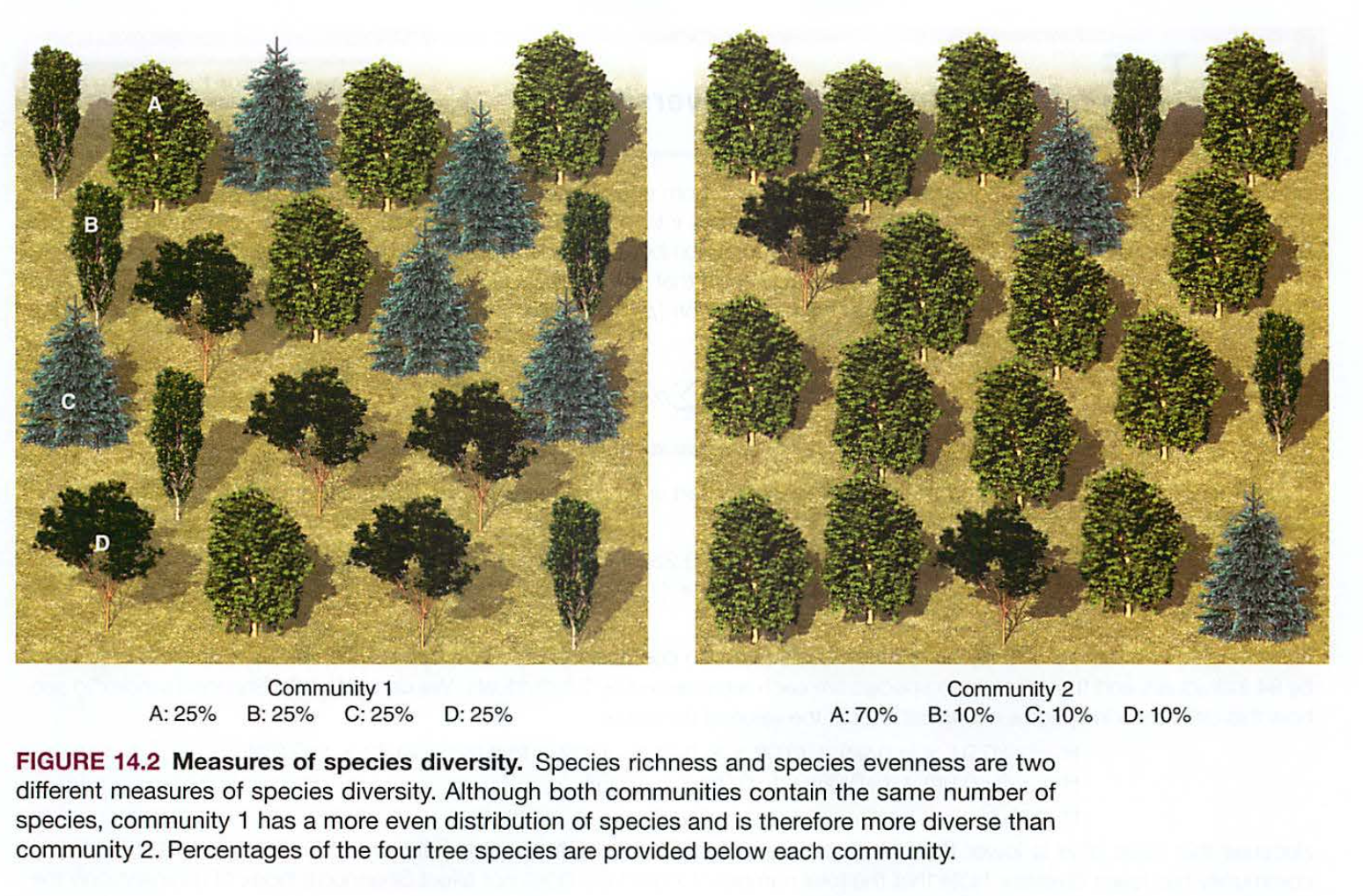Screen Shot 2022-10-16 at 12.02.58 PM.png
Measuring species diversity (lab):
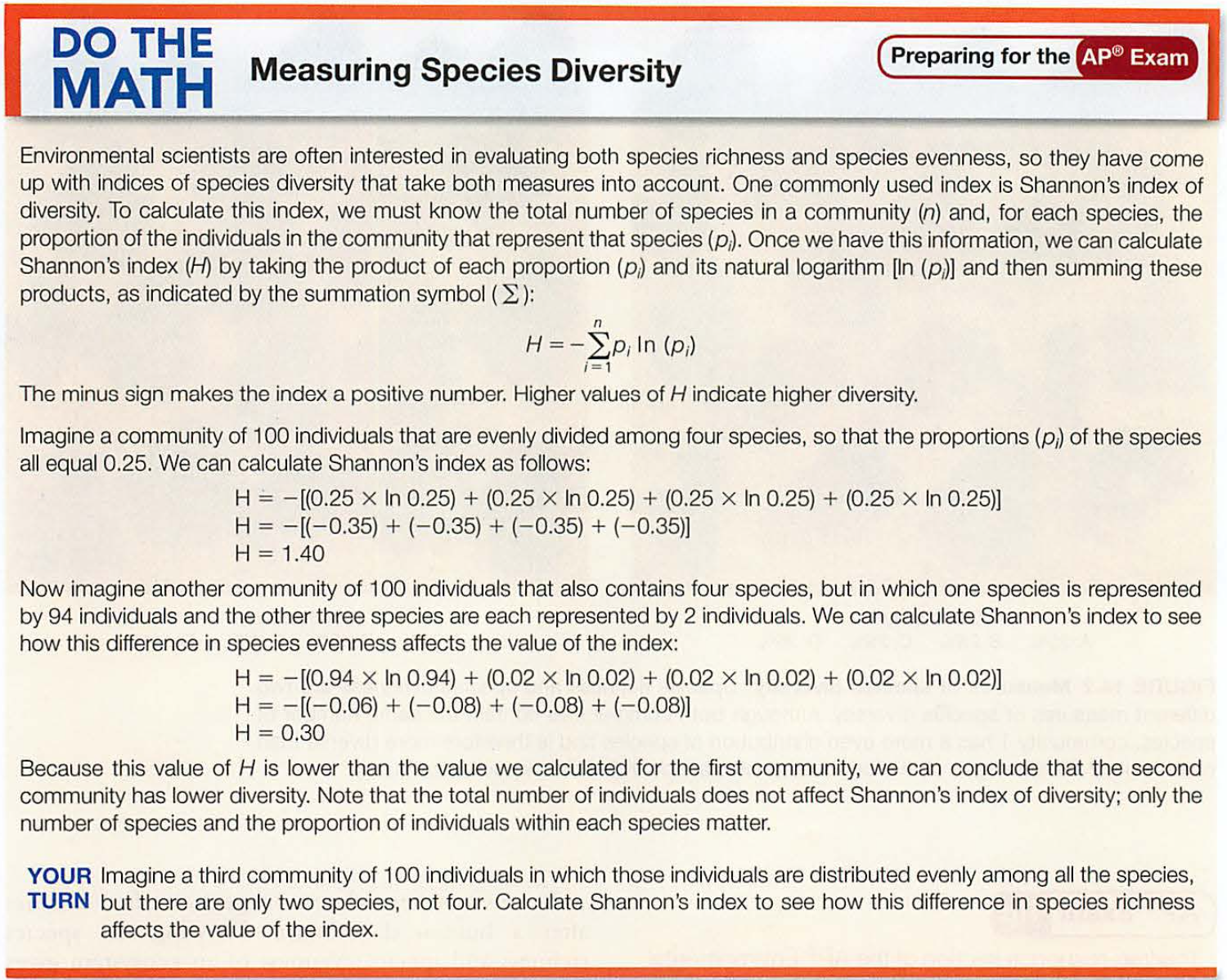Screen Shot 2022-10-16 at 12.09.43 PM.png**Lab**: Calculating Shannon's index, using baked goldfish (the cheddar kind, not the ones that stink)
1. wash your hands
2. pour out a random number of different colored goldfish on your plate (your "pond")
3. determine the number of distinct populations by color, using chopsticks
4. determine the proportion for each population (e.g. 5 red ones out of 20 total would be 5/20 or 0.25)
5. calculate Shannon's index (H) for this "pond"
6. repeat the experiment with a very low biodiversity, calculate H
7. repeat with a very high biodiversity, calculate H
8. eat the contents of your "pond", representing a catastrophic event
**Questions**:
1. what is the value of biodiversity in any community?
2. what are the benefits and drawbacks of a low biodiversity?
3. how does this play into competition (next chapter)
4. why is it important to determine the number of "distinct populations"?
5. what is the impact of this on a human population, e.g. the census?
---
Migrated from Apple Server Wiki. Original page ID: z7Z0C31
# Module 15: Evolution
Three conditions must be met:
1. Genetic variation (mutation)
2. Some stress that favors this variation (adaptation)
3. Survivors procreate, pass on the variation (reproduction)
Genotype: set of genes (dominant and recessive)
Phenotype: traits expressed in a living creature
Genetic drift-pretty much what it sounds like
Bottleneck effect-VERY important: when a species is almost extinct, there is little variation in the gene pool of the survivors, even if their population rebounds (e.g. whales hunted almost to extinction, the entire gene pool is limited to the diversity of the sole survivors)
The bottleneck effect is an evolutionary phenomenon where a significant reduction in a population's size, usually due to an environmental catastrophe, disease, or human activity, leads to a loss of genetic diversity. When only a small portion of the population survives, the resulting gene pool is limited to the genetic traits of the survivors. This effect can drastically alter a population's genetic makeup and impact its adaptability and survival ("robustness").
### How the Bottleneck Effect Works
1. **Population Reduction**: A large, diverse population faces a sudden event, such as a natural disaster (e.g., a volcanic eruption or flood), disease outbreak, or habitat destruction. This reduces the population to a small number of individuals.
2. **Loss of Genetic Diversity**: Because only a subset of the original population survives, the gene pool is significantly reduced. The surviving individuals carry only a small portion of the genetic diversity present in the original population.
3. **Repopulation**: As the surviving population grows again, all future generations are based on the limited genetic diversity of the survivors. Certain alleles (gene variants) may become much more common or even fixed, while others may be lost entirely.
### Consequences of the Bottleneck Effect
- **Reduced Genetic Diversity**: With fewer alleles in the gene pool, the population may lack traits that would allow it to adapt to new environmental pressures or changes, making it more vulnerable to extinction.
- **Increased Genetic Drift**: Genetic drift, the random fluctuation of allele frequencies, becomes more pronounced in smaller populations. Some alleles may disappear entirely from the population by chance, while others may become more common.
- **Higher Risk of Inbreeding**: In a population with reduced diversity, individuals are more likely to mate with close relatives, which increases the chances of inbreeding. Inbreeding can lead to an increase in harmful recessive traits and reduce overall fitness.
Founder effect: random selection of survivors, creating a new gene pool (birds, Gilligan)
The founder effect is an evolutionary phenomenon that occurs when a small group of individuals separates from a larger population to establish a new population. This small group carries only a limited amount of the genetic diversity from the original population, leading to unique genetic characteristics in the new population, which may differ significantly from the original group.
### How the Founder Effect Works
1. **Small Group of Founders**: A small subset of a population moves to a new location, becomes isolated, or is otherwise separated from the main population. This can occur through events like migration to a new region, geographic separation, or the establishment of a colony by a few individuals.
2. **Limited Gene Pool**: Because the founders represent only a small fraction of the original population, they carry a limited set of genes. Certain alleles (gene variants) may be overrepresented, underrepresented, or entirely absent in the new population compared to the original population.
3. **Genetic Drift in Small Populations**: In the new, smaller population, genetic drift—random changes in allele frequencies—can have a larger impact. Some alleles may become fixed (present in every individual), while others may be lost. Over time, this can lead to distinct genetic characteristics and traits in the new population.
### Consequences of the Founder Effect
- **Reduced Genetic Diversity**: Like the bottleneck effect, the founder effect often results in a population with less genetic diversity, which can limit the population’s ability to adapt to environmental changes.
- **High Frequency of Certain Traits**: Some alleles may be more common in the new population than they were in the original population. This can lead to a higher prevalence of specific traits, including rare genetic conditions, within the new population.
- **Genetic Differences from the Original Population**: The founder effect can lead to distinct genetic and phenotypic differences between the new population and the original population over generations, even if both groups remain within the same species.
### Examples of the Founder Effect
- Amish Populations: The Amish community in the United States originated from a small group of European settlers. Due to the founder effect, certain genetic disorders, like Ellis-van Creveld syndrome (a form of dwarfism), are more common in Amish populations than in the general population.
- **Darwin’s Finches**: On the Galápagos Islands, isolated populations of finches, each founded by a small group, evolved into different species with unique beak shapes suited to their specific environments. The founder effect, combined with natural selection, contributed to the diversification of finch species.
- **Pitcairn Island**: The descendants of the Bounty mutineers, who settled on Pitcairn Island, have unique genetic characteristics that reflect the limited gene pool of the original settlers.
### Key Takeaways
- **The founder effect** occurs when a new population is established by a small group, leading to reduced genetic diversity and potentially unique traits in the population.
- **Allele frequencies** in the new population can differ significantly from the original population, which can increase the prevalence of certain genetic traits, including rare disorders.
- **Environmental and social factors** can amplify or diminish the founder effect’s impact, leading to either significant differentiation from or similarity to the original population over time.
Questions:
1. If the early atmosphere of our planet was thinner and less developed, it might have allowed more cosmic radiation to reach the surface. How would this impact the natural mutation/evolution rate?
2. What would be the impact on an ecosystem of rampant mutation rates?
---
Migrated from Apple Server Wiki. Original page ID: j3s0b2k7
# Module 17: Niches and species distribution
Mod 17: niches and species distribution
Check this out:

You'll see another like this in population distributions...
- Range of tolerance-where it can survive
- Fundamental niche-happy place
- Realized niche-de facto place
- Distribution-areas where they live (we'll see more of this in the chapter on population distributions: random, scattered, patterned)
- Global Biodiversity:Note biodiversity increases closer to the equator:
Lab: Calculating Shannon's index, using baked goldfish (the cheddar kind, not the ones that stink)
1. wash your hands
2. pour out a random number of different colored goldfish on your plate (your "pond")
3. determine the number of distinct populations by color, using chopsticks
4. determine the proportion for each population (e.g. 5 red ones out of 20 total would be 5/20 or 0.25)
5. calculate Shannon's index (H) for this "pond"
6. repeat the experiment with a very low biodiversity, calculate H
7. repeat with a very high biodiversity, calculate H
8. eat the contents of your "pond", representing a catastrophic event
Questions:
1. what is the value of biodiversity in any community?
2. what are the benefits and drawbacks of a low biodiversity?
3. how does this play into competition (next chapter)
4. why is it important to determine the number of "distinct populations"?
5. what is the impact of this on a human population, e.g. the census?
---
Migrated from Apple Server Wiki. Original page ID: t732f0i
# Module 18: Abundance and distribution
Module 18-abundance and distribution
Start with this:
A crude example of this might be:
- individual-you
- population-HPA
- students community-HPA
- ecosystem-education
- biosphere-the world
or:
- some rabbit individual
- some of the rabbit's friends,
- a population of rabbits
- rabbits and the things they eat and eat them-community
- ecosystem-the plants that support both ends of this process
- biosphere-the planet
We covered ecosystem energy and matter a few weeks ago, this chapter is about population ecology.
--------------------
Population dynamics
Notation: Population size is represented as N (note not "n"): population size within a defined area at a specific time (brings in migration).So, we could say the student population of HPA would be all students here this year, 2022-2023
Check out the diagrams on population distribution: random, uniform and clumped. Important vis a vis biodiversityStructures: age and gender (sex)

- Density dependent factor: e.g. food or reproductive rate in rats (more rats, lower "fecundity" or birthrate)
- Something that influences reproduction or survival...
- Density independent factors: storms, disasters, fires (note density independent: one bambi or 100 bambi all perish in the same fire)
- Limiting resource: usually food, but could include space, nutrients, etc.
- Carrying capacity: K (note not "k"): how many individuals an environment can support
---
Migrated from Apple Server Wiki. Original page ID: s263q72
# Module 20: Community ecology
Module 20: Community ecology
Competitive exclusion principle: two species competing for the same resources cannot co-exist, leads to...
Resource partitioning: time, space, type of food (one species picks one, the other survives)
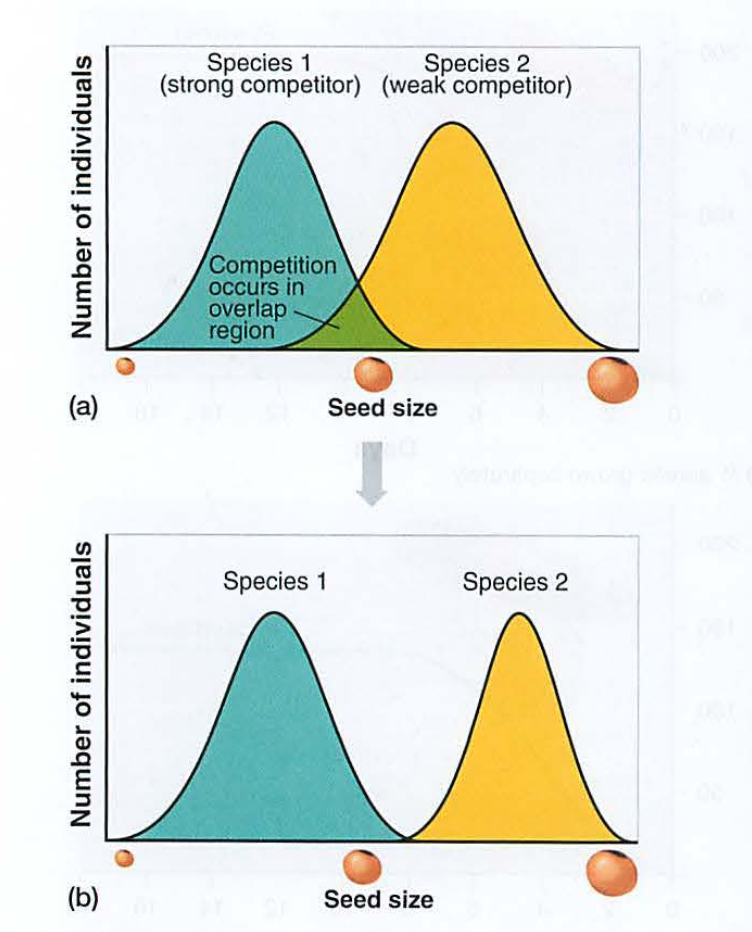Screenshot 2024-11-14 at 14.43.13.pngRelationships:
- Predation: predator and prey, one lives, the other dies
- Symbiotic:
- Mutualism: both benefit
- Commensalism: one benefits, no harm to the other
- Non-symbiotic:Parasitism: one benefits, harm to other
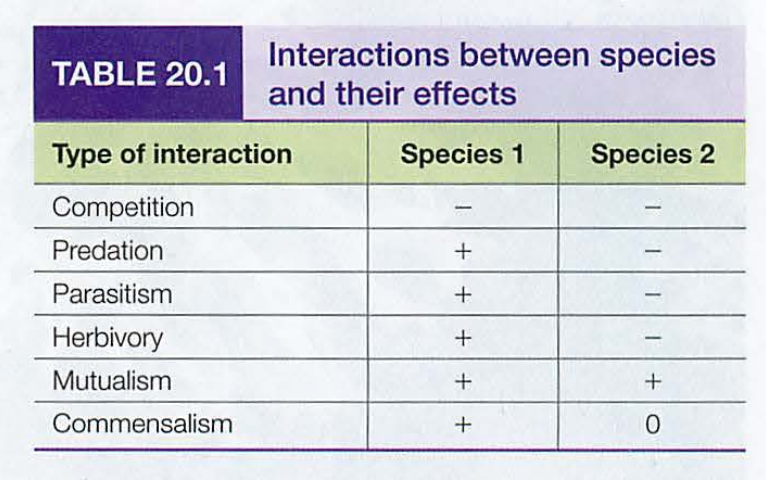Screenshot 2024-11-14 at 14.43.56.pngReview: keystone species vs. indicator species:Keystone species-many others depend on it, removal has an impact much greater than their relative population
e.g. beavers: create habitat for others (dams), so they are also "keystone engineers", only they don't wear funny hats.
Here's what a keystone looks like:
In architecture, if you remove the keystone, the arch collapses. Cool term, right?
This is different from a capstone (seniors might like this): a capstone is what you put on top of a finished structure
Another example: "keystone predators" e.g. sea stars, which eat mussels, clearing space on rocks for other species
Indicator species-signal health of a system, like some fish or worms signify water quality, also known as "bioindicators"
Succession: one species takes over another in time
---
Migrated from Apple Server Wiki. Original page ID: c09733
# Module 19: Growth Models
Module 19: growth modelsImagine you are a happy bacteria, or rabbit, with lots of food, land and no predators. Your population growth curve might look like this:

This is called exponential growth, or "J shaped growth"Note that it has no end, or limiting factor.
Small r is the growth rate. If you have had physics (yay!) this is usually "k" in some examples, or related to RC decay/growth.Learning this equation is VERY useful.Note that it depends on two things: the starting amount in the population (No) and the growth rate (r)Here is an example:
You might also find this link useful:[https://www.khanacademy.org/science/ap-biology/ecology-ap/population-ecology-ap/a/exponential-logistic-growth](https://www.khanacademy.org/science/ap-biology/ecology-ap/population-ecology-ap/a/exponential-logistic-growth)
Many systems follow J shaped exponential growth until they run out of food or space, then there is overshoot and die-off:

A more ideal version of this is the S shaped curve, called logistic growth:

Here is a formula for logistic growth that we'll discuss:
Don't be intimidated by this formula...dN/dt is just delta N over delta t, or the ∆ in number over the ∆ in time, (∆ means change)or the rate of population growth (some of you may see this as the slope of the S curve)Note that when the ratio N/K is very small or close to zero, the stuff in the parentheses becomes 1, so the formula is rate = rN, or J curved exponential growth.
Recall: J curved exponential growth only depends on starting population and reproductive rate.
As N/K nears one (number of critters equals carrying capacity) the term in the parentheses becomes zero, so no growth.
Note also that if N/K is GREATER than one, the growth rate (slope of the curve) become negative. This is overshoot and die off.

------Logistic growth worksheetFirst: exponential growth:
Imagine 10 imaginary rabbits (No=10)
Assume r = 0.5 (50 percent growth rate, or each rabbit makes 0.5 rabbits per year)
Find the population 2 years later:
Nt = Noe^rt
Nt = 10e^0.5\*2
Nt = 27 rabbits
After 4 years:
After 10 years:
———
Next, use the logistic growth formula, same data, with a carrying capacity (K) of 100:
Small population: 10 rabbits
∆N/∆t = rN(1-N/K)
= 0.5\*10(1-10/100)
= 5(1-0.1)
= 5(0.9)
= 4.5 rabbits per year
Find the rabbits per year for these populations:
Medium population: 27 rabbits
Near K: 74 rabbits
Above K: 1489 rabbits
quiz (you may use your worksheet only)
1. 30 rabbits live on an island with carrying capacity 200. They reproduce at a rate of 0.5 per year. How many rabbits will be on the island after 3 years? (hint: you would do the calculation three times-this is only an estimate though, the true formula would be a bit more complex)
2. What will be the slope of the growth curve at this point?
Next: predator/prey phase diagramsCheck this out:
The big steps:
1. Draw out a biome on your table, using dry erase markers (no permanent, please), about 60cm xx 60 cm
2. Distribute 3 rabbits on your biome
3. Drop a lynx on your biome. If it “eats” three rabbits, then add another lynx to the simulation. If it does not, remove that lynx
4. Double the number of rabbits, and drop a new lynx on your biome. If it eats 3 rabbits it reproduces. One new lynx kitten for every 3 rabbits.
5. Repeat 25 times, record the number of rabbits and lynxes after each generation, look for patterns
Population growth worksheet: (uses Numbers application)
[Download Population Growth Model.numbers (text/html, 740.6 KB)](https://bookstack.kamuela.org/attachments/47)
Worksheet: excel version:
Questions:
Now we can discuss generalizations of r and K strategists:Note: r comes from small r (growth rate) in the growth formula, while K comes from large K in the same formula (carrying capacity):

Where do you fit in? How about Nemo?

Birds also fall into type II (no pun intended), as they randomly crash into stuff...There is a fourth type: deer. How would you imagine this curve?
Related:Another reason why genocides are so damaging to cultures: If an oral tradition (e.g. Hawaiians) are decimated by smallpox for example, it is the very old (the holders of the legends and history) and the very young (those who have time to listen, not work, and will then grow up and tell their kids) that are gone. This is a sort of cultural bottleneck...
---
Migrated from Apple Server Wiki. Original page ID: b0b6V4P9
# Module 21: Community succession
Module 21: Community SuccessionPrimary succession: From bare rock, no soil: (e.g. lichen)
These hold moisture and some sort of matrix (e.g. soil) so that others can then grow
You might imagine driving from the Kohala coast up to Waimea, seeing bare lava along the coast, then fountain grass, then small bushes, then trees along the stream, then larger trees away from the stream. Water is the key to life, so anything that can trap and hold water (e.g. soil) can support life.
Secondary succession: from disturbed area with soil (e.g. after a fire)-there is soil, but no plants, growth here might be quicker than primary sucession.
Pioneer species: arrives first, sets up reliable system of water and matrix
Climax community: stable, well evolved ecosystem, e.g. old growth forest, able to survive disasters (e.g. fire)
Aquatic succession: from stream (flowing water) to pond (less flow) to shallow pond (even less flow) to marsh (mostly mud)
Island biogeography (like here in Waimea): habitat size AND distance from others influences diversity (e.g. birds)
This was Darwin's whole gig, also some folks off the coast of Chile, often with birds involved.
Check out an alternate presentation of these in the Withgott text, with a special section about our island:
[https://elab.hpa.edu/apes/texts/withgott%206e/3-4.pdf](https://elab.hpa.edu/apes/texts/withgott%206e/3-4.pdf)
Questions:
1. What three things in order are necessary for evolution to succeed?
2. What are the characteristics of an r specific species. Give an example.
3. What are the characteristics of a K specific species. Give an example as well.
4. The population of wolves may rise and fall along with rabbits, but not at the same time. Explain why.
[ ](http://physics.hpa.edu/groups/apenvironmentalscience/weblog/c3170/attachments/5330a/withgott%207e%20ch.4%20species%20interactions.pdf)
---
Migrated from Apple Server Wiki. Original page ID: e539F0S7
# Module 16: Speciation
- Geographic isolation (e.g. Galapagos) also found where we disturb natural habitats with roads
- This causes Allo (other) Patric (father) speciation
- Eventually reproductive isolation will result: different breeds will not be able to procreate
- There is another more rare form of speciation: Sympatric ("same father"), from polyploidy, ("many chromosomes")
Island example:
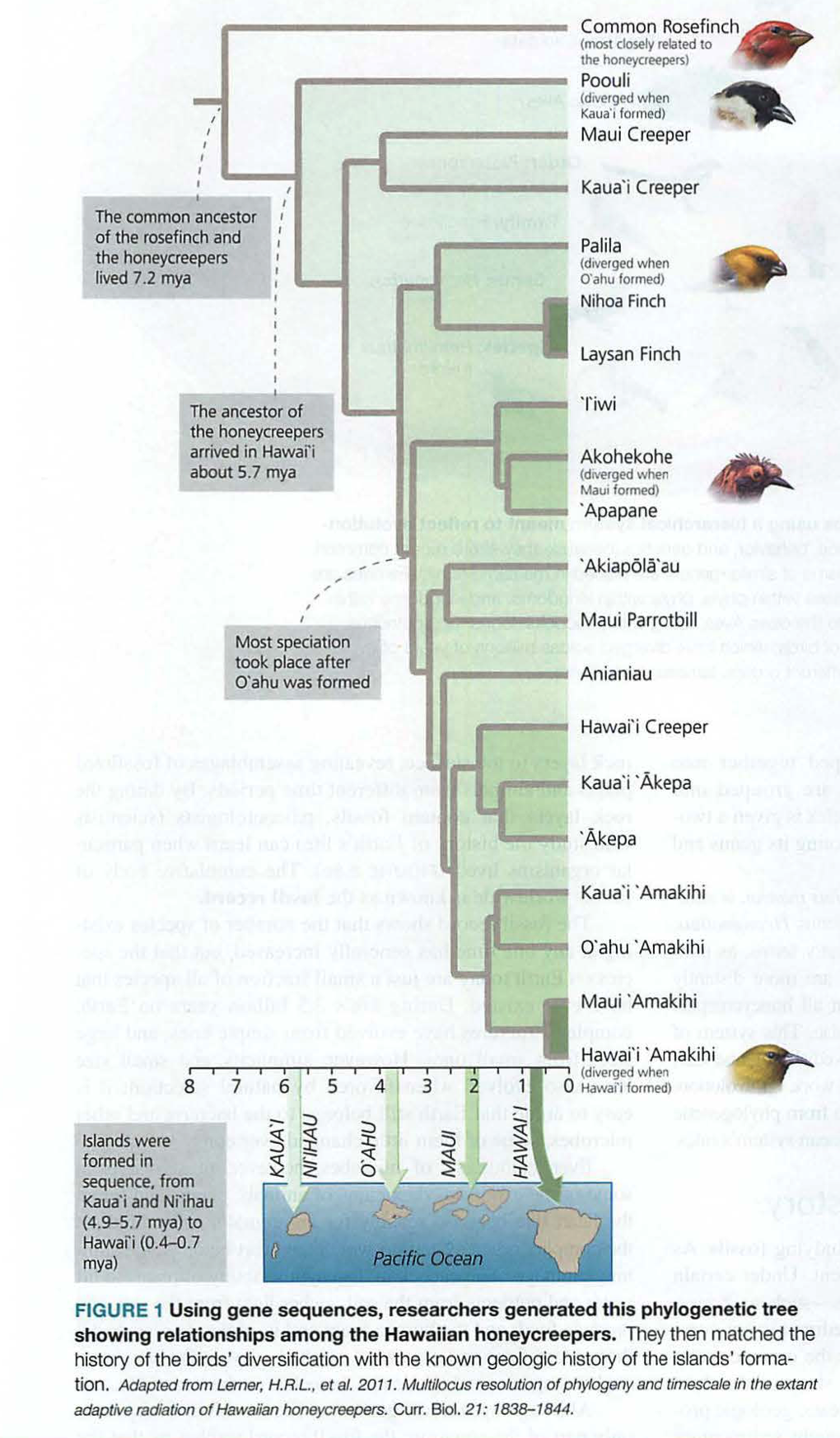Screenshot 2024-11-15 at 1.37.30 PM.png
----------
Polyploidy is a condition in which an organism has more than two complete sets of chromosomes. While most organisms are diploid, meaning they have two sets of chromosomes (one from each parent), polyploid organisms can have three (triploid), four (tetraploid), or even more sets of chromosomes. This phenomenon is particularly common in plants but can also occur in some animals, fungi, and other organisms.
There are two main types of polyploidy:
1. Autopolyploidy: This occurs when an organism has multiple sets of chromosomes from the same species. Autopolyploidy often results from errors during cell division, such as nondisjunction, where chromosomes fail to separate properly. The result is an increase in chromosome number within a single species.
2. Allopolyploidy: This occurs when chromosomes from two different species combine. It usually happens through hybridization, where two different species mate, and their chromosomes combine to form a hybrid organism. If chromosome doubling then occurs, the hybrid becomes fertile and can reproduce.
### Benefits and Challenges of Polyploidy
- Advantages: Polyploidy can introduce genetic variation, which may improve resilience, adaptability, and growth in certain environments. Polyploid plants, for instance, can have larger cells, which may lead to larger fruits, flowers, or other advantageous traits.
- Challenges: Polyploidy can create difficulties in reproduction, especially if the chromosomes don’t pair correctly during meiosis. This can result in infertility in some polyploid organisms, although certain mechanisms can evolve to overcome this.
### Examples of Polyploidy in Nature
Many crops, like wheat, cotton, and strawberries, are polyploid. For example, commercial wheat is hexaploid (six sets of chromosomes), giving it traits like increased grain size and robustness that are favorable for agriculture.
- GMO: see roundup ready corn and wheat, freeze proof tomatoes and others.
- Not to be confused with Dwarf Wheat and Norman Borlaug (see population chapters for more on this).
- Dwarf wheat was a simple hybrid, not a GMO.
- Look up "gene guns" and CRISPR
A genetically modified organism (GMO) is an organism—whether plant, animal, or microorganism—whose genetic material has been altered using genetic engineering techniques. This modification typically involves adding, deleting, or changing specific genes to produce desired traits, such as resistance to pests, tolerance to herbicides, or improved nutritional content.
### How GMOs Are Created
The process of creating a GMO typically involves the following steps:
1. Gene Identification: Scientists identify the specific gene responsible for the desired trait. For example, a gene that provides resistance to a particular pest may be isolated from another organism.
2. Gene Insertion: Using genetic engineering techniques, this gene is inserted into the DNA of the organism being modified. This process often involves using bacteria or other vectors to carry the gene into the target organism’s cells.
3. Selection and Testing: Cells that successfully incorporate the new gene are grown and tested to confirm that they exhibit the desired trait. If successful, these cells are developed into complete organisms.
4. Breeding and Cultivation: The genetically modified organisms are then bred to create generations that carry the trait.
### Applications of GMOs
GMOs are widely used in various fields:
- Agriculture: Many GM crops are engineered to resist pests, tolerate herbicides, and withstand environmental stresses like drought. Examples include Bt corn, which produces a protein toxic to certain insects, and Roundup Ready soybeans, which tolerate specific herbicides.
- Medicine: Genetically modified bacteria and other microorganisms are used to produce insulin, human growth hormones, vaccines, and other pharmaceuticals. Gene therapy, a medical application of genetic engineering, involves modifying a patient’s own cells to treat or cure genetic disorders.
- Environmental Applications: GMOs are used for environmental purposes, such as creating bacteria that can break down oil spills or detoxify contaminated soils.
### Benefits and Concerns of GMOs
- Benefits: GMOs can improve crop yields, reduce the need for chemical pesticides, enhance food quality and nutrition, and address specific health needs in pharmaceuticals. GM crops can also help improve food security, especially in regions with challenging growing conditions.
- Concerns: Potential risks include unintended environmental impacts, such as the development of herbicide-resistant weeds or impacts on biodiversity. There are also debates about the safety of GM foods for human consumption and concerns about the control of GMO technology by a few large companies.
### Regulation and Labeling
GMOs are regulated differently across countries. In the United States, the USDA, FDA, and EPA oversee GMO safety and production. Some countries, including the European Union, have stricter regulations and require labeling on foods containing GMOs.
---
Migrated from Apple Server Wiki. Original page ID: y2R3j7V1
# Module 22: Human Populations
Every day:
- 2.1 million infants are born (2,100,000)
- 800,000 people die
- result: global population increases by 1.3 million (2.1-0.8 = 1.3)
- this assumes no aliens landing, nobody going to Mars (yet)
We describe this as a population growth rate in percent this way:
Long ago, before clean water, health care and agriculture, CBR and CBR were about equal, so very low growth rate
Malthus: Top graph
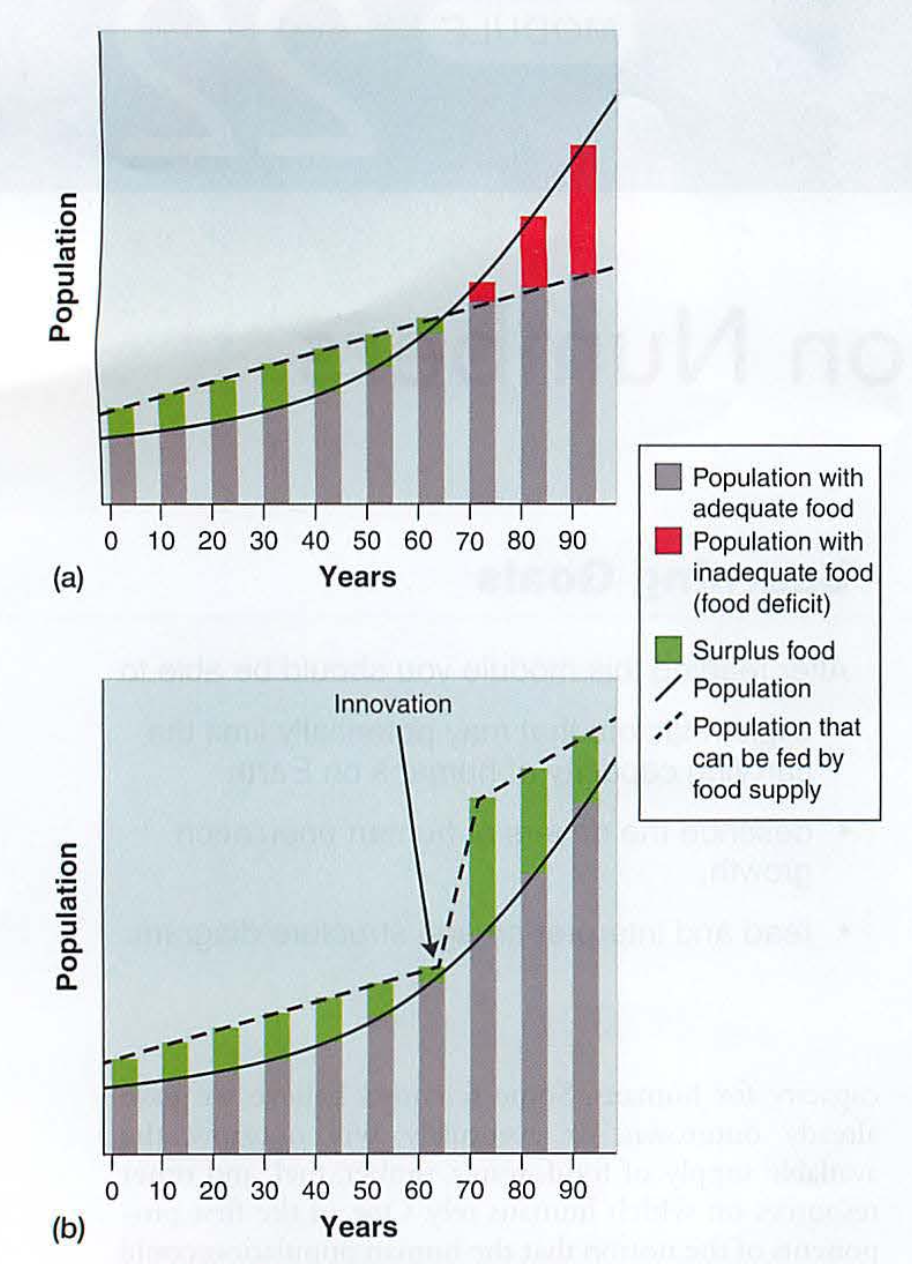Screen Shot 2022-10-23 at 5.54.07 AM.png
A similar thing happened in the 1960's in Mexico, when population was increasing much faster than food supply, until Norman Borlaug created dwarf wheat, by creating a hybrid between heavy kernels and short stalks.
Population growth as a system: Inputs and outputs:
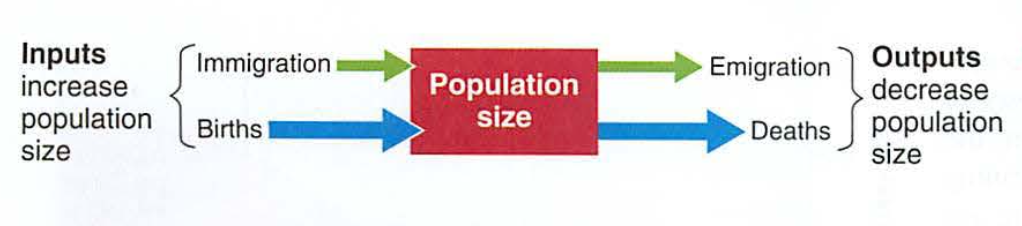Screen Shot 2022-10-23 at 5.56.53 AM.png
Nations are a bit different: people can immigrate (come in) and emigrate (leave for somewhere else)
n.b. the global population stays the same, they are just moving around the planet
National model:
((CBR + Immigration) - (CDR + emigration))
10
Try this:
Doofania has a CBR of 12%, CDR of 4% with an immigration rate of 2% and emigration rate of 3%
What is the % growth rate for Doofania?
There is a very easy way to use this to calculate number of years for a population of ANYTHING to double:
70/% = number of years to double ("doubling time")
So, Doofania would take 70/7 or 10 years to double.
Watch:
70/3.5 = 20 years
70/14 = 5 years
On the AP exam, all questions will use a multiple or fraction of 7 (35, 3.5, 7, 14, 28, etc.)
Fertility: (also known as "fecundity")
TFR is the total fertility rate, the average number of children each women will have.
n.b. TFR is not based on 1000 people like CBR and CDR, but is about EACH woman
TFR in the US was 1.8 a few years ago. This changed with COVID (why?)
Replacement level fertility: TFR needed to keep the population stable in a country
Where lifespan is short, TFR must be higher (war, famine, poor water, no food, no healthcare)
One reason families hundreds of years ago had many children (many did not survive to adulthood)
Present numbers are about 1.2 for TFR (some children don't survive, or have children themselves)
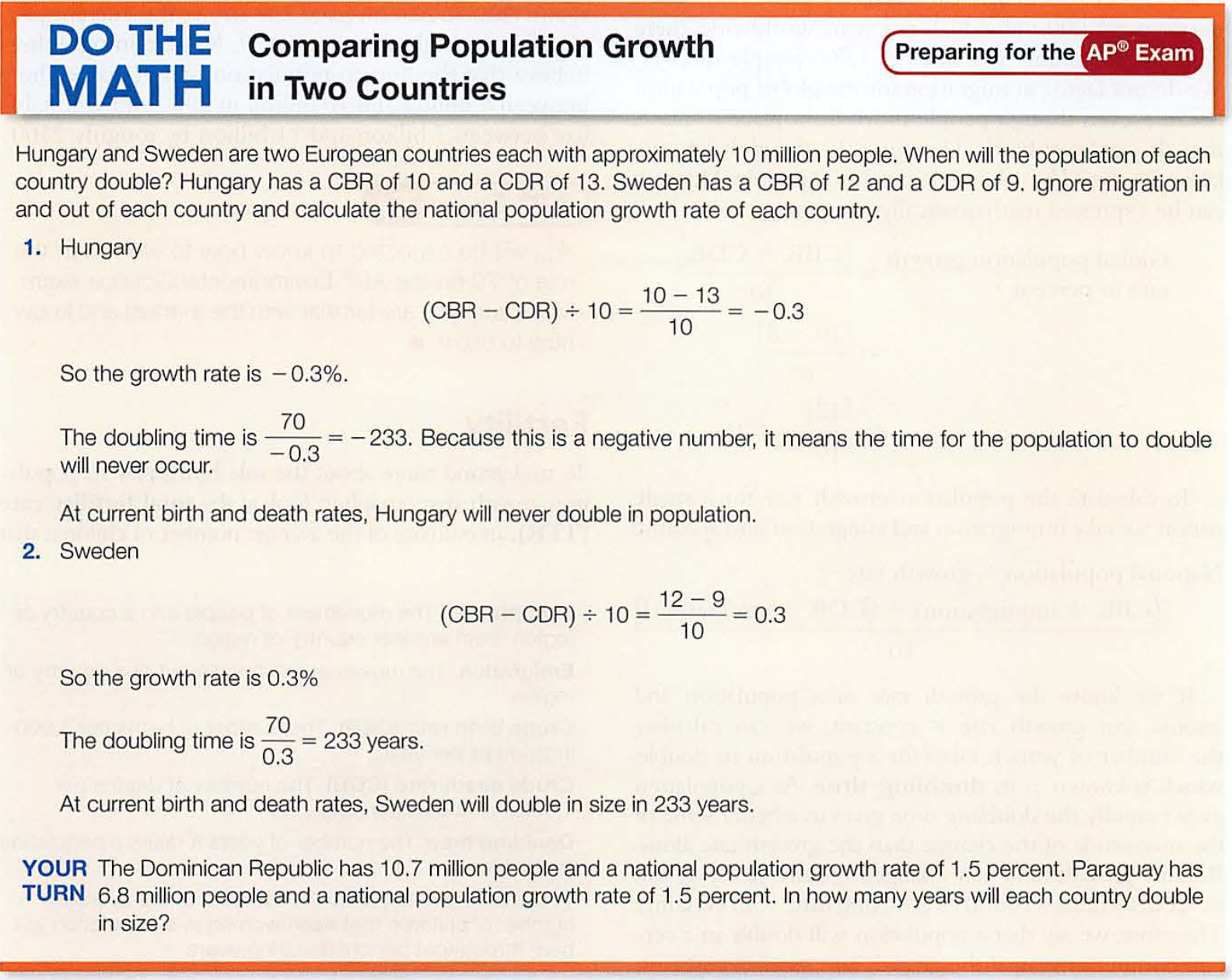Screen Shot 2022-10-23 at 6.13.15 AM.png
LDC (lesser developed countries)
Look at the average lifespan distribution-what do you see?
**Unavailable Apple Wiki media:** the exported data did not include file 526a331a-8edc-4fa2-997d-ec1b95fbab24.
Men have shorter lifespans: war, work, testosterone, heart disease, smoking, cancer
Look up the life expectancy of men and women your parents' age
Compare with someone born in 1900
How many were farmers then?
Now compare the life expectancy image with this one: (infant deaths before age 1, child deaths under age 5)
One reason the one year birthday is such a big deal here in Hawaii
**Unavailable Apple Wiki media:** the exported data did not include file cb4b7df0-3cbd-4052-a3bc-3e8c4e159a4f.
Why?
- clean water
- health care
- food supply
- sanitation
- lower pollution
Global IMR: 32
US: 5.8
Sweden: 2.5
Why?
Not just about countries...
US: 5.8
African American: 12
Native Americans: 7.6
Caucasians: 5.3
National Net migration rate: people in - people out
US: 1 million in, very few out, so 1/325 = .003 or 3/1000
US: TFR of 1.8 (below replacement level of 2.1)
but: many immigrants, so population is still growing
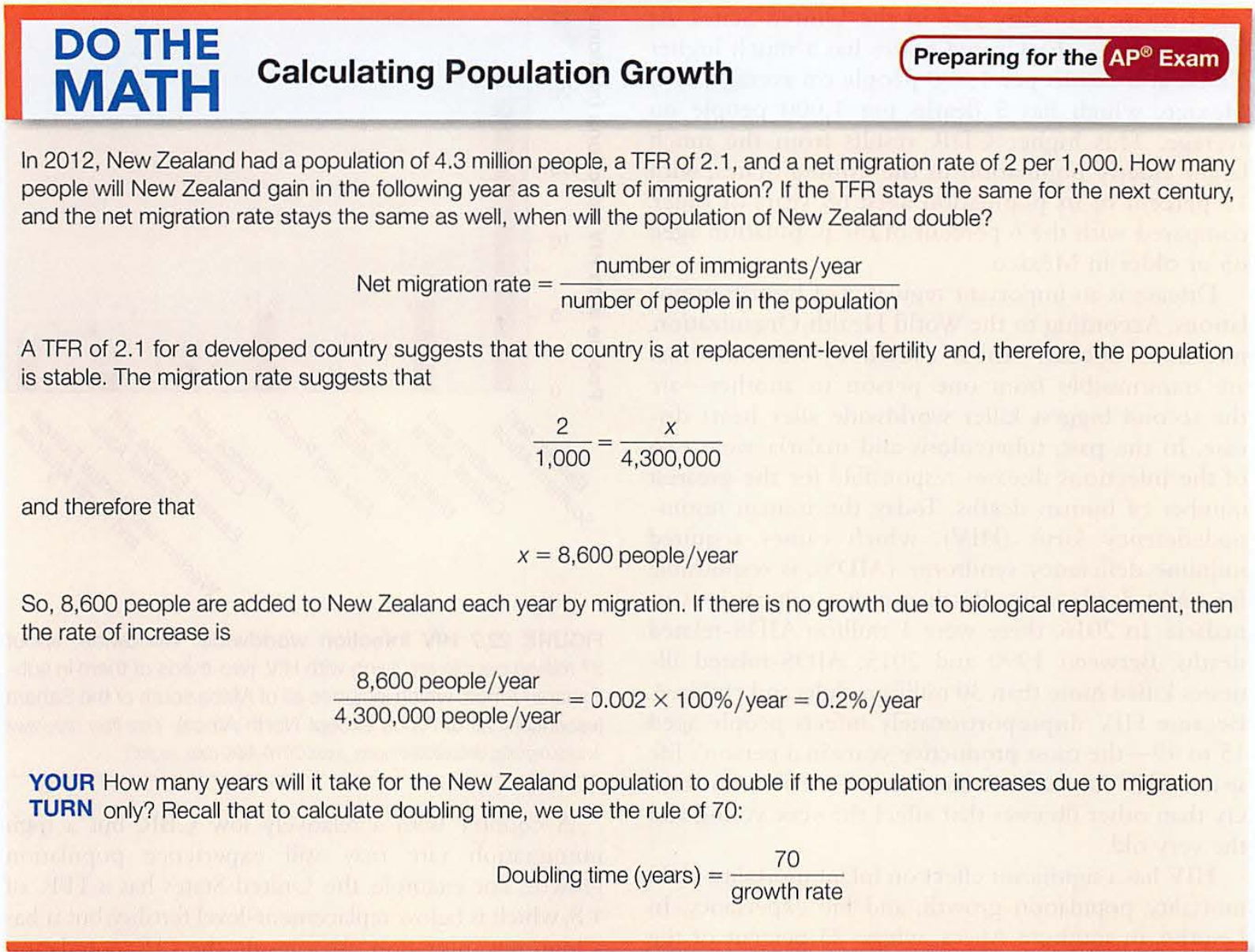Screen Shot 2022-10-23 at 7.14.58 AM.png
Age Structure Diagrams: (so cool!)
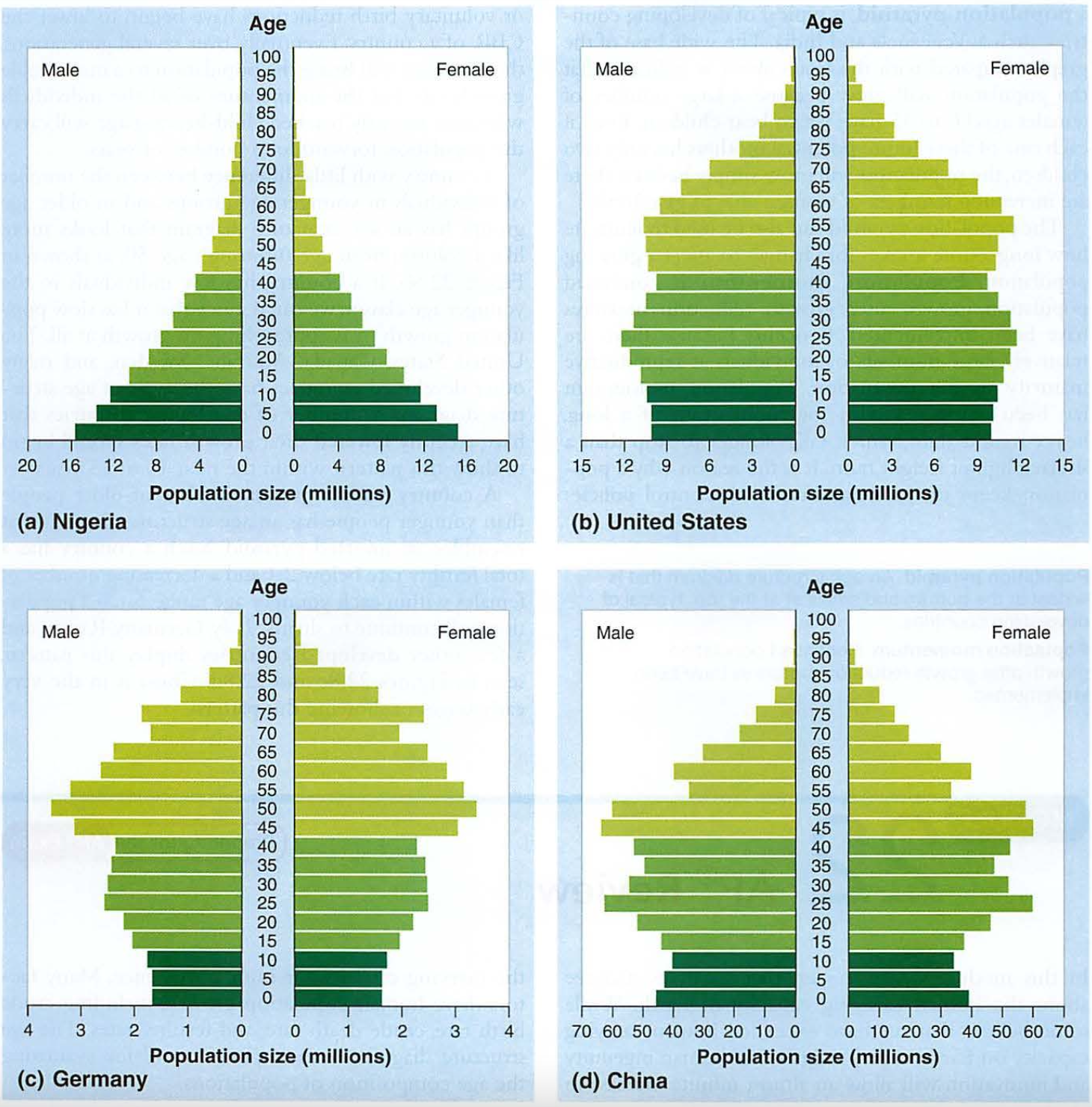Screen Shot 2022-10-23 at 7.15.49 AM.pngHow to read these:
- men on left, women on right
- kids at bottom, old people at top
- bulges are greatest populations
- look for:
- wars (on whose soil?)
- famine
- immigrant workers
- pyramids
Question: What does a neutral growth country look like?
Age structure diagrams/population pyramids-check these out:
UAE, Japan, Sudan, Iraq/Iran, Russia----WHY?
See also baby boom and boom echoes...Check this out: [https://www.populationpyramid.net/world/2022/](https://www.populationpyramid.net/world/2022/)
...and look these up:
1. Go to 1950 and look at the US population. Look again in 1960. Where is the baby boom? Why were there so few babies born during 1940-45?
2. If you were a 42 year old American in 2000, when were you born? How old are your kids? Find the "boom echo".
3. Find the impact of the Iran/Iraq war of 1980-89, which side had the biggest impact? If you were a 35 year old Iraqi man in 1995, how old were you during this war?
4. If you are a 30 year old German man in 1950, when were you born? How old were you in WWII (1936-1945)?
5. If you were a 35 year old woman in Japan in 1960, why are there so few men to choose from?
6. Look at the UK in 1960. Where are the casualties of WWII, and are they both male and female? Explain.
7. What the heck is going on in UAE?
8. Look at Russia in 1960. What gaps do you see? Why?
9. Information about China is very spotty-why would this be? See if you can find the impact of the one-child policy from 1979-2021.
10. Compare present day Japan to Africa. What issues will they need to address?
11. Look at present day Italy, Japan and Germany. What is common?
12. Compare present day India and China. What do you see?
Terms to know: Human Populations-----------------------------Fecundity: the ability to reproduce
Fertility: production of offspring
CBR: crude birth rate: births per 1000 people
TFR: total fertility rate: total kids per woman in her lifetime (25-30!)
ZPG: zero population growth: 5+ where infant mortality is high, 2.1 is normal
China: was 6 -> 1.8 (below replacement level since 1979, one child policy)
China has a 140/100 male to female ratio: why?
Global TFR is 2.6
CDR: crude death rate: deaths per 1000
Why is there a life span? mitochondrial DNA...
1900 Indian man had life expectancy of 23! Trace this to now...
Not now, reasons: nutrition CLEAN WATER, sanitation, education
75 men, 85 women (testosterone, war, "hold my beer and watch this!", Darwin Awards)
Dependency ratio; baby boomers and your future: how many workers to retirees
imagine your life at your age in other countries...
Russia low TFR: alcoholism and antibiotic resistant Tuberculosis
---
Migrated from Apple Server Wiki. Original page ID: J618L03
# Module 23: Demographic transition
From the semester exam:
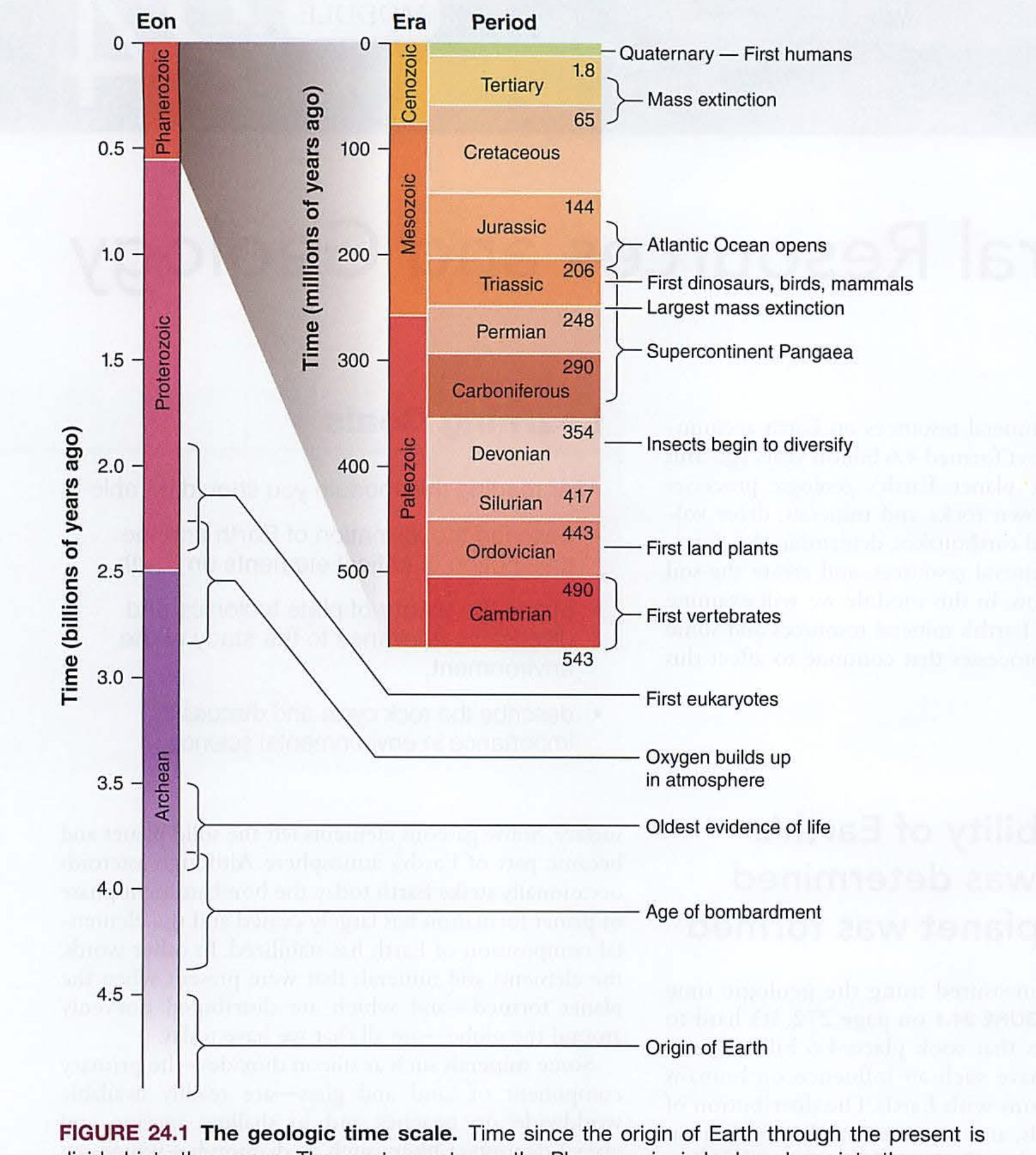eras.pngBack to Demographics...Demographics is the study of people
Check this out:
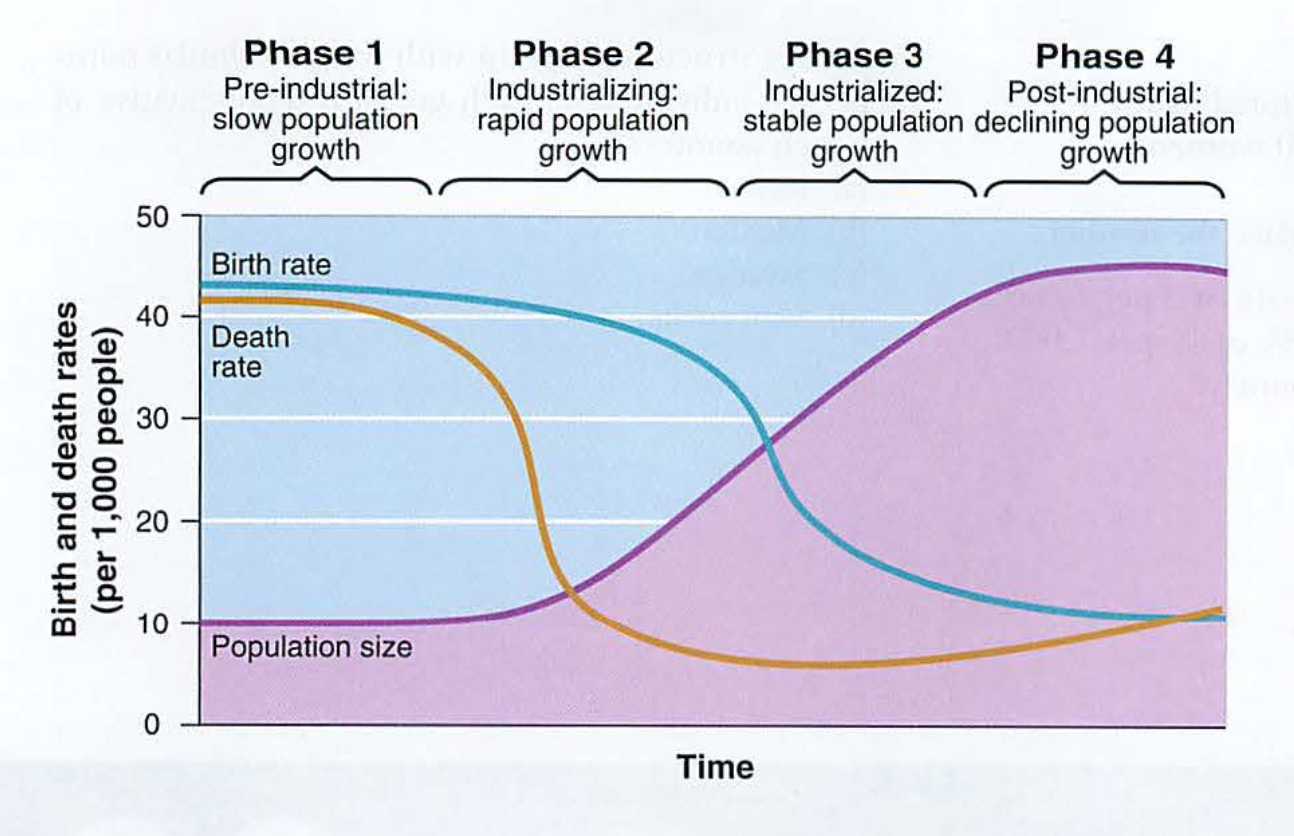Screen Shot 2022-10-23 at 7.24.03 AM.pngWhat does this mean?
Phase 1: many babies, most die, short lifespans=> low population (e.g. US and Britain before 1850, some places after war e.g. Gaza, Ukraine)
Phase 2: death rate drops (clean water, better food, lower infant mortality, longer lifespans)=> population grows (e.g. India)
Phase 3: education increases, women have better control over fertility, birth rate drops=> population stabilizes (e.g. US)
Phase 4: women enter the workforce, later babies, smaller families=> population decreases (e.g. Japan, Italy)
Another version:
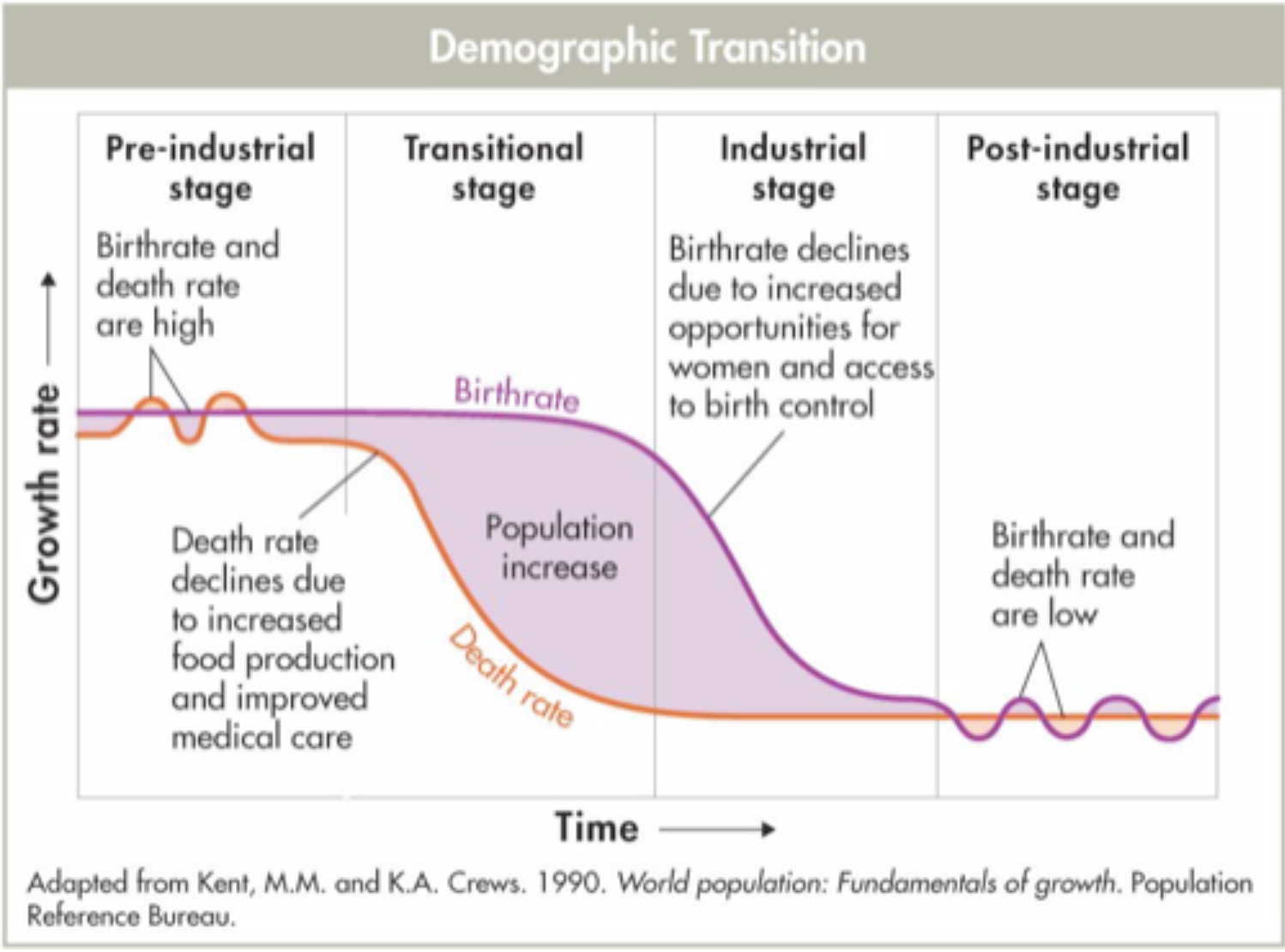Screen Shot 2022-10-23 at 7.30.40 AM.png
Note the wiggly bit on the right, looks like the carrying capacity from last chapter, right?
Things to notice:
1. in phase 1, lots of babies, lots of death (infant mortality and short lifespans), so population is low
2. as clean water, sanitation and health care improve, deaths drop, so population rises
3. as women gain reproductive rights and/or education, the birth rate drops (many factors here), while death rate stays low, so the population growth curve flattens a bit (hard to see on this diagram)
4. as industrialization includes more women, esp. as professionals, they may delay pregnancy later in life, so there is actually a population drop.
Examples are Italy, Japan and Germany, where the dependency ratio (number of people depending on social retirement divided by number of people in the workforce paying into the system) is greater than 1.0.
Question: how would you see this on a pyramid graph?
Make sure you can cite at least one example country for each...
1. Some places in sub-Saharan Africa, post-war, most of the world before the industrial revolution
2. Afghanistan
3. US
4. Japan
IPAT: Impact = Population x Affluence x Technology
Imagine two scenarios:
Case 1: A sustainable pacific island community, no phones, internet or electricity. Food sources are local, there is little affluence (tribal community), also less poverty, and a self-limiting population, limited by K, in this case food.
Case 2: Urban community, large population, lots of affluence (think NYC or SF), everyone has an iPhone or similar device, a computer, a car, a refrigerator, TV, and a wide selection of clothing, food and housing.
IPAT: the impact on an ecosystem = population x affluence x technology
Why is Apple using a robot ("Daisy") to take apart iPhones? How does this impact iPAT?[https://www.apple.com/newsroom/2018/04/apple-adds-earth-day-donations-to-trade-in-and-recycling-program/](https://www.apple.com/newsroom/2018/04/apple-adds-earth-day-donations-to-trade-in-and-recycling-program/)
Which parts of the iPAT formula does this impact, and in which ways?
Think also of electric vehicles: great for the environment, but use materials (Lithium, Neodymium, etc.) that need to be mined.
Gasoline/Diesel cars need steel, glass, plastic and some rare materials for electronics, but are much worse for the environment, both in production, use and disposal. More on this later.-------------------
GDP is global domestic product, or the sum of all goods and services delivered inside a country
This was the standard growth metric until recently...
GNP is the same thing, but includes multinational companies, or companies "off shore"
Urban areas, UGB (Portland)
[e2: Portland, sense of place](http://physics.hpa.edu/physics/apenvsci/videos/e2_videos/e2%20transport/5%20Portland-sense%20of%20place.m4v)
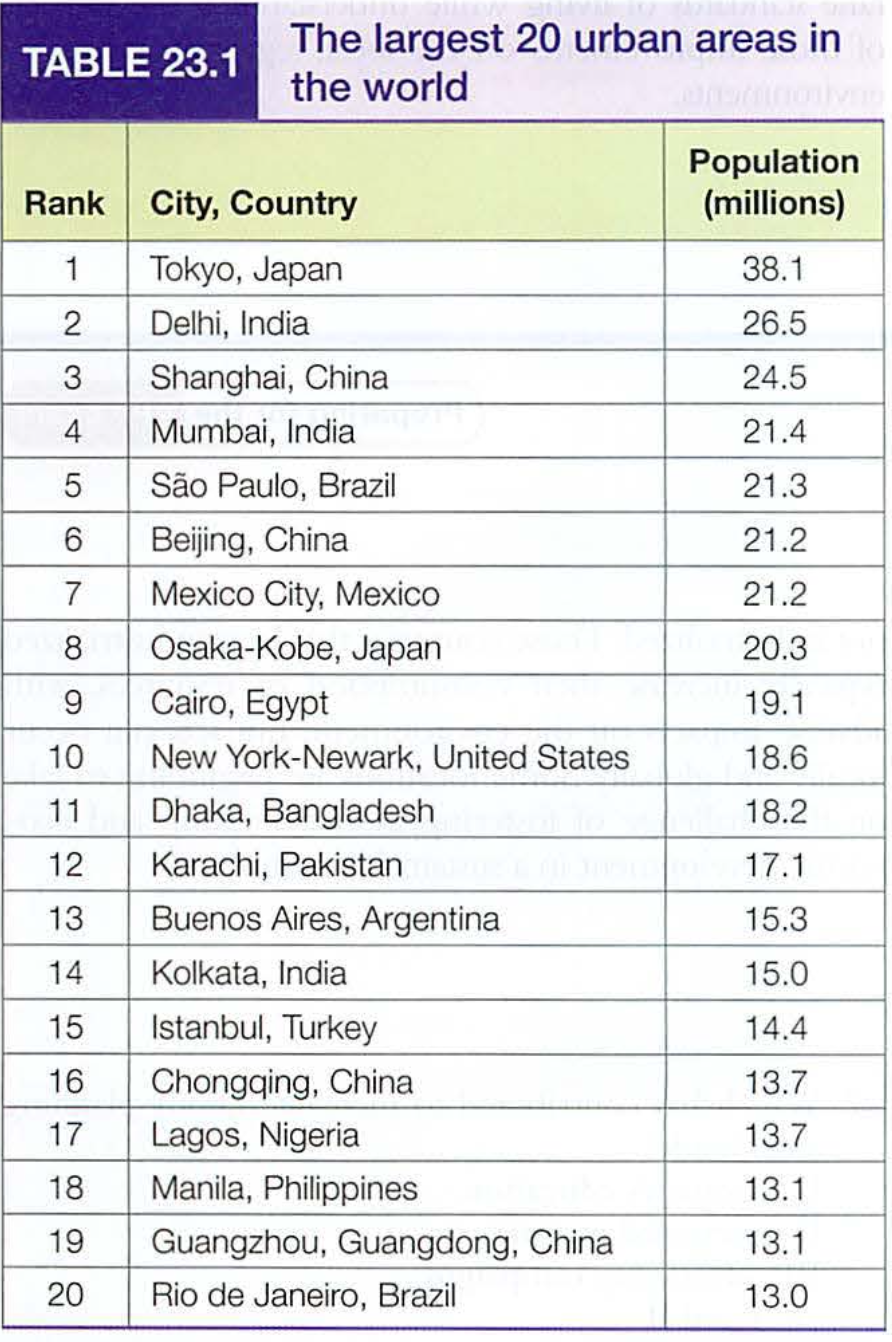Screen Shot 2022-10-23 at 7.37.29 AM.png
See also Ecological Footprint Calculator:
[http://www.footprintnetwork.org/resources/footprint-calculator/](http://www.footprintnetwork.org/resources/footprint-calculator/)
[https://www.ted.com/talks/hans\_rosling\_shows\_the\_best\_stats\_you\_ve\_ever\_seen](https://www.ted.com/talks/hans_rosling_shows_the_best_stats_you_ve_ever_seen)(9 minutes)
Play with these:
[https://www.gapminder.org/](https://www.gapminder.org/)
[https://www.gapminder.org/tools/#$chart-type=bubbles&url=v1](https://www.gapminder.org/tools/#_chart-type=bubbles)
[https://worldmapper.org/maps/?\_sft\_product\_cat=pollution](https://worldmapper.org/maps/?_sft_product_cat=pollution)
Rule of 70, er 69.3...The TRUTH!
We know that Nt =Noe^rt
When Nt/No = 2, this is the doubling time
ln (Nt/No) = ln (e^rt)ln(e^x) = x just like square root of x squared is x.
But wait! we saw 70, not .693...Growth rates are in percent (part/100) so the percents cancel out, meaning you can just use percent as a number, like 14%.
You will certainly see this on an AP exam, usually as a multiple or fraction of 70: 14, 28, 35, 7, 3.5...Rule of 70 rules! (or actually the rule of 69.3)....
Next: earth and soils:[https://www.youtube.com/watch?v=xzAOhyOtfqc](https://www.youtube.com/watch?v=xzAOhyOtfqc)
---
Migrated from Apple Server Wiki. Original page ID: F7j6g2e6
# Module 24: Earth science
Module 24: Earth ScienceKey points:
- All elements up to Iron on the periodic table came from the big bang
- Earth was formed from materials created by first generation stars going supernova
- The core of the earth is made up of a rotating solid core surrounded by a liquid core
- The inner core creates our magnetic field, which reverses periodically
- Layers: crust-mantle-outer core-inner core
- Uranium in the core produces heat that travels to the surface by convection
- Tectonic plates on the surface move on top of the sticky asthenosphere because of this convection
- Spreading zones are were these plates are created, subduction zones are where they dive under others
- Subduction zones create trenches in the ocean and andesitic volcanoes (sticky lava, pointy cones)
- Hot spots in the crust can create basaltic volcanic islands like the one we are on (runny lava, broad cones)
- Earthquakes include P (primary, compression) waves and S (secondary, shear) waves
- P waves are faster and go through solids and liquids, S waves only travel through solids
First, there was the big bang (see the cute video here: [https://www.youtube.com/watch?v=xzAOhyOtfqc](https://www.youtube.com/watch?v=xzAOhyOtfqc))
The only thing at first was Hydrogen, which is just a proton and an electron, sometimes a neutron making isotopes of Hydrogen
Stars formed from this hydrogen, and through fusion created all of the elements up until Iron (Fe)
Look this up on your periodic table------[https://ptable.com/#Properties](https://ptable.com/#Properties)
Eventually, these stars expanded and then collapsed...Smaller stars became neutron stars or various versions of these
Huge ones (15x our sun size) exploded and created all of the elements after Fe (check the periodic table again)so,
Any element in you below Fe on the table came from an exploding star cool...
NASA and other folks are really interested in two things now: exoplanets (planets outside our solar system) and asteroids[https://www.cnn.com/2020/10/23/world/asteroid-bennu-sample-update-scn-trnd/index.html](https://www.cnn.com/2020/10/23/world/asteroid-bennu-sample-update-scn-trnd/index.html)
Why?
Well, if we know what asteroids are made of, we have a clue about what materials (e.g. water) that were around when the solar system formed.
From this info, we can look for those elements in other solar systems, and look for life there.
Our earth was molten for a long time, then cooled to become solid-mostly.
Since it is also made up of Uranium and other things that combine to create heat, our planet is still really hot deep down.
A minister named Ussher ([https://en.wikipedia.org/wiki/Ussher\_chronology](https://en.wikipedia.org/wiki/Ussher_chronology)) worked backwards from the molten state to solid state of the earth to guess that the earth was created one Sunday afternoon in 4004 BC.
We was not stupid, he just did not know about Uranium, and our molten core...
Here's what we know the earth to look like (check this out on your globes too):
The core is actually two bits: solid inner iron and nickel, liquid outside that bit.
It spins, giving us a weak magnetic field which switches direction every few thousand years.
Remember this, it comes up later...
How do we know this?
Nuclear bomb testing and our global seismic sensor network.
How?
Two key clues about the earth came from military conflict: one from WWII and another from the cold war, when everyone was building bigger and bigger bombs.
First the cold war part:We set up seismic sensors called seismographs all over the world to spy on Russian and Chinese nuclear ("A-Bomb", fission) and thermonuclear ("H-Bomb", Fusion) bomb testing to see how powerful they were.
You next need to know that there are two main types of earthquake wave: P or "primary" waves which are compression waves. and S waves "secondary waves" that are transverse, like shaking a slinky.P waves are faster, and go through solids or liquids, but at slightly different velocities.S waves are slower, and can only travel through solids.So,
Here's what they saw:

This data was found by spying on atomic bomb tests in the 1950s, not because we wanted to know about the guts of our planet...
Now, to the WWII part...Submarines like to hide underwater, so planes and ships can't find them.
So, during WWII, our side tried dragging little magnetic sensing torpedo thingys from behind their ships, hoping to detect submarines. (they later used airplanes too).Here's what they found:
Ok, let's break this down: between England and the US, they found stripes of North then South weak magnetic fields.
When they got to the middle of the Atlantic (about where Iceland is on the map above), the pattern reversed.
Huh?
That's what they said too...
Remember the shifting magnetic field every few thousand years?As the magma came out of the earth in the molten state, it solidified in the magnetic field of that time, so the newest lava was along the center of the ocean (under Iceland too).
Ok, now shift quickly to a meteorologist named Alfred Wegener. Meteorologist is a fancy name for a person who studies the weather.
He cut out the continents on a map (like, with scissors) and noticed that South America and Africa fit nicely together.
Try this on your globe----Everyone in the geology community told him he was nuts.
He later froze to death in Greenland, but I digress...
Then, these strange magnetic stripe thingys showed up from the ships dragging those [magnetic torpedoes](https://en.wikipedia.org/wiki/Magnetic_anomaly_detector)....and it proved he was RIGHT:
Remember how hot is was in the earth core?
That heat rises to the surface as magma (say like Dr. Evil), just like the Hadley, Ferrel and Polar cells do:
So, connecting all of these dots, the plates are floating on the magma, some created at the mid-Atlantic ridge, others diving down under others in subduction zones....what about those subduction zones?
What mountains are in Chile?
Volcanoes are the key:
Two kinds of volcanoes:
Andesitic (pointy),
Basaltic (runny, look out your window)
Andesite-from pressure and heat as plates subduct (sticky, high silica content, e.g. Andes mountains)
Basalt-from ocean crust, lots of water, makes for weak, runny magma, formed as magma pushes through watery ocean plates
Note the sticky stuff boiling up in red-this is why the Andesitic volcanoes are sticky, and always found near subduction zones (Andes, Cascades, Japan, Italy, etc.)
Note also the trench where the subduction zone goes down: this is the origin of the Chilean/Peruvian trench we covered in the El Nino notes, as well as the deepest part of the ocean: the Marianas Trench, which is 7 MILES deep.
Whoa!
Let's review the geological players:Magma-(Dr. Evil voice here: [https://www.youtube.com/watch?v=yVo1S52xdpI](https://www.youtube.com/watch?v=yVo1S52xdpI))
- Asthenosphere-"sticky rock" (from [Greek](https://en.wikipedia.org/wiki/Greek_language "Greek language") ἀσθενής asthenḗs 'weak' + "sphere")
- Lithosphere-floating rock (litho = stone) ([Ancient Greek](https://en.wikipedia.org/wiki/Ancient_Greek "Ancient Greek"): λίθος \[lithos\] for "rocky", and σφαίρα \[sphaira\] for "sphere")
- Continents-even more floaty, made of lighter rock (granite) that formed from the interaction of magma with oceans
Plates are large, float on the Asthenosphere
Continents are like rafts on the Asthenosphere, more buoyant than the plates
The plates can slide under each other (subduction zones), crash into each other (Himalayas), next to each other (transform faults), and are formed at spreading zones (divergent boundaries)
Neato. What about those earthquakes?
Historic data shows subduction zone quakes that would create a tsunami 1000' high or more on the Pacific northwest coast, flooding everything west of I-5.
Look at all of the earthquakes (red dots) as the plate subducts
Two things to take-away about subduction zones:
1. subduction zones create ANDESITIC (pointy) volcanoes, which are high in silica, and sticky like thick pancake batter.
2. subduction zones create lots of deep-focus earthquakes.
We are lucky enough to live on an island with several active or dormant volcanoes. We live on top of a "hot-spot":
Hot spots:Usually in the middle of an oceanic plate, but can also be mid-continent (e.g. Yellowstone supervolcano caldera)
Hot spots-basalt-low silica content which melts easier (e.g. look out the window)
Look at the Hawaii island chain on google earth (underwater version)
While you are at it, look for the Nuuanu landslide that created a 4000' tsunami
You can also look at the Mauna Loa simulated tsunami on youtube...
This is what happens to a shield volcano when it "calves" one side, in this case, the northeast side, in the [Nuuanu](https://en.wikipedia.org/wiki/Nu%CA%BBuanu_Slide)landslide, one of the largest landslides on earth, causing a tsunami that deposited coral on the top of Mt. Kaala, 4055 ft. high...
The epicenter is the place ON THE SURFACE above the hypocenter (true origin) or earthquake FOCUS.
Deeper hypocentric quakes often feel "longer", while shallow hypocentric quakes feel "sharp".

How do we find these?
Seismographs:
P waves travel by compression (comPression). These are longitudinal waves, like sound.
They can travel through liquid or solid.
S waves travel by shear (Shear). These are transverse waves, like a slinky.
They can only travel through solids.Remember this?

Ok, back to earthquakes.
Suppose you have a house on posts (called "post and pier" construction).
An earthquake happens some distance away.
First, your house moves back and forth (P wave, much faster at 8 km/sec).
After a time, your house bounces up and down from the S waves (slower at 3 km/second).
If you are far away, these are separated by different arrival times.If you are near the epicenter, they hit at the same time...up, over, down=your house is demolished
We use this difference to calculate distance from the epicenter (and hypocenter if you are interested) using delay times on the seismograph
Look at the HPA seismograph here:[http://www.fdsn.org/networks/detail/PT/](http://www.fdsn.org/networks/detail/PT/)
and our Hawaii quakes here:[https://volcanoes.usgs.gov/observatories/hvo/hvo\_earthquakes.html](https://volcanoes.usgs.gov/observatories/hvo/hvo_earthquakes.html)
Click on some earthquakes and note the depth and the seismic image.
---
Migrated from Apple Server Wiki. Original page ID: v7c469X7s
# Module 25: Soils
Rocks Module 25
- Igneous (fire)
- Sedimentary (layers)
- Metamorphic (Kafka rocks, just kidding: changed by heat and pressure)
Igneous= directly from magma, and can be either basalt (low melting point, like our island or oceanic plates) or granite (lighter, what continents are made of)
Granite breaks down into light-colored sand, makes for fertile soil.
Basalt (like us) can make sand too, but less fertile (e.g. black sand beach).
Sedimentary= just like it sounds, from mud, sand, or dust, usually in layers.
Metamorphic= changed by heat and/or pressure (slate, marble, or coal)
Soil-formed by weathering (chemical or physical) of parent rock
Erosion can be by water or air (wind)
Soil Horizons:
- mesh 5 = 4 mm
- mesh 10 = 2 mm
- mesh 60 = .25 mm
- mesh 230 = 0.063 mm
Basically, most of what you find is silt and clay...
---
Migrated from Apple Server Wiki. Original page ID: 89B0F7Z2
# Module 31: Food
Recall our main themes: energy->water->food->cultureFood!
Three main groups:
- Proteins: always include Nitrogen
- Carbohydrates: CHO in chains (starches) or simple (sugars)
- Fats: CHO again, but in a special branch structure (glycol backbone) that is good for energy storage and insulation (e.g. killer whales, eskimos)
Proteins: complex molecules of CHO and N.
- Look up amino acids, note the common structure.
- Now look up the amino acid methionine.
- What element does it contain as well?
- Why do rotten eggs, swamps (and Kilauea volcano) stink?
CHO=carbohydrates (clever name),
- usually in a chain, short chains are sugars (used for fuel),
- longer ones are starches and can be used for structures (e.g. cellulose in plants) or pasta...
- smallest: sugars, all end in -ose (glucose, sucrose) LOOK THESE UP, CHECK OUT THEIR MOLECULE SHAPE
- glucose is a "monosaccharide" created by photosynthesis
- longer chains: starches (rice, pasta) slowly digested (see diabetics, and glycemic index)
- structural CHO: cellulose-little boxes with goo inside, need enzymes to break these down (cows)
- ENZYMES ALL END IN -ASE
Fats/lipids: same chemical structure as CHO, but built along a glycol (alcohol) backbone.
- If the fats have long carbon chains with only single bonds, they are saturated (lots of Hydrogen atoms) and can hold together (e.g. animal fat)[https://en.wikipedia.org/wiki/Saturated\_fat](https://en.wikipedia.org/wiki/Saturated_fat)
- If the long chains have double bonds and don't fit together, they melt easier (e.g. oils) and are called "unsaturated", usually better for your health.
- n.b. McDonalds® got into real hot water a while ago for frying all of their stuff in "supersaturated fats". Ugh...
Notes: Chapter 11 FR Overview:
- Frog 12.3 Agriculture
- Frog 12.4 Food Production
- Ch. 12 assessment
- FR ch. 11 feeding the world
- FR mod 31 nutritional needs
- FR mod 32 industrial ag-insecticides, GMO
- FR mod 33 sustainable farming
Big picture:
- Trophic pyramids in nature are sustainable
- Planet is nearing carrying capacity (K)
- Think of how many "earths" your global footprint represents
- To meet this food demand, current farming and fishing is industrial, not sustainable
Mod 31: Nutritional needs-what humans on our planet need, and what they lack
Read the case study p. 373-how is this like a trophic pyramid in nature?
- Undernutrition: lack of calories
- Malnutrition: lack of critical part of diet, usually protein (Kwashiorkor)[https://en.wikipedia.org/wiki/Kwashiorkor](https://en.wikipedia.org/wiki/Kwashiorkor)
- Food security: not just in lesser developed countries ("LDC"), also in the US"Food deserts"-what are these?
- Famine: one of these impacting a large group, often from crop failure, drought or war/displacement
- Overnutrition: common in the US, look up the US obesity rate-how is this determined? Why? Seen any food ads lately?
Look up US obesity rate-----
Meat diet: high in protein, also in fat (energy store) and cholesterol-these contribute to heart disease
- Wait-Eskimos eat lots of blubber, why don't they have heart disease?
- How is this different from Kalahari bush tribes?Climate
- Wait, wait-what happened to Japanese health care system when they moved from their traditional diet?
- What impact does this have globally?
- Diet for a small planet 1971: planet can sustain population using fewer calories while supplying protein, vitamins and calories. Not by relying on meat.Vitamins="vital amines"
Food energy subsidy (cost factor):
- 20 kg of grain to produce 1 kg of beef (20:1 factor, or subsidy factor 20x)
- 2.8 kg of grain to produce 1 kg of chicken (2.8:1 factor, or subsidy factor of 2.8)
- Better to eat beef, chicken, fish or tofu? (you need protein in some form)
---
Migrated from Apple Server Wiki. Original page ID: k6Q9C9e
# Module 32: Food production
Mod 32: Industrial Farming (and fishing)Agribusiness:
- just what it sounds like, the larger conglomerates taking over instead of smaller privately owned family farms.
- Often use monoculture crops to increase profits (economy of scale), as well as patented seeds and herbicides (e.g. "roundup ready corn")Hybrid crops vs. GMO crops:Started as a good thing: Hybrid crops"Selective breeding" works for animals (dogs, etc.) and crops called "hybrid crops" created by mixing pollen from one breed of plant (e.g. large kernel corn) with another breed of the same plant (e.g. short stalk corn) to form a "hybrid".
Green Revolution, Norman Borlaug-Mexican famine averted by development of hybrid (not GMO) wheat, called dwarf wheat (large kernel, short stalk).[dwarf wheat](https://en.wikipedia.org/wiki/Wheat)
GMO crops:in the beginning were just to withstand frost, now into a larger patent issue with GMO seeds and "round up ready crops"What is the impact on lesser developed countries of this business model?
[Genetically modified organisms (GMO)](https://en.wikipedia.org/wiki/Genetically_modified_organism) are different: they are done by splicing one part of a gene from an organism (like a frost resistant bacteria) into a totally different species (like a tomato) to make it frost resistant."IP" means intellectual property
- Monsanto spends money creating GMOs, so they patent the process, meaning using their seeds requires an IP license from them (just like software).If your farm has these seeds, intentionally or by accident, you have to pay them.
- You also cannot "re-use" seeds in the next season without paying for them.
- This is just like software in that you could buy the software or pay a monthly fee to use it.
- Which makes more money for the company?
- What is the impact on poorer countries?Roundup ready corn: seeds genetically modified to resist roundup (a herbicide)
- Result: plant their seeds, spray their herbicide and save money on weeding, more crops, more money (to whom?)
- Issue: exposure to roundup (a carcinogen) and possible impacts of mutated food
- Labeling? Where is this done so far?
[GMO from Food inc.](http://physics.hpa.edu/physics/apenvsci/videos/food_inc/food%20inc-GMO.m4v)
High Fructose Corn Syrup: HFCS
- Corn Lobby is very powerful (Iowa=presidential primaries)
- Corn: HFCS (food, meat, fish) and Corn Ethanol (energy, fuel)
- HFCS is in everything
- Corn is used to feed cattle, pork, poultry, even fish
- Cattle are not used to metabolizing corn, it makes them sick
- Bad for humans, increases incidence of diabetes[HFCS from Food inc.](http://physics.hpa.edu/physics/apenvsci/videos/food_inc/food%20inc-corn.m4v)
Main farming problems:
- Irrigation-desertification
- Pesticides-persistent organic pollutants (POPs)-like in your water hunt
- Fertilizers-eutrophication
Waterlogging: too much water in the soil, roots die (see hydroponics demo at elab, cycles water and air)
Salinization/desertification: using well water for irrigation, salts build up in the soil, infertile soil resultsSoil degradation:[Dirt 00-8:00](http://physics.hpa.edu/physics/apenvsci/videos/dirt/dirt_0-8.m4v)
Look up Wangari Maathai
Pesticides and herbicides:
- can be persistent or not (DDT, round up)
- Invented during WWII to kill humans (nerve gases, nazis), ("homicides")
- Modified to kill pests ("pesticides") or insects ("insecticides")
- Special cases include rodent poisons ("rodenticides") and others, like plants ("herbicides")
- Pesticide resistance-much like COVID: genetic variation in a rapidly multiplying pathogen will eventually overcome the stress (recall evolution) by replicating only those with immunity to the stress (vaccine, pesticide, drug resistant TB)
Here's one pesticide that changed malaria around the world:

Inorganic fertilizers: also something from war (Haber process, WWI)
Chemically uniting Nitrogen from the air into fertilizers, dyes, or explosives
Fertilizers: lots of crops around 1910 in Germany
Dyes: enabled them to tap into the huge market for dyed textiles (UK), so lots of $
Explosives: enabled Germany to go to war with Europe
You might ask some of your German friends or your history teacher what "Lebensraum" really means...
Haber process enabled nitrogen from the air to be chemically grouped with other compounds to form fertilizers like Ammonium nitrate: NH4NO3
This process uses huge amounts of petrochemicals, so these fertilizers are attached to the cost of oil (not coal)
Ammonium nitrate and fuel oil (diesel) can also be combined to make explosives, look up [ANFO bombs](https://en.wikipedia.org/wiki/ANFO) and terrorism.
Fishing:
- Aquaculture means fish or other water animal farmed in the ocean
- Hydroponics means growing plants in a water/air medium
- Fisheries: population of fish, look up [Atlantic Cod](https://en.wikipedia.org/wiki/Atlantic_cod) fisheries collapse in 1990
- Bycatch: unnecessary death of animals caught in fishing nets/traps (dolphins, sharks, etc.)
---
Migrated from Apple Server Wiki. Original page ID: T6H514n
# Module 33: Sustainable food production
Mod 33: Sustainable agriculture (fishing too)
- Desertification (see above)
- intercropping vs. monocropping, see ["the three sisters"](https://en.wikipedia.org/wiki/Three_Sisters_(agriculture))
- Contour cropping: saves space, reduces runoff, preserves top soil (e.g. our garden, most of Asia)
- No-till ag: same idea, retains organic material in topsoil, reduces erosion by wind and water
- IPM: integrated pest management (see Lalamilo Farmers)
- Organic agriculture (also mentioned in [Portlandia and Colin the Chicken](https://www.youtube.com/watch?v=G__PVLB8Nm4))More than just N-P-K, also micronutrients, slower release time, low salinity
- CAFO: concentrated animal feed operation (e.g. chickens, pigs, cattle)Usually inorganic feed (purines), hormones and other drugs
- Methyl xanthines: caffeine, theobromine, theophyllineevolved plant poisons for insects:

- Xanthine: group name
- Caffeine: energy drinks, coffee, soft drinks (to offset drowsiness from insulin spike)
- Theobromine: chocolate
- Theophylline: tea (also a bronchodilator-helps breathing)
Actually, almost anything that ends in -ine is usually a plant poison evolved to kill insects:
- nicotine: tobacco
- caffeine: coffee, tea
- cocaine: coca plants
**e2: Food miles 2022**
1. Look up Michael Pollan: what books has he written?
2. What is the fossil fuel to food ratio he cites?
3. Why is this so high?
4. What did it used to be?
5. What does he mean by “sustainable agriculture”?
6. Why did WWII give us a new form of agriculture?
7. Look this up: in 1895, what portion of our workforce in our country was farmers? What is it today?
8. Look up Lancaster PA, and who lives there?
9. Local farmers may not be able to sell to Foodland and other grocery stores because of guarantees of supply. Where can the farmers then sell their produce, and what does this imply?
10. When you go into Foodland and see the sandwiches and other wrapped foods, where were these prepared? Why? Why is this so nasty?
11. Starbucks baked goods used to be baked here in Waimea (Mamane Bakery, behind the Montessori school). They are now baked on the mainland and shipped here frozen. Why does this make sense for Starbucks, and what impact does this have on you?
12. McDonalds gets their food products from the mainland in huge truck and air shipments. Why do they do this?
13. In the video, why is a restaurant that buys local food better than the examples above?
14. Do you know of a restaurant here in Waimea that does this? What about our cafeteria?
15. Why would Amish farmers be more sustainable farmers than other modern farmers?
16. How many miles does the average food item travel in the video? Add 2500 miles for us, what is the new total?
17. Why would they fly salmon to China and back?
18. Local farmers can supply “food baskets” also known as a “CSA”. What are these and why are they more sustainable? https://en.wikipedia.org/wiki/Community-supported\_agriculture
19. Is “eating local” always a good thing? What are these folks known as?
20. What is the difference between a solar and a fossil fuel food supply?
21. What percentage of our income do we spend on our food? Is this the same in Hawaii? In Waimea? Why?
22. Where does most of the cost of food go?
23. Why do you think folks do not cook the way Pollan suggests?
24. Contrast the amount of each dollar going to a farmer in the past and now. How does localization change this?
25. Ok, now think of your home. What could you do differently?
---
Migrated from Apple Server Wiki. Original page ID: q7S481S91
# Module 26: Water availability
Recall:
Energy->Water->Food->Culture (Also Chapter 12 in Froggie book)
Water: key points: What is it, where is it:
- freshwater
- saltwater
- how it moves
- aquifers and reservoirs
- impact of climate change
- water wars
>
What is it, where is it?Where is the water? Note: 97% salt water
How does it get there?Recall from your soils lab the relationship between soil size (e.g. sand) and speed of water passage:
- Slowest: clay soils-high nutrient content, slow percolation, poor aeration
- Medium: silty soils-medium nutrient content, faster percolation, better aeration
- Fast: sandy soils-lowest nutrient content (washed out), fast percolation, good aeration
- Fastest: impervious surfaces (concrete, asphalt), very fast transit time to rivers, streams, ocean, no flitration
Huge [Ogallala aquifer](https://en.wikipedia.org/wiki/Ogallala_Aquifer)-note recharge time is in centuries, pesticides in Nebraska, cancer rates there are very high...
Two emerging critical issues for China due to climate crisis:
- Pearl river delta and salt intrusion (sea level rise): gradual slope, so 1 meter of sea-level rise is many km of salt intrusion, so no more rice farming in that area
- Vanishing Himalayan Glaciers: no farming in western China, no annual flow through their two main rivers
[Glaciers](http://physics.hpa.edu/physics/apenvsci/videos/glaciers.mov)
Glaciers are the "water towers" for all of Asia...Rivers impacted:Ganges, Yangtze, Yellow, Mekong, Brahmaputra, Irrawaddy, Indu, Salween,

Cone of depression (not a psychological term):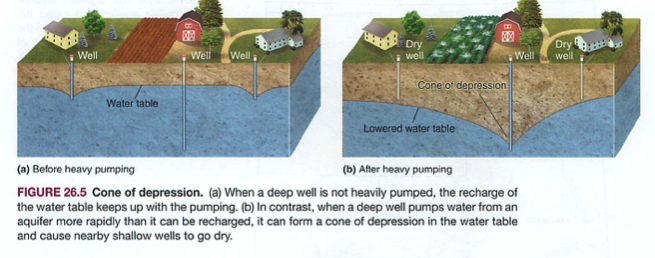Screen Shot 2022-11-26 at 1.59.19 PM.png
This is why all wells in Hawaii are owned by the board of water supply: so deep wells don't take all of the water from neighbors
Saltwater intrusion: with sea level rise, arable (farmable) land will disappear, particularly where slope of the land is most gradual, like the Nile river valley, most of Bangladesh, the Mississippi river delta, and the Pearl river delta in Asia where most of the rice for Asia is grown:
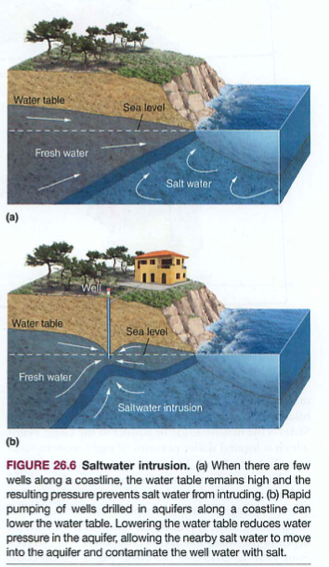Screen Shot 2022-11-26 at 2.00.46 PM.png
---
Migrated from Apple Server Wiki. Original page ID: Y8Q4V2
# Module 27: Humans and water
This module is all about controlling water:
- Primitive societies were often cited on rivers: Why?
- Levees are walls built to contain the rivers when they flood, particularly in flatter areas, fed by melting glaciers or snow melt.
- Most of the Netherlands (including the district called "Holland") is under sea level, very flat, and would be underwater without levees, which in their case don't follow a river, but block the sea, known as "Dikes"
- Dams are structures that block the flow of rivers, either to capture water for irrigation or to produce electricity by harnessing the flow of the water, usually from very deep water (this is why dams are often very high)
- Exceptions are the three gorges dam in China or the great Aswan dam in Egypt: long dams over a large area.
- Reservoirs are land based artificial lakes, often sealed at the bottom to hold the water. Evaporation is a key method of water loss in these.
- Fish ladders are gradual "backwards steps" to enable fish, usually salmon to travel upstream to lay their eggs.
- Aquaducts (from the Latin: aqua is water, duct is carry) are artificial rivers usually lined with concrete to carry water from one place to another without power, using the slope of the aquaduct. Invented by the Greeks, used by the Romans, as well as powerful forces in LA to bring water from northern California to LA (and Laguna Beach).
- Desalinization is the process of separating salt from water (usually ocean water) for irrigation and human use. Two methods are used: energy from heat boils salty water, and the freshwater condensate is then used. Reverse osmosis uses energy from high pressure to force water through a membrane. Both produce a toxic salty solution called brine, which can then be dumped into the sea, often causing environmental damage (e.g. Dubai)
Water, and therefore food is not universally available:
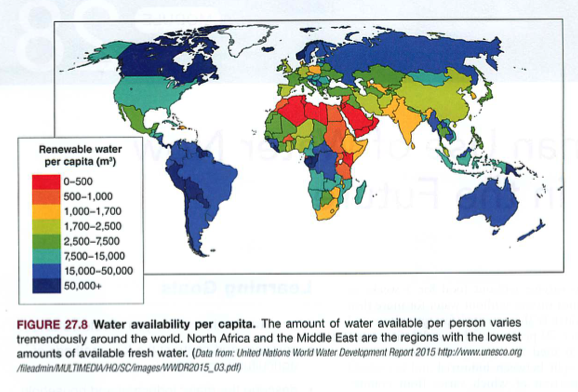Screen Shot 2022-11-26 at 2.15.35 PM.pngWhat this means is farming is limited to areas where there is freshwater, see next module on creative solutions to this...
---
Migrated from Apple Server Wiki. Original page ID: Z7g3M0z4
# Module 28: Humans and water in the future
Water footprint: the amount of water used per capita (per head) in a country, including irrigation, industry and residential use.
Check out these two images:
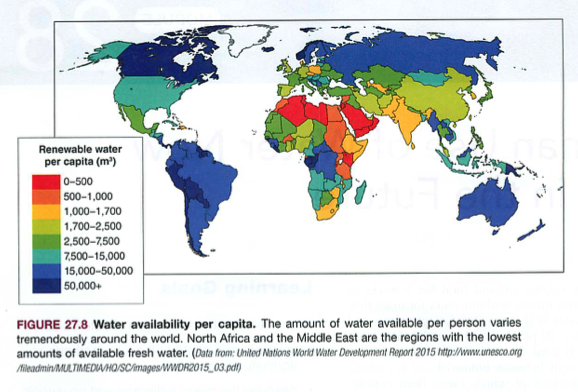Screen Shot 2022-11-26 at 2.15.35 PM.png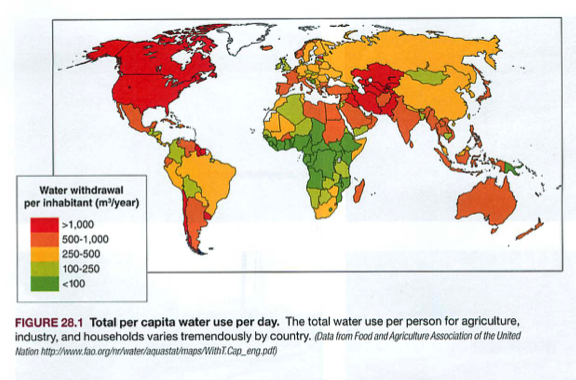Screen Shot 2022-11-26 at 2.18.40 PM.png
What do you notice about use and availability?
Often, humans waste what they have available (water, timber, food)
As the need for food increases (population just passed 8 billion), creative methods will be needed to conserve water:
Irrigation:
- Furrow irrigation: 65% of water goes to plants
- Flood irrigation: 70% goes to plants
- Spray irrigation: 75% goes to plants (if not windy)
- Drip irrigation: 95% goes to plants
So...why not use the last two? Expensive (materials and labor)
But: as food prices rise along with water needs, these will become more widespread
Hydroponics: takes soil out of the equation, how?
Closed system with water, aeration and nutrients, everything a plant needs
Issues: small scale but very high productivity, often enclosed in greenhouses which prevent pests, can be organic (no pesticides) and can be grown where weather prevents normal crops
Industrial water use (huge):
Copper: 440 l (116 gallons) per kg of Cu for wiring
Aluminum: 410 l per kg
Steel: 260 l per kg
Paper: 125 L per kg
Most folks don't see these water uses, and they show up as pollution sources as well as water users
Household water use:
White water: pure water, can be used for drinking
Grey water: soapy wash water, can be used for irrigation or flushing, but not clean enough for drinking
Black water: raw sewage, can be treated to become usable for irrigation or flushing, even drinking (see rivers next semester)
Japan has created washing machines and sinks ABOVE toilets, so grey water use used for flushing. Cool!
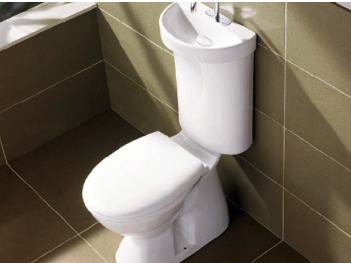Screen Shot 2022-11-26 at 2.31.14 PM.png
Water ownership:
Water wars will be fought more and more, current conflicts:
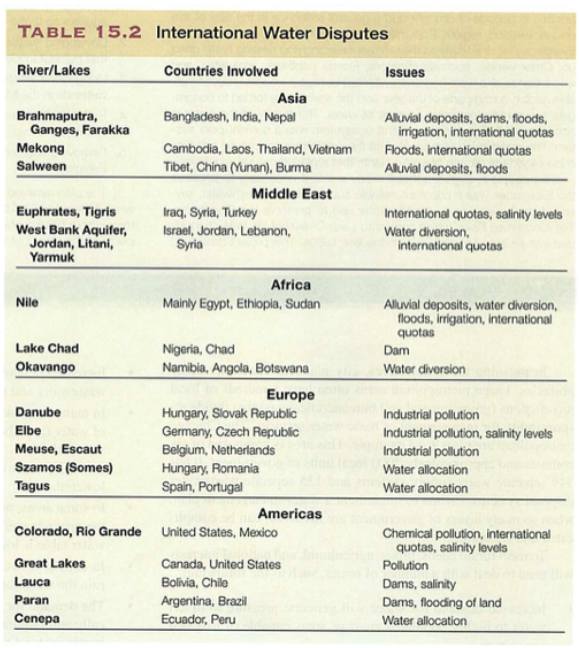Screen Shot 2022-11-26 at 2.32.41 PM.png
Deep wells and horizontal drilling are two sneaky ways to steal water from your neighbors.
Outright warfare is another, more obvious method.
Climate change will impact many of the rivers in the world as glaciers retreat, so water diversion will become a global issue:
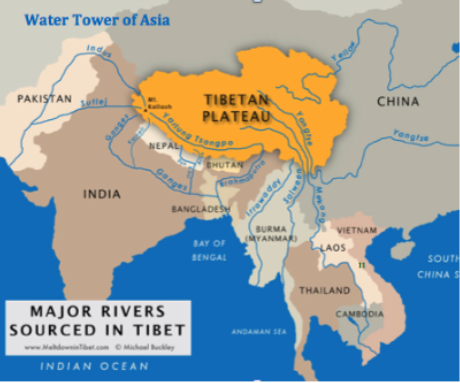Screen Shot 2022-11-26 at 2.34.44 PM.png
---
Migrated from Apple Server Wiki. Original page ID: Z1r0166
# Module 06: movement of energy
Module 6: Movement of energyBiosphere-all life
Producer (also primary producer) gets energy from sun or heat directly, also known as autotrophexample: grass
Photosynthesis: CO2 + water + energy (heat or light) -> sugars (CHO)Reverse process is respiration: Sugars + O2 -> energy + CO2 + water
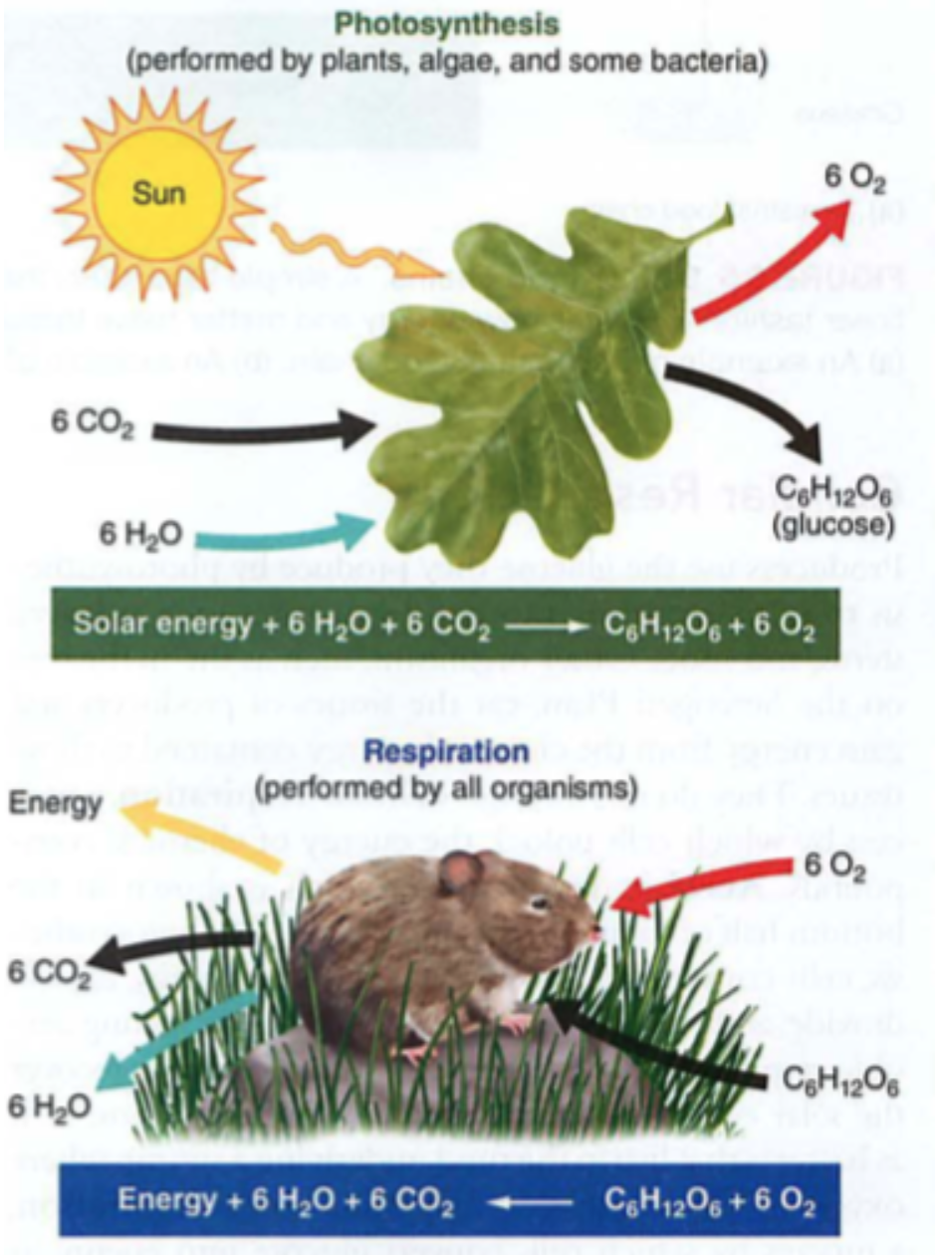Screen Shot 2022-12-02 at 3.38.24 PM.pngAnaerobic respiration (e.g. bacteria) don't use O2, less efficient, older primitive source of energy (pre-oxygen)
Consumer (heterotroph) consumes other primary autotrophs
- Primary consumers eat plants (e.g. herbivores)
- Secondary consumers eat them (carnivores)
- Tertiary consumers eat other carnivores (algae->zooplankton->fish->eagles)
Trophe = "nourishment"Trophic levels = food levels, see also food web
- Scavenger-eats dead stuff
- Detritovore-eats dead stuff that is decaying
- Decomposers-break down into basic elements
GPP gross primary productivity= Total amount of solar energy into the system: like gross income in a businesse.g. all of the money coming into your business
NPP net primary productivity = GPP minus respiration (think of Maui onions):gross income-expenses=net income
Biomass-total mass of all living things in an ecosystem-odd fact: rain forest soil is the lowest in nutrients and biomass-why?
Standing crop-total plant biomass (e.g. forest)Efficiency is low (around 10%)
Trophic pyramid: 10x reduction in energy for each level (why?)-vegetarians vs. meat eatersSo, carnivores (us, wolves) are eating harvesting devices (cows) for autotrophs (grasses):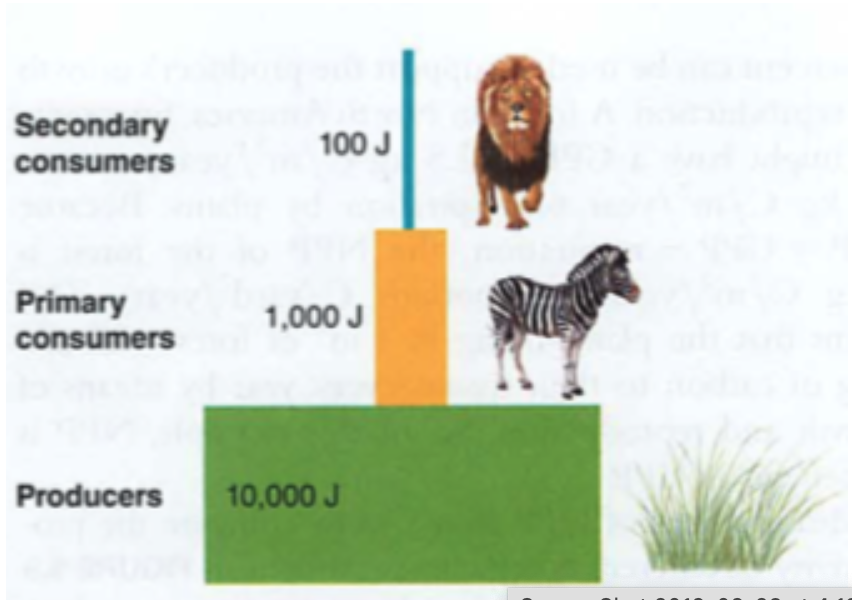Screen Shot 2022-12-02 at 3.38.31 PM.png
Not very efficient, unless you can't digest grass, or it takes too much energy to walk around all day. This IS, however a good argument for global sustainable survival, as the sun will not go away soon, and as long as we have arable (farmable) land to grow plants, we could survive with a global population of 8-10 billion.But we'd need access to fresh water...Recall: energy->water->food->culture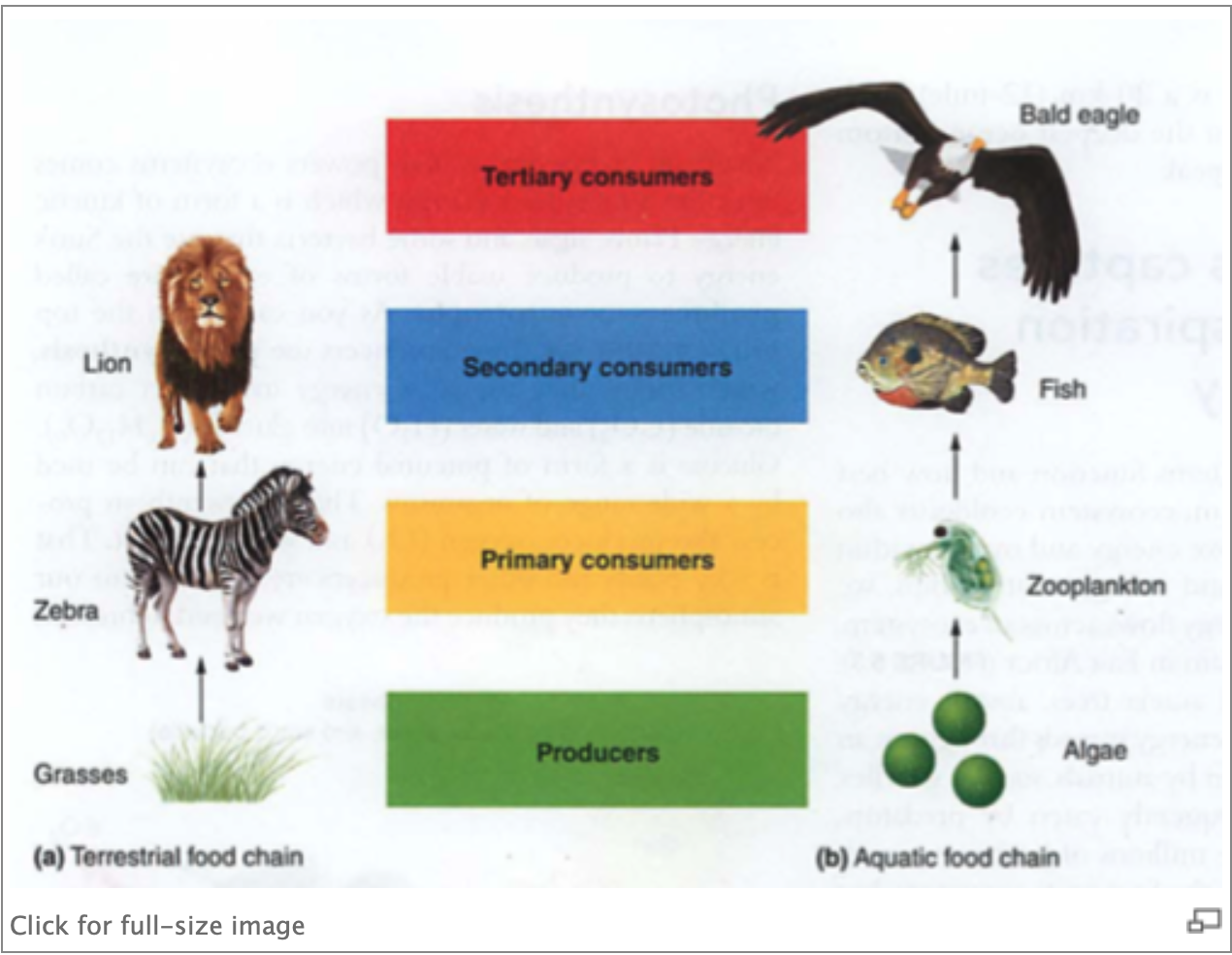Screen Shot 2022-12-02 at 3.38.37 PM.png---
Migrated from Apple Server Wiki. Original page ID: S530r9e
# Module 07: movement of matter
Module 7: Movement of MatterBiogeochemical cycles: bio=life geo = minerals chemical = chemical cycle = something that rotates
Hydrologic (water) cycle:Heat provides energy for evaporation,
Plants secrete water as transpiration,
Condensation is collection of water vapor to drops,
Precipitation is the falling of these drops as rain, snow, hail etc.
ETO evapotranspiration: amount of water moving through an ecosystem, usually plants.Farmers need to know EtO to know how much water to supply to their crops.Eto depends on sunlight, humidity, wind and temperature (think of how these impact transpiration)
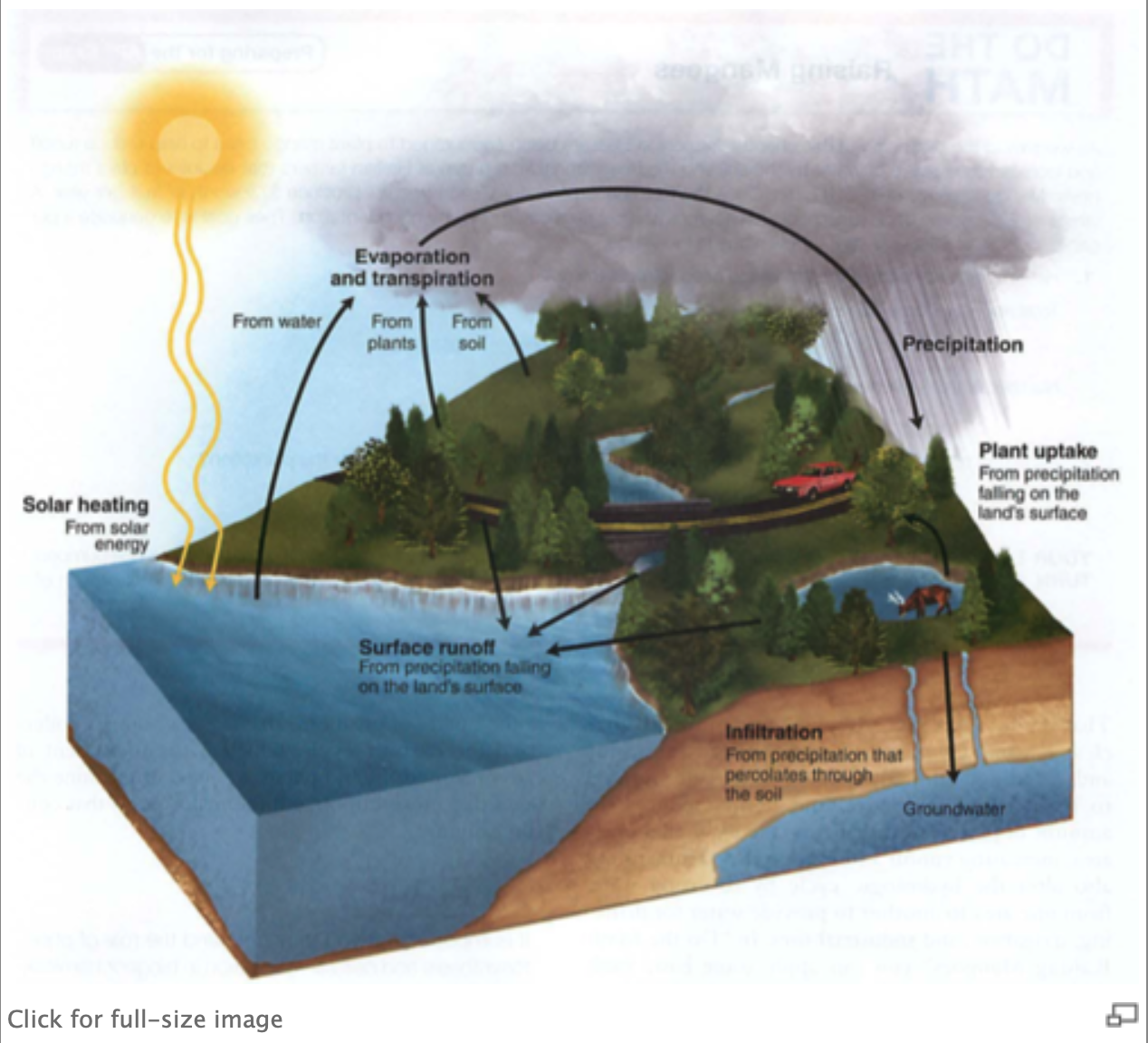Screen Shot 2022-12-02 at 3.41.31 PM.pngRunoff-just like it soundsYou will need to know about "transit time" which is the time it takes rain to reach a water body after hitting the groundWhy is this crucial?(you will see this mentioned in the Poisoned Waters video this weekend)
Carbon cycle: photosynthesis, respiration, exchange, sedimentation, burial, extraction, combustionair<->water<->land
photosynthesis-CO2 to sugar (air to plant structures or fruits-e.g. corn)
respiration-sugar to CO2
acidification or exchange-HCO3 (carbonic acid) e.g. seawater changing pH, remember?
sedimentation-CaCO3 (seashells, limestone) most efficient long term carbon sink (solids are dense)burial-just like it sounds, oil, coal, nat gasextraction-mining fossil fuelscombustion-burning fossil fuels with oxygen to release CO2
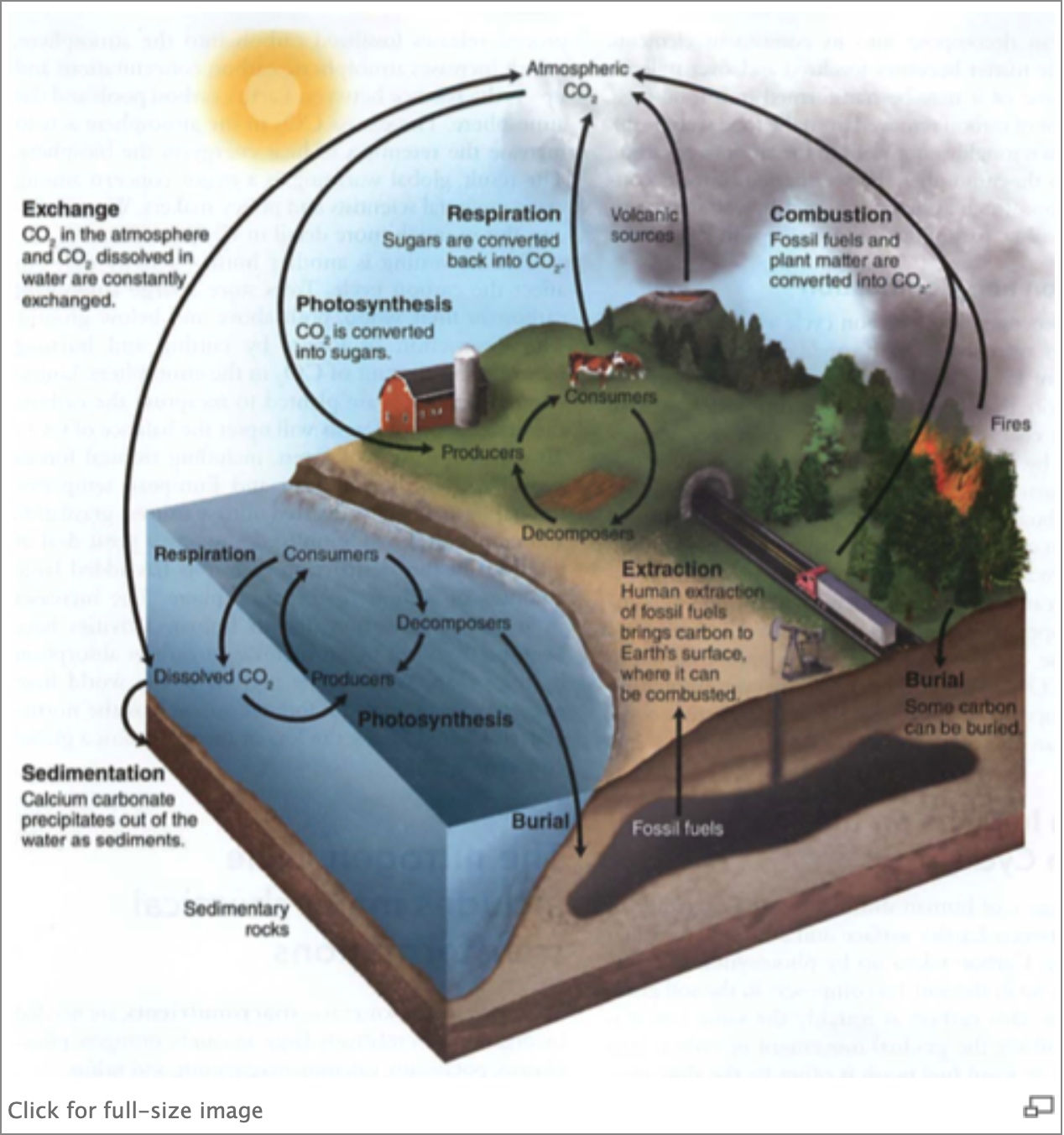Screen Shot 2022-12-02 at 3.41.38 PM.pngNitrogen cycle:6 macronutrients needed by plants: N,P,K, Ca, Mg, S (sulfur becomes part of Methionine, an amino acid)NPK from fertilizersN is a limiting nutrient
N fixation is when you can't get Nitrogen off your mind
Questions:
1. Define N, P, K and how each impacts plants
2. Define evapotranspiration, condensation and precipitation
3. Which biogeochemical cycle only has a solid phase in the environment?
4. What element replaces oxygen in chemosynthesis?
It also means bringing N2 gas from the atmosphere into the biome, biotically or abiotically (without life)
abiotic: lightning or burning fossil fuels (high temps) direct to nitrate (NO3) (that interesting smell after rainstorms)
biotic: nitrogen fixing bacteria: N2 ->NO2 ->NO3 ->NH3 ->NH4 ion (used by producers, it is aqueous)
commercial N fixation: petrochemicals to form fertilizers (NH3, anhydrous ammonia, ammonium nitrate NH4NO3, which is used in ANFO bombs)
nitrification: NH4+ ->NO2- ->NO3-nitrite kills bacteria (used in preserving meats), but nitrate is a good plant fertilizer (ANFO bombs, [Beirut harbor explosion](https://www.youtube.com/watch?v=LNDhIGR-83w))
assimilation: producing amino acids and then proteins (chains of AA)
Dead stuff: mineralization or ammonification (dead fish smell: NH4+ and amines)
Vitamins = "vital amines"
denitrification: NO3- goes to N2O to N2 gas (anaerobic bacteria, swamps)
Leaching: washing N out of soil
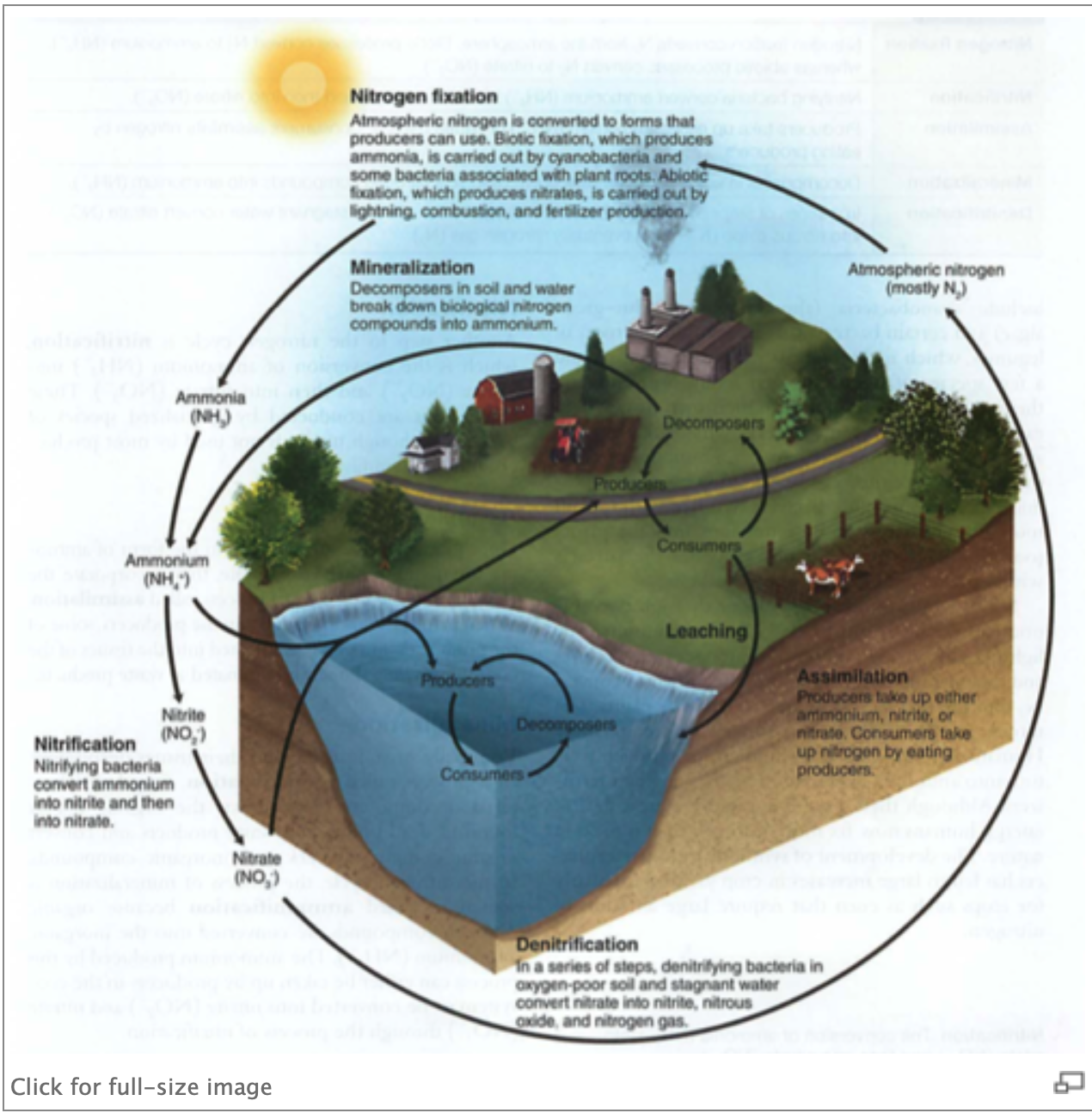Screen Shot 2022-12-02 at 3.41.44 PM.pngPhosphorus cycle:Mainly rocks, between land and waterONLY SOLIDS, NO LIQUID OR GAS PHASE
biotic: animals uptake PO4--- (see also phosphoric acid H3PO4), turn it into bones, teeth as CaPO4, then back to soil
abiotic: phosphate sediments in ocean-> become rocks, erosion on land dissolves into watershed
Algal bloom: PO4 -> lots of algae on surface (light) -> these die, fall to the bottom, and as they decompose, they take all O2 from the water (hypoxia)Arsenic in bananas---why we cannot use greywater for irrigation
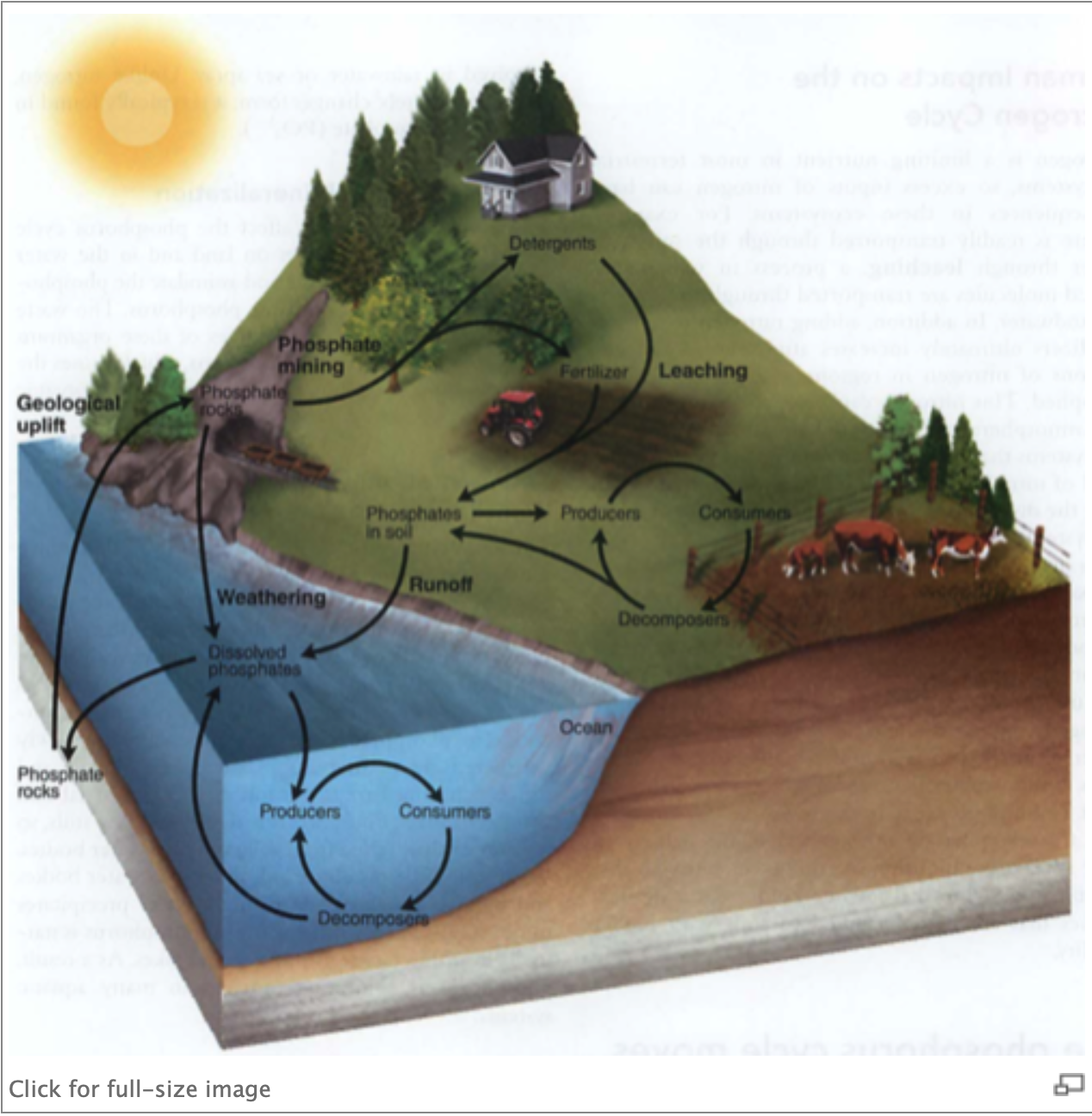Screen Shot 2022-12-02 at 3.41.50 PM.pngCa, Mg and K: dust (Kauai dependent on Gobi desert dust for K)
Sulfur cycle:rocks -> SO4, can become part of methionineSee also SO2 (vog, acid rain, pollution)
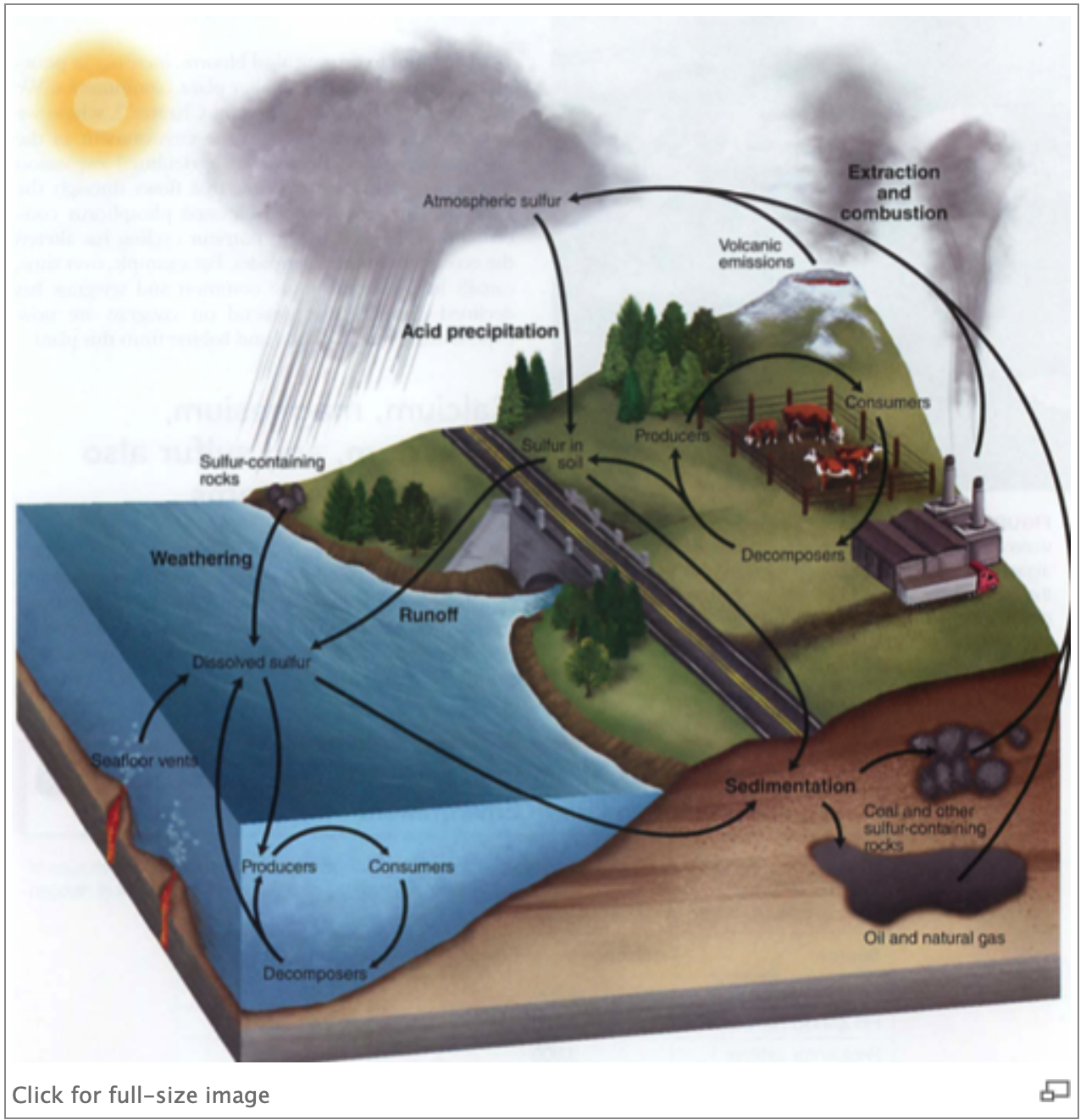Screen Shot 2022-12-02 at 3.41.56 PM.png
Here's something interesting:Find Sulfur below:
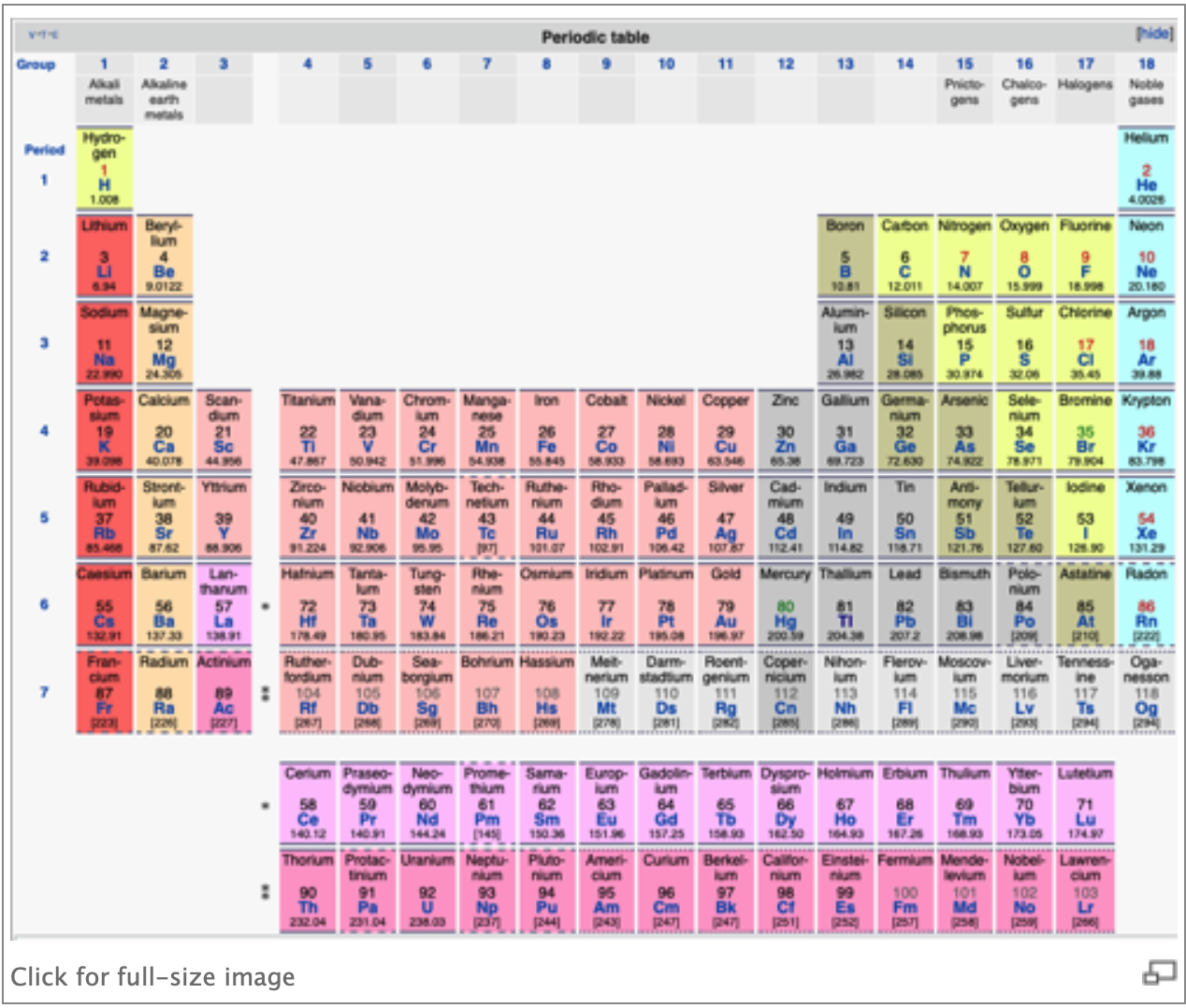Screen Shot 2022-12-02 at 3.42.03 PM.pngOk, now find Oxygen.Hydrothermal vents use sulfur instead of oxygen for a thermal (heat) version of photosynthesis called chemosynthesis
---
Migrated from Apple Server Wiki. Original page ID: b7W196
# Module 08: Response to disturbances
Module 8: Response to disturbancesRecall negative feedback (stable ships, relationships): greater the disturbance, the greater the restoring force (pendulums too)Resistance is how hard it is to move the pendulum (ecosystem) away from center
Resilience is how fast the pendulum (ecosystem) returns to normal
Biodiversity and disturbances:This is strange stuff:Rare disturbances = competition, so only a few species dominateCommon disturbances = only fast reproducers survive, so low biodiversityIntermediate disturbances = highest biodiversity
Watershed: drainage basin usually leading to a large body of water (Chesapeake watershed is huge):[https://www.cbf.org/about-the-bay/chesapeake-bay-watershed-geography-and-facts.html](https://www.cbf.org/about-the-bay/chesapeake-bay-watershed-geography-and-facts.html)
How do you think this impacts the water quality, phosphates, nitrates and silt in the Chesapeake bay?Why are we not allowed above the fences behind Pu'u La'e La'e?On Oahu, the watershed is guarded by a barbed wire fence-why?How are the Himalayas acting as a watershed?
Poisoned waters:Video:[http://physics.hpa.edu/physics/apenvsci/videos/poisoned\_waters/POISONED\_WATERS.mp4](http://physics.hpa.edu/physics/apenvsci/videos/poisoned_waters/POISONED_WATERS.mp4)
[http://physics.hpa.edu/physics/apenvsci/videos/poisoned\_waters/poisoned\_waters.m4v](http://physics.hpa.edu/physics/apenvsci/videos/poisoned_waters/poisoned_waters.m4v)
Weblog page:[http://physics.hpa.edu/groups/apenvironmentalscience/weblog/973c4/Poisoned\_Waters\_videoPBS.html](http://physics.hpa.edu/groups/apenvironmentalscience/weblog/973c4/Poisoned_Waters_videoPBS.html)
On campus try these:[http://physics.local/physics/apenvsci/videos/poisoned\_waters/POISONED\_WATERS.mp4](http://physics.hpa.edu/physics/apenvsci/videos/poisoned_waters/POISONED_WATERS.mp4)
[http://physics.local/physics/apenvsci/videos/poisoned\_waters/poisoned\_waters.m4v](http://physics.hpa.edu/physics/apenvsci/videos/poisoned_waters/poisoned_waters.m4v)[http://physics.local/groups/apenvironmentalscience/weblog/973c4/Poisoned\_Waters\_videoPBS.html](http://physics.local/groups/apenvironmentalscience/weblog/973c4/Poisoned_Waters_videoPBS.html)
quiz
1. why is the soil on Kauai so poor, and how does it get its Potassium?
2. how does the size of the Cheseapeake watershed impact eutrophication in the Chesapeake bay?
3. what is the difference between resistance and resilience in natural systems?
4. why do rotting fish smell so bad?
Summary notes:Systems
- systems are usually connected, exchange matter and/or energy
- main energy source is our sun, or past suns (e.g. uranium)
- feedback loops (again)
- spheres: litho=stone, bio=living, hydro=water, atmo=above
- geosphere: crust-mantle-core-inner core (spins, no way!)
- plates-who thought this up? need to understand convection
- where are oldest parts of crust? trick question
- subduction zones, mid atlantic ridges (atlantis?)
- eq: deep near subduction zones, shallow in transform faults
- mid atlantic ridge: how do we know this? submarines
- himalayas-how? matterhorn-what?
- water cycle: evaporation and transpiration (eTO)
- precipitation-condensation is first (condensation nuclei, e.g. vog)
- aquifers-underground lakes, low turnover rate (pesticides) Oglalla
- water can be ground water: aquifer, water table, water lens or surface water
Cycles
- conservation of matter (neglect E=mc2)
- nutrient cycles: carbon, oxygen, phosphorus, nitrogen COPN
- primary producers-photosynthesis: CO2, water and light/heat
- create sugar as stored food, structural element
- consumers-eat primary producers, decomposers break down waste/detritus
- cellular respiration (flowers in hospitals) at night
- carbon also in HCO3- ion (seawater) and CaCO3 (seashells, limestone)
- greenhouse effect from CO2 captured as plants->oil/coal "carbon bank"
- phosphorus: rocks and water (stone and sea), erosion, very limited supply in biosphere (Waterloo bones)
- P only absorbed in aqueous form (aq)
- too much = eutrophication (also nitrogen) see dead zones
- eutrophication: too much of a good thing, when algae dies, decomposes, creates hypoxic zones
- aerobic vs. anaerobic bacteria-wounds
- nitrogen cycle-NPK
- N2 to life: lightning and bacteria (N2 to ammonia NH3 then to NO2 and NO3 (plants absorb NO3)
- denitrifying bacteria change NO2 back to N2 (gas)
- Haber process
- See figure 3.30-nitrogen uptake
- golf courses-Mauna Kea, iBoat
---
Migrated from Apple Server Wiki. Original page ID: 3674N12
# Module 04: matter
Overview:
- Frog book chapter 3: systems (3.1 and first part of 3.2 on your iPad)
- FR chapter 2: systems (modules 3,4,5 in the FR text, Goodreader on your iPad)
- Math bits: radioactive decay, pH
Review:Chapter one was on overview of what Environmental Science is all about, what your greatest challenges will be in this century (good luck), and some bits about the scientific method (and how to find witches).The iBook coveres these as well, but in a more interactive overview.Chapter two is all about systems, matter and energy, the subject of other courses as well: physics is all about energy and matter, chemistry is about matter, energy and reactions, and biology includes feedback loops and systems, as well as lots of gooey living stuff.For this chapter, cause and effect will be your guide-keep these in mind.Reading: Chapter 2 in FR text, modules 4 and 5. Module 4 is huge, so don't give up.
Why this chapter now? How does it enable us to study other things?Soils-capillary actionPopulations-radioactive decayEnergy-PE/KE, thermodynamicsGlobal warming-radiation, thermodynamics, feedbackWater-pH, chemistry, colligative propertiesFood-fat/CHO/proteinsSustainability-feedback, thermodynamics
Some of these may be review for you, for others it may be new, so let's take our time...
Module 4: Systems and matter----------matter=takes up space and has mass (better definition: anything that has density since d = m/v)mass=amount of matter (n.b. NOT weight, you can be weightless in orbit, but you still have mass-watch the film Gravity...)atom: a=not, tom=cut (look up tomogram, CAT scan, or go to subway)atom=smallest particle (known then) that cannot be cut further (we now know there are protons, neutrons, electrons, and quarks, even smaller things than these are predicted, look up string theory)
Element: recall all of your previous science courses-this is a collection of atoms that share the same identity, usually noted on the periodic table by their number of protons, NOT neutrons (e.g. isotopes) or electrons (e.g. ions)Look at carbon 12, 13 and 14-look at the notation for each (isotopes=iso, same tope, type)Look at sodium atom and sodium ion, note the notation for each
Why do they have certain charges? Who does every element "want" to be? Why?Diverge here into orbitals if you like; s,p,d,f (sharp, principal, diffuse and fundamental spectral lines)
[https://ptable.com/?lang=en#Properties](https://ptable.com/?lang=en#Properties)
Molecules: more than one atom (H2)Compound: more than one element (NaCl)Questions:
1. If density = mass/volume, why is this a good definition of matter?
2. Hydrogen can be an atom, while Hydrogen gas is a molecule. Explain
3. What is the difference between atomic number and atomic mass?
4. Carbon 14/12 is an isotope of Carbon 12/12. Explain
Radioactivity: unstable nucleus (usually more neutrons than protons), releases particles (often neutrons, but includes electrons as beta rays, or energy as gamma rays)Largest and slowest radiation is alpha rays: slow Helium nuclei (2 protons, 2 neutrons, no electrons, so they are + charged)
Radiation summary: (n.b. you may see these referred to "rays" or "particles", they are the same)
- alpha rays: Helium nuclei, slow, charged, stopped by your skin or paper
- beta rays: fast electrons (137,000 mph), charged, stopped by foil
- gamma rays: fast photons with very high energy, penetrates almost everything, stopped by lead
- neutrons: can be fast (bad) or slow (thermal, useful in creating steam in nuclear power plants), goes through everything but 2 meters of concrete or lots of lead shielding
Radon gas
Biggest danger to you if you live near granite or other similar rocks (Alaska, Colorado, Oregon, Washington):Alpha emitter, so not dangerous alone, but if breathed in, it emits alpha particles deep in your lungs, causing cancer (lung cancer and leukemia).
Second main cause of lung cancer in the US!Much denser than air (226 grams per mole, vs. about 42 for room air) so found in basements or lower parts.Ventilation is the solution, or not living in lower areas of a house.Most states where this is found have laws requiring a ventilation fan system (ask someone from Alaska, Montana or Minnesota)
Half life: not just a boring Saturday nightTime it takes for half of whatever to decay, depends on amount left, like water leaking from a large water tank
If you are into math, this is known as a differential equation, meaning the rate is dependent on the amount left. We'll see more of this in population curves, but any time a rate is dependent on how many there are, you'll see the half life rear it's head.Some math you will need to know:A half life is the time it takes for half of something to go away.In radioactivity, we use the formula: amount left = starting amount x (1/2)^n. where n is the number of half lives:
Sample problem:Starting with 128 grams of unobtainium, which has a half life of 10 minutes, how much will be left after:10 minutes20 minutes60 minutes15 minutes (tough one, make sure you know how to use your calculator in real mode, not "hello Kitty" mode
You can also write the formula as: amount left = starting amount/2^n
Questions:
1. What is similar and/or different between U 234/92 and U 238/92?
2. How many protons, neutrons and electrons in each?
3. Would you expect this to be radioactive?
4. A news announcer says:”Iodine 131 has a half life of 8 days, so it will all be gone in just 16 days”. What is wrong with this?
--------------------Radioactive decay lab: M&Ms®
1. pour at least 40 M&Ms® into a jar, close the lid and mix
2. pour the M&Ms® out onto a plate, and count the total number
3. remove any M&Ms® that have the logo face up
4. count again
5. repeat #1 above, one minute later
6. graph your results, with the X-axis as number of tests and Y-axis as number remaining after each removal
7. what does the X-axis represent?
8. what does the Y-axis represent?
9. what is the half life for emanemium?
10. graph our results along with the data from other teams on one graph-what do you notice? (x-axis is minutes, y-axis is # remaining)
Review:
Bonds: (not the money kind)
- Covalent: weak, think of plastic, butter or things that can melt. Electron is shared between both atoms (e.g. pilot-copilot), examples: any twin (H2)
- Ionic: strong, electron moves from one atom to another (NaCl is a good example), hard to melt, usually dissolves in water
- Polar molecule: has one end more + than the other (like water, which is polar covalent-confusing!).
- Hydrogen bonds are formed when a polar covalent molecule like water has one end (the hydrogen end) that bonds weakly with the negative charge (the oxygen end) on another molecule
## Water!!!!--------------
- What do blonde people and very tall trees have in common?
- What do vaping teens and premature babies have in common?
Surface tension: cohesion (holding hands)-think of water bugs, and the soap exampleSoap makes water "wetter" by reducing surface tension between water moleculesSoaps also have an ionic (water loving, hydrophilic) side and a covalent (water hating, hydrophobic) side, so they can carry away oils when in water, like washing your hands
Capillary action: cohesion and adhesion (think of adhesive)Key to most plants...
- Cohesion: water molecules want to "hold hands"
- Adhesion (like adhesives): water molecules want to stick to other molecules
- Capillary action: combination of these two, where walls are close together (hair, trees, all plants)
Questions:
1. what is the connection between water striders, tall trees, premature babies and vaping?
2. what is the connection between wifi, microwave ovens and dry toast?
Acid: more Hydrogen ions free (H+)Base: fewer Hydrogen ions free (more OH-)Water: amphoteric (both sides): balanced H+ and OH-Water is H-O-H or H-OH, so has a balance
Here's the trick: Acids have more Hydrogen, but they have a lower pH (1) than bases (14) huh?pH: n.b. the notation, this means "potency of H+ ions" (don't misspell it)
Here's why:pH is the -log10 of the \[H+\], so larger numbers are actually closer to zerolog10 of 1EE-14 is -14, a very small amount of hydrogen, so a baselog10 of 1EE-1 is -1, a much larger number of hydrogen atoms, so an acidSee? The negative sign in the formula makes these into positive numbers, so:pH of acid is 1, pH of base is 14
Quick dive into pH and pOH:pH is LOWER the stronger the acidn.b. the pH and pOH always add to 14:water is pH 7 and pOH 7some acid might be pH 2 and pOH 12some base might be pH 12 and pOH 2pH of perfect acid is 0, which has a pOH of 14pH of perfect base is 14, pOH is 0
Acids: battery acid, your stomach acid, fruit juice, vinegar, old wine, your skin (why?)Bases: soaps, drain cleaners----------------------9.9.21---------------------<="colligative">Colligative properties<="colligative"> (collected properties): bp (boiling point), fp (freezing point), mp (melting point, often the same as fp)Can be influenced by other substances, e.g. antifreeze, which is ethylene glycol, an alcohol. You could use any alcohol in your car to raise the boiling point, but ethylene glycol is less flammable (yet toxic to animals) than ethanoln.b. anything that ends in -ol is an alcohol: methanol, ethanol, butanol, propanol, etc., (see below).
- You could also use salt, which is hard on the bodies of cars (rust), but is great for melting ice on roads, or making ice cream (freezing point depression)
- Water is weird stuff: as it boils, it gets less dense (e.g. steam) AND when it freezes, it gets less dense (e.g. ice)
- Why is this critical for life in lakes in the winter?
- It is also a "universal solvent" since it has pH of 7, dissolves ionics and is polar covalent. Nice to drink as well.
- Fancy-pants word for this: amphoteric (both acid and base)
Alcohols:"Organic chemistry" means based on carbonAny organic (carbon) molecule with OH attached is an alcohol (different from OH in acids and bases)Look these up:MethanolEthanolPropanolButanolWhat do you notice?
----On alcohol being used as food for alcoholics:Ethanol is metabolized in the body into ethanoic acid also known as acetic acid. You bio folks may recognize this as one of the inputs in the TCA (citric acid or Krebs) cycle. Once a human body "learns" how to live off of ethanol (e.g. alcoholics), many of their calories come from this source. One theory uses this as a possible explanation for certain genetic predispositions towards alcohol dependence. This is what the chemistry looks like:C-C-OH ---> C-C-O-O-H ---->C-C-H-Oethanol --> ethanoic acid --> ethanalThe other name for ethanal is acetaldehyde, which is the strange smell you detect coming off the breath and skin of alcohol drinkers.
Methanol takes a far more toxic path:C-OH --->C-OOH ----> C-HOmethanol --->methanoic (formic) acid ---> formaldehydeYou might recognize the second one as the sting from fire ants, and the third as a carcinogen they embalm dead bodies in...
As if that was not enough for one module...Chemical reactions: usually involve movement of energy (light, heat), no mass is created or destroyed (conservation of matter)melting and boiling don't count, sorry
Organic stuff (this could be an entire separate chapter-ask Ms. Anton!)Organic=contains carbon, the base for life on our planet usually C-H or C-C bonds.Look on the periodic table below Carbon, we could be Silicon, but we'd have to be lava creatures since the energy needed for chemical reactions would be higher.n.b. some thermal creatures use thermosynthesis instead of photosynthesis, using sulfur instead of oxygen (look again at the periodic table)
Inorganic=either no carbon, or bound carbon (C02, like in carbon dioxide)Food stuff:Proteins, fats and carbohydrates: all contain C-H-O in some combination, only proteins have N as well...Dive deep if you dare:CHO=carbohydrates (clever name), usually in a chain, short chains are sugars (used for fuel), longer ones are starches and can be used for structures (e.g. cellulose in plants) or pasta...smallest: sugars, all end in -ose (glucose, sucrose) LOOK THESE UP, CHECK OUT THEIR MOLECULE SHAPEglucose is a "monosaccharide" created by photosynthesis (next chapter)longer chains: starches (rice, pasta) slowly digested (see diabetics, and glycemic index)structural CHO: cellulose-little boxes with goo inside, need enzymes to break these down (cows)ENZYMES ALL END IN -ASE
Fats/lipids: same chemical structure as CHO, but built along a glycol (alcohol) backbone. If the fats have long carbon chains with only single bonds, they are saturated (lots of Hydrogen atoms) and can hold together (e.g. animal fat)[https://en.wikipedia.org/wiki/Saturated\_fat](https://en.wikipedia.org/wiki/Saturated_fat)
If the long chains have double bonds and don't fit together, they melt easier (e.g. oils) and are called "unsaturated", usually better for your health.n.b. McDonalds® got into real hot water a while ago for frying all of their stuff in "supersaturated fats". Ugh...
Proteins: complex molecules of CHO and N. Look up amino acids, note the common structure.Now look up the amino acid methionine. What element does it contain as well? Why do rotten eggs, swamps (and Kilauea volcano) stink?
Nucleic acids: DNA and RNA (another whole chapter)
Questions:
1. What is the difference between carbohydrates, fats and proteins?
2. How much more acidic is something with a pH 4 than one of pH 5?
3. An element has a half-life of 30 days. If the original sample is 100 grams, how many grams will remain after 45 days?
4. Which is more acidic: NaOH or HCl? Why?
CALCULATOR PRIMER-------------This is what an iPhone calculator looks like:
### How to do half lives:
Let's say you are given 64 grams of something with a half life of 7 days. This means every 7 days, half of what you started with goes away.If they ask you how much is left after 21 days, you first divide 21 by 7 to get "n" the number of half lives: 3
Then you set up your calculator like this:Amount = Starting amount (0.5)^nBest way is to do this from right to left (backwards)so,Enter 0.5hit the xY key (just below m+)enter n (3 in this case)press equalsmultiply all of this by your starting amount (64)you should get 8 grams left
Try this with 128 grams and a half life of 6 days, after 42 daysYou should get 18/6 = 3 = n0.5 xy 7 = 0.125128 x 0.125 = 16 grams
### How to do pH calculations:
pH is a number between 0 (acid) and 14 (base)pH is defined as -log10 \[H+\]What this usually means is just the exponent of the \[H+\] concentrationso,\[H+} of 1 ee -4 has a pH of 4\[H+} of 1 ee -6 has a pH of 6
\[H+} of 1 ee -4 has a pOH of 10
why? pOH is just 14 - pH, so pH + pOH always = 14On your calculator, calculate the pH of something with a hydrogen concentration of 1 ee-3enter 1press ee key (to the left of 1 on the calculator)press 3press the +/- key (above 8 on the calculator)press log10 (left of 4 on the calculator)change the sign from minus to plusyou should get the answer: 4
This also works for complicated numbers like \[H+\] = 4 ee -3: pH = 2.39
---
Migrated from Apple Server Wiki. Original page ID: B9n8F1z
# Module 05: Energy
**Module 5 (FINALLY!)Energy** is the ability to do work (heard that before?)Units are joules ("jowles in England), and a few others (calories, Calories, BTU, kWh)
**Power** is how fast you can do the work (climbing stairs or running up stairs), so Power = work/timeUnits are Watts (joules per second or j/s) among others
Energy->Joules (work~amount of water)
Power->Watts (how fast the work is done~flow)
demo: walking/running upstairs-----------------
**KE/PE: Kinetic and potential energy**
PE: chemical bonds, height, spring
KE: motion, freewheel, flowing air/water
temp: KE=1/2mv^2 (macro level)
molecular level:
KE=3/2kT, so T prop to v^2 of molecules
EMR: shorter wavelengths more energy e.g. UV, X-rays
Light is one form of EMR or electromagnetic radiation (needs no medium, so we get light from the sun through the vacuum of space)What you need to know: EMR has higher energy with higher frequency (e.g. ultraviolet light damages DNA, infrared heat can only burn)See visible spectrum:
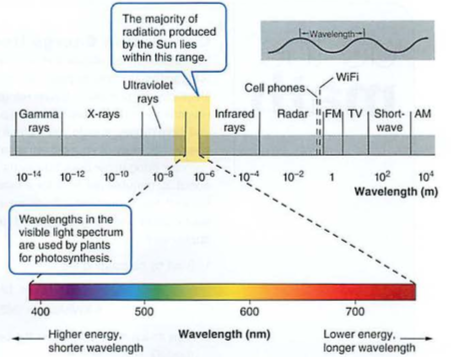
Energy can be potential (ability to do work) like altitude or chemical bonds or kinetic (see Kinesias in Lysistrata), the energy of motion or heat (molecules in motion, KE = 3/2kT)Temperature is not heat, but the average speed of the molecules...Temp in the upper atmosphere is 900°C but you'd freeze there, as there is no atmosphere to conduct the heat to you.Interesting fact: Concorde passengers could not touch the windows, not because they were too cold from the altitude, but too hot from the air friction of the plane going 2x the speed of sound.
**Thermodynamics (heat in motion)Laws: Physics version**1. you can't win (no such thing as more than 100% efficiency)2. you can't break even (not even 100% is possible, there is always a "heat tax" on every reaction)3. you can't get out of the game (all reactions tend towards disorder, the "heat death" of the universe, or ∆S>0 for the universe)
**Chemical version:**
1. energy cannot be created or destroyed
2. energy can move, but always at a cost (entropy, disorder increases, ∆S>0 universe)
**Efficiency** is the amount you get out of any energy reaction, divided by the amount that went in, always less than 100%**efficiency;** never 100%, 30-60% common
Human 35% efficiency, diesel engine 60%, Formula one racing car: 55%
**Energy "quality"** is the degree of organization of the energy (sugar molecules vs. heat coming from your body, or well organized gasoline "octane" molecules breaking into heat, CO2 and H2O)
**Entropy**: degree of disorder in any system, all reactions tend towards more disorder (e.g. your closet or bedroom-tell this to your parents)energy quality-entropy, disorder, e.g. closet ∆S>0, takes energy input to reduce S (entropy)
**System dynamics**----- (had enough yet?)**Open system:** stuff comes in, goes out, e.g. energy**Closed system:** everything stays in e.g. mass**Steady state:** balance of inputs and outputs (money example)**Feedback:** think of the howling speakers at assembly: microphone picks up the speaker, gets louder, goes on and on: positive feedback**Positive feedback:** response makes the situation stronger/unstable: capsizing ships, childbirth, bleeding to death, climate change, melting permafrost, albedo decrease in the arctic...**Negative feedback:** response makes the situation more stable, tends towards recovery: stable ships at sea, sweating, good relationships
**Questions:**
1. Explain the difference between energy and power
2. UV radiation will cause sunburns but infrared will not. Why?
3. What are the 3 laws of thermodynamics?
4. Give an example of positive and negative feedback
---
Migrated from Apple Server Wiki. Original page ID: p49469q
# Modules 01-03: introduction
FR Module 1 -------------
Fracking-What is it? Why is it controversial? How has it changed how we generate electricity in our country? At what cost? Why is this politically important? Why are the solvents they use secret? What is the impact of these solvents on water? Who developed it around 1960? What did he later put all of his money into?
Bio=life, so biotic means living, abiotic means not living (druids had a neat view on this)
How systems are defined enables us to create models of cause and effect (favorite topic of physicists and historians as well)
FR Module 2 ---------------
Environmental indicators: what we know and can observe that indicate the condition of a system
Ecosystem services: can be economic, direct or cascading (off shore oil for example, impacting fishing in the gulf of Mexico)
These are the 5 challenges that you will deal with in this century. Knowing about them will enable you to impact change.
It's all about you...
More terms:
Genetic diversity: variation in a population (could be age distribution in our class)
Species: different in obvious ways (definitions vary on this)
Species diversity: variation of species in a habitat (age distribution in the school or elab)
Speciation: an adaptation based on stress
Evolution needs three things:
1. some form of genetic variation
2. some stress that favors this variation
3. survivors have to reproduce and carry on the variation
Think of giraffes as an example:
1. longer necks in some animals
2. drought that kills all short neck creatures (just like in "land before time")
3. long neck animals survive to reproduce and carry on the variation
There is an interesting theory that the background rate of mutation/speciation was much higher long ago because our atmosphere was thinner, and enabled more cosmic rays to penetrate, causing much higher rates of mutation/speciation.
Cool stuff:
In England, butterflies have adapted since 1850 to look more like soot from coal fires.
In NYC, a species of "subway mosquitoes" have been found that feed on humans in a dark, cool place
Huh.
Extinction is the opposite of speciation, where species die off.
There is such a thing as a "background rate of extinction", which we have surpassed by many times
Diversity is good: think of monoculture food crops: one pest kills everything.
Food production: see Malthus and Norman Borlaug, e.g. Mexico famine (APHG?)
Anthopogenic (anthro=man, genic=cause) Climate change:
Greenhouse gases (see car windshield as an example)
Not too many people know we need some CO2 on our planet to keep water above freezing-think of this as we search for exoplanets...
Resource depletion is hard to grasp, but resource constraints are easier:
If we had a major tsunami here that closed airports (all near the shore) and ports, how long would we have:
- electricity?
- water? (pumped by electricity)
- food?
Our key concept:
energy->water->food->culture
1. With energy you can move/purify water
2. With water you can grow food
3. With food you can maintain a culture
Notice that these are not your usual "energy, food and water" items people think about.
Sustainability is living within your means.
Starbucks example...
Ecological footprint: created by Jurgen Randers and Mathis Wackernagel (both here for the opening of this famed structure)
1. energy
2. settlements
3. timber
4. food
5. seafood
6. carbon
7. built up land
8. forests
9. cropland
10. fisheries
What impacts your global footprint?
Weekend Homework, Due Wednesday (yay!) 8.25.21:
Read modules 1-3, complete the practice questions at the end of each module, email your answers.
Cause and effect, email your answers:
Why does the girl think her dad is an alien?
[https://www.youtube.com/watch?v=sVRAtQ7XjkM](https://www.youtube.com/watch?v=sVRAtQ7XjkM)
What don’t we see between the kiss and him driving home?
[https://www.youtube.com/watch?v=g7\_slK24lXU](https://www.youtube.com/watch?v=g7_slK24lXU)
Monty Python Witch scene:
[https://www.youtube.com/watch?v=Ii68tPIiZOo](https://www.youtube.com/watch?v=Ii68tPIiZOo)
1. Can you follow cause and effect?
2. What is their logical path?
3. Why do folks associate fracking with earthquakes? (chapter one in the text)
4. Why do folks associate fossil fuels with global heating?
5. Who might be against this line of reasoning and why?
---
Migrated from Apple Server Wiki. Original page ID: Q3w3h5
# Module 01: introduction
FR Module 1 -------------
Fracking-What is it? Why is it controversial? How has it changed how we generate electricity in our country? At what cost? Why is this politically important? Why are the solvents they use secret? What is the impact of these solvents on water? Who developed it around 1960? What did he later put all of his money into?
Bio=life, so biotic means living, abiotic means not living (druids had a neat view on this)
How systems are defined enables us to create models of cause and effect (favorite topic of physicists and historians as well)
---
Migrated from Apple Server Wiki. Original page ID: x2Z3r7m
# Module 02: biodiversity
FR Module 2 ---------------
Environmental indicators: what we know and can observe that indicate the condition of a system
Ecosystem services: can be economic, direct or cascading (off shore oil for example, impacting fishing in the gulf of Mexico)
These are the 5 challenges that you will deal with in this century. Knowing about them will enable you to impact change.
It's all about you...
More terms:
Genetic diversity: variation in a population (could be age distribution in our class)
Species: different in obvious ways (definitions vary on this)
Species diversity: variation of species in a habitat (age distribution in the school or elab)
Speciation: an adaptation based on stress
Evolution needs three things:
1. some form of genetic variation
2. some stress that favors this variation
3. survivors have to reproduce and carry on the variation
Think of giraffes as an example:
1. longer necks in some animals
2. drought that kills all short neck creatures (just like in "land before time")
3. long neck animals survive to reproduce and carry on the variation
There is an interesting theory that the background rate of mutation/speciation was much higher long ago because our atmosphere was thinner, and enabled more cosmic rays to penetrate, causing much higher rates of mutation/speciation.
Cool stuff:
In England, butterflies have adapted since 1850 to look more like soot from coal fires.
In NYC, a species of "subway mosquitoes" have been found that feed on humans in a dark, cool place
Huh.
Extinction is the opposite of speciation, where species die off.
There is such a thing as a "background rate of extinction", which we have surpassed by many times
Diversity is good: think of monoculture food crops: one pest kills everything.
Food production: see Malthus and Norman Borlaug, e.g. Mexico famine (APHG?)
Anthopogenic (anthro=man, genic=cause) Climate change:
Greenhouse gases (see car windshield as an example)
Not too many people know we need some CO2 on our planet to keep water above freezing-think of this as we search for exoplanets...
Resource depletion is hard to grasp, but resource constraints are easier:
If we had a major tsunami here that closed airports (all near the shore) and ports, how long would we have:
- electricity?
- water? (pumped by electricity)
- food?
Our key concept:
energy->water->food->culture
1. With energy you can move/purify water
2. With water you can grow food
3. With food you can maintain a culture
Notice that these are not your usual "energy, food and water" items people think about.
Sustainability is living within your means.
Starbucks example...
Ecological footprint: created by Jurgen Randers and Mathis Wackernagel (both here for the opening of this famed structure)
1. energy
2. settlements
3. timber
4. food
5. seafood
6. carbon
7. built up land
8. forests
9. cropland
10. fisheries
What impacts your global footprint?
Weekend Homework, Due Wednesday (yay!) 8.25.21:
Read modules 1-3, complete the practice questions at the end of each module, email your answers.
Cause and effect, email your answers:
Why does the girl think her dad is an alien?
[https://www.youtube.com/watch?v=sVRAtQ7XjkM](https://www.youtube.com/watch?v=sVRAtQ7XjkM)
What don’t we see between the kiss and him driving home?
[https://www.youtube.com/watch?v=g7\_slK24lXU](https://www.youtube.com/watch?v=g7_slK24lXU)
Monty Python Witch scene:
[https://www.youtube.com/watch?v=Ii68tPIiZOo](https://www.youtube.com/watch?v=Ii68tPIiZOo)
1. Can you follow cause and effect?
2. What is their logical path?
3. Why do folks associate fracking with earthquakes? (chapter one in the text)
4. Why do folks associate fossil fuels with global heating?
5. Who might be against this line of reasoning and why?
---
Migrated from Apple Server Wiki. Original page ID: b7v7i7r
# Module 03: Scientific method
Notice that these are not your usual "energy, food and water" items people think about.
Sustainability is living within your means.
Starbucks example...
Ecological footprint: created by Jurgen Randers and Mathis Wackernagel (both here for the opening of this famed structure)
1. energy
2. settlements
3. timber
4. food
5. seafood
6. carbon
7. built up land
8. forests
9. cropland
10. fisheries
What impacts your global footprint?
Weekend Homework, Due Wednesday (yay!) 8.25.21:
Read modules 1-3, complete the practice questions at the end of each module, email your answers.
Cause and effect, email your answers:
Why does the girl think her dad is an alien?
[https://www.youtube.com/watch?v=sVRAtQ7XjkM](https://www.youtube.com/watch?v=sVRAtQ7XjkM)
What don’t we see between the kiss and him driving home?
[https://www.youtube.com/watch?v=g7\_slK24lXU](https://www.youtube.com/watch?v=g7_slK24lXU)
Monty Python Witch scene:
[https://www.youtube.com/watch?v=Ii68tPIiZOo](https://www.youtube.com/watch?v=Ii68tPIiZOo)
1. Can you follow cause and effect?
2. What is their logical path?
3. Why do folks associate fracking with earthquakes? (chapter one in the text)
4. Why do folks associate fossil fuels with global heating?
5. Who might be against this line of reasoning and why?
---
Migrated from Apple Server Wiki. Original page ID: u3q4C3
# Module 29: Land use
APES Sem2Fire weather:[Download App Recording 20250112 1009 2.mp3 (audio/mpeg, 3.6 MB)](https://bookstack.kamuela.org/attachments/235)[http://technologyreview.com/gfi](http://technologyreview.com/gfi)
[Download TR green index.pdf (application/pdf, 225.6 KB)](https://bookstack.kamuela.org/attachments/53)
Where are we?
- Unit 5, Ch. 10: Modules 29, 30: Land: public and private
- Next: Energy Unit 6: ch. 12-13 mods 34-40 (6 mods)
- Following: Unit 7: Pollution-health Ch. 14-17, mods 41-58 (17 mods)
- Last: Unit 8: sustainability, biodiversity Ch. 18-20, mods 59-66 (7 mods)
Overview:
The biggest challenges your generation will face are:
Recall: energy->water->food->culture
In semester one, we learned about the building blocks of these concepts.
In semester two, you will see them integrate more and more...
Consider:
Europeans 1492 -> The New World
Earth 2022 -> Mars
"go west young man"
Sustainability 2025: Semester two
1. Conservation/Land use
2. Energy
3. Pollution
4. Climate change
Challenge:
How can you describe a round staircase to someone without using your hands?
How can you describe deep nature to someone who has never seen it?
National parks: positive, motivated by joy of the wilderness and nature
Sustainability/climate change: negative, based on fear: "climate crisis"
Tito Jankowski : "the climate crisis is the biggest business opportunity in the history of mankind"
Three main points: Living together, thinking of forever...
- Tragedy of the Commons
- Conservation movement
- Urban Sprawl
Random question: GPS ranching-why is this closer to pre-contact buffalo herds?
Tragedy of the commons (old idea, new article)
1968 Garret Harding KNOW THIS...
An old 1833 concept from farming villages, article updated in 1968 this to include rivers, streams, ocean, air...[https://en.wikipedia.org/wiki/Tragedy\_of\_the\_commons](https://en.wikipedia.org/wiki/Tragedy_of_the_commons)
What the heck are "commons"?
What are some examples here at HPA of the "Tragedy of the commons"?
Drama folks: what is the root of the word tragedy? (truly random)
Econ students may know this one:
Externalized costs, externality: shedding financial responsibility for your impact the the whole
Create an example here in class: someone makes money doing something, the community pays the price
Japanese Battery example (gruesome):
e.g. Minamata: [https://en.wikipedia.org/wiki/Minamata\_disease](https://en.wikipedia.org/wiki/Minamata_disease)
-----------------------
Conservation movement: Important peeps:
Some of these are also covered in your English classes, or they will be in college
Ralph Waldo Emerson-"Nature" "behind nature, throughout nature, spirit is present" 1837[https://en.wikipedia.org/wiki/Ralph\_Waldo\_Emerson](https://en.wikipedia.org/wiki/Ralph_Waldo_Emerson)
Henry David Thoreau-Walden "truth in nature and wilderness over the deceits of urban civilization". 1845[https://en.wikipedia.org/wiki/Henry\_David\_Thoreau](https://en.wikipedia.org/wiki/Henry_David_Thoreau)
Ansel Adams: Photographer championed the National Parks: 1920-1980
- "More than any other artist of the century, he would help transform the meaning of "wilderness" in America and change what people thought and felt about their own land"
- "It's a place that you step into, and you don't know what's going to happen, a place that can surprise you, it's a place where you are small, where being small is not a bad thing, where being small is actually a wonderful thing"-Carl Pope, Sierra Club
- "...The world is beautiful, that humanity is part of this larger world, that the concerns of the moment are part but not separate from a larger system of forces that that connect us to all of creation"Jonathan Spaulding, Biographer
Question: How did his photographs change the awareness of the public? People usually care about what they know...
Teddy Roosevelt used this to create parks in the Southwest US...
Aldo Leopold-environmental ethics, wildlife management, conservation, Sand County Almanac (Wisconsin) [https://en.wikipedia.org/wiki/Aldo\_Leopold](https://en.wikipedia.org/wiki/Aldo_Leopold)
John Muir-started the Sierra Club: "wilderness mirrors divinity, nourishes humanity and vivifies the spirit"
MSY: Maximum sustainable yield: max renewable output without compromising the collective future
See: native peoples: "seventh son of seventh son"
Also: "Sustainability = thinking about forever"
See diagram in chapter, greatest growth is at 50% of carrying capacity (there's that word again!)
Protected lands: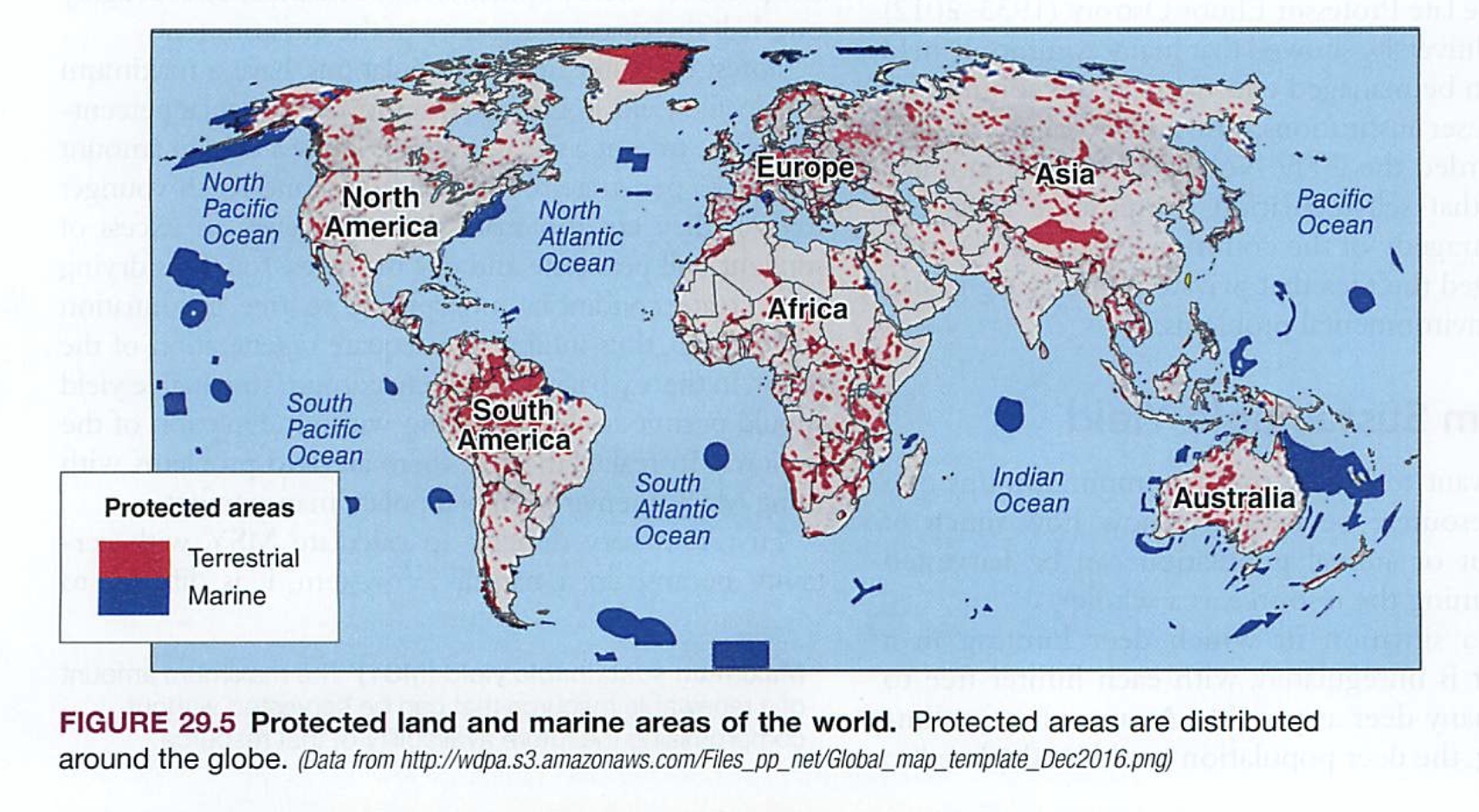Screenshot 2025-01-09 at 6.32.52 AM.pngPublic lands: often victim of economic predation (e.g. Burma illegal logging)
Other side: NRDC and others, purchase lands to protect them from predatory practices (e.g. Amazon basin)
In the US: National Parks are one example of a national recognition of several things:
1. Spiritual/psychological benefit to nature
2. Preservation of resources for future generations
3. Recreation
4. Habitat preservation for species (can be land, ocean, islands, etc.)
See also Amboseli in Kenya, Serengeti in Tanzania (Tanganyika+Zanzibar), Kruger park in S. Africa (Afrikaans)
---
Migrated from Apple Server Wiki. Original page ID: E4B1K8
# Module 30: Public lands
Public LandsIn the US, we classify public lands as
- Rangelands-open range, enables some ranching with leases
- National forests-old growth and new growth, limited forestry
- National parks-national treasures, limits on visitors, infrastructure (e.g. Denali)
- National wildlife refuges-usually associated with an endangered species or transit/migration path (e.g. wolves)
- Wilderness areas-no development, often noise abatement as well (think of helicopters in Waipio or Haleakala)We have several of these here in Hawaii:
- Kilauea Volcano (Madame Pele)
- Haleakala ("House of the sun")
- Pearl Harbor
- Pu'u Kohola (Whale Heiau)
- Papa hanau moku a kea-Northwest Hawai'ian Islands NWHIFederal lands: owned by the people, but can be leased to individuals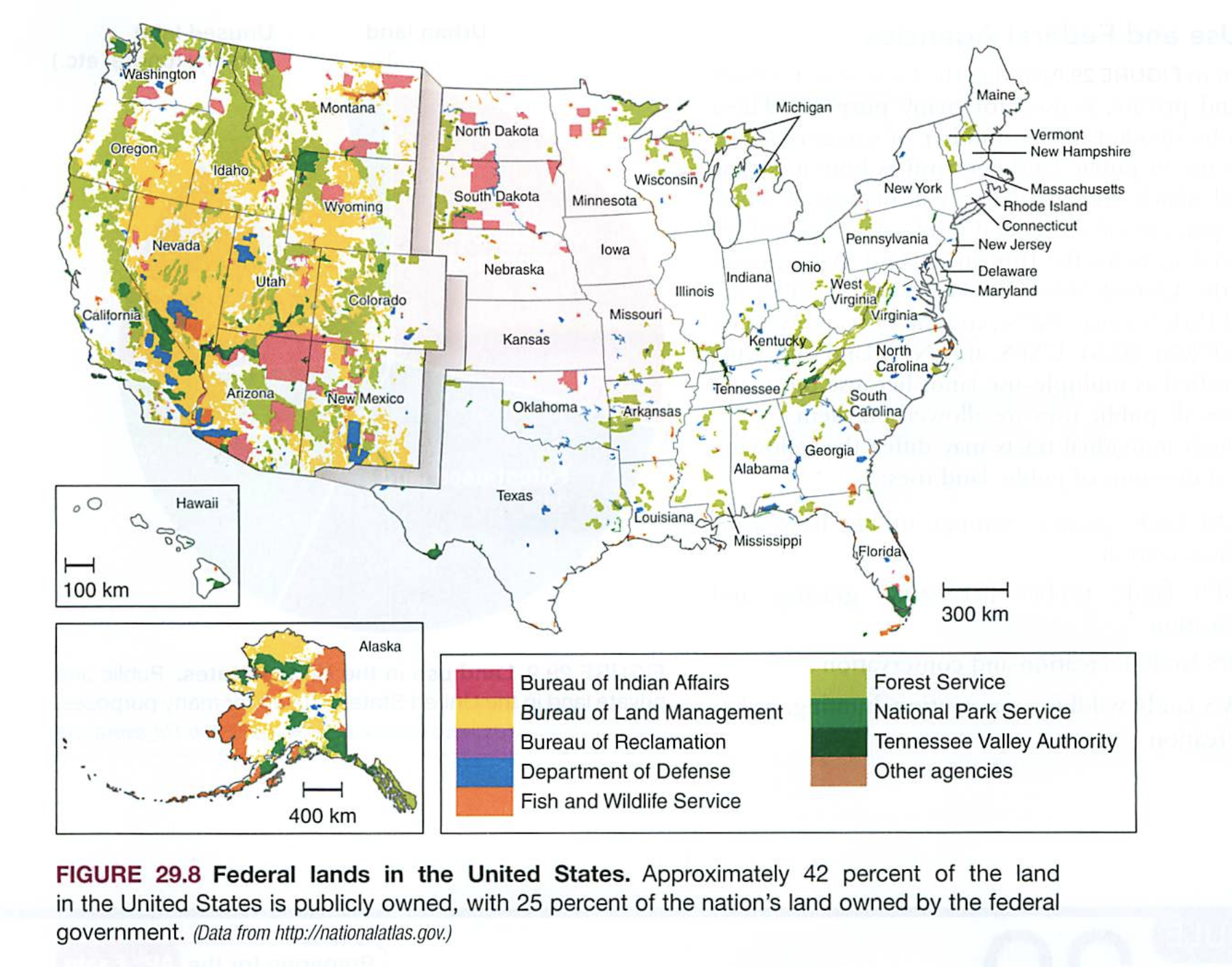Screenshot 2025-01-09 at 6.38.38 AM.pngTwo ethics are in competition:
- Resource conservation ethic-maximum use based on greatest good for everyone, usually preservation
- Multiple use lands-designated lands for grazing, timber, minerals, leased to individuals or companies for profit
- USFS (US Forest Service) believes in regular forest fires to deplete the amount of underbrush (as in nature)
- See also California and Australia wildfires: drought, no regular fires, buildup of underbrush
- See Yellowstone fire of 1988-result of overgrowth of underbrush
- [](https://www.northcountrypublicradio.org/news/npr/94114095/series-overview-yellowstone-s-evolution)[https://www.northcountrypublicradio.org/news/npr/94114095/series-overview-yellowstone-s-evolution](https://www.northcountrypublicradio.org/news/npr/94114095/series-overview-yellowstone-s-evolution)
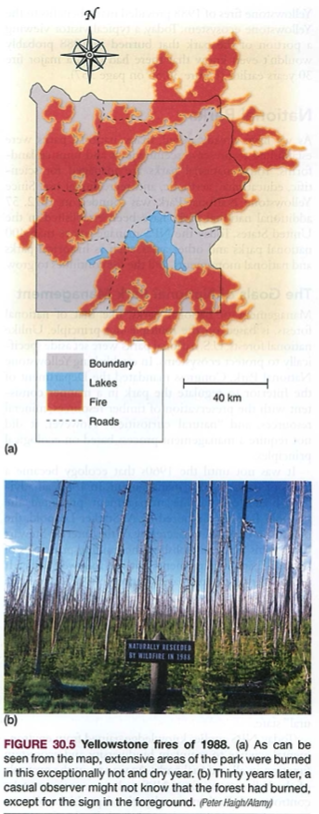Screen Shot 2023-01-04 at 8.58.33 AM.png
NPS: National park service
Manages parks for recreation, multiple use ethic, preservation of timber, minerals and "natural curiosities"
Also significant native peoples monuments (see above)
FWS: Fish and wildlife service
Manages fishing and hunting on all public lands
Know these:
- BLM: Bureau of Land Management
- USFS: US Forest Service
- NPS: National Park Service
- FWS: Fish and Wildlife Service
NEPA: National Environmental Policy Act 1969 (why then?)
- Mandates an EIS for all development
- EIS (environmental impact statements) are new standard for any project
- ESA endangered species act-often brought in where development could impact ES
Urban development--------------------------
Urban sprawl:
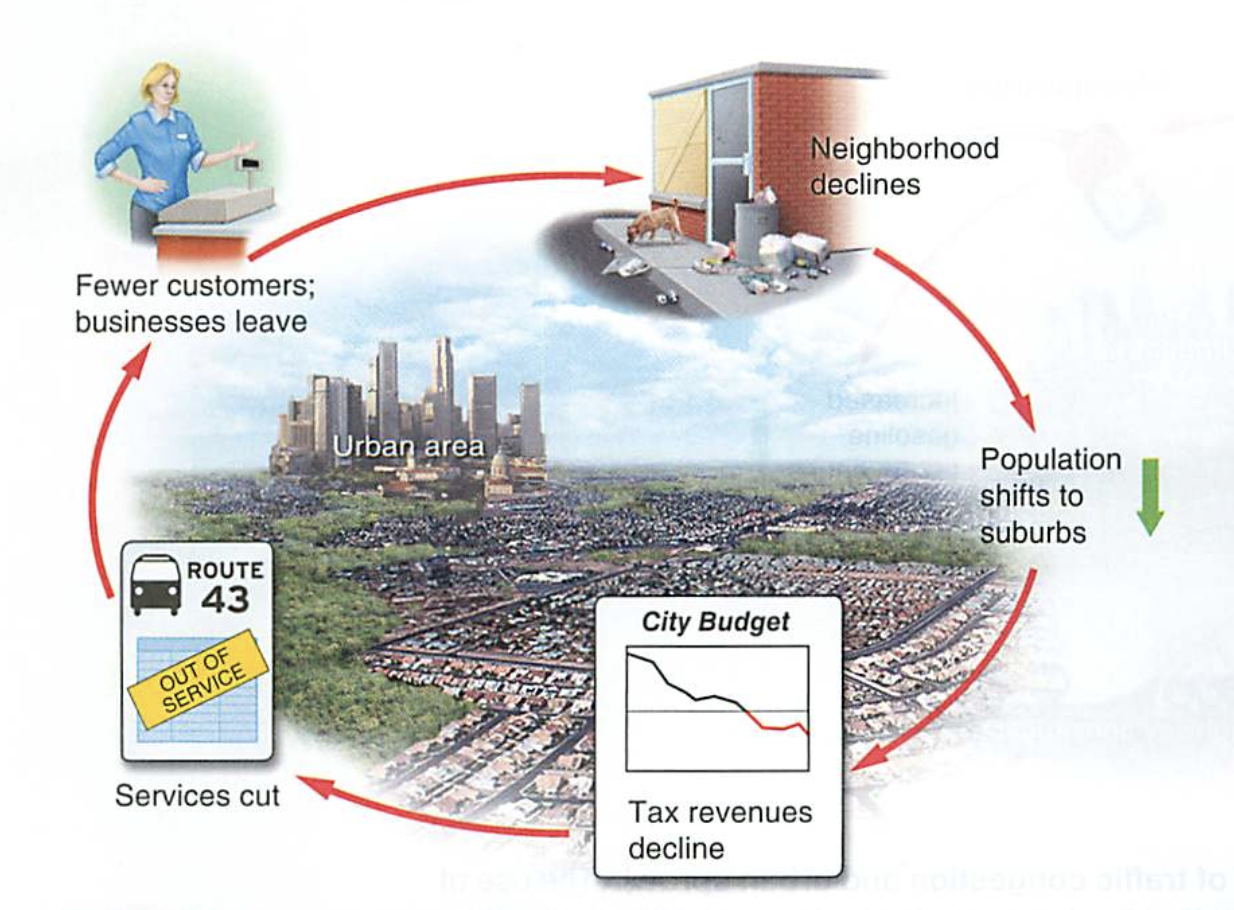Screenshot 2025-01-09 at 6.39.40 AM.png
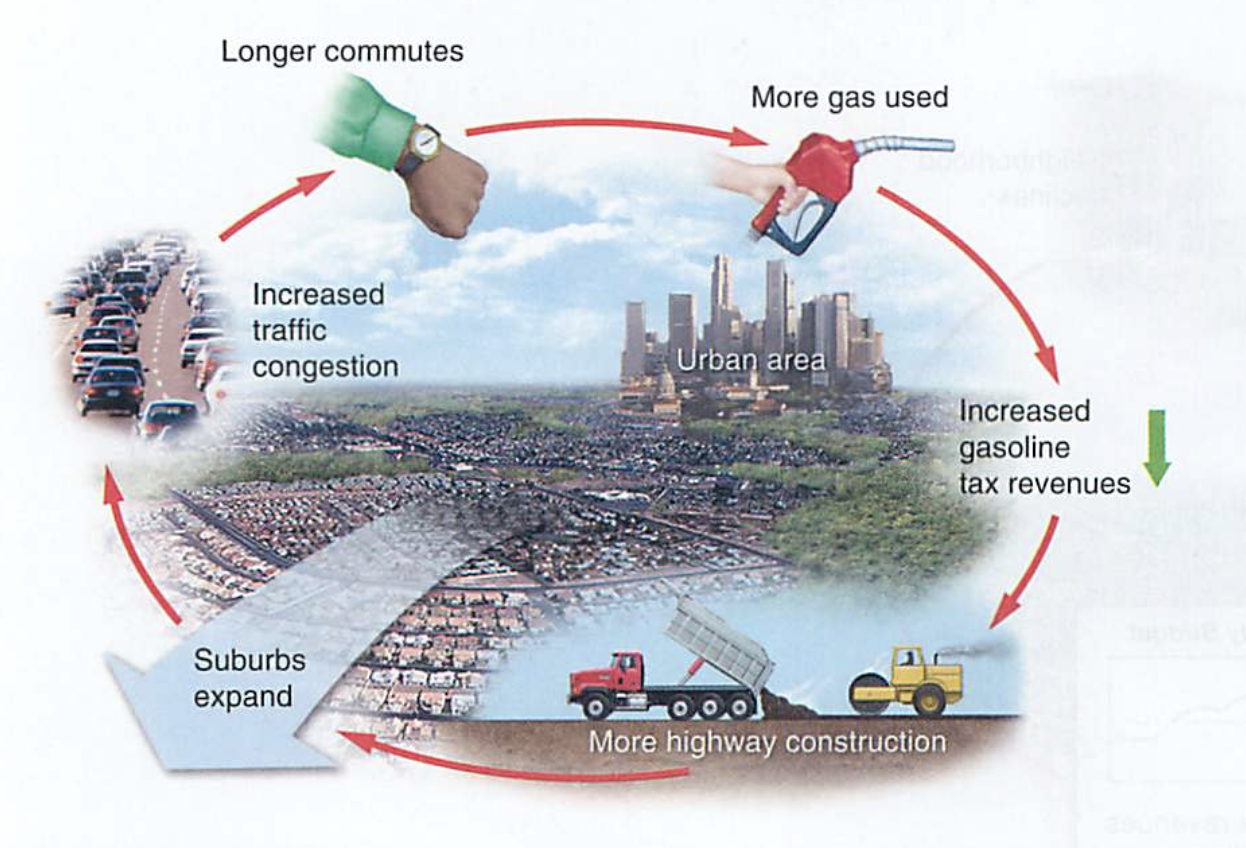Screenshot 2025-01-09 at 6.39.48 AM.png
Note impact of autos post WWII on this...
Solution: Urban Growth Boundary (UGB) ex. Portland, OR
UGB (Urban Growth Boundary)-see Portland
Prevents Urban Sprawl (richer folks move to the suburbs, commute, need parking, city dies from the inside, food deserts, etc.)
Portland Example of urban planning:
Tom McCall Governor of Oregon, 1967-1975Charlie Hales Mayor of Portland 2013-2017
e2: Portland-sense of place[](https://elab.hpa.edu/apes/videos/e2/e2%20transport/5%20Portland-sense%20of%20place.mp4)[https://elab.hpa.edu/apes/videos/e2/e2%20transport/5%20Portland-sense%20of%20place.mp4](https://elab.hpa.edu/apes/videos/e2/e2%20transport/5%20Portland-sense%20of%20place.mp4)
1. Morgan Freeman or Brad Pitt?
2. What is urban sprawl and what technologies enable it?
3. Portland was one main shipyard producing “Liberty Ships” in WWII. What drove their economy after that?
4. Portland was on the path of suburban sprawl in the 1960's. What happened?
5. What does this have to do with “Food Deserts”? (n.b. not desserts, that's something else entirely)
6. 1973 was a pivotal year there, what happened, driven by which group?
7. What was the initial reason for the mandate, and what was the final result according to Charlie Hales?
8. Look up Charlie Hales, what was his job after this film (2009).
9. How many years before his tram project was the last urban streetcar project in the US?
10. Explain an urban growth boundary (UGB).
11. Accessibility vs. mobility is the choice they made, like in Switzerland, as well as other European cities. What do you see in the video that you might also see in Europe?
12. What things in the video do you recognize that show a bike friendly city?
13. Who is the first class passenger in Portland, and how does this compare to Los Angeles or other similar city?
14. What is a “sustainable urban lifestyle”?
15. Cities in Europe have vibrant city centers, and are great cities to walk around. How is this done in Portland?
16. Explain "trip behavior".
17. How much did property values increase in the Pearl district after the trolley went in? Why? (note the amount of glass in each trolley). [](http://www.explorethepearl.com/)[http://www.explorethepearl.com/](http://www.explorethepearl.com/)
18. Michael Powell of Powell’s books compares buses (“tire-d” transportation) with permanent tracked transportation-what are the differences according to him?
19. How did he sell this idea to the property owners there? Was he right?
20. For what reasons would an electric tram or trolley be greener than a fossil fuel car or even a standard bus?
21. Portland required that every building have street level shops, and limited parking-why?
22. Why would people want to live along a trolley line? Why is quiet key to this?
23. Where in Europe do they also have aerial trams, and do you notice a trend?
24. How does an aerial tram like at OHSU enable different growth trends?
25. If the annual growth rate there is 4%, what is the doubling time in years? (Remember the rule of 70)
26. This film was made in 2009, so what year will the population be doubled from then?
27. What would be different without the tram (parking, traffic, time in car, development)?
28. The young mom says “we did not want to spend all that time in the car”. What is she talking about?
29. Explain "lifestyle migrants".
30. What is "gentrification"? Where else have you seen this? (hint: look up the term "landed gentry") [](https://en.wikipedia.org/wiki/Gentrification)[https://en.wikipedia.org/wiki/Gentrification](https://en.wikipedia.org/wiki/Gentrification)
31. What does the man mean about a "burlap future”?
32. What is the difference between aspiration and acquisition?
33. How does the concept of choice resonate with values in this country? What do you think?
34. Bring this home: what would you do at HPA to make it more sustainable? What about Waimea? Hawaii in general? Your home?
---
Migrated from Apple Server Wiki. Original page ID: j950M0
# Energy intro: units
energy->water->food->cultureEnergy: ability to do work. units: Joules or calories
Power: how fast you do that work. units: Watt
Demo: walk/run uphill:
> - mass (convert lbs to kg)
> - work done: mgh = mass x 10 x 3
> - work/time = power in Watts
> - Watts/747 = hp
> - calculate other power: double time, half time, double mass, half mass
> - work done/4.18 = calories (humans are about 33% efficient, so multiply by three)
> - 1000 cal = 1 food Calorie (1000 cal = 1 Cal)
Energy units:Joule is defined by mechanical work (force of 1 Newton for one meter)
calorie is the heat energy needed to raise one gram of water by 1 °C
1 kcal = 1000 cal = 1 Cal (food calorie, note the capital letter)
kJ = 1000 J
4.18 J = 1 cal
Electricity: energy and power units:Energy is in JoulesHow fast the energy is used is power, in Watts
1 joule/second = 1 Watt (capital again, named after James Watt)
1 kW = 1000 W, or about the power used to run a toaster
energy is like amount of water (gallons, liters)
power is like flow (gal/minute, liters/second)
Try these:
100W bulb runs for 3 hours = 0.3 kWh
Huh? another unit?
Yes, power people are not so complex, so instead of using Joules (like they do in much of the world), we take an energy unit (Joules) divided by time (seconds), then multiply by time again (hours) to get energy. Pretty dumb.
Another calculation:
1.5 kW (1500 Watt) toaster runs for 2 hours. Electricity costs $0.50 per kWh. How much does this cost?
1.5 kW x 2 hours = 3 kWh, 3 kWh x $0.50 = $1.50
This really adds up if you have a 4.5 kW water heater running for 2 hours per day. How much would this cost?
Hot water demo:
> - measure amount of water in hot water heater (tea maker)
> - plug in, turn on, time to boiling
> - measure Volts, Amps, Watts
> - convert Watts to kW (divide by 1000)
> - convert time to hours (divide minutes by 60)
> - multiply kW x hours = kWh or energy used
> - if power were 2x, how long would this take?
>
>
-------------homework questions-----------------
Homework: energy 1.0
>
> 1. Your home hot water heater uses energy at the rate of 4500 joules every second. How many kilowatts is this?
> 2. If it is on for 3 hours each day, how many kiloWatt-hours (kWh) is this?
> 3. If energy costs 40 cents for every kWh where you live, how much does this cost per day?
> 4. How much per year?
> 5. Why would a 100 kg person running up the stairs use more power than a 50 kg person if they did both in the same time?
> 6. Why would twins of the same mass have different power numbers if one walked up the stairs and the second ran up?
> 7. If Ella Finoe has mass 60 kg and runs up the stairs (3 meters) in 6 seconds, how much energy did Ella use?
> 8. What was her power?
>
>
>
Back to energy:
In the US, energy is used for three things:
1/3 transport (usually using oil-gasoline or diesel, or kerosene for jet airplanes)
1/3 buildings (natural gas, heating oil, or electricity from coal or natural gas)
1/3 industry (same as above, more electricity though, and different time trends: 24x7 or 8 hours)
How can we change this?Industry: factories, machines, pumps, furnaces
Natural gas: instead of coal for electricity. Why? This is rapidly changing because of fracking-more on this soon
Coal: mining, air pollution, water pollution, heavy metals, coal ash, CO2.
Natural gas: (methane, propane, butane, pentane etc.) has lower CO2 per Joule, lower Hg, no ash, no water pollution.
If it comes from fracking, then we have another issue (water pollution, toxic waste)
Transport: moving stuff around (cars, trucks, trains, airplanes)
Hybrid/electric vehicles, natural gas for trucking and train fleets (see same reasons as above).
Storage is key: must be mobile, and light for airplanes, fast recharge for cars
Question: why are electric trains in Europe, Japan and China so much greener?
Buildings: heating and cooling.
HVAC systems (Heating, Ventilation And Cooling) or heating/ventilation/air conditioning, depending on who you ask.
Very energy intensive, dependent on set points (thermostat), humidity, insulation, and air flow (ACH means something, look this up).
Conservation = 8x production $
HPA campus energy plan:
Three phases:
monitoring and conservation+harvesting+storage
One very rich [dude](https://en.wikipedia.org/wiki/Warren_Buffett) bought up all of the trains in the US a few years ago, at the same time he bought up much of the natural gas resources. Why would he do this?
Another very rich oil [dude](https://en.wikipedia.org/wiki/T._Boone_Pickens) sold all of his oil holdings and created huge networks of wind farms in Texas. Why would he do this? How old were these dudes? Why does this matter?
Smart Grid: [https://en.wikipedia.org/wiki/Smart\_grid](https://en.wikipedia.org/wiki/Smart_grid)
[e2 Videos: (20 minutes each)](http://physics.hpa.edu/physics/apenvsci/videos/e2_videos/e2%20energy/)
[Harvesting the wind:](http://physics.hpa.edu/physics/apenvsci/videos/e2_videos/e2%20energy/1%20harvesting%20the%20wind.mp4) community wind power in Minnesota
[Energy for a developing world:](http://physics.hpa.edu/physics/apenvsci/videos/e2_videos/e2%20energy/2%20energy%20for%20a%20developing%20world.mp4) solar power in Bangladesh
[Paving the way:](http://physics.hpa.edu/physics/apenvsci/videos/e2_videos/e2%20energy/3%20paving%20the%20way.mp4) next generation cars
[Growing energy:](http://physics.hpa.edu/physics/apenvsci/videos/e2_videos/e2%20energy/4%20growing%20energy.mp4) bioethanol in Brazil
[State of resolve:](http://physics.hpa.edu/physics/apenvsci/videos/e2_videos/e2%20energy/5%20state%20of%20resolve.mp4) California cars
[Coal and nuclear:](http://physics.hpa.edu/physics/apenvsci/videos/e2_videos/e2%20energy/6%20coal%20and%20nuclear.mp4) Next generation nuclear, coal
---
Migrated from Apple Server Wiki. Original page ID: F7D0s1x
# Module 34: Patterns of energy use
Mod 34-Patterns of energy use
- Non-renewable: not in your lifetime (argument made by one senator that nuclear power was renewable every billion years)
- Examples: fossil fuel (from [fossils](https://www.youtube.com/watch?v=jXEGMWh2apM)), nuclear energy
- Energy units: Joules, BTU (British thermal unit), quad = 1 ee 15 BTU or 1.055 EJ (etta Joules)
- Worldwide energy use (2015):

- Note about even split of coal, natural gas and oil, depending on location, economy, development.
- Which of these do you think is changing, how and why?
- China leads in overall consumption, US in consumption per person (China has 1300 million people, we have about 320 million)
- LDC (lesser developed countries) use subsistence energy sources: dung, wood, peat (one reason women in LDC have high cancer rates)
- US use (again, this is 5 years ago):

- n.b. coal is on the decline, nat gas is increasing ("fracking" or hydraulic fracturing of underground formations)
- Jan 10, 2023: More renewable energy used in the US than coal (!)
- Almost even 1/4 splits for transport, industrial, commercial and residential-which do you think is changing, how and why?
- James Woolsey on Salt 2010: [https://www.npr.org/templates/story/story.php?storyId=128127191](https://www.npr.org/templates/story/story.php?storyId=128127191)
- Transportation use: 70% oil
- Electrical grid: 50% coal, also nat gas, hydro, nuclear (this is rapidly shifting)
- These two are not connected-Electric vehicles will change these HOW?
- (OPEC means Oil producing/exporting countries)
- "We have to destroy oil as a strategic commodity" (btw, data exceeded oil in value last year)
- Plug in hybrids, efficiency in fossil fuel cars, encourage biofuels (flex fuel, remember Brazil?)
- PM particulates, aromatics (benzene, toluene, xylene), $100 million in US health costs
- Point source pollution exemption-crazy!
- Fossil fuels are portable, potent and there is infrastructure to support it (oil dominance in transportation)
- Think also of Tesla charging stations-a new infrastructure is emerging
- Salt-why Austria/Hungary was so wealthy, one reason we had World War one...
- New term: EROEI: energy return on energy investment, e.g. 100 J of coal from 5 J of work would be 20/1
- EROEI of Corn ethanol is around one, or slightly less than one, since we use petrochemicals (fertilizers, pesticides) to grow it...
mJ per passenger kilometer: [https://en.wikipedia.org/wiki/Energy\_efficiency\_in\_transport](https://en.wikipedia.org/wiki/Energy_efficiency_in_transport)

Where would bicycle show up on here?
Electricity is an energy CARRIER not a source.
Here is a typical steam powered electrical plant.
You will need to know all these bits and how they work together:
The only thing changed for nuclear, oil, or natural gas NON-TURBINE plants is the heat source...
---
Migrated from Apple Server Wiki. Original page ID: 46A8A4t
# Module 35: Fossil fuels
Module 35: Fossil fuelsCoal:
From dead plants 280-360 million years ago
Evolution: Peat->lignite->bituminous coal->anthracite
Coal formation:
n.b. as moisture is reduced, coal is cleaner, hotter burning (more carbon, less water)
Know the formation of coal, and the stages: (see above)
- Peat: burns barely, Scotland is made of it, more like compacted wood and plants (Heathcliff! Heathcliff! Where are you?)
- Lignite: poor quality, usually high sulfur content (see London fog of 1952, also BBC news this week Jan 2023)
- Sub bituminous: better, less sulfur (bitumen = tar)
- Bituminous: more energy per kg, a bit cleaner, but still lots of heavy metals
- Anthracite: cleanest, most energy content, lowest sulfur of the bunch
Cool fact: after WWII, Britain was so poor from the war they could only burn lignite, which caused[ London smog deaths in 1952](https://en.wikipedia.org/wiki/Great_Smog_of_London) with 4,000 dead
Another cool fact: Alaska exports anthracite to Korea and China for steel production since it produces clean, intense heat
- Coal is very nasty: Dangerous mining (look up coal mining deaths in China per year), shaft mining, open pit mining ruins ecosystems
- Mining tailings are [toxic](https://en.wikipedia.org/wiki/List_of_tailings_dam_failures) and lead to dam failures: [Video](https://www.theguardian.com/world/video/2019/feb/01/terrifying-dam-collapsed-in-brazil-caught-on-camera-video)[https://www.theguardian.com/world/video/2019/feb/01/terrifying-dam-collapsed-in-brazil-caught-on-camera-video](https://www.theguardian.com/world/video/2019/feb/01/terrifying-dam-collapsed-in-brazil-caught-on-camera-video)
- Burning coal releases heavy metals (e.g. mercury, cadmium, zinc), sulfur (e.g. acid rain) and particulates (PM 10, 5 and 2.5, the most toxic)
- Coal fly ash (after burning) is toxic (e.g. heavy metals) and is banned for use in construction in EU
- Know about the various mining techniques: open pit, shaft, strip and mountaintop removal
Coal to electricity: pay attention to the use of steam:
Many folks associate the cooling towers (see above) with nuclear power. This is wrong, it is simply how steam is recycled into clean water for the boilers...
Petroleum
Cleaner than coal (lower sulfur, depending on where it comes from-why is some crude oil called "sweet"?)
Drilling for it is hazardous, and hugely damaging to the environment, e.g. ANWR
Some of it is located in toxic geopolitical areas, like the Middle East
Video: [opening credits of The Kingdom](https://www.youtube.com/watch?v=LKppKRnM7cU)n.b.Wahabbis: see Lawrence of Arabia 1918Ibn Saud: Saudi Arabia 1932
- 1933 oil discovered
- 1938 ARAMCO
- 1945 divided Arabia, palestine with British
- 1973 arab israeli war, embargo, 4x oil price
- 1974 embargo ends
- 1990 Kuwait war
- Osama bin laden-formed the Mujahaddeen in Afghanistan (see film: Charlie Wilson's war)
- We supported them against the Soviets in 78, boycotted the Olympics that year, then Reagan moved to outspend them after their defeat there
- We sold lots of weapons in 1980, trying to outspend the Soviets, who dumped oil on the market
- 1990+ terrorist attacks Nairobi, Tanzania, USS Cole
- 2001-World Trade Center 15/19 were Saudis
- Al Quada took credit, then took over Euphrates valley
Back to the Wahabbis....---------1.14.20---------------Why oil?
- Easy to transport
- Can be refined into many products from plastic to tar to nat gas, gasoline and kerosene
- Basic to agriculture (e.g. nitrogen based fertilizers, pesticides, tractor fuel)
- Transportation, military, heating, industrial, electrical
- Very important geopolitical implications
- Note comparison between diamonds and oil: both are the result of heat and pressure on an organic precursor.
- Now think of the salt interview with diamonds instead.
- What are "proven reserves"?
- primary and secondary extraction (latter uses steam, e.g. tar sands)
- Refining oil: also known as "cracking"
Cleanest hydrocarbon fuel so far: low sulfur, no heavy metals, simple CH4 and others:
Methane, Ethane, Propane, Butane
Natural gas: surface decomposition (swamp gas) or subsurface (thermogenic)
Kerogen = source for nat gas and oil
Swamp gas = biogenic, also in landfills
Good stuff: cleaner to burn, usually found underground, so less ecosystem damage than coal, does not spill in the ocean
Bad stuff: very flammable, leakage contributes to global warming (methane, CH4 is a very potent greenhouse gas), harder to store and transport, must be kept under pressure and cool

Other stuff
Tar sands: lately in Alberta, Canada, use steam to melt the tar out of sand, almost energy 1:1 (bad), depending on the price of oil
Liquid coal: CTL developed by the Nazis in WWII, as they had coal in Silesia (Eastern Germany, Poland) but not much oil, until they could get to the oil fields in North Africa and the Caspian Sea (after fighting the Russians)
Methane Hydrate: deep oceans, large patch in the Eastern Pacific ocean:[https://www.washington.edu/news/2014/12/09/warmer-pacific-ocean-could-release-millions-of-tons-of-seafloor-methane/](https://www.washington.edu/news/2014/12/09/warmer-pacific-ocean-could-release-millions-of-tons-of-seafloor-methane/)
Very dangerous for global warming...Here's why:

As the ocean warms, these will no longer be "frozen" much like the permafrost, which will cause huge global warming impact...More on this: [https://geology.com/articles/methane-hydrates/](https://geology.com/articles/methane-hydrates/)
Carbon capture: not yet, see HEAT movie later on
Hubbert curve: The supply of oil is finite, and those with it don't want to admit how little is left
Look up ARAMCO, and why the Saudi Kingdom is selling all of their oil fields in a huge IPO
Peak Oil has already passed, we are now on the back side of this (see poster in the elab):
This has to do with proven reserves and possible reserves...2004 graph:
---
Migrated from Apple Server Wiki. Original page ID: h7i1u6K3W
# ROI-TCO worksheet
ROI/TCO lab
1. The PV panel we tested in class produces 250 Watts in ideal sunlight. The cost for this panel today is about $0.50 per Watt
2. Calculate the price for this panel
3. If this panel collects 5.5 hours of sunlight per day, how many kWh does it produce each day?
4. At $0.40 per kWh, how much money does this panel harvest each day?
5. Divide the price by the amount collected per day, this should give you the number of days needed to pay off the panel.
6. How many days or years is this? This is called ROI or return on investment.
7. Total cost of ownership (TCO) is the total cost of operating the system. If the system lasts 25 years, how much money would it produce?
8. Subtract the cost of the unit from the money the unit produced, the result is the TCO, or total cost of ownership. If this is negative, you made money on the system.
9. Repeat these steps with the following data:
Solar PV panel:
- PV cost: $0.50 per Watt
- 250 Watts (0.250 kW)
- 5.5 hours per day production
- lifespan 25 years
- energy per day:
- money per day:
- cost of panel:
- ROI:
- TCO:
Solar thermal panel:
- 2.5 m2 area
- 1500 W/m2 solar insolation
- 5.5 hours per day
- cost: $900
- lifespan: 30 years
- total power:
- energy per day:
- money per day:
- ROI:
- TCO:
Wind turbine:
- 2 kW output
- 8 hours per day (night time too)
- cost: $10,000
- lifespan: 5 years
- energy per day:
- money per day:
- ROI:
- TCO:
check your answers:PV
- 1.375 kWh (0.250 \* 5.5)
- $0.55 per day (kWh \* $0.40/kWh)
- $125 (250W \* $0.50/kW of PV)
- 227 days or 0.62 years ($125/0.55 per day)
- $4898 (25 years - 0.6 years = 24.4 years, 24.4 \* 365 \* $0.55)
solar thermal
- 3750W or 3.75 kW (2.5 m2 \* 1500 W/m2 = 3750 W)
- 20.6 kWh energy per day (3.75 kW \* 5.5 h = 20.6 kWh per day)
- $8.25 per day (20.6 kWh \* $0.40 per kWh)
- 109 days or 0.3 years ($900/8.25 = 109 days)
- $89,434 (29.7 years \* 365 \* $8.25 = $89,434)
wind
- 16 kWh (2 kW \* 8 hours)
- $6.40 per day
- 1562 days or 4.3 years, or 4 years 4 months
- $+656 (note cost of device and lifespan, not including maintenance costs)
PPA array lab
1. Look up the power produced by the PPA array here: [http://10.14.8.1](http://10.14.8.1/)
2. Look for PPA gen/use
3. Look up the solar radiation for the same time here: [https://tempestwx.com/station/133324](https://tempestwx.com/station/133324)
4. go out and measure the effective size of each panel, and count the panels
5. find the total area of the array in m2
6. multiply the solar radiation (insolation) by the area to get ideal power capacity
7. divide the actual power by this number to get % efficiency
Lab questions:
1. A solar panel is 2m x 1.5 m and collects 120 Watts in solar radiation of 1000 W/m2. What is the efficiency?
2. How much heat power could we collect from a solar thermal panel 3m x 2m in 1500 W/m2 solar insolation?
3. What are the three clues we can use to detect energy use on a telemetry system like elab2?
4. What impacted you the most about the e2 film about the Grameen Bank?
5. Energy storage and efficiency are keys to the ROI and TCO of the devices above. Explain.
6. Storing 15 kWh of energy as hot water using a well insulated hot water tank costs $1000. How much is this per kWh?
7. About how many hours can this store the energy (stay hot)?
8. Lithium storage batteries like those in the student union now cost $500/kWh for a 15 kWh system. How much did this cost?
9. How long can this store the energy?
10. Why is insulating a hot water heater so important?
---
Migrated from Apple Server Wiki. Original page ID: 66P1J3E
# Energy Primer
Energy primerEnergy and power units:
- kW means kiloWatt, kilo = 1000 Watt named after a person, so capitalized
- 1000 Watts = 1 kW (note spelling)
- kW is a rate, like miles per hour or gallons per minute, so saying "kilowatts per hour" makes no sense, just like "miles per hour per hour"
To get total energy (or miles or gallons) we multiply by time:
- 1000 Watts for one hour = 1 kWh (“one kiloWatt hour”)
- Example: a 1000 Watt hot water maker is on for one hour
- 1000 W = 1 kW times 1 hour = 1 kWh
- KVA is another unit similar to kW, but it includes what is called the power factor.
- Note on units: Watts, Volts, Amps (Amperes) are all capitalized. Don’t capitalize meters, hours or gallons.
Check-in:
Your tea maker uses 1250 Watts, and takes 10 minutes to boil 500 grams of water. If electricity costs $0.40/kWh:
- How many kW is the heater?
- How many kWh did the tea require to heat?
- How much did this cost you?
Power Factor
- For simple things like hot water makers or toasters, PF (power factor) = 1.00, meaning 100% of the electrical energy goes to work.
- Motors, compressors, refrigerators, computers and pumps can have power factors as low as 50%, meaning if you think the device is using 1000W, you are really paying for 2000W.
- HELCO charges us a premium if our campus total PF is less than 90%
- HELCO charges us about $0.40 (40 cents) for every KVA, so if you have an energy number, you can round to about half of this number to convert to dollars (neat tip).
Check-in:
Your refrigerator uses 1250 Watts and is on 10 minutes every hour to keep your food chilled. If the Power factor is 0.50:
- How many kW is the refrigerator power rating?
- How many kWh does the fridge use each hour?
- How much each day (assuming the same rate)?
- How much does this cost each day, using the power factor?
- How much would this cost each month?
- Why is it important not to leave the door open while you look around?
- If you looked at an energy graph of your house, how could you spot the refrigerator?
Lighting:
We are in the 4th generation of lights in this country.
~1850 incandescent lights (Edison and his gang). These look like hot wires in a glass envelope
Most energy goes to heat, so not efficient, simple to operate, PF 1.00 (just a hot wire, like a coffee heater)
~1950 Fluorescent lights (note spelling: flUOrescent, like FlUOrine)
More efficient, contain mercury (toxic), need a transformer (hot, noisy)
Related: mercury vapor (white) and sodium vapor (yellow) lamps, also known as metal halide lamps, often found in streetlights, gyms, tennis centers. PF is about 80%. Many of these are being replaced with LEDs (see below).
All of these create an electrical arc through a vapor of metal (even fluorescent bulbs, which contain mercury and a phosphorus inner coating to transform the harsh mercury light into visible light)
~2000 Compact Fluorescent bulbs (CFL)
Similar to traditional long or circular bulbs, but able to screw into 1850 era light sockets (yes, they are that old).
Contain mercury and phosphorus, 3-5 year lifespan, PF ~80%, often a harsh white/blue light, as opposed to the warmer hot incandescent light bulbs. This color is referred to as a temperature, so 2000°K is a warm looking source, while 3500°K would look harsh and blue-tinted.
~2010 Light Emitting Diodes (LED)
Very efficient, can be many colors, little heat, long lifespan, PF close to 95%, uses about 65% less energy than traditional bulbs, relatively expensive, but long lifespan makes for excellent ROI and TCO (return on investment, total cost of ownership). These vary in temperature (see above), with newer LED units in the warmer 2000°K range, where older ones tended to look blue and harsh, often around 3500°K. Newer ones are also dimmable.
~2018 Smart LED bulbs
Same as above, but linked through wireless or power lines to controllers, so you can say "Hey Siri, turn on the lights" and magic will happen. These are key to the smart home, where sensors for lighting and occupancy can control lighting, saving energy, and therefore money.
\------------------------------
Conservation:
- Every dollar spent on conservation is worth about $8 in new energy sources.
- Monitoring is key, to determine energy flows, leaks, identity (energy profile) and more.
- This can be electrical metering, infrared cameras, flow meters, propane meters, water meters, temperature sensors and other linked data gathering devices.
- Key targets are refrigeration (e.g. cafeteria), water pumps (e.g. pool), lighting, water heating and timing-when these resources are used relative to energy harvesting.
- Especially important at night, when PV and solar thermal systems are dependent on storage (the sun is not shining much at night).
Solar energy sources: Solar thermal and PVSolar thermal:
Goal: Turn solar radiation into hot water
Active systems: Sun—>solar panel—>pump—>tank—> users
Passive systems: Sun —>solar panel/tank —> users (no pump needed, uses convection)
HPA systems are of two types:
Carter dorm has the active system, while Perry-Fiske and cafeteria have passive Solahart systems
- Propane is used to "finish" these systems, making sure that users always have hot water at about 120°F. These are propane "flash" heaters, making sure that any water going to the showers/sinks/washers is always at 130°F. You can see these behind each bathroom if you are curious.
- Hot water is stored in tanks, with about 10-15 kWh energy in each Solahart tank. Each Solahart system costs about $6K installed (panel and tank). To store 10 kWh using batteries would cost $13,000.
- Solar thermal panels are about 90% efficient at converting solar radiation into hot water. PV panels are about 15% efficient in converting solar radiation into electrical energy.
- Propane is competitive with electrical energy at about $0.25-$0.35 per kWh equivalent in our hot water heaters.
PV (photovoltaic): sunlight to DC electrical energy
- If solar thermal captures solar radiation as heat, PV systems convert this radiation into electrical flow in one direction (direct current, or DC, like batteries). This is convenient for battery storage, but to be used in most homes and businesses, AC (alternating current, 60 Hz) is needed. Inverters are electronic devices that turn DC from PV and/or batteries into AC for use.
- Since HPA is on one meter with HELCO, we are essentially a “micro-grid” meaning any electrical energy harvested from PV (or released from batteries) goes to slow down or reverse the HELCO meter. Since we do not presently get any credit for energy out, we want to make certain we can store any excess energy on campus for our night time use.
- Since the sun is brightest at noon, PV engineers use an estimation of a PV array output called “solar hours”, meaning the equivalent amount of energy harvested if noon lasted that many hours. This is like making a camel hump curve into a rectangle, adding the edges to the top.
For example, our PPA (purchase power agreement) array behind the elab produces about 100 kW maximum. This is true at noon, but less so either side of noon, so we use “solar hours” to estimate energy harvest each day. For us, this is about 5.5 solar hours, depending on season:
100 kW x 5.5 solar hours = 550 kWh or about $200 saved each day.
PPA arrangements usually charge us a fraction (about $0.20 per kWh) of the HELCO cost, but we have to pay for what it produces, not what it uses. If we are pushing energy off campus to HELCO using the PPA array, we are in effect paying to give this energy away, which happens during vacations (summer, winter, spring).
Wind energy:
- Based on the flow of air over very thin wings ("blades") that rotate around a center, which turns an electric turbine, usually AC.
- Two types: HAWT-horizontal axis wind turbine and VAWT-Vertical axis wind turbine ("salad spinners")
- HAWT turbines are either following blade or leading blade. Our large turbine is a following blade, smaller ones have a tail fin and are leading blade. Commercial turbines are leading blade, with gears that force the blades into the wind
- Wind turbines suffer from water and dirt damage, and need frequent maintenance
- Wind turbines are noisy, and interfere with the view shed
- Cats kill far more birds than wind turbines, but there are environmental impacts (see Altamont Pass)
Net zero energy is when we have effectively stopped the HELCO meter, meaning we are producing exactly how much we are using.
We hope to harvest enough to reach net zero around 10AM each day until about 2 PM each afternoon. The extra energy during that time we hope to capture using battery and other storage systems (pumped storage hydro, hot water activation, etc.)
Energy Storage:
Batteries for large scale systems are usually either lead acid batteries dating back to around 1800, or lithium batteries from this century:
~1800 lead acid batteries
- lead and sulfuric acid
- environmentally nasty
- 3 year lifespan
- shorter if used more
- only 40% of capacity is usable
- slow discharge and recharge
- about $300 for each kWh stored
Example: our overnight campus use is about 100 kW for 20 hours or 2000 kWh (or 2 mWh). At $300/kWh this would cost us $600,000 and would last 3-5 years at max capacity, but in actuality it would be 2.5 times this because these batteries cannot be discharged all the way, so $1.5M.
~2010 lithium batteries (LiPO, Lithium iron phosphate, etc.)
- Used in Prius, Leaf and other cars
- lightweight
- fast discharge and recharge (good for regenerative braking in cars)
- 20 year lifespan at 80% capacity
- greener
- expensive ($500 per kWh)
- Tesla's Power Wall is one example, so is the blue box in the student union and IT office. Kauai island is using these to move that island to complete energy neutrality in the next few years.
The same example above costs more, last longer, and requires fewer batteries. It also discharges faster to maintain our microgrid, and recharges faster when used as backup power for the IT building, protecting our computers from multiple outages we face with HELCO. You may also see these in the student union (left inside the main doors, blue lights)
Pumped storage hydro:
This is just like a typical hydroelectric plant with a dam above a river below. Water tanks low on campus have a pump and a generator. When we have extra energy, we pump this water uphill to a similar tank where it is stored for use later on. When needed, the system activates the generator, which provides power for the campus. This is green, cheap, renewable, lasts 50 years or more and can be safely integrated into other water systems (e.g. fire suppression) as needed.
Net neutrality:
We have three ways we can claim neutrality:
1. Net energy neutral: We export the same amount of energy around noon that we use overnight, so as far as the HELCO grid is concerned, we have a net zero energy profile. We still pay for what we use at night, though)
2. Net money neutral: We capture any excess energy during the noon hours when the HELCO meter would be spinning backwards, and use this at night from our batteries or other storage). If we were allowed to sell power to the grid, this would also work.
3. Net carbon neutral: We measure all carbon used on campus, including transportation, heating and other carbon impacts and offset with energy produced via solar thermal, PV, wind or other means (not nuclear, don’t worry). This is the most current global metric used, and relates well to our sustainability misssion.
Each has certain PR and moral aspects, depending on the goals of the organization. Since our business is creating change agents to solve sustainability issues in the future, each of these is important.
---
Migrated from Apple Server Wiki. Original page ID: 446839G7
# Frog book Ch. 17: Energy
energy -frog book notes
- chemical energy: electrons
- nuclear energy: nuclei (protons, neutrons)
- combustion-usually oxygen, but any oxidizer (chlorine etc.) as well
- hydrocarbons usually CnHx + O2 -> CO2 and H2O
- Incomplete = CO (toxic to hemoglobin)
- food is CHO (also N), when burned by body, creates CO2 and H2O (breath, urine and perspiration)
- efficiency: energy out/energy in %

Evolution of fuels:
- wood: renewable, but hard to find, limited growth rate, but sustainable for small populations
- coal: non-renewable, stored energy from fossil plants, more concentrated energy, easier to transport, hotter burning (to create steam, melt iron), various grades based on source and degree of decomposition/reduction (peat,lignite, bituminous, anthracite, diamonds)
- oil/natural gas: non-renewable, stored energy from swamps and marine organisms, both can be distilled into smaller or larger fractions in refineries:
- oil-> naptha, kerosene, diesel, gasoline, tar (bitumen), plastics, etc. <question: why is gasoline more expensive here in Hawaii?>
- nat gas -> methane->butane->pentane-> denser HC, fertilizers, plastics, etc.
See also LNG (liquified nat gas)
question: look up the price of crude oil. notice the names and the trends. what is “sweet” crude oil?
electricity generation: coal (steam), diesel (only in Hawaii, direct or steam), nat gas (steam or direct turbine), nuclear (steam)
Think of ships, this is where most of our electrical generation technology was developed
Hubbert Peak: King Saud (see opening credits to “The Kingdom”), Saudi Arabia, geopolitical implications

Fracking: Nat gas game changer: water impact, price of oil, change in electrical grid (smarter, faster, more nimble)
others: oil shale, oil sands (Alberta), methane hydrates deep sea deposits
ERoEI: Energy Return on Energy Invested
[http://physics.hpa.edu/physics/apenvsci/videos/ERoEI.mov](http://physics.hpa.edu/physics/apenvsci/videos/ERoEI.mov)
summary: there will always be some oil, but how expensive is it to get out of the ground?
Salt Audio clip: James Woolsey
[Download 20100626\_wesat\_05.mp3 (audio/mpeg, 2.7 MB)](https://bookstack.kamuela.org/attachments/54)[http://www.npr.org/templates/story/story.php?storyId=128127191](http://www.npr.org/templates/story/story.php?storyId=128127191)
Land use diagram:
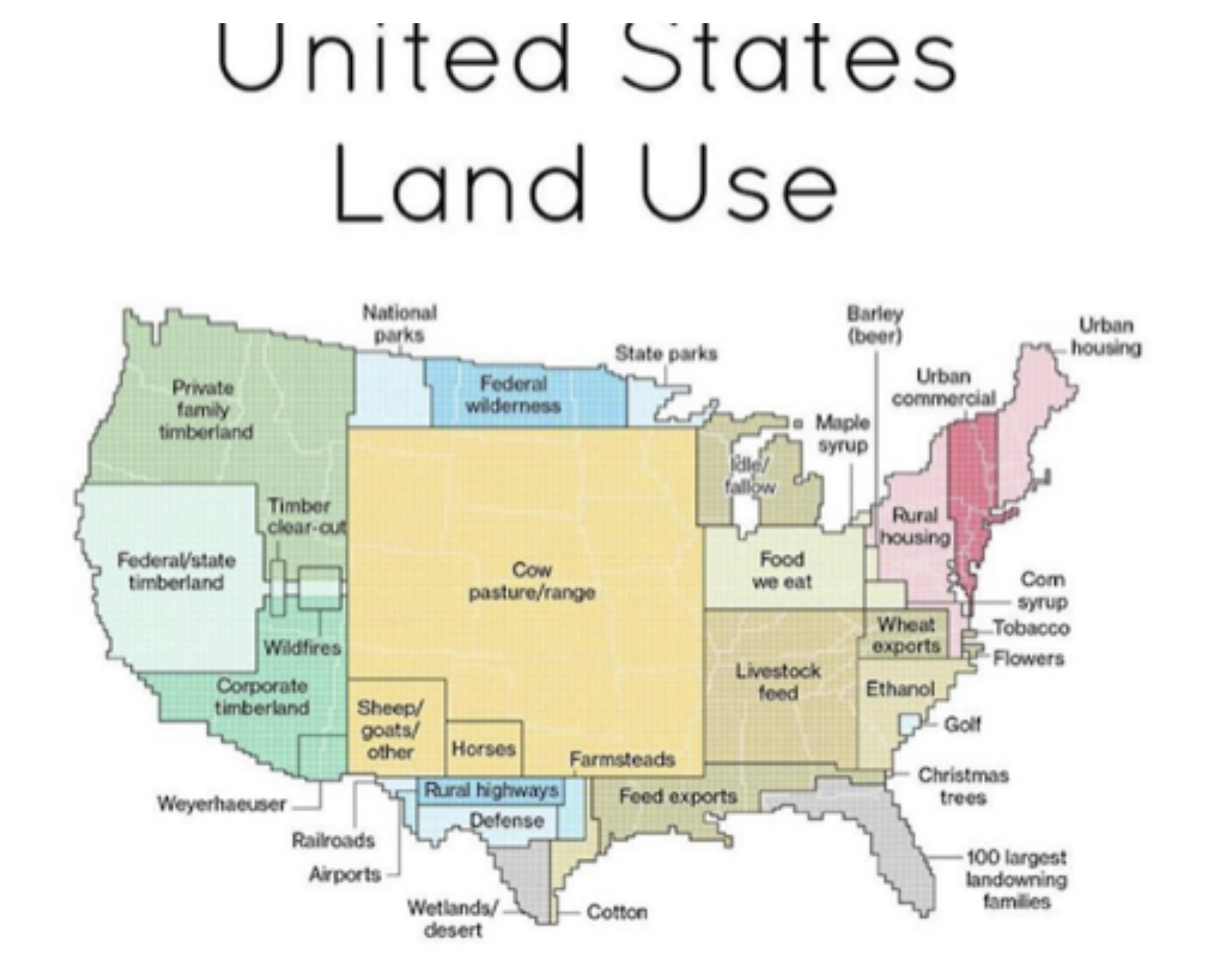Screenshot 2023-01-18 at 1.20.09 PM.pngNews Flash 1.18.2023: China population growth was negative this week: first time in 60 yearsNews Flash 1.18.2023: TFR in South Korea is now 0.8 (negative growth)17.3-Fossil fuel hazards
- Look up how many mine deaths per day in China
- Keep in mind many coal deaths are due to lung disease in miners and normal folks
- Greenhouse gases from fossil fuels-CO2 and methane (CH4)
- Air pollution: SOx, NOx, Pb, heavy metals (worst with coal, lowest with nat gas)
- Water pollution: esp. with fracking
- Oil spills, coal ash accidents e.g. [Aberfan](https://en.wikipedia.org/wiki/Aberfan_disaster) in Wales, [Kingston](https://en.wikipedia.org/wiki/Kingston_Fossil_Plant_coal_fly_ash_slurry_spill) TN,
- "Fly ash" from burning coal for power is illegal in Europe (why?)
- Acid drainage-mines (see also metal mining, Butte, MT)
- Geopolitical issues-imagine if we did not care about oil countries since 1930…
Energy Conservation
e2 car segment
[http://physics.hpa.edu/physics/apenvsci/videos/e2\_videos/e2%20energy/3%20paving%20the%20way.mp4](http://physics.hpa.edu/physics/apenvsci/videos/e2_videos/e2%20energy/3%20paving%20the%20way.mp4)
17.4 Nuclear powerUntil now, most of our energy has come from burning stuffYour world will move on to something else…Chemical energy (e.g. burning) vs. nuclear energy:
- Chemical energy: electrons, low energy (electron volts)
- Nuclear energy: protons and neutrons, high energy (million electron volts)
Fission vs. Fusion:
- Fission: heavy stuff (Uranium, Plutonium) to smaller stuff (like Kr, Ba)
- Fusion: light stuff (Hydrogen, Helium) to heavier stuff (Lithium, etc.)
Fission (splitting) was discovered by Enrico Fermi (U. of Chicago) around 1940, first used for heat, then bombs (WWII: Hiroshima, Nagasaki))
Next, used in nuclear subs (why there?)
Electrical power on land copied from subs (why is this crazy?)
Fission example: U235 + 1 neutron -> 3 neutrons, Ba 141 and Kr 92
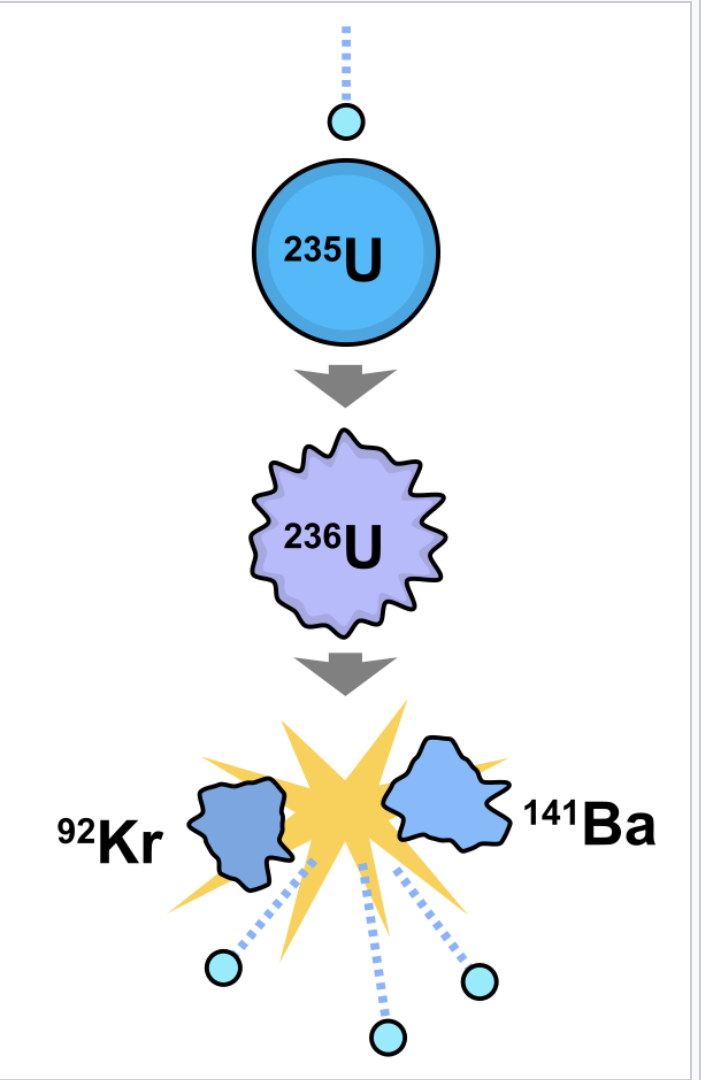Screenshot 2023-01-20 at 9.23.20 AM.pngNote: 1 neutron in, 3 neutrons out
- If we capture 2 out of 3, this is sustaining reaction (factor 1.0)
- If we capture 3, then it stops
- If we capture 1, the reaction will increase
- If we capture none of them, we have a nuclear bomb
Moderators capture extra neutrons and slow them into “thermal neutrons” (control rods also) to heat water for steam powered turbines
- Bomb: make it all happen really, really fast: add materials that create more neutrons
- Power plant: make it slow down, capture the neutrons into thermal neutrons, make steam, then electricity
\*\*\*make sure you can draw ALL of the parts of a nuclear power plant\*\*\*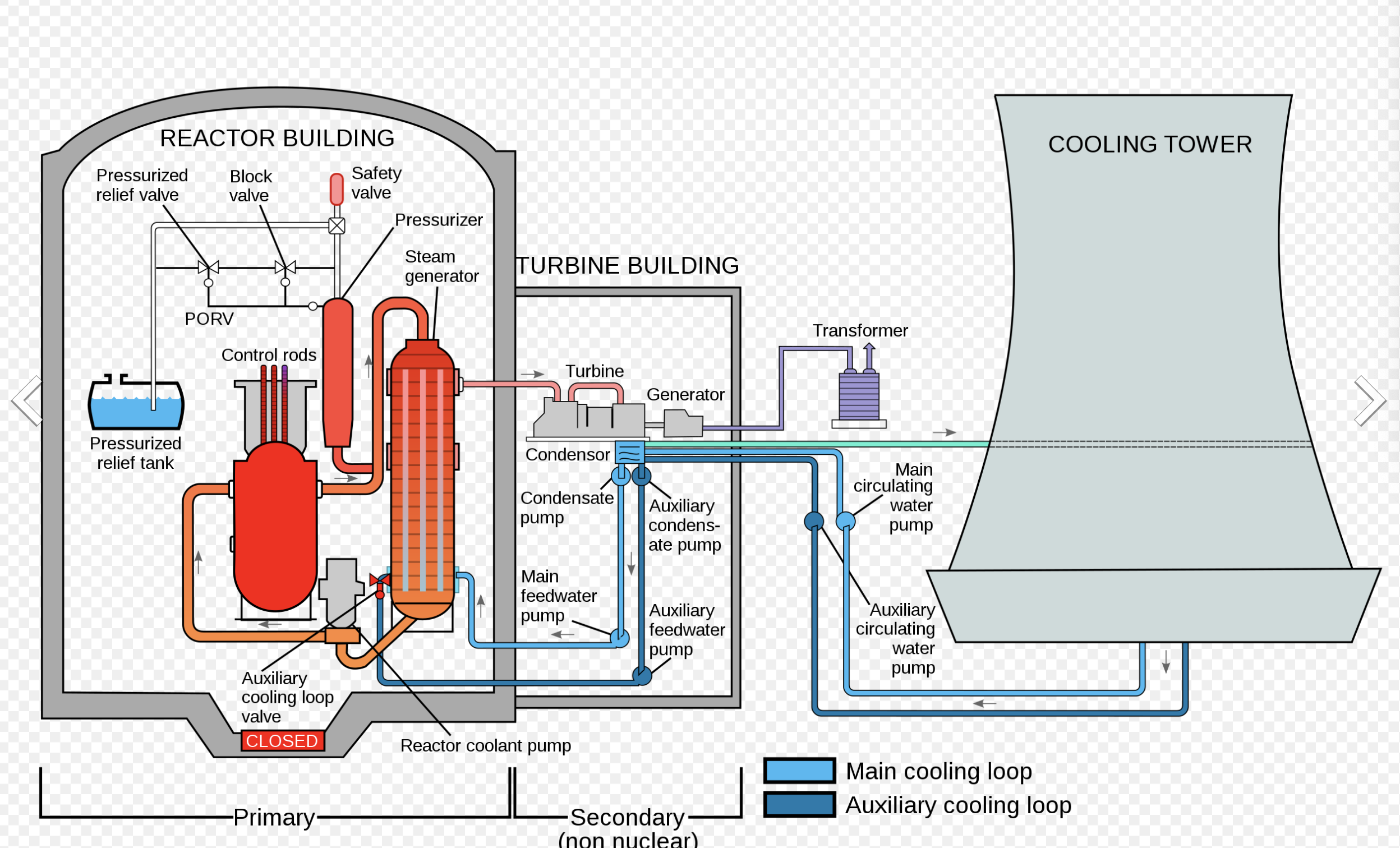Screenshot 2023-01-20 at 9.27.38 AM.pngCompare this with any "thermal power plant":
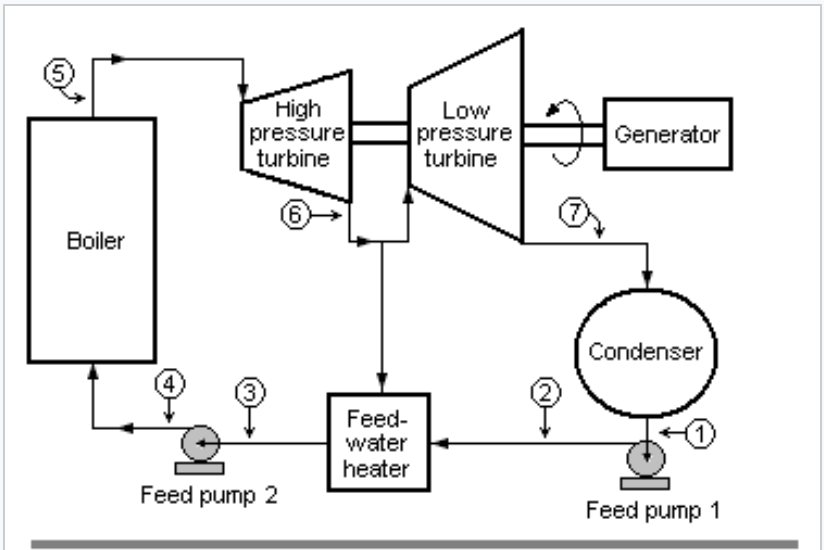Screenshot 2023-01-20 at 9.26.29 AM.png
- See why engineers copied this for nuclear plants?
- How is this different in a natural gas turbine plant ("Gas Combined Cycle")
- How is a solar thermal power plant set up?
Good stuff: few greenhouse gases
Bad stuff:
- radioactive waste
- pollution
- radioactive fallout
- limited supply of Uranium (Thorium possible)
Bad ones: 99 so far since 1945:
[https://en.wikipedia.org/wiki/Nuclear\_and\_radiation\_accidents\_and\_incidents](https://en.wikipedia.org/wiki/Nuclear_and_radiation_accidents_and_incidents)
- Kyshtym/Chelyabinsk disaster 1957 Plutonium (level 6 disaster)
- Windscale fire (GB level 5, 1957)
- Navy reactor accident Idaho SL-1 (1961) secret until recently
- Various Russian submarine accidents (secret) K-19, K-11, K-27, K-140, K-429, K-222, K-314, K-431
- Three Mile Island (1979) see video clip from film China Syndrome
- Goiania accident 1987 (Cobalt) also Mexico city, Zaragoza, Morocco, Costa Rica
- Chernobyl 1986 (level 7)
- Fukushima Daiichi 2010 (level 7)
What common theme? How dangerous? How could we avoid these in the future?
\*\*\*be prepared to cite at least three of these, and explain what happened and why\*\*\*\*
Fusion 2023: LLL Shiva (look this up) NIF: National ignition facility
\*\*\*Make sure you understand and can replicate the Coal energy graphic at the end of ch. 17\*\*\*Trends: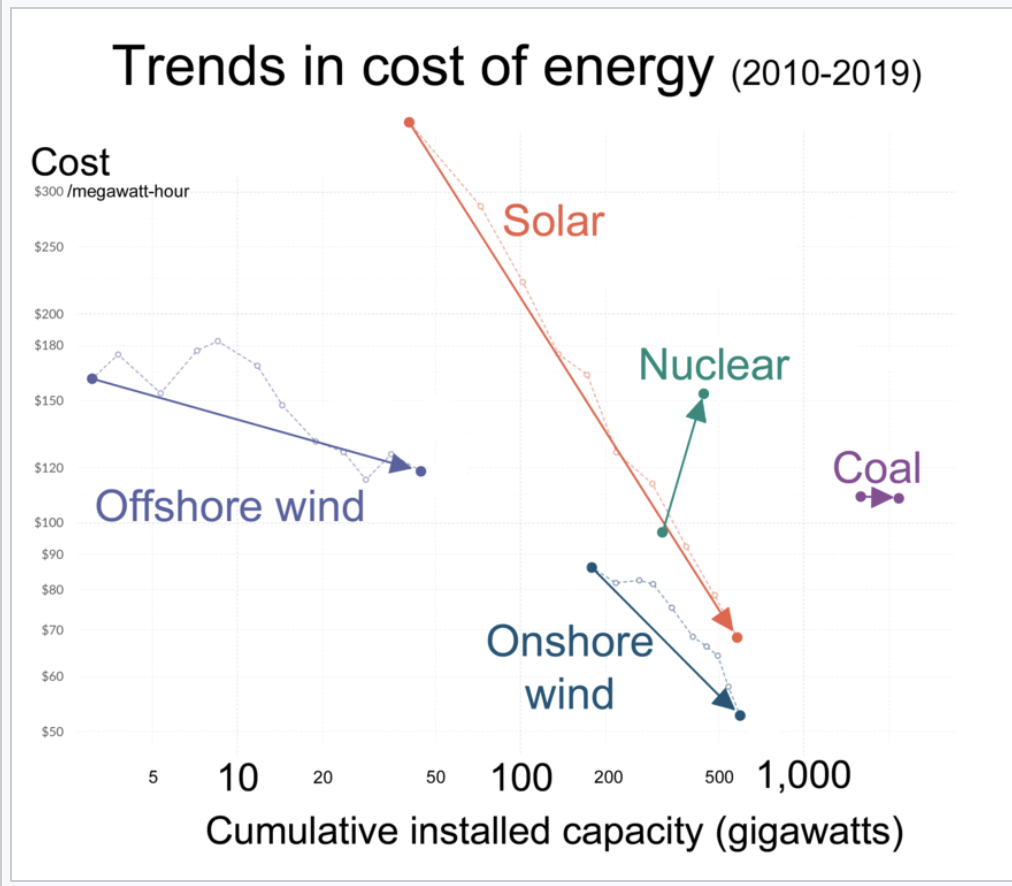Screenshot 2023-01-20 at 9.25.45 AM.png
- How has this changed since 2019?
- What is missing?
- How will it look when you are 50? (2055)
---
Migrated from Apple Server Wiki. Original page ID: x7\_668R3
# Renewable energy at HPA
**Renewable energy on our campus:**
**Solar PV:** radiation from the sun (visible) making electrons move in a special semiconductor material (silicon, made from sand), so photo (light) voltaic (Volts) = PV or photovoltaic. These release direct current (+ and -) energy like a battery. To be used in our electrical system, we use an inverter to change the DC to AC (alternating current). Inverters are large boxes that are usually hot when in use. PV panels are usually made of glass, often with a purple color, which is the semiconductor below.
**Solar Thermal:** radiation from the sun (visible) hits a dark metallic surface (often copper or aluminum, since they conduct heat well). The dark surface transforms visible radiation into thermal (infrared) energy, which is conducted by the copper or aluminum to attached water pipes. To keep the heat energy from radiating away from the panel, the metal is coated with a special paint, and covered with a special glass insulating layer. The glass is the heaviest part!
**Wind energy**: Solar radiation (mainly visible) heats the surface (water or ground) which makes the air in contact with the surface less dense, so it rises into the atmosphere. Wind is the movement of air to replace this rising air. Since air has mass, when is passes over a surface that can move, the kinetic energy of the wind (1/2mv2) can push a wing. Two or more wings working together will rotate a shaft that can be connected to a generator (Direct current, DC) or an alternator (alternating current, AC). Turbines can be horizontal axis (HAWT) or vertical axis (VAWT), which are less popular. Horizontal axis turbines can be leading or trailing, meaning the blades are in front of or behind the tower. Most large turbines are leading, because of the turbulence from the mast.
**Storage**:
**Hot water:** the cheapest energy storage method is hot water, usually from solar thermal panels, but can also be from PV panels running a traditional electric hot water heater, just like a coffee maker. Insulation is a key aspect to hot water storage, as heat travels from hot to cold through conduction (contact) radiation (radiation) or convection (hot air rising). Most hot water heaters are insulated (conduction), reflective (radiation) and covered (convection).
**Batteries**: These can be old style lead acid batteries like those in a car or golf cart, or newer lithium batteries like those in electric vehicles or in our IT and student union setups. Batteries only store Direct Current (DC), so they must go through an inverter to supply the grid, which is alternating current (AC). Energy stored in a battery can be as cheap as $100 per kWh stored for lead acid batteries, or up to $500 per kWh for lithium batteries, which charge much faster, last longer, and are much better for the environment than lead acid batteries.
**Hydrogen**: Passing direct current energy through water splits the water in to its components, Hydrogen and Oxygen. If the Hydrogen is captured and compressed, it can be used to burn for heating, cooking or in vehicles, or if passed through a special Fuel Cell membrane into direct current electricity, just like a battery as well as hot water. This is not as efficient as a battery, but can be used for long term storage.
**Conservation:**
Every dollar spent on conservation is worth 8 dollars in new renewable energy systems. Some key places to conserve energy:
Hot water insulation and timers
Passive ventilation vs. air conditioning
Lighting LED and passive
Vampire load reduction
Smart use of resources, occupancy based energy use
**Energy units:**
1 Joule is the basic unit of work or energy
1 Joule used or produced every second is called a Watt, so 1 Watt = 1 joule/sec
1000 Watts is 1 kiloWatt or kW
1 kW used or produced for one hour equals one kiloWatt-hour or kWh. A truly goofy term, but something easy to measure:
1000 Watt coffee pot running for 1 hour: 1 kW x 1 hour = 1 kWh
This is attached to cost, so the electric utility may charge you 2 cents for a kWh in Oregon, or 45 cents per kWh here in Hawaii-why?
---
Migrated from Apple Server Wiki. Original page ID: \_484t7J3
# Energy Tools
**Energy labs-tools**
1. **Kill-a-Watt**
1. Volts-should be around 120V, AC or DC?
2. Amperes-only when loaded, test with hot water heater
3. Watts-sometimes = volts x amps, but not always
4. power factor: only 1.00 with heaters (ohmic loads)
5. Hz: 60 here, 50 other countries
6. Use to determine vampire loads
2. **VOM meter**
1. Ohms-measure across your body-why does it change?
2. Volts;DC for batteries, AC for outlets
3. **eGauge**
1. campus energy used
2. campus energy produced
3. smaller buildings: faculty cottages only users
4. dorms: when do they sleep?
5. cafeteria: why so big?
4. **Thermal camera**
1. use to see vampire loads
2. use to see heat loss from hot water heaters
3. see leakage around refrigerators
4. see thermal changes in solar hot water panels
5. **EMC and Mango**
1. use to search for data
2. weather, solar radiation data for calculations
3. long term (12 years for EMC)
4. useful for efficiency (wind, solar thermal, solar)
5. EMC: 10.14.4.4
6. Mango: 10.14.4.123:8080 also 163, 15, 170
7. Elab server: 10.14.4.2 (12 year record)
6. **Weather stations**
1. solar radiation
2. temp
3. wind
4. 10.14.62.x
---
Migrated from Apple Server Wiki. Original page ID: Z3A2T6o3M
# Module 36: Nuclear Energy
Nuclear Energy
Recall that since the beginning of steam driven electrical power generation, all we needed was something hot (wood, coal, oil) to boil steam and push a fan (turbine) which turned a generator.
Nuclear power uses heat from a nuclear reaction.
Basics:
Fission is the splitting of heavy atoms into lighter ones.
Note heavy atoms (e.g. Uranium, Plutonium, Thorium) split into lighter ones (Krypton-kills Superman, Barium-what they do with dead people):

This happens quickly in an atomic bomb, slower in a nuclear power plant.
If you are into physics, the energy comes from the binding energy of the heavy nucleus, so we call it “nuclear energy”, E = mc2 is the famous formula for this energy released from the loss of mass (the mass of the smaller ones combined is less than the mass of the original atom, this missing mass is released as energy).
Important: count the number of neutrons in (1) and the number out (3). A nuclear chain reaction happens like this:
See how the number of neutrons increases with each collision? This happens in a fraction of a second, which is useful in a bomb, but hard to control with human reaction times in a reactor.
For this to be effective in a power plant, the neutrons need to be going slowly: (“thermal” neutrons).
In a nuclear power plant, to keep this reaction going, and control the speed (slow), we need to absorb some of the neutrons, (“criticality”, one neutron in, one out), and slow these down to make their collision with the next Uranium atom effective.
Moderators are how these neutrons are slowed and controlled, usually water in the reactor, graphite control rods or other materials.
Big picture:
Good: lowers carbon emissions (none), air pollution (mercury, sulfur, other heavy metals from coal or oil)
Bad: nuclear waste, accidents (“China Syndrome”), terrorism (dirty bombs)
Three critical (public) [nuclear reactor](https://en.wikipedia.org/wiki/Nuclear_reactor) accidents:
- [Three mile island](https://en.wikipedia.org/wiki/Three_Mile_Island_accident) (PA) 1979
- [Chernobyl](https://en.wikipedia.org/wiki/Chernobyl_disaster) (Ukraine) 1986
- [Fukushima](https://en.wikipedia.org/wiki/Fukushima_Daiichi_nuclear_disaster) (Japan) 2011
Background:
Fission reactors were first used to power stuff in submarines (lots of cooling water). This design was not changed much when it was adapted to land-based power plants, usually situated near rivers or oceans for access to lots of cooling water. They were also made much larger using the same design, which makes for trouble.
We need to understand two main types of nuclear reactor:
PWR: Pressurized water reactor (most common)
BWR: Boiling water reactor (e.g. Fukushima)
PWR reactor diagrams:
This looks complex, here are the steps:
Fission happens when the neutrons from the fuel, slowed by the control rods and water, heat the water in the primary loop.
This hot, radioactive pressurized water passes through another secondary water loop, heating that water to make steam, which drives the turbine.
The “dead steam” is then condensed in cooling towers if on land, or using cooling river or ocean water to go back into the secondary loop.
Plus: Safer because the radioactive primary loop is contained in a containment shellMinus: more complex, if the water boils out, the plant can meltdown, causing the China Syndrome, where the molten fuel would melt through the crust, supposedly “to China”. Some people never studied Geology.
This has happened several times: Three Mile Island in Pennsylvania, Chernobyl in the Ukraine, and Fukushima in Japan, which was a BWR reactor.
The spent fuel from both of these reactors, which is replaced every few years can also melt down if not cooled. This is still an issue in Fukushima where the cooling ponds are leaking into the ocean.
You might find it useful to think of a pressure cooker, which keeps water in a liquid state by being under PRESSURE, so PWR, Pressurized water reactor
BWR Reactors: (boiling water reactors)
n.b. one loop, everything else is similar.
Neutrons are slowed by the water flowing through, so as the water boils, the gaseous steam slows the neutrons less effectively, so the reaction slows down.
This sounds more automatic, but this can go crazy if the water pumping system fails, as it did in the tsunami that flooded the Fukushima plant in Japan after an earthquake, killing the generators that powered the gear that controlled the reactors as well as the pumps cooling the reactor, so it "melted down".
It is still molten, radioactive and spewing radioactive waste into the ocean (2023)
Plus: simpler, somewhat self regulating
Minus: lots of radioactive stuff to dispose of, e.g. everything (pumps, turbines, condensers, pipes, water, tools, equipment)
USSR tried using molten sodium as the coolant, the plant exploded taking a town with it. This was discovered by satellite photos when the town just disappeared.
Other types:Breeder reactor: creates energy, but main purpose is to produce Plutonium for bombs by enriching other heavy elements with neutrons.
Gas reactor: also known as a VHTR or very high temperature reactor. These can either be next-generation pebble bed reactors like in the e2 video, or very high temperature reactors that skip the turbine step and instead use heat to split water (pyrolysis) into hydrogen and oxygen, which can be used as fuel. They often use carbon dioxide as the moderator, so as it heats up, it becomes less efficient, so is largely self-regulating.
Fusion energy (the other nuclear energy):
If fission is splitting heavy atoms into smaller ones, if you can push two light elements (Hydrogen, Helium) together, you can FUSE them, releasing huge amounts of energy:
This happens at high temperatures and pressures, like in the core of our sun or other stars.
First ever "break even" was achieved in 2022, when more energy was released than was needed to trigger the reaction
- H2/1 is an isotope of hydrogen, called Deuterium.
- H3/1 is another isotope called Tritium.
- Both have extra neutrons, but the same number of protons (recall that protons define the identity of the atom).
- You may also see the notation n1/0, which means neutron, one thing in the nucleus, no protons.
To do this here on earth, we can do one of two things:
1. Heat and pressure from lasers aimed at a drop of Deuterium (H2/1) can fuse at a temperature of 1,000,000°C (SHIVA at NIF, TOKOMAK)
2. Use atom bombs (fission) around deuterium (H2/1) or Tritium (H3/1) to make a “hydrogen bomb” or "thermonuclear weapon" (thermo=heat).
- The bombs you have heard of at [Trinity](https://en.wikipedia.org/wiki/Trinity_(nuclear_test)) (first atomic bomb test), [Hiroshima and Nagasaki](https://en.wikipedia.org/wiki/Atomic_bombings_of_Hiroshima_and_Nagasaki) were all fission “A-bombs”.
- Nagasaki used Plutonium (easy to produce, hard to explode), the others used Uranium (hard to produce, easy to explode).
- We only had enough Uranium for two tests, we had lots of Plutonium.
- Both of these released huge amounts of radioactive fallout, covered below.
Fusion “Hydrogen bombs" or "H-bombs” are hundreds of times more powerful and destructive "thermonuclear" weapons.
The ones you see in [tests on the ocean](https://en.wikipedia.org/wiki/List_of_nuclear_weapons_tests) are H-bombs.
Present use of A-bombs is only in small cases, or in “neutron bombs” which are designed to release neutron radiation, killing people, leaving buildings intact (banned in the 1970's as inhumane, developed to defend Europe if the USSR invaded).
Fusion power would be great, as the oceans have lots of Deuterium. It is also much cleaner. Ignition is the toughest part, check this out:
[National Ignition Facility-SHIVA](https://en.wikipedia.org/wiki/National_Ignition_Facility)
Radiation and Fallout:
Recall four main types of nuclear radiation:
- Alpha particle/rays: slow, heavy Helium nucleus (He), charged, stopped by your skin, but if it gets inside (lungs or blood) they are fatal.
- Beta particle/rays: faster (137,000 mph), lighter, charged electrons, stopped by metal foil, can knock electrons off of DNA, so these are called “ionizing radiation”.
- Gamma particle/rays: speed of light (675,000,000 mph), no charge, no mass, ionizes DNA, stopped by lots of lead or concrete. Very dangerous.
- Neutron radiation: heavy, uncharged particles destroy cell membranes, make steel brittle, passes through many meters of lead of concrete.
Radiation comes from anything radioactive. Fallout is the name for dust or particles of this radioactive material.
Two main cases:
1. Bombs: release radioactive materials from the bomb, but mainly lots of dust from vaporized islands/desert/other stuff. “Dirty bombs” are just explosives with lots of radioactive stuff wrapped around them (e.g. plutonium, cobalt, cesium, radioactive waste)
2. Reactor accidents: usually much more radioactive material involved (1000 kg vs. 10 kg), less of an explosion vaporizing stuff, more a matter of radioactive fuel exploding and going into the atmosphere.
Hiroshima, Nagasaki: radioactive dust, Plutonium (Nagasaki), many mutations from radiation: direct (alpha, beta, gamma, neutron) and fallout (usually alpha, beta, gamma).
[Pacific bomb tests:](https://en.wikipedia.org/wiki/Pacific_Proving_Grounds)
- US tests obliterated some of the Marshall islands.
- The French tests near Tahiti released lots of radioactive Strontium 90, which radiated dairy products in NZ (look up Strontium and Calcium on the periodic table).
- The French are not popular in that region.
- Side note: the French later bombed a [Greenpeace](https://en.wikipedia.org/wiki/Sinking_of_the_Rainbow_Warrior) ship, the Rainbow Warrior in Auckland Harbor in 1985 which was protesting these French bomb tests. Again, not very popular.
[Three mile island:](https://en.wikipedia.org/wiki/Three_Mile_Island_accident) 1979:
- A water valve malfunctioned, due to human error the core was uncovered, the core then melted down, radioactive gas was released from the containment dome, no deaths, but a 5/7 on the total nuclear disaster scale.
- This happened the same weekend a movie about the same accident opened: [The China Syndrome](https://en.wikipedia.org/wiki/The_China_Syndrome)
[Chernobyl: ](https://en.wikipedia.org/wiki/Chernobyl_disaster)1986:
- During a rogue test (more human error), the graphite/uranium core exploded, radioactive core materials, Iodine 131 and other radioactive isotopes were released, many tons of highly radioactive dust were released all over Europe (detected even here in Hawaii).
- Toll: 28 dead on scene, 200,000 estimated cancer deaths all over Europe.
- The USSR hid the disaster for days, which was finally detected at a nuclear facility in Sweden.
[Fukushima](https://en.wikipedia.org/wiki/Fukushima_Daiichi_nuclear_disaster): 2011:
- The 9.0 Tohoku earthquake offshore caused a tsunami that flooded and disabled the power plant pumping the BWR reactor cooling water, the core melted down, then exploded, the core is still molten today
- TEPCO (Tokyo electric power company, the power utility) continuously lied about the accident, and is still trying to contain the leakage into the ocean and groundwater.
- All fish and produce from the area is still banned.
Smaller accidents:
- Sweden: Forsmark,
- Japan: Tokaimura,
- SL-1 Reactor Idaho Falls (three victims were buried in lead coffins they were so radioactive)Make sure you understand radioactive half life:
At = A0 (1/2)n or At = A0/2n
At is the amount later at some time t
A0 is the amount at time zero
n is the number of half lives
Common misconception about half life: 2x half-life does not make zero
Can also use population formula if you want to show off:
At = A0e-kt if you know k (the decay rate)
k = 0.693/t1/2 n.b. as t1/2 is larger, k is smaller (slower decay)
---
Migrated from Apple Server Wiki. Original page ID: o261D5A
# e2: Paving the way
e2: paving the way
[http://physics.hpa.edu/physics/apenvsci/videos/e2\_videos/e2%20energy/3%20paving%20the%20way.mp4](http://physics.hpa.edu/physics/apenvsci/videos/e2_videos/e2%20energy/3%20paving%20the%20way.mp4)
[https://elab.hpa.edu/apes/videos/e2/e2%20energy/](https://elab.hpa.edu/apes/videos/e2/e2%20energy/?target=)
APES questions—e2 energy 3 paving the way
1. How many gallons of gas does each American use each day?
2. Why is it encouraging that the VP of research and development (R&D) at GM says what he does?
3. Look up Amory Lovins, what does he think represents the best solution?
4. Hydrogen is not really a fuel, but an energy transport technology. why?
5. What kind of car was Henry Ford’s car for his wife?
6. How many mpg did the Model T get, compared to today?
7. How efficient is the fuel in a car? why?
8. If only 1% of the energy in fuel moves the passengers, how do hybrid vehicles change this?
9. Vijay says the solution involves what?
10. FiberForge is in Colorado, not the normal industrial centers, why is this important?
11. Why is "stamping" a familiar process for car makers?
12. What is Amory’s reference to “The Graduate” and how is this relevant to you? (look up "one word: plastics" on youtube)
13. What are the most expensive parts of a car plant?
14. What is the role of public policy in this solution?
15. Why is the latest Chevy Volt different from the Prius and the Tesla?
16. Why is the Prius mileage better in the city than the freeway, the opposite of normal cars?
17. Your fossil fuel car has a mileage rating in miles per gallon (mpg). How would you rate the mileage of an EV (electric vehicle)?
18. Why is the battery technology Elon Musk is developing such a game changer?
19. Why is the hydrogen fuel cell better than most battery solutions?
20. Imagine you are having a conversation with your parents about getting a more efficient car. what would you tell them?
21. If you were planning on getting an electric vehicle (EV or plug-in hybrid), what changes would you make at your home?
22. Since this video came out (2007), GM and other car makers were near bankruptcy, and were rescued by the US government. What was the tradeoff for this rescue?
23. Summarize Vijay’s argument at the end of the video. how would you make this happen?
---
Migrated from Apple Server Wiki. Original page ID: b2e2d5\_
# e2: coal and nuclear
e2 Coal and nuclear:
[http://physics.hpa.edu/physics/apenvsci/videos/e2\_videos/e2%20energy/6%20coal%20and%20nuclear.mp4](http://physics.hpa.edu/physics/apenvsci/videos/e2_videos/e2%20energy/6%20coal%20and%20nuclear.mp4)
[https://elab.hpa.edu/apes/videos/e2/e2%20energy/](https://elab.hpa.edu/apes/videos/e2/e2%20energy/)
Jim Woolsey salt audio: [https://elab.hpa.edu/apes/audio/20100626\_wesat\_05.mp3](https://elab.hpa.edu/apes/audio/20100626_wesat_05.mp3)
APES questions
1. Jim Woolsey in the audio describes a power shift, using salt as an example-explain
2. What are the three main uses of energy in our country, according to the audio?
3. How will smart grids and electric/hybrid vehicles impact this?
4. Why a "perfect storm"?
5. When he says “our grandchildren” who does he mean to you?
6. Why a silver bullet? what is this reference? (think of werewolves)
7. What percentage of global energy is sustainable now?
8. Why are coal and nuclear "two 800 lb gorillas"?
9. Wood to coal-why and when? why is it the 21st century energy source?
10. How has this changed since this video was created in 2008?
11. How often were new Chinese coal plants opened, and how long will each one last?
12. Why and to whom do mercury, sulfur compounds impact?
13. Who does Mike Mudd represent? Is he telling the truth?
14. Jeffrey Sachs stresses testing-why?
15. Why is carbon capture dangerous?
16. Why do you think the Montana folks want to promote carbon capture?
17. For how many years could coal provide US energy?
18. 2100 mW for how many homes and how much for each home?
19. What does Dan Kammen think about carbon capture?
20. Why does the pursuit of carbon capture slow development of greener solutions?
21. This video is from 2008, what has changed since then that dramatically changes the scene to the use of coal for electricity? (hint: fracking is part of this)
22. The coal guy says 2012 is when IGCC should be running-what actually happened?
23. How much energy in the US is created by nuclear plants now?
24. Jeffrey Sachs compares coal and nuclear-what does he think?
25. This video was done before Fukushima Daiichi in Japan. How has public opinion changed since then globally? (Germany, Japan, US)
26. Why is a pebble bed reactor safer? How does it differ from a traditional reactor? (look this up)
27. How is the nuclear waste issue in a PBR differ?
28. What is the LEGO NGNP construction model?
29. Nuclear power plants cost many more times as much to decommission as to build, so how does this impact investment?
30. How many permits for nuclear power have been approved in the last 30 years?
31. Why is Jeffrey Sachs an optimist? Are you part of his vision?
32. What do you think energy will look like when you are 50 in the year 2058?
33. After reading the MIT article on small modular reactors (SMR) how will this change the future of nuclear power?
34. Who is funding this now and why?
35. Coal and nuclear both rely on boiling water to make steam. Natural gas can be burned in a turbine, like a jet engine that can respond almost instantly, instead of waiting for water to boil. This has a huge impact on the adoption of renewable energy like wind and solar. Why?
---
Migrated from Apple Server Wiki. Original page ID: F3e4K8D
# Energy resources
Withgott 7e
- [Chapter 19: Fossil fuels](https://elab.hpa.edu/apes/texts/Withgott7e%20v.2%20ocr/ch19ocr.pdf?target=)
- [Chapter 20: Alternate energy](https://elab.hpa.edu/apes/texts/Withgott7e%20v.2%20ocr/ch20ocr.pdf?target=)
- [Chapter 21: Renewable energy](https://elab.hpa.edu/apes/texts/Withgott7e%20v.2%20ocr/ch21ocr.pdf?target=)
Frog Book on iPads:
- Chapter 17: non-renewable energy
- Chapter 18: renewable energy
Friedland and Relyea 2e:
- [Chapter 12: non renewable energy: modules 34-36](http://physics.hpa.edu/physics/apenvsci/texts/fr_2e_ocr/12-13.pdf)
- [Chapter 13: renewable energy: module 37-40](http://physics.hpa.edu/physics/apenvsci/texts/fr_2e_ocr/12-13.pdf)
Pages:
- [Energy tools](http://10.14.4.85:6875/books/ap-environmental-science/page/energy-tools)
- [Energy Primer](http://10.14.4.85:6875/books/ap-environmental-science/page/energy-primer)
- [Energy Units](http://10.14.4.85:6875/books/ap-environmental-science/page/energy-intro-units)
- [Renewable energy at HPA](http://10.14.4.85:6875/books/ap-environmental-science/page/renewable-energy-at-hpa)
- [ROI-TCO labs](http://10.14.4.85:6875/books/ap-environmental-science/page/roi-tco-worksheet)
Energy Videos:
- [e2 paving the way](http://10.14.4.85:6875/books/ap-environmental-science/page/e2-paving-the-way)
- [e2 coal and nuclear](http://10.14.4.85:6875/books/ap-environmental-science/page/e2-coal-and-nuclear)
- [e2 growing energy](http://10.14.4.85:6875/books/ap-environmental-science/page/e2-growing-energy)
- [e2 harvesting the wind](http://10.14.4.85:6875/books/ap-environmental-science/page/e2-harvesting-the-wind)
- [e2 energy for a developing world](http://10.14.4.85:6875/books/ap-environmental-science/page/e2-energy-for-a-developing-world-22024)
Design Videos:
- [e2 Green for all](http://10.14.4.85:6875/books/ap-environmental-science/page/e2-green-for-all)
- [e2 The art and science of Renzo Piano](http://10.14.4.85:6875/books/ap-environmental-science/page/e2-the-art-and-science-of-renzo-piano)
- [e2 The Druk White school in Ladakh](http://10.14.4.85:6875/books/ap-environmental-science/page/e2-druk-white-school-in-ladakh)
- [e2 Green apple](http://10.14.4.85:6875/books/ap-environmental-science/page/e2-green-apple)
Sensors:
- [elab energy sensor](http://10.14.8.1/62979/classic.html)
- [elab weather station](https://tempestwx.com/station/133324)
- [elab weather data screens](https://tempestwx.com/station/133324/grid)
- [elab telemetry server](http://elab2.hpa.edu)
- [EMC5 server](http://10.14.4.5/cgi-bin/EMCcgi)
---
Migrated from Apple Server Wiki. Original page ID: a8E9e5t0z5
# e2: growing energy
APES questions e2 growing energy
[http://physics.hpa.edu/physics/apenvsci/videos/e2\_videos/e2%20energy/](http://physics.hpa.edu/physics/apenvsci/videos/e2_videos/e2%20energy/)
[https://elab.hpa.edu/apes/videos/e2/e2%20energy/](https://elab.hpa.edu/apes/videos/e2/e2%20energy/?target=)
1. What is the basic difference between biofuels and fossil fuels?
2. What is the time frame for collection of solar energy for fossil fuels vs. biofuels?
3. Brazil has a unique climate, and uses a crop that is native to the area. Compare this with corn ethanol in the Midwest US
4. Why is corn ethanol so popular in the farm states, and why is there national policy around it?
5. Steven Chu: look this guy up. Where did he used to work in 2007, on what, and what was his job in Obama’s administration?
6. Compare cellulosic ethanol with ethanol from sugar cane or corn
7. After the sugar cane is soaked to get the sugar, cellulosic fibers called "bagasse" are left. What could you do with this? (hint: many homes in Hawaii use it)
8. What is the energy balance of corn ethanol as grown in the US? Does this make sense? Why/why not?
9. Harbors here in Hawaii provide ethanol free gasoline. Why?
10. What caused the 1973 oil crisis?
11. PETROBRAS is the national oil company of Brazil. How does this change the rate of progress in their ethanol solution?
12. What kind of government did Brazil have then?
13. What is the population curve of Brazil?
14. Why did VW move to biofuels instead of hybrids? What has happened since then?
15. What is a CAFE standard, and what what was made exempt from these standards in 1995?
16. Why?
17. Does ethanol provide the same mileage per gallon as gasoline? Explain.
18. Imagine a developing country with no fossil fuel resources. How could biofuels impact their development?
19. Dan Kammen of UC Berkeley (Go Bears) describes a repetitive trend in renewable energy. What is the trend?
20. Where is the first presidential caucus of the US election held?
21. What is the main industry there and why is this important?
22. When corn ethanol use was legislated in the US, the price of tortillas in Mexico went up tremendously. Why?
23. How can cows derive energy from grass? How many stomachs do they have?
---
Migrated from Apple Server Wiki. Original page ID: H6Y5V85
# e2: harvesting the wind
[e2 Videos: (20 minutes each)](http://physics.hpa.edu/physics/apenvsci/videos/e2_videos/e2%20energy/)[https://elab.hpa.edu/apes/videos/e2/e2%20energy/](https://elab.hpa.edu/apes/videos/e2/e2%20energy/)
[Harvesting the wind:](http://physics.hpa.edu/physics/apenvsci/videos/e2_videos/e2%20energy/1%20harvesting%20the%20wind.mp4) community wind power in Minnesota
APES questions
1. This series unites economic opportunity with environmental issues. Why is this unique? What does this mean for you?
2. The Minnesota radio report starts with weather-why is this usually the case in farming regions?
3. Why is small town America “dying on the vine”?
4. How might this change since Covid?
5. Look up the percentage of people in the US who were farmers in 1900, and now (2021).
6. What is the average age of farmers today?
7. How much energy was produced by wind in the US at the time of this video (2008)?
8. What country started wind power, and who leads now?
9. What happened in 1994 in Minnesota with nuclear power? Why is this important?
10. Who is Tim Pawlenty, and when did he run for president?
11. Why is community wind better than corporate wind?
12. How much do we pass on to foreign investors per year in wind projects?
13. What are the power per home numbers according to Dan Juhl?
14. Minnesota has a high Norwegian/Swedish ethnic population. Why?
15. Does the wind farm prevent traditional farming?
16. How reliable is income from wind vs. income from farming. Why?
17. Look carefully at the blades of the wind turbines. Why are they shaped this way?
18. Why is the airport an issue? What is the solution?
19. Dan Juhl refers to “the crop”. What does he mean?
20. One big issue with wind is that demand is in one place, while resources in another place. What does this mean to the grid?
21. How will a smart grid change this?
22. What is the best way to predict the future?
23. What is the tax credit game all about? How does it work? Do people use this here in Hawaii?
24. Define ROI and TCO (look these up)
25. Newer turbines have two or three blades, while older (e.g. 1880) ones in the video had many blades. What were these used for on farms?
26. There is a Jacobs wind turbine above the Headmaster’s home. How long did this work, and what were they originally designed for? (hint: has to do with airmail)
27. Tyler Juhl makes an important point relevant to your peers. What is this?
28. Why is making the blades for the turbines locally so important?
29. How are aviation and turbines similar as a researcher or future worker?
30. Why would states support wind power?
31. What is the trifecta of wind power?
---
Migrated from Apple Server Wiki. Original page ID: D4p4V8G
# e2: energy for a developing world
e2: energy for a developing world
[http://physics.hpa.edu/physics/apenvsci/videos/e2\_videos/e2%20energy/2%20energy%20for%20a%20developing%20world.mp4](http://physics.hpa.edu/physics/apenvsci/videos/e2_videos/e2%20energy/2%20energy%20for%20a%20developing%20world.mp4)
If you have difficulty viewing the video, please hold option while clicking on the link. This will download the video to your computer
1. Morgan Freeman or Brad Pitt?
2. This series approaches environmental issues as an economic opportunity-how?
3. Look up Muhammad Yunus in wikipedia-what did he do?
4. Jeffrey Sachs says Bangladesh is called a basket case-why?
5. What is his solution for poverty?
6. What does Yunus say about poverty? Who created it?
7. How is microcredit different from normal loans?
8. Who did Grameen bank impact first?
9. Why is energy the key to resolving poverty?
10. Jeffrey Sachs uses the term “sine qua non”. What does this mean in this sense?
11. What other things are needed in his vision?
12. If you were a 17 year old woman growing up in Bangladesh, how would Grameen Shakti change your life?
13. How would replacing kerosene lamps improve the health of women in Bangladesh?
14. What does solar lighting also free the women for? How would this change their literacy, reproductive rights and children?
15. What is the impact of religion on population control, economic equality and education?
16. If you were your age and gender in Bangladesh, how would your life be different?
17. What are the three things a woman in the video buy once she has any money?
18. As women become technicians for Grameen Shakti, they are able to do something men cannot do-explain.
19. When Grameen Shakti started, a 20 Watt panel (like the one in the video) cost $200. It now costs 10$. What could happen now?
20. What is the beautiful aspect of the biogas plant in the video?
21. The woman mentions she does not have to clean the pots-why does this impact her time more than just the washing?
22. Tie this together with other woman cooking food, how does it enable them to have more time? What do they not have to do?
23. What is environmental degradation, and environmental mining or predation?
24. Bangladesh has a population of 161 million, about half of the US, in an area something like the size of Michigan, all of it about 1 meter or less above sea level. What will happen to these people as global warming increases, and what would you do to solve this?
25. “If you do not imagine, you cannot create” If you had a gazillion (lots) dollars, and could create a solution with global impact, what would it be? (maybe you made your fortune inventing a better hot water heater :-))
---
Migrated from Apple Server Wiki. Original page ID: U7K0h3z4
# Ch. W20: Conventional energy alternatives
You may notice that the Withgott 7e text divides energy into three main categories:
- [Chapter 19:](https://elab.hpa.edu/apes/texts/Withgott7e%20v.2%20ocr/ch19ocr.pdf) Fossil fuels
- [Chapter 20:](https://elab.hpa.edu/apes/texts/Withgott7e%20v.2%20ocr/ch20ocr.pdf) Conventional energy alternatives (nuclear, biofuels, hydropower)
- [Chapter 21:](https://elab.hpa.edu/apes/texts/Withgott7e%20v.2%20ocr/ch21ocr.pdf) Emerging renewable energy (solar, wind, geothermal, ocean, hydrogen storage)
This makes a great deal of sense, so below you will find notes from Chapter 20 (I may add notes from 19 later)
Chapter 20: Conventional energy alternatives (nuclear, biofuels, hydropower)
n.b. the text seems to refer to energy policies in Sweden quite a bit: why do you think?
Part I: Nuclear Power:
Fission for now:
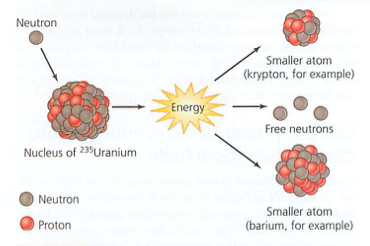Screen Shot 2023-01-28 at 5.18.32 PM.pngMake sure to understand the difference between U238 (common) and U235 (rare, must be refined to get, known as "enriched Uranium")
You may also hear about "enriched Uranium in the news about countries like Iran and N. Korea, where enriched Uranium can be used for nuclear weapons, as well as fuel for energy reactors
Make sure you understand each of these elements, but more, how are they similar and different from a coal fired power plant?
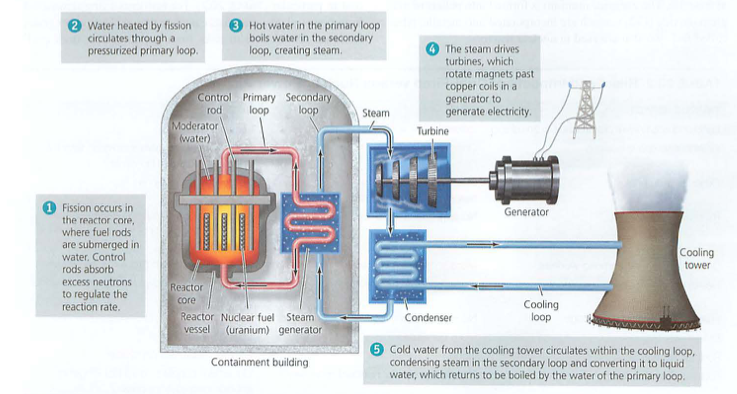Screen Shot 2023-01-28 at 5.21.29 PM.pngRealize also that this is called a Pressurized light Water Reactor (PWR) which is the most common. Make sure to look up the other, more dangerous type, called the BWR or boiling water reactor. The main difference is this one has a primary loop that is separated from the secondary steam loop.
You may also hear about a PWR "heavy water" reactor, which uses depleted fuels to create Plutonium for weapons...
Good to know for the AP exam:
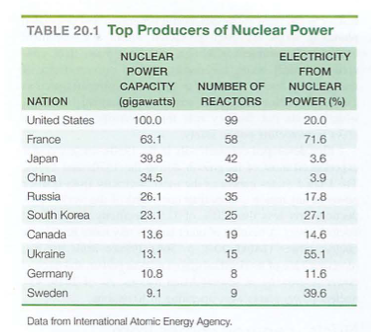Screen Shot 2023-01-28 at 5.25.10 PM.png
You should also know the term "mill tailings" which are radioactive and toxic leftovers from mining and refining Uranium.
From your e2 video "coal vs. nuclear" you should be able to list a few of these:
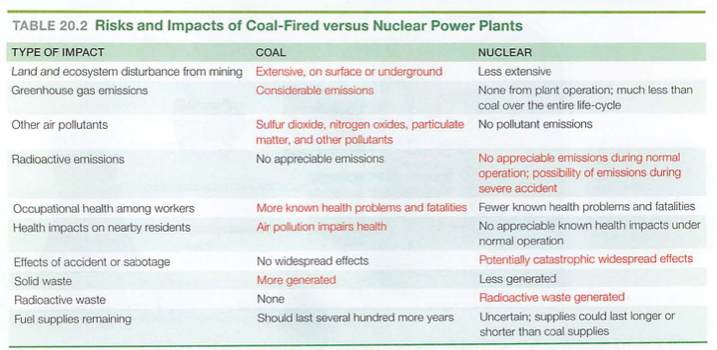Screen Shot 2023-01-28 at 5.26.28 PM.png
The text refers to Fusion as a "dream" but you know that recently (January 2023) Fusion achieved "break even" meaning it had an EROEI of 1:1 for the first time EVER. They've been working on this since 1950, so this is a very big deal.
Here's the reaction:
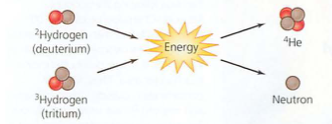Screen Shot 2023-01-28 at 5.28.33 PM.png
Three main accidents covered in the text:
Three Mile Island: Pennsylvania, 1979
- partial meltdown
- still toxic
- some radioactive gas released
- no stats on health impact or death
- caused by human error
Chernobyl: Ukraine (was USSR), 1986
- human error
- bad design
- poor response
- some killed directly
- many millions impacted, early cancers (thyroid, others)
- 100+ tons of radioactive material released
- still toxic for 20 miles around
- top 2m of topsoil was removed, buried deep underground
Fukushima: Japan, 2011
- tsunami, flooded electrical generators
- full meltdown 3x, partial another 3x
- still very radioactive, releasing radioactive water into the sea
Next big issue: nuclear waste:
- dangerous to store
- dangerous to move to storage sites
- can be used for "dirty bombs" (conventional explosives + radioactive waste)
- melts containers, can get into ground water
- radioactive for thousands of years
Reactor design:
Gen 1 reactors: Submarines, early shore reactors
Gen 2 reactors: most present reactors
Gen 3 reactors: better recent design, some using heat convection like the SMR modular reactor
Gen 4 reactors: pebble bed reactor, liquid sodium reactor, molten salt reactor
Part II: Bioenergy
Basically anything that was living, used as fuel for energy
Examples:
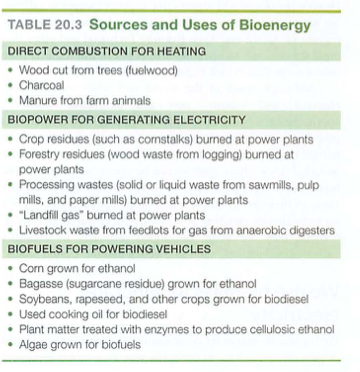Screen Shot 2023-01-28 at 5.39.26 PM.png
Issues:
- Diversion of food
- Impact on erosion, soil health, nutrients
- EROEI less than 1.0 for corn ethanol in the US (very political)
Main versions:
1. Direct burning: wood, manure, bagasse
2. Fermentation: corn, sugar cane or other sugar crop grown, fermented to make ethanol (alcohol)
3. Cellulosic ethanol: using non-food crops (waste, grasses) with bacteria and yeast to create ethanol
4. Biodiesel: from oily crops (rapeseed)
5. Algal biodiesel: from algae
EROEI (energy return on energy invested)
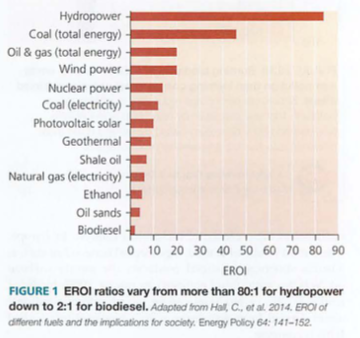Screen Shot 2023-01-28 at 5.45.01 PM.png
Note that EROEI for ethanol depends on where it is grown: corn (US) vs. sugarcane (Brazil)
Part III: Hydropower
Three main topics:
1. Hydroelectric dams (PE of water behind dam becomes KE of water through turbine)
2. Run of the river hydropower (KE of water flowing through turbines, no dam)
3. PSH: pumped storage hydro (essentially creating a dam or pond as hydropower storage)
- Very high EROEI (80:1)
- Finite lifespan for dams
- Dams impact downstream life as well as upstream dislocation
- Only available where there is consistent flow of water, and location for dam
- Different from tidal or ocean energy, as all dams are freshwater
---
Migrated from Apple Server Wiki. Original page ID: 93G3M0
# Ch. W21: New renewable energy sources
This chapter rounds out the three chapter study of energy in the Withgott 7e text.
These differ from the chapters on fossil fuels (19) conventional alternates (20) as these are new, renewable sources, where the others are not
Sections:
- Part 1: Outline: Wind in Texas and Germany
- Part 2: Growth of RE (renewable energy)
- Part 3: Solar Energy
- Active solar
- Solar thermal (pumped and siphon)
- Concentrated solar thermal power (CSP)
- Photovoltaic (PV)
- Passive solar
- building design
- stack effect
- building placement
- trombe walls
- Part 4: Wind power
- Horizontal axis wind turbines (HAWT)
- leading blade (big)
- following blade (smaller)
- offshore vs. land based
- delivery issues
- coupling with natural gas, hydro, nuclear base-load power
- usage curves-analysis
- Part 5: Geothermal power
- closed loop vs. open loop
- ground source heating-cooling
- heat pumps
- building considerations
- enhanced geothermal (EGS)
- Part 6:Ocean energy
- tidal energy
- wave energy
- current energy (Hawai'i-Maui, Alanuihaha channel)
- ocean thermal energy conversion (OTEC) NELHA in Kona
- Part 7: Energy Storage-Smart Grid
- conventional battery (Lead acid)
- lithium battery (LiFePO4)
- pumped storage hydro (PSH)
- hydrogen fuel cells
Part 1: Wind in Texas and Germany:
- Texas: petroleum mecca for the US, windy in the north, population in the south
- Germany: dependent on others for petroleum, some coal, huge industrial base
Texas challenges:
Wind grew so fast, grid was unable to handle it
T. Boone Pickens (oil guy, discovered fracking in 1960) sold all of his oil holdings, put into wind
He knew something about two things: EROEI and ROI for both-explain
Texas government invested in wind via tax breaks and some funding
Germany:
Not much sun, but lots of PV anyway, so 9% of all energy from solar
Offshore wind started in 1980 (Michael Saalfeld, the donor of the elab)
Feed-in Tariff required energy companies to purchase electricity from consumer who produce their own (PV)
California did this too, HELCO has resisted for decades, now charging a fee to upload energy ($0.12 in, $0.35 out)
Goal: 2050 80% from renewables
Summer of 2022: Germany was completely RE for one day in June
Part 2: Growth of Renewable Energy (RE)
Biomass and hydropower are old solutions, not scalable or really sustainable
"new renewables" usually refer to direct, immediate use of solar energy (solar, wind, tidal/gravity, geothermal/hot core)
Why: scaling now, new technologies, future solutions
Three main uses:
- electricity
- heating water and air
- transportation
Crazy growth rates for wind and solar: 50% or more per YEAR
- inexaustable in our time frame
- geographically dispersed (vs. oil wars)
- available in LDCs (lesser developed countries)
- economically diverse (good for investment)
- promotes local sustainability and resilience
- good for employment (need a job? learn about RE)
- "green collar" jobs (vs. blue collar or white collar)
- one solution for climate crisis (low CO2 emissions)
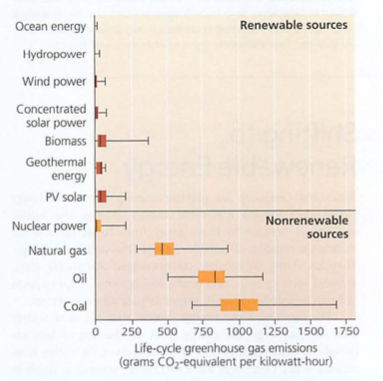Screen Shot 2023-01-29 at 8.10.37 AM.png
Fun fact: oil in Hawaii is so expensive, and solar is so available that solar energy is now much cheaper than fossil fuel energy
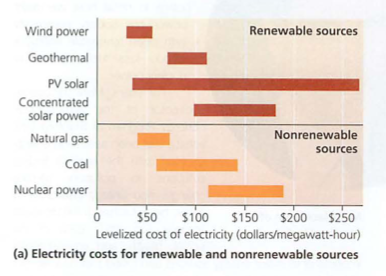Screen Shot 2023-01-29 at 8.13.34 AM.png
How to read this: here in Hawaii, we pay $0.35 per kWh, which is $350 per mWh, or off the scale in this graph.
Imagine our energy costing $0.02 per kWh instead.
This is the price for electricity in Prineville Oregon, which gets its power from hydropower.
Facebook sites their servers there, cooling them with river water...neat
What would we need to be globally energy neutral?
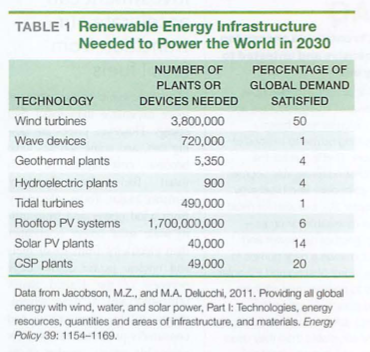Screen Shot 2023-01-29 at 8.17.28 AM.png
Need to recycle rare-earths and others:
China has mined many of these, and owns the mines around the world for many (smart move)
How old will you be in 2050? About 45?
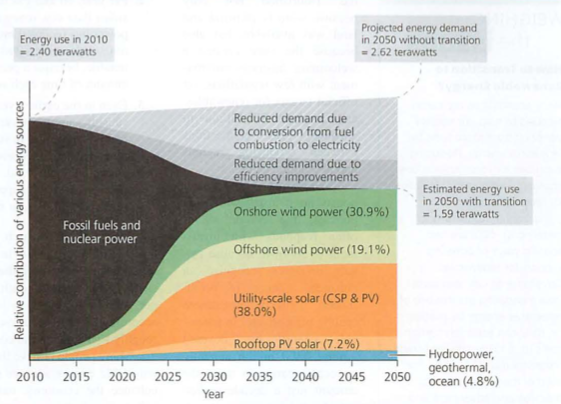Screen Shot 2023-01-29 at 8.21.47 AM.pngTruth about government subsidies (tax breaks and grants):
- oil and gas companies have received 75x more than RE
- nuclear has received 31x more than RE
- per year, oil/gas 13x, nuclear 9x than RE
On average, each person on earth pays $40 per year in subsidies for the fossil fuel industry
Each person pays $700 in externalized costs each year (pollution, health impacts)
Part 3: Solar Energy
- Passive solar
- building design
- trombe walls
- building placement
- stack effect
- Active solar
- Solar thermal (pumped and siphon)
- Concentrated solar thermal power (CSP)
- Photovoltaic (PV)
Simplest method of collecting energy from sun:
Passive solar collection
- Equator facing windows, often with something to hold the heat (thermal mass)
- Can be tanks of water or other mass (e.g. concrete)
- [Trombe Wall](https://en.wikipedia.org/wiki/Trombe_wall) is a wall of thermal mass to cool in the day and warm at night (large thermal mass)
- Also buffer temperature with moist plants (water holds heat)
- elab has two of these: deep concrete foundation and mobile trombe wall (solar collectors and tank)
- building placement: open to the equator, earth away
- stack effect: passive ventilation, see Polynesian house diagram
Active solar collection: focus, move, harvest or store energy (think of food: cultivate, plant, harvest, store)
Flat plate solar thermal collectors: passive (thermosiphon) or active (electrical pump)
- passive (solahart, above the cafeteria and Anna's dorm, also the elab)
- active (solar thermal demo at elab, Robertson's dorm, faculty cottages)
Diagram of a mainland active solar thermal system:
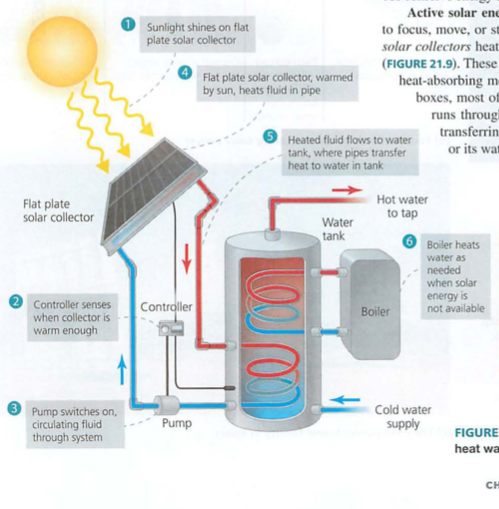Screen Shot 2023-01-29 at 8.43.13 AM.png
Notice that there are two loops, just like a nuclear power plant. This is because on the mainland, they use antifreeze in the primary (solar) loop so it does not freeze in the winter.
In Hawaii, we don't have that problem...
Passive solar thermal system (Solahart):
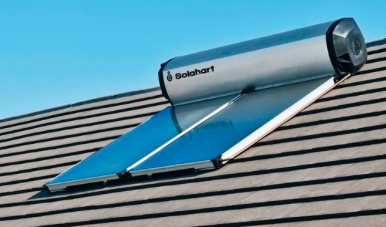Screen Shot 2023-01-29 at 8.47.58 AM.png
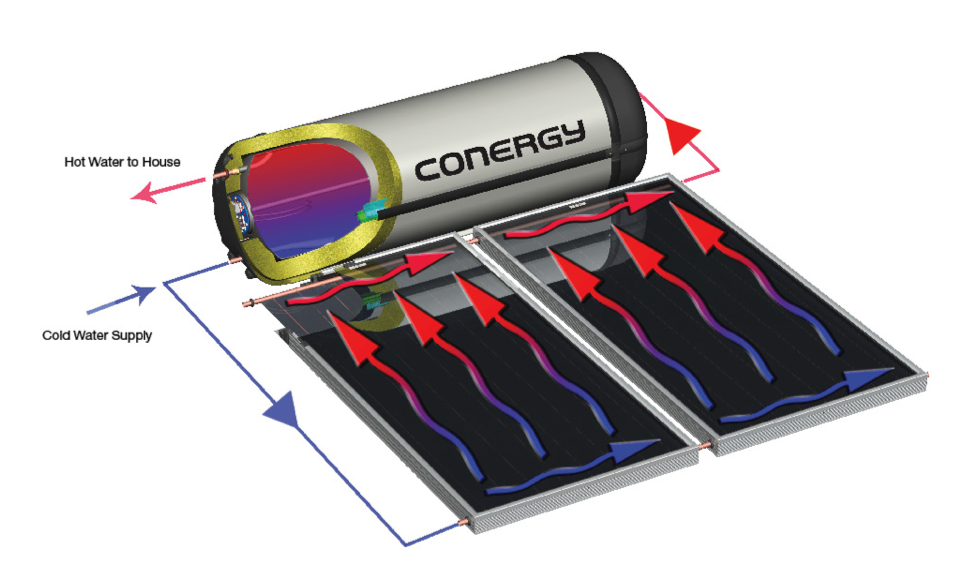Screen Shot 2023-01-29 at 8.46.53 AM.png
CSP: Concentrated solar power
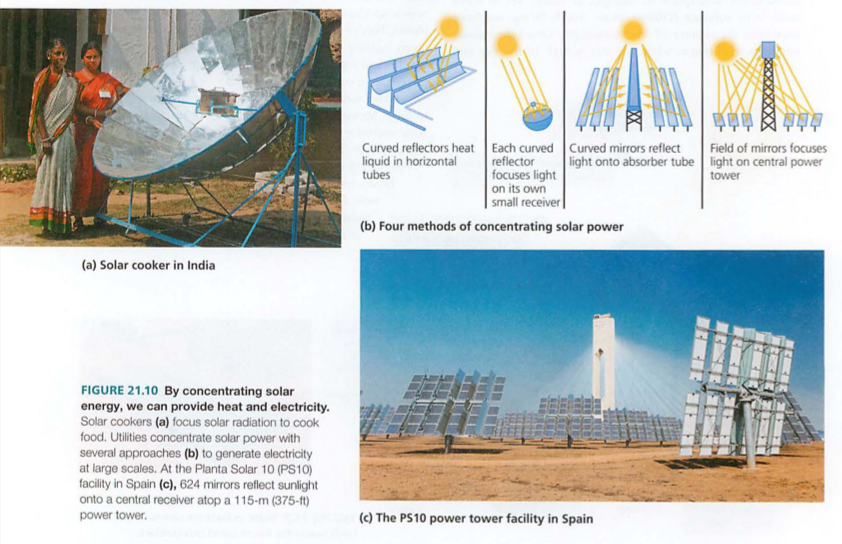Screen Shot 2023-01-29 at 8.48.52 AM.png
- Can be used for low temp solutions like cooking or melting salt (Spanish project) which can then be used at night to make steam for power.
- There are the remains of one of these projects next to the airport in Kona. It boiled oil to make steam, then electricity.
- HELCO would not let them transport energy over tax map key (TMK) boundaries, so it failed.
- Deserts are great places for CSP: lots of space, lots of sun, no people or animals
Photo(light) voltaic (volts) power:
Direct sunlight radiation energy to electrical energy (Direct current or DC)
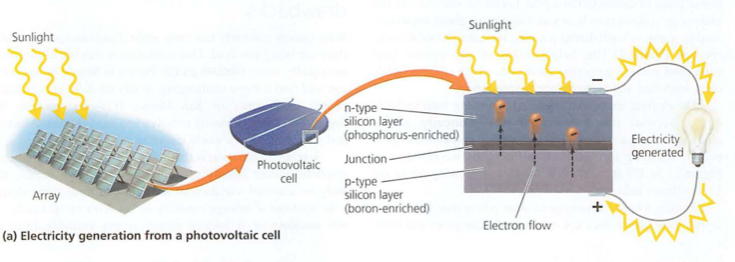Screen Shot 2023-01-29 at 11.05.39 AM.png
This DC power can be used directly to charge batteries (also DC) but for home use must be converted into AC power using an inverter:
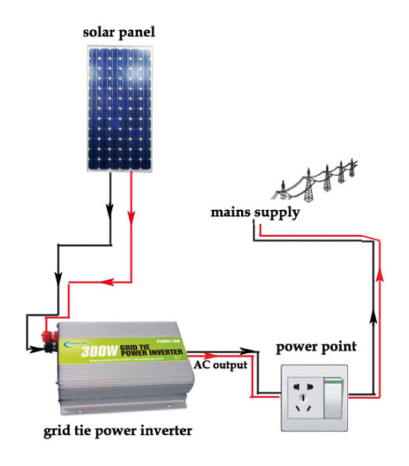Screen Shot 2023-01-29 at 11.07.57 AM.png
Modern inverters for home use integrate battery storage so when the power utility fails, the PV system and batteries can take over. These can also produce power for the grid, earning money or offsetting electrical use for the customer in a process called net-metering:
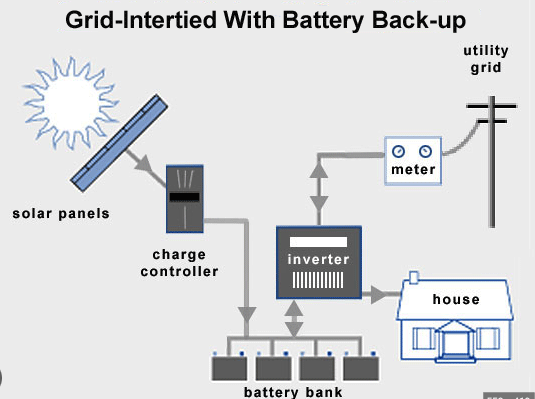Screen Shot 2023-01-29 at 11.10.42 AM.png
Latest PV panels are made from thin films, which is cheaper than earlier crystalline PV panels.
Fun fact: early panels had circular cell patterns because they were adopted from outdated machines to produce silicon wafers for computer chips
Here's why some companies are eager to install PV on your home in Hawaii then sell you back the power:
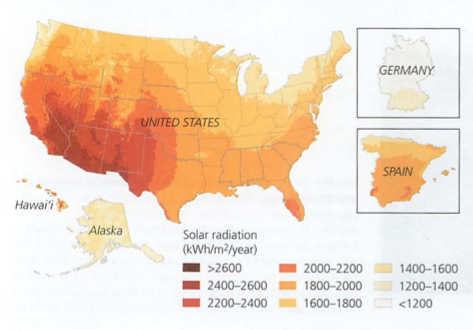Screen Shot 2023-01-29 at 11.13.03 AM.png
- They also make money selling the carbon offsets and tax credits given to solar energy users, so they make money 3x.
- HPA had one of these PPA (purchase power agreement) projects above the elab, which we later purchased outright.
- Why? HPA paid for the power generated, not what we used, so we were paying the PPA folks for power in the summer then giving it away to HELCO for free. Not a good deal.
- PV production prediction is a new field you could get into: integrating PV into the "smart grid"
- Smart grid: integrating RE and conventional energy sources with power transmission and customer demand.
- Cost of PV: in 2008 was $14/Watt. Now is $0.12/Watt (70x cheaper)
- Konawaena HS won the [solar car contest](https://en.wikipedia.org/wiki/Race_the_Sun_(film)) long ago (1990)
- China leads the world in PV cell production, often at a loss, so we tariff these, as does Germany
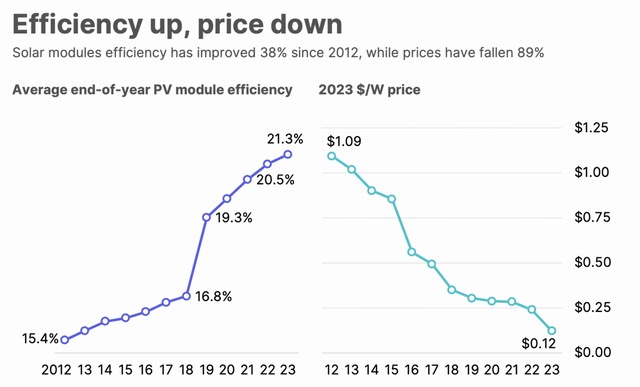pv prices.jpeg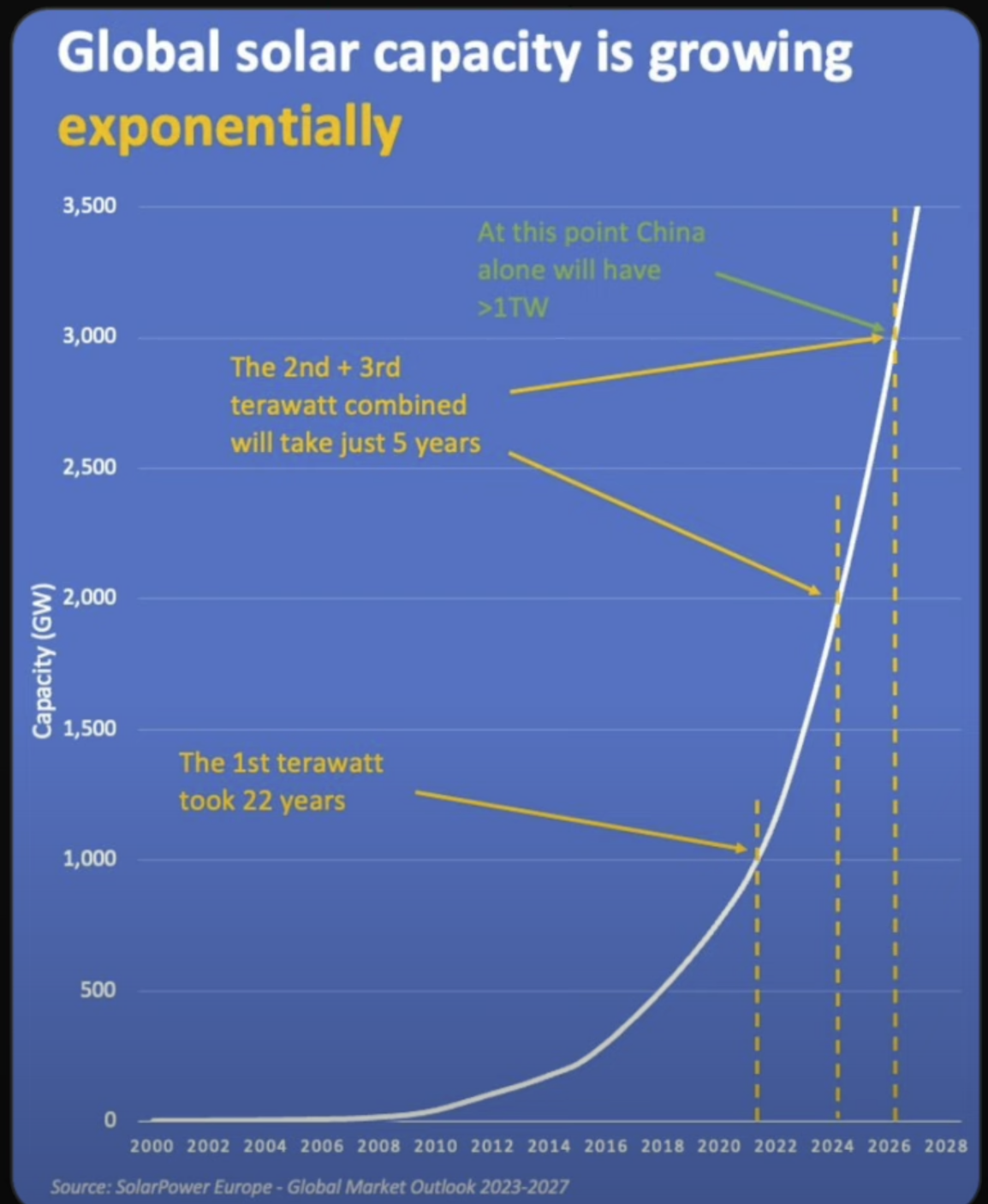Screenshot 2024-02-26 at 5.14.21 PM.png
Putting it all together: Solar powered electric vehicles:
1 acre of solar powering an EV = 300 acres of corn fueling a combustion engine vehicle:
- Wind power
- Horizontal axis wind turbines (HAWT)
- leading blade (big)
- following blade (smaller)
- offshore vs. land based
- delivery issues
- coupling with natural gas, hydro, nuclear base-load power
- usage curves-analysis
Wind turbines are like those used for hydroelectric power, only to gather energy from the KE of wind instead of water, we need much larger blades, often modeled after airplane wings.
- Look up the "Betz factor" which predicts the maximum energy possible from a wind turbine
- Two main types: leading blade (big) and trailing blade (smaller)
- Both are HAWT or horizontal axis wind turbines
- Basic design goes back to Europe around 1200 AD, to mill grain where rivers were not available (miller or müller are names for those who ran these mills)
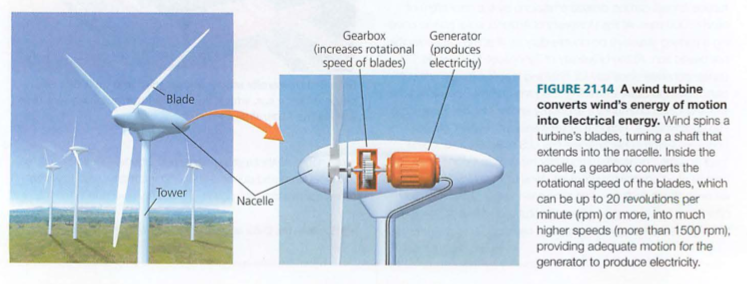Screen Shot 2023-01-29 at 11.26.03 AM.png
- Blade leading turbines like those above have sensors that point the turbine into the air, so the tower does not interfere with the airflow.
- Blade following turbines are simpler, relying on the wind vane effect, pointing the unit into the trailing wind.
- Some wind turbines are on a vertical axis known as VAWT, but are much less efficient
- We had one at the elab, it [exploded](https://elab.hpa.edu/elabweb/archive/videos/helix/)
- Offshore wind is much more consistent, but is more expensive to maintain (salt air, far from land)
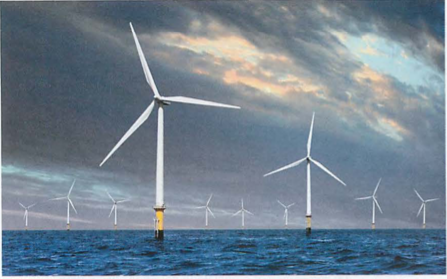Screen Shot 2023-01-29 at 11.37.24 AM.png
Benefits:
- no emissions
- fairly constant (vs. solar-clouds)
- if located offshore, no noise or animal impact (literally)
- EROEI of 20:1
- Can be included in traditional farming situations (see [e2 video: harvesting the wind](http://physics.hpa.edu/groups/apenvironmentalscience/weblog/3b6a5/))
- produces power at night, winter (vs. PV)
Drawbacks:
- noise if near people
- view-shed issues
- mechanical vs. electrical like PV
- windy locations often far from consumers (see below)
- smart grid integration is only in its infancy (Germany leads in this with [Energiewende](https://en.wikipedia.org/wiki/Energiewende))
- some animal impact (birds, bats)
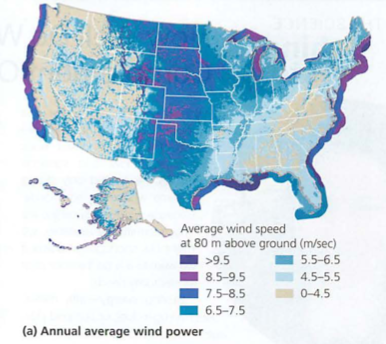Screen Shot 2023-01-29 at 11.41.03 AM.png
When coupled with nuclear, hydro, geothermal or natural gas turbine plant "baseload power", this can be an excellent augment to the smart grid.
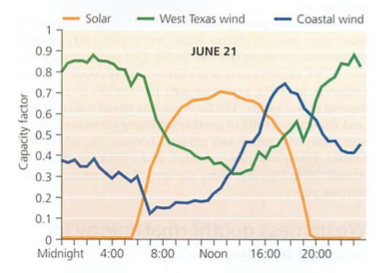Screen Shot 2023-01-29 at 11.47.31 AM.png
Smart grid and storage are key to this integration (more on this next)
Part 5: Geothermal power:
- Geothermal power
- closed loop vs. open loop
- ground source heating-cooling
- heat pumps
- building considerations
- enhanced geothermal (EGS)
Geothermal refers to any energy source or sink that is underground.
This can be high temperature things like geysers and hot springs that are near 100°C or using the ground to stabilize the temperature of buildings using pipes buried underground.
First, the hot stuff:
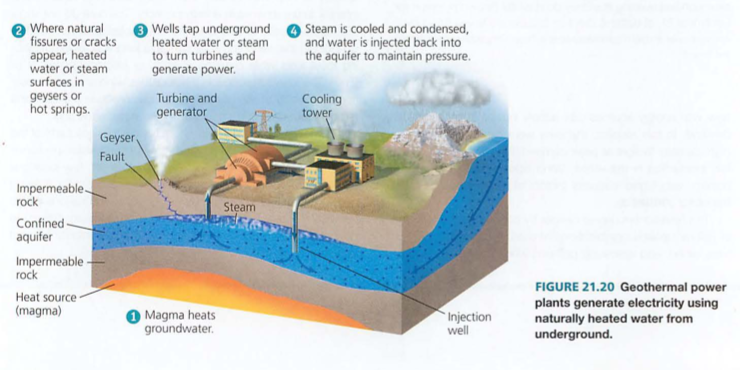Screen Shot 2023-01-29 at 11.51.03 AM.png
- Note in this case that water is injected into the confined aquifer, then brought up as steam to run a conventional steam power plant. This is an open loop system.
- Iceland just taps into existing steam vents, so is an open system with no loops.
- PGV (Puna geothermal venture) near the Kilauea volcano on our island uses Hexane as a fluid, running through pipes buried underground near very hot magma. This is a closed loop system.
- Open loop geothermal has a bad name here, as it often emitted toxic sulfur fumes, but this ended in 1978.
Ground source heating and cooling:
- Ground source heating and cooling involves running pipes underground, where the temperature is more stable (warmer in winter and cooler in summer).
- These can be augmented using a heat pump, which is basically an air conditioner hooked up in reverse, with the heating part bringing energy into the house in winter.
- Heat pumps can also be used just like air conditioners, without any ground source heating or cooling, in which case they deliver 4 units of heating energy for every 1 unit of energy put into the unit (amazing).
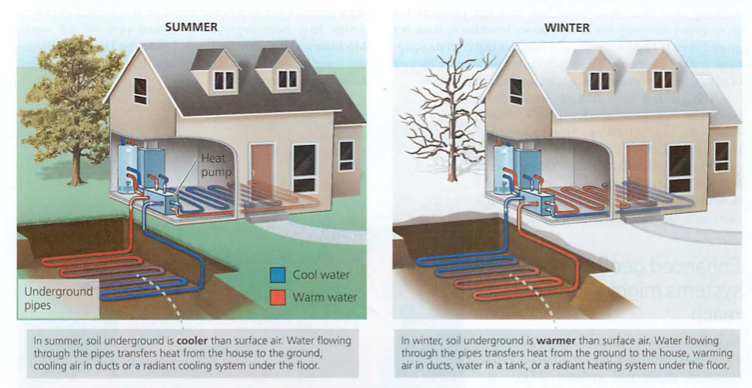Screen Shot 2023-01-29 at 11.58.59 AM.png
EGS or enhanced geothermal systems are deep wells not near usual hot spots to take advantage of heat deep in the crust.
Fun fact: diamond mines in South Africa have to be cooled as they are so deep, heat from the core makes them unbearably hot
"Chillers" are used in large buildings like hotels and airports where the cooling demands are huge, but the temperature differences are not great. You may see these at the SEATAC airport or at large hotels here on the coast.
Screen Shot 2023-01-29 at 12.04.36 PM.png
Looks like Easter Island, doesn't it?
Screenshot 2024-02-22 at 1.42.01 PM.png
Part 6: Ocean Energy
- Ocean energy
- tidal energy
- wave energy
- current energy (Hawai'i-Maui, Alanuihaha channel)
- ocean thermal energy conversion (OTEC) NELHA in Kona
Ocean energy relies on one of these:
- gravity: PE from change in ocean height from tides
- velocity: water flowing through tidal inlets or between islands, or waves on the surface
- temperature: cooler water at depth used to cool or warm-cool water difference used as a heat engine
Tidal energy is the easiest to grasp: just like hydropower one dams up an inlet where the tide causes a rise and fall of water levels, run through a turbine, there's your power.
Problems:
- only runs when there is a difference, and the difference is not as great as in most dams
- can block ship access.
- maintenance issue (salt water vs. freshwater in most dams)
Nice stuff: quiet
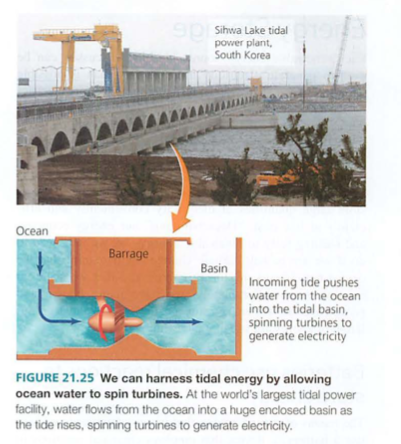Screen Shot 2023-01-29 at 12.09.57 PM.png
Wave energy uses the motion of waves from wind which when captured can produce power:
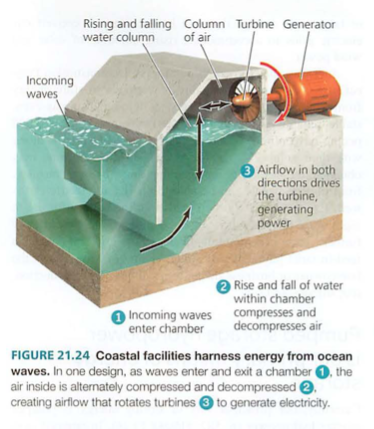Screen Shot 2023-01-29 at 12.10.52 PM.png
Issues: lots of mechanical parts, in the ocean, salt water is hard on machinery
Nice stuff: quiet
OTEC: Ocean thermal energy conversion
You many not hear about this on the mainland, but Kona is the main site for OTEC research on the planet, at a place called NELHA (used to be called HNEI: the Hawaii Natural Energy Institute)
Here's how it works:
Deep ocean water (2000 years old, from melted ice off of Greenland) emerges closer to the surface off the coast of Kona as nowhere else on earth.
Surface water is warmed by the sun.
The difference between these is about 30°C. Not enough to boil water, but enough to boil ammonia gas.
Ammonia is used just like steam in a power plant, generating electrical power:
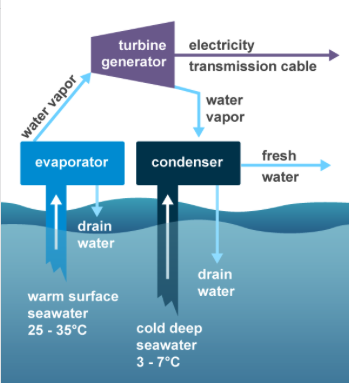Screen Shot 2023-01-29 at 12.16.25 PM.png
Fun facts:
- cool water is used to cool buildings at NELHA
- cool water going through pipes underground condenses water vapor to farm strawberries
- cool water in tanks is used to grow shellfish
- drain water is full of nutrients, making fishing offshore excellent
You have seen this from the air if you have ever flown into or out of Kona airport:
---
Migrated from Apple Server Wiki. Original page ID: S597i4J3
# Solar thermal labs
Part I: Solar thermal energy harvesting: solar thermal panel
Part II: Thermal energy storage: Hot water heater tank
In these labs, you will be dealing with harvesting solar energy and storing it in an insulated hot water tank.
Some of the concepts you learn here will help you design your ideal green home, which is your next big project
Basic concepts:
- Solar radiation from the sun hits a dark metallic conductor (copper) which turns this visible radiation into heat (thermal energy)
- Water is passed through pipes in this conducting collector plate, and absorbs some of this thermal energy, warming the water
- The efficiency of this "flat plate collector" is determined by measuring the solar radiation in Watts/m2, the area of the plate, the temperature difference in the water in and out, and the rate of the water through the collector
- Once the water is heated, either by solar radiation or other means (gas, electrical power), the hot water is stored in an insulated hot water heater tank.
- The better this tank is insulated, the more thermal energy is available for use, and less is wasted
- The best measurement for insulating qualities is the decay rate or "k" which is determined by measuring the hot temperature of the tank, room temperature, then the temperature of the tank some time later "t" measured in seconds.
- This calculation is identical to the radioactive decay formula we used, as well as the population growth formula, with a negative exponent in front of k
Part I: Solar thermal panel
Data gathering:
- Area of panel in m2:
- Current solar radiation in W/m2 (look at elab.hpa.edu under "current weather")
- Watts available for collection:
- Temperature of incoming water (look at 10.14.8.62)
- Temperature of outgoing water (same place)
- Temp difference
- Time to fill a 1 liter container in seconds:
Calculations:
- W/m2 \* m2 = Watts available
- ((temp difference °C)\*4.18\*1000g) / time to fill = joules/second = Watts collected
- Watts collected/Watts available = efficiency
- Watts/1000 = kW effective
Part II: Hot water heater
Data Gathering:
- Room temp
- Starting temp
- Starting time
- Ending temp
- Ending time
- Notes on container (insulated, covered, color, material)
- Notes on infrared camera observations
- Logger pro temp sensor set for 180 seconds, one or two samples per second
Calculations:
- Starting temp above room temp
- Ending temp above room temp
- Time in seconds
- Tt = Toe^-kt so (ln (Tt/To))/t = -k, drop the minus sign to get k
- Compare your k with others, make inferences about insulation, cover, color, material
Questions:
Solar thermal collector
1. How do you think the rate of the water going through the collector might impact the efficiency?
2. Is the collector more efficient with very cold water or very hot water?
3. Why is the collector in a glass insulated case?
4. What is the power of your collector in kW?
5. Compare this with a normal electric water heater which is 4.5 kW
6. Go to 10.14.4.5 and search for the word "thermal". Click on the "graph" boxes and then "graph". Change the starting time to 6 AM. What does this graph show you?
7. How could a system like this help you optimize and/or automate your solar collection?
8. How could such a system help you determine if your system is broken?
Hot water heater
1. Why is the solar thermal collector in an insulated box with special glass cover?
2. If houses use the k value to determine insulation, what other factors impact energy needed to keep a house warm in the winter or cool in the summer?
3. In 1976 after the oil embargo, the speed limit was changed from 85 mph to 55 mph, and President Carter asked people to keep their thermostat at 68 in the winter and 75 in the summer. What part of this is related to your lab?
4. If you are at Waimea coffee, Starbucks or Avo, what color are the cups? Why do they have tops? How could you keep your coffee warmer longer?
5. Looking at the logger pro graphs, what do you see that verifies this?
6. Detectives use this exact process to determine time of death. Why and how do they do this?
7. If you could improve the heat lost in electric water heaters by 10% nationwide, you could save several billion dollars per year. Why is this promoted more in northern states and not in Hawaii?
8. Why should it be promoted here in Hawaii?
9. What is a trombe wall, and how is it similar to this hot water heater lab?
10. How could what you've learned here help you with your ideal green home design?
11. In a repeat of your lab, a white, covered styrofoam container (test A) is compared with an open glass container (test B). Both start at 100°C and room temp of 25°C. 30 minutes later, A is at 92°c and B is at 62°C. Calculate k for both of these.
12. Thermal energy (heat) always travels from hot to cold, so if you are freezing, should you put a reflective blanket shiny side in or shiny side out?
13. Heat travels from hot to cold by three methods: conduction (contact), radiation (light or heat rays) or convection (matter in motion, like the weather). Which of these were in action in your lab, and how could you improve on your system?
Alternate link for solar radiation at the elab: [https://tempestwx.com/station/86658/grid](https://tempestwx.com/station/86658/grid)
Sample solar thermal data:
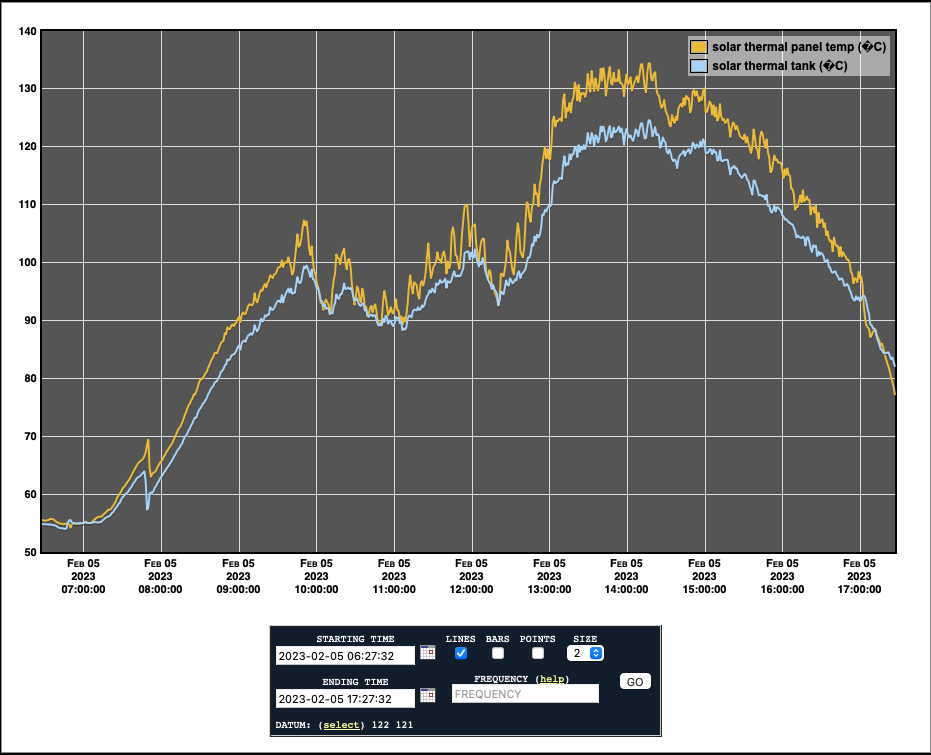Screen Shot 2023-02-06 at 7.28.38 AM.png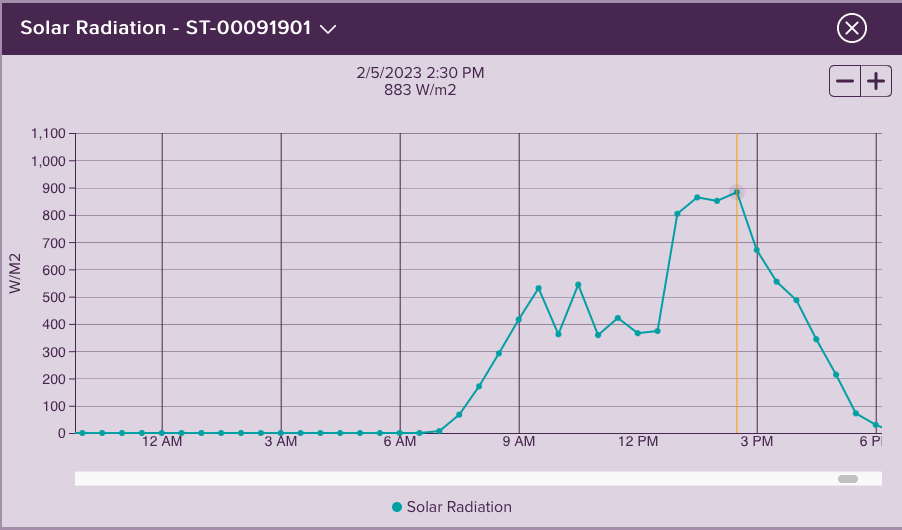Screen Shot 2023-02-06 at 7.29.52 AM.png
area of panel: 2.7 m2
rate of water: 25 seconds/1000g
delta t: 9°C
solar radiation: 883 W/m2
Solar energy available: 883 * 2.7 = 2384 Watts
Solar energy collected:
- ((temp difference °C)\*4.18\*1000g) / time to fill = joules/second = Watts collected
- 9 \* 4.18 \*1000/25 = 1508 Watts collected
- efficiency: 1508/2384 = 63%
Note: at 9 AM, when the panel was cooler, ∆t was 5°C and radiation was 400W/m2:
400*2.7 = 1080W available
5*4.18*1000/25= 836W collected
efficiency = 836/1080=77%
Why is this better?
---
Migrated from Apple Server Wiki. Original page ID: X2s7p16
# PV and wind labs
Part 1: Photovoltaic energy
Uphill from the elab there is a large PV array. Our goal is to determine the efficiency for this array.
1. walk up and measure the effective area of one panel in m2
2. count the number of panels
3. calculate the total area of the panels
4. look up the total solar radiation at the elab here: [https://tempestwx.com/station/85882/](https://tempestwx.com/station/85882/)
5. multiply by the total area to determine ideal power harvest capacity
6. go to 10.14.4.5 and search for PPA array for the power actually harvested
7. determine the efficiency of the array
Part 2: Wind power
1. look outside the energy lab at the sometimes wind turbine on the tower.
2. determine the type of turbine, and notice the placement of the blades and generator
3. walk up to the smaller turbines (careful-don't reach up to the blades!)
4. determine the type of turbine, and notice the placement of blades and generator
5. if you have time, look at the turbine at the far northeast part of the elab, compare blades
Part 3: ROI and TCO
If a device that saves you money costs money to purchase, the amount of time for the money gathered to equal the money spent is known as return on investment, or ROI for short, often measured in years.
If the device lasts longer than the ROI, the total cost of ownership or TCO can be calculated. If this is negative, the device made you money over the lifetime of the device. If negative, it cost you money.
Here's an example:
A 300W solar PV panel costs $300 and harvests solar energy for 5 hours each day.
300W is 0.3 kW, which for 5 hours is 1.5 kWh every day harvested.
If electricity costs $0.40 per kWh, this earns you $0.60 per day
To pay off this $300 investment, it would take $300/$0.60/day or 500 days to pay it off. This is the ROI.
If the panel works for 20 years, subtracting the 500 days (which is about 1.4 years) you have 20-1.4 or 18.6 years of free money.
18.6 years * 365* $0.60 = $4,073 TCO.
See below for questions.
Questions:
Part 1:
1. how would you compare the energy harvesting efficiency of the PV array with the solar thermal panel downstairs?
2. what are the benefits and drawbacks of using PV versus a solar thermal panel or wind turbine?
Part 2:
1. why are turbine blades thicker at the root (closer to the generator)?
2. why are they twisted at a greater angle near the root?
3. if the blades of the smaller turbine rotate too fast, what happens to the generator and why?
4. what are the benefits and drawbacks of using wind power versus PV and solar thermal?
Part 3:
1. Ella Finoe installs 3 kW of PV on her roof at a cost of $6,000. If she has 5 hours of sun at her location, what is her ROI and if it lasts for 20 years, the TCO? Electricity costs $0.40 per kWh.
2. Is this a good investment?
3. She then decides to install a 1 kW wind turbine that works about 50% of the time, 24 hours a day at capacity, and costs $10,000, but only lasts 4 years. What is the ROI and TCO?
4. Is this a good investment?
5. Wanting to heat her massive hot tub with solar energy, Ella replaces her electric hot water heater with a solar thermal panel which collects 4.5 kW of heat for 5 hours each day and costs $900. What is the ROI and TCO if the panel lasts for 25 years?
6. Is this a good investment?
7. Which of these are you going to put on your dream home and why?
---
Migrated from Apple Server Wiki. Original page ID: C6B7Z3t5
# Dream home project
You have just inherited a huge $10M fortune and decide to design your own home. Being smart about all things sustainable, you decide to use your ample funds to design a home that will be the envy of every other home builder around the globe, and include ideas and concepts never before seen on planet earth.
Your project may be of any size, but must meet the following criteria:
1. It must be located on this planet, though a Mars option is possible with some discussion
2. It must harvest its own energy and be completely self-sustaining with respect to energy: lighting, heating, cooking, laundry and internal electrical use
3. It must harvest its own water
4. It must take care of its own waste
5. As much as possible, it should be sustainably designed, using local or recycled materials.
6. It must be a healthy, well ventilated space with ample lighting and low CO2
7. It must not contain any hazardous vapors, chemicals or toxins
8. It must be able to house at least two people, preferably three (one could be a child)
---
Migrated from Apple Server Wiki. Original page ID: e8B1r4x5M
# Unit 8: Pollution: module 4.42-4.44 Air Pollution
APES spring 2026
- air pollution, PM10, IAP, acid rain (42-44)
- health-toxicity, LD50
- eutrophication, biomag, POPs
- LD50, IDs
- ozone, greenhouse gases
- climate change
- AP practice
W7e:
- W 14: health, toxicology
- W 18: climate change
FR4e: (13 mods)
- mod 42: air pollution
- mod 43: PM10
- mod 44: IAP
- mod 45: reduction
- mod 46: acid rain, noise
- mod 47: health
- mod 48: eutrophication
- mod 49: biomag, POPs
- mod 53: LD50
- mod 54: ID
- mod 55: ozone
- mod 56: greenhouse
- mod 57: climate change
- mod 58: biodiversity
-----------------------------pollution modules----------------------
- Mod 42: criteria pollutants
- Mod 43: photochemical smog
- Mod 44: indoor air pollution
## Module 4.42 (module 42, 4th edition text)Big ideas: air is shared by everyone on the planet, crosses international borders without consent, impacts innocents with little power.
Contrast this with solid, toxic or radioactive waste: usually disposed of on your own land, or with rivers, which demonstrate "continuity downstream"
What is a "criteria"? good/bad6 major pollutants: “criteria pollutants”
- Sulfur dioxide: SO2 (could also be SOx)
- Nitrogen oxides: NOx (could be NO, NO2, or NO3)
- Carbon monoxide: CO
- Particulate matter: PM (PM 2.5, PM 5, PM10)
- Ozone: O3
- Lead: Pb
Mnemonic: SOX/NOX, CO/O3, PM/Pb
Added in 2007: CO2, VOC, HgFrom your text: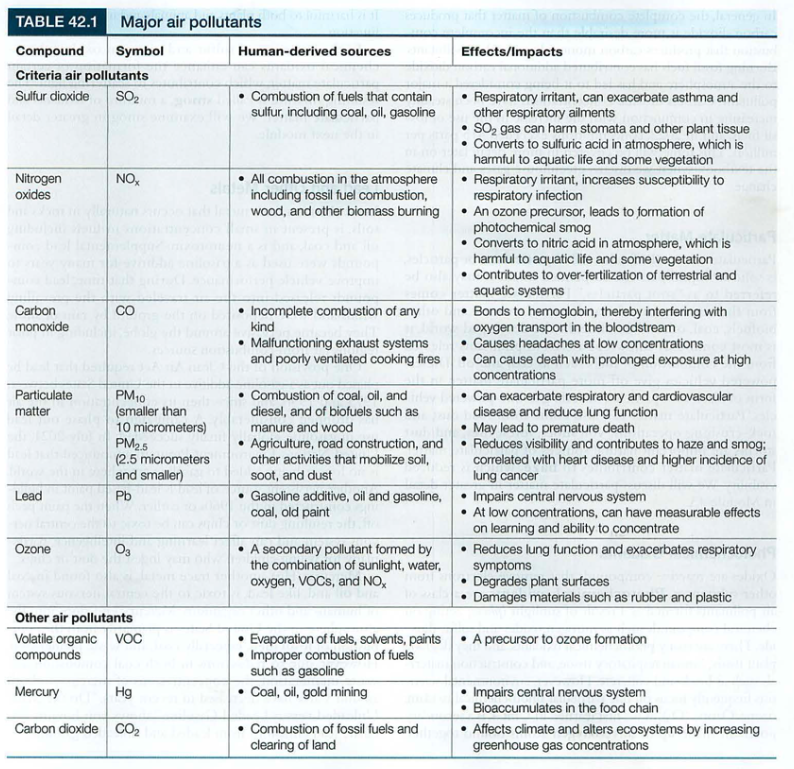Screen Shot 2023-02-26 at 4.48.53 PM.png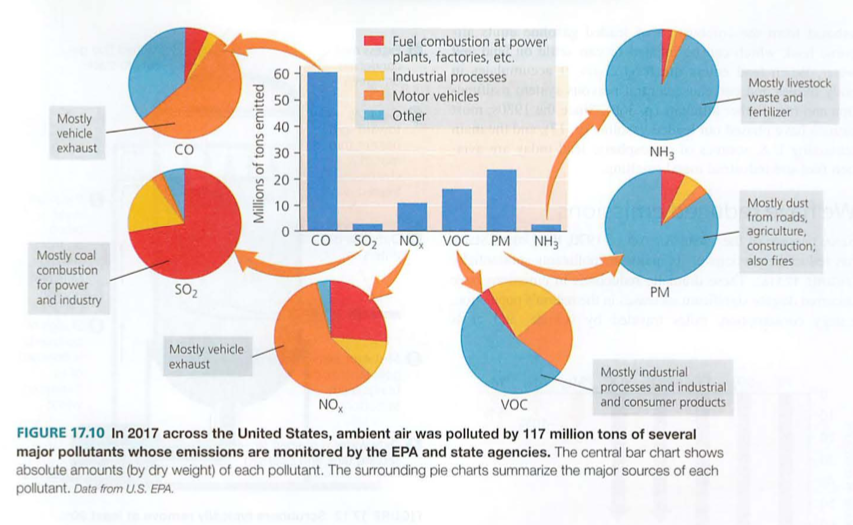criteria pollutants sources.pngContext and relevance:SOx: Sulfur Dioxide (SO2) and other SOx versions
- From [Methionine](https://en.wikipedia.org/wiki/Methionine) (amino acid in living things) in fossil fuels (look up the structure of this)
- Combines with water in the air to make H2SO4 (sulfuric acid, acid rain)
- When you breathe it, it burns your lungs, stings your eyes
- May look like "yellow smog"
- One example is VOG: sulfur dioxide and ash (volcanic glass)
NOx: Nitric oxide (NO2) and other NOx versions
- Various forms of oxidized nitrogen, which alone is inert and makes up 78% of the atmosphere at sea level
- From high temperature combustion (e.g. auto engines, esp. high efficiency ones, which burn at higher temps)
- Also from decomposition of fertilizers (e.g. Ammonium Nitrate)
- Combines with water to make HNO3 (nitric acid) which also burns your lungs and eyes
CO: Carbon monoxide
- Emission from car exhaust, or other incomplete combustion: C + O2 —> CO2
- Many people die camping by burning stoves in their tent without enough oxygen, forming carbon monoxide
- If not enough O2, then CO forms, like in a closed space (tent, hut, cold house in Texas)
- Toxic, permanently attaches to your [hemoglobin](https://en.wikipedia.org/wiki/Hemoglobin) rendering it useless for respiration. (30 day life cycle for your hemoglobin)
- Imagine the town van, but nobody gets off. The bus still goes, but nobody goes to town.
- For 30 days (until your red blood cells are replaced) no seats on the bus, no oxygen.
Ozone
- Ozone is formed by sunlight, splitting O2 into O which then joins another O2 to make O3
- Ozone in stratosphere is good, in troposphere bad
- Ozone (O3) blocks UV radiation, while Oxygen (O2) does not
- Stratospheric ozone is necessary to filter UV radiation. CFC (chloro-fluro-carbons) destroy this layer
- This caused an ozone hole over Antarctica: Why there?
-
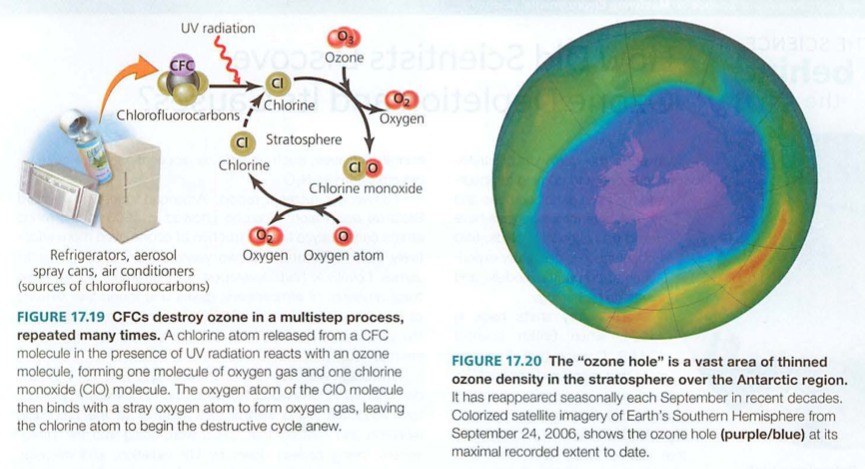CFCs ozone hole.png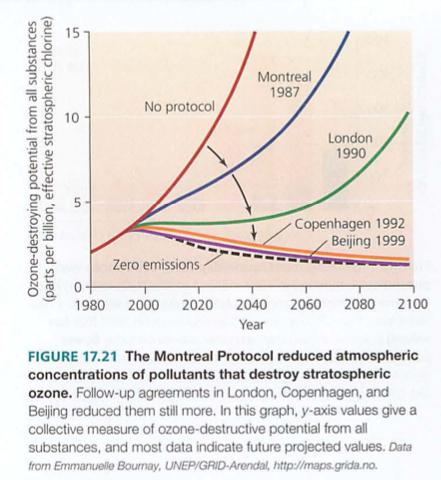montreal protocol.png
- How did we solve this? The 1987 Montreal Protocol:
- Tropospheric ozone causes lung and eye irritation, and is toxic to some organisms
- You may have heard of ozone generators used in hotel rooms to absorb smoke
-
PM: Particulate Matter
- Look up [alveolus](https://en.wikipedia.org/wiki/Pulmonary_alveolus) in your lungs
- Particulate Matter (PM) is basically soot (carbon)
- PM2.5 is 2.5 microns in size, PM10 is 10 microns in size (there is also PM5)
- PM2.5 is most dangerous, smaller particles lodge deep in the lungs, beyond ability of [pulmonary cilia](https://en.wikipedia.org/wiki/Mucociliary_clearance) to flush out
- PM5, PM10 larger particles, get caught by cilia
- Main cause: coal fired power plants, diesel engines, oil fired power plants (carbon soot)
- See also vog: PM2.5 particles of ash (glass shards) with SO2 dissolved in water droplets (sulfuric acid): physical abrasive + corrosive acid = respiratory damage
- Fun fact: smokers get colds more often because tar in tobacco gums up the cilia, so they can't brush away germs and viruses.
Pb: Lead
- In the old days, there was leaded gasoline, and highly leaded gasoline (called "super" or "ethyl" because they used [tetraethyl lead](https://en.wikipedia.org/wiki/Tetraethyllead) as an additive to improve power)
- Gasoline additive (tetraethyl lead improves octane rating cheaply), replaced by other worse carcinogenic (cancer causing) chemicals like MTBE: [https://en.wikipedia.org/wiki/Methyl\_tert-butyl\_ether](https://en.wikipedia.org/wiki/Methyl_tert-butyl_ether)
- Decreases mental capacity (e.g. Roman insanity theory)
- Coal smoke contains lead, along with Mercury and other heavy metals. Sludge from mining is worse.
VOC: Volatile Organic Compounds
- Volatile organic compounds, e.g. gasoline vapors (why your gas cap must be on or you get a dashboard warning): [https://en.wikipedia.org/wiki/Volatile\_organic\_compound](https://en.wikipedia.org/wiki/Volatile_organic_compound)
- Aerosol vaporizers are also VOC generators (indoor air pollution)
- Remember water striders sitting on water, due to surface tension?
- Your alveoli are surrounded by water (blood) so they need a [surfactant](https://en.wikipedia.org/wiki/Pulmonary_surfactant) (detergent) to break the surface tension so they can expand you can breathe.
- If you breathe in VOC's (siphoning gasoline, vaping, or in the case of premature babies), the surfactant is gone, and you cannot breathe.
- Vaping is a concentrated version of VOCs, dissolving the surfactant in your lungs, causing "chemical pneumonia", only seen before in anesthesia and people siphoning gasoline or premature babies.
Air Quality monitoring: Purple Air: note the PM 2.5 graphs
[https://www.purpleair.com/map?&zoom=12&lat=20.03156357084113&lng=-155.69287088607177&clustersize=30&inc=313230\|313232&orderby=L&latr=0.28062097322957413&lngr=0.3714752197265625](https://www.purpleair.com/map?&zoom=12&lat=20.03156357084113&lng=-155.69287088607177&clustersize=30&inc=313230%7C313232&orderby=L&latr=0.28062097322957413&lngr=0.3714752197265625)
Check out other locations...
Vog forecast: [http://weather.hawaii.edu/vmap/new/](http://weather.hawaii.edu/vmap/new/)
============moved to new pages 2.11.26======================================
## Module 43: Photochemical smog, thermal inversions, particulatesTwo types:
- Photochemical smog: LA smog, brown smog, caused by surface ozone reactions
- Sulfurous smog: grey smog, VOG (includes bits of volcanic glass)
Here's how they look:
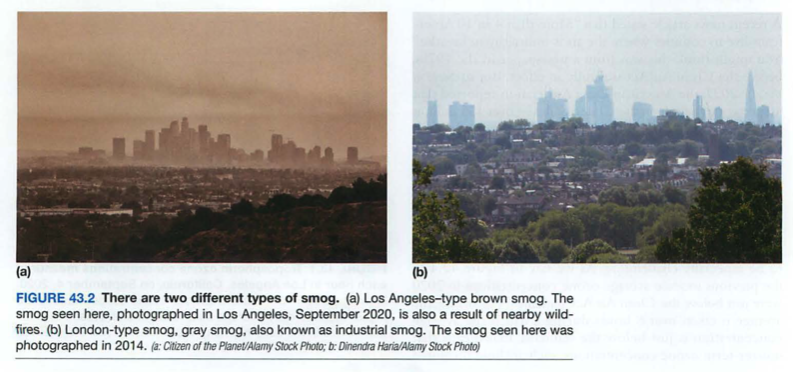Screen Shot 2023-02-26 at 4.56.17 PM.pngSmog and other photochemical reactions:Primary and secondary pollutants:
ca2f59ae-e3ef-e3ef-8624-5baef5db51bc
**Unavailable Apple Wiki media:** the exported data did not include file e9e5330a-8909-4077-b73a-333c80e052aa.
ca2f59ae-e3ef-e3ef-8624-5baef5db51bc
- Secondary pollutants: need a chemical reaction (often energy from sunlight) to form (see figures above)
- Example: PhotoChemical Smog: Photo (light) Chemical (reaction) smog
- See PANs: Peroxyacyl nitrates: formed from VOCs, NOx [https://en.wikipedia.org/wiki/Peroxyacyl\_nitrates](https://en.wikipedia.org/wiki/Peroxyacyl_nitrates)
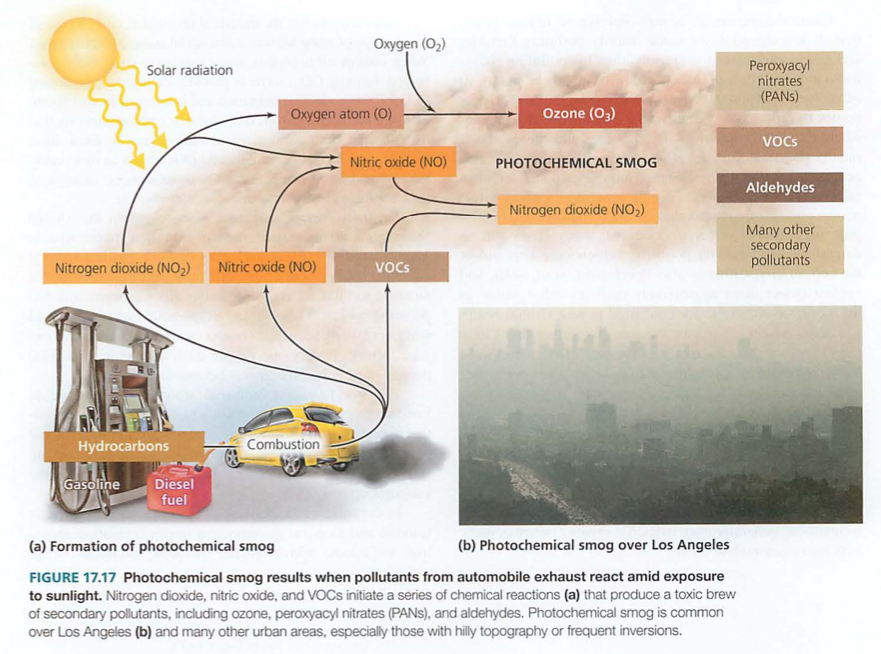photochemical smog.png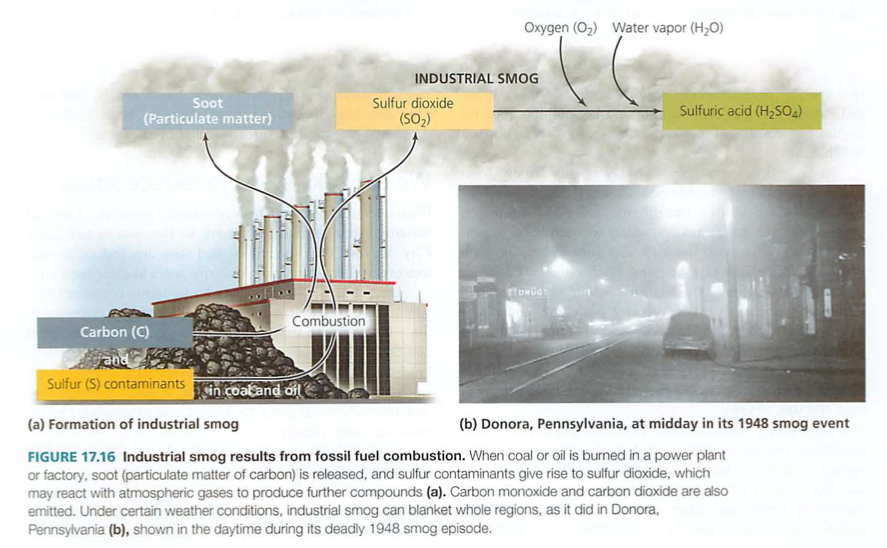industrial smog formation.pngThermal inversions: L[ondon fog](https://en.wikipedia.org/wiki/Great_Smog_of_London), US, [Donora](https://en.wikipedia.org/wiki/1948_Donora_smog), PA 1948 k.20, sick 7000
- 1952 London 4000-12,000 dead, three nights
- Mexico city 1996 300 dead, 400K sick
- How?
- Normally, the sun heats the surface, warming the air there, which rises. Cooler air aloft then falls to replace this rising air.
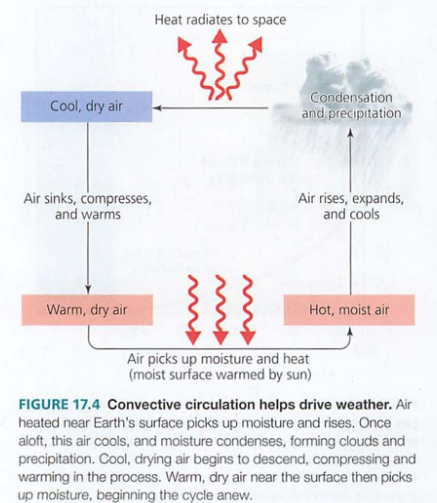convection.png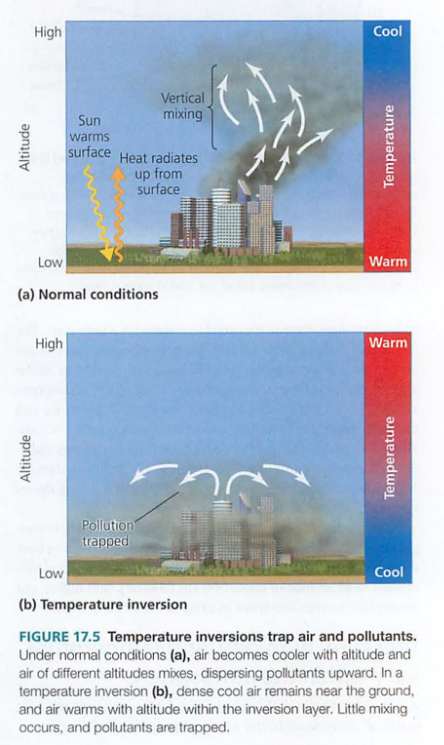inversion.pngIn an inversion, warmer air aloft traps the air at the surface (no temperature difference, so no convection), causing the pollution to be trapped in the lower levels. Most dangerous in valleys or bowl shaped cities (London, Mexico City, Denver, Donora).
Los Angeles has severe smog in the daytime, when hotter air draws in ocean air ("onshore breeze"), but the cycle reverses at night when the water is warmer than the land, so they have an "offshore breeze". Surfers like the first one.
Another diagram:
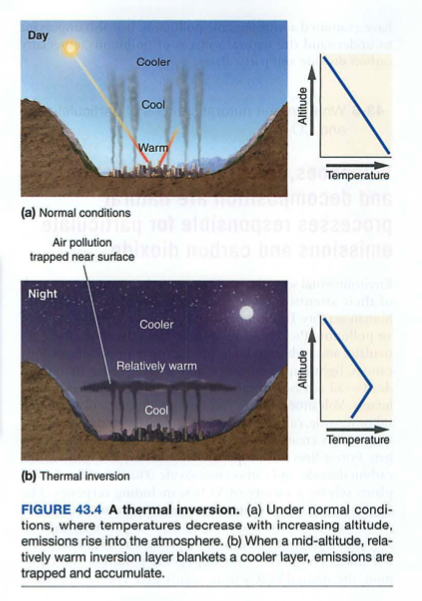Screen Shot 2023-02-26 at 5.02.24 PM.png
- SO2 + O2, water = H2SO4 (sulfuric acid)
- NO3 + O2, water = HNO3 (nitric acid)
- “Acid snow” yes, acid snow...
- W. VA had rain more acidic than stomach acid in the 1970's
Important: Know how a power plant air scrubber works (just like the nuclear plant diagram)
## Module 44: Indoor air pollution (IAP)
- Leading cause of death in LDC (women). LDC is the latest term for "Lesser Developed Countries"
- Burning manure for fuel, open pit fires, CO, PM10
- Sick building syndrome: formaldehyde, CO2, VOC
- Check out the Living Building Challenge and LEED Platinum in the elab hallway
Main culprits:
- VOC (paints, aerosols, vaporizers)
- CO (burning),
- Radon (radioactive rocks)
- Lead (paint, gasoline)
- Formaldehyde (adhesives, wood products, carpet glue)
- Asbestos (insulation, tiles, flooring)
- PM10 (soot from burning)
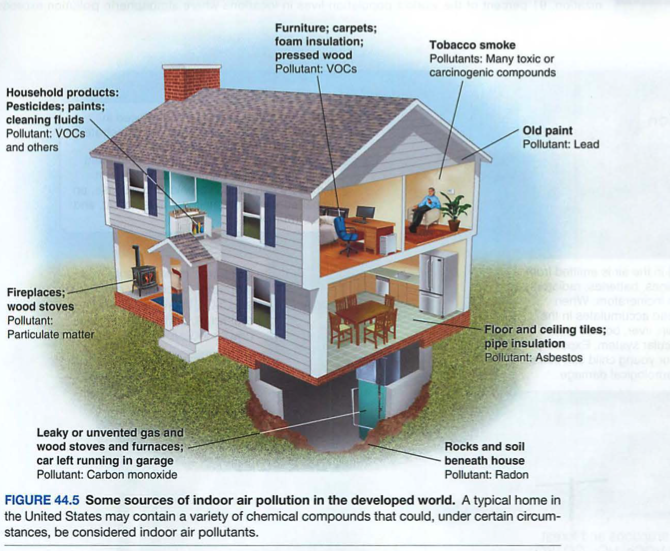Screen Shot 2023-02-26 at 5.07.33 PM.png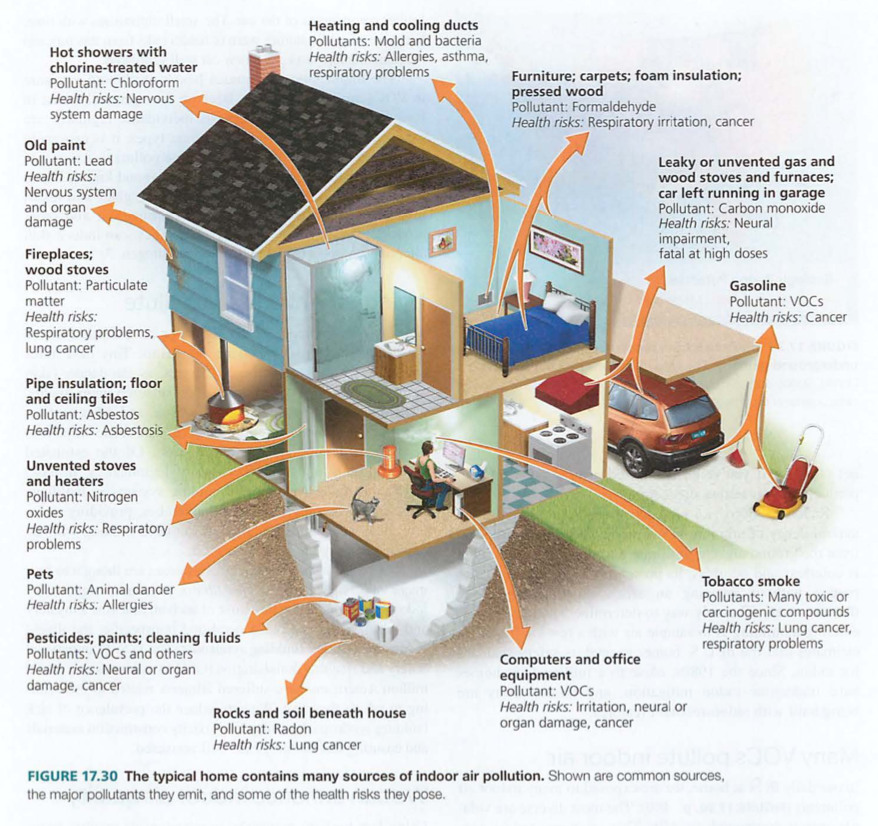IAP.png
Asbestos-asbestosis, mesothelioma (like the ads on TV, usually aimed at Military folks or shipyard workers)
Radon 222-lung cancer (smoke demo-lungs)-#2 cause of lung cancer in the US (behind smoking of course)
Why?: Radon is very heavy gas, sits in lower lobes of your lungs, emits alpha particles (He nucleus) causing cancer
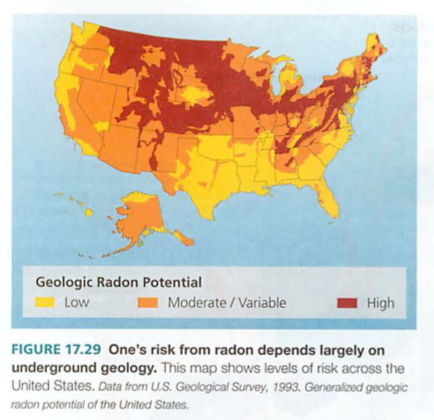radon.pngAIR QUALITY LABS-From the AP exam folks• Air Quality: Air quality can be assessed using various methods.
• Particulates: Sticky paper can be used to collect air particulates from various sources, and then the paper can be examined under a microscope. It is
not possible to see the smallest particulates, but they do color the white paper.
• Ozone: In this lab, an ecobadge or a homemade potassium iodide gel sampler is hung or worn in
order to collect data on tropospheric ozone. The badge or KI sample changes color in the presence
of ozone and becomes more intensely colored as the amount of ozone increases.
• Carbon dioxide: In this lab, a commercial sampling device is used to determine the amount of carbon dioxide in an air sample. Car exhaust, burning tobacco, or other pollutants can also be sampled.
Pollution roundup:
Review for AP:
[https://elab.hpa.edu/apes/ap\_exam\_prep/apes\_princeton/ch08-pollution.pdf](https://elab.hpa.edu/apes/ap_exam_prep/apes_princeton/ch08-pollution.pdf)
[https://elab.hpa.edu/apes/ap\_exam\_prep/apes%205%20steps%20to%20a%205/18-pollution.pdf](https://elab.hpa.edu/apes/ap_exam_prep/apes%205%20steps%20to%20a%205/18-pollution.pdf)
Old site links:
[http://physics.hpa.edu/physics/apenvsci/apes\_exam\_prep/apes\_princeton/ch08-pollution.pdf](http://physics.hpa.edu/physics/apenvsci/apes_exam_prep/apes_princeton/ch08-pollution.pdf)
[http://physics.hpa.edu/physics/apenvsci/apes\_exam\_prep/apes%205%20steps%20to%20a%205/18-pollution.pdf](http://physics.hpa.edu/physics/apenvsci/apes_exam_prep/apes%205%20steps%20to%20a%205/18-pollution.pdf)
[https://en.wikipedia.org/wiki/Peroxyacyl\_nitrates](https://en.wikipedia.org/wiki/Peroxyacyl_nitrates)
---
Migrated from Apple Server Wiki. Original page ID: U7n9N4P6g
# Pollution Resources
Text links:
- [FR4e (evaluation copy) Air Pollution](http://physics.hpa.edu/physics/apenvsci/texts/fr4e/Unit7%20air%20pollution.pdf?target=)
Web page links:
- [Ch 15 FR notes (legacy)](http://physics.hpa.edu/groups/apenvironmentalscience/weblog/e22bd/Ch_15_Air_Pollution.html)
---
Migrated from Apple Server Wiki. Original page ID: T510z7g2y
# Water Pollution resources
[Unit 8: Water Pollution](http://physics.hpa.edu/physics/apenvsci/texts/fr4e/unit%208%20water%20pollution.pdf?target=)
---
Migrated from Apple Server Wiki. Original page ID: g9a1Y6L3
# Unit 8: Pollution: module 4.47: Pollution sources
Module 47: Pollution, impacts, endocrine disruptors
- Point source vs. non-point source: easy to trace in a river, not so easy in farmlands, or ocean
- Homeostasis: balance in organisms: temperature, nutrition, water, energy
- Pollution first causes impaired survival or activity, then acute (sharp) physiological impacts, including death
- Presence vs. concentration (also ability to clear, ability to store, lifetime exposure)
- Case studies: THC, Mercury in Sushi, PCBs in killer whales, coral bleaching
- Pollutants can by synergistic: the total impact is greater than the sum of the discrete or separate parts
- Multiple attacks, e.g. coral:
- pesticides
- sediments
- ocean warming
- ocean acidification
- human interaction (tourism, anchorages)
Chemical pollutants:
Heavy metals (not the musical kind) and synthetics not found in nature
------
Lead:
- in the air (tetra ethyl lead)
- in the water (lead pipes "plumber"=Pb)
- in soldered pipes
- lead paint
- damages brain, kidneys
- esp. damaging to kids, stunts mental development
- water filtration is a smart idea: sediment filters (white) plus charcoal filters (black)
- Case study: Flint Michigan: saved $5m using river water with Chlorine, leached Pb from pipes into drinking water
- EPA limit is 5 ppb (parts per billion), Flint Michigan was 13,000 ppb
Arsenic:
- can be found naturally in well water (look up India As)
- can be removed with filters
- causes cancer
- EPA limit is 10 ppb
- Arsenic poisoning in India and Bangladesh
- See also Antimony ("monk killer")
- used in mystery stories to murder people...
Mercury:
- can be inorganic (safer) or organic Methyl Mercury (much more dangerous)
- Hg from the latin Hydrargyrum, or "quick silver" (like the surf company)
- very high in coal
- also incineration of rubbish, e.g. dental fillings
- limestone heating into concrete also, since coal is used to heat the limestone, which also has Hg
- inorganic (metallic) mercury can be oxidized into organic mercury (dangerous)
- bacteria convert inorganic mercury into methyl mercury, a CNS toxin
- See [Minamata disaster](https://en.wikipedia.org/wiki/Minamata_disease)
- also fish and shellfish, esp. apex predators (e.g. tuna), 50% increase each decade
- actor Jeremy Piven suffered from mercury poisoning after eating sushi regularly (apex predator-Ahi Tuna)
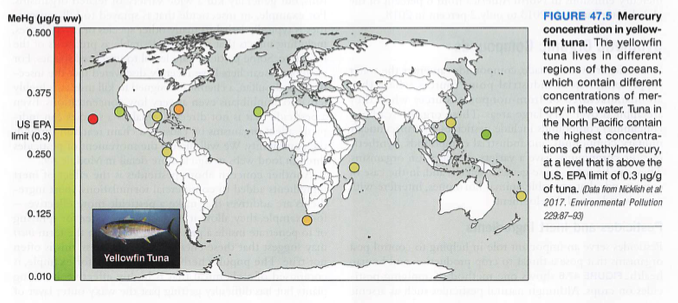Screen Shot 2023-03-05 at 5.22.42 PM.pngSynthetic compounds: man-made, not found in nature
Pesticides: result of nerve gas research in WWII (WWI was all about using chlorine and phosgene in trenches)
- herbicides: kill plants, e.g. roundup ("liquid lawnmower" or "haole cane knife")
- fungicides: kill fungus
- rotenticide: kills rats
- many cross-species interactions: killing bees, amphibians (thin skin)
- inert additives: e.g. roundup uses a penetrant that is toxic to amphibians
Pharmaceuticals and hormones:
- antibiotics (in rivers and in poultry, beef)
- BCP and other reproductive hormones
- non-prescription drugs
- steroids
- water treatment systems don't stop these
Military compounds
- perchlorates (explosives)
- rocket fuels
- DU: depleted Uranium (Hawai'i island, PTA)
Industrial compounds:
- Cuyahoga river, Cleveland, 1969 (many other times back to the 1860's)
- CWA was one result from this
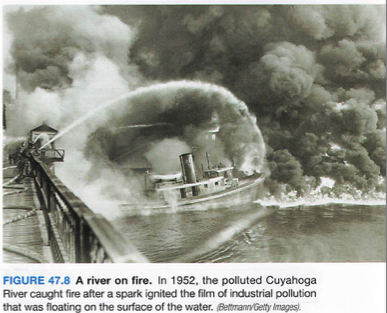Screen Shot 2023-03-05 at 5.32.48 PM.png
- PCBs: [polychlorinated biphenyls](https://en.wikipedia.org/wiki/Polychlorinated_biphenyl)
- used as insulation in transformers, plastics
- lethal and carcinogenic (you may see hazmat trucks near a [transformer fire](https://www.youtube.com/watch?v=fzbQjd_Oo4Q))
- PBDEs: poly brominated diphenyl ether: flame retardants, toxic, found in fish, birds, human milk
- PFAS: polyfluoro alkyl substances: teflon in clothing (Goretex) and in cookware
- 15,000 different types in the environment
- also known as "forever chemicals" since they never break down
Summary chart: Focus on the type--->
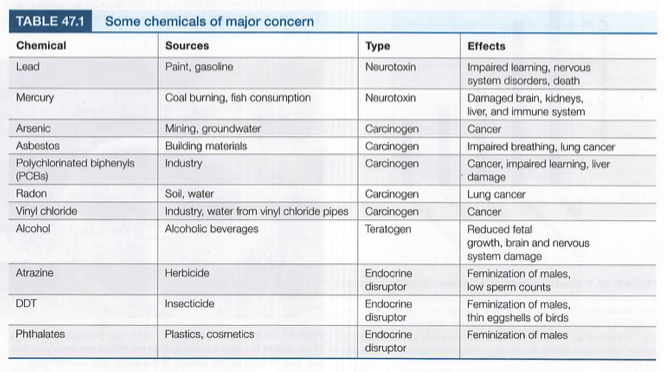Screen Shot 2023-03-05 at 5.39.43 PM.png
- mutate cells, causing cell death or cancers
- impact increases with age (more mutations)
- different from teratogens, which cause birth defects
- radon, asbestos, formaldehyde, tobacco
- fun fact: you get cancer every day (mutations) but your immune system cleans them out
- if your immune system is compromised, or synergistic toxins are present, cancer is more likely, e.g. radiation exposure to a smoker is worse than for a non-smoker, or alcohol plus nitrites in smoked meats...
- from the [Greek](https://en.wikipedia.org/wiki/Greek_language "Greek language") τέρας teras ([word stem](https://en.wikipedia.org/wiki/Word_stem "Word stem") τέρατ-terat-), meaning "sign sent by the gods, portent, marvel, monster"
- cause birth defects by crossing the placenta in pregnant women
- only one generation, unless they reproduce, carrying the broken gene (see also germ editing)
- Case study: [thalidomide](https://en.wikipedia.org/wiki/Thalidomide), sleep aid, caused many tragic birth defects, around 1960, some still survive today
- alcohol is a potent teratogen, FAS (see also decreasing fertility in Russia due to alcohol use)
- note structure of estradiol and xenoestrogen-similar?
- disrupt normal hormonal balance, stasis or levels
- can mimic or impede binding sites (see below)
- growth, metabolism, gender (e.g. intersex in frogs)
- ED in wastewater (see video on poisoned waters) causing intersex
- drinking water treatment facilities do not remove these
- examples: birth control pills, hormones, drugs (prescription and recreational)
- U shaped response curve-very weird: low and high levels cause more impact
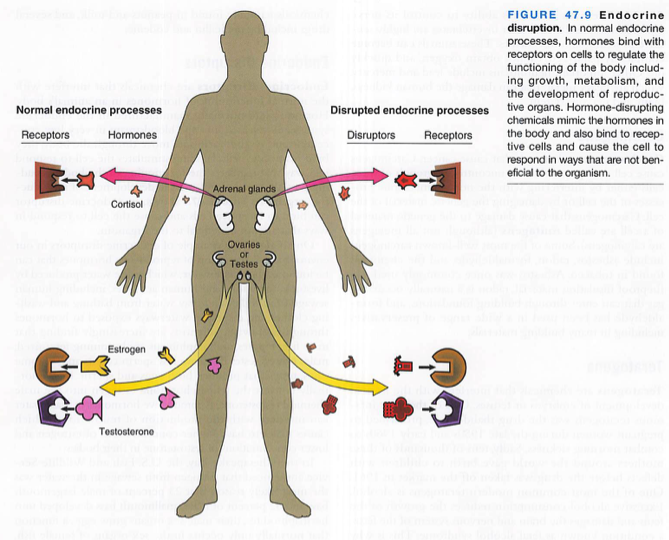Screen Shot 2023-03-05 at 5.49.39 PM.png
Oil Pollution:
- historically leaking from ground (Native Americans) or in seawater (rare until 1870)
- since 1870 usually from spills (tankers like the Exxon Valdex in AK) or oil well disasters (Deepwater Horizon)
- Exxon Valdez: 11 million gallons of crude oil
- Deepwater Horizon: 206 million gallons of crude oil
- serious impact to coastline, fisheries, corals, seabed
- remediation:
- booms to isolate
- dispersants (e.g. Dawn dish soap: why is there a duck on their label?)
- burning
- GMO bacteria
---
Migrated from Apple Server Wiki. Original page ID: m612n0Q
# Poisoned Waters-PBS video
Poisoned Waters-Frontline Video
Video is here:
You may find it helpful to download this into your own computer: hold the option key while clicking on the link.
Transcript: [Download POISONED\_WATERS audio\_otter\_ai-2.pdf (application/pdf, 173.3 KB)](https://bookstack.kamuela.org/attachments/216)
Context:
- Water Pollution-air pollution-climate change
- Watersheds, transit time
- water pollution:continuity, local until ocean,
Segments:
Segment 1: Chesapeake bay: 00-45:00
> - Chesapeake watershed
> - EPA CWA 1970
> - Perdue/hog Ag farms, Eutrophication
Segment 2: Potomac River: 45:00-54:00
> - Endocrine disrupters-drinking water
Segment 3: Puget Sound: 54:00-1:33:00
> - Bioaccumulation-PCB Killer Whales
> - Boeing-PCBs from runways
> - Runoff-water transit time King County
Segment 4: FairFax County, VA: 1:33:00-1:54:00
> - Tyson’s corner-transit time, sediment runoff
> - Loudon county-traffic planning
> - Arlington-urban planning
Questions:Segment 1a: Chesapeake Bay Point sources
1. why is it useful to get the historical view of the craggy old fishermen?
2. how are the fish an indicator species?
3. how large is the Chesapeake watershed?
4. why is this bay uniquely vulnerable?
5. what causes dead zones in the film?
6. what is the global trend in dead zones? where?
7. what three basic functions of the bay will likely be lost to your generation?
8. what was different 40 years ago?
9. what was the cause and effect process of Earth Day and the EPA?
10. Did Nixon back the clean water act? Explain.
11. What were the key tenets of the CWA?
12. What were the initial actions of the EPA?
13. RFK jr. says he could not swim in the Hudson, Charles or Potomac. Where are these?
14. Why did you have to take a shower if you fell into these rivers?
15. What was the Potomac point source pollution source described in the film?
16. What is BNR and how does it work?
17. What is not removed from human wastewater with BNR that concerns us?
18. How did Reagan’s policies impact the EPA and pollution regulation?
19. What is “voluntary compliance” and did it work? explain.
Segment 1b: Chesapeake Bay Factory farms
1. what is the biggest danger with concentrated animal farms (poultry, pigs, cows)?
2. Look up why we have different names for the same animals: cow/beef,chicken/poultry, pig/pork
3. Why is it advantageous for Perdue to subcontract chicken operations?
4. what is vertical integration?
5. what was the national response to cheap chicken?
6. if you were to put chicken manure on your garden, you could burn your plants. why?
7. On the way downhill to the coast, there is an egg factory that went out of business, who now sells “manure compost”. Where did this come from, and how is it a good deal for them?
8. Why does not Perdue own the chicken waste, if they own the chickens? How does the Perdue guy dodge the problem?
9. what is the difference between city waste and ag waste?
10. What does the chicken guy say about deer?
11. What did the chicken lobby in Maryland (eastern shore) do about pollution regulation? why?
12. How is this similar to the Iowa corn ethanol lobby?
13. RFK Jr. describes two things: externalized costs and subsidies. What does he mean by these?
Segment 2: Potomac River Endocrine disrupters
1. Why are not endocrine disrupters part of the clean water act?
2. What is intersex in the male bass and what causes this?
3. How does the concept of river continuity impact endocrine disrupters?
4. Do they need to be very concentrated to cause impact?
5. A person flushes birth control pills (hormones) down the drain. How can this impact someone living many miles downstream?
6. Why are these hormones not filtered by water treatment plants?
7. What is “synergism” and why is it critical here?
Segment 3: Puget Sound Bioaccumulation
1. How cold is the water in Puget Sound and why is this relevant to the animals there?
2. Why do the apex predators have the highest concentration of PCB?
3. What is a sentinel species and why is this relevant?
4. Which population of humans is now showing similar health effects?
5. What is Superfund and who funds it?
6. What is the biggest liability problem with the Boeing situation?
7. What is the legal concept of “deep pockets”?
8. Why would native Americans be the indicator species in the Duomish river?
9. Is south park (not the tv show) upper income or lower, immigrant or not and why is this important?
10. You will be expected to know all about the Love Canal disaster. How is this similar?
11. What do you think is coming out of the pipe underwater in the video?
12. Why are “impervious surfaces” so bad for the Puget Sound?
13. Why do folks get upset about ocean oil spills and not the stuff you see in the video?
14. What is the difference in transit time for rain water hitting concrete vs. soil?
15. Ron Sims has enemies in King county. Who?
16. How is the Growth Management Act/Critical Areas Ordinance (CAO) similar to the Urban Growth Boundaries (UGB) concept in Portland Oregon (recall the Portland e2 video)
17. Look up the CAO now. How is it going?
18. Who is King County named for? Why is this ironic?
Segment 4: Fairfax Urban planning
1. Look up Tyson’s corner. What did it look like in 1945?
2. Would Tyson’s corner have been successful without cars?
3. How is Tyson’s corner like Los Angeles?
4. How is Arlington different from Tyson’s corner?
5. In a sense, US cities are learning to become more like older European cities. Why are they different?
6. what is the “canary in the coal mine” and where did this term come from?
7. According to the narrator and Governor of Washington, what is a necessary part of the solution?
8. What is your part in this future?
---
Migrated from Apple Server Wiki. Original page ID: 38p9n630
# Unit 8: Pollution: module 4.48 Eutrophication and thermal pollution
Water carrying categories:
- Levees: raised banks of a river, meant to prevent flooding (see Nile river flooding and soils)
- Dikes: raised bank to prevent the ocean (tidal, storm or sea level), [NL example 1953 dike failure](https://en.wikipedia.org/wiki/North_Sea_flood_of_1953)
- Dams: stop flow of river, increased depth can be used for hydropower
- Reservoir: the body of water behind the dam-see also: Yangtze river, fish ladders (Ballard Locks)
- Aqueducts: long usually open lined pathways for water (loss about 55% on the way-evaporation)
- [Catskill Aqueduct NYC](https://en.wikipedia.org/wiki/Catskill_Aqueduct): underground supplies water to NYC
- River diversion: (see also three gorges dam in [China](https://en.wikipedia.org/wiki/Three_Gorges_Dam))
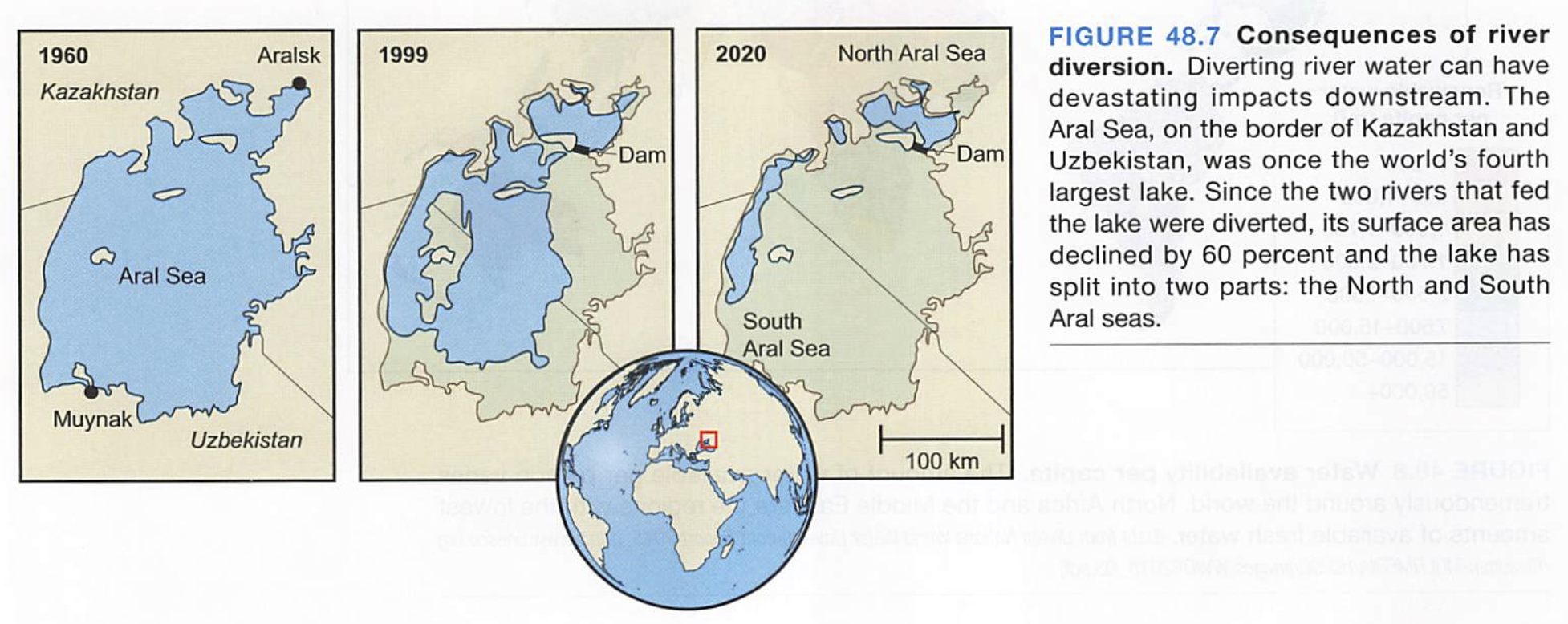Screenshot 2023-03-06 at 4.21.18 PM.pngWater Purification and desalinization:
- Distillation: uses heat, either solar, fossil fuels or electrical (nuclear proposed), brine impact can be serious
- Reverse Osmosis: uses energy to force water under pressure through a membrane, fresher water passes through
Three types of waste water:
- white water: relatively clean, may be potable (drinkable)
- grey water: soapy water, not potable, can be used to water plants, may be recycled
- black water: raw sewage, not for watering, must be treated
Eutrophication: too much of a good thing (e.g. food)
- usually associated with nitrates (e.g. fertilizers) or phosphates (manure)
- If caused by humans, "anthropogenic" or "cultural" eutrophication
- BOD (biochemical oxygen demand) refers to anything that can be decomposed with oxygen (e.g. manure, sewage)
- algal bloom has three steps:
1. 1. nitrate and phosphates cause algae to grow: "bloom"
2. algae runs out of food, then dies
3. algae settles to the bottom, decaying and using up dissolved oxygen there (dead zone)
Oxygen sag curve: in a river, when biological matter is added:
1. sewage or other microbial food is introduced into the river
2. BOD (biochemical oxygen demand) increases
3. dissolved oxygen (DO) drops (dead zone again) as microbes decompose the material, using dissolved oxygen in the water
4. agitation, photosynthesis eventually improves DO levels
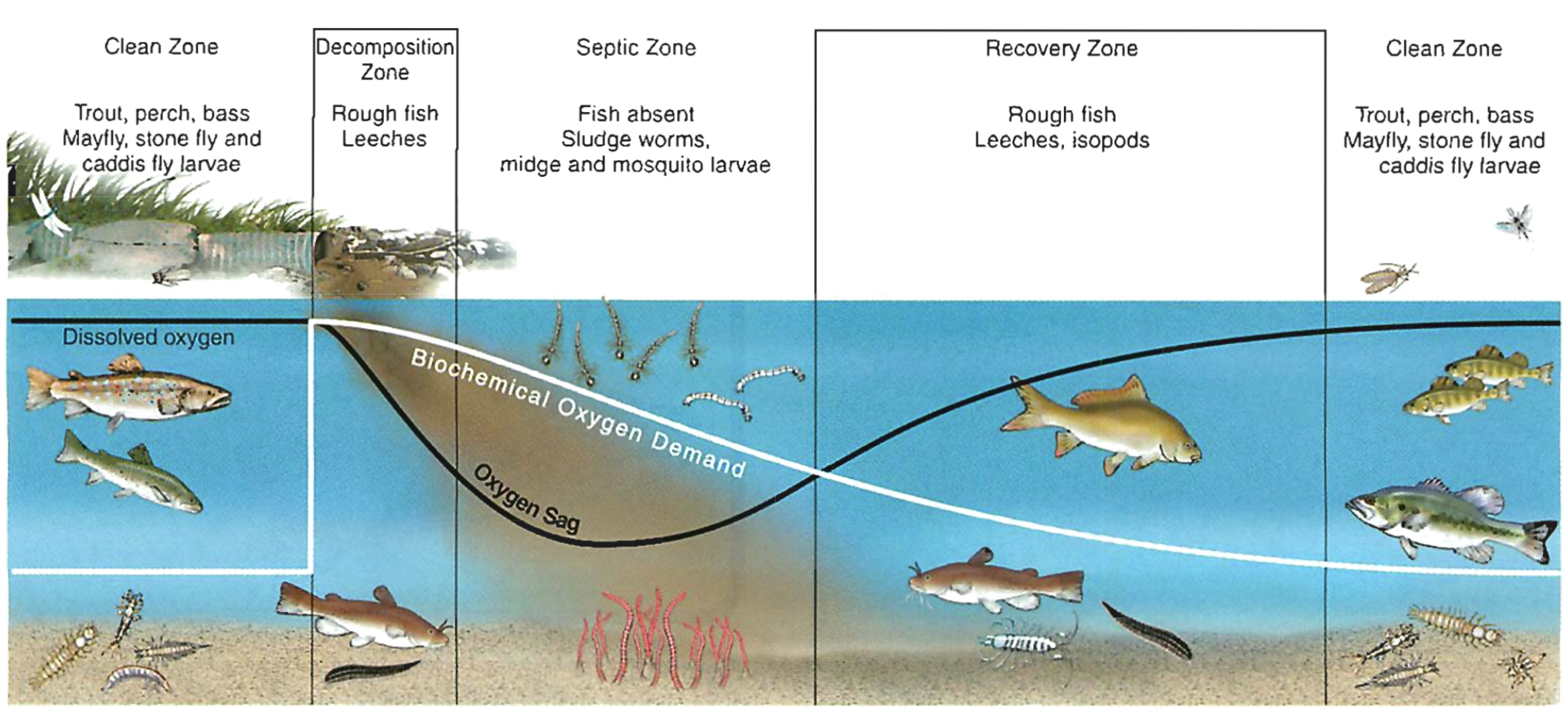Screenshot 2023-03-06 at 4.37.35 PM.png
Thermal Pollution
- Since DO is dependent on water temperature, warm water has less dissolved oxygen
- Power plants and other thermal waste sources reduce DO
- Other locations include sediment filled shallow basins like Chesapeake bay (dark water absorbs solar radiation)
"Perfect storm" for low dissolved oxygen: (see Chesapeake Bay example)
- high phosphates: algal bloom, high BOD
- high nitrates: algal bloom with toxins
- shallow: solar heating of water, low DO
- low agitation: no waterfalls
- sediment: no photosynthesis (ties to BOD test: brown bottles)
- BOD: sewage added (manure)
Noise Pollution:
- Airborne or waterborne
- Airborne: tour helicopters, industry
- Waterborne: military sonar, explosions (BBC piece on whales 3.28.24)
- OSHA sets limits on noise levels based on dB scale
- Exposure time limit is halved for every 10dB increase
---
Migrated from Apple Server Wiki. Original page ID: K9x4p90
# Unit 8: Pollution: module 4.49: POPs, biomagnification, bioaccumulation
Main topics:
- Persistent organic pollutants (POPs)
- BioAccumulation (A single creature, e.g. killer whales)
- BioMagnification (MANY creatures, up the food chain)
Important Pathways:
- water soluble or fat soluble?
- ingested, absorbed through skin or lungs?
- cleared from the body or not?
- examples:
- vitamin C: water soluble, cannot overdose, cleared by urine
- vitamin D: fat soluble, can overdose (vitamins A D E K are fat soluble)
Recall carcinogens, teratogens, mutagens and neurotoxins: exposure dependent
- carcinogens: cause cancer
- teratogens: cause birth defects
- mutagens: cause mutations (cancers, others)
- neurotoxins: paralysis, death
Persistent=staying in the environment long enough to have impact on life
Dependent on:
- temp?
- pH?
- water or soil?
- can it decompose or be degraded by microbes?
Just like radioactive substance, we use half life:
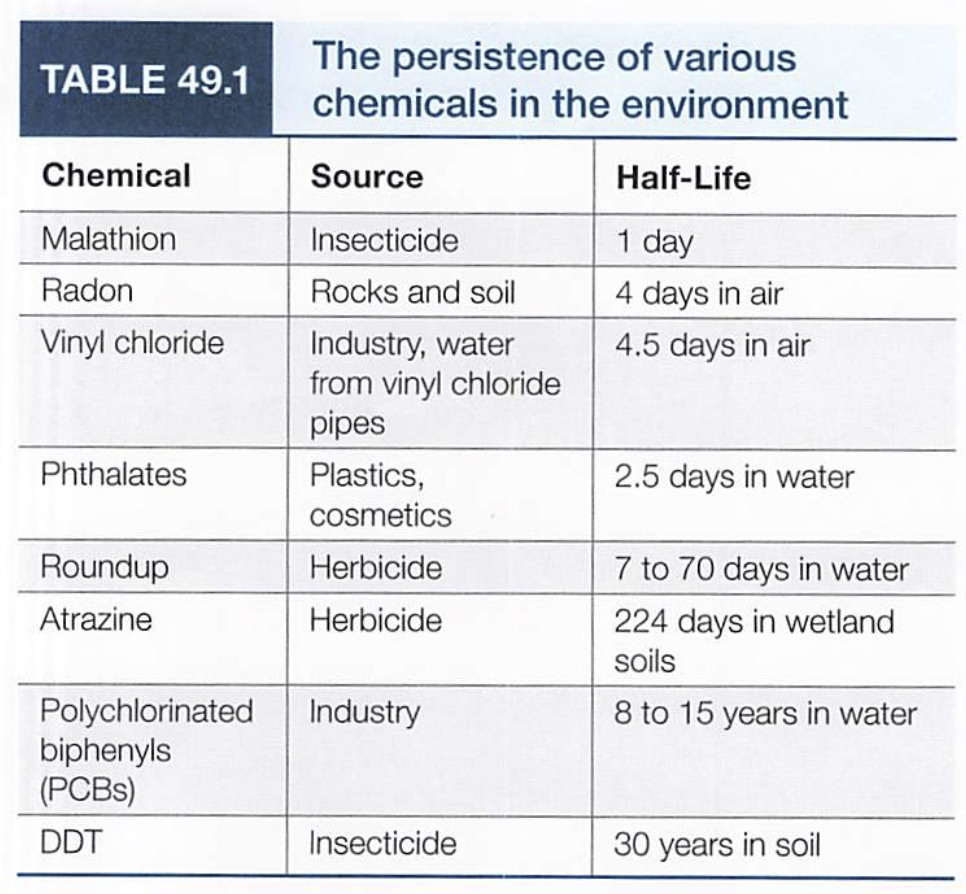Screenshot 2023-03-09 at 7.24.52 AM.pngExample: THC has a half life of 20 hours: see what a daily single dose does over a week:
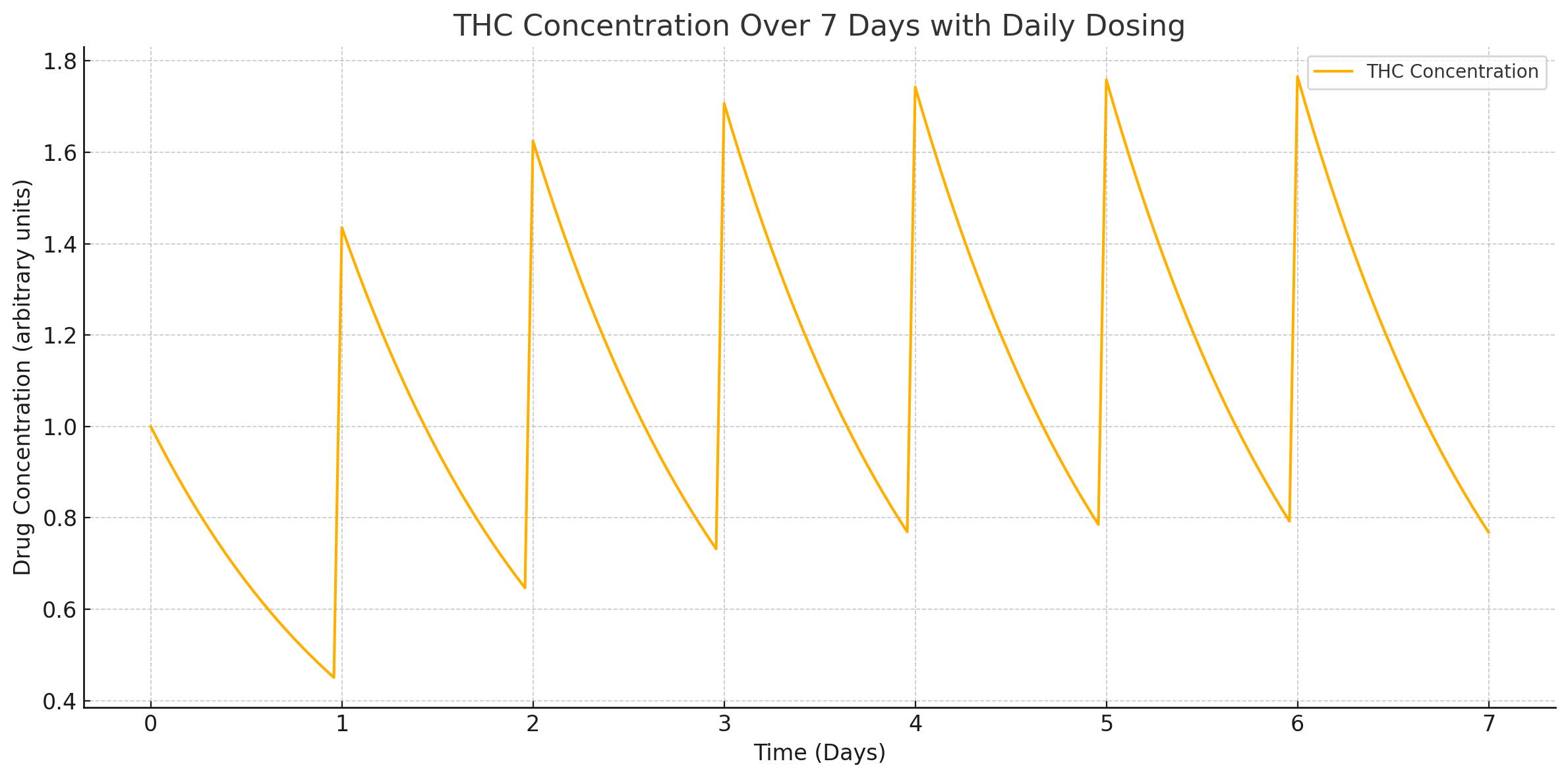THC Concentration Over 7 Days with Daily Dosing.png
Here's one for caffeine: Caffeine has a half life of 5 hours. below is a graph through a 24 hour period for 3 doses of caffeine at 8 AM, 1 dose at noon, and another at 3 pm:
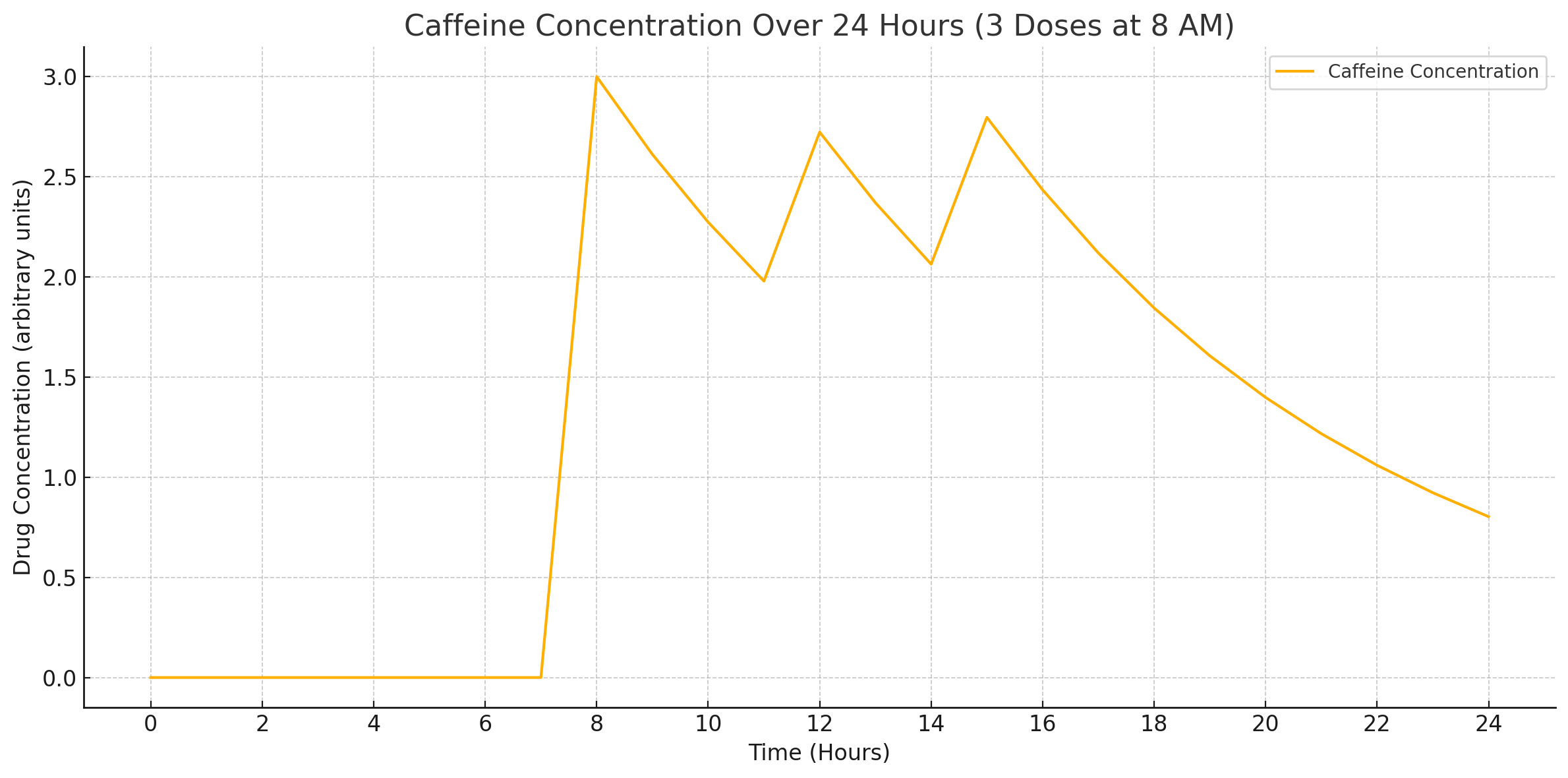Caffeine Concentration Over 24 Hours (3 Doses at 8 AM).png
Imagine trying to go to sleep at 10 PM (22h on the graph)
So, POP:
Persistent=around for a long time
Organic=carbon based, so assimilates into living carbon based life
Pollutant=something man made (anthropogenic)
Example: PCB: Poly chlorinated biphenyl: one form of dioxin
Look:
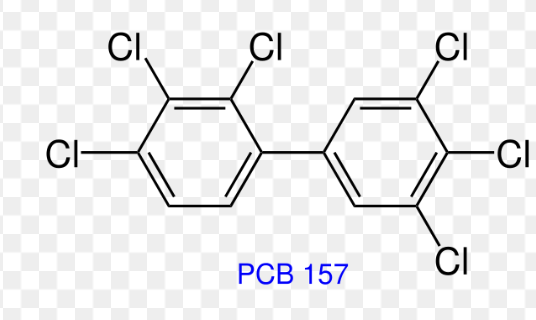Screenshot 2023-03-09 at 7.28.26 AM.png
- The hex shaped rings are phenyl rings, made of carbon, so they interact with carbon based life, and are stored in fat cells in creatures (like fat soluble vitamins) see the poisoned water video about orcas (killer whales)
- There are two rings together, so they are called "biphenyl"
- The chlorines mutate cells (they are known as oxidizers)
- Every corner is a carbon atom...
Bioaccumulation in Orcas:
cold water = fatty animal insulation, where PCBs concentrate
Look here:
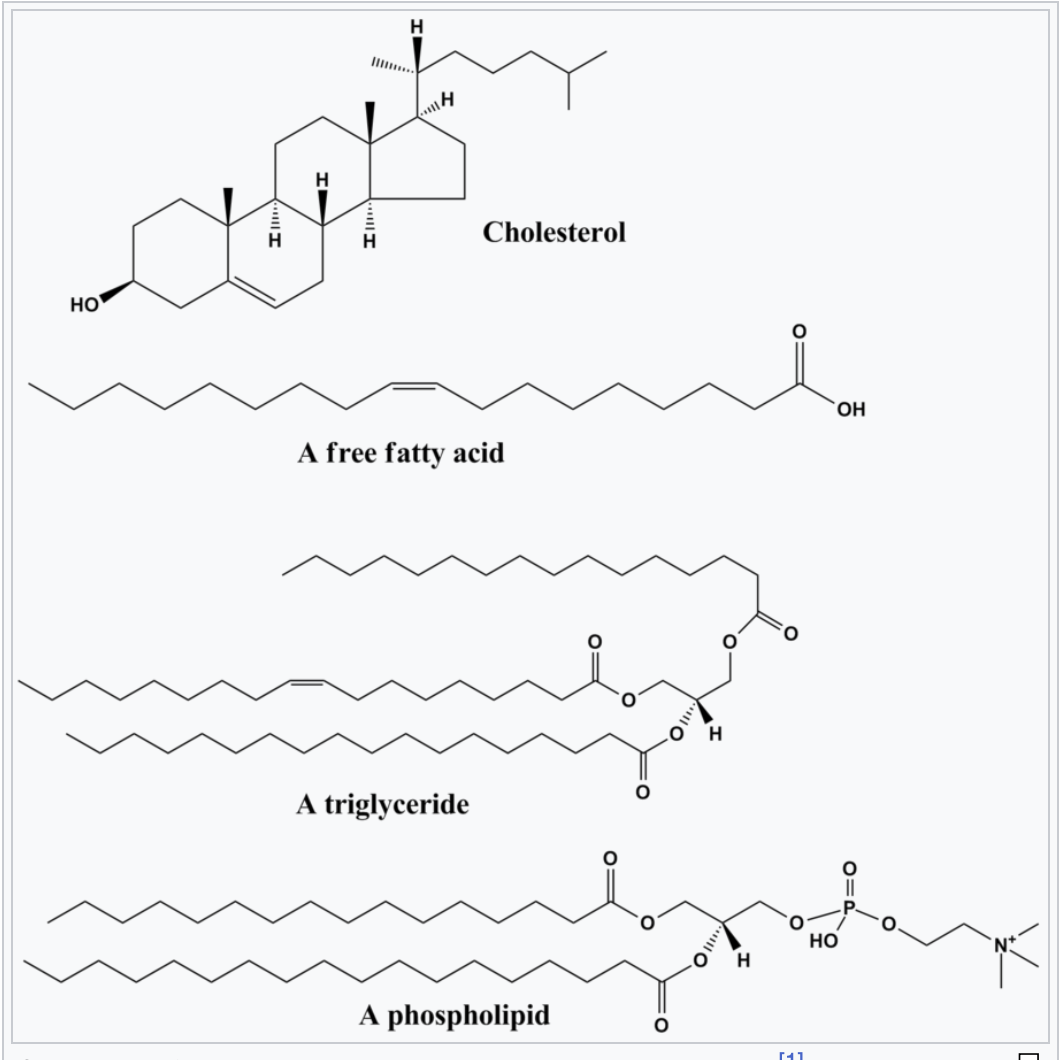Screenshot 2024-04-01 at 10.24.23 AM.pngAll of those zig-zag things are carbons, now look at PCB:
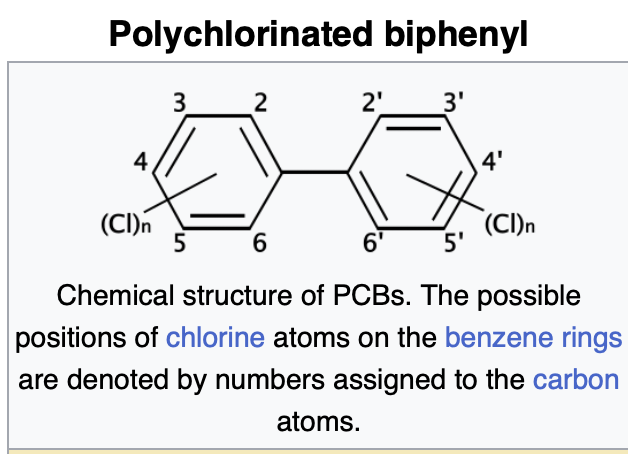Screenshot 2024-04-01 at 10.24.11 AM.png
All of these apexes is a carbon too...
See how one can dissolve in the other?
Now look at vitamin A, D, E or K:
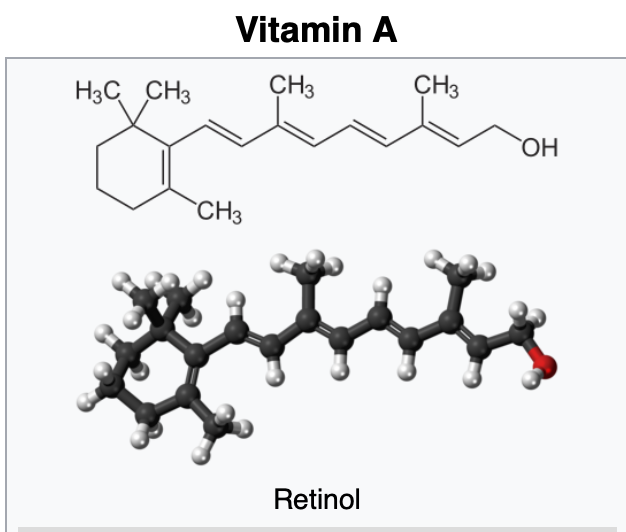Screenshot 2024-04-01 at 10.24.01 AM.png
See how you could overdose on vitamins A, D, E or K just like the orcas bioaccumulate PCB in their fatty tissues?
Teflon and Gore-tex:
PFAS are another issue: they degrade so slowly their half life is measured in thousands of years
They impact reproduction, immune system response, and are carcinogens
They are in Gore-tex and teflon for example
Look these up, notice what chemicals make them up
Routes of exposure:
- soil-pesticides
- food-pesticides, hormones
- air-pollution, coal, heavy metals
- water-pollution, hormones
- fetal contamination: through the placenta
Solubility:
- water based pollutants are found in surface waters and aquifers
- fat soluble pollutants are found in deep soils or sediments (why beauticians use clay on the face)
Bioaccumulation: A single animal, fat soluble chemicals build up in fatty tissues (orca)
BioMagnification: Many animals, up the food chain, with increasing levels in apex predators (ahi, eagles)
Bioaccumulation examples: Building up in your body
- Fat soluble PCB in killer whales (fat used as insulation)
- Dioxin in humans
- Many insecticides concentrate in fatty tissues (DBCP, Malathion, heptachlor used in sugar cane)
- Heptachlor ant poison was found in mother's milk on Oahu ca. 1983 from feeding hepachlor coated sugar can green waste ("green-chop") to cows: milk is mostly fat
Biomagnification: Building up in your food:
- DDT (fat soluble) ->algae->zooplankton->fish->birds
- Concentration increases with each trophic level
- DDT in birds 276,000x water level
- Methyl mercury in fish (apex predators have highest levels)
- DDT in birds (makes their shells weak, crushing chicks)
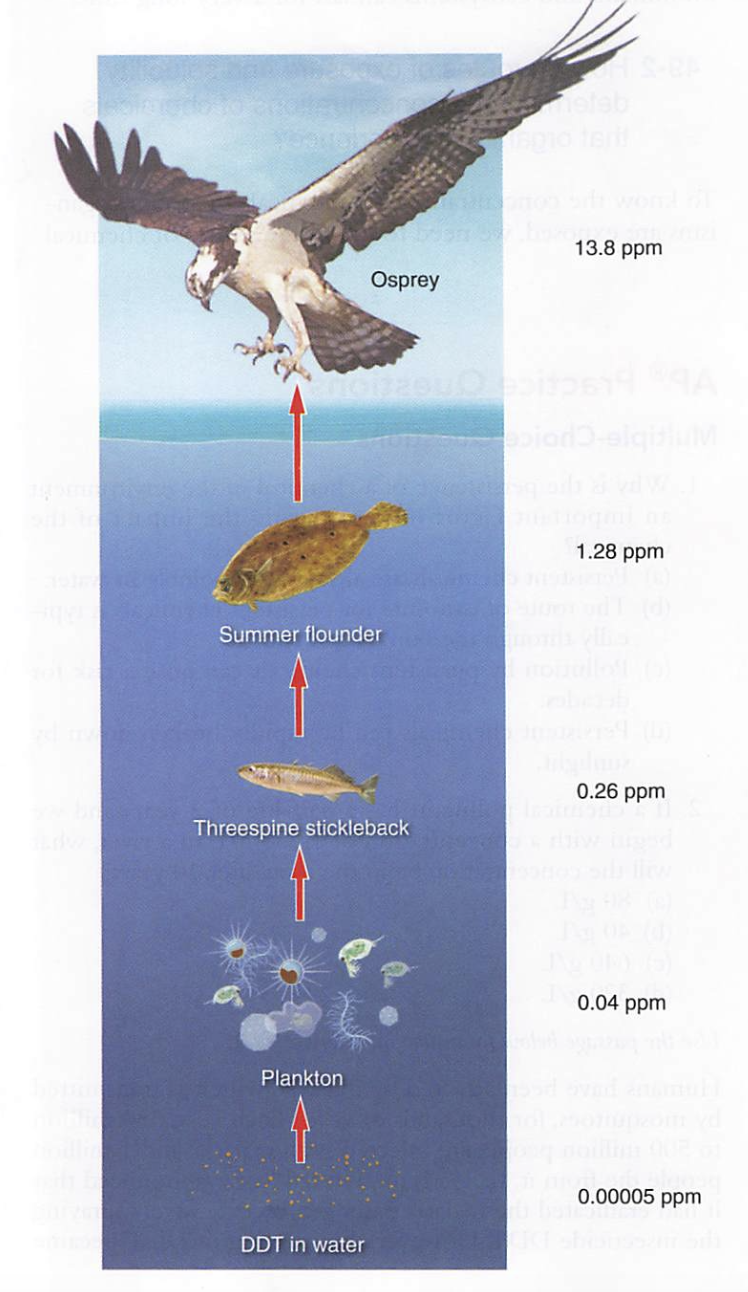Screenshot 2023-03-09 at 7.44.25 AM.png
Love Canal:
You will certainly see this on an AP exam: (why?)
Hooker chemical (no, I'm not making this up) dumped dioxin on land, then sold it to young families for homes:
Impervious surfaces prevent filtration from the soil
Faster "transit time" means grease, gasoline, oil and others from roads run directly into streams
German autobahns filter runoff instead of letting it flow into streams and fields:
Fun fact: it is illegal to run out of gas on the autobahn in Germany:
It is illegal to run out of gas on the Autobahn; it's seen as a preventable circumstance and it leads to stopping, which is illegal. Entering and exiting is only allowed on the marked interchanges. Pulling over onto the shoulder is prohibited, unless your car breaks down. It is seen as "poor planning".
- Primitive societies had no solid waste: they used everything, or it degraded naturally (dispersed, not concentrated)
- "disposable society" meant buying instead of repairing: post WWII (affluence)
- MSW: Municipal (e.g. city) Solid Waste, 60% residential, 40% commercial
- per capita (per head) 2 kg/person per day in US,
- LDC (lesser developed countries) is 0.5 kg/person per day
why?
- waste stream: everything-landfill, recycling etc.
- ewaste: new problem: heavy metals, don't degrade, toxic, growing with IPAT
- Make sure you remember IPAT: Impact = Population x Affluence x Technology
- think of two extremes:
- small population of primitive folks living on an island with no money
- urban professionals with lots of money and tech
MSW destinations:
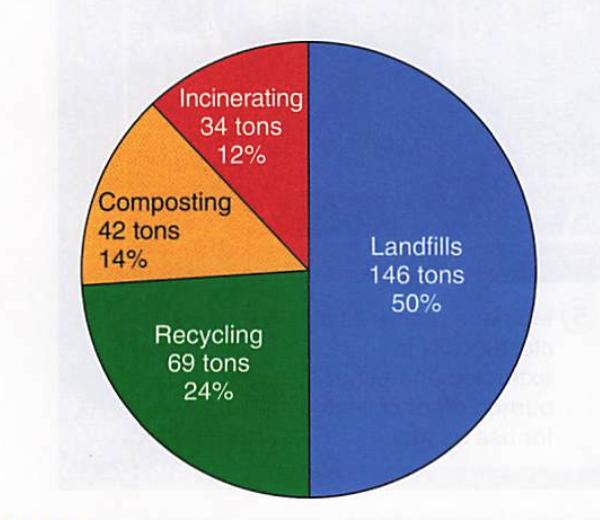Screenshot 2023-03-22 at 10.42.16 AM.png
Landfills: used to be piled up on surface, then dug into ground, leachate (liquid) flowed into water table, gases (methane, CH4) into atmosphere
Sanitary landfill: liner catches leachate, surface is covered and methane captured for use as fuel
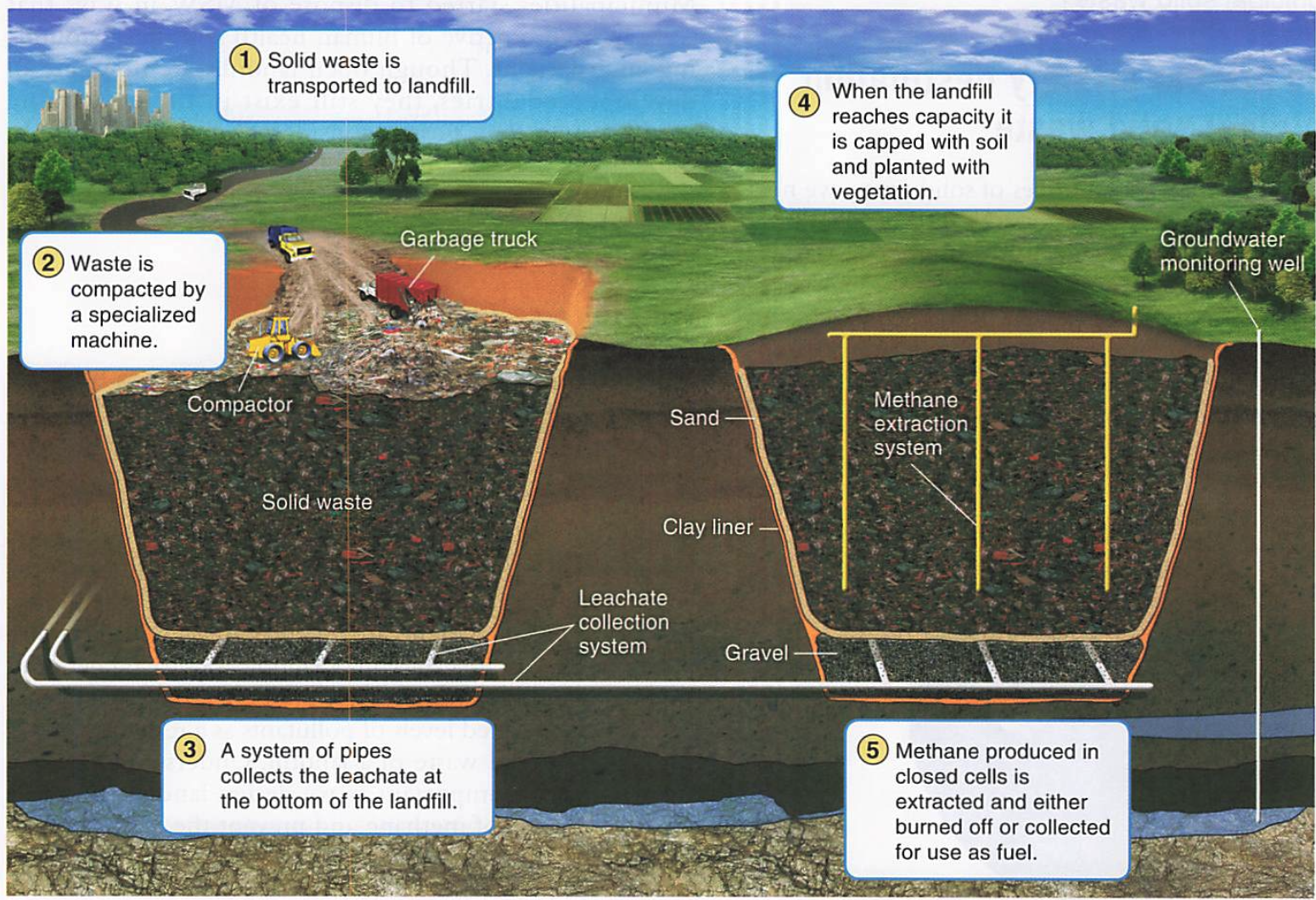Screenshot 2023-03-22 at 10.44.18 AM.png
- "Tipping" fee: very high in Hawaii (limited space), even higher on other islands (San Juan Is. = $6 per bag)
- Another option: incineration-can be for energy (H-power on Oahu) or others
- Japan uses plasma incineration for medical waste: completely ionizes viruses
- Fly ash is toxic, banned for use in EU (heavy metals, toxins)
- Ocean dumping was common, now largely illegal (still done though, watch "The Sopranos")
Hazardous waste: different category: toxic and hazardous are too general
- toxic: e.g. fly ash, heavy metals
- flammable: burns
- reactive: chemically active, e.g. oxidizers
- radioactive: just like it sounds
You may have seen signs like this on the back of trucks:
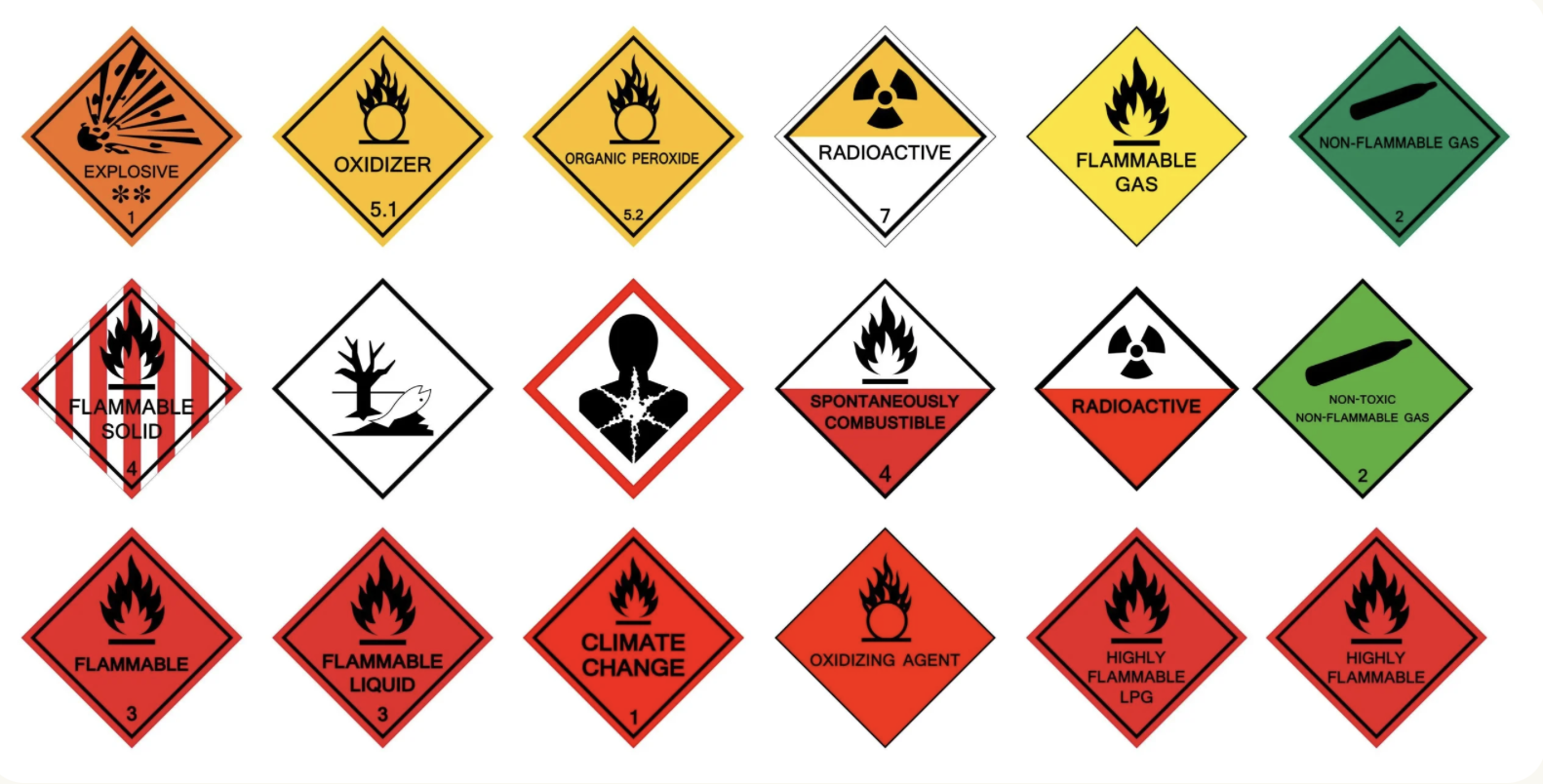Screenshot 2026-03-18 at 6.17.27 AM.png
- Color Coding: Colors indicate the hazard class:
- Red: Flammable liquids and gases.
- Orange: Explosives.
- Yellow: Oxidizers.
- Green: Non-flammable gases.
- Blue: Water-reactive substances.
- White: Toxins/Poisons.
- Half Black/Half White: Corrosives.
- Nine Hazard Classes:
- Class 1: Explosives.
- Class 2: Gases (Flammable, Non-Flammable, Poison).
- Class 3: Flammable Liquids.
- Class 4: Flammable Solids, Spontaneously Combustible, Dangerous When Wet.
- Class 5: Oxidizers and Organic Peroxides.
- Class 6: Poison (Toxic) and Infectious Substances.
- Class 7: Radioactive Materials.
- Class 8: Corrosives.
- Class 9: Miscellaneous Dangerous Goods.
Nuclear waste:
- not just fuel rods-everything
- dangerous for thousands of years
- nobody wants them in their state (Yucca Flats) or country
- in some cases, spent fuel rods can be used in next generation reactors:
[Download What do new nuclear reactors mean for waste? \| MIT Technology Review.pdf (application/pdf, 7.6 MB)](https://bookstack.kamuela.org/attachments/249)
Special to Waimea:
- You may have seen random people walking around fields in our area planting little flags...
- These are EOD contractors, looking for unexploded ordnance (bombs, bullets, shells)
- These are known as UXO for unexploded ordnance from WWII when this was a training ground for the assault on Japanese Islands (Okinawa was the main one)
- As these weapons age, they become less stable, and can detonate with little shock
- Hikers and kids often find UXO in the streams, even above the HPA campus...
- Another local issue with solid waste is the use of DU or depleted Uranium shells in training grounds on the saddle road (Pohakaloa Training Area, or PTA for short)
- Since these shells are used for training, the possible contamination of folks in Kona by windborne Uranium dust is an issue
Mining waste:
- called "tailings" or "overburden" by miners
- heavy metals, acids
- can runoff into streams, water bodies
- classic case: Butte MT
Laws:
Superfund: created in 1980, as CERCLA
Comprehensive Environmental Response, Compensation and Liability Act
- comprehensive: covers everyone
- environmental: like is sounds
- response: they respond to environmental situations
- compensation: they pay victims
- liability: they go after the polluters
RCRA tracks solid waste, "cradle to grave" responsibility
Brownfields: behind the elab is an example, so is the train yard in Portland (e2: sense of place)
Contaminated industrial or commercial sites
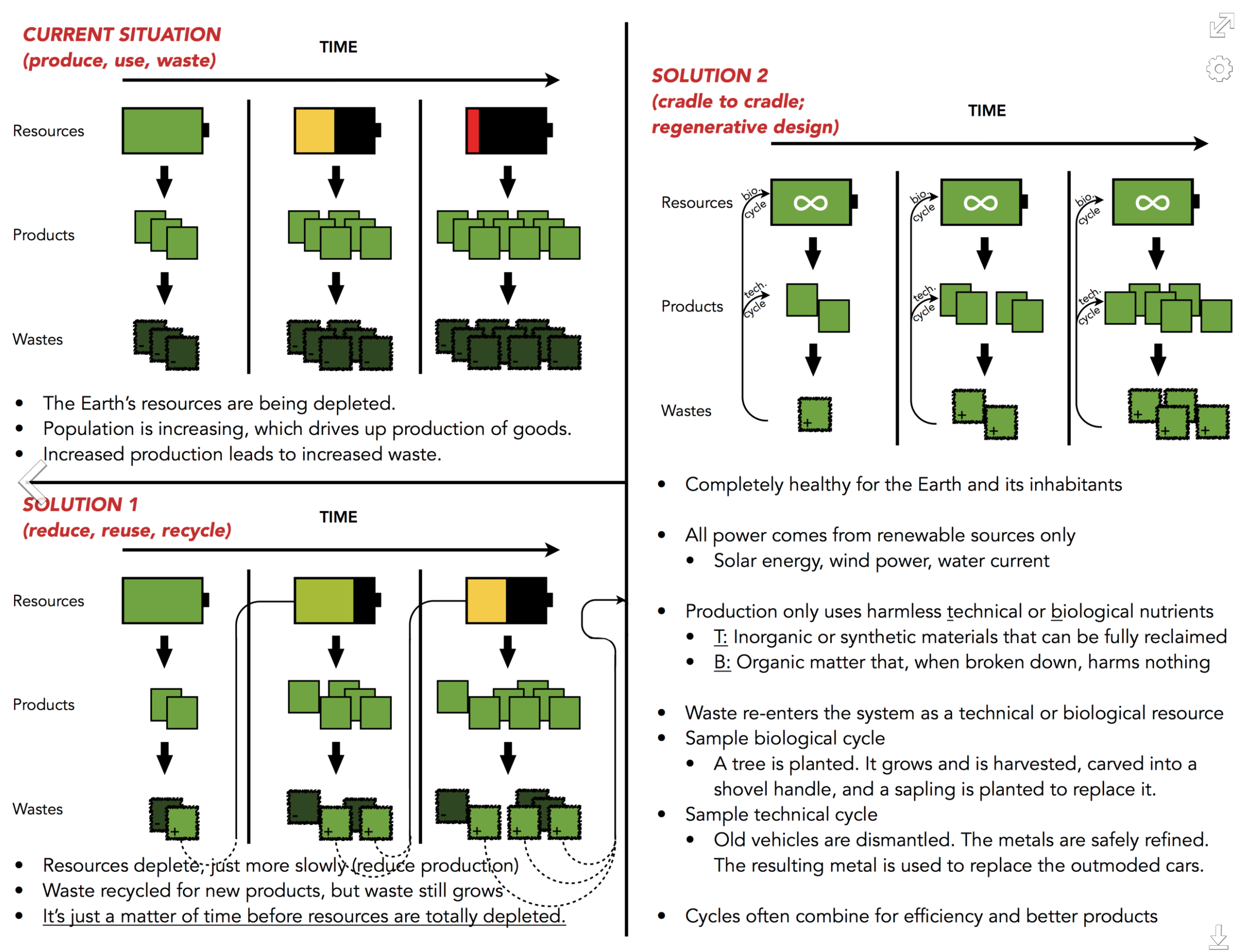Screenshot 2023-03-22 at 11.10.40 AM.pngNote recycling by state: why?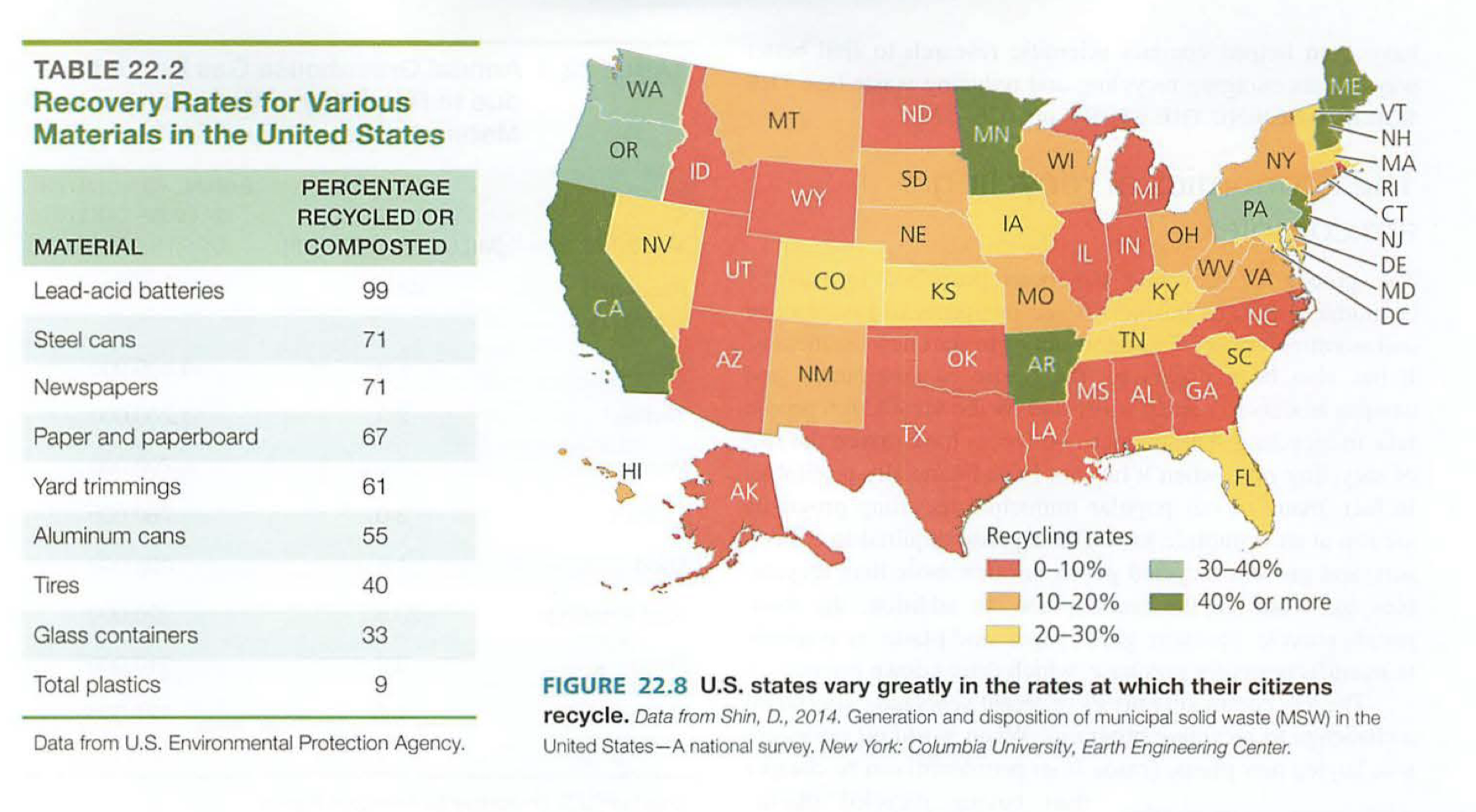Screenshot 2026-03-24 at 6.40.16 AM.pngBottle bills by state-compare with map above:
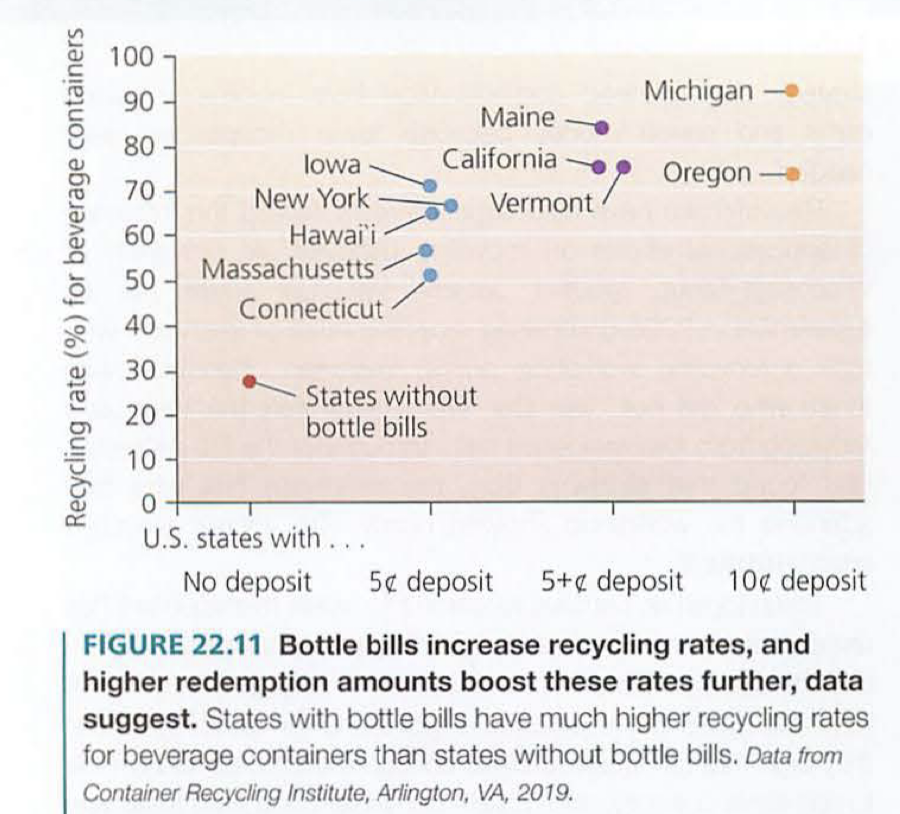Screenshot 2026-03-24 at 6.40.43 AM.png
- Who pays for this?
- Who holds the money?
- Does all of it get refunded?
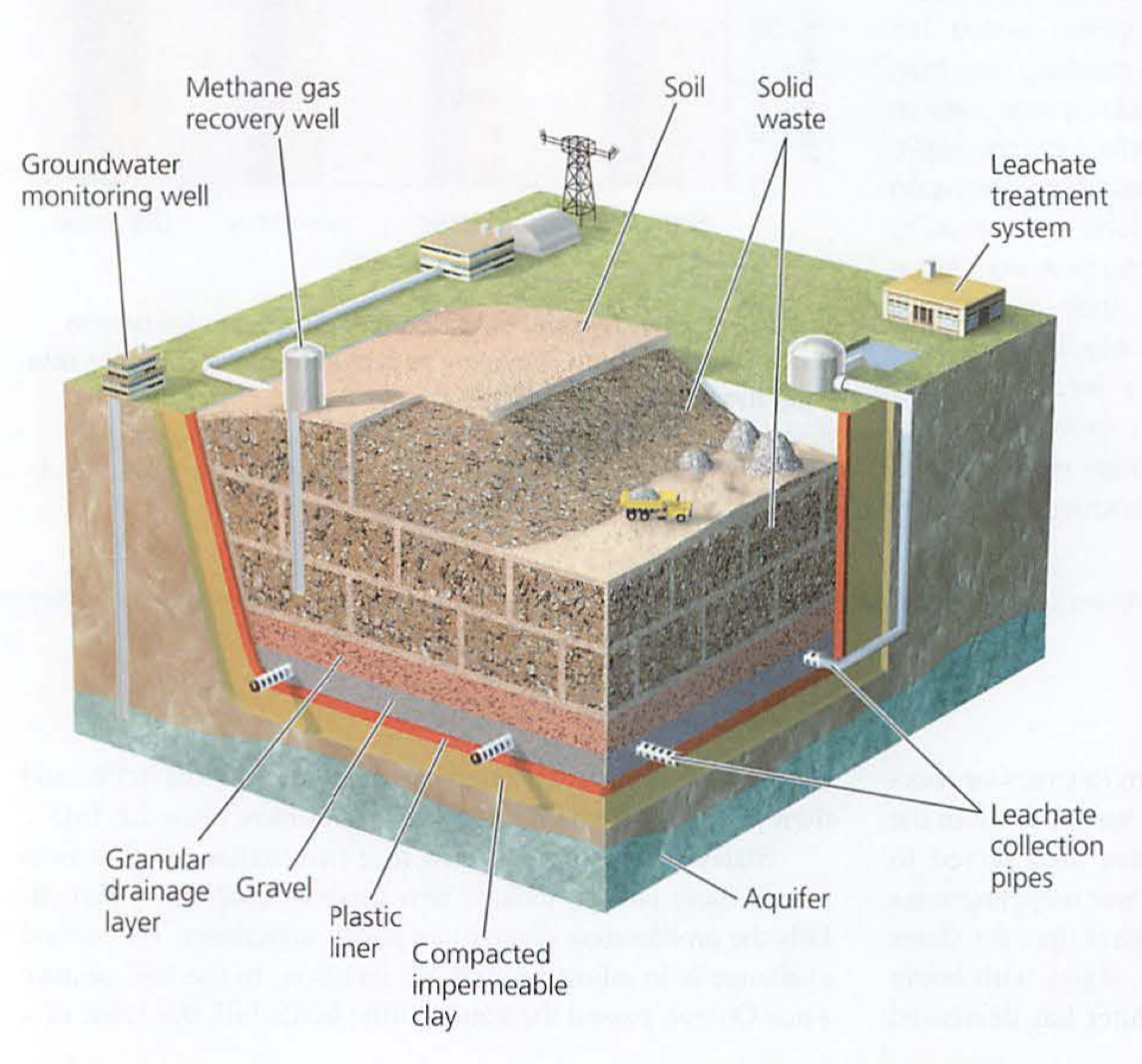Screenshot 2026-03-24 at 6.40.55 AM.pngH-power on Oahu looks similar-look this up:
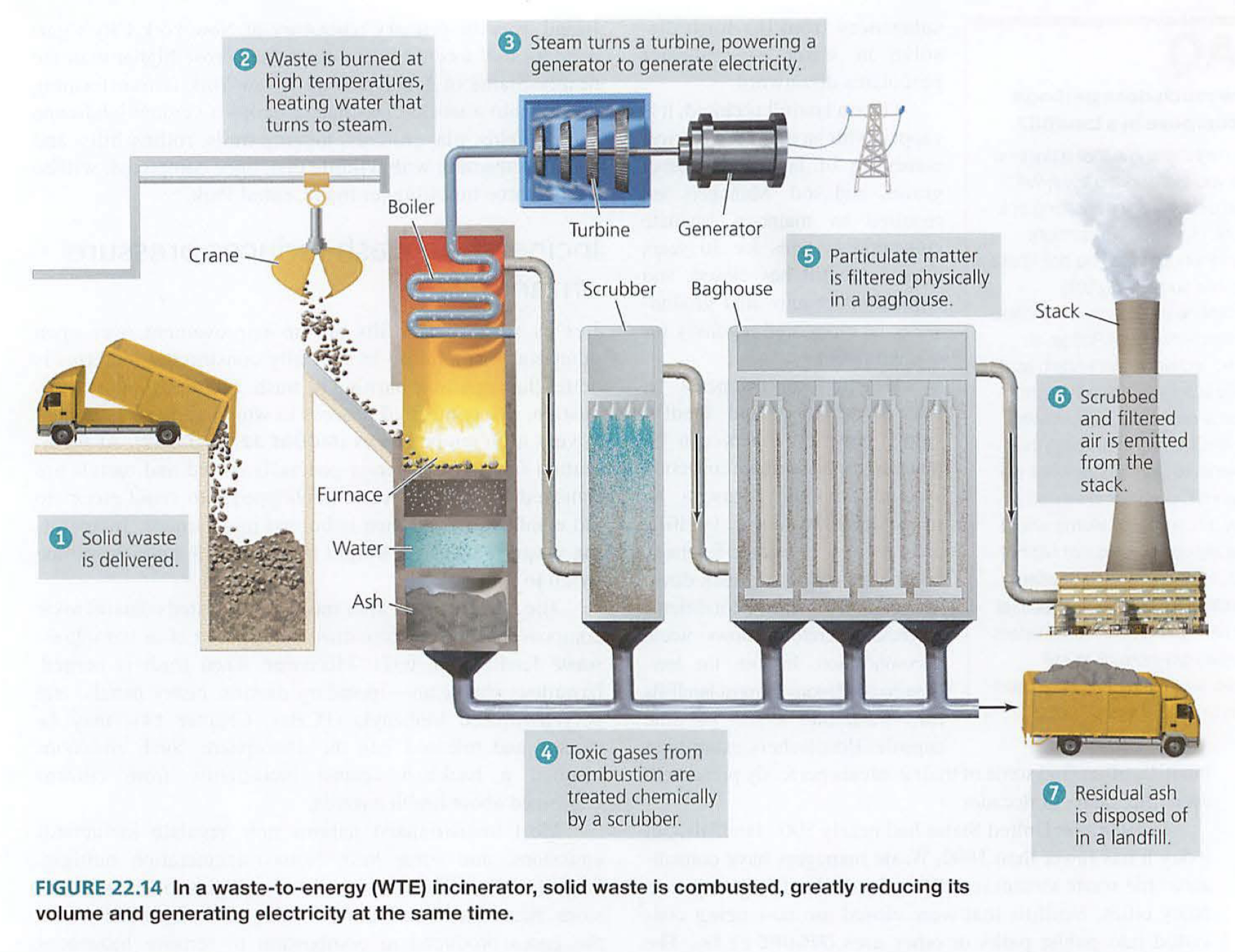Screenshot 2026-03-24 at 6.41.10 AM.pngOne solution to hazardous liquid waste:
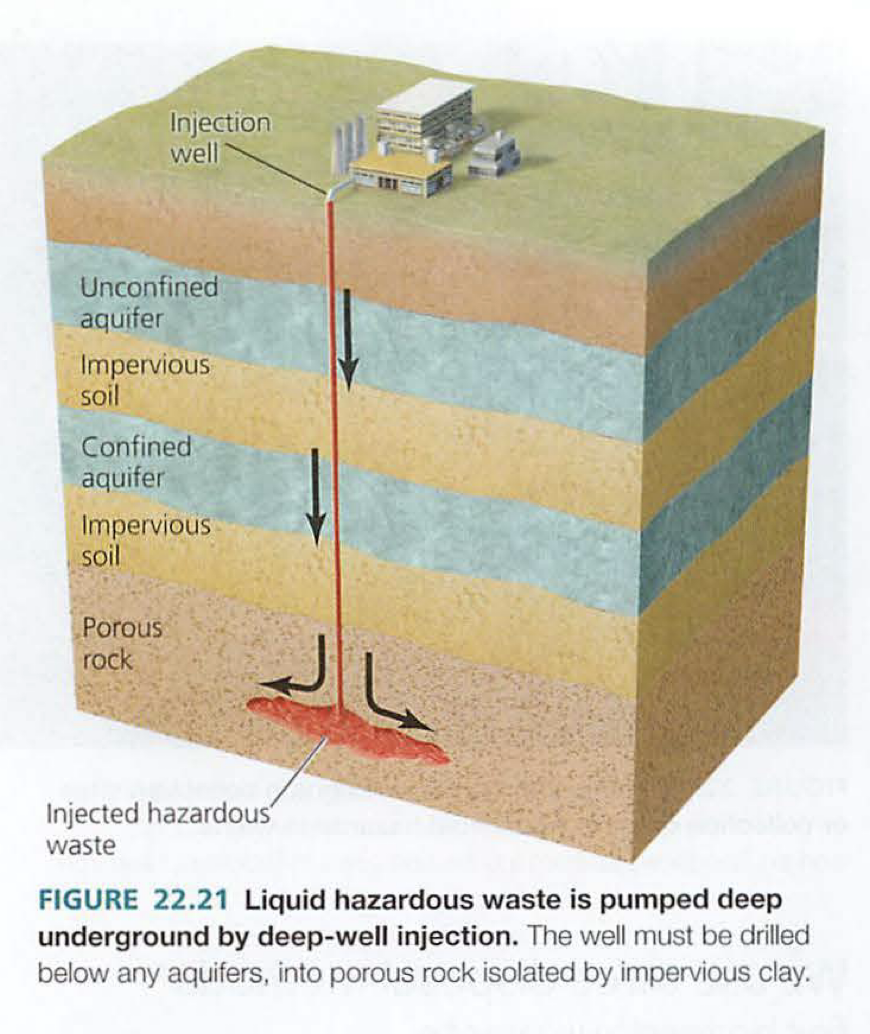Screenshot 2026-03-24 at 6.41.37 AM.png
---
Migrated from Apple Server Wiki. Original page ID: T3n5u0F
# Unit 8: Pollution: module 4.52 sewage treatment
Sewage is anything coming from humans' (or animals') digestive system:
- urine (Nitrogen, salts)
- feces (nutrients and bacteria)
Bozeman Science:
[https://elab.local/apes/videos/bozeman\_science/](https://elab.local/apes/videos/bozeman_science/)
Water Pollution video:
[http://www.bozemanscience.com/ap-es-030-water-pollution](http://www.bozemanscience.com/ap-es-030-water-pollution)
Reference: FR4e Unit 8:
[https://elab.hpa.edu/apes/texts/fr4e/unit%208%20water%20pollution.pdf](https://elab.hpa.edu/apes/texts/fr4e/unit%208%20water%20pollution.pdf)
BOD: biochemical oxygen demand: the demand on the dissolved oxygen in water needed to biodegrade the nutrients
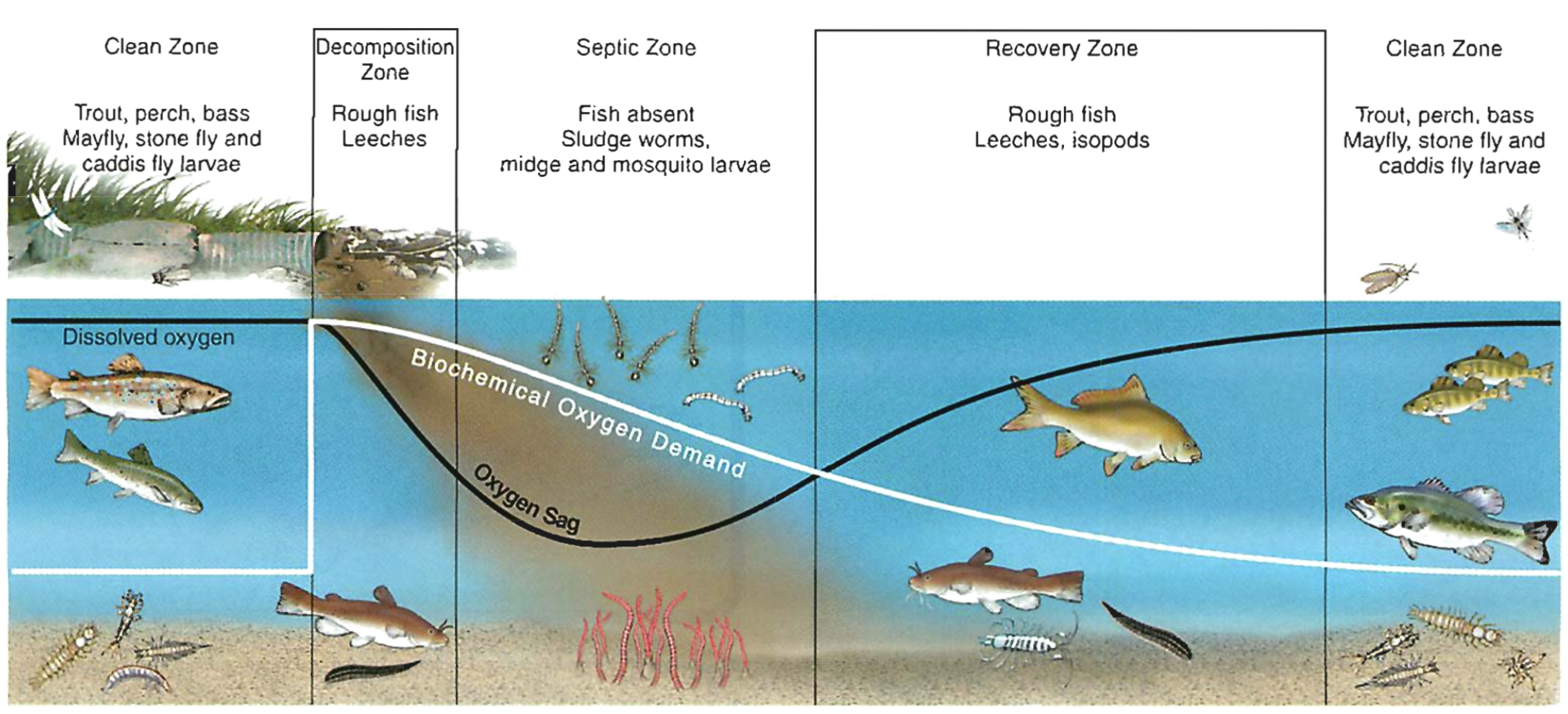Screenshot 2023-03-06 at 4.37.35 PM.pngTest for BOD: (white line on the graph above)
1. take a sample from water
2. measure DO (dissolved oxygen)
3. store in dark place overnight (no photosynthesis)
4. re-measure DO: if it drops, there were nutrients that needed to be biodegraded
- If BOD is high, with no agitation or photosynthesis, it produces Dead Zones with very low DO
- Why no agitation or photosynthesis?
- Warm water or water with suspended solids make this worse (e.g. Chesapeake Bay)
Chesapeake Bay: Perfect storm of cultural eutrophication and dead zone
- Phosphates from chicken manure: eutrophication, algal bloom
- Nitrogen from fertilizer runoff and CAFO (concentrated animal feed operations): algal bloom
- Silt from rivers: blocks photosynthesis, low DO
- No agitation: low DO
- Shallow and warm: low DO
- High BOD from sewage: low DO
Disease organisms in sewage:
- Cholera: simple bacteria, if you can remain hydrated, your immune system will cure you in a few days
- Hepatitis: damages liver, can be fatal, several varieties (A, B, C) all contagious
- Typhoid fever: waterborne, then airborne
- Viruses: only killed by ozone treatment, not chlorine (!)
- Fecal coliform: gut bacteria, harmless in your gut, toxic when on food or in water
- Fecal coliform (FC) is an indicator of polluted water (see brown water alerts in Hawaii)
Sewage treatment: septic systems vs. cesspools
- Septic system: tank for settling, leach field for absorption into soil, plants use the nutrients (e.g. elab)
- Puako issue: septic systems are not in place, they have cesspools, essentially a concrete tank with holes, which leak raw sewage into the ocean near the shore when the tide comes in. Cesspools are now illegal in Hawaii.
Sewage treatment plants:
1. Primary treatment: physical: settling, liquid separated
2. Secondary treatment: biological: aerobic bacteria with aeration (e.g. paddles)
3. Tertiary treatment: chemical: kill the bacteria and any pathogens
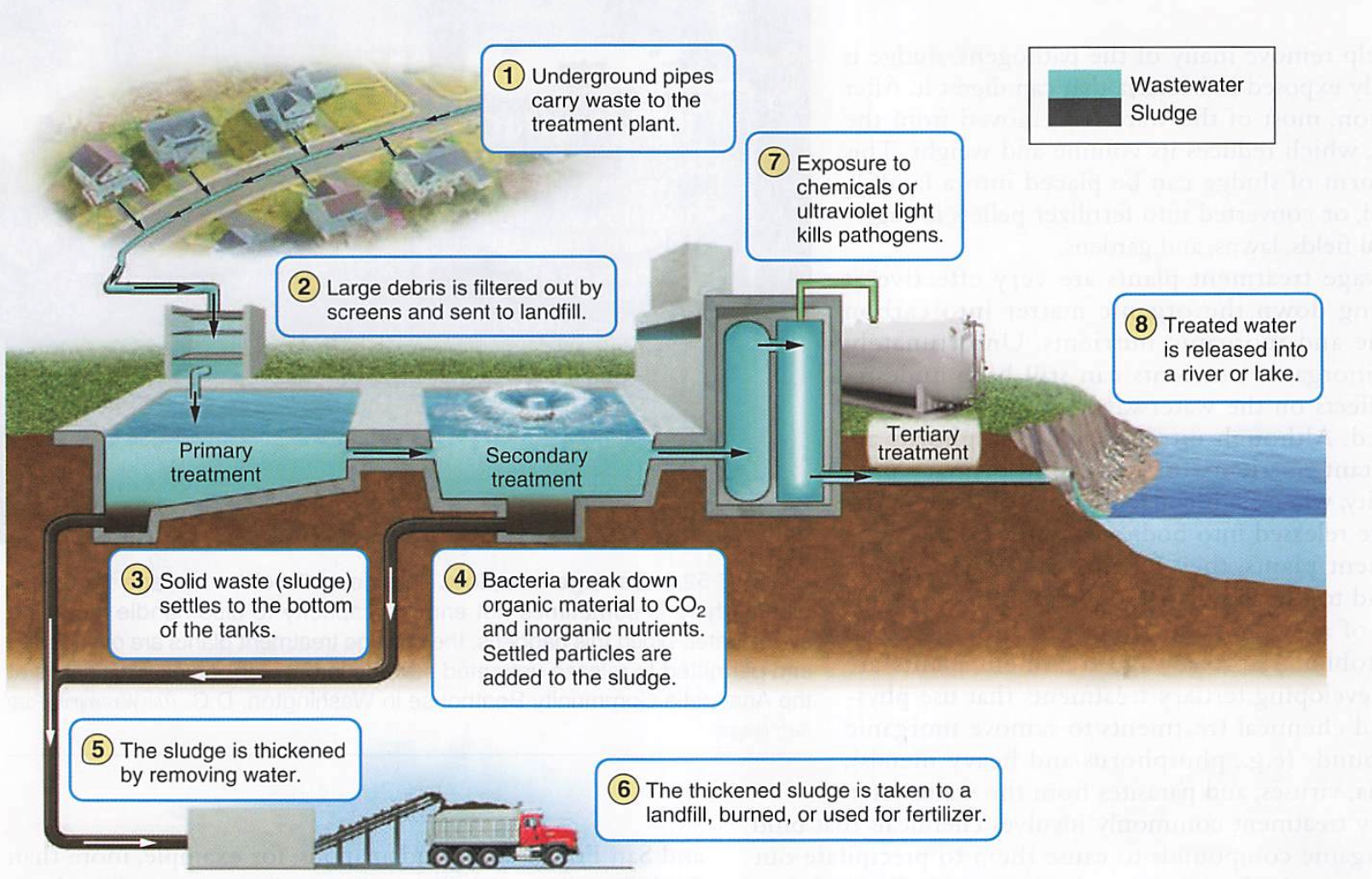Screenshot 2023-03-22 at 11.41.18 AM.png
Human health and LD50:
---
Migrated from Apple Server Wiki. Original page ID: z952U2
# Unit 8: Pollution: module 4.53 toxicity and LD50
FR4e reference: [https://elab.hpa.edu/apes/texts/fr4e/unit%208%20water%20pollution.pdf](https://elab.hpa.edu/apes/texts/fr4e/unit%208%20water%20pollution.pdf)
Bozeman Science:
[https://elab.local/apes/videos/bozeman\_science/Health%20Impacts%20of%20Pollution.mp4](https://elab.local/apes/videos/bozeman_science/Health%20Impacts%20of%20Pollution.mp4)
[https://elab.hpa.edu/apes/videos/bozeman\_science/Health%20Impacts%20of%20Pollution.mp4](https://elab.hpa.edu/apes/videos/bozeman_science/Health%20Impacts%20of%20Pollution.mp4)
Module 53: LD50: lethal dose to 50% of the population
- Dose-response curve: can be bad (e.g. toxins) or good (e.g. antibiotics)
- acute=sudden
- chronic=long term
- when using animals or organisms as study, mortality is the metric (% dead) sorry...
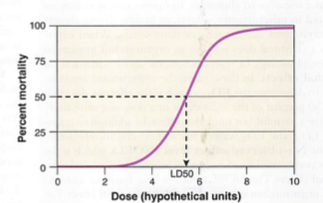Screen Shot 2023-03-28 at 5.42.14 PM.png
- Look carefully: this is not linear (rarely are) and it shows that at a certain dose (x axis) 50% of the organisms are dead
- This is known as LD50, or lethal dose for 50% of the population
- There is another metric, the ED50, or effective dose for 50% of the population for non-lethal impacts (often used to describe effectiveness of drugs)
- NOEL means no observed effect level-under lab conditions with present sensors we cannot determine any impact
- NOEL is dangerous, as we don't have very sensitive gear for many toxins
TOSCA:
- Toxic Substances Control Act-regulates levels of chemicals (except food, cosmetics, pesticides)...also an opera
- Rat studies: x/10 then x/10 again, but still assumes similar metabolism
- See West Va. study on sleep aids in aged-made them psychotic: liver and kidneys less effective at clearing drugs
- Also: not based on weight, but should be (they do it for horses and dogs...)
Environmental hazard: anything causing harm
Risk assessment is science, but psychology is important: smokers will not drive, drivers without seatbelts afraid to fly...
[This is madness](https://www.youtube.com/watch?v=WAoBW3yjlvA)
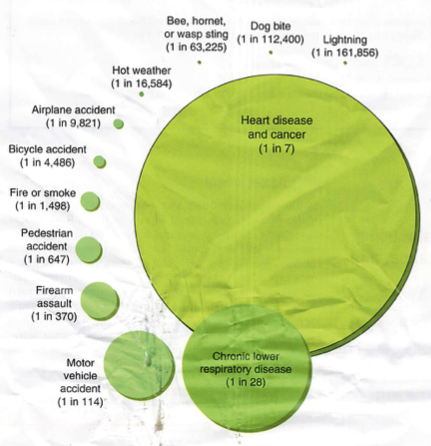Screen Shot 2023-03-28 at 5.50.05 PM.pngRisk assessment:
Probability of exposure x Probability of harm
Think of sharks, lightning, driving without seatbelts, flying...
Two approaches to regulating drugs and chemicals:
- Innocent until proven guilty: businesses like this
- Tobacco industry used this tactic for decades: "sure smokers get cancer, but not from smoking
- Precautionary: test before release, better for society
- stratospheric ozone: protects life by absorbing UV-C rays
- tropospheric ozone: surface air pollution from industry, transportation
Three types of UV (ultraviolet) radiation:
- UV-C highest energy, splits DNA
- UV-B lower energy, damages photosynthesis
- UV-A lowest energy, can damage DNA
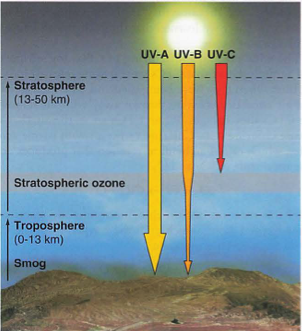Screen Shot 2023-04-02 at 3.53.40 PM.png
- Note that UV-C (the most powerful of the ultraviolet rays) is absorbed by the stratospheric ozone layer
- Formed by UV-C splitting O2 into O + O, then O + O2 = O3 (ozone)
- This can then be split again into O2 + O by UV-N or UV-C rays, so there is equilibrium
CFC= chlorinated fluorcarbon, can release a single Cl atom
O3 + Cl --> ClO + O2 (note this is transparent to UV)
one Cl atom can do this many thousands of times, depleting the ozone layer
Here's what we saw back in the 1990's over Antarctica:
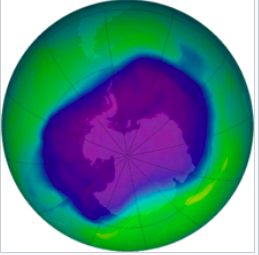7d179.png
This "ozone hole" was growing larger, and global ozone was also decreasing:
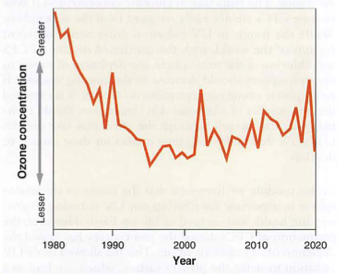Screen Shot 2023-04-02 at 4.02.37 PM.pngIn 1997, most of the countries of the world met in Montreal Canada to create the Montreal Protocol, banning these CFC’s (chlorinated fluorocarbons) like Freon. replacing them with similar non-harmful refrigerants called HCFCs
Here’s how we know it worked:
[https://www.esrl.noaa.gov/gmd/aggi/](https://www.esrl.noaa.gov/gmd/aggi/)
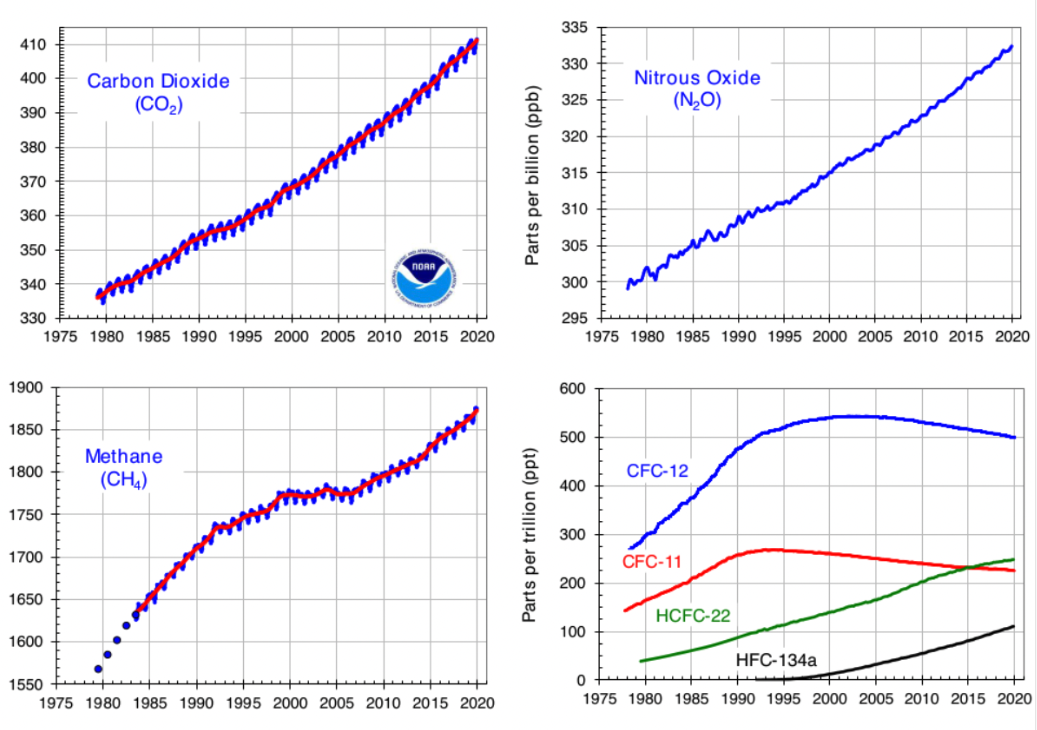Screen Shot 2023-04-02 at 4.06.00 PM.pngThis demonstrates that if every country decides to change for the survival of the planet, it can be done.
Why do you think this is different for global warming?
Why does this show up on every AP exam?
How does it demonstrate cause and effect?
How does it demonstrate why solving the climate crisis is different?
Ozone crisis:
Everybody dies, no more food, no international or rich/poor boundaries-EVERYONE DIES
Clear pattern of cause and effect
Visible impact in an area not yet dangerous (ozone hole over Antarctica)
Economical alternatives created (new safer HCFCs instead of CFCs)
Climate crisis:
Tied to national interests (economy, money, energy, development)
Only poor folks on the coastal areas will be impacted (flooding, malaria, disease, loss of food)
Only some countries' food supply will be impacted (corn in Nebraska is ok, rice in the Mekong delta: salt intrusion)
Rich folks can afford air conditioning and when it becomes severe, CO2 scrubbing indoors (gated community model)
Lots of misinformation created by money interests (oil companies, certain politicians tied to them)
Energy sources are not uniform: lots of coal in China, lots of oil in Arabian gulf
Renewable energy alternatives stifled by inconsistent investment
Lack of clear information about cause and effect.
---
Migrated from Apple Server Wiki. Original page ID: 66v8k1\_
# Unit 9: Global Change: 4.56: Greenhouse effect
- First of all, if we had no greenhouse effect, the planet would be frozen (not like the movie)
- Second, while a greenhouse is made of glass, which holds in heat and reflects infrared radiation, gases in our atmosphere like water vapor, CO2 and others actually re-radiate infrared radiation back to the planet.
- This is a subtle difference, but one that is important if you want to understand how these gases interact with climate change
- Look at the hydroponics unit, for demo (outside)
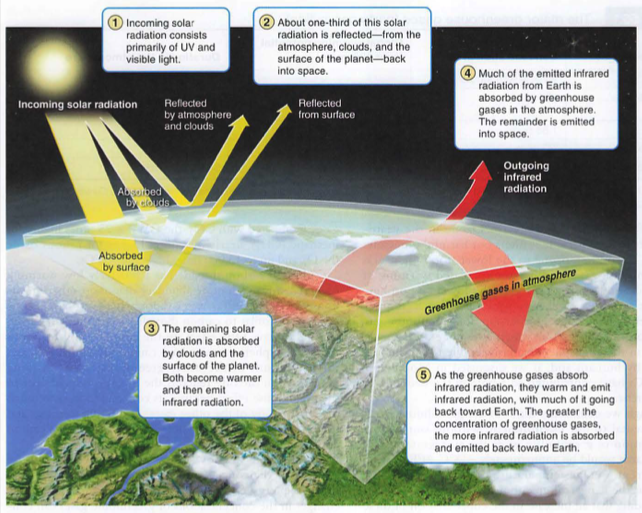Screen Shot 2023-04-02 at 4.12.16 PM.pngImportant:
If this were as simple as the dashboard on your car or a real greenhouse, the IR radiation would just reflect back from the glass. In the diagram above, you can see shorter wavelength visible light passing through the atmosphere (radiation) hitting the surface where it strikes the ground and is re-radiated back as lower wavelength infrared radiation (heat).
You recall we studied this when we discussed weather: radiation, conduction, convection
To be more accurate, imagine the glass windshield also radiating some heat back to the car (this is true if the glass is hot).
We determine the 100 year impact of greenhouse gases like water vapor, methane and CO2 by combining their impact by their lifespan called the greenhouse warming potential (GWP):
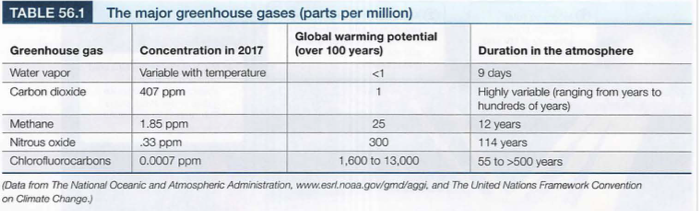Screen Shot 2023-04-02 at 4.15.56 PM.png
Note that while methane has a lifespan of 12 years, it is many times more effective at warming than CO2 (1.0)
This is also calculated as the annual greenhouse gas index (AGGI):
Note that they chose the CO2 level in 1990 as a benchmark of 1.00 (why then?)
- The AGGI in 2019 was 1.45, which means that we’ve turned up the warming influence by 45% since 1990.
- It took ~240 years for the AGGI to go from 0 to 1, i.e., to reach 100%, and 29 years for it to increase by another 45%.
- In terms of CO2 equivalents, the atmosphere in 2019 contained 500 ppm, of which 410 is CO2 alone. The rest comes from other gases.
- CO2 is by far the largest contributor to the AGGI in terms of both amount and rate of increase.
- Note: The IPCC suggests that a constant concentration of CO2 alone at 550 ppm would lead to an average increase in Earth’s temperature of ~3°C (5.4°F).
- What is the AGGI in the latest 2022 graph 3 years later (link above)
- What is the CO2 level today outside? [http://10.14.47.1/index.html](http://10.14.47.1/index.html)
Sources of greenhouse gases (this is interesting)
Volcanoes
- CO2 and water vapor
- also ash, which can block sunlight, cooling the earth
- check this out: [https://en.wikipedia.org/wiki/Mount\_Pinatubo](https://en.wikipedia.org/wiki/Mount_Pinatubo)
Decomposition:
- dead trees in the forest (lots of oxygen) create CO2
- if not enough O2, then methane (CH4) is produced, which is much more harmful
- the permafrost in the arctic is billions of tons of anaerobically decaying biomass which is frozen (like the movie) for now
- as the planet warms, this will melt and release much more methane
- digestion is also anaerobic (termites, cows) releasing methane
Denitrification
- wet soils and lake bottoms
- nitrate converts to nitrous oxide
Evaporation (water vapor)
- warmer planet means more water vapor in the atmosphere (latent heat)
- this is why storms are much more intense, also more rain and snowfall (global warming does make more snow, yes this is true)
Human fossil fuel burning: CO2 and methane
- coal is the worst: 100% as a CO2 benchmark for comparison
- oil is 85% of this
- natural gas is 56% of this (natural gas IS methane)
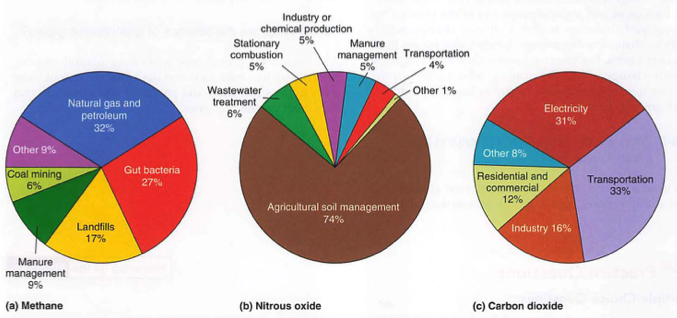Screen Shot 2023-04-02 at 4.30.40 PM.pngNASA simulation:
[https://climate.nasa.gov/interactives/climate-time-machine](https://climate.nasa.gov/interactives/climate-time-machine)
NASA Eyes simulation: look for "vital signs" then "carbon dioxide"
[https://eyes.jpl.nasa.gov/eyes-on-the-earth.html](https://eyes.jpl.nasa.gov/eyes-on-the-earth.html)
---
Migrated from Apple Server Wiki. Original page ID: 1155w4553
# Unit 9: Global Change: 4.57: Greenhouse gases
Link to text: Mods 55-59
[https://elab.hpa.edu/apes/texts/fr4e/unit%209-new.pdf](https://elab.hpa.edu/apes/texts/fr4e/unit%209-new.pdf)
Start with this graph from Mauna Loa: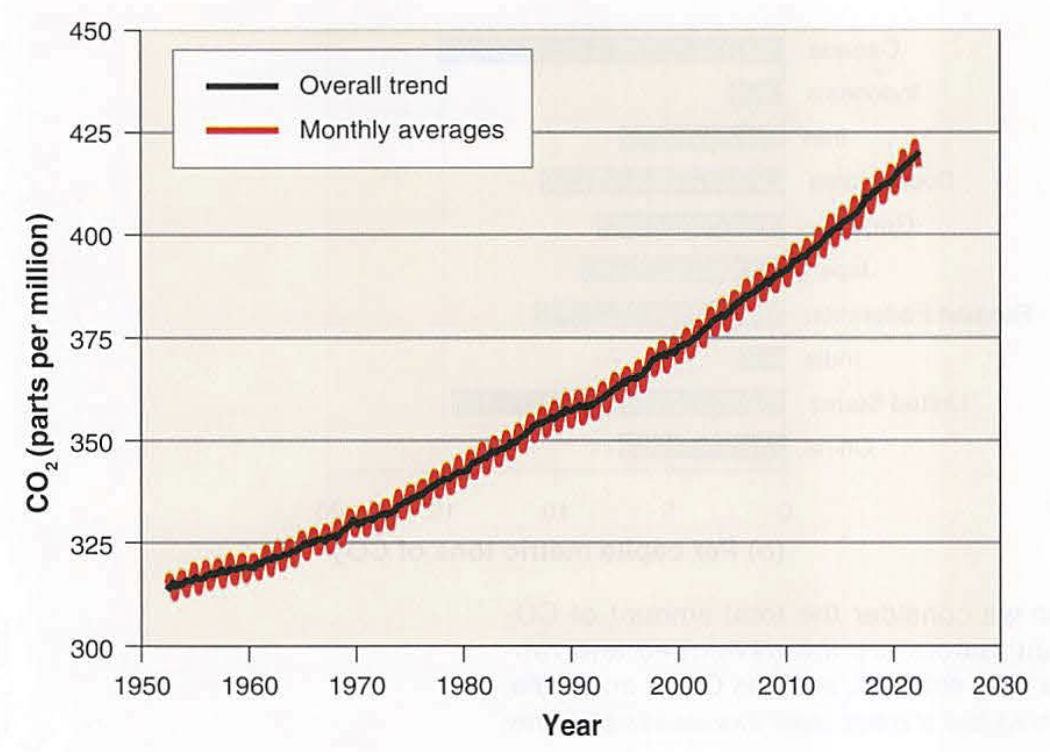Screenshot 2023-04-05 at 6.04.37 AM.png
- Seasonal variations are the little bumps, which represent our seasons in the northern hemisphere
- These would be reversed in the southern hemisphere
- Causes: photosynthesis uptakes carbon
- Pre-industrial level was 280 ppm
- Larger increase is about 1.6 ppm per year, so in 2008 when the elab was built, our CO2 sensors were calibrated as "normal" with 385 ppm.
- Today the average is around 440 ppm
- Check out the ppm today in the workshop: [http://10.14.20.1/](http://10.14.20.1/)
Sources:
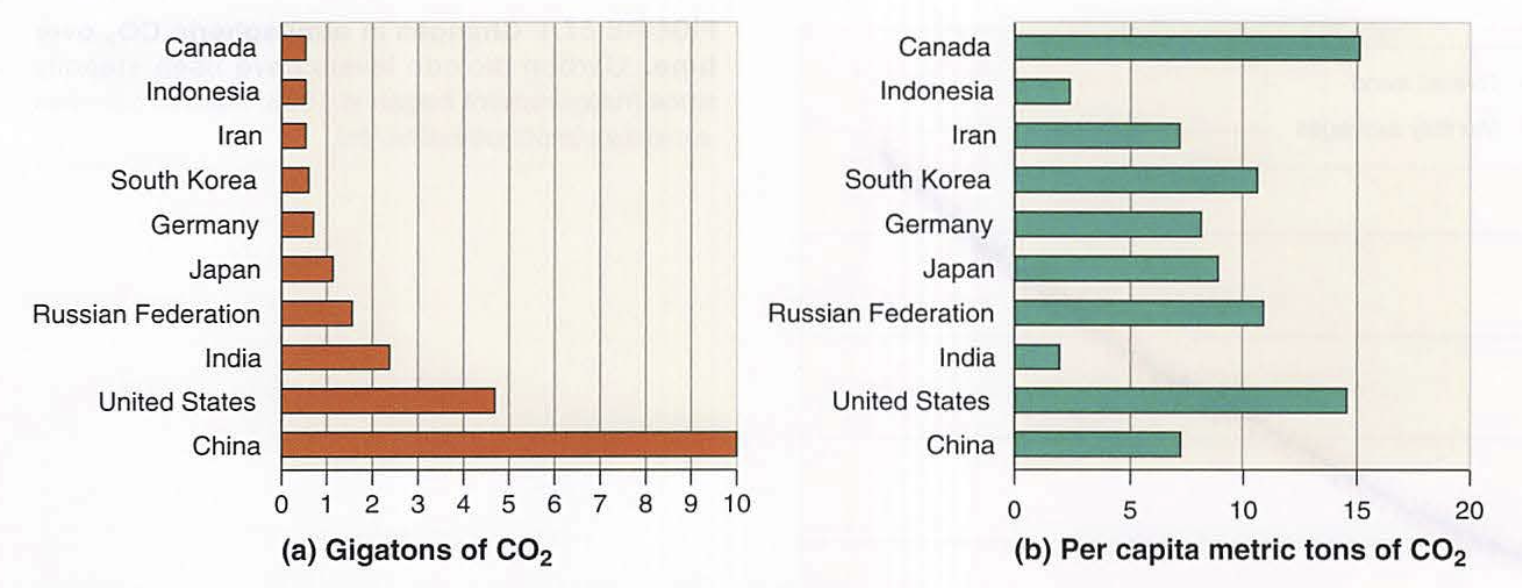Screenshot 2023-04-05 at 6.10.18 AM.png
Notice the leading country (China) due to use of coal for energy
Notice also the leading per capita country (Canada) due to lower population
2024 was officially the hottest year on record, surpassing the previous record-holder, 2023, and the last 10 years have been the warmest 10 on record.
Annual increase:
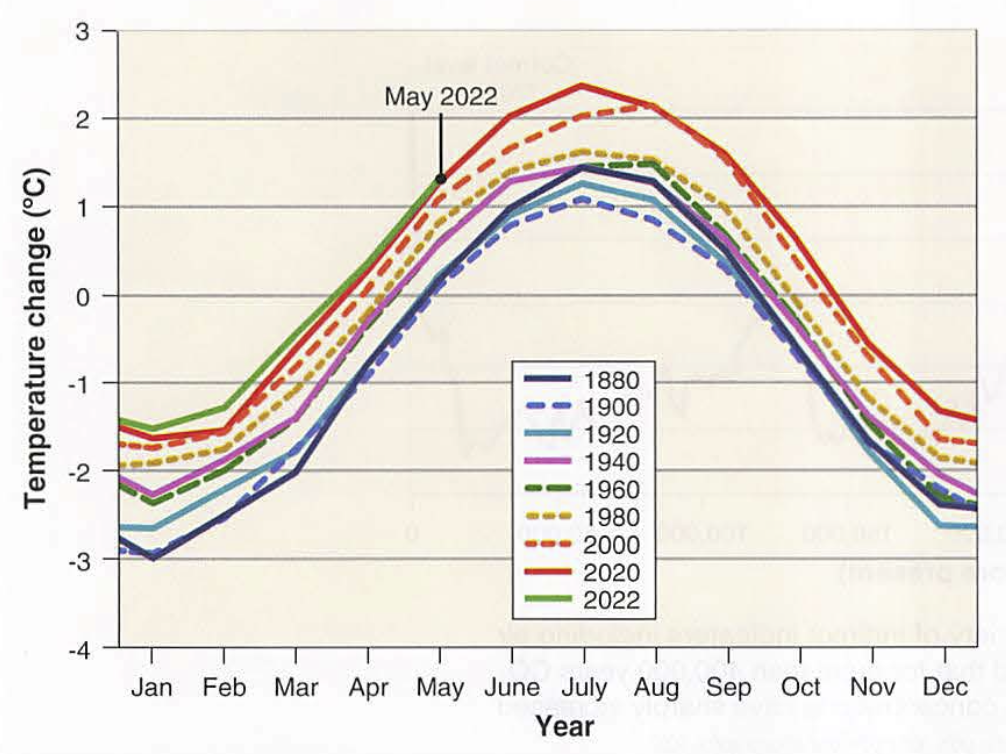Screenshot 2023-04-05 at 6.14.12 AM.png
Note we still have seasons, but the winters are warmer, the summers are hotter
So: more energy in the atmosphere, more water in gaseous form, so stronger storms, floods, hurricanes, [tornadoes](https://www.washingtonpost.com/weather/2023/04/02/tornadoes-climate-change/?utm_campaign=tempest-news-2023&utm_medium=email&_hsmi=253194624&_hsenc=p2ANqtz-8PRcFSDEw4vV2l70RLlJTmtquIatdDiToONPzKxBo056QxYdkJcNL-JxtG6EC7nfEnumYJ_FAbk1QFFMamF5pFoPsaVQ&utm_content=253194624&utm_source=hs_email)
How do we know about long term trends?
Ice cores from 500,000 years ago hold gas bubbles with CO2 levels intact, max was 300 ppm:
This is known as the "hockey stick" graph:
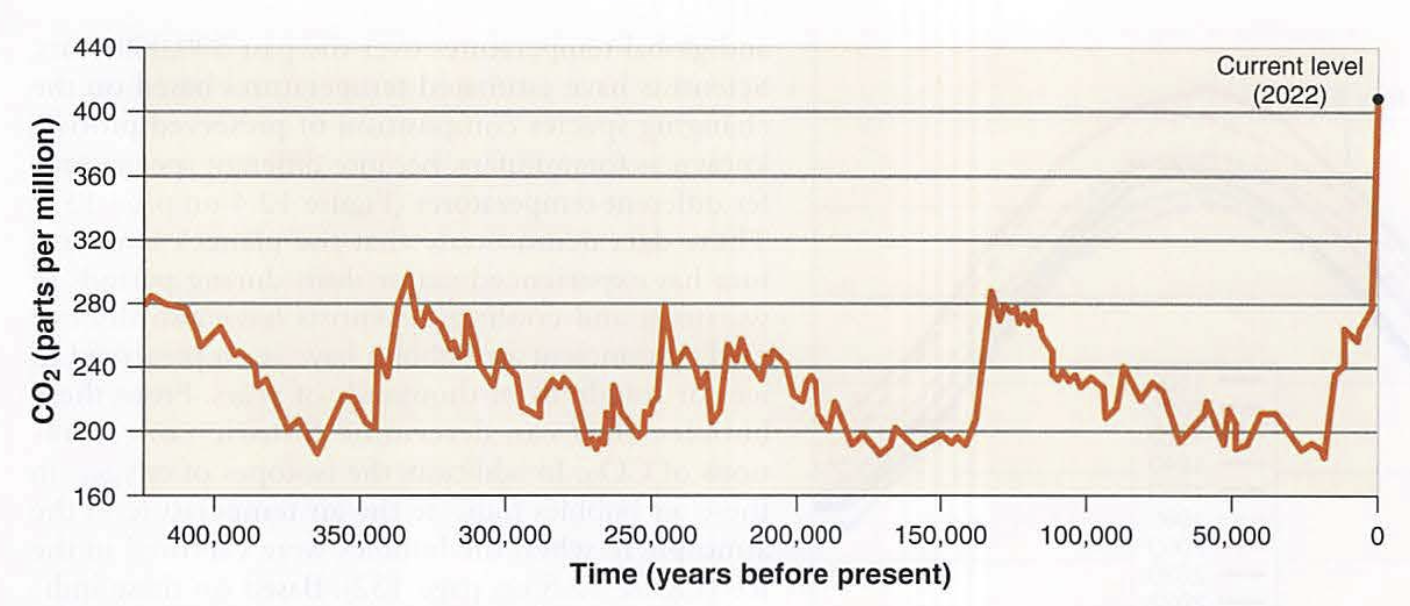Screenshot 2023-04-05 at 6.17.50 AM.png
Other anthropogenic gases have also increased since the industrial revolution:
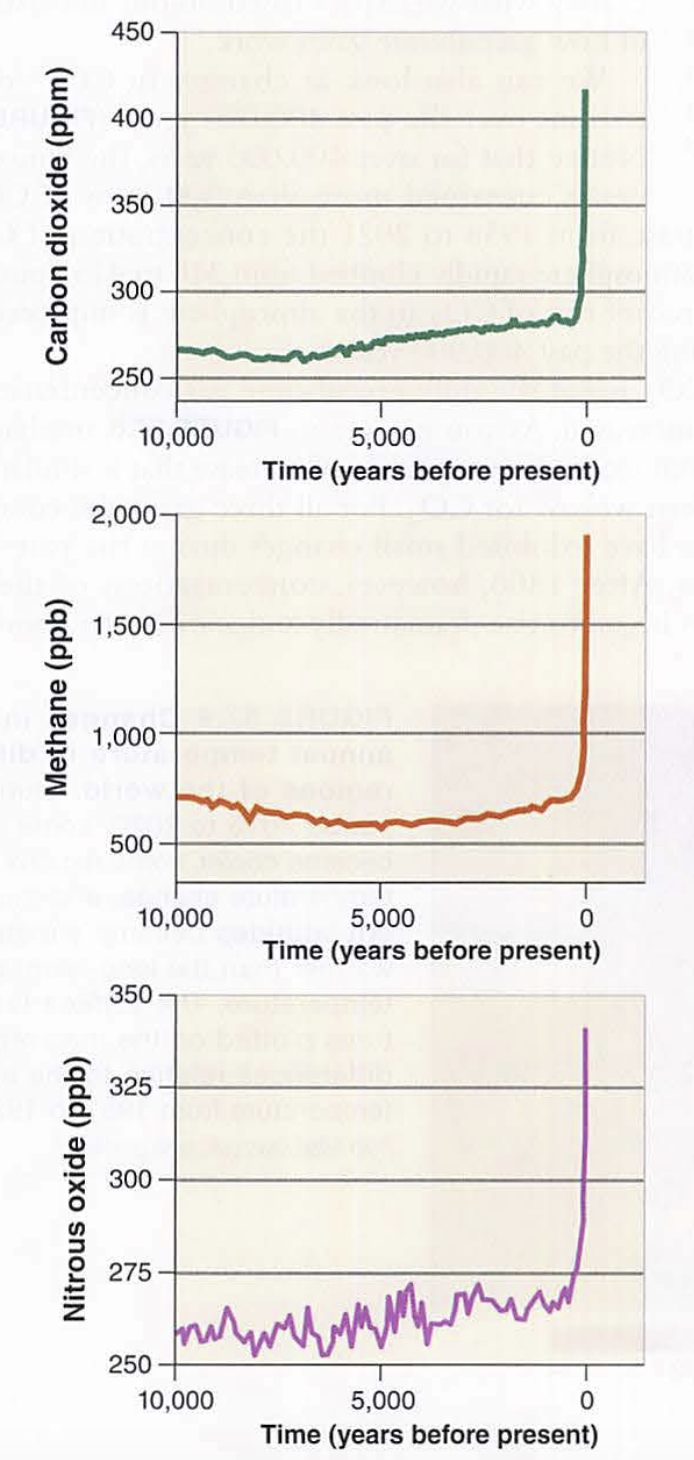Screenshot 2023-04-05 at 6.18.46 AM.pngIncreased temp has a positive feedback loop:
1. increased greenhouse gases from anthropogenic sources
2. increased atmospheric and ocean temperatures
3. melting ice caps, lowers the "whiteness" or albedo of the planet
4. planet absorbs more heat
5. more ice melts
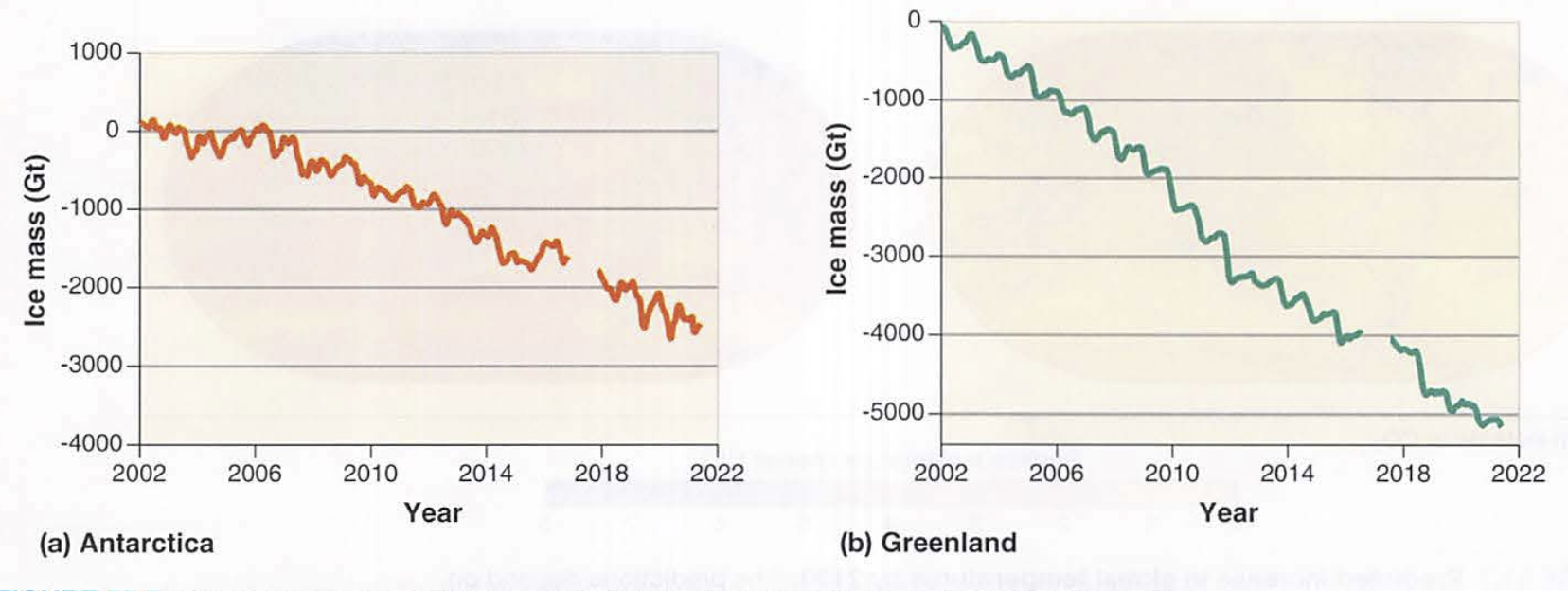Screenshot 2023-04-05 at 6.25.33 AM.png
- There is a second more scary version of this with the permafrost:
- Recall that methane is about 44x as potent as a greenhouse gas
- Siberia, Canada and Alaska are covered with up to 1600 meters of frozen, un-decomposed plant matter called the permafrost (20% of the planet actually)
- As this melts, it will decompose anaerobically, releasing lots of methane.
- This is another positive feedback loop, and one reason we need to keep the global warming to under 2°C
Glaciers are the "water towers for the world" where melting ice creates river flow in many rivers (e.g. Asia)
As these glaciers recede, the annual flow in the spring and summer will decrease, impacting farming.
As the sea level rises, the amount of arable (farmable) land in low coastal areas will decrease due to salt water intrusion.
Combining these means less land and less water for farming, esp. in Asia
One reason China is buying lots of land in Africa...
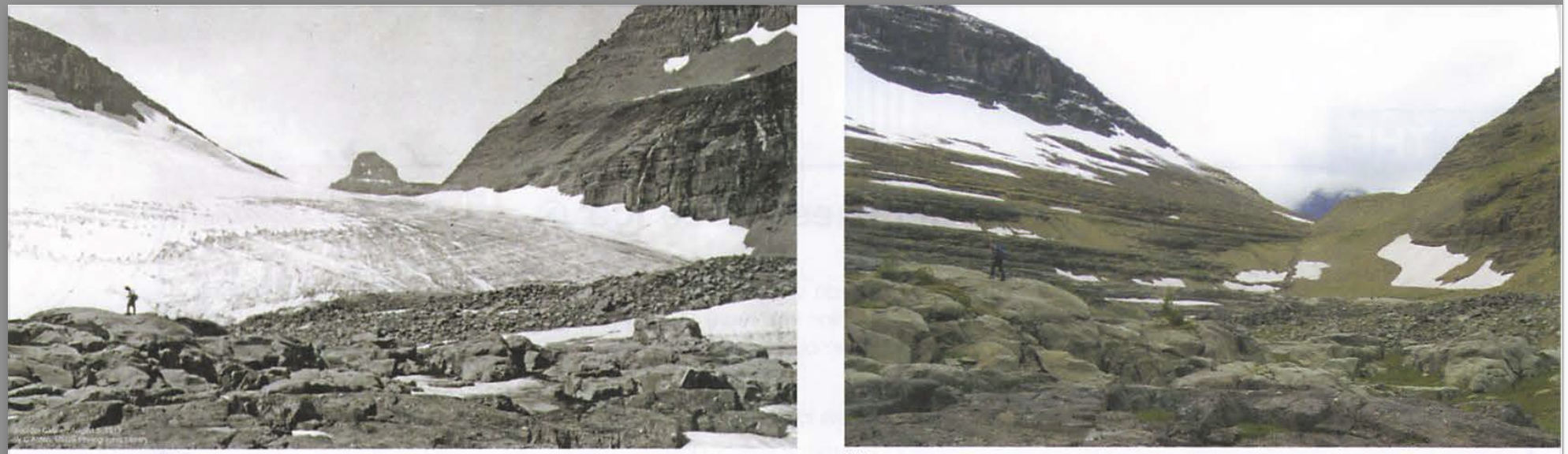Screenshot 2023-04-05 at 6.28.26 AM.png
Ocean currents may change: thermohaline current could cease, meaning freezing average temps for Europe
Sea levels will rise: melting ice plus expansion of warmer water
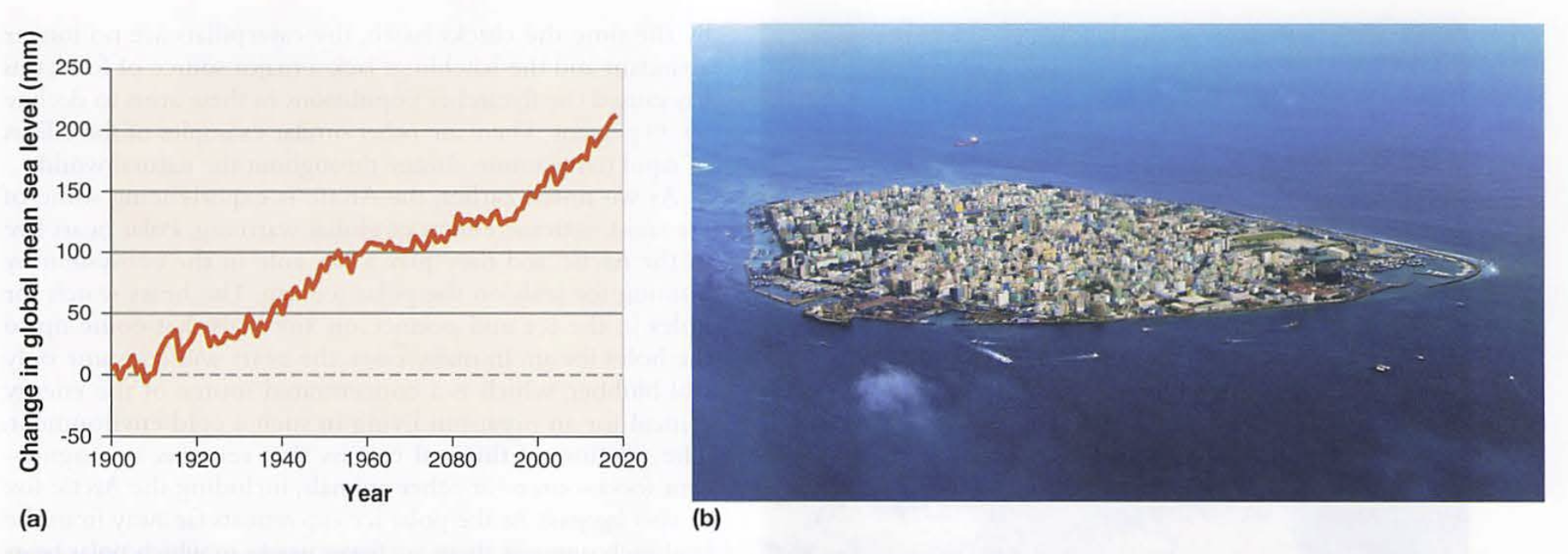Screenshot 2023-04-05 at 6.32.57 AM.pngWhat can you do?
"Climate helplessness" is a common response
You are well informed, you understand cause and effect, and can make informed decisions for your future
You can also explain these concepts to others, changing the lives of others...
---
Migrated from Apple Server Wiki. Original page ID: w5A1w2J
# Unit 9: Global Change: 4.58: ocean warming and acidification
Two main ideas:
1. Global warming is causing ocean water to expand, rising sea levels
2. Increased CO2 in the atmosphere is changing the pH of the oceans (ocean acidification)
- Some lakes (confined, smaller bodies of water) have increased by 2°C or more
- Oceans has warmed by 1.5-2°C
- 2.7°C in the top layers (!)
- Kyoto protocol: 5.2% decrease in greenhouse gases by 2012
- Paris climate Accord: 2°C max temp increase
Result:
- fish migration, northwards
- coral bleaching: mutualistic algae ([zooxanthellae](https://en.wikipedia.org/wiki/Zooxanthellae)) dies
- corals are sensitive to pH, temp, sedimentation, pollution, disease and salinity (few corals on windward shores of Hawaii due to freshwater runoff)
- some genetic researchers are trying to create heat resistant corals (CRISPR) and other variants of zoozanthellae (A-C)
Ocean acidification:
## CO2 + H2O <--> H2CO3 <--> HCO3- + H+
## H2CO3 is carbonic acid
H+ joins with water to become H3O+ known as the hydronium ion (basis for low pH)
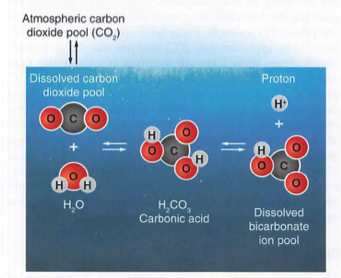Screen Shot 2023-04-08 at 4.02.29 PM.png
Important:
As pH decreases, CaCO3 in corals dissolves (AP exam question last year) and creatures have a harder time absorbing calcium carbonate
Coral Bleaching:
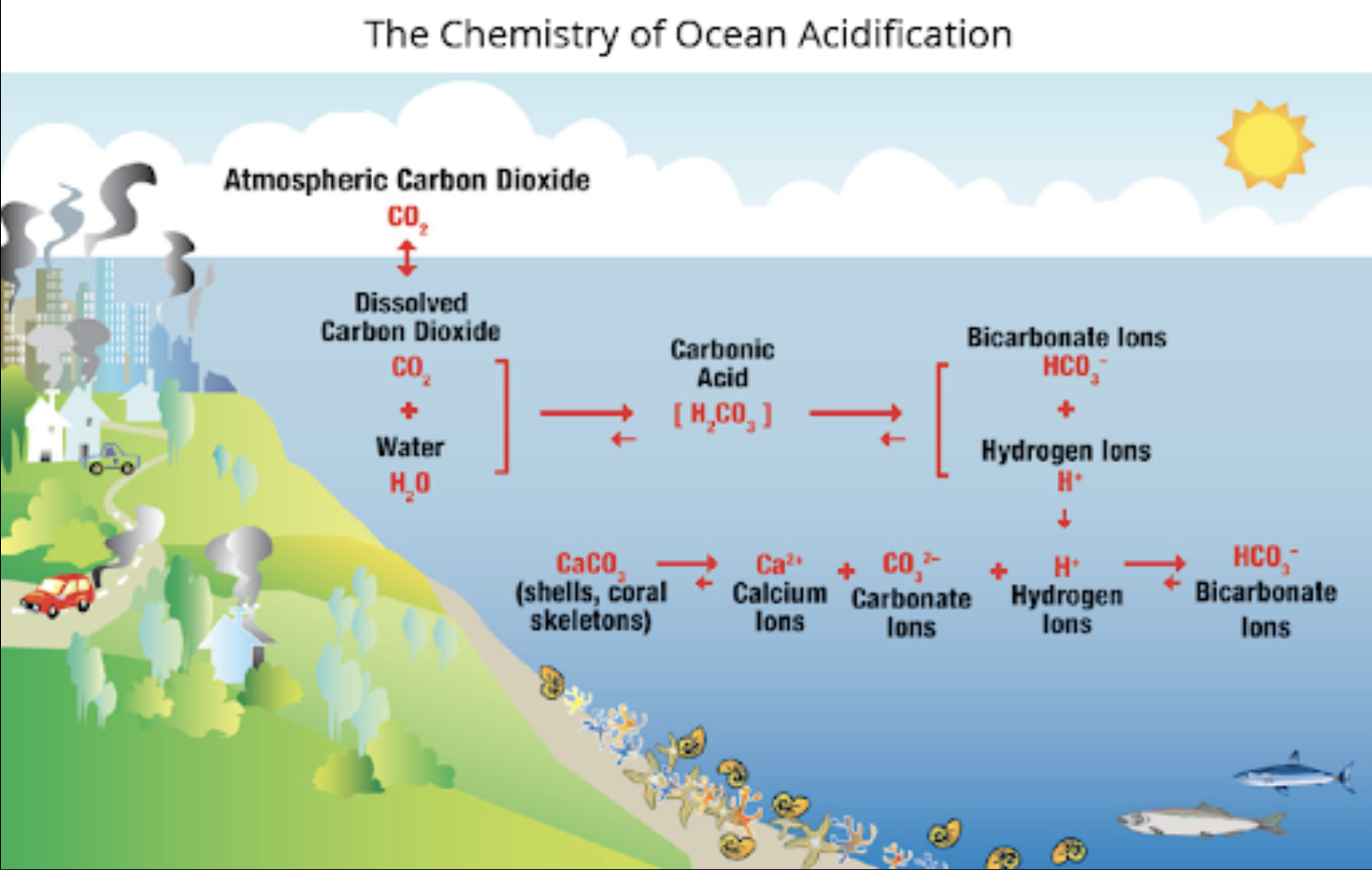Screenshot 2025-04-25 at 4.59.45 AM.png
Here’s how to read this:
The top formula is what you know already:
CO2 + H2O <-> H2CO3<-> H+ + HCO3-
The next bit is more complex:
Since there is lots of H+ in the ocean with acidification, it pulls CO3-- out of coral:
Follow coral from the left:
CaCO3—>Ca++ + CO3-
CO3-- + H+ —> HCO3-
This second part is what you may be asked about on the AP exam...
Important: Invasive species have fewer predators and/or can adapt much faster than native species, often r-selected species with fast growth
Plant philosophy: faster ones survive to get nutrients and solar radiation
Equilibrium: equal freedom or balance: equi= equal, librium=freedom
Classic case: [Zebra mussels](https://www.usgs.gov/faqs/what-are-zebra-mussels-and-why-should-we-care-about-them) in the great lakes-carried in along with water ballast from Asia
[Zebra mussels](https://nas.er.usgs.gov/queries/FactSheet.aspx?speciesID=5) are an invasive, fingernail-sized mollusk that is native to fresh waters in Eurasia. Their name comes from the dark, zig-zagged stripes on each shell.
Zebra mussels:
- Probably arrived in the Great Lakes in the 1980s via ballast water that was discharged by large ships from Europe.
- They have spread rapidly throughout the Great Lakes region and into the large rivers of the eastern Mississippi drainage.
- They have also been found in Texas, Colorado, Utah, Nevada, and California.
- Zebra mussels negatively impact ecosystems in many ways, filtering out algae that native species need for food and they attach to--and incapacitate--native mussels.
- Power plants must also spend millions of dollars removing zebra mussels from clogged water intakes.
Other mistakes:
- Mongoose in Hawaii-kills birds (eats the eggs),
- Cane toads in Australia
- Kudzu vine from Asia, grows 1 foot per DAY
- Silver carp in great lakes (40#) Look up video!
Endangered species: likely to go extinct in the near future
- Habitat destruction
- Migration disruption
- Invasive species competition
- Disruption of food supplies (e.g. predator-prey)
Biodiversity: genetic diversity and genetic bottlenecks (recall the humpback whale)
- Habitat loss
- Invasive species
- Climate change
- Overfishing
- Pollution
Look up IUCN
List of threats:HIPPCO another mnemonic
- Habitat destruction
- Invasive species
- Population growth-human
- Pollution
- Climate change
- Overexploitation
Laws to know:
- Marine mammal protection act: prohibits killing of marine mammals in the US
- Lacey Act: prohibits interstate shipping of illegally harvested plants and animals (big in Hawaii)
- Endangered species act (ESA): 1973 protects endangered species in US
- CITES: international law, Convention on international trade in endangered species, 1973
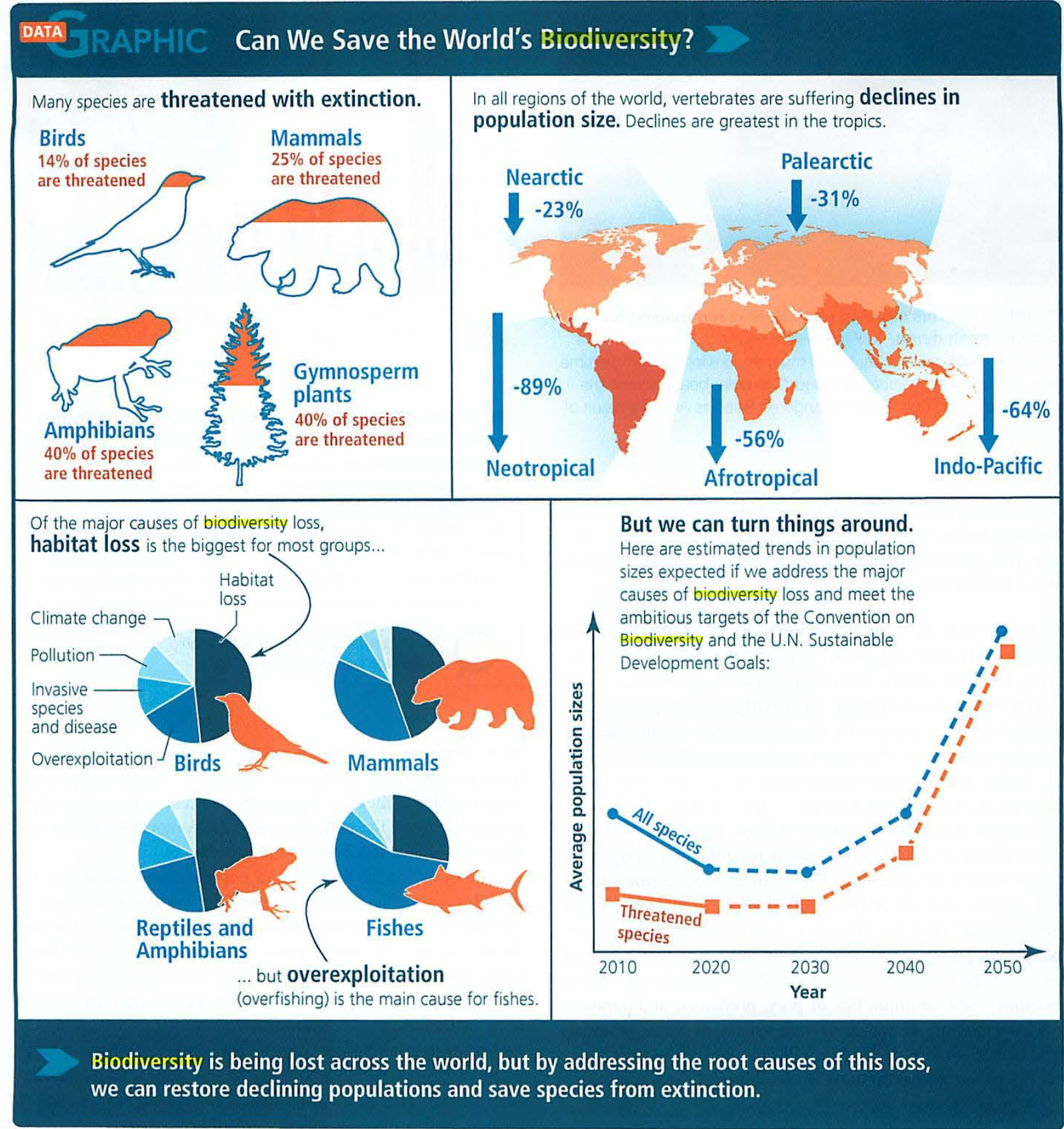Screenshot 2024-04-21 at 6.57.54 AM.png
The World Wildlife Fund's Living Planet Report 2022 found that wildlife populations declined by an average 69% since 1970
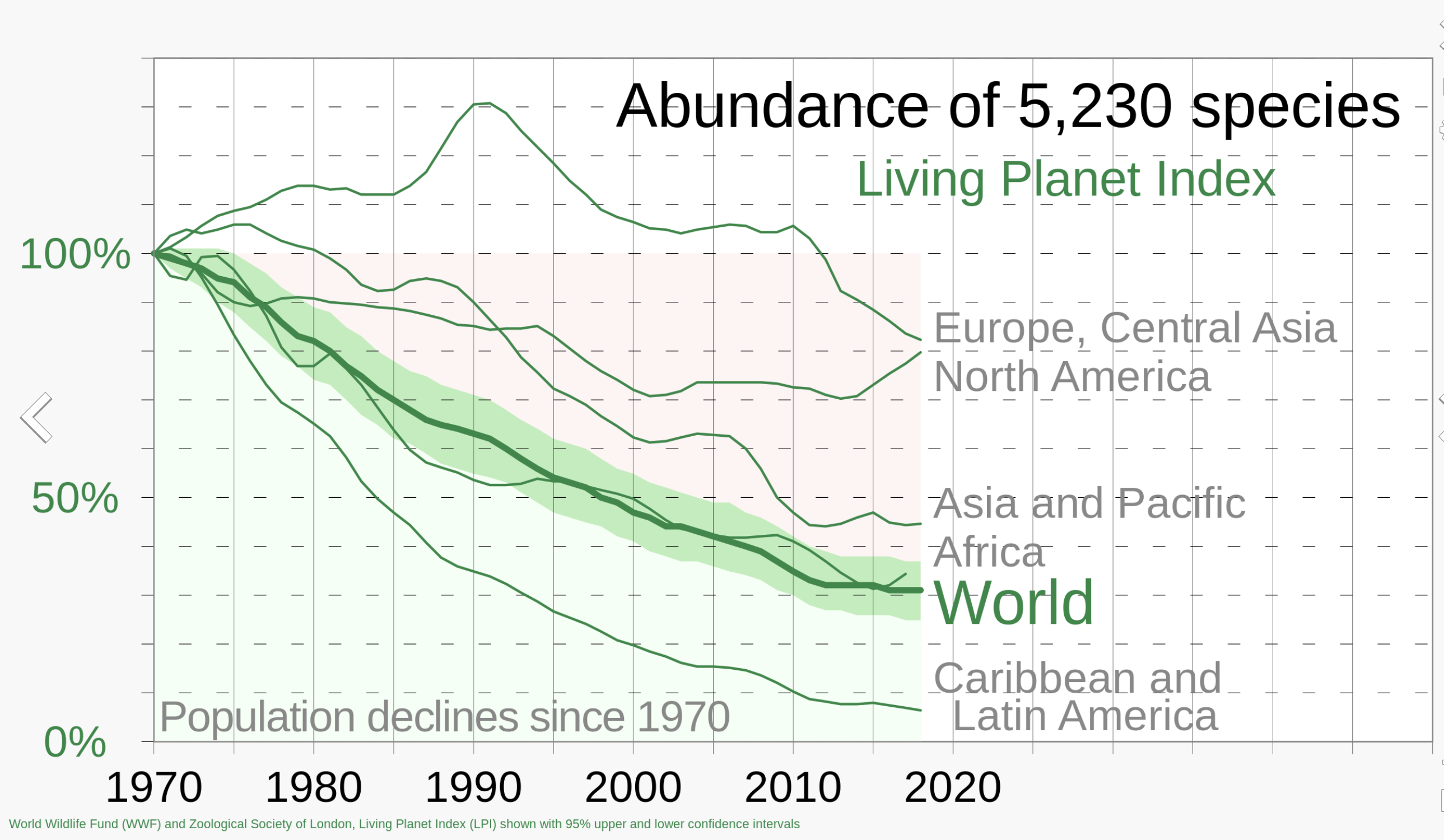Screenshot 2024-04-22 at 12.53.16 PM.png
Global biodiversity hot spots:
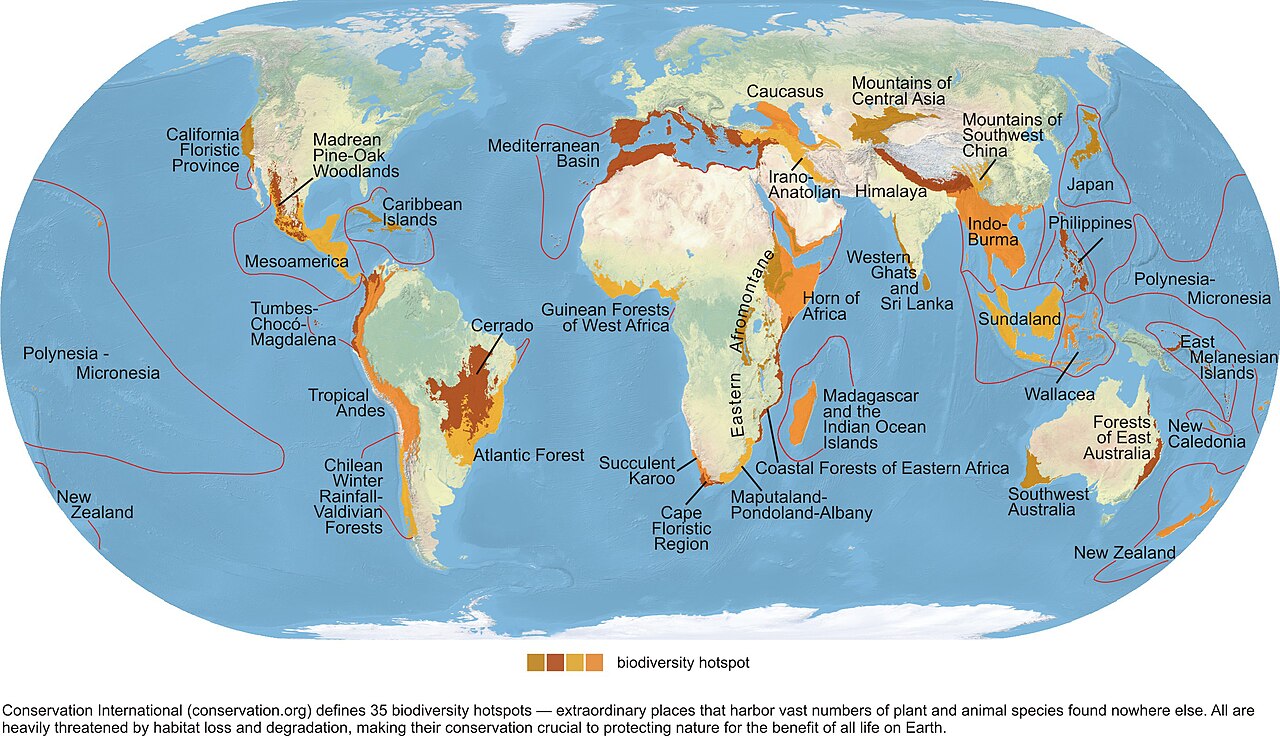1280px-Biodiversity\_Hotspots\_Map.jpg
Map of life dashboard: [https://mol.org/dashboard/home](https://mol.org/dashboard/home)
Finally, look up our island on the biodiversity maps...why?
---
Migrated from Apple Server Wiki. Original page ID: \_4j487S
# Bozeman Science folder
Bozeman science folder:
[https://elab.local/apes/videos/bozeman\_science/](https://elab.local/apes/videos/bozeman_science/)
Classes before your AP exam May2:
- M 4.17
- W 4.19
- M 4.24
- W 4.26
- F 4.28
---
Migrated from Apple Server Wiki. Original page ID: p7W1c0p9n
# AP exam study guide v.1
Comprehensive 2023 AP Environmental Science (APES) Study Guide
Unit 1: The Living World: Ecosystems 1.1 Introduction to ecosystems 1.2 Biogeochemical cycles 1.3 Energy flow in ecosystems 1.4 Primary productivity 1.5 Trophic levels 1.6 Food chains and food webs 1.7 Ecological succession 1.8 Biomes \*1.9 Impacts of human activity on ecosystems
Unit 2: The Living World: Biodiversity 2.1 Biodiversity and its importance 2.2 Species diversity 2.3 Genetic diversity 2.4 Ecosystem diversity 2.5 Evolution and natural selection \*2.6 Threats to biodiversity \*2.7 Conservation of biodiversity 2.8 Restoration ecology 2.9 Ecosystem services
Unit 3: Populations 3.1 Population dynamics 3.2 Population growth models 3.3 Carrying capacity 3.4 Survivorship curves 3.5 Age structure diagrams 3.6 Human population growth \*3.7 Factors affecting human population growth 3.8 Demographic transition 3.9 Global population trends and projections
Unit 4: Earth Systems and Resources 4.1 Earth's layers 4.2 Plate tectonics 4.3 Soil formation and properties 4.4 Soil degradation and conservation 4.5 Earth's atmosphere 4.6 Global circulation patterns 4.7 Climate and weather 4.8 Biogeochemical cycles (detailed) \*4.9 Human impact on natural systems
Unit 5: Land and Water Use 5.1 Agriculture 5.2 Agricultural practices 5.3 Sustainable agriculture 5.4 Forestry 5.5 Rangelands 5.6 Urban land use \*5.7 Water resources and management 5.8 Water pollution 5.9 Water conservation and treatment
Unit 6: Energy Resources and Consumption 6.1 Energy concepts 6.2 Energy efficiency 6.3 Renewable energy sources 6.4 Nonrenewable energy sources 6.5 Nuclear energy 6.6 Global energy consumption trends \*6.7 Environmental impacts of energy production and consumption 6.8 Energy conservation strategies 6.9 Sustainable energy solutions
Unit 7: Atmospheric Pollution 7.1 Air pollution sources 7.2 Criteria air pollutants 7.3 Hazardous air pollutants 7.4 Indoor air pollution 7.5 Air pollution control measures \*7.6 Stratospheric ozone depletion 7.7 Photochemical smog 7.8 Acid deposition 7.9 Air pollution and human health
Unit 8: Aquatic and Terrestrial Pollution 8.1 Water pollution sources 8.2 Types of water pollutants 8.3 Eutrophication 8.4 Ocean pollution 8.5 Solid waste management \*8.6 Hazardous waste management 8.7 Brownfields 8.8 Superfund sites 8.9 Pollution prevention and remediation
Unit 9: Global Change 9.1 Climate change 9.2 Greenhouse gases 9.3 Climate feedbacks 9.4 Impacts of climate change \*9.5 Mitigation and adaptation strategies 9.6 Ozone depletion 9.7 Loss of biodiversity 9.8 Invasive species 9.9 Human-driven global changes
Note: The starred (\*) topics are considered the hardest or most important, so allocate more time to studying these areas.
---
Migrated from Apple Server Wiki. Original page ID: T78433H7
# AP exam study guide v.2 (bigger)
MATERIAL:
Unit 1: The Living World: Ecosystems
- Definition and components of an ecosystem, including abiotic and biotic factors
- Types of ecosystems, including terrestrial, freshwater, and marine ecosystems
- Primary productivity, including gross and net primary productivity
- Food webs and trophic levels, including producers, consumers, and decomposers
- Energy flow and nutrient cycling in ecosystems, including the carbon cycle, nitrogen cycle, and phosphorus cycle
- Ecological succession, including primary and secondary succession
- Disturbances in ecosystems, including natural and human-caused disturbances
Unit 2: The Living World: Biodiversity
- Definition and importance of biodiversity, including ecosystem services
- Levels of biodiversity, including genetic, species, and ecosystem diversity
- Threats to biodiversity, including habitat destruction, pollution, overharvesting, and invasive species
- Conservation strategies for preserving biodiversity, including habitat conservation, restoration, and protected areas
Unit 3: Populations
- Definition and characteristics of a population, including population density and distribution
- Factors that affect population size, including birth rates, death rates, immigration, and emigration
- Population growth models, including exponential and logistic growth models
- Carrying capacity and population regulation, including density-dependent and density-independent factors
- Human population growth, including historical trends and future projections
Unit 4: Earth Systems and Resources
- The structure and composition of the earth's atmosphere, lithosphere, and hydrosphere
- The carbon cycle, including sources and sinks of carbon, and the impacts of human activities on the carbon cycle
- The nitrogen cycle, including sources and sinks of nitrogen, and the impacts of human activities on the nitrogen cycle
- The phosphorus cycle, including sources and sinks of phosphorus, and the impacts of human activities on the phosphorus cycle
- The water cycle, including water availability and water management strategies
- Soil types and properties, including physical, chemical, and biological properties
- Land use practices, including agricultural practices, urbanization, and deforestation, and their impacts on the environment
Unit 5: Land and Water Use
- Different types of land use, including agriculture, urban development, mining, and forestry, and their impacts on the environment
- Soil erosion and conservation practices, including conservation tillage and crop rotation
- Water use and management, including groundwater depletion, water pollution, and water conservation strategies
- Impacts of dams and other water management strategies on aquatic ecosystems
Unit 6: Energy Resources and Consumption
- Types of energy sources, including fossil fuels, nuclear, and renewable energy sources, and their advantages and disadvantages
- The energy crisis and energy conservation, including energy efficiency and demand-side management
- The impacts of energy use on the environment, including air pollution, water pollution, and climate change
- The relationship between energy use and economic development, including the concept of energy intensity
Unit 7: Atmospheric Pollution
- Different types of air pollutants, including particulate matter, sulfur dioxide, nitrogen oxides, and ozone, and their sources and effects on human health and the environment
- Sources of air pollution, including natural and anthropogenic sources, and strategies for reducing air pollution, including regulations and technologies
- The Clean Air Act and its history and impact on air pollution control
Unit 8: Aquatic and Terrestrial Pollution
- Different types of water pollution, including point source and non-point source pollution, and their sources and effects on aquatic ecosystems and human health
- Different types of soil pollution, including chemical and biological pollution, and their sources and effects on terrestrial ecosystems and human health
- Strategies for reducing water and soil pollution, including regulations and technologies, conservation practices, and pollution prevention strategies
- The Clean Water Act and its history and impact on water pollution control
- The Superfund program and its role in cleaning up contaminated sites
Unit 9: Global Change
- The causes and effects of climate change, including greenhouse gas emissions, ocean acidification, and sea level rise
- Mitigation strategies for climate change, including reducing greenhouse gas emissions, carbon capture and storage, and renewable energy sources
- Adaptation strategies for climate change, including adjusting to changing climate patterns and protecting vulnerable populations and ecosystems
- The impact of human activities on the ozone layer, including the production and use of ozone-depleting substances
- The impacts of deforestation and desertification on the environment, including loss of biodiversity and ecosystem services, and strategies for addressing these issues
LEGISLATION:
Unit 1: The Living World: Ecosystems
- Endangered Species Act (1973): Protects endangered and threatened species and their habitats
- National Environmental Policy Act (1969): Requires federal agencies to evaluate the environmental impact of their actions and decisions
- Clean Water Act (1972): Regulates and protects the quality of water in the United States
- Clean Air Act (1963): Regulates and reduces air pollution in the United States
Unit 2: The Living World: Biodiversity
- Endangered Species Act (1973): Protects endangered and threatened species and their habitats
- Convention on International Trade in Endangered Species of Wild Fauna and Flora (1973): Regulates and monitors international trade in endangered species
- National Environmental Policy Act (1969): Requires federal agencies to evaluate the environmental impact of their actions and decisions
Unit 3: Populations
- Clean Air Act (1963): Regulates and reduces air pollution in the United States
- Clean Water Act (1972): Regulates and protects the quality of water in the United States
- Resource Conservation and Recovery Act (1976): Regulates the management of hazardous waste
Unit 4: Earth Systems and Resources
- Clean Water Act (1972): Regulates and protects the quality of water in the United States
- Clean Air Act (1963): Regulates and reduces air pollution in the United States
- Resource Conservation and Recovery Act (1976): Regulates the management of hazardous waste
- National Environmental Policy Act (1969): Requires federal agencies to evaluate the environmental impact of their actions and decisions
Unit 5: Land and Water Use
- Clean Water Act (1972): Regulates and protects the quality of water in the United States
- National Environmental Policy Act (1969): Requires federal agencies to evaluate the environmental impact of their actions and decisions
- Endangered Species Act (1973): Protects endangered and threatened species and their habitats
Unit 6: Energy Resources and Consumption
- Clean Air Act (1963): Regulates and reduces air pollution in the United States
- Energy Policy Act (2005): Encourages the development of renewable energy sources and energy efficiency
- National Environmental Policy Act (1969): Requires federal agencies to evaluate the environmental impact of their actions and decisions
Unit 7: Atmospheric Pollution
- Clean Air Act (1963): Regulates and reduces air pollution in the United States
- Montreal Protocol (1987): Regulates the production and use of ozone-depleting substances
Unit 8: Aquatic and Terrestrial Pollution
- Clean Water Act (1972): Regulates and protects the quality of water in the United States
- Resource Conservation and Recovery Act (1976): Regulates the management of hazardous waste
- Superfund Amendments and Reauthorization Act (1986): Provides funding for the cleanup of hazardous waste sites
Unit 9: Global Change
- Paris Agreement (2015): An international agreement to combat climate change by reducing greenhouse gas emissions
- Clean Air Act (1963): Regulates and reduces air pollution in the United States
- National Environmental Policy Act (1969): Requires federal agencies to evaluate the environmental impact of their actions and decisions
RESOURCES:
Unit 1: The Living World: Ecosystems
- Khan Academy: Ecosystems and biogeochemical cycles
- Crash Course: Ecology
Unit 2: The Living World: Biodiversity
- Khan Academy: Biodiversity and conservation biology
- The Nature Conservancy: Biodiversity 101
Unit 3: Populations
- Khan Academy: Population ecology
- Crash Course: Population ecology
Unit 4: Earth Systems and Resources
- Khan Academy: Earth's systems and the geosphere
- Crash Course: Geology and earth science
Unit 5: Land and Water Use
- Khan Academy: Land use and water resources
- The Environmental Working Group: Farming and land use
Unit 6: Energy Resources and Consumption
- Khan Academy: Energy and the environment
- US Energy Information Administration: Energy sources and usage
Unit 7: Atmospheric Pollution
- Khan Academy: Air pollution and the Clean Air Act
- Environmental Defense Fund: Air pollution basics
Unit 8: Aquatic and Terrestrial Pollution
- Khan Academy: Water pollution and water management
- National Geographic: Soil pollution
Unit 9: Global Change
- Khan Academy: Climate change and its impacts
- United Nations Framework Convention on Climate Change: Climate change and policy
MOST DIFFICULT (based off previous APES students reviews) *regardless of unit*
1. Climate change and its impacts on the environment and human society
2. The impacts of human activities on the natural environment, including habitat destruction, pollution, and overexploitation of natural resources
3. Mitigation and adaptation strategies for climate change
4. Understanding biogeochemical cycles, including the carbon cycle, nitrogen cycle, phosphorus cycle, and water cycle
5. The complex interrelationships between different components of ecosystems, including food webs, trophic levels, and energy flow
6. Understanding population dynamics, including factors that affect population growth and carrying capacity
7. Understanding the different types and sources of pollution, including water, air, and soil pollution, and strategies for reducing pollution
8. Understanding the different types of land use, including agriculture, urban development, mining, and forestry, and their impacts on the environment
9. Understanding the different types of energy sources, including fossil fuels, nuclear, and renewable energy sources, and their advantages and disadvantages
10. Understanding the economic, political, and social factors that influence environmental policy and decision-making.
---
Migrated from Apple Server Wiki. Original page ID: n3u3H7K8
# week one 8.16.23
Welcome to APES!
Resources:
- [elab.hpa.edu](http://elab.hpa.edu) also known as elab.local (on campus) or elab.kamuela.org (off campus)
- Bozeman science videos
- [https://elab.local/apes/videos/bozeman\_science/](https://elab.local/apes/videos/bozeman_science/)
- [http://www.bozemanscience.com/ap-environmental-science](http://www.bozemanscience.com/ap-environmental-science)
- Science review
- [https://elab.local/apes/texts/sci\_review-ocr/](https://elab.local/apes/texts/sci_review-ocr/)
- AP central join codes
- APES D XM624X
- APES E PVYZGG
- Text: Friedland and Relyea 4th edition, with sapling (trying this out)
- Other texts located here: [https://elab.local/wiki/projects/apes/apes.html](https://elab.local/wiki/projects/apes/apes.html)
- weblog is our main materials platform (older ones are on physics.local)
Discussion points:
1. control vs. variable? dependent vs. independent variable?
2. x vs. y : making a graph
3. precision vs. accuracy: accuracy: actual truth, precision: how detailed
4. mks system: kg, km, m3
5. prefixes kilo, mega, giga, centi, milli, micro, nano
6. unit conversion: km to millimeters
7. temp: K, C, F
quiz on these next week...
Homework:
- Get the text (online or print)
- Watch Bozeman science video 001
- Check MyHPA for updates
Day 2:
- Pick three topics (yours or others)
- It is now 2056, you are about 50 years old
- What has changed in each of the three?
- Visualize solutions: what is needed, by whom?
Global footprint:
[https://www.footprintnetwork.org/resources/footprint-calculato](https://www.footprintnetwork.org/resources/footprint-calculator/)r
Cause and effect:
Why does the girl think her dad is an alien?
[https://www.youtube.com/watch?v=sVRAtQ7XjkM](https://www.youtube.com/watch?v=sVRAtQ7XjkM)
What don’t we see between the kiss and him driving home?
[https://www.youtube.com/watch?v=g7\_slK24lXU](https://www.youtube.com/watch?v=g7_slK24lXU)
Monty Python Witch scene:
[https://www.youtube.com/watch?v=Ii68tPIiZOo](https://www.youtube.com/watch?v=Ii68tPIiZOo)
1. Can you follow cause and effect?
2. What is their logical path?
3. Why do folks associate fracking with earthquakes? (chapter one in the text)
4. Why do folks associate fossil fuels with global heating?
5. Who might be against this line of reasoning and why?
Scientific method:
1. control vs. variable? dependent vs. independent variable?
2. x vs. y : making a graph
3. precision vs. accuracy: accuracy: actual truth, precision: how detailed
4. mks system: kg, km, m3
5. prefixes kilo, mega, giga, centi, milli, micro, nano
6. unit conversion: km to millimeters
7. temp: K, C, F
ca66b0e5-5ef2-5ef2-595a-0a1a9548ea1a
ca66b0e1-17b2-17b2-2680-cfb9a9afa870
ca66b0e1-17b2-17b2-2680-cfb9a9afa870
---
Migrated from Apple Server Wiki. Original page ID: 20w2N0t5g8
# e2: Portland sense of place 2.2024
e2: portland sense of place
[https://elab.local/apes/videos/e2/e2%20transport/5%20Portland-sense%20of%20place.mp4](https://elab.local/apes/videos/e2/e2%20transport/5%20Portland-sense%20of%20place.mp4)
[https://elab.kamuela.org/apes/videos/e2/e2%20transport/5%20Portland-sense%20of%20place.mp4](https://elab.kamuela.org/apes/videos/e2/e2%20transport/5%20Portland-sense%20of%20place.mp4)
[https://elab.hpa.edu/apes/videos/e2/e2%20transport/](https://elab.hpa.edu/apes/videos/e2/e2%20transport/)
Remember to hold option to download the video for watching, and let me know if you have issues with the video.
1. Morgan Freeman or Brad Pitt?
2. What is urban sprawl and what technologies enable it?
3. Portland was on the path of suburban sprawl in the 1960's. Why?
4. What does this have to do with “Food Deserts”?
5. 1973 was a pivotal year there, what happened, driven by which group?
6. What was the initial reason for the mandate, and what was the final result according to Charlie Hales?
7. Look up Charlie Hales, what was his job after this film (2009).
8. How many years before his tram project was the last urban streetcar project in the US?
9. Explain an urban growth boundary (UGB).
10. Accessibility vs. mobility is the choice they made, like in Switzerland, as well as other European cities. What do you see in the video that you might also see in Europe?
11. What things in the video do you recognize that show a bike friendly city?
12. Who is the first class passenger in Portland, and how does this compare to Los Angeles or other similar city?
13. What is a “sustainable urban lifestyle”?
14. Cities in Europe have vibrant city centers, and are great cities to walk around. How is this done in Portland?
15. Explain "trip behavior".
16. How much did property values increase in the Pearl district after the trolley went in? Why? (note the amount of glass in each trolley). [http://www.explorethepearl.com/](http://www.explorethepearl.com/)
17. Michael Powell of Powell’s books compares buses (“tire-d” transportation) with permanent tracked transportation-what are the differences according to him?
18. How did he sell this idea to the property owners there? Was he right?
19. For what reasons would an electric tram or trolley be greener than a fossil fuel car or even a standard bus in Portlans?
20. Portland required that every building have street level shops, and limited parking-why?
21. How does an aerial tram like at OHSU enable different growth trends?
22. What would be different without the tram (parking, traffic, time in car, development)?
23. How will self driving cars change Portland or other cities?
24. The young mom says “we did not want to spend all that time in the car”. What is she talking about?
25. What are "lifestyle migrants”?
26. What is "gentrification"? Where else have you seen this? (hint: look up the term "landed gentry") [https://en.wikipedia.org/wiki/Gentrification](https://en.wikipedia.org/wiki/Gentrification)
27. What does the man mean about a "burlap future”?
28. What is the difference between aspiration and acquisition?
29. How does the concept of choice resonate with values in this country? What do you think?
30. Bring this home: what would you do at HPA to make it more sustainable? What about Waimea? Hawaii in general? Your home?
---
Migrated from Apple Server Wiki. Original page ID: C748y2t
# e2: energy for a developing world 2.2024
e2: energy for a developing world
[https://elab.local/apes/videos/e2/e2%20energy/2%20energy%20for%20a%20developing%20world.mp4](https://elab.local/apes/videos/e2/e2%20energy/2%20energy%20for%20a%20developing%20world.mp4)
[https://elab.kamuela.org/apes/videos/e2/e2%20energy/2%20energy%20for%20a%20developing%20world.mp4](https://elab.kamuela.org/apes/videos/e2/e2%20energy/2%20energy%20for%20a%20developing%20world.mp4)
[https://elab.hpa.edu/apes/videos/e2/e2%20energy/](https://elab.hpa.edu/apes/videos/e2/e2%20energy/)
If you have difficulty viewing the video, please hold option while clicking on the link. This will download the video to your computer
1. Morgan Freeman or Brad Pitt?
2. This series approaches environmental issues as an economic opportunity-how?
3. Look up Muhammad Yunus in wikipedia-what did he do?
4. Jeffrey Sachs says Bangladesh is called a basket case-why?
5. What is his solution for poverty?
6. What does Yunus say about poverty? Who created it?
7. How is microcredit different from normal bank loans?
8. Who did Grameen bank impact first and why?
9. Why is energy the key to resolving poverty?
10. Jeffrey Sachs uses the term “sine qua non”. What does this mean in this sense?
11. What other things are needed in his vision?
12. If you were a 17 year old woman growing up in Bangladesh, how would Grameen Shakti change your life?
13. How would replacing kerosene lamps improve the health of women in Bangladesh?
14. What does solar lighting also free the women for?
15. How would this change their literacy, reproductive rights and children?
16. What is the impact of religion on population control, economic equality and education?
17. If you were your age and gender in Bangladesh, how would your life be different?
18. What are the three things a woman in the video buy once she has any money?
19. As women become technicians for Grameen Shakti, they are able to do something men cannot do-explain.
20. When Grameen Shakti started, a 20 Watt panel (like the one in the video) cost $200. It now costs 10$. What could happen there now?
21. What is the beautiful aspect of the biogas plant in the video?
22. The woman mentions she does not have to clean the pots-why does this impact her time more than just the washing?
23. Tie this together with other woman cooking food, how does it enable them to have more time?
24. What do they not have to do?
25. What is environmental degradation, and environmental mining or predation?
26. Bangladesh has a population of 161 million, about half of the US, in something the size of Michigan, most about 1 meter or less above sea level. What will happen to these people as global warming increases?
27. What would you do to solve this?
28. “If you do not imagine, you cannot create” If you had a gazillion (lots) dollars, and could create a solution with global impact, what would it be?
29.
For more information about editing pages, click the Action (gear) button and choose Help.
---
Migrated from Apple Server Wiki. Original page ID: n6o4p0z
# 25.08.14 Eight countries footprint research project
This project was the result of research by Mathis Wackernagel and his team at the Global Footprint Network:
While you are on this site, you can start by determining your ecological footprint.
Note how travel and food impact your score, with 1.0 earths being the goal.
- who in the class had the highest and the lowest numbers, and why?
- what are things you can change, which are out of your control?
- are dorms more efficient than single homes? explain
- we will learn later on that New York City dwellers have a low footprint-why?
- how does your diet impact your footprint?
- how does your commute to school, or back home at holidays impact your footprint?
Next, we'll look at lots of people, e.g. countries...
We worked with the staff at global footprint to create a mystery project:
Your team will be given a folder with 8 countries.
You may group them any way you like, but this is all about cause and effect:
- carbon (blue, bottom line)
- cropland (orange)
- grazing land (yellow)
- fishing grounds (blue)
- forest (green)
- built-up land (red, top line)
Live version: [https://data.footprintnetwork.org/#/countryTrends?cn=5001&type=BCtot,EFCtot](https://data.footprintnetwork.org/#/countryTrends?cn=5001&type=BCtot,EFCtot)
Keep in mind, the total is like a cake: all of the categories add up to the top level
You will also notice that countries with green above red have a positive footprint balance, while those with red above do not.
The negative impacts are often carbon and built-up land, but not always.
Consider the following, trying to determine cause and effect:
- How would you group the countries? Language? Economy? Religion? Footprint?
- What are the general trends in each?
- When do you see great changes or transitions, and in what category?
- What events seem to be periodic?
- What is the shape and duration of each "event"?
- When would you predict that each country goes from net positive to negative footprint balance or reverse?
- Where would you want to live when you are 40? Why?
This is all about cause and effect.
Google can give you answers or try to explain cause and effect.
It is often wrong.
Try using google with the "more" tab to just use web.
Have fun!
---
Migrated from Apple Server Wiki. Original page ID: C1r5\_8Q
# Week two 8.28.23: environment, scientific method
apes D T Th
apes E MWF
- summarize your cause and effect projects for presentation in day 2 of the week
- begin exploration of cause and effect
- begin readings from fr text chapter 1 (link below)
FR3e chapter 1 (covers things newer version of the text does not)
energy->water->food->culture
1. With energy you can move/purify water
2. With water you can grow food
3. With food you can maintain a culture
What is the "environment"?
- Front of ship fell off-[https://www.youtube.com/watch?v=3m5qxZm\_JqM](https://www.youtube.com/watch?v=3m5qxZm_JqM)
- "we towed it out into the environment"..."you mean into another environment"
Environment: Everything around us, including us
Climate change map-try this out:
[https://impactlab.org/map/#usmeas=absolute&usyear=2080-2099&gmeas=absolute&gyear=1986-2005&usyear=1986-2005&gmeas=absolute&gyear=1986-2005](https://impactlab.org/map/#usmeas=absolute&usyear=2080-2099&gmeas=absolute&gyear=1986-2005&usyear=1986-2005&gmeas=absolute&gyear=1986-2005)
Nebraska->Alberta by 2050
Module 1 -------------
Fracking-know what it is? Why is it controversial? How has it changed how we generate electricity in our country? At what cost? Why is this politically important? Why are the solvents they use secret? What is the impact of these solvents on water?
Bio=life, so biotic means living, abiotic means not living (druids had a neat view on this)
How systems are defined enables us to create models of cause and effect (favorite topic of physicists and historians as well)
Module 2 ---------------
Environmental indicators: what we know and can observe that indicate the condition of a system
- Biodiversity
- Food production
- Global warming
- Human Population
- Resource depletion
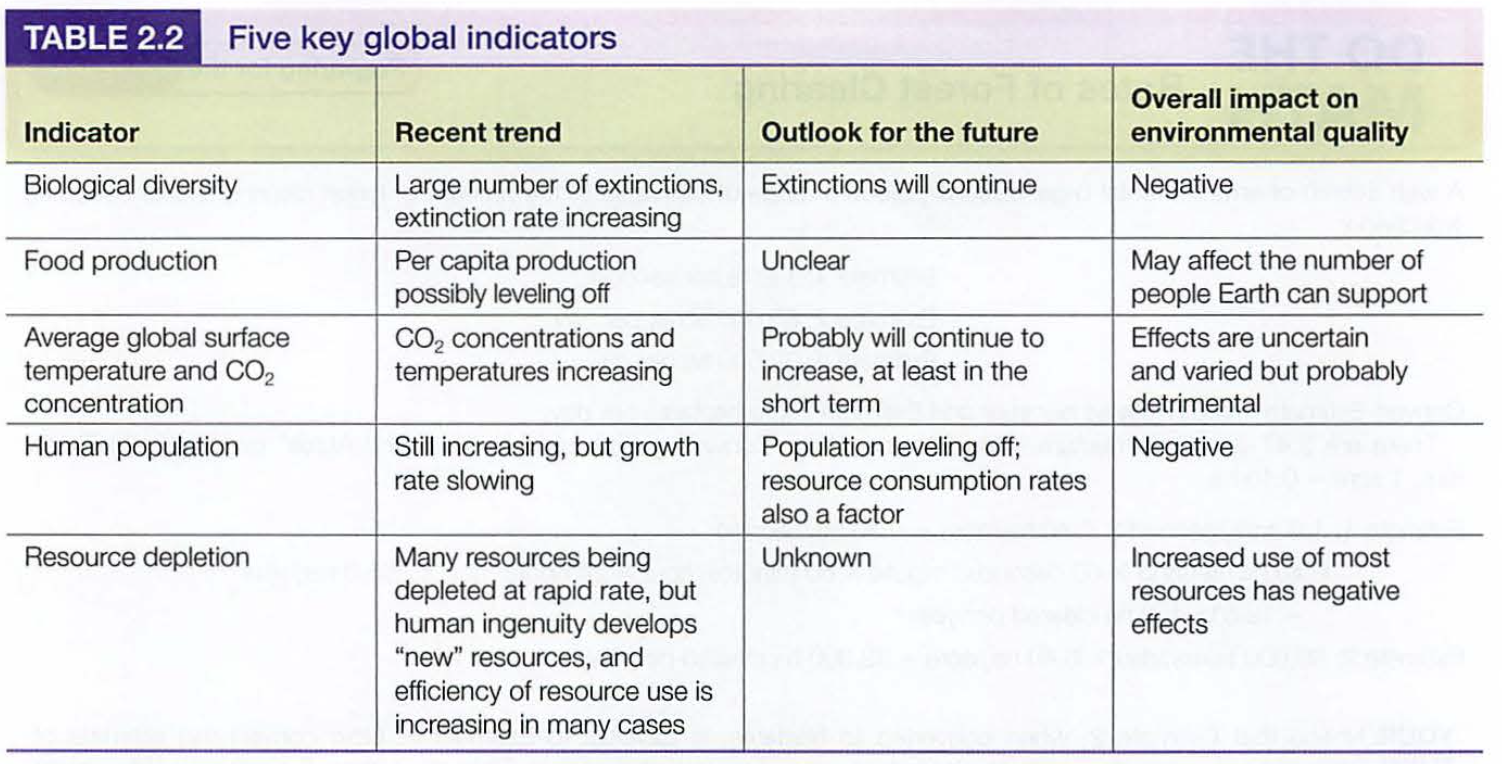Screenshot 2023-08-27 at 4.15.26 PM.png
Ecosystem services: can be economic, direct or cascading (fishing in the Gulf of Mexico impacted by offshore oil spills)
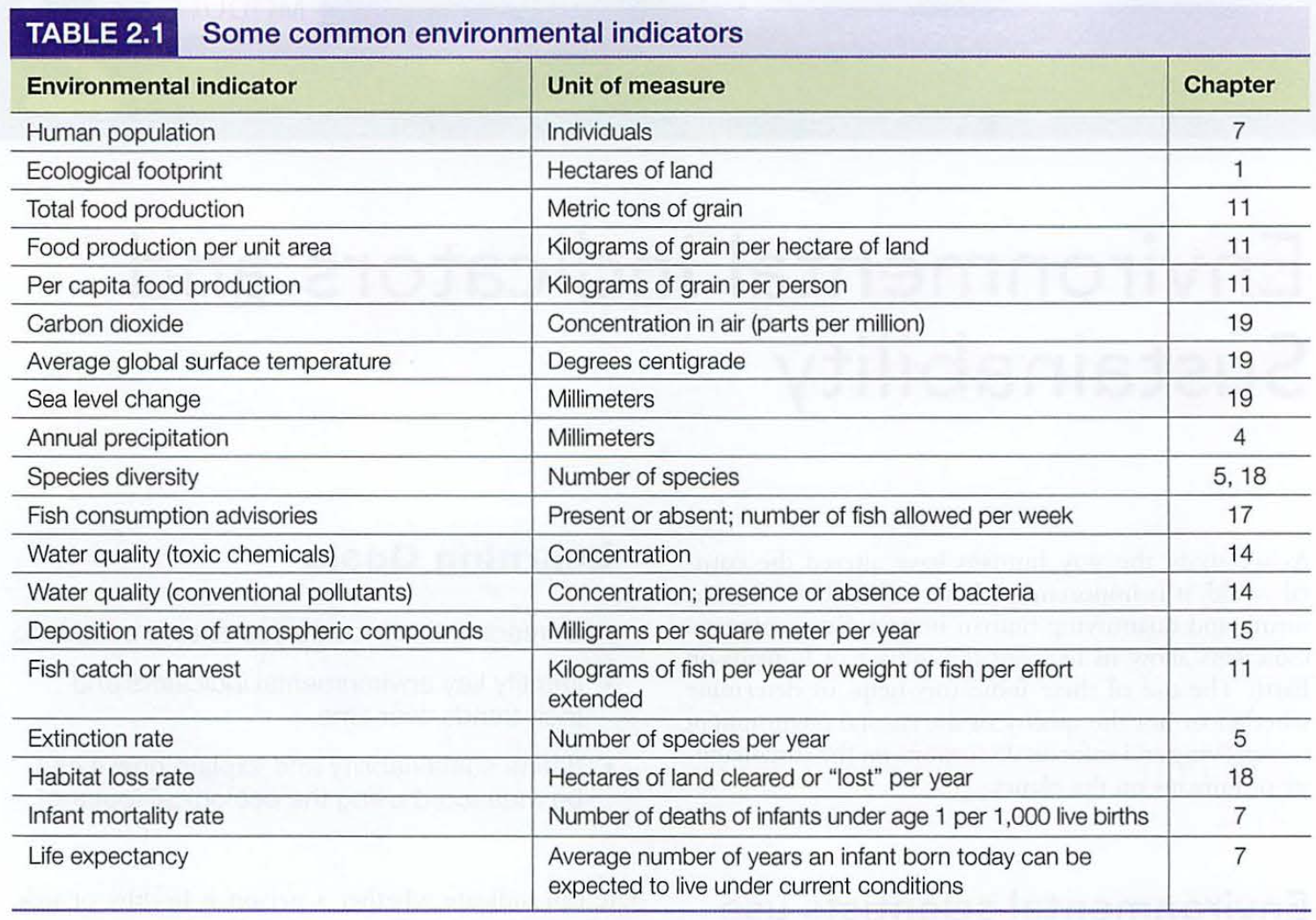Screenshot 2023-08-27 at 4.00.04 PM.png
1. Biodiversity: biological diversity (more about this later)
- Robust systems (can be biological, racial, technological) all have strong diversity
- Genetic Diversity: genetic variation within a population (corn for example)
- Species: ducks vs. dogs
- Species diversity: variation of species in an ecosystem
- Speciation (more) vs. extinction (less)
- Background speciation rate (cosmic rays)
- Background extinction rate (before humans, much higher in the anthropocene era)
Speciation: an adaptation based on stress (evolution)
Evolution needs three things:
1. some form of genetic variation
2. some stress that favors this variation
3. survivors have to reproduce and carry on the variation
Think of giraffes as an example:
1. longer necks in some animals
2. drought that kills all short neck creatures (just like in land before time)
3. long neck animals survive to reproduce and carry on the variation
Cool stuff:
- There is a theory that the background rate of mutation/speciation was much higher long ago because our atmosphere was thinner, and enabled more cosmic rays to penetrate, causing much higher rates of mutation/speciation.
- In England, butterflies have adapted since 1850 to look more like soot from coal fires.
- In NYC, a species of "subway mosquitoes" have been found that feed on humans in a dark, cool place
- Huh.
Extinction is the opposite of speciation, where species die off (except in the film Jurassic Park)
There is such a thing as a "background rate of extinction", which we have surpassed by many times
Diversity is good: think of monoculture food crops: one pest kills everything
2. Food production: see Malthus and Norman Borlaug, e.g. Mexico famine
- grain variation and monoculture
- regional grain production (e.g. Pearl river delta)
- vegetarian vs. carnivores
3. Global Warming
Man made, from burning fossil fuels (anything that was living, decayed capturing atmospheric carbon)
carbon dioxide was in the air, then captured as plants and animals
we burn their carbon with oxygen to make carbon dioxide
greenhouse gases: trap infrared radiation, warming the planet (cause and effect)
Not too many people know we need some CO2 to keep water above freezing-think of this as we search for exoplanets...
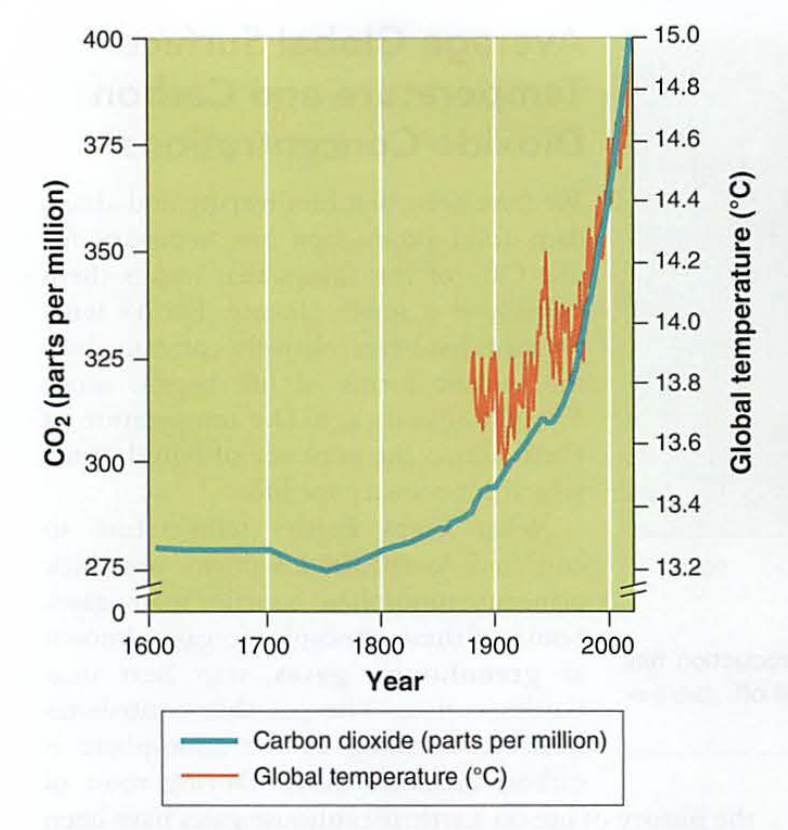Screenshot 2023-08-27 at 4.12.53 PM.png
4. Human population
- growth rates
- dispersion
- access to water
- Why was China’s one child policy eventually a problem for China?
- education, reproductive rights and religion
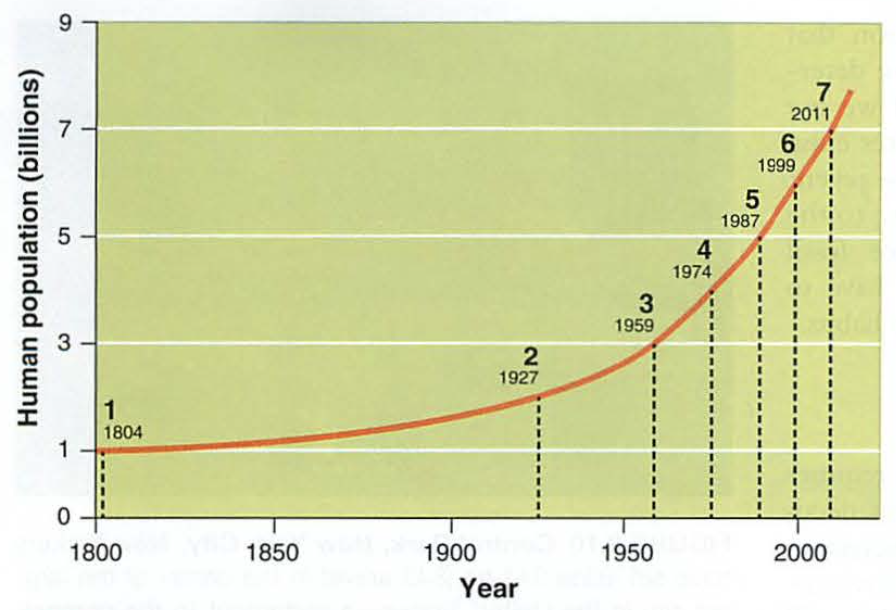Screenshot 2023-08-27 at 4.17.07 PM.png
5. Resource depletion
- water is first
- Resource depletion is hard to grasp, but resource constraints are easier:
- If we had a major tsunami here that closed airports (all near the shore) and ports, how long would we have electricity?
- water? (pumped by electricity)
- food?
Sustainability: ability to sustain present conditions forever (not likely)
Ecological footprint: what you calculated
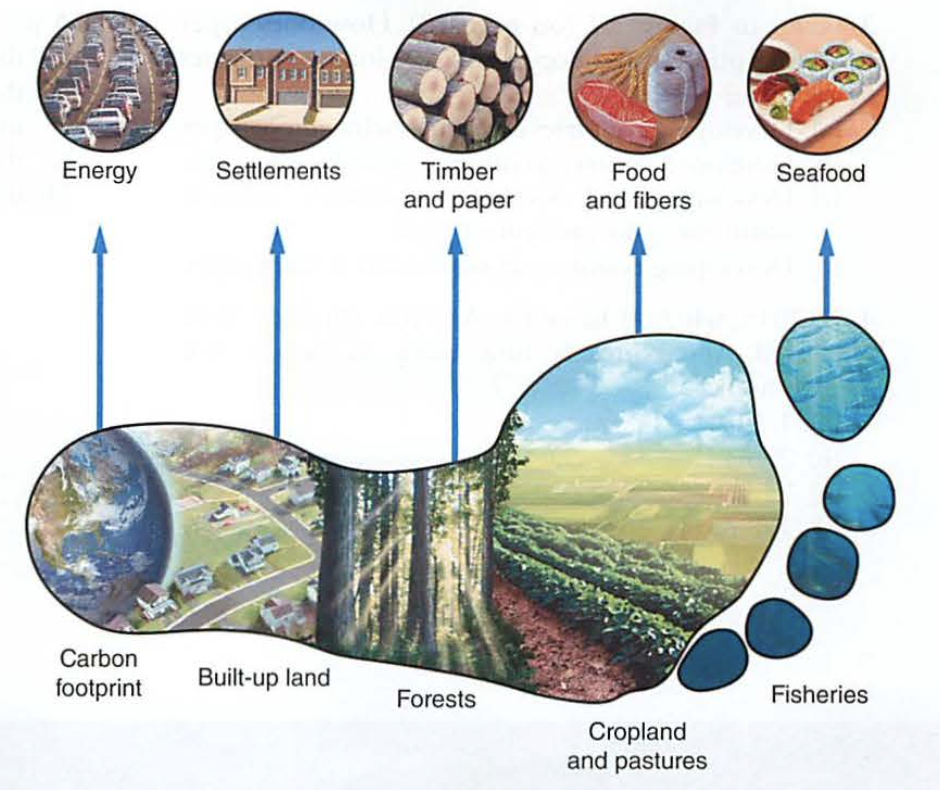Screenshot 2023-08-27 at 4.17.50 PM.png
1. Can you follow cause and effect?
2. What is their logical path?
3. Why do folks associate fossil fuels with global heating?
4. Who might be against this line of reasoning and why?
5. Fact: in ancient times, women were thrown into ponds to determine if they were witches. If the water "rejected them" they were possessed by the devil and therefore witches. If not, they just drowned. It is a wonder we made it this far.
6. Another example: cold fusion (look this up) Ponds and Fleishmann claimed they could replicate the processes in the sun (1 million degrees C) in a cooler on a table.
7. Science is built on replication: if a process cannot be replicated, it cannot become part of the scientific "pyramid" of understanding. No bad blocks allowed.
8. Also key is taking notes (must be in pen, not pencil). Alfred Nobel invented dynamite. His brother's last words in his lab notebook, in pen were "I'm now going to compress the dynamite"
9. Why is there no Nobel prize for Mathematics?
The process, goofy but true:
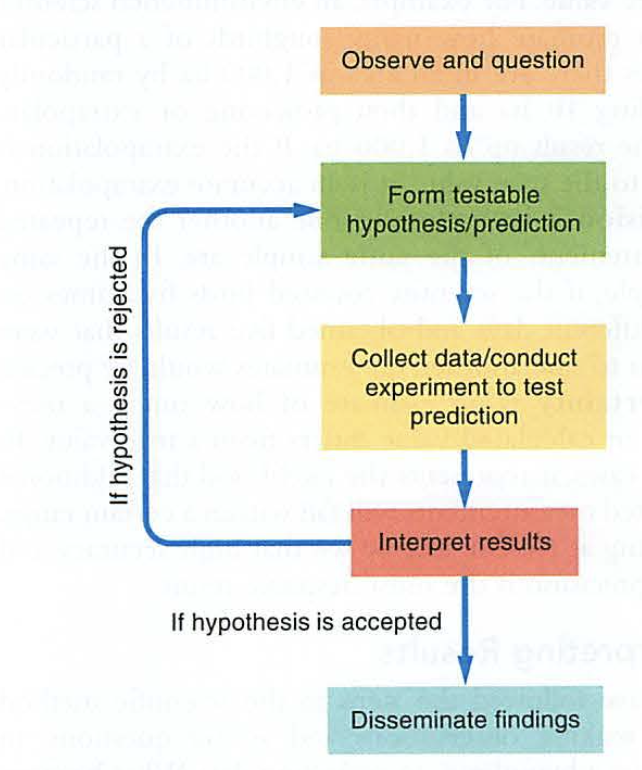Screenshot 2023-08-27 at 4.24.26 PM.png
Replication is key: if you have magic beans, and nobody can replicate your results, you are in trouble.
See also Korean claims of cloning humans (not sheep, we already did that-her name was Dolly)
Key idea: even wrong experiments are valuable: Edison: "I learned 800 ways not to make a light bulb"
Important terms (yes, these actually show up on the AP exam):
- Variable: any difference, in a planned or "natural" experiment
- Independent variable: the part that does not change (like x in a graph)
- Dependent variable: the part that changes-or not
- Null hypothesis: proving something is NOT cause and effect (can sheep's bladders be used to predict earthquakes)
- Replication: everybody must be able to get the same results, using the same materials
- Sample size (n): must be large enough to be accurate
- Accuracy: close to truth or true value
- Precision: how close your results are to each other (gas pump is in 0.01liters, but your odometer is only in miles)
- Control group: those you DON'T mess with in the experiment (think of some drug test)
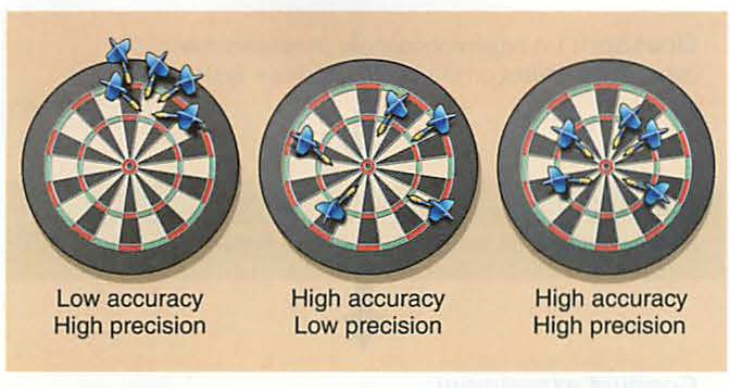Screenshot 2023-08-27 at 4.29.34 PM.png
Natural experiment: variation not planned (Lahaina, COVID, Mount Pinatubo and cooling of the planet, etc.)
Frog book (iPad) chapter one:
Screenshot 2023-08-28 at 8.00.06 AM.png
Ozone hole example: compare and contrast with anthropogenic climate change-why different?
Renewable vs. non-renewable resources (one politician recently tried to get nuclear energy classified as a renewable resource-it takes billions of years)
Renewable can be a forest, if used at a sustainable rate, otherwise not
Malthus again, Norman Borlaug again, and a new name: Paul Erlich (1968) "The Population Bomb"
In short: famine and conflict will arise from population growth.
In reality, it is much more complex, involving politics (e.g. Syria), economics (e.g. refugees from sub-Saharan Africa) and water rights (e.g. Palestine).
Jurgen Randers told me during the Elab opening that he thought in the next 50 years, China would invade Mongolia to the north, stating as a cause "religious instability" but the real cause would be access to water there.
If the Himalayan snowpack ceases to be a seasonal flow for the rivers of Asia, most of Western China would be in a drought, unable to produce food.
Ecological Footprint again:
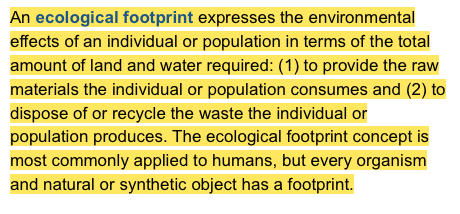
Tragedy of the Commons:
Garrett Hardin, UCSB (look this up)
We will duplicate this with a fishing example:
---
Migrated from Apple Server Wiki. Original page ID: g689G7j
# Module 4: systems and matter
IMPORTANT: for updates, please go to the Blog link at the top right cornerMain topics:
- elements: protons, neutrons, electrons
- atomic mass, isotopes
- isotopes vs. ions
- bonds: ionic and covalent
- periodic table: columns
- half lives
- pH and pOH
- melting and boiling points
- surface tension: adhesion and cohesion
- organic vs. inorganic substances
- proteins, fats, carbohydrates
Atoms and molecules:
- atom: one nucleus with protons and neutrons, electrons around the nucleus
- element: one type of atom, defined by the number of protons
- protons: positive charge, give the atom identity
- neutrons: neutral charge, gives the atom more mass
- electrons: much smaller (1/1800), negative charge, gives the atom charge
Examples: see [https://ptable.com/?lang=en#Properties](https://ptable.com/?lang=en#Properties)
Helium: He, discovered in the sun (helios), 2 protons, 2 neutrons, 2 electrons
Carbon: C, 6 protons, 6 neutrons, 6 electrons
Atomic mass is the mass of all of the protons and neutrons (electrons are too light to count)
Isotopes:
Wait: why does carbon have atomic mass of 12.011 instead of 12?
There are other types of carbon, called isotopes (same type)
C12/6, C13/6, C14/6
Each of these has the same number of protons (identity) but more neutrons
check: how many protons, neutrons and electrons in C14/6?
Ions and bonds:
so far we've been playing with the nucleus.
If you change the number of electrons from a match with protons (C6/12 has 6 electrons), we can add or take away electrons:
Na+ is Sodium missing an electron
Cl- is Chlorine with an extra electron
Why?
Look again at the periodic table: [https://ptable.com/?lang=en#Properties](https://ptable.com/?lang=en#Properties)
Everyone wants to be on the right hand column, called the noble gases
To get there, Na loses an electron to look like Neon, while Chlorine adds an electron to look like Argon (see for yourself)
These sorts of bonds, where one gives up and one takes is a very strong bond, called ionic (because it involves ions)
NaCl (salt) is one example:
- Ionic bonds have high melting points
- They conduct electricity, especially in water
The weaker type of bond you will see is called covalent.
Think of a pilot and co-pilot: both share the duties
In a covalent bond, neither one is more positive or negative, they share an electron.
Molecular Hydrogen (H2) and Molecular oxygen (O2) are good examples
so are plastics, water and other substances
Covalent bonds:
- Weak bonds
- Don't conduct electricity as well as ionic solutions
- low melting points (water, plastic, butter)
Periodic table classes:
The periodic table (here it is again: [https://ptable.com/?lang=en#Properties](https://ptable.com/?lang=en#Properties)) is key to solving riddles in APES around pollution, toxins, and many other things:
Example:
Strontium 90/38 is a radioactive isotope, a product of nuclear reactions (reactor meltdowns, nuclear weapons)
Look at the periodic table, find Strontium.
What is above it?
Calcium is part of your bones, so when you ingest Sr90/38, it is absorbed into your bones just like Calcium, since elements in the same column are chemically similar.
What sort of cancer would this cause?
Question: Cesium is a radioactive element, where would it go in your body?
Radioactivity:
The good news is these do not hang around forever, they decay into other things, some radioactive, some not.
A half life is the amount of time it takes something radioactive to decay into half of the amount it was before.
So, If you have 128 grams of Strontium 90/38, which has a half life of about 30 years, after 30 years you will have:
64 grams
Then 30 years later it will be all gone, right?
Nope: 32 grams
Then continue: 16, 8,4,2...
It never really goes completely away
We'll show you some cool ways to calculate how much is left soon...
Acids and Bases: pH
In aqueous (water) solutions, we often need to know if a solution is acidic or basic
Acids have more Hydrogen ions (H+) floating around
Bases have more hydroxide (OH-) ions floating around
Water is amphoteric (both) since it is really H-OH
Water has pH (potency of Hydrogen) of 7, in between 0 (acid) and 14 (totally base, dude)
First look at most solutions is a good guess:
NaOH base
HCL acid
See?
You try: KOH, HNO3, H2SO4, H3PO4
Which were acids and bases?
The scale is confusing, and we'll get into it with some calculators soon...
Melting and boiling points:
Water is everywhere, and we study it a lot
The melting and freezing point for water is 0°C at one atmosphere (very interesting stuff happens at other pressures, like ice hockey)
The boiling and condensation point for water at one atmosphere is 100°C (again, interesting things happen at other pressures like pressure cookers and freeze dried ice cream)
It turns out that anything added to water raises the melting and boiling points.
You may have heard to add salt when cooking pasta: this raises the boiling point a bit so the pasta cooks a bit faster.
It also explains why they add salt to ice to make ice cream, or pour salt on road to melt ice...
You can demonstrate changing pressure on melting by slowly chewing on an ice cube: pressure makes ice melt (ice hockey skates)
Surface tension: adhesion and cohesion
Water is very cool stuff: it likes to stick to other stuff (adhesion) as well as to other water (cohesion)
This makes for interesting phenomena when the sides of a container are very close, like in roots or thin hair:
As the water molecules climb up the sides of the roots (adhesion) they stretch out the molecules in the middle (cohesion).
This is called surface tension
This make the curve stretch and then shorten, so water moves up the column (roots, long hair).
This is called capillary action, and is very important for all plants.
Surface tension is also how water striders "sit" on the water: their feet stretch the water molecules.
Soaps destroy the cohesion, making water "wetter", also making little bugs fall into the water...
Organic and inorganic compounds:
Anything with a carbon backbone (like you) is an organic chemical compound
Anything without carbon is called inorganic, like salts, metals and minerals
These could be anything from the foods you eat (more on this later) to the gasoline you might put into your car.
Organic compounds can be water soluble, or not.
Hydrocarbons like gasoline and oil have only C-H bonds, so are insoluble in water (like greasy hands, or olive oil in salad dressing)
Alcohols are organic compounds with an OH molecule attached, so they can dissolve oils while also dissolving in water.
Some important alcohols:
- methanol CH3OH (toxic)
- ethanol C2H5OH (makes you drunk)
- propanol (C3H7OH) known as rubbing alcohol
Proteins, fats and carbohydrates:
All three of these can act as fuel in your body, as your body is really clever that way.
Oddly, though, even your awesome body cannot repair tissues or grow new ones without proteins
Why?
Proteins are the only food source with Nitrogen, which is key to amino acids (amines means Nitrogen)
Proteins can be used as fuel for your body by "de-amination" meaning taking off the nitrogen
Fats and carbohydrates have similar chemical formula, but vastly different structures.
Fats all have an alcohol backbone, with little strands coming off made of C-H bonds (like a hydrocarbon)
This is why most fats do not mix with water...
Carbohydrates are C-H-O bonds (anything that ends in -ate means with oxygen)
Carbs can be long strings, like starches, or compact little hexagons or pentagons like sugars
Fun fact: sugar alcohols look like sugar to your body, but don't behave like sugars-used in drinks and candies...
---
Migrated from Apple Server Wiki. Original page ID: 84A109
# Energy-Power lab
APES lab: energy and powerNotes:
- Energy is the ability to do work, measured here in Joules
- Power is work done in an amount of time, J/s = Watts
This lab will have two parts:
1. physical work and power
2. electrical work and power
Energy-Power Lab: Physical
1. If you have not already, watch the youtube video on "Robert Forstmann makes toast" [https://www.youtube.com/watch?v=S4O5voOCqAQ](https://www.youtube.com/watch?v=S4O5voOCqAQ)
2. Calculate your mass in kg (divide your weight in pounds by 2.2)
3. Measure the height of the stairs in meters
4. Get a timer
5. Walk as slowly as you can up the stairs, measure the time
6. Run as fast as you can SAFELY up the stairs, measure the time
7. Calculate the work done (energy): mass x 10 x height = joules
8. Calculate your slow power: divide energy by slow time
9. Calculate your fast power: divide energy by fast time
10. How does mass impact energy expended?
11. How does time impact energy expended?
Questions:
1. Could you expend the same amount of power for a longer time?
2. Cyclists and triathletes measure FTP (functional threshold power) or the amount of power they can deliver for 20 minutes. Would this be higher or lower than what they can deliver for 30 seconds?
3. How does your power compare with Robert Forstmann?
4. Could you power a toaster, and if so, for how long?
Energy-Power Lab: Electrical
1. First, watch this short intro into energy terms: [https://elab.hpa.edu/apes/videos/bozeman\_science/Energy%20Concepts.mp4](https://elab.hpa.edu/apes/videos/bozeman_science/Energy%20Concepts.mp4)
2. Fill one of the hot water makers with cool water from the tap
3. Measure the amount of water (listed on the side)
4. Plug in the heater, measuring the voltage on the kill-a-Watt meter (see diagram below)
5. Measure the power, it should read zero Watts
6. Turn on the heater, measure the time it takes to boil
7. While heating, measure the power used on the meter
8. Calculate the energy used: time in seconds x J/s or time x Watts = Joules
9. Refill the container with cool tap water, only using half of the original amount
10. Repeat the heating, measuring time
11. What is the power this time?
12. What is the energy used this time?
Questions:
1. How does the power compare in both cases?
2. How does the energy compare in both cases?
3. If you only needed enough boiling water for one ramen or cup of tea, how could you save money?
4. What fraction of an hour did each run take? (divide minutes by 60)
5. If 1000Watts running for 1 hour costs 40 cents, how much did each run cost?
6. A certain coffee chain claims that due to rising energy costs they have to charge more for their coffee. Is this reasonable?
7. How does the power needed to boil water compare with the power you generated?
8. How does the energy needed to boil the water in each case compare with the energy you expended?
9. Where does the energy for you to run come from? (think directly and big picture)
10. Where does the energy to boil the water come from? (think big picture, with several options)
ca7286b8-8932-8932-ba8e-da897faf84fa
ca7286b8-8932-8932-ba8e-da897faf84fa
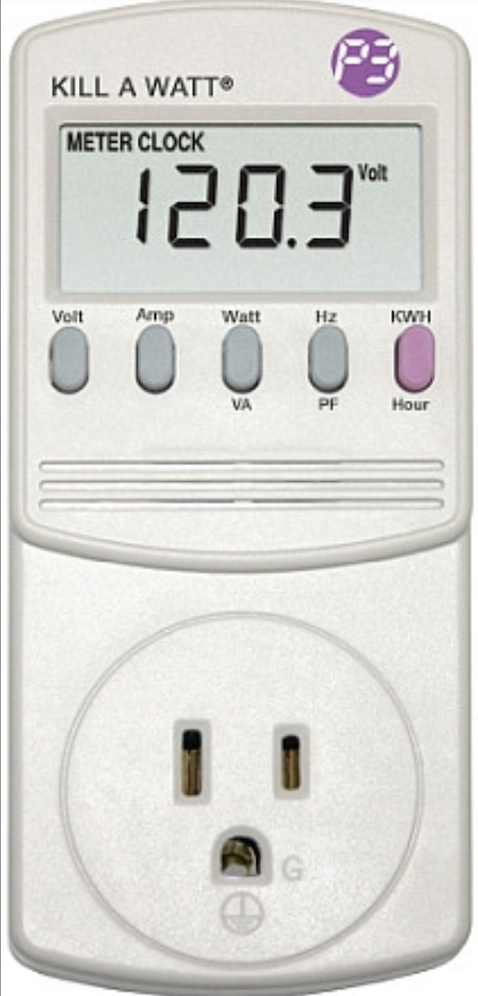Screenshot 2023-09-23 at 10.26.41 AM.png---
Migrated from Apple Server Wiki. Original page ID: u3a820
# Modules 9-11 Heat Energy: air and water
Modules 9-11: Heat Energy: air and water
(fun with globes)
Modules 9-11 FR 3e (also module 22 in FR 4e)
Heat
Heat energy always moves from hot to cold (high energy to lower energy)
Heat energy moves in three "modes":
- conduction: from the latin word for "contact", objects touching
- convection: matter in motion, like hot air or steam rising
- radiation: infrared radiation below visible light on the spectrum
Conduction:
Materials can be excellent conductors of heat like silver, aluminum, copper and gold
Fun fact: Materials that are good conductors of heat are also good conductors of electricity
Insulators are materials that do not conduct well: styrofoam, pink panther insulation, cloth, rubber
Think of this: to pick up something very hot, what would you hold it with?
Convection:
Hotter fluids are less dense than cooler ones, causing upward migration of hot material
Fun fact: everything in zero gravity needs a fan to cool (why?)
Convection can be blocked by covering hot objects, like the cover on your coffee or pot on the stove
You may have seen strange mirage like waves over something hot: this is convection of less dense air bending light
Radiation:
This is basically light, so can be reflected by foil, or any reflective material
Radiation is most effective at higher temperatures, one reason you can't see warm objects but can see red hot objects
This is also how snakes and other reptiles (or the alien in predator) see the tracks of their prey
This is one reason hot drinks are usually delivered in white cups: white reflects radiation better than black, which absorbs and re-radiates the energy (one part of the greenhouse effect)
Note that these are not the key ways your body cools during exercise: that is called "latent" (hidden) heat of vaporization
- When sweat evaporates, it takes with it lots of energy to do so, cooling you very efficiently
- Consider why some triathletes who come for the Kona Ironman (or others) have trouble here with the high humidity
- Higher humidity means less efficient evaporation.
- It also explains why 110°F in Phoenix might be tolerable if the humidity is very low
Lab: Heat transfer
1. choose a cup or other container for testing
2. measure room temperature with temp sensor
3. fill container with hot water, measure with temp sensor
4. measure regularly as heat escapes from your container
5. repeat after modifying to block conduction, convection and radiation
Module 9: Heating of the earth
Radiation from the sun hits the surface of the earth, which re-radiates this energy as longer wavelength infrared radiation.
(There is some heating of the atmosphere in both directions)
The atmosphere is divided into layers based on temperature, gases and density:
- Troposphere: at the surface, where all the action is
- ozone layer-blocks UV light
- Stratosphere: where planes fly: cooler
- Mesosphere: "middle" layer
- Thermosphere: "hot" layer, fast (3/2kT) molecules (from radiation), low pressure
- Exosphere: very low density, lots of radiation
(see layer diagram)
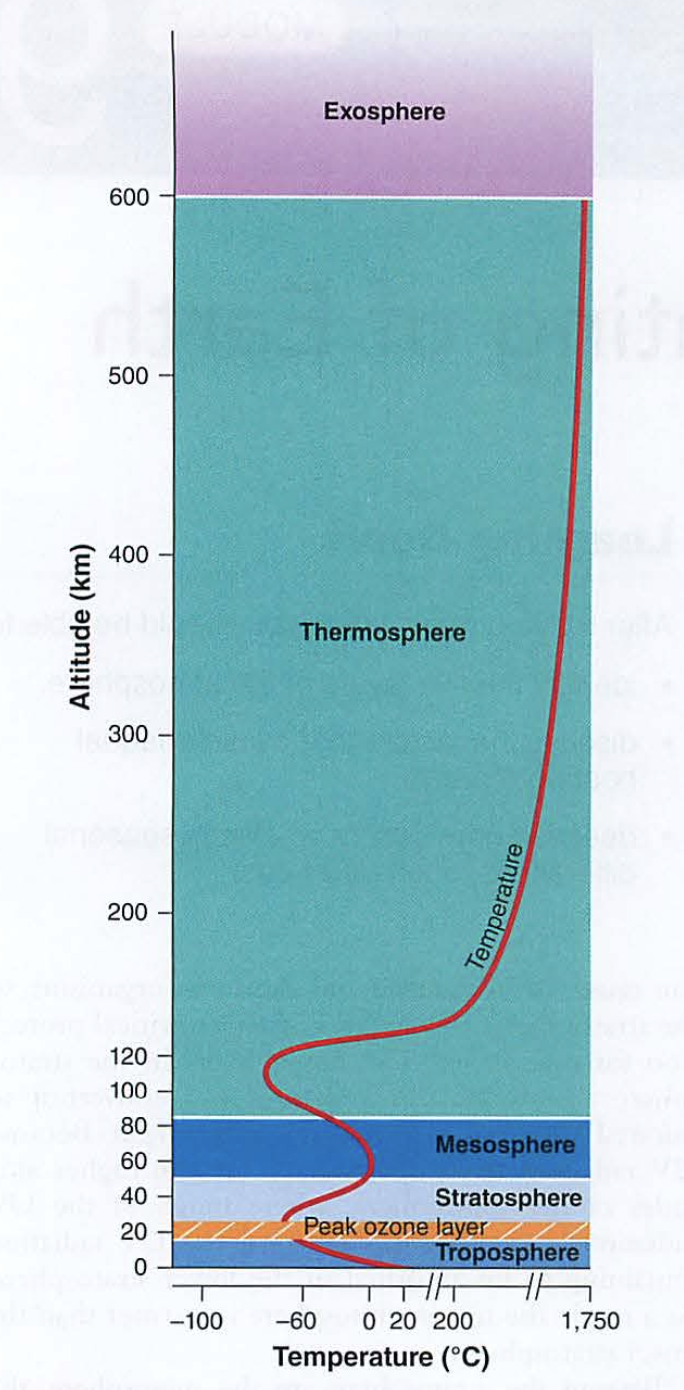Screenshot 2023-09-28 at 10.53.35 AM.pngn.b. thermosphere is also known as the ionosphere (reflects radio waves), blocks nasty radiation from space, absorbs the energy from this radiation, gets hot
Now think of the three heat transfer modes:
Radiation: energy from the sun hitting the surface
Conduction: hot ground heats the air in contact with it
Convection: hot air rises, creating weather
Weather?
As air rises, it creates local low pressure areas, bringing in clouds and moisture (wind)
As this air rises, it cools, dropping moisture as rain or snow
This dry air circulates at high altitude until it transfers its heat to space (radiation and conduction) then descends as cooler, dry air
(see adiabatic cooling diagram)
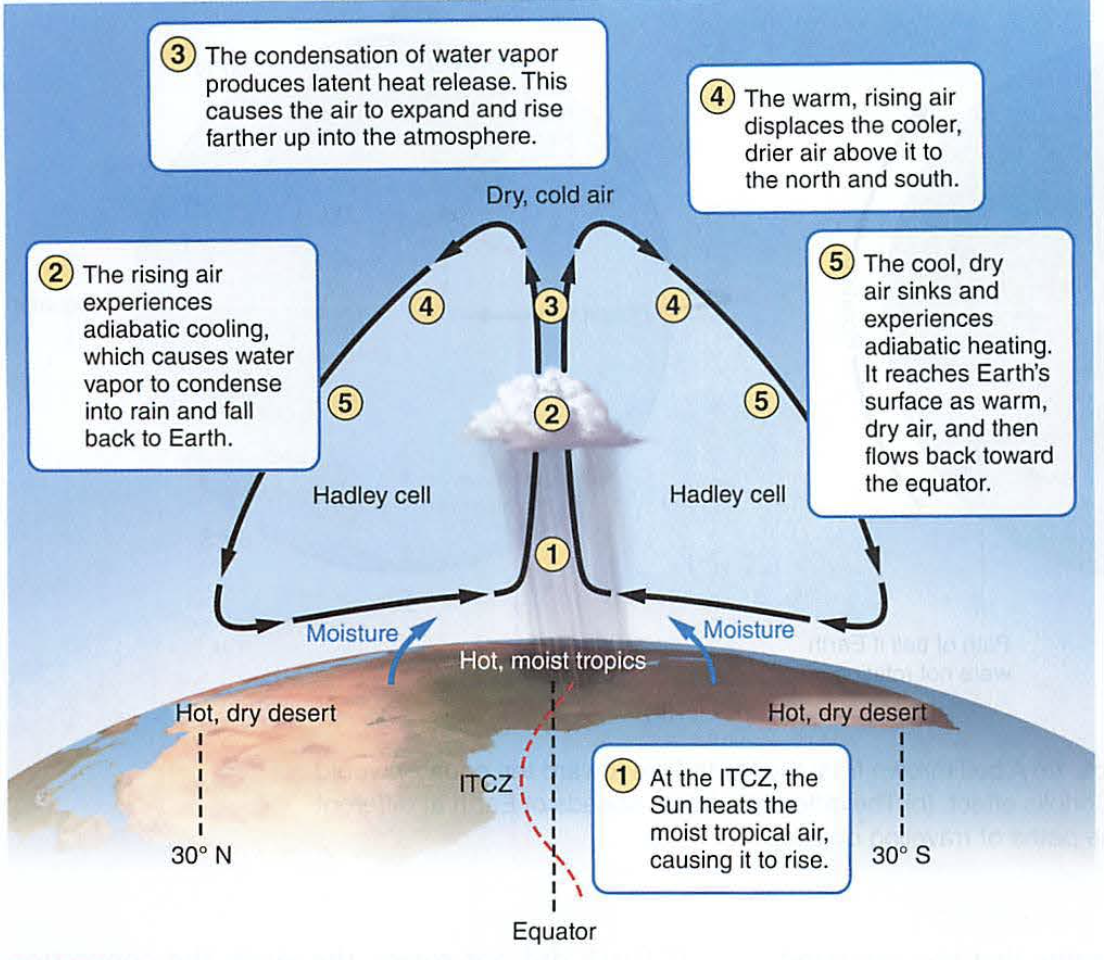Screenshot 2023-09-28 at 10.54.41 AM.pngThis also happens if moist air is forced over a mountain range (remember the Waipio question?)
(see rain shadow diagram, module 22 FR4e)
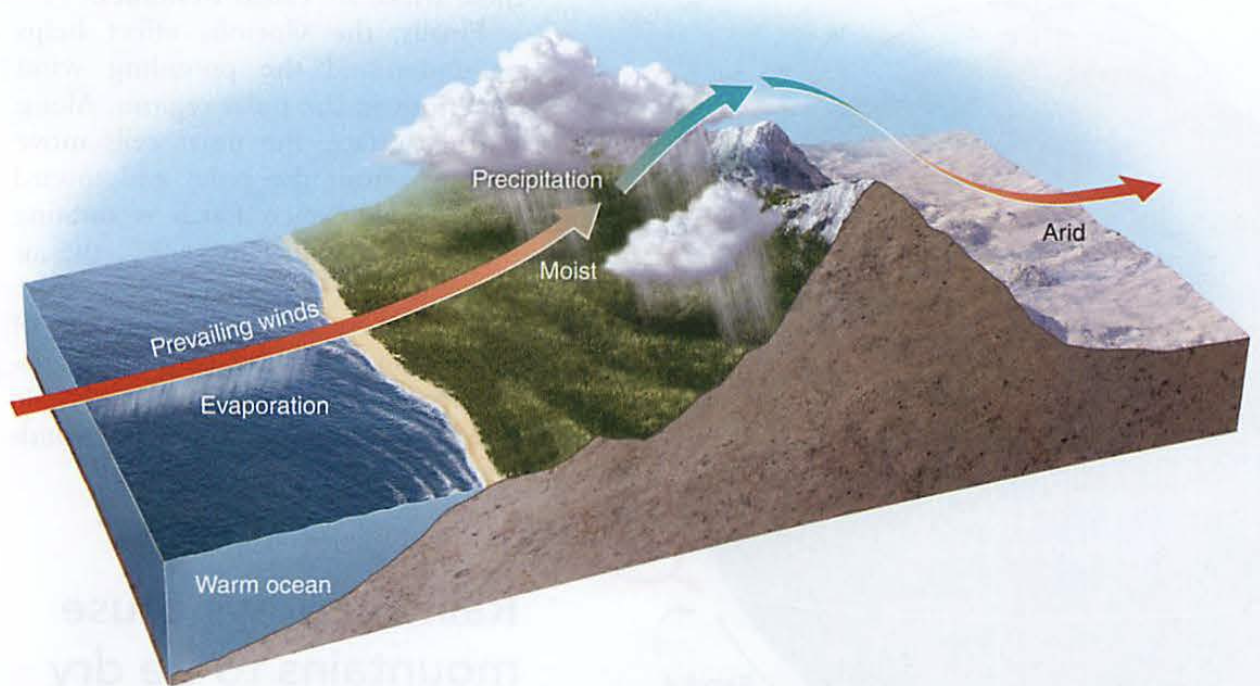Screenshot 2023-09-28 at 10.55.20 AM.pngThe amount of heat the surface absorbs is based on reflectivity (recall radiation above)
Albedo is a measure of this reflectivity (think of Albus Dumbledore: white beard)
- Average albedo for the earth is about 30%
- Snow and ice are about 90%
- Water is about 35%
- Soil is about 15%
- Asphalt is about 5%
- Clouds vary in density from 10-90%
(see albedo diagram)
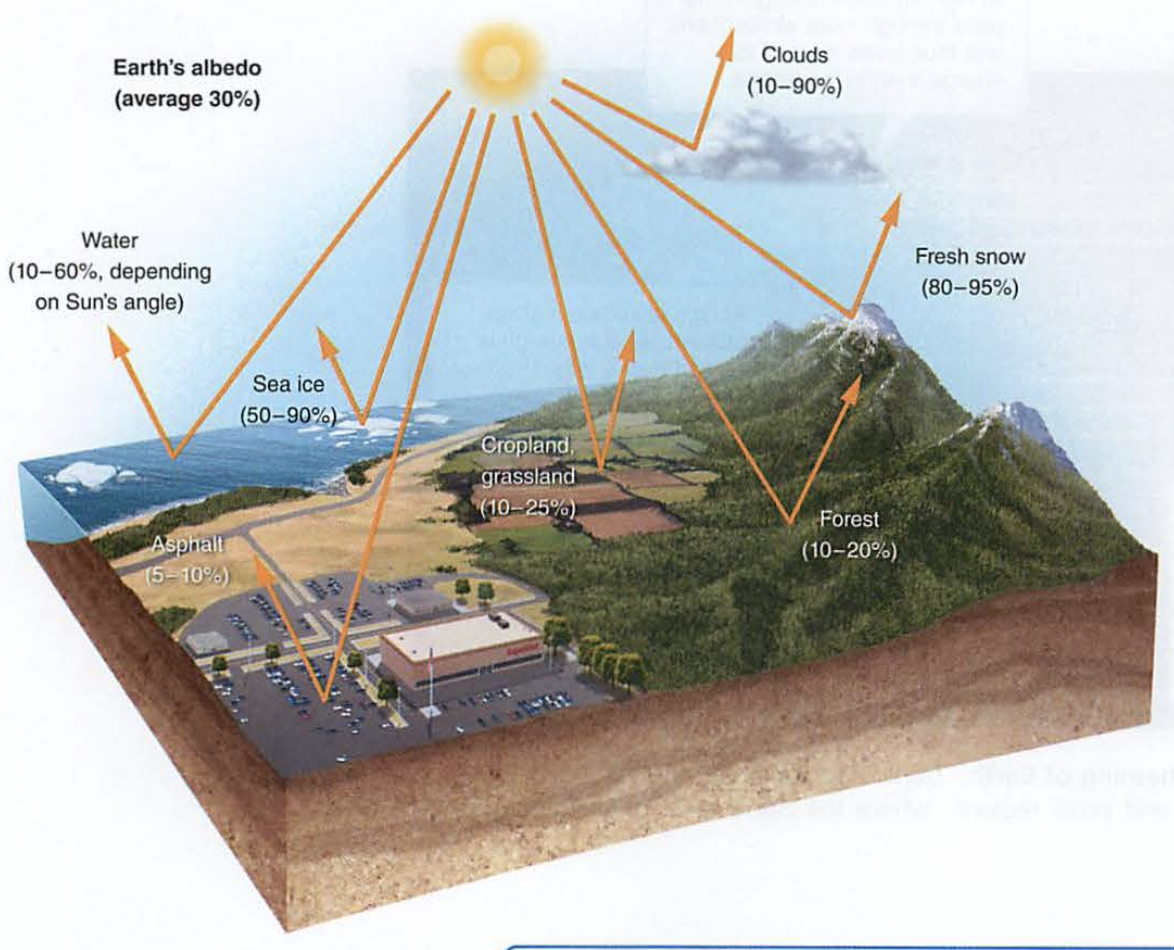Screenshot 2023-09-28 at 10.56.07 AM.pngFun fact: as global warming melts ice (high albedo) it turns into water (lower albedo), warming the planet more (positive feedback).
The place on the planet with the most average solar radiation is the equator, so air rises there (convection)
This creates the first of three cells: the Hadley cell
- As air moves towards the equator, it brings moisture (ITCZ)
- As this moist air rises, it cools and rain results
- The resulting dry air moves north and south away from the equator in the stratosphere
- This dry air descends creating deserts
Fun fact: on windy trade wind days your flight to the mainland is faster-why?
(see Hadley cell diagram)
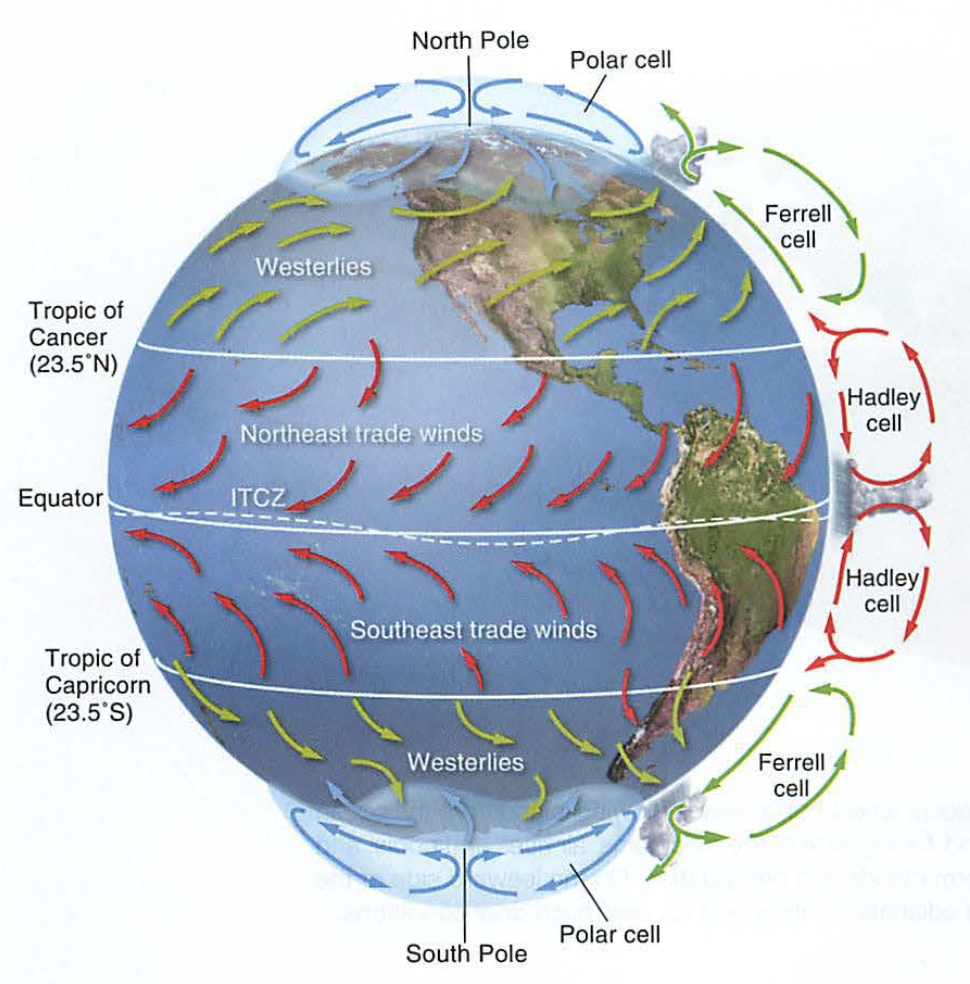Screenshot 2023-09-28 at 10.56.49 AM.pngPrimitive meteorologists (weather folks) detected three of these cells:
- Hadley
- Ferrell
- Polar
To draw these, remember that when cells touch, air moves in the same direction: up-up or down-down
Biome impact: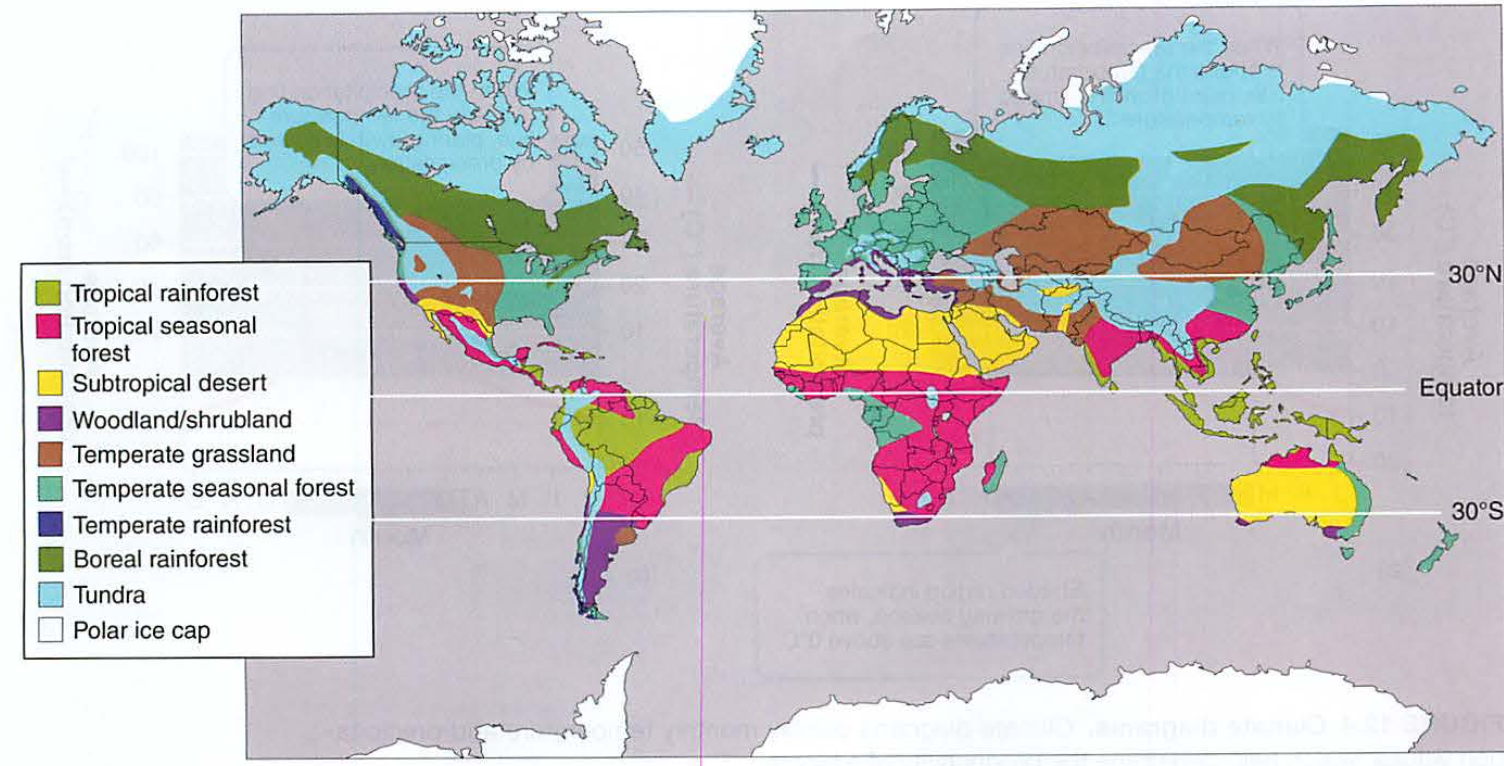Screenshot 2023-09-28 at 11.08.21 AM.pngSeasons:
The earth is tilted on its axis about 23.5° (get over it, it changes every 20,000 years)
Because of this, each hemisphere gets more or less solar radiation at certain times of the year.
We divide this (almost)circular motion into 4 points:
- Summer solstice: June 21 (summer for N hemisphere)
- Autumnal equinox ("equal night"): September 21 (today!)
- Winter solstice: December 21 (winter for N hemisphere)
- Vernal or spring equinox: March 21 (pagan festivals, etc.)
Australians have Christmas in their summer. Santa arrives by surfboard (true fact)
Fun fact: Pagans feared each winter that the days would just keep getting shorter and total darkness would result, so when they calculated winter festivals, they waited a week after the darkest day (December 21) to make sure the sun would come back.
This is why Christmas is December 25, not 21.
(see season diagram)
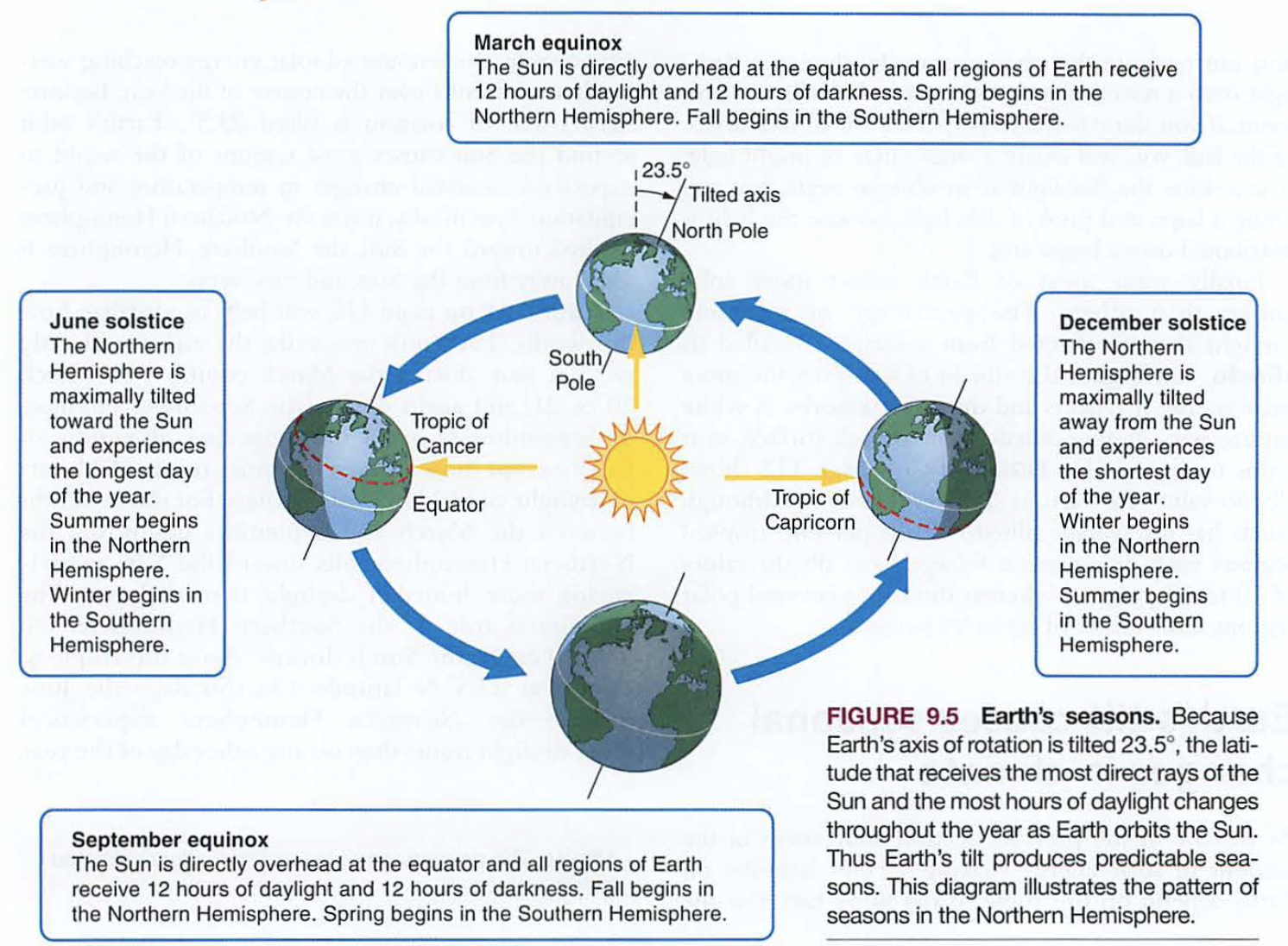Screenshot 2023-09-28 at 10.57.55 AM.pngIn Hawaii, we are below 23.5° latitude (find this on your globe), so for several months in our summer, the sun is actually NORTH of straight overhead. This is called "Lahaina noon".
Coriolis effect:
If you look at your globe from above (like some eskimo god), you will notice the radius at the equator is greater than at higher latitudes.
Actually, the tangential velocity (physics term) at the equator is about 1600 km/hr (1000 mph), while it is zero at the north pole.
As large storms stretch out with one end more south than the rest, it falls behind, creating the coriolis effect.
Demo: imagine dripping water (you, the eskimo god again) on the globe while it spins, which way would the water drip?
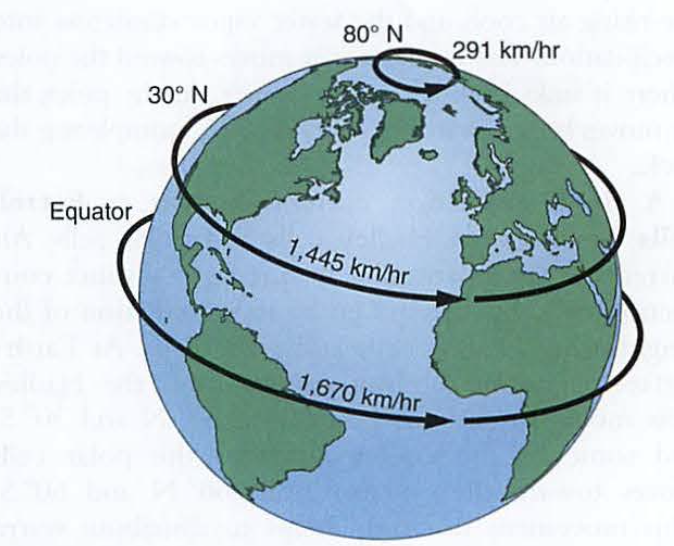Screenshot 2023-09-28 at 10.58.33 AM.pngOceans: wind and water
Surfers in California usually wear wetsuits.
Why?
Water along the California coast travels south from Alaska.
Remember this: oceans in the northern hemisphere travel clockwise
(opposite in the southern hemisphere)
Tough question: why are our trade winds from the NE not the North (Hadley cell)?
Verify on windy.com:
[https://www.windy.com/?20.002,-155.533,5](https://www.windy.com/?20.002,-155.533,5)
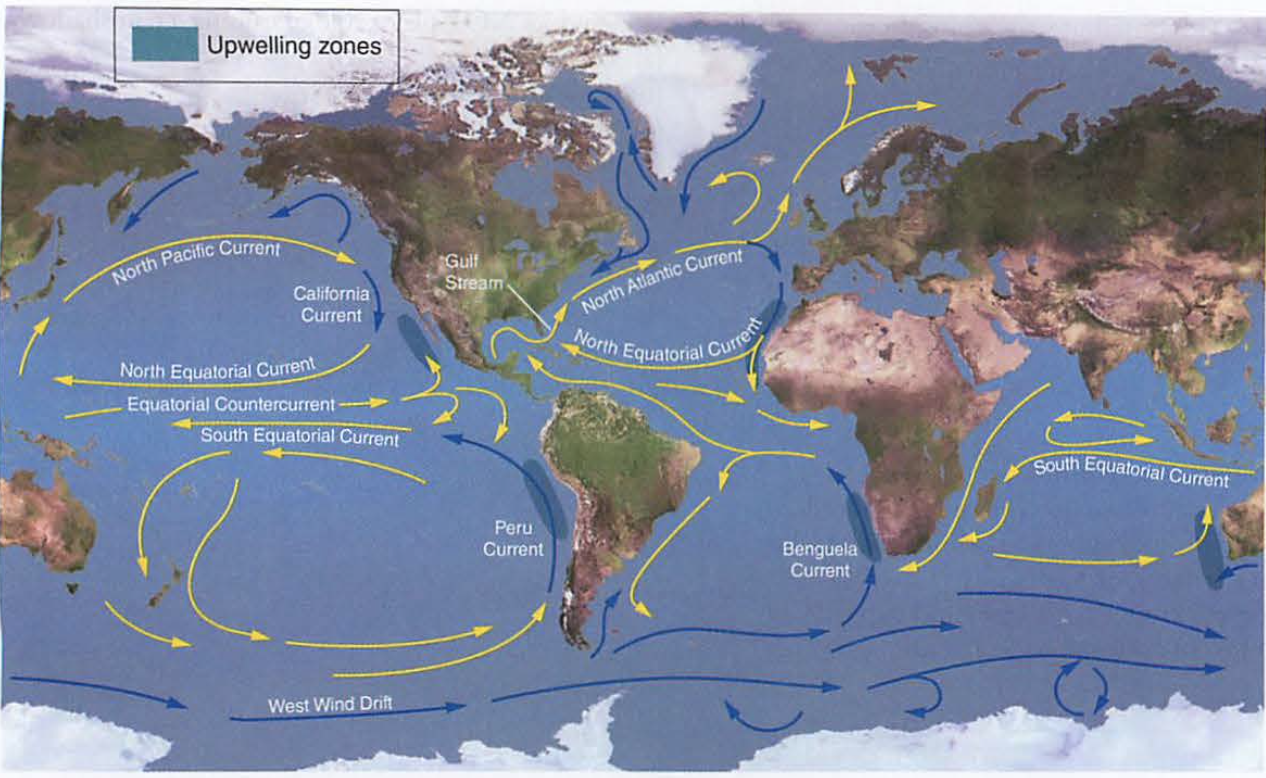Screenshot 2023-09-28 at 10.59.05 AM.pngThere is one very interesting deep ocean current called the "thermohaline" circulation:
thermo=heat, haline=salty
Also known as the NADW or North Atlantic Deep Water:
Melting ice sheets in Greenland create dense, cool water that flows south along the ocean floor, and emerges in two places on the planet: India and KONA!
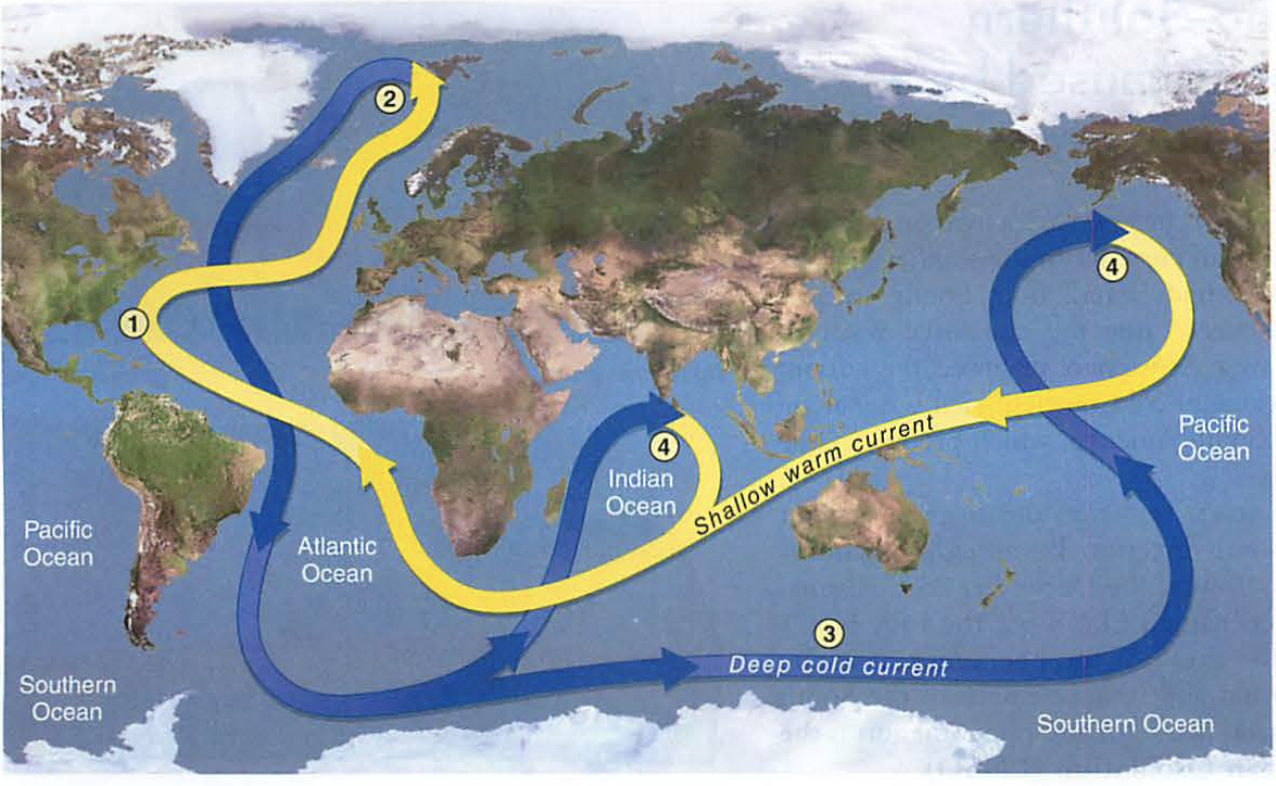Screenshot 2023-09-28 at 10.59.30 AM.pngOcean circulation: Up and down
The Andes run north and south from Peru to Chile as a result of tectonic plates going under South America from the west (more on this soon).
As a result, there is a deep trench off the coast of Peru and Chile
Looked at sideways from the south, as water rises from this deep trench it brings with it decomposed ocean creatures (detritus) that surface fish love to eat: happy fisherpeople
For this to happen, an offshore wind has to be strong.
This condition is called La Niña, and is an indicator of weather all over the planet
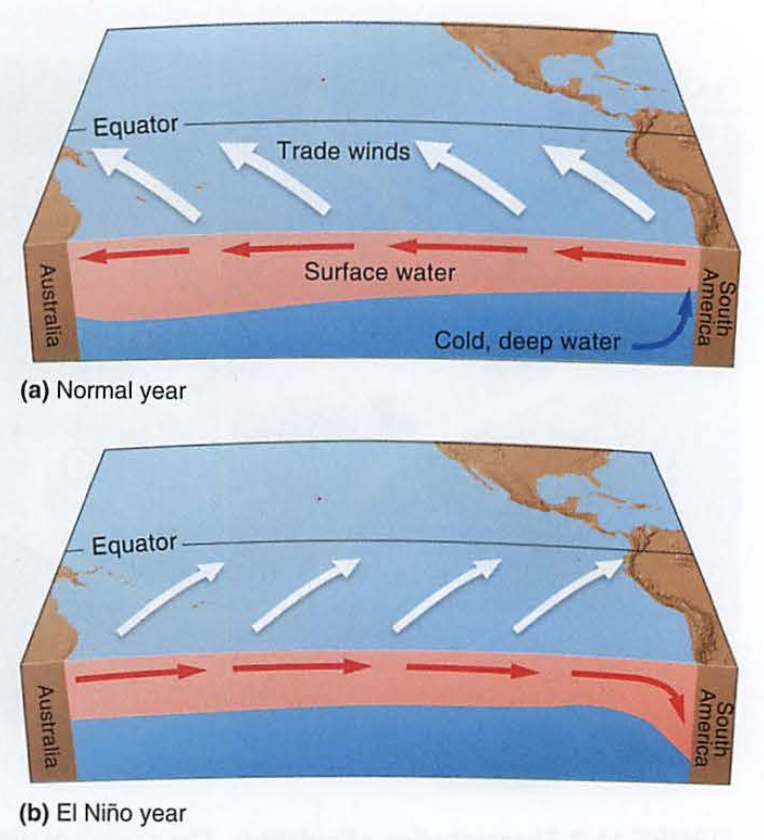Screenshot 2023-09-28 at 11.00.02 AM.pngEl Niño is when this wind becomes onshore, stopping the migration of fish food (sad fisherpeople)
(see sideways diagrams of La Niña and El Niño)
Better picture:
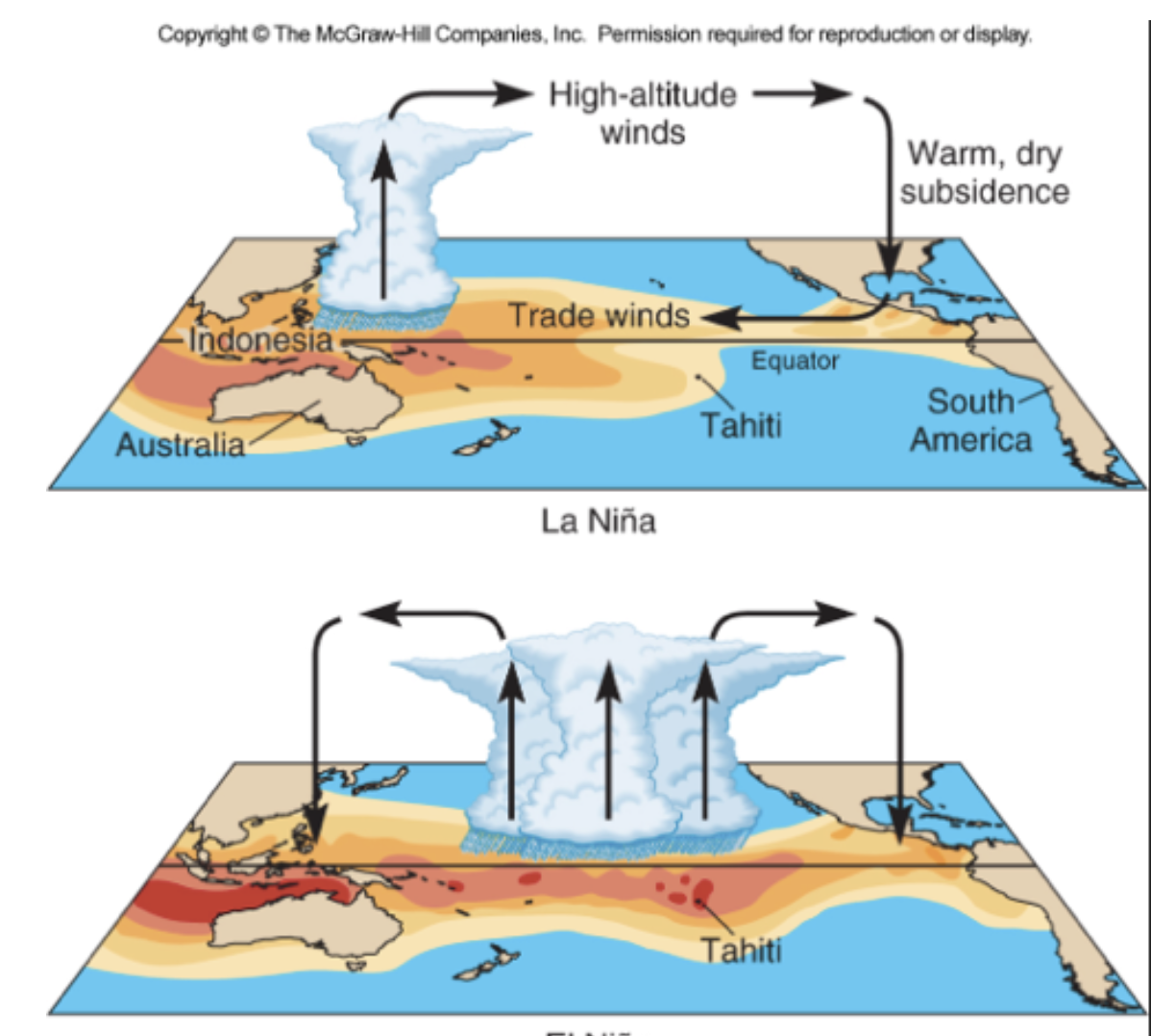Screenshot 2023-09-28 at 11.01.19 AM.png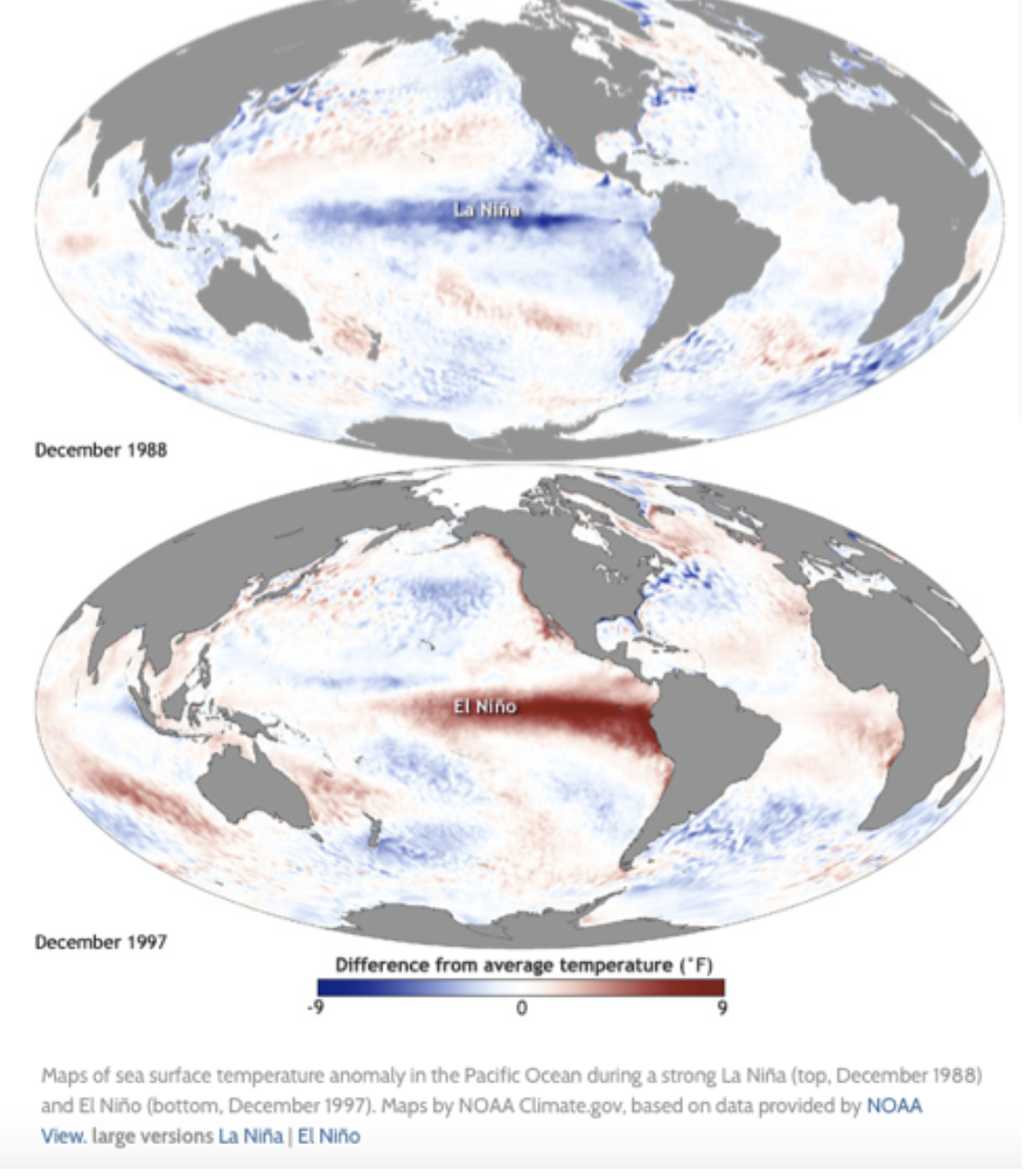Screenshot 2023-09-28 at 11.03.08 AM.png
---
Migrated from Apple Server Wiki. Original page ID: J5j9j2m
# Heat transfer lab
Lab: Heat transfer
Heat energy moves from hot to cold in three modes:
- Radiation: infrared light rays that can be reflected
- Conduction: contact transfer, can be blocked by insulators
- Convection: matter in motion, less dense matter rises
You will be using a very delicate (and expensive) infrared camera for this lab
1. focus the camera using the outer ring
2. don't touch the lens
3. do not drop or abuse it
4. do not press the yellow trigger while aiming at people
You will be creating a perfect heat container, using materials in the elab.
Keep in mind the three heat energy modes in your creation.
We will start by observing the heat decay of two containers, to see which one loses heat faster, and how
You will then create a much better heat container using foil, paper towels and whatever you can think of...
Procedure:
1. choose two containers you think might have different heat holding properties
2. put temp sensors in each, start the measurement on logger pro (green arrow)
3. fill both containers with hot water, measure with temp sensors as they cool down for a few minutes
4. watch the "heat decay curve" on the computer, look for the best and worst heat container
5. take a photo of the decay curve for your report
6. make some guesses about which modes are in action: radiation, conduction, and convection
7. look at each with the IR camera, note how heat energy is escaping to the cooler room
8. go nuts, creating what you think is a much better heat container
9. repeat the test, and record the new graph (photo is fine)
Questions:
1. what modes were prevalent in each case?
2. how did your creation improve on these?
3. how could you tell?
4. people in cold climates claim that wearing a hat keeps them warmer-why?
5. you might feel cooler if a fan is blowing on you-why?
6. how are the three modes blocked by a white, covered, paper coffee cup?
7. why do people blow on soup or hot drinks to cool them down?
8. why do emergency folks cover accident victims with a foil blanket?
9. if you want to pick up something hot, what sort of materials would you wrap your hands with?
10. track the flow of energy from the sun to rain over the equator, including each applicable process
11. climate change is impacted by the albedo of the planet. which mode of energy transfer is this?
12. climate change is also impacted by the thickness of the CO2 layer in our atmosphere, which mode is this?
13. as the planet warms, which mode(s) do you think will change the most?
14. Hadley cells are an example of what mode?
15. if air is a better insulator than any fabric, why would a sweater with gaps or holes be warmer?
16. why do some folks wear foil hats? (any answer is ok here)
---
Migrated from Apple Server Wiki. Original page ID: C0i9a7C
# Earth Science Modules 19-21 FR4e
Key points:
- All elements up to Iron on the periodic table came from the big bang
- Earth was formed from materials created by first generation stars going supernova
- The core of the earth is made up of a rotating solid core surrounded by a liquid core
- The inner core creates our magnetic field, which reverses periodically
- Layers: crust-mantle-outer core-inner core
- Uranium in the core produces heat that travels to the surface by convection
- Tectonic plates on the surface move on top of the sticky asthenosphere because of this convection
- Spreading zones are were these plates are created, subduction zones are where they dive under others
- Subduction zones create trenches in the ocean and andesitic volcanoes (sticky lava, pointy cones)
- Hot spots in the crust can create basaltic volcanic islands like the one we are on (runny lava, broad cones)
- Earthquakes include P (primary, compression) waves and S (secondary, shear) waves
- P waves are faster and go through solids and liquids, S waves only travel through solids
Big Bang:
- First, there was the big bang (see the cute video here: [https://www.youtube.com/watch?v=xzAOhyOtfqc](https://www.youtube.com/watch?v=xzAOhyOtfqc))
- The only thing at first was Hydrogen, which is just a proton and an electron, sometimes a neutron making isotopes of Hydrogen
- Stars formed from this hydrogen, and through fusion created all of the elements up until Iron (Fe)
- Look this up on your periodic table------[https://ptable.com/#Properties](https://ptable.com/#Properties)
- Eventually, these stars expanded and then collapsed...Smaller stars became neutron stars or various versions of these
- Huge ones (15x our sun size) exploded and created all of the elements after Fe (check the periodic table again)so,
- Any element in you below Fe on the table came from an exploding star cool...
Exoplanets:
- NASA and other folks are really interested in two things now: exoplanets (planets outside our solar system) and asteroids [https://www.cnn.com/2020/10/23/world/asteroid-bennu-sample-update-scn-trnd/index.html](https://www.cnn.com/2020/10/23/world/asteroid-bennu-sample-update-scn-trnd/index.html)
- Why?
- Well, if we know what asteroids are made of, we have a clue about what materials (e.g. water) that were around when the solar system formed.
- This is why capturing materials from Bennu last week was such a big deal...
- From this info, we can look for those elements in other solar systems, and look for life there.
- Back to our earth...
Our Solar System
- This is how our solar system formed.
- Our earth was molten for a long time, then cooled to become solid-mostly.
- Since it is also made up of Uranium and other things that combine to create heat, our planet is still really hot deep down.
- A minister named Ussher ([https://en.wikipedia.org/wiki/Ussher\_chronology](https://en.wikipedia.org/wiki/Ussher_chronology)) worked backwards from the molten state to solid state of the earth to guess that the earth was created one Sunday afternoon in 4004 BC.
- We was not stupid, he just did not know about Uranium, and our molten core...
- Here's what we know the earth to look like (check this out on your globes too):
- Layers: (onion boy)
Core-Mantle-Crust-think of an apple
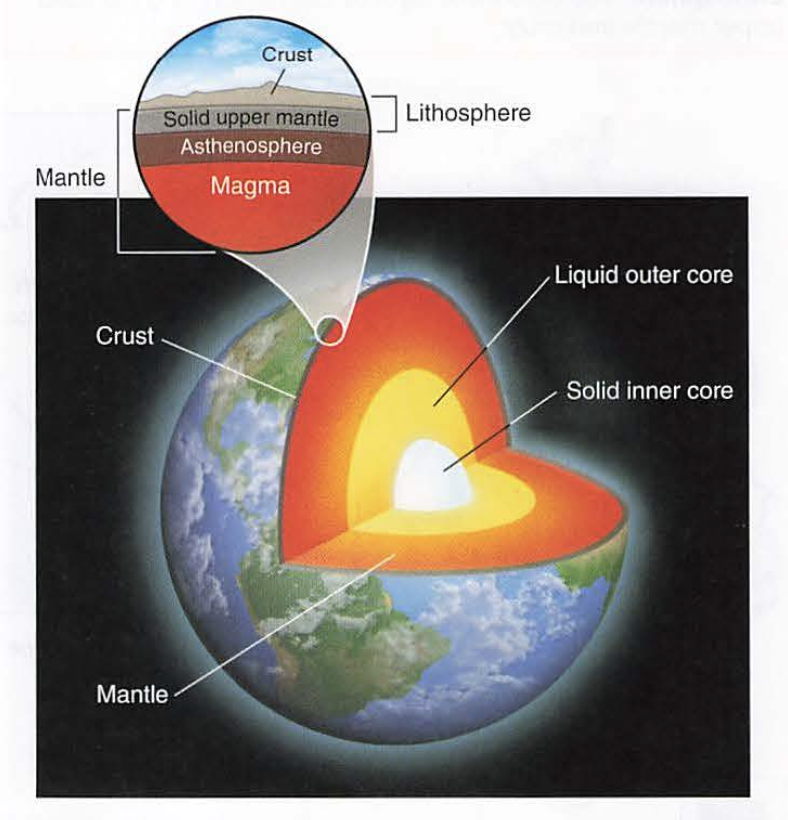Screenshot 2023-10-15 at 5.51.22 PM.png
The Core:
- The core is actually two bits: solid inner iron and nickel, liquid outside that bit.
- It spins, giving us a weak magnetic field which switches direction every few thousand years.
- Remember this, it comes up later...
- How do we know this?
- Nuclear bomb testing and our global seismic sensor network.
- How?
- Two key clues about the earth came from military conflict: one from WWII and another from the cold war, when everyone was building bigger and bigger bombs.
First the cold war part:
- We set up seismic sensors called seismographs all over the world to spy on Russian and Chinese nuclear ("A-Bomb", fission) and thermonuclear ("H-Bomb", Fusion) bomb testing to see how powerful they were.
- You next need to know that there are two main types of earthquake wave:
- P or "primary" waves which are compression waves. and S waves "secondary waves" that are transverse, like shaking a slinky.
- P waves are faster, and go through solids or liquids, but at slightly different velocities.
- S waves are slower, and can only travel through solids.
- So, here's what they saw:
-

This data was found by spying on atomic bomb tests in the 1950s, not because we wanted to know about the guts of our planet...
Now, to the WWII part...
- Submarines like to hide underwater, so planes and ships can't find them.
- So, during WWII, our side tried dragging little magnetic sensing torpedo thingys from behind their ships, hoping to detect submarines. (they later used airplanes too).Here's what they found:
- Between England and the US, they found stripes of North then South weak magnetic fields.
- When they got to the middle of the Atlantic (about where Iceland is on the map above), the pattern reversed.
- Huh?
- That's what they said too...
- Remember the shifting magnetic field every few thousand years?
- As the magma came out of the earth in the molten state, it solidified in the magnetic field of that time, so the newest lava was along the center of the ocean (under Iceland too).
Ok, now shift quickly to a meteorologist named Alfred Wegener. (look this guy up)
("Meteorologist" is a fancy name for a person who studies the weather)
He cut out the continents on a map (like, with scissors) and noticed that South America and Africa fit nicely together.
Try this on your globe----Everyone in the geology community told him he was nuts.
Fossils from different places lined up:
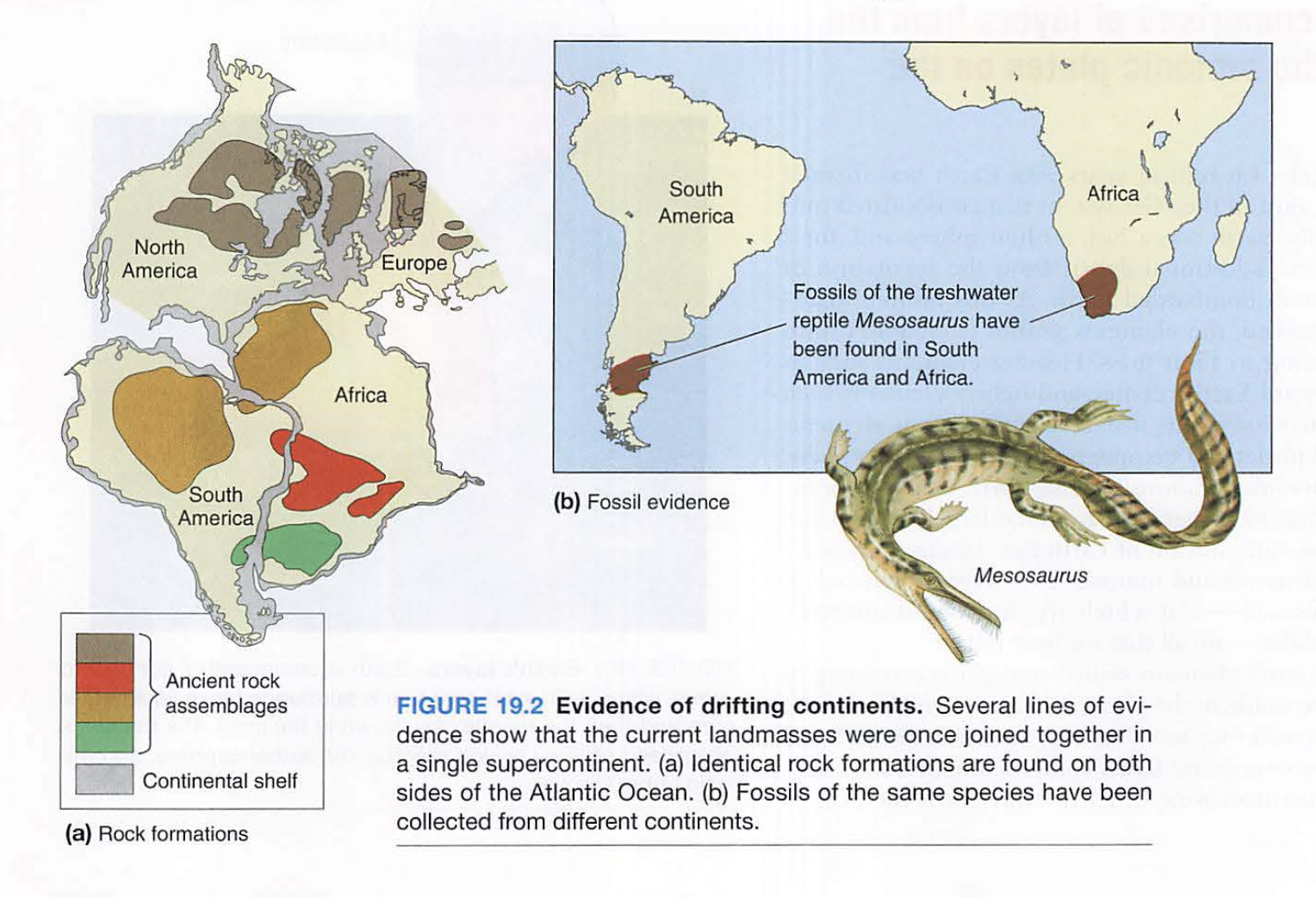Screenshot 2023-10-15 at 5.47.19 PM.png
Then, these strange magnetic stripe thingys showed up from the ships dragging those [magnetic torpedoes](https://en.wikipedia.org/wiki/Magnetic_anomaly_detector)....and it proved he was RIGHT
He later froze to death in Greenland, but I digress...
Ok, now remember convection, conduction and radiation?
Remember how hot is was in the earth core?
That heat rises to the surface as magma (say like Dr. Evil), just like the Hadley, Ferrel and Polar cells do:
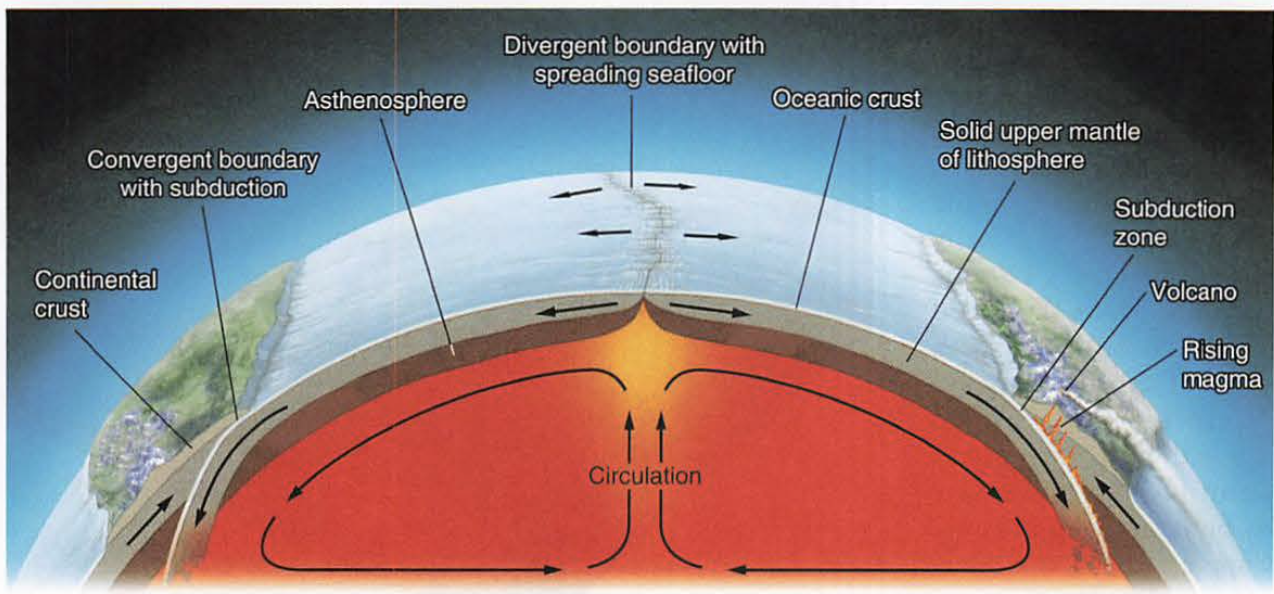Screenshot 2023-10-15 at 5.50.29 PM.png
Check out this diagram: note the red (spreading) and the blue (subducting), esp. look at Chile---->
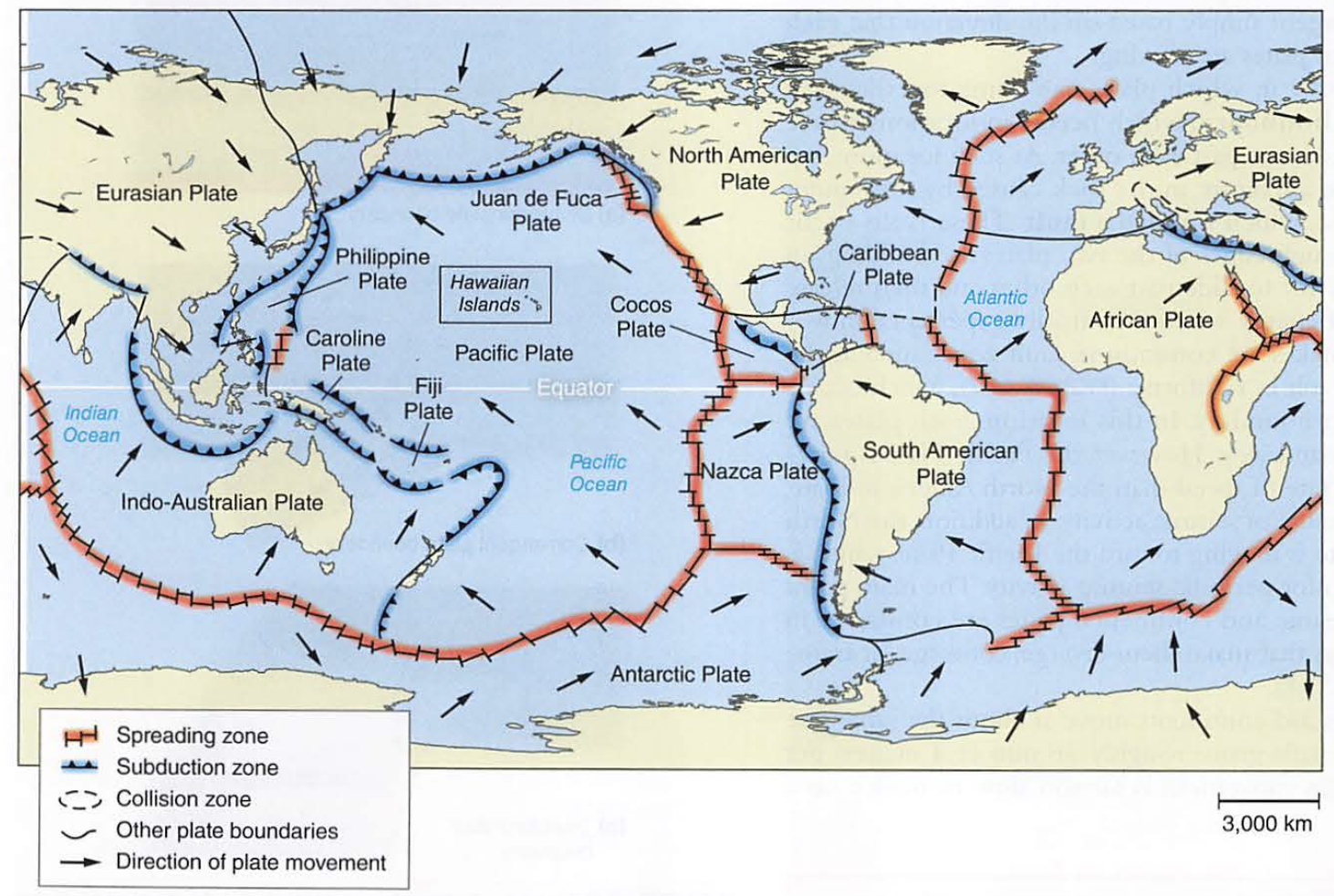Screenshot 2023-10-15 at 5.49.40 PM.pngSo, connecting all of these dots, the plates are floating on the magma, some created at the mid-Atlantic ridge, others diving down under others in subduction zones....what about those subduction zones?
What about those mountains in Chile?
First, on your globes, trace out the red (subduction) zones and the blue (spreading) zones
This is the key to the two types of volcanoes:
Andesitic (pointy)
Basaltic (runny, look out your window)
Andesite-from pressure and heat as plates subduct (sticky, high silica content, e.g. Andes mountains)
Basalt-from ocean crust, lots of water, makes for weak, runny magma, formed as magma pushes through watery ocean plates
- Note the sticky stuff boiling up in red-this is why the Andesitic volcanoes are sticky, and always found near subduction zones (Andes, Cascades, Japan, Italy, etc.)
- Note also the trench where the subduction zone goes down: this is the origin of the Chilean/Peruvian trench we covered in the El Nino notes, as well as the deepest part of the ocean: the Marianas Trench, which is 7 MILES deep.
Whoa!
Now put it all together:
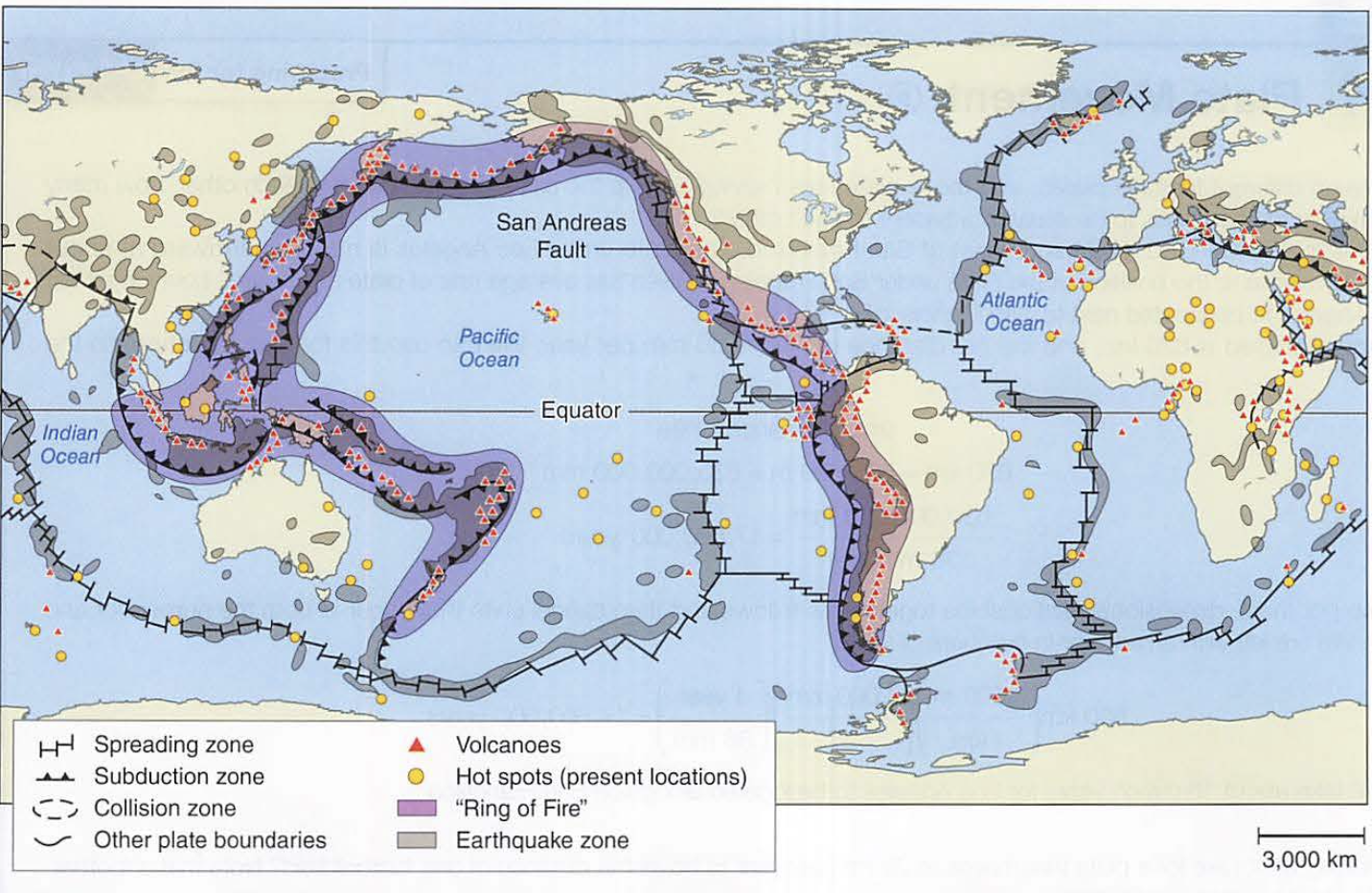Screenshot 2023-10-15 at 5.54.06 PM.png
- Look at the red triangles (volcanoes)
- Which ones are andesitic and which are basaltic?
- (clue: hotspots)
Let's review the geological players:
- Magma-(Dr. Evil voice here: [https://www.youtube.com/watch?v=yVo1S52xdpI](https://www.youtube.com/watch?v=yVo1S52xdpI))
- Asthenosphere-"sticky rock" (from [Greek](https://en.wikipedia.org/wiki/Greek_language "Greek language") ἀσθενής asthenḗs 'weak' + "sphere")
- Lithosphere-floating rock (litho = stone) ([Ancient Greek](https://en.wikipedia.org/wiki/Ancient_Greek "Ancient Greek"): λίθος \[lithos\] for "rocky", and σφαίρα \[sphaira\] for "sphere")
- Continents-even more floaty, made of lighter rock (granite) that formed from the interaction of magma with oceans
Plates and continents:
- Plates are large, float on the Asthenosphere (less dense, so they float)
- Continents are like rafts on the Asthenosphere, more buoyant than the plates
- The plates can slide under each other (subduction zones), crash into each other (Himalayas), next to each other (transform faults), and are formed at spreading zones (divergent boundaries)
Neato. What about those earthquakes?
Historic data shows subduction zone quakes that would create a tsunami 1000' high or more on the Pacific northwest coast, flooding everything west of I-5.
Look at all of the earthquakes (red dots) as the plate subducts
Two things to take-away about subduction zones:
1. subduction zones create ANDESITIC (pointy) volcanoes, which are high in silica, and sticky like thick pancake batter.
2. subduction zones create lots of deep-focus earthquakes.
We are lucky enough to live on an island with several active or dormant volcanoes.
We live on top of a "hot-spot":
Hot spots:
- Usually in the middle of an oceanic plate, but can also be mid-continent (e.g. Yellowstone supervolcano caldera)
- Hot spots-basalt-low silica content which melts easier (e.g. look out the window)
- Look at the Hawaii island chain on google earth (underwater version)
- While you are at it, look for the Nuuanu landslide that created a 4000' tsunami (!) 1.5 my ago
- You can also look at the Mauna Loa simulated tsunami on youtube...
This is what happens to a shield volcano when it "calves" one side, in this case, the northeast side, in the [Nuuanu](https://en.wikipedia.org/wiki/Nu%CA%BBuanu_Slide)landslide, one of the largest landslides on earth, causing a tsunami that deposited coral on the top of Mt. Kaala, 4055 ft. high...
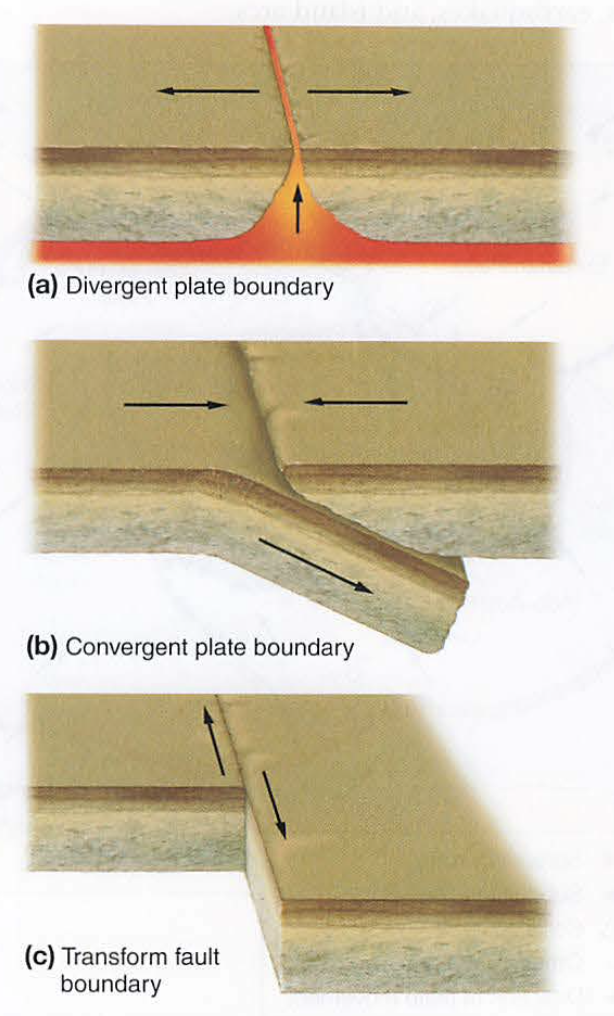Screenshot 2023-10-15 at 6.02.29 PM.pngEarthquakes:
Earthquakes occur where there is movement between plates or sections along fault lines.
The epicenter is the place ON THE SURFACE above the hypocenter (true origin) or earthquake FOCUS.
Deeper hypocentric quakes often feel "longer", while shallow hypocentric quakes feel "sharp".
Since one wave (P wave) travels faster than the S wave, the farther away you are from the hypocenter, the greater the delay between the two:

How do we detect these?
Seismographs:
- P waves travel by compression (comPression).
- These are longitudinal waves, like sound.
- They can travel through liquid or solid.
- S waves travel by shear (Shear).
- These are transverse waves, like a slinky.
- They can only travel through solids.
- Remember this?

Ok, back to earthquakes.
- Suppose you have a house on posts (called "post and pier" construction).
- An earthquake happens some distance away.
- First, your house moves back and forth (P wave, much faster at 8 km/sec).
- After a time, your house bounces up and down from the S waves (slower at 3 km/second).
- If you are far away, these are separated by different arrival times.
- If you are near the epicenter, they hit at the same time...up, over, down=your house is demolished
- We use this difference to calculate distance from the epicenter (and hypocenter if you are interested) using delay times on the seismograph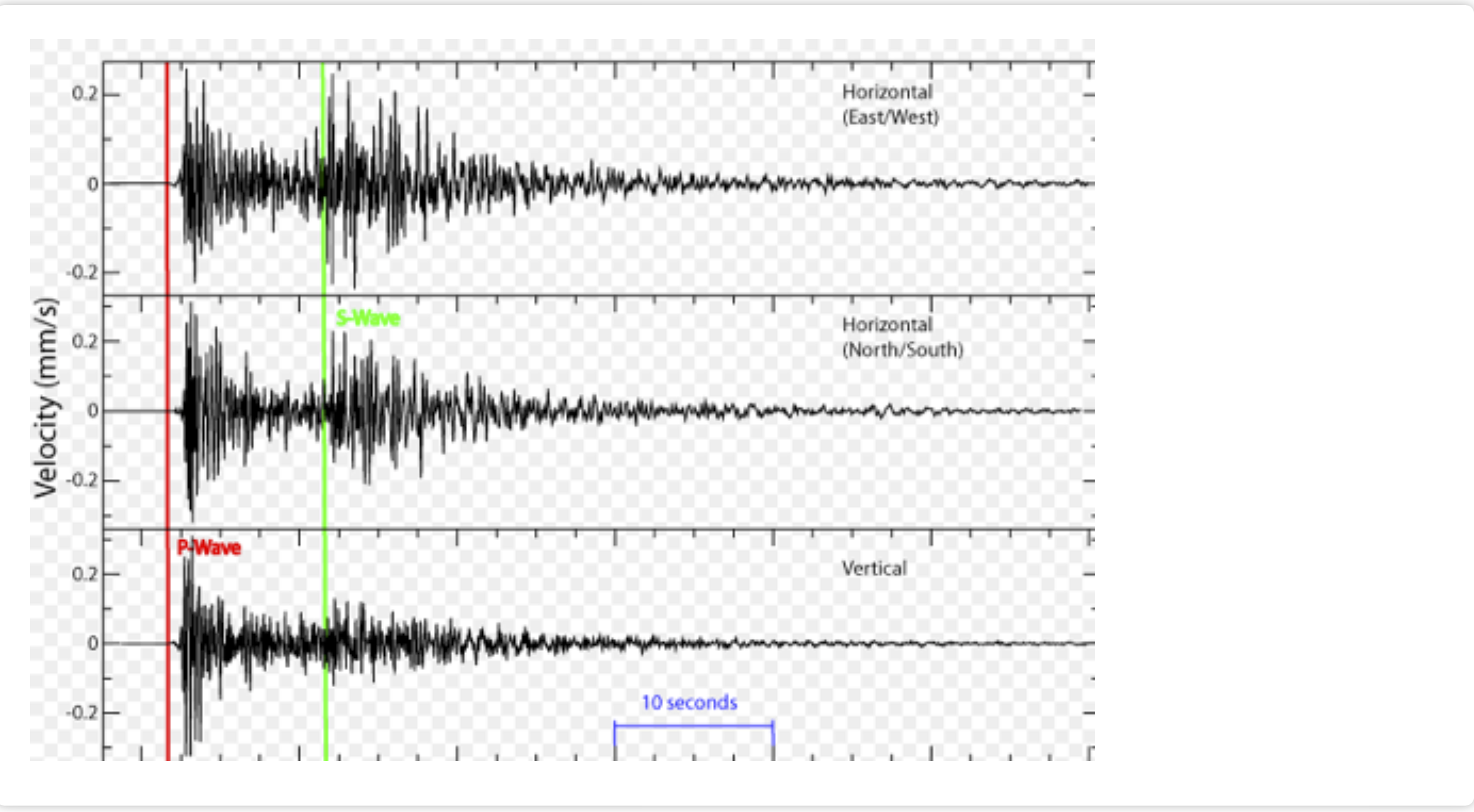Screenshot 2023-10-16 at 3.01.32 PM.png
- Look at the HPA Pacific Tsunami Warning Center (PTWC) seismograph here:[http://www.fdsn.org/networks/detail/PT/](http://www.fdsn.org/networks/detail/PT/)
- Our Elab quake network here: [https://shakenet.raspberryshake.org/](https://shakenet.raspberryshake.org/)
- Hawaii quakes here:[https://volcanoes.usgs.gov/observatories/hvo/hvo\_earthquakes.html](https://volcanoes.usgs.gov/observatories/hvo/hvo_earthquakes.html)
Click on some earthquakes and note the depth and the seismic image.
---
Migrated from Apple Server Wiki. Original page ID: q4a1y3v0
# Earth Science Modules 19-21
To edit this page, click the Edit (pencil) button. To delete this page, click the Action (gear) button and choose Delete.
When you edit this page, you can easily rename the page, and use the editing toolbar to:
- Apply paragraph or character styles to text.
- Create bulleted lists, numbered lists, and tables.
- Insert media, such as images, audio, or QuickTime movies.
- Attach files.
- Insert an HTML snippet from another website or email.
For more information about editing pages, click the Action (gear) button and choose Help.
---
Migrated from Apple Server Wiki. Original page ID: v5E9K6
# Biodiversity lab
Biodiversity has two elements:
- Species richness: the number of different species in an ecosystem
- Species evenness: the relative proportion of individuals within the different species in a given area
We'll be using colored goldfish (species) to demonstrate this, in several cases:
1. totally random distribution, calculate H (Shannon's index)
2. uneven distribution: major species takes over, calculate H
3. limited diversity example: few species, calculate H
4. species richness, many species, even distribution, calculate H
We'll be using a formula that looks scary, but is not really, called Shannon's index:
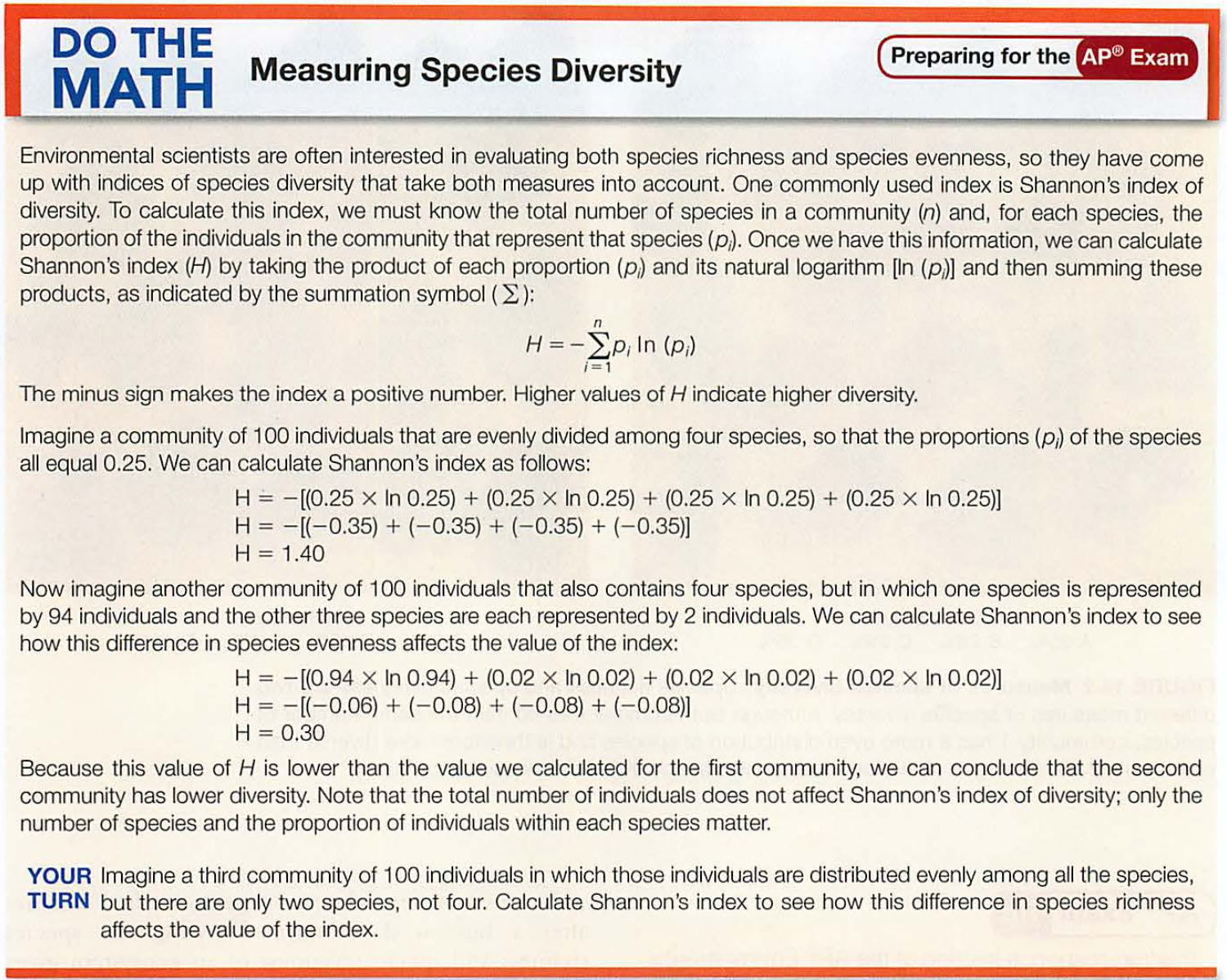Screen Shot 2022-10-16 at 12.09.43 PM.png
- In each case, record the number of each species (color of goldfish), H for each, and take a photo of each bowl (ecosystem).
- Low numbers are like 1.5, high numbers are 4.5
- Make sure to bring YOUR notes on YOUR data to class next for a quiz.
Lab: Calculating Shannon's index, using baked goldfish (the cheddar kind, not the ones that stink)
1. wash your hands
2. pour out a random number of different colored goldfish on your plate (your "pond")
3. determine the number of distinct populations by color, using chopsticks, if available
4. determine the proportion for each population (e.g. 5 red ones out of 20 total would be 5/20 or 0.25)
5. calculate Shannon's index (H) for this "pond"
6. repeat the experiment with a very low biodiversity, calculate H
7. repeat with a very high biodiversity, calculate H
8. record all of your data on your notes (not shared notes) for next class
9. eat the contents of your "pond", representing a catastrophic event where the poor goldfish have poor resistance...
Questions: email your answers before next class
1. what is the value of biodiversity in any community?
2. what are the benefits and drawbacks of a low biodiversity?
3. how does this play into competition?
4. what is the difference between species richness and species evenness?
5. what is the impact of this on a human population, e.g. the census?
6. if you have 10 each of the six colors of M&M candies, what is the H value for this?
7. You then eat some, leaving 10 brown, and 2 of each of the rest, what is H now?
8. which of these colors would likely be an invasive species in a simulation?
9. How does agriculture affect biodiversity? Discuss the impacts of monoculture farming compared to polyculture practices.
10. Describe the primary threats to marine biodiversity, including overfishing and coral reef degradation.
Notes on Shannon's index:
Shannon Diversity: It might sound complex, but at its core, it quantifies **ecological complexity**, using an index for measuring the variety and abundance of life in a given area.
**Here’s the key link to biodiversity:** Shannon Index reflects how much we can *predict* about each species within a community based on observing others:
1. **Diversity Indices:** The index assigns scores to communities, reflecting their diversity levels. A higher score means greater diversity!
2. **Species Abundance & evenness:** The formula considers both the number of different species (species richness) and how equally abundant they are in terms of relative population sizes (evenness).
**Why does this matter? Understanding biodiversity is crucial for these reasons: :**
- **Ecosystem Stability:** High diversity often leads to more resilient ecosystems that can better withstand environmental changes.
- **Conservation Efforts:** Identifying areas with high biodiversity allows targeted conservation efforts, ensuring we protect the most valuable species and habitats.
- **Predictive Models:** The index helps researchers predict how a change in one species might impact another (e.g., top-down or bottom-up effects) within a community.
**How it works (simplified):** Imagine an area with:
- Lots of different plant and animal species, like rainforests.
- Some plants are very common, some rare, making for uneven distribution in the ecosystem
The Shannon Index would consider these factors to calculate its diversity score based on how much we can predict about each unique life form within that community given what's already known.
**Example:**
- A diverse forest with numerous tree species (high richness) and a relatively even population of those trees across the area (evenness) will likely have a higher Shannon Index value compared to an area dominated by just one or two dominant species, indicating less diversity.
**Keep in mind:** The Shannon index is not perfect. It doesn't capture everything about biodiversity; it focuses on predicting the overall 'information content' of the system based on observed species variation within a specific community
**In summary**: The Shannon Index offers a valuable tool for biologists and ecologists to quantify ecological diversity, which helps in understanding how nature functions as a whole.
---
Migrated from Apple Server Wiki. Original page ID: s2D9T9n0
# Conservation worksheet
Bozeman: forests:
[http://www.bozemanscience.com/ap-es-017-forestry-rangelands](http://www.bozemanscience.com/ap-es-017-forestry-rangelands)
1. how much of our old growth forests are gone?
2. why is fire suppression not ideal?
3. what are his solutions to the tragedy of the commons?
4. look up GPS ranching collars-why could this help with rangelands?
5. Look up Ralph Waldo Emerson, and cite one of his quotes that is relevant to this topic.
6. Do the same for Henry David Thoreau.
7. What is John Muir famous for, and why is this important?
8. Look up Rachel Carson, and explain why the spring was "silent"
9. What was the impact of her work?
10. Look up Aldo Leopold and cite something relevant to this topic
11. Watch the first 8 minutes of this video: [http://physics.hpa.edu/physics/apenvsci/videos/ansel\_adams.mp4](http://physics.hpa.edu/physics/apenvsci/videos/ansel_adams.mp4) and explain: how did the creation of local parks change the perception among city dwellers about conservation in other parts of the country? alternate links: [http://physics.kamuela.org/physics/apenvsci/videos/ansel\_adams.mp4](http://physics.kamuela.org/physics/apenvsci/videos/ansel_adams.mp4) [http://cm.kamuela.org:8888/video/ansel\_adams.mp4](http://cm.kamuela.org:8888/video/ansel_adams.mp4)
12. "More than any other artist of the century, he would help transform the meaning of "wilderness" in America and change what people thought and felt about their own land”-How?
13. Szarkovski uses the metaphor of a dictionary to describe what Ansel Adams did: how did these “words” change the ability of citizens to appreciate nature?
14. He also describes a non-verbal understanding of nature: “that’s it, that’s true”. Why is this important?
15. "It's a place that you step into, and you don't know what's going to happen, a place that can surprise you, it's a place where you are small, where being small is not a bad thing, where being small is actually a wonderful thing"-Carl Pope, Sierra Club: what is the impact of this on you?
16. "...The world is beautiful, that humanity is part of this larger world, that the concerns of the moment are part but not separate from a larger system of forces that that connect us to all of creation"Jonathan Spaulding, Biographer: why was this form of art so effective at conveying this?
17. How did his photographs change the awareness of the public? People usually care about what they know...
18. Teddy Roosevelt used this awareness of the gifts of nature to create parks in the Southwest US-how?
19. Watch this: National Parks: 7:00-10:00 [http://physics.hpa.edu/physics/apenvsci/videos/national%20parks/NATIONAL\_PARKS\_1.m4v](http://physics.hpa.edu/physics/apenvsci/videos/national%20parks/NATIONAL_PARKS_1.m4v) and explain what he means by "ownership" alternate link: [http://cm.kamuela.org:8888/video/NATIONAL\_PARKS\_1.m4v](http://cm.kamuela.org:8888/video/NATIONAL_PARKS_1.m4v)
20. (optional) In minutes 11:30-17:15 the Ansel Adams video describes how his father “nurtured a spark” in a non-traditional way-how can you relate to this?
---
Migrated from Apple Server Wiki. Original page ID: o5W6R8q
# Population worksheet
Population worksheetReview biodiversity:
A certain pond has six species of fish:
- 30 type a
- 20 type b
- 10 type c
- 15 type d
- 40 type e
- 50 type f
1. what is the total number of fish in this pond?
2. what is the predominant species?
3. if the r for type c, is higher than the others, what would imagine would eventually happen?
4. what is shannon’s index for this pond?
Exponential growth: (see module 16 for examples)
A small island has 1200 rabbits that exhibit J selected growth with a 14% growth rate
1. what is the initial growth rate for the rabbits? (∆N/∆t or rabbits per year)
2. what will be the population of the island after one year?
3. what will be the population of the island after 5 years?
Carrying capacity:
If the same island above starts with 1200 rabbits, and a carrying capacity of 2000:
1. what does the slope of the growth rate indicate?
2. what is the slope of the growth rate when the population is 1500?
3. what is the slope when the population is 2000 rabbits?
4. what is the slope when the population is 2400 rabbits?
5. what is this called?
6. make a graph of this scenario
Predator prey relationships
1. why does the population of hares in the weblog example peak before the lynx population does?
2. why is there a delay between the peak of the hares and the peak of the lynxes?
Use the simulation below to be creative: invent models of carrying capacity, competition and predator prey curves
You can use these to check your work...
Numbers 09:
[Download Population Growth Model 09.numbers (text/html, 221.2 KB)](https://bookstack.kamuela.org/attachments/198)
[Download Population Growth Model.xls (text/html, 61.5 KB)](https://bookstack.kamuela.org/attachments/196)
ca82b400-0a69-0a69-8673-d6dfe24b6444
ca82b400-0a69-0a69-8673-d6dfe24b6444
Human Populations:
1. what is the doubling time for a country called Doffania with a population of 1.2 million if the growth rate is 7%?
2. how long will it take to make the population 9.6 million?
3. later restrictions on family size bring the rate down to 3.5%, what is the new doubling time?
4. what other social changes could have brought down the growth rate?
5. If the CBR in a country is 11, and the CDR is 9, ignoring immigration and emigration, what is the population growth rate?
6. what is the doubling time?
7. repeat with a second country with a CBR of 9, and a CDR of 13, what is the growth rate?
8. what is the doubling time? explain
9. A third country has a CBR of 11, a CDR of 9, immigration rate of 2, emigration rate of 1, what is the growth rate?
10. what is the doubling time?
11. how would an increase or decrease in life expectancy change this?
Replacement ratio:
1. in South Korea, what is the consequence of having a replacement ratio of 0.8?
2. What is causing this?
3. Look up other countries with a replacement ratio of less than 2.1 and explain how this could be alleviated in each case (political, religious, economic, racial, etc.)
4. Why did China institute a one-child policy in 1978?
5. What happened to the population growth curve?
6. Why is this a problem now?
7. New Zealand (4.3 million people) has a stable 2.1 replacement ratio. If the immigration rate is 2 per 1000, how many people per year immigrate to NZ?
8. what is the growth rate in NZ?
9. what is their doubling time?
10. why is female education a solution to overpopulation?
11. if a country has a perfectly parallel population pyramid, is the population stable? why or why not?
12. Ask two of your friends how many siblings they have, and how many mothers in each generation to calculate the replacement ratio in each case.
Population pyramids:
Go to populationpyramid.net to answer the following:
1. what is the approximate carrying capacity of the world as of 2023?
2. how would you describe the world pyramid in 2023?
3. compare this with the world pyramid in 1958, (use the -5 key) what do you see?
4. what is the bulge in population for 5-10 year olds in 1958?
5. when were these children born?
6. if a male went to war in 1940 at the age of 20, where does he show up on the 1958 US curve?
7. compare male to female for that age then-explain
8. do the same for Germany in 1958
9. zoom forward to 1978 when some of your parents were born, why is there a bulge in both genders in 15-19 year olds?
10. If you were a 42 year old American in 2000, when were you born? How old are your kids? Find the "boom echo".
11. Find the impact of the Iran/Iraq war of 1980-89, which side had the biggest impact? If you were a 35 year old Iraqi man in 1995, how old were you during this war?
12. If you are a 30 year old German man in 1950, when were you born? How old were you in WWII (1936-1945)?
13. If you were a 35 year old woman in Japan in 1960, why are there so few men to choose from?
14. Look at the UK in 1960. Where are the casualties of WWII, and are they both male and female? Explain.
15. What the heck is going on in UAE?
16. Look at Russia in 1960. What gaps do you see? Why?
17. Information about China is very spotty-why would this be? See if you can find the impact of the one-child policy from 1979-2021.
18. Compare present day Japan to Africa. What issues will they need to address?
19. Look at present day Italy, Japan and Germany. What is common?
20. Compare present day India and China. What do you see?
---
Migrated from Apple Server Wiki. Original page ID: Z5k9z6y
# Food Miles-Agriculture
**e2: Food miles 2022**
**[https://elab.hpa.edu/apes/videos/e2/e2%20transport/3%20Food%20miles.mp4](https://elab.hpa.edu/apes/videos/e2/e2%20transport/3%20Food%20miles.mp4)**
1. Look up Michael Pollan: what books has he written?
2. What is the fossil fuel to food ratio he cites?
3. Why is this so high?
4. What did it used to be?
5. What does he mean by “sustainable agriculture”?
6. Why did WWII give us a new form of agriculture?
7. Look this up: in 1895, what portion of our workforce in our country was farmers? What is it today?
8. Look up Lancaster PA, and who lives there?
9. Why is this important to your understanding of this?
10. Local farmers may not be able to sell to Foodland and other grocery stores because of guarantees of supply quantities (minimum amounts). Where can the farmers then sell their produce, and what does this imply?
11. Foodland and KTA have different policies about this-explain.
12. When you go into Foodland and see the sandwiches and other wrapped foods labeled in boxes marked KOA, where were these prepared? Why?
13. Why is this so environmentally nasty?
14. Starbucks baked goods used to be baked here in Waimea (Mamane Bakery, behind the Montessori school). They are now baked on the mainland and shipped here frozen. Why does this make sense for Starbucks, and what impact does this have on you?
15. McDonalds gets their food products from the mainland in huge truck and air shipments. Why do they do this?
16. In the video, why is a restaurant that buys local food better than the examples above?
17. Do you know of any restaurants here in Waimea that do this?
18. What about our cafeteria?
19. Why would Amish farmers be more sustainable farmers than other modern farmers?
20. How many miles does the average food item travel in the video? Add 2500 miles for us, what is the new total?
21. Why would they fly salmon to China and back?
22. Local farmers can supply “food baskets” also known as a “CSA”. What are these and why are they more sustainable? https://en.wikipedia.org/wiki/Community-supported\_agriculture
23. Is “eating local” always a good thing? What are these folks known as?
24. What is the difference between a solar and a fossil fuel food supply?
25. What percentage of our income do we spend on our food? Is this the same in Hawaii? In Waimea? Why?
26. Where does most of the cost of food go?
27. Why do you think folks do not cook the way Pollan suggests?
28. Contrast the amount of each dollar going to a farmer in the past and now. How does localization change this?
29. Ok, now think of your home. What could you do differently?
**Bozeman Science: Video 16**
[**http://www.bozemanscience.com/ap-es-016-agriculture**](http://www.bozemanscience.com/ap-es-016-agriculture)
1. What is the difference between malnutrition and undernutrition?
2. What is overnutrition?
3. How did the green revolution make the way for industrial ag?
4. Why is industrial ag more efficient at first?
5. What are the consequences of monocropping?
6. How can these be prevented?
7. Why is irrigation of crops not a long term solution?
8. How is rain different from well water?
9. Why are pesticides not a long term solution?
10. How are inorganic fertilizers created?
11. How does intercropping work?
12. What is the connection between atrazine and bees?
13. Why is this an issue?
14. How is pesticide resistance like over prescription of antibiotics in humans?
15. How does the Haber process work?
---
Migrated from Apple Server Wiki. Original page ID: F5i3R8
# Sustainable House Design
Sustainable Design ChallengeGoal: To design a sustainable, off-grid home
Design Criteria:
1. Location: can be anywhere on earth, Mars or the moon
2. Size: enough for two people (minimum)
3. Energy: must harvest and store its own energy
4. Water: must harvest and store its own water
5. Waste: provide means to dispose of waste
6. Materials: where possible, use local materials
7. Heating-cooling: must maintain a temp of 22°C (72°F) year round
8. Lighting: passive lighting where possible
9. Ventilation: airflow to keep CO2 below 800 ppm
10. Sound: must be below 60 dB at all times
11. Environmental-cultural resonance: must fit into the environment
12. Access: must be accessible for access to resupply
13. Food: where possible, grow food and/or herbs onsite
14. Water runoff: where possible, limit erosion and runoff into water bodies (streams, rivers, oceans)
15. Impact: where possible, offset ecological impact (flora, fauna)
16. Beauty: should inspire and create curiosity about your design
17. Site: where possible, include solar, wind and water orientation
18. Toxic materials: nothing on the [red list ](https://living-future.org/red-list/)(toxic in creation, use or disposal)
19. [Sick building syndrome](https://en.wikipedia.org/wiki/Sick_building_syndrome): no vapors harmful to humans
First design report:
1. location (google earth or maps)
2. biome (pick from one system)
3. water sources (rain, river, ocean, well, etc.)
4. light (seasons, shading, solar radiation)
5. wind (ventilation, power, etc.)
6. temperature extremes (insulation, thermal mass)
7. possible energy sources (wind, tidal, geothermal, PV, etc.)
Resources:Cradle to cradle design: [https://en.wikipedia.org/wiki/Cradle-to-cradle\_design](https://en.wikipedia.org/wiki/Cradle-to-cradle_design)
e2 videos:
- [The art and science of Renzo Piano](http://10.14.4.85:6875/books/ap-environmental-science/page/e2-the-art-and-science-of-renzo-piano)
- [Green for all](http://10.14.4.85:6875/books/ap-environmental-science/page/e2-green-for-all)
- [Green apple](http://10.14.4.85:6875/books/ap-environmental-science/page/e2-green-apple)
- [Druk White school in Ladakh](http://10.14.4.85:6875/books/ap-environmental-science/page/e2-druk-white-school-in-ladakh)
e2 video list:
now
future
partial
- e2 design 1
- 1 green apple.mov
- 2 green for all.mov
- 3 green machine.mov
- 4 gray to green.mov
- 5 china-red to green?.mov
- 6 deeper shades of green.mov
- e2 design 2
- 1 druk white lotus school-ladakh.m4v
- 2 greening the federal government.m4v
- 3 bogota-building a city.m4v
- 4 affordable green housing.m4v
- 5 adaptive reuse in the Netherlands.m4v
- 6 architecture 2030.m4v
- e2 design 3
- 1 a garden in cairo.m4v
- 2 the village architect.m4v
- 3 melbourne reborn.m4v
- 4 the art and science of renzo piano.m4v
- 5 new orleans-the water line.m4v
- 6 super use.m4v
- e2 energy
- 1 harvesting the wind.mp4
- 2 energy for a developing world.mp4
- 3 paving the way.mp4
- 4 growing energy.mp4
- 5 state of resolve.mp4
- 6 coal and nuclear.mp4
- e2 transport
- 1 London-the price of traffic.m4v
- 2 Paris-velo liberte.m4v
- 3 Food miles.m4v
- 4 Seoul-stream of consciousness.m4v
- 5 Portland-sense of place.m4v
- 6 Aviation-limited sky.m4v
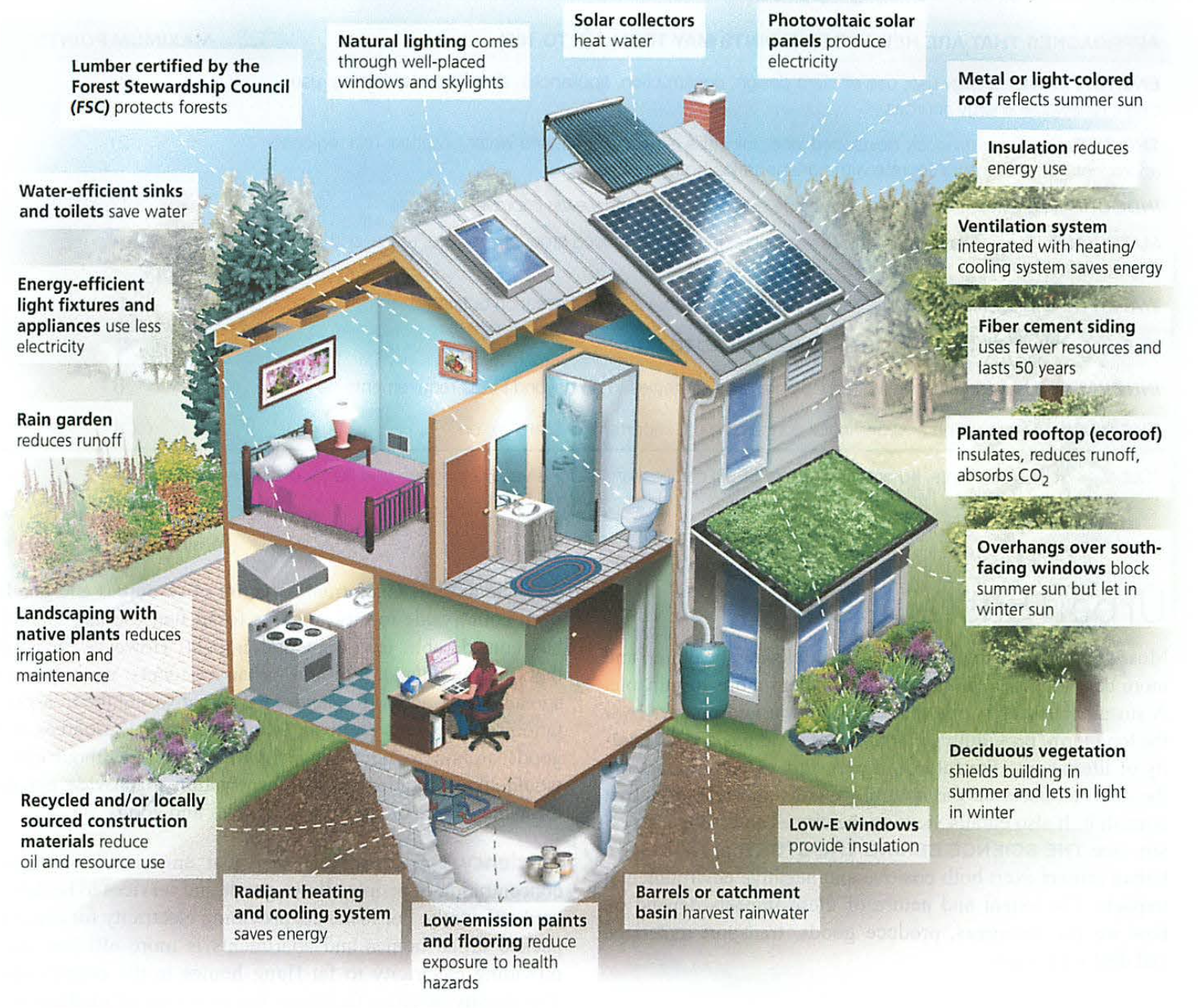Screenshot 2024-01-26 at 9.00.49 AM.png
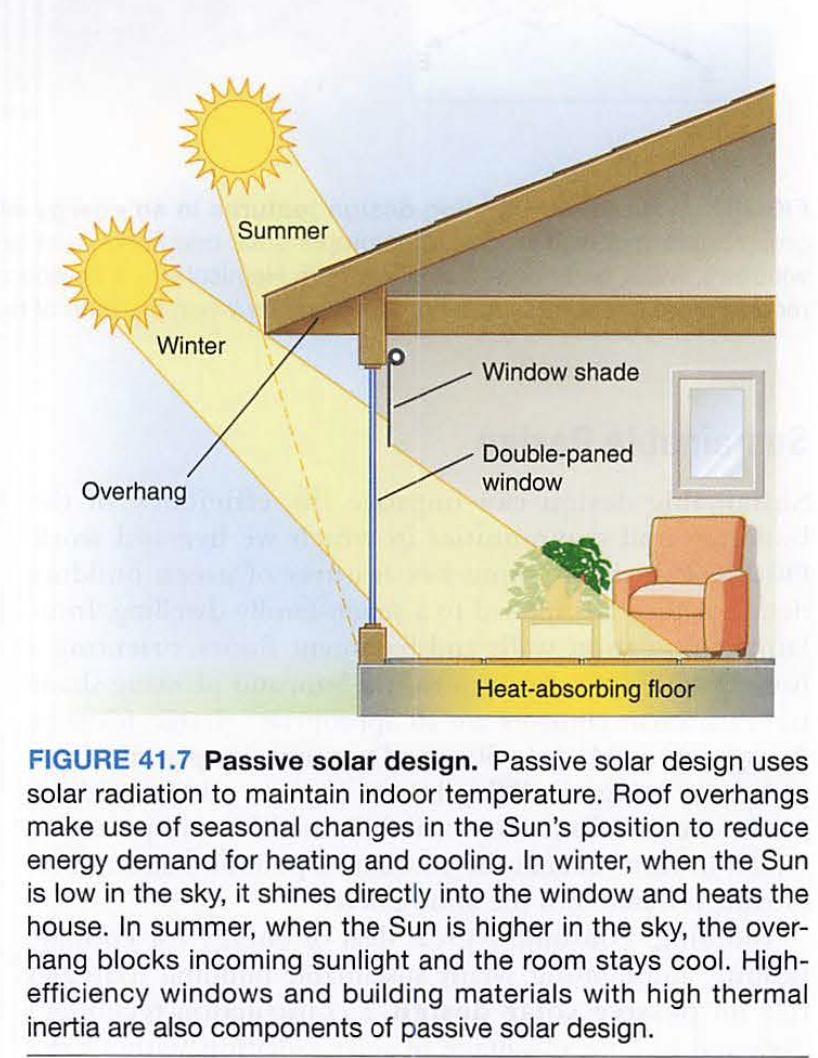Screenshot 2024-01-26 at 9.02.46 AM.png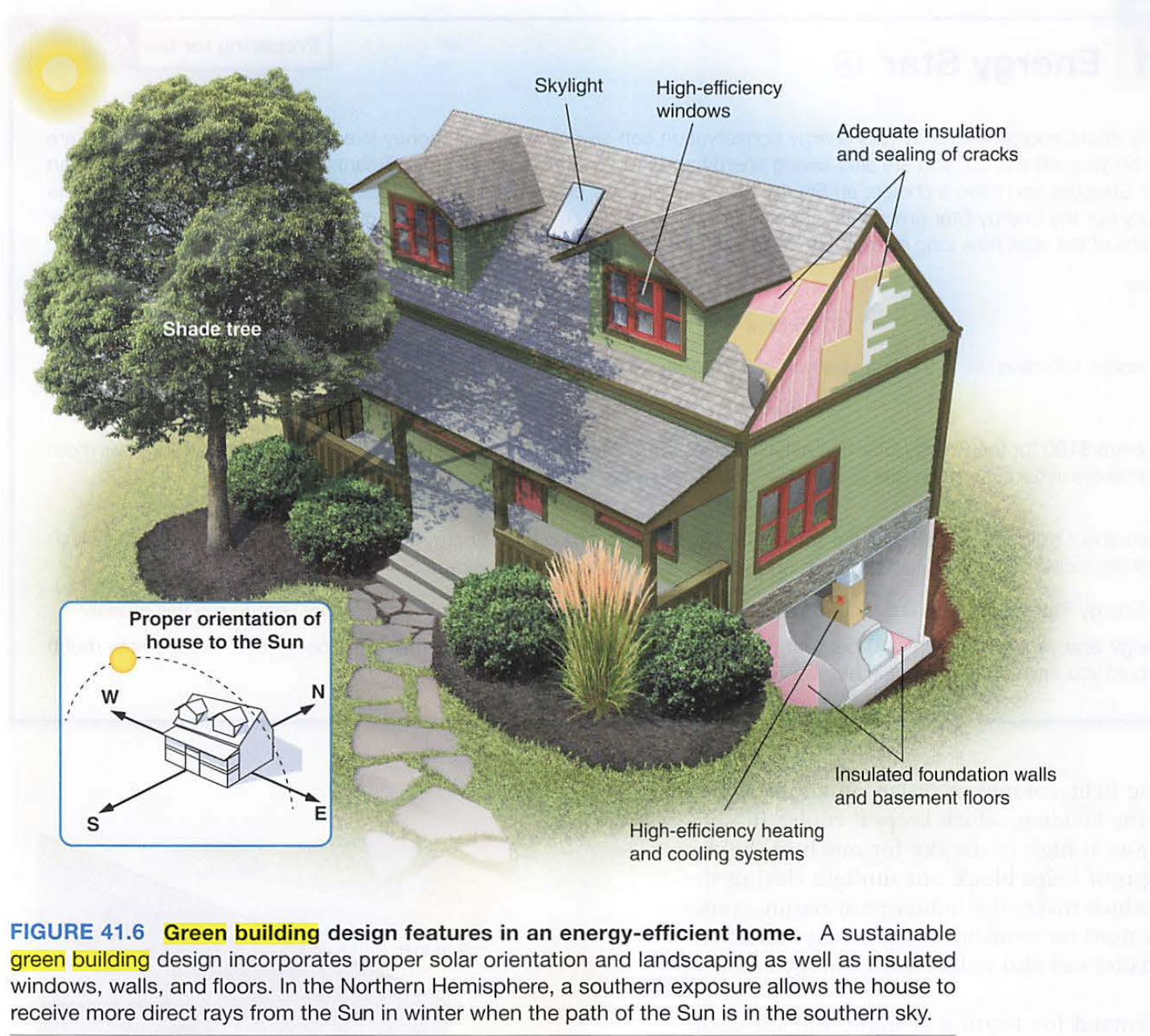Screenshot 2024-01-26 at 9.03.19 AM.png
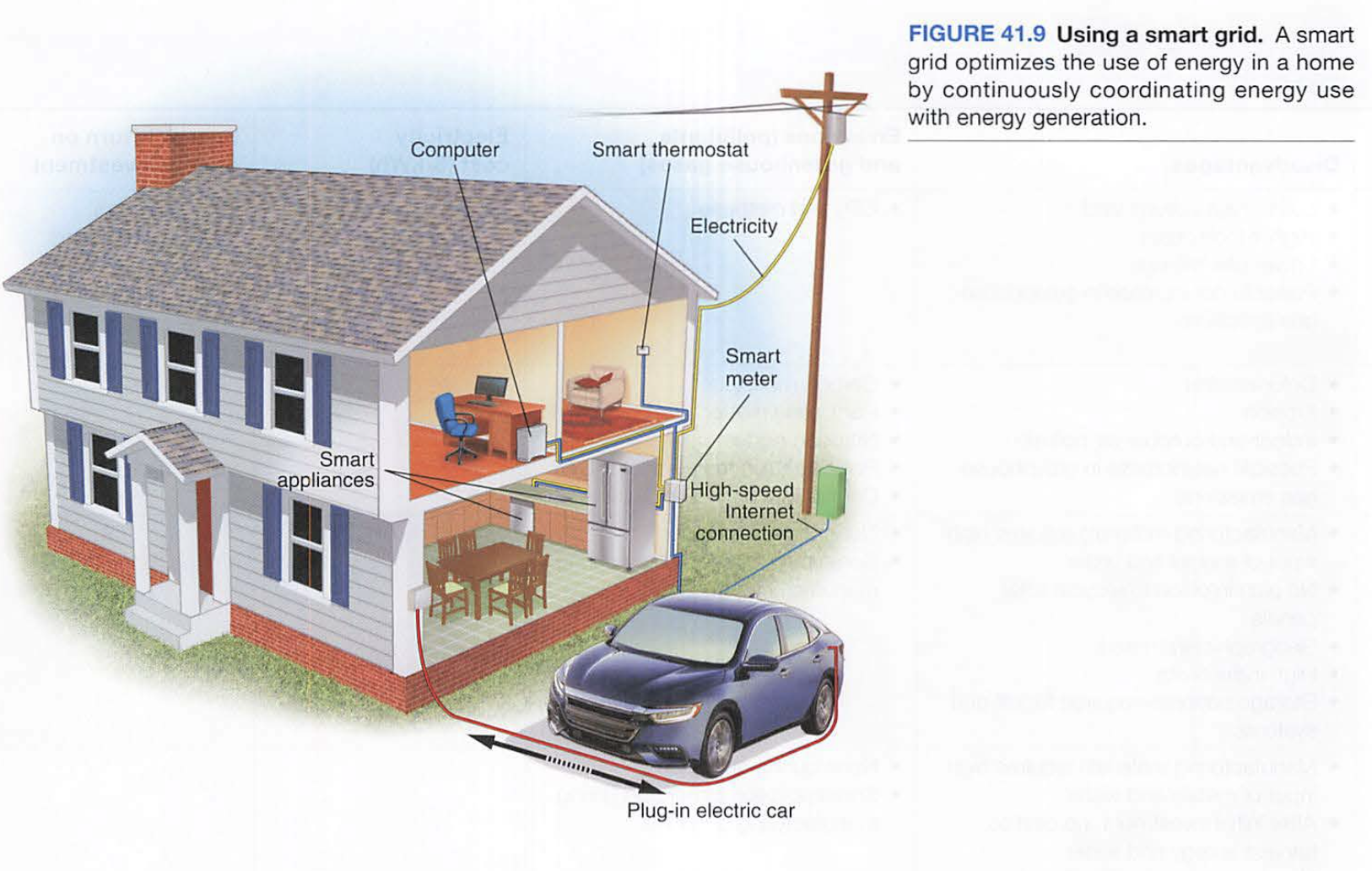Screenshot 2024-01-26 at 9.04.10 AM.png
APES green building project
First, think of what you need as a human:
- Air
- Water
- Energy
Next, consider the following about your project:
- What is the purpose of your building? (home, hotel, school, office, number of people, etc.)
- Where is your building located? (lighting, rain, wind, terrain, etc.)
- What materials do you have access to?
- How will you design your building: design, beauty, inspiration
You will be evaluated on the following metrics, with points in each category:
1. energy
2. materials
3. site
4. beauty and inspiration
5. water
6. indoor quality
You will also need to include an analysis of sustainability and carbon impact.
What you need to present:
- A detailed visual presentation
- A detailed written presentation
---
Migrated from Apple Server Wiki. Original page ID: 16U3f3
# e2: The art and science of Renzo Piano
e2-design 3.4 Renzo Piano
- [](https://elab.hpa.edu/apes/videos/e2/e2%20design%203/)[https://elab.hpa.edu/apes/videos/e2/e2%20design%203/](https://elab.hpa.edu/apes/videos/e2/e2%20design%203/)
1. 1. The intro says: "it is clear that human activity is the cause of climate change"-how long have we known this? What motivates some groups to deny this?
2. e2 or "e squared" means what in this sense, and how is it different from many other approaches to environmental decisions?
3. Morgan Freeman or Brad Pitt?
4. Have you ever visited the California Academy of Sciences (CAS)?
5. What “story” is Renzo Piano telling?
6. What environmental ethic went into the energy lab?
7. If the earthquake of 1989 had not happened, do you think the CAS would have been built?
8. What is our mission and "statement" here at the elab? (we opened the same year as CAS)
9. What brought Renzo to the project? Why did he come?
10. How did the creative process in the film differ from “normal” design processes?
11. What do you notice about all of Renzo's projects?
12. How is the term "transparency" used at CAS? Where can you see it in our elab?
13. Compare how the old and new museums fit into the park and the hills behind them?
14. How does the CAS project combine honesty and green building?
15. What do they mean by “biomorphic”?
16. Look up "biophilic" building design. How is this relevant to the CAS and the elab?
17. Why is it important that the three museums are interwoven?
18. The CAS project combines research and education. Why might this be familiar to you?
19. What two factors enable native species on the roof to resist invasive species?
20. A donor comes to you offering to support your dream project: what would you imagine?
21. We will soon learn about runoff and something called “water transit time”. How does the roof increase water transit time and why is this important?
22. Why is it critical to show people coral reefs in person?
23. Note the square white sound panels like the student union-how do these work?
24. How is the elab an "educational model" as mentioned in the film?
25. The director describes his mission-what does this mean to you?
26. Renzo had a toddler (small child) at home during this project-how did what he said resonate with this?
27. Piano describes ecology as a “moral duty”. Why?
28. On the south lanai of the elab, there are special solar PV panels. Where else have you seen these and why are they important?
29. How is this project empowering and to whom?
30. Winston Churchill (wise dude) said "we shape our buildings, then they shape us". What did he mean by this?
---
Migrated from Apple Server Wiki. Original page ID: Q9U4p6p
# e2: Green for all
e2 design 1.2 green for all
- [https://elab.hpa.edu/apes/videos/e2/e2%20design%201/](https://elab.hpa.edu/apes/videos/e2/e2%20design%201/)
1. In the intro (Brad Pitt), there is mention of how much energy buildings use. Why is this?
2. What are the points Jeff Speck brings up?
3. Who are the Yaqui Indians and why is this important?
4. If you make $2 per day, how long would it take to build a house that costs $5000?
5. What was wrong with the government homes?
6. How is architecture linked to health and wellbeing and why is this relevant in the elab?
7. Why is the open courtyard in the video a thermal, light and social solution?
8. How does the community “own” the building? Why is this brilliant?
9. The new home owners cut the ribbon. Where did this happen at the elab, and why is this culturally relevant in Hawaii? (hint there are two of them in the lab today)
10. Many cities are divided by a road or railway. What does the saying “wrong side of the tracks” mean?
11. How does the Guadalupe project change this?
12. Who was involved, and why is this important?
13. In Hawaii we have “ohana” homes. What are these called in the video?
14. What does Sergio mean about the politics of Austin?
15. How did this video inspire you?
---
Migrated from Apple Server Wiki. Original page ID: R625m1i3
# e2: Green Apple
e2 design 1.1 green apple
- [https://elab.hpa.edu/apes/videos/e2/e2%20design%201/](https://elab.hpa.edu/apes/videos/e2/e2%20design%201/)
1. Why is it confusing to think of NYC as an ecosystem?
2. Why does it make sense?
3. Why is per capita a more accurate measure? ("capita" means head, where you wear your cap)
4. Why did the guy who moved into the country gain weight?
5. A wise person once said that the greatest cities are those built with walking in mind. How is this different in LA?
6. Why would a skyscraper be more efficient than a smaller building?
7. How did “environmental” become “smarter”?
8. How was 4 Times Square a prototype? What other prototype buildings do you know of?
9. Transparent PV panels were mentioned in the video. How would this change the frit concept?
10. “Blast furnace slag” and "fly ash" are used for the concrete in the film. Why is fly ash banned in Europe?
11. Instead of using drinking water to flush toilets, they use what?
12. Why is a 5 year ROI basic business sense?
13. How is payback different in Europe and Japan?
14. What parts of the Living Building Challenge resonate with this video?
15. What would make you want to live in the Solaire, near Battery Park?
16. What are the blue things on the side of the building?
17. We are 4.6% of the global population, consuming how much of the world’s resources?
---
Migrated from Apple Server Wiki. Original page ID: g3u1p3R3
# e2: Druk White School in Ladakh
e2: Design 2.1: Druk White school in Ladakh
- [https://elab.hpa.edu/apes/videos/e2/e2%20design%202/](https://elab.hpa.edu/apes/videos/e2/e2%20design%202/)
1. We’ve heard Brad Pitt ask “was it a conscious decision or a momentary lapse of reason”. What is the difference to you?
2. Look up Ladakh here: [https://en.wikipedia.org/wiki/Ladakh](https://en.wikipedia.org/wiki/Ladakh). Why is it critical to educate youth about their culture?
3. What is the message from His Holiness the 12th Gyalwang Drukpa?
4. Why is Ladakh “a fragile place”?
5. The lowest part of Ladakh is about the altitude of the Mauna Kea visitor center (9000 ft.) and the top is twice as high as the summit of Mauna Kea. Consider the biomes there, and what could possibly survive there?
6. What Buddhist principles are cited as coincident with sustainable design?
7. Watching them build the school, did you see any heavy equipment or power tools?
8. What is the resonant feature of the circular building? [https://en.wikipedia.org/wiki/Mandala](https://en.wikipedia.org/wiki/Mandala)
9. Why is it useful to marry local resources and concepts to a modern design?
10. What was the learning opportunity for the modern architects there?
11. Why is frugality a key concept in sustainability?
12. Where else do you see this? [https://en.wikipedia.org/wiki/Living\_Building\_Challenge](https://en.wikipedia.org/wiki/Living_Building_Challenge)
13. How is passive solar used, and why is this critical there?
14. What is a trombe wall system?
15. Where else do you see this? [https://en.wikipedia.org/wiki/Trombe\_wall](https://en.wikipedia.org/wiki/Trombe_wall)
16. How do they take water out of the waste cycle?
17. Why is it useful for the kids to know how the building works?
18. What is the impact of bringing in rural students?
19. Why is the woman architect’s approach so different?
20. Circle back to the vision of His Holiness the 12th Gyalwang Drukpa. What is his vision for the future?
---
Migrated from Apple Server Wiki. Original page ID: u4g4y7y
# Elab Hunt
Find these:
1. Living building challenge award
2. Apple award
3. Apple award #2
4. LBC petals (wood block)
5. Green building award (like, green)
6. LEED Schools Platinum award (glass)
7. Material sourcing, distance, FSC wood (look this up)
8. Materials redlist (look this up)
9. Architecture award (ugh, another award...)
10. Building automation system (BAS) [http://elab22.hpa.edu](http://elab22.hpa.edu)
11. Carbon dioxide monitors (QR codes, look around)
12. Passive ventilation (heat stack)
13. Passive lighting-skylights
14. concrete table (white, HPA logo)
15. Ohia legs, Ohia tree
16. Less than 10 meters to any window
17. sound baffles (red and black)
18. home made sound baffles (white)
19. concrete thermal mass (decks)
20. concrete driveway thermal mass
21. bike parking (looks like a place for trashcans)
22. airfoil roof
23. sun shades
24. PV panels
25. handicap access ramps (2)
26. water catchment system
27. radiant cooling system
28. recycled construction
29. on site sewer treatment
30. solar thermal water heating
31. recycled materials
32. solar inverters
33. backup battery power
34. site relocation-bear sanctuary, plantings
35. bike path
36. Polynesian roof design
37. carbon dioxide sensors, ventilation system
38. LED lighting
39. clerestory heat venting, auto
40. clerestory heat venting, stack effect
41. recycled M toilet
42. auto lighting system
43. recycled F toilet
44. bas relief of mountain range
45. no VOC carpet, furniture
46. no VOC paint
47. low flow faucet
48. low flow vanity faucet
49. backup fan for comfort, auto
---
Migrated from Apple Server Wiki. Original page ID: i5k0G5f1h
# Living Building Challenge
Elab green building hunt:
[Download ber cement siding.tiff (image/tiff, 2.6 MB)](https://bookstack.kamuela.org/attachments/209)
LEED:
- Prerequisites and points
- Certified (we tried): 40-49 points
- Silver: 50-59 points
- Gold: 60-79 points
- Platinum: 80+ points (elab was 97)
- [https://www.usgbc.org/credits?Version=%22v2.0%22&Rating+System=%22New+Construction%22](https://www.usgbc.org/credits?Version=%22v2.0%22&Rating+System=%22New+Construction%22)
Living building challenge:
1. Energy, water and waste self sufficient (audit for one year with no failures)
2. Materials sourcing based on density (steel, concrete, wood, etc.)
3. Nothing can be toxic in production, use, or disposal (the “red list”) [https://living-future.org/declare/declare-about/red-list/](https://living-future.org/declare/declare-about/red-list/)
4. LBC petals (see below)
5. Pass/fail
[Download BEAUTY &.tiff (image/tiff, 697.8 KB)](https://bookstack.kamuela.org/attachments/210)
[Download Living-Building-Challenge-1.3-Standard.pdf (application/pdf, 1.0 MB)](https://bookstack.kamuela.org/attachments/213)
[Download Living-Building-Challenge-2.0-Standard.pdf (application/pdf, 3.0 MB)](https://bookstack.kamuela.org/attachments/211)
Redlist:
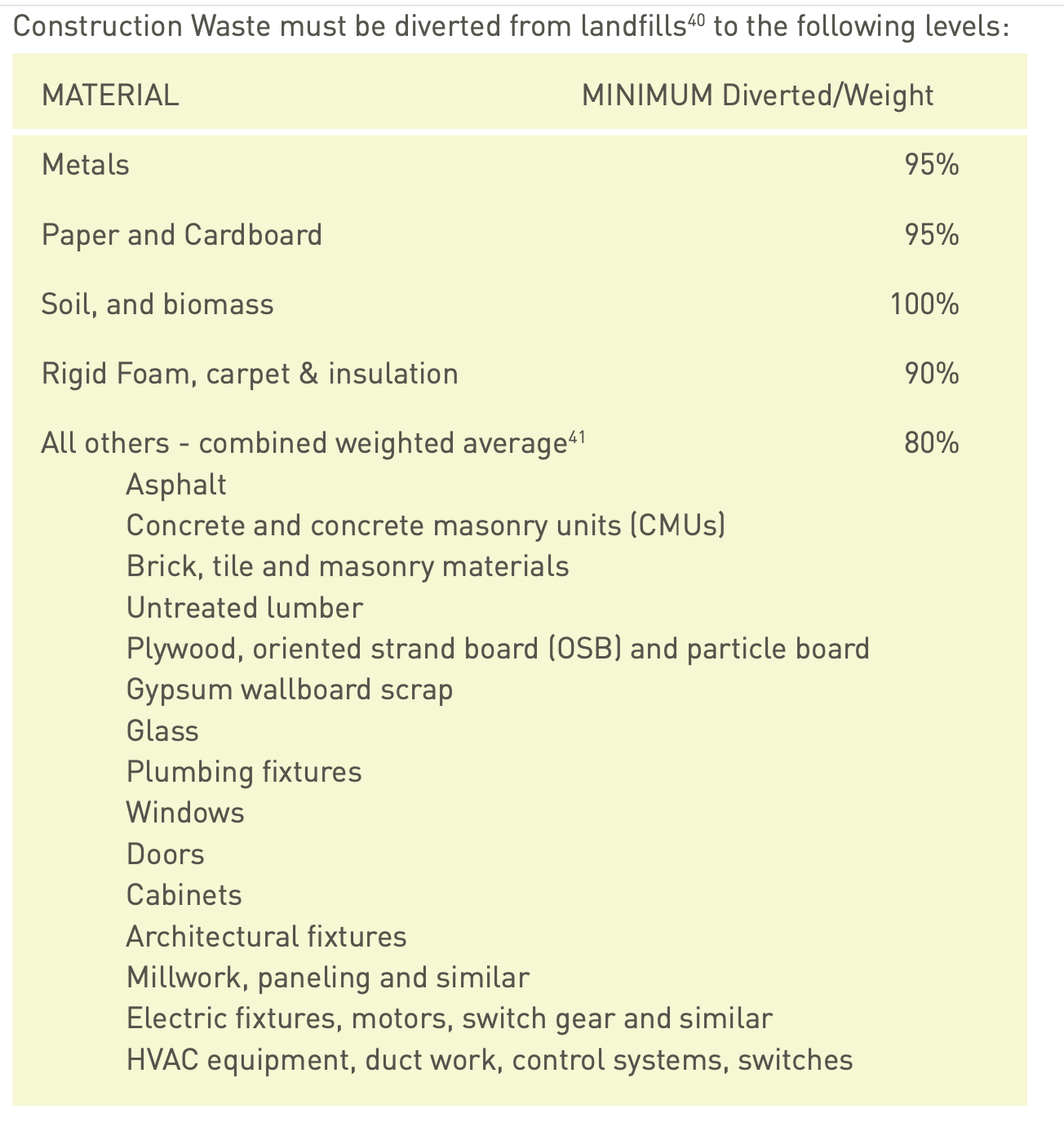Screenshot 2024-01-29 at 1.29.14 PM.png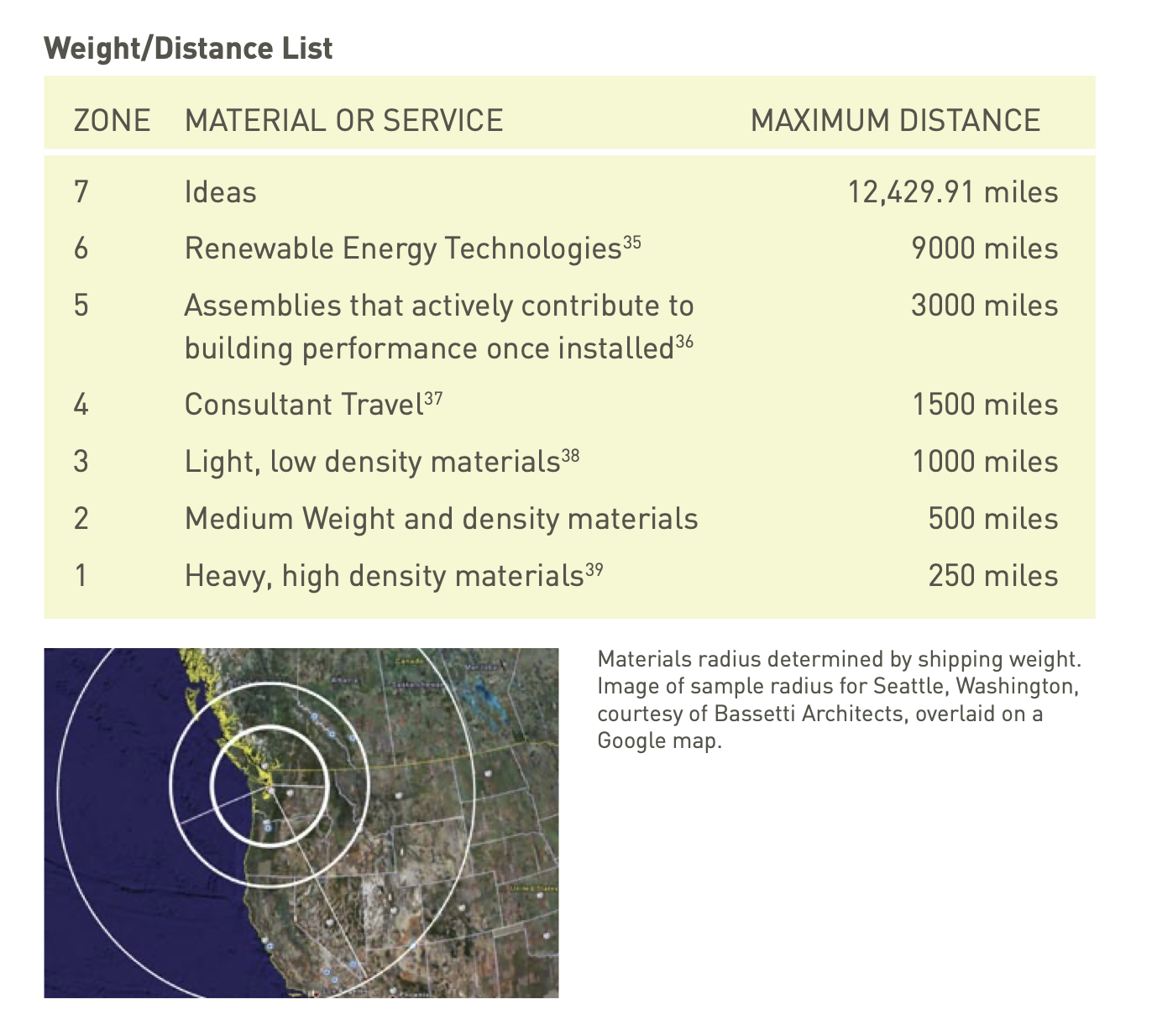Screenshot 2024-01-29 at 1.28.55 PM.pngHPA Energy Lab: a Prototype Integrated Sustainable Building
- Recycled toilet fixtures
- Recycled building materials (lab tables)
- Radiant cooling system (roof panels)
- Solar thermal water heating system
- Photovoltaic panels (three arrays)
- Low/no VOC paints
- No VOC carpet
- No VOC furniture (no phenol glue)
- Native plants (Koaia tree to reduce erosion)
- Rain water catchment
- Energy efficient LED lighting with occupancy controls
- Automated climate control system (ventilation, CO2, temperature, RH)
- Energy efficient appliances (Apple minis, all recyclable)
- Water efficient toilets and sinks
- FSC certified lumber from Oregon
- Natural lighting (skylights, double glazed glass)
- Noise reduction (double glazed glass)
- View of outside (10 meters to windows everywhere)
- Metal roof with insulation (soy insulation)
- Passive ventilation system
- Cement countertops (later found to be high CO2 producers)
- Roof shape design: south facing for solar panels, roof shape for Bernoulli ventilation
- Water storage under deck (10,000 gallons, 40,000 liters)
- Insulated cool water reservoir for radiant cooling system
- Soy insulation on roof
- Low emissivity windows/tinting
- Double glazed windows for sound and thermal isolation
- Solar shade panels
- Heat stack effect ventilation (a la pacific island design)
- Technology innovation: EMC system
- Energy monitoring and control system (reduce loads, locate vampire loads)
- Land restoration (purchase of sanctuary lands in Oregon)
- Locally sourced materials (concrete, steel, wood)
- Brownfield restoration (Mount Spencer)
- Bike Path to elab
- Onsite sewage treatment
- Hybrid/electric vehicle parking
- Stormwater management
- Reduced heat island impact
- Environmental quality: noise reduction, lighting, outside view, ventilation
- Recycled building materials (99% recycling of all building materials)
- LEED for schools: all aspects of the building can relate to a K-12 concept
- Erosion and sediment control: flume above elab
- Weather stations interact with building automation system
- Bifacial solar panels
- Wind turbine
- Co-gen plant
- Reflective deck
- Greywater use
- Red list for materials
- Geo sourcing based on density
- 1 year occupancy evaluation/certification
- High SEER HVAC systems (heat pumps, HVAC)
---
Migrated from Apple Server Wiki. Original page ID: y0k7f9W0
# e2: Affordable green housing
- [http://physics.hpa.edu/physics/apenvsci/videos/e2\_videos/e2%20design%202/4%20affordable%20green%20housing.m4v](http://physics.hpa.edu/physics/apenvsci/videos/e2_videos/e2%20design%202/4%20affordable%20green%20housing.m4v)
- [https://elab.hpa.edu/apes/videos/e2/e2%20design%202/](https://elab.hpa.edu/apes/videos/e2/e2%20design%202/)
1. Brad or Morgan?
2. What is your connection between biological diversity and social diversity like in the film?
3. Look up the percent of income spent on housing in Hawaii, SF, NYC and Seattle.
4. "To repair the fabric of communities" is a paraphrase of [Tikun Olam](https://parabola.org/2018/01/10/repairing-the-fabric-of-the-world-a-conversation-with-jonathan-f-p-rose/) in Hebrew. Look this up and describe why it is relevant here.
5. What factors led to the success of the Burnham Building? hint: what is next to it, for example?
6. Why did he (Jonathan Rose) put the library in the basement?
7. Lee Weintraub describes a situation where people who serve a community cannot afford to live in that community. Think of Westchester in NY, Seattle, San Francisco, Aspen Colorado and Waikoloa here. What is common?
8. Why is this at the core of sustainability?
9. Look up the history of [Harlem](https://en.wikipedia.org/wiki/Harlem) in NYC, once known as Haarlem. Why is this so ironic?
10. Why is local ownership so good for both sides of the economic divide?
11. The development is aimed at foster kids. Why is this better than building it for retirees?
12. Rose uses the term "monoculture". Where else have you heard this?
13. Security, health and ownership are key-why?
14. Look up the South Bronx on this [map](https://en.wikipedia.org/wiki/Boroughs_of_New_York_City) of the New York area. Why would this work for low income folks?
15. What is the physical/psychological impact of walking up through gardens in the Via Verde project?
16. What does Via Verde translate to in Spanish? Why is this important?
17. This is a very aspirational film, what impacted you the most?
---
Migrated from Apple Server Wiki. Original page ID: f2H6X2i3a
# Energy Summary
APES Energy UnitBig bang: Hydrogen->fusion -> Helium ->iron stars (red giants)
Giant red giants ->supernova->all elements beyond iron
Hydrogen, Helium and other elements->our sun
Sun: Hydrogen fusion->helium (helios means sun in greek)
Direct solar energy:
Sun is source of photosynthesis
Photosynthesis: light + CO2 + water->sugar (carbon based fuel)
Biomass is using this as renewable fuel (wood, sugarcane->ethanol)
Dead plants and animals (fossil fuels) + oxygen -> energy again
Fossil fuels are slow legacy solar energy, stored from eons ago
Sun is also source of radiant energy:Solar thermal: capturing radiation, turn to heat, store this thermal energy
Solar photovoltaic: capture radiation, move electrons, create direct current electricity (plus and minus, just like batteries)
Wind energy: from solar radiation heating air, moves across the surface, moves blades, turbine, electricity
Tidal energy: caused by gravity from the sun (and moon) pulling on water, moving it through turbines, electricity
Uranium from those supernova is in the earth core:
Slow nuclear energy: geothermal (actually geo-nuclear-thermal) energy
Fast nuclear energy: dig up Uranium, create heat, make steam, move turbines, create alternating current electricity (like in your house)
Future energy: Use Hydrogen isotopes to create fusion: H + H ->He (like the sun)
issues: 1 million degrees, hard to ignite (pressure and temp like in the sun core)
Renewable Energy:
Direct solar: solar thermal, solar PV
Indirect solar: wind energy, tidal energy
Photosynthesis solar: biomass (wood, sugarcane, ethanol)
Non-renewable energy: (e.g. not from the sun each day)
Fossil fuels: coal, oil, natural gas
Nuclear fuels: uranium, thorium
---
Migrated from Apple Server Wiki. Original page ID: 77p2E21
# Ch. W19: Fossil fuels
Energy Background:Big bang:
- Hydrogen->fusion -> Helium ->iron stars (red giants)
- Giant red giants ->supernova->all elements beyond iron (including Uranium)
- Hydrogen, Helium and other elements->our sun
Sun: Hydrogen fusion->helium (helios means sun in greek)
Solar energy:
- Sun is source of photosynthesis: light + CO2 + water->sugar (carbon based fuel)
- Sun can also be direct radiant energy (solar thermal, photovoltaic-PV)
Solar energy storage: photosynthesis
- Biomass is a form of this stored, renewable fuel (wood, sugarcane->ethanol)
- Fossil fuels are slow legacy non-renewable solar energy: dead plants and animals stored from eons ago (oil, coal, natural gas)
Solar energy release:
- Burning: biomass + oxygen -> energy (e.g wood)
- Combustion: fossil fuels + oxygen -> energy (e.g. burning coal)
Solar radiant energy:
- Solar thermal: capturing radiation, turn to heat, store this thermal energy (e.g. hot water)
- Solar photovoltaic: capture radiation, move electrons, create direct current electricity (plus and minus, just like batteries)
- Wind energy: from solar radiation heating air, moves across the surface, moves blades, turbine, electricity
Gravitational energy: Tidal energy: caused by gravity from the sun (and moon) pulling on water, moving it through turbines, electricity
Non-solar energy:Uranium from those supernova is in the earth core:
- Slow nuclear energy: geothermal (actually geo-nuclear-thermal) energy
- Fast nuclear energy: dig up Uranium, create heat, make steam, move turbines, create alternating current electricity (like in your house)
Future energy: Use Hydrogen isotopes to create fusion: H + H ->He (like the sun)
Issues: 1 million degrees, hard to ignite (pressure and temp like in the sun core)
Energy sources (from Withgott 7e):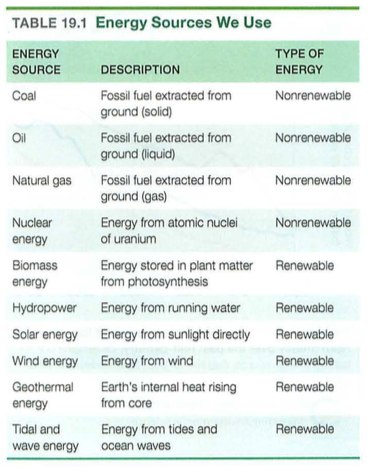Screen Shot 2024-02-13 at 4.14.12 PM.pngThings are changing: Note increase in natural gas, decrease in coal (why?)
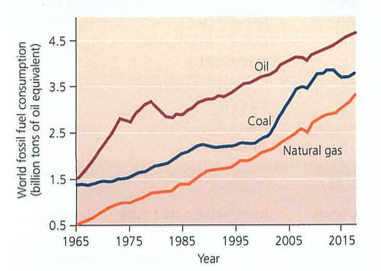Screen Shot 2024-02-13 at 4.19.05 PM.png
Most energy production in our civilization is based on dopey steam technology from the 1800's:
1. heat water
2. make steam
3. steam blows over spinning turbines (like fans)
4. spinning generators generate electricity
(If this were on a ship, it would be connected to a propellor)
So,
Oil is burned, coal is burned, nuclear energy heats water into steam (old tech)
Natural gas can be used for this as well, but can also be used in a direct turbine (no steam, just like a jet engine)
So?
If we are moving towards renewable energy sources like wind and solar, sudden changes in the energy grid require fast response, like a "jet engine" powered by natural gas.
It is also much cleaner than oil or coal (less sulfur, no heavy metals)
Fun fact: one reason so many US Navy ships were sunk in the Pearl Harbor attack was it took hours to heat the water in their boilers into steam to turn the propellors on these ships...
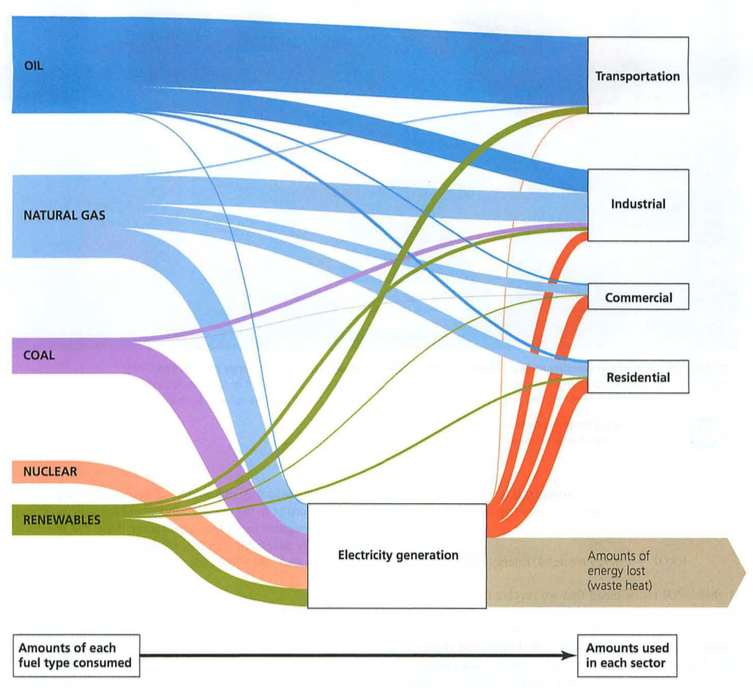Screen Shot 2024-02-13 at 4.24.41 PM.png
Notice about 1/3 transportation, 1/3 electrical, and 1/3 industrial/residential (like in the audio clip from Jim Woolsey)
How will electric vehicles (EV) change this?
How will energy storage change this?
How are fossil fuels formed?
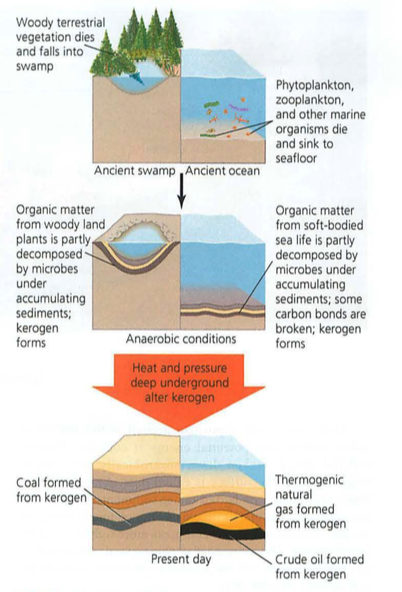Screen Shot 2024-02-13 at 4.26.31 PM.pngHow is coal formed? Note different types, from Peat (like in Scotland: Bogs) to lower water content versions, so they are better for heating.
Fun fact: UK sold most of their high quality anthracite after WWII to pay debts, so lower quality highly toxic coal was used, causing the [London Fog Disaster](https://en.wikipedia.org/wiki/Great_Smog_of_London), killing thousands. UK debt to GDP ratio then was 250%
How is oil found?
Believe it or not, satellites with sensitive gravity meters are one way...
also this:
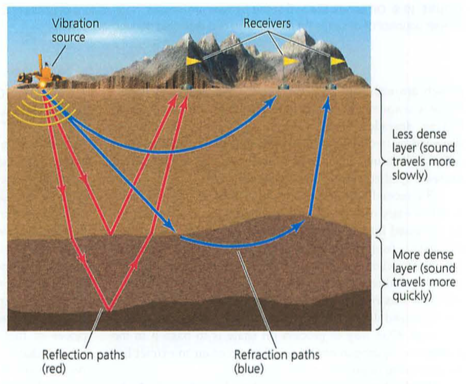Screen Shot 2024-02-13 at 4.30.35 PM.png
Important bit about distillation: make sure you understand this, it shows up on AP exams...
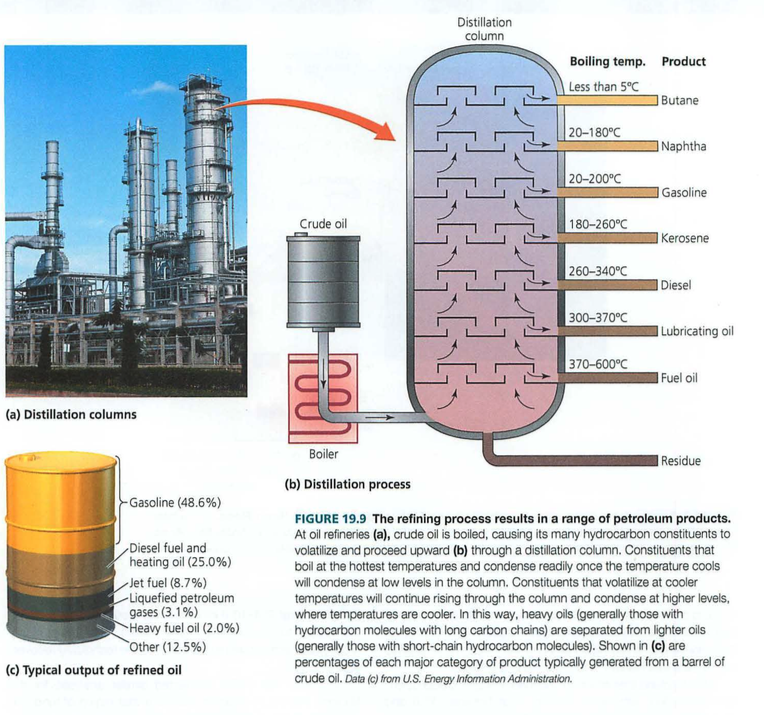Screen Shot 2024-02-13 at 4.32.05 PM.pngNot-so-fun fact: one reason gasoline is so expensive in Hawaii, is crude oil is refined into aviation fuel (kerosene) because all airplanes that land here are empty and need to fill up to get elsewhere.
Dopey way we get electricity (remember steam comments above): make sure you understand this, another AP exam favorite:
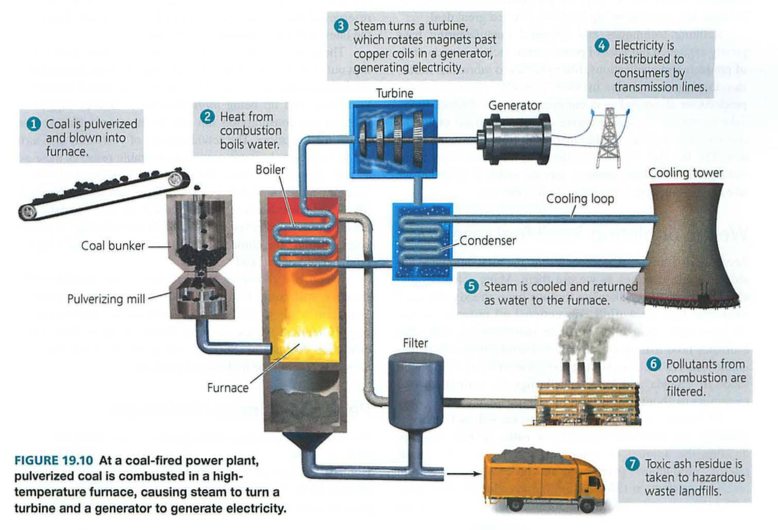Screen Shot 2024-02-13 at 4.33.59 PM.png
Petroleum products are everywhere: recall the HW question about "plastics"...
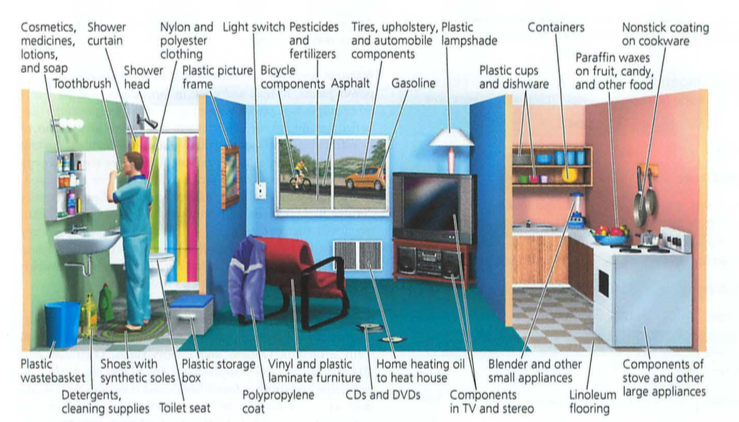Screen Shot 2024-02-13 at 4.34.29 PM.pngConsider this: as we reach Peak Oil, and beyond, oil will be too expensive to use for just fuel, it will be reserved for these things.
Peak Oil:
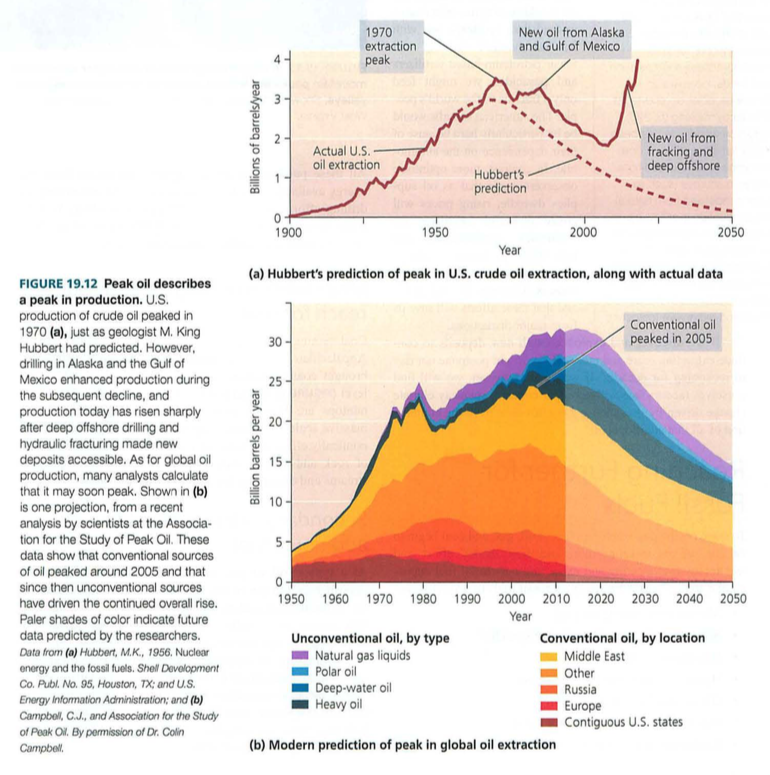Screen Shot 2024-02-13 at 4.35.55 PM.pngFracking is [Hydraulic Fracturing](https://en.wikipedia.org/wiki/Fracking) using toxic solvents forced through older oil and gas formations
Good thing: cheaper natural gas
Bad thing: toxic pollution, earthquakes, gas leaks (methane s 44x as harmful as a greenhouse gas)
Political issues: why go to war for energy?
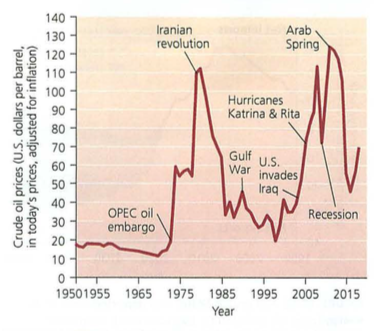Screen Shot 2024-02-13 at 4.38.47 PM.pngConservation: 8x as efficient as installing new energy sources (solar thermal, PV)
One example: LED lighting:
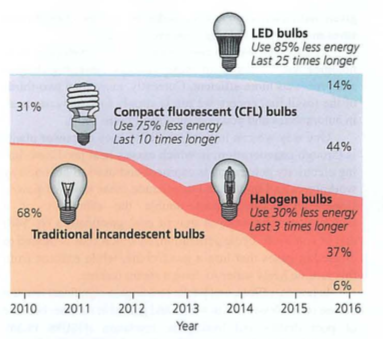Screen Shot 2024-02-13 at 4.40.27 PM.png
Even more effective: insulation (look up R values)
Double glazed windows, like in your dream house!
---
Migrated from Apple Server Wiki. Original page ID: w2G8J9L
# Energy questions: fossil fuels
**Energy questions 2.16.24**
Bozeman Science:
Energy consumption:
[http://www.bozemanscience.com/ap-es-023-energy-consumption](http://www.bozemanscience.com/ap-es-023-energy-consumption)
Fossil Fuel resources:
[http://www.bozemanscience.com/ap-es-024-fossil-fuel-resources](http://www.bozemanscience.com/ap-es-024-fossil-fuel-resources)
Read chapter W19 here:
[https://elab.hpa.edu/apes/texts/Withgott7e%20v.2%20ocr/ch19ocr.pdf](https://elab.hpa.edu/apes/texts/Withgott7e%20v.2%20ocr/ch19ocr.pdf)
Or here:
[http://physics.hpa.edu/physics/apenvsci/texts/withgott/Withgott7e%20v.2%20ocr/ch19ocr.pdf](http://physics.hpa.edu/physics/apenvsci/texts/withgott/Withgott7e%20v.2%20ocr/ch19ocr.pdf)
**Questions:**
1. How many kcal in a pizza?
2. How many pizzas do we use each day?
3. What was the first energy crisis?
4. What solved it?
5. Is this renewable?
6. What is the EROI?
7. What happened in 1973 and 1979?
8. Why did the price of oil drop again in 1980? (look this up)
9. What is driving the use of renewable energy sources?
10. Why are fossil fuels only formed by anaerobic decomposition? What would happen if they decomposed in air?
11. Trace the formation steps of vegetation to coal
12. What is the difference between anthracite and lignite?
13. Why is methane called “the green fossil fuel”?
14. Why is fracking bad?
15. Look up the greenhouse impact of making cement and explain.
16. Why could you say Uranium is the only non-solar fuel?
17. How is radiant solar energy different from fossil fuels?
18. What form of energy is not solar or from a supernova?
19. Why is natural gas a “bridge energy source” for renewables?
20. Why do we still use steam technology today?
21. What caused the 1952 London fog disaster and the Donora disaster?
22. How are satellites used to find Uranium and natural gas?
23. Why do we pay more for gasoline in Hawaii than most other places?
24. What are the common parts of any thermal-electrical power plant?
25. Going forward, what ideas do you have to create a renewable energy future?
26.
---
Migrated from Apple Server Wiki. Original page ID: 5892H5r4
# Energy questions: Nuclear and Hydropower
Energy Questions: W20: Nuclear and Hydropower
Please read:
- [Chapter 20:](https://elab.hpa.edu/apes/texts/Withgott7e%20v.2%20ocr/ch20ocr.pdf) Conventional energy alternatives (nuclear, biofuels, hydropower)
Please watch:
Bozeman Science:
[025 - Nuclear Energy](http://www.bozemanscience.com/ap-es-025-nuclear-energy)
[http://www.bozemanscience.com/ap-es-025-nuclear-energy](http://www.bozemanscience.com/ap-es-025-nuclear-energy)
[026 - Hydroelectric Power](http://www.bozemanscience.com/ap-es-026-hydroelectric-power)
[http://www.bozemanscience.com/ap-es-026-hydroelectric-power](http://www.bozemanscience.com/ap-es-026-hydroelectric-power)
1. Why is a log scale in stead of a linear scale useful for earthquakes and nuclear disasters?
2. How would you argue that nuclear energy should be promoted?
3. Why is water needed to keep the nuclear reaction going?
4. What happened to the control rods in each of the three major accidents?
5. Why did the Soviets give kids Iodine tablets just after the Chernobyl accident?
6. What two parts control the nuclear reaction?
7. What is thermal pollution, and what other plants produce it?
8. In the video, 250 kg of Radium decays. How much would be left after 9000 years?
9. Why is human error a part of each of the three disasters?
10. Hydroelectric power is “movement of water”. Does this always involve gravity in some sense?
11. Why do dams have a defined lifespan?
12. The great Aswan dam on the nile changed agriculture in a good and bad way. Explain.
13. How many villages were flooded to make the Three Gorges Dam in China?
14. Deep dams create mineral pollution-explain.
15. What are “mill tailings”, where are they, and what is their impact?
16. Make the argument for bad design as a cause of each of the three major nuclear accidents.
17. Where were nuclear reactors first used (hint: not on land), and why is this part of your reasoning for the question above?
18. Why is the EROEI for hydropower so high?
---
Migrated from Apple Server Wiki. Original page ID: t4D0v5K8
# Energy Questions: Renewable Energy
Energy questions: W21 Renewable EnergyPlease read:
Chapter 21: Renewable energy
[https://elab.hpa.edu/apes/texts/Withgott7e%20v.2%20ocr/ch21ocr.pdf](https://elab.hpa.edu/apes/texts/Withgott7e%20v.2%20ocr/ch21ocr.pdf)
Bozeman Science:
[027 - Energy Reduction](http://www.bozemanscience.com/ap-es-027-energy-conservation)
[http://www.bozemanscience.com/ap-es-027-energy-conservation](http://www.bozemanscience.com/ap-es-027-energy-conservation)
[028 - Renewable Energy](http://www.bozemanscience.com/ap-es-028-renewable-energy)
[http://www.bozemanscience.com/ap-es-028-renewable-energy](http://www.bozemanscience.com/ap-es-028-renewable-energy)
Questions:
1. Using the metaphor for a leaking ship, should you get a bigger pump or fix the leak?
2. How does this metaphor relate to energy?
3. TOU is the latest incentive for Hawaiian Electric-what does this mean?
4. In 1976, President Carter’s TV messages showed him in a sweater in the winter, what message was he sending?
5. We were then asked to keep the thermostat at 68 in the winter, 75 in the summer. Why are these different?
6. Why does a hybrid car use less fuel than a pure gasoline or diesel car?
7. A hybrid vehicle gets 45 mpg in the city and 40 on the highway. A gas car might get 25 in the city and 35 on the highway. Explain.
8. Why would a laptop computer use less power than a desktop computer?
9. What are the CAFE standards?
10. What vehicle class was exempt, even though it had poor miles per gallon?
11. What is the "broken" part of the CAFE standard?
12. What do you see in the video that you use in your dream home?
13. What are the six forms of RE (renewable energy)?
14. Which ones are sustainable?
15. Heat pumps can be over 100% efficient. How is this possible?
16. How is charcoal formed and why?
17. Why is the EROEI for sugarcane in Brazil higher than in the US?
18. As the price of PV drops, what happens to the EROEI?
19. Hydrogen is not really a fuel, but more like a battery-explain.
20. Our energy grid is fossil fuel based-explain
21. Explain why open loop geothermal caused problems in Puna (near Hilo) in the 1970’s
22. Why is PSH greener than any other storage, and could we use it at HPA?
23. China has exclusive access to many of rare earth mines around the world. Why?
24. What changes in government policy could increase RE use?
25. Why has this not happened?
26. What is the difference between passive and active solar thermal?
27. Why do you need an invterter to include PV into your home use?
28. Why are PPAs evil and good at the same time?
29. Explain a “smart grid” and why we don’t have one now.
30. What is your vision for your future regarding energy?
---
Migrated from Apple Server Wiki. Original page ID: 84C923o
# W21 questions: renewable energy
Energy questions: W21 Renewable EnergyPlease read:
Chapter 21: Renewable energy
[https://elab.hpa.edu/apes/texts/Withgott7e%20v.2%20ocr/ch21ocr.pdf](https://elab.hpa.edu/apes/texts/Withgott7e%20v.2%20ocr/ch21ocr.pdf)
Bozeman Science:[027 - Energy Reduction](http://www.bozemanscience.com/ap-es-027-energy-conservation)
[http://www.bozemanscience.com/ap-es-027-energy-conservation](http://www.bozemanscience.com/ap-es-027-energy-conservation)
[028 - Renewable Energy](http://www.bozemanscience.com/ap-es-028-renewable-energy)
[http://www.bozemanscience.com/ap-es-028-renewable-energy](http://www.bozemanscience.com/ap-es-028-renewable-energy)
Questions:
1. Using the metaphor for a leaking ship, should you get a bigger pump or fix the leak?
2. How does this metaphor relate to energy?
3. TOU is the latest incentive for Hawaiian Electric-what does this mean?
4. In 1976, President Carter’s TV messages showed him in a sweater in the winter, what message was he sending?
5. We were then asked to keep the thermostat at 68 in the winter, 75 in the summer. Why are these different?
6. Why does a hybrid car use less fuel than a pure gasoline or diesel car?
7. A hybrid vehicle gets 45 mpg in the city and 40 on the highway. A gas car might get 25 in the city and 35 on the highway. Explain.
8. Why would a laptop computer use less power than a desktop computer?
9. What are the CAFE standards?
10. What vehicle was exempt?
11. What is the broken part of the CAFE standard?
12. What do you see in the video that you use in your dream home?
13. What are the six forms of RE (renewable energy)?
14. Which ones are sustainable?
15. Heat pumps can be over 100% efficient. How is this possible?
16. How is charcoal formed and why?
17. Why is the EROEI for sugarcane in Brazil higher than in the US?
18. As the price of PV drops, what happens to the EROEI?
19. Hydrogen is not really a fuel, but more like a battery-explain.
20. Our energy grid is fossil fuel based-explain
21. Explain why open loop geothermal caused problems in Puna (near Hilo) in the 1970’s
22. Why is PSH greener than any other storage, and could we use it at HPA?
23. China has exclusive access to many of rare earth mines around the world. Why?
24. What changes in government policy could increase RE use?
25. Why has this not happened?
26. What is the difference between passive and active solar thermal?
27. Why do you need an invterter to include PV into your home use?
28. Why are PPAs evil and good at the same time?
29. Explain a “smart grid” and why we don’t have one now.
30. What is your vision for your future regarding energy?
---
Migrated from Apple Server Wiki. Original page ID: 64C6p4
# Lab: ROI-TCO
Lab: ROI-TCOReturn on investment (ROI) is the time it will take for any investment to break even, or recover the initial investment.
Example: if you purchase an electric vehicle that saves you $400 every month in fuel, but costs you $40,000, you would divide the 40,000 by 400 to get 100 months, or about 8.3 years. Note: the error in this problem is that the electric vehicle still has value, so you could sell it later on.
Total cost of ownership (TCO) is the total amount of money you put into the investment before it breaks or you lose the income from the investment. In the car example, if the car was stolen with no insurance after 100 months, your TCO would be zero. If it was stolen before you paid it off, your TCO would be positive (you had to pay more than you got back). If it lasted 200 months, your TCO would be negative (you made money on the investment). One error with the car is it assumes no maintenance, and the fuel costs ($400/month) were the same. It also does not include the electric power you could get free from solar panels to charge the car.
Solar radiation notes:
1. go to [http://10.14.8.1](http://10.14.8.1)
2. click on Elab solar, play with the days and times.
3. note the shape of the curves for PV production at the elab
4. We use “solar hours” as an expression of how many hours at full power a system could produce if it were a box, not a curve:
5. 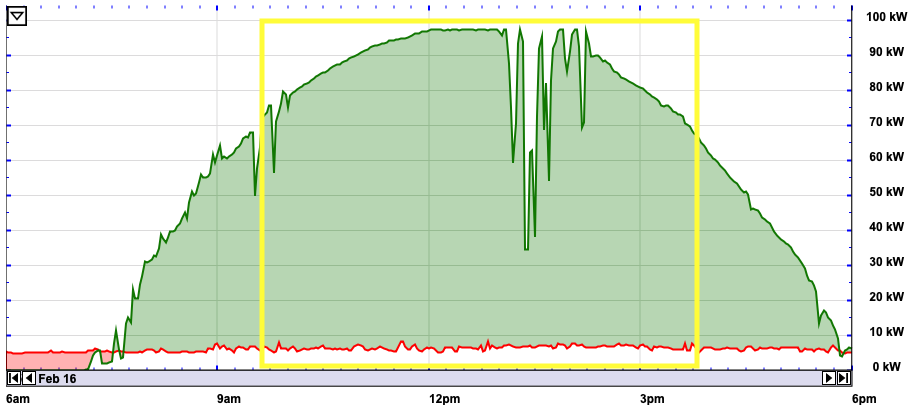solar 5.5 hours.png
In this example we would have about 6 solar hours at 100 kW or 600 kWh of energy.
You can see we are taking morning and afternoon power and pasting it into the white bits later on.
Homework questions:PV questions: (updated 3.4.24)
Your PV panels cost $1.00/Watt, you have 6 solar hours per day, and you want to use 400 Watt solar panels to power your home, which uses 24 kWh of electrical energy every day.
1. How much did you spend on electricity every day before you put in the panels, at $0.40/kWh
2. How much energy would you get from each 0.4 kW panel each day?
3. How many panels will you need to cover your energy use?
4. How much will this cost?
5. What is the ROI for your system?
6. If the system lasts 25 years, what is the TCO?
Solar Thermal questions:
Your hot water heater uses 4.5 kW for 2 hours each day.
1. How many kWh is this every day?
2. How much does this cost you per day (use the same cost as above)?
3. If your solar thermal panel is 1m x 2m, what is the area for this panel?
4. If your solar insolation is 1000 W/m2, for 6 solar hours per day, how many kWh of heat energy can you harvest each day?
5. How much would this save you at $0.40/kWh each day?
6. If the system cost you $1500, what is your ROI?
7. If it lasts for 35 years, what is your TCO?
8. If half of the energy is lost as heat each night due to poor water tank insulation, how much is this costing you each day?
9. If insulating the hot water heater costs $100, what is the ROI for this?
10. If it lasts for 20 years, what is the TCO for the insulation?
Note: 50% is an exaggeration, but a new insulated tank could make this sort of difference. Look at the heat photos of the water heaters in the cottages, and make a proposal for what you would change.
Check your answers:
1. $9.60
2. 2.4 kWh
3. 10 panels
4. $4000
5. 416 days about 1 year
6. $84,000 (negative, you made money!)
1. 9 kWh
2. $3.60/day
3. 2 m2
4. 12 kWh
5. $4.80
6. 312 days, about 1 year
7. about $60,000
8. $2.40 lost per day
9. about 40 days
10. $17,500 (negative again, you saved money)
---
Migrated from Apple Server Wiki. Original page ID: U5o600B
# Unit 8: Pollution: module 4.54 Health
Module 54: Human health, pathogens, infectious diseases
Most studies are retrospective: natural experiments (exposure caused some condition) often disasters (e.g. [Bhopal](https://en.wikipedia.org/wiki/Bhopal_disaster) and union carbide)
Prospective study: planned exposure (drug trial, animal testing)
Synergistic reactions: like drug combinations (don't take this medication with alcohol), combined impact is greater than sum of separate impacts
Disease (literally "lack of ease"): anything that interferes with normal body function
Infectious diseases: caused by agents ("pathogens": patho = harm, gen = makes stuff)
Non-infectious disease:
- heart disease (diet, smoking, lack of exercise)
- diabetes (hereditary, diet, exercise, others)
- cancer (radiation, diet, heredity, exposure to free radicals)
Infectious disease pathogens:
- viruses-not really alive, DNA with a protein coat (why soap is effective: dissolves the protein coat, think of washing off cooked eggs from a pan)
- bacteria-can be gram positive or negative, aerobic or anaerobic (reason to leave wounds open to air)
- fungi-basically plants, they know how to fight viruses and bacteria
- protists-simple cell organisms
- parasites-worms, others (e.g. giardia)
Historical pathogens:
Epidemic: some countries impacted
Pandemic: all countries impacted, e.g. COVID-19
- Cholera: bacteria (vibrio cholerae) causes dysentery, diarrhea
- Hepatitis: liver infection, A B C, airborne and fluids
- Plague: bacteria (Yersinia pestis), kille 25% of people in Europe 1334
- Malaria: "bad air" vs Buenos Aires ("good air"), plasmodium, no real cure, but as of 2025 an emerging vaccine, DDT used to reduce mosquito populations
- Tuberculosis: "TB", contagious bacterium (mycobacterium tuberculosis) invades lungs, fatal, often seen in gothic novels or stories (Les Miserables), lots of coughing spreading the bacteria, huge issue in Russia now with drug resistant TB emerging: folks sell their antibiotics for alcohol, lots of public transportation.
- [COVID-19](https://en.wikipedia.org/wiki/COVID-19) (why "corona"?)
Emergent diseases:
- [HIV AIDS](https://en.wikipedia.org/wiki/HIV/AIDS): human immuno deficiency virus, acquired immune deficiency syndrome, used to be terminal, attacks human T cells (immune system surveillance cells)
- [Ebola](https://en.wikipedia.org/wiki/Ebola): hemorrhagic fever, almost always fatal
- [Mad cow disease (BSE)](https://en.wikipedia.org/wiki/Bovine_spongiform_encephalopathy): Bovine Spongiform Encephalitis, brain disease carried by feeding cows other cows (gross!) mediated by prions or protein bits
- Avian (bird) flu: carried by birds H5N1 (Histogram-Nucleic acid) human to human migration
- Swine flu: H1N1 human to human migration
- SARS: severe acute respiratory syndrome; early coronavirus (should sound familiar!)
- MERS: carried by camels, much more fatal, another coronavirus
- SARS-CoV-2: "COVID-19" or "COronaVIrus Disease 2019"
- West Nile virus: birds and mosquitoes
- Lyme disease: (borrelia burgdorferi) was just Northeast, carried by deer ticks, (exodus scapularis) causes immune system impact
- Zika virus: caused brain damage in infants, mosquitoes or sexual transmission (Haiti)
Laws:
- From video clean water act: CWA 1972 controlled surface waters (not wells)
- SWDA: safe water drinking act; set maximum levels for certain contaminants (mercury, lead, etc.)
Fun with GPT:
Ask GPT about one of the diseases above, share the prompt you used and the answer
Repeat with a question from the review modules on your iPad
---
Migrated from Apple Server Wiki. Original page ID: \_3F4q9B7G2
# Climate change: HEAT video
Frontline: HEATClimate change:
- definitions
- cause and effect
- video
- problem teams (diads)
First, some terms:
- Climate change
- Global warming
- Climate Crisis
Which is most accurate?
Most scary?
Most likely to cause change?
Recall: energy->water->food->culture
Global warming will impact and be impacted by each of these:
- Energy: how we got into this mess-fossil fuels, starting around 1850, burning plants that consumed CO2 eons ago as part of photosynthesis, releasing their trapped carbon (coal, oil, gas)
- Water: freshwater will become more resource constrained, sea levels will rise, oceans will become acid
- Food: locations to grow will become constrained (e.g. Pearl River Delta, desertification), poor people will not have options for farming or fishing
- Culture: coastal flooding will cause huge migrations of mainly poor people, but renewable energy could de-centralize energy structures (e.g. solar energy in Africa)
Mechanics: How this all works
1. Solar radiation is visible, UV, infrared and others, virtually all pass through our atmosphere to reach the surface
2. Surface is either reflective (high albedo: ice) or absorbing (low albedo: water, soil)
3. Water and soil absorb the radiated energy and re-radiate it back as heat (infrared radiation, like the dashboard of your car)
4. This heat radiation is captured by the CO2 in the atmosphere, re-radiating back down warming the planet
5. Some CO2 is needed to warm our planet above freezing, too much is warming the planet: global warming
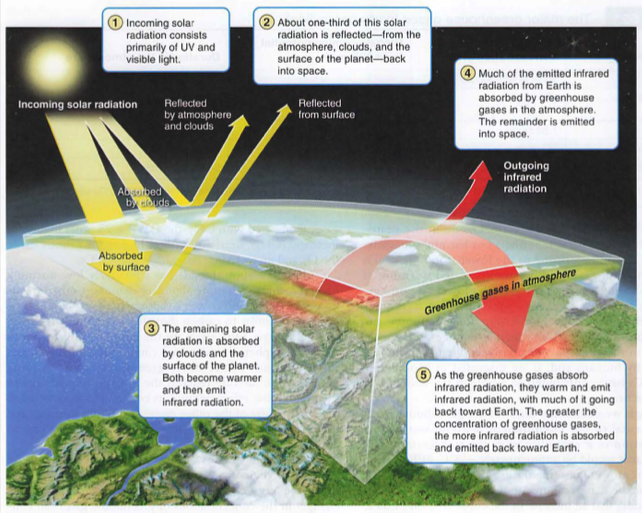Screen Shot 2023-04-02 at 4.12.16 PM.png
Impacts:
- melting of polar ice (changes albedo to absorb more)
- warming of oceans (expanding water=sea level rise, expels dissolved gases)
- ocean acidification (CO2 + H2O -> carbonic acid)
- more evaporation (stronger, more frequent storms, more latent energy in the atmosphere)
- desertification and drought (shifting air patterns)
- salinization of coastal/delta farmlands (salt water intrusion)
- melting of permafrost-releases methane, a potent GH gas (greenhouse gas)
- melting of deep ocean methane hydrates-releases more methane
- biodiversity and habitat loss
- severe storms
- increased wildfires
- wild feedback loop
- impact increased by deforestation (e.g. amazon rainforest)
How we survive-Marketplace (12:00)-good listen about emerging green technologies
[https://www.marketplace.org/collection/using-tech-to-adapt-to-climate-change/](https://www.marketplace.org/collection/using-tech-to-adapt-to-climate-change/)
Frontline: Heat (2008 release date)
[https://elab.hpa.edu/apes/videos/Heat.mp4](https://elab.hpa.edu/apes/videos/Heat.mp4)
[http://physics.hpa.edu/physics/apenvsci/videos/heat/](http://physics.local/physics/apenvsci/videos/heat/)
[https://www.pbs.org/video/frontline-heat/](https://www.pbs.org/video/frontline-heat/)
Closed captioned version, can change speed (bottom right)
Team, many questions here, which we will break into several assignments:
Part One:
1. What river is China planning to divert that will cause conflict with India, and why are they doing this?
2. Why did Brashears go back to that specific site to take the photo, and what did he see? What possible explanations are there for this? Take both sides of the climate crisis argument in your answer.
3. What was so surprising in the dorky 1958 movie? Was this common knowledge back then? How can you tell?
4. How does the cheapness of energy influence public opinion?
5. Is the climate crisis an energy issue, a tree issue, an albedo issue, an ocean issue, or a permafrost issue?
6. What happened at the Kyoto meeting? What was the most embarrassing part? Why did the US behave so?
7. Why would China's growth outweigh any changes the US might make to change carbon emissions?
8. What is Geely? Where? What model is their biggest seller? Is this scary? Why? What did their director say?
9. How many coal plants does China create every week according to the video, and how many years will they be emitting CO2?
10. Dr. Ling Wen says 30% growth over 5 years. What is the doubling rate for this in years? (divide 70 by the percent growth).
11. Why is his line "if we can" so scary? What are his responsibilities, in what order?
12. In what year will India's population exceed that of China? Why?
13. What is the third largest contributor to greenhouse gases? Where?
14. What reduction in CO2 did the Indian guy say they could do by 2050? What is the growth rate?
15. What did Sunita Narain say about this? Why is this not sustainable?
16. What did Pachauri say and what are his reasons?
17. What did the US negotiators say and why is this unfair? What did China say?
18. Google Senator Inhofe, and find out why he was a global warming skeptic. Where did his money come from?
19. This video was filmed in 2008. What was the position of each presidential candidate then?
20. What did Jeffrey Sachs say, and why is it important?
21. How many tons of coal are mined in the Powder River basin each day, and about how much CO2 does this release?
22. The director of the West Virginia power plant (Charlie Powell) says: "we produce 1300 kilowatts of power every hour" which is like saying "my car goes 60 miles per hour every hour". What is wrong with his statement?
23. How many pounds of Coal power your TV for one hour? What percentage of power in the US comes from coal in 2008 when this was created?
24. Analyze the term "clean coal" from both sides of the argument. What are the motives of each side and why?
25. Senators Byrd and McConnell represent which states? What is their bias?
26. What is IGCC? Where is it located? Has it been tested? Where would they inject the ground? Why is this dangerous?
27. Are we "carbon capture ready"? Where would this be tested first, and why is it problematic? If pipelines were used, why would these be dangerous?
28. How many tons of CO2 does the US emit every day in 2020?
29. Why is the US is called the "Saudi Arabia of Coal"?
30. What is the second largest emitter of greenhouse gases? Now list the top three in order.
Part Two:
1. What are CAFE standards, and what does it stand for?
2. How did auto manufacturers get around the CAFE standards since the Ford Explorer came out?
3. What was John Dingell's motive and where was he from?
4. Was his responsibility only to his 800,000 citizens or to the country, or the planet as a whole?
5. What MPG was the terminator seeking for California?
6. In the 1970's all cars in the US came in two flavors: "49 state" or "CA". Why?
7. What is the clean air act?
8. What was the target of the CA emissions standards?
9. At 80 million bbl/day, how many days of global oil supply did Hibernia provide? (bbl means barrel)
10. How did the Exxon lady defend their lack of investment in renewable resources?
11. Dan Kammen says what? Where does he work? (hint: Go Bears)
12. How much did Exxon make in the year of the movie? How much did they invest in renewable energy? Explain.
13. It has been said that if you drive a Prius hybrid with fuel from the tar sands of Canada, it's the equivalent of driving a Hummer. Why?
14. During the 2008 video, they state that oil is at $90/bbl. What is it today?
15. What did Toyota build, and why? How long is their advantage now?
16. Do you believe the lady from GM? Explain.
17. What happened to the Chevy Volt in the photo shoot?
18. Is corn ethanol really a green solution? Who is pushing corn ethanol and why do they have so much political clout?
Part Three:
1. Why does Dan Kammen say corn is not a good biofuel?
2. Explain the three sources of bio-ethanol: corn, cellulosic and sugar cane.
3. Brazil produces which of these?
4. How does Amy's statement about small interests resonate with Senator Dingell's actions earlier in the film?
5. Compare renewable energy in Germany to the US, including smart grids.
6. How do the smart grid and storage fit into the renewable energy solution?
7. T. Boone Pickens (who died recently) sold his oil investments and moved into wind farms in Texas. Why?
8. About 150,000 megawatts of power is what Pickens planned on installing, which would be worth how much per year? (assume 1 mW for a day is about $2400)
9. Why is nuclear energy getting a fresh look, and why was it so politically toxic? Where and why in each country?
10. What is the difference between Navy nuclear power plants and commercial industrial power plants? Why is this a problem?
11. How is nuclear waste storage involved in this problem, and what does NIMBY stand for?
12. Explain cap and trade, and the plus and minus for this proposal.
13. What is Yucca Flats, and why is it relevant to this topic?
Climate change challenge
Dream of one solution you would propose to a country or global body to mitigate climate change
- Name of your solution
- Describe the timeline for your solution
- Describe who needs to be involved
- List the impacts both positive and negative (economy, population, biome, etc.)
- What resources would you need to make this a reality?
BBC news the climate question
[https://www.bbc.co.uk/programmes/w13xtvb6/episodes/downloads](https://www.bbc.co.uk/programmes/w13xtvb6/episodes/downloads)
---
Migrated from Apple Server Wiki. Original page ID: 0145D3Q6
# AP Exam docs
Visual notes for AP exam:
[https://elab.hpa.edu/apes/\_pdf/APES%20visual%20notes%20for%20exam.pdf](https://elab.hpa.edu/apes/_pdf/APES%20visual%20notes%20for%20exam.pdf)
2024 AP central exam description:
[https://elab.hpa.edu/apes/\_pdf/2024%20apes%20exam%20summary.pdf](https://elab.hpa.edu/apes/_pdf/2024%20apes%20exam%20summary.pdf)
Note format, length and sample MC and FR questions2024 AP central whole burrito:
[https://elab.hpa.edu/apes/\_pdf/2024%20ap-environmental-science-course-and-exam-description.pdf](https://elab.hpa.edu/apes/_pdf/2024%20ap-environmental-science-course-and-exam-description.pdf)
AP exam prep folder:
[https://elab.hpa.edu/apes/ap\_exam\_prep/](https://elab.hpa.edu/apes/ap_exam_prep/)
Critical notes:
[https://elab.hpa.edu/apes/ap\_exam\_prep/%20critical\_readme/apes%20notes%20final%20pdf.pdf](https://elab.hpa.edu/apes/ap_exam_prep/%20critical_readme/apes%20notes%20final%20pdf.pdf)
Princeton review strategy section: [https://elab.hpa.edu/apes/\_pdf/Princeton%20review%20strategy.pdf](https://elab.hpa.edu/apes/_pdf/Princeton%20review%20strategy.pdf)
2024 FR practice questions:[https://elab.hpa.edu/apes/ap\_exam\_prep/apes\_princeton/2023%20Fr%20practice.pdf](https://elab.hpa.edu/apes/ap_exam_prep/apes_princeton/2023%20Fr%20practice.pdf)Test Format: 2024 exam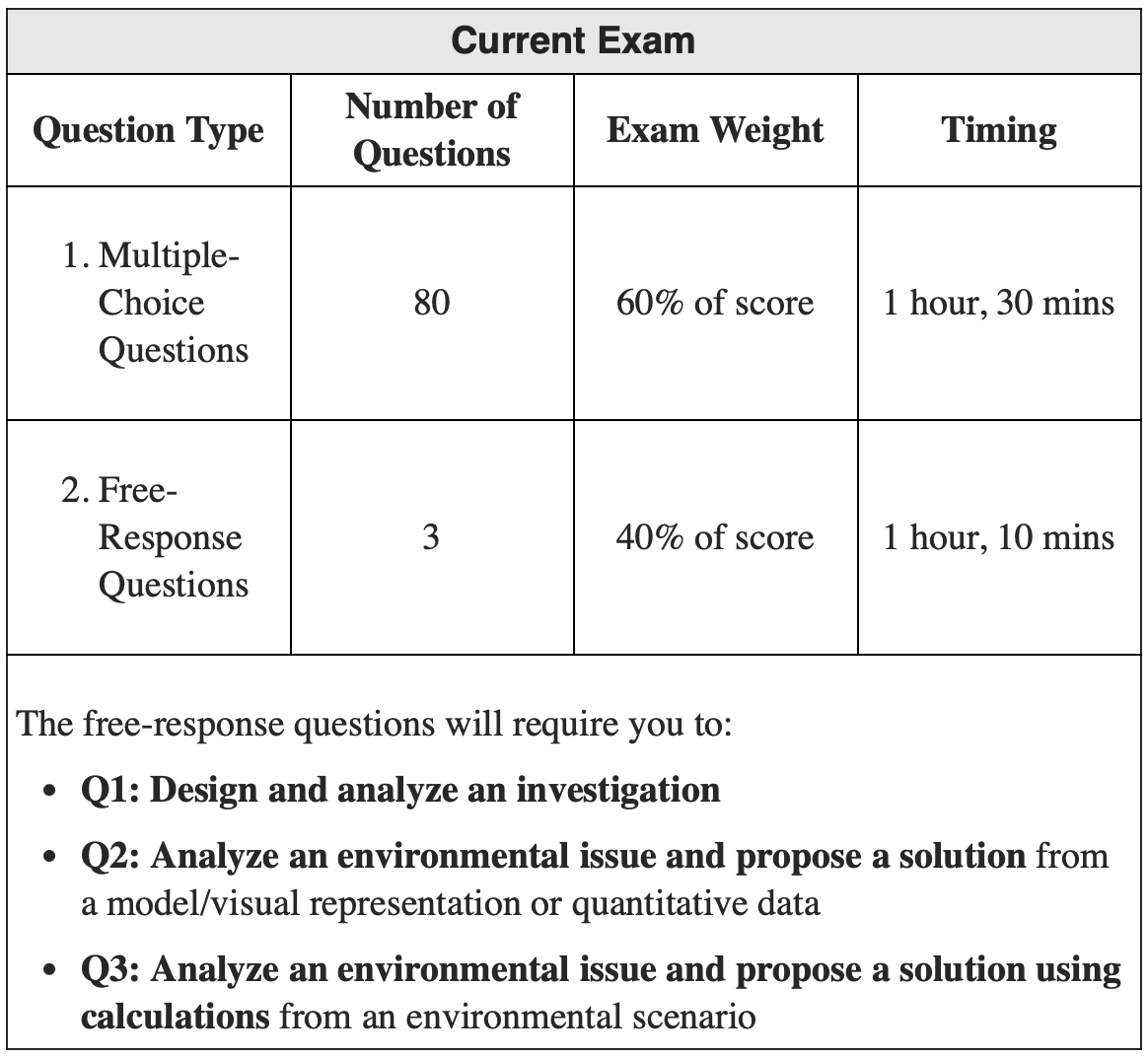Screenshot 2024-05-02 at 10.24.44 AM.png---
Migrated from Apple Server Wiki. Original page ID: Q1o3S8Q
# Solid waste 4.50
4.50: Solid waste
Solid waste: produced by humans, non-toxic, results of civilization
- Primitive societies had no solid waste: they used everything, or it degraded naturally (dispersed, not concentrated)
- The "disposable society" meant buying instead of repairing: post WWII (affluence)
- MSW: Municipal (e.g. city) Solid Waste, 60% residential, 40% commercial
- Solid waste per capita (per head) 2 kg/person per day in US,
- In lesser developed countries (LDC) the number is 0.5 kg/person per day
- why?
- Definition of waste stream: everything-landfill, recycling etc.
- Electronic waste "ewaste": new problem: heavy metals, don't degrade, toxic, growing with IPAT
- "Tipping" fee: very high in Hawaii (limited space), even higher on other islands (San Juan Is. = $6 per bag)
- Another option: incineration-can be for energy (H-power on Oahu) or others
- Japan uses plasma incineration for medical waste: completely ionizes viruses
- Fly ash is toxic, banned for use in EU (heavy metals)
- Ocean dumping was common, now largely illegal (still done though)
Hazardous waste: different category: toxic and hazardous are too general
- Toxic hazardous waste: e.g. fly ash, heavy metals
- Flammable hazardous waste: burns
- Reactive hazardous waste: chemically active, e.g. oxidizers
- Radioactive hazardous waste: just like it sounds
Superfund: created in 1980, as CERCLA
Comprehensive Environmental Response, Compensation and Liability Act
- Comprehensive: covers everyone
- Environmental: like is sounds
- Response: they respond to environmental situations
- Compensation: they pay victims
- Liability: they go after the polluters
Hooker chemical, toxic waste, cancer in kids
Superfund is paid for by tax on chemical and other factories
Another law:
RCRA: resource conservation and recovery act
RCRA tracks solid waste, "cradle to grave" responsibility
Brownfields: behind the elab is an example, so is the train yard in Portland (e2: sense of place)
Contaminated industrial or commercial sites
---
Migrated from Apple Server Wiki. Original page ID: S4V9H4
# Recycling 4.51
Module 4.51: waste reduction and recycling
Reduce, reuse and recycle: 3 R's
Source reduction: see also Tesla manufacturing: "best part of any car is the part you can delete"
also reusable containers, buying in bulk (e.g. health food store)
Reuse: easiest example is shopping bags, also cups here at the elab
Recycling: can be closed loop (carpet, asphalt) or open loop (PET bottles in to garments or decking-TREX)
**Unavailable Apple Wiki media:** the exported data did not include file 43ec70ef-7f01-43fb-8fe3-f6d71c3eaa1e.
- Tough ones: glass and paper
- Glass needs to be melted to be reused, we don't do this in Hawaii, so there is a carbon footprint to transporting it to be recycled
- Paper is easier, but uses water to recycle, and again, has a carbon footprint for transport in Hawaii.
- Amazon boxes are a prime example...
- Composting: degrading naturally: if just paper, good for worms (e.g. Willie's garden)
- If food, can be a rodent issue (e.g. VC garden)
- Both are aerobic processes, so need to be well ventilated or "turned"
- Egg farm downhill from HPA: another example
LIfe cycle analysis:
Cradle to grave or cradle to cradle (William McDonough) Integrated waste management:
**Unavailable Apple Wiki media:** the exported data did not include file 2ba92fff-1b9b-435d-8dd4-d45ac1a12bd7.
Designing for reuse: [cradle to cradle design](https://en.wikipedia.org/wiki/Cradle-to-cradle_design)
---
Migrated from Apple Server Wiki. Original page ID: X8Q4m3h0z
# Module 33: Sustainable food production
Mod 33: Sustainable agriculture (fishing too)
- Desertification (see above)
- intercropping vs. monocropping, see ["the three sisters"](https://en.wikipedia.org/wiki/Three_Sisters_(agriculture))
- Contour cropping: saves space, reduces runoff, preserves top soil (e.g. our garden, most of Asia)
- No-till ag: same idea, retains organic material in topsoil, reduces erosion by wind and water
- IPM: integrated pest management (see Lalamilo Farmers)
- Organic agriculture (also mentioned in [Portlandia and Colin the Chicken](https://www.youtube.com/watch?v=G__PVLB8Nm4))More than just N-P-K, also micronutrients, slower release time, low salinity
- CAFO: concentrated animal feed operation (e.g. chickens, pigs, cattle)Usually inorganic feed (purines), hormones and other drugs
- Methyl xanthines: caffeine, theobromine, theophyllineevolved plant poisons for insects:

- Xanthine: group name
- Caffeine: energy drinks, coffee, soft drinks (to offset drowsiness from insulin spike)
- Theobromine: chocolate
- Theophylline: tea (also a bronchodilator-helps breathing)
Actually, almost anything that ends in -ine is usually a plant poison evolved to kill insects:
- nicotine: tobacco
- caffeine: coffee, tea
- cocaine: coca plants
---
Migrated from Apple Server Wiki. Original page ID: U5n5W4h7d
# APES Laws and agreements
Code:
- Anything ending in "a" is an act of Congress
- Anything ending in "ES" involves endangered species
- Any "protocol" is an international agreement
Critical laws and agreements by date:
1963 (revised several times since) Clean Air Act (CAA): Includes provisions for:
-Providing resources to study air in order to inquest about the issue of atmospheric pollutants.
-Setting enforceable regulations to limit emissions from stationary and mobile sources.
-Developing programs to monitor and reduce acid deposition
-Establishing a program to phase out the use of chemicals that deplete stratospheric O3
-Establishing a cap and trade (a system in which maximum allowable emissions are set for each industry; businesses that reduce their emissions to below the standards are awarded credits which they can sell to other businesses within their industry, creating economic incentive for reducing emissions).
1970 National Environmental Policy Act (NEPA): One of the first pieces of environmental legislation in the United States, NEPA was written to promote the idea of sustainability.
-Environmental Impact Statement (EIS): Any major federal agency must submit an EIS for any activity that may have a harmful impact on the environment.
-1970 Environmental Protection Agency (EPA): Formed under the Nixon Administration with the primary purpose of protecting human health and the environment and enforce environmental standards under a variety of state and local environmental laws.
1972 (revised several times since) Clean Water Act (CWA): A response to the 1969 Cuyahoga River catching fire in Cleveland, Ohio. Its mission is to restore and maintain the chemical, physical, and biological integrity of Americaʼs waterways and make them “fishable and swimmable.” Provisions intended to reduce and prevent point and non-point sources of water pollution, although there are no provisions regarding groundwater protection.
1973 Endangered Species Act (ESA): A far-reaching act that provides protection for any species that is determined to be threatened with extinction. Provisions include strict enforcement of habitat protection, a ban on any activity which disturbs or endangers the life of a listed species, and a ban on the import or export of any individual organisms or product derived from an endangered species.
1973 Convention on International Trade in Endangered Species of Wild Flora and Fauna (CITES): A multilateral treaty ensuring that international trade in specimens of wild animals and plants does not threaten the survival of the species in the wild and accords varying degrees of protection for more than 33,000 species.
1974 Safe Drinking Water Act (SDWA): Focuses on maintaining the purity of any water source that may potentially be used as drinking water, including both surface and groundwater.
1976 Resource Conservation and Recovery Act (RCRA): Also called the “Cradle-to-Grave Act,” sets specific regulations concerning the manufacture, transport, storage, use, and disposal of a host of hazardous chemicals. Its major provision requires extensive documentation at every step to ensure the hazardous wastes are disposed of properly.
1980 Comprehensive Environmental Response, Compensation, and Liability Act (CERCLA): Also called the Superfund Act, established to handle industrial contamination in sites where no direct individual or party could be help responsible. Imposed a tax on the chemical and petroleum industries and authorized the federal government to respond to the release of hazardous substances. Also created a trust fund for cleaning hazardous waste sites when no responsible party could be identified.
1987 Montreal Protocol: A global effort and one of the greatest environmental success stories to date. Provisions include requiring participating nations to phase out the use of ozone-depleting chemicals (specifically CFCs) in favor of less harmful alternatives.
1997 Kyoto Protocol: Developed at a world summit to address measures for reducing greenhouse gas emissions. No real progress was made; when the US announced it would not sign the protocol the whole movement lost support.
Recall our first week together: Cause and effect: 8 countries
Think of this as we go over the main laws:
APES Laws: Their evolution: Notice trends, cause and effect (disaster->response)
Air pollution laws:
- Event cause: 1948 Donora PA smog event, killed 20, thousands sick, London Smog Disaster 1952, killed 4000, 10,000 sick. What is common? Air
- What if we do nothing?: Humans die, many diseases, health care issues, kids are sick, everyone lives shorter lives
- Impact: Each country creates laws regulating LOCAL air pollution (see also criteria pollutants)
Donora PA smog event, 1948: [https://en.wikipedia.org/wiki/1948\_Donora\_smog](https://en.wikipedia.org/wiki/1948_Donora_smog)
London smog disaster, 1952: [https://en.wikipedia.org/wiki/Great\_Smog\_of\_London](https://en.wikipedia.org/wiki/Great_Smog_of_London)
1\. \*\*Air Pollution Control Act of 1955\*\*: (note just after the London smog disaster) This was the first federal legislation addressing air pollution. It provided funding for research and technical assistance to address air pollution problems.
(response to both Donora and London events)
2\. \*\*Clean Air Act of 1963\*\*: CAA This act expanded federal government involvement in air pollution control and funded research on air pollution control technologies. However, it lacked specific regulatory authority.
See question #2 in PR practice exam #2
3\. \*\*Clean Air Act of 1970\*\*: (NEPA and the EPA were formed then-why then?) This was a landmark piece of legislation that established comprehensive federal air quality regulations. It authorized the Environmental Protection Agency (EPA) to set National Ambient Air Quality Standards (NAAQS) for pollutants harmful to public health and the environment, such as sulfur dioxide, nitrogen dioxide, carbon monoxide, ozone, lead, and particulate matter. It also mandated state implementation plans (SIPs) to achieve and maintain compliance with these standards.
Note the definition of criteria pollutants: SOx, NOx, PM, Pb, O3, CO
4\. \*\*Clean Air Act Amendments of 1977\*\*: These amendments strengthened the regulatory framework of the Clean Air Act by tightening emission standards for automobiles and industrial sources, establishing new requirements for non-attainment areas (areas that do not meet NAAQS), and introducing provisions for Prevention of Significant Deterioration (PSD) of air quality.
5\. \*\*Clean Air Act Amendments of 1990\*\*: These amendments represented a significant overhaul of the Clean Air Act. They addressed acid rain, urban air pollution, toxic air emissions, and ozone depletion. Key provisions included the establishment of a cap-and-trade program for sulfur dioxide emissions to address acid rain, tighter vehicle emissions standards, and the creation of the Hazardous Air Pollutants (HAPs) program to regulate emissions of toxic air pollutants.
6\. \*\*The Clear Skies Initiative (2002)\*\*: Proposed by the George W. Bush administration, this initiative aimed to amend the Clean Air Act to reduce emissions of sulfur dioxide, nitrogen oxides, and mercury from power plants. However, it faced criticism and did not pass Congress.
7\. \*\*The Clean Air Interstate Rule (CAIR) (2005)\*\*: This rule, promulgated by the EPA under the authority of the Clean Air Act, aimed to reduce interstate transport of air pollution, particularly sulfur dioxide and nitrogen oxides, by imposing emissions caps on power plants in affected states. It was later replaced by the Cross-State Air Pollution Rule (CSAPR) in 2011.
8\. \*\*The Clean Power Plan (2015)\*\*: This was an Obama-era initiative aimed at reducing carbon dioxide emissions from existing power plants. It aimed to accelerate the transition to cleaner energy sources and was intended to help the United States meet its commitments under the Paris Agreement on climate change. However, it faced legal challenges and was ultimately repealed by the Trump administration.
Note that when party in power (Democrats or Republicans) changes, often so do laws and regulations. This goes back to 1981 when President Reagan (R) said "government is not the solution it is the problem", ushering in the era of "de-regulation" that goes back and forth even today.Water Pollution laws:
- Event cause: What is common about Santa Barbara Oil spill, Cuyahoga River fire, toxic Potomac river, and dead Lake Erie? Water
- What if we do nothing?: No fish, sick humans, shorter life spans, dead wildlife
- Impact: National laws regarding waterways, drinking water and waste dumping
1\. \*\*Rivers and Harbors Act of 1899\*\*: (what was going on in London and other river cities then?)
- While primarily focused on navigation and the protection of waterways, this legislation included provisions aimed at preventing the discharge of refuse into navigable waters without a permit, marking an early recognition of the need for water pollution control.
2\. \*\*Federal Water Pollution Control Act of 1948\*\*:
- This was the first major U.S. law to address water pollution. It provided funding for research and technical assistance but lacked regulatory authority.
Notice the theme:" research and technical assistance". What was happening in the US in 1948?
3\. \*\*Clean Water Act of 1972\*\*: CWA. (why then? Potomac river, Lake Erie, Cuyahoga River, Santa Barbara)
- The Clean Water Act (CWA) is the primary federal law governing water pollution. It established the basic structure for regulating pollutant discharges into U.S. waters and set ambitious goals for eliminating pollutants from discharge into navigable waters by 1985.
4\. \*\*Safe Drinking Water Act of 1974\*\*: SWDA
- While primarily focused on regulating drinking water quality, this law also addresses the protection of underground sources of drinking water from contamination, particularly from underground injection activities.
How does fracking work into this? Note this is different from surface waters...
5\. \*\*Ocean Dumping Ban Act of 1988\*\*:
- This law amended the Marine Protection, Research, and Sanctuaries Act to prohibit the dumping of municipal sewage sludge and industrial waste into the ocean.
6\. \*\*Water Quality Act of 1987\*\*:
- This legislation amended the Clean Water Act to address nonpoint source pollution, establishing grant programs and requiring states to develop management programs for controlling such pollution.
7\. \*\*Beaches Environmental Assessment and Coastal Health (BEACH) Act of 2000\*\*:
- This law aimed to protect public health and improve water quality at beaches by requiring states to develop beach monitoring and notification programs.This is why you get brown water alerts about our beaches...
8\. \*\*Water Infrastructure Funding and Improvement Act (WIFIA) of 2014\*\*:
- This act established a federal loan and loan guarantee program to help finance water infrastructure projects, including those aimed at improving water quality and wastewater treatment.
9\. \*\*Recent Initiatives\*\*:
- In recent years, there has been increased attention on emerging contaminants, such as per- and polyfluoroalkyl substances (PFAS), and efforts to address the impacts of climate change on water resources.
(Know these: PFAS include teflon, gore-tex and many others)Waste:
- Event Cause: Love Canal toxic soil, kids got sick. Common element: Waste
- What if we do nothing?: National pollution, many people sick, shorter lifespans
- Impact: National laws regarding toxic waste
1\. \*\*Resource Conservation and Recovery Act (RCRA) of 1976\*\*: Cradle to grave act
- RCRA is the primary federal law governing the management of solid and hazardous waste in the United States.
- It established a cradle-to-grave regulatory system for tracking hazardous waste from generation to disposal.
2\. \*\*Comprehensive Environmental Response, Compensation, and Liability Act (CERCLA) of 1980 (Superfund)\*\*:
Know one example besides Love canal (look one up, make it yours)
- CERCLA, commonly known as Superfund, addresses the cleanup of hazardous waste sites and the liability for environmental contamination.
- It established a trust fund to finance the cleanup of abandoned or uncontrolled hazardous waste sites where responsible parties could not be identified or were unable to pay.
3\. \*\*Hazardous and Solid Waste Amendments (HSWA) of 1984\*\*:
- These amendments to RCRA strengthened regulations for hazardous waste management, including requirements for hazardous waste minimization, land disposal restrictions, and corrective action for releases from hazardous waste treatment, storage, and disposal facilities.
4\. \*\*Toxic Substances Control Act (TSCA) of 1976\*\*: TOSCA
- While primarily focused on regulating the manufacture, distribution, and use of chemicals, TSCA also addresses the management of chemical wastes.Climate change:
- Event Cause: raising global temperatures, no place is immune, ocean level rise, migration patterns changing, severe weather, etc. Common element: Global Warming
- What if we do nothing? see above, more of the same, even worse
- Impact: global agreements around climate change (or not)
1\. \*\*United Nations Framework Convention on Climate Change (UNFCCC)\*\*:
- Adopted in 1992 at the Earth Summit in Rio de Janeiro, the UNFCCC is the foundational international treaty on climate change. (why then? what did they know or see coming then?)
- It aimed to stabilize greenhouse gas concentrations in the atmosphere to prevent dangerous anthropogenic interference with the climate system.
- The UNFCCC established the Conference of the Parties (COP) as the supreme decision-making body, with the first COP held in 1995 in Berlin.
2\. \*\*Kyoto Protocol (1997)\*\*: (did it work?)
- The Kyoto Protocol was the first international treaty to set binding emission reduction targets for developed countries.
- It required participating developed countries to reduce their greenhouse gas emissions by an average of 5.2% below 1990 levels during the commitment period of 2008-2012.
- The protocol established mechanisms such as emissions trading and the Clean Development Mechanism (CDM) to help countries meet their targets.
(why just the developed countries first?)
3\. \*\*Copenhagen Accord (2009)\*\*: (what was the US position?)
- The Copenhagen Accord emerged from the 15th UNFCCC COP held in Copenhagen, Denmark.
- While not a legally binding treaty, it represented a political agreement among participating countries to limit global warming to below 2 degrees Celsius and to provide financial support to developing countries for climate mitigation and adaptation efforts.
4\. \*\*Paris Agreement (2015)\*\*:
- The Paris Agreement is considered a landmark global climate accord.
- It was adopted at the 21st UNFCCC COP in Paris, France.
- Unlike the Kyoto Protocol, the Paris Agreement is a bottom-up approach where each country sets its own nationally determined contributions (NDCs) to reduce greenhouse gas emissions.(Self determined limits? Did this work?)
- The agreement aims to limit global warming to well below 2 degrees Celsius above pre-industrial levels, with efforts to limit it to 1.5 degrees Celsius.
Ozone:
- Event Cause: Ozone hole discovered over Antarctica, skin cancer on the rise. Common element: Ozone
- What if we do nothing?: UV radiation increases, plants die, human cancers, no life
- Impact: Global agreement to ban CFCs and other chemicals
1\. \*\*Vienna Convention for the Protection of the Ozone Layer (1985)\*\*: (so they knew even in 1985 something was wrong-what did they know?
- The Vienna Convention was the first international treaty aimed at addressing the depletion of the ozone layer.
- It provided a framework for international cooperation and research on ozone depletion and established the principle that states have the responsibility to prevent activities that could harm the ozone layer.
2\. \*\*Montreal Protocol on Substances that Deplete the Ozone Layer (1987)\*\*: (Make sure you understand the difference between Montreal and Kyoto, also what gases are involved in each agreement)
- The Montreal Protocol is widely regarded as one of the most successful environmental treaties. (why?)
- It was adopted in response to growing scientific evidence of ozone depletion and established legally binding obligations for phasing out the production and consumption of ozone-depleting substances (ODS), such as chlorofluorocarbons (CFCs) and halons.
4\. \*\*Vienna and Montreal Amendments (1995)\*\*:
- These amendments established controls on hydrochlorofluorocarbons (HCFCs), which were introduced as alternatives to CFCs but still had ozone-depleting potential.
(Know the difference between CFC and HCFC)Endangered species:
- Event Cause: endangered and invasive species detected over 100 years ago, increasing every year, human extinction era "anthropocene extinction event". Common theme: Invasive species and extinction
- What if we do nothing?: Lack of biodiversity, native plants and animals gone, humans have no food
- Impact: International and national laws regarding invasive and protected species
1\. \*\*Lacey Act of 1900 (United States)\*\*: (over 124 years ago-why then?)
- While primarily focused on preventing the illegal trade of wildlife, the Lacey Act was one of the earliest pieces of legislation aimed at protecting endangered species.
4\. \*\*Convention on International Trade in Endangered Species of Wild Fauna and Flora (CITES) (1973)\*\*: CITES
- CITES is one of the most comprehensive and widely recognized international agreements aimed at protecting endangered species from overexploitation due to international trade.
5\. \*\*Endangered Species Act (ESA) of 1973 (United States)\*\*:
- It provides for the listing, protection, and recovery of threatened and endangered species and their habitats.
Pesticides:
- Event Cause: Over 100 years ago, farmers killed using pesticides, no controls, runoff of pesticides destroying wildlife. Common theme: Pesticides and toxins
- What if we do nothing?: species extinctions, humans sick, shorter lifespans
- Impact: National laws regulating content and use of pesticides
1. **Federal Insecticide Act of 1910**: (Labeling for safety and quality control, even 114 years ago)
- This was the first federal law regulating pesticides. It required that pesticide products be labeled with the ingredients used and their proportions but did not require premarket approval.
2. *\*Federal Insecticide, Fungicide, and Rodenticide Act (FIFRA) of 1947**: FIFRA
- FIFRA repealed and replaced the Federal Insecticide Act of 1910.
- It required the registration of all pesticides sold in interstate commerce and gave the USDA the authority to regulate pesticides.
3. **Amendments to FIFRA in 1972**:
- These amendments transferred regulatory authority over pesticides from the USDA to the newly formed Environmental Protection Agency (EPA).
Summary: (GPT: "List important environmental laws and agreements")
Critical laws and agreements for environmental science encompass a wide range of issues, including air and water quality, biodiversity conservation, pollution prevention, and climate change mitigation. Here's a list of some key ones:
1\. \*\*Clean Air Act (United States)\*\*: CAA A comprehensive federal law aimed at controlling air pollution, including setting standards for air quality, regulating emissions from industrial sources and vehicles, and protecting the ozone layer.
2\. \*\*Clean Water Act (United States)\*\*: CWA A federal law that regulates the discharge of pollutants into U.S. waters and aims to maintain and restore the chemical, physical, and biological integrity of the nation's waters.
3\. \*\*Endangered Species Act (United States)\*\*: ESA A federal law designed to protect and recover endangered and threatened species and their habitats.
4\. \*\*Paris Agreement\*\*: Paris Accord: climate changeAn international treaty under the United Nations Framework Convention on Climate Change (UNFCCC) aimed at limiting global warming to well below 2 degrees Celsius above pre-industrial levels and pursuing efforts to limit the temperature increase to 1.5 degrees Celsius.
5\. \*\*Convention on Biological Diversity (CBD)\*\*: CBD An international treaty aimed at promoting the conservation and sustainable use of biodiversity and equitable sharing of benefits arising from the utilization of genetic resources.
6\. \*\*Montreal Protocol\*\*: Montreal Protocol: Ozone An international treaty aimed at phasing out the production and consumption of ozone-depleting substances (ODS) to protect the ozone layer.
7\. \*\*Convention on International Trade in Endangered Species of Wild Fauna and Flora (CITES)\*\*: An international agreement aimed at ensuring that international trade in specimens of wild animals and plants does not threaten their survival.
8\. \*\*Kyoto Protocol\*\*: Kyoto: Climate change An international treaty under the UNFCCC that sets binding targets for reducing greenhouse gas emissions, primarily from developed countries.
9\. \*\*United Nations Framework Convention on Climate Change (UNFCCC)\*\*: An international treaty aimed at stabilizing greenhouse gas concentrations in the atmosphere to prevent dangerous anthropogenic interference with the climate system.
10\. \*\*National Environmental Policy Act (NEPA) (United States)\*\*: NEPA A federal law that establishes a national policy for protecting the environment and requires federal agencies to consider environmental impacts when making decisions.
These laws and agreements form the foundation of global environmental governance and play a critical role in addressing pressing environmental challenges and promoting sustainable development.
Nice summary here: [https://elab.hpa.edu/apes/ap\_exam\_prep/laws/apenvirolaws.pdf](https://elab.hpa.edu/apes/ap_exam_prep/laws/apenvirolaws.pdf)
Quizlet here: [https://quizlet.com/10948697/ap-environmental-laws-flash-cards/](https://quizlet.com/10948697/ap-environmental-laws-flash-cards/)
---
Migrated from Apple Server Wiki. Original page ID: k2Q6Z0L3g1
# AP exam math review
Most common math concepts:
- Exponential decay: radioactive elements, A=Ao(1/2)^n where n is the number of half lives
- Isotopes: atomic number (protons) and atomic mass (p+n)
- Exponential growth: populations, rule of 70, 70/% = doubling time
- pH: log10 of \[H+\], 10x per pH value
- Trophic pyramids: 10% rule
- Energy vs. power: work is joules, joules/time = power, kW, kWh
- Photosynthesis: follow carbon: CO2 + H2O-> sugars (carbohydrates)
- Ocean acidification: CO2 + H2O <-> H2CO3<->H+ + HCO3-
- Ozone depletion: track Chlorine
- Respiration and combustion
- Aerobic vs. anaerobic respiration
- Efficiency: work out/work in (always less than 100%)
### 🔬 1. Exponential Decay (Radioactive Elements)
A scientist begins with 100 grams of a radioactive isotope with a half-life of 5 years.
How much of the substance remains after 15 years?
### ⚛ 2. Isotopes (Atomic Number and Mass)
Carbon-12 and Carbon-14 are both isotopes of carbon.
What do they have in common, and how are they different in terms of protons and neutrons?
### 📈 3. Exponential Growth (Rule of 70)
A country has a population growth rate of 2% per year.
Use the Rule of 70 to estimate how many years it will take for the population to double.
### 🧪 4. pH (Log Scale)
Lemon juice has a pH of 2. Tomato juice has a pH of 4.
How many times more acidic is lemon juice compared to tomato juice?
### 🐾 5. Trophic Pyramids (10% Rule)
If a plant produces 10,000 Joules of energy,
How much energy is available to a secondary consumer?
### ⚡ 6. Energy vs. Power
A microwave uses 1.2 kilowatts (kW) of power. If it runs for 30 minutes,
How much energy (in kilowatt-hours) does it use?
### 🌿 7. Photosynthesis (Tracking Carbon)
In the process of photosynthesis, carbon dioxide and water form glucose and oxygen.
Which molecule provides the carbon atoms found in glucose?
### 🌊 8. Ocean Acidification
Explain what happens to the pH of ocean water as more CO₂ is absorbed from the atmosphere.
Use the equation: CO₂ + H₂O ⇌ H₂CO₃ ⇌ H⁺ + HCO₃⁻
### ☁️ 9. Ozone Depletion (Tracking Chlorine)
One chlorine atom from CFCs can destroy thousands of ozone molecules.
How does chlorine act as a catalyst in ozone depletion?
### 🔥 10. Respiration and Combustion
Compare respiration and combustion in terms of energy release and byproducts.
### 💨 11. Aerobic vs. Anaerobic Respiration
During intense exercise, muscles may switch to anaerobic respiration.
What are the differences in energy output and waste products between aerobic and anaerobic respiration?
### ⚙️ 12. Efficiency (Work Out / Work In)
A motor receives 500 J of electrical energy and does 350 J of useful work.
What is the efficiency of the motor as a percentage?
## ✅ Answer Key
1. 12.5 grams (100 → 50 → 25 → 12.5 over 3 half-lives)
2. Both have 6 protons (same atomic number); Carbon-12 has 6 neutrons, Carbon-14 has 8 neutrons (different atomic mass).
3. 35 years (70 ÷ 2 = 35)
4. 100 times more acidic (10^2)
5. 100 Joules (10% of 1000, which is 10% of 10,000)
6. 0.6 kWh (1.2 kW × 0.5 hr = 0.6 kWh)
7. CO₂ (carbon dioxide)
8. Ocean pH decreases (becomes more acidic) as H⁺ concentration increases due to carbonic acid dissociation.
9. Chlorine breaks ozone into O₂ and ClO, then regenerates to destroy more ozone (acts repeatedly).
10. Both release energy and CO₂; respiration is controlled, slow, uses glucose and O₂; combustion is fast, uses fuel and O₂.
11. Aerobic: more ATP, produces CO₂ + H₂O; Anaerobic: less ATP, produces lactic acid or ethanol.
12. 70% efficiency (350 ÷ 500 × 100 = 70%)
[Download Environmental\_Science\_Practice\_Problems.pdf (application/pdf, 3.5 KB)](https://bookstack.kamuela.org/attachments/236)
[Download College\_Level\_Environmental\_Science\_All\_in\_One.pdf (application/pdf, 2.6 MB)](https://bookstack.kamuela.org/attachments/237)
Fill in the blank version:
[Download College\_Level\_Environmental\_Science\_Fill\_in\_Blank.pdf (application/pdf, 2.6 MB)](https://bookstack.kamuela.org/attachments/238)
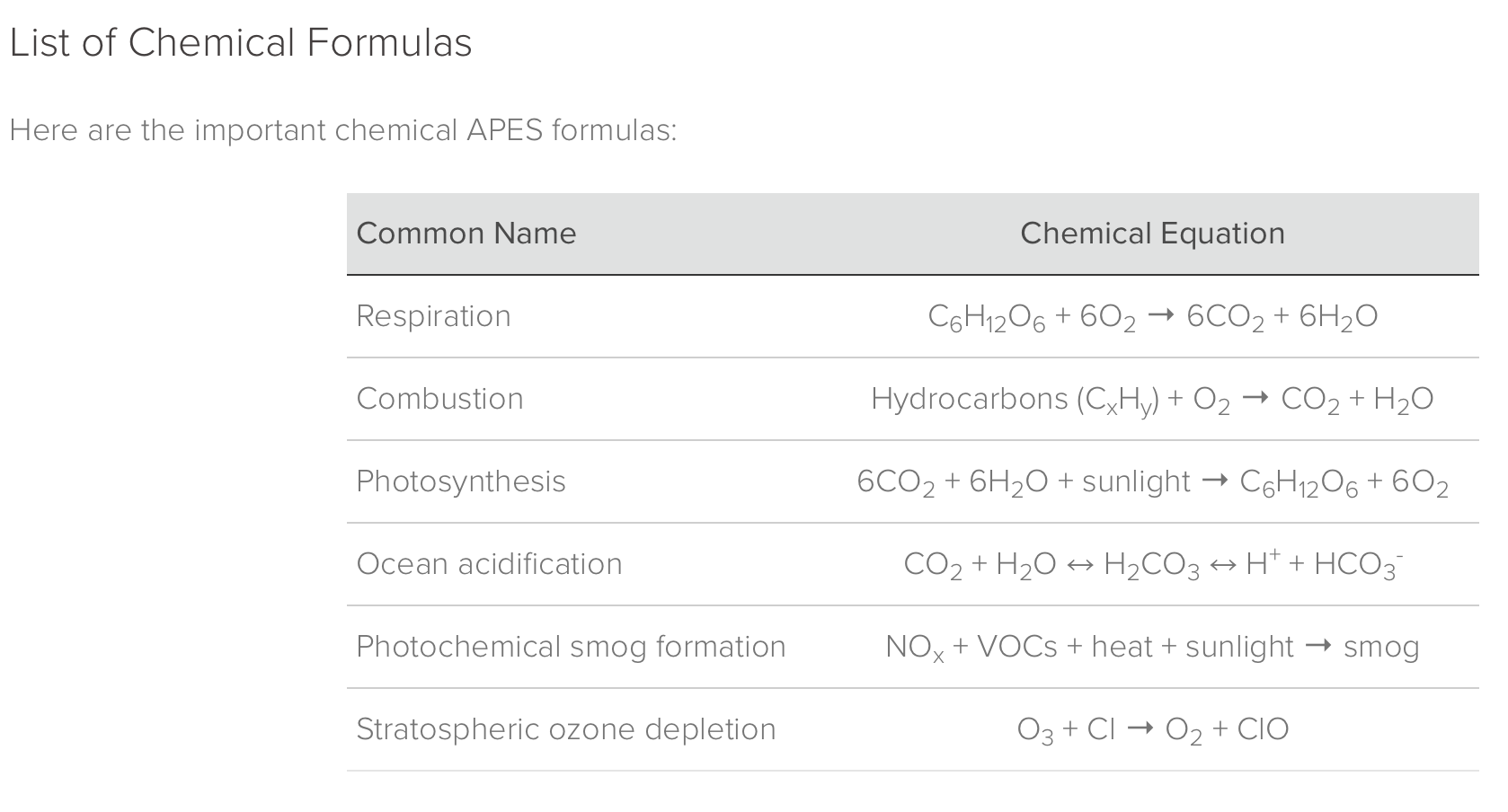Screenshot 2024-05-04 at 7.46.59 AM.pngNotes:
Follow carbon in each equation
Sugar holds energy in bonds, released in respiration
Hydrocarbons "burn" to produce CO2 and water
Photosynthesis stores sunlight as bonds in sugar (reverse of respiration)
H+ lowers the pH of ocean water, impacts corals and other creatures
NOx and SOx are primary pollutants, sunlight (energy) creates secondary pollutants (e.g. acid rain)
Cl in CFC breaks O3 into O2 (transparent to UV radiation)
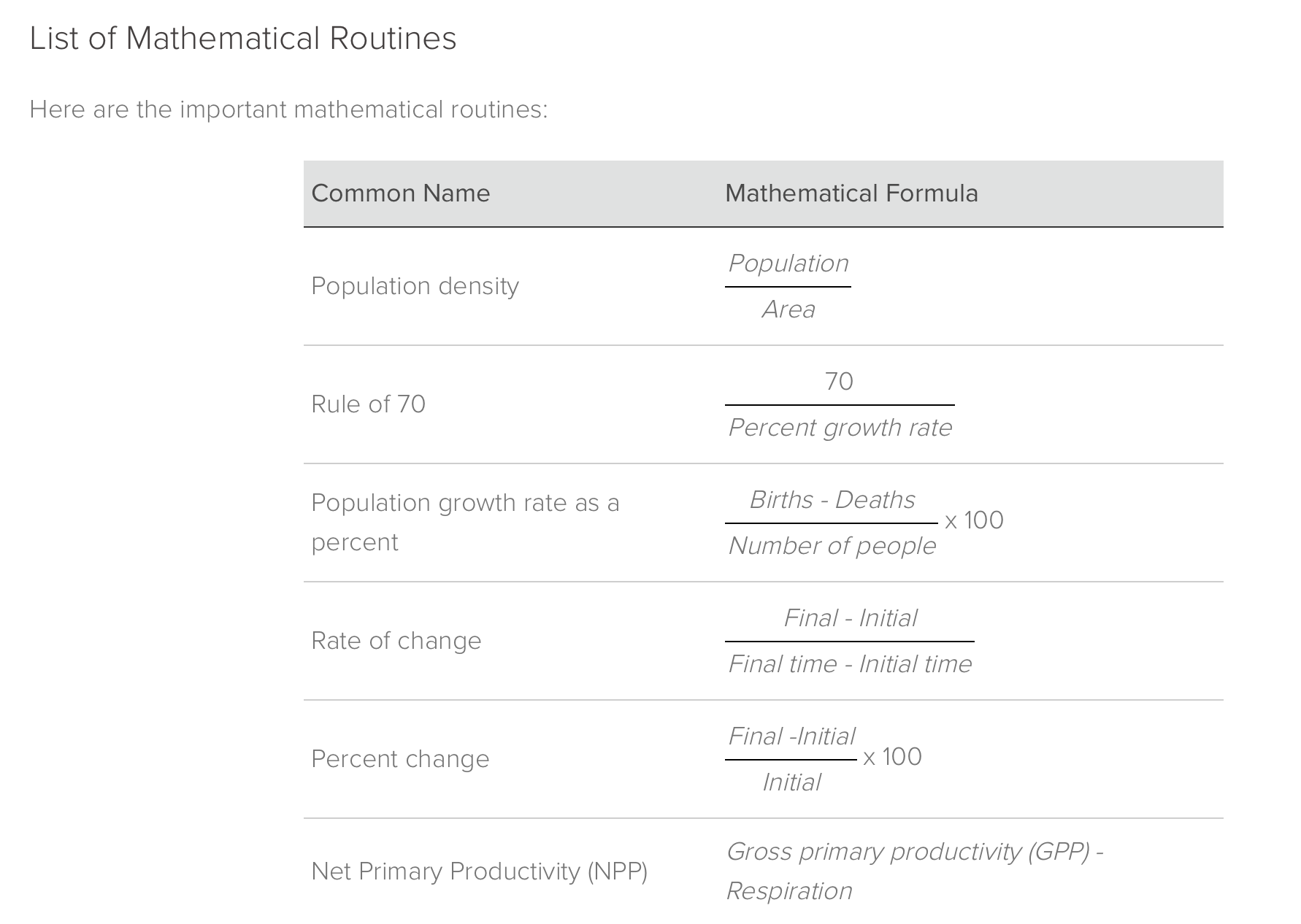Screenshot 2024-05-04 at 7.47.22 AM.pngNote:
Rule of 70 is for doubling time, could also be used in reverse to have decay rate
Rule of 70 will usually use variations of 7: 7, 14, 28, 35 as percent growth (or decay)
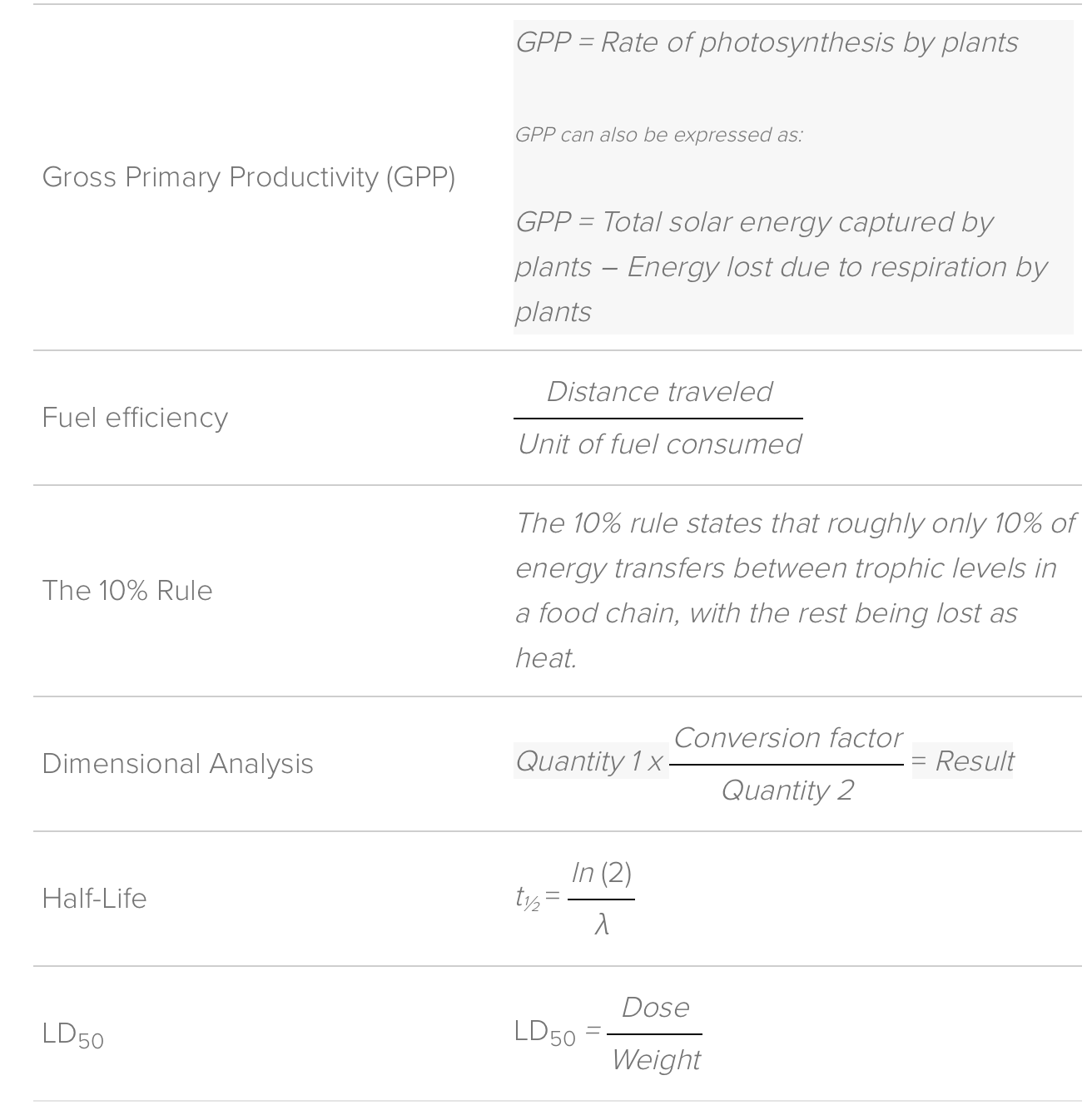Screenshot 2024-05-04 at 7.47.35 AM.pngPower and energy:
Energy: the ability to do work
Joules or calories, 1000 calories is a kcal or one food Calorie
Could be potential energy like a student a certain height above the ground: PE = mgh
Could also be potential energy in a chemical bond, like in sugar or gasoline
Could be kinetic energy of motion, like a running student or a fast molecule (ionosphere?)
Power: how fast the work is done
Units are: horsepower, Watts or kW (kiloWatts)
One Watt = 1 joule every second: j/s
KiloWatt: 1000j/s
Horsepower: 746 Watts
Electrical energy use:
A hot water heater might use energy at the rate 1200W or 1.2kW or 1200 joules every second (power)
Multiply power by time to get energy: 1.2 kW x 1 hour = 1.2kWh
Electricity is charged by the kWh, usually about $0.07 per kWh in the mainland
Examples:
A 4.5 kW residential hot water heater is used 4 hours per day where electricity costs $0.10/kWh
4.5 kW x 4 hours = 18 kWh, 18 x 0.10 = $1.80
Electrical use in a certain country is predicted to increase by 3.5%, when will this electrical use double?
70/3.5 = 20 years
Designing an experiment:
A teacher wishes to determine if giving students caffeinated drinks during class increases engagement in class.
Hypothesis: Caffeine increases engagement and retention of material
Control group: students with drinks without caffeine (caffeine free tea) n.b. this separates drinks as a variable
Independent variable: Caffeinated drinks (non, one, more than one)
Dependent variable: engagement in class, based on retention of material
Experiment: pre-class test, post-class test to measure retention, various drinks for students
Data: more caffeine increases retention
What is wrong with this experiment?
1. different students learn differently
2. some have higher threshold for caffeine
3. some have negative impact of caffeine
4. some may have already had caffeine
5. testing of retention is much more complex
Population problems:
Know the phases of demographic transition, and population pyramids
Rule of 70 and immigration-emigration formulas (above)
r specific growth (J curves)
K specific growth (logistic curve with carrying capacity)
Layers: know these
Atmosphere
Soil
Earth
Oceans
Lakes
Rivers (riparian)
## FRQ Reminders in AP Environmental Science
1. Always write in complete sentences.
2. Don’t write more than the question asks for.
3. If the FRQ asks for two examples, only the first two examples that you write are graded.
4. Introductory sentences or re-stating the question is not necessary. No points removed, but it can take precious time.
5. Label each section: a. b. ci……. DO NOT write one giant paragraph and write on the lines.
6. You can answer out of order—just make sure to label.
7. If you write more, the graders will read them to check for contradictions, but you will not earn points. Contradictions will take away points.
## FRQ Task Verbs
Identify, Provide or List: Simple answer with a complete sentence.
Describe: Needs additional information beyond a simple answer. 1-2 complex sentences.
Make a Claim: Make an assertion based on evidence or knowledge. Make sure you add “Because” or “Which leads to” in your answer to get full points
Justify: Provide evidence to support, qualify, or defend a claim and/or provide reasoning to explain HOW that evidence supports the claim.
Calculate: A math problem to solve. Show set-up and answer WITH UNITS. (Does not need complete sentence)
Explain: HOW or WHY something occurs.
- Use evidence and/or reasoning.
- Sometimes, it is a process requiring steps in order.
- Use “because” for “why” questions.
- It often requires 3 parts: This happens, which leads to, which results in.
---
Migrated from Apple Server Wiki. Original page ID: D9e7V5a
# 24.08.16 Syllabus notes
AP Environmental Science Syllabus: 2024-25
Summary of the important bits:
How to succeed
This class is all about discovery and discussion
Points: How to get an A in APES:
Classwork:
- Daily quizzes: on homework and our class discussions. These help me keep up with our progress together
- Exams: summarize sections of information. I don't prefer these as they are stressful and not really accurate indicators
Homework:
- Text readings and questions: like any other class, these help you prepare for our class discussions
- Weekly summary questions: I put these together at the end of each week summarizing our work together, usually due the first class of the following week
- Lab reports: while some of our lab activities may complete the data gathering in class, lab questions are done at home
Late work:
For full credit, work is due when posted, usually at the beginning of each class. Not 10 minutes into class, the beginning of class.
Late work will be accepted for half credit until our next class, after which it does not count.
Missed quizzes may be completed before the next class as well for full credit, after which they may not receive full credit
How to succeed in this class:
1. Come to class prepared: Read the readings, any weblog notes online, and answer the homework questions on your own. Collaboration is fun, but if you don't know the material, you can't fully join our discussions.
2. Join the discussions. This class is likely the most diverse science class you will ever take. The experiences and interests of your classmates enrich our discussions, so bring your ideas and be ready to share, ask and contribute.
3. Communicate: if you are falling behind, have other issues I don't know about or don't understand the material, seek me out. It is what I am here for
Goals/Topics
Our goal in this class is to develop environmental literacy, so you can become change agents for the future.
Our topics include basic terminology, chemistry and physics concepts, biomes, ethics, populations and earth systems, then larger modules on air, water and soil. We follow these with modules on energy and pollution, concluding with a comprehensive study of sustainability, our theme throughout the year.
This is a hands-on lab course, with some work in the field around HPA, or in the elab. Lab format will be consistent with what you have done in other lab courses, so don’t worry.
Class Format
Our class meets in the energy lab on assigned days, with access to the lab for projects over lunch and after school on arrangement with the teacher. Our class will be largely hands-on, and students are expected to take notes and complete in-class and homework assignments as well as lab reports.
Resources
We will use online videos, tools in the energy lab, iPads and laptops for our course. You are expected to use these with care, and abide by the acceptable use policy of the school, which says among other things that these tools are to be used only for class related activities. You are expected to bring your computer to class for access to class materials, but when needed, we'll use the laptops provided for security reasons during some exams. Taking notes in class is a key skill we'll work on, preferably on paper, not the computer.
Course process:
As you know, our new schedule has 70 minute periods. We meet about 3 times each week.
Grading:
We usually begin each class with a short 5 minute quiz on the homework and/or class discussion and notes. These are not just your normal recall quizzes, they should get you to consolidate and process the material we are learning together. We usually follow this with a short discussion of the quiz, and a review of homework: what you or your classmates struggled with, or demonstrated their brilliance.
Every few weeks we'll have an exam which will take longer, but will be based on the homework, class discussions and quiz materials, so make sure you make up any material you miss, including missed class discussions.
If you miss a quiz, you have until the next class to make it up, with a newer version of that quiz.
If you miss homework, don’t panic: I drop the first missed homework score of each quarter. Late homework will be accepted for 1/2 credit until our next class meeting.
Quizzes will count for a fraction of each exam, and labs will count as several exams. We have 16 required AP level labs on energy, water, soil and air, so the balance of these in your final grade may vary from quarter to quarter as we cover them. Energy is usually a very strong topic for HPA students taking the AP exam in May.
Homework:
Homework will be assigned most nights, and may include questions, videos and other materials.Homework is due at the beginning of class, not 10 minutes into class, the beginning of class (you'll see this on myHPA and your calendar). The earlier you can turn in homework (e.g. the night before it is due) I'll give constructive comments which will make for a higher score. Last minute work will not get this treatment. Please make sure to use your HPA email, not something like"somecooldude@gmail.com"
Expectations
Notes: Students are expected to bring their own notebooks, calculator and/or writing tools to every class, with no exceptions. We will learn how to effectively take notes using the Cornell notes format among others. I suggest taking notes on paper, not just because it is retro and quaint, but studies show that you process and integrate information better this way, even better than taking notes on the computer. Go figure.
Phones: Phones are not permitted in class, except for calculator use. Any phone use during class will result in the phone being collected and turned over to the Dean of Discipline (this includes bathroom breaks).
Some of our work will be done in class, but any out of class assignments will usually have a very express turn in time. This is partly to help you organize your workload, but also so that I can have a chance to grade your work before we discuss it in class. As AP college prep students, you may also turn in assignments early, in which case I can give you feedback and usually this results in a higher grade, as well as greater comprehension. Please check out the student handbook for more information.
Energy Lab:Please do not bring food or drink from outside into the energy lab. Students may bring in their own water containers, but since we have a limited supply of bottled water, please do not fill your containers from these bottles, instead use the water in the sinks, which is actually purified rainwater, purified by our nuclear fusion reactor in the basement.
AP exam:
Everyone is required to take the AP exam in May, which in our class often falls on the first exam of the first day (lucky you!). Actually this is an advantage as you have more time to study for your other exams. We'll have more on this through the year. We will usually have a timed AP simulation exam just before spring break, to show you what you'll need to work on for the real thing in May.
Texts:
The text we'll be using is required (see resources below): Environmental Science, Miller 17th edition, Cengage.
We'll also be using iPads in class with the iBook Environmental Science by Jay Withgott among others. If you can get a copy of the iBook for yourself, this is very helpful. See the resources page for other resources you should consider for the class. Books are expensive, but their value is considerable.
We may use other texts as resources, in which case a pdf will be shared with you. More on this in class.
Online resources:
We'll be using myHPA for all calendar events, gradebook, attendance and assignments. We'll also be using the elab server at [elab.hpa.edu](http://elab.hpa.edu/) where many of our online resources live. This is also where you'll find class notes and summaries. Why not on myHPA? You'll find this server to be an excellent searchable resource with materials going back many years of this class. It is a gold mine of questions, videos and class notes you might enjoy. MyHPA does not have this legacy aspect, but is valuable as a common communication platform.
You should be able to access this off campus or on campus at elab.local.
You may also find resources on our older server: [physics.hpa.edu](http://physics.hpa.edu/) or physics.local
You may also find it useful to download videos while in the elab, as our servers live there, and your download speeds will be much more awesome as a result.
Access:
The best way to reach me is before or after class, but any questions about grading have to be taken care of outside of our class time, out of respect for others in the class as well as your privacy. Email is always the best, as I basically live at [bill@hpa.edu](mailto:bill@hpa.edu). You can expect a return on any questions before 7PM most nights.
Our first day together:
I'd like to begin by learning more about you, so we'll chat for a bit, then I'll have an email assignment for you (your first score-yippee!)
On day 2, we'll have a "navigation quiz". Next week
Huh?
Navigation-finding out where we are, and where we want to go. What will success look like for you? Is it a 5 on the AP or a 5 in life?
"Errors and trust are opportunities to learn"
Keep this in mind when you are struggling-we have your back. We are here to challenge you and make you think. Hopefully laugh a lot too.
As always, let me know how I can help. My email is bill@hpa.edu. I'll share other contact info in class. You should always check your email the night before class, and I'll do the same to make sure I've answered all of your questions.
This course may cover topics such as religion or gender issues as part of the course material. If you find anything either in our discussions or in the material makes you uncomfortable, please reach out to me. My goal is to be inclusive and respectful of all viewpoints. This does not mean we’ll challenge accepted scientific principles like “did we really land on the moon” or “is climate change caused by human activity”.
Finally, AI, GPT, Chegg and all of the other online tools enable you to learn in new ways. We’ll be learning how to use these tools together, but I expect that anything you turn in with your name on it is yours, and reflects your thinking, not something from the collective auto-correct of the internet. More on this in class.
Let me know how I can help.
aloha
b
AP note:
The cost for each AP exam will be billed to the student’s Ka Makani Cash account
following the end of the first semester Add/Drop period. If a student remains in the
course after the first semester Add/Drop period has ended, they will be charged for the
exam, and this charge is non-refundable. Any student who registers for an AP exam
after the November registration deadline will be assessed an additional $40 late
registration fee by the College Board on top of the exam fee.
Honor Code
Mutual trust and honorable behavior are foundations for the concept of “community.” HPA desires to be a learning community in the truest sense. In this vein, our Honor Code is simple and direct: “To promote trust, honor, and, therefore, community, I will not lie, steal, or cheat and will not support such behavior in other HPA students.” This code applies both in the classroom and in all areas of HPA life. In addition to acting honorably themselves, we also encourage our students to report suspected breaches of the Honor Code by any other HPA student. This encouragement helps to promote a way of living and learning in which everyone understands and respects the centrality of Honor. Stated in another way, a strong and well-supported Honor System is perhaps the major factor in the promotion of community trust and individual self-esteem, traits that characterize the most successful and noble independent schools.
Honor Pledge: “I have neither given nor received unauthorized aid on this assignment/ exam.” Including AI
AI Guidelines for Students:
● HP A views AI as a valuable tool to enhance education and support the
learning journey. While using AI, students must ensure all work aligns
with HP A's Honor Code, Acceptable Use Policy, and guidelines
provided by the teacher . AI shall be used to support and augment
learning and discovery. AI may not be used for unauthorized aid or as a
replacement of critical thinking and creativity.
HPA Mission: The mission of Hawai‘i Preparatory Academy is to provide exceptional
learning opportunities in a diverse community honoring the traditions of Hawai‘i.
○ HPA Core Values:
■ Integrity: living honestly and with moral courage
■ Respect: serving with kindness and responsibility
■ Pursuit of excellence: striving for the highest and best result
■ Wonder: being curious, appreciative, and content
---
Migrated from Apple Server Wiki. Original page ID: Z0X4Q7873
# 24.08.28 Sustainability
Bozeman Science:
[http://www.bozemanscience.com/ap-es-001-environmental-science](http://www.bozemanscience.com/ap-es-001-environmental-science)
Link to chapter 1 of the cengage Miller text:
[https://elab.hpa.edu/apes/\_pdf/cengage/chapters/cengage\_ch1.pdf](https://elab.hpa.edu/apes/_pdf/cengage/chapters/cengage_ch1.pdf)
Chapter 1.1 homework:email answers before next class
Cengage, chapter 1.1
1. How many mass extinctions?
2. How does gecko tape work?
3. What is the difference between ecology and environmentalism?
4. Give an example of each of the three first principles of sustainability in our community here in Hawaii: opportunities and threats
5. Explain in your own words the three additional sustainability principles in section 1.1 of the text
6. Look up the term LDC and explain why you need to know this
7. p. 24 has a section on ecological footprint analysis. Answer the following:
1\. Which three countries have the largest ecological deficits? For each of these countries, why do you think it has a deficit?
2\. Rank the countries with ecological credits in order from highest to lowest credit. For each country, why do you think it has an ecological credit?
3\. Rank the countries in order from the largest to the smallest per capita ecological footprint.
cadd5cf5-559c-559c-1dc5-ad267c2f8d25
cadd5cf5-559c-559c-1dc5-ad267c2f8d25
---
Migrated from Apple Server Wiki. Original page ID: X0G8P0h
# 24.08.28 Tragedy of the commons
Questions:
1. What is a "commons", what is the history, and where you might find one (NE US?)
2. Where would you find a similar situation on campus?
3. Our country is aging, and the "youthening" of the nation will change our IPAT how?
4. On your 8 countries, which are spending more of their capital than they have? Why?
5. Why will aquifer depletion (like for golf courses and developments) will be intensified by climate change?
6. Why are conservation organizations purchasing parts of the amazon rain forest?
7. How many "earths" did you calculate as your footprint, and how does it compare with the global average?
8. Read ahead to the next section a bit: how do you compare to the US average and why?
9. Why would a subsistence fisherperson on a remote Pacific island have a low footprint?
10. What would you guess are the three things in order LDC people purchase when they have money?
11. What are the four "revolutions" and what makes you hopeful about them?
12. The "A" in IPAT is usually a bad thing. Why could it be a good thing?
Thinking about your 8 countries, list an anomaly you see in each one, something interesting you'd like to share next week:
1. Australia
2. Brazil
3. S. Korea
4. US
5. UK
6. NZ
7. Pakistan
8. Bangladesh
---
Migrated from Apple Server Wiki. Original page ID: i3r1B1X
# 24.08.27 environmental ethics
1.3 Homework:
1. We’ll be studying population growth in detail soon, but solve this riddle: you are given 2 M&M candies, and told that you can double it every minute, starting at the beginning of class. How many would you have after 15 minutes? You can do this with math or just double-double-double…
2. The rule of 70 says that if you know the percentage growth rate of anything (country, bacteria, Taylor Swift fans) you can calculate how many years it will take to double the population: 70/% = years to double. If the growth rate in Doofania (Doofensmirtz is president) is 10% how many years will it take for the population to double? 5%? 20%?
3. Indoor air pollution is a huge issue worldwide, but impacts poor women in LDC countries particularly, explain why.
4. Explain how subsidies to oil companies might impact the environment.
5. Look up “externalized cost” and explain how this is relevant to pollution and question 4.
6. A company says “we are responsible only to our shareholders”. How is this different from the stewardship worldview?
7. Explain the difference between Muir and Teddy Roosevelt’s approaches to resources
8. How was Aldo Leopold different from them?
9. Look up Rachel Carson and list three things about her that stand out to you.
10. When was the EPA started, and what three events were going on in the US then that inspired it?
---
Migrated from Apple Server Wiki. Original page ID: R289L043p
# 1.0 chapter summary
To edit this page, click the Edit (pencil) button. To delete this page, click the Action (gear) button and choose Delete.
When you edit this page, you can easily rename the page, and use the editing toolbar to:
- Apply paragraph or character styles to text.
- Create bulleted lists, numbered lists, and tables.
- Insert media, such as images, audio, or QuickTime movies.
- Attach files.
- Insert an HTML snippet from another website or email.
For more information about editing pages, click the Action (gear) button and choose Help.
---
Migrated from Apple Server Wiki. Original page ID: s7L8r7
# 24.08.29 Eight countries summation
8 countries summation:
1. How did your team group the 8 countries and why?
2. What did you learn about cause and effect that you did not understand before this project?
3. Explain the difference between causation and correlation
4. Which of the markers was tied closely to the economy and why?
5. What resources did you use that were successful, and which ones were not useful-why?
6. Some parts of your personal global footprint you might have control over: which might these be?
7. Which ones don't you have control over and why?
8. Imagine you are a new student, list the steps you would have them take to analyze the data
Bonus question: who was Agent P’s boss?
---
Migrated from Apple Server Wiki. Original page ID: 06E9U8G7
# 24.09.4 Scientific method HW
2.1 scientific method
[https://elab.hpa.edu/apes/\_pdf/cengage/chapters/](https://elab.hpa.edu/apes/_pdf/cengage/chapters/)
1. Primitive societies at one time would sacrifice food, animals or even people to ensure a good harvest, good weather, or other things. If the harvest was good, was this causation or correlation?
2. How is the scientific method different from this?
3. Look up Pons and Fleischmann and cold fusion. How did the rest of us know they were fake, and what part of the scientific method is relevant here?
4. What is the difference between accuracy and precision when discussing data?
5. Give an example of a dependent and independent variable in your life, and explain each
6. Bud Tuggly does an experiment on caffeine and study ability with students, using only 3 students. What is wrong with this, and why is sample size important in any experiment?
7. Create an imaginary experiment with a hypothesis, explain your result
8. You are given the following data regarding caffeine and speed of a runner around a course:
- 1 cup of coffee: average speed 6 km/hr
- 2 cups of coffee: 6.5 km/hr
- 3 cups of coffee: 7 km/hr
- 4 cups of coffee: 6 km/hr
Graph these and label with the dependent and independent variable. (take a photo of your graph for the email)
9\. what could also be impacting this experiment that we did not include?
10\. In this experiment, what would be a control group?
11\. In 1979 Mount St. Helens erupted, covering a huge area with ash. How was this a natural experiment, and why is it different from a normal experiment?
12\. Ella Finoe wants to determine the efficiency of her car. She records the odometer when she fills the gas tank as 245.4 miles, and on the gas pump, 14.3 gallons. She then calculates her miles per gallon as 17.1608391608 mpg. What is wrong with this?
---
Migrated from Apple Server Wiki. Original page ID: o5t2F1
# 24.09.9 science review: methods and terms
Alternate resource: [https://elab.hpa.edu/apes/texts/fr3e/friedland-relyea-3rd-edition.pdf](https://elab.hpa.edu/apes/texts/fr3e/friedland-relyea-3rd-edition.pdf)
Scientific method:
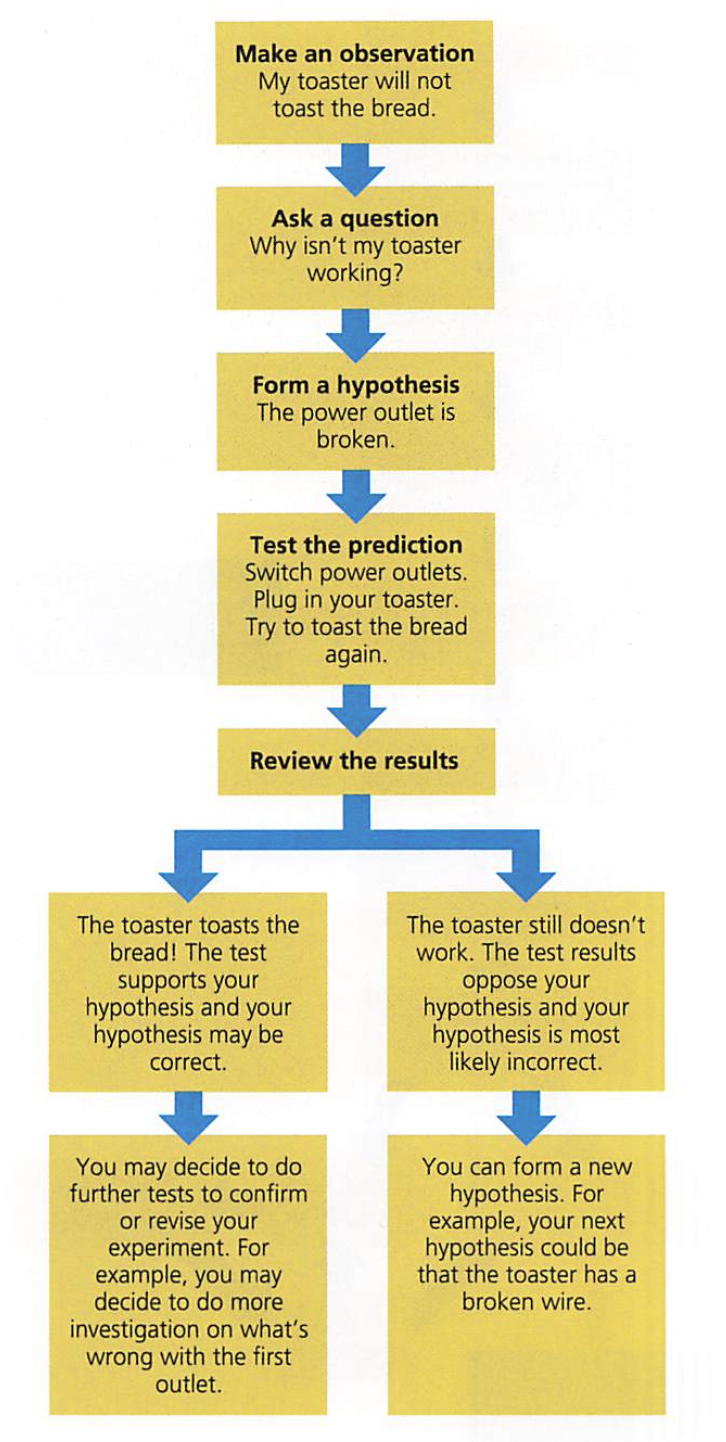Screenshot 2024-09-01 at 7.50.19 AM.png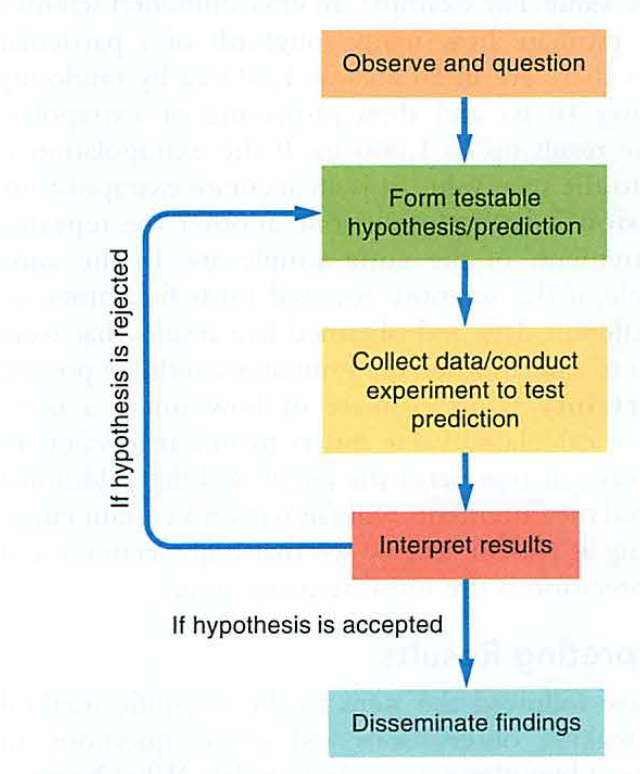Screenshot 2024-09-01 at 7.59.35 AM.pngKey part of science is peer review and replication
- Peer review: qualified folks who know the subject well review the process, data and interpretation
- Replication: once published in reputable media, the experiment must be able to be replicated using the same tools
- Pons and Fleschmann: no replication possible, same with the S. Korean human cloning guy
Key skills:
- Be skeptical about everything you read or hear.
- Evaluate evidence and hypotheses using inputs and opinions from a variety of reliable sources.
- Identify and evaluate your personal assumptions, biases, and beliefs and distinguish between facts and opinions before coming to a conclusion.
Bad example: Monty Python Witch scene: [https://www.youtube.com/watch?v=Ii68tPIiZOo](https://www.youtube.com/watch?v=Ii68tPIiZOo)
Law vs. theory: if verified and proven cause and effect, theory can become law: tentative, open to future data
Climate change example:
1. Global temperatures are rising based on ice core data and recent measurements
2. Carbon dioxide and other greenhouse gases follow the same pattern
3. The dynamics of light, heat and gases is well known
4. The impact is far greater than smaller variations (e.g. tilt of the earth)
5. Carbon dioxide is a byproduct of human fossil fuel burning
6. Human activity is linked to climate change
Important terms (yes, these actually show up on the AP exam):
- Variable: any difference, in a planned or "natural" experiment
- Independent variable: the part that does not change (like x in a graph)
- Dependent variable: the part that changes-or not
- Null hypothesis: proving something is NOT cause and effect (can sheep's bladders be used to predict earthquakes)
- Replication: everybody must be able to get the same results, using the same materials
- Sample size (n): must be large enough to be accurate
- Accuracy: close to truth or true value
- Precision: how close your results are to each other (gas pump is in 0.01liters, but your odometer is only in miles)
- Control group: those you DON'T mess with in the experiment (think of some drug test)
- Natural experiment: variation not planned (Lahaina, COVID, Mount Pinatubo and cooling of the planet, etc.)
Trivia question: what does Frankenstein have to do with an erupting volcano?
Demo: bean bags, target
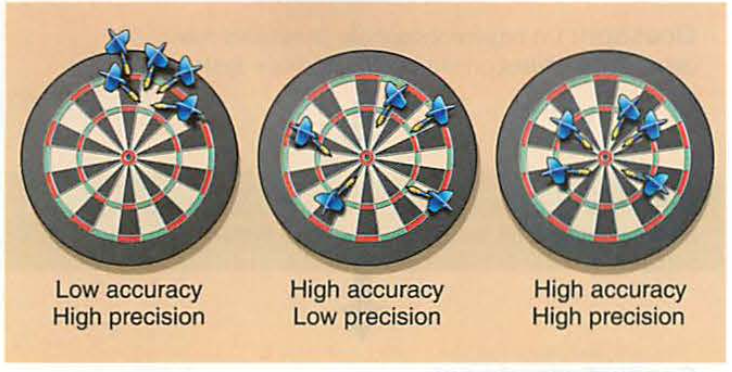Screenshot 2024-09-01 at 8.02.48 AM.png
Graphing:
X axis: independent variable
Y axis: dependent variable (the result)
question: in math, a function is something with only one dependent variable-why?
Units:
mks system is meters, kilograms, seconds
prefixes to know:
- kilo: thousand, 1000 or 10^3
- mega: million, 1000000 or 10^6
- giga: billion, 1000000000 or 10^9
- centi: 1/100 (like cents), 1 cm is about the width of your pinky
- milli: 1/1000, millimeter is 1/1000 meter, 1/10 of your pinky
- micro: 1/million
- nano: 1/billion
Demo: meter stick
challenges:
- how many cm tall are you?
- How many mm to Kona (62 km)?
- How many kg do you weigh?
Temperature:
- Fahrenheit: only used by older civilizations, or the US (joke there), based on goofy science from long ago
- Centigrade: based on 0° for ice, 100° for steam
- Kelvin: bad guys in Star Trek, or based on molecular motion: absolute zero is 0°K, ice is 273°K, steam is 373°K
- Cool idea: at absolute zero, things could vanish (actually they would get very, very small) why?
Homework: 2.1
1. how many nanometers tall are you?
2. if you were weighted in grams, how many would that be?
3. what is your body temperature in °C? In °K?
4. an element has 3 protons and 4 neutrons, what is the symbol?
5. what is the charge if it has 2 electrons?
6. what do you call this?
7. another element has 3 protons and 3 neutrons, how is this related to the element above?
8. look up the periodic table and find this element, what column is it in?
9. what else is in that column going up and down?
10. why do we need a Kelvin scale and a Centigrade scale?
---
Migrated from Apple Server Wiki. Original page ID: h5C1E5x9
# 24.09.11 Environmental indicators
Alternate resource: [https://elab.hpa.edu/apes/texts/fr3e/friedland-relyea-3rd-edition.pdf](https://elab.hpa.edu/apes/texts/fr3e/friedland-relyea-3rd-edition.pdf)
Modules 1-3 are useful...
Please download while in the elab today, and look over modules 1-3
Energy->water->food->culture
1. With energy you can move/purify water
2. With water you can grow food
3. With food you can maintain a culture
Climate change map-try this out:
[https://impactlab.org/map/#usmeas=absolute&usyear=2080-2099&gmeas=absolute&gyear=1986-2005&usyear=1986-2005&gmeas=absolute&gyear=1986-2005](https://impactlab.org/map/#usmeas=absolute&usyear=2080-2099&gmeas=absolute&gyear=1986-2005&usyear=1986-2005&gmeas=absolute&gyear=1986-2005)
Look up the sea level rise simulator as well:
Nebraska->Alberta by 2050; Why? Where should you buy land?
Terms:
- Bio=life, so biotic means living, abiotic means not living (druids had a neat view on this)
- Ecosystem services: can be economic, direct or cascading (fishing in the Gulf of Mexico impacted by offshore oil spills)
Environmental indicators: what we know and can observe that indicate the condition of a system
- Biodiversity
- Food production
- Global warming
- Human Population
- Resource depletion
1. Biodiversity: Biological diversity (more about this later)
- Robust systems (can be biological, racial, technological) all have strong diversity
- Genetic Diversity: genetic variation within a population (corn for example)
- Species: ducks vs. dogs
- Species diversity: variation of species in an ecosystem
- Speciation (more) vs. extinction (less)
- Background speciation rate (cosmic rays)
- Background extinction rate (before humans, much higher in the anthropocene era)
Speciation: an adaptation based on stress (evolution)
Evolution needs three things:
1. some form of genetic variation
2. some stress that favors this variation
3. survivors have to reproduce and carry on the variation
Think of giraffes as an example:
1. longer necks in some animals
2. drought that kills all short neck creatures (just like in land before time)
3. long neck animals survive to reproduce and carry on the variation
Cool stuff:
- There is a theory that the background rate of mutation/speciation was much higher long ago because our atmosphere was thinner, and enabled more cosmic rays to penetrate, causing much higher rates of mutation/speciation.
- In England, butterflies have adapted since 1850 to look more like soot from coal fires.
- In NYC, a species of "subway mosquitoes" have been found that feed on humans in a dark, cool place
- Huh.
Extinction is the opposite of speciation, where species die off (except in the film Jurassic Park)
There is such a thing as a "background rate of extinction", which we have surpassed by many times
Diversity is good: think of monoculture food crops: one pest kills everything
2. Food production: see Malthus and Norman Borlaug, e.g. Mexico famine (look this guy up)
- grain variation and monoculture
- regional grain production (e.g. Pearl river delta)
- vegetarian vs. carnivores
3. Global Warming
- Man made, from burning fossil fuels (anything that was living, decayed capturing atmospheric carbon)
- carbon dioxide was in the air, then captured as plants and animals
- we burn their carbon with oxygen to make carbon dioxide
- greenhouse gases: trap infrared radiation, warming the planet (cause and effect)
- Not too many people know we need some CO2 to keep water above freezing-think of this as we search for exoplanets...
- growth rates
- dispersion due to climate change
- access to water-where, how much, salty?
- why was China’s one child policy eventually a problem for China?
- education, reproductive rights and religion
- water is first
- Resource depletion is hard to grasp, but resource constraints are easier:
- If we had a major tsunami here that closed airports (all near the shore) and ports, how long would we have electricity?
- water? (pumped by electricity)
- food?
Sustainability: ability to sustain present conditions forever (not likely)
Ecological footprint: what you calculated
2.1 Environmental indicators
1. Locate your home on the climate change map, and describe conditions when you are 50 years old
2. Hawaii is often noted as a “biodiversity hotstpot”. Why is this?
3. Create another example of how evolution favors survival
4. The Darwin awards are often nicknamed “chlorine for the gene pool" Why?
5. Look up the film “Jurassic Park” and do some research into recent real examples of this
6. Why will sea level rise challenge the food production of Asia?
7. Why is some carbon dioxide needed in the atmosphere for our survival?
8. What is the global trend for population growth?
9. Why did I list the energy-water-food-culture in that order?
10. What is your most important "why" for learning about APES?
---
Migrated from Apple Server Wiki. Original page ID: 22e8X678
# 24.09.19 science review-chemistry
Module 4, Science terms:
Main topics:
- elements: protons, neutrons, electrons
- atomic mass, isotopes
- isotopes vs. ions
- bonds: ionic and covalent
- periodic table: columns
- half lives
- pH and pOH
- melting and boiling points
- surface tension: adhesion and cohesion
- organic vs. inorganic substances
- proteins, fats, carbohydrates
Atoms and molecules:
- atom: one nucleus with protons and neutrons, electrons around the nucleus
- element: one type of atom, defined by the number of protons
- protons: positive charge, give the atom identity, found in the nucleus
- neutrons: neutral charge, gives the atom more mass, found in the nucleus
- electrons: much smaller (1/1800), negative charge, gives the atom charge, "orbits" the nucleus
Examples: see [https://ptable.com/?lang=en#Properties](https://ptable.com/?lang=en#Properties)
Helium: He, discovered in the sun (helios), 2 protons, 2 neutrons, 2 electrons
Carbon: C, 6 protons, 6 neutrons, 6 electrons
Atomic mass is the mass of all of the protons and neutrons (electrons are too light to count)
Isotopes: nuclear stuff
Wait: why does carbon have atomic mass of 12.011 instead of 12?
There are other types of carbon, called isotopes (same type)
C12/6, C13/6, C14/6
Each of these has the same number of protons (identity) but more neutrons
check: how many protons, neutrons and electrons in C14/6?
Demo: m&ms in cup
Ions and bonds: chemical stuff
so far we've been playing with the nucleus.
If you change the number of electrons from a match with protons (C6/12 has 6 electrons), we can add or take away electrons:
Na+ is Sodium missing an electron
Cl- is Chlorine with an extra electron
Why?
Look again at the periodic table: [https://ptable.com/?lang=en#Properties](https://ptable.com/?lang=en#Properties)
Everyone wants to be on the right hand column, called the noble gases
To get there, Na loses an electron to look like Neon, while Chlorine adds an electron to look like Argon (see for yourself)
These sorts of bonds, where one gives up and one takes is a very strong bond, called ionic (because it involves ions)
NaCl (salt) is one example:
- Ionic bonds have high melting points
- They conduct electricity, especially in water
- examples: NaCl, KCl, MgCl2 (notice usually groups 1 or 2 and a halogen, group 7)
demo: salty fingers, lower electrical resistance
The weaker type of bond you will see is called covalent.
Think of a pilot and co-pilot: both share the duties
In a covalent bond, neither one is more positive or negative, they share an electron.
Molecular Hydrogen (H2) and molecular oxygen (O2) are good examples
so are plastics, water and other substances
Covalent bonds:
- Weak bonds
- Don't conduct electricity as well as ionic solutions
- low melting points (water, plastic, butter)
Periodic table classes:
The periodic table (here it is again: [https://ptable.com/?lang=en#Properties](https://ptable.com/?lang=en#Properties)) is key to solving riddles in APES around pollution, toxins, and many other things:
Example:
Strontium 90/38 is a radioactive isotope, a product of nuclear reactions (reactor meltdowns, nuclear weapons)
Look at the periodic table, find Strontium.
What is above it?
Calcium is part of your bones, so when you ingest Sr90/38, it is absorbed into your bones just like Calcium, since elements in the same column are chemically similar.
What sort of cancer would this cause?
Question: Cesium is a radioactive element, where would it go in your body?
Homework 2.2
1. Why is radon so potent as a carcinogen for lung cancer?
2. How much more potent an acid is something with pH of 4 than one with pH of 6?
3. Someone is poisoned with Strontium 90, what sort of cancer would they likely get?
4. List a few other ionic compounds, with formula
5. List a few other covalent compounds with formulas
Acids and Bases: pH
In aqueous (water) solutions, we often need to know if a solution is acidic or basic
Acids have more Hydrogen ions (H+) floating around
Bases have more hydroxide (OH-) ions floating around
Water is amphoteric (both) since it is really H-OH
Water has pH (potency of Hydrogen) of 7, in between 0 (acid) and 14 (totally base, dude)
Water is "mid"
First look at most solutions is a good guess:
NaOH base
HCl acid
See?
You try: KOH, HNO3, H2SO4, H3PO4
Which were acids and bases?
Clue: anything with an H alone is usually an acid, anything with an OH is usually a base
Exceptions: alcohols (see below) have an OH, but are not basic, they are organic compounds
This is usually easy: a sample problem might ask what is the H+ concentration of something with a pH of 1 ee -4?
Simply take the minus sign off the exponent and you have your answer: pH = 4
Another version of this would be:
How much stronger is an acid with pH 4 than pH 6?
This is a bit trickier: since each power of ten is one pH number, 10^2 is 100, so the answer is 100.
Try this: How much more acidic is water than NaOH solution with pH 12?
Since water is pH 7, 12-7 = 5, so 10^5 is 10,000x stronger.
Weird to think of water as an acid, but there it is.
You may also see something like "what is the pOH of something with a pH of 4?"
The answer is: pOH is just 14-pH, to the answer is 10.
There is a scary looking formula for pH:
pH = -log10[H+]
not so scary: all it says is take the log to the base 10 (usually the same as the power) and throw away the minus sign
Like in radioactive decay, you may see something that is not in the form 1 ee-4, in other words, the 1 may not be a 1.
In that case, you just use the scary formula...
The good news is these do not hang around forever, they decay into other things, some radioactive, some not.
A half life is the amount of time it takes something radioactive to decay into half of the amount it was before.
So, If you have 128 grams of Strontium 90/38, which has a half life of about 30 years, after 30 years you will have:
64 grams
Then 30 years later it will be all gone, right?
Nope: 32 grams
Then continue: 16, 8,4,2...
It never really goes completely away
Demo: M&M's in jar
Half-life how to: caffeine, nuclear waste, drugs
If 100% of something decays exponentially, this means that after one half life (t 1/2) half of it remains.
We demonstrated this with M&Ms in class, and you saw an exponential decay graph
Why do we want to know how this works?
Easy: nuclear waste, radioactive fallout, caffeine and other drugs all follow exponential decay.
So, to find out how much is left of something, you can count the half-lives and divide each one by two over and over again:
1/2->1/4->1/8->1/16
You may also see this as percentages:
50%->25%->12.5%->6.25%
There is a simple formula for this if you want to use it:
Amount left = Amount starting (1/2)^n
At = Ao (1/2)^n. or At = Ao/2^n
where n is the number of half lives.
Example:
The half life of C14/6 is 5730 years
How much of a 200 gram sample will be left after 22,000 years?
Divide 22,000 by 5730, you get about 4
(1/2)^4 is 1/16, or 6.25% whichever you like using more
200 grams/16 = 12.5 grams left. or...
200 grams * 0.0625 =12.5 grams 12.5
This also works if you have something in between half lives, like if you repeated this problem for 18,000 years:
18,000/5730 = 3.14
(1/2)^3.14 = 1/8.8 or 0.113
0.113 * 200 = 2.26 grams left
In some rare cases, you will be see this situation in reverse:
The half life for Sr90/38 is about 30 years.
If 25 grams of a 100 gram sample remains, how old is it?
25/100 is about 1/4, 4 = (1/2)^2 so two half lives, or 60 years.
HW Radioactive decay
1. Take a photo of your graph and include it below. What represents the “half life” in your demonstration?
2. A sample of a radioactive isotope has a half-life of 5 years. If the initial mass of the sample is 100 grams, how much of the sample remains after 15 years?
3. A radioactive isotope decays to 25% of its original amount in 10 years. What is the half-life of the isotope?
4. A certain radioactive isotope has a half-life of 20 years. What fraction of the original sample will remain after 60 years?
5. A fossil contains 12.5% of its original amount of Carbon-14. Given that the half-life of Carbon-14 is 5730 years, estimate the age of the fossil.
6. The activity of a radioactive source is measured to be 800 disintegrations per second. If the half-life of the source is 2 hours, what will be the activity after 6 hours?
7. If Caffeine has a half life in your system of 5 hours, and you have one “dose” at 7 AM, how much is in your system at noon?
8. You then have another dose of caffeine at noon, how much is in your system at 5 PM?
9. You then have another at 5 PM, how much is in your system at 10 PM?
10. If the half life of caffeine was longer, what would happen to the amount in your system by the end of the day?
11. THC (tetrahydrocannabinol) has a half life of 20-30 hours, which we can estimate to 24 hours for this question. A user has a “dose” at 6 AM, then another at the same time every day for five days. What is the level in doses after 5 days?
12. THC absorbs into the fatty tissues of the nervous system, just like other fatty-soluble toxins we will study, like PCBs in Killer whales. Look this up and describe why this is important to our study of APES.
Radiation: nuclear fallout, nuclear energy, radon
There are 4 main types of radiation from radioactive substances or nuclear reactions (nuclear weapons, meltdowns, etc.)
- Alpha rays are Helium nuclei, +2 charge, very heavy, very slow, and can be stopped by skin or paper
- Beta rays are fast electrons, -1 charge, fast, light, and can be stopped by metal foil
- Gamma rays are light photons, no charge, can be stopped by lead
- Neutrons are fast neutrons, no charge, can be only stopped by lots of concrete or lead (slow ones are called "thermal" neutrons and are useful in nuclear power plants to make steam)
Health examples: Radiation, mutations, cancers
Radon gas (222/86) is very heavy, and emits alpha rays.
No problem if the gas is outside your body, your skin protects you.
If you breathe radon gas, is sits in the bottom of your lungs and alpha rays destroy your white blood cells: leukemia and other lung cancers result
Gamma rays split DNA and cause mutations, some cause cancer.
Neutron radiation dissolves membranes in animals, killing them in nasty ways...
In each of these cases, radiation is harmful, it depends on where you are exposed, for how long, and what protection you use.
Radon is the #2 cause of lung cancer in the US (!!!)
Be aware of this if your dorm room in college (or anywhere) is in the basement, and you are near the Rocky mountains.
Demo: Radon rock
Solubility of gases:
Air holding water: Humidity, condensation, rain shadows, hurricanes
We know that air can hold water vapor, this is invisible, unless it condenses (like steam or clouds)
As gases get cooler, they can hold less water, that's when it rains or condenses.
You know this: cool drinks form beads of water on the outside, since the drinks are cooler than the air.
It also means that warmer air can hold more water
Remember this: gases hold more water when warmer
This also explains why you may get a shock in cooler climates walking across a carpet: dry air is a better insulator, so can build up an electrical charge better.
It also explains why it rains on the windward side of mountains: as the moist air rises, it gets cooler, and cooler air can hold less water: "Orographic lifting"
It also explains why air coming in from the ocean is more humid: it has been warmed by the ocean.
Demo: elab humidity sensors, temp and RH
Water holding gases is the opposite: Dissolved Oxygen, DO, thermal pollution
One smart character decided to boil the water for the aquarium before dropping the fish. Even though the water was at the right temperature, by boiling the water, all of the dissolved oxygen was gone-what do you think happened to the fish?
Gases dissolve better in cooler water. Fishing folks know this, and go where the water is cooler, since fish breathe better there.
It also explains why the British are so nuts about when they boil water for tea: if you boil it too long it has no oxygen in it, and it tastes "flat".
You also know this that soda drinks lose their fizziness if you warm them up.
This is very important when we study dead zones and fish kills...
It also explains why you don't ever need to get ice in your carbonated drinks: to get the carbon dioxide to dissolve into the drinks they MUST cool the drinks down to inject the CO2.
Demo: cool soda water, warm soda water
More water stuff:
Surface tension: adhesion and cohesion: capillary action, trees and all plants
Water is very cool stuff: it likes to stick to other stuff (adhesion) as well as to other water (cohesion)
This makes for interesting phenomena when the sides of a container are very close, like in roots or thin hair:
As the water molecules climb up the sides of the roots (adhesion) they stretch out the molecules in the middle (cohesion).
This is called surface tension
This make the curve stretch and then shorten, so water moves up the column (roots, long hair).
This is called capillary action, and is very important for all plants.
Surface tension is also how water striders "sit" on the water: their feet stretch the water molecules.
Soaps destroy the cohesion, making water "wetter", also making little bugs fall into the water...
All plants rely on capillary action to bring water to their leaves, so it is not a good idea to drop soap on the roots of plants.
Think of roots: many thin fibers next to each other-perfect for capillary action.
Demo: soap in water, surface tension
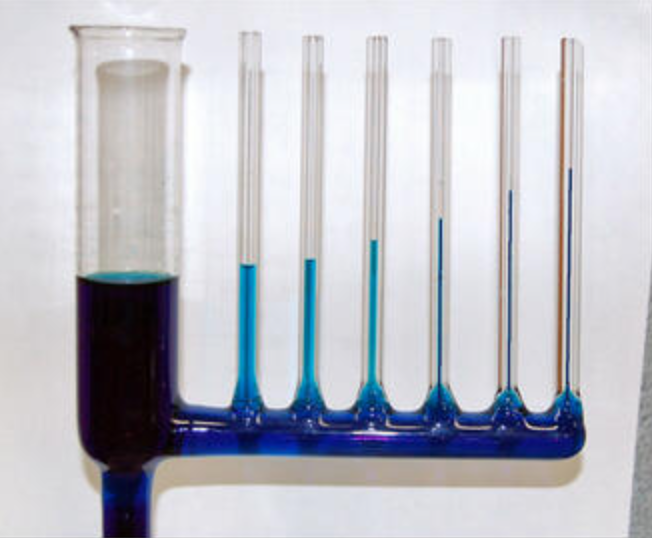Screenshot 2024-09-18 at 11.02.38 PM.png
1. Explain how tall trees and other plants carry water vertically to their leaves
2. Explain why soap might impact this action
3. What is the difference between adhesion and cohesion, and why should we care?
4. If a body of water gets too warm, fish will die, why?
5. You might feel comfortable on a very hot day in the desert, but not at the same temperature where it is humid-why?
6. Why would triathletes struggle in Kona? What is different from where they have trained?
7. Why would the British only boil water for their tea until just before boiling?
8. Herman boils the water for his aquarium to keep it clean, then cools the water before dropping in his prized fish, which all promptly die-why?
9. Why is there a desert (not a dessert) on the eastern, leeward side of the coastal mountains in Washington and Oregon?
10. If you run into a person wearing a foil hat, what sort of radiation do you think they are protecting themselves from?
11. What about a paper hat?
12. What phase of water are ice skaters skating on?
13. If it is temperature that cooks food, why would increasing the pressure make for a shorter cooking time?
14. The Chesapeake bay is a "perfect storm" of pollution, shallow, slow moving water, lots of fertilizer and silt. Why is this a perfect storm for killing fish?
Melting and boiling points: colligative properties, melting ice, antifreeze/anti boil
Water is everywhere, and we study it a lot
The melting and freezing point for water is 0°C at one atmosphere (very interesting stuff happens at other pressures, like ice hockey)
The boiling and condensation point for water at one atmosphere is 100°C (again, interesting things happen at other pressures like pressure cookers and freeze dried ice cream)
It turns out that anything added to water raises the melting and boiling points.
You may have heard to add salt when cooking pasta: this raises the boiling point a bit so the pasta cooks a bit faster. (heat cooks food, not boiling)It also explains why they add salt to ice to make ice cream, or pour salt on road to melt ice...
You can demonstrate changing pressure on melting by slowly chewing on an ice cube: pressure makes ice melt (ice hockey skates)
This also means that water boils at a lower temperature if there is less pressure, like on a mountain, or even here in Waimea, since we are at 800 meters elevation (about 3000')
Pressure melting of ice is how ice skaters move, if you look at their skates end-on, you will see an upside down U shape that traps the melted water from their weight pressing on the ice.
Heavier ice hockey players can use a thicker skate...
It also means that if the ice is too cold, this does not happen (ask Mr. McKenna about this where he skated in Canada)
Demo: pressure cooker, crushing ice, salt on ice, salt in boiling water
HW review:
1. A chemist claims she can make a compound from Mg and F that she calls MgF. What is wrong with this formula?
2. Another chemist claims that something that conducts electricity is covalent, what is wrong with this?
3. Look up three radioactive isotopes that are present in nuclear fallout, and explain how they might impact the body.
4. Look up their half lives and calculate how much would be remaining after one year
5. Explain what the term amphoteric means, and why you need to understand it
6. Why is water both an acid and a base?
7. A substance has an \[H+\] of 1 ee -4, is it an acid or a base, and what is the pH and pOH?
8. Look up the decay of Radon, and explain the various forms of radiation it emits
9. If you wanted to ski on dry, powdery snow, where could you go in the US, and why is it dry snow there?
10. Why would stream water near there have a high DO?
11. For very tall trees, would the tree fibers in the trunk be thinner or thicker and why?
12. Look up the process for freeze-dried coffee or ice cream, and explain how this works, using what we know so far.
- You may have heard of this in your chem or bio class.
- Osmosis in simple form means that water always chases salt or other "solute"
- When a solute like salt dissolves in a solution like water, it becomes salty.
- If a membrane like skin or cell walls separate this salty solution from fresher water, the water will travel through the membrane to get to the salty solution.
- Good use of this: if you have an injury with swelling, doctors may say "soak it in warm, salty water".
- This draws the fluid from the injury, enabling healing.
- Also works for sore throats...
- Bad use of this: if you pee on plants, the Nitrogen in urine helps plants grow, but the salt in urine pulls water from the roots, killing the plant.
- This also happens in areas where well water is used to irrigate crops: the minerals (salts) in the water accumulate in the soil, killing the roots of the plant.
- EVEN MORE SCARY: As ocean levels rise, salty ocean water is penetrating into the water table in many fertile areas like the Mississippi delta, Florida and the Pearl river delta in Asia, killing crops. The Pearl river delta is where most of the rice for all of Asia is grown...
- This is called salt water intrusion
Osmosis vs. Diffusion:
- Osmosis is where water follow salt (or solute), example sore throat with hot salty water
- Diffusion is where any molecule (solvent or solute) moves from high concentration to lower, example CO2 out of the room, can be gases, liquids (even solids in some cases-how computer chips are made)
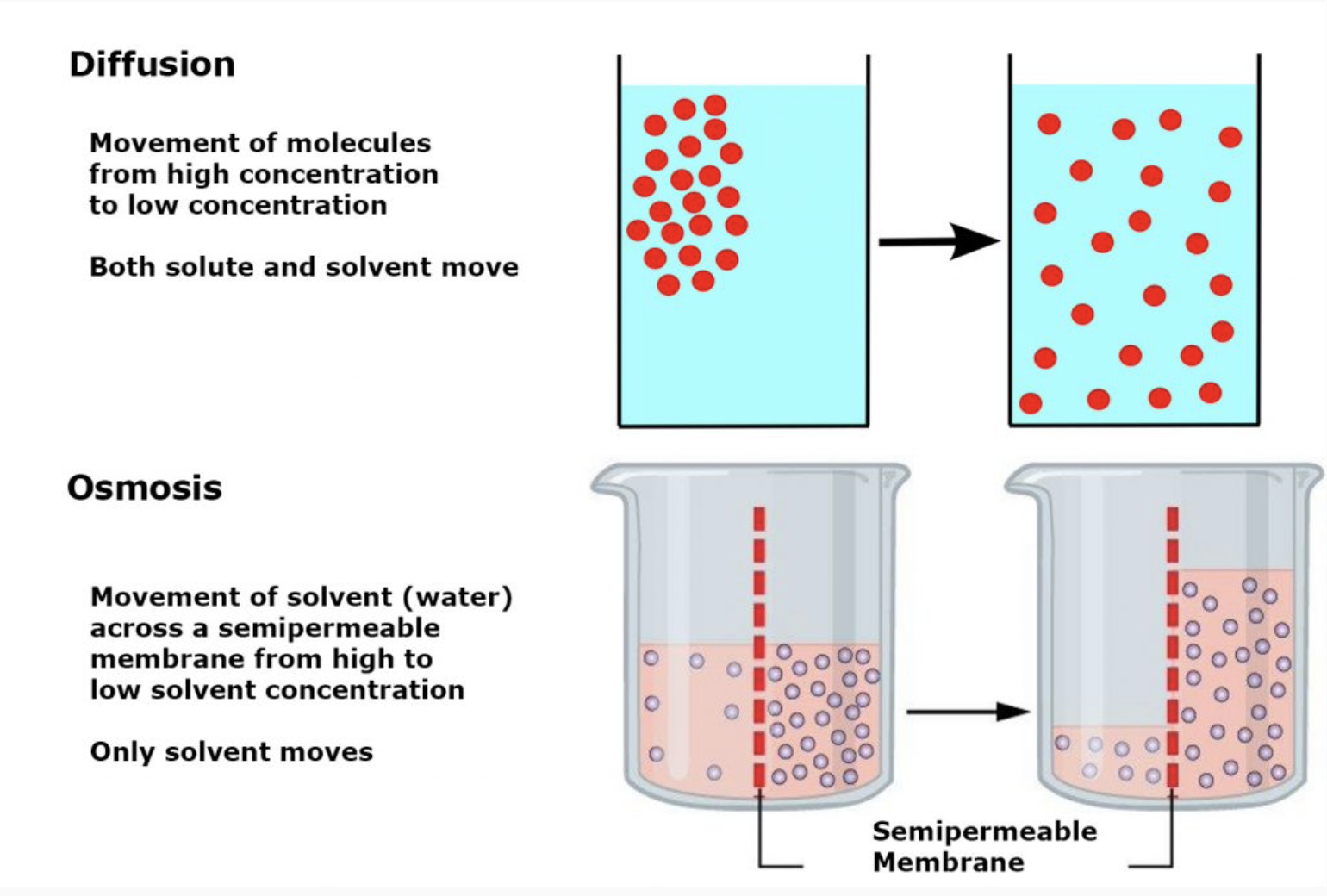Screenshot 2024-09-22 at 12.54.57 PM.pngReverse Osmosis is a method of purifying salty water by forcing water through a membrane (uses energy):
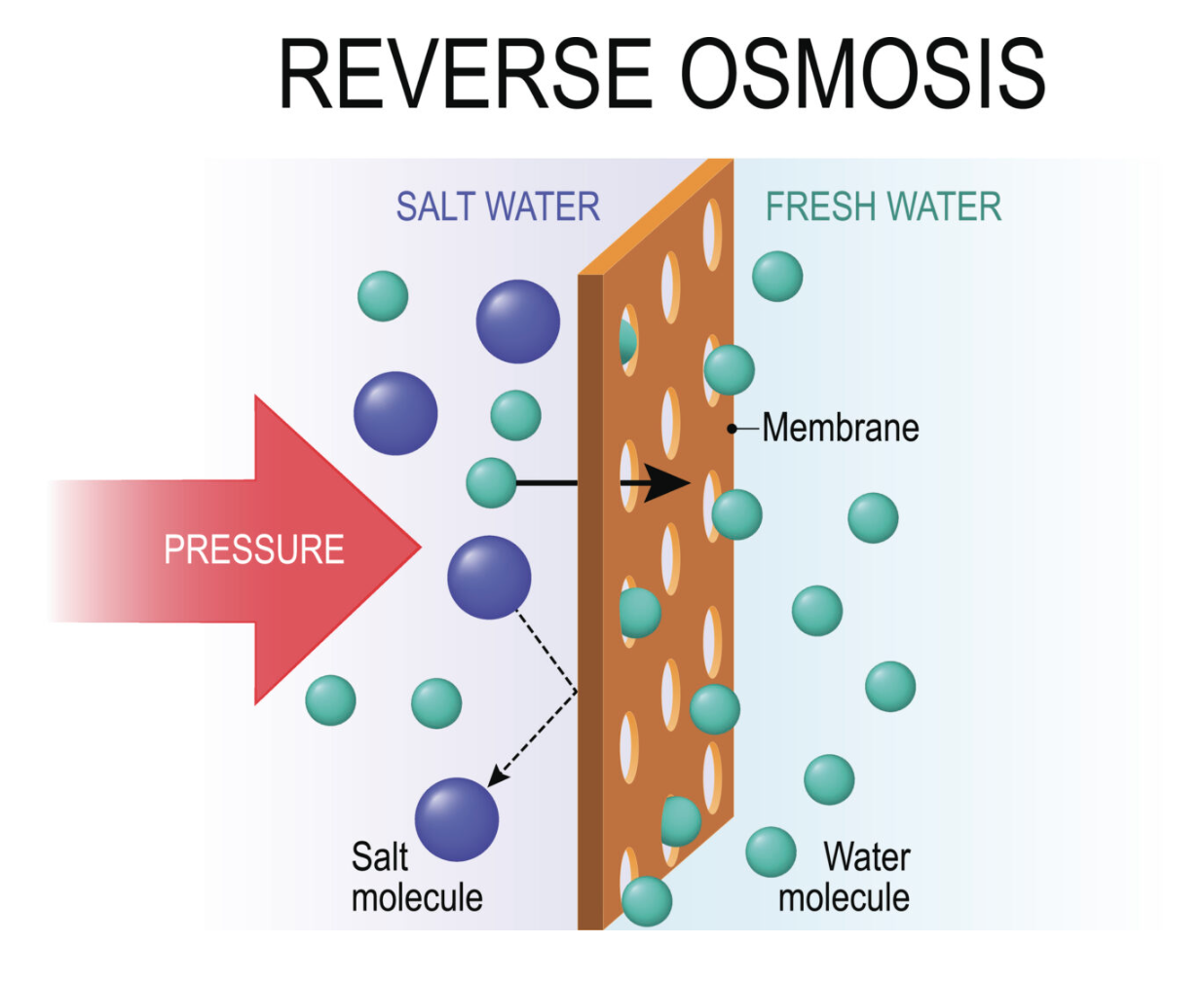Screenshot 2024-09-22 at 12.56.33 PM.png
Demo: cucumber->pickles
Organic and inorganic compounds: everything based on carbon
- Anything with a carbon backbone (like you) is an organic chemical compound
- Anything without carbon is called inorganic, like salts, metals and minerals
- These could be anything from the foods you eat (more on this later) to the gasoline you might put into your car or grease (don't eat that)
- Organic compounds can be water soluble, or not.
- Hydrocarbons like gasoline and oil have only C-H bonds, so are insoluble in water (like greasy hands, or olive oil in salad dressing)
- anything ending in -ane means single bond organic compound
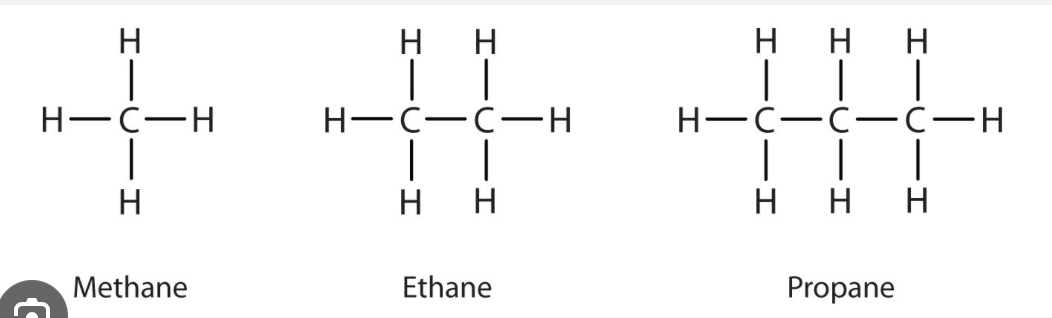Screenshot 2024-09-22 at 12.58.45 PM.pngAlcohols
- organic compounds with an OH molecule attached, so they can dissolve oils while also dissolving in water.
- try this: use alcohol to remove grease from your hands, or your laptop
- -ol is the suffix in organic compounds that means alcohol
Some important alcohols:
- methanol CH3OH (toxic)
- ethanol C2H5OH (makes you drunk)
- propanol (C3H7OH) known as rubbing alcohol
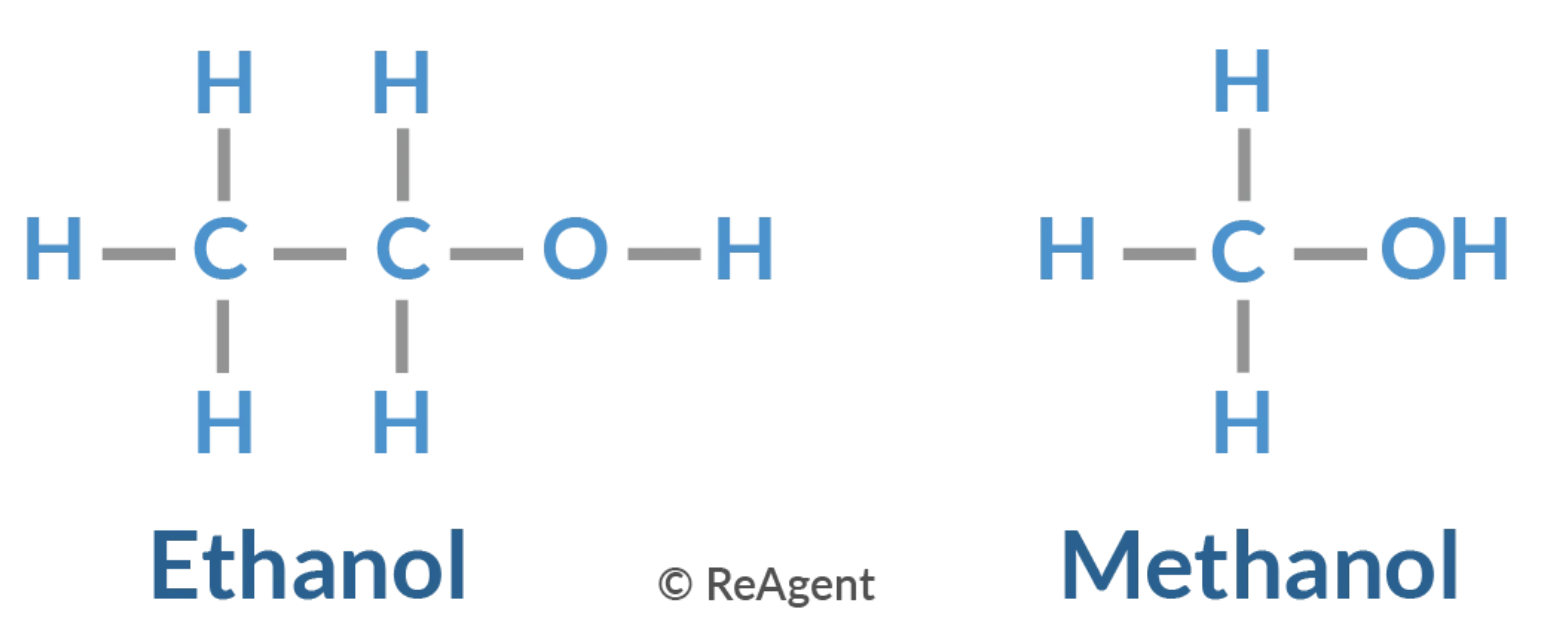Screenshot 2024-09-22 at 12.59.53 PM.pngScary stuff: if you are interested, compare the digestion and metabolism of ethanol and methanol...one of these turns into ant venom in your bloodstream!
Soaps
- are an interesting combination of organic (C-H, hydrophobic) and inorganic (ionic, hydrophilic) ends, so they can mix with oils then be carried away by water.
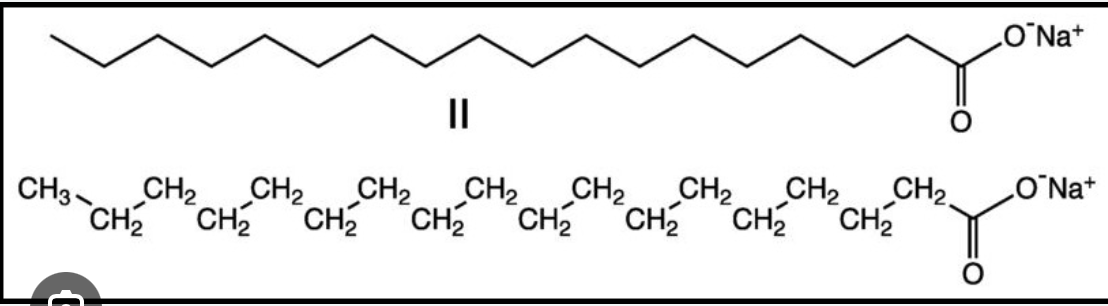Screenshot 2024-09-22 at 1.00.52 PM.png
- Many organic compounds dissolve in plastics, like spaghetti sauce in plastic food containers (Vitamin E/Carotene=orange and lycopene=red)
- -ene means double bonds in an organic compound
- many fat soluble toxins can build up in fatty tissues of wildlife, like killer whales (remember?)
Demo: spaghetti sauce in plastic
Proteins, fats and carbohydrates: CHO, C-H-O and C-H-O-N
- All three of these can act as fuel in your body, as your body is really clever that way.
- Oddly, though, even your awesome body cannot repair tissues or grow new ones without proteins
- Why not?
Proteins
- are the only food source with Nitrogen, since they are made up of amino acids (amines means Nitrogen)
- Proteins can be used as fuel for your body by "de-amination" meaning taking off the nitrogen
- so, could you live on just proteins alone? depends...
- Look up several amino acids, the building blocks of proteins, and find the only one that contains sulfur (very important)
- DNA is made up of proteins as are muscle and tissues (brains too)
-
- Fun fact: vitamins are often amines, and were thought to be vital to health: "vital amines"=vitamins (look up the formula for a vitamin of your choice)
- Another fun fact: athletes using protein supplements can "burn" their kidneys if they don't drink enough water with the proteins, as the body de-aminates the proteins into fats and carbs for fuel (drink water!)
Fats:
- Fats and carbohydrates have similar chemical formula (carbon and hydrogen), but different structures
- Fats all have a special sort of alcohol backbone, with little strands coming off made of C-H bonds (like a hydrocarbon)
- This is why most fats do not mix with water...
- "Free fatty acids" in your blood are the main fuel for athletes (not carbs, as most folks believe)
Carbohydrates:
- Carbohydrates are C-H-O bonds (anything that ends in -ate means with oxygen), so carbo=carbon, hydr=hydrogen ate=oxygen
- Carbs can be long strings, like starches, or compact little hexagons or pentagons like sugars
- Carbs are a short term fuel for athletes
- sugars can give a short term boost in blood sugar, followed by depression (insulin rebound)
- one reason caffeine is added to sugary soft drinks.
- Sugars tend to be metabolized much faster (smaller molecule) than starches
- Diabetics suffer from insulin deficiency, so starches are better for them: slower digestion
- Fun fact: sugar alcohols look like sugar to your body, but don't behave like sugars-used in drinks and candies...
Demo: food analysis
Conservation of mass, conservation of matter:
- In any chemical (not nuclear) reaction, mass is conserved
- Later we will discuss nuclear reactions, where mass actually turns into energy (and vice versa)
Reaction rates:
- Every 10°C increase in temperature doubles the speed of any reaction
- Who cares?
- When you have a fever, you burn fuel much faster
- When explosives heat up, their blast is much more violent
---
Migrated from Apple Server Wiki. Original page ID: E471r1
# 26.09.08 science review: energy and power
[https://elab.hpa.edu/apes/texts/fr3e/fr3e\_ch2.pdf](https://elab.hpa.edu/apes/texts/fr3e/fr3e_ch2.pdf)
Review:
- energy always moves from high energy (e.g. hot) to low energy (cold), or ordered energy (banana) to disorder (heat)
- entropy is a measure of disorder, so ∆universe > 0 (everything moves to disorder, including your room or closet)
- energy cannot be created, but can be converted, like a banana (chemical energy) to heat and motion (you running around)
- nothing is 100% efficient, so your banana only turns about 33% of its energy in to motion, most of it is waste heat
- same for your car: 9$ of gasoline buys you 3$ of motion, and 6$ of heat
- EVs are more efficient as they are not heat engines (hot moving to cold), and they capture motion in batteries for starting up again (regenerative braking)
- three rules of thermo (heat) dynamics (movement):
- you can't win (nothing has > 100% efficiency)
- you can't break even (all reactions have an energy tax as heat)
- you can't get out of the game (all reactions tend towards disorder)
- energy moves in one of three ways:
- radiation (heat lamps, light) can be reflected (foil) or absorbed (hot pavement)
- conduction (contact) can be insulated (styrofoam) or conducted (copper pans)
- convection (movement) like a convection oven (air in motion) or all weather
- temperature is based on the velocity of molecules
- even if the molecules are going fast, there must be enough of them to conduct heat, so high altitude planes release steam (burning kerosene) which freezes (jet trails)
- positive feedback: radiation heats the polar ice (white) melting it (darker) which absorbs more energy and melts more
- negative feedback: you run, get hot, sweat, cool down
- energy and mass systems can be open (energy comes in) or closed (mass stays the same)
- where these are balanced it is a "steady state"
- all weather is based on these concepts:
- solar radiation heats the surface
- the surface conducts heat to the air
- warm air rises (less dense), along with water that has evaporated because of the heat energy
- as the warm air rises, it cannot hold water, so it rains
- cooler air descends to the surface to be heated again
- where air rises, it rains (e.g. Seattle)
- where air falls, it is a desert (e.g. Sahara)
- air motion on our planet is divided into three cells: Hadley, Ferrel, and Polar
- hurricanes are a good example of a heat engine
- shaped like a huge smokestack
- hot air rises, condensation forms rain
- as a small storm gets big (100km across) one part is closer to the equator (faster) then the other (slower, north in our hemisphere)
- coriolis is the spinning of the hurricane, ccw in our hemisphere cw in the southern hemisphere
- as the air rises it pulls in more air, like a skater pulling arms, spinning faster
- hurricane "eye" is smallest for dangerous hurricanes
- tornadoes also spin, but for smaller scale reasons, vertical updrafts and downdrafts in huge storms
- ****
Reaction rates:
- Every 10°C increase in temperature doubles the speed of any reaction
- Who cares?
- When you have a fever, you burn fuel much faster
- When explosives heat up, their blast is much more violent
Energy:
- same as work
- don't care if it happens fast or slow, just lift the rocks
- minilab: calculate your mass in kg (lbs x 2.2)
- how high are the stairs? (meters)
- lifting your mass up the stairs is WORK: PE = mgh. (gravity is about 10 here)
- how much work did you do walking up the stairs?
- important: not how FAST you do it, just how MUCH you did
- work=energy, how fast the work is done= power
Power:
- power is how FAST you do the work
- athletes need the ability to do work (lifting) as well as quickly (power)
- [https://www.youtube.com/watch?v=S4O5voOCqAQ&t=178s](https://www.youtube.com/watch?v=S4O5voOCqAQ&t=178s)
- walk up the stairs, as slowly as you like
- calculate the work you did walking up the stairs: mass x 10 x height (meters)
- units will be in Joules (energy)
- next, run up the stairs and time yourself
- work/time is power in Watts (Joules/second)
- 747 Watts is one horsepower
- how many Watts and hp can you produce?
- how does it compare to Robert Forstmann?
- what is the difference between your slow power and your fast power?
Electrical work and power:
- 1 Watt is the same as 1 joule (work) done in one second (time)
- 1000 Watts is one kilowatt (kW)
- a hot water heater uses energy (does work) at a certain rate (power), measure this in Watts and kW (1000 Watts)
- if it runs for one second, the power number (joules/second) is the same value as the energy (joules)
- to calculate energy used to heat the water, multiply power (Watts or j/s) x time (seconds)
- you will see this on the AP exam, here's what it may look like:
Sample AP problem:
Your home hot water heater converts electrical energy into heat energy at the rate of 4500W.
1. how many kW is this?
2. if it runs for 2 hours each day, how many seconds is this?
3. how many joules is this?
4. calculate how many kWh this is (kW x hours)
5. convert this to joules, are your answers the same?
6. if one kWh costs your family 40 cents ($0.40), how much does this cost each day?
7. each month?
8. each year?
9. how could you reduce this?
10. why does the electric company charge you for kWh not kW?
11. why don't they use joules like the rest of the world?
Module 5 Energy flows, feedback
- energy terms: cal, kcal, Joule, kWh, BTU
- power terms: Watt, J/s, hp
- EM spectrum
- KE= 1/2mv^2 or 3/2kT (T is degrees Kelvin)
- PE = chemical bonds or mgh (height potential energy)
- ICE vs. hybrid vs. electric cars
- thermo 1: conservation
- thermo 2: efficiency
- thermo 3: entropy
- open and closed systems
- equilibrium, stability and steady states
- positive feedback loops
- negative feedback loops
Energy terms:Energy is the ability to do work
You may have seen this in other science courses as force x distance, PE=mgh, or other descriptions
We use the following units for energy:
- calories: the energy used to heat 1 gram of water 1 degree C (note small c)
- kcal: one thousand calories
- Cal: a single food calorie, equal to 1000 chemical calories (note big C)
- Joule: the work needed to move something 1 meter against a 1 Newton force (note caps for dead people)
- 1 cal = 4.18 Joules (good to know)
- kWh = one kiloWatt of power used for 1 hour (heating tea for an hour, costs about $0.40 here)
- BTU: British thermal unit, most often seen in heating, ventilation and cooling (HVAC) systems
Demo: walk up stairs
Power:
- Energy is the ability to do work, or to measure work that is done.
- Power is how FAST that work was done, measured in Watts (note caps again, another dead person)
- You could walk up a flight of stairs, doing some amount of work:
- 50 kg person, 10 m stairs, g = 10, equals 5000 Joules
- If you do this in 100 seconds, you have done this with 50 Watts of power (50 joules/second)
- If you did it in 10 seconds, you would be creating 500 Watts of power (that's a lot)
- 1 horsepower (hp) is 747 Watts
- Fun fact: some elite cyclists can create over 1000 Watts for many minutes-true animals
- Another fun fact: the electric company does not care how fast you use energy (kiloWatts), they only care how many hours you used this power (kWh)
- Think of water: you are not charged for how FAST you use the water, just how MUCH you use
Electromagnetic spectrum:
Spectrum means a spread of values, so a musical spectrum might mean the lowest and highest notes you could sing or hear.
The electromagnetic (EM) spectrum describes EM radiation, that includes in order of increasing energy:
- radio waves: (radios use these)
- heat (IR or infrared): snakes can see these, also heat lamps over food or for people
- visible light: you can see these: ROYGBIV
- UV (ultraviolet) light: bees can see these, they also burn your skin
- X-rays: films and sensors can see these, they go through your skin, but less so through your bones
- gamma rays: go through most stuff (remember?), mutate DNA
- and cosmic rays: mysterious stuff, comes from supernova explosions, can form muons (cow rays)
- if you see Tiffany, ask her about relativistic muons...
Demo: spectrographs
The visible spectrum includes the following colors, in order of energy:
Low energy-------
- red
- orange
- yellow
- green
- blue
- indigo
- violet
High energy------
You can now see why infrared is below red, and ultraviolet is above violet
Plant pigments have evolved to resonate with certain colors, like chlorophyll likes green light, others like reds and so on.
Fun fact: autumn leaves are red because the green is gone (winter, darker). The red was there all along.
Kinetic energy:
- When you ask a physicist (I am one, so I know) about Kinetic energy, they will drone on about moving objects, their mass and velocity...
- KE = 1/2mv^2
- This is incredibly fascinating you will agree (?) and it explains why car crashes at 80 mph are 4x more damaging than ones at 40 mph...
- In chemistry, we use KE to describe the energy of moving molecules: KE = 3/2kT, where T is the absolute temperature (Kelvin)
- This means that if you double the Kelvin temperature, you double the KE of a molecule.
- This changes for different molecule shapes (3 comes from x, y, z motion), which you may find interesting if you study physical chemistry (ask Dr. J)
- For our purposes, we need to know that increasing temperature increases the speed of molecules:
- 3/2kT = 1/2mv^2
- So, those physics guys were not crazy.
- This has huge implications on climate change, phase changes, rain, condensation, and many other things.
Potential energy:
- If you ask a physicist (what, again?) about potential energy, they will blather on about mass, gravity and height.
- While scintillating, this is useless in most chemical equations, which tend to happen at the same height.
- It does, however impact some weather phenomena, so let's let them have this one.
- If you ask a chemist about PE, they will often refer to chemical bonds, which represent energy stored like a spring holding molecules together
- If you ask a nutritionist about PE, they will talk about Caloric content (food)
- If you ask a coach about PE, they will tell you about the untapped potential of an athlete...maybe
- In APES, we mainly care about stored energy, usually in a phase change (latent heat of vaporization) or chemical bonds like in food.
Demo: springs
ICE, hybrid and electric cars:
- ICE stands for internal combustion engine (e.g. normal cars, lots of heat, hot brakes etc.)
- hybrid cars capture the KE of motion and store it in batteries to accelerate the car, saving energy
- electric cars do this as well, but have no thermal engine parts like ICE or hybrid cars, so they are much more efficient
- electric cars capture braking kinetic energy and store it as chemical energy in batteries (often lithium)
Demo: Prius, Tesla
Thermodynamics: one two and three
Thermodynamics is the study of heat (thermo) in motion (dynamics)
There are three big laws of thermodynamics:
1. you cannot create or destroy energy (you can't do this with mass either, more on this later)
2. in any reaction, there is an energy "tax" you could think of as friction
3. all reactions go naturally towards disorder
Short Las Vegas version:
1. you can't win
2. you can't break even
3. you can't get out of the game
- You can imagine a magical car that you put 1000J of energy in the tank and 2000J of work is done by the engine.
- No
- Way.
- The most efficient Formula one racing car engine is about 45% efficient.
- Where does the rest go?
- Heat.
- Your body is at most 33% efficient in turning M&Ms into work. The rest?
- Heat.
- One way of looking at disorder is entropy, a measure of disorder.
- You can imagine a pool table, hitting the triangle of balls and then spreading across the table.
- It is more likely to go in this direction (more disorder) than to have the balls spontaneously jump out of the pockets and form a perfect triangle.
- Not to get depressing, but there is a formula that goes like this:
- ∆S for the universe is >0 translation: the universe always moves towards disorder
- so sad...
Demo: look up thermal efficiency of formula one cars, diesel and EV
Open and closed systems:
- This means different things to different folks, but you could imagine a system where mass and energy are contained in the system as closed.
- You might also look at a system where certain nutrients are recycled as closed.
- You could look at recycling paper as a closed system to a degree.
- Most of our product cycles are open: we throw stuff away instead of recycling.
- Much more on this later...
Equilibrium, stability and steady states:
- Equilibrium means literally "equal freedom" , in this case equal freedom to move from one condition to another.
- Imagine two fish tanks with a pipe connecting them.
- Fish are free to move from one to the other.
- Not the same fish, but about the same fish on each side.
- This is equilibrium.
- Stable systems are ones where equilibrium exists, and can recover from stresses (resilience)
- Steady state systems are ones where the inputs equal the outputs, and are usually stable as well.
- Unstable systems have nasty feedback loops (see below)
Positive feedback loops:
- In a positive feedback loop, any change causes a greater change as a result
- Boat example: if a large cruise ship tilts over, the mass of the people on the ship make the ship want to tilt more.
- Climate change example: as the planet warms, ice sheets melt, changing from reflective ice to darker ocean water that absorbs more heat, melting more ice.
- Permafrost example: as the planet warms, the permafrost melts, releasing methane gas, which is a greenhouse gas, causing more warming, and more methane...
- Positive feedback loops exist in your body as well: massive blood loss and childbirth are two examples.
Demo: look up femoral artery hemorrhage
Negative feedback loops:
- Where positive feedback tends towards instability, negative feedback loops restore stability, and naturally recover to initial conditions.
- As you exercise, your body sweats, cooling the body.
- This is a negative feedback loop.
- Some coast guard rescue boats are created with negative feedback as well: the more they tip over, the more they want to come back to normal.
- Psychologists often use these terms to describe personalities and relationships...
Demo: sailing ships, keel
---
Migrated from Apple Server Wiki. Original page ID: E5u117
# 24.09.17 Summative challenge!
- Challenge will include ~15 free response questions week of 9.23.24
- You create the questions on a google doc (share with me by Friday afternoon)
- Topics should cover everything so far this year (see the weblog)
- Google doc collaborations: :-)
- GPT :-(
- You must include a solution to your challenge questions
- Study guide :-)
---
Migrated from Apple Server Wiki. Original page ID: a7W6s9
# 24.10.14 Heat energy and flows: atmosphere, weather, seasons
References:
- [Cengage chapter 3 ](https://elab.hpa.edu/apes/texts/parts/)
- [FR 3e modules 9-11 ](https://elab.hpa.edu/apes/texts/parts/)
Heat
Important: Heat energy always moves from hot to cold (high energy to lower energy)
Heat energy moves in three "modes":
- conduction: from the latin word for "contact", objects touching
- convection: matter in motion, like hot air or steam rising
- radiation: infrared radiation below visible light on the spectrum
Conduction:
- Materials can be excellent conductors of heat like silver, aluminum, copper and gold
- Fun fact: Materials that are good conductors of heat are also good conductors of electricity
- Insulators are materials that do not conduct well: styrofoam, pink panther insulation, cloth, rubber
- Think of this: to pick up something very hot, what would you hold it with?
Convection:
- Hotter fluids are less dense than cooler ones, causing upward migration of hot material
- Fun fact: everything in zero gravity needs a fan to cool (why?)
- Convection can be blocked by covering hot objects, like the cover on your coffee or pot on the stove
- You may have seen strange mirage like waves over something hot: this is convection of less dense air bending light
Radiation:
- This is basically light, so can be reflected by foil, or any reflective material
- Radiation is most effective at higher temperatures, one reason you can't see warm objects but can see red hot objects
- This is also how snakes and other reptiles (or the alien in predator) see the tracks of their prey
- This is one reason hot drinks are usually delivered in white cups: white reflects radiation better than black, which absorbs and re-radiates the energy (one part of the greenhouse effect)
Note that these are not the key ways your body cools during exercise: that is called "latent" (hidden) heat of vaporization
- When sweat evaporates, it takes with it lots of energy to do so, cooling you very efficiently
- Consider why some triathletes who come for the Kona Ironman (or others) have trouble here with the high humidity
- Higher humidity means less efficient evaporation.
- It also explains why 110°F in Phoenix might be tolerable if the humidity is very low
- Also why athletes in the Kona Ironman struggle if they come from other biomes
[Lab: Heat transfer:](http://10.14.4.85:6875/books/ap-environmental-science/page/heat-transfer-lab)
[http://10.14.4.85:6875/books/ap-environmental-science/page/heat-transfer-lab](http://10.14.4.85:6875/books/ap-environmental-science/page/heat-transfer-lab)
Module 9: Heating of the earth
Radiation from the sun hits the surface of the earth, which re-radiates this energy as longer wavelength infrared radiation.
(There is some heating of the atmosphere in both directions)
The atmosphere is divided into layers based on temperature, gases and density:
- Troposphere: at the surface, where all the action is
- ozone layer-blocks UV light
- Stratosphere: where planes fly: cooler
- Mesosphere: "middle" layer
- Thermosphere: "hot" layer, fast (3/2kT) molecules (from radiation), low pressure
- Exosphere: very low density, lots of radiation
(see layer diagram)
n.b. thermosphere is also known as the ionosphere (reflects radio waves), blocks nasty radiation from space, absorbs the energy from this radiation, gets hot
To see this in action: [https://www.spacex.com/launches/mission/?missionId=starship-flight-5](https://www.spacex.com/launches/mission/?missionId=starship-flight-5)
Go to minute 1:18
Now think of the three heat transfer modes:
- Radiation: energy from the sun hitting the surface
- Conduction: hot ground heats the air in contact with it
- Convection: hot air rises, creating weather
Weather?
- As air rises, it creates local low pressure areas, bringing in clouds and moisture (wind)
- As this air rises, it cools, dropping moisture as rain or snow
- This dry air circulates at high altitude until it transfers its heat to space (radiation and conduction) then descends as cooler, dry air
(see adiabatic cooling diagram)
The amount of heat the surface absorbs is based on reflectivity (recall radiation above)
Albedo is a measure of this reflectivity (think of Albus Dumbledore: white beard)
- Average albedo for the earth is about 30%
- Snow and ice are about 90%
- Water is about 35%
- Soil is about 15%
- Asphalt is about 5%
- Clouds vary in density from 10-90%
(see albedo diagram)
Fun fact: as global warming melts ice (high albedo) it turns into water (lower albedo), warming the planet more (positive feedback).
The place on the planet with the most average solar radiation is the equator, so air rises there (convection)
This creates the first of three cells: the Hadley cell
- As air moves towards the equator, it brings moisture (ITCZ)
- As this moist air rises, it cools and rain results
- The resulting dry air moves north and south away from the equator in the stratosphere
- This dry air descends creating deserts
Fun fact: on windy trade wind days your flight to the mainland is faster-why?
(see Hadley cell diagram)
Primitive meteorologists (weather folks) detected three of these cells:
- Hadley
- Ferrell
- Polar
To draw these, remember that when cells touch, air moves in the same direction: up-up or down-down
Biome impact:
Seasons:
The earth is tilted on its axis about 23.5° (get over it, it changes every 20,000 years)
Because of this, each hemisphere gets more or less solar radiation at certain times of the year.
We divide this (almost)circular motion into 4 points:
- Summer solstice: June 21 (summer for N hemisphere)
- Autumnal equinox ("equal night"): September 21 (today!)
- Winter solstice: December 21 (winter for N hemisphere)
- Vernal or spring equinox: March 21 (pagan festivals, etc.)
Australians have Christmas in their summer. Santa arrives by surfboard (true fact)
Fun fact: Pagans feared each winter that the days would just keep getting shorter and total darkness would result, so when they calculated winter festivals, they waited a week after the darkest day (December 21) to make sure the sun would come back.
This is why Christmas is December 25, not 21.
(see season diagram)
In Hawaii, we are below 23.5° latitude (find this on your globe), so for several months in our summer, the sun is actually NORTH of straight overhead. This is called "Lahaina noon".
Coriolis effect:
- If you look at your globe from above (like some eskimo god), you will notice the radius at the equator is greater than at higher latitudes.
- Actually, the tangential velocity (physics term) at the equator is about 1600 km/hr (1000 mph), while it is zero at the north pole.
- As large storms stretch out with one end more south than the rest, it falls behind, creating the coriolis effect.
- Demo: imagine dripping water (you, the eskimo god again) on the globe while it spins, which way would the water drip?
Ocean currents:
[Download mod11-ocean currents.pdf (application/pdf, 1.7 MB)](https://bookstack.kamuela.org/attachments/232)
Oceans: wind and water
- Surfers in California usually wear wetsuits.
- Why?
- Water along the California coast travels south from Alaska.
- Remember this: oceans in the northern hemisphere travel clockwise
- (opposite in the southern hemisphere)
- Tough question: why are our trade winds from the NE not the North (Hadley cell)?
- Verify on windy.com:
[https://www.windy.com/?20.002,-155.533,5](https://www.windy.com/?20.002,-155.533,5)
- There is one very interesting deep ocean current called the "thermohaline" circulation:
- thermo=heat, haline=salty
- Also known as the NADW or North Atlantic Deep Water:
- Melting ice sheets in Greenland create dense, cool water that flows south along the ocean floor, and emerges in two places on the planet: India and KONA!
Ocean circulation: Up and down, east and west
- The Andes run north and south from Peru to Chile as a result of tectonic plates going under South America from the west (more on this soon).
- As a result, there is a deep trench off the coast of Peru and Chile
- Looked at sideways from the south, as water rises from this deep trench it brings with it decomposed ocean creatures (detritus) that surface fish love to eat: happy fisherpeople
- This is called "upwelling"
- For this to happen, an offshore wind has to be strong.
- This condition is called La Niña ("the little girl"), and is an indicator of weather all over the planet
El Niño ("the little boy" named because it often comes at Christmas) is when this wind becomes onshore, stopping the migration of fish food (sad fisherpeople)
(see sideways diagrams of La Niña and El Niño)
Better picture: Top is La Niña (good) lower is El Niño (bad):
- Note that in the La Niña year, the East-West "cell" is larger, stronger, and pulls more surface water away from Peru-Chile (happy fisherpeople)
- Look at the thermal image below, notice the cooler (deep) water coming off the coast of Chile in a La Niña year
- Note that in the El Niño year, the "cell" is smaller, weaker, and the offshore current is weaker (sad fisherpeople)
- Look at the thermal image for El Niño year: warmer (surface) water off the coast of Chile
- You might be interested in why there is a trench off the coast of Chile-it is the same reason the Andes mountains are in Chile...
- Look at the bottom diagram, which is winter on the southern hemisphere-see the rain over Tahiti?
- Notice also the dry air over Australia-remember the 8 countries projects?
- Harder to notice: in their summer, the water in the south pacific is warm, not cool from the upwelling
- Why is this important?
Here's a bigger picture: [https://oceanservice.noaa.gov/facts/ninonina.html](https://oceanservice.noaa.gov/facts/ninonina.html)
Here's a nice summary of the three states: La Nada (nothing, normal), El Niño (bad), and La Niña (good):
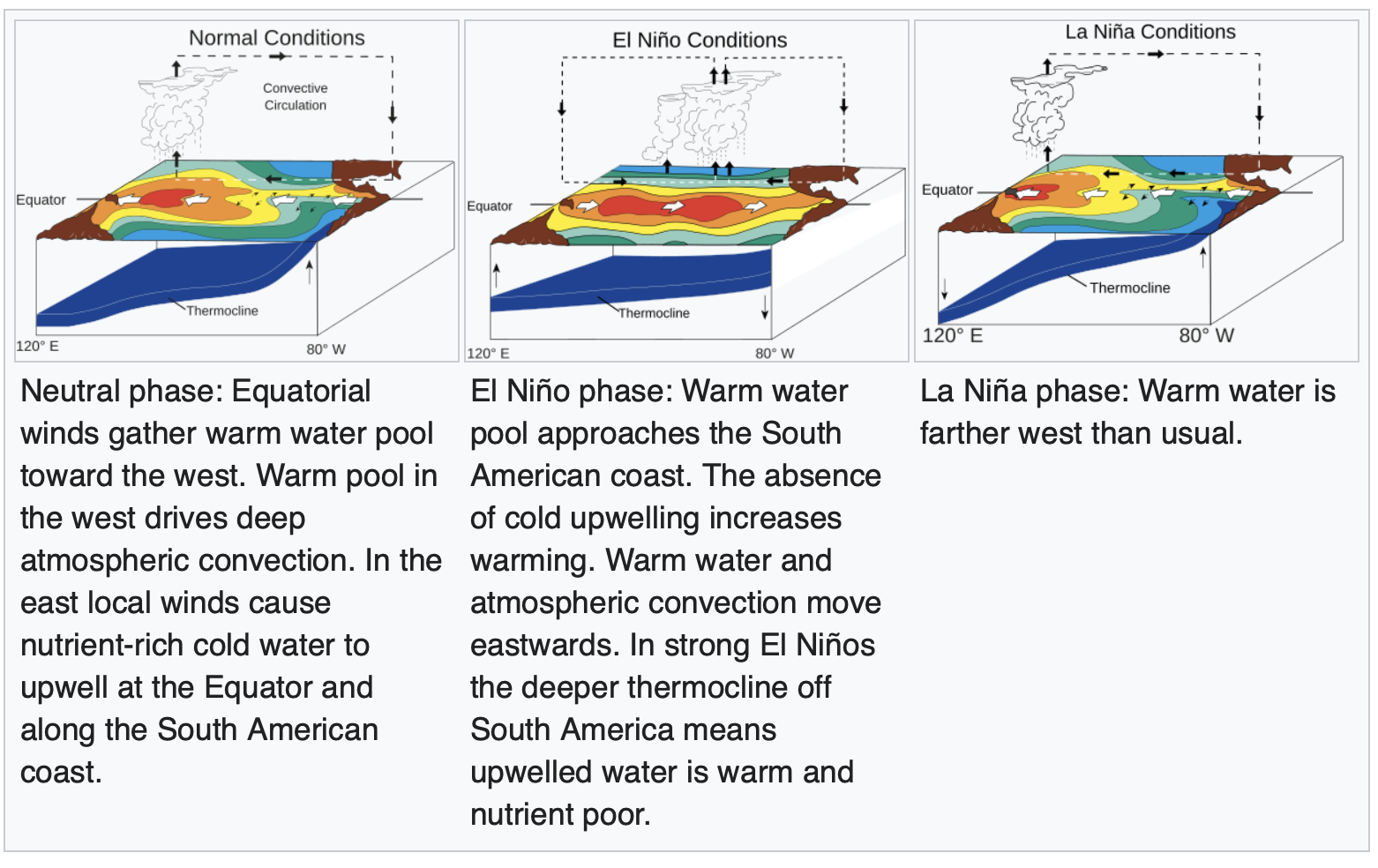Screenshot 2024-10-15 at 6.49.13 AM.png
When does this happen?
---
Migrated from Apple Server Wiki. Original page ID: P7L3x0
# 24.10.15 Aquatic biomes
Google [aquatic biome game](https://www.google.com/search?client=safari&rls=en&q=aquatic+biome+game&ie=UTF-8&oe=UTF-8)
Recall terrestrial biomes are defined by temperature and precipitation (rain)
Aquatic biomes are by definition underwater, so they are defined by
- Depth: how deep is the deepest part, how much photosynthesis is possible
- Distance from shore: shallow water has more life, more things to attach to, more biodiversity
We separate aquatic biomes into freshwater (lakes, rivers, streams) and saltwater (oceans, estuaries)
Freshwater biomes:
Riparian=river
Limnotic=lakes
Lakes:
- Shallow shore area=littoral (means shallow), see the "littoral Navy", photosynthesis here (shallow, light shines through)
- Open water area=limnetic zone, no rooted plants (too deep), phytoplankton here, only as deep as sunlight can penetrate
- Deep water=profundal ("profound") or deep zone: no light penetrates, bacterial decomposition.
- Bottom=benthic zone: mud, dark, cloudy
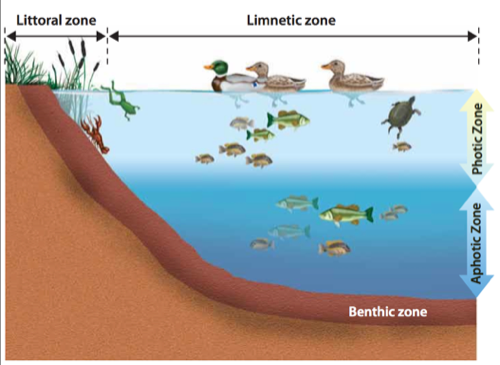47fc3.pngPonds are much smaller, and may freeze in the winter, so their dynamics are different
Productivity: see also NPP (net primary productivity)
- n.b. usually related to photosynthesis (plants)
- Oligo (few) trophic=low productivity
- Meso (middle) trophic=medium
- Eutrophic (eu=good trephien=food)=lots of productivity (sometimes too much, like in "Poisoned Waters")
- Freshwater wetlands-submerged most of the time (swamps, marshes, bogs) this is the history of all coal and oil we now use
Wetlands:
- Freshwater wetlands-submerged most of the time (swamps, marshes, bogs) this is the history of all coal and oil we now use
- Salt marsh: usually connected to the sea, act as a coastal buffer for Hurricanes, very productive, many nutrients, lots of organic material
- Mangrove swamp: special adapted version of this in Tropical areas (e.g. Florida)
- Intertidal zone: area between high and low tide or seasonal variations
Ocean zones:
- Coral reefs-see coral bleaching, pH, temperature and salinity sensitive (see Hamakua coast vs. Puako)
- Intertidal zone: between high and low tide
- Photic (light) zone-shallow, photosynthesis, kelp, others
- Aphotic (dark) zone-too dark for photosynthesis
- Chemosythesis/thermosynthesis: deepwater steam vents, based on Sulfur instead of Oxygen, bacteria generate energy with methane (CH4) and H2S (instead of H20)
- Benthic=deep ocean
- Pelagic=open ocean (think of big sailing ships, whales, stuff like that)
- Hadal zones: like Hades: deepest, darkest zones. Weird fish, no light...
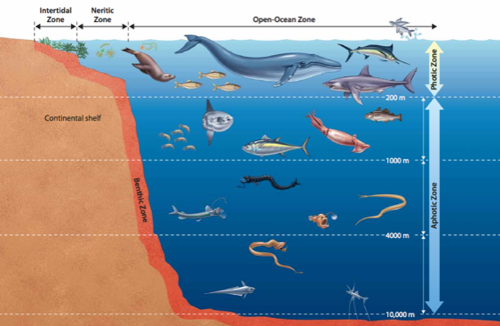b3276.pngSummary: (note open ocean is called Pelagic, and deep ocean zones are called Hadal)
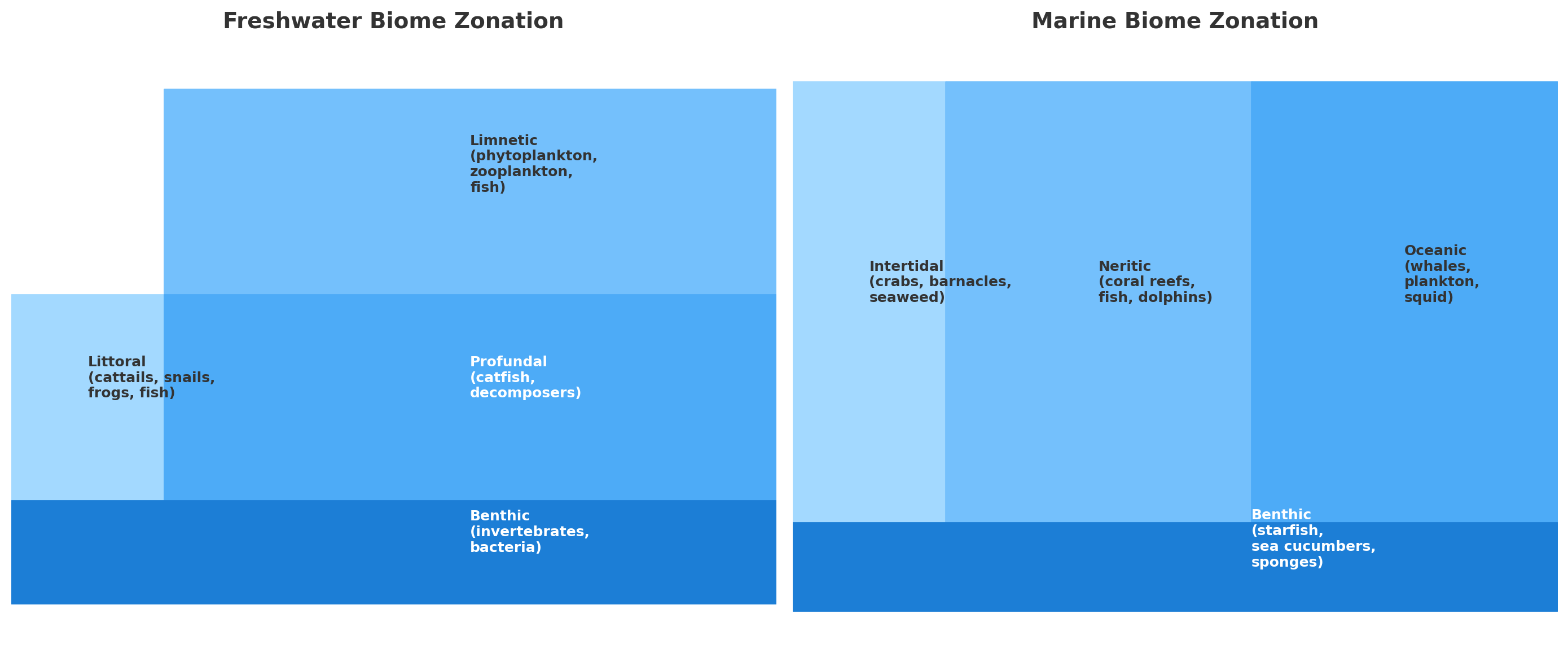Marine Biome Zonation.png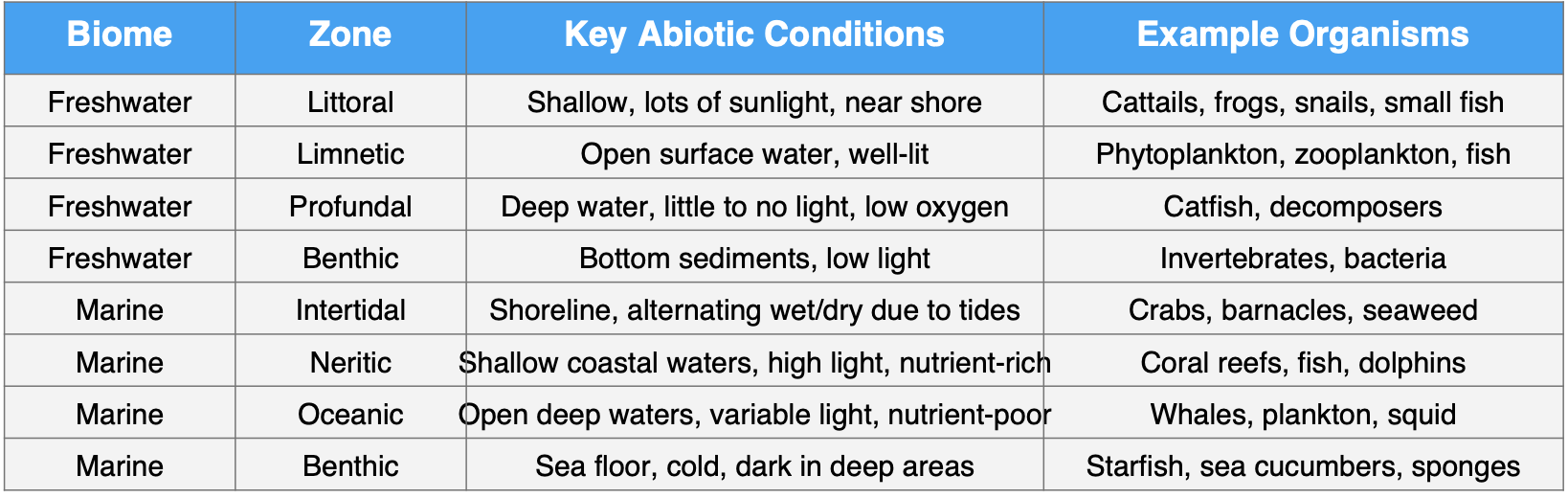Screenshot 2025-09-22 at 3.49.56 PM.pngSalt stuff:
- salt water = 30-50 ppt (parts per thousand)
- know what these mean, we will see them soon: ppt, ppm, ppb
- fresh water = 0.5 ppt
- in between 0.5-30 ppt = brackish (anchialine ponds in Kona)
- salinity, wind and temperature determine flow
==================Terms to know: Review
Zones:
photic zone=light
aphotic=no light
benthic=really no light, never, ever ever. don’t even think about it.
Hadal=too dark to imagine, named after Hades (hell)
Marine animals:
- aquatic mammals must surface for air
- fishies don’t-they have gills
- DO dissolved oxygen (very important) depends on plants (so depth) and temp (cooler water can hold more O2)
- warm water has low O2 generally.
- best place to fish: cool water after a waterfall (why?)
Rivers, ponds and lakes, oh my...
- flowing water: rivers
- standing water: ponds
- lakes can become inland seas (drought lowers level, unable to drain, forms a lake)
- littoral=shore, limentic=away from shore benthic=botttom
Wetlands:
- terms: marshes, swamps, bogs and fens
- marshes marshes marshes!-tall grasses
- swamps-some trees
- bogs-acidic, poor decomposition, floating stuff, decay slowly-ancient cheese story, peat moss
- fens-freshwater spring underneath, less acidic, better nutrients
River stuff:
- rivers-"oxbow" lakes and meander (usually in very flat lands like Nebraska)
- continuity concept: source->tributary->mouth (delta)
- slope exponential as distance from source (one reason dams do not last long)
- deposition rates (rapids vs. plains, think of sedimentation)
- silt carrying capacity, turbidity
- estuaries-like deltas
- tidal estuary: e.g. hudson river: deeper than the body it serves
Oceans——
- 200 ft. of salt if all oceans evaporated
- oceans were red (iron) then ppt out (iron range in WI, MI) (see PBS Nova episode)
- salinity, wind and temperature determine flow
- upwelling (recall Peruvian fisherpersons)
- also downwelling
Photic (light) zones-again
- intertidal zone-makes sense, between tides
- neritic zone-close to shore, less than 200 ft. deep (not in Hawaii, we have no continental shelf-boo hoo)
- open ocean (pelagic) zone
- kelp forests-e.g. california coast
- coral reefs-away from fresh water, coastal, photic
- open ocean-scary stuff
---
Migrated from Apple Server Wiki. Original page ID: X8680818
# 24.10.14 Land Biomes
Part one: Land biomes
Hawaii biomes:
[https://www.youtube.com/watch?v=ajpGScyuPiE](https://www.youtube.com/watch?v=ajpGScyuPiE)
[Download mod12-land\_biomes.pdf (application/pdf, 6.2 MB)](https://bookstack.kamuela.org/attachments/233)
Look:Here's what we learned so far:
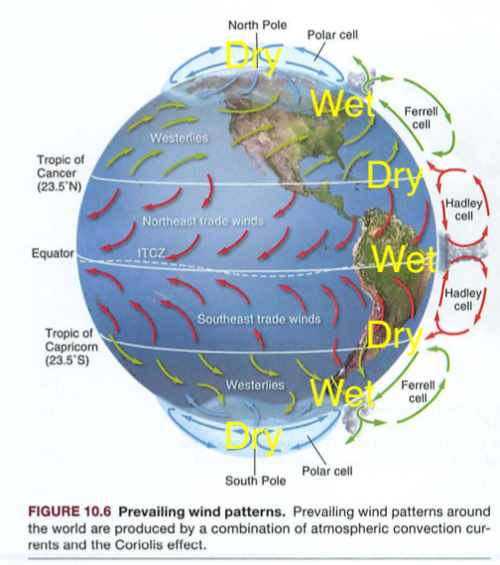cd6cd.png
Now look at this map, and compare with your trusty globe:
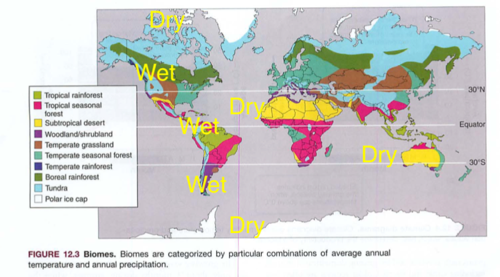6a22f.pngSee the pattern? Pay close attention to cause and effect:
- onshore moist air from the Pacific ocean hits the mountains near Seattle=rainy there
- onshore moist air from the lower Atlantic ocean hits the amazon basin=rainy there
- dry air moving down from the Mediterranean moves over the Sahara Desert=dry there
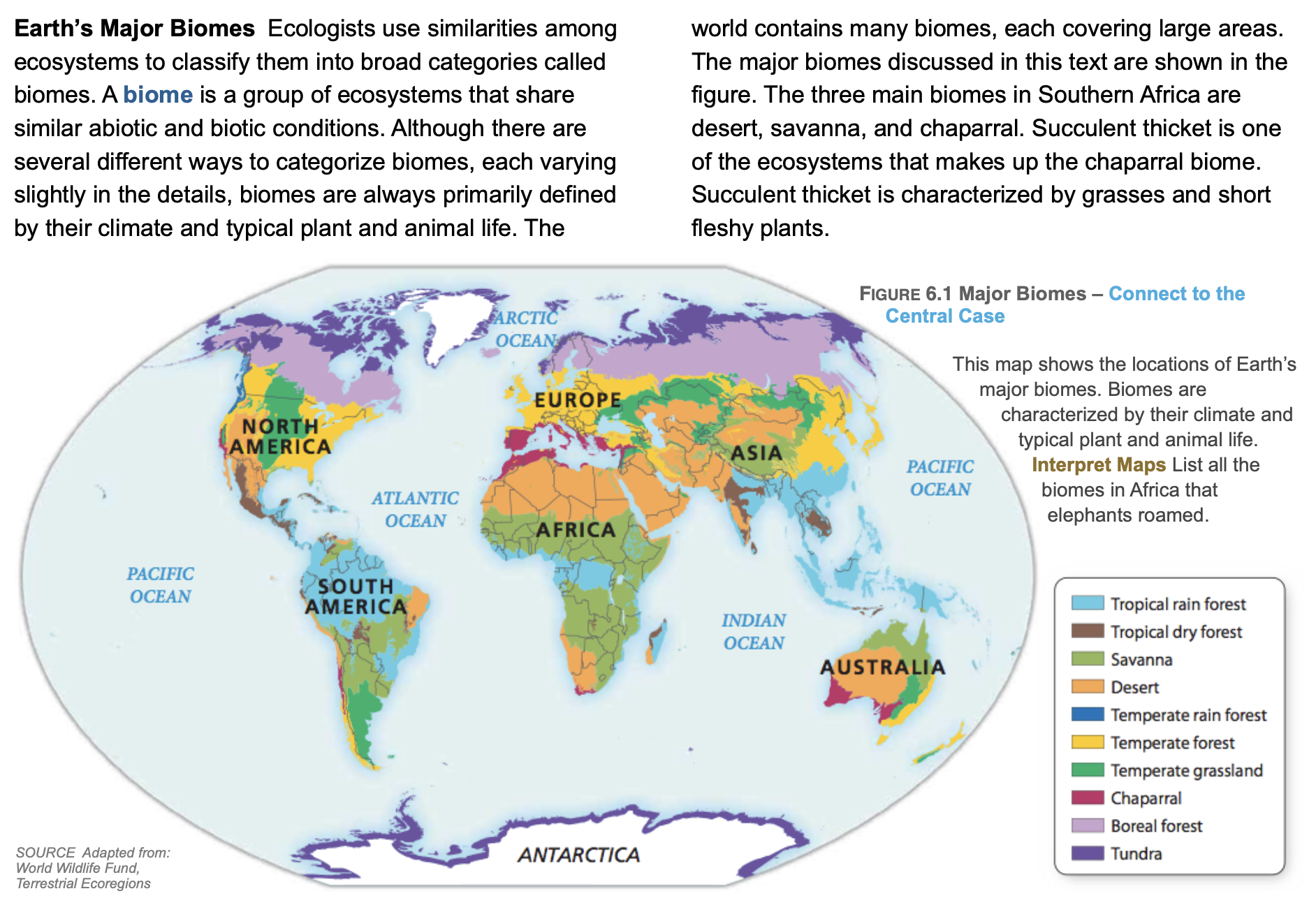Screenshot 2024-10-14 at 2.14.31 PM.png
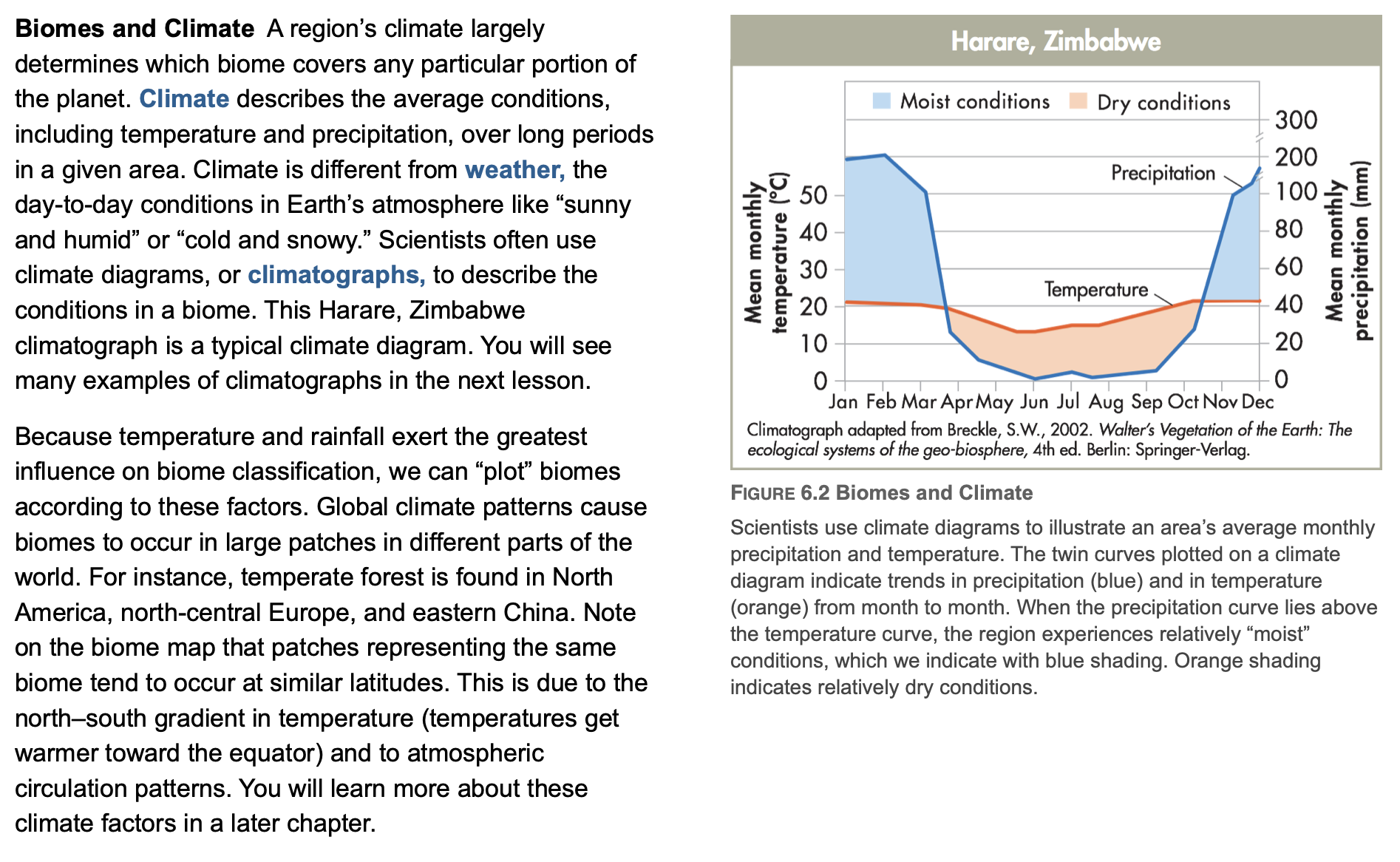Screenshot 2024-10-14 at 2.14.43 PM.png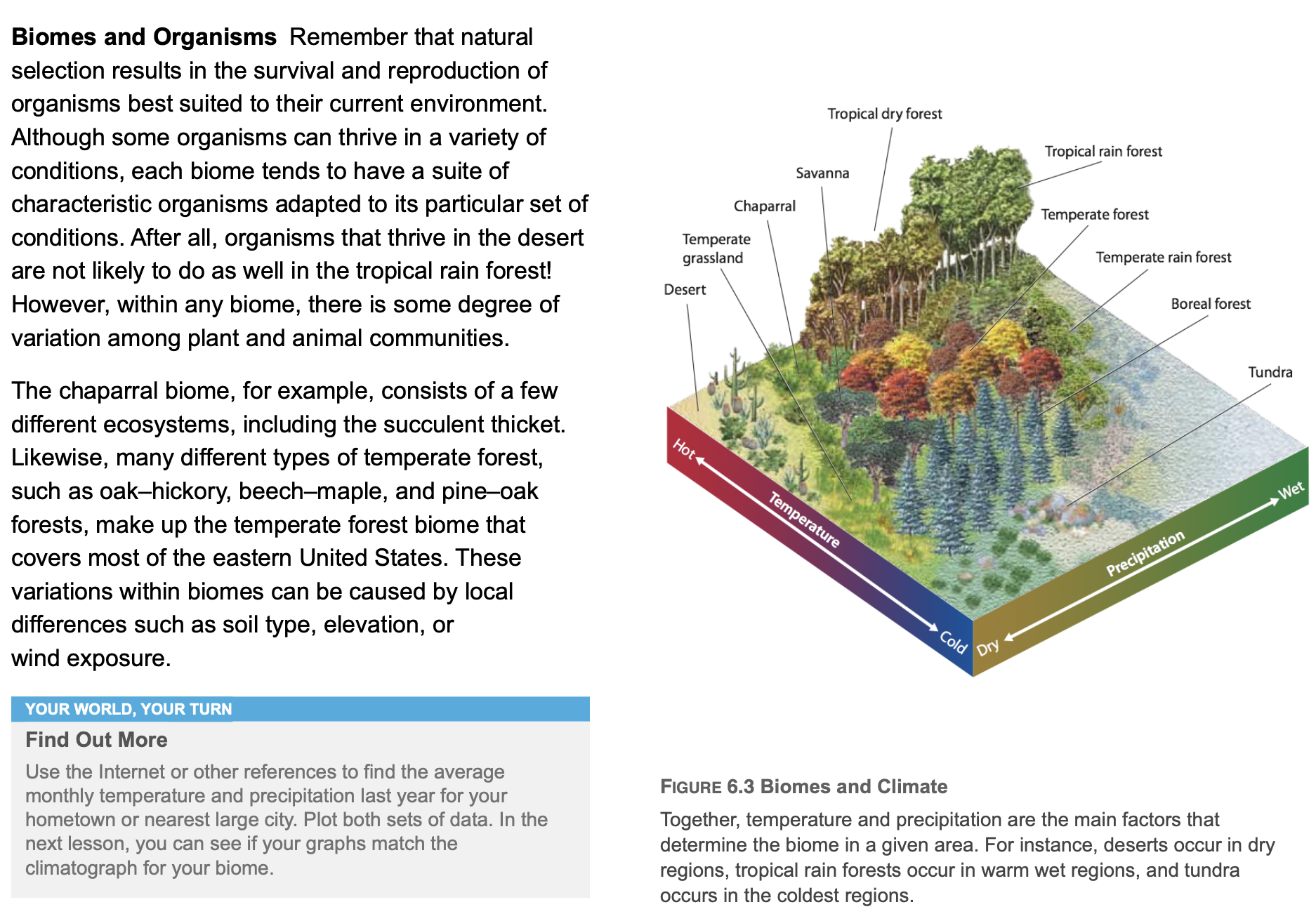Screenshot 2024-10-14 at 2.14.54 PM.pngThere are about 9 Biomes, usually defined by precipitation (rain, fog, others) and temperature.
- The Big Island has 8 of the 9 biomes, or in the 12 biome model, we have 11/12, or 9 of 13, or 10 of 14 in another model.
- Many models...[https://www.hawaiimagazine.com/content/hawaii-has-10-worlds-14-climate-zones-explorers-guide-each-them](https://www.hawaiimagazine.com/content/hawaii-has-10-worlds-14-climate-zones-explorers-guide-each-them)
- Traveling up a mountain is like crossing biomes. Check this out:
- Imagine driving from Hamakua or Hilo up to the summit of Mauna Kea: tropical rain forest to temperate (mild) rain forest to boreal (north) forest to tundra.
- There is even a glacier up on Mauna Kea. Cool.
- This would be like starting in the upper right corner of the diagram and moving diagonally down and to the left.
Now check out the planet again:
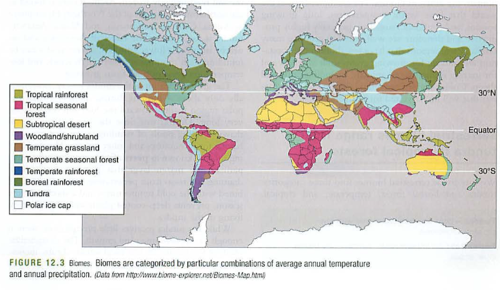703d0.png
Notice the horizontal bands. If you've read "Guns Germs and Steel" you know that humans migrated horizontally, so their crops and livestock would thrive in similar biomes. See? Migrating north to south is tough.How is this changing?[https://climate.nasa.gov/interactives/climate-time-machine](https://climate.nasa.gov/interactives/climate-time-machine)
Biomes provide the physical and climatic framework, while biodiversity fills that framework with living systems. Warmer and wetter biomes usually support greater biodiversity, while harsher biomes restrict it.
Biodiversity is complex (genes, species, ecosystems), ecologists usually talk in relative terms: how species richness compares across biomes. I’ll use the classic global biodiversity gradient (warm + wet = highest; cold + dry = lowest).
## Relative Biodiversity by Biome1 = very low diversity and 10 = very high diversity, based on species richness patterns.
Biome
Relative Biodiversity (1–10)
Rationale
Tundra
1
Harsh climate (cold, dry, short growing season) → very few species.
Boreal Forest (Taiga)
2
Cold, conifer-dominated, acidic soils → moderate productivity but low species richness.
Temperate Grassland
4
Fewer plant species (mostly grasses), but supports large herbivore and predator diversity.
Very low precipitation → low species count, though high specialization.
Temperate Forest
6
Mixed tree communities, moderate climate → higher diversity than grasslands/taiga.
Temperate Seasonal Forest
6–7
Deciduous dominance, rich soils, clear seasons → supports more species than conifer forests.
Tropical Seasonal Forest
8
High productivity, seasonal rainfall → slightly less rich than rainforests but still very diverse.
Tropical Rainforest
10
Highest biodiversity on Earth: stable warm/wet climate, extremely high productivity.
## Key Patterns
1. Latitude Gradient: Biodiversity increases from poles (tundra) → tropics (rainforest).
2. Precipitation Effect: Wetter biomes generally support more plant species → more niches for animals.
3. Seasonality vs. Stability: Seasonal environments (temperate/seasonal forests, savannas) have moderate-high diversity, but not as high as stable, year-round productive environments (rainforests).
4. Extremes Are Low: Very cold (tundra) and very dry (deserts) are biodiversity “deserts.”
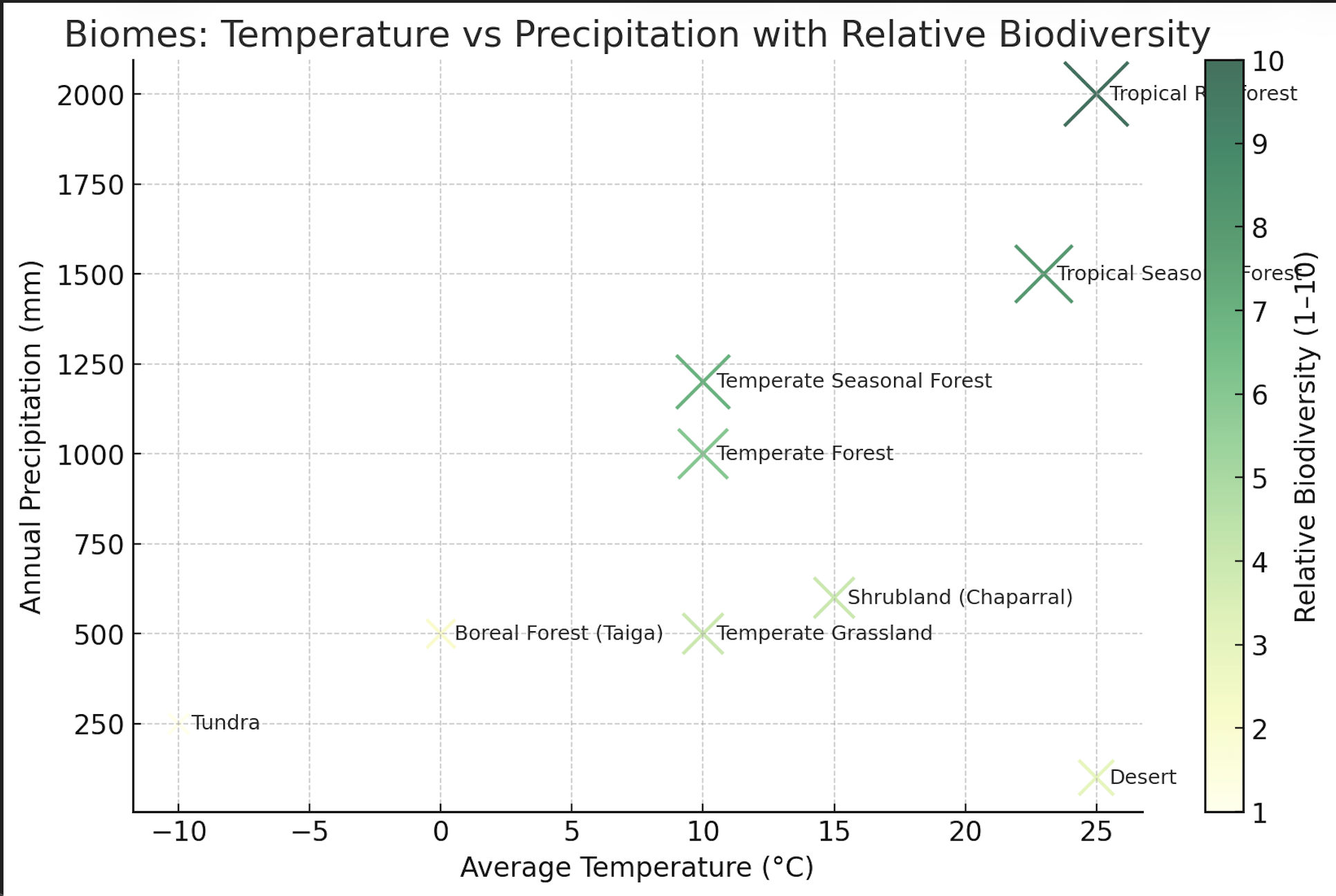Screenshot 2025-09-22 at 8.09.03 AM.png
Decoding Climatograms:
You will need to understand these when you create your green dream home:
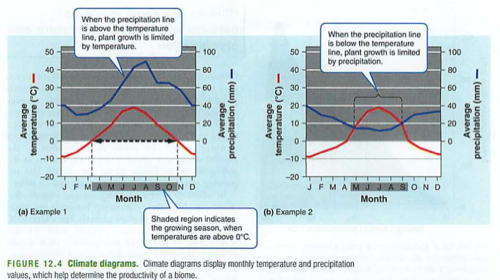fce37.png
- These diagrams are how climatologists describe biomes without a cool map.
- The blue line is the amount of rainfall, with units on the RIGHT side of the graph.
- The red line is the temperature, with units on the LEFT side of the graph.
- The shaded region in the months below (jfmamjjasond) is the growing season when temperatures are above freezing.
- When the precipitation line is above the temperature line, growth is limited by temperature (e.g. freezing).
- When the blue line is below the red line, growth is limited by precipitation (e.g. the desert).
- Start with the north: Tundra is what you'd see in Alaska.
- Permafrost is soon to be in the news.
- It is made of permanently frozen ground a few feet below the surface.
- Even roots cannot penetrate it, so some trees grow in a stunted fashion.
- It is also composed of frozen organic matter, which when it melts will decompose, releasing CO2 and CH4 (methane), which is 20x as powerful as CO2 as a greenhouse gas.
Tundra: (like in Palmer, Alaska, away from the water)
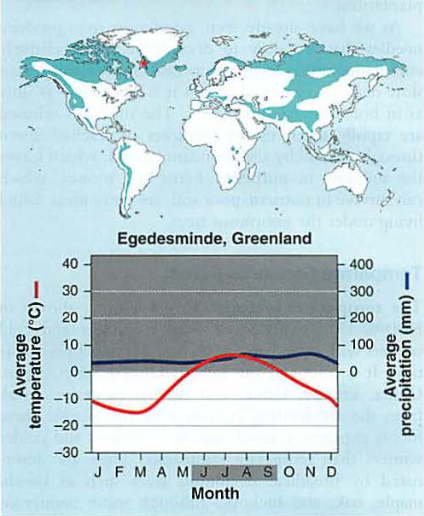2879f.png
Note the cool temp, so growth is determined by temp, not rainfall. Lots of snow here, and little liquid water for plants, so yeah, mainly snow and glaciers.
Boreal (north) forest: (think of the aurora-lights, borealis-northern)
Contrast that with the boreal (north) forest:
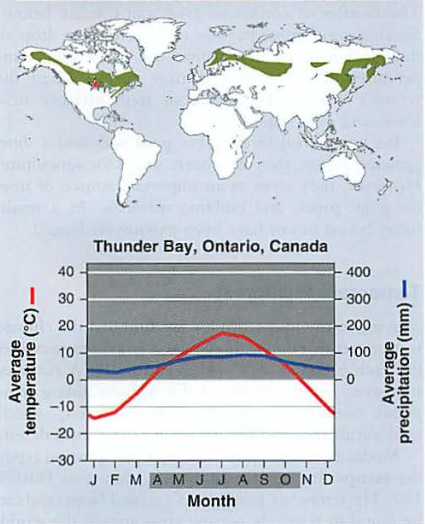ea2c0.png
- Note the short growing season.
- Any plants that survive usually have an oily sap (pine trees, evergreens) that does not freeze.
- Also note the serious cold in the winter-animals have to adapt to these (fur, hibernation, etc.)
Temperate (mild) forests: (maybe Skagway, AK, on the water)
- Temperate (mild) forests are nicer, longer growing season, and rarely freeze.
- They are usually near the ocean, so they do not freeze (ocean is a huge heat sink).
- They often have lots of rain (think of Seattle).
- You may recall these are places where the surface parts of Ferrell and Polar cells converge, bringing in clouds and as these clouds rise into the atmosphere, they release their water as precipitation.
- Temperate (mild) seasonal forest actually has seasons
- Deciduous trees can live here, like maple and oak. It gets close to freezing, but no real dry season.
- Is like much of southern California, or the Mediterranean.
- Wine can grow here. It is also known as the mediterranean (medi=middle, terra=earth) biome.
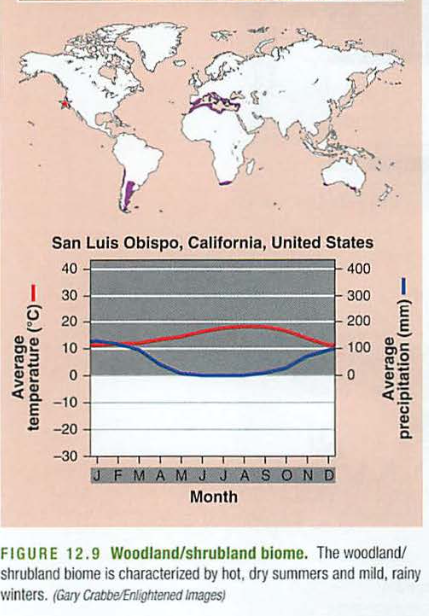99264.pngNote it never really freezes, but growth is determined by precipitation (blue line is below the red line). This is also known as "chaparral" or the "fynbos" or "nice forest" in Afrikaans (South Africa). Look up the main wine regions of the world, they will fit this biome. Also consider how many Italians could start vineyards in northern California...
Temperate grassland/cold desert:
- Is a dry, grassy area, like Oklahoma, although it does get very cold there, so think more of Texas, or the Gobi desert.
- Again, growth is rain limited: (you may recall these are near Hadley/Ferrel cell subsidence, so dry air from space falls here).
- These areas tend to be far from large bodies of water, so they have more extreme temperatures than similar latitudes near water (e.g. Italy, France, California)
- Is the rainiest of them all, and much of our island has this near the shore.
- Warm temperatures, and paradoxically poor soil nutrition (all of the nutrients are in the plants).
- On Mt. Waialeale on Kauai, the rainfall is 480 INCHES per year, 2.5 times as high as the high point on the chart below:
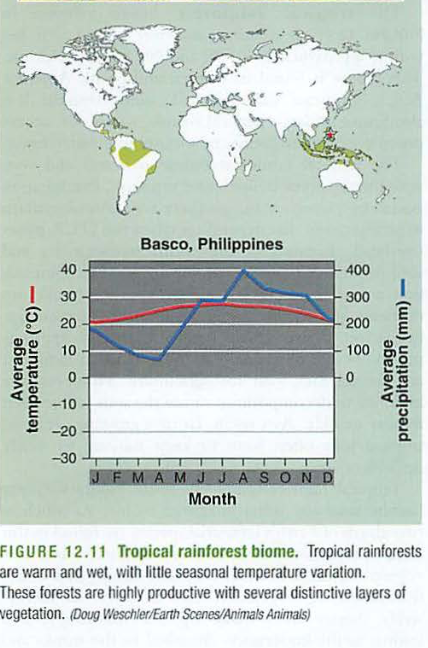4d9c8.pngSavanna or tropical seasonal forest:
- Africa and Brazil hold the next biome: Savanna or tropical seasonal forest.
- Think of Madagascar (the film): not many large trees, room for animals to roam, lots of grass, happy lions, maybe a bossy penguin or two...Growth dependent on rainfall: (blue line below red one)
- Finally, the subtropical desert biome, like what you'd see in the Sahara desert (another film), or most of Australia, the Atacama in Chile, the Mojave desert in California, and some of Mexico.
- Note the Gobi desert is not on this list-too cold. Again, note these areas are where dry air subsides (falls) from the Hadley and Ferrell cells.
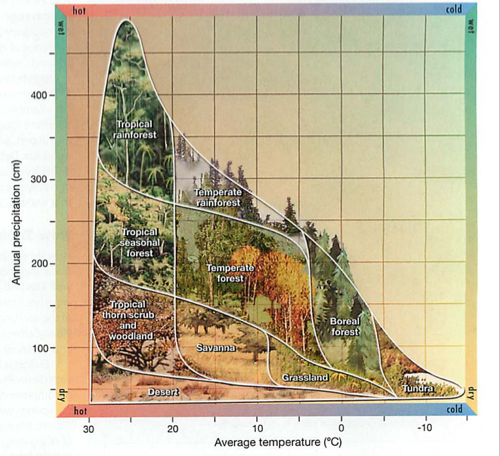cffbb.pngFind these places in the first three climatographs: Philadelphia, PennsylvaniaSan Diego, CaliforniaBelem, Brazil
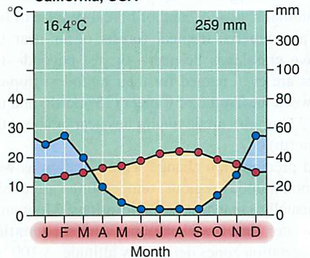de227.png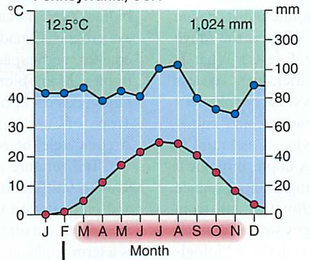9139d.png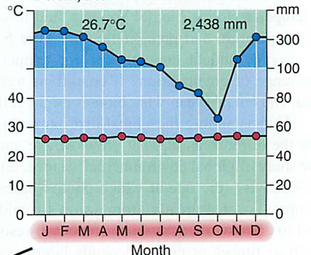86a5a.png[Download Find these biomes below:.pdf.pdf (application/pdf, 980.2 KB)](https://bookstack.kamuela.org/attachments/231)
Google this: [aquatic biome game](https://www.google.com/search?client=safari&rls=en&q=aquatic+biome+game&ie=UTF-8&oe=UTF-8)
---
Migrated from Apple Server Wiki. Original page ID: V5v9M8
# Biodiversity
To edit this page, click the Edit (pencil) button. To delete this page, click the Action (gear) button and choose Delete.
When you edit this page, you can easily rename the page, and use the editing toolbar to:
- Apply paragraph or character styles to text.
- Create bulleted lists, numbered lists, and tables.
- Insert media, such as images, audio, or QuickTime movies.
- Attach files.
- Insert an HTML snippet from another website or email.
For more information about editing pages, click the Action (gear) button and choose Help.
---
Migrated from Apple Server Wiki. Original page ID: C8r4c0z3
# 2022 summary
apes D T Th
apes E MWF
- summarize your cause and effect projects for presentation in day 2 of the week
- begin exploration of cause and effect
- begin readings from fr text chapter 1 (link below)
FR3e chapter 1 (covers things newer version of the text does not)
energy->water->food->culture
1. With energy you can move/purify water
2. With water you can grow food
3. With food you can maintain a culture
What is the "environment"?
- Front of ship fell off-[https://www.youtube.com/watch?v=3m5qxZm\_JqM](https://www.youtube.com/watch?v=3m5qxZm_JqM)
- "we towed it out into the environment"..."you mean into another environment"
Environment: Everything around us, including us
Climate change map-try this out:
[https://impactlab.org/map/#usmeas=absolute&usyear=2080-2099&gmeas=absolute&gyear=1986-2005&usyear=1986-2005&gmeas=absolute&gyear=1986-2005](https://impactlab.org/map/#usmeas=absolute&usyear=2080-2099&gmeas=absolute&gyear=1986-2005&usyear=1986-2005&gmeas=absolute&gyear=1986-2005)
Nebraska->Alberta by 2050
Module 1 -------------
Fracking-know what it is? Why is it controversial? How has it changed how we generate electricity in our country? At what cost? Why is this politically important? Why are the solvents they use secret? What is the impact of these solvents on water?
Bio=life, so biotic means living, abiotic means not living (druids had a neat view on this)
How systems are defined enables us to create models of cause and effect (favorite topic of physicists and historians as well)
Module 2 ---------------
Environmental indicators: what we know and can observe that indicate the condition of a system
- Biodiversity
- Food production
- Global warming
- Human Population
- Resource depletion
1. Biodiversity: biological diversity (more about this later)
- Robust systems (can be biological, racial, technological) all have strong diversity
- Genetic Diversity: genetic variation within a population (corn for example)
- Species: ducks vs. dogs
- Species diversity: variation of species in an ecosystem
- Speciation (more) vs. extinction (less)
- Background speciation rate (cosmic rays)
- Background extinction rate (before humans, much higher in the anthropocene era)
Speciation: an adaptation based on stress (evolution)
Evolution needs three things:
1. some form of genetic variation
2. some stress that favors this variation
3. survivors have to reproduce and carry on the variation
Think of giraffes as an example:
1. longer necks in some animals
2. drought that kills all short neck creatures (just like in land before time)
3. long neck animals survive to reproduce and carry on the variation
Cool stuff:
- There is a theory that the background rate of mutation/speciation was much higher long ago because our atmosphere was thinner, and enabled more cosmic rays to penetrate, causing much higher rates of mutation/speciation.
- In England, butterflies have adapted since 1850 to look more like soot from coal fires.
- In NYC, a species of "subway mosquitoes" have been found that feed on humans in a dark, cool place
- Huh.
Extinction is the opposite of speciation, where species die off (except in the film Jurassic Park)
There is such a thing as a "background rate of extinction", which we have surpassed by many times
Diversity is good: think of monoculture food crops: one pest kills everything
2. Food production: see Malthus and Norman Borlaug, e.g. Mexico famine
- grain variation and monoculture
- regional grain production (e.g. Pearl river delta)
- vegetarian vs. carnivores
3. Global Warming
Man made, from burning fossil fuels (anything that was living, decayed capturing atmospheric carbon)
carbon dioxide was in the air, then captured as plants and animals
we burn their carbon with oxygen to make carbon dioxide
greenhouse gases: trap infrared radiation, warming the planet (cause and effect)
Not too many people know we need some CO2 to keep water above freezing-think of this as we search for exoplanets...
- growth rates
- dispersion
- access to water
- Why was China’s one child policy eventually a problem for China?
- education, reproductive rights and religion
- water is first
- Resource depletion is hard to grasp, but resource constraints are easier:
- If we had a major tsunami here that closed airports (all near the shore) and ports, how long would we have electricity?
- water? (pumped by electricity)
- food?
Sustainability: ability to sustain present conditions forever (not likely)
Ecological footprint: what you calculated
1. Can you follow cause and effect?
2. What is their logical path?
3. Why do folks associate fossil fuels with global heating?
4. Who might be against this line of reasoning and why?
5. Fact: in ancient times, women were thrown into ponds to determine if they were witches. If the water "rejected them" they were possessed by the devil and therefore witches. If not, they just drowned. It is a wonder we made it this far.
6. Another example: cold fusion (look this up) Ponds and Fleishmann claimed they could replicate the processes in the sun (1 million degrees C) in a cooler on a table.
7. Science is built on replication: if a process cannot be replicated, it cannot become part of the scientific "pyramid" of understanding. No bad blocks allowed.
8. Also key is taking notes (must be in pen, not pencil). Alfred Nobel invented dynamite. His brother's last words in his lab notebook, in pen were "I'm now going to compress the dynamite"
9. Why is there no Nobel prize for Mathematics?
Replication is key: if you have magic beans, and nobody can replicate your results, you are in trouble.
See also Korean claims of cloning humans (not sheep, we already did that-her name was Dolly)
Key idea: even wrong experiments are valuable: Edison: "I learned 800 ways not to make a light bulb"
Important terms (yes, these actually show up on the AP exam):
- Variable: any difference, in a planned or "natural" experiment
- Independent variable: the part that does not change (like x in a graph)
- Dependent variable: the part that changes-or not
- Null hypothesis: proving something is NOT cause and effect (can sheep's bladders be used to predict earthquakes)
- Replication: everybody must be able to get the same results, using the same materials
- Sample size (n): must be large enough to be accurate
- Accuracy: close to truth or true value
- Precision: how close your results are to each other (gas pump is in 0.01liters, but your odometer is only in miles)
- Control group: those you DON'T mess with in the experiment (think of some drug test)
Ozone hole example: compare and contrast with anthropogenic climate change-why different?
Renewable vs. non-renewable resources (one politician recently tried to get nuclear energy classified as a renewable resource-it takes billions of years)
Renewable can be a forest, if used at a sustainable rate, otherwise not
Malthus again, Norman Borlaug again, and a new name: Paul Erlich (1968) "The Population Bomb"
In short: famine and conflict will arise from population growth.
In reality, it is much more complex, involving politics (e.g. Syria), economics (e.g. refugees from sub-Saharan Africa) and water rights (e.g. Palestine).
Jurgen Randers told me during the Elab opening that he thought in the next 50 years, China would invade Mongolia to the north, stating as a cause "religious instability" but the real cause would be access to water there.
If the Himalayan snowpack ceases to be a seasonal flow for the rivers of Asia, most of Western China would be in a drought, unable to produce food.
Ecological Footprint again:

Tragedy of the Commons:
Garrett Hardin, UCSB (look this up)
We will duplicate this with a fishing example:
TOTCGoldfishActiv.pdf
- review iPad frog book
- review chapter 1 work
- move on to chapter 2 in FR3e
- begin quiz format
- Can you follow cause and effect?
- What is their logical path?
- Why do folks associate fossil fuels with global heating?
- Who might be against this line of reasoning and why?
- Fact: in ancient times, women were thrown into ponds to determine if they were witches. If the water "rejected them" they were possessed by the devil and therefore witches. If not, they just drowned. It is a wonder we made it this far.
- Another example: [cold fusion](https://en.wikipedia.org/wiki/Cold_fusion) (look this up) Pons and Fleishmann claimed they could replicate the processes in the sun (1 million degrees C) in a cooler on a table. Totally fake
- Science is built on replication: if a process cannot be replicated, it cannot become part of the scientific "pyramid" of understanding. No bad blocks allowed.
- Also key is taking notes (must be in pen, not pencil). Alfred Nobel invented dynamite. His brother's last words in his lab notebook, in pen were "I'm now going to compress the dynamite".
- Why is there no Nobel prize for Mathematics?
- if you have magic beans, and nobody can replicate your results, you are in trouble.
- See also Korean claims of cloning humans (not sheep, we already did that-her name was Dolly)
- Key idea: even wrong experiments are valuable: Edison: "I learned 800 ways not to make a light bulb"
Important terms (yes, these actually show up on the AP exam):
- Variable: any difference, in a planned or "natural" experiment
- Independent variable: the part that does not change (like x in a graph)
- Dependent variable: the part that changes-or not
- Null hypothesis: proving something is NOT cause and effect (can sheep's bladders be used to predict earthquakes)
- Replication: everybody must be able to get the same results, using the same materials
- Sample size (n): must be large enough to be accurate
- Accuracy: close to truth or true value
- Precision: how close your results are to each other (gas pump is in 0.01liters, but your odometer is only in miles)
- Control group: those you DON'T mess with in the experiment (think of some drug test)
Note the format of the iBook: short topics with recall checks at the end of each-great intro into our subjects
- Ozone hole example: compare and contrast with anthropogenic climate change-why different?
- Renewable vs. non-renewable resources (one politician recently tried to get nuclear energy classified as a renewable resource-it takes billions of years)
- Renewable can be a forest, if used at a sustainable rate, otherwise not
- Malthus again, Norman Borlaug again, and a new name: Paul Erlich (1968) "The Population Bomb"
- In short: famine and conflict will arise from population growth.
- In reality, it is much more complex, involving politics (e.g. Syria), economics (e.g. refugees from sub-Saharan Africa) and water rights (e.g. Palestine).
- [JØrgen Randers](https://en.wikipedia.org/wiki/J%C3%B8rgen_Randers) told me during the Elab opening that he thought in the next 50 years, China would invade Mongolia to the north, stating as a cause "religious instability" but the real cause would be access to water there.
- He wrote [Limits to Growth](https://en.wikipedia.org/wiki/The_Limits_to_Growth), along with [Mathis Wackernagel](https://en.wikipedia.org/wiki/Mathis_Wackernagel), who created your 8 countries project for HPA.
- If the Himalayan snowpack ceases to be a seasonal flow for the rivers of Asia, most of Western China would be in a drought, unable to produce food.
Ecological Footprint again:

Main topics:
- elements: protons, neutrons, electrons
- atomic mass, isotopes
- isotopes vs. ions
- bonds: ionic and covalent
- periodic table: columns
- half lives
- pH and pOH
- melting and boiling points
- surface tension: adhesion and cohesion
- organic vs. inorganic substances
- proteins, fats, carbohydrates
Atoms and molecules:
- atom: one nucleus with protons and neutrons, electrons around the nucleus
- element: one type of atom, defined by the number of protons
- protons: positive charge, give the atom identity
- neutrons: neutral charge, gives the atom more mass
- electrons: much smaller (1/1800), negative charge, gives the atom charge
Examples: see [https://ptable.com/?lang=en#Properties](https://ptable.com/?lang=en#Properties)
Helium: He, discovered in the sun (helios), 2 protons, 2 neutrons, 2 electrons
Carbon: C, 6 protons, 6 neutrons, 6 electrons
Atomic mass is the mass of all of the protons and neutrons (electrons are too light to count)
Isotopes:
Wait: why does carbon have atomic mass of 12.011 instead of 12?
There are other types of carbon, called isotopes (same type)
C12/6, C13/6, C14/6
Each of these has the same number of protons (identity) but more neutrons
check: how many protons, neutrons and electrons in C14/6?
Ions and bonds:
so far we've been playing with the nucleus.
If you change the number of electrons from a match with protons (C6/12 has 6 electrons), we can add or take away electrons:
Na+ is Sodium missing an electron
Cl- is Chlorine with an extra electron
Why?
Look again at the periodic table: [https://ptable.com/?lang=en#Properties](https://ptable.com/?lang=en#Properties)
Everyone wants to be on the right hand column, called the noble gases
To get there, Na loses an electron to look like Neon, while Chlorine adds an electron to look like Argon (see for yourself)
These sorts of bonds, where one gives up and one takes is a very strong bond, called ionic (because it involves ions)
NaCl (salt) is one example:
- Ionic bonds have high melting points
- They conduct electricity, especially in water
The weaker type of bond you will see is called covalent.
Think of a pilot and co-pilot: both share the duties
In a covalent bond, neither one is more positive or negative, they share an electron.
Molecular Hydrogen (H2) and Molecular oxygen (O2) are good examples
so are plastics, water and other substances
Covalent bonds:
- Weak bonds
- Don't conduct electricity as well as ionic solutions
- low melting points (water, plastic, butter)
Periodic table classes:
The periodic table (here it is again: [https://ptable.com/?lang=en#Properties](https://ptable.com/?lang=en#Properties)) is key to solving riddles in APES around pollution, toxins, and many other things:
Example:
Strontium 90/38 is a radioactive isotope, a product of nuclear reactions (reactor meltdowns, nuclear weapons)
Look at the periodic table, find Strontium.
What is above it?
Calcium is part of your bones, so when you ingest Sr90/38, it is absorbed into your bones just like Calcium, since elements in the same column are chemically similar.
What sort of cancer would this cause?
Question: Cesium is a radioactive element, where would it go in your body?
Radioactivity:
The good news is these do not hang around forever, they decay into other things, some radioactive, some not.
A half life is the amount of time it takes something radioactive to decay into half of the amount it was before.
So, If you have 128 grams of Strontium 90/38, which has a half life of about 30 years, after 30 years you will have:
64 grams
Then 30 years later it will be all gone, right?
Nope: 32 grams
Then continue: 16, 8,4,2...
It never really goes completely away
Half-life how to:
If 100% of something decays exponentially, this means that after one half life (t 1/2) half of it remains.
We demonstrated this with M&Ms in class, and you saw an exponential decay graph
Why do we want to know how this works?
Easy: nuclear waste, radioactive fallout, caffeine and other drugs all follow exponential decay.
So, to find out how much is left of something, you can count the half-lives and divide each one by two over and over again:
1/2->1/4->1/8->1/16
You may also see this as percentages:
50%->25%->12.5%->6.25%
There is a simple formula for this if you want to use it:
Amount left = Amount starting (1/2)^n
At = Ao (1/2)^n. or At = Ao/2^n
where n is the number of half lives.
Example:
The half life of C14/6 is 5730 years
How much of a 200 gram sample will be left after 22,000 years?
Divide 22,000 by 5730, you get about 4
(1/2)^4 is 1/16, or 6.25% whichever you like using more
200 grams/16 = 12.5 grams left
This also works if you have something in between half lives, like if you repeated this problem for 18,000 years:
18,000/5730 = 3.14
(1/2)^3.14 = 1/8.8 or 0.113
0.113 * 200 = 2.26 grams left
In some rare cases, you will be see this situation in reverse:
The half life for Sr90/38 is about 30 years.
If 25 grams of a 100 gram sample remains, how old is it?
25/100 is about 1/4, 4 = 2^2 so two half lives, or 60 years.
Radiation:
There are 4 main types of radiation from radioactive substances or nuclear reactions (nuclear weapons, meltdowns, etc.)
- Alpha rays are Helium nuclei, +2 charge, very heavy, very slow, and can be stopped by skin or paper
- Beta rays are fast electrons, -1 charge, fast, light, and can be stopped by metal foil
- Gamma rays are light photons, no charge, can be stopped by lead
- Neutrons are fast neutrons, no charge, can be only stopped by lots of concrete or lead (slow ones are called "thermal" neutrons and are useful in nuclear power plants to make steam)
Health examples:
Radon gas (222/86) is very heavy, and emits alpha rays.
No problem if the gas is outside your body, your skin protects you.
If you breathe radon gas, is sits in the bottom of your lungs and alpha rays destroy your white blood cells: leukemia and other lung cancers result
Gamma rays split DNA and cause mutations, some cause cancer.
Neutron radiation dissolves membranes in animals, killing them in nasty ways...
In each of these cases, radiation is harmful, it depends on where you are exposed, for how long, and what protection you use.
Radon is the #2 cause of lung cancer in the US (!!!)
Be aware of this if your dorm room in college (or anywhere) is in the basement, and you are near the Rocky mountains.
Acids and Bases: pH
In aqueous (water) solutions, we often need to know if a solution is acidic or basic
Acids have more Hydrogen ions (H+) floating around
Bases have more hydroxide (OH-) ions floating around
Water is amphoteric (both) since it is really H-OH
Water has pH (potency of Hydrogen) of 7, in between 0 (acid) and 14 (totally base, dude)
First look at most solutions is a good guess:
NaOH base
HCl acid
See?
You try: KOH, HNO3, H2SO4, H3PO4
Which were acids and bases?
Clue: anything with an H alone is usually an acid, anything with an OH is usually a base
Exceptions: alcohols (see below) have an OH, but are not basic, they are organic compounds
Calculating pH:
This is usually easy: a sample problem might ask what is the H+ concentration of something with a pH of 1 ee -4?
Simply take the minus sign off the exponent and you have your answer: pH = 4
Another version of this would be:
How much stronger is an acid with pH 4 than pH 6?
This is a bit trickier: since each power of ten is one pH number, 10^2 is 100, so the answer is 100.
Try this: How much more acidic is water than NaOH solution with pH 12?
Since water is pH 7, 12-7 = 5, so 10^5 is 10,000x stronger.
Weird to think of water as an acid, but there it is.
You may also see something like "what is the pOH of something with a pH of 4?"
The answer is: pOH is just 14-pH, to the answer is 10.
There is a scary looking formula for pH:
pH = -log10[H+]
not so scary: all it says is take the log to the base 10 (usually the same as the power) and throw away the minus sign
Like in radioactive decay, you may see something that is not in the form 1 ee-4, in other words, the 1 may not be a 1.
In that case, you just use the scary formula...
Solubility of gases:
Air holding water:
We know that air can hold water vapor, this is invisible, unless it condenses (like steam or clouds)
As gases get cooler, they can hold less water, that's when it rains or condenses.
You know this: cool drinks form beads of water on the outside, since the drinks are cooler than the air.
It also means that warmer air can hold more water
Remember this: gases hold more water when warmer
This also explains why you may get a shock in cooler climates walking across a carpet: dry air is a better insulator, so can build up an electrical charge better.
It also explains why it rains on the windward side of mountains: as the moist air rises, it gets cooler, and cooler air can hold less water.
It also explains why air coming in from the ocean is more humid: it has been warmed by the ocean.
Water holding gases is the opposite:
One smart character decided to boil the water for the aquarium before dropping the fish. Even though the water was at the right temperature, by boiling the water, all of the dissolved oxygen was gone-what do you think happened to the fish?
Gases dissolve better in cooler water. Fishing folks know this, and go where the water is cooler, since fish breathe better there.
It also explains why the British are so nuts about when they boil water for tea: if you boil it too long it has no oxygen in it, and it tastes "flat".
You also know this that soda drinks lose their fizziness if you warm them up.
This is very important when we study dead zones and fish kills...
It also explains why you don't ever need to get ice in your carbonated drinks: to get the carbon dioxide to dissolve into the drinks they MUST cool the drinks down to inject the CO2.
Surface tension: adhesion and cohesion
Water is very cool stuff: it likes to stick to other stuff (adhesion) as well as to other water (cohesion)
This makes for interesting phenomena when the sides of a container are very close, like in roots or thin hair:
As the water molecules climb up the sides of the roots (adhesion) they stretch out the molecules in the middle (cohesion).
This is called surface tension
This make the curve stretch and then shorten, so water moves up the column (roots, long hair).
This is called capillary action, and is very important for all plants.
Surface tension is also how water striders "sit" on the water: their feet stretch the water molecules.
Soaps destroy the cohesion, making water "wetter", also making little bugs fall into the water...
All plants rely on capillary action to bring water to their leaves, so it is not a good idea to drop soap on the roots of plants.
Think of roots: many thin fibers next to each other-perfect for capillary action.
Melting and boiling points:
Water is everywhere, and we study it a lot
The melting and freezing point for water is 0°C at one atmosphere (very interesting stuff happens at other pressures, like ice hockey)
The boiling and condensation point for water at one atmosphere is 100°C (again, interesting things happen at other pressures like pressure cookers and freeze dried ice cream)
It turns out that anything added to water raises the melting and boiling points.
You may have heard to add salt when cooking pasta: this raises the boiling point a bit so the pasta cooks a bit faster.
It also explains why they add salt to ice to make ice cream, or pour salt on road to melt ice...
You can demonstrate changing pressure on melting by slowly chewing on an ice cube: pressure makes ice melt (ice hockey skates)
This also means that water boils at a lower temperature if there is less pressure, like on a mountain, or even here in Waimea, since we are at 800 meters elevation (about 3000')
Pressure melting of ice is how ice skaters move, if you look at their skates end-on, you will see an upside down U shape that traps the melted water from their weight pressing on the ice.
Heavier ice hockey players can use a thicker skate...
It also means that if the ice is too cold, this does not happen (ask Mr. McKenna about this where he skated in Canada)
Osmosis:
You may have heard of this in your chem or bio class.
Osmosis in simple form means that water always chases salt or other "solute"
When a solute like salt dissolves in a solution like water, it becomes salty.
If a membrane like skin or cell walls separate this salty solution from fresher water, the water will travel through the membrane to get to the salty solution.
Good use of this: if you have an injury with swelling, doctors may say "soak it in warm, salty water".
This draws the fluid from the injury, enabling healing.
Bad use of this: if you pee on plants, the Nitrogen in urine helps plants grow, but the salt in urine pulls water from the roots, killing the plant.
This also happens in areas where well water is used to irrigate crops: the minerals (salts) in the water accumulate in the soil, killing the roots of the plant.
EVEN MORE SCARY: As ocean levels rise, salty ocean water is penetrating into the water table in many fertile areas like the Mississippi delta, Florida and the Pearl river delta in Asia, killing crops. The Pearl river delta is where most of the rice for all of Asia is grown...
Organic and inorganic compounds:
Anything with a carbon backbone (like you) is an organic chemical compound
Anything without carbon is called inorganic, like salts, metals and minerals
These could be anything from the foods you eat (more on this later) to the gasoline you might put into your car.
Organic compounds can be water soluble, or not.
Hydrocarbons like gasoline and oil have only C-H bonds, so are insoluble in water (like greasy hands, or olive oil in salad dressing)
Alcohols are organic compounds with an OH molecule attached, so they can dissolve oils while also dissolving in water.
Some important alcohols:
- methanol CH3OH (toxic)
- ethanol C2H5OH (makes you drunk)
- propanol (C3H7OH) known as rubbing alcohol
Soaps are an interesting combination of organic (C-H, hydrophobic) and inorganic (ionic, hydrophilic) ends, so they can mix with oils then be carried away by water.
Proteins, fats and carbohydrates:
All three of these can act as fuel in your body, as your body is really clever that way.
Oddly, though, even your awesome body cannot repair tissues or grow new ones without proteins
Why?
Proteins are the only food source with Nitrogen, which is key to amino acids (amines means Nitrogen)
Proteins can be used as fuel for your body by "de-amination" meaning taking off the nitrogen
Fats and carbohydrates have similar chemical formula, but vastly different structures.
Fats all have an alcohol backbone, with little strands coming off made of C-H bonds (like a hydrocarbon)
This is why most fats do not mix with water...
Carbohydrates are C-H-O bonds (anything that ends in -ate means with oxygen)
Carbs can be long strings, like starches, or compact little hexagons or pentagons like sugars
Fun fact: sugar alcohols look like sugar to your body, but don't behave like sugars-used in drinks and candies...
Module 5 Energy flows, feedback
- energy terms: cal, kcal, Joule, kWh, BTU
- power terms: Watt, J/s, hp
- EM spectrum
- KE= 1/2mv^2 or 3/2kT
- PE = bonds or mgh
- ICE vs. hybrid vs. electric cars
- thermo 1: conservation
- thermo 2: efficiency
- thermo 3: entropy
- open and closed systems
- equilibrium, stability and steady states
- positive feedback loops
- negative feedback loops
Energy terms:
Energy is the ability to do work
You may have seen this in other science courses as force x distance, PE=mgh, or other descriptions
We use the following units for energy:
- calories: the energy used to heat 1 gram of water 1 degree C
- kcal: one thousand calories
- Cal: a single food calorie, equal to 1000 chemical calories
- Joule: the work needed to move something 1 meter against a 1 Newton force (note caps for dead people)
- 1 cal = 4.18 Joules (good to know)
- kWh = one kiloWatt of power used for 1 hour (heating tea for an hour, costs about $0.45 here)
- BTU: British thermal unit, most often seen in heating, ventilation and cooling (HVAC) systems
Power:
- Energy is the ability to do work, or to measure work that is done.
- Power is how FAST that work was done, measured in Watts (note caps again, another dead person)
- You could walk up a flight of stairs, doing some amount of work:
- 50 kg person, 10 m stairs, g = 10, equals 5000 Joules
- If you do this in 100 seconds, you have done this with 50 Watts of power
- If you did it in 10 seconds, you would be creating 500 Watts of power (that's a lot)
- 1 horsepower (hp) is 747 Watts
- Fun fact: some elite cyclists can create over 1000 Watts for many minutes-true animals
- Another fun fact: the electric company does not care how fast you use energy (kiloWatts), they only care how many hours you used this power (kWh)
Electromagnetic spectrum:
Spectrum means a spread of values, so a musical spectrum might mean the lowest and highest notes you could sing or hear.
The electromagnetic (EM) spectrum describes EM radiation, that includes in order of increasing energy:
- radio waves: (radios use these)
- heat (IR or infrared): snakes can see these
- visible light: you can see these
- UV (ultraviolet) light: bees can see these, they also burn your skin
- X-rays: film can see these, they go through your skin, but less so through your bones
- gamma rays: go through most stuff (remember?), mutate DNA
- and cosmic rays: mysterious stuff, comes from supernova explosions...
The visible spectrum includes the following colors, in order of energy:
- red
- orange
- yellow
- green
- blue
- indigo
- violet
You can now see why infrared is below red, and ultraviolet is above violet
Plant pigments have evolved to resonate with certain colors, like chlorophyll likes green light, others like reds and so on.
Fun fact: autumn leaves are red because the green is gone (winter, darker). The red was there all along.
Kinetic energy:
- When you ask a physicist (I am one, so I know) about Kinetic energy, they will drone on about moving objects, their mass and velocity...
- KE = 1/2mv^2
- This is incredibly fascinating you will agree (?) and it explains why car crashes at 80 mph are 4x more damaging than ones at 40 mph...
- In chemistry, we use KE to describe the energy of moving molecules: KE = 3/2kT, where T is the absolute temperature (Kelvin)
- This means that if you double the Kelvin temperature, you double the KE of a molecule.
- This changes for different molecule shapes (3 comes from x, y, z motion), which you may find interesting if you study physical chemistry (ask Dr. J)
- For our purposes, we need to know that increasing temperature increases the speed of molecules:
- 3/2kT = 1/2mv^2
- So, those physics guys were not crazy.
- This has huge implications on climate change, phase changes, rain, condensation, and many other things.
Potential energy:
- If you ask a physicist (what, again?) about potential energy, they will blather on about mass, gravity and height.
- While scintillating, this is useless in most chemical equations, which tend to happen at the same height.
- It does, however impact some weather phenomena, so let's let them have this one.
- If you ask a chemist about PE, they will often refer to chemical bonds, which represent energy stored.
- If you ask a nutritionist about PE, they will talk about Caloric content.
- If you ask a coach about PE, they will tell you about the untapped potential of an athlete...
- In APES, we mainly care about stored energy, usually in a phase change (latent heat of vaporization) or chemical bonds like in food.
ICE, hybrid and electric cars:
- ICE stands for internal combustion engine (e.g. normal cars, lots of heat, hot brakes etc.)
- hybrid cars capture the KE of motion and store it in batteries to accelerate the car, saving energy
- electric cars do this as well, but have no thermal engine parts like ICE or hybrid cars, so they are much more efficient
Thermodynamics: one two and three
Thermodynamics is the study of heat (thermo) in motion (dynamics)
There are three big laws of thermodynamics:
1. you cannot create or destroy energy (you can't do this with mass either, more on this later)
2. in any reaction, there is an energy "tax" you could think of as friction
3. all reactions go naturally towards disorder
Short Las Vegas version:
1. you can't win
2. you can't break even
3. you can't get out of the game
You can imagine a magical car that you put 1000J of energy in the tank and 2000J of work is done by the engine.
No
Way.
The most efficient Formula one racing car engine is about 45% efficient.
Where does the rest go?
Heat.
Your body is at most 33% efficient in turning M&Ms into work. The rest?
Heat.
One way of looking at disorder is entropy, a measure of disorder.
You can imagine a pool table, hitting the triangle of balls and then spreading across the table.
It is more likely to go in this direction (more disorder) than to have the balls spontaneously jump out of the pockets and form a perfect triangle.
Not to get depressing, but there is a formula that goes like this:
∆S for the universe is >0
so sad...
Open and closed systems:
This means different things to different folks, but you could imagine a system where mass and energy are contained in the system as closed.
You might also look at a system where certain nutrients are recycled as closed.
You could look at recycling paper as a closed system to a degree.
Most of our product cycles are open: we throw stuff away instead of recycling.
Much more on this later...
Equilibrium, stability and steady states:
Equilibrium means literally "equal freedom" , in this case equal freedom to move from one condition to another.
Imagine two fish tanks with a pipe connecting them.
Fish are free to move from one to the other.
Not the same fish, but about the same fish on each side.
This is equilibrium.
Stable systems are ones where equilibrium exists, and can recover from stresses (resilience)
Steady state systems are ones where the inputs equal the outputs, and are usually stable as well.
Unstable systems have nasty feedback loops (see below)
Positive feedback loops:
In a positive feedback loop, any change causes a greater change as a result
Boat example: if a large cruise ship tilts over, the mass of the people on the ship make the ship want to tilt more.
Climate change example: as the planet warms, ice sheets melt, changing from reflective ice to darker ocean water that absorbs more heat, melting more ice.
Permafrost example: as the planet warms, the permafrost melts, releasing methane gas, which is a greenhouse gas, causing more warming, and more methane...
Positive feedback loops exist in your body as well: massive blood loss and childbirth are two examples.
Negative feedback loops:
Where positive feedback tends towards instability, negative feedback loops restore stability, and naturally recover to initial conditions.
As you exercise, your body sweats, cooling the body.
This is a negative feedback loop.
Some coast guard rescue boats are created with negative feedback as well: the more they tip over, the more they want to come back to normal.
Psychologists often use these terms to describe personalities and relationships...
Modules 9-11: Heat Energy: air and water
(fun with globes)
Modules 9-11 FR 3e (also module 22 in FR 4e)
Heat
Heat energy always moves from hot to cold (high energy to lower energy)
Heat energy moves in three "modes":
- conduction: from the latin word for "contact", objects touching
- convection: matter in motion, like hot air or steam rising
- radiation: infrared radiation below visible light on the spectrum
Conduction:
Materials can be excellent conductors of heat like silver, aluminum, copper and gold
Fun fact: Materials that are good conductors of heat are also good conductors of electricity
Insulators are materials that do not conduct well: styrofoam, pink panther insulation, cloth, rubber
Think of this: to pick up something very hot, what would you hold it with?
Convection:
Hotter fluids are less dense than cooler ones, causing upward migration of hot material
Fun fact: everything in zero gravity needs a fan to cool (why?)
Convection can be blocked by covering hot objects, like the cover on your coffee or pot on the stove
You may have seen strange mirage like waves over something hot: this is convection of less dense air bending light
Radiation:
This is basically light, so can be reflected by foil, or any reflective material
Radiation is most effective at higher temperatures, one reason you can't see warm objects but can see red hot objects
This is also how snakes and other reptiles (or the alien in predator) see the tracks of their prey
This is one reason hot drinks are usually delivered in white cups: white reflects radiation better than black, which absorbs and re-radiates the energy (one part of the greenhouse effect)
Note that these are not the key ways your body cools during exercise: that is called "latent" (hidden) heat of vaporization
- When sweat evaporates, it takes with it lots of energy to do so, cooling you very efficiently
- Consider why some triathletes who come for the Kona Ironman (or others) have trouble here with the high humidity
- Higher humidity means less efficient evaporation.
- It also explains why 110°F in Phoenix might be tolerable if the humidity is very low
[Lab: Heat transfer:](http://10.14.4.85:6875/books/ap-environmental-science/page/heat-transfer-lab)
[](http://10.14.4.85:6875/books/ap-environmental-science/page/heat-transfer-lab)[http://10.14.4.85:6875/books/ap-environmental-science/page/heat-transfer-lab](http://10.14.4.85:6875/books/ap-environmental-science/page/heat-transfer-lab)
Module 9: Heating of the earth
Radiation from the sun hits the surface of the earth, which re-radiates this energy as longer wavelength infrared radiation.
(There is some heating of the atmosphere in both directions)
The atmosphere is divided into layers based on temperature, gases and density:
- Troposphere: at the surface, where all the action is
- ozone layer-blocks UV light
- Stratosphere: where planes fly: cooler
- Mesosphere: "middle" layer
- Thermosphere: "hot" layer, fast (3/2kT) molecules (from radiation), low pressure
- Exosphere: very low density, lots of radiation
(see layer diagram)
n.b. thermosphere is also known as the ionosphere (reflects radio waves), blocks nasty radiation from space, absorbs the energy from this radiation, gets hot
Now think of the three heat transfer modes:
Radiation: energy from the sun hitting the surface
Conduction: hot ground heats the air in contact with it
Convection: hot air rises, creating weather
Weather?
As air rises, it creates local low pressure areas, bringing in clouds and moisture (wind)
As this air rises, it cools, dropping moisture as rain or snow
This dry air circulates at high altitude until it transfers its heat to space (radiation and conduction) then descends as cooler, dry air
(see adiabatic cooling diagram)
The amount of heat the surface absorbs is based on reflectivity (recall radiation above)
Albedo is a measure of this reflectivity (think of Albus Dumbledore: white beard)
- Average albedo for the earth is about 30%
- Snow and ice are about 90%
- Water is about 35%
- Soil is about 15%
- Asphalt is about 5%
- Clouds vary in density from 10-90%
(see albedo diagram)
Fun fact: as global warming melts ice (high albedo) it turns into water (lower albedo), warming the planet more (positive feedback).
The place on the planet with the most average solar radiation is the equator, so air rises there (convection)
This creates the first of three cells: the Hadley cell
- As air moves towards the equator, it brings moisture (ITCZ)
- As this moist air rises, it cools and rain results
- The resulting dry air moves north and south away from the equator in the stratosphere
- This dry air descends creating deserts
Fun fact: on windy trade wind days your flight to the mainland is faster-why?
(see Hadley cell diagram)
Primitive meteorologists (weather folks) detected three of these cells:
- Hadley
- Ferrell
- Polar
To draw these, remember that when cells touch, air moves in the same direction: up-up or down-down
Biome impact:
Seasons:
The earth is tilted on its axis about 23.5° (get over it, it changes every 20,000 years)
Because of this, each hemisphere gets more or less solar radiation at certain times of the year.
We divide this (almost)circular motion into 4 points:
- Summer solstice: June 21 (summer for N hemisphere)
- Autumnal equinox ("equal night"): September 21 (today!)
- Winter solstice: December 21 (winter for N hemisphere)
- Vernal or spring equinox: March 21 (pagan festivals, etc.)
Australians have Christmas in their summer. Santa arrives by surfboard (true fact)
Fun fact: Pagans feared each winter that the days would just keep getting shorter and total darkness would result, so when they calculated winter festivals, they waited a week after the darkest day (December 21) to make sure the sun would come back.
This is why Christmas is December 25, not 21.
(see season diagram)
In Hawaii, we are below 23.5° latitude (find this on your globe), so for several months in our summer, the sun is actually NORTH of straight overhead. This is called "Lahaina noon".
Coriolis effect:
If you look at your globe from above (like some eskimo god), you will notice the radius at the equator is greater than at higher latitudes.
Actually, the tangential velocity (physics term) at the equator is about 1600 km/hr (1000 mph), while it is zero at the north pole.
As large storms stretch out with one end more south than the rest, it falls behind, creating the coriolis effect.
Demo: imagine dripping water (you, the eskimo god again) on the globe while it spins, which way would the water drip?
Oceans: wind and water
Surfers in California usually wear wetsuits.
Why?
Water along the California coast travels south from Alaska.
Remember this: oceans in the northern hemisphere travel clockwise
(opposite in the southern hemisphere)
Tough question: why are our trade winds from the NE not the North (Hadley cell)?
Verify on windy.com:
[https://www.windy.com/?20.002,-155.533,5](https://www.windy.com/?20.002,-155.533,5)
There is one very interesting deep ocean current called the "thermohaline" circulation:
thermo=heat, haline=salty
Also known as the NADW or North Atlantic Deep Water:
Melting ice sheets in Greenland create dense, cool water that flows south along the ocean floor, and emerges in two places on the planet: India and KONA!
Ocean circulation: Up and down
The Andes run north and south from Peru to Chile as a result of tectonic plates going under South America from the west (more on this soon).
As a result, there is a deep trench off the coast of Peru and Chile
Looked at sideways from the south, as water rises from this deep trench it brings with it decomposed ocean creatures (detritus) that surface fish love to eat: happy fisherpeople
For this to happen, an offshore wind has to be strong.
This condition is called La Niña, and is an indicator of weather all over the planet
El Niño is when this wind becomes onshore, stopping the migration of fish food (sad fisherpeople)
(see sideways diagrams of La Niña and El Niño)
Better picture:
- Note that in the La Niña year, the "cell" is larger, stronger, and pulls more surface water away from Peru-Chile (happy fisherpeople)
- Look at the thermal image below, notice the cooler (deep) water coming off the coast of Chile in a La Niña year
- Note that in the El Niño year, the "cell" is smaller, weaker, and the offshore current is weaker (sad fisherpeople)
- Look at the thermal image for El Niño year: warmer (surface) water off the coast of Chile
- You might be interested in why there is a trench off the coast of Chile-it is the same reason the Andes mountains are in Chile...
Pay close attention to cause and effect:
- onshore moist air from the Pacific ocean hits the mountains near Seattle=rainy there
- onshore moist air from the lower Atlantic ocean hits the amazon basin=rainy there
- dry air moving down from the Mediterranean moves over the Sahara Desert=dry there
There are about 9 Biomes, usually defined by precipitation (rain, fog, others) and temperature.
Our Big Island has 8 of the 9 biomes, or in the 12 biome model, we have 11/12, or 9 of 13, or 10 of 14 in another model. Many models...
Traveling up a mountain is like crossing biomes. Check this out:

Imagine driving from Hamakua or Hilo up to the summit of Mauna Kea:
Tropical rain forest to temperate (mild) rain forest to boreal (north) forest to tundra.
There is even a glacier up on Mauna Kea. Cool.
This would be like starting in the upper right corner of the diagram and moving diagonally down and to the left.
Now check out the planet again:
- Notice the horizontal bands. If you've read "Guns Germs and Steel" you know that humans migrated horizontally, so their crops and livestock would thrive in similar biomes. See?
- Migrating north to south is tough.
- How is this changing?[https://climate.nasa.gov/interactives/climate-time-machine](https://climate.nasa.gov/interactives/climate-time-machine)
Now look at this:
These diagrams are how climatologists describe biomes without a cool map.
- The blue line is the amount of rainfall, with units on the RIGHT side of the graph.
- The red line is the temperature, with units on the LEFT side of the graph.
- The shaded region in the months below (jfmamjjasond) is the growing season when temperatures are above freezing. When the precipitation line is above the temperature line, growth is limited by temperature (e.g. freezing).
- When the blue line is below the red line, growth is limited by precipitation (e.g. the desert).
Deductive process:
1. Which hemisphere? North or South? (when is summer, when is winter?)
2. How far from the equator? Hot or cold? (does it ever freeze?)
3. How much rainfall? Wet or dry? (Hadley, Ferrel, Polar cells?)
4. How long is the growing season? Short or long? When?
Exceptions:
- Altitude: Waimea is a Mediterranean biome, but is cooler, as we are 800m above sea level
- Water: San Francisco Bay area should be much cooler, but is surrounded by water-rarely snows there
- Topography: strong consistent onshore breezes can impact rainfall (e.g. Seattle)
Start with the north:
Tundra is what you'd see in Alaska.
- Permafrost is soon to be in the news (why?)
- It is made of permanently frozen ground a few feet below the surface. Even roots cannot penetrate it, so some trees grow in a stunted fashion.
- It is also composed of frozen organic matter, which when it melts will decompose, releasing CO2 and CH4 (methane), which is 20x as powerful as CO2 as a greenhouse gas.

Note the cool temp, so growth is determined by temp, not rainfall. Lots of snow here, and little liquid water for plants, so yeah, mainly snow and glaciers.
Contrast that with the boreal (north) forest:

Note the short growing season.
- Any plants that survive usually have an oily sap (pine trees, evergreens) that does not freeze.
- Also note the serious cold in the winter-animals have to adapt to these (fur, hibernation, etc.)
Temperate (mild) forests are nicer, longer growing season, and rarely freeze.
- They are usually near the ocean, so they do not freeze (ocean is a huge heat sink).
- The often have lots of rain (think of Seattle).
- You may recall these are places where the surface parts of Ferrell and Polar cells converge, bringing in clouds and as these clouds rise into the atmosphere, they release their water as precipitation.

Temperate (mild) seasonal forest actually has seasons:

- Deciduous trees can live here, like maple and oak.
- It gets close to freezing, but no real dry season.
Woodland/shrubland is like much of southern California, or the Mediterranean.
Wine can grow here. It is also known as the mediterranean (medi=middle, terra=earth) biome.

- Note it never really freezes, but growth is determined by precipitation (blue line is below the red line).
- This is also known as "chaparral" or the "fynbos" or "nice forest" in Afrikaans (South Africa).
- There is also a notable University there...
- Look up the main wine regions of the world, they will fit this biome. Also consider how many Italians could start vineyards in northern California...
Temperate grassland/cold desert is a dry, grassy area, like Oklahoma, although it does get very cold there, so think more of Texas, or the Gobi desert. Again, growth is rain limited: (you may recall these are near Hadley/Ferrel cell subsidence, so dry air from space falls here). These areas tend to be far from large bodies of water, so they have more extreme temperatures than similar latitudes near water (e.g. Italy, France, California)

Tropical rainforest is the rainiest of them all, and much of our island has this near the shore.
- Warm temperatures, and paradoxically poor soil nutrition (all of the nutrients are in the plants).
- On Mt. Waialeale on Kauai, the rainfall is 480 INCHES per year, 2.5 times as high as the high point on the chart below:

Africa and Brazil hold the next biome: Savanna or tropical seasonal forest.
- Think of Madagascar (the film): not many large trees, room for animals to roam, lots of grass, happy lions, maybe a bossy penguin or two...Growth dependent on rainfall: (blue line below red one)

Finally, the subtropical desert biome, like what you'd see in the Sahara desert (another film), or most of Australia, the Atacama in Chile, the Mojave desert in California, and some of Mexico.
- Note the Gobi desert is not on this list-too cold. Again, note these areas are where dry air subsides (falls) from the Hadley and Ferrell cells.

## LAB: Gambling with biomes
Gambling with biomes
1. Below is a list of locations around the world. Roll the dice and using your vast knowledge of biomes and the high tech globes on your desk, determine the biome and type of life you might find there.
2. In the next round reverse the process with the biome list below, determining the locations around the globe.
Locations:
1. Chile
2. Zambia
3. Philippines
4. Oklahoma
5. San Luis Obispo
6. Germany
7. Seattle
8. Greenland
9. Ontario Canada
10. Tunisia
11. North Pole
12. Kamuela
Biomes:
1. tundra
2. boreal forest
3. temperate rain forest
4. temperate seasonal forest
5. woodlands
6. temperate grassland
7. tropical rain forest
8. savannah
9. desert
10. cold desert
11. taiga
12. tropical seasonal forest
### Aquatic Biomes: Module 3 (fr4e)
Recall terrestrial biomes are defined by temperature and precipitation (usually rain)
Aquatic biomes are by definition underwater, so they are defined by
- Depth: how deep is the deepest part, how much photosynthesis is possible (deeper is darker)
- Distance from shore: shallow water has more life, more things to attach to, more biodiversity
We separate aquatic biomes into freshwater (lakes, rivers, streams) and saltwater (oceans, estuaries)
Freshwater biomes:
Riparian=river
Limnotic=lakes
Lakes:
- Shallow shore area=littoral (means shallow), see the "littoral Navy", photosynthesis here (shallow, light shines through)
- Open water area=limnetic zone, no rooted plants (too deep), phytoplankton here, only as deep as sunlight can penetrate
- Deep water=profundal ("profound") or deep zone: no light penetrates, bacterial decomposition.Bottom=benthic zone: mud, dark, cloudy
Productivity: note usually related to photosynthesis (plants)
- Oligo (few) trophic=low productivity (think of an oligarchy, same root)
- Meso (middle) trophic=medium (think of mesoamerica, or central America, or mesopotamia: between 2 rivers)
- Eutrophic (eu=good trephien=food)=lots of productivity (sometimes too much, like in "Poisoned Waters")
Wetlands:
- Freshwater wetlands-submerged most of the time (swamps, marshes, bogs) this is the history of all coal and oil we now use
- Salt marsh: usually connected to the sea, act as a coastal buffer for Hurricanes, very productive, many nutrients, lots of organic material
- Mangrove swamp: special version of this in Tropical areas (e.g. Florida)
- Intertidal zone: area between high and low tide or seasonal variations
Ocean zones:
- Coral reefs-see coral bleaching, pH, temperature and salinity sensitive (see Hamakua coast vs. Puako)
- Intertidal zone: between high and low tide
- Photic (light) zone-shallow, photosynthesis, kelp, others
- Aphotic (dark) zone-too dark for photosynthesis
- Chemosythesis/thermosynthesis: deepwater steam vents, based on Sulfur instead of Oxygen, bacteria generate energy with methane (CH4) and H2S (instead of H20)
- Benthic=deep ocean
- Pelagic=open ocean (think of big sailing ships, whales, stuff like that)
- Hadal zones: like Hades: deepest, darkest zones. Weird fish, no light...
NPP: Net Primary Productivity= total amount of biomass after respiration and reproduction
(rate which primary producers convert energy to biomass)
tropical rain forest-canopy (layers)--------
poor soil nutrient levels (most nutrients are in the trees)

- shallow roots, big leaves, lots of rain
- pitcher plants-eat animals
- epiphytes-grow on other plants (e.g. orchids)
- air roots
- specialized animals
tropical dry forest——
- deciduous forest: warm, but variable rain (e.g. monsoon)
- autumn leaves-loss to protect plant, changes in photosynthesis
- waxy leaves (e.g. pine needles) if over winter plants
- estivation: hibernation
- migration: birds (why birds and not other animals?)
savanna——
- very dry, few trees, seasonal grasses, fires
- porous soils (like Kona), often coffee locations (s. america)
- waxy leaves, deep roots
desert——
- under 25 cm (250 mm) of water per year (10 inches)
- dry dry dry, so dramatic temp variations (opposite of ocean biomes)
- few plants, low nutrient levels in soil
- nocturnal animals (e.g. rats, snakes)
- succulents: store water (e.g. cacti)
- large, shallow roots, also taproots (160 ft. deep)
temperate rain forest——
- not too warm, not too cold, just right
- rainy, warm, mossy, foresty (e.g. washington, oregon, BC)
- coniferous-have pine cones, conifers: oily needles (don’t freeze)
- lumber
temperate forest——
- eastern US: oak etc. seasonal loss of leaves
- hibernating animals
temperate (mild) grassland——
- prairie, steppe (russia)
- moderate rain, but not enough for trees. grass only.
- grass grows from below, so can be eaten by cattle and still live
- roots capture moisture, hold soil together (kikuyu grass)
chaparral——
- California, mediterranean (middle of the earth, contrast with chinese translation of the word “china”: middle earth kingdom)
- dry, seasonal rain, drought (like now)
Boreal (north) forest———
- taiga
- acidic soils (from conifers/pine needles as competition)
- very cold
- conifer shape sheds snow, preserves branches (christmas trees)
- when ground freezes, no water for roots, all water stored as sap in trees (oily compound, very sticky, makes retsina in Greece)
tundra——
- russia, alaska, canada
- very cold-study the climatograph (-220 °C!) right….
- permafrost-permanently frozen ground, so only shallow roots
polar ice—
- not really a biome, but stuff lives there (aquatic mammals, fish, very small rocks, churches, mud, but no ducks)
- Notothenioids-antifreeze fish
- blubbery mammals-can concentrate fat soluble toxins like PCBs
mountains—
- another non-biome, but look at this!

how cool is that?
aquatic ecosystems—
- salinity, depth, standing or flowing water
- salt water = 30-50 ppt (parts per thousand)
- concentration terms: ppt, ppm, ppb
- fresh water = 0.5 ppt
- in between 0.5-30 ppt = brackish (anchialine ponds in Kona)
- study the fishies in the pictures
- Depth is everything...determines amount of light, tf. photosynthesis
Zones:
photic zone=light
aphotic=no light
benthic=really no light, never, ever ever. don’t even think about it.
Marine animals:
- aquatic mammals must surface for air
- fishies don’t-gills
- DO dissolved oxygen (very important) depends on plants (so depth) and temp (cooler water can hold more O2)
- warm water has low O2 generally.
- best place to fish: cool water after a waterfall (why?)
Rivers, ponds and lakes, oh my...
- flowing water: rivers
- standing water: ponds
- lakes can become inland seas
- littoral=shore, limentic=away from shore benthic=botttom
Wetlands:
- marshes, swamps, bogs and fens
- marshes marshes marshes!-tall grasses
- swamps-some trees
- bogs-acidic, poor decomposition, floating stuff
- fens-spring underneath, less acidic, better nutrients
- bogs decay slowly-ancient cheese story, peat moss
River stuff:
- rivers-oxbow lake and meander
- source, tributary (continuity concept), mouth (delta)
- slope exponential as distance from source
- deposition rates (rapids vs. plains)
- silt carrying capacity, turbidity
- estuaries-like deltas
- tidal estuary: hudson river: deeper than the body it serves
Oceans——
- 200 ft. of salt if all oceans evaporated
- oceans were red (iron) then ppt out (iron range in WI, MI) (see PBS Nova episode)
- salinity, wind and temperature determine flow
- upwelling (recall Peruvian fisherpersons)
- also downwelling
Photic (light) zones-again
- intertidal zone-makes sense, between tides
- neritic zone-close to shore, less than 200 ft. deep (not in Hawaii, we have no continental shelf-boo hoo)
- open ocean (pelagic) zone
- kelp forests-e.g. california coast
- coral reefs-away from fresh water, coastal, photic
- open ocean-scary stuff
Module 19: Plate Tectonics
Big Bang:
- First, there was the big bang (see the cute video here: [https://www.youtube.com/watch?v=xzAOhyOtfqc](https://www.youtube.com/watch?v=xzAOhyOtfqc))
- The only thing at first was Hydrogen, which is just a proton and an electron, sometimes a neutron making isotopes of Hydrogen
- Stars formed from this hydrogen, and through fusion created all of the elements up until Iron (Fe)
- Look this up on your periodic table------[https://ptable.com/#Properties](https://ptable.com/#Properties)
- Eventually, these stars expanded and then collapsed...Smaller stars became neutron stars or various versions of these
- Huge ones (15x our sun size) exploded and created all of the elements after Fe (check the periodic table again)so,
- Any element in you below Fe on the table came from an exploding star cool...
Exoplanets:
- NASA and other folks are really interested in two things now: exoplanets (planets outside our solar system) and asteroids [https://www.cnn.com/2020/10/23/world/asteroid-bennu-sample-update-scn-trnd/index.html](https://www.cnn.com/2020/10/23/world/asteroid-bennu-sample-update-scn-trnd/index.html)
- Why?
- Well, if we know what asteroids are made of, we have a clue about what materials (e.g. water) that were around when the solar system formed.
- This is why capturing materials from Bennu last week was such a big deal...
- From this info, we can look for those elements in other solar systems, and look for life there.
Our Solar System
This is how our solar system formed:
**Unavailable Apple Wiki media:** the exported data did not include file be8b155a-563f-46b1-bb97-73574c356816.
- Our earth was molten for a long time, then cooled to become solid-mostly.
- Since it is also made up of Uranium and other things that combine to create heat, our planet is still really hot deep down.
- A minister named Ussher ([https://en.wikipedia.org/wiki/Ussher\_chronology](https://en.wikipedia.org/wiki/Ussher_chronology)) worked backwards from the molten state to solid state of the earth to guess that the earth was created one Sunday afternoon in 4004 BC.
- We was not stupid, he just did not know about Uranium, and our molten core...
- Here's what we know the earth to look like (check this out on your globes too):
- Layers: (onion boy)
**Unavailable Apple Wiki media:** the exported data did not include file 1c89d87e-c4e8-4322-bead-7d13762d82cf.
The Core:
- The core is actually two bits: solid inner iron and nickel, liquid outside that bit.
- It spins, giving us a weak magnetic field which switches direction every few thousand years.
- Remember this, it comes up later...
- How do we know this?
- Nuclear bomb testing and our global seismic sensor network.
- How?
- Two key clues about the earth came from military conflict: one from WWII and another from the cold war, when everyone was building bigger and bigger bombs.
First the cold war part:
We set up seismic sensors called seismographs all over the world to spy on Russian and Chinese nuclear ("A-Bomb", fission) and thermonuclear ("H-Bomb", Fusion) bomb testing to see how powerful they were.
You next need to know that there are two main types of earthquake wave:
P or "primary" waves which are compression waves. and S waves "secondary waves" that are transverse, like shaking a slinky.
P waves are faster, and go through solids or liquids, but at slightly different velocities.
S waves are slower, and can only travel through solids. So, here's what they saw:
**Unavailable Apple Wiki media:** the exported data did not include file 666870e7-1313-481c-a9a2-761bd89351c1.
This data was found by spying on atomic bomb tests in the 1950s, not because we wanted to know about the guts of our planet...
Now, to the WWII part...
- Submarines like to hide underwater, so planes and ships can't find them.
- So, during WWII, our side tried dragging little magnetic sensing torpedo thingys from behind their ships, hoping to detect submarines. (they later used airplanes too).Here's what they found:
**Unavailable Apple Wiki media:** the exported data did not include file b0b90a74-ddf4-42ac-9ac7-ada8bcf26018.
What the heck is this?
This might help:
**Unavailable Apple Wiki media:** the exported data did not include file 549517b6-51d8-4765-8851-67f45ef1aa6b.
Ok, let's break this down:
- Between England and the US, they found stripes of North then South weak magnetic fields.
- When they got to the middle of the Atlantic (about where Iceland is on the map above), the pattern reversed.
- Huh?
- That's what they said too...
- Remember the shifting magnetic field every few thousand years?
- As the magma came out of the earth in the molten state, it solidified in the magnetic field of that time, so the newest lava was along the center of the ocean (under Iceland too).
- Ok, now shift quickly to a meteorologist named Alfred Wegener. (look this guy up)
- ("Meteorologist" is a fancy name for a person who studies the weather)
- He cut out the continents on a map (like, with scissors) and noticed that South America and Africa fit nicely together.
- Try this on your globe----Everyone in the geology community told him he was nuts.
- Fossils from different places lined up:
Then, these strange magnetic stripe thingys showed up from the ships dragging those [magnetic torpedoes](https://en.wikipedia.org/wiki/Magnetic_anomaly_detector)....and it proved he was RIGHT
He later froze to death in Greenland, but I digress...
- Ok, now remember convection, conduction and radiation?
- Remember how hot is was in the earth core?
- That heat rises to the surface as magma (say like Dr. Evil), just like the Hadley, Ferrel and Polar cells do
- Remember the earth's magnetic field changing?
**Unavailable Apple Wiki media:** the exported data did not include file bf45ccdb-951e-4064-8ae9-2b35f843bc4e.
A bigger image: Note the right side, that would be the Andes
So, connecting all of these dots, the plates are floating on the magma, some created at the mid-Atlantic ridge, others diving down under others in subduction zones....what about those subduction zones?
What about those mountains in Chile?
First, on your globes, trace out the red (subduction) zones and the blue (spreading) zones
This is the key to the two types of volcanoes:
- Andesitic (pointy)
- Basaltic (runny, look out your window)
Andesite-from pressure and heat as plates subduct (sticky, high silica content, e.g. Andes mountains)
Basalt-from ocean crust, lots of water, makes for weak, runny magma, formed as magma pushes through watery ocean plates
Subduction zones:
**Unavailable Apple Wiki media:** the exported data did not include file bfb94f01-8a72-456b-ad35-e9fc905691a0.
**Unavailable Apple Wiki media:** the exported data did not include file 1da88c38-74cb-4fe3-a57d-371c714d30ed.
- Note the sticky stuff boiling up in red-this is why the Andesitic volcanoes are sticky, and always found near subduction zones (Andes, Cascades, Japan, Italy, etc.)
- Note also the trench where the subduction zone goes down: this is the origin of the Chilean/Peruvian trench we covered in the El Nino notes, as well as the deepest part of the ocean: the Marianas Trench, which is 7 MILES deep.
- Look at the red triangles (volcanoes)
- Which ones are andesitic and which are basaltic?
- (clue: hotspots)
Let's review the geological players:
- Magma-(Dr. Evil voice here: [https://www.youtube.com/watch?v=yVo1S52xdpI](https://www.youtube.com/watch?v=yVo1S52xdpI))
- Asthenosphere-"sticky rock" (from [Greek](https://en.wikipedia.org/wiki/Greek_language "Greek language") ἀσθενής asthenḗs 'weak' + "sphere")
- Lithosphere-floating rock (litho = stone) ([Ancient Greek](https://en.wikipedia.org/wiki/Ancient_Greek "Ancient Greek"): λίθος \[lithos\] for "rocky", and σφαίρα \[sphaira\] for "sphere")
- Continents-even more floaty, made of lighter rock (granite) that formed from the interaction of magma with oceans
Plates and continents:
- Plates are large, float on the Asthenosphere (less dense, so they float)
- Continents are like rafts on the Asthenosphere, more buoyant than the plates
- The plates can slide under each other (subduction zones), crash into each other (Himalayas), next to each other (transform faults), and are formed at spreading zones (divergent boundaries)
Neato. What about those earthquakes?
Check this out:
**Unavailable Apple Wiki media:** the exported data did not include file e8c58914-2121-4f19-ba81-955430770540.
Historic data shows subduction zone quakes that would create a tsunami 1000' high or more on the Pacific northwest coast, flooding everything west of I-5.
Here's how we know what is going on to form the Andes:
**Unavailable Apple Wiki media:** the exported data did not include file f7c38b5a-d1f9-4250-80a8-56417aa83f4e.
Look at all of the earthquakes (red dots) as the plate subducts
Two things to take-away about subduction zones:
1. subduction zones create ANDESITIC (pointy) volcanoes, which are high in silica, and sticky like thick pancake batter.
2. subduction zones create lots of deep-focus earthquakes.
We are lucky enough to live on an island with several active or dormant volcanoes.
We live on top of a "hot-spot":
Hot spots:
- Usually in the middle of an oceanic plate, but can also be mid-continent (e.g. Yellowstone supervolcano caldera)
- Hot spots are basalt-low silica content which melts easier (e.g. look out the window)
- Look at the Hawaii island chain on google earth (underwater version)
- While you are at it, look for the Nuuanu landslide that created a 4000' tsunami (!) 1.5 my ago
- You can also look at the Mauna Loa simulated tsunami on youtube...
**Unavailable Apple Wiki media:** the exported data did not include file 95e94b40-6c0c-4f63-87a3-9d4dbaeb0fe7.
Note the tracking of the pacific plate:
**Unavailable Apple Wiki media:** the exported data did not include file 688a3e61-a58c-4454-9a38-12c76d2ac938.
This is what happens to a shield volcano when it "calves" one side, in this case, the northeast side, in the [Nuuanu](https://en.wikipedia.org/wiki/Nu%CA%BBuanu_Slide)landslide, one of the largest landslides on earth, causing a tsunami that deposited coral on the top of Mt. Kaala, 4055 ft. high...
**Unavailable Apple Wiki media:** the exported data did not include file 61e90ee7-63d5-4828-8683-63ea47121b3e.
**Unavailable Apple Wiki media:** the exported data did not include file 6b6a2e30-99be-4d1c-8b63-6cd726f63a1c.
Look at the debris field North-East of Oahu...
More about earthquakes:Three types of fault boundaries:
**Unavailable Apple Wiki media:** the exported data did not include file 4790fd99-e642-4902-aafb-d789eacc9b9d.
Examples:
- The San Andreas Fault in California is a strike slip fault
- The fault that caused the 2008 quake in Puako was a normal fault (actually a "waterbed fault")
then there's the famous "not-my" fault...
These map to three types of plate boundaries:
Earthquakes:
Earthquakes occur where there is movement between plates or sections along fault lines.
- The epicenter is the place ON THE SURFACE above the hypocenter (true origin) or earthquake FOCUS.
- Deeper hypocentric quakes often feel "longer", while shallow hypocentric quakes feel "sharp".
- Since one wave (P wave) travels faster than the S wave, the farther away you are from the hypocenter, the greater the delay between the two:
**Unavailable Apple Wiki media:** the exported data did not include file 69b157ed-e87d-424b-92d4-f72add189738.
How do we detect these?
Seismographs:
- P waves travel by compression (comPression).
- These are longitudinal waves, like sound.
- They can travel through liquid or solid.
- S waves travel by shear (Shear).
- These are transverse waves, like a slinky.
- They can only travel through solids.
- Remember this?
**Unavailable Apple Wiki media:** the exported data did not include file f680b3bc-03df-4635-adc5-ae07a901fd64.
Ok, back to earthquakes.Suppose you have a house on posts (called "post and pier" construction).
An earthquake happens some distance away.
First, your house moves back and forth (P wave, much faster at 8 km/sec).
After a time, your house bounces up and down from the S waves (slower at 3 km/second).
If you are far away, these are separated by different arrival times.If you are near the epicenter, they hit at the same time...up, over, down=your house is demolished
We use this difference to calculate distance from the epicenter (and hypocenter if you are interested) using delay times on the seismograph
- Look at the HPA Pacific Tsunami Warning Center (PTWC) seismograph here:[http://www.fdsn.org/networks/detail/PT/](http://www.fdsn.org/networks/detail/PT/)
- Our Elab quake network here: [https://shakenet.raspberryshake.org/](https://shakenet.raspberryshake.org/)
- Hawaii quakes here:[https://volcanoes.usgs.gov/observatories/hvo/hvo\_earthquakes.html](https://volcanoes.usgs.gov/observatories/hvo/hvo_earthquakes.html)
Click on some earthquakes and note the depth and the seismic image.
Key points:
- All elements up to Iron on the periodic table came from the big bang
- Earth was formed from materials created by first generation stars going supernova
- The core of the earth is made up of a rotating solid core surrounded by a liquid core
- The inner core creates our magnetic field, which reverses periodically
- Layers: crust-mantle-outer core-inner core
- Uranium in the core produces heat that travels to the surface by convection
- Tectonic plates on the surface move on top of the sticky asthenosphere because of this convection
- Spreading zones are were these plates are created, subduction zones are where they dive under others
- Subduction zones create trenches in the ocean and andesitic volcanoes (sticky lava, pointy cones)
- Hot spots in the crust can create basaltic volcanic islands like the one we are on (runny lava, broad cones)
- Earthquakes include P (primary, compression) waves and S (secondary, shear) waves
- P waves are faster and go through solids and liquids, S waves only travel through solids
## Module 20: soils
- Igneous (fire)
- Sedimentary (layers)
- Metamorphic (Kafka rocks, just kidding: changed by heat and pressure)
**Unavailable Apple Wiki media:** the exported data did not include file 41b6f30b-0dde-4a45-809e-f213bd087874.
Igneous= directly from magma, and can be either basalt (low melting point, like our island or oceanic plates) or granite (lighter, what continents are made of)
Granite breaks down into light-colored sand, makes for fertile soil.
Basalt (like us) can make sand too, but less fertile (e.g. black sand beach).
Sedimentary= just like it sounds, from mud, sand, or dust, usually in layers.
Metamorphic= changed by heat and/or pressure (slate, marble, or coal)
Soil-formed by weathering (chemical or physical) of parent rock
Erosion can be by water or air (wind)
Soil Horizons:
**Unavailable Apple Wiki media:** the exported data did not include file 979f5eda-4cd6-4df1-be74-587d67c6ba5b.
**Unavailable Apple Wiki media:** the exported data did not include file 30621d69-b784-418a-910e-eeb8faff7e33.
Our Soil Sieve has 4 filters, with 5 layers:
- mesh 5 = 4 mm
- mesh 10 = 2 mm
- mesh 60 = .25 mm
- mesh 230 = 0.063 mm
Basically, most of what you find is silt and clay...
1. la niña-trench (cutway)
2. why a trench and mountains there?
3. plate-subduction (cutaway)
4. why does it move?
5. convection-heat (flow)
6. where does the heat come from?
7. core-uranium (core)
8. where does uranium come from?
9. big bang-star-supernova-Fe+-uranium (periodic table)
10. so the core is radioactive? yes
11. how do we know?
12. earthquakes-nuclear testing (P and S waves)
13. how do we know the plates move?
14. submarine detectors WWII (magnetic ridges)
15. Plates are formed at ridges, subduction zones (mark on globe)
16. what are hotspots then? weak spots in the plates (Hawaii)
17. have they always moved? (yes, not always straight-Hawaii)
18. yes-wegener-fossils (fossils)
19. what was the supercontinent called? pangea (map)
20. continents float on crust, crust moves (cutaway)
21. plates go under continents, form Andesitic volcanoes (red cutaway)
22. hotspots are pure magma from the core, Basaltic volcanoes (cutaway)
23. where are these? (mark on globe)
24. how does this impact wine? (biomes+volcanoes)
25. why do we care? (agriculture=soils+water+temp)
26. plates moving: fault lines
27. two types: slip and transform
28. slip causes massive land based earthquakes (san andreas, SF 1906)
29. transform causes tsunamis (Bali quake, puako)
30. earthquakes: P and S waves (P S earth again)
31. epicenter vs. hypocenter (diagram)
32. how calculated? (exercise)
33. fracking and quakes (lubrication)
34. prediction (radon emissions)
35. tsunamis-transform faults or submarine landslides (diagram)
36. 600 mph, rise only when close to shore CV-64
37. tsunami=harbor+wave
38. Mauna Loa, Nuuanu slide
La Niña:
**Unavailable Apple Wiki media:** the exported data did not include file c042bef5-1395-4a3a-b3aa-5ea1977be21f.
Why a trench and mountains there?
**Unavailable Apple Wiki media:** the exported data did not include file 31e826d4-f632-4ce4-8bff-59187a69ccf1.
What is a subduction zone?
**Unavailable Apple Wiki media:** the exported data did not include file dd573bd2-8260-4ac9-852d-0b50995fa296.
How does it move? Convection
**Unavailable Apple Wiki media:** the exported data did not include file 475959bb-1254-4c32-87d8-407295b398ad.
Where does the heat come from?
**Unavailable Apple Wiki media:** the exported data did not include file f9463eba-39f1-4a0d-990d-9a3d5b2d32ca.
Why is it still hot? (Ussher 4000 years)
**Unavailable Apple Wiki media:** the exported data did not include file 308536f0-35ab-421f-9019-453115c3cdcf.
Where does the Uranium come from?
**Unavailable Apple Wiki media:** the exported data did not include file f24727b2-3572-44c7-954b-82221403da58.
Which ones are formed in first generation stars?
**Unavailable Apple Wiki media:** the exported data did not include file da8892a2-9d4d-4247-8377-14b56b699ccf.
Anything after that on the periodic table comes from a supernova:
**Unavailable Apple Wiki media:** the exported data did not include file bc839d4c-2b66-4de2-8a34-f1dd35cbae07.
So the core is radioactive? Yes.
How do we know what the core looks like?
Nuclear bomb testing:
**Unavailable Apple Wiki media:** the exported data did not include file 784925c2-0acc-4cab-b74c-9e07129b0be7.
Two types of earthquake waves: P (primary, compression) and S (secondary, shear):
**Unavailable Apple Wiki media:** the exported data did not include file ae122dab-2212-4a2a-9a27-c6ebd938e992.
How do we know the plates move?
**Unavailable Apple Wiki media:** the exported data did not include file 96fa851b-0d00-4866-b146-c89dd008918c.
What are hotspots then?
**Unavailable Apple Wiki media:** the exported data did not include file 46d1974b-2508-40e8-9851-67ec1271fe4b.
Here's the whole picture:
**Unavailable Apple Wiki media:** the exported data did not include file 38c98629-3d97-43cf-862d-93e9efe10fad.
Have they always moved in the same direction? No:
**Unavailable Apple Wiki media:** the exported data did not include file a52976f4-d729-4b04-a4a5-cd5e5a4297ac.
How did Wegener's idea get proven? Fossils ([https://www.youtube.com/watch?v=jVMLaR4GC-w](https://www.youtube.com/watch?v=jVMLaR4GC-w))
**Unavailable Apple Wiki media:** the exported data did not include file b50324c4-e9a3-4eb0-8326-438966fe9fb2.
Super continent was called Pangea
Andesitic volcanoes form where plates go under continents:
**Unavailable Apple Wiki media:** the exported data did not include file d2a138b0-e364-4a67-ac2c-b5477e6aa6f0.
Where are these on the planet?
**Unavailable Apple Wiki media:** the exported data did not include file 1596a6fa-ae4b-4ec4-b666-aa125564894d.
Draw these on your globe...
Andesitic volcanoes have sticky magma, and can explode when they get stopped up (Vesuvius, Mt. St. Helens, Krakatoa) Also called strato volcanoes because they are so tall.
**Unavailable Apple Wiki media:** the exported data did not include file fbdf9043-70b4-4684-a32a-5f6072b40be0.
Basaltic Volcanoes have runny magma:
**Unavailable Apple Wiki media:** the exported data did not include file b15cdfa2-bec2-4a13-a0b7-5416bbc20b6a.
How does this impact wine?
Agriculture = soils + water + temp (temperate biomes anyone?)
As plates move past each other, they create fault lines (cracks)
Three types: slip faults and transform faults (normal or thrusting)
**Unavailable Apple Wiki media:** the exported data did not include file 56d358e5-45ad-41e3-9f3c-259a9bf87f81.
Transform faults caused the San Andreas quake
**Unavailable Apple Wiki media:** the exported data did not include file 2b3f7dc6-e157-4813-8361-eb11c1abd135.
**Unavailable Apple Wiki media:** the exported data did not include file e8acad8a-75be-4616-83e3-0ff3a16cd657.
Transform faults caused the Bali quake and tsunami:
**Unavailable Apple Wiki media:** the exported data did not include file 98889bdd-01e0-44e7-a029-37cd87996365.
Back to earthquakes:
P and S waves:
**Unavailable Apple Wiki media:** the exported data did not include file eeb76c65-bccf-4c43-a01d-090db05b2094.
P waves are faster than S waves:
**Unavailable Apple Wiki media:** the exported data did not include file ca82e1e9-ec84-410c-aa8d-63326990d1a7.
We can use the difference to calculate epicenter (surface location) and hypocenter (actual center):
**Unavailable Apple Wiki media:** the exported data did not include file d5b8ceb6-8f8b-4966-ab67-82037088e413.
**Unavailable Apple Wiki media:** the exported data did not include file fa3ad1b6-aa92-43f1-a440-3ca85be1588c.
AP exam question:
- How much stronger is a magnitude 7 quake than a magnitude 6?
- 7 to 5?
- 7 to 4?
Nuuanu slide:
**Unavailable Apple Wiki media:** the exported data did not include file 6e74d04b-97da-4be8-87ae-157351f17d76.
From our work on biomes, and next our work on plate tectonics, map the following on your globes:
1. look up where wine is grown on our planet
2. agriculture is based on what plants need and like: sunlight, temperature, water and soil
3. wine grows best in soils that are volcanic in origin (Andesitic)
4. wine also needs temperate zones and enough water
5. explore where these things intersect
6. challenge question: If you wanted to grow grapes for wine, knowing that climate change will move all biomes away from the equator, where would you buy land today?
## Soils
Soils provide minerals, hold moisture, allow air to pass, create a space for living creatures and bacteria, and physically hold plants to the ground. Without soil, agriculture as a whole would fail (there are small exceptions, like hydroponics)
We'll cover two aspects of soil: physical and chemical
## physical aspects:
All soil comes from three parent materials (rocks):
- Igneous rocks (fire)
- Sedimentary rocks (layers)
- Metamorphic rocks (Kafka rocks, just kidding: changed by heat and pressure)
**Unavailable Apple Wiki media:** the exported data did not include file 41b6f30b-0dde-4a45-809e-f213bd087874.
Igneous Rocks:
- Comes directly from magma, and can be either basalt (low melting point, like our island or oceanic plates) or granite (lighter, what continents are made of)
- Granite breaks down into light-colored sand, makes for fertile soil.
- Basalt (like Hawaii) can make sand too, but less fertile (e.g. black sand beach).
- Fun fact: you can melt any rock on our island (not coral)
Sedimentary Rocks:
- just like it sounds, from mud, sand, or dust, usually in layers.
- you may have seen these in rock formations or cliffs
- often formed from layers of decaying stuff (plankton, diatoms)
Metamorphic Rocks
- changed by heat and/or pressure (slate, marble, or coal)
- Soil-formed by weathering (chemical or physical) of parent rock
- Erosion can be by water or air (wind)
Soil Horizons:
**Unavailable Apple Wiki media:** the exported data did not include file 979f5eda-4cd6-4df1-be74-587d67c6ba5b.
**Unavailable Apple Wiki media:** the exported data did not include file 30621d69-b784-418a-910e-eeb8faff7e33.
How to read this:
1. always read clockwise
2. make sure to read each type (3)
Our Soil Sieve has 4 filters, with 5 layers:
- mesh 5 = 4 mm
- mesh 10 = 2 mm
- mesh 60 = .25 mm
- mesh 230 = 0.063 mm
Basically, most of what you find is silt and clay...
Soil, water and air
- These physical aspects impact the ability for soil to hold water and allow air between the spaces
- Smaller particles hold water better (capillary action, remember?) but don't allow air to pass
- Larger particles drain faster, enabling air passage, but have lower nutrient values (because they are washed so much) and hold water less
- Organic particles (decaying plant matter) hold water like a sponge, making a perfect combination
- We measure these as:
> > 1. Water holding capacity: the amount of water held in the soil
> > 2. Permeability: the ability for water to transit through the soil
## Chemical aspects:
Cation exchange:
- Clay soils have a negative charge, so they attract positive ions (cations)
- These cations can be released for use by the plants as nutrients
- We measure this as CEC or cation exchange capacity
- too much clay (>20%) makes the soil waterlogged (no air) so the roots die
pH:
- neutral pH is 7.0
- Ca, Mg, Na and K are all soil bases, as they can counteract Al and H+
- soil acids stop growth, soil bases promote health
- the amount of bases in a soil is called Base Saturation and can be measured with pH
- High base saturation and high CEC will be productive
N, P, K: Critical elements for plant growth
Nitrogen:
- critical for plant growth
- can be added by fertilizers (NH4NO3, ammonium nitrate)
- petrochemical fertilizers use natural gas (CH4) with N2 from the air to form these
Phosphorus:
- fruits and roots
- needed for root crops to develop
- limiting nutrient, in excess can cause eutrophication in water bodies
Potassium (K):
- critical in plant immunity from disease and pests
- not a limiting nutrient per se, but critical to health of the plant
Fertilizers will have notation such as 10-20-15, meaning:
10% N
20% P
15% K
Organic fertilizers provide these and other trace elements (Ca, Mg, Na) slowly, as done in nature
Petrochemical fertilizers, usually derived from natural gas are much stronger, and impact the plants much quicker
Nitrogen and Phosphorus are growth limiting nutrients, very important when we discuss watersheds.
Some terms and concepts we need to understand first:
Dissolved Oxygen:
- gases can hold more water (liquids into gases) when hottoer
- liquids can hold more gas (gases into liquids) when cooler
- DO means dissolved oxygen, the measure of the oxygen dissolved in water
- High DO is good for fish
- Hot water lowers DO (thermal pollution from power plants)
- photosynthesis from plants raises DO
- cooler water or agitated (aerated) water raises DO
Eutrophication:
Trophos means "food", so eutrophication means "too much food".
Process:
1. fertilizers (N and P) cause algae in a body of water to grow very quickly
2. this algal bloom then dies, falling to the bottom of the water body
3. as it decays, it consumes all of the dissolved oxygen in the water, killing fish
Module 21: Watersheds
Any area of land draining into a body of water
**Unavailable Apple Wiki media:** the exported data did not include file 27880f6d-bff3-4b90-bce0-5397fb38cce1.
What comes along with this drainage?
- sediments (makes water murky)
- nitrogen fertilizer (farm runoff)
- phosphorus fertilizer (farm runoff)
- animal waste: N and P in chicken manure
- thermal pollution (power plants)
- pathogens (animal waste)
- drugs, chemicals (from city water treatment plants)
- minerals (acid mine drainage)
Best Example: Chesapeake bay (Virginia and Delaware)
How do each of these impact the water body?
- sediments: block sunlight from getting to plants in the water, lower dissolved oxygen
- nitrogen: causes algae blooms, then eutrophication
- phosphorus: major cause of eutrophication
- thermal pollution: lowers dissolved oxygen content in water
- pathogens: kill animals downstream
- drugs and chemicals: mutate creatures in the water body
Check this out:
**Unavailable Apple Wiki media:** the exported data did not include file d18ffafe-083a-4528-9617-3a8265ec3d07.
Any runoff from any city, farm or animal feed plant goes into the Chesapeake bay, the "perfect storm" of watershed damage:
- shallow (very warm)
- murky (little photosynthesis)
- phosphates (algal blooms)
- nitrogen (algal blooms)
- city water treatment (hormones, drugs)
- calm (no aeration)
- slow flow (no water changes)
- thermal pollution (power plants)
Check out deadzones on wikipedia...
Next:
Module 4: carbon and nitrogen cycles
Module 5: phosphorus and water cycles
Module 6: Net Primary Productivity
Module 7: Trophic levels, food chains
- Bio-geo-chemical cycles: bio=life, geo=earth, chemical=chemical
- These are cycles as the go from some reservoir through the environment and back
- These are known as sources and sinks
- Often the reservoir will be the key to identifying the cycle
### Carbon cycle:
**Unavailable Apple Wiki media:** the exported data did not include file dca21605-3090-4a29-adc9-26202d2432b3.
Notice:
- fast processes involve living things (you eat sugar, exhale carbon dioxide)
- slow processes involve minerals, rocks and soil, hydrocarbons, and the oceans
- photosynthesis: light energy creates chemical energy (e.g. sugar)
- respiration: oxygen combines with sugar or other carbon fuel, releasing carbon dioxide and energy
- chemosynthesis: same process only using heat instead of light, sulfur instead of oxygen (look on periodic table)
- aerobic respiration: uses oxygen
- anaerobic respiration: uses carbon based fuels without oxygen, much less efficient
- carbon stored in the ocean as carbonate (H2CO3)
- carbon stored in corals as CaCO3
- carbon sediments can turn into fossil fuels (coal, oil, natural gas) with time, heat and pressure
- steady state: sources and sinks are equal
- fossil fuel extraction: combines with oxygen to form carbon dioxide and energy (reverse of photosynthesis)
- released CO2 increases the heating of the earth:
**Unavailable Apple Wiki media:** the exported data did not include file 35f2ee0e-239c-4f70-8abb-f3fa45b24157.
This has caused the planet to warm like a greenhouse, since fossil fuels were used as fuel (coal, then oil and natural gas):
**Unavailable Apple Wiki media:** the exported data did not include file 7770b7d7-b17c-454c-a700-b1f19621b9dd.
### Nitrogen cycle:
- Nitrogen is in the air as N2, a diatomic molecule
- We can't metabolize this as is, it needs to be incorporated into plants or animals we eat.
- Nitrogen goes through many changes to get from the air to food, usually involving oxygen
- Nitrogen fixation "fixes" nitrogen in the air into forms plants can use, either biotically (living things) or abiotically (not living things):
**Unavailable Apple Wiki media:** the exported data did not include file 6f4a56d8-b613-45a0-bba5-c2216f203a53.
Biotic process:
1. nitrogen fixing bacteria (often along roots) fix nitrogen gas (N2) into ammonia (NH3)
2. this is converted into ammonium (NH4) which plants can use
Abiiotic process:
1. lightning or fires have enough energy to combine N2 with O2, making NO3
2. NO3 is carried to the ground with rain (the rain smell)
3. can also be done using the Haber process for chemical nitrate synthesis
Next step: Nitrification
Ammonium needs to be converted to Nitrate for plants (plants ate nitrate)
1. ammonium (NH4) converts to nitrite (NO2)
2. NO2 converts to NO3 (nitrate)
3. commercial fertilizers are something with NO3, like NH4NO3, ammonium nitrate (a potent explosive: [Beirut port explosion](https://www.youtube.com/watch?v=FnSr820S2Mk))
Ammonification is when dead organisms return this NH4 back into the ecosystem through denitrification:
NO3 ->N2O->N2 gas
Summary:
**Unavailable Apple Wiki media:** the exported data did not include file 761b1031-43d1-481b-9547-3037f311c882.
Nitrogen is a limiting nutrient in ecosystems, excess nitrogen can cause algal blooms:
1. Nitrogen causes algae to bloom
2. Algae dies, falling to the bottom of the water body
3. As it decays, it consumes the Oxygen from the water: dead zones
### Phosphorus cycle:
- Phosphorus is used as an energy molecule: AMP, ADP, ATP use P bonds to store energy
- P is also a key component in DNA and RNA
- P is a limiting nutrient for plants, along with Nitrogen
Phosphorus cycle:
**Unavailable Apple Wiki media:** the exported data did not include file a7eae3aa-4c8d-4eaa-8219-47c3bec618a4.
Trick AP question: which cycle has no gas phase component?
Phosphorus, just between land and water
P is carried as dust from the Sahara to the US, and from the Gobi desert to Kauai (!)
Usually in the form of phosphate (PO4)
Very little P is found in rivers, so it is a limiting nutrient (eutrophication)
Algal Bloom:
**Unavailable Apple Wiki media:** the exported data did not include file 07ad3c4c-e68c-48bd-9a26-5f2aeb327fc6.
Dead zone, from watershed:
**Unavailable Apple Wiki media:** the exported data did not include file 94df6568-b113-4dc9-930b-28e80b0a08ea.
### Water (hydrologic) cycle:
- Transpiration: when water leaves plants through leaves (not the same as evaporation)
- Evaporation: when water changes from liquid to gas phase (vapor)
- Condensation: when vapor forms into drops (liquid)
- Precipitation: when water drops fall from the sky (rain)
- Evapotranspiration: a combination of sunlight, wind, humidity, temp, to increase transpiration from plants (known as EtO)
- Runoff is when water moves across land into other bodies of water
- percolation is when it flows through soil (like in your soil lab)
**Unavailable Apple Wiki media:** the exported data did not include file 0258a0dc-4b3e-4ea6-a27a-a40f7ddf4372.
Note what drives this entire cycle is solar energy...
- Competition: one wins, one loses
- Could be energy, food, mates, money, whatever
- Competitive exclusion principle: only one winner (assumes a limited resource)
- This impacts evolution: if there is overlap between two competitors for a limited resource, natural selection will favor the ones that don't overlap, since they don't have to compete for those resources:
**Unavailable Apple Wiki media:** the exported data did not include file 1ed1b6ab-b2c4-4816-ac64-9184800ff187.
This is called Resource partitioning (biologists love words like this)
Note that the two curves separate...
Predator-prey and other fun stuff:
- Predation: one lives, one dies, example lion eats a zebra
- Parasitism: one lives, other lives off of them (bad manners to kill the host), example worms
- Mutualism: both win, example Egrets on back of horses or cows: egrets eat bugs, horse protects the egrets from ground predators
- Commensalism: one wins, the other does not care, example orchids growing on branches
- Herbivory: only plants die (e.g. cows)
- Recall: troph = food
- Autotrophs make their own food (photosynthesis)
- Examples: plants
Trophic levels explain how energy (food) moves up through a food chainSimple food chain:
**Unavailable Apple Wiki media:** the exported data did not include file 582fafad-c319-4814-8ce8-e45d00be4d6b.
- Consumers are known as heterotrophs (hetero=not same, troph = food)
- Herbivores (herb=plant, vore=eat) eat plants, and are primary consumers
- Consumers that eat other consumers are known as carnivores (carne=meat, vore=eat) or secondary consumers
- Tertiary consumers eat secondary consumers
- Apex predators have few predators for them, e.g. sharks, humans (cannibals don't count, and they don't eat clowns, they taste funny)
- Trophic levels are each stage up the food chain
- Only 10% of energy moves up each level (why?)
- reproduction
- metabolism (grazing etc.)
- avoiding predators
- romping with friends
Other nasty bits:
- scavengers: eat dead animals, e.g. vultures
- detritivores: eat decaying matter, e.g. beetles (not the Beatles, that's something else)
- decomposers: break down decaying matter, e.g. bacteria
The cycle of life: (just like in Lion King)
**Unavailable Apple Wiki media:** the exported data did not include file 937a860f-6506-4ecc-a89e-e2219054ca52.
Back to the 10% rule:
**Unavailable Apple Wiki media:** the exported data did not include file 57934820-d818-4f2b-bbee-a81c013b9c77.
Just like Marty had to romp around, and in some cases run away from Alex, some energy was used for other things (reproduction is included, though Marty did not have kids that we know of...)
Make sure you understand this: just take one zero off for each level...
Also make sure you can duplicate a complex drama like this:
**Unavailable Apple Wiki media:** the exported data did not include file 2dd01e5b-d2ce-4c44-a60b-ff7956a0256b.
Or this wetter version:
**Unavailable Apple Wiki media:** the exported data did not include file 3f2a2331-8748-4441-9ce9-431468c421d3.
- Review of Biogeochemical cycles:
- [https://elab.hpa.edu/apes/videos/bozeman\_science/Biogeochemical%20Cycles.mp4](https://elab.hpa.edu/apes/videos/bozeman_science/Biogeochemical%20Cycles.mp4)
- Ecosystem ecology:
- [https://elab.hpa.edu/apes/videos/bozeman\_science/Ecosystem%20Ecology.mp4](https://elab.hpa.edu/apes/videos/bozeman_science/Ecosystem%20Ecology.mp4)
- Energy flow in ecosystems:
- [https://elab.hpa.edu/apes/videos/bozeman\_science/Energy%20Flow%20in%20Ecosystems.mp4](https://elab.hpa.edu/apes/videos/bozeman_science/Energy%20Flow%20in%20Ecosystems.mp4)
We are moving from the physical sciences elements of environmental science into the biological elements. We'll follow these with studies of energy, health and pollution, including climate change.
The Bio modules:
- mod 6 Net Primary Productivity
- mod 7 trophic levels
- mod 1 competition
-
- mod 8 biodiversity-M&Ms
- mod 9 ecosystem services
- mod 10 biogeography
-
- mod 11 ecological tolerance
- mod 12 disruptions
- mod 13 adaptation
- mod 14 ecological succession
-
- mod 15 population dynamics r, K
- mod 16 carrying capacity-lynx-hare
- mod 17 age distribution
- mod 18 human population
Net Primary Productivity: The rate of turning solar energy into organic materials
From last week: photosynthesis (water, CO2 based) or chemosynthesis (sulfur based) turn energy into organic compounds (light+water->sugar)
- Autotrophs= auto (self) troph (food)
- also known as Producers in the food chain
- GPP: gross primary productivity = all energy into all food
- NPP: net primary productivity = gross - energy of respiration
- Net is usually only 25-50% of gross (not much)
- Fun fact: your body is only about 33% efficient, the rest goes to heat
- Same with your gas powered car...
Plants are not very efficient users of solar energy:
**Unavailable Apple Wiki media:** the exported data did not include file 19163b39-e1d0-48f1-94bc-72f2e0019470.
If this were a business, they would charge 20$ for a shirt, that cost them $12, so they only make $8 per shirt. Not good business.
This is most efficient where there is lots of solar radiation, biomass and water:
**Unavailable Apple Wiki media:** the exported data did not include file 583848c4-6347-4e01-ba19-1b21de031daa.
Net vs. Gross is easy to understand:
- If your business takes in money, this is your gross income, say 100$
- If your materials cost 20$, then your net income would be 80$
Ecosystem services:
- Ecosystem services: processes by which clean water, timber, fisheries and ag crops are produced
- Provisions: goods humans can use: timber, food crops, plants
- Support systems: pollinators (bees), water filtration (soils)
- Cultural services: aesthetics (John Muir, Ansel Adams)
- Monetary value: lumber, fishing, tourism, ecotourism
Island Biogeography:
Island (physically separate) bio=life, geography=mapping the earth
Size of islands determines number of species on an island: bigger island=more species
Species-area curve:
**Unavailable Apple Wiki media:** the exported data did not include file 9fe8e0a4-fd7c-4f3d-918d-712f8fffc795.
Dependent on several factors:
- colonization: how many new species can make it to the island
- extinction: how many species die out
- distance from each other: greater separation=fewer species
Invasive species are usually generalists, so pose a greater threat to island species (specialists)
All individuals have an ecological tolerance
Their best place is called a fundamental niche: a place where they not only survive, or survive and grow, but can reproduce:
**Unavailable Apple Wiki media:** the exported data did not include file 71eb2a26-5fe1-4510-9a06-4148eb4b66a0.
- You can also see this as a "goldilocks zone" (same concept used to discover exoplanets that may host life)
- The actual place they live is a realized niche
- Climate change is causing animals which can migrate to meet their fundamental niche away from the equator
- This happens in plants, but since they cannot migrate this happens slower:
**Unavailable Apple Wiki media:** the exported data did not include file 039f30d7-8121-4455-9ace-9bf20599f05b.
Changes beyond the organism tolerance can cause extinction (e.g. if they cannot migrate)
Five mass extinctions:
**Unavailable Apple Wiki media:** the exported data did not include file 0c947eec-21dd-4e90-9da4-dff58db9449a.
- Biggest was the Permian extinction about 250 my ago (see graph) likely caused by the Siberian Traps (PBS video I sent you)
- Next biggest was the K-T extinction about 65 my ago (dead dinos) caused by an asteroid the size of mount Everest hitting the Yucatan area (again, in the PBS video)
- Sixth mass extinction is the Anthropocene (human caused)
- PBS video: [https://www.pbs.org/wgbh/nova/video/ancient-earth-humans/](https://www.pbs.org/wgbh/nova/video/ancient-earth-humans/)
Three varieties of ecosystem disruptions (non human)
- Periodic: cycles of day, month, year
- Episodic: 100 year floods, sunspot cycles
- Random: Hurricanes, volcanic eruptions
Two important concepts:
- Resistance: the ability to resist change in a stress (energy, matter, etc.)
- Resilience: the ability to recover after a stress: Stability
Naturally stable: negative feedback in a stress situation (e.g. deep keel sailboat)
Naturally unstable: positive feedback in a stress situation: stress-->more stress (e.g.tour ocean liner)
**Unavailable Apple Wiki media:** the exported data did not include file 0cc45b1d-2d11-4113-908f-bf79b9a31b93.
Intermediate disturbance hypothesis:Intermediate disturbances favor a higher level of diversity (promotes generalists and speciation)
Implications of climate change:
**Unavailable Apple Wiki media:** the exported data did not include file d6472e07-a5a0-4e2e-bf08-372c204d9ac9.
More important tipping point: as permafrost melts, biomass decomposes, releasing methane (40x more effective greenhouse gas than CO2)
Evolution: Natural selection (vs. artificial selection)
Needs three things, in order:
1. genetic variation (e.g. longer neck giraffes)
2. some stress that favors that variation (e.g. drought)
3. survivors reproduce to carry on the new variation (longer necks)
Artificial selection (e.g. selective breeding)
- dogs, other pets for certain traits
- food crops, for greater yield, resistance to pests (GMO crops)
- humans in the future (?) also known as eugenics (Nazis played with this idea)
Adaptations refers to the progressive evolution in traits that promote survival, fitness, or to expand a niche
Mutations are random changes in the gene pool
Gene flow is the combination of genetic traits by populations mixing
Genetic drift is the eventual random dissipation of some traits (higher where there is stress or mutagens)
Genetic Bottleneck: restriction of the genetic diversity after large decrease in population (e.g. whales)
Founder effect: migration of a subset of a species then proliferates, the resulting population has a smaller gene pool made up solely from the founders.
Allopatric speciation: allo=other patric=father: physical separation leads to genetic difference (can be island or a road separating populations)
Sympatric speciation: "same father", no physical separation, just genetic drift making a population diverse
GMO example: Round-up ready soybeans: genetically altered soy beans that can withstand the herbicide round-up (a carcinogen)
Usually dependent on soil, water, light energy or temperature
Primary Succession example: drive up from the coast: lava->fountain grass->small bushes->large shrubs->small trees->large trees->forest canopy
- Note that bare lava (or other rock) can only support lichens and mosses
- In our case, dust from wind and fires lodges in crevasses in the lava
- Moisture collects there, enabling seeds to survive (fountain grass)
- As the fountain grass dies, burns, or other cycle, biomass builds in the cracks, holding water through a season
- Small bushes can then survive through a drought
Primary Succession: from bare rock
Pioneer species: lichens, molds onto bare rock (or lava)
**Unavailable Apple Wiki media:** the exported data did not include file ac1e0e60-b5c8-46ad-a09f-89b68710fb86.
Secondary succession: disturbed areas that have soil (post-forest fire)
**Unavailable Apple Wiki media:** the exported data did not include file fb0b7c71-2bf6-4c60-875f-3f9d9e930d58.
Climax community: tree canopy forest or mature pond with sediment
Succession initially increases species richness (number of species), biomass and productivity, then transitions into a stable system
Keystone species: impact is far greater than their fraction of the population
**Unavailable Apple Wiki media:** the exported data did not include file 98b6b91d-09c8-4ffe-8bba-07a10b056f5b.
Indicator species: impact of changes show up first in these, demonstrating impact of change (e.g. frogs in the Potomac River)
Review:
- Generalists can survive in a wide range of conditions
- Specialists exist in a narrow range
- Niche refers to this range where they can exist and reproduce
Population growth rates
- r selected (r means rate) species grow exponentially until they reach or exceed the carrying capacity of the ecosystem (fish, bacteria)
- K selected species grow slowly and reach the carrying capacity (humans, whales, elephants)
- Carrying capacity (K) refers to land, water, food or other biotic requirement for the species
- Biotic potential is the reproductive rate if there were no limits
**Unavailable Apple Wiki media:** the exported data did not include file 9e6e16e7-89ab-469f-a663-ab07f799d38d.
We describe these r and K species also by their survivorship curves:
Simple version:
**Unavailable Apple Wiki media:** the exported data did not include file e98b1f82-2b74-49d1-8865-9eca79082cb8.
What does this mean?
- Dandelions have many offspring, most of them die, the survivors live on
- Whales have few offspring, take care of them, then live on
- Squirrels die randomly, same for birds, they crash into stuff, old or young
- Where would deer fit into this diagram? Hint: they are another different line
Have a look at the chart above, and think of yourself as an infant.
Compare with Nemo...
Population growth: r and K explained: why do we use those letters?
Exponential growth is the opposite of radioactive decay which we demonstrated with M&Ms
At = Ao/2^n or At = Ao* (1/2^n) where n is the number of half-lives
Populations have doubling times, the time for the population to double, using the same formula:
At = Ao*2^n where n is the number of doubling times
Try this:
Take a piece of paper, cut it in two, record your result on a table as you do this 6 times
What was your final total?
Now do this starting with several sheets of paper (be creative), do this 6 times and record on a table.
When you start with one sheet, Ao is one
When you start with several sheets, Ao is the number
r in this case was 0.693 (a very important number)
t is the number of times you tore the paper
Test this out with your calculator
Here's what this looks like, called J-shaped growth:
**Unavailable Apple Wiki media:** the exported data did not include file 49666958-4963-4315-94c3-c6d7cde85610.
Here's where the r comes from in the r-selected species:
Nt = No e ^rt where r is the growth rate in %
(r comes from rate)
**Unavailable Apple Wiki media:** the exported data did not include file 000fece1-faa0-45c1-8fbb-8e5b6bfd7825.
So simple J growth looks like this:
## ∆N/∆t = rN
∆N means change in population
∆t means change in time
r means reproductive rate
N means initial population
### so, ∆N/∆t really means growth rate or slope of the growth curve
Note this depends on two things:
- Initial population (N)
- reproductive rate (r)
What about K-selected species?
Examples: humans, whales and elephants
We use a different equation for this, but it is really the same equation:
## ∆N/∆t = rN(1-N/K)
K is the carrying capacity of an ecosystem:
**Unavailable Apple Wiki media:** the exported data did not include file 6364cbfc-806a-42fd-82c8-d558f5cf5a39.
Look at the formula:
If the population is well below K (the carrying capacity) then the rate of population growth is
# ∆N/∆t = rN(1-0) or ∆N/∆t = rN
(J shaped growth again)
As the population approaches K the value in the parentheses becomes 0 (no growth) then negative (die off or overshoot):
**Unavailable Apple Wiki media:** the exported data did not include file 6b256936-53a6-4d26-8d9a-01065e69d3cd.
Two types of growth factors:
- Density dependent factors: food, water, land
- Density independent factors: disasters (flood, fire)
Important fact: as food becomes limited, K species will have fewer offspring, so they approach the carrying capacity (K) more gradually, not overshoot and die off.
Try this formula with an island that can hold 100 rabbits, using the numbers above (50% growth rate).
Try this with 50 rabbits, 100 rabbits, 150 rabbits.
What is the value of ∆N/∆t in each case?
What does this mean about the slope of the growth curve?
From Wikipedia:
**Unavailable Apple Wiki media:** the exported data did not include file b731a107-97f7-4133-ba4d-96c5cb5ce5bd.
where N is the [population](https://en.wikipedia.org/wiki/Population "Population"), r is the maximum [growth rate](https://en.wikipedia.org/wiki/Population_growth_rate "Population growth rate"), K is the [carrying capacity](https://en.wikipedia.org/wiki/Carrying_capacity "Carrying capacity") of the local environment, and dN/dt, the [derivative](https://en.wikipedia.org/wiki/Derivative "Derivative") of N with respect to time t, is the rate of change in population with time. Thus, the equation relates the growth rate of the population N to the current population size, incorporating the effect of the two constant parameters r and K. (Note that decrease is negative growth.) The choice of the letter K came from the [German](https://en.wikipedia.org/wiki/German_language "German language") Kapazitätsgrenze (capacity limit), while r came from rate.
**Unavailable Apple Wiki media:** the exported data did not include file b9992638-2b81-4d02-a886-9d3e05b60d12.
Predator Prey oscillations:
Lynx and hare demo:
**Unavailable Apple Wiki media:** the exported data did not include file c8eb3205-aaaa-460d-b54a-67d9d40b8e9e.
Note that the predator peaks after the prey, then overshoots...
saying that the change per instant of time of x at time t is proportional to the value of x(t), and x(t) has the [initial value](https://en.wikipedia.org/wiki/Initial_value "Initial value")
- Carrying capacity for the earth: about 9 billion
- Malthus: exponential growth of population, linear growth of food supply (ignores innovation):
**Unavailable Apple Wiki media:** the exported data did not include file 5c950a5f-ec3f-478c-b06e-1b42d83d2971.
Population inputs:
- Immigration
- Births
- Aliens landing on earth
Population outputs:
- Emigration
- Deaths
- People moving to Mars
Two crude concepts:
- CBR: crude birth rate: births per 1000 people per year
- CDR: crude death rate: deaths per 1000 people per year
- Global population change: (CBR-CDR/10) notice that 1000/10 = 100 so it looks like a percent
For a country:
National population % growth rate =
\[(CBR +immigration)- (CDR+ emigration)\]/10
- In words this says all things coming in, minus all things going out, divided by ten is the national growth rate in percent (per hundred)
- Births are easy to calculate (except in rural areas where some live, some don't and are rarely reported)
- Life expectancy: average number of years a newborn is expected to live
- Global: 73 years (70 men, 75 women)
- US: 79 years (76 men, 81 women)
**Unavailable Apple Wiki media:** the exported data did not include file 0223e85c-1f7b-4b2f-a9b9-5bc9d8dccd9f.
Infant mortality: number of deaths for children under 1 year per 1000
Child mortality: number of deaths for children under 5 years per 1000
**Unavailable Apple Wiki media:** the exported data did not include file b400bdfd-f6a3-4e7e-8c29-712c897f5bff.
Math stuff: sure to be on the AP exam...
**Unavailable Apple Wiki media:** the exported data did not include file ec3e7bcc-ab3f-4cdf-9a64-9d28559b28dc.
Age structure diagrams:
**Unavailable Apple Wiki media:** the exported data did not include file d533b429-9b82-4230-a741-71db710c5e62.
How to read these:
- men on left, women on right
- kids at bottom, old people at top
- bulges are greatest populations
- look for:
- wars (on whose soil?)
- famine
- immigrant workers
- pyramids
Question: What does a neutral growth country look like?
If the replacement ratio for stable population is 2.1 kids per woman (why?) is a parallel age structure diagram stable or declining?
This is also known as "replacement level fertility"
Total fertility rate: TFR: total number of children each woman will have in her lifetime between 15 and 49 (does not count men, divorce, death of spouse)
Time to visit gapminder.org: [https://www.gapminder.org/tools/?from=world#$chart-type=bubbles&url=v1](https://www.gapminder.org/tools/?from=world#$chart-type=bubbles&url=v1)
**Unavailable Apple Wiki media:** the exported data did not include file 8b278ae2-fa96-452b-8bc2-e601d8f7562f.
Men have shorter lifespans: war, work, testosterone, heart disease, smoking, cancer
Look up the life expectancy of men and women your parents' age
Compare with someone born in 1900
How many were farmers then?
Now compare the life expectancy image with this one: (infant deaths before age 1, child deaths under age 5)
One reason the one year birthday is such a big deal here in Hawaii
Why?
- clean water
- health care
- food supply
- sanitation
- lower pollution
Global IMR: 32
US: 5.8
Sweden: 2.5
Why?
Not just about countries...
US: 5.8
African American: 12
Native Americans: 7.6
Caucasians: 5.3
Mexico: 6% over 65, CDR is 5/1000
US: 15% over 65, CDR is 8/1000
Terms to know: Human Populations-----------------------------Fecundity: the ability to reproduce
Fertility: production of offspring
CBR: crude birth rate: births per 1000 people
TFR: total fertility rate: total kids per woman in her lifetime (25-30!)
ZPG: zero population growth: 5+ where infant mortality is high, 2.1 is normal
China: was 6 -> 1.8 (below replacement level since 1979, one child policy)
China has a 140/100 male to female ratio: why?
Global TFR is 2.6
CDR: crude death rate: deaths per 1000
Why is there a life span? mitochondrial DNA...
1900 Indian man had life expectancy of 23! Trace this to now...
Not now, reasons: nutrition CLEAN WATER, sanitation, education
75 men, 85 women (testosterone, war, "hold my beer and watch this!", Darwin Awards)
Dependency ratio; baby boomers and your future: how many workers to retirees
imagine your life at your age in other countries...
Russia low TFR: alcoholism and antibiotic resistant Tuberculosis
Recall exponential growth:
- At = Aoe^rt where r is the reproductive rate in % and Ao is the original population
- We need to know how fast a population is growing better than just % growth rate
Here's how:
**Unavailable Apple Wiki media:** the exported data did not include file c3aa1d0a-3410-480d-9efb-f933acf6819f.
Here's why:
- When the population doubles, the ratio of At/Ao is 2
- If At/Ao = 2 = e^rt then ln 2 = rt = 0.693 (mysterious thing: look up the ln of 1/2 and 2, see?)
- so, 0.693 = rt, then t = 0.693/r
- since r is in percent, then 70/(growth rat in %) = time to double the population
On the AP exam, you will see questions using some multiple of 7: 14%, 35%, 3.5%, 28% to calculate population doubling time: Make sure you understand that higher % means SHORTER doubling time...
Demographic transition:
**Unavailable Apple Wiki media:** the exported data did not include file 14b12c27-f131-4183-95a5-d2fd3f39e11c.
IPAT: Impact = Population x Affluence x Technology
-------------------------end of population units-----------------------
Population check in:
1. An r-selected species has a growth rate of 12%. If the initial population is 200, what will be the population at year 5? (hint: use the Nt = Noe^rt formula)
2. What is the doubling time for this population? (hint: use 70/% to get doubling time)
3. If the carrying capacity of a separate K selected species is 100, what will the slope of the growth curve look like when the population is 95?
4. What will it look like when the population is 120, and what do you call this?
Sample AP FR question:
**Unavailable Apple Wiki media:** the exported data did not include file a34adf72-c6e5-430a-87d2-8c6a5f12e341.
Solution:
**Unavailable Apple Wiki media:** the exported data did not include file d3ad5586-7fee-42ef-bcd9-13b849a8cd38.
**Unavailable Apple Wiki media:** the exported data did not include file f64537e2-e332-458d-823e-90e65debd85c.
See also chapter 12 in Frog Book (iPad)History of Agriculture:
- Hunter gatherer tribes 60,000 BCE: no fixed location, no cultivation, no domestication of animals
- First ag revolution 11,000 BCE: localization, cultivation of plants, domestication of animals (guns, germs, steel)
- Second ag revolution: 1600-1930: mechanization of planting, harvesting, storage, tractors, moved from subsistence farming (just for one family) to community farming
- Third ag revolution: 1940: Green revolution: used Nitrogen based petrochemical fertilizers (Haber process), petrochemical insecticides (nerve gases from WWII), irrigation and development of agribusiness:
Agribusiness:
- just what it sounds like, the larger conglomerates taking over instead of smaller privately owned family farms.
- Often use monoculture crops to increase profits (economy of scale), as well as patented seeds and herbicides (e.g. "roundup ready corn")
Hybrid crops vs. GMO crops:Started as a good thing: Hybrid crops"Selective breeding" works for animals (dogs, etc.) and crops called "hybrid crops" created by mixing pollen from one breed of plant (e.g. large kernel corn) with another breed of the same plant (e.g. short stalk corn) to form a "hybrid".
Green Revolution, Norman Borlaug-Mexican famine averted by development of hybrid (not GMO) wheat, called dwarf wheat (large kernel, short stalk).[dwarf wheat](https://en.wikipedia.org/wiki/Wheat)
GMO crops:in the beginning were just to withstand frost, now into a larger patent issue with GMO seeds and "round up ready crops"What is the impact on lesser developed countries of this business model?
[Genetically modified organisms (GMO)](https://en.wikipedia.org/wiki/Genetically_modified_organism) are different: they are done by splicing one part of a gene from an organism (like a frost resistant bacteria) into a totally different species (like a tomato) to make it frost resistant."IP" means intellectual property
- Monsanto spends money creating GMOs, so they patent the process, meaning using their seeds requires an IP license from them (just like software).If your farm has these seeds, intentionally or by accident, you have to pay them.
- You also cannot "re-use" seeds in the next season without paying for them.
- This is just like software in that you could buy the software or pay a monthly fee to use it.
- Which makes more money for the company?
- What is the impact on poorer countries?
Roundup ready corn: seeds genetically modified to resist roundup (a herbicide)
- Result: plant their seeds, spray their herbicide and save money on weeding, more crops, more money (to whom?)
- Issue: exposure to roundup (a carcinogen) and possible impacts of mutated food
- Labeling? Where is this done so far?
[GMO from Food inc.](http://physics.hpa.edu/physics/apenvsci/videos/food_inc/food%20inc-GMO.m4v)
High Fructose Corn Syrup: HFCS
- Corn Lobby is very powerful (Iowa=presidential primaries)
- Corn: HFCS (food, meat, fish) and Corn Ethanol (energy, fuel)
- HFCS is in everything
- Corn is used to feed cattle, pork, poultry, even fish
- Cattle are not used to metabolizing corn, it makes them sick
- Bad for humans, increases incidence of diabetes[HFCS from Food inc.](http://physics.hpa.edu/physics/apenvsci/videos/food_inc/food%20inc-corn.m4v)
Main farming problems:
- Irrigation-desertification
- Pesticides-persistent organic pollutants (POPs)-like in your water hunt
- Fertilizers-eutrophication
Waterlogging: too much water in the soil, roots die (see hydroponics demo at elab, cycles water and air)
Salinization/desertification: using well water for irrigation, salts build up in the soil, infertile soil resultsSoil degradation:[Dirt 00-8:00](http://physics.hpa.edu/physics/apenvsci/videos/dirt/dirt_0-8.m4v)
Look up Wangari Maathai
**Unavailable Apple Wiki media:** the exported data did not include file 5249e01f-5235-4ef4-a21c-92eafb11e95a.
Pesticides and herbicides:
- can be persistent or not (DDT, round up)
- Invented during WWII to kill humans (nerve gases, nazis), ("homicides")
- Modified to kill pests ("pesticides") or insects ("insecticides")
- Special cases include rodent poisons ("rodenticides") and others, like plants ("herbicides")
- Pesticide resistance-much like COVID: genetic variation in a rapidly multiplying pathogen will eventually overcome the stress (recall evolution) by replicating only those with immunity to the stress (vaccine, pesticide, drug resistant TB)
Here's one pesticide that changed malaria around the world:

Inorganic fertilizers: also something from war (Haber process, WWI)
Chemically uniting Nitrogen from the air into fertilizers, dyes, or explosives
Fertilizers: lots of crops around 1910 in Germany
Dyes: enabled them to tap into the huge market for dyed textiles (UK), so lots of $
Explosives: enabled Germany to go to war with Europe
You might ask some of your German friends or your history teacher what "Lebensraum" really means...
Haber process enabled nitrogen from the air to be chemically grouped with other compounds to form fertilizers like Ammonium nitrate: NH4NO3
This process uses huge amounts of petrochemicals, so these fertilizers are attached to the cost of oil (not coal)
Ammonium nitrate and fuel oil (diesel) can also be combined to make explosives, look up [ANFO bombs](https://en.wikipedia.org/wiki/ANFO) and terrorism.
Monocropping: large plantings of a specific variety (very low Shannon's index), so vulnerable to pests, diseases.
Energy Subsidy: amount of energy (including petrochemicals) needed to produce a kg of any food:
**Unavailable Apple Wiki media:** the exported data did not include file 6a051b69-09c7-4ab1-a47b-232ee7ffbda8.
Could this change your diet?
**Unavailable Apple Wiki media:** the exported data did not include file a72efce2-0945-40cc-b695-b37aed8b4487.
Module 26: impacts:
- Plowing: turning over soil, flipping soil horizons
- Tilling: stirring, digging, cultivating soil, moves organic matter deeper into the soil
- No-Till agriculture: leaving the topsoil intact, preserves microorganisms, roots, prevents erosion
- Slash and burn ag: Amazon rain forest, Indonesia oil trees
- Petrochemical fertilizers and insecticides: huge energy input, dependence on fossil fuels (oil, natural gas)
- Natural gas (methane, CH4) combined with N2 from the air to produce NH4 and others
See also Chapter 11 in the Frog Book (iPad)Check out windy.com, zoom forward to Wednesday Nov. 29Tragedy of the commons:
- First use of the term: 1833, village commons overgrazed (what is a commons?)
- Garret Harding 1968: modern use of the term to describe any public resource that is abused (no ownership)
- Think of places like this in your life: dorm commons, locker room, student union
- Basic premise: if nobody "owns" the resource, it eventually becomes abused
- Tragedy: nobody wins (fun fact: look up the Greek origin of this word)
- Is private ownership a solution? Lahaina fires were fed by neglected invasive grasses in the privately owned lands uphill...
- Possible solution: community ownership
Externalities:
- Externality: shedding financial responsibility for your impact the the whole
- If your company produces pollution, and expects the community or government to clean it up, it costs you nothing, you have "externalized" your cost (the cost is "external" to your business)
- This could also be used to refer to a resource you use without paying for it
- Think of places this happens in our community...
- Create an example here in class: someone makes money doing something, the community pays the price
Minamata: Japanese Battery example (gruesome): [https://en.wikipedia.org/wiki/Minamata\_disease](https://en.wikipedia.org/wiki/Minamata_disease)
Question: The lady in the Poisoned Waters video raised chickens for Purdue farms. She had to take care of the manure, while they profited from the chickens. Who externalized the cost? Who was impacted?
MSY: Maximum sustainable yield: max renewable output without compromising the collective future (note the use of the carrying capacity term here)
Think of maximum yield from a corn field, then MSY from the same field...
From your frog book (iPad):
**Unavailable Apple Wiki media:** the exported data did not include file dd00ae7e-5e7e-4186-87ad-ba4176a7d96c.
Note the highest slope (growth rate) in the middle (this also applies to other logistic growth curves, a regular AP exam question)
"Sustainability = thinking about forever"
Also: native peoples: "seventh son of seventh son"
Public Lands: Protected vs. harvested (e.g. forests, rangelands, fisheries)
Global protected areas: terrestrial (land) and marine (ocean)
**Unavailable Apple Wiki media:** the exported data did not include file 5e294179-1646-4786-a2a4-a9b459610781.
In the US, we classify public lands as
- Rangelands-open range, enables some ranching with leases (like the series "Yellowstone")
- National forests-old growth and new growth, limited forestry
- National parks-national treasures, limits on visitors, infrastructure (e.g. Denali)
- National wildlife refuges-usually associated with an endangered species or transit/migration path (e.g. wolves)
- Wilderness areas-no development, often noise abatement as well (think of helicopters in Waipio or Haleakala)
We have several of these national parks here in Hawaii: [https://www.nps.gov/state/hi/index.htm](https://www.nps.gov/state/hi/index.htm)
- Kilauea Volcano (Madame Pele)
- Haleakala ("House of the sun")
- Kaloko-Honokohau ("City of Refuge")
- Pearl Harbor
- Pu'u Kohola (Whale Heiau)
- Papa hanau moku a kea-Northwest Hawai'ian Islands NWHI
- [Ala Kahakai](https://www.nps.gov/alka/) (shore trail on this island)
Federal lands: owned by the people, but can be leased to individuals
**Unavailable Apple Wiki media:** the exported data did not include file 55eb5408-ee07-47e3-a4a7-1146712ce6d8.
Two ethics are in competition:
- Resource conservation ethic-maximum use based on greatest good for everyone, usually preservation
- Multiple use lands-designated lands for grazing, timber, minerals, leased to individuals or companies for profit
- USFS (US Forest Service) believes in regular forest fires to deplete the amount of underbrush (as in nature)
- See also California and Australia wildfires: drought, no regular fires, buildup of underbrush
- See Yellowstone fire of 1988-result of overgrowth of underbrush
- Also 2009 SoCal fires and 2000 Los Alamos fires accident
- [https://www.northcountrypublicradio.org/news/npr/94114095/series-overview-yellowstone-s-evolution](https://www.northcountrypublicradio.org/news/npr/94114095/series-overview-yellowstone-s-evolution)
Manages parks for recreation, multiple use ethic, preservation of timber, minerals and "natural curiosities"
Also significant native peoples monuments (see above)
FWS: Fish and wildlife service
Manages fishing and hunting on all public lands
Know these:
- BLM: Bureau of Land Management
- USFS: US Forest Service
- NPS: National Park Service
- FWS: Fish and Wildlife Service
NEPA: National Environmental Policy Act 1969 (why then?)
- Mandates an EIS for all development
- EIS (environmental impact statements) are new standard for any project
- ESA endangered species act-often brought in where development could impact ES
Classifications: note recreation is part of each
- US Forest Service: timber, grazing, recreation
- National Park Service: recreation and conservation
- Fish and wildlife service: conservation, hunting, fishing, recreation
- Bureau of land management (BLM): grazing, mining, timber, recreation
Important person: Aldo Leopold 1949 Sand County Almanac: Wisconsin
- Land management, conservation ecology
- "Land Ethic": moral responsibility to protect nature (for all, including next generations)
- Compare with William McDonough: cradle to cradle: "How do we love all the children of all species for all time?” Not just our children. Not just our species. Not just now. All the children, of all species, for all time"
Conservation movement: Important peeps:
Some of these are also covered in your English classes, or they will be in college
Ralph Waldo Emerson-"Nature" "behind nature, throughout nature, spirit is present" 1837[https://en.wikipedia.org/wiki/Ralph\_Waldo\_Emerson](https://en.wikipedia.org/wiki/Ralph_Waldo_Emerson)
Henry David Thoreau-Walden "truth in nature and wilderness over the deceits of urban civilization". 1845[https://en.wikipedia.org/wiki/Henry\_David\_Thoreau](https://en.wikipedia.org/wiki/Henry_David_Thoreau)
Ansel Adams: Photographer championed the National Parks: 1920-1980
- "More than any other artist of the century, he would help transform the meaning of "wilderness" in America and change what people thought and felt about their own land"
- "It's a place that you step into, and you don't know what's going to happen, a place that can surprise you, it's a place where you are small, where being small is not a bad thing, where being small is actually a wonderful thing"-Carl Pope, Sierra Club
- "...The world is beautiful, that humanity is part of this larger world, that the concerns of the moment are part but not separate from a larger system of forces that that connect us to all of creation"Jonathan Spaulding, Biographer
Question: How did his photographs change the awareness of the public? People usually care about what they know...
Teddy Roosevelt used this to create parks in the Southwest US...
Aldo Leopold-environmental ethics, wildlife management, conservation, Sand County Almanac (Wisconsin) [https://en.wikipedia.org/wiki/Aldo\_Leopold](https://en.wikipedia.org/wiki/Aldo_Leopold)
John Muir-started the Sierra Club: "wilderness mirrors divinity, nourishes humanity and vivifies the spirit"
- Rangeland: open dry grasslands for grazing
- Forests: land dominated by trees
- Clear-cutting: all trees, regrowth is all same age trees, promotes erosion, wildfires (litter)
- Selective cutting: older trees first
**Unavailable Apple Wiki media:** the exported data did not include file 73a29d7b-1182-4aac-a0ce-871bc2f3c957.
Not sure why the text brings this in here, but let's go:
ESA: Endangered Species Act
1973 protects plant and animal species from extinction, also monitors invasive species
Recall our main themes: energy->water->food->cultureFood!
Three main groups:
- Proteins: always include Nitrogen
- Carbohydrates: CHO in chains (starches) or simple (sugars)
- Fats: CHO again, but in a special branch structure (glycol backbone) that is good for energy storage and insulation (e.g. killer whales, eskimos)
Proteins: complex molecules of CHO and N.
- Look up amino acids, note the common structure.
- Now look up the amino acid methionine.
- What element does it contain as well?
- Why do rotten eggs, swamps (and Kilauea volcano) stink?
CHO=carbohydrates (clever name),
- usually in a chain, short chains are sugars (used for fuel),
- longer ones are starches and can be used for structures (e.g. cellulose in plants) or pasta...
- smallest: sugars, all end in -ose (glucose, sucrose) LOOK THESE UP, CHECK OUT THEIR MOLECULE SHAPE
- glucose is a "monosaccharide" created by photosynthesis
- longer chains: starches (rice, pasta) slowly digested (see diabetics, and glycemic index)
- structural CHO: cellulose-little boxes with goo inside, need enzymes to break these down (cows)
- ENZYMES ALL END IN -ASE
Fats/lipids: same chemical structure as CHO, but built along a glycol (alcohol) backbone.
- If the fats have long carbon chains with only single bonds, they are saturated (lots of Hydrogen atoms) and can hold together (e.g. animal fat)[https://en.wikipedia.org/wiki/Saturated\_fat](https://en.wikipedia.org/wiki/Saturated_fat)
- If the long chains have double bonds and don't fit together, they melt easier (e.g. oils) and are called "unsaturated", usually better for your health.
- n.b. McDonalds® got into real hot water a while ago for frying all of their stuff in "supersaturated fats". Ugh...
Notes: Frog book
- Frog 12.3 Agriculture
- Frog 12.4 Food Production
Big picture:
- Trophic pyramids in nature are sustainable
- Planet is nearing carrying capacity (K)
- Think of how many "earths" your global footprint represents
- To meet this food demand, current farming and fishing is industrial, not sustainable
Nutritional needs-what humans on our planet need, and what they lack
- Undernutrition: lack of calories
- Malnutrition: lack of critical part of diet, usually protein (Kwashiorkor)[https://en.wikipedia.org/wiki/Kwashiorkor](https://en.wikipedia.org/wiki/Kwashiorkor)
- Food security: not just in lesser developed countries ("LDC"), also in the US"Food deserts"-what are these?
- Famine: one of these impacting a large group, often from crop failure, drought or war/displacement
- Overnutrition: common in the US, look up the US obesity rate-how is this determined? Why? Seen any food ads lately?
Look up US obesity rate-----
Meat diet: high in protein, also in fat (energy store) and cholesterol-these contribute to heart disease
- Wait-Eskimos eat lots of blubber, why don't they have heart disease?
- How is this different from Kalahari bush tribes?Climate
- Wait, wait-what happened to Japanese health care system when they moved from their traditional diet?
- What impact does this have globally?
- Diet for a small planet 1971: planet can sustain population using fewer calories while supplying protein, vitamins and calories. Not by relying on meat.Vitamins="vital amines"
Food energy subsidy (cost factor):
20 kg of grain to produce 1 kg of beef (20:1 factor, or subsidy factor 20x)
2.8 kg of grain to produce 1 kg of chicken (2.8:1 factor, or subsidy factor of 2.8)
Better to eat beef, chicken, fish or tofu? (you need protein in some form)
Industrial Farming (and fishing)Agribusiness:
- Just what it sounds like, the larger conglomerates taking over instead of smaller privately owned family farms.
- Often use monoculture crops to increase profits (economy of scale), as well as patented seeds and herbicides (e.g. "roundup ready corn")
Hybrid crops vs. GMO crops:Started as a good thing: Hybrid crops"Selective breeding" works for animals (dogs, etc.) and crops called "hybrid crops" created by mixing pollen from one breed of plant (e.g. large kernel corn) with another breed of the same plant (e.g. short stalk corn) to form a "hybrid".
Green Revolution, Norman Borlaug-Mexican famine averted by development of hybrid (not GMO) wheat, called dwarf wheat (large kernel, short stalk).[dwarf wheat](https://en.wikipedia.org/wiki/Wheat)
GMO crops:in the beginning were just to withstand frost, now into a larger patent issue with GMO seeds and "round up ready crops"What is the impact on lesser developed countries of this business model?
[Genetically modified organisms (GMO)](https://en.wikipedia.org/wiki/Genetically_modified_organism) are different: they are done by splicing one part of a gene from an organism (like a frost resistant bacteria) into a totally different species (like a tomato) to make it frost resistant."IP" means intellectual property
- Monsanto spends money creating GMOs, so they patent the process, meaning using their seeds requires an IP license from them (just like software).If your farm has these seeds, intentionally or by accident, you have to pay them.
- You also cannot "re-use" seeds in the next season without paying for them.
- This is just like software in that you could buy the software or pay a monthly fee to use it.
- Which makes more money for the company?
- What is the impact on poorer countries?
Roundup ready corn: seeds genetically modified to resist roundup (a herbicide)
- Result: plant their seeds, spray their herbicide and save money on weeding, more crops, more money (to whom?)
- Issue: exposure to roundup (a carcinogen) and possible impacts of mutated food
- Labeling? Where is this done so far?
- Transgenic seeds?
- Can you patent life?
- [GMO from Food inc.](http://physics.hpa.edu/physics/apenvsci/videos/food_inc/food%20inc-GMO.m4v)
--------------
Ethanol:
Any fruit or grain can be fermented with yeast to produce ethanol (C2H5OH)
Give examples...
Can also be used as a fuel: "gasahol" or E85 (85% ethanol, 15% gasoline)
Brazil: sugar cane->ethanol for cars
Iowa: corn->ethanol for cars
Difference:
Brazil: sugar cane just needs water and sunlight
Iowa: corn needs petrochemical fertilizers, pesticides and GMO seeds
Net energy: 2 units of energy in for 1 unit of transportation fuel
Why?
"domestic energy supply"
Iowa primary (this week): no politician will ever go against corn or the corn lobby
Not really "domestic" if we use crude oil from Saudi Arabia to grow corn in Iowa.
Fun fact: "E-Free" gasoline (needed for small engines and all marine engines) has more power, better mileage and more energy per liter.
It is heavily taxed to promote E10 fuel (10% ethanol) or E85 (85% ethanol)
Why marine engines?
Ethanol dissolves fuel lines (ouch!)
High Fructose Corn Syrup: HFCS
- Corn Lobby is very powerful (Iowa=presidential primaries)
- Corn: HFCS (food, meat, fish) and Corn Ethanol (energy, fuel)
- HFCS is in everything
- Corn is used to feed cattle, pork, poultry, even fish
- Cattle are not used to metabolizing corn, it makes them sick
- Bad for humans, increases incidence of diabetes
- [HFCS from Food inc.](http://physics.hpa.edu/physics/apenvsci/videos/food_inc/food%20inc-corn.m4v)
Main farming problems:
- Irrigation-desertification
- Pesticides-persistent organic pollutants (POPs)
- Fertilizers-eutrophication
Waterlogging: too much water in the soil, roots die (see hydroponics demo at elab, cycles water and air)
Salinization/desertification: using well water for irrigation, salts build up in the soil, infertile soil resultsSoil degradation:[Dirt 00-8:00](http://physics.hpa.edu/physics/apenvsci/videos/dirt/dirt_0-8.m4v)
Look up [Wangari Maathai](https://en.wikipedia.org/wiki/Wangari_Maathai)
Pesticides and herbicides:
- Can be persistent or not (DDT, round up)
- Invented during WWII to kill humans (nerve gases, nazis), ("homicides")
- Modified to kill pests ("pesticides") or insects ("insecticides")
- Special cases include rodent poisons ("rodenticides") and others, like plants ("herbicides")
- Pesticide resistance-much like COVID: genetic variation in a rapidly multiplying pathogen will eventually overcome the stress (recall evolution) by replicating only those with immunity to the stress (vaccine, pesticide, drug resistant TB)
Here's one pesticide that changed malaria around the world:

Inorganic fertilizers: also something from war (Haber process, WWI)
Chemically uniting Nitrogen from the air into fertilizers, dyes, or explosives
Fertilizers: lots of crops around 1910 in Germany
Dyes: enabled them to tap into the huge market for dyed textiles (UK), so lots of $
Explosives: enabled Germany to go to war with Europe
You might ask some of your German friends or your history teacher what "Lebensraum" really means...
[Haber process](https://en.wikipedia.org/wiki/Haber_process) enabled nitrogen from the air (N2) to be chemically grouped with other compounds to form fertilizers like Ammonium nitrate: NH4NO3
This process uses huge amounts of petrochemicals, so these fertilizers are attached to the cost of oil and natural gas (not coal)
Ammonium nitrate and fuel oil (diesel) can also be combined to make explosives, look up [ANFO bombs](https://en.wikipedia.org/wiki/ANFO) and terrorism.
Fishing:
- Aquaculture means fish or other water animal farmed in the ocean
- Hydroponics means growing plants in a water/air medium
- Fisheries: population of fish, look up [Atlantic Cod](https://en.wikipedia.org/wiki/Atlantic_cod) fisheries collapse in 1990
- Bycatch: unnecessary death of animals caught in fishing nets/traps (dolphins, sharks, etc.)
Mod 33: Sustainable agriculture (fishing too)
- Desertification (see above)
- intercropping vs. monocropping, see ["the three sisters"](https://en.wikipedia.org/wiki/Three_Sisters_(agriculture))
- Contour cropping: saves space, reduces runoff, preserves top soil (e.g. our garden, most of Asia)
- No-till ag: same idea, retains organic material in topsoil, reduces erosion by wind and water
- IPM: integrated pest management (see Lalamilo Farmers)
- Organic agriculture (also mentioned in [Portlandia and Colin the Chicken](https://www.youtube.com/watch?v=G__PVLB8Nm4))More than just N-P-K, also micronutrients, slower release time, low salinity
- CAFO: concentrated animal feed operation (e.g. chickens, pigs, cattle)Usually inorganic feed (purines), hormones and other drugs
- Methyl xanthines: caffeine, theobromine, theophyllineevolved plant poisons for insects:

- Xanthine: group name
- Caffeine: energy drinks, coffee, soft drinks (to offset drowsiness from insulin spike)
- Theobromine: chocolate
- Theophylline: tea (also a bronchodilator-helps breathing)
Actually, almost anything that ends in -ine is usually a plant poison evolved to kill insects:
- nicotine: tobacco
- caffeine: coffee, tea
- cocaine: coca plants
Diversity: small to large
- Genetic Diversity: genetic variation among individuals in a population (e.g. redheads, blondes, black hair)
- Species Diversity: number of species in an ecosystem (moose, wolf, bear)
- Habitat Diversity: number of habitats in an ecosystem (forest, plains, swamp)
Genetic Variation:
- Genetic variation occurs because reproduction is always a combination of factors: genetics, environment, even lifestyle (kinin potentiation: health impacts genetic variation)
- When a population suffers a massive reduction in population (e.g. whales being hunted) the total genetic variation in the remaining population is lower.
- This is called a Population bottleneck
- This makes them vulnerable to disease and threats that apply to that limited gene pool.
- A greater genetic variation, like ideas, makes for a richer population, able to survive and thrive in different challenging conditions.
- They are also able to diversify food sources, shelter and the ability to withstand environmental challenges.
- The opposite of this biodiversity has a perfect example: monocropping, where one threat can wipe out an entire group of crops (no diversity)
- Habitat diversity has two categories: specialists and generalists
- Specialists can only live in certain limited conditions, and tend to be located in niches
- Generalists can live in many conditions, and many invasive species tend to be generalists
- Species richness means many different species in an ecosystem
- Species evenness means no one species takes over
Example
Both of these have 4 species (richness) but community 1 (left side) has more evenness:
**Unavailable Apple Wiki media:** the exported data did not include file ac196e51-71e9-42fe-a9a5-8423804e7d35.
Diversity, local to global:
**Unavailable Apple Wiki media:** the exported data did not include file 959c2b15-cd54-4c51-b167-f495b6b2d24e.
**Unavailable Apple Wiki media:** the exported data did not include file 382083d8-e686-4629-8379-6d3331f78f7a.
**Unavailable Apple Wiki media:** the exported data did not include file ff046a5c-9cac-47d4-a361-b8342703d17f.
---
Migrated from Apple Server Wiki. Original page ID: o9Y8Y12
# competition and predation
- Competition: one wins, one loses
- Could be energy, food, mates, money, whatever
- Competitive exclusion principle: only one winner (assumes a limited resource)
- This impacts evolution: if there is overlap between two competitors for a limited resource, natural selection will favor the ones that don't overlap, since they don't have to compete for those resources:
**Unavailable Apple Wiki media:** the exported data did not include file 1ed1b6ab-b2c4-4816-ac64-9184800ff187.
This is called Resource partitioning (biologists love words like this)
Note that the two curves separate...
Predator-prey and other fun stuff:
- Predation: one lives, one dies, example lion eats a zebra
- Parasitism: one lives, other lives off of them (bad manners to kill the host), example worms
- Mutualism: both win, example Egrets on back of horses or cows: egrets eat bugs, horse protects the egrets from ground predators
- Commensalism: one wins, the other does not care, example orchids growing on branches
- Herbivory: only plants die (e.g. cows)
---
Migrated from Apple Server Wiki. Original page ID: R7N302w
# Module 14: Biodiversity
Diversity vs. Uniformity
- biological
- cultural
- financial
- language
- food sources
- religious
- ethnic
- farming
- clothing
Biodiversity: small to large
- Genetic Diversity: genetic variation among individuals in a population (e.g. redheads, blondes, black hair)
- Species Diversity: number of species in an ecosystem (moose, wolf, bear)
- Habitat Diversity: number of habitats in an ecosystem (forest, plains, swamp)
Genetic Variation:
- Genetic variation occurs because reproduction is always a combination of factors: genetics, environment, even lifestyle (kinin potentiation: health impacts genetic variation)
- When a population suffers a massive reduction in population (e.g. whales being hunted) the total genetic variation in the remaining population is lower.
- This is called a Population bottleneck
- This makes them vulnerable to disease and threats that apply to that limited gene pool.
- A greater genetic variation, like ideas, makes for a richer population, able to survive and thrive in different challenging conditions.
- They are also able to diversify food sources, shelter and the ability to withstand environmental challenges.
- The opposite of this biodiversity has a perfect example: monocropping, where one threat can wipe out an entire group of crops (no diversity)
- Habitat diversity has two categories: specialists and generalists
- Specialists can only live in certain limited conditions, and tend to be located in niches
- Generalists can live in many conditions, and many invasive species tend to be generalists
- Species richness means many different species in an ecosystem
- Species evenness means no one species takes over
Example
Both of these have 4 species (richness) but community 1 (left side) has more evenness:
**Unavailable Apple Wiki media:** the exported data did not include file ac196e51-71e9-42fe-a9a5-8423804e7d35.
Diversity, local to global:
**Unavailable Apple Wiki media:** the exported data did not include file 959c2b15-cd54-4c51-b167-f495b6b2d24e.
**Unavailable Apple Wiki media:** the exported data did not include file 382083d8-e686-4629-8379-6d3331f78f7a.
**Unavailable Apple Wiki media:** the exported data did not include file ff046a5c-9cac-47d4-a361-b8342703d17f.
Shannon's index:
Imagine a community of 100 individuals that are evenly divided among four species, so that the proportions (p1 ) of the species all equal 0.25. We can calculate Shannon's index as follows:
- H = - ((0.25 X In 0.25) + (0.25 X In 0.25) + (0.25 X In 0.25) + (0.25 X In 0.25))
- H = - \[(-0.35) + (- 0.35) + (- 0.35) + (-0.35))
- H = 1.40
Now imagine another community of 100 individuals that also contains four species, but in which one species is represented by 94 individuals and the other three species are each represented by 2 individuals. We can calculate Shannon's index to see how this difference in species evenness affects the value of the index:
- H = - ((0.94 X In 0.94) + (0.02 X In 0.02) + (0.02 X In 0.02) + (0.02 X In 0.02)\]
- H = - \[(-0.06) + (-0.08) + (- 0.08) + (-0.08)\]
- H = 0.30
Because this value of H is lower than the value we calculated for the first community, we can conclude that the second community has lower diversity. Note that the total number of individuals does not affect Shannon's index of diversity; only the number of species and the proportion of individuals within each species matter.
Low diversity looks like H = 1.5, high diversity is around H = 4.5
Try this with your data:
- pick several populations (age in class, home state/country, M&M, goldfish)
- determine percent of total for each population (p1)
- calculate ln (natural log) of each percentage
- multiply ln of each percentage by the percentage
- add these up for each population
---
Migrated from Apple Server Wiki. Original page ID: q0v5J197u
# 24.10.16 earth science: plate tectonics
La Niña:
**Unavailable Apple Wiki media:** the exported data did not include file c042bef5-1395-4a3a-b3aa-5ea1977be21f.
Why a trench and mountains there?
**Unavailable Apple Wiki media:** the exported data did not include file 31e826d4-f632-4ce4-8bff-59187a69ccf1.
What is a subduction zone?
**Unavailable Apple Wiki media:** the exported data did not include file dd573bd2-8260-4ac9-852d-0b50995fa296.
How does it move? Convection (remember the three heat modes?)
**Unavailable Apple Wiki media:** the exported data did not include file 475959bb-1254-4c32-87d8-407295b398ad.
Where does the heat come from?
**Unavailable Apple Wiki media:** the exported data did not include file f9463eba-39f1-4a0d-990d-9a3d5b2d32ca.
Why is it still hot? (Ussher said 4000 years old)
Uranium!
Where does the Uranium come from?
Two steps: Hydrogen fusion--> Iron (red giants)
Supernova-->all elements beyond Iron, including Uranium
**Unavailable Apple Wiki media:** the exported data did not include file 308536f0-35ab-421f-9019-453115c3cdcf.
What makes stars hot? Hydrogen Fusion:
Helium means "from the sun"
**Unavailable Apple Wiki media:** the exported data did not include file f24727b2-3572-44c7-954b-82221403da58.
Which ones are formed in first generation stars?
**Unavailable Apple Wiki media:** the exported data did not include file da8892a2-9d4d-4247-8377-14b56b699ccf.
Anything after that on the periodic table comes from a supernova:
**Unavailable Apple Wiki media:** the exported data did not include file bc839d4c-2b66-4de2-8a34-f1dd35cbae07.
Uranium is one of these from a supernove, so our planet is being heated from the inside by stuff from a supernova!
So the core is radioactive? Yes.
What makes it hot?
Uranium Fission (different from fusion, this is splitting something heavy)
How do we know what the core looks like?
Nuclear bomb testing: what?
1950's we wanted to know who was testing nuclear weapons, which when tested, make small earthquakes
We (the US) put seismic sensors all over the world to be able to triangulate these tests and determine location and magnitude.
You need to know: there are two types of waves: P waves (fast, compression) and S waves (slow, shear waves)
**Unavailable Apple Wiki media:** the exported data did not include file 784925c2-0acc-4cab-b74c-9e07129b0be7.
Here's what they look like: two types of earthquake waves: P (primary, compression) and S (secondary, shear):
**Unavailable Apple Wiki media:** the exported data did not include file ae122dab-2212-4a2a-9a27-c6ebd938e992.
P waves can travel through solids and liquids (e.g. magma), S waves can only travel through solids
See how they learned about the core?
It is crazier than this: we now know what the inner solid core actually LOOKS like. Wow.
How do we know the plates move?
Started with Navy ships trying to detect submarines by their magnetic field.
What they saw when they crossed the Atlantic:
**Unavailable Apple Wiki media:** the exported data did not include file 96fa851b-0d00-4866-b146-c89dd008918c.
What are hotspots then?
Here's the whole picture:
**Unavailable Apple Wiki media:** the exported data did not include file 38c98629-3d97-43cf-862d-93e9efe10fad.
Have they always moved in the same direction? No:
**Unavailable Apple Wiki media:** the exported data did not include file a52976f4-d729-4b04-a4a5-cd5e5a4297ac.
How did Wegener's idea get proven? Fossils ([https://www.youtube.com/watch?v=jVMLaR4GC-w](https://www.youtube.com/watch?v=jVMLaR4GC-w))
**Unavailable Apple Wiki media:** the exported data did not include file b50324c4-e9a3-4eb0-8326-438966fe9fb2.
Super continent was called "Pangea" meaning "all-earth"
Andesitic (sticky magma) volcanoes form where plates go under continents:
**Unavailable Apple Wiki media:** the exported data did not include file d2a138b0-e364-4a67-ac2c-b5477e6aa6f0.
Where are these on the planet?
Look for the red zones, meaning subduction
**Unavailable Apple Wiki media:** the exported data did not include file 1596a6fa-ae4b-4ec4-b666-aa125564894d.
Draw these on your globe...
- Andesitic volcanoes have sticky magma, and can explode when they get stopped up (Vesuvius, Mt. St. Helens, Krakatoa)
- Also called strato volcanoes because they are so tall.
**Unavailable Apple Wiki media:** the exported data did not include file fbdf9043-70b4-4684-a32a-5f6072b40be0.
Basaltic Volcanoes have runny magma:
**Unavailable Apple Wiki media:** the exported data did not include file b15cdfa2-bec2-4a13-a0b7-5416bbc20b6a.
How does this impact wine?
Agriculture = soils + water + temp (temperate biomes anyone?)
As plates move past each other, they create fault lines (cracks)
Three types: slip faults and transform faults (normal or thrusting)
**Unavailable Apple Wiki media:** the exported data did not include file 56d358e5-45ad-41e3-9f3c-259a9bf87f81.
Transform faults caused the San Andreas quake
**Unavailable Apple Wiki media:** the exported data did not include file 2b3f7dc6-e157-4813-8361-eb11c1abd135.
**Unavailable Apple Wiki media:** the exported data did not include file e8acad8a-75be-4616-83e3-0ff3a16cd657.
Thrust faults caused the Bali quake and tsunami: (look this up on youtube)
**Unavailable Apple Wiki media:** the exported data did not include file 98889bdd-01e0-44e7-a029-37cd87996365.
Back to earthquakes:
P and S waves:
**Unavailable Apple Wiki media:** the exported data did not include file eeb76c65-bccf-4c43-a01d-090db05b2094.
P waves are faster than S waves:
**Unavailable Apple Wiki media:** the exported data did not include file ca82e1e9-ec84-410c-aa8d-63326990d1a7.
We can use this difference to calculate epicenter (surface location) and hypocenter (actual center):
**Unavailable Apple Wiki media:** the exported data did not include file d5b8ceb6-8f8b-4966-ab67-82037088e413.
**Unavailable Apple Wiki media:** the exported data did not include file fa3ad1b6-aa92-43f1-a440-3ca85be1588c.
AP exam question:
- How much stronger is a magnitude 7 quake than a magnitude 6?
- 7 to 5?
- 7 to 4?
Nuuanu slide: Look up on Wikipedia, how big was the tsunami?
**Unavailable Apple Wiki media:** the exported data did not include file 6e74d04b-97da-4be8-87ae-157351f17d76.
From our work on biomes, and next our work on plate tectonics, map the following on your globes:
1. look up where wine is grown on our planet
2. agriculture is based on what plants need and like: sunlight, temperature, water and soil
3. wine grows best in soils that are volcanic in origin (Andesitic)
4. wine also needs temperate zones and enough water
5. explore where these things intersect
6. challenge question: If you wanted to grow grapes for wine, knowing that climate change will move all biomes away from the equator, where would you buy land today?
---
Migrated from Apple Server Wiki. Original page ID: y3c7U0u
# 24.10.17 earth science: earthquakes and tsunamis
As plates move past each other, they create fault lines (cracks)
Three types: slip faults (side to side) and transform (vertical) faults (normal-falling or thrusting-rising)
**Unavailable Apple Wiki media:** the exported data did not include file 56d358e5-45ad-41e3-9f3c-259a9bf87f81.
The San Andreas Fault caused the 1906 quake, which moved 7 meters (22 feet) in one slip and devastated San Francisco:
**Unavailable Apple Wiki media:** the exported data did not include file 2b3f7dc6-e157-4813-8361-eb11c1abd135.
What the San Andreas Fault looks like from the air:
**Unavailable Apple Wiki media:** the exported data did not include file e8acad8a-75be-4616-83e3-0ff3a16cd657.
Thrust (vertical) faults caused the Bali quake and tsunami: (look this up on youtube)
**Unavailable Apple Wiki media:** the exported data did not include file 98889bdd-01e0-44e7-a029-37cd87996365.
Remember earthquake waves:
P and S waves:
**Unavailable Apple Wiki media:** the exported data did not include file eeb76c65-bccf-4c43-a01d-090db05b2094.
P waves are faster than S waves:
**Unavailable Apple Wiki media:** the exported data did not include file ca82e1e9-ec84-410c-aa8d-63326990d1a7.
We can use this difference to calculate epicenter (surface location) and hypocenter (actual center under the surface):
Recall epidermis is your skin (epi=top, dermis = skin), a hypodermic needle goes under (hypo) your skin (dermis)
**Unavailable Apple Wiki media:** the exported data did not include file d5b8ceb6-8f8b-4966-ab67-82037088e413.
**Unavailable Apple Wiki media:** the exported data did not include file fa3ad1b6-aa92-43f1-a440-3ca85be1588c.
AP exam question:
- How much stronger is a magnitude 7 quake than a magnitude 6?
- 7 to 5?
- 7 to 4?
More on tsunamis:
- Nuuanu slide: Look up on Wikipedia, how big was the tsunami, where and when?
- What is our biggest tsunami threat now?
- Where did the 1946 and 1960 Hilo tsunamis come from?
- Why is this important to you?
**Unavailable Apple Wiki media:** the exported data did not include file 6e74d04b-97da-4be8-87ae-157351f17d76.
Check this out:
- Why would anyone living east of the interstate-5 corridor be concerned?
- Look at the dates on this diagram:
**Unavailable Apple Wiki media:** the exported data did not include file e8c58914-2121-4f19-ba81-955430770540.
Historic data shows subduction zone quakes that would create a tsunami 1000' high or more on the Pacific northwest coast, flooding everything west of I-5.
Here's how we know what is going on to form the Andes:
**Unavailable Apple Wiki media:** the exported data did not include file f7c38b5a-d1f9-4250-80a8-56417aa83f4e.
Look at all of the earthquakes (red dots) as the plate subducts
Two things to take-away about subduction zones:
1. subduction zones create ANDESITIC (pointy) volcanoes, which are high in silica, and sticky like thick pancake batter.
2. subduction zones create lots of deep-focus earthquakes.
Play time:
- Look at the HPA Pacific Tsunami Warning Center (PTWC) seismograph here:[http://www.fdsn.org/networks/detail/PT/](http://www.fdsn.org/networks/detail/PT/)
- Look for the HPAH station-where is this?
- Why are the stairs to the nurse's office in such strange angles?
- Our Elab quake network here: [https://shakenet.raspberryshake.org/](https://shakenet.raspberryshake.org/)
- look for "station view" and zoom in
- jump in the elab, and see if R160F moves
- go into the monlab and find the same one
- why is it not showing up on the PTWC seismic sensor?
- why does your jumping NOT cause an alert?
- Hawaii quakes here:[https://earthquake.usgs.gov/earthquakes/map/?extent=-69.225,-230.44922&extent=70.25945,-69.43359](https://earthquake.usgs.gov/earthquakes/map/?extent=-69.225,-230.44922&extent=70.25945,-69.43359)
Click on some earthquakes and note the depth and the seismic image.
Key earth science points:
- All elements up to Iron on the periodic table came from the big bang
- Earth was formed from materials created by first generation stars going supernova
- The core of the earth is made up of a rotating solid core surrounded by a liquid core
- The inner core creates our magnetic field, which reverses periodically
- Layers: crust-mantle-outer core-inner core
- Uranium in the core produces heat that travels to the surface by convection
- Tectonic plates on the surface move on top of the sticky asthenosphere because of this convection
- Spreading zones are were these plates are created, subduction zones are where they dive under others
- Subduction zones create trenches in the ocean and andesitic volcanoes (sticky lava, pointy cones)
- Hot spots in the crust can create basaltic volcanic islands like the one we are on (runny lava, broad cones)
- Earthquakes include P (primary, compression) waves and S (secondary, shear) waves
- P waves are faster and go through solids and liquids, S waves only travel through solids
---
Migrated from Apple Server Wiki. Original page ID: j6t8W6d802
# 24.10.29 earth science: soils-physical aspects
## Soils provide minerals, hold moisture, allow air to pass, create a space for living creatures and bacteria, and physically hold plants to the ground. Without soil, agriculture as a whole would fail (there are small exceptions, like hydroponics)
Module 25: [https://elab.hpa.edu/apes/texts/fr3e/modules/mod25-soils.pdf](https://elab.hpa.edu/apes/texts/fr3e/modules/mod25-soils.pdf)
We'll cover two aspects of soil: physical and chemical
## physical aspects:
All soil comes from three parent materials (rocks):
- Igneous rocks (fire)
- Sedimentary rocks (layers)
- Metamorphic rocks (Kafka rocks, just kidding: changed by heat and pressure)
**Unavailable Apple Wiki media:** the exported data did not include file 41b6f30b-0dde-4a45-809e-f213bd087874.
Igneous Rocks:
- Comes directly from magma, and can be either basalt (low melting point, like our island or oceanic plates) or granite (lighter, what continents are made of)
- Granite breaks down into light-colored sand, makes for fertile soil.
- Basalt (like Hawaii) can make sand too, but less fertile (e.g. black sand beach).
- Fun fact: you can melt any rock on our island (not coral)
Sedimentary Rocks:
- just like it sounds, from mud, sand, or dust, usually in layers.
- you may have seen these in rock formations or cliffs
- often formed from layers of decaying stuff (plankton, diatoms)
Metamorphic Rocks
- changed by heat and/or pressure (slate, marble, or coal)
- Soil-formed by weathering (chemical or physical) of parent rock
- Erosion can be by water or air (wind)
Erosion:
The breakdown of parent rocks into minerals is erosion
Can be wind, chemical (eg. acid rain), water, or physical (glaciers)
Soil is the connection between geology and(e.g. rocks) and biology (e.g. living things)
Ecosystem services is a term to describe how soil is critical to these systems:
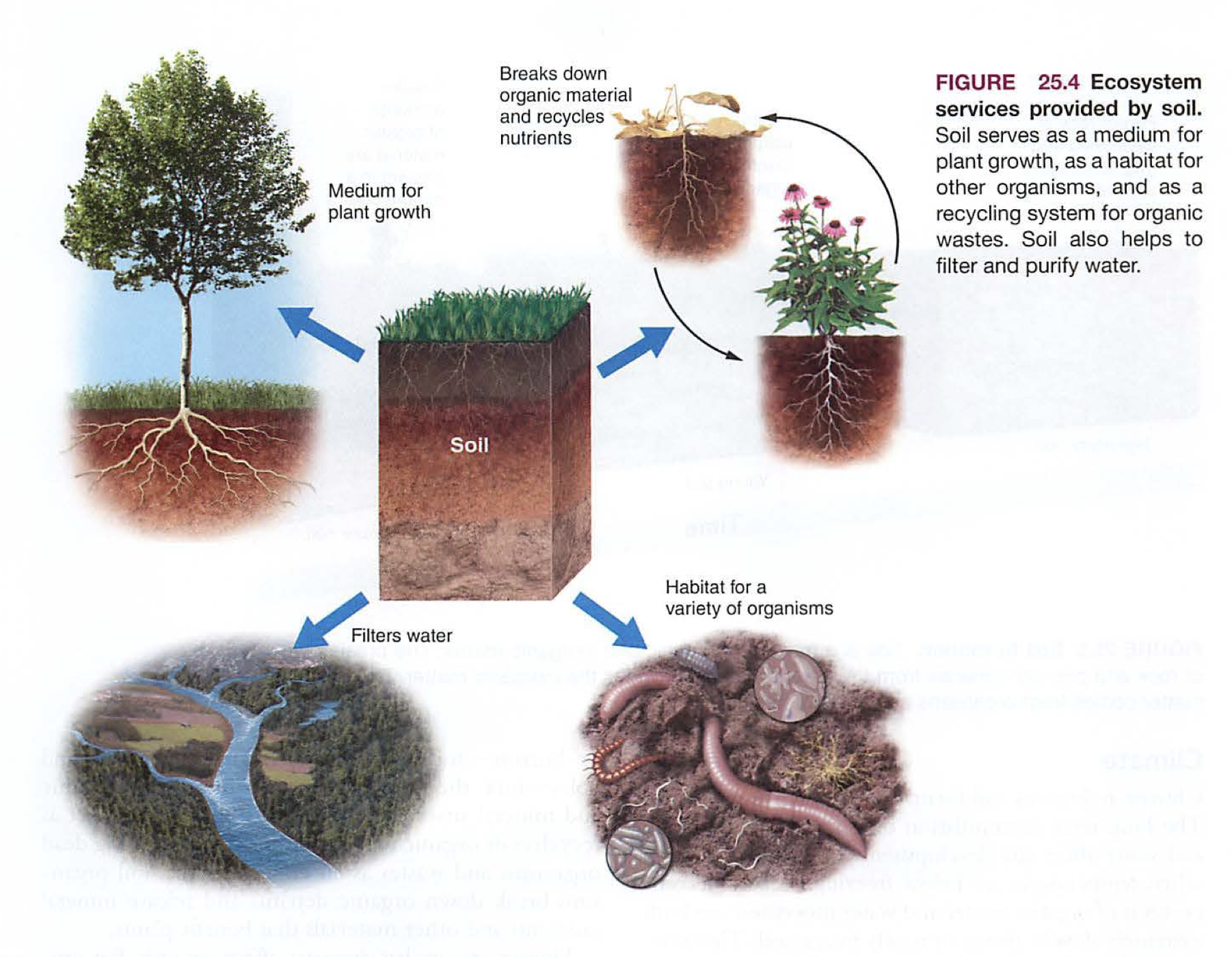Screenshot 2024-10-25 at 5.25.44 AM.png
Parent Material is a term to describe the rock the soil comes from
Influenced by:
- wind
- water
- climate
- topography
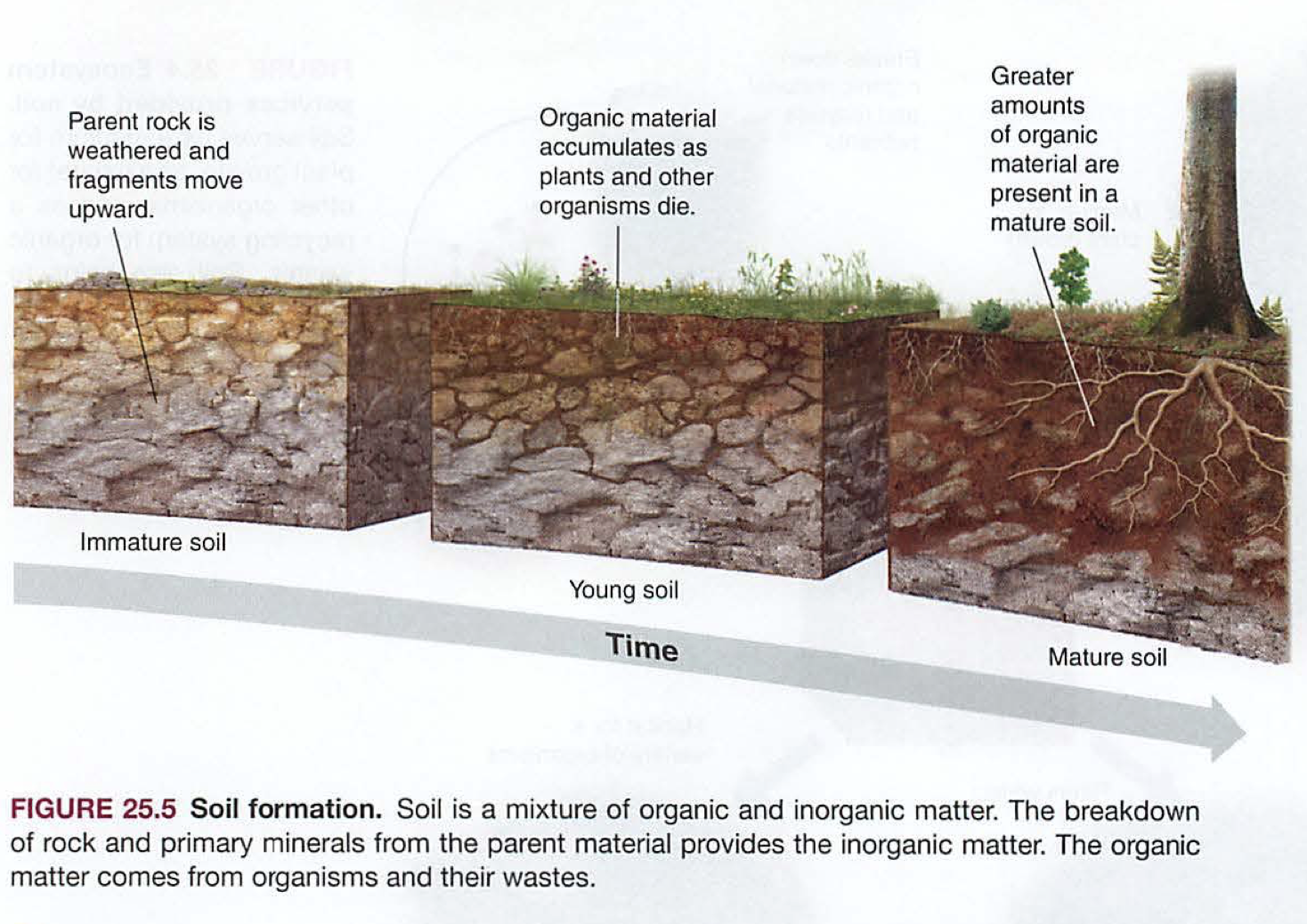Screenshot 2024-10-25 at 5.26.54 AM.png
Soil degradation is the process of degrading the soil's ability to support plant growth:
- soil erosion
- dust bowl: wind erosion removed topsoil
- floods: water erosion removes topsoil
- desertification: overuse of mineral-rich well water makes the soils too salty to support plants
- over tilling: removes organic matter that protects the topsoil
Soil Horizons:
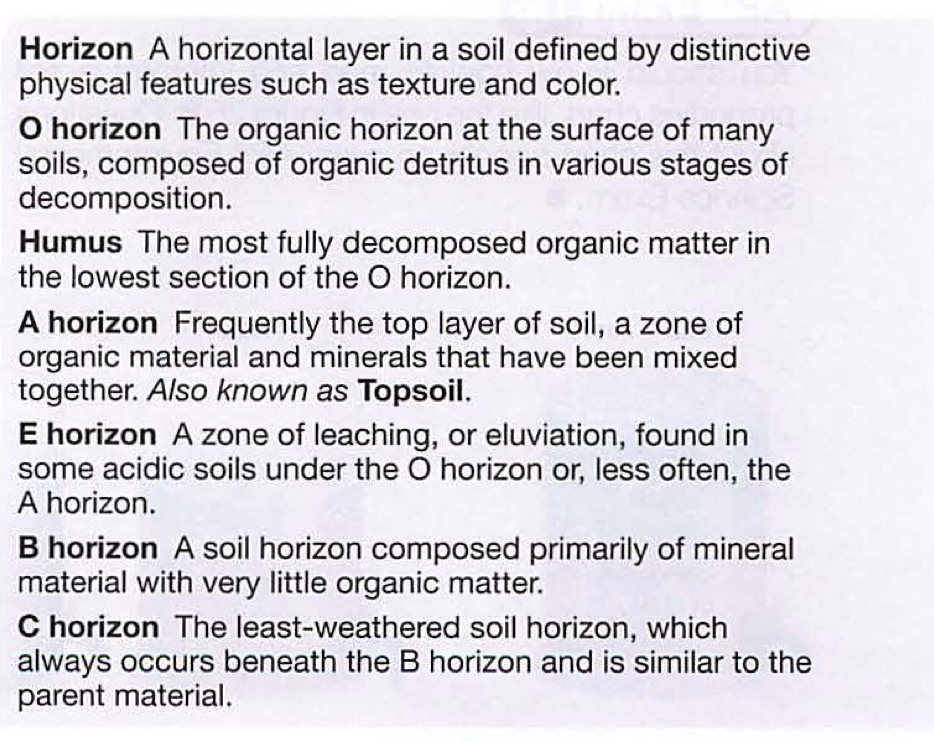Screenshot 2024-10-25 at 5.31.36 AM.png
**Unavailable Apple Wiki media:** the exported data did not include file 979f5eda-4cd6-4df1-be74-587d67c6ba5b.
Soil is made up of three general sized particles and organized into a soil triangle:
**Unavailable Apple Wiki media:** the exported data did not include file 30621d69-b784-418a-910e-eeb8faff7e33.
How to read this:
1. always read clockwise
2. make sure to read each type (3)
Our Soil Sieve has 4 filters, with 5 layers:
- mesh 5 = 4 mm
- mesh 10 = 2 mm
- mesh 60 = .25 mm
- mesh 230 = 0.063 mm
Basically, most of what you find is silt and clay...
Go online and find your favorite soil triangle game!
- These physical aspects impact the ability for soil to hold water and allow air between the spaces
- Smaller particles hold water better (capillary action, remember?) but don't allow air to pass
- Larger particles drain faster, enabling air passage, but have lower nutrient values (because they are washed so much) and hold water less (think of water on the beach)
- Organic particles (decaying plant matter) hold water like a sponge, making a perfect combination
- We measure these as:
> > 1. Water holding capacity: the amount of water held in the soil (organic matter does this)
> > 2. Permeability: the ability for water to transit through the soil (depends on soil particle sizes)
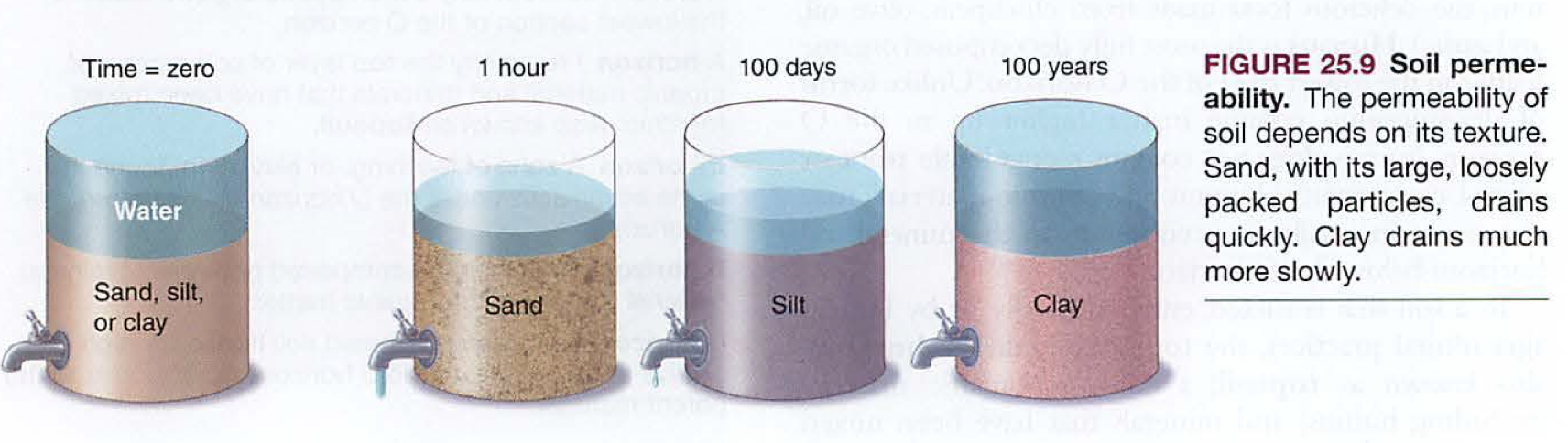Screenshot 2024-10-25 at 5.34.35 AM.png
Lots of cool things live in the soil, changing the physical and chemical properties of the soil:
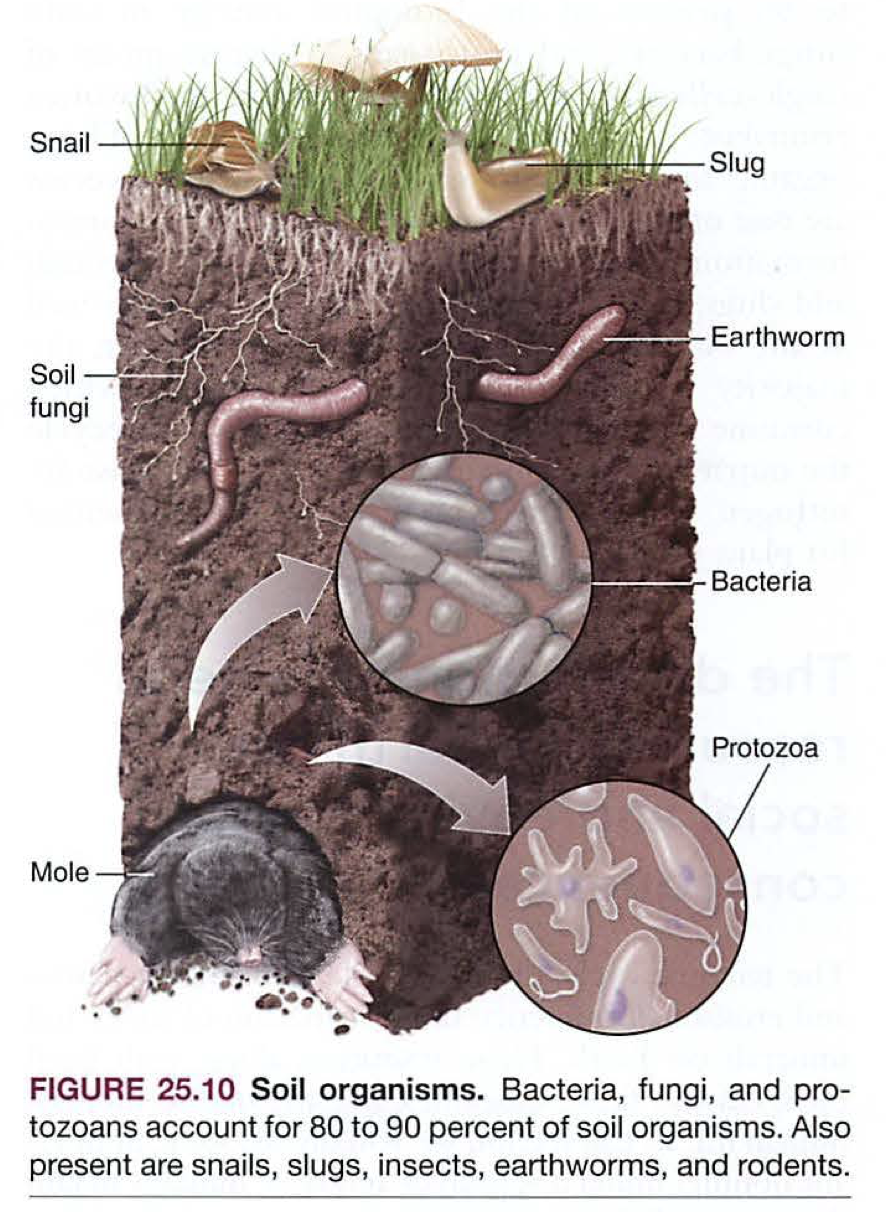Screenshot 2024-10-25 at 5.36.19 AM.pngImportant safety tip: when discussing soils with soil folks, never call it "dirt". Soil folks get angry when you confuse these...
---
Migrated from Apple Server Wiki. Original page ID: \_4L5Z0p8
# 24.10.30 earth science: soils-chemical aspects, watersheds
## Chemical aspects:
Cation exchange:
- Clay soils have a negative charge, so they attract positive ions (cations)
- These cations can be released for use by the plants as nutrients
- We measure this as CEC or cation exchange capacity
- Clay has a high CEC which is good for plants, but...
- Too much clay (>20%) makes the soil waterlogged (no air) so the roots die
pH:
- neutral pH is 7.0
- Ca, Mg, Na and K are all soil bases, as they can counteract Al and H+
- soil acids stop growth, soil bases promote health (think of acid rain impact)
- the amount of bases in a soil is called Base Saturation and can be measured with pH
- High base saturation and high CEC will be productive, releasing nutrients
N, P, K: Critical elements for plant growth
Nitrogen:
- critical for plant growth
- can be added by fertilizers (NH4NO3, ammonium nitrate)
- petrochemical fertilizers use natural gas (CH4) with N2 from the air to form these
- nitrates (NO3) are very water soluble, impacting watersheds
Phosphorus:
- fruits and roots
- needed for root crops to develop
- limiting nutrient, in excess can cause eutrophication in water bodies
- very high in animal manures, esp. fed with high protein feedstocks
Potassium (K):
- critical in plant immunity from disease and pests
- not a limiting nutrient per se, but critical to health of the plant
- regulates carbohydrate and nutrient flows
Fertilizers will have notation such as 10-20-15, meaning:
10% N
20% P
15% K
fertilizer.jpg
Organic fertilizers provide these and other trace elements (Ca, Mg, Na) slowly, as done in nature
Petrochemical fertilizers, usually derived from natural gas are much stronger, and impact the plants much quicker, also creating much more runoff in to the watersheds (more on this below)
Nitrogen and Phosphorus are growth limiting nutrients, very important when we discuss watersheds.
Some terms and concepts we need to understand first:
[https://en.wikipedia.org/wiki/Three\_Sisters\_(agriculture)](https://en.wikipedia.org/wiki/Three_Sisters_(agriculture))
In some traditional cuisines there is a balance of 70% [whole grains](https://en.wikipedia.org/wiki/Whole_grain "Whole grain") to 30% [legumes](https://en.wikipedia.org/wiki/Legume "Legume"), which may vary to 80% grains with 20% legumes. This tradition can be seen expressed in three regions:[\[5\]](https://en.wikipedia.org/wiki/Diet_for_a_Small_Planet?wprov=srpw1_1#cite_note-5)
- Latin America: [beans](https://en.wikipedia.org/wiki/Bean "Bean") with [tortillas](https://en.wikipedia.org/wiki/Tortilla "Tortilla") or [rice](https://en.wikipedia.org/wiki/Rice "Rice"),
- Middle East: [bulgur wheat](https://en.wikipedia.org/wiki/Bulgur_wheat "Bulgur wheat") with [chickpeas](https://en.wikipedia.org/wiki/Chickpea "Chickpea"), or [pita](https://en.wikipedia.org/wiki/Pita "Pita") [falafel](https://en.wikipedia.org/wiki/Falafel "Falafel") with [hummus](https://en.wikipedia.org/wiki/Hummus "Hummus"),
- Asia: [soy](https://en.wikipedia.org/wiki/Soy "Soy") with rice (southern China, northern [Japan](https://en.wikipedia.org/wiki/Japanese_cuisine "Japanese cuisine"), [Indonesia](https://en.wikipedia.org/wiki/Indonesian_cuisine "Indonesian cuisine")), soy with [wheat](https://en.wikipedia.org/wiki/Wheat "Wheat") or [millet](https://en.wikipedia.org/wiki/Millet "Millet") ([northern China](https://en.wikipedia.org/wiki/Northern_China "Northern China")), or soy with [barley](https://en.wikipedia.org/wiki/Barley "Barley") ([Korea](https://en.wikipedia.org/wiki/Korean_cuisine "Korean cuisine") and [southern China](https://en.wikipedia.org/wiki/Southern_China "Southern China")).
- Other recent authors mention that traditional cuisine in Africa combines [sorghum](https://en.wikipedia.org/wiki/Sorghum "Sorghum") or millet with [ground nuts](https://en.wikipedia.org/wiki/Vigna_subterranea "Vigna subterranea")
Important connections:
- Corn is a grass, and is very nitrogen dependent
- Corn runoff impacts all watersheds (Mississippi in particular) creating dead zones
- High N fertilizers are created from fossil fuels (oil and natural gas)
- Corn is then used in our country to feed pigs and to ferment into ethanol
- One reason the corn lobby is so powerful is today: the election: the primaries in Iowa (a corn state) are first
- The carbon footprint of corn ethanol in your gas tank is higher than oil alone, but is driven by politics, not science
Water impacts of fertilizers:
Dissolved Oxygen:
- gases can hold more water (liquids into gases) when hotter
- liquids can hold more gas (gases into liquids) when cooler
- DO means dissolved oxygen, the measure of the oxygen dissolved in water
- High DO is good for fish
- Hot water lowers DO (thermal pollution from power plants)
- photosynthesis from plants raises DO
- cooler water or agitated (aerated) water raises DO
Eutrophication:
Trophos means "food", so eutrophication means "too much food".
Process:
1. fertilizers (N and P) cause algae in a body of water to grow very quickly
2. this algal bloom then dies, falling to the bottom of the water body
3. as it decays, it consumes all of the dissolved oxygen in the water, killing fish (aerobic bacteria do this)
Watersheds
Any area of land draining into a body of water
**Unavailable Apple Wiki media:** the exported data did not include file 27880f6d-bff3-4b90-bce0-5397fb38cce1.
What comes along with this drainage?
- sediments (makes water murky)
- nitrogen fertilizer (farm runoff)
- phosphorus fertilizer (farm runoff)
- animal waste: N and P in chicken manure, pig manure
- thermal pollution (power plants)
- pathogens (human and animal waste)
- drugs, chemicals (from city water treatment plants)
- minerals (acid mine drainage)
Best Example: Chesapeake bay (Virginia and Delaware)
How do each of these impact the water body?
- sediments: block sunlight from getting to plants in the water, lower dissolved oxygen
- nitrogen: causes algae blooms, then eutrophication
- phosphorus: major cause of eutrophication, growth limiting nutrient
- thermal pollution: lowers dissolved oxygen content in water
- pathogens: kill animals downstream
- drugs and chemicals: mutate creatures in the water body
Check this out:
**Unavailable Apple Wiki media:** the exported data did not include file d18ffafe-083a-4528-9617-3a8265ec3d07.
>
Danica DiDonato writes:
>
> The Chesapeake Bay is a perfect example of eutrophication because the Chesapeake Bay watershed includes over 100,000 streams/rivers, covers 64,000 square miles, and has a population of over 18 million people, making it very vulnerable to nutrient runoff and pollution that travel downstream. The three most prevalent sources of nutrient runoff come from wastewater treatment plants, urban development, and air pollution. When excessive nutrients enter the bay, an overgrowth of algae occurs. These algae blooms not only block sunlight from reaching underwater plants, but also sink to the bottom of the ocean when they die (where they are decomposed by bacteria). This process depletes the amount of dissolved oxygen in the bay, harming marine life.
>
>
Any runoff from any city, farm or animal feed plant goes into the Chesapeake bay, the "perfect storm" of watershed damage:
- shallow (very warm)
- murky (little photosynthesis)
- algae covers the surface, so less photosynthesis below
- phosphates (algal blooms)
- nitrogen (algal blooms)
- city water treatment (hormones, drugs)
- calm (no aeration)
- slow flow (no water changes)
- thermal pollution (power plants)
Next:
Module 4: carbon and nitrogen cycles
Module 5: phosphorus and water cycles
Module 6: Net Primary Productivity
Module 7: Trophic levels, food chains
---
Migrated from Apple Server Wiki. Original page ID: 75i7j7F1
# 24.11.06 earth science: biogeochemical cycles
- Bio-geo-chemical cycles: bio=life, geo=earth, chemical=chemical
- These are cycles as the go from some reservoir through the environment and back
- These are known as sources and sinks
- Often the reservoir will be the key to identifying the cycle
### Carbon cycle: air and living things
**Unavailable Apple Wiki media:** the exported data did not include file dca21605-3090-4a29-adc9-26202d2432b3.
Notice:
- fast processes involve living things (you eat sugar, exhale carbon dioxide)
- slow processes involve minerals, rocks and soil, hydrocarbons, and the oceans
- photosynthesis: light energy creates chemical energy (e.g. sugar)
- respiration: oxygen combines with sugar or other carbon fuel, releasing carbon dioxide and energy
- chemosynthesis: same process only using heat instead of light, sulfur instead of oxygen (look on periodic table)
- aerobic respiration: uses oxygen
- anaerobic respiration: uses carbon based fuels without oxygen, much less efficient
- carbon stored in the ocean as carbonate (H2CO3 or carbonic acid)
- carbon stored in corals as CaCO3 (calcium carbonate)
- carbon sediments can turn into fossil fuels (coal, oil, natural gas) with time, heat and pressure
- steady state: sources and sinks are equal
- fossil fuel extraction: combines with oxygen to form carbon dioxide and energy (reverse of photosynthesis)
- released CO2 increases the heating of the earth:
**Unavailable Apple Wiki media:** the exported data did not include file 35f2ee0e-239c-4f70-8abb-f3fa45b24157.
This has caused the planet to warm like a greenhouse, since fossil fuels were used as fuel (coal, then oil and natural gas):
**Unavailable Apple Wiki media:** the exported data did not include file 7770b7d7-b17c-454c-a700-b1f19621b9dd.
How fast is this changing?:
In 1990, the CO2 parts per million was increasing 0.4 ppm/year
In 2025, it is increasing 2.5 ppm per year
54% of the CO2 in the atmosphere has been added since ~1975
OMG...
A global temp increase of +1.5° by the year 2100 when you are ~80 years old WAS the warming target in 2000
+2° was the next one in 2010...
Latest predictions in 2025: +3° C and perhaps several meters of water rise
Last time the CO2 was this high: prehistoric water levels were 300m higher (Kamuela is at 800m).
### Nitrogen cycle: proteins
- Nitrogen is in the air as N2, a diatomic molecule
- We can't metabolize this as is, it needs to be incorporated into plants or animals we eat.
- Plants cannot use nitrogen directly from the atmosphere, it has be in the form of nitrates ("plants ate nitrate")
- Nitrogen goes through many changes to get from the air to food, usually involving oxygen, like nitrates (NO3)
- Nitrogen fixation "fixes" nitrogen in the air into forms plants can use, either biotically (living things) or abiotically (not living things)
- Nitrogen is the basis for amino acids, and therefore proteins in living thing
**Unavailable Apple Wiki media:** the exported data did not include file 6f4a56d8-b613-45a0-bba5-c2216f203a53.
Biotic process: Nitrogen fixing, most common
1. nitrogen fixing bacteria (often along roots like in bean plants) fix nitrogen gas (N2) into ammonia (NH3)
2. this is converted into ammonium (NH4) which plants can use
Abiotic (non living) process:
1. lightning or fires have enough energy to combine N2 with O2, making NO3
2. NO3 is carried to the ground with rain (the rain smell)
3. can also be done using the Haber process for chemical nitrate synthesis
Next step: Nitrification
Ammonium needs to be converted to Nitrate for plants ("plants ate nitrate")
1. Ammonium (NH4) converts to nitrite (NO2) (look up sodium nitrite and what is is used for)
2. NO2 converts to NO3 (nitrate) (plants can use this)
3. commercial fertilizers are something with NO3, like NH4NO3, ammonium nitrate (a potent explosive: [Beirut port explosion](https://www.youtube.com/watch?v=FnSr820S2Mk))
Ammonification is when dead organisms return this NH4 back into the ecosystem through denitrification:
NO3 ->N2O->N2 gas
Summary:
1. N2 gas in the air fixed by organisms into ammonia (NH3)
2. Ammonia (NH3)converts into ammonium (NH4)
3. ammonium (NH4) converts into nitrite (NO2)
4. Nitrite (NO2) converts to nitrate (NO3)
so:
N2->NH3->HN4->NO2-NO3 (nitrate)
remember: plants ate nitrate
**Unavailable Apple Wiki media:** the exported data did not include file 761b1031-43d1-481b-9547-3037f311c882.
Nitrogen is a limiting growth nutrient in ecosystems, excess nitrogen can cause algal blooms:
1. Nitrogen causes algae to bloom
2. Algae dies, falling to the bottom of the water body
3. As it decays, it consumes the Oxygen from the water: dead zones
### Phosphorus cycle: energy
- Phosphorus is used as an energy molecule: AMP, ADP, ATP use P bonds to store energy (look these up)
- P is also a key component in DNA and RNA
- P is a limiting nutrient for plants, along with Nitrogen
Phosphorus cycle:
**Unavailable Apple Wiki media:** the exported data did not include file a7eae3aa-4c8d-4eaa-8219-47c3bec618a4.
Trick AP question: which cycle has no gas phase component?
Answer: Phosphorus, just between land and water
P is carried as dust from the Sahara to the US, and from the Gobi desert to Kauai (!)
Usually in the form of phosphate (PO4)
5 processes:
Very little P is found in rivers, so it is a limiting nutrient (eutrophication)
Algal Bloom:
**Unavailable Apple Wiki media:** the exported data did not include file 07ad3c4c-e68c-48bd-9a26-5f2aeb327fc6.
Dead zone, from watershed:
**Unavailable Apple Wiki media:** the exported data did not include file 94df6568-b113-4dc9-930b-28e80b0a08ea.
### Water (hydrologic) cycle: basis of life
- Transpiration: when water leaves plants through leaves (not the same as evaporation)
- Evaporation: when water changes from liquid to gas phase (vapor)
- Condensation: when vapor forms into drops (liquid)
- Precipitation: when water drops fall from the sky (rain)
- Evapotranspiration: a combination of sunlight, wind, humidity, temp, to increase transpiration from plants (known as EtO)
- Runoff is when water moves across land into other bodies of water
- Percolation is when it flows through soil, think of a coffee percolator (like in your soil lab)
- Transit time: the time between when rain falls on the surface until it enters a stream or river body (recall #2 on your homework)
**Unavailable Apple Wiki media:** the exported data did not include file 0258a0dc-4b3e-4ea6-a27a-a40f7ddf4372.
Note what drives this entire cycle is solar energy...
---
Migrated from Apple Server Wiki. Original page ID: i2e1r1f8d8
# 24.11.07 Bio: trophic levels, competition
The Bio modules:
- mod 6 Net Primary Productivity
- mod 7 trophic levels
- mod 1 competition
-
- mod 8 biodiversity-M&Ms
- mod 9 ecosystem services
- mod 10 biogeography
-
- mod 11 ecological tolerance
- mod 12 disruptions
- mod 13 adaptation
- mod 14 ecological succession
-
- mod 15 population dynamics r, K
- mod 16 carrying capacity-lynx-hare
- mod 17 age distribution
- mod 18 human population
Net Primary Productivity: The rate of turning solar energy into organic materials
From last week: photosynthesis (water, CO2 based) or chemosynthesis (sulfur based) turn energy into organic compounds (light+water->sugar)
- Autotrophs= auto (self) troph (food)
- also known as Producers in the food chain
- GPP: gross primary productivity = all energy into all food
- NPP: net primary productivity = gross - energy of respiration
- Net is usually only 25-50% of gross (not much)
- Fun fact: your body is only about 33% efficient, the rest goes to heat
- Same with your gas powered car...
Plants are not very efficient users of solar energy:
**Unavailable Apple Wiki media:** the exported data did not include file 19163b39-e1d0-48f1-94bc-72f2e0019470.
If this were a business, they would charge 20$ for a shirt, that cost them $12, so they only make $8 per shirt. Not good business.
This is most efficient where there is lots of solar radiation, biomass and water:
Look for the richest and the poorest in each ecosystem:
**Unavailable Apple Wiki media:** the exported data did not include file 583848c4-6347-4e01-ba19-1b21de031daa.
Net vs. Gross is easy to understand:
- If your business takes in money, this is your gross income, say 100$
- If your materials cost 20$, then your net income would be 80$
Ecosystem services: terms
- Ecosystem services: processes by which clean water, timber, fisheries and ag crops are produced
- Provisions: goods humans can use: timber, food crops, plants
- Support systems: pollinators (bees), water filtration (soils)
- Cultural services: aesthetics (John Muir, Ansel Adams)
- Monetary value: lumber, fishing, tourism, ecotourism
Island Biogeography: an intro to evolution by location and geography
Island (physically separate) bio=life, geography=mapping the earth
Important: Size of islands determines number of species on an island: bigger island=more species
Species-area curve: what this means: larger islands have more species
**Unavailable Apple Wiki media:** the exported data did not include file 9fe8e0a4-fd7c-4f3d-918d-712f8fffc795.
Dependent on several factors:
- colonization: how many new species can make it to the island, e.g. is it far from the mainland like Hawaii?
- extinction: how many species die out, and how fast, from what (disasters, humans)
- distance from each other: greater separation=fewer species (think of birds migrating across our island chain)
Invasive species are usually generalists, so pose a greater threat to island species (specialists)
---
Migrated from Apple Server Wiki. Original page ID: 2374g3b3G
# Module 17: Niches, extinction
All individuals have an ecological tolerance
Their best place is called a fundamental niche: a place where they not only survive, or survive and grow, but can reproduce:
**Unavailable Apple Wiki media:** the exported data did not include file 71eb2a26-5fe1-4510-9a06-4148eb4b66a0.
- You can also see this as a "goldilocks zone" (same concept used to discover exoplanets that may host life)
- The actual place they live is a realized niche
- Climate change is causing animals which can migrate to meet their fundamental niche away from the equator
- This happens in plants, but since they cannot migrate this happens slower through favorable seed survival:
**Unavailable Apple Wiki media:** the exported data did not include file 039f30d7-8121-4455-9ace-9bf20599f05b.
Changes beyond the organism tolerance can cause extinction (e.g. if they cannot migrate)
There have been at least five major global mass extinctions:
**Unavailable Apple Wiki media:** the exported data did not include file 0c947eec-21dd-4e90-9da4-dff58db9449a.
- Biggest was the Permian extinction about 250 my ago (see graph) likely caused by the Siberian Traps
- Next biggest was the K-T extinction about 65 my ago (dead dinos) caused by an asteroid the size of mount Everest hitting the Yucatan area
- Sixth mass extinction is the Anthropocene (human caused)
- PBS video: [https://www.pbs.org/wgbh/nova/video/ancient-earth-humans/](https://www.pbs.org/wgbh/nova/video/ancient-earth-humans/)
Three varieties of ecosystem disruptions (non human)
- Periodic: cycles of day, month, year
- Episodic: 100 year floods, sunspot cycles
- Random: Hurricanes, volcanic eruptions
Two important concepts:
- Resistance: the ability to resist change in a stress (energy, matter, etc.)
- Resilience: the ability to recover after a stress: Stability
Naturally stable: negative feedback in a stress situation (e.g. deep keel sailboat)
Naturally unstable: positive feedback in a stress situation: stress-->more stress (e.g.tour ocean liner)
**Unavailable Apple Wiki media:** the exported data did not include file 0cc45b1d-2d11-4113-908f-bf79b9a31b93.
Intermediate disturbance hypothesis:
Intermediate (non catastrophic) disturbances favor a higher level of diversity (promotes generalists and speciation)
Implications of climate change:
**Unavailable Apple Wiki media:** the exported data did not include file d6472e07-a5a0-4e2e-bf08-372c204d9ac9.
More important tipping point: as permafrost melts, biomass decomposes, releasing methane (40x more effective greenhouse gas than CO2)
Example: Spread of Avian Malaria on this island:
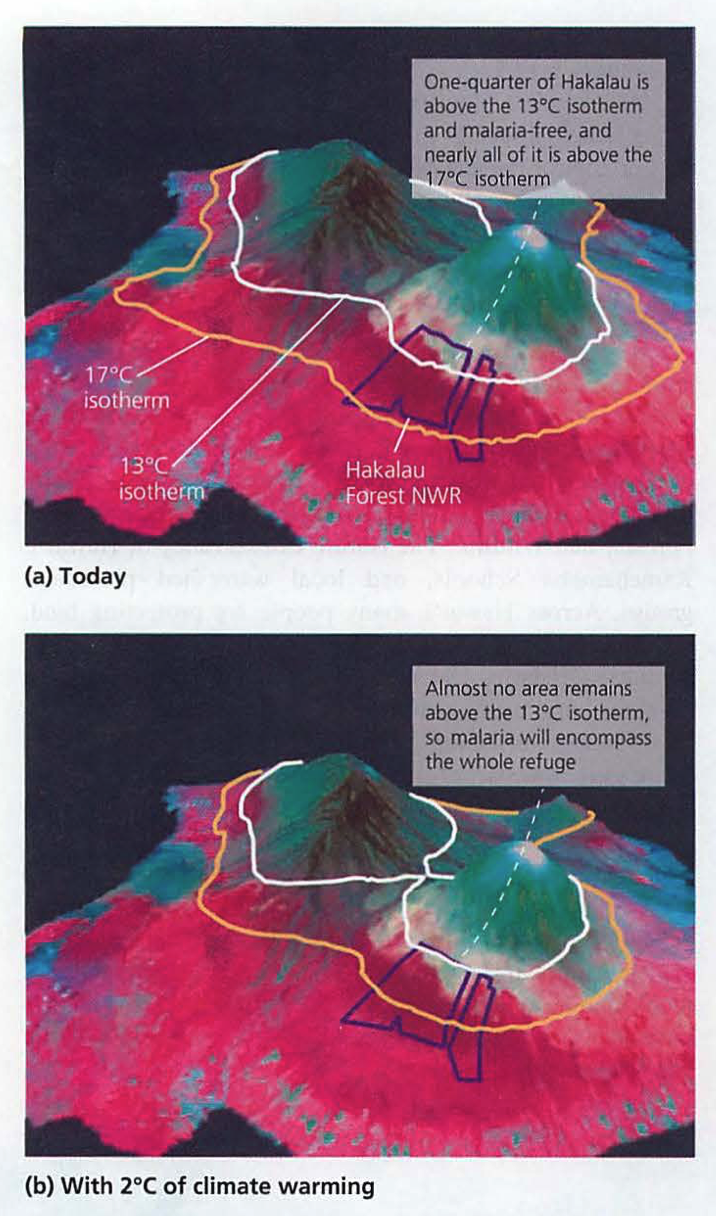Screenshot 2024-11-15 at 1.40.26 PM.png
Evolution: Natural selection (vs. artificial selection)
Needs three things, in order:
1. genetic variation (e.g. longer neck giraffes)
2. some stress that favors that variation (e.g. drought)
3. survivors reproduce to carry on the new variation (longer necks)
Not the same as artificial selection (e.g. selective breeding)
- dogs, other pets for certain traits
- food crops, for greater yield, resistance to pests (GMO crops)
- humans in the future (?) also known as eugenics (Nazis played with this idea)
Important terms to know:
Adaptations refers to the progressive evolution in traits that promote survival, fitness, or to expand a niche
Mutations are random changes in the gene pool
Gene flow is the combination of genetic traits by populations mixing
Genetic drift is the eventual random dissipation of some traits (higher where there is stress or mutagens)
Genetic Bottleneck: restriction of the genetic diversity after large decrease in population (e.g. whales)
Founder effect: migration of a subset of a species then proliferates, the resulting population has a smaller gene pool made up solely from the founders.
Allopatric speciation: allo=other patric=father: physical separation leads to genetic difference (can be island or a road separating populations)
Sympatric speciation: "same father", no physical separation, just genetic drift making a population diverse
GMO (genetically modified organisms) example: Round-up ready soybeans: genetically altered soy beans that can withstand the herbicide round-up (a carcinogen)
Succession: (not the TV show)
Usually dependent on soil, water, light energy or temperature
Primary Succession example: drive up from the coast: lava->fountain grass->small bushes->large shrubs->small trees->large trees->forest canopy
- Note that bare lava (or other rock) can only support lichens and mosses
- In our case, dust from wind and fires lodges in crevasses in the lava
- Moisture collects there, enabling seeds to survive (fountain grass)
- As the fountain grass dies, burns, or other cycle, biomass builds in the cracks, holding water through a season
- Small bushes can then survive through a drought
Primary Succession: from bare rock
Pioneer species: lichens, molds onto bare rock (or lava)
**Unavailable Apple Wiki media:** the exported data did not include file ac1e0e60-b5c8-46ad-a09f-89b68710fb86.
Secondary succession: disturbed areas that have soil (post-forest fire)
**Unavailable Apple Wiki media:** the exported data did not include file fb0b7c71-2bf6-4c60-875f-3f9d9e930d58.
Climax community: tree canopy forest or mature pond with sediment
Succession initially increases species richness (number of species), biomass and productivity, then transitions into a stable system
Keystone species: impact is far greater than their fraction of the population
**Unavailable Apple Wiki media:** the exported data did not include file 98b6b91d-09c8-4ffe-8bba-07a10b056f5b.
\-----------------
A keystone species is a species that has a disproportionately large impact on its ecosystem relative to its abundance. These species play a critical role in maintaining the structure, diversity, and health of an ecosystem. If a keystone species is removed, the ecosystem can experience drastic changes, often leading to a collapse in ecological balance, loss of biodiversity, or even extinction of other species.
### Types of Keystone Species
1. Predator Keystone Species: These are top predators that control the population of other species in the ecosystem, preventing any one species from dominating. By controlling prey populations, they help maintain biodiversity. For example:
- Wolves in Yellowstone National Park: When wolves were reintroduced, they controlled populations of deer and elk, which allowed vegetation to recover, benefiting many other species and altering river courses due to stabilized vegetation.
2. Ecosystem Engineer Keystone Species: These species physically modify the environment, creating habitats for other organisms. Their actions shape the ecosystem in a way that benefits other species.
- Beavers: By building dams, beavers create ponds and wetlands that support a diverse range of aquatic and terrestrial species, making beavers essential to their ecosystems.
3. Mutualist Keystone Species: These species have a mutually beneficial relationship with other organisms, which is crucial to the survival of several species in the ecosystem.
- Honeybees: Bees pollinate plants, which is essential for the reproduction of many flowering plants. The plants, in turn, provide food and habitat for various organisms. Without bees, these ecosystems would collapse due to lack of pollination.
4. Plant Keystone Species: Some plants are keystone species because they provide essential resources such as food, habitat, or protection to many other species.
- Mangrove Trees: Mangroves in coastal areas protect shorelines from erosion, provide nursery habitats for fish, and support diverse communities of organisms, including fish, crabs, and birds.
### Importance of Keystone Species
- Maintaining Biodiversity: Keystone species prevent the dominance of one species, allowing multiple species to coexist and promoting a rich diversity of life.
- Balancing Ecosystems: By controlling populations, keystone species prevent overgrazing, overpopulation, and resource depletion, helping to maintain a stable and sustainable ecosystem.
- Supporting Other Species: Keystone species create or sustain habitats, provide food resources, and facilitate reproduction for other species, contributing to overall ecosystem health.
### Consequences of Losing a Keystone Species
If a keystone species is removed, it can trigger a series of cascading effects within the ecosystem:
- Trophic Cascade: The removal of a top predator, for instance, can lead to overpopulation of prey species, which may overgraze or overuse resources, leading to habitat degradation and loss of other species.
- Reduced Biodiversity: Without the regulating influence of a keystone species, competition and predation may favor a few dominant species, reducing biodiversity.
- Ecosystem Collapse: In extreme cases, the removal of a keystone species can cause the ecosystem to collapse, as it may become unable to support the balance and needs of the remaining organisms.
### Key Takeaways
- Keystone species play a critical role in their ecosystem and are essential for maintaining biodiversity, balance, and structure.
- Their impact on the ecosystem is much greater than what would be expected based on their population size alone.
- Loss of a keystone species can lead to significant ecological changes, threatening the stability and health of the ecosystem and often resulting in a decrease in biodiversity.
Indicator species: impact of changes show up first in these, demonstrating impact of change (e.g. frogs in the Potomac River)
Indicator species are organisms used as a measure of environmental conditions in an ecosystem. These species are particularly sensitive to specific environmental changes, so their presence, absence, or well-being can provide valuable information about the health of an ecosystem. By monitoring indicator species, scientists can often detect pollution, climate change, habitat degradation, or other ecological shifts that may not be immediately obvious.
### Characteristics of Indicator Species
- Sensitivity to Environmental Changes: Indicator species respond quickly to changes in their environment, making them effective for early detection of ecological disturbances.
- Specific Habitat Requirements: Many indicator species have narrow habitat requirements and specific ecological niches, so any deviation from their needs (like pollution or habitat loss) is quickly reflected in their health or behavior.
- Predictable Response: Indicator species exhibit consistent responses to particular environmental conditions, making it easier to correlate their status with specific ecological factors.
### Types of Indicator Species
1. Pollution Indicators: These species are sensitive to pollutants and can reveal the presence of contaminants in an environment.
- Lichens: Because they absorb water and nutrients directly from the air, lichens are highly sensitive to air pollution. A decline in lichen populations often indicates increased air pollution levels, especially sulfur dioxide.
2. Water Quality Indicators: Certain species indicate the health of freshwater ecosystems, such as rivers, lakes, and streams.
- Macroinvertebrates (like stoneflies and mayflies): These aquatic insects are sensitive to changes in water quality, such as oxygen levels and pollution. Their presence indicates clean, oxygen-rich water, while their absence can signal pollution.
3. Climate Change Indicators: Some species respond to changes in temperature, precipitation, or seasonality, making them valuable for studying climate change.
- Coral Reefs: Coral is highly sensitive to temperature changes and ocean acidification. Coral bleaching is a stress response to rising water temperatures and can signal the broader impacts of climate change on marine ecosystems.
4. Ecosystem Health Indicators: These species indicate the overall health of their ecosystem, often reflecting factors like habitat quality and biodiversity.
- Amphibians (like frogs and salamanders): Amphibians have permeable skin and are exposed to both water and land conditions, making them sensitive to pollutants, temperature changes, and habitat degradation. Declining amphibian populations often indicate environmental distress.
### Importance of Indicator Species
- Early Warning System: Indicator species provide an early warning of environmental problems, allowing scientists and conservationists to address issues before they become severe.
- Targeted Conservation Efforts: By focusing on the health of indicator species, conservation efforts can be more efficient, targeting specific threats to protect the ecosystem.
- Environmental Monitoring: Indicator species help scientists monitor and assess ecosystem changes over time, allowing for long-term tracking of environmental trends.
### Examples of Indicator Species in Action
- Canary in a Coal Mine: Historically, miners took canaries into coal mines because the birds were highly sensitive to toxic gases. If the canaries showed distress or died, it signaled dangerous levels of gases, alerting miners to evacuate. They also breathe much more rapidly than humans, so the impact is faster.
- Freshwater Mussels: Mussels filter water and can accumulate toxins in their tissues, reflecting water quality. Their health and populations are used to monitor pollution levels in rivers and streams.
### Key Takeaways
- Indicator species provide insight into the health of an environment, often serving as early warning signs of ecological problems.
- They respond predictably to specific environmental conditions, which allows scientists to monitor pollution, water quality, climate change, and habitat health.
- Monitoring indicator species can guide conservation efforts, help assess ecosystem resilience, and inform policies to protect biodiversity and ecosystem integrity.
Review:
- Generalists can survive in a wide range of conditions
- Specialists exist in a narrow range
- Niche refers to this range where they can exist and reproduce
---
Migrated from Apple Server Wiki. Original page ID: S8s1P8\_
# Module 19: Growth models
Population growth rates
- r selected (r means rate) species grow exponentially until they reach or exceed the carrying capacity of the ecosystem (fish, bacteria)
- K selected species grow slowly and reach the carrying capacity (humans, whales, elephants)
- Carrying capacity (K) refers to land, water, food or other biotic requirement for the species
- Biotic potential is the reproductive rate if there were no limits
**Unavailable Apple Wiki media:** the exported data did not include file 9e6e16e7-89ab-469f-a663-ab07f799d38d.
We describe these r and K species also by their survivorship curves:
Simple version:
**Unavailable Apple Wiki media:** the exported data did not include file e98b1f82-2b74-49d1-8865-9eca79082cb8.
What does this mean?
- Dandelions have many offspring, most of them die, the survivors live on
- Whales have few offspring, take care of them, then live on
- Squirrels die randomly, same for birds, they crash into stuff, old or young
- Where would deer fit into this diagram? Hint: they are another different line
Have a look at the chart above, and think of yourself as an infant.
Compare with Nemo...
Population growth: r and K explained: why do we use those letters?
Exponential growth is the opposite of radioactive decay which we demonstrated with M&Ms
At = Ao/2^n or At = Ao* (1/2^n) where n is the number of half-lives
Populations have doubling times, the time for the population to double, using the same formula:
At = Ao*2^n where n is the number of doubling times
Try this:
Take a piece of paper, cut it in two, record your result on a table as you do this 6 times
What was your final total?
Now do this starting with several sheets of paper (be creative), do this 6 times and record on a table.
When you start with one sheet, Ao is one
When you start with several sheets, Ao is the number
r in this case was 0.693 (a very important number)
t is the number of times you tore the paper
Test this out with your calculator
Here's what this looks like, called J-shaped growth:
**Unavailable Apple Wiki media:** the exported data did not include file 49666958-4963-4315-94c3-c6d7cde85610.
Here's where the r comes from in the r-selected species:
Nt = No e ^rt where r is the growth rate in %
(r comes from rate)
**Unavailable Apple Wiki media:** the exported data did not include file 000fece1-faa0-45c1-8fbb-8e5b6bfd7825.
So simple J growth looks like this:
## ∆N/∆t = rN
∆N means change in population
∆t means change in time
r means reproductive rate
N means initial population
### so, ∆N/∆t really means growth rate or slope of the growth curve
Note this depends on two things:
- Initial population (N)
- reproductive rate (r)
What about K-selected species?
Examples: humans, whales and elephants
We use a different equation for this, but it is really the same equation:
## ∆N/∆t = rN(1-N/K)
K is the carrying capacity of an ecosystem:
**Unavailable Apple Wiki media:** the exported data did not include file 6364cbfc-806a-42fd-82c8-d558f5cf5a39.
Look at the formula:
If the population is well below K (the carrying capacity) then the rate of population growth is
# ∆N/∆t = rN(1-0) or ∆N/∆t = rN
(J shaped growth again)
As the population approaches K the value in the parentheses becomes 0 (no growth) then negative (die off or overshoot):
**Unavailable Apple Wiki media:** the exported data did not include file 6b256936-53a6-4d26-8d9a-01065e69d3cd.
Two types of growth factors:
- Density dependent factors: food, water, land
- Density independent factors: disasters (flood, fire)
Important fact: as food becomes limited, K species will have fewer offspring, so they approach the carrying capacity (K) more gradually, not overshoot and die off.
Try this formula with an island that can hold 100 rabbits, using the numbers above (50% growth rate).
Try this with 50 rabbits, 100 rabbits, 150 rabbits.
What is the value of ∆N/∆t in each case?
What does this mean about the slope of the growth curve?
From Wikipedia:
**Unavailable Apple Wiki media:** the exported data did not include file b731a107-97f7-4133-ba4d-96c5cb5ce5bd.
where N is the [population](https://en.wikipedia.org/wiki/Population "Population"), r is the maximum [growth rate](https://en.wikipedia.org/wiki/Population_growth_rate "Population growth rate"), K is the [carrying capacity](https://en.wikipedia.org/wiki/Carrying_capacity "Carrying capacity") of the local environment, and dN/dt, the [derivative](https://en.wikipedia.org/wiki/Derivative "Derivative") of N with respect to time t, is the rate of change in population with time. Thus, the equation relates the growth rate of the population N to the current population size, incorporating the effect of the two constant parameters r and K. (Note that decrease is negative growth.) The choice of the letter K came from the [German](https://en.wikipedia.org/wiki/German_language "German language") Kapazitätsgrenze (capacity limit), while r came from rate.
**Unavailable Apple Wiki media:** the exported data did not include file b9992638-2b81-4d02-a886-9d3e05b60d12.
Predator Prey oscillations:
Lynx and hare demo:
**Unavailable Apple Wiki media:** the exported data did not include file c8eb3205-aaaa-460d-b54a-67d9d40b8e9e.
Note that the predator peaks after the prey, then overshoots...
saying that the change per instant of time of x at time t is proportional to the value of x(t), and x(t) has the [initial value](https://en.wikipedia.org/wiki/Initial_value "Initial value")
---
Migrated from Apple Server Wiki. Original page ID: R4R443m4H
# Module 22: Human population models
Welcome back!
Today:
- review semester exam #2: 9, 27, 42, 64, 73, 79
- note taking: how, why, best practices
- sem 2 overview: human pop, energy, health, green building
- read chapter 6, cengage text (human populations)
- read module 22, FR3e (HW)
- prep for country choice
- Videos: Bozeman science: 012, 013, 014, 015
- [http://www.bozemanscience.com/ap-environmental-science](http://www.bozemanscience.com/ap-environmental-science)
- Homework: Bozeman 012, 013 (take notes), mod 22
Human Populations notes: FR3e
- module 22 is part of chapter 7: [https://elab.hpa.edu/apes/texts/parts/fr3e-chapter7.pdf](https://elab.hpa.edu/apes/texts/parts/fr3e-chapter7.pdf)
- Carrying capacity for the earth: about 9 billion
- Malthus: exponential growth of population, linear growth of food supply (ignores innovation):
**Unavailable Apple Wiki media:** the exported data did not include file 5c950a5f-ec3f-478c-b06e-1b42d83d2971.
Population inputs:
- Immigration
- Births
- Aliens landing on earth
Population outputs:
- Emigration
- Deaths
- People moving to Mars
Two crude concepts:
- CBR: crude birth rate: births per 1000 people per year
- CDR: crude death rate: deaths per 1000 people per year
- Global population change: (CBR-CDR/10) notice that 1000/10 = 100 so it looks like a percent
For a country:
National population % growth rate =
\[(CBR +immigration)- (CDR+ emigration)\]/10
- In words this says all things coming in, minus all things going out, divided by ten is the national growth rate in percent (per hundred)
- Births are easy to calculate (except in rural areas where some live, some don't and are rarely reported)
- Life expectancy: average number of years a newborn is expected to live
- Global: 73 years (70 men, 75 women)
- US: 79 years (76 men, 81 women)
- Look up your life expectancy and that of your parents
**Unavailable Apple Wiki media:** the exported data did not include file 0223e85c-1f7b-4b2f-a9b9-5bc9d8dccd9f.
Infant mortality: number of deaths for children under 1 year per 1000
Child mortality: number of deaths for children under 5 years per 1000
**Unavailable Apple Wiki media:** the exported data did not include file b400bdfd-f6a3-4e7e-8c29-712c897f5bff.
Math stuff: sure to be on the AP exam...
**Unavailable Apple Wiki media:** the exported data did not include file ec3e7bcc-ab3f-4cdf-9a64-9d28559b28dc.
Age structure diagrams:
**Unavailable Apple Wiki media:** the exported data did not include file d533b429-9b82-4230-a741-71db710c5e62.
How to read these:
- men on left, women on right
- kids at bottom, old people at top
- bulges are greatest populations
- look for:
- wars (on whose soil?)
- famine
- immigrant workers
- pyramids
Question: What does a neutral growth country look like?
If the replacement ratio for stable population is 2.1 kids per woman (why?) is a parallel age structure diagram stable or declining?
This is also known as "replacement level fertility"
Total fertility rate: TFR: total number of children each woman will have in her lifetime between 15 and 49 (does not count men, divorce, death of spouse)
Time to visit gapminder.org: [https://www.gapminder.org/tools/?from=world#$chart-type=bubbles&url=v1](https://www.gapminder.org/tools/?from=world#$chart-type=bubbles&url=v1)
**Unavailable Apple Wiki media:** the exported data did not include file 8b278ae2-fa96-452b-8bc2-e601d8f7562f.
Men have shorter lifespans: war, work, testosterone, heart disease, smoking, cancer, "hold my beer and watch this"
Look up the life expectancy of men and women your parents' age
Compare with someone born in 1900
How many were farmers then?
Now compare the life expectancy image with this one: (infant deaths before age 1, child deaths under age 5)
One reason the one year birthday is such a big deal here in Hawaii
Why?
- clean water
- health care
- food supply
- sanitation
- lower pollution
Global IMR (infant mortality rate): 32
US: 5.8
Sweden: 2.5
Why?
Not just about countries...
US: 5.8 average
- African American: 12
- Native Americans: 7.6
- Caucasians: 5.3
- Closer to home:
- Hawaii: 4.9
- Native Hawaiians, Pacific Islanders: 9.4
Why?
Social, education, income, food supply, food deserts, diet
Crude death rate also depends on demographics:
Mexico: 6% over 65, CDR is 5/1000
US: 15% over 65, CDR is 8/1000
Terms to know: Human Populations-----------------------------
- Fecundity: the ability to reproduce
- Fertility: production of offspring
- CBR: crude birth rate: births per 1000 people
- TFR: total fertility rate: total kids per woman in her lifetime (25-30!)
- ZPG: zero population growth: 5+ where infant mortality is high, 2.1 is normal
- China: was 6 -> 1.8 (below replacement level since 1979, one child policy)
- China has a 140/100 male to female ratio: why?
- Global TFR is 2.6
- CDR: crude death rate: deaths per 1000
- Why is there a life span? mitochondrial DNA...
- 1900 Indian man had life expectancy of 23! Trace this to now...
- Not now, reasons: nutrition CLEAN WATER, sanitation, education
- 75 men, 85 women (testosterone, war, "hold my beer and watch this!", Darwin Awards)
- Dependency ratio; baby boomers and your future: how many workers to retirees
- imagine your life at your age in other countries...
- Russia low TFR: alcoholism and antibiotic resistant Tuberculosis
Recall exponential growth:
- At = Aoe^rt where r is the reproductive rate in % and Ao is the original population
- We need to know how fast a population is growing better than just % growth rate
Here's how:
**Unavailable Apple Wiki media:** the exported data did not include file c3aa1d0a-3410-480d-9efb-f933acf6819f.
Here's why:
- When the population doubles, the ratio of At/Ao is 2
- If At/Ao = 2 = e^rt then ln 2 = rt = 0.693 (mysterious thing: look up the ln of 1/2 and 2, see?)
- so, 0.693 = rt, then t = 0.693/r
- since r is in percent, then 70/(growth rate in %) = time to double the population
On the AP exam, you will see questions using some multiple of 7: 14%, 35%, 3.5%, 28% to calculate population doubling time: Make sure you understand that higher % means SHORTER doubling time...
Population check in:
1. An r-selected species has a growth rate of 12%. If the initial population is 200, what will be the population at year 5? (hint: use the Nt = Noe^rt formula)
2. What is the doubling time for this population? (hint: use 70/% to get doubling time)
3. If the carrying capacity of a separate K selected species is 100, what will the slope of the growth curve look like when the population is 95?
4. What will it look like when the population is 120, and what do you call this?
Sample AP FR question:
**Unavailable Apple Wiki media:** the exported data did not include file a34adf72-c6e5-430a-87d2-8c6a5f12e341.
Solution:
**Unavailable Apple Wiki media:** the exported data did not include file d3ad5586-7fee-42ef-bcd9-13b849a8cd38.
**Unavailable Apple Wiki media:** the exported data did not include file f64537e2-e332-458d-823e-90e65debd85c.
---
Migrated from Apple Server Wiki. Original page ID: F1e1u7u4
# Poisoned Waters: Chesapeake Bay
To edit this page, click the Edit (pencil) button. To delete this page, click the Action (gear) button and choose Delete.
When you edit this page, you can easily rename the page, and use the editing toolbar to:
- Apply paragraph or character styles to text.
- Create bulleted lists, numbered lists, and tables.
- Insert media, such as images, audio, or QuickTime movies.
- Attach files.
- Insert an HTML snippet from another website or email.
For more information about editing pages, click the Action (gear) button and choose Help.
---
Migrated from Apple Server Wiki. Original page ID: N0x0S7c6B
# Module 6: Energy flow: Trophic levels
- Recall: troph = food
- Autotrophs make their own food (photosynthesis)
- Examples: plants
Trophic levels explain how energy (food) moves up through a food chain
Simple food chain: think of Madagascar...
**Unavailable Apple Wiki media:** the exported data did not include file 582fafad-c319-4814-8ce8-e45d00be4d6b.
- Consumers are known as heterotrophs (hetero=not same, troph = food)
- Herbivores (herb=plant, vore=eat) eat plants, and are primary consumers
- Consumers that eat other consumers are known as carnivores (carne=meat, vore=eat) or secondary consumers
- Tertiary consumers eat secondary consumers
- Apex predators have few predators for them, e.g. sharks, humans (cannibals don't count, and they don't eat clowns, they taste funny)
- Trophic levels are each stage up the food chain
- Only 10% of energy moves up each level (why?)
- reproduction
- metabolism (grazing etc.)
- avoiding predators
- romping with friends
Other nasty bits:
- scavengers: eat dead animals, e.g. vultures
- detritivores: eat decaying matter, e.g. beetles (not the Beatles, that's something else)
- decomposers: break down decaying matter, e.g. bacteria
The cycle of life: (just like in Lion King)
**Unavailable Apple Wiki media:** the exported data did not include file 937a860f-6506-4ecc-a89e-e2219054ca52.
Back to the 10% rule:
**Unavailable Apple Wiki media:** the exported data did not include file 57934820-d818-4f2b-bbee-a81c013b9c77.
Just like Marty had to romp around, and in some cases run away from Alex, some energy was used for other things (reproduction is included, though Marty did not have kids that we know of...)
Make sure you understand this: just take one zero off for each level...
Also make sure you can duplicate a complex drama like this:
**Unavailable Apple Wiki media:** the exported data did not include file 2dd01e5b-d2ce-4c44-a60b-ff7956a0256b.
Or this wetter version:
**Unavailable Apple Wiki media:** the exported data did not include file 3f2a2331-8748-4441-9ce9-431468c421d3.
Trick question: could the Lions see the Hyena as a predator or prey? (remember Scar in Lion King?)
Another one: what is the connection between Madagascar and the show Friends?
Net Primary Productivity: The rate of turning solar energy into organic materials
From last module: photosynthesis (water, CO2 based) or chemosynthesis (sulfur based) turn energy into organic compounds (light+water->sugar)
- Autotrophs= auto (self) troph (food)
- also known as Producers in the food chain
- GPP: gross primary productivity = all energy into all food
- NPP: net primary productivity = gross - energy of respiration
- Net is usually only 25-50% of gross (not much)
- Fun fact: your body is only about 33% efficient, the rest goes to heat
- Same with your gas powered car...
Plants are not very efficient users of solar energy:
**Unavailable Apple Wiki media:** the exported data did not include file 19163b39-e1d0-48f1-94bc-72f2e0019470.
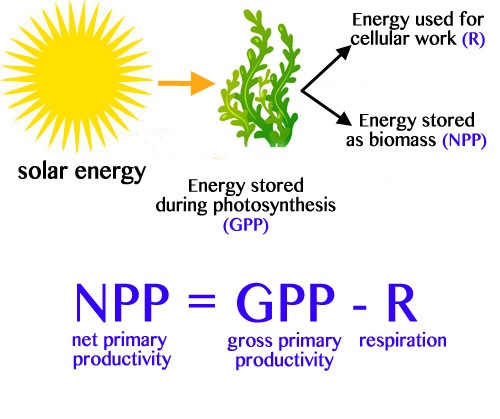gpp.jpegIf this were a business, they would charge 20$ for a shirt, that cost them $12, so they only make $8 per shirt. Not good business.
This is most efficient where there is lots of solar radiation, biomass and water:
Look for the richest and the poorest in each ecosystem: Note connection with biomes...
- Richest land biome: lots of sunlight (energy), warm temperatures and lots of water (photosynthesis)
- Poorest land biome: less sunlight, long dark winters, cooler, and drier
- Richest aquatic biome: warm, close to shore, sunlight
- Poorest aquatic biome: cooler, far from shore
**Unavailable Apple Wiki media:** the exported data did not include file 583848c4-6347-4e01-ba19-1b21de031daa.
Net vs. Gross is easy to understand:
- If your business takes in money, this is your gross income, say 100$
- If your materials cost 20$, then your net income would be 80$
Ecosystem services: terms
- Ecosystem services: processes by which clean water, timber, fisheries and ag crops are produced
- Provisions: goods humans can use: timber, food crops, plants
- Support systems: pollinators (bees), water filtration (soils)
- Cultural services: aesthetics (John Muir, Ansel Adams)
- Monetary value: lumber, fishing, tourism, ecotourism
Island (physically separate) bio=life, geography=mapping the earth
Important: Size of islands determines number of species on an island: bigger island=more species
Species-area curve: what this means: larger islands have more species
**Unavailable Apple Wiki media:** the exported data did not include file 9fe8e0a4-fd7c-4f3d-918d-712f8fffc795.
Dependent on several factors:
- colonization: how many new species can make it to the island, e.g. is it far from the mainland like Hawaii?
- extinction: how many species die out, and how fast, from what (disasters, humans)
- distance from each other: greater separation=fewer species (think of birds migrating across our island chain)
Invasive species are usually generalists, so pose a greater threat to island species (specialists)
This is covered when we learn about niches soon.
We will see this again when we study biodiversity next...
Find a game!
---
Migrated from Apple Server Wiki. Original page ID: e9k0J1A
# Module 18: Population distribution
Module 18-abundance and distribution
Start with this:
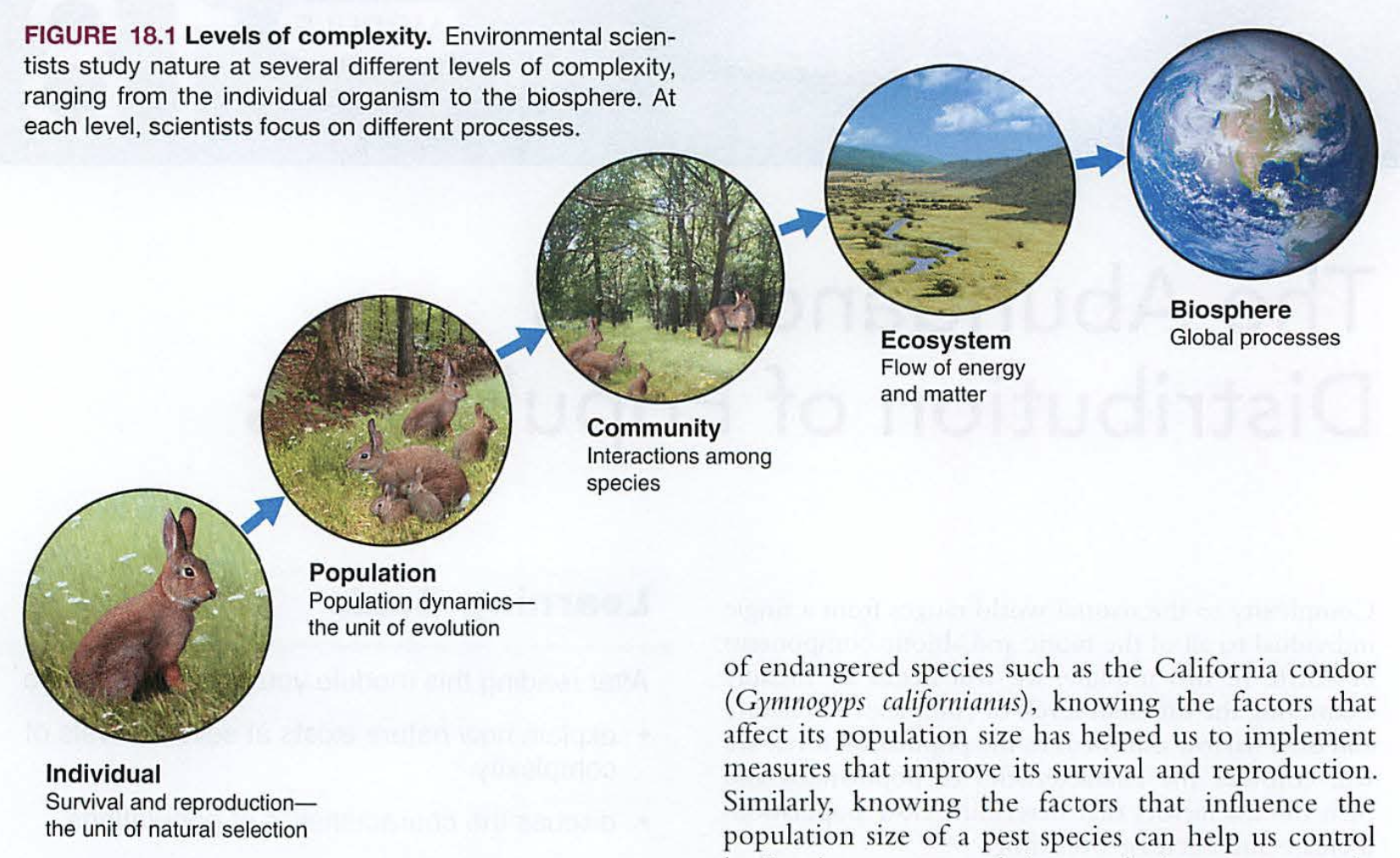Screenshot 2024-11-12 at 5.33.08 PM.pngA crude example of this might be:
- individual-you
- population-HPA
- students community-HPA
- ecosystem-education
- biosphere-the world
or:
- some rabbit individual
- some of the rabbit's friends,
- a population of rabbits
- rabbits and the things they eat and eat them-community
- ecosystem-the plants that support both ends of this process
- biosphere-the planet
We covered ecosystem energy and matter a few weeks ago, this chapter is about population ecology.
--------------------
Population dynamics
Notation:
- Population size is represented as N (note not "n"): population size within a defined area at a specific time (brings in migration).
- So, we could say the student population of HPA would be all students here this year, 2024-2025
- Check out the diagrams on population distribution: random, uniform and clumped. Important vis a vis biodiversityStructures: age and gender (sex)
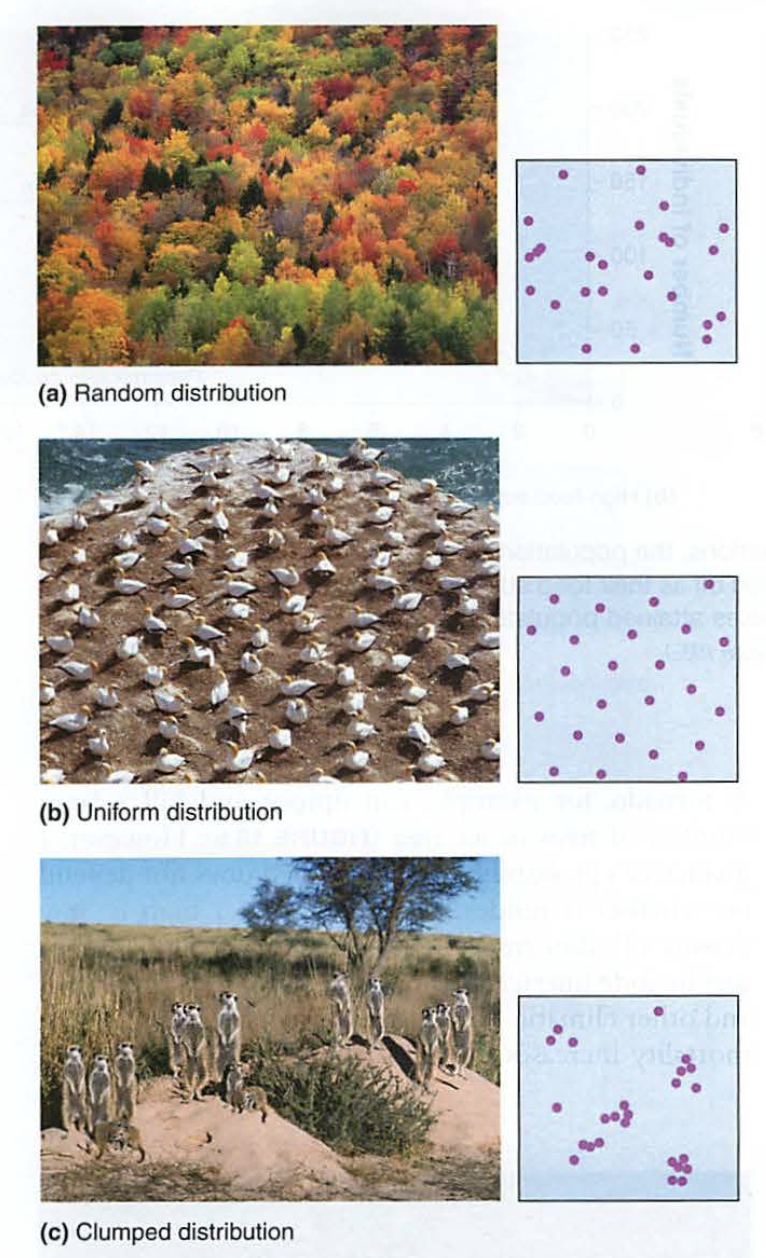Screenshot 2024-11-12 at 5.39.41 PM.png
- Density dependent factor: e.g. food or reproductive rate in rats (more rats, lower "fecundity" or birthrate)
- Something that influences reproduction or survival...
- Density independent factors: storms, disasters, fires (note density independent: one bambi or 100 bambi all perish in the same fire)
- Limiting resource: usually food, but could include space, nutrients, etc.
- Carrying capacity: K (note not "k"): how many individuals an environment can support
--------------------
Carrying capacity is the maximum number of individuals of a species that an environment can sustainably support over time, given the available resources such as food, water, shelter, and other necessities. The concept of carrying capacity is central to ecology and population biology, as it helps determine the limits of population growth in an ecosystem.
### Key Factors Influencing Carrying Capacity
1. Availability of Resources: The amount of food, water, and shelter determines the carrying capacity. If resources are abundant, the carrying capacity is higher. If resources are limited, the carrying capacity is lower.
2. Environmental Conditions: Factors like climate, temperature, and natural disasters influence carrying capacity. For example, harsh winters or droughts can reduce the carrying capacity for a species in a given area.
3. Species Interactions: Predation, competition, and symbiosis all affect carrying capacity. High predation rates or competition for resources among species can reduce the carrying capacity for each population.
4. Waste Accumulation and Pollution: The buildup of waste or pollution in an ecosystem can lower the carrying capacity by degrading the environment and reducing resources available for organisms.
### How Carrying Capacity Works
- Population Growth Phases: When a population starts in a new environment with abundant resources, it typically grows rapidly (exponential growth). However, as the population size approaches the carrying capacity, resources become scarcer, leading to competition and slower growth (logistic growth).
- Equilibrium: Eventually, the population stabilizes around the carrying capacity, where birth and death rates are in balance. This means that, on average, the number of individuals added to the population is equal to the number that die.
- Overshoot and Dieback: If a population temporarily exceeds its carrying capacity due to a sudden resource boost or reduced predation, it may experience a “population overshoot.” This often leads to resource depletion, after which the population undergoes a dieback (sharp decline) to below the carrying capacity.
### Examples of Carrying Capacity
- Deer in a Forest: In a forest ecosystem, the carrying capacity for deer depends on available food, space, and water. If deer numbers exceed the carrying capacity, the forest may become overgrazed, reducing food availability. This leads to higher competition, malnutrition, and potentially increased death rates until the population returns to a sustainable level.
- Fish in a Pond: In a pond, the carrying capacity for fish is limited by factors like water oxygen levels, food supply, and space. Overcrowding can reduce oxygen and increase waste, causing a decrease in the fish population until it stabilizes at a level the pond can support.
### Importance of Understanding Carrying Capacity
- Conservation and Wildlife Management: Understanding carrying capacity allows conservationists to manage wildlife populations, ensuring that species do not exceed the limits of their environment, which could harm the ecosystem.
- Human Population: Carrying capacity applies to human populations as well. Overpopulation can lead to resource depletion, pollution, and habitat destruction, making it essential to manage resources and plan sustainably.
### Key Takeaways
- Carrying capacity is the maximum sustainable population size an environment can support over time, given its resources.
- Resource limitations and environmental conditions primarily determine carrying capacity, which stabilizes populations over time.
- Exceeding carrying capacity can lead to a population decline, as the environment becomes unable to support the population due to resource depletion or environmental degradation.
---
Migrated from Apple Server Wiki. Original page ID: u7c773X3
# c4: biodiversity and evolution
[Cengage chapter 5:](https://elab.hpa.edu/apes/texts/parts/cengage4-biodiversity-evolution.pdf) biodiversity and evolution notes
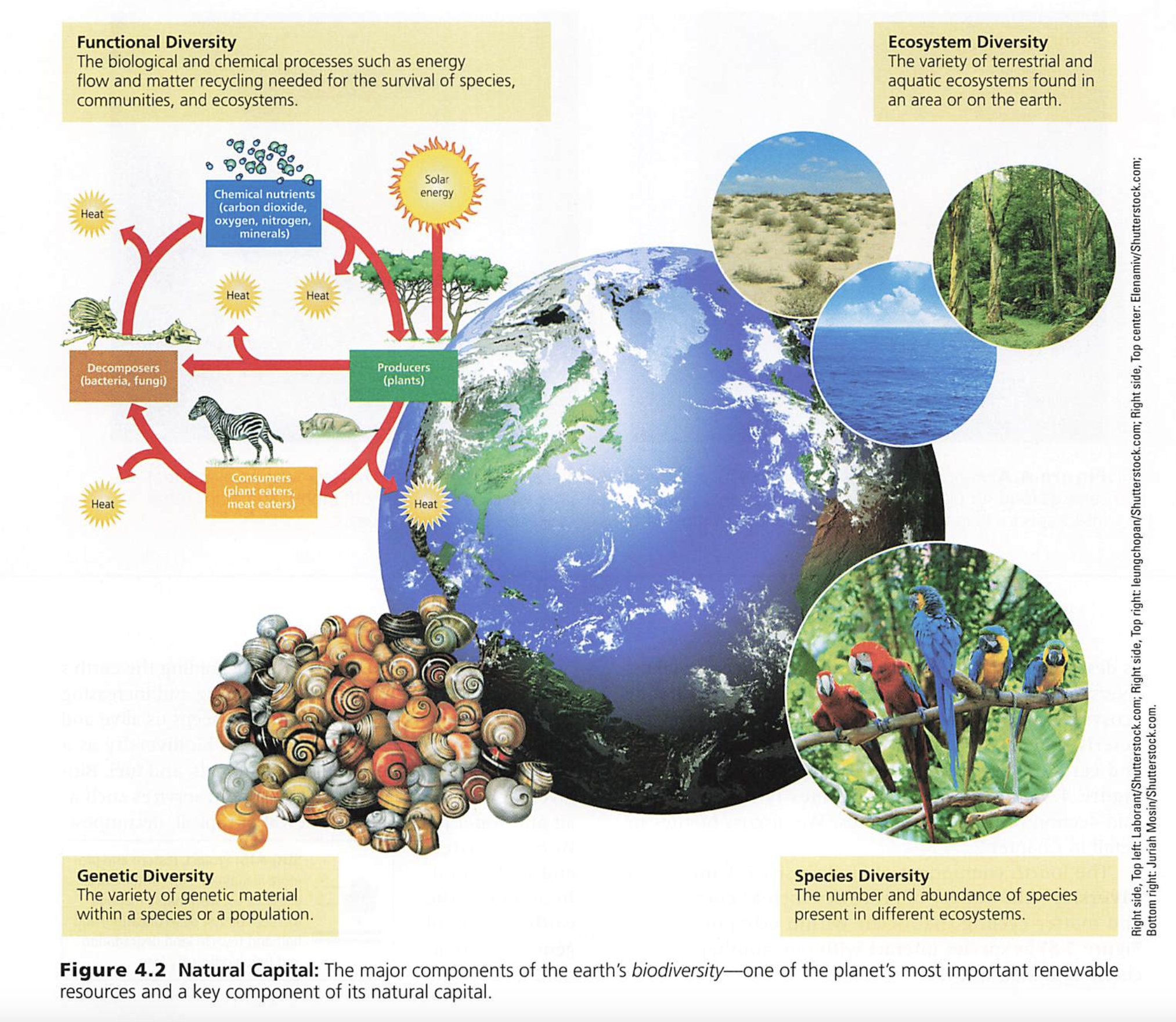Screenshot 2024-11-17 at 5.57.11 AM.pngFour kinds of biodiversity: why we studied Shannon's index as a relative metric
1. species diversity: number and abundance of species in an ecosystem
2. genetic diversity: genetic variation within a species
3. ecosystem diversity: number and abundance of biomes
4. functional diversity: energy and matter flows, food chains and food webs
One example: biome diversity of North America:
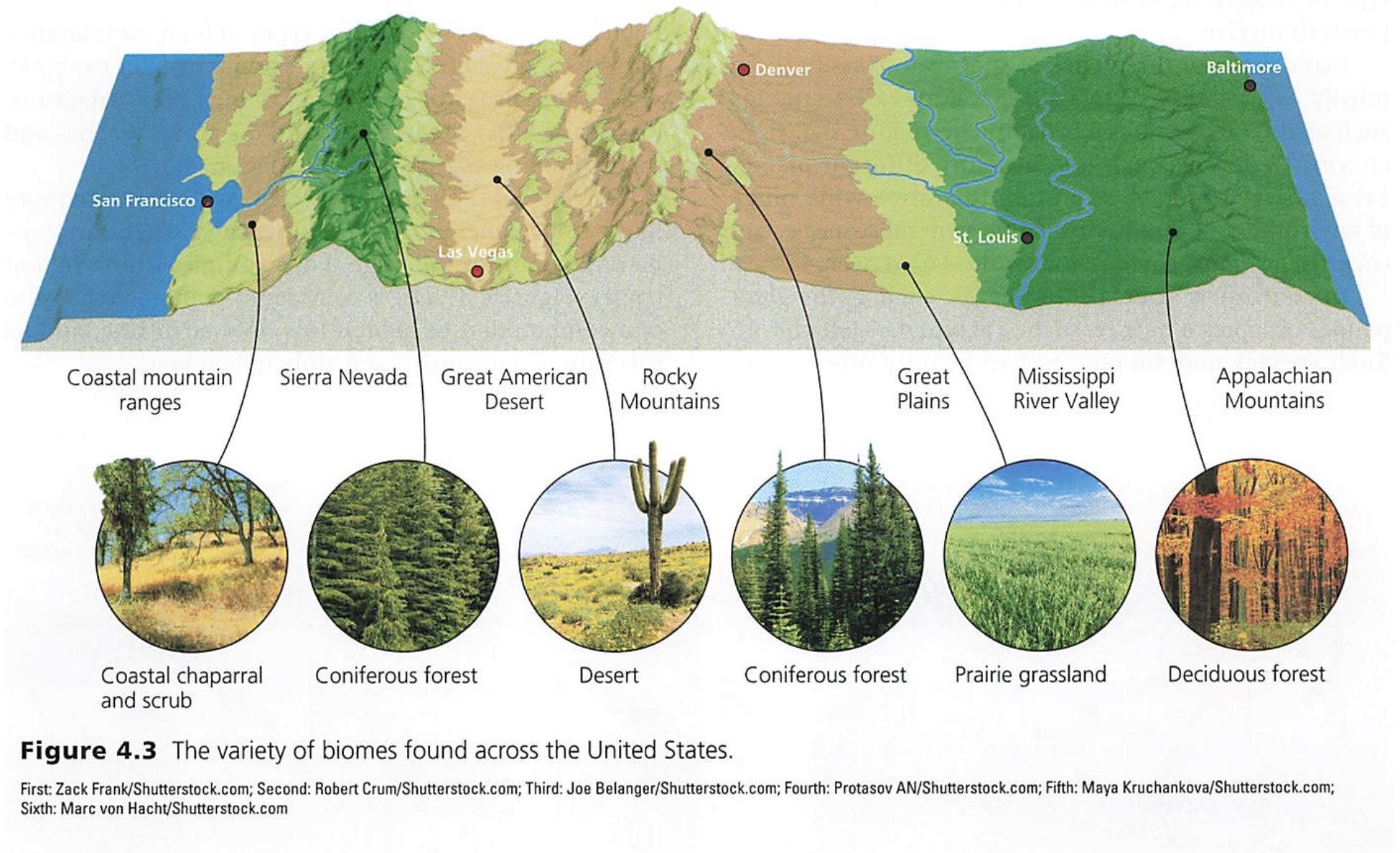Screenshot 2024-11-17 at 6.01.03 AM.png
- ecological niche is not the same as habitat
- generalist: broad niche
- specialist: narrow niche
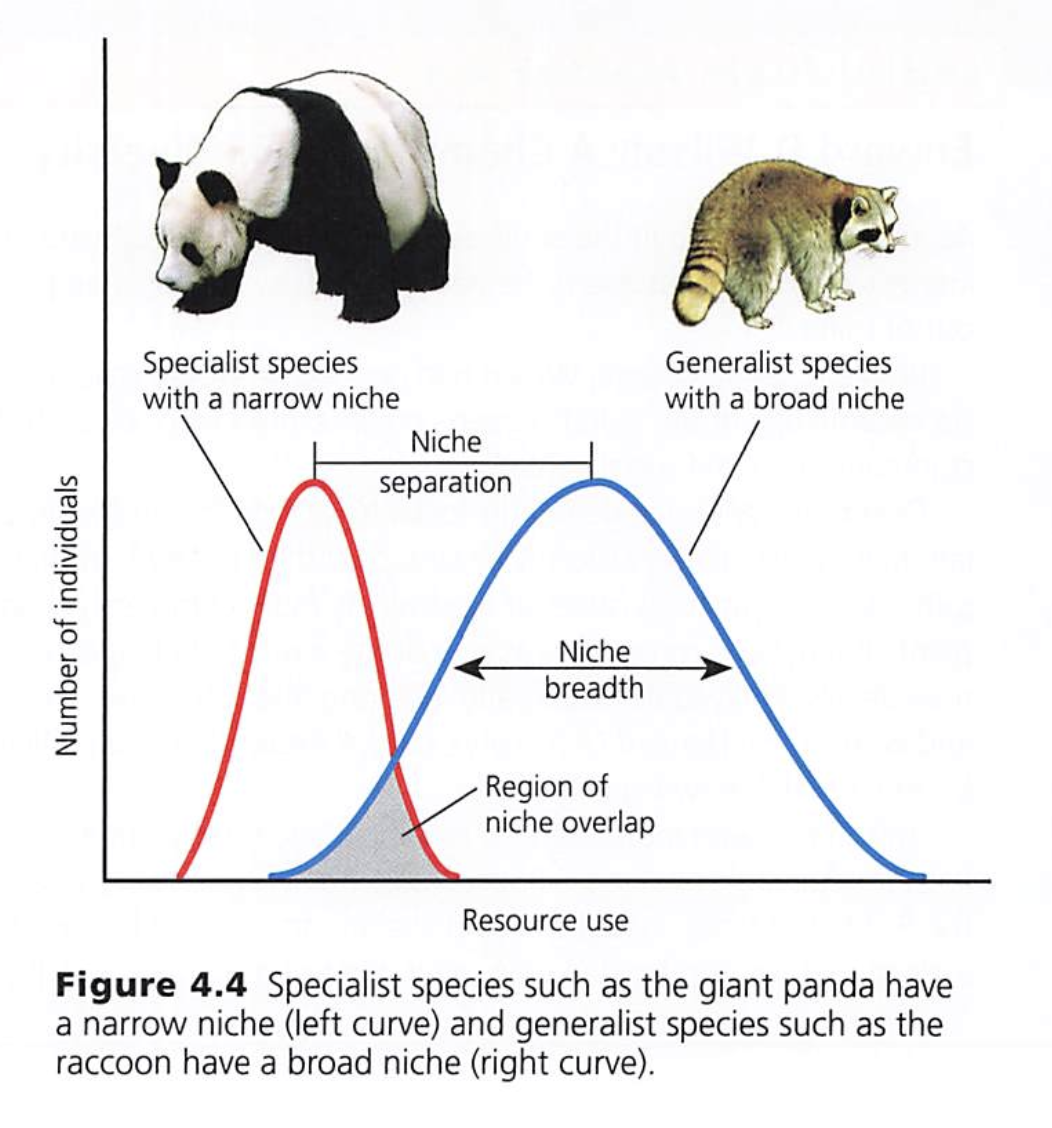Screenshot 2024-11-17 at 6.03.46 AM.png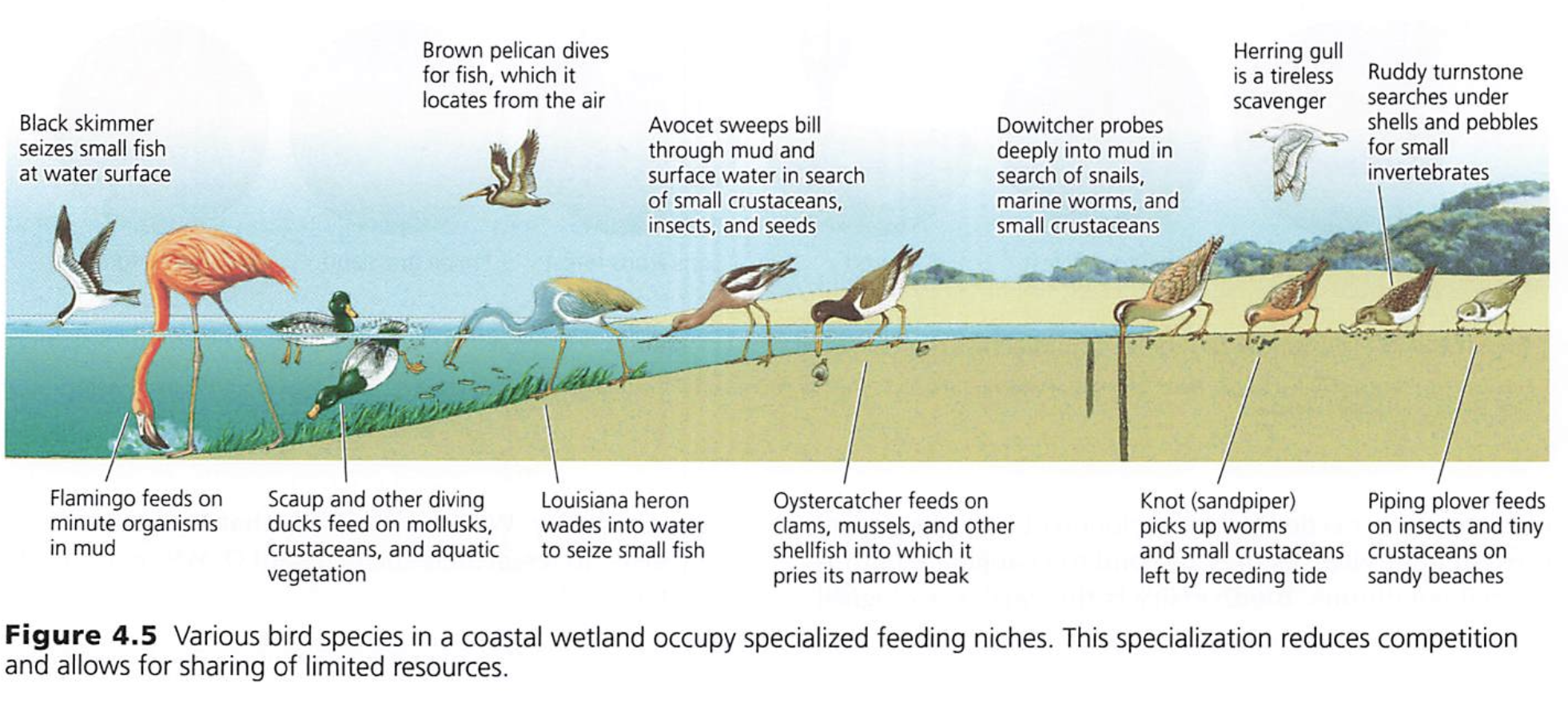Screenshot 2024-11-17 at 6.04.14 AM.pngSpecies stuff:
- Native species: normally live and thrive in an ecosystem
- non-native species: deliberately or accidentally introduced
- invasive species: compete with native species
- indicator species: biological smoke alarms
- keystone species: large effect on types and abundance of other species
- endemic species: only found in one place
Evolution: "biological evolution"
- natural selection: response to stress, three steps: variation, stress, survivor reproduction
- mutagens: cause mutations
Common myths about evolution:
Survival of the fittest means survival of the strongest.
To biologists, fitness is a measure of reproductive success, not strength. Thus, the fittest individuals are those that leave the most descendants, not those that are physically the strongest.
Evolution explains the origin of life.
It does not. However, it does explain how species evolved after life came into being around 3.8 billion years ago.
Humans evolved from apes or monkeys.
Fossil and other evidence shows that humans, apes, and monkeys evolved along different paths from a common ancestor that lived 5-8 million years ago.
Evolution by natural selection is part of a grand planin nature in which species are to become more perfectlyadapted. There is no evidence of such a plan.
Evolution by natural selection is not important becauseit is just a theory.
This reveals a misunderstanding of the concept of a scientific theory, which is based on extensive evidence and accepted widely by scientific experts in a particular field of study. Evolution by natural selection explains the earth's biodiversity and how populations of different species have adapted to changes in the earth's environmental conditions over billions of years.
How do species evolve?
Geographic speciation: separated, evolve for the new environment
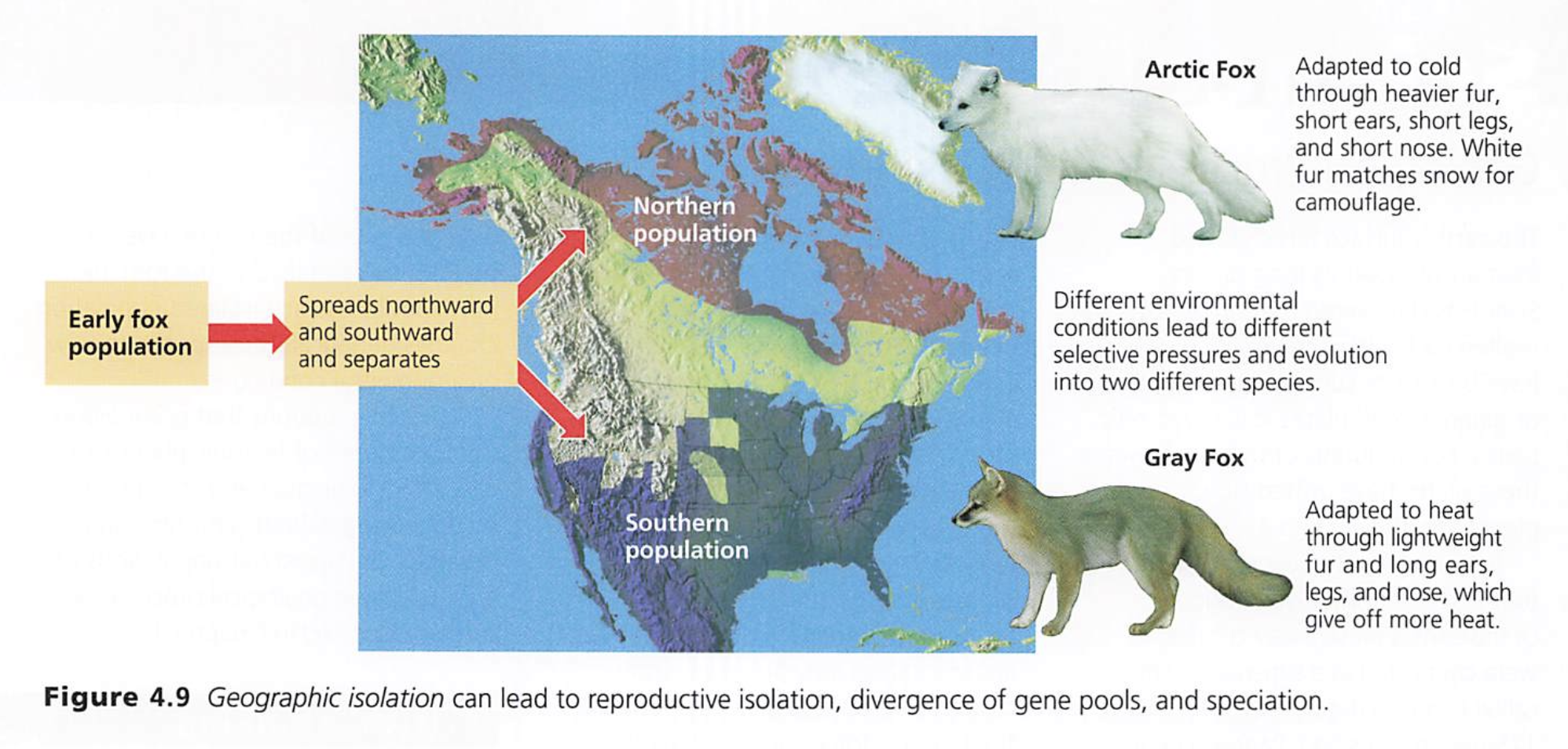Screenshot 2024-11-17 at 6.17.17 AM.png
Reproductive speciation: in one place, but genetic variations favor new species by natural selection
Man made: artificial selection: selective breeding or cross breeding within a species (e.g.dogs)
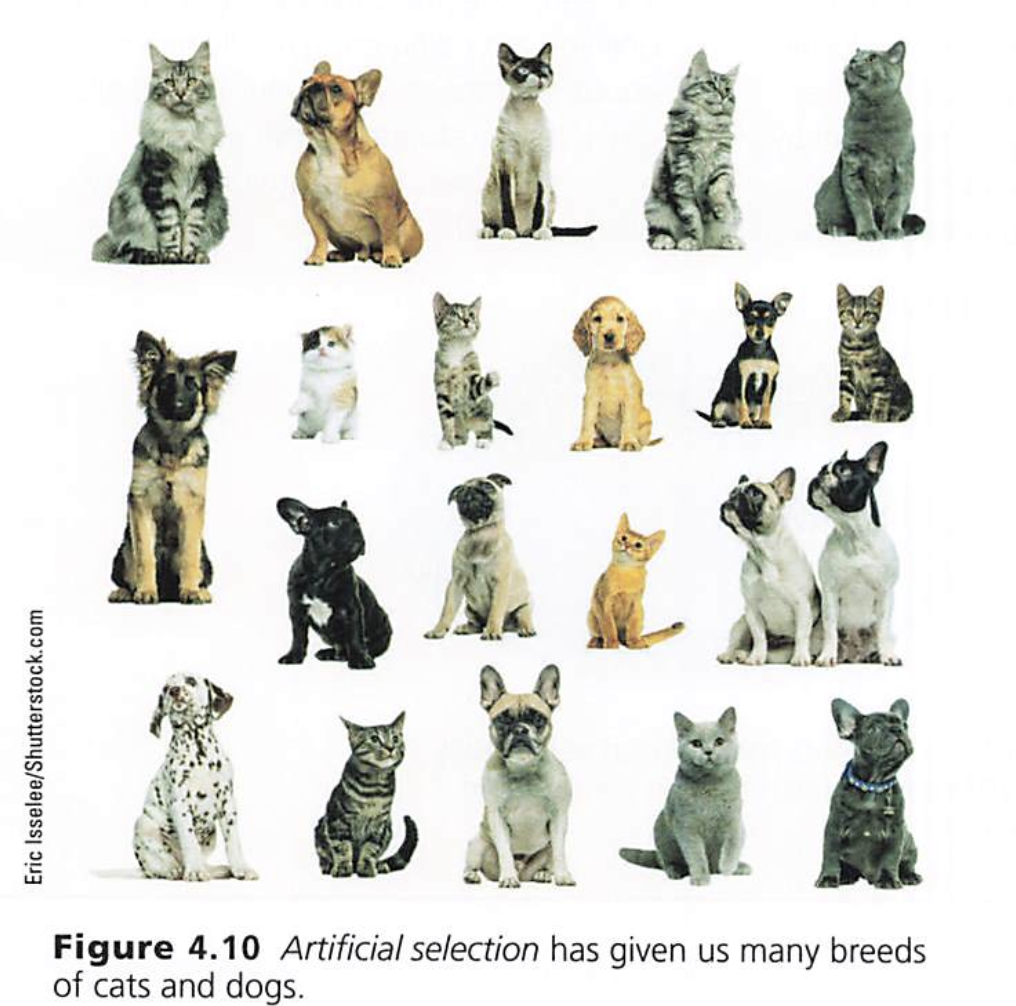Screenshot 2024-11-17 at 6.17.49 AM.png
These are different from genetic engineering: cutting and splicing DNA, creating GMOs, genetically modified organisms
e.g. splicing cold water fish DNA into tomatoes so they don't freeze
Synthetic biology: not even starting with living things, creating from scratch
Extinction:
endemic species: species only found in one place, vulnerable to extinction
Two types of extinction:
- background rate: natural
- mass extinction: massive events (see below)
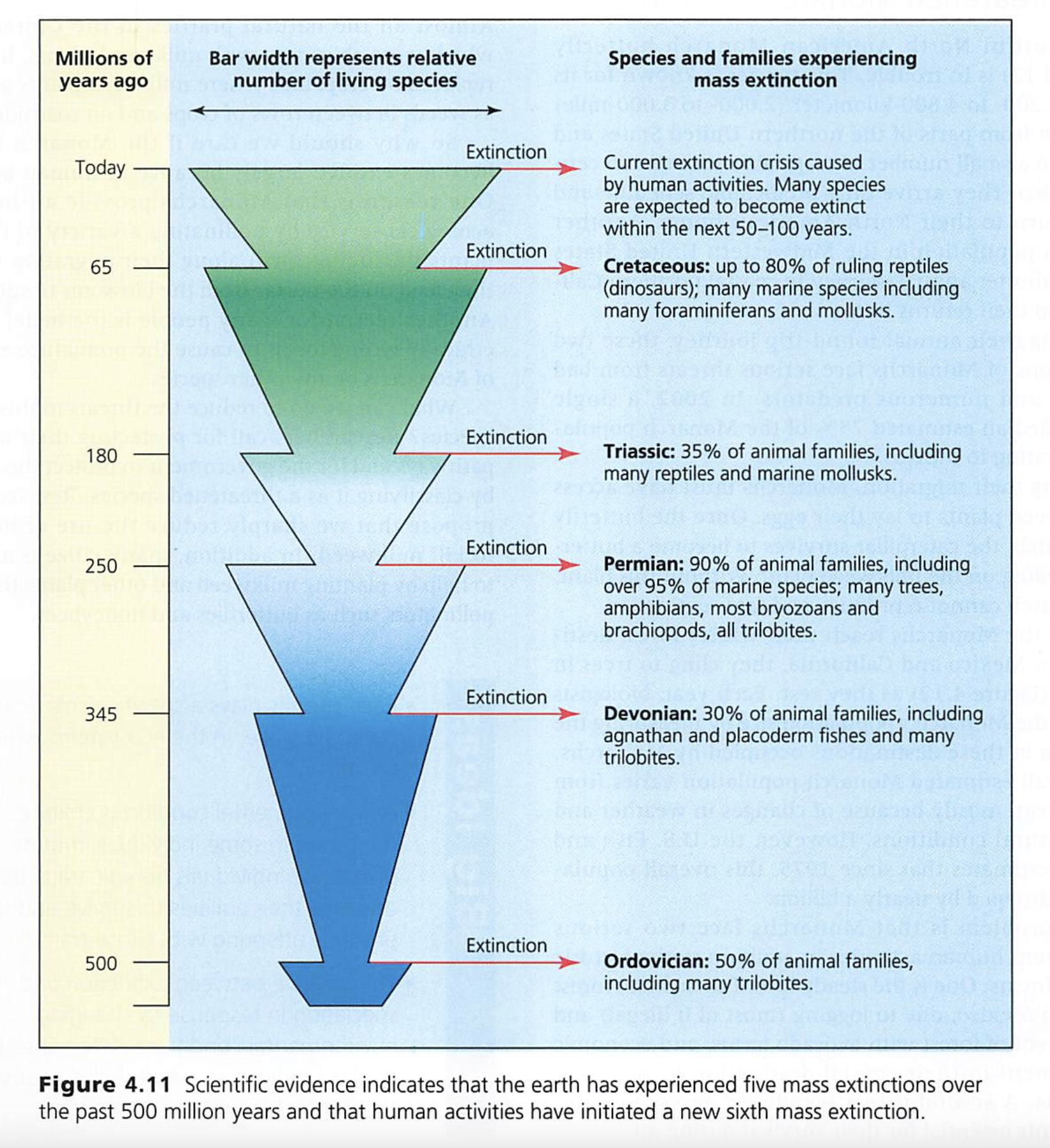Screenshot 2024-11-17 at 6.21.51 AM.png
---
Migrated from Apple Server Wiki. Original page ID: j3c0a5
# c5: population ecology
[cengage chapter 5:](https://elab.hpa.edu/apes/texts/parts/cengage5-population-ecology.pdf) population ecology
Five main types of species interactions:
1. interspecific competition
2. predation
3. parasitism
4. mutualism
5. commensalism
Interspecific competition: two species, niches overlap, compete for resources (e.g. humans and many animals)
Resource partitioning: one resource is shared by species, but in different ways:
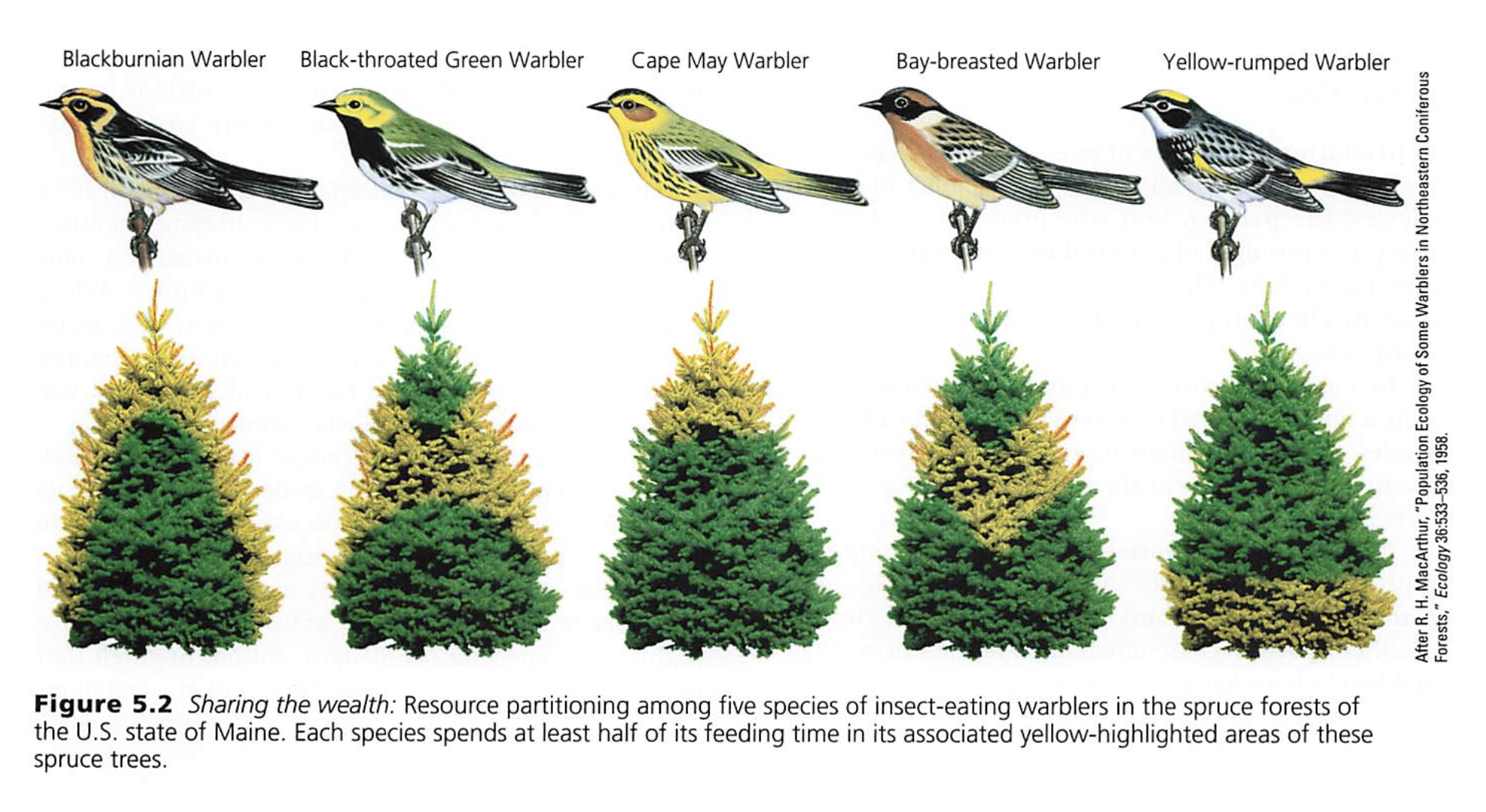Screenshot 2024-11-17 at 6.29.45 AM.png
Predation: predator-prey (one always dies, the other survives)
See also predator prey growth cycles
Predator strategies:
speed (e.g. cheetah)
teamwork (e.g. lions)
camouflage (e.g. praying mantis)
chemical warfare (e.g. spiders)
Prey survival strategies:
speed (gazelle)
senses (sight, sound, smell)
physical (shells, spines, thorns)
camouflage (arctic hare)
chemical warfare (octopus)
mimicry (looking like something else)
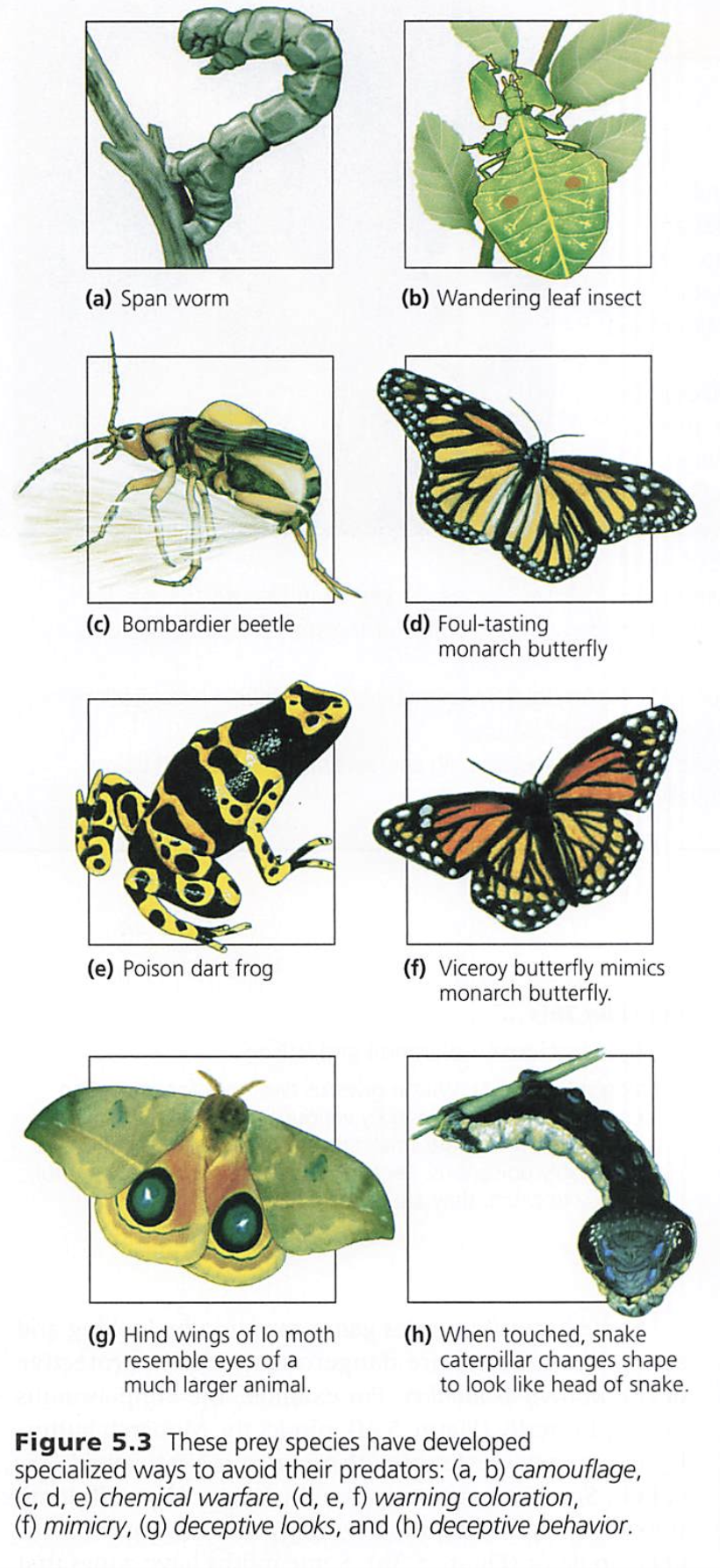Screenshot 2024-11-17 at 6.35.19 AM.pngCoevolution: predator gets better, prey gets better, predator gets better...
1. bats use sound to find moths (echolocation)
2. moths evolve to hear the sounds, evade
3. bats change the frequency
4. moths evolve to create their own sounds, blocking the bats
5. bats evolve to listen for the moth sounds
Parasitism: One lives off of energy and nutrients from the host "it is bad manners for the parasite to kill the host"
Mutualism: both benefit (birds eating bugs on cattle)
Commensalism: one benefits, the other does not care (orchids in trees)
Ecological succession:
Primary succession: from bare rock, no organic materials
Secondary succession: building blocks for live are there, have been removed (e.g. forest fire)
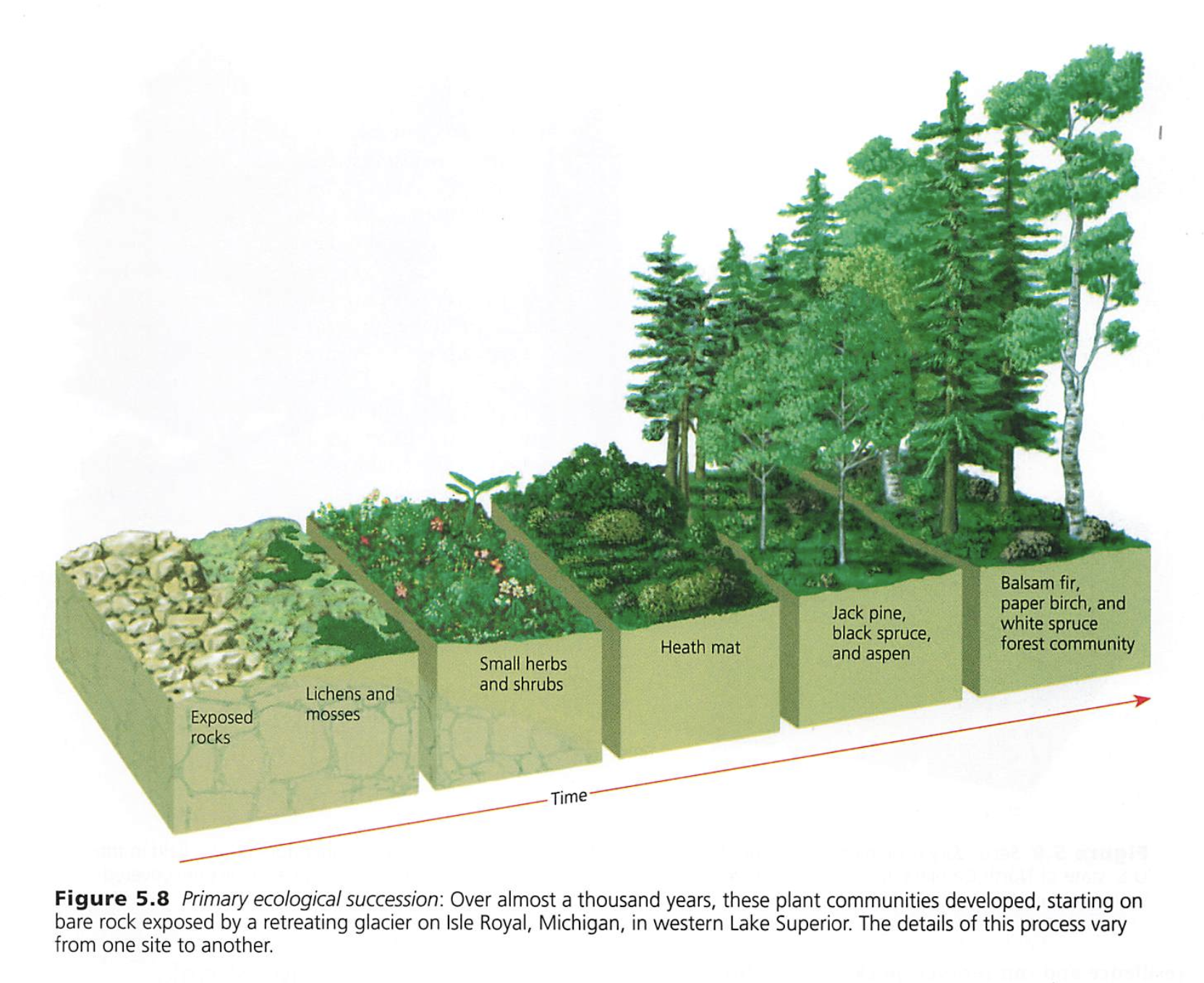Screenshot 2024-11-17 at 6.41.49 AM.png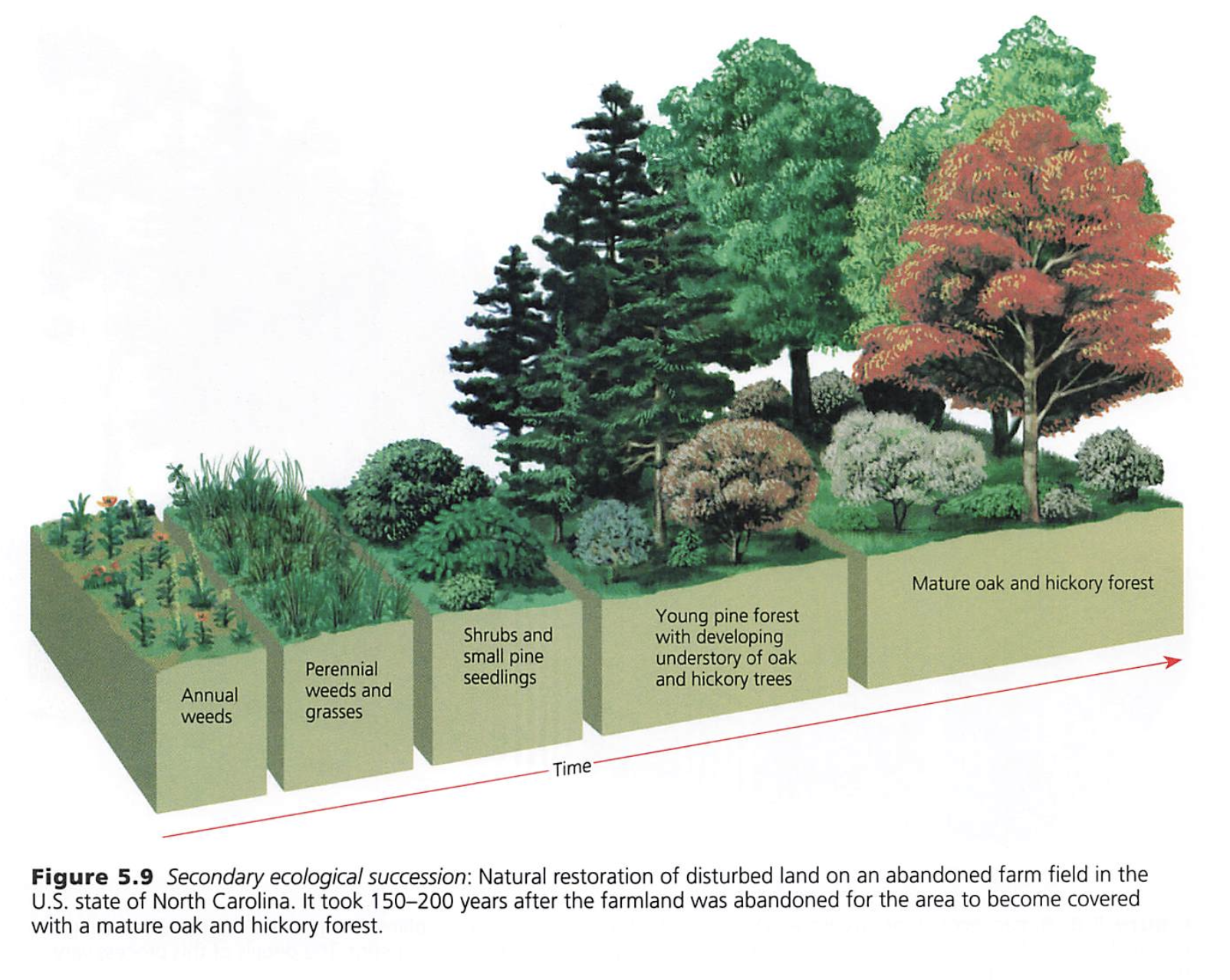Screenshot 2024-11-17 at 6.45.09 AM.pngDifferent take on resistance and resilience:
Resistance: "ecological intertia or persistence"
Resilience: ability to recover
Ecosystems have one or the other, not both:
Tropical rain forest: high diversity, high resistance, but when cleared cannot recover
Grasslands: low diversity, low resistance, but high resilience, organics are in the roots in a fire
---
Migrated from Apple Server Wiki. Original page ID: L730R4
# r, K lab
**r, K lab:
small plate “pond”
bowl with goldfish “reservoir”
don’t eat the goldfish-you will need them later…
1. start with one fish
2. double number of fish each reproductive cycle
3. after each cycle, when one fish touches another, both “die” and are removed
4. graph total number of fish after each cycle and the tragic cracker fatalities
5. repeat until you see equilibrium
**Random cards: repeat in each case
1. draw a line halfway across the plate, fish can only live on one side
2. a predator enters the pond, eating half of them
3. an invasive species enters, reducing the food supply
4. a disease reduces the birthrate for the fish, so that only every other fish has an offspring
5. a predator enters the pond, but eventually the fish develop an evasive tactic to hide from the predator
6. start with 10 fish instead of 1
7. when fish touch, remove three, not two
8. each cycle triple the number of fish
**Questions:**
1. what would happen if the reproductive cycle were much shorter?
2. where did you see overshoot and die-off?
3. what is the carrying capacity for the pond?
4. was this an equilibrium state?
5. what happened in the random card situations?
6. If the plate were 10x bigger, what would the graph look like?
7. label the r and the K part of the graph
•8.when the fish touch, they are removed-what is this a metaphor of?
---
Migrated from Apple Server Wiki. Original page ID: y6t5G5v25
# predator prey lab
**Predator-prey lab:
Goldfish “prey”
sticky note “predators” (any color)
large plate “pond”
1. create an ecosystem “pond”
2. start with one fish
3. each cycle, double the number of fish then drop a sticky note on the plate. If the sticky note touches a fish, next cycle drop two notes
4. repeat, doubling the fish population and for every sticky note that touches a fish, add another predator
5. graph your results
**Random cards:
1. use smaller sticky notes
2. use larger sticky notes
3. only double the number of fish every other turn
4. triple the number of sticky notes each turn
**Questions:**
1. what is using a smaller or bigger note a metaphor for?
2. how would a change of seasons change the graph if it were land based?
3. If it were land based on lynxes and hares, which would be the prey and which the predator?
4. during the "hunt" which of the prey are eaten first?
5. how does this improve the gene pool?
---
Migrated from Apple Server Wiki. Original page ID: z6y1B6S
# APES Home Design: active and passive systems
- passive vs. active: define
- why is passive better?
- How can you tell active from passive? Which systems fail with no power
- cost? benefits? intangibles?
- Extreme examples: elab vs. typical office building
- Points for including each of these into your design
- Research and include newer solutions (e.g. PV windows)
Passive design:
- air-ventilation
- water
- lighting
- heating-cooling
- energy
- waste
Elab examples:Passive air flow:
- using airfoil design, pulls air out of building
- horizontal louvers drop dust and mist while channelling air upwards along surface (laminar flow)
- Stack effect: hot air rises, pulls air up and out
- air exchange per hour to reduce CO2 (ACH)
- try: place your house in a natural air flow (valley, peak)
Passive water capture:
- Rain water capture on three roofs, one vertical, two horizontal
- gravity feed to tank
- solar powered pump
- solar powered UV purification
- pressure driven filtration
- green roof to capture and slow water (transit time)
- drip irrigation to preserve green areas, reduce temperature and evaporation
- evaporative cooling (EtO)
- low flow faucets and toilets
- bottled water to meet county regs (arsenic)
- grey water where possible (plants, irrigation)
- try: orient your house to capture rain or mistPassive lighting:
- orientation: south to capture light, depends on latitude
- north facing skylights to capture light, not heat
- diffusers to soften light, reduce heat and shadows
- south facing windows with shades as needed to modulate
- light colored floors and paints to reflect light inside
- try: orient your home to maximize passive lightingPassive heating-cooling:
- South facing windows with shades
- large thermal mass foundation, 180° phase change for heat
- west facing walls to capture heat for night
- wind driven air exchange
- sensible heat: air flow reduces perceived temp
- 12” soy foam insulation on roof
- insulation inside all walls
- Low E double glazed glass
- sound insulation panels for comfort, lighting, acoustics
- insulated floor tiles for sound
- heat exchangers where needed (e.g. AK, UAE)
- fiber siding reduces heat flow
- metal roof: reflects heat
- Overhang: reduces direct solar
- sealed doors in HVAC rooms
- periodic heating audit to locate heating-cooling leaks
- try: adjustable ventilation, heat exchangersPassive energy:
- Thermal panels with thermosiphon flow for hot water
- Passive solar PV panels for energy
- Lithium battery storage for night
- Wind turbines for cloudy augmentation
- EMC system to detect, reduce passive loads
- EV charging system below
- try: passive solar thermal firstPassive waste:
- Gravity flow to bioreactor
- Low flow faucets and toilets to preserve water capture
- try: local biodegradationElab active systems: all solar poweredAir:
- Thermal radiative cooling system, with solar pump
- Fans for air flow, augments stack effect
- HVAC filtration where neededWater:
- Water pressure system: solar powered
- Forced water purification system, solar poweredLighting:
- LED bulbs with occupancy sensors and timers
- Daylight sensors for exterior lights
- manual control for events, astronomyHeating-cooling:
- High SEER heat pumps for heating, cooling (HVAC)Energy:
- pump driven solar thermal system (demo downstairs)Waste:
- motor driven digester (if needed)Typical building systems:
- Air: very little air flow, sick building syndrome, toxic materials
- Water: no local capture, dependent on city water
- Lighting: incandescent, sodium (yellow), or CFL, harsh spectrum
- Heating-cooling: HVAC systems (pumps, radiators, AC)
- Energy: no local capture, dependent on city systems (HELLCO)
- Waste: dependent on city systems
NYC is an example, but offsets all of these active systems, with concentrated, efficient stacking of humans
Next: materials
---
Migrated from Apple Server Wiki. Original page ID: A4x3P8T5
# Energy Labs
Energy labs
- PV panels: PV efficiency
- Solar thermal panels: power output and efficiency, thermal camera
- Cottage hot water heater: thermal camera, look for leaks
- Tea maker: power, kWh, cost per cup of tea, egauge, kill-a-watt
- Superthermos: radiation, conduction, convection, R value
- Monitoring and conservation lab: egauge, skyspark (10.0.0.25:8080), vampire loads
- ROI-TCO lab: wind, pv, solar thermal
Outside labs-need sunlight:
—————Solar array lab:
1. walk up to the huge solar array above the elab with a meter stick and a few friends
2. measure the inside (blue) part of one of the panels in meters (not inches)
3. calculate the area in m^2 of one panel
4. count the panels
5. return to the comfort of the elab
6. look on the weather station (see below) for solar radiation
7. look on the egauge (see below) for power output on the egauge
8. calculate the solar radiation falling on the blue parts of all of the panels added up
9. divide the energy on the egauge by the total solar radiation
10. determine the efficiency of the total solar array
- Solar radiation sensor:
- [https://tempestwx.com/station/169148/grid](https://tempestwx.com/station/169148/grid)
- [http://10.14.62.1](http://10.14.62.10/)
- Energy monitor at the elab: (green is energy in, red is energy used)
- [http://10.14.8.1/62979/classic.html](http://10.14.8.1/62979/classic.html)
Calculations:
- Single panel area: \_\_\_\_\_\_\_\_\_\_\_\_m2
- number of panels: \_\_\_\_\_\_\_\_\_\_\_\_
- Total array area (area of one panel x number of panels): \_\_\_\_\_\_\_\_\_\_\_\_\_\_\_m2
- Solar radiation: \_\_\_\_\_\_\_\_\_\_\_\_W/m2
- Total ideal power from array: (total area x solar radiation): \_\_\_\_\_\_\_\_\_\_\_\_Watts
- Recorded actual power: \_\_\_\_\_\_\_\_\_\_\_\_\_\_\_Watts
- Efficiency: (actual power/ideal power. x 100) \_\_\_\_\_\_\_\_\_\_\_\_\_\_\_%
questions:
1. how could you increase the efficiency of the panels?
2. if you could increase this by 5%, how many kW would this be?
3. if the array produces energy an equivalent of 5 hours per day at max power, how many kWh is this?
4. at $0.40 per kWh how much money is this?
5. If you could improve the efficiency of the array by 5%, how much money would this be per day?
———Solar thermal power lab:
You will determine the power and efficiency of a solar thermal (hot water) panel
1. measure the dimensions of the glass part of the solar panel in meters
2. determine the area of the panel in m^2
3. turn on the pump on the power strip above the panel
4. adjust the water flow to where the water coming out of the top of the panel is almost too hot to touch
5. measure the temperature of the water going into the panel using one of the thermometer units (contact or infrared)
6. increase and decrease the flow and notice the difference-why?
Questions:
1. If the solar insolation is 1000 W/m2, how many watts are available for heating water in this panel? (multiply area by the insolation)
2. If the power output of the panel is 4500W, what is the efficiency for this panel?
3. How does this compare to the PV panels?
4. what did you notice about the flow rate and the temperature difference?
5. Which would you choose for your green home: PV or solar thermal?
6. what are the advantages and disadvantages of each?
7. consider storage of PV and solar thermal-compare each
—————Cottage hot water heater lab:
- You will be QUIETLY investigating the solar hot water tanks in several faculty cottages.
- These are private homes, so no talking or joking around.
- you will be using a very expensive, delicate heat camera, take care of it, and do not touch the lens, focus is the outer ring.
1. Carefully open the solar hot water heater tank outside cottage 4 and 5
2. Take photos of the plumbing in each case, email to me and to the occupants: rburchell@hpa.edu (cottage 5) and jbamba@hpa.edu (cottage 4)
3. Using the thermal cameras, look at each hot water heater for heat leaks
4. Determine which pipes go up to the solar thermal panel, and which ones come back down
5. Diagnose the setup and make suggestions for better insulation to save heat
6. Take photos of the thermal camera display and email these to the same folks (above)
7. Look on the skyspark server (see above) to determine when this heater is on and why
8. Check to see if the greybox timer (that is what they are called, no joke) is set to the correct time
9. Explain why this is important
10. One of the faculty cottage water heaters has a serious leak. Use skyspark to find this heater
questions:
1. what steps could you take to reduce the heat lost in the tank?
2. if the tank holds 80 gallons, how many liters is this?
3. to heat the tank uses 4.5 kW for 4 hours each day, how many kWh is this?
4. at $0.40 per kWh, how much does this cost each day, month and year?
5. If you could insulate the tank saving 20% of this, how much money would you save?
6. you are a business person, there are 320 million people in the US, and average 3 people per home. If you could save this same amount of money for them, how much is this?
7. If you sell an insulating blanket for each tank for $40, and it costs you $5, how much money would you make from the entire country buying your awesome product?
Inside labs----------------------
—————ROI-TCO lab:
- We will study three renewable energy sources you might include in your green home
- Wind: can run 24 hours per day
- PV: can be stored by batteries
- Solar thermal: stored in insulated tanks
Wind Power:
1. cost of a small wind turbine: $500
2. power output: 400 Watts (convert to kW)
3. realistic hours per day: 12
4. calculate $ per day earned by the device
5. calculate days to recover cost of device (ROI= return on investment)
6. if the device operates for 5 years, calculate the TCO (total cost of ownership)
7. If the device fails before the ROI, what is the TCO?
8. what are the benefits and negatives for wind?
PV (photovoltaic):
1. cost of a single panel: $400
2. power output: 400W (convert to kW)
3. hours per day: 5
4. $ per day earned by the device
5. ROI
6. TCO if panels last for 20 years
7. what are the benefits and negatives for PV?
Solar thermal:
1. cost of a single panel: $800
2. power output: 4.5 kW
3. hours per day:5
4. $ per day earned by the device
5. ROI
6. If the panel lasts 50 years, what is the TCO?
7. what are the benefits and drawbacks of solar thermal?
8. If a solar thermal panel is 90% efficient, and a PV panel is 15% efficient, with limited roof space, which would you choose for your home?
————Energy monitoring lab:
You will be using very sophisticated monitoring systems to evaluate energy use in the dorms and faculty cottages
1. You will need to be on the "hpa-students" wifi network, and go to http://10.0.0.25:8080 to start
2. Login as guest/guest
3. Host: upper campus
4. select “campus”
5. upper left corner, look for “select”
6. select a building to evaluate
7. looking at the dorms, what patterns do you notice about use?
8. which dorm is using the most energy every day? why?
9. look at the faculty cottages. If a hot water heater uses 4.5 kW, when do these turn on?
10. which cottage has a leaky or non-insulated hot water heater? how can you tell?
11. which buildings have an air conditioner installed? how can you tell?
12. now switch to the elab, what is the power used by the air conditioners at the elab?
13. how can you tell an air conditioner from a refrigerator (tough one!)
14. switch over to 10.14.8.2 on the elab network
15. look at the loads by panel: A B and C
16. If C is usually lights, how can you tell?
17. If the B panel is usually power outlets, how can you tell?
18. The A panel is Air conditioning and water treatment-how much power does the HVAC system use and when?
19. use the thermal camera to find vampire loads
20. turn the hot water heater on and off, and verify the load recorded on 10.14.8.2
questions:
1. what advice would you give to a homeowner who wants to reduce their electrical bill?
2. what is demand metering and why is it important for this study?
—————cost of tea lab:
- You will use two devices to measure energy use: the server at [http://10.14.8.2](http://10.14.8.2) and the kill-a-Watt devices
- You will be measuring the power and energy used to heat water for tea, using two of the hot water heater thingys.
1. fill the hot water heater thingy with water, to about 1 liter (1000 grams)
2. measure the temperature of the water
3. connect the heater to a kill-a-Watt meter and measure voltage, power and current
4. start your timer, and time how many seconds it takes to heat the water to boiling (100°C)
5. repeat this with another hot water heater, and compare the number of seconds it takes to boil
6. convert seconds into hours (divide by 3600)
7. convert Watts to kW (divide by 1000)
8. multiply kW by hours to get kWh for your tea adventure in both cases.
9. If each cup of tea is about 100 ml, how many cups of tea could you get from each event?
10. divide the cost to heat by the number of cups of tea.
11. imagine that Starbuck or Surfcamp says they need to raise prices for tea because of energy, can the be true?
12. how can you conserve energy (and money) in your home when making tea?
13. compare your results and calculations with the meter with your estimate by looking at http://10.14.8.2
14. advanced stuff:
1. 1 liter of water is 1000 grams
2. calculate the change in degrees C from cool water to boiling (100°C)
3. multiply this by 1000 to get calories
4. multiply calories by 4.18 to get joules
5. multiply Watts recorded by seconds to get joules from electricity
6. which of these joule values is higher and why?
———Superthermos lab:
You will use various containers to evaluate conduction, radiation and convection
This is similar to a demonstration we did in the first semester, this time you will measure values to determine R, the thermal transmission (emissivity) of your home.
1. Fill several containers with boiling water (amount is not critical)
2. set your timer and measure the temperature every minute for at least 15 minutes, longer is better.
3. measure the room temperature
4. calculate the difference between boiling water (100°C) and the final temperature for each container
5. use the exponential decay formula (below) to determine k for your each container
6. 1/k is R, the emissivity of each container
7. calculate R for each container and explain the differences
8. what can you use from in the design of your green home?
Exponential decay formula:
- Tt = To(e^-rt)
- Tt/To = e^rt
- ln (Tt/To) = rt
- (ln (Tt/To))/t = r
- 1/r = K
---
Migrated from Apple Server Wiki. Original page ID: 93V0e6B2p
# Dream green home summary report
Dream green home summary report:
You will evaluate three projects and create 4 email messages:
One email to each project creator (10 points each), and a summary email to me, which will be worth 50 points
For each creator email, evaluate their project on these metrics:
1. how was energy harvested and stored?
2. how was water harvested and stored?
3. how was waste handled?
4. how did the design influence these?
5. what were the most inspiring parts of this for you?
6. what suggestions would you make to each creator to improve their design?
Summary report: email to me, 50 points total
include the text of each email you sent to each creator (10 points each)
Answer the following (20 points total):
1. in the projects you studied, what where the greatest environmental challenges and how did each respond to these?
2. From the e2 videos you watched, what elements did you see included in each design?
3. What elements of each home would you include in your own home as an adult in a few years?
4. If you moved into a home already built, what could you do to make it a greener place to live?
---
Migrated from Apple Server Wiki. Original page ID: z1p1G0Z6
# AP FR practice
Folks, please review these Free Response questions from 2024 and 2023.
Look for the following:
- notice how the depth of each question increases with each section
- notice what subjects are combined into one question
- note how they are graded-see me for grading standards
- look over correct responses:
- how detailed are they?
- how much time should I spend on each one?
- how important is it that I re-read the question before moving on?
Free response sample question [folder](https://elab.hpa.edu/apes/_pdf/apes%20FR/)
Link to [folder](https://elab.hpa.edu/apes/_pdf/apes%20FR.zip)
APES FR notesKnow the Exam Structure
• FRQs = 40% of your score.
• 3 questions:
1. Design an Investigation2. Analyze an Environmental Problem and Propose a Solution3. Synthesize Information from Multiple TopicsMaster Key Content Areas
Review the most tested topics:
• Biogeochemical cycles (carbon, nitrogen, phosphorus)• Energy flow and trophic levels• Climate change and greenhouse gases• Pollution types and sources• Population dynamics• Sustainability and land use
Use AP Classroom, Barron’s, Princeton Review, or Fiveable for focused study.
Practice Free Response Questions• Use past FRQs from College Board (linked below).• Time yourself (22 minutes per question).• Use the APES scoring guidelines to self-grade and understand how points are awarded.• Practice writing clearly and concisely—no fluff, just facts.
🔗 [Past FRQs and Scoring Guidelines – APES](https://apstudents.collegeboard.org/courses/ap-environmental-science/free-response-questions)
Use the CER Framework
When writing responses, structure them as:
• Claim: Make a direct, factual statement.
• Evidence: Use data or facts from the prompt.
• Reasoning: Explain how the evidence supports the claim.
Example:Claim: A decrease in biodiversity negatively impacts ecosystem stability.Evidence: Loss of pollinators like bees leads to reduced crop yields.Reasoning: With fewer pollinators, plants fail to reproduce, leading to food shortages in the ecosystem.Show All Math Clearly
• For any math-based questions:
• Show all units
• Write out the formula
• Plug in numbers before solving
• Box the final answer (easier for the grader)Use Specific Vocabulary
• Say “nitrate runoff causes eutrophication” instead of “pollution is bad”.
• Environmental science is full of key terms—use them confidently and accurately.
Memorize Key Examples
Have 1–2 examples ready for common themes:
• Case studies: BP oil spill, Three Gorges Dam, Aral Sea, Chesapeake Bay
• Laws: Clean Air Act, Endangered Species Act, Clean water act
• Solutions: Renewable energy types, conservation techniques, population control
Analyze Graphs and Data
• Practice interpreting graphs, reading axes (x and y, not the kind you throw), and describing trends.
• Use terms like “increase,” “fluctuate,” “plateau,” and always relate data back to environmental concepts.
FOR MATH/CALCULATIONS
- - Show your setup (formula)
- - Include units in all steps
- - Circle or box your final answer
Example:
Formula: Rate = Quantity / Time
Work: (1000 kg - 500 kg) / 5 years = 100 kg/year
Answer: 100 kg/year
COMMON TOPICS & VOCABULARY TO USE
- Biodiversity: Genetic diversity, ecosystem services, habitat fragmentation
- Pollution: Point vs. nonpoint, bioaccumulation, thermal, noise
- Climate: Greenhouse gases, carbon sinks, feedback loops
- Energy: Renewable, nonrenewable, efficiency, EROI
- Water: Aquifers, eutrophication, water tableWaste: Landfill, leachate, incineration, recycling
- Agriculture: Monoculture, IPM, soil salinization, GMOs
KEY LAWS & CASE STUDIES
- Clean Air Act Regulates air pollutants
- Clean Water Act Maintains water quality
- Endangered Species Act Protects threatened species
- CERCLA (Superfund) Cleans hazardous sites
Case Studies:
- BP Oil Spill Marine pollution
- Three Gorges Dam Hydroelectric power & habitat loss
- Aral Sea Water diversion, ecosystem collapse
FOR GRAPH/DATA QUESTIONS- Describe trend (increase, decrease, plateau)- Use data values or years- Explain why the trend happens (link to concept)PHRASES THAT SCORE POINTS- "This causes a decrease in biodiversity because..."- "This is a sustainable practice because it reduces..."- "This leads to eutrophication due to increased nutrient runoff..."
---
Migrated from Apple Server Wiki. Original page ID: m832k931
# withgott 7.1: science and sustainability
Withgott ch. 1 science and sustainability
[https://elab.hpa.edu/apes/texts/Withgott7e%20v.2%20ocr/ch1ocr.pdf](https://elab.hpa.edu/apes/texts/Withgott7e%20v.2%20ocr/ch1ocr.pdf)
1. why was the 1968 photo so enlightening?
2. how are renewable and non-renewable resources different?
3. how did the agricultural revolution change how humans approached the environment? (AP human folks: guns, germs and steel mentions this too)
4. how is this different from the industrial revolution?
5. what is the ecological footprint based on?
6. give a personal example of overshoot where your supply exceeds your demand
7. how is APES different from any course you have taken? (see fig. 1.6)
8. look up the theories about what happened to Easter Island-is there consensus?
9. create an example in your life of a dependent and an independent variable in something you are testing
10. explain why a control is always needed in any experiment, and give an example in your made up test
11. explain why time is always represented as the x-axis on any graph
12. look up "cold fusion" and explain how we knew it was bogus
13. look at the graph on page 17, and explain the bump at 1973
14. Watch this video and explain why their logic is broken: [](https://www.youtube.com/watch?v=zrzMhU_4m-g)
[](https://www.youtube.com/watch?v=zrzMhU_4m-g)
15. [ ](https://www.youtube.com/watch?v=zrzMhU_4m-g)[https://elab.hpa.edu/apes/videos/Village%20Witch%20with%20English%20subtitles.mp4](https://elab.hpa.edu/apes/videos/Village%20Witch%20with%20English%20subtitles.mp4) minutes 0:45-4:15
[ ](https://www.youtube.com/watch?v=zrzMhU_4m-g)
---
Migrated from Apple Server Wiki. Original page ID: 6040i9d842
# Questions: Scientific Method
[https://elab.hpa.edu/apes/\_pdf/cengage/chapters/](https://elab.hpa.edu/apes/_pdf/cengage/chapters/)
Look for chapter 2
1. Primitive societies at one time would sacrifice food, animals or even people to ensure a good harvest, good weather, or other things. If the harvest was good, was this causation or correlation?
2. How is the scientific method different from this?
3. Look up Pons and Fleischmann and cold fusion. How did the rest of us know they were fake, and what part of the scientific method is relevant here?
4. What is the difference between accuracy and precision when discussing data?
5. Give an example of a dependent and independent variable in your life, and explain each
6. Bud Tuggly does an experiment on caffeine and study ability with students, using only 3 students. What is wrong with this, and why is sample size important in any experiment?
7. Create an imaginary experiment with a hypothesis, explain your result
8. You are given the following data regarding caffeine and speed of a runner around a course:
- 1 cup of coffee: average speed 6 km/hr
- 2 cups of coffee: 6.5 km/hr
- 3 cups of coffee: 7 km/hr
- 4 cups of coffee: 6 km/hr
Graph these and label with the dependent and independent variable. (take a photo of your graph for the email)
9\. what could also be impacting this experiment that we did not include?
10\. In this experiment, what would be a control group?
11\. In 1979 Mount St. Helens erupted, covering a huge area with ash. How was this a natural experiment, and why is it different from a normal experiment?
12\. Ella Finoe wants to determine the efficiency of her car. She records the odometer when she fills the gas tank as 245.4 miles, and on the gas pump, 14.3 gallons. She then calculates her miles per gallon as 17.1608391608 mpg. What is wrong with this?
---
Migrated from Apple Server Wiki. Original page ID: w3C994H
# 25.08.20: science terms, method
Alternate resource: [https://elab.hpa.edu/apes/texts/fr3e/friedland-relyea-3rd-edition.pdf](https://elab.hpa.edu/apes/texts/fr3e/friedland-relyea-3rd-edition.pdf)
Key part of science is peer review and replication
- Peer review: qualified folks who know the subject well review the process, data and interpretation
- Replication: once published in reputable media, the experiment must be able to be replicated using the same tools
- Pons and Fleschmann: no replication possible, same with the S. Korean human cloning guy
Key skills:
- Be skeptical about everything you read or hear.
- Evaluate evidence and hypotheses using inputs and opinions from a variety of reliable sources.
- Identify and evaluate your personal assumptions, biases, and beliefs and distinguish between facts and opinions before coming to a conclusion.
Bad example: Monty Python Witch scene: [https://www.youtube.com/watch?v=Ii68tPIiZOo](https://www.youtube.com/watch?v=Ii68tPIiZOo)
Law vs. theory: if verified and proven cause and effect, theory can become law: tentative, open to future data
Climate change example:
1. Global temperatures are rising based on ice core data and recent measurements
2. Carbon dioxide and other greenhouse gases follow the same pattern
3. The dynamics of light, heat and gases is well known
4. The impact is far greater than smaller variations (e.g. tilt of the earth)
5. Carbon dioxide is a byproduct of human fossil fuel burning
6. Human activity is linked to climate change
Important terms (yes, these actually show up on the AP exam):
- Variable: any difference, in a planned or "natural" experiment
- Independent variable: the part that does not change (like x in a graph)
- Dependent variable: the part that changes-or not
- Null hypothesis: proving something is NOT cause and effect (can sheep's bladders be used to predict earthquakes)
- Replication: everybody must be able to get the same results, using the same materials
- Sample size (n): must be large enough to be accurate
- Accuracy: close to truth or true value
- Precision: how close your results are to each other (gas pump is in 0.01liters, but your odometer is only in miles)
- Control group: those you DON'T mess with in the experiment (think of some drug test)
- Natural experiment: variation not planned (Lahaina, COVID, Mount Pinatubo and cooling of the planet, etc.)
Trivia question: what does Frankenstein have to do with an erupting volcano?
Graphing:
X axis: independent variable
Y axis: dependent variable (the result)
question: in math, a function is something with only one dependent variable-why?
Units:
mks system is meters, kilograms, seconds
prefixes to know:
- kilo: thousand, 1000 or 10^3
- mega: million, 1000000 or 10^6
- giga: billion, 1000000000 or 10^9
- centi: 1/100 (like cents), 1 cm is about the width of your pinky
- milli: 1/1000, millimeter is 1/1000 meter, 1/10 of your pinky
- micro: 1/million
- nano: 1/billion
Demo: meter stick
challenges:
- how many cm tall are you?
- How many mm to Kona (62 km)?
- How many kg do you weigh?
Temperature:
- Fahrenheit: only used by older civilizations, or the US (joke there), based on goofy science from long ago
- Centigrade: based on 0° for ice, 100° for steam
- Kelvin: bad guys in Star Trek, or based on molecular motion: absolute zero is 0°K, ice is 273°K, steam is 373°K
- Cool idea: at absolute zero, things could vanish (actually they would get very, very small) why?
Questions:
1. how many nanometers tall are you?
2. if you were weighted in grams, how many would that be?
3. what is your body temperature in °C? In °K?
4. an element has 3 protons and 4 neutrons, what is the symbol?
5. what is the charge if it has 2 electrons?
6. what do you call this?
7. another element has 3 protons and 3 neutrons, how is this related to the element above?
8. look up the periodic table and find this element, what column is it in?
9. what else is in that column going up and down?
10. why do we need a Kelvin scale and a Centigrade scale?
Look for chapter 2
1. Primitive societies at one time would sacrifice food, animals or even people to ensure a good harvest, good weather, or other things. If the harvest was good, was this causation or correlation?
2. How is the scientific method different from this?
3. Look up Pons and Fleischmann and cold fusion. How did the rest of us know they were fake, and what part of the scientific method is relevant here?
4. What is the difference between accuracy and precision when discussing data?
5. Give an example of a dependent and independent variable in your life, and explain each
6. Bud Tuggly does an experiment on caffeine and study ability with students, using only 3 students. What is wrong with this, and why is sample size important in any experiment?
7. Create an imaginary experiment with a hypothesis, explain your result
8. You are given the following data regarding caffeine and speed of a runner around a course:
- 1 cup of coffee: average speed 6 km/hr
- 2 cups of coffee: 6.5 km/hr
- 3 cups of coffee: 7 km/hr
- 4 cups of coffee: 6 km/hr
Graph these and label with the dependent and independent variable. (take a photo of your graph for the email)
9\. what could also be impacting this experiment that we did not include?
10\. In this experiment, what would be a control group?
11\. In 1979 Mount St. Helens erupted, covering a huge area with ash. How was this a natural experiment, and why is it different from a normal experiment?
12\. Ella Finoe wants to determine the efficiency of her car. She records the odometer when she fills the gas tank as 245.4 miles, and on the gas pump, 14.3 gallons. She then calculates her miles per gallon as 17.1608391608 mpg. What is wrong with this?
---
Migrated from Apple Server Wiki. Original page ID: e0c2X7w
# Week two: Environment and scientific method
- summarize your cause and effect projects for presentation in day 2 of the week
- begin exploration of cause and effect
- begin readings from fr text chapter 1 (link below)
energy->water->food->culture
1. With energy you can move/purify water
2. With water you can grow food
3. With food you can maintain a culture
What is the "environment"?
- Front of ship fell off-[https://www.youtube.com/watch?v=3m5qxZm\_JqM](https://www.youtube.com/watch?v=3m5qxZm_JqM)
- "we towed it out into the environment"..."you mean into another environment"
Environment: Everything around us, including us
Climate change map-try this out:
[https://impactlab.org/map/#usmeas=absolute&usyear=2080-2099&gmeas=absolute&gyear=1986-2005&usyear=1986-2005&gmeas=absolute&gyear=1986-2005](https://impactlab.org/map/#usmeas=absolute&usyear=2080-2099&gmeas=absolute&gyear=1986-2005&usyear=1986-2005&gmeas=absolute&gyear=1986-2005)
Nebraska->Alberta by 2050
Module 1 -------------
Fracking-know what it is? Why is it controversial? How has it changed how we generate electricity in our country? At what cost? Why is this politically important? Why are the solvents they use secret? What is the impact of these solvents on water?
Bio=life, so biotic means living, abiotic means not living (druids had a neat view on this)
How systems are defined enables us to create models of cause and effect (favorite topic of physicists and historians as well)
Module 2 ---------------
Environmental indicators: what we know and can observe that indicate the condition of a system
- Biodiversity
- Food production
- Global warming
- Human Population
- Resource depletion
1. Biodiversity: biological diversity (more about this later)
- Robust systems (can be biological, racial, technological) all have strong diversity
- Genetic Diversity: genetic variation within a population (corn for example)
- Species: ducks vs. dogs
- Species diversity: variation of species in an ecosystem
- Speciation (more) vs. extinction (less)
- Background speciation rate (cosmic rays)
- Background extinction rate (before humans, much higher in the anthropocene era)
Speciation: an adaptation based on stress (evolution)
Evolution needs three things:
1. some form of genetic variation
2. some stress that favors this variation
3. survivors have to reproduce and carry on the variation
Think of giraffes as an example:
1. longer necks in some animals
2. drought that kills all short neck creatures (just like in land before time)
3. long neck animals survive to reproduce and carry on the variation
Cool stuff:
- There is a theory that the background rate of mutation/speciation was much higher long ago because our atmosphere was thinner, and enabled more cosmic rays to penetrate, causing much higher rates of mutation/speciation.
- In England, butterflies have adapted since 1850 to look more like soot from coal fires.
- In NYC, a species of "subway mosquitoes" have been found that feed on humans in a dark, cool place
- Huh.
Extinction is the opposite of speciation, where species die off (except in the film Jurassic Park)
There is such a thing as a "background rate of extinction", which we have surpassed by many times
Diversity is good: think of monoculture food crops: one pest kills everything
2. Food production: see Malthus and Norman Borlaug, e.g. Mexico famine
- grain variation and monoculture
- regional grain production (e.g. Pearl river delta)
- vegetarian vs. carnivores
3. Global Warming
Man made, from burning fossil fuels (anything that was living, decayed capturing atmospheric carbon)
carbon dioxide was in the air, then captured as plants and animals
we burn their carbon with oxygen to make carbon dioxide
greenhouse gases: trap infrared radiation, warming the planet (cause and effect)
Not too many people know we need some CO2 to keep water above freezing-think of this as we search for exoplanets...
- growth rates
- dispersion
- access to water
- Why was China’s one child policy eventually a problem for China?
- education, reproductive rights and religion
- water is first
- Resource depletion is hard to grasp, but resource constraints are easier:
- If we had a major tsunami here that closed airports (all near the shore) and ports, how long would we have electricity?
- water? (pumped by electricity)
- food?
Sustainability: ability to sustain present conditions forever (not likely)
Ecological footprint: what you calculated
1. Can you follow cause and effect?
2. What is their logical path?
3. Why do folks associate fossil fuels with global heating?
4. Who might be against this line of reasoning and why?
5. Fact: in ancient times, women were thrown into ponds to determine if they were witches. If the water "rejected them" they were possessed by the devil and therefore witches. If not, they just drowned. It is a wonder we made it this far.
6. Another example: cold fusion (look this up) Ponds and Fleishmann claimed they could replicate the processes in the sun (1 million degrees C) in a cooler on a table.
7. Science is built on replication: if a process cannot be replicated, it cannot become part of the scientific "pyramid" of understanding. No bad blocks allowed.
8. Also key is taking notes (must be in pen, not pencil). Alfred Nobel invented dynamite. His brother's last words in his lab notebook, in pen were "I'm now going to compress the dynamite"
9. Why is there no Nobel prize for Mathematics?
Replication is key: if you have magic beans, and nobody can replicate your results, you are in trouble.
See also Korean claims of cloning humans (not sheep, we already did that-her name was Dolly)
Key idea: even wrong experiments are valuable: Edison: "I learned 800 ways not to make a light bulb"
Important terms (yes, these actually show up on the AP exam):
- Variable: any difference, in a planned or "natural" experiment
- Independent variable: the part that does not change (like x in a graph)
- Dependent variable: the part that changes-or not
- Null hypothesis: proving something is NOT cause and effect (can sheep's bladders be used to predict earthquakes)
- Replication: everybody must be able to get the same results, using the same materials
- Sample size (n): must be large enough to be accurate
- Accuracy: close to truth or true value
- Precision: how close your results are to each other (gas pump is in 0.01liters, but your odometer is only in miles)
- Control group: those you DON'T mess with in the experiment (think of some drug test)
Natural experiment: variation not planned (Lahaina, COVID, Mount Pinatubo and cooling of the planet, etc.)
cb51f98b-b94b-b94b-b111-0b2bab06f916
Ozone hole example: compare and contrast with anthropogenic climate change-why different?
Renewable vs. non-renewable resources (one politician recently tried to get nuclear energy classified as a renewable resource-it takes billions of years)
Renewable can be a forest, if used at a sustainable rate, otherwise not
Malthus again, Norman Borlaug again, and a new name: Paul Erlich (1968) "The Population Bomb"
In short: famine and conflict will arise from population growth.
In reality, it is much more complex, involving politics (e.g. Syria), economics (e.g. refugees from sub-Saharan Africa) and water rights (e.g. Palestine).
Jurgen Randers told me during the Elab opening that he thought in the next 50 years, China would invade Mongolia to the north, stating as a cause "religious instability" but the real cause would be access to water there.
If the Himalayan snowpack ceases to be a seasonal flow for the rivers of Asia, most of Western China would be in a drought, unable to produce food.
Ecological Footprint again:
Tragedy of the Commons:
Garrett Hardin, UCSB (look this up)
---
Migrated from Apple Server Wiki. Original page ID: Y9g6h204U
# Unit one: methods, tools, science review
Many of these may be familiar to you, our goal is to make sure everyone is fluent with these ideas, which will make all of our other work make sense (along with many other things).
We may break these down into smaller modules as needed, here are the main topics:
- Scientific method: replication
- Experimental setup: control, dependent, independent variables
- graphing: linear, nonlinear, is it a function?
- Measurement: accuracy vs. precision
- Units: mass, length, kilo, mega, micro, milli
- ——systems and matter
- chem-periodic table
- ions, isotopes
- radioactivity-half life
- bonds: ionic, covalent
- hydrogen bonds
- surface tension-capillary action
- bp, mp-water as solvent, mp depression, bp elevation
- acids, bases, pH
- chemical reactions
- organic vs. inorganic compounds
- living chem: CHON
- proteins, carbohydrates, fats
- lipids and lipid membranes
- -----energy
- flows and feedback
- energy units
- energy vs. power
- PE KE
- radiation-EMR
- radiation-conduction-convection
- chemical energy-electrons
- nuclear energy-neutrons
- KE and 1/2mv2
- temp vs. heat
- thermodynamics
- efficiency
- quality
- entropy
- open and closed systems
- feedback loops
- positive, negative feedback
Part 1: scientific method and replication
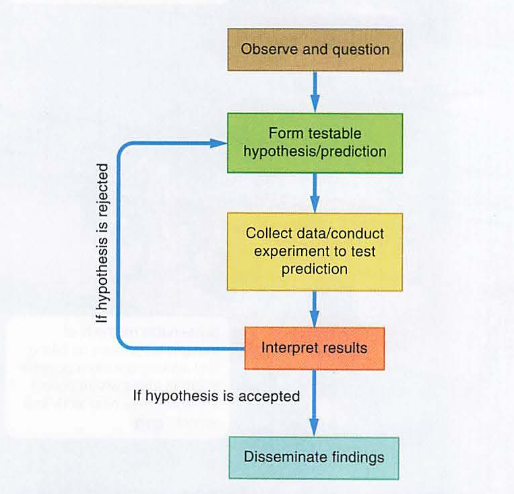Screenshot 2025-08-19 at 3.37.27 PM.pngPeer reviewed and able to be replicated: look up cold fusion
Independent variable vs. dependent variable: x and y: y is a "function" of x, you may see this as f(x)
why is a line that crosses not a function?
Like getting two results from an experiment: which do you choose?
Natural experiments are ones not planned: COVID, volcanic eruptions, etc.
You can still study them, but you do not setup the conditions
Graphing:
Always start with x units, usually zero at the axes, make sure limits are included
linear, exponential graphs: how are they different? what is exponential growth?
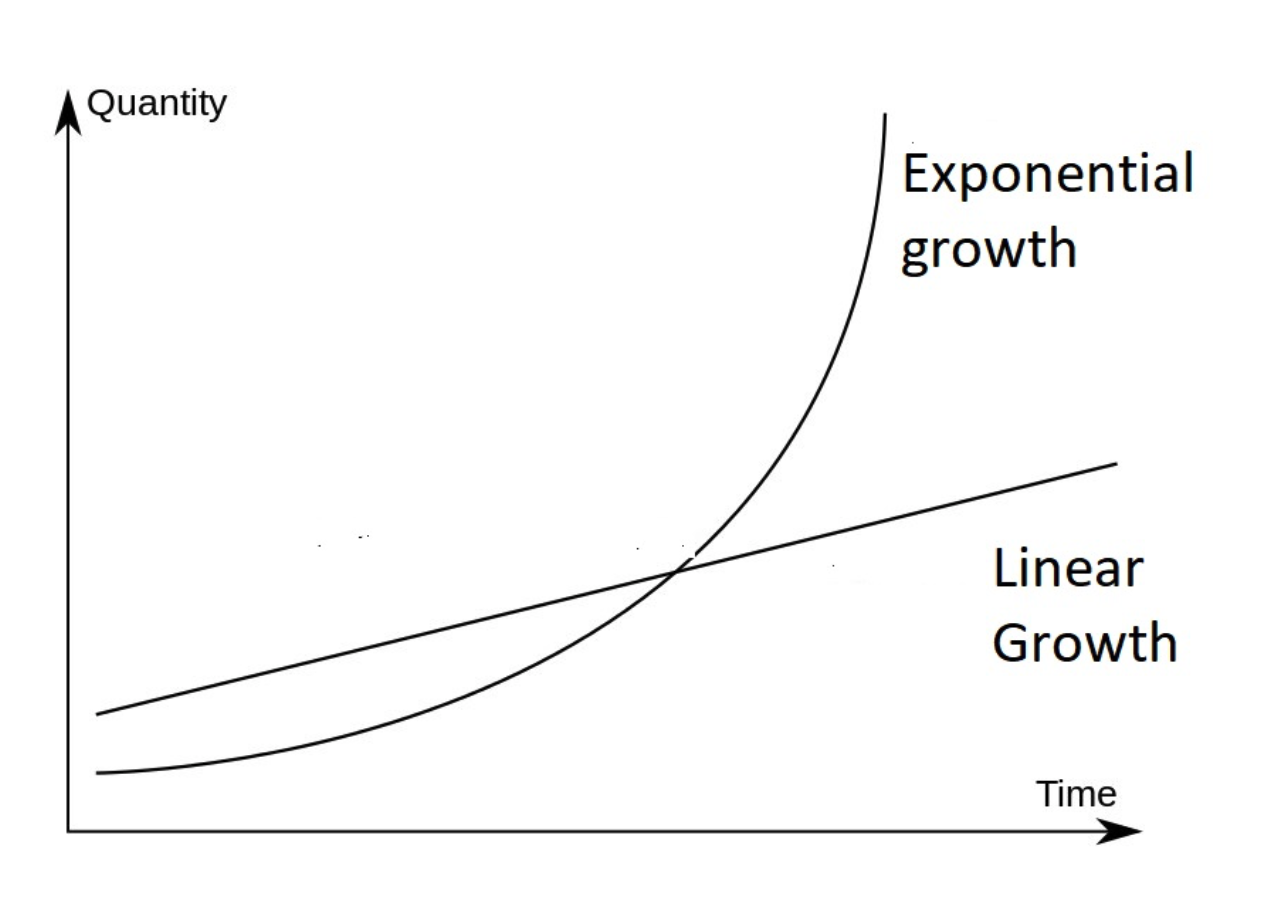Screenshot 2025-08-19 at 3.44.46 PM.png
Malthus said that since food supply (farming) is linear, and population is exponential, there would be a crisis-where?
Challenge: draw a simple curve of y = 2x and another of y = x^2 where do they cross?
Units:
mks system is what we use: meters, kilograms and seconds
deka is hardly ever used, except for decimate, meaning 1 out of 10 survived
deciliter is a measure of liquid
centimeter is smaller than an inch (2.54= 1 inch)
millimeter is 1/10 of that
micro is very small, used to measure bacteria and viruses
nanometer is useful in measuring light waves
picograms are a measure of pollution
Challenge: how many millimeters tall are you, and how many grams is your mass?
Dimensional analysis:
Best done on the board, but if 1 inch =2.54 centimeters 2.54 cm, then 1 in/2.54cm is a fraction equal to one
If you are given 45 inches and want to know how many cm, write the equal sign first:
= _______ cm
Then make sure that the cm unit fraction is on top, so it survives to look like the answer
so, 45 in x 2.54 cm/1 in. = ______ cm
cross out whatever cancels
Challenge question: how many inches is it to Kona?
Accuracy vs. precision:
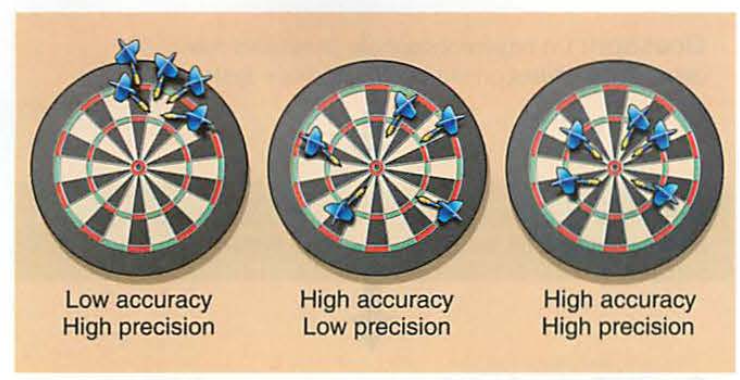Screenshot 2025-08-19 at 3.58.47 PM.png
You can be precisely wrong, but you are still wrong...
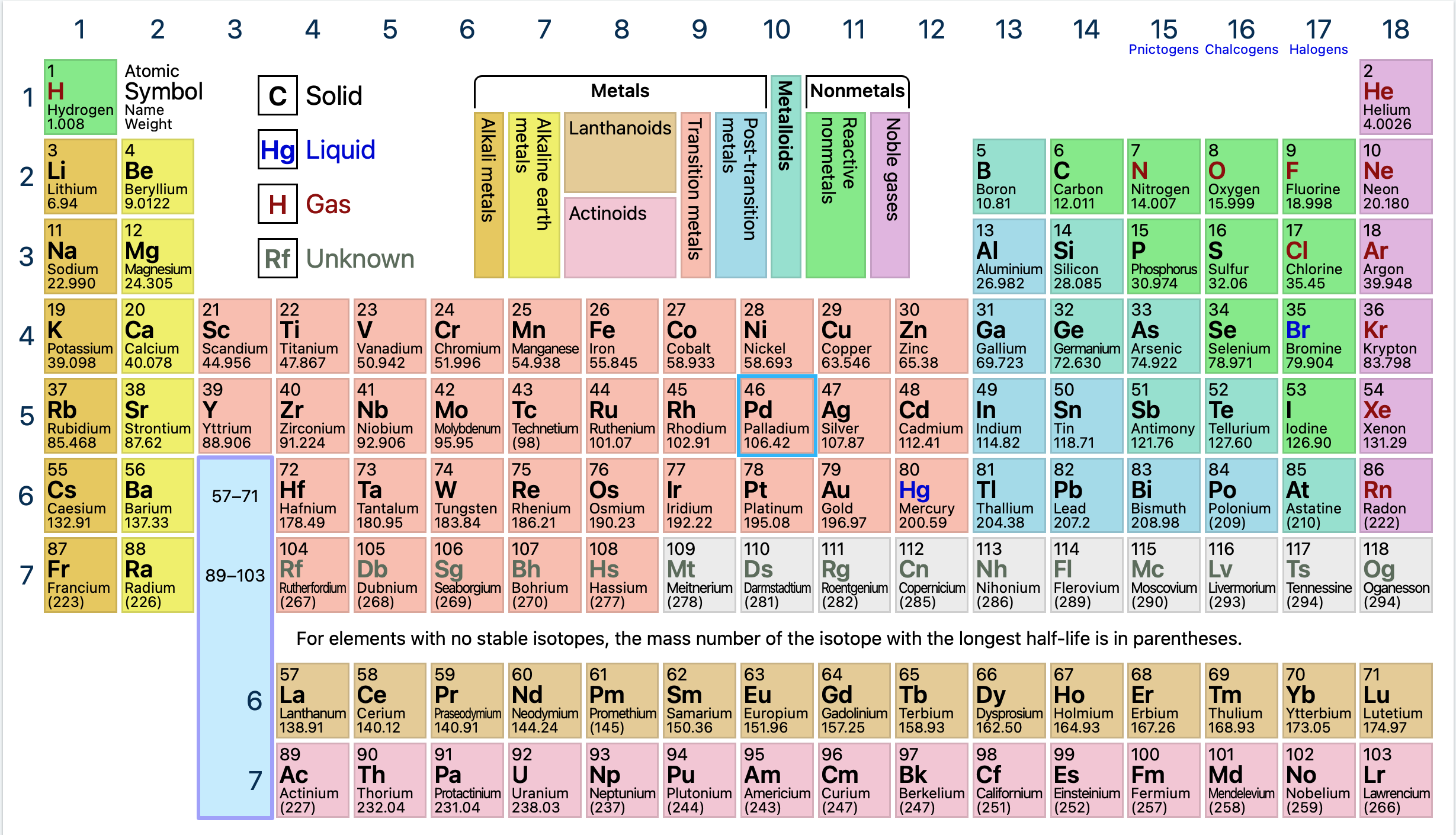Screenshot 2025-08-19 at 4.04.59 PM.png
we'll print one out for you to doodle all over...
Mark + and - on the columns from left to right, ignoring the middle for now.
column 8 is the noble gases, they have a stable set of electrons (full shells)
imagine you are lithium, who do you want to look like? how?
repeat with sodium and chlorine...
Ok, that's fun, now look up and down the columns: you could poison someone with Barium (it's what they do with dead people). Where would it show up in your body?
Radioactive strontium causes what form of cancer? what about cesium from nuclear reactors?
Vertical columns are chemically similar...
Elements on the left usually give up electrons to act like noble gases, so become positive
Elements on the right usually add electrons to act like noble gases, so become negative.
If these combine like Na and Cl you get a very strong IONIC bond like salt (high melting point, always conducts electricity)
Fun fact: you cannot get electrocuted in a bath of distilled water.
Another fun fact: you CAN get shocked working on a car battery in salty board shorts (ow!)
Ok, that's all exciting what makes up elements then?
Protons determine the element: the name, how it acts, everything.
Electrons are much smaller, and give the element charge
Neutrons are about the same mass as protons, and keep the protons company in the nucleus.
Changing electrons creates ions, which is a chemical process.
Changing neutrons creates isotopes, which is a nuclear process.
Challenge: list a few ions and a few isotopes
Atomic number: just the protons
Atomic mass: all of it (we ignore the puny electrons, so p+n)
Isotope: same protons, different neutrons
Ion: same everything, just more or fewer electrons
So, if you believe all of this, then C14/6 is radioactive while C12/6 is what is inside my body?
Not so fast, they are both in your body.
If you died suddenly of an overdose of M&Ms, 5730 years from now, anthropologists could dig up your bones, and find only 1/2 of the C14/6 you ate in the candies. They would know you did this 5730 years ago. They would likely be stale by then...
Main topics:
- elements: protons, neutrons, electrons
- atomic mass, isotopes
- isotopes vs. ions
- bonds: ionic and covalent
- periodic table: columns
- half lives
- pH and pOH
- melting and boiling points
- surface tension: adhesion and cohesion
- organic vs. inorganic substances
- proteins, fats, carbohydrates
Atoms and molecules:
- atom: one nucleus with protons and neutrons, electrons around the nucleus
- element: one type of atom, defined by the number of protons
- protons: positive charge, give the atom identity, found in the nucleus
- neutrons: neutral charge, gives the atom more mass, found in the nucleus
- electrons: much smaller (1/1800), negative charge, gives the atom charge, "orbits" the nucleus
Examples: see [https://ptable.com/?lang=en#Properties](https://ptable.com/?lang=en#Properties)
Helium: He, discovered in the sun (helios), 2 protons, 2 neutrons, 2 electrons
Carbon: C, 6 protons, 6 neutrons, 6 electrons
Atomic mass is the mass of all of the protons and neutrons (electrons are too light to count)
Isotopes: nuclear stuff
Wait: why does carbon have atomic mass of 12.011 instead of 12?
There are other types of carbon, called isotopes (same type)
C12/6, C13/6, C14/6
Each of these has the same number of protons (identity) but more neutrons
check: how many protons, neutrons and electrons in C14/6?
Demo: m&ms in cup
Ions and bonds: chemical stuff
so far we've been playing with the nucleus.
If you change the number of electrons from a match with protons (C6/12 has 6 electrons), we can add or take away electrons:
Na+ is Sodium missing an electron
Cl- is Chlorine with an extra electron
Why?
Look again at the periodic table: [https://ptable.com/?lang=en#Properties](https://ptable.com/?lang=en#Properties)
Everyone wants to be on the right hand column, called the noble gases
To get there, Na loses an electron to look like Neon, while Chlorine adds an electron to look like Argon (see for yourself)
These sorts of bonds, where one gives up and one takes is a very strong bond, called ionic (because it involves ions)
NaCl (salt) is one example:
- Ionic bonds have high melting points
- They conduct electricity, especially in water
- examples: NaCl, KCl, MgCl2 (notice usually groups 1 or 2 and a halogen, group 7)
demo: salty fingers, lower electrical resistance
The weaker type of bond you will see is called covalent.
Think of a pilot and co-pilot: both share the duties
In a covalent bond, neither one is more positive or negative, they share an electron.
Molecular Hydrogen (H2) and molecular oxygen (O2) are good examples
so are plastics, water and other substances
Covalent bonds:
- Weak bonds
- Don't conduct electricity as well as ionic solutions
- low melting points (water, plastic, butter)
Periodic table classes:
The periodic table (here it is again: [https://ptable.com/?lang=en#Properties](https://ptable.com/?lang=en#Properties)) is key to solving riddles in APES around pollution, toxins, and many other things:
Example:
Strontium 90/38 is a radioactive isotope, a product of nuclear reactions (reactor meltdowns, nuclear weapons)
Look at the periodic table, find Strontium.
What is above it?
Calcium is part of your bones, so when you ingest Sr90/38, it is absorbed into your bones just like Calcium, since elements in the same column are chemically similar.
What sort of cancer would this cause?
Question: Cesium is a radioactive element, where would it go in your body?
Homework questions:
1. Why is radon so potent as a carcinogen for lung cancer?
2. How much more potent an acid is something with pH of 4 than one with pH of 6?
3. Someone is poisoned with Strontium 90, what sort of cancer would they likely get?
4. List a few other ionic compounds, with formula
5. List a few other covalent compounds with formulas
Acids and Bases: pH
In aqueous (water) solutions, we often need to know if a solution is acidic or basic
Acids have more Hydrogen ions (H+) floating around
Bases have more hydroxide (OH-) ions floating around
Water is amphoteric (both) since it is really H-OH
Water has pH (potency of Hydrogen) of 7, in between 0 (acid) and 14 (totally base, dude)
Water is "mid"
First look at most solutions is a good guess:
NaOH base
HCl acid
See?
You try: KOH, HNO3, H2SO4, H3PO4
Which were acids and bases?
Clue: anything with an H alone is usually an acid, anything with an OH is usually a base
Exceptions: alcohols (see below) have an OH, but are not basic, they are organic compounds
This is usually easy: a sample problem might ask what is the H+ concentration of something with a pH of 1 ee -4?
Simply take the minus sign off the exponent and you have your answer: pH = 4
Another version of this would be:
How much stronger is an acid with pH 4 than pH 6?
This is a bit trickier: since each power of ten is one pH number, 10^2 is 100, so the answer is 100.
Try this: How much more acidic is water than NaOH solution with pH 12?
Since water is pH 7, 12-7 = 5, so 10^5 is 10,000x stronger.
Weird to think of water as an acid, but there it is.
You may also see something like "what is the pOH of something with a pH of 4?"
The answer is: pOH is just 14-pH, to the answer is 10.
There is a scary looking formula for pH:
pH = -log10[H+]
not so scary: all it says is take the log to the base 10 (usually the same as the power) and throw away the minus sign
Like in radioactive decay, you may see something that is not in the form 1 ee-4, in other words, the 1 may not be a 1.
In that case, you just use the scary formula...
The good news is these do not hang around forever, they decay into other things, some radioactive, some not.
A half life is the amount of time it takes something radioactive to decay into half of the amount it was before.
So, If you have 128 grams of Strontium 90/38, which has a half life of about 30 years, after 30 years you will have:
64 grams
Then 30 years later it will be all gone, right?
Nope: 32 grams
Then continue: 16, 8,4,2...
It never really goes completely away
Demo: M&M's in jar
Half-life how to: caffeine, nuclear waste, drugs
If 100% of something decays exponentially, this means that after one half life (t 1/2) half of it remains.
We demonstrated this with M&Ms in class, and you saw an exponential decay graph
Why do we want to know how this works?
Easy: nuclear waste, radioactive fallout, caffeine and other drugs all follow exponential decay.
So, to find out how much is left of something, you can count the half-lives and divide each one by two over and over again:
1/2->1/4->1/8->1/16
You may also see this as percentages:
50%->25%->12.5%->6.25%
There is a simple formula for this if you want to use it:
Amount left = Amount starting (1/2)^n
At = Ao (1/2)^n. or At = Ao/2^n
where n is the number of half lives.
Example:
The half life of C14/6 is 5730 years
How much of a 200 gram sample will be left after 22,000 years?
Divide 22,000 by 5730, you get about 4
(1/2)^4 is 1/16, or 6.25% whichever you like using more
200 grams/16 = 12.5 grams left. or...
200 grams * 0.0625 =12.5 grams 12.5
This also works if you have something in between half lives, like if you repeated this problem for 18,000 years:
18,000/5730 = 3.14
(1/2)^3.14 = 1/8.8 or 0.113
0.113 * 200 = 2.26 grams left
In some rare cases, you will be see this situation in reverse:
The half life for Sr90/38 is about 30 years.
If 25 grams of a 100 gram sample remains, how old is it?
25/100 is about 1/4, 4 = (1/2)^2 so two half lives, or 60 years.
HW Radioactive decay
1. Take a photo of your graph and include it below. What represents the “half life” in your demonstration?
2. A sample of a radioactive isotope has a half-life of 5 years. If the initial mass of the sample is 100 grams, how much of the sample remains after 15 years?
3. A radioactive isotope decays to 25% of its original amount in 10 years. What is the half-life of the isotope?
4. A certain radioactive isotope has a half-life of 20 years. What fraction of the original sample will remain after 60 years?
5. A fossil contains 12.5% of its original amount of Carbon-14. Given that the half-life of Carbon-14 is 5730 years, estimate the age of the fossil.
6. The activity of a radioactive source is measured to be 800 disintegrations per second. If the half-life of the source is 2 hours, what will be the activity after 6 hours?
7. If Caffeine has a half life in your system of 5 hours, and you have one “dose” at 7 AM, how much is in your system at noon?
8. You then have another dose of caffeine at noon, how much is in your system at 5 PM?
9. You then have another at 5 PM, how much is in your system at 10 PM?
10. If the half life of caffeine was longer, what would happen to the amount in your system by the end of the day?
11. THC (tetrahydrocannabinol) has a half life of 20-30 hours, which we can estimate to 24 hours for this question. A user has a “dose” at 6 AM, then another at the same time every day for five days. What is the level in doses after 5 days?
12. THC absorbs into the fatty tissues of the nervous system, just like other fatty-soluble toxins we will study, like PCBs in Killer whales. Look this up and describe why this is important to our study of APES.
Radiation: nuclear fallout, nuclear energy, radon
There are 4 main types of radiation from radioactive substances or nuclear reactions (nuclear weapons, meltdowns, etc.)
- Alpha rays are Helium nuclei, +2 charge, very heavy, very slow, and can be stopped by skin or paper
- Beta rays are fast electrons, -1 charge, fast, light, and can be stopped by metal foil
- Gamma rays are light photons, no charge, can be stopped by lead
- Neutrons are fast neutrons, no charge, can be only stopped by lots of concrete or lead (slow ones are called "thermal" neutrons and are useful in nuclear power plants to make steam)
Health examples: Radiation, mutations, cancers
Radon gas (222/86) is very heavy, and emits alpha rays.
No problem if the gas is outside your body, your skin protects you.
If you breathe radon gas, is sits in the bottom of your lungs and alpha rays destroy your white blood cells: leukemia and other lung cancers result
Gamma rays split DNA and cause mutations, some cause cancer.
Neutron radiation dissolves membranes in animals, killing them in nasty ways...
In each of these cases, radiation is harmful, it depends on where you are exposed, for how long, and what protection you use.
Radon is the #2 cause of lung cancer in the US (!!!)
Be aware of this if your dorm room in college (or anywhere) is in the basement, and you are near the Rocky mountains.
Demo: Radon rock
Solubility of gases:
Air holding water: Humidity, condensation, rain shadows, hurricanes
We know that air can hold water vapor, this is invisible, unless it condenses (like steam or clouds)
As gases get cooler, they can hold less water, that's when it rains or condenses.
You know this: cool drinks form beads of water on the outside, since the drinks are cooler than the air.
It also means that warmer air can hold more water
Remember this: gases hold more water when warmer
This also explains why you may get a shock in cooler climates walking across a carpet: dry air is a better insulator, so can build up an electrical charge better.
It also explains why it rains on the windward side of mountains: as the moist air rises, it gets cooler, and cooler air can hold less water: "Orographic lifting"
It also explains why air coming in from the ocean is more humid: it has been warmed by the ocean.
Demo: elab humidity sensors, temp and RH
Water holding gases is the opposite: Dissolved Oxygen, DO, thermal pollution
One smart character decided to boil the water for the aquarium before dropping the fish. Even though the water was at the right temperature, by boiling the water, all of the dissolved oxygen was gone-what do you think happened to the fish?
Gases dissolve better in cooler water. Fishing folks know this, and go where the water is cooler, since fish breathe better there.
It also explains why the British are so nuts about when they boil water for tea: if you boil it too long it has no oxygen in it, and it tastes "flat".
You also know this that soda drinks lose their fizziness if you warm them up.
This is very important when we study dead zones and fish kills...
It also explains why you don't ever need to get ice in your carbonated drinks: to get the carbon dioxide to dissolve into the drinks they MUST cool the drinks down to inject the CO2.
Demo: cool soda water, warm soda water
More water stuff:
Surface tension: adhesion and cohesion: capillary action, trees and all plants
Water is very cool stuff: it likes to stick to other stuff (adhesion) as well as to other water (cohesion)
This makes for interesting phenomena when the sides of a container are very close, like in roots or thin hair:
As the water molecules climb up the sides of the roots (adhesion) they stretch out the molecules in the middle (cohesion).
This is called surface tension
This make the curve stretch and then shorten, so water moves up the column (roots, long hair).
This is called capillary action, and is very important for all plants.
Surface tension is also how water striders "sit" on the water: their feet stretch the water molecules.
Soaps destroy the cohesion, making water "wetter", also making little bugs fall into the water...
All plants rely on capillary action to bring water to their leaves, so it is not a good idea to drop soap on the roots of plants.
Think of roots: many thin fibers next to each other-perfect for capillary action.
1. Explain how tall trees and other plants carry water vertically to their leaves
2. Explain why soap might impact this action
3. What is the difference between adhesion and cohesion, and why should we care?
4. If a body of water gets too warm, fish will die, why?
5. You might feel comfortable on a very hot day in the desert, but not at the same temperature where it is humid-why?
6. Why would triathletes struggle in Kona? What is different from where they have trained?
7. Why would the British only boil water for their tea until just before boiling?
8. Herman boils the water for his aquarium to keep it clean, then cools the water before dropping in his prized fish, which all promptly die-why?
9. Why is there a desert (not a dessert) on the eastern, leeward side of the coastal mountains in Washington and Oregon?
10. If you run into a person wearing a foil hat, what sort of radiation do you think they are protecting themselves from?
11. What about a paper hat?
12. What phase of water are ice skaters skating on?
13. If it is temperature that cooks food, why would increasing the pressure make for a shorter cooking time?
14. The Chesapeake bay is a "perfect storm" of pollution, shallow, slow moving water, lots of fertilizer and silt. Why is this a perfect storm for killing fish?
Melting and boiling points: colligative properties, melting ice, antifreeze/anti boil
Water is everywhere, and we study it a lot
The melting and freezing point for water is 0°C at one atmosphere (very interesting stuff happens at other pressures, like ice hockey)
The boiling and condensation point for water at one atmosphere is 100°C (again, interesting things happen at other pressures like pressure cookers and freeze dried ice cream)
It turns out that anything added to water raises the melting and boiling points.
You may have heard to add salt when cooking pasta: this raises the boiling point a bit so the pasta cooks a bit faster. (heat cooks food, not boiling)It also explains why they add salt to ice to make ice cream, or pour salt on road to melt ice...
You can demonstrate changing pressure on melting by slowly chewing on an ice cube: pressure makes ice melt (ice hockey skates)
This also means that water boils at a lower temperature if there is less pressure, like on a mountain, or even here in Waimea, since we are at 800 meters elevation (about 3000')
Pressure melting of ice is how ice skaters move, if you look at their skates end-on, you will see an upside down U shape that traps the melted water from their weight pressing on the ice.
Heavier ice hockey players can use a thicker skate...
It also means that if the ice is too cold, this does not happen (ask Mr. McKenna about this where he skated in Canada)
Demo: pressure cooker, crushing ice, salt on ice, salt in boiling water
HW review:
1. A chemist claims she can make a compound from Mg and F that she calls MgF. What is wrong with this formula?
2. Another chemist claims that something that conducts electricity is covalent, what is wrong with this?
3. Look up three radioactive isotopes that are present in nuclear fallout, and explain how they might impact the body.
4. Look up their half lives and calculate how much would be remaining after one year
5. Explain what the term amphoteric means, and why you need to understand it
6. Why is water both an acid and a base?
7. A substance has an \[H+\] of 1 ee -4, is it an acid or a base, and what is the pH and pOH?
8. Look up the decay of Radon, and explain the various forms of radiation it emits
9. If you wanted to ski on dry, powdery snow, where could you go in the US, and why is it dry snow there?
10. Why would stream water near there have a high DO?
11. For very tall trees, would the tree fibers in the trunk be thinner or thicker and why?
12. Look up the process for freeze-dried coffee or ice cream, and explain how this works, using what we know so far.
- osmosis vs. diffusion (capillaries, healing)
- salt intrusion-crops
- organic chem
- alcohols: OH
- CHON
- proteins-malnourish vs under (famine)
- deamination
- CHO-diabetes, glycemic index
- Fats: heat and energy
- free fatty acids-fuel, marathons
- lipids-membranes
- fat soluble-bioaccumulation-orcas
- ADEK
- biomagnification: many animals: ahi Hg
Osmosis: cell walls, plant hairs, swollen toes
- You may have heard of this in your chem or bio class.
- Osmosis in simple form means that water always chases salt or other "solute"
- When a solute like salt dissolves in a solution like water, it becomes salty.
- If a membrane like skin or cell walls separate this salty solution from fresher water, the water will travel through the membrane to get to the salty solution.
- Good use of this: if you have an injury with swelling, doctors may say "soak it in warm, salty water".
- This draws the fluid from the injury, enabling healing.
- Also works for sore throats...
- Bad use of this: if you pee on plants, the Nitrogen in urine helps plants grow, but the salt in urine pulls water from the roots, killing the plant.
- This also happens in areas where well water is used to irrigate crops: the minerals (salts) in the water accumulate in the soil, killing the roots of the plant.
- EVEN MORE SCARY: As ocean levels rise, salty ocean water is penetrating into the water table in many fertile areas like the Mississippi delta, Florida and the Pearl river delta in Asia, killing crops. The Pearl river delta is where most of the rice for all of Asia is grown...
- This is called salt water intrusion
Osmosis vs. Diffusion:
- Osmosis is where water follow salt (or solute), example sore throat with hot salty water
- Diffusion is where any molecule (solvent or solute) moves from high concentration to lower, example CO2 out of the room, can be gases, liquids (even solids in some cases-how computer chips are made)
Organic and inorganic compounds: everything based on carbon
- Anything with a carbon backbone (like you) is an organic chemical compound
- Anything without carbon is called inorganic, like salts, metals and minerals
- These could be anything from the foods you eat (more on this later) to the gasoline you might put into your car or grease (don't eat that)
- Organic compounds can be water soluble, or not.
- Hydrocarbons like gasoline and oil have only C-H bonds, so are insoluble in water (like greasy hands, or olive oil in salad dressing)
- anything ending in -ane means single bond organic compound
- organic compounds with an OH molecule attached, so they can dissolve oils while also dissolving in water.
- try this: use alcohol to remove grease from your hands, or your laptop
- -ol is the suffix in organic compounds that means alcohol
Some important alcohols:
- methanol CH3OH (toxic)
- ethanol C2H5OH (makes you drunk)
- propanol (C3H7OH) known as rubbing alcohol
Scary stuff: if you are interested, compare the digestion and metabolism of ethanol and methanol...one of these turns into ant venom in your bloodstream!
Soaps
- are an interesting combination of organic (C-H, hydrophobic) and inorganic (ionic, hydrophilic) ends, so they can mix with oils then be carried away by water.
- Many organic compounds dissolve in plastics, like spaghetti sauce in plastic food containers (Vitamin E/Carotene=orange and lycopene=red)
- -ene means double bonds in an organic compound
- many fat soluble toxins can build up in fatty tissues of wildlife, like killer whales (remember?)
Demo: spaghetti sauce in plastic
Proteins, fats and carbohydrates: CHO, C-H-O and C-H-O-N
- All three of these can act as fuel in your body, as your body is really clever that way.
- Oddly, though, even your awesome body cannot repair tissues or grow new ones without proteins
- Why not?
Proteins
- are the only food source with Nitrogen, since they are made up of amino acids (amines means Nitrogen)
- Proteins can be used as fuel for your body by "de-amination" meaning taking off the nitrogen
- so, could you live on just proteins alone? depends...
- Look up several amino acids, the building blocks of proteins, and find the only one that contains sulfur (very important)
- DNA is made up of proteins as are muscle and tissues (brains too)
-
- Fun fact: vitamins are often amines, and were thought to be vital to health: "vital amines"=vitamins (look up the formula for a vitamin of your choice)
- Another fun fact: athletes using protein supplements can "burn" their kidneys if they don't drink enough water with the proteins, as the body de-aminates the proteins into fats and carbs for fuel (drink water!)
Fats:
- Fats and carbohydrates have similar chemical formula (carbon and hydrogen), but different structures
- Fats all have a special sort of alcohol backbone, with little strands coming off made of C-H bonds (like a hydrocarbon)
- This is why most fats do not mix with water...
- "Free fatty acids" in your blood are the main fuel for athletes (not carbs, as most folks believe)
Carbohydrates:
- Carbohydrates are C-H-O bonds (anything that ends in -ate means with oxygen), so carbo=carbon, hydr=hydrogen ate=oxygen
- Carbs can be long strings, like starches, or compact little hexagons or pentagons like sugars
- Carbs are a short term fuel for athletes
- sugars can give a short term boost in blood sugar, followed by depression (insulin rebound)
- one reason caffeine is added to sugary soft drinks.
- Sugars tend to be metabolized much faster (smaller molecule) than starches
- Diabetics suffer from insulin deficiency, so starches are better for them: slower digestion
- Fun fact: sugar alcohols look like sugar to your body, but don't behave like sugars-used in drinks and candies...
Demo: food analysis
Conservation of mass, conservation of matter:
- In any chemical (not nuclear) reaction, mass is conserved
- Later we will discuss nuclear reactions, where mass actually turns into energy (and vice versa)
Reaction rates:
- Every 10°C increase in temperature doubles the speed of any reaction
- Who cares?
- When you have a fever, you burn fuel much faster
- When explosives heat up, their blast is much more violent
9.3.25 notes:
- osmosis vs. diffusion (capillaries, healing)
- organic chem
- alcohols
- CHON
- proteins-malnourish vs under (famine)
- deamination
- CHO-diabetes, glycemic index
- Fats: heat and energy
- free fatty acids-fuel, marathons
- lipids-membranes
- fat soluble-bioaccumulation-orcas
- ADEK
- biomagnification: many animals: ahi Hg
---
Migrated from Apple Server Wiki. Original page ID: b713b7y5
# Science review: energy and power
[https://elab.hpa.edu/apes/texts/fr3e/fr3e\_ch2.pdf](https://elab.hpa.edu/apes/texts/fr3e/fr3e_ch2.pdf)
Energy:
- same as work
- don't care if it happens fast or slow, just lift the rocks
- calculate your mass in kg (lbs x 2.2)
- how high are the stairs? (meters)
- lifting your mass up the stairs is WORK: PE = mgh. (gravity is about 10 here)
- how much work did you do walking up the stairs?
- important: not how FAST you do it, just how MUCH you did
Power:
- power is how FAST you do the work
- athletes need the ability to do work (lifting) as well as quickly (power)
- [https://www.youtube.com/watch?v=S4O5voOCqAQ&t=178s](https://www.youtube.com/watch?v=S4O5voOCqAQ&t=178s)
- walk up the stairs, as slowly as you like
- calculate the work you did walking up the stairs: mass x 10 x height (meters)
- units will be in Joules (energy)
- next, run up the stairs and time yourself
- work/time is power in Watts (Joules/second)
- 747 Watts is one horsepower
- how many Watts and hp can you produce?
- how does it compare to Robert Forstmann?
- what is the difference between your slow power and your fast power?
Electrical work and power:
- 1 Watt is the same as 1 joule (work) done in one second (time)
- 1000 Watts is one kilowatt (kW)
- a hot water heater uses energy (does work) at a certain rate (power), measure this in Watts and kW (1000 Watts)
- if it runs for one second, the power number (joules/second) is the same value as the energy (joules)
- to calculate energy used to heat the water, multiply power (Watts or j/s) x time (seconds)
- you will see this on the AP exam, here's what it may look like:
Sample AP problem:
Your home hot water heater converts electrical energy into heat energy at the rate of 4500W.
1. how many kW is this?
2. if it runs for 4 hours each day, how many seconds is this?
3. how many joules is this?
4. calculate how many kWh this is (kW x hours)
5. convert this to joules, are your answers the same?
6. if one kWh costs your family 50 cents ($0.50), how much does this cost each day?
7. each month?
8. each year?
9. how could you reduce this?
10. why does the electric company charge you for kWh not kW?
11. why don't they use joules like the rest of the world?
Energy flows, feedback
- energy terms: cal, kcal, Joule, kWh, BTU
- power terms: Watt, J/s, hp
- EM spectrum
- KE= 1/2mv^2 or 3/2kT (T is degrees Kelvin)
- PE = chemical bonds or mgh (height potential energy)
- ICE vs. hybrid vs. electric cars
- thermo 1: conservation
- thermo 2: efficiency
- thermo 3: entropy
- open and closed systems
- equilibrium, stability and steady states
- positive feedback loops
- negative feedback loops
Energy units:
We use the following units for energy:
- calories: the energy used to heat 1 gram of water 1 degree C (note small c)
- kcal: one thousand calories
- Cal: a single food calorie, equal to 1000 chemical calories (note big C)
- Joule: the work needed to move something 1 meter against a 1 Newton force (note caps for dead people)
- 1 cal = 4.18 Joules (good to know)
- kWh = one kiloWatt of power used for 1 hour (heating tea for an hour, costs about $0.40 here)
- BTU: British thermal unit, most often seen in heating, ventilation and cooling (HVAC) systems
Power units:
- Watt: one joule every second
- kiloWatt: a thousand of those
- horsepower: 747 Watts
Example:
- 50 kg person, 10 m stairs, g = 10, equals 5000 Joules
- If you do this in 100 seconds, you have done this with 50 Watts of power (50 joules/second)
- If you did it in 10 seconds, you would be creating 500 Watts of power (that's a lot)
- 1 horsepower (hp) is 747 Watts
- Fun fact: some elite cyclists can create over 1000 Watts for many minutes-true animals
- Another fun fact: the electric company does not care how fast you use energy (kiloWatts), they only care how many hours you used this power (kWh)
- Think of water: you are not charged for how FAST you use the water, just how MUCH you use
Spectrum means a spread of values, so a musical spectrum might mean the lowest and highest notes you could sing or hear.
The electromagnetic (EM) spectrum describes EM radiation, that includes in order of increasing energy:
- radio waves: (radios use these)
- heat (IR or infrared): snakes can see these, also heat lamps over food or for people
- visible light: you can see these: ROYGBIV
- UV (ultraviolet) light: bees can see these, they also burn your skin
- X-rays: films and sensors can see these, they go through your skin, but less so through your bones
- gamma rays: go through most stuff (remember?), mutate DNA
- and cosmic rays: mysterious stuff, comes from supernova explosions, can form muons (cow rays)
- if you see Tiffany, ask her about relativistic muons...
Demo: spectrographs
The visible spectrum includes the following colors, in order of energy:
Low energy-------
- red
- orange
- yellow
- green
- blue
- indigo
- violet
High energy------
You can now see why infrared is below red, and ultraviolet is above violet
Plant pigments have evolved to resonate with certain colors, like chlorophyll likes green light, others like reds and so on.
Fun fact: autumn leaves are red because the green is gone (winter, darker). The red was there all along.
Kinetic energy:
- When you ask a physicist (I am one, so I know) about Kinetic energy, they will drone on about moving objects, their mass and velocity...
- KE = 1/2mv^2
- This is incredibly fascinating you will agree (?) and it explains why car crashes at 80 mph are 4x more damaging than ones at 40 mph...
- In chemistry, we use KE to describe the energy of moving molecules: KE = 3/2kT, where T is the absolute temperature (Kelvin)
- This means that if you double the Kelvin temperature, you double the KE of a molecule.
- This changes for different molecule shapes (3 comes from x, y, z motion), which you may find interesting if you study physical chemistry (ask Dr. J)
- For our purposes, we need to know that increasing temperature increases the speed of molecules:
- 3/2kT = 1/2mv^2
- So, those physics guys were not crazy.
- This has huge implications on climate change, phase changes, rain, condensation, and many other things.
Potential energy:
- If you ask a physicist (what, again?) about potential energy, they will blather on about mass, gravity and height.
- While scintillating, this is useless in most chemical equations, which tend to happen at the same height.
- It does, however impact some weather phenomena, so let's let them have this one.
- If you ask a chemist about PE, they will often refer to chemical bonds, which represent energy stored like a spring holding molecules together
- If you ask a nutritionist about PE, they will talk about Caloric content (food)
- If you ask a coach about PE, they will tell you about the untapped potential of an athlete...maybe
- In APES, we mainly care about stored energy, usually in a phase change (latent heat of vaporization) or chemical bonds like in food.
Demo: springs
ICE, hybrid and electric cars:
- ICE stands for internal combustion engine (e.g. normal cars, lots of heat, hot brakes etc.)
- hybrid cars capture the KE of motion and store it in batteries to accelerate the car, saving energy
- electric cars do this as well, but have no thermal engine parts like ICE or hybrid cars, so they are much more efficient
- electric cars capture braking kinetic energy and store it as chemical energy in batteries (often lithium)
Demo: Prius, Tesla
Thermodynamics: one two and three
Thermodynamics is the study of heat (thermo) in motion (dynamics)
There are three big laws of thermodynamics:
1. you cannot create or destroy energy (you can't do this with mass either, more on this later)
2. in any reaction, there is an energy "tax" you could think of as friction
3. all reactions go naturally towards disorder
Short Las Vegas version:
1. you can't win
2. you can't break even
3. you can't get out of the game
- You can imagine a magical car that you put 1000J of energy in the tank and 2000J of work is done by the engine.
- No
- Way.
- The most efficient Formula one racing car engine is about 50% efficient.
- Where does the rest go?
- Heat.
- Your body is at most 33% efficient in turning M&Ms into work. The rest?
- Heat.
- One way of looking at disorder is entropy, a measure of disorder.
- You can imagine a pool table, hitting the triangle of balls and then spreading across the table.
- It is more likely to go in this direction (more disorder) than to have the balls spontaneously jump out of the pockets and form a perfect triangle.
- Not to get depressing, but there is a formula that goes like this:
- ∆S for the universe is >0 translation: the universe always moves towards disorder
- so sad...
Demo: look up thermal efficiency of formula one cars, diesel and EV
Open and closed systems:
- This means different things to different folks, but you could imagine a system where mass and energy are contained in the system as closed.
- You might also look at a system where certain nutrients are recycled as closed.
- You could look at recycling paper as a closed system to a degree.
- Most of our product cycles are open: we throw stuff away instead of recycling.
- Much more on this later...
Equilibrium, stability and steady states:
- Equilibrium means literally "equal freedom" , in this case equal freedom to move from one condition to another.
- Imagine two fish tanks with a pipe connecting them.
- Fish are free to move from one to the other.
- Not the same fish, but about the same fish on each side.
- This is equilibrium.
- Stable systems are ones where equilibrium exists, and can recover from stresses (resilience)
- Steady state systems are ones where the inputs equal the outputs, and are usually stable as well.
- Unstable systems have nasty feedback loops (see below)
Positive feedback loops:
- In a positive feedback loop, any change causes a greater change as a result
- Boat example: if a large cruise ship tilts over, the mass of the people on the ship make the ship want to tilt more.
- Climate change example: as the planet warms, ice sheets melt, changing from reflective ice to darker ocean water that absorbs more heat, melting more ice.
- Permafrost example: as the planet warms, the permafrost melts, releasing methane gas, which is a greenhouse gas, causing more warming, and more methane...
- Positive feedback loops exist in your body as well: massive blood loss and childbirth are two examples.
Demo: look up femoral artery hemorrhage
Negative feedback loops:
- Where positive feedback tends towards instability, negative feedback loops restore stability, and naturally recover to initial conditions.
- As you exercise, your body sweats, cooling the body.
- This is a negative feedback loop.
- Some coast guard rescue boats are created with negative feedback as well: the more they tip over, the more they want to come back to normal.
- Psychologists often use these terms to describe personalities and relationships...
Demo: sailing ships, keel
---
Migrated from Apple Server Wiki. Original page ID: C7L251
# 24.10.16: competition and predation
- Competition: one wins, one loses
- Could be energy, food, mates, money, whatever
- Competitive exclusion principle: only one winner (assumes a limited resource)
- This impacts evolution: if there is overlap between two competitors for a limited resource, natural selection will favor the ones that don't overlap, since they don't have to compete for those resources:
**Unavailable Apple Wiki media:** the exported data did not include file 1ed1b6ab-b2c4-4816-ac64-9184800ff187.
This is called Resource partitioning (biologists love words like this)
Note that the two curves separate...
Predator-prey and other fun stuff:
- Predation: one lives, one dies, example lion eats a zebra
- Parasitism: one lives, other lives off of them (bad manners to kill the host), example worms
- Mutualism: both win, example Egrets on back of horses or cows: egrets eat bugs, horse protects the egrets from ground predators
- Commensalism: one wins, the other does not care, example orchids growing on branches
- Herbivory: only plants die (e.g. cows)
-
---
Migrated from Apple Server Wiki. Original page ID: 06o8f7
# 24.11.07: growth models: r and K species
Population growth rates
- r selected (r means rate) species grow exponentially until they reach or exceed the carrying capacity of the ecosystem (fish, bacteria)
- K selected species grow slowly and reach the carrying capacity (humans, whales, elephants)
- Carrying capacity (K) refers to land, water, food or other biotic requirement for the species
- Biotic potential is the reproductive rate if there were no limits
**Unavailable Apple Wiki media:** the exported data did not include file 9e6e16e7-89ab-469f-a663-ab07f799d38d.
We describe these r and K species also by their survivorship curves:
Simple version:
**Unavailable Apple Wiki media:** the exported data did not include file e98b1f82-2b74-49d1-8865-9eca79082cb8.
What does this mean?
- Dandelions have many offspring, most of them die, the survivors live on
- Whales have few offspring, take care of them, then live on
- Squirrels die randomly, same for birds, they crash into stuff, old or young
- Where would deer fit into this diagram? Hint: they are another different line
Have a look at the chart above, and think of yourself as an infant.
Compare with Nemo...
Population growth: r and K explained: why do we use those letters?
Exponential growth is the opposite of radioactive decay which we demonstrated with M&Ms
At = Ao/2^n or At = Ao* (1/2^n) where n is the number of half-lives
Populations have doubling times, the time for the population to double, using the same formula:
At = Ao*2^n where n is the number of doubling times
Try this:
Take a piece of paper, cut it in two, record your result on a table as you do this 6 times
What was your final total?
Now do this starting with several sheets of paper (be creative), do this 6 times and record on a table.
When you start with one sheet, Ao is one
When you start with several sheets, Ao is the number
r in this case was 0.693 (a very important number)
t is the number of times you tore the paper
Test this out with your calculator
Here's what this looks like, called J-shaped growth:
**Unavailable Apple Wiki media:** the exported data did not include file 49666958-4963-4315-94c3-c6d7cde85610.
Here's where the r comes from in the r-selected species:
Nt = No e ^rt where r is the growth rate in %
(r comes from rate)
**Unavailable Apple Wiki media:** the exported data did not include file 000fece1-faa0-45c1-8fbb-8e5b6bfd7825.
So simple J growth looks like this:
## ∆N/∆t = rN
∆N means change in population
∆t means change in time
r means reproductive rate
N means initial population
### so, ∆N/∆t really means growth rate or slope of the growth curve
Note this depends on two things:
- Initial population (N)
- reproductive rate (r)
What about K-selected species?
Examples: humans, whales and elephants
We use a different equation for this, but it is really the same equation:
## ∆N/∆t = rN(1-N/K)
K is the carrying capacity of an ecosystem:
**Unavailable Apple Wiki media:** the exported data did not include file 6364cbfc-806a-42fd-82c8-d558f5cf5a39.
Look at the formula:
If the population is well below K (the carrying capacity) then the rate of population growth is
# ∆N/∆t = rN(1-0) or ∆N/∆t = rN
(J shaped growth again)
As the population approaches K the value in the parentheses becomes 0 (no growth) then negative (die off or overshoot):
**Unavailable Apple Wiki media:** the exported data did not include file 6b256936-53a6-4d26-8d9a-01065e69d3cd.
Two types of growth factors:
- Density dependent factors: food, water, land
- Density independent factors: disasters (flood, fire)
Important fact: as food becomes limited, K species will have fewer offspring, so they approach the carrying capacity (K) more gradually, not overshoot and die off.
Try this formula with an island that can hold 100 rabbits, using the numbers above (50% growth rate).
Try this with 50 rabbits, 100 rabbits, 150 rabbits.
What is the value of ∆N/∆t in each case?
What does this mean about the slope of the growth curve?
From Wikipedia:
**Unavailable Apple Wiki media:** the exported data did not include file b731a107-97f7-4133-ba4d-96c5cb5ce5bd.
where N is the [population](https://en.wikipedia.org/wiki/Population "Population"), r is the maximum [growth rate](https://en.wikipedia.org/wiki/Population_growth_rate "Population growth rate"), K is the [carrying capacity](https://en.wikipedia.org/wiki/Carrying_capacity "Carrying capacity") of the local environment, and dN/dt, the [derivative](https://en.wikipedia.org/wiki/Derivative "Derivative") of N with respect to time t, is the rate of change in population with time. Thus, the equation relates the growth rate of the population N to the current population size, incorporating the effect of the two constant parameters r and K. (Note that decrease is negative growth.) The choice of the letter K came from the [German](https://en.wikipedia.org/wiki/German_language "German language") Kapazitätsgrenze (capacity limit), while r came from rate.
**Unavailable Apple Wiki media:** the exported data did not include file b9992638-2b81-4d02-a886-9d3e05b60d12.
Predator Prey oscillations:
Lynx and hare demo:
**Unavailable Apple Wiki media:** the exported data did not include file c8eb3205-aaaa-460d-b54a-67d9d40b8e9e.
Note that the predator peaks after the prey, then overshoots...
saying that the change per instant of time of x at time t is proportional to the value of x(t), and x(t) has the [initial value](https://en.wikipedia.org/wiki/Initial_value "Initial value")
---
Migrated from Apple Server Wiki. Original page ID: T518D8k1r
# 24.11.11: energy flow: trophic levels
- Recall: troph = food
- Autotrophs make their own food (photosynthesis)
- Examples: plants
Trophic levels explain how energy (food) moves up through a food chain
Simple food chain: think of Madagascar...
**Unavailable Apple Wiki media:** the exported data did not include file 582fafad-c319-4814-8ce8-e45d00be4d6b.
- Consumers are known as heterotrophs (hetero=not same, troph = food)
- Herbivores (herb=plant, vore=eat) eat plants, and are primary consumers
- Consumers that eat other consumers are known as carnivores (carne=meat, vore=eat) or secondary consumers
- Tertiary consumers eat secondary consumers
- Apex predators have few predators for them, e.g. sharks, humans (cannibals don't count, and they don't eat clowns, they taste funny)
- Trophic levels are each stage up the food chain
- Only 10% of energy moves up each level (why?)
- reproduction
- metabolism (grazing etc.)
- avoiding predators
- romping with friends
Other nasty bits:
- scavengers: eat dead animals, e.g. vultures
- detritivores: eat decaying matter, e.g. beetles (not the Beatles, that's something else)
- decomposers: break down decaying matter, e.g. bacteria
The cycle of life: (just like in Lion King)
**Unavailable Apple Wiki media:** the exported data did not include file 937a860f-6506-4ecc-a89e-e2219054ca52.
Back to the 10% rule:
**Unavailable Apple Wiki media:** the exported data did not include file 57934820-d818-4f2b-bbee-a81c013b9c77.
Just like Marty had to romp around, and in some cases run away from Alex, some energy was used for other things (reproduction is included, though Marty did not have kids that we know of...)
Make sure you understand this: just take one zero off for each level...
Also make sure you can duplicate a complex drama like this:
**Unavailable Apple Wiki media:** the exported data did not include file 2dd01e5b-d2ce-4c44-a60b-ff7956a0256b.
Or this wetter version:
**Unavailable Apple Wiki media:** the exported data did not include file 3f2a2331-8748-4441-9ce9-431468c421d3.
Trick question: could the Lions see the Hyena as a predator or prey? (remember Scar in Lion King?)Another one: what is the connection between Madagascar and the show Friends?
Net Primary Productivity: The rate of turning solar energy into organic materials
From last module: photosynthesis (water, CO2 based) or chemosynthesis (sulfur based) turn energy into organic compounds (light+water->sugar)
- Autotrophs= auto (self) troph (food)
- also known as Producers in the food chain
- GPP: gross primary productivity = all energy into all food
- NPP: net primary productivity = gross - energy of respiration
- Net is usually only 25-50% of gross (not much)
- Fun fact: your body is only about 33% efficient, the rest goes to heat
- Same with your gas powered car...
Plants are not very efficient users of solar energy:
**Unavailable Apple Wiki media:** the exported data did not include file 19163b39-e1d0-48f1-94bc-72f2e0019470.
If this were a business, they would charge 20$ for a shirt, that cost them $12, so they only make $8 per shirt. Not good business.
This is most efficient where there is lots of solar radiation, biomass and water:
Look for the richest and the poorest in each ecosystem: Note connection with biomes...
- Richest land biome: lots of sunlight (energy), warm temperatures and lots of water (photosynthesis)
- Poorest land biome: less sunlight, long dark winters, cooler, and drier
- Richest aquatic biome: warm, close to shore, sunlight
- Poorest aquatic biome: cooler, far from shore
**Unavailable Apple Wiki media:** the exported data did not include file 583848c4-6347-4e01-ba19-1b21de031daa.
Net vs. Gross is easy to understand:
- If your business takes in money, this is your gross income, say 100$
- If your materials cost 20$, then your net income would be 80$
Ecosystem services: terms
- Ecosystem services: processes by which clean water, timber, fisheries and ag crops are produced
- Provisions: goods humans can use: timber, food crops, plants
- Support systems: pollinators (bees), water filtration (soils)
- Cultural services: aesthetics (John Muir, Ansel Adams)
- Monetary value: lumber, fishing, tourism, ecotourism
Island (physically separate) bio=life, geography=mapping the earth
Important: Size of islands determines number of species on an island: bigger island=more species
Species-area curve: what this means: larger islands have more species
**Unavailable Apple Wiki media:** the exported data did not include file 9fe8e0a4-fd7c-4f3d-918d-712f8fffc795.
Dependent on several factors:
- colonization: how many new species can make it to the island, e.g. is it far from the mainland like Hawaii?
- extinction: how many species die out, and how fast, from what (disasters, humans)
- distance from each other: greater separation=fewer species (think of birds migrating across our island chain)
Invasive species are usually generalists, so pose a greater threat to island species (specialists)
This is covered when we learn about niches soon.
We will see this again when we study biodiversity next...
Find a game!
---
Migrated from Apple Server Wiki. Original page ID: B8K6R6B3
# 24.11.14: Evolution
Three conditions must be met:
1. Genetic variation (mutation)
2. Some stress that favors this variation (adaptation)
3. Survivors procreate, pass on the variation (reproduction)
Genotype: set of genes (dominant and recessive)
Phenotype: traits expressed in a living creature
Genetic drift-pretty much what it sounds like
Bottleneck effect-VERY important: when a species is almost extinct, there is little variation in the gene pool of the survivors, even if their population rebounds (e.g. whales hunted almost to extinction, the entire gene pool is limited to the diversity of the sole survivors)
The bottleneck effect is an evolutionary phenomenon where a significant reduction in a population's size, usually due to an environmental catastrophe, disease, or human activity, leads to a loss of genetic diversity. When only a small portion of the population survives, the resulting gene pool is limited to the genetic traits of the survivors. This effect can drastically alter a population's genetic makeup and impact its adaptability and survival ("robustness").
### How the Bottleneck Effect Works
1. Population Reduction: A large, diverse population faces a sudden event, such as a natural disaster (e.g., a volcanic eruption or flood), disease outbreak, or habitat destruction. This reduces the population to a small number of individuals.
2. Loss of Genetic Diversity: Because only a subset of the original population survives, the gene pool is significantly reduced. The surviving individuals carry only a small portion of the genetic diversity present in the original population.
3. Repopulation: As the surviving population grows again, all future generations are based on the limited genetic diversity of the survivors. Certain alleles (gene variants) may become much more common or even fixed, while others may be lost entirely.
### Consequences of the Bottleneck Effect
- Reduced Genetic Diversity: With fewer alleles in the gene pool, the population may lack traits that would allow it to adapt to new environmental pressures or changes, making it more vulnerable to extinction.
- Increased Genetic Drift: Genetic drift, the random fluctuation of allele frequencies, becomes more pronounced in smaller populations. Some alleles may disappear entirely from the population by chance, while others may become more common.
- Higher Risk of Inbreeding: In a population with reduced diversity, individuals are more likely to mate with close relatives, which increases the chances of inbreeding. Inbreeding can lead to an increase in harmful recessive traits and reduce overall fitness.
Founder effect: random selection of survivors, creating a new gene pool (birds, Gilligan)
The founder effect is an evolutionary phenomenon that occurs when a small group of individuals separates from a larger population to establish a new population. This small group carries only a limited amount of the genetic diversity from the original population, leading to unique genetic characteristics in the new population, which may differ significantly from the original group.
### How the Founder Effect Works
1. Small Group of Founders: A small subset of a population moves to a new location, becomes isolated, or is otherwise separated from the main population. This can occur through events like migration to a new region, geographic separation, or the establishment of a colony by a few individuals.
2. Limited Gene Pool: Because the founders represent only a small fraction of the original population, they carry a limited set of genes. Certain alleles (gene variants) may be overrepresented, underrepresented, or entirely absent in the new population compared to the original population.
3. Genetic Drift in Small Populations: In the new, smaller population, genetic drift—random changes in allele frequencies—can have a larger impact. Some alleles may become fixed (present in every individual), while others may be lost. Over time, this can lead to distinct genetic characteristics and traits in the new population.
### Consequences of the Founder Effect
- Reduced Genetic Diversity: Like the bottleneck effect, the founder effect often results in a population with less genetic diversity, which can limit the population’s ability to adapt to environmental changes.
- High Frequency of Certain Traits: Some alleles may be more common in the new population than they were in the original population. This can lead to a higher prevalence of specific traits, including rare genetic conditions, within the new population.
- Genetic Differences from the Original Population: The founder effect can lead to distinct genetic and phenotypic differences between the new population and the original population over generations, even if both groups remain within the same species.
### Examples of the Founder Effect
- Amish Populations: The Amish community in the United States originated from a small group of European settlers. Due to the founder effect, certain genetic disorders, like Ellis-van Creveld syndrome (a form of dwarfism), are more common in Amish populations than in the general population.
- Darwin’s Finches: On the Galápagos Islands, isolated populations of finches, each founded by a small group, evolved into different species with unique beak shapes suited to their specific environments. The founder effect, combined with natural selection, contributed to the diversification of finch species.
- Pitcairn Island: The descendants of the Bounty mutineers, who settled on Pitcairn Island, have unique genetic characteristics that reflect the limited gene pool of the original settlers.
### Key Takeaways
- The founder effect occurs when a new population is established by a small group, leading to reduced genetic diversity and potentially unique traits in the population.
- Allele frequencies in the new population can differ significantly from the original population, which can increase the prevalence of certain genetic traits, including rare disorders.
- Environmental and social factors can amplify or diminish the founder effect’s impact, leading to either significant differentiation from or similarity to the original population over time.
Questions:
1. If the early atmosphere of our planet was thinner and less developed, it might have allowed more cosmic radiation to reach the surface. How would this impact the natural mutation/evolution rate?
2. What would be the impact on an ecosystem of rampant mutation rates?
---
Migrated from Apple Server Wiki. Original page ID: i0g5A6\_9
# 24.11.11 Biodiversity
Diversity vs. Uniformity
- biological
- cultural
- financial
- language
- food sources
- religious
- ethnic
- farming
- clothing
Biodiversity: small to large
- Genetic Diversity: genetic variation among individuals in a population (e.g. redheads, blondes, black hair)
- Species Diversity: number of species in an ecosystem (moose, wolf, bear)
- Habitat Diversity: number of habitats in an ecosystem (forest, plains, swamp)
Genetic Variation:
- Genetic variation occurs because reproduction is always a combination of factors: genetics, environment, even lifestyle (kinin potentiation: health impacts genetic variation)
- When a population suffers a massive reduction in population (e.g. whales being hunted) the total genetic variation in the remaining population is lower.
- This is called a Population bottleneck
- This makes them vulnerable to disease and threats that apply to that limited gene pool.
- A greater genetic variation, like ideas, makes for a richer population, able to survive and thrive in different challenging conditions.
- They are also able to diversify food sources, shelter and the ability to withstand environmental challenges.
- The opposite of this biodiversity has a perfect example: monocropping, where one threat can wipe out an entire group of crops (no diversity)
- Habitat diversity has two categories: specialists and generalists
- Specialists can only live in certain limited conditions, and tend to be located in niches
- Generalists can live in many conditions, and many invasive species tend to be generalists
- Species richness means many different species in an ecosystem
- Species evenness means no one species takes over
Example
Both of these have 4 species (richness) but community 1 (left side) has more evenness:
**Unavailable Apple Wiki media:** the exported data did not include file ac196e51-71e9-42fe-a9a5-8423804e7d35.
Diversity, local to global:
**Unavailable Apple Wiki media:** the exported data did not include file 959c2b15-cd54-4c51-b167-f495b6b2d24e.
**Unavailable Apple Wiki media:** the exported data did not include file 382083d8-e686-4629-8379-6d3331f78f7a.
**Unavailable Apple Wiki media:** the exported data did not include file ff046a5c-9cac-47d4-a361-b8342703d17f.
Shannon's index:
Imagine a community of 100 individuals that are evenly divided among four species, so that the proportions (p1 ) of the species all equal 0.25. We can calculate Shannon's index as follows:
- H = - ((0.25 X In 0.25) + (0.25 X In 0.25) + (0.25 X In 0.25) + (0.25 X In 0.25))
- H = - \[(-0.35) + (- 0.35) + (- 0.35) + (-0.35))
- H = 1.40
Now imagine another community of 100 individuals that also contains four species, but in which one species is represented by 94 individuals and the other three species are each represented by 2 individuals. We can calculate Shannon's index to see how this difference in species evenness affects the value of the index:
- H = - ((0.94 X In 0.94) + (0.02 X In 0.02) + (0.02 X In 0.02) + (0.02 X In 0.02)\]
- H = - \[(-0.06) + (-0.08) + (- 0.08) + (-0.08)\]
- H = 0.30
Because this value of H is lower than the value we calculated for the first community, we can conclude that the second community has lower diversity. Note that the total number of individuals does not affect Shannon's index of diversity; only the number of species and the proportion of individuals within each species matter.
Low diversity looks like H = 1.5, high diversity is around H = 4.5
Try this with your data:
- pick several populations (age in class, home state/country, M&M, goldfish)
- determine percent of total for each population (p1)
- calculate ln (natural log) of each percentage
- multiply ln of each percentage by the percentage
- add these up for each population
---
Migrated from Apple Server Wiki. Original page ID: L9p0D0t
# 24.11.14: Community ecology
Module 20: Community ecology
Competitive exclusion principle: two species competing for the same resources cannot co-exist, leads to...
Resource partitioning: time, space, type of food (one species picks one, the other survives)
Relationships:
- Predation: predator and prey, one lives, the other dies
- Symbiotic:
- Mutualism: both benefit
- Commensalism: one benefits, no harm to the other
- Non-symbiotic:Parasitism: one benefits, harm to other
Review: keystone species vs. indicator species:Keystone species-many others depend on it, removal has an impact much greater than their relative population
e.g. beavers: create habitat for others (dams), so they are also "keystone engineers", only they don't wear funny hats.
Here's what a keystone looks like:
In architecture, if you remove the keystone, the arch collapses. Cool term, right?
This is different from a capstone (seniors might like this): a capstone is what you put on top of a finished structure
Another example: "keystone predators" e.g. sea stars, which eat mussels, clearing space on rocks for other species
Indicator species-signal health of a system, like some fish or worms signify water quality, also known as "bioindicators"
Succession: one species takes over another in time
---
Migrated from Apple Server Wiki. Original page ID: m8q1g471
# 24.11.15: biodiversity lab
Biodiversity has two elements:
- Species richness: the number of different species in an ecosystem
- Species evenness: the relative proportion of individuals within the different species in a given area
We'll be using colored goldfish (species) to demonstrate this, in several cases:
1. totally random distribution, calculate H (Shannon's index)
2. uneven distribution: major species takes over, calculate H
3. limited diversity example: few species, calculate H
4. species richness, many species, even distribution, calculate H
We'll be using a formula that looks scary, but is not really, called Shannon's index:
- In each case, record the number of each species (color of goldfish), H for each, and take a photo of each bowl (ecosystem).
- Low numbers are like 1.5, high numbers are 4.5
- Make sure to bring YOUR notes on YOUR data to class next for a quiz.
Lab: Calculating Shannon's index, using baked goldfish (the cheddar kind, not the ones that stink)
1. wash your hands
2. pour out a random number of different colored goldfish on your plate (your "pond")
3. determine the number of distinct populations by color, using chopsticks, if available
4. determine the proportion for each population (e.g. 5 red ones out of 20 total would be 5/20 or 0.25)
5. calculate Shannon's index (H) for this "pond"
6. repeat the experiment with a very low biodiversity, calculate H
7. repeat with a very high biodiversity, calculate H
8. record all of your data on your notes (not shared notes) for next class
9. eat the contents of your "pond", representing a catastrophic event where the poor goldfish have poor resistance...
Questions: email your answers before next class
1. what is the value of biodiversity in any community?
2. what are the benefits and drawbacks of a low biodiversity?
3. how does this play into competition?
4. what is the difference between species richness and species evenness?
5. what is the impact of this on a human population, e.g. the census?
6. if you have 10 each of the six colors of M&M candies, what is the H value for this?
7. You then eat some, leaving 10 brown, and 2 of each of the rest, what is H now?
8. which of these colors would likely be an invasive species in a simulation?
9. How does agriculture affect biodiversity? Discuss the impacts of monoculture farming compared to polyculture practices.
10. Describe the primary threats to marine biodiversity, including overfishing and coral reef degradation.
Notes on Shannon's index:
Shannon Diversity: It might sound complex, but at its core, it quantifies ecological complexity, using an index for measuring the variety and abundance of life in a given area.
Here’s the key link to biodiversity: Shannon Index reflects how much we can predict about each species within a community based on observing others:
1. Diversity Indices: The index assigns scores to communities, reflecting their diversity levels. A higher score means greater diversity!
2. Species Abundance & evenness: The formula considers both the number of different species (species richness) and how equally abundant they are in terms of relative population sizes (evenness).
Why does this matter? Understanding biodiversity is crucial for these reasons: :
- Ecosystem Stability: High diversity often leads to more resilient ecosystems that can better withstand environmental changes.
- Conservation Efforts: Identifying areas with high biodiversity allows targeted conservation efforts, ensuring we protect the most valuable species and habitats.
- Predictive Models: The index helps researchers predict how a change in one species might impact another (e.g., top-down or bottom-up effects) within a community.
How it works (simplified): Imagine an area with:
- Lots of different plant and animal species, like rainforests.
- Some plants are very common, some rare, making for uneven distribution in the ecosystem
The Shannon Index would consider these factors to calculate its diversity score based on how much we can predict about each unique life form within that community given what's already known.
Example:
- A diverse forest with numerous tree species (high richness) and a relatively even population of those trees across the area (evenness) will likely have a higher Shannon Index value compared to an area dominated by just one or two dominant species, indicating less diversity.
Keep in mind: The Shannon index is not perfect. It doesn't capture everything about biodiversity; it focuses on predicting the overall 'information content' of the system based on observed species variation within a specific community
In summary: The Shannon Index offers a valuable tool for biologists and ecologists to quantify ecological diversity, which helps in understanding how nature functions as a whole.
---
Migrated from Apple Server Wiki. Original page ID: v1i2G2
# 24.11.15: Community succession
Module 21: Community SuccessionPrimary succession: From bare rock, no soil: (e.g. lichen)
These hold moisture and some sort of matrix (e.g. soil) so that others can then grow
You might imagine driving from the Kohala coast up to Waimea, seeing bare lava along the coast, then fountain grass, then small bushes, then trees along the stream, then larger trees away from the stream. Water is the key to life, so anything that can trap and hold water (e.g. soil) can support life.Secondary succession: from disturbed area with soil (e.g. after a fire)-there is soil, but no plants, growth here might be quicker than primary sucession.Pioneer species: arrives first, sets up reliable system of water and matrix
Climax community: stable, well evolved ecosystem, e.g. old growth forest, able to survive disasters (e.g. fire)
Aquatic succession: from stream (flowing water) to pond (less flow) to shallow pond (even less flow) to marsh (mostly mud)
Island biogeography (like here in Waimea): habitat size AND distance from others influences diversity (e.g. birds)
This was Darwin's whole gig, also some folks off the coast of Chile, often with birds involved.
Check out an alternate presentation of these in the Withgott text, with a special section about our island:
[https://elab.hpa.edu/apes/texts/withgott%206e/3-4.pdf](https://elab.hpa.edu/apes/texts/withgott%206e/3-4.pdf)
Questions:
1. What three things in order are necessary for evolution to succeed?
2. What are the characteristics of an r specific species. Give an example.
3. What are the characteristics of a K specific species. Give an example as well.
4. The population of wolves may rise and fall along with rabbits, but not at the same time. Explain why.
[](http://physics.hpa.edu/groups/apenvironmentalscience/weblog/c3170/attachments/5330a/withgott%207e%20ch.4%20species%20interactions.pdf)
---
Migrated from Apple Server Wiki. Original page ID: 4264P2t
# 24.11.15: Speciation
- Geographic isolation (e.g. Galapagos) also found where we disturb natural habitats with roads
- This causes Allo (other) Patric (father) speciation
- Eventually reproductive isolation will result: different breeds will not be able to procreate
- There is another more rare form of speciation: Sympatric ("same father"), from polyploidy, ("many chromosomes")
Polyploidy is a condition in which an organism has more than two complete sets of chromosomes. While most organisms are diploid, meaning they have two sets of chromosomes (one from each parent), polyploid organisms can have three (triploid), four (tetraploid), or even more sets of chromosomes. This phenomenon is particularly common in plants but can also occur in some animals, fungi, and other organisms.
There are two main types of polyploidy:
1. Autopolyploidy: This occurs when an organism has multiple sets of chromosomes from the same species. Autopolyploidy often results from errors during cell division, such as nondisjunction, where chromosomes fail to separate properly. The result is an increase in chromosome number within a single species.
2. Allopolyploidy: This occurs when chromosomes from two different species combine. It usually happens through hybridization, where two different species mate, and their chromosomes combine to form a hybrid organism. If chromosome doubling then occurs, the hybrid becomes fertile and can reproduce.
### Benefits and Challenges of Polyploidy
- Advantages: Polyploidy can introduce genetic variation, which may improve resilience, adaptability, and growth in certain environments. Polyploid plants, for instance, can have larger cells, which may lead to larger fruits, flowers, or other advantageous traits.
- Challenges: Polyploidy can create difficulties in reproduction, especially if the chromosomes don’t pair correctly during meiosis. This can result in infertility in some polyploid organisms, although certain mechanisms can evolve to overcome this.
### Examples of Polyploidy in Nature
Many crops, like wheat, cotton, and strawberries, are polyploid. For example, commercial wheat is hexaploid (six sets of chromosomes), giving it traits like increased grain size and robustness that are favorable for agriculture.
- GMO: see roundup ready corn and wheat, freeze proof tomatoes and others.
- Not to be confused with Dwarf Wheat and Norman Borlaug (see population chapters for more on this).
- Dwarf wheat was a simple hybrid, not a GMO.
- Look up "gene guns" and CRISPR
A genetically modified organism (GMO) is an organism—whether plant, animal, or microorganism—whose genetic material has been altered using genetic engineering techniques. This modification typically involves adding, deleting, or changing specific genes to produce desired traits, such as resistance to pests, tolerance to herbicides, or improved nutritional content.
### How GMOs Are Created
The process of creating a GMO typically involves the following steps:
1. Gene Identification: Scientists identify the specific gene responsible for the desired trait. For example, a gene that provides resistance to a particular pest may be isolated from another organism.
2. Gene Insertion: Using genetic engineering techniques, this gene is inserted into the DNA of the organism being modified. This process often involves using bacteria or other vectors to carry the gene into the target organism’s cells.
3. Selection and Testing: Cells that successfully incorporate the new gene are grown and tested to confirm that they exhibit the desired trait. If successful, these cells are developed into complete organisms.
4. Breeding and Cultivation: The genetically modified organisms are then bred to create generations that carry the trait.
### Applications of GMOs
GMOs are widely used in various fields:
- Agriculture: Many GM crops are engineered to resist pests, tolerate herbicides, and withstand environmental stresses like drought. Examples include Bt corn, which produces a protein toxic to certain insects, and Roundup Ready soybeans, which tolerate specific herbicides.
- Medicine: Genetically modified bacteria and other microorganisms are used to produce insulin, human growth hormones, vaccines, and other pharmaceuticals. Gene therapy, a medical application of genetic engineering, involves modifying a patient’s own cells to treat or cure genetic disorders.
- Environmental Applications: GMOs are used for environmental purposes, such as creating bacteria that can break down oil spills or detoxify contaminated soils.
### Benefits and Concerns of GMOs
- Benefits: GMOs can improve crop yields, reduce the need for chemical pesticides, enhance food quality and nutrition, and address specific health needs in pharmaceuticals. GM crops can also help improve food security, especially in regions with challenging growing conditions.
- Concerns: Potential risks include unintended environmental impacts, such as the development of herbicide-resistant weeds or impacts on biodiversity. There are also debates about the safety of GM foods for human consumption and concerns about the control of GMO technology by a few large companies.
### Regulation and Labeling
GMOs are regulated differently across countries. In the United States, the USDA, FDA, and EPA oversee GMO safety and production. Some countries, including the European Union, have stricter regulations and require labeling on foods containing GMOs.
---
Migrated from Apple Server Wiki. Original page ID: v8L3N3x5j3
# 24.11.18: Niches, extinction
All individuals have an ecological tolerance
Their best place is called a fundamental niche: a place where they not only survive, or survive and grow, but can reproduce:
**Unavailable Apple Wiki media:** the exported data did not include file 71eb2a26-5fe1-4510-9a06-4148eb4b66a0.
- You can also see this as a "goldilocks zone" (same concept used to discover exoplanets that may host life)
- The actual place they live is a realized niche
- Climate change is causing animals which can migrate to meet their fundamental niche away from the equator
- This happens in plants, but since they cannot migrate this happens slower through favorable seed survival:
**Unavailable Apple Wiki media:** the exported data did not include file 039f30d7-8121-4455-9ace-9bf20599f05b.
Changes beyond the organism tolerance can cause extinction (e.g. if they cannot migrate)
There have been at least five major global mass extinctions:
**Unavailable Apple Wiki media:** the exported data did not include file 0c947eec-21dd-4e90-9da4-dff58db9449a.
- Biggest was the Permian extinction about 250 my ago (see graph) likely caused by the Siberian Traps
- Next biggest was the K-T extinction about 65 my ago (dead dinos) caused by an asteroid the size of mount Everest hitting the Yucatan area
- Sixth mass extinction is the Anthropocene (human caused)
- PBS video: [https://www.pbs.org/wgbh/nova/video/ancient-earth-humans/](https://www.pbs.org/wgbh/nova/video/ancient-earth-humans/)
Three varieties of ecosystem disruptions (non human)
- Periodic: cycles of day, month, year
- Episodic: 100 year floods, sunspot cycles
- Random: Hurricanes, volcanic eruptions
Two important concepts:
- Resistance: the ability to resist change in a stress (energy, matter, etc.)
- Resilience: the ability to recover after a stress: Stability
Naturally stable: negative feedback in a stress situation (e.g. deep keel sailboat)
Naturally unstable: positive feedback in a stress situation: stress-->more stress (e.g.tour ocean liner)
**Unavailable Apple Wiki media:** the exported data did not include file 0cc45b1d-2d11-4113-908f-bf79b9a31b93.
Intermediate disturbance hypothesis:Intermediate (non catastrophic) disturbances favor a higher level of diversity (promotes generalists and speciation)
Implications of climate change:
**Unavailable Apple Wiki media:** the exported data did not include file d6472e07-a5a0-4e2e-bf08-372c204d9ac9.
Evolution: Natural selection (vs. artificial selection)
Needs three things, in order:
1. genetic variation (e.g. longer neck giraffes)
2. some stress that favors that variation (e.g. drought)
3. survivors reproduce to carry on the new variation (longer necks)
Not the same as artificial selection (e.g. selective breeding)
- dogs, other pets for certain traits
- food crops, for greater yield, resistance to pests (GMO crops)
- humans in the future (?) also known as eugenics (Nazis played with this idea)
Important terms to know:
Adaptations refers to the progressive evolution in traits that promote survival, fitness, or to expand a niche
Mutations are random changes in the gene pool
Gene flow is the combination of genetic traits by populations mixing
Genetic drift is the eventual random dissipation of some traits (higher where there is stress or mutagens)
Genetic Bottleneck: restriction of the genetic diversity after large decrease in population (e.g. whales)
Founder effect: migration of a subset of a species then proliferates, the resulting population has a smaller gene pool made up solely from the founders.
Allopatric speciation: allo=other patric=father: physical separation leads to genetic difference (can be island or a road separating populations)
Sympatric speciation: "same father", no physical separation, just genetic drift making a population diverse
GMO (genetically modified organisms) example: Round-up ready soybeans: genetically altered soy beans that can withstand the herbicide round-up (a carcinogen)
Succession: (not the TV show)
Usually dependent on soil, water, light energy or temperature
Primary Succession example: drive up from the coast: lava->fountain grass->small bushes->large shrubs->small trees->large trees->forest canopy
- Note that bare lava (or other rock) can only support lichens and mosses
- In our case, dust from wind and fires lodges in crevasses in the lava
- Moisture collects there, enabling seeds to survive (fountain grass)
- As the fountain grass dies, burns, or other cycle, biomass builds in the cracks, holding water through a season
- Small bushes can then survive through a drought
Primary Succession: from bare rock
Pioneer species: lichens, molds onto bare rock (or lava)
**Unavailable Apple Wiki media:** the exported data did not include file ac1e0e60-b5c8-46ad-a09f-89b68710fb86.
Secondary succession: disturbed areas that have soil (post-forest fire)
**Unavailable Apple Wiki media:** the exported data did not include file fb0b7c71-2bf6-4c60-875f-3f9d9e930d58.
Climax community: tree canopy forest or mature pond with sediment
Succession initially increases species richness (number of species), biomass and productivity, then transitions into a stable system
Keystone species: impact is far greater than their fraction of the population
**Unavailable Apple Wiki media:** the exported data did not include file 98b6b91d-09c8-4ffe-8bba-07a10b056f5b.
\-----------------
A keystone species is a species that has a disproportionately large impact on its ecosystem relative to its abundance. These species play a critical role in maintaining the structure, diversity, and health of an ecosystem. If a keystone species is removed, the ecosystem can experience drastic changes, often leading to a collapse in ecological balance, loss of biodiversity, or even extinction of other species.
### Types of Keystone Species
1. Predator Keystone Species: These are top predators that control the population of other species in the ecosystem, preventing any one species from dominating. By controlling prey populations, they help maintain biodiversity. For example:
- Wolves in Yellowstone National Park: When wolves were reintroduced, they controlled populations of deer and elk, which allowed vegetation to recover, benefiting many other species and altering river courses due to stabilized vegetation.
2. Ecosystem Engineer Keystone Species: These species physically modify the environment, creating habitats for other organisms. Their actions shape the ecosystem in a way that benefits other species.
- Beavers: By building dams, beavers create ponds and wetlands that support a diverse range of aquatic and terrestrial species, making beavers essential to their ecosystems.
3. Mutualist Keystone Species: These species have a mutually beneficial relationship with other organisms, which is crucial to the survival of several species in the ecosystem.
- Honeybees: Bees pollinate plants, which is essential for the reproduction of many flowering plants. The plants, in turn, provide food and habitat for various organisms. Without bees, these ecosystems would collapse due to lack of pollination.
4. Plant Keystone Species: Some plants are keystone species because they provide essential resources such as food, habitat, or protection to many other species.
- Mangrove Trees: Mangroves in coastal areas protect shorelines from erosion, provide nursery habitats for fish, and support diverse communities of organisms, including fish, crabs, and birds.
### Importance of Keystone Species
- Maintaining Biodiversity: Keystone species prevent the dominance of one species, allowing multiple species to coexist and promoting a rich diversity of life.
- Balancing Ecosystems: By controlling populations, keystone species prevent overgrazing, overpopulation, and resource depletion, helping to maintain a stable and sustainable ecosystem.
- Supporting Other Species: Keystone species create or sustain habitats, provide food resources, and facilitate reproduction for other species, contributing to overall ecosystem health.
### Consequences of Losing a Keystone Species
If a keystone species is removed, it can trigger a series of cascading effects within the ecosystem:
- Trophic Cascade: The removal of a top predator, for instance, can lead to overpopulation of prey species, which may overgraze or overuse resources, leading to habitat degradation and loss of other species.
- Reduced Biodiversity: Without the regulating influence of a keystone species, competition and predation may favor a few dominant species, reducing biodiversity.
- Ecosystem Collapse: In extreme cases, the removal of a keystone species can cause the ecosystem to collapse, as it may become unable to support the balance and needs of the remaining organisms.
### Key Takeaways
- Keystone species play a critical role in their ecosystem and are essential for maintaining biodiversity, balance, and structure.
- Their impact on the ecosystem is much greater than what would be expected based on their population size alone.
- Loss of a keystone species can lead to significant ecological changes, threatening the stability and health of the ecosystem and often resulting in a decrease in biodiversity.
Indicator species: impact of changes show up first in these, demonstrating impact of change (e.g. frogs in the Potomac River)
Indicator species are organisms used as a measure of environmental conditions in an ecosystem. These species are particularly sensitive to specific environmental changes, so their presence, absence, or well-being can provide valuable information about the health of an ecosystem. By monitoring indicator species, scientists can often detect pollution, climate change, habitat degradation, or other ecological shifts that may not be immediately obvious.
### Characteristics of Indicator Species
- Sensitivity to Environmental Changes: Indicator species respond quickly to changes in their environment, making them effective for early detection of ecological disturbances.
- Specific Habitat Requirements: Many indicator species have narrow habitat requirements and specific ecological niches, so any deviation from their needs (like pollution or habitat loss) is quickly reflected in their health or behavior.
- Predictable Response: Indicator species exhibit consistent responses to particular environmental conditions, making it easier to correlate their status with specific ecological factors.
### Types of Indicator Species
1. Pollution Indicators: These species are sensitive to pollutants and can reveal the presence of contaminants in an environment.
- Lichens: Because they absorb water and nutrients directly from the air, lichens are highly sensitive to air pollution. A decline in lichen populations often indicates increased air pollution levels, especially sulfur dioxide.
2. Water Quality Indicators: Certain species indicate the health of freshwater ecosystems, such as rivers, lakes, and streams.
- Macroinvertebrates (like stoneflies and mayflies): These aquatic insects are sensitive to changes in water quality, such as oxygen levels and pollution. Their presence indicates clean, oxygen-rich water, while their absence can signal pollution.
3. Climate Change Indicators: Some species respond to changes in temperature, precipitation, or seasonality, making them valuable for studying climate change.
- Coral Reefs: Coral is highly sensitive to temperature changes and ocean acidification. Coral bleaching is a stress response to rising water temperatures and can signal the broader impacts of climate change on marine ecosystems.
4. Ecosystem Health Indicators: These species indicate the overall health of their ecosystem, often reflecting factors like habitat quality and biodiversity.
- Amphibians (like frogs and salamanders): Amphibians have permeable skin and are exposed to both water and land conditions, making them sensitive to pollutants, temperature changes, and habitat degradation. Declining amphibian populations often indicate environmental distress.
### Importance of Indicator Species
- Early Warning System: Indicator species provide an early warning of environmental problems, allowing scientists and conservationists to address issues before they become severe.
- Targeted Conservation Efforts: By focusing on the health of indicator species, conservation efforts can be more efficient, targeting specific threats to protect the ecosystem.
- Environmental Monitoring: Indicator species help scientists monitor and assess ecosystem changes over time, allowing for long-term tracking of environmental trends.
### Examples of Indicator Species in Action
- Canary in a Coal Mine: Historically, miners took canaries into coal mines because the birds were highly sensitive to toxic gases. If the canaries showed distress or died, it signaled dangerous levels of gases, alerting miners to evacuate. They also breathe much more rapidly than humans, so the impact is faster.
- Freshwater Mussels: Mussels filter water and can accumulate toxins in their tissues, reflecting water quality. Their health and populations are used to monitor pollution levels in rivers and streams.
### Key Takeaways
- Indicator species provide insight into the health of an environment, often serving as early warning signs of ecological problems.
- They respond predictably to specific environmental conditions, which allows scientists to monitor pollution, water quality, climate change, and habitat health.
- Monitoring indicator species can guide conservation efforts, help assess ecosystem resilience, and inform policies to protect biodiversity and ecosystem integrity.
Review:
- Generalists can survive in a wide range of conditions
- Specialists exist in a narrow range
- Niche refers to this range where they can exist and reproduce
-
---
Migrated from Apple Server Wiki. Original page ID: A702Y0\_7
# 24.11.15: Biodiversity
Diversity: small to large
- Genetic Diversity: genetic variation among individuals in a population (e.g. redheads, blondes, black hair)
- Species Diversity: number of species in an ecosystem (moose, wolf, bear)
- Habitat Diversity: number of habitats in an ecosystem (forest, plains, swamp)
Genetic Variation:
- Genetic variation occurs because reproduction is always a combination of factors: genetics, environment, even lifestyle (kinin potentiation: health impacts genetic variation)
- When a population suffers a massive reduction in population (e.g. whales being hunted) the total genetic variation in the remaining population is lower.
- This is called a Population bottleneck
- This makes them vulnerable to disease and threats that apply to that limited gene pool.
- A greater genetic variation, like ideas, makes for a richer population, able to survive and thrive in different challenging conditions.
- They are also able to diversify food sources, shelter and the ability to withstand environmental challenges.
- The opposite of this biodiversity has a perfect example: monocropping, where one threat can wipe out an entire group of crops (no diversity)
- Habitat diversity has two categories: specialists and generalists
- Specialists can only live in certain limited conditions, and tend to be located in niches
- Generalists can live in many conditions, and many invasive species tend to be generalists
- Species richness means many different species in an ecosystem
- Species evenness means no one species takes over
Example
Both of these have 4 species (richness) but community 1 (left side) has more evenness:
**Unavailable Apple Wiki media:** the exported data did not include file ac196e51-71e9-42fe-a9a5-8423804e7d35.
Diversity, local to global:
**Unavailable Apple Wiki media:** the exported data did not include file 959c2b15-cd54-4c51-b167-f495b6b2d24e.
**Unavailable Apple Wiki media:** the exported data did not include file 382083d8-e686-4629-8379-6d3331f78f7a.
**Unavailable Apple Wiki media:** the exported data did not include file ff046a5c-9cac-47d4-a361-b8342703d17f.
Recall our main themes: energy->water->food->cultureFood!
Three main groups:
- Proteins: always include Nitrogen
- Carbohydrates: CHO in chains (starches) or simple (sugars)
- Fats: CHO again, but in a special branch structure (glycol backbone) that is good for energy storage and insulation (e.g. killer whales, eskimos)
Proteins: complex molecules of CHO and N.
- Look up amino acids, note the common structure.
- Now look up the amino acid methionine.
- What element does it contain as well?
- Why do rotten eggs, swamps (and Kilauea volcano) stink?
CHO=carbohydrates (clever name),
- usually in a chain, short chains are sugars (used for fuel),
- longer ones are starches and can be used for structures (e.g. cellulose in plants) or pasta...
- smallest: sugars, all end in -ose (glucose, sucrose) LOOK THESE UP, CHECK OUT THEIR MOLECULE SHAPE
- glucose is a "monosaccharide" created by photosynthesis
- longer chains: starches (rice, pasta) slowly digested (see diabetics, and glycemic index)
- structural CHO: cellulose-little boxes with goo inside, need enzymes to break these down (cows)
- ENZYMES ALL END IN -ASE
Fats/lipids: same chemical structure as CHO, but built along a glycol (alcohol) backbone.
- If the fats have long carbon chains with only single bonds, they are saturated (lots of Hydrogen atoms) and can hold together (e.g. animal fat)[https://en.wikipedia.org/wiki/Saturated\_fat](https://en.wikipedia.org/wiki/Saturated_fat)
- If the long chains have double bonds and don't fit together, they melt easier (e.g. oils) and are called "unsaturated", usually better for your health.
- n.b. McDonalds® got into real hot water a while ago for frying all of their stuff in "supersaturated fats". Ugh...
Notes: Frog book
- Frog 12.3 Agriculture
- Frog 12.4 Food Production
Big picture:
- Trophic pyramids in nature are sustainable
- Planet is nearing carrying capacity (K)
- Think of how many "earths" your global footprint represents
- To meet this food demand, current farming and fishing is industrial, not sustainable
Nutritional needs-what humans on our planet need, and what they lack
- Undernutrition: lack of calories
- Malnutrition: lack of critical part of diet, usually protein (Kwashiorkor)[https://en.wikipedia.org/wiki/Kwashiorkor](https://en.wikipedia.org/wiki/Kwashiorkor)
- Food security: not just in lesser developed countries ("LDC"), also in the US"Food deserts"-what are these?
- Famine: one of these impacting a large group, often from crop failure, drought or war/displacement
- Overnutrition: common in the US, look up the US obesity rate-how is this determined? Why? Seen any food ads lately?
Look up US obesity rate-----
Meat diet: high in protein, also in fat (energy store) and cholesterol-these contribute to heart disease
- Wait-Eskimos eat lots of blubber, why don't they have heart disease?
- How is this different from Kalahari bush tribes?Climate
- Wait, wait-what happened to Japanese health care system when they moved from their traditional diet?
- What impact does this have globally?
- Diet for a small planet 1971: planet can sustain population using fewer calories while supplying protein, vitamins and calories. Not by relying on meat.Vitamins="vital amines"
Food energy subsidy (cost factor):
20 kg of grain to produce 1 kg of beef (20:1 factor, or subsidy factor 20x)
2.8 kg of grain to produce 1 kg of chicken (2.8:1 factor, or subsidy factor of 2.8)
Better to eat beef, chicken, fish or tofu? (you need protein in some form)
Industrial Farming (and fishing)Agribusiness:
- Just what it sounds like, the larger conglomerates taking over instead of smaller privately owned family farms.
- Often use monoculture crops to increase profits (economy of scale), as well as patented seeds and herbicides (e.g. "roundup ready corn")
Hybrid crops vs. GMO crops:Started as a good thing: Hybrid crops"Selective breeding" works for animals (dogs, etc.) and crops called "hybrid crops" created by mixing pollen from one breed of plant (e.g. large kernel corn) with another breed of the same plant (e.g. short stalk corn) to form a "hybrid".
Green Revolution, Norman Borlaug-Mexican famine averted by development of hybrid (not GMO) wheat, called dwarf wheat (large kernel, short stalk).[dwarf wheat](https://en.wikipedia.org/wiki/Wheat)
GMO crops:in the beginning were just to withstand frost, now into a larger patent issue with GMO seeds and "round up ready crops"What is the impact on lesser developed countries of this business model?
[Genetically modified organisms (GMO)](https://en.wikipedia.org/wiki/Genetically_modified_organism) are different: they are done by splicing one part of a gene from an organism (like a frost resistant bacteria) into a totally different species (like a tomato) to make it frost resistant."IP" means intellectual property
- Monsanto spends money creating GMOs, so they patent the process, meaning using their seeds requires an IP license from them (just like software).If your farm has these seeds, intentionally or by accident, you have to pay them.
- You also cannot "re-use" seeds in the next season without paying for them.
- This is just like software in that you could buy the software or pay a monthly fee to use it.
- Which makes more money for the company?
- What is the impact on poorer countries?
Roundup ready corn: seeds genetically modified to resist roundup (a herbicide)
- Result: plant their seeds, spray their herbicide and save money on weeding, more crops, more money (to whom?)
- Issue: exposure to roundup (a carcinogen) and possible impacts of mutated food
- Labeling? Where is this done so far?
- Transgenic seeds?
- Can you patent life?
- [GMO from Food inc.](http://physics.hpa.edu/physics/apenvsci/videos/food_inc/food%20inc-GMO.m4v)
--------------
Ethanol:
Any fruit or grain can be fermented with yeast to produce ethanol (C2H5OH)
Give examples...
Can also be used as a fuel: "gasahol" or E85 (85% ethanol, 15% gasoline)
Brazil: sugar cane->ethanol for cars
Iowa: corn->ethanol for cars
Difference:
Brazil: sugar cane just needs water and sunlight
Iowa: corn needs petrochemical fertilizers, pesticides and GMO seeds
Net energy: 2 units of energy in for 1 unit of transportation fuel
Why?
"domestic energy supply"
Iowa primary (this week): no politician will ever go against corn or the corn lobby
Not really "domestic" if we use crude oil from Saudi Arabia to grow corn in Iowa.
Fun fact: "E-Free" gasoline (needed for small engines and all marine engines) has more power, better mileage and more energy per liter.
It is heavily taxed to promote E10 fuel (10% ethanol) or E85 (85% ethanol)
Why marine engines?
Ethanol dissolves fuel lines (ouch!)
High Fructose Corn Syrup: HFCS
- Corn Lobby is very powerful (Iowa=presidential primaries)
- Corn: HFCS (food, meat, fish) and Corn Ethanol (energy, fuel)
- HFCS is in everything
- Corn is used to feed cattle, pork, poultry, even fish
- Cattle are not used to metabolizing corn, it makes them sick
- Bad for humans, increases incidence of diabetes
- [HFCS from Food inc.](http://physics.hpa.edu/physics/apenvsci/videos/food_inc/food%20inc-corn.m4v)
Main farming problems:
- Irrigation-desertification
- Pesticides-persistent organic pollutants (POPs)
- Fertilizers-eutrophication
Waterlogging: too much water in the soil, roots die (see hydroponics demo at elab, cycles water and air)
Salinization/desertification: using well water for irrigation, salts build up in the soil, infertile soil resultsSoil degradation:[Dirt 00-8:00](http://physics.hpa.edu/physics/apenvsci/videos/dirt/dirt_0-8.m4v)
Look up [Wangari Maathai](https://en.wikipedia.org/wiki/Wangari_Maathai)
Pesticides and herbicides:
- Can be persistent or not (DDT, round up)
- Invented during WWII to kill humans (nerve gases, nazis), ("homicides")
- Modified to kill pests ("pesticides") or insects ("insecticides")
- Special cases include rodent poisons ("rodenticides") and others, like plants ("herbicides")
- Pesticide resistance-much like COVID: genetic variation in a rapidly multiplying pathogen will eventually overcome the stress (recall evolution) by replicating only those with immunity to the stress (vaccine, pesticide, drug resistant TB)
Here's one pesticide that changed malaria around the world:

Inorganic fertilizers: also something from war (Haber process, WWI)
Chemically uniting Nitrogen from the air into fertilizers, dyes, or explosives
Fertilizers: lots of crops around 1910 in Germany
Dyes: enabled them to tap into the huge market for dyed textiles (UK), so lots of $
Explosives: enabled Germany to go to war with Europe
You might ask some of your German friends or your history teacher what "Lebensraum" really means...
[Haber process](https://en.wikipedia.org/wiki/Haber_process) enabled nitrogen from the air (N2) to be chemically grouped with other compounds to form fertilizers like Ammonium nitrate: NH4NO3
This process uses huge amounts of petrochemicals, so these fertilizers are attached to the cost of oil and natural gas (not coal)
Ammonium nitrate and fuel oil (diesel) can also be combined to make explosives, look up [ANFO bombs](https://en.wikipedia.org/wiki/ANFO) and terrorism.
Fishing:
- Aquaculture means fish or other water animal farmed in the ocean
- Hydroponics means growing plants in a water/air medium
- Fisheries: population of fish, look up [Atlantic Cod](https://en.wikipedia.org/wiki/Atlantic_cod) fisheries collapse in 1990
- Bycatch: unnecessary death of animals caught in fishing nets/traps (dolphins, sharks, etc.)
Mod 33: Sustainable agriculture (fishing too)
- Desertification (see above)
- intercropping vs. monocropping, see ["the three sisters"](https://en.wikipedia.org/wiki/Three_Sisters_(agriculture))
- Contour cropping: saves space, reduces runoff, preserves top soil (e.g. our garden, most of Asia)
- No-till ag: same idea, retains organic material in topsoil, reduces erosion by wind and water
- IPM: integrated pest management (see Lalamilo Farmers)
- Organic agriculture (also mentioned in [Portlandia and Colin the Chicken](https://www.youtube.com/watch?v=G__PVLB8Nm4))More than just N-P-K, also micronutrients, slower release time, low salinity
- CAFO: concentrated animal feed operation (e.g. chickens, pigs, cattle)Usually inorganic feed (purines), hormones and other drugs
- Methyl xanthines: caffeine, theobromine, theophyllineevolved plant poisons for insects:

- Xanthine: group name
- Caffeine: energy drinks, coffee, soft drinks (to offset drowsiness from insulin spike)
- Theobromine: chocolate
- Theophylline: tea (also a bronchodilator-helps breathing)
Actually, almost anything that ends in -ine is usually a plant poison evolved to kill insects:
- nicotine: tobacco
- caffeine: coffee, tea
- cocaine: coca plants
See also Chapter 11 in the Frog Book (iPad)Check out windy.com, zoom forward to Wednesday Nov. 29Tragedy of the commons:
- First use of the term: 1833, village commons overgrazed (what is a commons?)
- Garret Harding 1968: modern use of the term to describe any public resource that is abused (no ownership)
- Think of places like this in your life: dorm commons, locker room, student union
- Basic premise: if nobody "owns" the resource, it eventually becomes abused
- Tragedy: nobody wins (fun fact: look up the Greek origin of this word)
- Is private ownership a solution? Lahaina fires were fed by neglected invasive grasses in the privately owned lands uphill...
- Possible solution: community ownership
Externalities:
- Externality: shedding financial responsibility for your impact the the whole
- If your company produces pollution, and expects the community or government to clean it up, it costs you nothing, you have "externalized" your cost (the cost is "external" to your business)
- This could also be used to refer to a resource you use without paying for it
- Think of places this happens in our community...
- Create an example here in class: someone makes money doing something, the community pays the price
Minamata: Japanese Battery example (gruesome): [https://en.wikipedia.org/wiki/Minamata\_disease](https://en.wikipedia.org/wiki/Minamata_disease)
Question: The lady in the Poisoned Waters video raised chickens for Purdue farms. She had to take care of the manure, while they profited from the chickens. Who externalized the cost? Who was impacted?
MSY: Maximum sustainable yield: max renewable output without compromising the collective future (note the use of the carrying capacity term here)
Think of maximum yield from a corn field, then MSY from the same field...
From your frog book (iPad):
**Unavailable Apple Wiki media:** the exported data did not include file dd00ae7e-5e7e-4186-87ad-ba4176a7d96c.
Note the highest slope (growth rate) in the middle (this also applies to other logistic growth curves, a regular AP exam question)
"Sustainability = thinking about forever"
Also: native peoples: "seventh son of seventh son"
Public Lands: Protected vs. harvested (e.g. forests, rangelands, fisheries)
Global protected areas: terrestrial (land) and marine (ocean)
**Unavailable Apple Wiki media:** the exported data did not include file 5e294179-1646-4786-a2a4-a9b459610781.
In the US, we classify public lands as
- Rangelands-open range, enables some ranching with leases (like the series "Yellowstone")
- National forests-old growth and new growth, limited forestry
- National parks-national treasures, limits on visitors, infrastructure (e.g. Denali)
- National wildlife refuges-usually associated with an endangered species or transit/migration path (e.g. wolves)
- Wilderness areas-no development, often noise abatement as well (think of helicopters in Waipio or Haleakala)
We have several of these national parks here in Hawaii: [https://www.nps.gov/state/hi/index.htm](https://www.nps.gov/state/hi/index.htm)
- Kilauea Volcano (Madame Pele)
- Haleakala ("House of the sun")
- Kaloko-Honokohau ("City of Refuge")
- Pearl Harbor
- Pu'u Kohola (Whale Heiau)
- Papa hanau moku a kea-Northwest Hawai'ian Islands NWHI
- [Ala Kahakai](https://www.nps.gov/alka/) (shore trail on this island)
Federal lands: owned by the people, but can be leased to individuals
**Unavailable Apple Wiki media:** the exported data did not include file 55eb5408-ee07-47e3-a4a7-1146712ce6d8.
Two ethics are in competition:
- Resource conservation ethic-maximum use based on greatest good for everyone, usually preservation
- Multiple use lands-designated lands for grazing, timber, minerals, leased to individuals or companies for profit
- USFS (US Forest Service) believes in regular forest fires to deplete the amount of underbrush (as in nature)
- See also California and Australia wildfires: drought, no regular fires, buildup of underbrush
- See Yellowstone fire of 1988-result of overgrowth of underbrush
- Also 2009 SoCal fires and 2000 Los Alamos fires accident
- [https://www.northcountrypublicradio.org/news/npr/94114095/series-overview-yellowstone-s-evolution](https://www.northcountrypublicradio.org/news/npr/94114095/series-overview-yellowstone-s-evolution)
Manages parks for recreation, multiple use ethic, preservation of timber, minerals and "natural curiosities"
Also significant native peoples monuments (see above)
FWS: Fish and wildlife service
Manages fishing and hunting on all public lands
Know these:
- BLM: Bureau of Land Management
- USFS: US Forest Service
- NPS: National Park Service
- FWS: Fish and Wildlife Service
NEPA: National Environmental Policy Act 1969 (why then?)
- Mandates an EIS for all development
- EIS (environmental impact statements) are new standard for any project
- ESA endangered species act-often brought in where development could impact ES
Classifications: note recreation is part of each
- US Forest Service: timber, grazing, recreation
- National Park Service: recreation and conservation
- Fish and wildlife service: conservation, hunting, fishing, recreation
- Bureau of land management (BLM): grazing, mining, timber, recreation
Important person: Aldo Leopold 1949 Sand County Almanac: Wisconsin
- Land management, conservation ecology
- "Land Ethic": moral responsibility to protect nature (for all, including next generations)
- Compare with William McDonough: cradle to cradle: "How do we love all the children of all species for all time?” Not just our children. Not just our species. Not just now. All the children, of all species, for all time"
Conservation movement: Important peeps:
Some of these are also covered in your English classes, or they will be in college
Ralph Waldo Emerson-"Nature" "behind nature, throughout nature, spirit is present" 1837[https://en.wikipedia.org/wiki/Ralph\_Waldo\_Emerson](https://en.wikipedia.org/wiki/Ralph_Waldo_Emerson)
Henry David Thoreau-Walden "truth in nature and wilderness over the deceits of urban civilization". 1845[https://en.wikipedia.org/wiki/Henry\_David\_Thoreau](https://en.wikipedia.org/wiki/Henry_David_Thoreau)
Ansel Adams: Photographer championed the National Parks: 1920-1980
- "More than any other artist of the century, he would help transform the meaning of "wilderness" in America and change what people thought and felt about their own land"
- "It's a place that you step into, and you don't know what's going to happen, a place that can surprise you, it's a place where you are small, where being small is not a bad thing, where being small is actually a wonderful thing"-Carl Pope, Sierra Club
- "...The world is beautiful, that humanity is part of this larger world, that the concerns of the moment are part but not separate from a larger system of forces that that connect us to all of creation"Jonathan Spaulding, Biographer
Question: How did his photographs change the awareness of the public? People usually care about what they know...
Teddy Roosevelt used this to create parks in the Southwest US...
Aldo Leopold-environmental ethics, wildlife management, conservation, Sand County Almanac (Wisconsin) [https://en.wikipedia.org/wiki/Aldo\_Leopold](https://en.wikipedia.org/wiki/Aldo_Leopold)
John Muir-started the Sierra Club: "wilderness mirrors divinity, nourishes humanity and vivifies the spirit"
- Rangeland: open dry grasslands for grazing
- Forests: land dominated by trees
- Clear-cutting: all trees, regrowth is all same age trees, promotes erosion, wildfires (litter)
- Selective cutting: older trees first
**Unavailable Apple Wiki media:** the exported data did not include file 73a29d7b-1182-4aac-a0ce-871bc2f3c957.
Not sure why the text brings this in here, but let's go:
ESA: Endangered Species Act
1973 protects plant and animal species from extinction, also monitors invasive species
---
Migrated from Apple Server Wiki. Original page ID: X7c473x
# 24.11.18: Biodiversity and evolution
[Cengage chapter 5:](https://elab.hpa.edu/apes/texts/parts/cengage4-biodiversity-evolution.pdf) biodiversity and evolution notes
Four kinds of biodiversity: why we studied Shannon's index as a relative metric
1. species diversity: number and abundance of species in an ecosystem
2. genetic diversity: genetic variation within a species
3. ecosystem diversity: number and abundance of biomes
4. functional diversity: energy and matter flows, food chains and food webs
Species stuff:
- Native species: normally live and thrive in an ecosystem
- non-native species: deliberately or accidentally introduced
- invasive species: compete with native species
- indicator species: biological smoke alarms
- keystone species: large effect on types and abundance of other species
- endemic species: only found in one place
Evolution: "biological evolution"
- natural selection: response to stress, three steps: variation, stress, survivor reproduction
- mutagens: cause mutations
Common myths about evolution:
Survival of the fittest means survival of the strongest.
To biologists, fitness is a measure of reproductive success, not strength. Thus, the fittest individuals are those that leave the most descendants, not those that are physically the strongest.
Evolution explains the origin of life.
It does not. However, it does explain how species evolved after life came into being around 3.8 billion years ago.
Humans evolved from apes or monkeys.
Fossil and other evidence shows that humans, apes, and monkeys evolved along different paths from a common ancestor that lived 5-8 million years ago.
Evolution by natural selection is part of a grand planin nature in which species are to become more perfectlyadapted.There is no evidence of such a plan.
Evolution by natural selection is not important becauseit is just a theory.
This reveals a misunderstanding of the concept of a scientific theory, which is based on extensive evidence and accepted widely by scientific experts in a particular field of study. Evolution by natural selection explains the earth's biodiversity and how populations of different species have adapted to changes in the earth's environmental conditions over billions of years.
How do species evolve?
Geographic speciation: separated, evolve for the new environment
---
Migrated from Apple Server Wiki. Original page ID: N7Y7x2v8
# 24.11.30: population ecology
[cengage chapter 5:](https://elab.hpa.edu/apes/texts/parts/cengage5-population-ecology.pdf) population ecology
Five main types of species interactions:
1. interspecific competition
2. predation
3. parasitism
4. mutualism
5. commensalism
Interspecific competition: two species, niches overlap, compete for resources (e.g. humans and many animals)
Resource partitioning: one resource is shared by species, but in different ways:
1. bats use sound to find moths (echolocation)
2. moths evolve to hear the sounds, evade
3. bats change the frequency
4. moths evolve to create their own sounds, blocking the bats
5. bats evolve to listen for the moth sounds
Parasitism: One lives off of energy and nutrients from the host "it is bad manners for the parasite to kill the host"
Mutualism: both benefit (birds eating bugs on cattle)
Commensalism: one benefits, the other does not care (orchids in trees)
Ecological succession:
Primary succession: from bare rock, no organic materials
Secondary succession: building blocks for live are there, have been removed (e.g. forest fire)
Resistance: "ecological intertia or persistence"
Resilience: ability to recover
Ecosystems have one or the other, not both:
Tropical rain forest: high diversity, high resistance, but when cleared cannot recover
Grasslands: low diversity, low resistance, but high resilience, organics are in the roots in a fire
---
Migrated from Apple Server Wiki. Original page ID: F909Z1c4h
# 25.10.20 Soil lab
Format:
- Title: short and sweet
- Purpose: direct, should cover what you intend to do
- Materials: detailed list of what is needed beyond normal lab gear
- Procedure: can be numbered, must include each step
- Data: anything that can be represented by numbers
- Observations: anything that cannot be represented by numbers
- Conclusions/Error analysis: circle back to the purpose and answer your own question
Physical tests:
1. Gather soil samples in special scientific soil gathering cups (red is best) using scientifically approved trowel or soil implement
2. Notice tilth, smell, color and friability (ability to crumble)
3. Bring soil back to elab, clean out soil sieve ("sifter" to Americans)
4. Gently pour sample into the sieve (sifter) and shake horizontally to sort the soil
5. Calculate the mass of each level by subtracting from the tare ("empty" for Americans) weight of each level
6. Calculate the percentage in each level, first by combining all levels for a total, then by ignoring the first "overlayer" or O layer debris (also known as detritis)
Chemical tests:
1. Open a soil test kit and read the directions (these are printed words that explain the process)
2. DeWilde kit process: [https://www.amazon.com/live/video/0ea771ec274746808b16bf4afb0883b1](https://www.amazon.com/live/video/0ea771ec274746808b16bf4afb0883b1)
1. take the soil from your lowest (finest) level or a combination of levels and place 2.5 cm (1 inch for Americans) of soil in the larger tube
2. add distilled water (our sinks are rain water, which is essentially distilled water) to fill the tube
3. shake for 1 minute
4. stand upright for 30 minutes until the soil and water separate (should be clear)
pH test:
- using the pipette, draw clear liquid from the test tube and fill to the "2" mark on the small tube
- add 4 drops of pH test solution
- close and shake
- wait 1 minute, read color, compare to color chart
Potassium test:
- using the pipette, draw clear liquid from the test tube and fill to the "2" mark on the small tube
- add 2 drops of potassium test solution
- close and shake
- wait 1 minute, read color, compare to color chart
Phosphorus test:
- using the pipette, draw clear liquid from the test tube and fill to the "2" mark on the small tube
- add 2 drops of phosphorus test solution
- close and shake
- wait 1 minute, read color, compare to color chart
Ammonia Nitrogen test:
- using the pipette, draw clear liquid from the test tube and fill to the "1" mark on the small tube
- add 4 drops of Ammonia activator solution
- close and shake
- add 2 drops of ammonia nitrogen solution
- close and shake
- wait 1 minute, read color, compare to color chart
---
Migrated from Apple Server Wiki. Original page ID: J6k934R2
# 25.10.22: Water quality lab
- Make sure to read the previous notes on watersheds before beginning.
- We will be measuring several virtual water samples (less toxic, and a greater variety available here)
- Metrics are physical (turbidity, temperature, chemical (DO, pH, nitrate, BOD, conductivity) and biological (coliform, fecal coliform)
- Here is data on one sample:
Sample X
• DO: 4.0 mg/L
• Turb: 60 NTU
• Cond: 1100 µS/cm
• pH: 7.0
• T: 20 °C
• NO₃: 5.5 mg/L
• PO₄: 0.9 mg/L
• BOD: 20 mg/L
• Total coliform: 2000 CFU/100 mL
• E. coli: 1200 CFU/100 mLSource: stagnant trough used by cattle — runoff and direct fecal input.
What do each of these mean?
- 1. Dissolved Oxygen (DO) — 4.0 mg/L
- Meaning: The amount of oxygen available in the water for aquatic life. aeration and cooler water typically have higher dissolved oxygen, hot water has lower DO
- Typical range: Healthy streams and lakes usually have >6 mg/L.
- Interpretation:
4.0 mg/L is low — may stress fish and other organisms, often due to high organic matter or low flow.
### 2. Turbidity (Turb) — 60 NTU
- Meaning: Cloudiness of the water caused by suspended particles (silt, algae, organic matter). High turbidity blocks photosynthesis in aquatic plants, so is often tied to lower DO
- Typical range: Drinking water should be <1 NTU; natural streams usually <10 NTU.
- Interpretation:
60 NTU is very high, indicating muddy or polluted water, possibly from runoff, erosion, or algae blooms.
### 3. Conductivity (Cond) — 1100 µS/cm
- Meaning: Measures how well water conducts electricity, which depends on the concentration of dissolved ions (salts, minerals, pollutants). Often found near industrial waste or mines, where metallic minerals are leaching into the water
- Typical range: Freshwater is 50–1500 µS/cm.
- Interpretation:
1100 µS/cm is moderate-high — could reflect urban runoff, fertilizers, or wastewater influence.
### 4. pH — 7.0
- Meaning: Acidity or alkalinity of the water (7 is neutral). Acid pH is often associated with acid rain or industrial pollution.
- Typical range: Most aquatic life prefers 6.5–8.5.
- Interpretation:
7.0 is ideal — neutral and safe for most organisms.
### 5. Temperature (T) — 20 °C
- Meaning: Affects metabolic rates, oxygen solubility, and species composition. Higher temp is called "thermal pollution" and lowers the DO level
- Typical range: Cold-water species thrive <15 °C; warm-water species tolerate 20–30 °C.
- Interpretation:
20 °C is moderate, but can reduce oxygen solubility, contributing to low DO levels.
### 6. Nitrate (NO₃) — 5.5 mg/L
- Meaning: Nutrient essential for plants but harmful in excess (from fertilizer, sewage). Often associated with with eutrophication.
- Typical range: Unpolluted waters usually <1 mg/L.
- Interpretation:
5.5 mg/L is elevated — may promote algae growth (eutrophication) and affect drinking water safety.
### 7. Phosphate (PO₄) — 0.9 mg/L
- Meaning: Another plant nutrient, often from detergents or fertilizers. Another source for eutrophication.
- Typical range: Clean water is <0.05 mg/L.
- Interpretation:
0.9 mg/L is very high — likely to trigger algal blooms.
### 8. Biochemical Oxygen Demand (BOD) — 20 mg/L
- Meaning: Amount of oxygen needed by microorganisms to decompose organic matter. High BOD usually associated with sewage leaks, can be linked to fecal coliform (see below)
- Typical range: Unpolluted water: <3 mg/L; polluted water: >10 mg/L.
- Interpretation:
20 mg/L is very high, showing strong organic pollution (sewage, waste discharge).
### 9. Total Coliform — 2000 CFU/100 mL
- Meaning: Bacteria indicating potential contamination by pathogens. Fecal coliform is e. coli from the gut of animals, including humans (see below). Animal waste may also include leptospirosis or other pathogens not measured by the total coliform (see below).
- Typical range: Safe for recreation: <200 CFU/100 mL; drinking water: 0 CFU.
- Interpretation:
2000 CFU/100 mL is unsafe — suggests fecal contamination or poor sanitation.
### 10. E. coli — 1200 CFU/100 mL
- Meaning: Specific indicator of fecal contamination (from warm-blooded animals). Humans, livestock, wild animals are all sources.
- Typical range: Safe for recreation: <126 CFU/100 mL; drinking water: 0 CFU.
- Interpretation:
1200 CFU/100 mL is very high, indicating sewage or animal waste contamination.
### Summary
Parameter
Your Value
Condition
Possible Concern
DO
4.0 mg/L
Low
Oxygen stress for aquatic life
Turbidity
60 NTU
High
Sediment/algae pollution
Conductivity
1100 µS/cm
Moderate-high
Dissolved salts, runoff
pH
7.0
Normal
None
Temperature
20 °C
Warm
Lowers oxygen solubility
Nitrate
5.5 mg/L
High
Nutrient pollution
Phosphate
0.9 mg/L
Very high
Eutrophication risk
BOD
20 mg/L
Very high
Organic waste
Total coliform
2000 CFU/100 mL
Unsafe
Fecal contamination
E. coli
1200 CFU/100 mL
Unsafe
Sewage or animal waste
Site Summary
This analysis evaluates the chemical, physical, and biological quality of the sampled water based on ten standard parameters: dissolved oxygen (DO), turbidity, conductivity, pH, temperature, nitrate (NO₃), phosphate (PO₄), biochemical oxygen demand (BOD), total coliform, and E. coli.
### 1. Physical Characteristics
- Turbidity (60 NTU) — The water is highly turbid, indicating heavy sediment load or algal growth. Such levels often result from soil erosion, stormwater runoff, or organic pollution.
- Temperature (20 °C) — Moderately warm. While not harmful itself, it reduces oxygen solubility and can exacerbate low DO levels.
### 2. Chemical Characteristics
- pH (7.0) — Neutral and within the healthy range for aquatic organisms (6.5–8.5).
- Conductivity (1100 µS/cm) — Indicates moderately high dissolved ion content, suggesting influence from urban runoff, road salts, or agricultural fertilizers.
- Dissolved Oxygen (4.0 mg/L) — Low oxygen availability, likely from organic pollution and high BOD. Fish and invertebrates may be stressed under these conditions.
- Biochemical Oxygen Demand (BOD, 20 mg/L) — Very high, showing strong organic pollution, such as sewage or decaying vegetation, which consumes oxygen.
- Nitrate (5.5 mg/L) and Phosphate (0.9 mg/L) — Both are elevated nutrients, commonly linked to fertilizer runoff or wastewater. These can trigger eutrophication, leading to algal blooms and oxygen depletion.
### 3. Biological Characteristics
- Total Coliform (2000 CFU/100 mL) and E. coli (1200 CFU/100 mL) — Levels far exceed recreational and drinking standards, confirming fecal contamination from sewage or animal waste sources.
Such contamination increases risk of pathogens like Giardia or Salmonella.
### 4. Overall Assessment
Category
Status
Primary Concern
Oxygen levels
Poor
Low DO, high BOD
Nutrients
High
Runoff, eutrophication
Clarity
Poor
Sediment/algae
Bacteria
Unsafe
Fecal contamination
pH
Good
Within acceptable range
The combination of low DO, high turbidity, high nutrients, and bacterial contamination indicates significant organic and nutrient pollution, likely from agricultural runoff, storm drains, or untreated wastewater.
Below are 11 water samples taken from various locations
Your goal is to match each one with a list of possible locations below:
- Power plant discharge
- Tidal estuary
- Livestock trough
- Groundwater well (deep aquifer)
- Industrial discharge
- Algal bloom
- Leaking septic system
- Treated municipal water system
- Street runoff
- Agriculture runoff
- Pristine mountain stream
Common parameter units / quick legend
• DO = dissolved oxygen (mg·L⁻¹)
• Turb = turbidity (NTU)
• Cond = conductivity (µS·cm⁻¹)
• pH = pH (unitless)
• T = temperature (°C)
• NO₃ = nitrate (mg·L⁻¹ as NO₃⁻)
• PO₄ = orthophosphate (mg·L⁻¹ as PO₄³⁻)
• BOD = biochemical oxygen demand (mg·L⁻¹, 5-day if using BOD₅)
• Total coliform / E. coli = colony forming units per 100 mL (CFU/100 mL)
Sample 11
> • DO: 3.8 mg/L
> • Turb: 6 NTU
> • Cond: 1050 µS/cm
> • pH: 7.6
> • T:33 °C (10–15 °C warmer than intake)
> • NO₃: 0.7 mg/L
> • PO₄: 0.05 mg/L
> • BOD: 4 mg/L
> • Total coliform: 8 CFU/100 mL
> • E. coli: < 1 CFU/100 mL
---
Migrated from Apple Server Wiki. Original page ID: \_2w1v0Y1
# 2026 Sem 1 Energy Projects
[Download elab energy hunt.pdf (application/pdf, 34.1 KB)](https://bookstack.kamuela.org/attachments/246)
[Download Elab green building hunt.pdf (application/pdf, 22.5 KB)](https://bookstack.kamuela.org/attachments/247)
[Download Green home notes.pdf (application/pdf, 14.0 KB)](https://bookstack.kamuela.org/attachments/248)
---
Migrated from Apple Server Wiki. Original page ID: c9h9z3d9Z
# Formula page
### APES SI Prefix Unit Conversion Revision Table (10⁹ → 10⁻⁹)
Name
Scientific Notation
Prefix Name
Prefix Letter
Billion
10⁹
giga
G
Million
10⁶
mega
M
Thousand
10³
kilo
k
Hundredth
10⁻²
centi
c
Thousandth
10⁻³
milli
m
Millionth
10⁻⁶
micro
µ
Billionth
10⁻⁹
nano
n
Example 1: 67MW = 0.067GW = 67,000kW = 67,000,000W
Example 2: 12cm = 0.12m = 120mm
### APES Chemical Formulas
Here are important chemical APES formulas to know:
Common Name
Chemical Equation
Respiration
C6H12O6 + 6O2 → 6CO2 + 6H2O
Combustion
Hydrocarbons (CxHy) + O2 → CO2 + H2O
Photosynthesis
6CO2 + 6H2O + sunlight → C6H12O6 + 6O2
Ocean acidification
CO2 + H2O ↔ H2CO3 ↔ H+ + HCO3-
Photochemical smog formation
NOx + VOCs + heat + sunlight → smog
Stratospheric ozone depletion
O3 + Cl → O2 + ClO
### List of Mathematical Routines
Here are the important mathematical routines:
Common Name
Mathematical Formula
Population density
PopulationArea
Rule of 70
70 Percent growth rate
Population growth rate as a percent
Births - DeathsNumber of people x 100
Rate of change
Final - InitialFinal time - Initial time
Percent change
Final -InitialInitial x 100
Net Primary Productivity (NPP)
Gross primary productivity (GPP) - Respiration
Gross Primary Productivity (GPP)
GPP = Rate of photosynthesis by plantsGPP can also be expressed as:GPP = Total solar energy captured by plants − Energy lost due to respiration by plants
Fuel efficiency
Distance traveledUnit of fuel consumed
The 10% Rule
The 10% rule states that roughly only 10% of energy transfers between trophic levels in a food chain, with the rest being lost as heat.
Dimensional Analysis
Quantity 1 x Conversion factorQuantity 2 = Result
Half-Life
t½ = ln (2) λ
LD50
LD50 = DoseWeight
Common NameMathematical FormulaPopulation densityPopulation / AreaRule of 7070 / Percent growth ratePopulation growth rate as a percent( ( Births - Deaths ) / Number of people ) x 100Rate of change( Final - Initial ) / ( Final time - Initial time )Percent change( Final - Initial ) / Initial ) x 100Net Primary Productivity (NPP)Gross primary productivity (GPP) - RespirationGross Primary Productivity (GPP)GPP = Rate of photosynthesis by plantsGPP can also be expressed as:GPP = Total solar energy captured by plants − Energy lost due to respiration by plantsFuel efficiencyDistance traveled / Unit of fuel consumedThe 10% RuleThe 10% rule states that roughly only 10% of energy transfers between trophic levels in a food chain, with the rest being lost as heat.Dimensional AnalysisQuantity 1 x ( Conversion factor / Quantity 2 )= ResultHalf-Lifet½ = ln (2) / λLD50LD50= Dose / Weight
---
Migrated from Apple Server Wiki. Original page ID: X5m3S955
# Unit 8: Pollution: module 4.42: Air pollution
## Module 4.42 (module 42, 4th edition text)Big ideas: air is shared by everyone on the planet, crosses international borders without consent, impacts innocents with little power.
Contrast this with solid, toxic or radioactive waste: usually disposed of on your own land, or with rivers, which demonstrate "continuity downstream"
What is a "criteria"? good/bad6 major pollutants: “criteria pollutants”
- Sulfur dioxide: SO2 (could also be SOx)
- Nitrogen oxides: NOx (could be NO, NO2, or NO3)
- Carbon monoxide: CO
- Particulate matter: PM (PM 2.5, PM 5, PM10)
- Ozone: O3
- Lead: Pb
Mnemonic: SOX/NOX, CO/O3, PM/Pb
Added in 2007: CO2, VOC, HgFrom your text:
Context and relevance:SOx: Sulfur Dioxide (SO2) and other SOx versions
- From [Methionine](https://en.wikipedia.org/wiki/Methionine) (amino acid in living things) in fossil fuels (look up the structure of this)
- Combines with water in the air to make H2SO4 (sulfuric acid, acid rain)
- When you breathe it, it burns your lungs, stings your eyes
- May look like "yellow smog"
- One example is VOG: sulfur dioxide and ash (volcanic glass)
NOx: Nitric oxide (NO2) and other NOx versions
- Various forms of oxidized nitrogen, which alone is inert and makes up 78% of the atmosphere at sea level
- From high temperature combustion (e.g. auto engines, esp. high efficiency ones, which burn at higher temps)
- Also from decomposition of fertilizers (e.g. Ammonium Nitrate)
- Combines with water to make HNO3 (nitric acid) which also burns your lungs and eyes
CO: Carbon monoxide
- Emission from car exhaust, or other incomplete combustion: C + O2 —> CO2
- Many people die camping by burning stoves in their tent without enough oxygen, forming carbon monoxide
- If not enough O2, then CO forms, like in a closed space (tent, hut, cold house in Texas)
- Toxic, permanently attaches to your [hemoglobin](https://en.wikipedia.org/wiki/Hemoglobin) rendering it useless for respiration. (30 day life cycle for your hemoglobin)
- Imagine the town van, but nobody gets off. The bus still goes, but nobody goes to town.
- For 30 days (until your red blood cells are replaced) no seats on the bus, no oxygen.
Ozone
- Ozone is formed by sunlight, splitting O2 into O which then joins another O2 to make O3
- Ozone in stratosphere is good, in troposphere bad
- Ozone (O3) blocks UV radiation, while Oxygen (O2) does not
- Stratospheric ozone is necessary to filter UV radiation. CFC (chloro-fluro-carbons) destroy this layer
- This caused an ozone hole over Antarctica: Why there?
-
- How did we solve this? The 1987 Montreal Protocol:
- Tropospheric ozone causes lung and eye irritation, and is toxic to some organisms
- You may have heard of ozone generators used in hotel rooms to absorb smoke
-
PM: Particulate Matter
- Look up [alveolus](https://en.wikipedia.org/wiki/Pulmonary_alveolus) in your lungs
- Particulate Matter (PM) is basically soot (carbon)
- PM2.5 is 2.5 microns in size, PM10 is 10 microns in size (there is also PM5)
- PM2.5 is most dangerous, smaller particles lodge deep in the lungs, beyond ability of [pulmonary cilia](https://en.wikipedia.org/wiki/Mucociliary_clearance) to flush out
- PM5, PM10 larger particles, get caught by cilia
- Main cause: coal fired power plants, diesel engines, oil fired power plants (carbon soot)
- See also vog: PM2.5 particles of ash (glass shards) with SO2 dissolved in water droplets (sulfuric acid): physical abrasive + corrosive acid = respiratory damage
- Fun fact: smokers get colds more often because tar in tobacco gums up the cilia, so they can't brush away germs and viruses.
Pb: Lead
- In the old days, there was leaded gasoline, and highly leaded gasoline (called "super" or "ethyl" because they used [tetraethyl lead](https://en.wikipedia.org/wiki/Tetraethyllead) as an additive to improve power)
- Gasoline additive (tetraethyl lead improves octane rating cheaply), replaced by other worse carcinogenic (cancer causing) chemicals like MTBE: [https://en.wikipedia.org/wiki/Methyl\_tert-butyl\_ether](https://en.wikipedia.org/wiki/Methyl_tert-butyl_ether)
- Decreases mental capacity (e.g. Roman insanity theory)
- Coal smoke contains lead, along with Mercury and other heavy metals. Sludge from mining is worse.
VOC: Volatile Organic Compounds
- Volatile organic compounds, e.g. gasoline vapors (why your gas cap must be on or you get a dashboard warning): [https://en.wikipedia.org/wiki/Volatile\_organic\_compound](https://en.wikipedia.org/wiki/Volatile_organic_compound)
- Aerosol vaporizers are also VOC generators (indoor air pollution)
- Remember water striders sitting on water, due to surface tension?
- Your alveoli are surrounded by water (blood) so they need a [surfactant](https://en.wikipedia.org/wiki/Pulmonary_surfactant) (detergent) to break the surface tension so they can expand you can breathe.
- If you breathe in VOC's (siphoning gasoline, vaping, or in the case of premature babies), the surfactant is gone, and you cannot breathe.
- Vaping is a concentrated version of VOCs, dissolving the surfactant in your lungs, causing "chemical pneumonia", only seen before in anesthesia and people siphoning gasoline or premature babies.
Air Quality monitoring: Purple Air: note the PM 2.5 graphs
[https://www.purpleair.com/map?&zoom=12&lat=20.03156357084113&lng=-155.69287088607177&clustersize=30&inc=313230\|313232&orderby=L&latr=0.28062097322957413&lngr=0.3714752197265625](https://www.purpleair.com/map?&zoom=12&lat=20.03156357084113&lng=-155.69287088607177&clustersize=30&inc=313230%7C313232&orderby=L&latr=0.28062097322957413&lngr=0.3714752197265625)
Check out other locations...
Vog forecast: [http://weather.hawaii.edu/vmap/new/](http://weather.hawaii.edu/vmap/new/)
---
Migrated from Apple Server Wiki. Original page ID: F9N8s0
# Unit 8: Pollution: module 4.43 Photochemical smog, thermal inversions
## Module 43: Photochemical smog, thermal inversions, particulatesTwo types:
- Photochemical smog: LA smog, brown smog, caused by surface ozone reactions
- Sulfurous smog: grey smog, VOG (includes bits of volcanic glass)
Smog and other photochemical reactions:Primary and secondary pollutants:
**Unavailable Apple Wiki media:** the exported data did not include file e9e5330a-8909-4077-b73a-333c80e052aa.
- Secondary pollutants: need a chemical reaction (often energy from sunlight) to form (see figures above)
- Example: PhotoChemical Smog: Photo (light) Chemical (reaction) smog
- See PANs: Peroxyacyl nitrates: formed from VOCs, NOx [https://en.wikipedia.org/wiki/Peroxyacyl\_nitrates](https://en.wikipedia.org/wiki/Peroxyacyl_nitrates)
Thermal inversions: L[ondon fog](https://en.wikipedia.org/wiki/Great_Smog_of_London), US, [Donora](https://en.wikipedia.org/wiki/1948_Donora_smog), PA 1948 k.20, sick 7000
- 1952 London 4000-12,000 dead, three nights
- Mexico city 1996 300 dead, 400K sick
- How?
- Normally, the sun heats the surface, warming the air there, which rises. Cooler air aloft then falls to replace this rising air.
In an inversion, warmer air aloft traps the air at the surface (no temperature difference, so no convection), causing the pollution to be trapped in the lower levels. Most dangerous in valleys or bowl shaped cities (London, Mexico City, Denver, Donora).
Los Angeles has severe smog in the daytime, when hotter air draws in ocean air ("onshore breeze"), but the cycle reverses at night when the water is warmer than the land, so they have an "offshore breeze". Surfers like the first one.
Another diagram:
- SO2 + O2, water = H2SO4 (sulfuric acid)
- NO3 + O2, water = HNO3 (nitric acid)
- “Acid snow” yes, acid snow...
- W. VA had rain more acidic than stomach acid in the 1970's
Important: Know how a power plant air scrubber works (just like the nuclear plant diagram)
---
Migrated from Apple Server Wiki. Original page ID: r705h0s31
# Unit 8: Pollution: module 4.44: Indoor air pollution
## Module 44: Indoor air pollution (IAP)
- Leading cause of death in LDC (women). LDC is the latest term for "Lesser Developed Countries"
- Burning manure for fuel, open pit fires, CO, PM10
- Sick building syndrome: formaldehyde, CO2, VOC
- Check out the Living Building Challenge and LEED Platinum in the elab hallway
Main culprits:
- VOC (paints, aerosols, vaporizers)
- CO (burning),
- Radon (radioactive rocks)
- Lead (paint, gasoline)
- Formaldehyde (adhesives, wood products, carpet glue)
- Asbestos (insulation, tiles, flooring)
- PM10 (soot from burning)
Asbestos-asbestosis, mesothelioma (like the ads on TV, usually aimed at Military folks or shipyard workers)
Radon 222-lung cancer (smoke demo-lungs)-#2 cause of lung cancer in the US (behind smoking of course)
Why?: Radon is very heavy gas, sits in lower lobes of your lungs, emits alpha particles (He nucleus) causing cancer
AIR QUALITY LABS-From the AP exam folks• Air Quality: Air quality can be assessed using various methods.
• Particulates: Sticky paper can be used to collect air particulates from various sources, and then the paper can be examined under a microscope. It is
not possible to see the smallest particulates, but they do color the white paper.
• Ozone: In this lab, an ecobadge or a homemade potassium iodide gel sampler is hung or worn in
order to collect data on tropospheric ozone. The badge or KI sample changes color in the presence
of ozone and becomes more intensely colored as the amount of ozone increases.
• Carbon dioxide: In this lab, a commercial sampling device is used to determine the amount of carbon dioxide in an air sample. Car exhaust, burning tobacco, or other pollutants can also be sampled.
Pollution roundup:
Review for AP:
[https://elab.hpa.edu/apes/ap\_exam\_prep/apes\_princeton/ch08-pollution.pdf](https://elab.hpa.edu/apes/ap_exam_prep/apes_princeton/ch08-pollution.pdf)
[https://elab.hpa.edu/apes/ap\_exam\_prep/apes%205%20steps%20to%20a%205/18-pollution.pdf](https://elab.hpa.edu/apes/ap_exam_prep/apes%205%20steps%20to%20a%205/18-pollution.pdf)
Old site links:
[http://physics.hpa.edu/physics/apenvsci/apes\_exam\_prep/apes\_princeton/ch08-pollution.pdf](http://physics.hpa.edu/physics/apenvsci/apes_exam_prep/apes_princeton/ch08-pollution.pdf)
[http://physics.hpa.edu/physics/apenvsci/apes\_exam\_prep/apes%205%20steps%20to%20a%205/18-pollution.pdf](http://physics.hpa.edu/physics/apenvsci/apes_exam_prep/apes%205%20steps%20to%20a%205/18-pollution.pdf)
[https://en.wikipedia.org/wiki/Peroxyacyl\_nitrates](https://en.wikipedia.org/wiki/Peroxyacyl_nitrates)
---
Migrated from Apple Server Wiki. Original page ID: b0H3S90
# Unit 8: Pollution: module 4.45: reduction of air pollution
- prevention
- conservation
- regulation
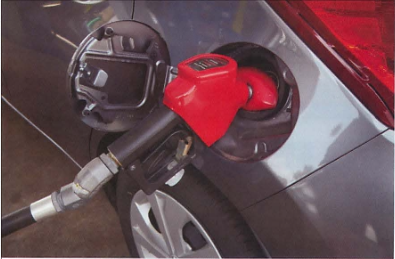Screenshot 2026-02-11 at 1.53.31 PM.png
Catalytic converters:
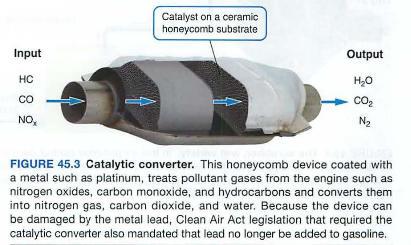Screenshot 2026-02-11 at 1.54.39 PM.png
Smokestack scrubber: Note that ash at the bottom is toxic, and must be removed to a toxic waste dump
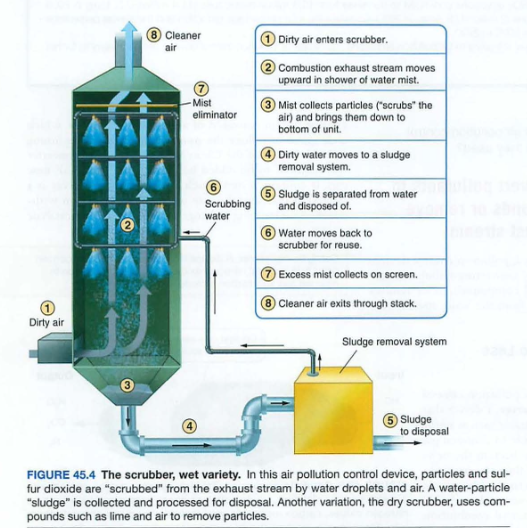Screenshot 2026-02-11 at 1.55.06 PM.png
---
Migrated from Apple Server Wiki. Original page ID: Q700A7E7\_
# Unit 8: Pollution: module 4.46: acid rain and noise pollution
Acid rain:
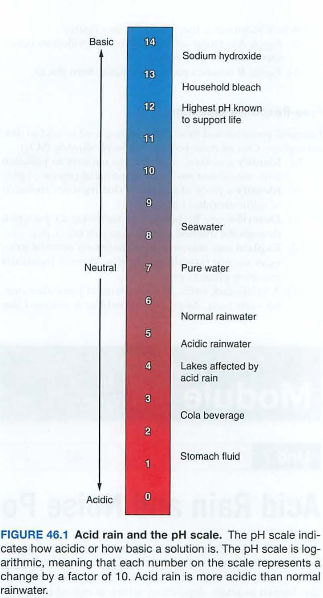Screenshot 2026-02-11 at 1.56.51 PM.png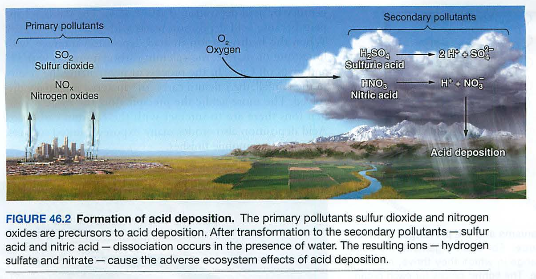Screenshot 2026-02-11 at 1.57.21 PM.png
Interferes with soils, animals, and any structures made of CaCO3 like marble statues
Noise pollution:
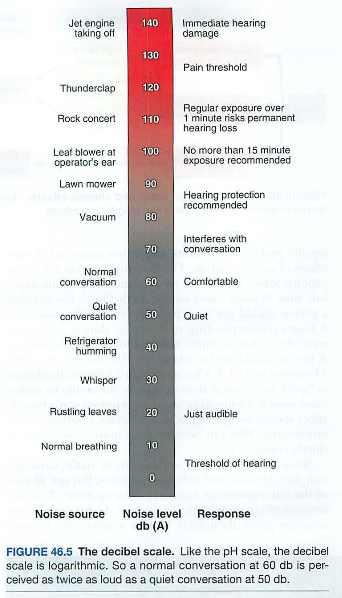Screenshot 2026-02-11 at 2.01.43 PM.png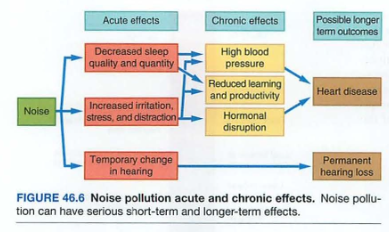Screenshot 2026-02-11 at 2.02.16 PM.png
---
Migrated from Apple Server Wiki. Original page ID: M2U1n6A4
# Unit 8: Pollution: Index page
We'll be separating this Unit 8 study of pollution into sections:
Section 1: Air
- [mod 42-44: air pollution](http://10.14.4.85:6875/books/ap-environmental-science/page/unit-8-pollution-module-442-444-air-pollution)
- [mod 45: reduction of air pollution](http://10.14.4.85:6875/books/ap-environmental-science/page/unit-8-pollution-module-445-reduction-of-air-pollution)
- [mod 46: acid rain and noise pollution](http://10.14.4.85:6875/books/ap-environmental-science/page/unit-8-pollution-module-446-acid-rain-and-noise-pollution)
Section 2: Water
- [mod 47: pollution sources, endocrine disruptors](http://10.14.4.85:6875/books/ap-environmental-science/page/unit-8-pollution-module-447-pollution-sources)
- [mod 48: eutrophication](http://10.14.4.85:6875/books/ap-environmental-science/page/unit-8-pollution-module-448-eutrophication-and-thermal-pollution)
- [mod 49: POPs, bioaccumulation and biomagnification](http://10.14.4.85:6875/books/ap-environmental-science/page/unit-8-pollution-module-449-pops-biomagnification-bioaccumulation)
Text link: [https://elab.hpa.edu/apes/texts/parts/fr4e\_unit8.pdf](https://elab.hpa.edu/apes/texts/parts/fr4e_unit8.pdf)
(hold option and click on the link to download)
---
Migrated from Apple Server Wiki. Original page ID: z4n2n3m4
# Green homes 2026
Wonderful homes this year!!
Hold option-click or control-click to download images to your computer
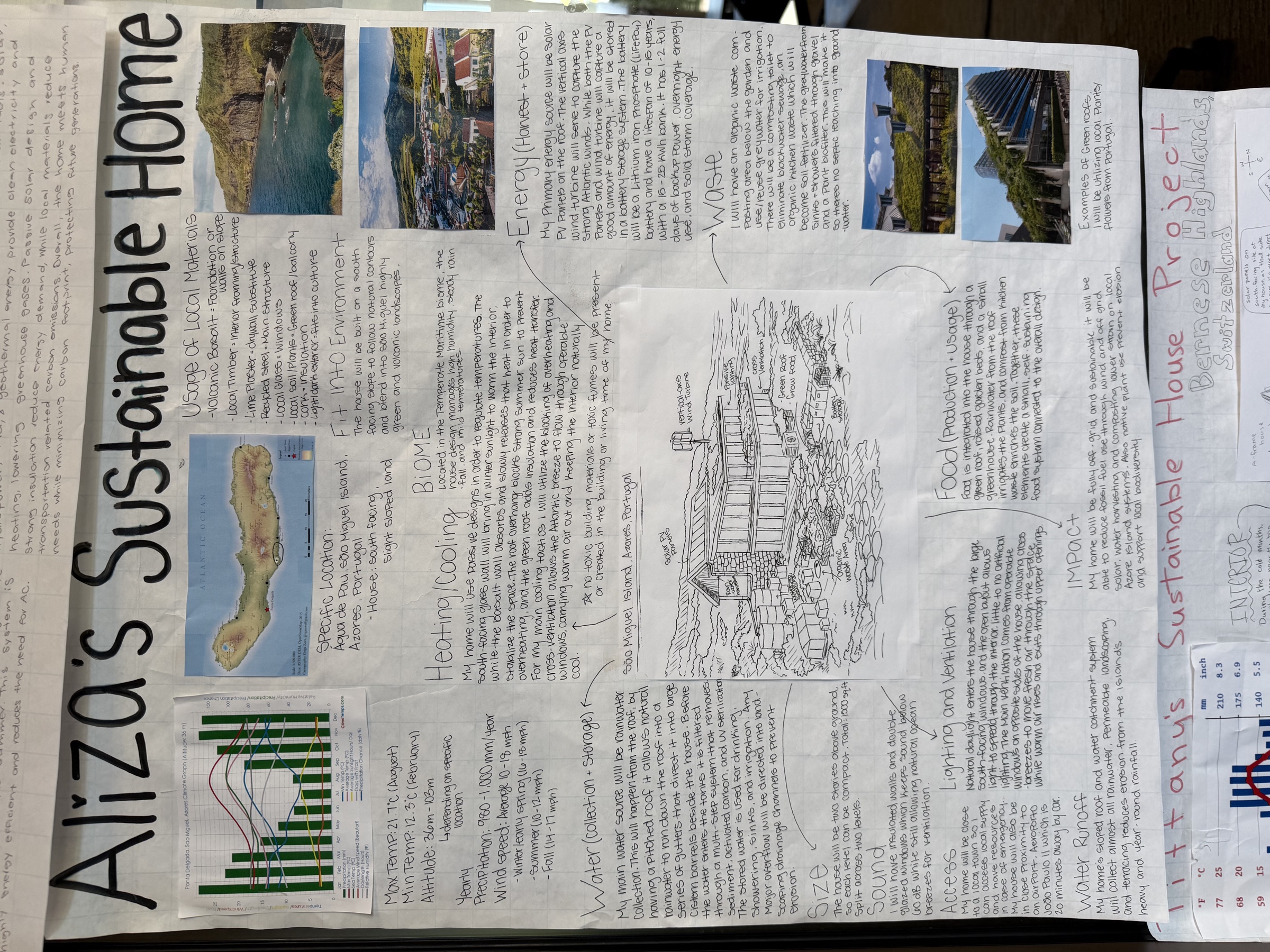aliza.jpeg
---
Migrated from Apple Server Wiki. Original page ID: H7c2p4B4
# Green homes 2025
2024-2025 sample green homes
Danica
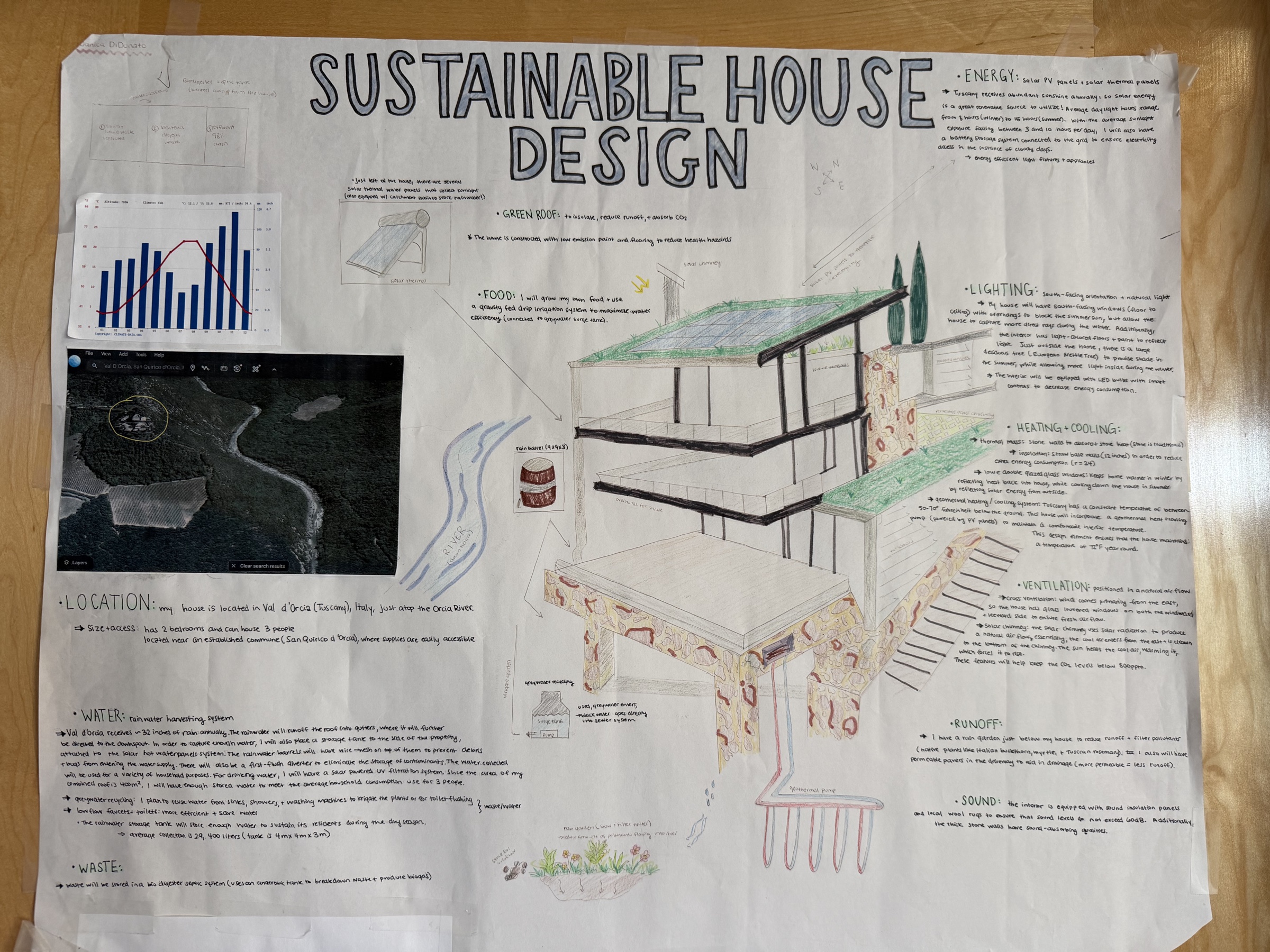IMG\_2082.jpegWynter
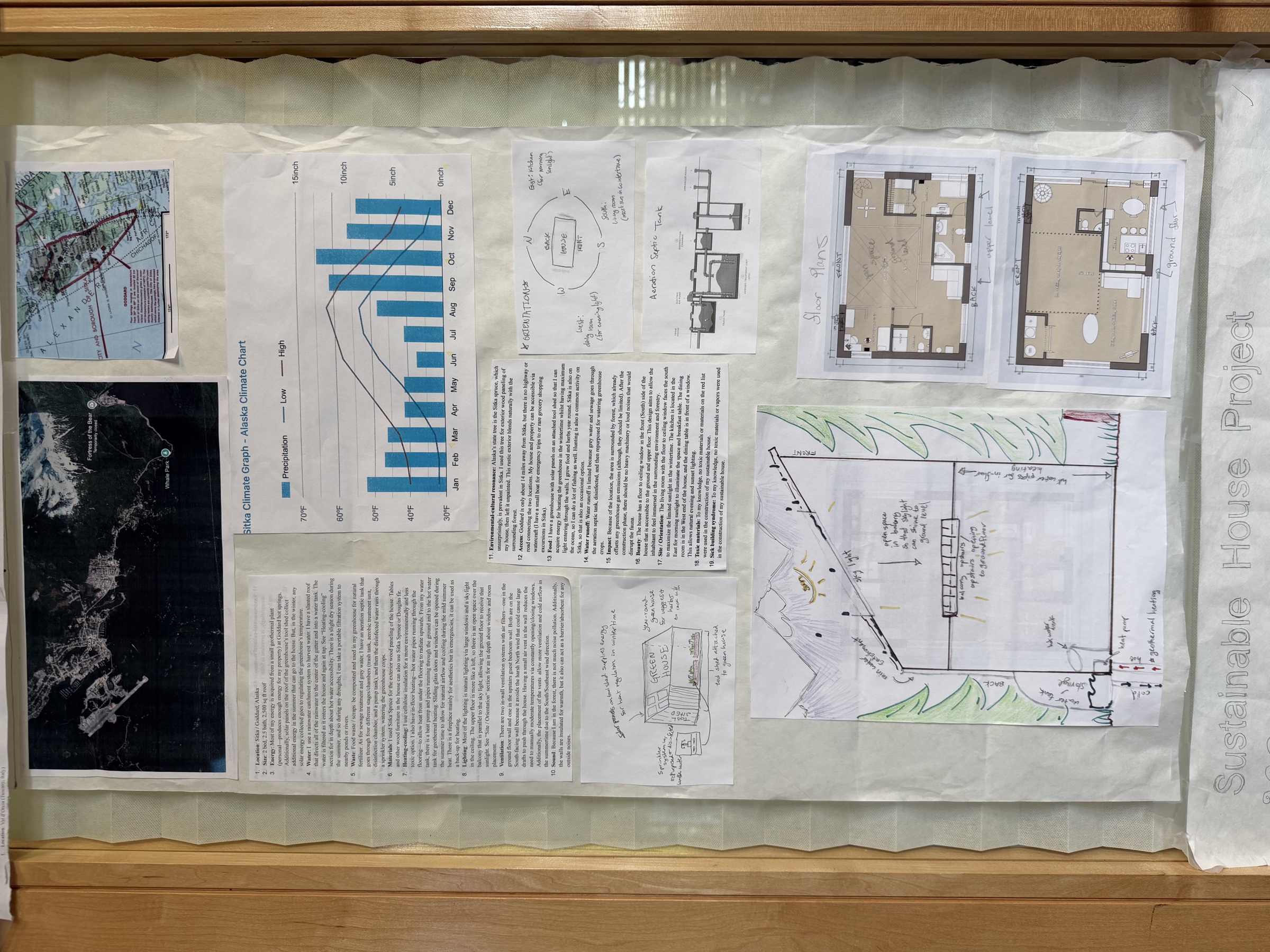IMG\_2083.jpegAdri
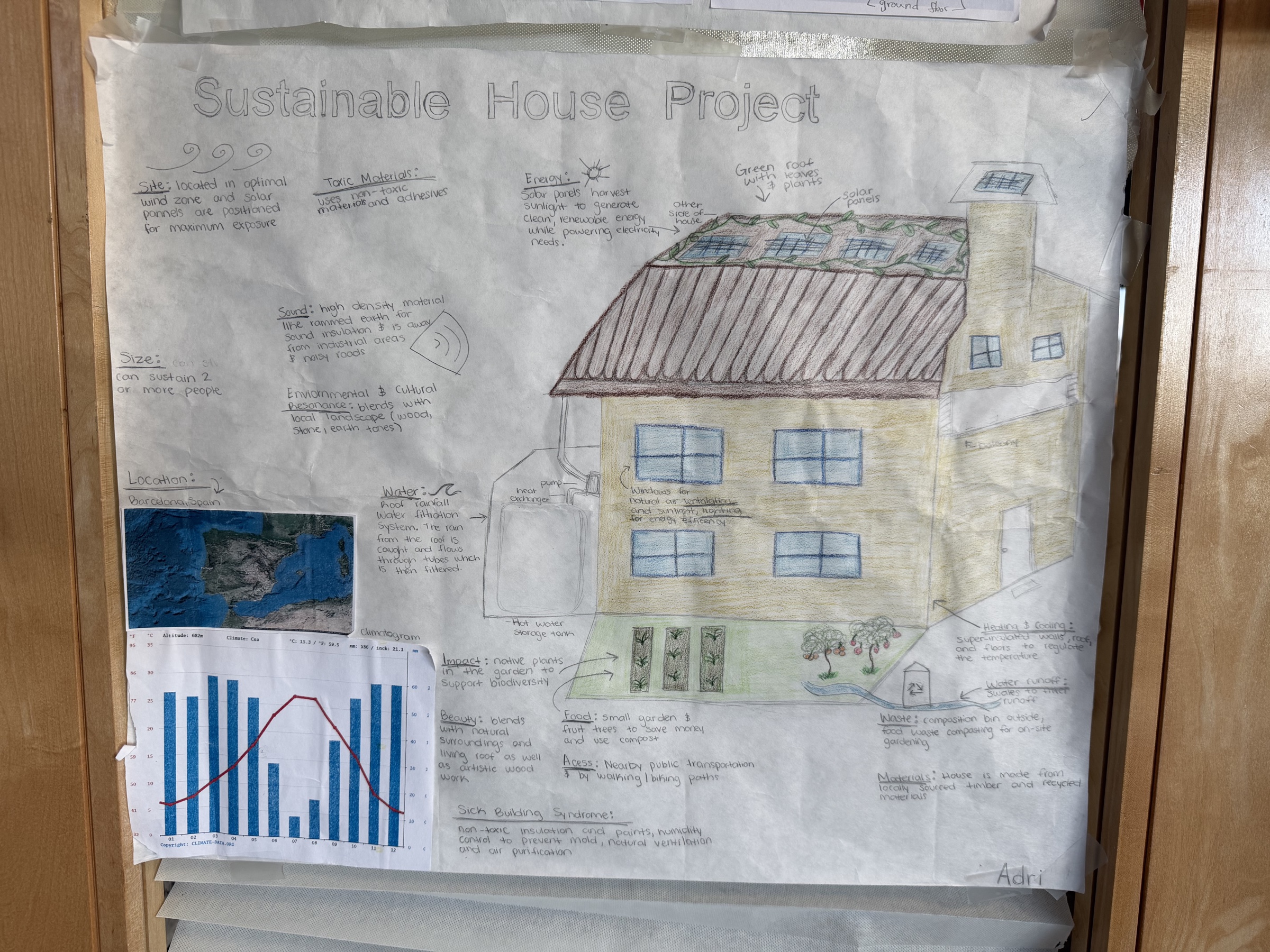IMG\_2084.jpeg
Parker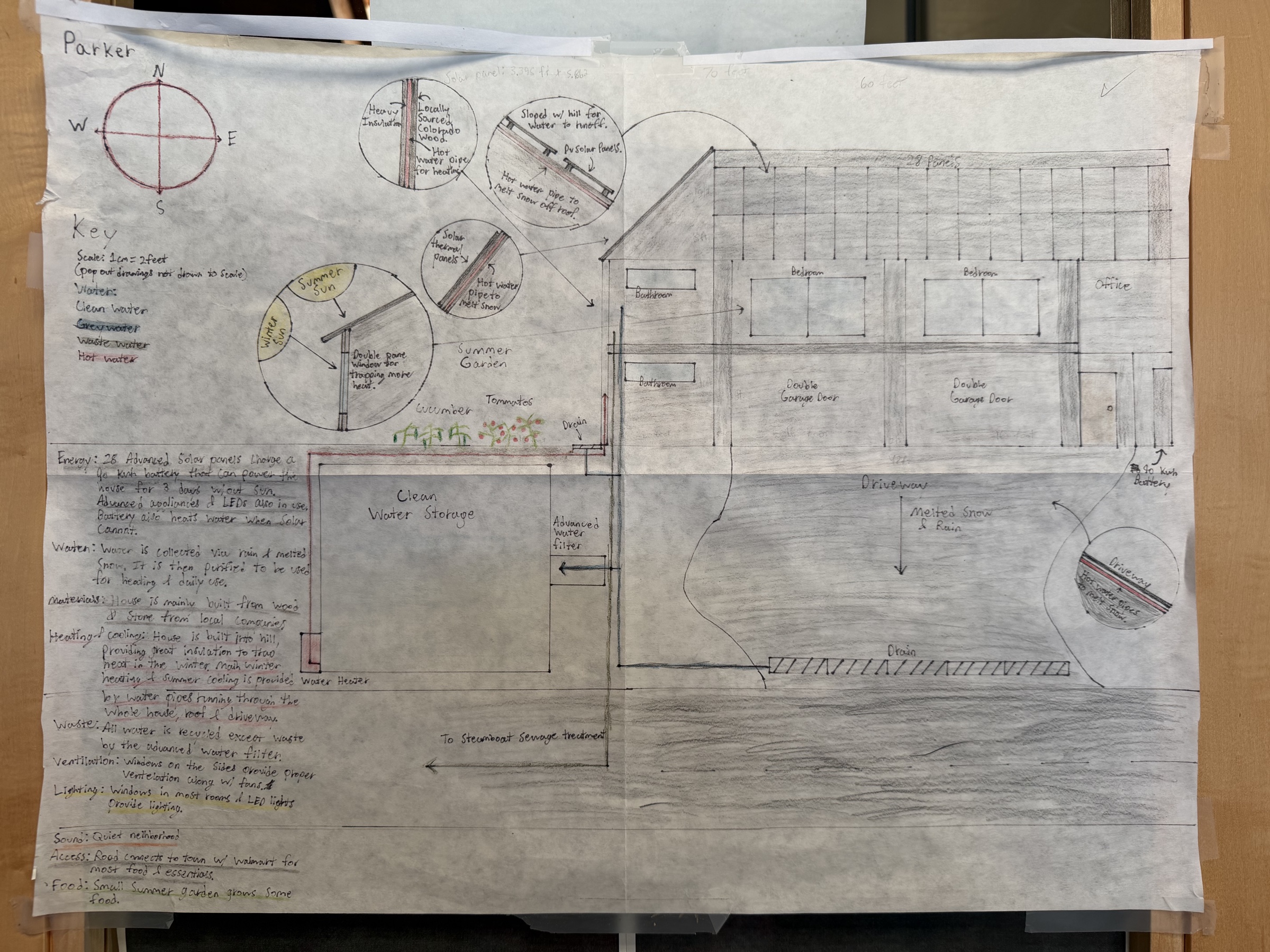IMG\_2085.jpeg---
Migrated from Apple Server Wiki. Original page ID: S2G7S5K
# Unit 8: Pollution: module 4.51 waste reduction and recycling
Module 4.51: waste reduction and recycling
Reduce, reuse and recycle: 3 R's
Source reduction: see also Tesla manufacturing: "best part of any car is the part you can delete"
also reusable containers, buying in bulk (e.g. health food store)
Reuse: easiest example is shopping bags, also cups here at the elab
Recycling: can be closed loop (carpet, asphalt) or open loop (PET bottles in to garments or decking-TREX)
**Unavailable Apple Wiki media:** the exported data did not include file 43ec70ef-7f01-43fb-8fe3-f6d71c3eaa1e.
- Tough ones: glass and paper (need special facilities to recycle)
- Glass needs to be melted to be reused, we don't do this in Hawaii, so there is a carbon footprint to transporting it to be recycled
- Paper is easier, but uses water to recycle, and again, has a carbon footprint for transport in Hawaii.
- Amazon boxes are a prime example...
- Composting: degrading naturally: if just paper, good for worms (e.g. Willie's garden)
- If food, can be a rodent issue (e.g. VC garden)
- Both are aerobic processes, so need to be well ventilated or "turned"
- Egg farm downhill from HPA: another example: turned toxic manure into compost to sell
LIfe cycle analysis:
Cradle to grave or cradle to cradle (William McDonough) Integrated waste management:
**Unavailable Apple Wiki media:** the exported data did not include file 2ba92fff-1b9b-435d-8dd4-d45ac1a12bd7.
Designing for reuse: [cradle to cradle design](https://en.wikipedia.org/wiki/Cradle-to-cradle_design)
**Unavailable Apple Wiki media:** the exported data did not include file aa628c43-70c9-4102-bd11-4a78cb8b2419.
---
Migrated from Apple Server Wiki. Original page ID: 6037t1S
# 2026 intro
Summary of the important bits:How to succeed
This class is all about discovery and discussion
Points: How to get an A in APES:Classwork:
- Daily quizzes: on homework and our class discussions. These help me keep up with our progress together, 8 points each, 60% of your grade.
- Exams: summarize sections of information. I don't prefer these as they are stressful and not really accurate indicator, points vary, also 60% of your grade
- Labs: We will complete at least 8 AP specified labs, such as soil quality, water quality, and your final project: designing a green home, 10% of your grade, points vary.
Homework:
- Text readings and questions: like any other class, these help you prepare for our class discussions, usually 4 points, 30% of your grade.
- Weekly summary questions: I put these together at the end of each week summarizing our work together, usually due the first class of the following week, usually 4 points, 30% of grade.
- Lab reports: while some of our lab activities may complete the data gathering in class, lab questions are done at home, as above, 10% of your grade
Late work:
- For full credit, work is due when posted, usually at the beginning of each class. Not 10 minutes into class, the beginning of class.
- Late work will be accepted for half credit until our next class, after which it does not count.
- Missed quizzes may be completed before the next class as well for full credit, after which they may not receive full credit
- One missed homework will be automatically dropped for each marking period by myHPA.
How to succeed in this class:
1. Come to class prepared: Read the readings, any weblog notes online, and answer the homework questions on your own. Collaboration is fun, but if you don't know the material, you can't fully join our discussions.
2. Join the discussions. This class is likely the most diverse science class you will ever take. The experiences and interests of your classmates enrich our discussions, so bring your ideas and be ready to share, ask and contribute.
3. Communicate: if you are falling behind, have other issues I don't know about or don't understand the material, seek me out. It is what I am here for
4. I bring my A game. I know you are busy, but I expect you to bring yours as well, and I'll let you know when I think you are not.
5. Turn in your homework early-If I can read it before it is due, I can send you comments to get a better grade, and understand the work better.
6. Demonstrate understanding, not rote learning. How we teach in HS is about recall. college is about synthesis and context
AI policy:
- AI is a potent aid in learning, but anything you submit with your name for credit must be your work, your thinking.
- I will do my best to read everything you write, and I want to hear what you think, not a silicon life form
- As you would not send a robot to the gym to do your workouts, think of AI as a workout partner, helping you do your best, but you do the work.
Goals/Topics
Our goal in this class is to develop environmental literacy, so you can become change agents for the future.
Our topics include basic terminology, chemistry and physics concepts, biomes, ethics, populations and earth systems, then larger modules on air, water and soil. We follow these with modules on energy and pollution, concluding with a comprehensive study of sustainability, our theme throughout the year.
This is a hands-on lab course, with some work in the field around HPA, or in the elab. Lab format will be consistent with what you have done in other lab courses, so don’t worry.
Class Format
Our class meets in the energy lab on assigned days, with access to the lab for projects over lunch and after school on arrangement with the teacher. Our class will be largely hands-on, and students are expected to take notes and complete in-class and homework assignments as well as lab reports.
Resources
We will use online videos, tools in the energy lab, iPads and laptops for our course. You are expected to use these with care, and abide by the acceptable use policy of the school, which says among other things that these tools are to be used only for class related activities. You are expected to bring your computer to class for access to class materials, but when needed, we'll use the laptops provided for security reasons during some exams. Taking notes in class is a key skill we'll work on, preferably on paper, not the computer.
Course process:
As you know, our schedule has 70 minute periods. We meet about 3 times each week for about 34 total classes per semester.
Grading:
We usually begin each class with a short 5 minute quiz with 4 questions on the homework and/or class discussion and notes. These are not just your normal recall quizzes, they should get you to consolidate and process the material we are learning together. We usually follow this with a short discussion of the quiz, and a review of homework: what you or your classmates struggled with, or demonstrated their brilliance.
Every few weeks we'll have an exam which will take longer, but will be based on the homework, class discussions and quiz materials, so make sure you make up any material you miss, including missed class discussions.
- If you miss a quiz, you have until the next class to make it up, with a newer version of that quiz.
- If you miss homework, don’t panic: I drop the first missed homework score of each quarter.
- Late homework will be accepted for 1/2 credit until our next class meeting.
Quizzes will count for a fraction of each exam, and labs will count as several exams. We have 16 required AP level labs on energy, water, soil and air, so the balance of these in your final grade may vary from quarter to quarter as we cover them. Energy is usually a very strong topic for HPA students taking the AP exam in May.
Homework:
Homework will be assigned most nights, and may include questions, videos and other materials.Homework is due at the beginning of class, not 10 minutes into class, the beginning of class (you'll see this on myHPA and your calendar). The earlier you can turn in homework (e.g. the night before it is due) I'll give constructive comments which will make for a higher score. Last minute work will not get this treatment. Please make sure to use your HPA email, not something like"somecooldude@gmail.com"
ExpectationsStudents are expected to bring their own notebooks, calculator and/or writing tools to every class, with no exceptions. We will learn how to effectively take notes using the Cornell notes format among others. I suggest taking notes on paper, not just because it is retro and quaint, but studies show that you process and integrate information better this way, even better than taking notes on the computer. Go figure.Phones: Phones are not permitted in class, except for calculator use. Any phone use during class will result in the phone being collected and turned over to the Dean of Discipline (this includes bathroom breaks). This may be updated as we test out the new lockdown system for phones.
Some of our work will be done in class, but any out of class assignments will usually have a very express turn in time. This is partly to help you organize your workload, but also so that I can have a chance to grade your work before we discuss it in class. As AP college prep students, you may also turn in assignments early, in which case I can give you feedback and usually this results in a higher grade, as well as greater comprehension. Please check out the student handbook for more information.
Energy Lab: Please do not bring food or drink from outside into the energy lab. Students may bring in their own water containers, but since we have a limited supply of bottled water, please do not fill your containers from these bottles, instead use the water in the sinks, which is actually purified rainwater.
AP exam:
Everyone is required to take the AP exam in May, which in our class often falls on the first exam of the first day (lucky you!). Actually this is an advantage as you have more time to study for your other exams. We'll have more on this through the year. We will usually have a timed AP simulation exam just before spring break, to show you what you'll need to work on for the real thing in May.
Texts:
We'll be using various pdf resources along with iPads in class with the iBook Environmental Science by Jay Withgott among others. See the resources page for other resources you should consider for the class. Books are expensive, but their value is considerable.
We may use other texts as resources, in which case a pdf will be shared with you. More on this in class.
Online resources:
We'll be using myHPA for all calendar events, gradebook, attendance and assignments. We'll also be using the elab server at [elab.hpa.edu](http://elab.hpa.edu) where many of our online resources live. This is also where you'll find class notes and summaries. Why not on myHPA? You'll find this server to be an excellent searchable resource with materials going back many years of this class. It is a gold mine of questions, videos and class notes you might enjoy. MyHPA does not have this legacy aspect, but is valuable as a common communication platform.
You should be able to access this off campus or on campus at elab.local.
You may also find it useful to download videos while in the elab, as our servers live there, and your download speeds will be much more awesome as a result.
Access:
The best way to reach me is before or after class, but any questions about grading have to be taken care of outside of our class time, out of respect for others in the class as well as your privacy. Email is always the best, as I basically live at . You can expect a return on any questions before 7PM most nights.
Our first day together:
I'd like to begin by learning more about you, so we'll chat for a bit, then I'll have an email assignment for you (your first score-yippee!)
In our first weeks, we'll have a "navigation quiz".
Huh?
Navigation-finding out where we are, and where we want to go. What will success look like for you? Is it a 5 on the AP or a 5 in life?
"Errors and trust are opportunities to learn"
Keep this in mind when you are struggling-we have your back. We are here to challenge you and make you think. Hopefully laugh a lot too.
As always, let me know how I can help. My email is bill@hpa.edu. I'll share other contact info in class. You should always check your email the night before class, and I'll do the same to make sure I've answered all of your questions.
This course may cover topics such as religion or gender issues as part of the course material. If you find anything either in our discussions or in the material makes you uncomfortable, please reach out to me. My goal is to be inclusive and respectful of all viewpoints. This does not mean we’ll challenge accepted scientific principles like “did we really land on the moon” or “is climate change caused by human activity”.
Finally, AI, GPT, Chegg and all of the other online tools enable you to learn in new ways. We’ll be learning how to use these tools together, but I expect that anything you turn in with your name on it is yours, and reflects your thinking, not something from the collective auto-correct of the internet. More on this in class.
Let me know how I can help.
---
Migrated from Apple Server Wiki. Original page ID: d0n67004
# science review: chemistry notes
- atom: one nucleus with protons and neutrons, electrons around the nucleus
- element: one type of atom, defined by the number of protons
- protons: positive charge, give the atom identity, found in the nucleus
- neutrons: neutral charge, gives the atom more mass, found in the nucleus
- electrons: much smaller (1/1800), negative charge, gives the atom charge, "orbits" the nucleus
Examples: see [https://ptable.com/?lang=en#Properties](https://ptable.com/?lang=en#Properties)
Helium: He, discovered in the sun (helios), 2 protons, 2 neutrons, 2 electrons
Carbon: C, 6 protons, 6 neutrons, 6 electrons
Atomic mass is the mass of all of the protons and neutrons (electrons are too light to count)
Isotopes: nuclear stuff
Wait: why does carbon have atomic mass of 12.011 instead of 12?
There are other types of carbon, called isotopes (same type)
C12/6, C13/6, C14/6
Each of these has the same number of protons (identity) but more neutrons
check: how many protons, neutrons and electrons in C14/6?
Demo: m&ms in cup
Ions and bonds: chemical stuff
so far we've been playing with the nucleus.
If you change the number of electrons from a match with protons (C6/12 has 6 electrons), we can add or take away electrons:
Na+ is Sodium missing an electron
Cl- is Chlorine with an extra electron
Why?
Look again at the periodic table: [https://ptable.com/?lang=en#Properties](https://ptable.com/?lang=en#Properties)
Everyone wants to be on the right hand column, called the noble gases
To get there, Na loses an electron to look like Neon, while Chlorine adds an electron to look like Argon (see for yourself)
These sorts of bonds, where one gives up and one takes is a very strong bond, called ionic (because it involves ions)
NaCl (salt) is one example:
- Ionic bonds have high melting points
- They conduct electricity, especially in water
- examples: NaCl, KCl, MgCl2 (notice usually groups 1 or 2 and a halogen, group 7)
demo: salty fingers, lower electrical resistance
The weaker type of bond you will see is called covalent.
Think of a pilot and co-pilot: both share the duties
In a covalent bond, neither one is more positive or negative, they share an electron.
Molecular Hydrogen (H2) and molecular oxygen (O2) are good examples
so are plastics, water and other substances
Covalent bonds:
- Weak bonds
- Don't conduct electricity as well as ionic solutions
- low melting points (water, plastic, butter)
Periodic table classes:
The periodic table (here it is again: [https://ptable.com/?lang=en#Properties](https://ptable.com/?lang=en#Properties)) is key to solving riddles in APES around pollution, toxins, and many other things:
Example:
Strontium 90/38 is a radioactive isotope, a product of nuclear reactions (reactor meltdowns, nuclear weapons)
Look at the periodic table, find Strontium.
What is above it?
Calcium is part of your bones, so when you ingest Sr90/38, it is absorbed into your bones just like Calcium, since elements in the same column are chemically similar.
What sort of cancer would this cause?
Question: Cesium is a radioactive element, where would it go in your body?
Homework 2.2
1. Why is radon so potent as a carcinogen for lung cancer?
2. How much more potent an acid is something with pH of 4 than one with pH of 6?
3. Someone is poisoned with Strontium 90, what sort of cancer would they likely get?
4. List a few other ionic compounds, with formula
5. List a few other covalent compounds with formulas
Acids and Bases: pH
In aqueous (water) solutions, we often need to know if a solution is acidic or basic
Acids have more Hydrogen ions (H+) floating around
Bases have more hydroxide (OH-) ions floating around
Water is amphoteric (both) since it is really H-OH
Water has pH (potency of Hydrogen) of 7, in between 0 (acid) and 14 (totally base, dude)
Water is "mid"
First look at most solutions is a good guess:
NaOH base
HCl acid
See?
You try: KOH, HNO3, H2SO4, H3PO4
Which were acids and bases?
Clue: anything with an H alone is usually an acid, anything with an OH is usually a base
Exceptions: alcohols (see below) have an OH, but are not basic, they are organic compounds
This is usually easy: a sample problem might ask what is the H+ concentration of something with a pH of 1 ee -4?
Simply take the minus sign off the exponent and you have your answer: pH = 4
Another version of this would be:
How much stronger is an acid with pH 4 than pH 6?
This is a bit trickier: since each power of ten is one pH number, 10^2 is 100, so the answer is 100.
Try this: How much more acidic is water than NaOH solution with pH 12?
Since water is pH 7, 12-7 = 5, so 10^5 is 10,000x stronger.
Weird to think of water as an acid, but there it is.
You may also see something like "what is the pOH of something with a pH of 4?"
The answer is: pOH is just 14-pH, to the answer is 10.
There is a scary looking formula for pH:
pH = -log10[H+]
not so scary: all it says is take the log to the base 10 (usually the same as the power) and throw away the minus sign
Like in radioactive decay, you may see something that is not in the form 1 ee-4, in other words, the 1 may not be a 1.
In that case, you just use the scary formula...
The good news is these do not hang around forever, they decay into other things, some radioactive, some not.
A half life is the amount of time it takes something radioactive to decay into half of the amount it was before.
So, If you have 128 grams of Strontium 90/38, which has a half life of about 30 years, after 30 years you will have:
64 grams
Then 30 years later it will be all gone, right?
Nope: 32 grams
Then continue: 16, 8,4,2...
It never really goes completely away
Demo: M&M's in jar
Half-life how to: caffeine, nuclear waste, drugs
If 100% of something decays exponentially, this means that after one half life (t 1/2) half of it remains.
We demonstrated this with M&Ms in class, and you saw an exponential decay graph
Why do we want to know how this works?
Easy: nuclear waste, radioactive fallout, caffeine and other drugs all follow exponential decay.
So, to find out how much is left of something, you can count the half-lives and divide each one by two over and over again:
1/2->1/4->1/8->1/16
You may also see this as percentages:
50%->25%->12.5%->6.25%
There is a simple formula for this if you want to use it:
Amount left = Amount starting (1/2)^n
At = Ao (1/2)^n. or At = Ao/2^n
where n is the number of half lives.
Example:
The half life of C14/6 is 5730 years
How much of a 200 gram sample will be left after 22,000 years?
Divide 22,000 by 5730, you get about 4
(1/2)^4 is 1/16, or 6.25% whichever you like using more
200 grams/16 = 12.5 grams left. or...
200 grams * 0.0625 =12.5 grams 12.5
This also works if you have something in between half lives, like if you repeated this problem for 18,000 years:
18,000/5730 = 3.14
(1/2)^3.14 = 1/8.8 or 0.113
0.113 * 200 = 2.26 grams left
In some rare cases, you will be see this situation in reverse:
The half life for Sr90/38 is about 30 years.
If 25 grams of a 100 gram sample remains, how old is it?
25/100 is about 1/4, 4 = (1/2)^2 so two half lives, or 60 years.
HW Radioactive decay
1. Take a photo of your graph and include it below. What represents the “half life” in your demonstration?
2. A sample of a radioactive isotope has a half-life of 5 years. If the initial mass of the sample is 100 grams, how much of the sample remains after 15 years?
3. A radioactive isotope decays to 25% of its original amount in 10 years. What is the half-life of the isotope?
4. A certain radioactive isotope has a half-life of 20 years. What fraction of the original sample will remain after 60 years?
5. A fossil contains 12.5% of its original amount of Carbon-14. Given that the half-life of Carbon-14 is 5730 years, estimate the age of the fossil.
6. The activity of a radioactive source is measured to be 800 disintegrations per second. If the half-life of the source is 2 hours, what will be the activity after 6 hours?
7. If Caffeine has a half life in your system of 5 hours, and you have one “dose” at 7 AM, how much is in your system at noon?
8. You then have another dose of caffeine at noon, how much is in your system at 5 PM?
9. You then have another at 5 PM, how much is in your system at 10 PM?
10. If the half life of caffeine was longer, what would happen to the amount in your system by the end of the day?
11. THC (tetrahydrocannabinol) has a half life of 20-30 hours, which we can estimate to 24 hours for this question. A user has a “dose” at 6 AM, then another at the same time every day for five days. What is the level in doses after 5 days?
12. THC absorbs into the fatty tissues of the nervous system, just like other fatty-soluble toxins we will study, like PCBs in Killer whales. Look this up and describe why this is important to our study of APES.
Radiation: nuclear fallout, nuclear energy, radon
There are 4 main types of radiation from radioactive substances or nuclear reactions (nuclear weapons, meltdowns, etc.)
- Alpha rays are Helium nuclei, +2 charge, very heavy, very slow, and can be stopped by skin or paper
- Beta rays are fast electrons, -1 charge, fast, light, and can be stopped by metal foil
- Gamma rays are light photons, no charge, can be stopped by lead
- Neutrons are fast neutrons, no charge, can be only stopped by lots of concrete or lead (slow ones are called "thermal" neutrons and are useful in nuclear power plants to make steam)
Health examples: Radiation, mutations, cancers
Radon gas (222/86) is very heavy, and emits alpha rays.
No problem if the gas is outside your body, your skin protects you.
If you breathe radon gas, is sits in the bottom of your lungs and alpha rays destroy your white blood cells: leukemia and other lung cancers result
Gamma rays split DNA and cause mutations, some cause cancer.
Neutron radiation dissolves membranes in animals, killing them in nasty ways...
In each of these cases, radiation is harmful, it depends on where you are exposed, for how long, and what protection you use.
Radon is the #2 cause of lung cancer in the US (!!!)
Be aware of this if your dorm room in college (or anywhere) is in the basement, and you are near the Rocky mountains.
Demo: Radon rock
Solubility of gases:
Air holding water: Humidity, condensation, rain shadows, hurricanes
We know that air can hold water vapor, this is invisible, unless it condenses (like steam or clouds)
As gases get cooler, they can hold less water, that's when it rains or condenses.
You know this: cool drinks form beads of water on the outside, since the drinks are cooler than the air.
It also means that warmer air can hold more water
Remember this: gases hold more water when warmer
This also explains why you may get a shock in cooler climates walking across a carpet: dry air is a better insulator, so can build up an electrical charge better.
It also explains why it rains on the windward side of mountains: as the moist air rises, it gets cooler, and cooler air can hold less water: "Orographic lifting"
It also explains why air coming in from the ocean is more humid: it has been warmed by the ocean.
Demo: elab humidity sensors, temp and RH
Water holding gases is the opposite: Dissolved Oxygen, DO, thermal pollution
One smart character decided to boil the water for the aquarium before dropping the fish. Even though the water was at the right temperature, by boiling the water, all of the dissolved oxygen was gone-what do you think happened to the fish?
Gases dissolve better in cooler water. Fishing folks know this, and go where the water is cooler, since fish breathe better there.
It also explains why the British are so nuts about when they boil water for tea: if you boil it too long it has no oxygen in it, and it tastes "flat".
You also know this that soda drinks lose their fizziness if you warm them up.
This is very important when we study dead zones and fish kills...
It also explains why you don't ever need to get ice in your carbonated drinks: to get the carbon dioxide to dissolve into the drinks they MUST cool the drinks down to inject the CO2.
Demo: cool soda water, warm soda water
More water stuff:
Surface tension: adhesion and cohesion: capillary action, trees and all plants
Water is very cool stuff: it likes to stick to other stuff (adhesion) as well as to other water (cohesion)
This makes for interesting phenomena when the sides of a container are very close, like in roots or thin hair:
As the water molecules climb up the sides of the roots (adhesion) they stretch out the molecules in the middle (cohesion).
This is called surface tension
This make the curve stretch and then shorten, so water moves up the column (roots, long hair).
This is called capillary action, and is very important for all plants.
Surface tension is also how water striders "sit" on the water: their feet stretch the water molecules.
Soaps destroy the cohesion, making water "wetter", also making little bugs fall into the water...
All plants rely on capillary action to bring water to their leaves, so it is not a good idea to drop soap on the roots of plants.
Think of roots: many thin fibers next to each other-perfect for capillary action.
1. Explain how tall trees and other plants carry water vertically to their leaves
2. Explain why soap might impact this action
3. What is the difference between adhesion and cohesion, and why should we care?
4. If a body of water gets too warm, fish will die, why?
5. You might feel comfortable on a very hot day in the desert, but not at the same temperature where it is humid-why?
6. Why would triathletes struggle in Kona? What is different from where they have trained?
7. Why would the British only boil water for their tea until just before boiling?
8. Herman boils the water for his aquarium to keep it clean, then cools the water before dropping in his prized fish, which all promptly die-why?
9. Why is there a desert (not a dessert) on the eastern, leeward side of the coastal mountains in Washington and Oregon?
10. If you run into a person wearing a foil hat, what sort of radiation do you think they are protecting themselves from?
11. What about a paper hat?
12. What phase of water are ice skaters skating on?
13. If it is temperature that cooks food, why would increasing the pressure make for a shorter cooking time?
14. The Chesapeake bay is a "perfect storm" of pollution, shallow, slow moving water, lots of fertilizer and silt. Why is this a perfect storm for killing fish?
Melting and boiling points: colligative properties, melting ice, antifreeze/anti boil
Water is everywhere, and we study it a lot
The melting and freezing point for water is 0°C at one atmosphere (very interesting stuff happens at other pressures, like ice hockey)
The boiling and condensation point for water at one atmosphere is 100°C (again, interesting things happen at other pressures like pressure cookers and freeze dried ice cream)
It turns out that anything added to water raises the melting and boiling points.
You may have heard to add salt when cooking pasta: this raises the boiling point a bit so the pasta cooks a bit faster. (heat cooks food, not boiling)It also explains why they add salt to ice to make ice cream, or pour salt on road to melt ice...
You can demonstrate changing pressure on melting by slowly chewing on an ice cube: pressure makes ice melt (ice hockey skates)
This also means that water boils at a lower temperature if there is less pressure, like on a mountain, or even here in Waimea, since we are at 800 meters elevation (about 3000')
Pressure melting of ice is how ice skaters move, if you look at their skates end-on, you will see an upside down U shape that traps the melted water from their weight pressing on the ice.
Heavier ice hockey players can use a thicker skate...
It also means that if the ice is too cold, this does not happen (ask Mr. McKenna about this where he skated in Canada)
Demo: pressure cooker, crushing ice, salt on ice, salt in boiling water
HW review:
1. A chemist claims she can make a compound from Mg and F that she calls MgF. What is wrong with this formula?
2. Another chemist claims that something that conducts electricity is covalent, what is wrong with this?
3. Look up three radioactive isotopes that are present in nuclear fallout, and explain how they might impact the body.
4. Look up their half lives and calculate how much would be remaining after one year
5. Explain what the term amphoteric means, and why you need to understand it
6. Why is water both an acid and a base?
7. A substance has an \[H+\] of 1 ee -4, is it an acid or a base, and what is the pH and pOH?
8. Look up the decay of Radon, and explain the various forms of radiation it emits
9. If you wanted to ski on dry, powdery snow, where could you go in the US, and why is it dry snow there?
10. Why would stream water near there have a high DO?
11. For very tall trees, would the tree fibers in the trunk be thinner or thicker and why?
12. Look up the process for freeze-dried coffee or ice cream, and explain how this works, using what we know so far.
- You may have heard of this in your chem or bio class.
- Osmosis in simple form means that water always chases salt or other "solute"
- When a solute like salt dissolves in a solution like water, it becomes salty.
- If a membrane like skin or cell walls separate this salty solution from fresher water, the water will travel through the membrane to get to the salty solution.
- Good use of this: if you have an injury with swelling, doctors may say "soak it in warm, salty water".
- This draws the fluid from the injury, enabling healing.
- Also works for sore throats...
- Bad use of this: if you pee on plants, the Nitrogen in urine helps plants grow, but the salt in urine pulls water from the roots, killing the plant.
- This also happens in areas where well water is used to irrigate crops: the minerals (salts) in the water accumulate in the soil, killing the roots of the plant.
- EVEN MORE SCARY: As ocean levels rise, salty ocean water is penetrating into the water table in many fertile areas like the Mississippi delta, Florida and the Pearl river delta in Asia, killing crops. The Pearl river delta is where most of the rice for all of Asia is grown...
- This is called salt water intrusion
Osmosis vs. Diffusion:
- Osmosis is where water follow salt (or solute), example sore throat with hot salty water
- Diffusion is where any molecule (solvent or solute) moves from high concentration to lower, example CO2 out of the room, can be gases, liquids (even solids in some cases-how computer chips are made)
Organic and inorganic compounds: everything based on carbon
- Anything with a carbon backbone (like you) is an organic chemical compound
- Anything without carbon is called inorganic, like salts, metals and minerals
- These could be anything from the foods you eat (more on this later) to the gasoline you might put into your car or grease (don't eat that)
- Organic compounds can be water soluble, or not.
- Hydrocarbons like gasoline and oil have only C-H bonds, so are insoluble in water (like greasy hands, or olive oil in salad dressing)
- anything ending in -ane means single bond organic compound
- organic compounds with an OH molecule attached, so they can dissolve oils while also dissolving in water.
- try this: use alcohol to remove grease from your hands, or your laptop
- -ol is the suffix in organic compounds that means alcohol
Some important alcohols:
- methanol CH3OH (toxic)
- ethanol C2H5OH (makes you drunk)
- propanol (C3H7OH) known as rubbing alcohol
Scary stuff: if you are interested, compare the digestion and metabolism of ethanol and methanol...one of these turns into ant venom in your bloodstream!
Soaps
- are an interesting combination of organic (C-H, hydrophobic) and inorganic (ionic, hydrophilic) ends, so they can mix with oils then be carried away by water.
- Many organic compounds dissolve in plastics, like spaghetti sauce in plastic food containers (Vitamin E/Carotene=orange and lycopene=red)
- -ene means double bonds in an organic compound
- many fat soluble toxins can build up in fatty tissues of wildlife, like killer whales (remember?)
Demo: spaghetti sauce in plastic
Proteins, fats and carbohydrates: CHO, C-H-O and C-H-O-N
- All three of these can act as fuel in your body, as your body is really clever that way.
- Oddly, though, even your awesome body cannot repair tissues or grow new ones without proteins
- Why not?
Proteins
- are the only food source with Nitrogen, since they are made up of amino acids (amines means Nitrogen)
- Proteins can be used as fuel for your body by "de-amination" meaning taking off the nitrogen
- so, could you live on just proteins alone? depends...
- Look up several amino acids, the building blocks of proteins, and find the only one that contains sulfur (very important)
- DNA is made up of proteins as are muscle and tissues (brains too)
-
- Fun fact: vitamins are often amines, and were thought to be vital to health: "vital amines"=vitamins (look up the formula for a vitamin of your choice)
- Another fun fact: athletes using protein supplements can "burn" their kidneys if they don't drink enough water with the proteins, as the body de-aminates the proteins into fats and carbs for fuel (drink water!)
Fats:
- Fats and carbohydrates have similar chemical formula (carbon and hydrogen), but different structures
- Fats all have a special sort of alcohol backbone, with little strands coming off made of C-H bonds (like a hydrocarbon)
- This is why most fats do not mix with water...
- "Free fatty acids" in your blood are the main fuel for athletes (not carbs, as most folks believe)
Carbohydrates:
- Carbohydrates are C-H-O bonds (anything that ends in -ate means with oxygen), so carbo=carbon, hydr=hydrogen ate=oxygen
- Carbs can be long strings, like starches, or compact little hexagons or pentagons like sugars
- Carbs are a short term fuel for athletes
- sugars can give a short term boost in blood sugar, followed by depression (insulin rebound)
- one reason caffeine is added to sugary soft drinks.
- Sugars tend to be metabolized much faster (smaller molecule) than starches
- Diabetics suffer from insulin deficiency, so starches are better for them: slower digestion
- Fun fact: sugar alcohols look like sugar to your body, but don't behave like sugars-used in drinks and candies...
Demo: food analysis
Conservation of mass, conservation of matter:
- In any chemical (not nuclear) reaction, mass is conserved
- Later we will discuss nuclear reactions, where mass actually turns into energy (and vice versa)
Reaction rates:
- Every 10°C increase in temperature doubles the speed of any reaction
- Who cares?
- When you have a fever, you burn fuel much faster
- When explosives heat up, their blast is much more violent
---
Migrated from Apple Server Wiki. Original page ID: 95o1K63
# 00 quizzes-worksheets
share 8 countries
8.24.26 quiz D
1. How many protons, neutrons and electrons in each of these: C14/6, Sr90/38, U238/92
2. What is the new and old name of these symbols: Ag, Au, Na, Fe
3. If a sample of carbon is found to have 12.5% of the natural amount of C14/6 in it, how old is it? (C14 half life is about 5000 years)
4. List three anomalies from your 8 countries workl
- pH, acids and bases
- metabolic-respiratory acidosis-alkalosis
- boiling in space
- capillary action
- colligative properties
- gas solubility: orographic lifting-Waipio
- osmosis: soaking in hot salt water
- surface tension: adhesion and cohesion
- RO for homes
- regelation
- ocean acidification-carbonic acid
- drug half-lives
- skin pH
- methionine-acid rain
- radiation, conduction, convection: climate change+hurricanes
- radiation: alpha, beta, gamma, neutrons (paper, foil hats, radon)
- eutrophication: NPK
- chesapeake bay: perfect storm
- organic vs. inorganic substances
- proteins, fats, carbohydrates
---
Migrated from Apple Server Wiki. Original page ID: L15666i
# Heat lab: Save the thermobacteria!
Challenge:
You are a researcher of volcanic geysers who has just discovered a new species of hot water bacteria, and need to transport a sample of 100°C water from the geyser to the lab. You have the following supplies to achieve your mission:
- several sheets of aluminum foil, one side is shiny, one is dull
- two styrofoam cups
- napkins from a local restaurant
- plastic wrap
- a few plastic bags
- access to toilet paper
- your geyser thermal camera
You will gather a sample of hot bacteria water, then measure the temperature when you reach your lab hours away. The hotter the water, more bacteria have survived for your research.
Create a diagram of your "thermobacteria transport device" so others can learn from you!
Lab questions:
1. how did you stop convection, conduction and radiation of heat from your sample?
2. which side of the shiny foil was facing the hot water and why?
3. if you were later studying DO (dissolved oxygen) in a cool water sample, what would you do differently?
4. does the hot water cool at the same rate through your trip? Explain
5. could the thermobacteria be aerobic or anaerobic? Explain
---
Migrated from Apple Server Wiki. Original page ID: Z4o562S5
# 001 Elements, water, energy
Helpful text: [https://elab.hpa.edu/apes/texts/fr3e/fr3e\_ch2.pdf](https://elab.hpa.edu/apes/texts/fr3e/fr3e_ch2.pdf)
Review:
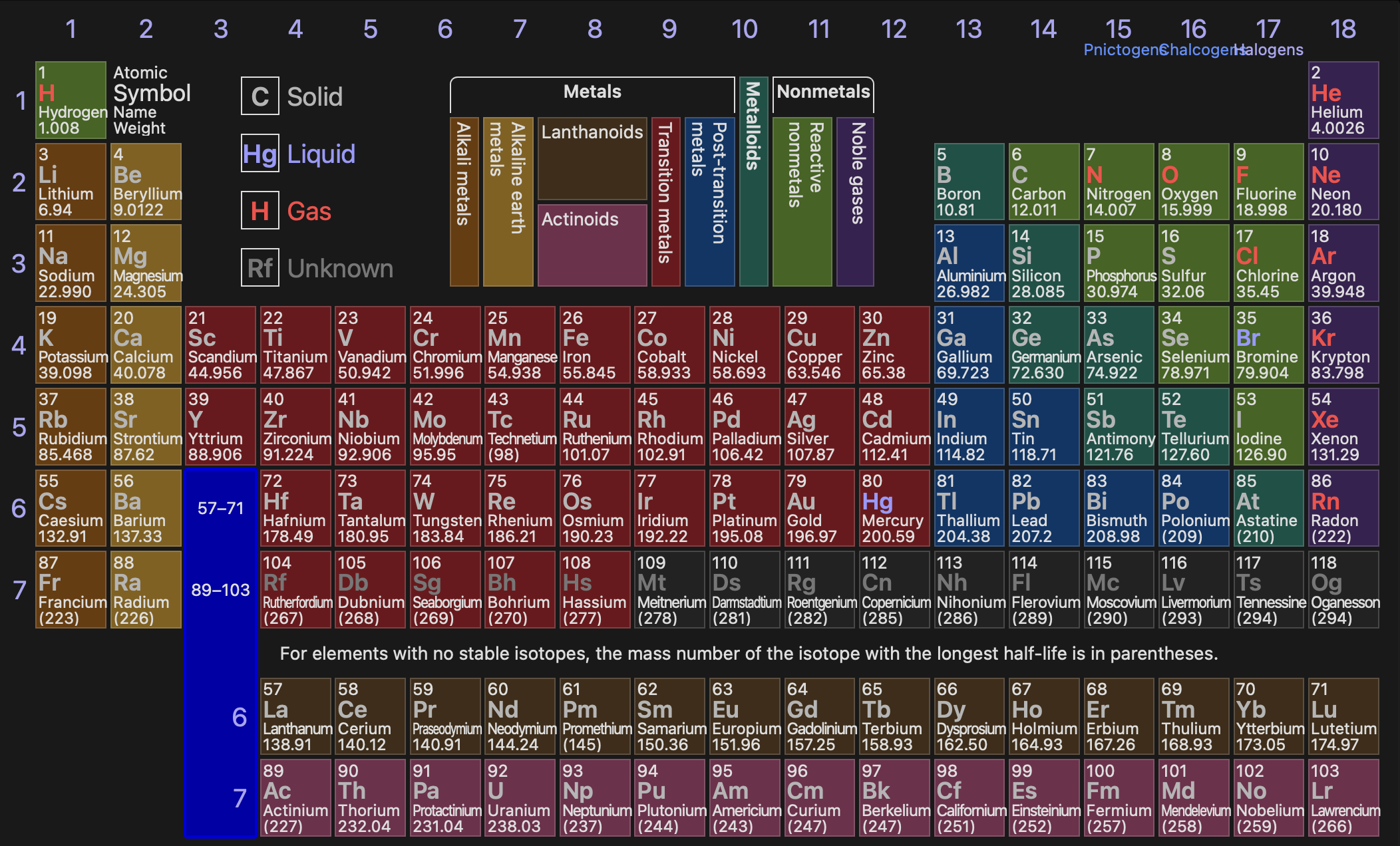Screenshot 2026-08-25 at 1.56.26 PM.pngPeriodic Table:
- The periodic table (here it is: [https://ptable.com/?lang=en#Properties](https://ptable.com/?lang=en#Properties)) is key to solving riddles in APES around pollution, toxins, and many other things:
- columns are chemically similar, e.g. Cs 137 looks to the body like K
- column 1 elements want to lose an electron to look like a stable shell, e.g. Li+
- stable shells are 2 electrons per orbit in the first two columns, six electrons in the Boron-Neon columns (2 electrons, 3 shells = 6)
- noble gases have a full shell, don't mix with anyone
- F column (halogens) need an electron to look like Ne
- strongest bond: Ionic: Na loses an electron (Na+) and Cl gets an electron (Cl-) to form NaCl, high melting point
- covalent bond is weaker, sharing an electron, low melting point e.g. water
- Think of a pilot and co-pilot: both share the duties
- In a covalent bond, neither one is more positive or negative, they share an electron.
- Molecular Hydrogen (H2) and molecular oxygen (O2) are good examples
Atoms and molecules:
- atom: one nucleus with protons and neutrons, electrons around the nucleus
- element: one type of atom, defined by the number of protons (same as the letters)
- protons: positive charge, give the atom identity, found in the nucleus
- neutrons: neutral charge, gives the atom more mass, also found in the nucleus
- electrons: much smaller (1/1800), negative charge, gives the atom charge, "orbits" the nucleus
- atomic number: matches the letters, and if not charged, same as protons and electrons
- atomic mass: the mass of the things in the nucleus: protons + neutrons
- isotopes: same protons (symbol) but different neutrons
- Examples: see [https://ptable.com/?lang=en#Properties](https://ptable.com/?lang=en#Properties)
- many isotopes are radioactive
- half life is the time needed to lose half of the material, e.g. t1/2 of C14/6 is 5730 years so in about 15000 years, about 12.5% is left 15000/5000 = 3, 1/2 x 1/2 x 1/2
- three types of radiation, all based on atomic particles:
- alpha rays: Helium nucleus, charged, big, slow, stopped by paper (paper suits around radioactive waste)
- beta rays: fast electron, charged, small, fast, stopped by aluminum foil (e.g. hats)
- gamma rays: speed of light fast, charged photons, stopped by lead, can penetrate the skin and break DNA, causing cancers (why you wear a shield when working with these, like in an x-ray)
- neutrons: the worst ones: no charge, just fast bullets, breaks DNA and cells, lots of lead or 2m of concrete to stop these (why nuclear power plants have huge thick domes)
Water: physical
- bp of water is 100°C at 1 atm pressure
- raising the pressure holds the water in a liquid state (pressure cookers, geysers)
- lowering the pressure lowers the boiling point (everest, freeze dried coffee)
- melting point of water is 0°C at 1 atm pressure
- possible to melt ice with pressure (regelation, glaciers, ice skaters)
- gases can dissolve in liquid water (down phase) if the water is cool (carbonated water)
- warm water makes the dissolved gases escape (Dissolved Oxygen = DO, kills fish, dead zones)
- warm air can hold water (up phase) if warmer (hot and humid)
- cooler air can hold less water (cool cans, air conditioner, Waipio, hurricanes, all weather)
- water has adhesion (sticks to stuff) and cohesion (holds hands with other water molecules)=capillary action
- surface tension is at the water surface: all cohesion
- osmosis is when water follows salt through a membrane (urine kills roots, soaking sore feet)
Water: chemical
- one oxygen with two hydrogens
- can be seen as one H+ and an OH-
- weak covalent bond, but has a weak + end and a weak - end, so it is polar covalent
- universal solvent
- aqueous means "in water"
- acids have more H+ floating around, e.g. HNO3, HCl, H2SO4, H3PO4 (notice H and something on the right side of the table)
- bases have more OH- floating around, e.g. NaOH, KOH (note OH and stuff from the left side)
- exception: alcohols have an OH but are not basic, more on this later
- acid rain is one form of H2SO4, sulfuric acid (Sulfur from methionine in fossil fuels + water)
- HCl is in your stomach, one reason bulemics have rotten teeth
- H3PO4 dissolves glass
- your skin is slightly acidic to kill germs
- when carbon dioxide dissolves in water, it forms carbonic acid H2CO3, ocean acidification
Calculating pH:
- pH means "Hydrogen potency" so it is pH not PH or Ph
- acids have more H+, so an acid might have an H+ concentration of 1ee-4
- bases have more OH- and less H+, so they might have an H+ concentration of 1ee-8
- trick question: which is larger?
- common problem: what is the pH of something with H+ concentration of 1ee-3?
- just look at the exponent and make it positive: pH = 3
- another question: how much stronger is pH3 as an acid than pH4? 10x
- pH3 to pH5? 100x
- here's the definition of pH: pH = -log10\[H+\]
- not so scary: all it says is take the log to the base 10 (usually the same as the power) and throw away the minus sign
- challenge: pick 8 acids and bases, and calculate the \[H+\]
- challenge: create 8 \[H+\] with a friend and ask them to calculate pH
- super challenge: find the pOH and \[OH-\] for each
Reactions:
- mass is conserved in CHEMICAL reactions
- mass is converted into energy in NUCLEAR reactions
- chemical reactions always involve electrons, never protons or neutrons
- nuclear reactions involve neutrons and protons, never electrons (much more energy)
- two forms of nuclear reactions:
- fission: splitting a big atom in to smaller ones, + energy (Uranium -> Kr + Ba + energy, nuclear bomb or power plant)
- fusion: joining two lighter atoms into one larger one (H + H = He + energy, sun, all stars
- all stars start by fusing Hydrogen, then Helium down the table until Iron, where they stop and either die (brown dwarfs) or explode (supernova) creating all elements on the table beyond Fe
- fission is used as a weapon and a power source, producing dead people (bombs) and radioactive waste
- fusion is much cleaner, and uses H2/1 called deuterium, 1/600 of ocean water
- challenge: draw a typical fission reaction, with the masses of each particle
- challenge: calculate the lost mass and where the energy goes
Organic chemistry
- organic = carbon based
- inorganic = not carbon based (e.g. rocks)
- three main classes of organic compounds for life:
- carbohydrates: carbon and water (hydrates), if long these are starches, if short they are sugars
- fats: same chemical elements as CHO, but in long chains (C-H) on an alcohol backbone (CHO), good at storing energy, insulation and storing fat soluble vitamins (ADEK), also called "lipids"
- proteins: CHO and N, basis for DNA and RNA, all tissues, Nitrogen dependent (amino acids)
- alcohols like the backbone in fats (glycerol) always end in "ol" e.g. ethanol (drunks) methanol (kills you) propanol (before shots) or butanol (stinky socks).
- hydrocarbons are made of C and H alone, like gasoline or motor oil
- many toxins are fat soluble like dioxin, a carcinogen (dead orcas are toxic waste, bioaccumulation)
- this is different from biomagnification, which is many animals up a food chain (e.g. DDT)
- challenge: look up the structure of 4 starches and 4 sugars, challenge a friend to match from a list
- challenge: draw a diagram of a typical fat, labeling the glycol backbone. what part of this structure is fat soluble and why?
- challenge: what are fats good for in the body, and why would an orca have more than a tuna?
- challenge: why is it possible to overdose on vitamins ADEK but not vitamin C?
- challenge: why are vitamins called vitamins?
- challenge: draw 4 proteins and ask a friend to match from a list
- challenge: athletes consume protein supplements before and after a workout-why?
- superchallenge: what is the "anabolic window"?
- challenge: draw the structure of alcohols with 1, 2, 3 and 4 carbons: what is common?
- challenge: how are fats different from gasoline, if they both store energy?
- challenge: why would an orca be toxic while tuna is something pregnant women should not eat?
- challenge: draw a 2 carbon alkane, alkene and alkyne, with their names-which is used to melt metal?
Energy
- energy always moves from high energy (e.g. hot) to low energy (cold), or ordered energy (banana) to disorder (heat)
- entropy is a measure of disorder, so ∆universe > 0 (everything moves to disorder, including your room or closet)
- energy cannot be created, but can be converted, like a banana (chemical energy) to heat and motion (you running around)
- nothing is 100% efficient, so your banana only turns about 33% of its energy in to motion, most of it is waste heat
- same for your car: 9$ of gasoline buys you 3$ of motion, and 6$ of heat
- EVs are more efficient as they are not heat engines (hot moving to cold), and they capture motion in batteries for starting up again (regenerative braking)
- three rules of thermo (heat) dynamics (movement):
- you can't win (nothing has > 100% efficiency)
- you can't break even (all reactions have an energy tax as heat)
- you can't get out of the game (all reactions tend towards disorder)
- energy moves in one of three ways:
- radiation (heat lamps, light) can be reflected (foil) or absorbed (hot pavement)
- conduction (contact) can be insulated (styrofoam) or conducted (copper pans)
- convection (movement) like a convection oven (air in motion) or all weather
- temperature is based on the velocity of molecules
- even if the molecules are going fast, there must be enough of them to conduct heat, so high altitude planes release steam (burning kerosene) which freezes (jet trails)
- positive feedback: radiation heats the polar ice (white) melting it (darker) which absorbs more energy and melts more
- negative feedback: you run, get hot, sweat, cool down
- energy and mass systems can be open (energy comes in) or closed (mass stays the same)
- where these are balanced it is a "steady state"
- all weather is based on these concepts:
- solar radiation heats the surface
- the surface conducts heat to the air
- warm air rises (less dense), along with water that has evaporated because of the heat energy
- as the warm air rises, it cannot hold water, so it rains
- cooler air descends to the surface to be heated again
- where air rises, it rains (e.g. Seattle)
- where air falls, it is a desert (e.g. Sahara)
- air motion on our planet is divided into three cells: Hadley, Ferrel, and Polar
- hurricanes are a good example of a heat engine
- shaped like a huge smokestack
- hot air rises, condensation forms rain
- as a small storm gets big (100km across) one part is closer to the equator (faster) then the other (slower, north in our hemisphere)
- coriolis is the spinning of the hurricane, ccw in our hemisphere cw in the southern hemisphere
- as the air rises it pulls in more air, like a skater pulling arms, spinning faster
- hurricane "eye" is smallest for dangerous hurricanes
- tornadoes also spin, but for smaller scale reasons, vertical updrafts and downdrafts in huge storms
- layers of the atmosphere
- all weather is in the troposphere
- jets fly in the stratosphere (jet trails are ice-why none in Hawaii?)
- mesosphere is the middle (like mesopotamia)
- thermosphere is hot, also called the ionosphere (ions, aurora)
- exosphere is where starlinks go to die
-
Reaction rates:
- Every 10°C increase in temperature doubles the speed of any reaction
- Who cares?
- When you have a fever, you burn fuel much faster
- When explosives heat up, their blast is much more violent
Energy and power: [http://10.14.4.85:6875/books/ap-environmental-science/page/260908-science-review-energy-and-power](http://10.14.4.85:6875/books/ap-environmental-science/page/260908-science-review-energy-and-power)
---
Migrated from Apple Server Wiki. Original page ID: 23c4Q89
# apenvironmentalscience
Welcome to your wiki. Share information by creating and editing wiki pages, or by uploading files.
- To create a new page, click the Add (+) button and choose Page.
- To edit the current page, click the Edit (pencil) button.
- To upload a file, click the Add (+) button and choose File.
- To change wiki settings, click the Action (gear) button and choose Settings.
For more information about using the wiki, click the Action (gear) button and choose Help.
---
Migrated from Apple Server Wiki. Original page ID: o139d5H
# Chapter 3 modules 6-8 energy and matter movement
Chapter 3 Modules 6-8 Movement of energy and matter
Module 6: Movement of energyBiosphere-all lifeProducer (also primary producer) gets energy from sun or heat directly, also known as autotrophexample: grassPhotosynthesis: CO2 + water + energy (heat or light) -> sugars (CHO)Reverse process is respiration: Sugars + O2 -> energy + CO2 + water
**Unavailable Apple Wiki media:** the exported data did not include file 05a89973-d852-48ba-9829-ff21a598671a.
Anaerobic respiration (e.g. bacteria) don't use O2, less efficient, older primitive source of energy (pre-oxygen)Consumer (heterotroph) consumes other primary autotrophs
- Primary consumers eat plants (e.g. herbivores)
- Secondary consumers eat them (carnivores)
- Tertiary consumers eat other carnivores (algae->zooplankton->fish->eagles)
Trophe = "nourishment"Trophic levels = food levels, see also food web
- Scavenger-eats dead stuff
- Detritovore-eats dead stuff that is decaying
- Decomposers-break down into basic elements
GPP gross primary productivity= Total amount of solar energy into the system: like gross income in a businesse.g. all of the money coming into your businessNPP net primary productivity = GPP minus respiration (think of Maui onions):gross income-expenses=net incomeBiomass-total mass of all living things in an ecosystem-odd fact: rain forest soil is the lowest in nutrients and biomass-why?Standing crop-total plant biomass (e.g. forest)Efficiency is low (around 10%)Trophic pyramid: 10x reduction in energy for each level (why?)-vegetarians vs. meat eatersSo, carnivores (us, wolves) are eating harvesting devices (cows) for autotrophs (grasses):
**Unavailable Apple Wiki media:** the exported data did not include file 9aa3d3ea-e5d7-4018-9604-5e587fa9c258.
Not very efficient, unless you can't digest grass, or it takes too much energy to walk around all day. This IS, however a good argument for global sustainable survival, as the sun will not go away soon, and as long as we have arable (farmable) land to grow plants, we could survive with a global population of 8-10 billion.But we'd need access to fresh water...Recall: energy->water->food->culture
**Unavailable Apple Wiki media:** the exported data did not include file 83426d04-4f93-4ad1-bb17-e1aa5769faa6.
Module 7: Movement of MatterBiogeochemical cycles: bio=life geo = minerals chemical = chemical cycle = something that rotates
Hydrologic (water) cycle:Heat provides energy for evaporation,Plants secrete water as transpiration,Condensation is collection of water vapor to drops,Precipitation is the falling of these drops as rain, snow, hail etc.ETO evapotranspiration: amount of water moving through an ecosystem, usually plants.Farmers need to know EtO to know how much water to supply to their crops.Eto depends on sunlight, humidity, wind and temperature (think of how these impact transpiration)
**Unavailable Apple Wiki media:** the exported data did not include file 126d4911-26b2-41e9-88c0-34fcb2aa09e7.
Runoff-just like it soundsYou will need to know about "transit time" which is the time it takes rain to reach a water body after hitting the groundWhy is this crucial?(you will see this mentioned in the Poisoned Waters video this weekend)
Carbon cycle: photosynthesis, respiration, exchange, sedimentation, burial, extraction, combustionair<->water<->landphotosynthesis-CO2 to sugar (air to plant structures or fruits-e.g. corn)respiration-sugar to CO2acidification or exchange-HCO3 (carbonic acid) e.g. seawater changing pH, remember?sedimentation-CaCO3 (seashells, limestone) most efficient long term carbon sink (solids are dense)burial-just like it sounds, oil, coal, nat gasextraction-mining fossil fuelscombustion-burning fossil fuels with oxygen to release CO2
**Unavailable Apple Wiki media:** the exported data did not include file a28f9b78-8090-4962-8845-d223ecb1a94d.
Nitrogen cycle:6 macronutrients needed by plants: N,P,K, Ca, Mg, S (sulfur becomes part of Methionine, an amino acid)NPK from fertilizersN is a limiting nutrientN fixation is when you can't get Nitrogen off your mind
Questions:
1. Define N, P, K and how each impacts plants
2. Define evapotranspiration, condensation and precipitation
3. Which biogeochemical cycle only has a solid phase in the environment?
4. What element replaces oxygen in chemosynthesis?
It also means bringing N2 gas from the atmosphere into the biome, biotically or abiotically (without life)abiotic: lightning or burning fossil fuels (high temps) direct to nitrate (NO3) (that interesting smell after rainstorms)biotic: nitrogen fixing bacteria: N2 ->NO2 ->NO3 ->NH3 ->NH4 ion (used by producers, it is aqueous)commercial N fixation: petrochemicals to form fertilizers (NH3, anhydrous ammonia, ammonium nitrate NH4NO3, which is used in ANFO bombs)nitrification: NH4+ ->NO2- ->NO3-nitrite kills bacteria (used in preserving meats), but nitrate is a good plant fertilizer (ANFO bombs, [Beirut harbor explosion](https://www.youtube.com/watch?v=LNDhIGR-83w))assimilation: producing amino acids and then proteins (chains of AA)Dead stuff: mineralization or ammonification (dead fish smell: NH4+ and amines)Vitamins = "vital amines"
denitrification: NO3- goes to N2O to N2 gas (anaerobic bacteria, swamps)Leaching: washing N out of soil
**Unavailable Apple Wiki media:** the exported data did not include file b5b0106e-e8cf-4fb1-b450-b4b1761ffb84.
Phosphorus cycle:Mainly rocks, between land and waterONLY SOLIDS, NO LIQUID OR GAS PHASEbiotic: animals uptake PO4--- (see also phosphoric acid H3PO4), turn it into bones, teeth as CaPO4, then back to soilabiotic: phosphate sediments in ocean-> become rocks, erosion on land dissolves into watershedHumans: phosphate detergents, fertilizers (Dead zones)Algal bloom: PO4 -> lots of algae on surface (light) -> these die, fall to the bottom, and as they decompose, they take all O2 from the water (hypoxia)Arsenic in bananas---why we cannot use greywater for irrigation
**Unavailable Apple Wiki media:** the exported data did not include file fcf124e5-49c2-4e12-8ebd-e2c8630e3094.
Ca, Mg and K: dust (Kauai dependent on Gobi desert dust for K)Sulfur cycle:rocks -> SO4, can become part of methionineSee also SO2 (vog, acid rain, pollution)
**Unavailable Apple Wiki media:** the exported data did not include file b9ad679f-d851-403f-8f52-ab46e87f2fa0.
Here's something interesting:Find Sulfur below:
**Unavailable Apple Wiki media:** the exported data did not include file bfa775c1-5d37-4151-b3b2-510bd442faed.
Ok, now find Oxygen.Hydrothermal vents use sulfur instead of oxygen for a thermal (heat) version of photosynthesis called chemosynthesisModule 8: Response to disturbancesRecall negative feedback (stable ships, relationships): greater the disturbance, the greater the restoring force (pendulums too)Resistance is how hard it is to move the pendulum (ecosystem) away from center
Resilience is how fast the pendulum (ecosystem) returns to normalBiodiversity and disturbances:This is strange stuff:Rare disturbances = competition, so only a few species dominateCommon disturbances = only fast reproducers survive, so low biodiversityIntermediate disturbances = highest biodiversity
Watershed: drainage basin usually leading to a large body of water (Chesapeake watershed is huge):[https://www.cbf.org/about-the-bay/chesapeake-bay-watershed-geography-and-facts.html](https://www.cbf.org/about-the-bay/chesapeake-bay-watershed-geography-and-facts.html)
**Unavailable Apple Wiki media:** the exported data did not include file 3d0e8527-360f-4ec0-b479-da632541a44a.
Questions:
1. How do you think this impacts the water quality, phosphates, nitrates and silt in the Chesapeake bay?
2. Why are we not allowed above the fences behind Pu'u La'e La'e?
3. On Oahu, the watershed is guarded by a barbed wire fence-why?
4. How are the Himalayas acting as a watershed?
5. why is the soil on Kauai so poor, and how does it get its Potassium?
6. how does the size of the Cheseapeake watershed impact eutrophication in the Chesapeake bay?
7. what is the difference between resistance and resilience in natural systems?
8. why do rotting fish smell so bad?
Summary notes:Systems
- systems are usually connected, exchange matter and/or energy
- main energy source is our sun, or past suns (e.g. uranium)
- feedback loops (again)
- spheres: litho=stone, bio=living, hydro=water, atmo=above
- geosphere: crust-mantle-core-inner core (spins, no way!)
- plates-who thought this up? need to understand convection
- where are oldest parts of crust? trick question
- subduction zones, mid atlantic ridges (atlantis?)
- eq: deep near subduction zones, shallow in transform faults
- mid atlantic ridge: how do we know this? submarines
- himalayas-how? matterhorn-what?
- water cycle: evaporation and transpiration (eTO)
- precipitation-condensation is first (condensation nuclei, e.g. vog)
- aquifers-underground lakes, low turnover rate (pesticides) Oglalla
- water can be ground water: aquifer, water table, water lens or surface water
Cycles
- conservation of matter (neglect E=mc2)
- nutrient cycles: carbon, oxygen, phosphorus, nitrogen COPN
- primary producers-photosynthesis: CO2, water and light/heat
- create sugar as stored food, structural element
- consumers-eat primary producers, decomposers break down waste/detritus
- cellular respiration (flowers in hospitals) at night
- carbon also in HCO3- ion (seawater) and CaCO3 (seashells, limestone)
- greenhouse effect from CO2 captured as plants->oil/coal "carbon bank"
- phosphorus: rocks and water (stone and sea), erosion, very limited supply in biosphere (Waterloo bones)
- P only absorbed in aqueous form (aq)
- too much = eutrophication (also nitrogen) see dead zones
- eutrophication: too much of a good thing, when algae dies, decomposes, creates hypoxic zones
- aerobic vs. anaerobic bacteria-wounds
- nitrogen cycle-NPK
- N2 to life: lightning and bacteria (N2 to ammonia NH3 then to NO2 and NO3 (plants absorb NO3)
- denitrifying bacteria change NO2 back to N2 (gas)
- Haber process
- See figure 3.30-nitrogen uptake
- golf courses-Mauna Kea, iBoat
by [admin](http://physics.hpa.edu/groups/apenvironmentalscience/search/?q=admin&fields=lastModifiedAuthor)
## [e2: Portland-sense of place](http://physics.hpa.edu/groups/apenvironmentalscience/weblog/ce634/e2_Portlandsense_of_place.html)
e2: Portland-sense of place
[http://physics.hpa.edu/physics/apenvsci/videos/e2\_videos/e2%20transport/5%20Portland-sense%20of%20place.m4v](http://physics.hpa.edu/physics/apenvsci/videos/e2_videos/e2%20transport/5%20Portland-sense%20of%20place.m4v)
1. Morgan Freeman or Brad Pitt?
2. What is urban sprawl and what technologies enable it?
3. Portland was one main shipyard producing “Liberty Ships” in WWII. What drove their economy after that?
4. Portland was on the path of suburban sprawl in the 1960's. What happened?
5. What does this have to do with “Food Deserts”?
6. 1973 was a pivotal year there, what happened, driven by which group?
7. What was the initial reason for the mandate, and what was the final result according to Charlie Hales?
8. Look up Charlie Hales, what was his job after this film (2009).
9. How many years before his tram project was the last urban streetcar project in the US?
10. Explain an urban growth boundary (UGB).
11. Accessibility vs. mobility is the choice they made, like in Switzerland, as well as other European cities. What do you see in the video that you might also see in Europe?
12. What things in the video do you recognize that show a bike friendly city?
13. Who is the first class passenger in Portland, and how does this compare to Los Angeles or other similar city?
14. What is a “sustainable urban lifestyle”?
15. Cities in Europe have vibrant city centers, and are great cities to walk around. How is this done in Portland?
16. Explain "trip behavior".
17. How much did property values increase in the Pearl district after the trolley went in? Why? (note the amount of glass in each trolley). [http://www.explorethepearl.com/](http://www.explorethepearl.com/)
18. Michael Powell of Powell’s books compares buses (“tire-d” transportation) with permanent tracked transportation-what are the differences according to him?
19. How did he sell this idea to the property owners there? Was he right?
20. For what reasons would an electric tram or trolley be greener than a fossil fuel car or even a standard bus?
21. Portland required that every building have street level shops, and limited parking-why?
22. Why would people want to live along a trolley line? Why is quiet key to this?
23. Where in Europe do they also have aerial trams, and do you notice a trend?
24. How does an aerial tram like at OHSU enable different growth trends?
25. If the annual growth rate there is 4%, what is the doubling time in years? (Remember the rule of 70)
26. This film was made in 2009, so what year will the population be doubled from then?
27. What would be different without the tram (parking, traffic, time in car, development)?
28. The young mom says “we did not want to spend all that time in the car”. What is she talking about?
29. Explain "lifestyle migrants".
30. What is "gentrification"? Where else have you seen this? (hint: look up the term "landed gentry") [https://en.wikipedia.org/wiki/Gentrification](https://en.wikipedia.org/wiki/Gentrification)
31. What does the man mean about a "burlap future”?
32. What is the difference between aspiration and acquisition?
33. How does the concept of choice resonate with values in this country? What do you think?
34. Bring this home: what would you do at HPA to make it more sustainable? What about Waimea? Hawaii in general? Your home?
by [admin](http://physics.hpa.edu/groups/apenvironmentalscience/search/?q=admin&fields=lastModifiedAuthor)
## [APES Sem 2 2021-2022](http://physics.hpa.edu/groups/apenvironmentalscience/weblog/0083e/APES_Sem_2_20212022.html)
APES Sem2Housekeeping items:
- Syllabus reminder: FIRST missed homework is dropped
- HW fixed at 20% (no effective change for you)
- Please bring iPads to class
Overview:
The biggest challenges your generation will face are sustainability, pollution/climate change and resource constraints
Recall: energy->water->food->culture
In semester one, we learned about the building blocks of these concepts.
In semester two, you will see them integrate more and more...
Consider:
Europeans -> The New World
Earth 2022 -> Mars
"go west young man"
Sustainability 2022: Semester two
1. Conservation/Land use
2. Energy
3. Pollution/climate change
Challenge:
How can you describe a round staircase to someone without using your hands?
How can you describe deep nature to someone who has never seen it?
National parks: positive, motivated by joy of the wilderness and nature
Sustainability/climate change: negative, based on fear
Tito: "the climate crisis is the biggest business opportunity in the history of mankind"
Land Use: Chapter 10, modules 29-30
Homework: Chapter 10 PQ and chapter questions
Three main points: Living together, thinking of forever...1. Tragedy of the Commons2. Conservation movement3. Urban Sprawl
email: GPS ranching-why is this closer to pre-contact buffalo herds?
Tragedy of the commons (old idea, new article) 1968 Garret Harding KNOW THIS...An old 1833 concept from farming villages, article updated in 1968 this to include rivers, streams, ocean, air...[https://en.wikipedia.org/wiki/Tragedy\_of\_the\_commons](https://en.wikipedia.org/wiki/Tragedy_of_the_commons)
Econ students may know this one:Externalized costs, externality: shedding financial responsibility for your impact the the wholee.g. Minamata: [https://en.wikipedia.org/wiki/Minamata\_disease](https://en.wikipedia.org/wiki/Minamata_disease)
Conservation movement: Important peepsRalph Waldo Emerson-"Nature" "behind nature, throughout nature, spirit is present" 1837[https://en.wikipedia.org/wiki/Ralph\_Waldo\_Emerson](https://en.wikipedia.org/wiki/Ralph_Waldo_Emerson)
Henry David Thoreau-Walden "truth in nature and wilderness over the deceits of urban civilization". 1845[https://en.wikipedia.org/wiki/Henry\_David\_Thoreau](https://en.wikipedia.org/wiki/Henry_David_Thoreau)
Ansel Adams: Photographer championed the National Parks: 1920-1980[http://physics.hpa.edu/physics/apenvsci/videos/ansel\_adams.mp4](http://physics.hpa.edu/physics/apenvsci/videos/ansel_adams.mp4)0:00-8:00
"More than any other artist of the century, he would help transform the meaning of "wilderness" in America and change what people thought and felt about their own land"
"it's a place that you step into, and you don't know what's going to happen, a place that can surprise you, it's a place where you are small, where being small is not a bad thing, where being small is actually a wonderful thing"-Carl Pope, Sierra Club
"...the world is beautiful, that humanity is part of this larger world, that the concerns of the moment are part but not separate from a larger system of forces that that connect us to all of creation"Jonathan Spaulding, Biographer
Question: How did his photographs change the awareness of the public? People usually care about what they know...
Aldo Leopold-environmental ethics, wildlife management, conservation, Sand County Almanac (Wisconsin) [https://en.wikipedia.org/wiki/Aldo\_Leopold](https://en.wikipedia.org/wiki/Aldo_Leopold)
John Muir-started the Sierra Club: "wilderness mirrors divinity, nourishes humanity and vivifies the spirit"[https://en.wikipedia.org/wiki/John\_Muir](https://en.wikipedia.org/wiki/John_Muir)
Rachel Carson-silent spring DDT (persistent pesticide, weakens bird egg shells), 1963:[https://en.wikipedia.org/wiki/Rachel\_Carson](https://en.wikipedia.org/wiki/Rachel_Carson)[https://en.wikipedia.org/wiki/Dichlorodiphenyltrichloroethane](https://en.wikipedia.org/wiki/Dichlorodiphenyltrichloroethane)
MSY: maximum sustainable yield: max renewable output without compromising futureSee: native peoples: "seventh son of seventh son"Also: "Sustainability = thinking about forever"See diagram in chapter, greatest growth is at 50% of carrying capacity (there's that word again!)
Protected lands:
Public lands: often victim of economic predation (e.g. Burma illegal logging)Other side: NRDC and others, purchase lands to protect them from predatory practices (e.g. Amazon basin)In the US: National Parks are one example of a national recognition of several things:1. Spiritual/psychological benefit to nature2. Preservation of resources for future generations3. Recreation4. Habitat preservation for species (can be land, ocean, islands, etc.)
See also Amboseli in Kenya, Serengeti in Tanzania (Tanganyika+Zanzibar), Kruger park in S. Africa (Afrikaans)Public LandsIn the US, we classify public lands as Rangelands-open range, enables some ranching with leases National forests-old growth and new growth, limited forestry National parks-national treasures, limits on visitors, infrastructure (e.g. Denali)National wildlife refuges-usually associated with an endangered species or transit/migration path (e.g. wolves)Wilderness areas-no development, often noise abatement as well (think of helicopters in Waipio or Haleakala)
We have several of these here in Hawaii:Kilauea Volcano (Madame Pele)Haleakala ("House of the sun")Honokohau ("City of Refuge")Pearl Harbor Pu'u Kohola (Whale Heiau)Papa hanau moku a kea-Northwest Hawai'ian Islands NWHI
Federal lands: owned by the people, but can be leased to individuals
Two ethics are in competition:Resource conservation ethic-maximum use based on greatest good for everyone, usually preservationMultiple use lands-designated lands for grazing, timber, minerals, leased to individuals or companies for profitLand Management in the US:BLM: Bureau of land managementGrazing, ranching, monitors rangeland health, erosion
USFS: Us Forest ServiceManges timber harvesting, where, how, what treesOld growth vs. new growth, replanting, clear cut?
FSC: Forest stewardship council:FSC certification: no clear cut, no damage to land, replanting, selective cutting, underbrush considerationsHUGE debate over underbrush, USFS believes in regular forest fires to deplete the amount of underbrush (as in nature)See also California and Australia wildfires: drought, no regular fires, buildup of underbrushSee Yellowstone fire of 1988-result of overgrowth of underbrush
Forests: clear cut vs. selective cutFSC wood-how different?[https://en.wikipedia.org/wiki/Forest\_Stewardship\_Council](https://en.wikipedia.org/wiki/Forest_Stewardship_Council)
Fire management: Yellowstone fire 1988[https://www.northcountrypublicradio.org/news/npr/94114095/series-overview-yellowstone-s-evolution](https://www.northcountrypublicradio.org/news/npr/94114095/series-overview-yellowstone-s-evolution)
USFS prefers many small fires, removing flammable underbrush
NPS: National park serviceManages parks for recreation, multiple use ethic, preservation of timber, minerals and "natural curiosities"Also significant native peoples monuments (see above)
FWS: Fish and wildlife serviceManages fishing and hunting on all public lands
Know these:BLM: Bureau of Land Management USFS: US Forest Service NPS: National Park Service FWS: Fish and Wildlife Service
NEPA: National Environmental Policy Act 1969 (why then?) mandates an EIS for all developmentEIS (environmental impact statements) are new standard for any projectESA endangered species act-often brought in where development could impact ES
Solution: Urban Growth Boundary (UGB) ex. Portland, OR
UGB (Urban Growth Boundary)-see PortlandPrevents Urban Sprawl (richer folks move to the suburbs, commute, need parking, city dies from the inside, food deserts, etc.)Portland Example of urban planning:Tom McCall Governor of Oregon, 1967-1975
Charlie Hales Mayor of Portland 2013-2017
Videos:[e2: Portland sense of place](http://physics.hpa.edu/physics/apenvsci/videos/e2_videos/e2%20transport/5%20Portland-sense%20of%20place.m4v)
[e2: The green apple](http://physics.hpa.edu/physics/apenvsci/videos/e2_videos/e2%20design%201/1%20green%20apple.mov)
Frog book: Chapter 10: land use, urbanization, sustainable cities
5 steps to a 5 review:

[e2: Portland sense of place](http://physics.hpa.edu/physics/apenvsci/videos/e2_videos/e2%20transport/5%20Portland-sense%20of%20place.m4v)
[e2: The green apple](http://physics.hpa.edu/physics/apenvsci/videos/e2_videos/e2%20design%201/1%20green%20apple.mov)
Three main points: Living together, thinking of forever...1. Tragedy of the Commons2. Conservation movement3. Urban Sprawl
email: GPS ranching-why is this closer to pre-contact buffalo herds?
Tragedy of the commons (old idea, new article) 1968 Garret Harding KNOW THIS...An old 1833 concept from farming villages, article updated in 1968 this to include rivers, streams, ocean, air...[https://en.wikipedia.org/wiki/Tragedy\_of\_the\_commons](https://en.wikipedia.org/wiki/Tragedy_of_the_commons)
Econ students may know this one:Externalized costs, externality: shedding financial responsibility for your impact the the wholee.g. Minamata: [https://en.wikipedia.org/wiki/Minamata\_disease](https://en.wikipedia.org/wiki/Minamata_disease)
Conservation movement: Important peepsRalph Waldo Emerson-"Nature" "behind nature, throughout nature, spirit is present" 1837[https://en.wikipedia.org/wiki/Ralph\_Waldo\_Emerson](https://en.wikipedia.org/wiki/Ralph_Waldo_Emerson)
Henry David Thoreau-Walden "truth in nature and wilderness over the deceits of urban civilization". 1845[https://en.wikipedia.org/wiki/Henry\_David\_Thoreau](https://en.wikipedia.org/wiki/Henry_David_Thoreau)
Ansel Adams: Photographer championed the National Parks: 1920-1980[http://physics.hpa.edu/physics/apenvsci/videos/ansel\_adams.mp4](http://physics.hpa.edu/physics/apenvsci/videos/ansel_adams.mp4)0:00-8:00
"More than any other artist of the century, he would help transform the meaning of "wilderness" in America and change what people thought and felt about their own land"
"it's a place that you step into, and you don't know what's going to happen, a place that can surprise you, it's a place where you are small, where being small is not a bad thing, where being small is actually a wonderful thing"-Carl Pope, Sierra Club
"...the world is beautiful, that humanity is part of this larger world, that the concerns of the moment are part but not separate from a larger system of forces that that connect us to all of creation"Jonathan Spaulding, BiographerQuestion: How did his photographs change the awareness of the public? People usually care about what they know...-----Land use:MSY: maximum sustainable yield: max renewable output without compromising futureSee: native peoples: "seventh son of seventh son"Also: "Sustainability = thinking about forever"

Public lands: often victim of economic predation (e.g. Burma illegal logging)Other side: NRDC and others, purchase lands to protect them from predatory practices (e.g. Amazon basin)In the US: National Parks are one example of a national recognition of several things:1. Spiritual/psychological benefit to nature2. Preservation of resources for future generations3. Recreation4. Habitat preservation for species (can be land, ocean, islands, etc.)
See also Amboseli in Kenya, Serengeti in Tanzania (Tanganyika+Zanzibar), Kruger park in S. Africa (Afrikaans)Public LandsIn the US, we classify public lands as Rangelands-open range, enables some ranching with leases National forests-old growth and new growth, limited forestry National parks-national treasures, limits on visitors, infrastructure (e.g. Denali)National wildlife refuges-usually associated with an endangered species or transit/migration path (e.g. wolves)Wilderness areas-no development, often noise abatement as well (think of helicopters in Waipio or Haleakala)
We have several of these here in Hawaii:Kilauea Volcano (Madame Pele)Haleakala ("House of the sun")Honokohau ("City of Refuge")Pearl Harbor Pu'u Kohola (Whale Heiau)Papa hanau moku a kea-Northwest Hawai'ian Islands NWHI

Two ethics are in competition:Resource conservation ethic-maximum use based on greatest good for everyone, usually preservationMultiple use lands-designated lands for grazing, timber, minerals
Changes:
Let's check out these guys again:English folks might recall Emerson, Thoreau and WhitmanConservation movement: Important peepsRalph Waldo Emerson-"Nature" "behind nature, throughout nature, spirit is present"[https://en.wikipedia.org/wiki/Ralph\_Waldo\_Emerson](https://en.wikipedia.org/wiki/Ralph_Waldo_Emerson)
Henry David Thoreau-Walden "Truth in nature and wilderness over the deceits of urban civilization"[https://en.wikipedia.org/wiki/Henry\_David\_Thoreau](https://en.wikipedia.org/wiki/Henry_David_Thoreau)
Teddy Roosevelt- ca. 1900, National Parks[https://en.wikipedia.org/wiki/Theodore\_Roosevelt](https://en.wikipedia.org/wiki/Theodore_Roosevelt)
[http://physics.hpa.edu/physics/apenvsci/videos/national%20parks/](http://physics.hpa.edu/physics/apenvsci/videos/national%20parks/)
First two minutes, start again at 7:00-10:00Note influence of railroads in parks as well as all lands in the west (Leland Stanford, for example)"Americans think 100 years is a long time, and Europeans think 100 miles is a long distance..."
Aldo Leopold-environmental ethics, wildlife management, conservation, Sand County Almanac (Wisconsin) [https://en.wikipedia.org/wiki/Aldo\_Leopold](https://en.wikipedia.org/wiki/Aldo_Leopold)
John Muir-started the Sierra Club: "wilderness mirrors divinity, nourishes humanity and vivifies the spirit"[https://en.wikipedia.org/wiki/John\_Muir](https://en.wikipedia.org/wiki/John_Muir)
Rachel Carson-silent spring DDT (persistent pesticide, weakens bird egg shells), 1963:[https://en.wikipedia.org/wiki/Rachel\_Carson](https://en.wikipedia.org/wiki/Rachel_Carson)[https://en.wikipedia.org/wiki/Dichlorodiphenyltrichloroethane](https://en.wikipedia.org/wiki/Dichlorodiphenyltrichloroethane)
Land Management in the US:BLM: Bureau of land managementGrazing, ranching, monitors rangeland health, erosion
USFS: Us Forest ServiceManges timber harvesting, where, how, what treesOld growth vs. new growth, replanting, clear cut?
FSC: Forest stewardship council:FSC certification: no clear cut, no damage to land, replanting, selective cutting, underbrush considerationsHUGE debate over underbrush, USFS believes in regular forest fires to deplete the amount of underbrush (as in nature)See also California and Australia wildfires: drought, no regular fires, buildup of underbrushSee Yellowstone fire of 1988-result of overgrowth of underbrush
Forests: clear cut vs. selective cutFSC wood-how different?[https://en.wikipedia.org/wiki/Forest\_Stewardship\_Council](https://en.wikipedia.org/wiki/Forest_Stewardship_Council)
Fire management: Yellowstone fire 1988[https://www.northcountrypublicradio.org/news/npr/94114095/series-overview-yellowstone-s-evolution](https://www.northcountrypublicradio.org/news/npr/94114095/series-overview-yellowstone-s-evolution)
USFS prefers many small fires, removing flammable underbrush
NPS: National park serviceManages parks for recreation, multiple use ethic, preservation of timber, minerals and "natural curiosities"Also significant native peoples monuments (see above)
FWS: Fish and wildlife serviceManages fishing and hunting on all public lands
Know these:BLM: Bureau of Land Management USFS: US Forest Service NPS: National Park Service FWS: Fish and Wildlife Service
NEPA: National Environmental Policy Act 1969 (why then?) mandates an EIS for all developmentEIS (environmental impact statements) are new standard for any projectESA endangered species act-often brought in where development could impact ES
Urban sprawl:
UGB (Urban Growth Boundary)-see PortlandPrevents Urban Sprawl (richer folks move to the suburbs, commute, need parking, city dies from the inside, food deserts, etc.)Portland Example of urban planning:Tom McCall Governor of Oregon, 1967-1975
Charlie Hales Mayor of Portland 2013-2017E2 video: Portland: Sense of Place....listen for Brad Pitt:[http://physics.hpa.edu/physics/apenvsci/videos/e2\_videos/e2%20transport/5%20Portland-sense%20of%20place.m4v](http://physics.hpa.edu/physics/apenvsci/videos/e2_videos/e2%20transport/5%20Portland-sense%20of%20place.m4v)
weblog withgott 6.6
[http://physics.hpa.edu/groups/apenvironmentalscience/weblog/19b82/Withgott\_66\_Sustainable\_Development.html](http://physics.hpa.edu/groups/apenvironmentalscience/weblog/19b82/Withgott_66_Sustainable_Development.html)
[0 comments](http://physics.hpa.edu/groups/apenvironmentalscience/weblog/2ca78/Land_Use_Modules_2930.html#comments)
November 29, 2021
by [admin](http://physics.hpa.edu/groups/apenvironmentalscience/search/?q=admin&fields=lastModifiedAuthor)
[e2: Food miles](http://physics.hpa.edu/physics/apenvsci/videos/e2_videos/e2%20transport/3%20Food%20miles.m4v)
e2: Food miles
1. Look up Michael Pollan: what books has he written?
2. What is the fossil fuel to food ratio he cites?
3. Why is this so high?
4. What did it used to be?
5. What does he mean by “sustainable agriculture”?
6. Why did WWII give us a new form of agriculture?
7. Look this up: in 1895, what portion of our workforce in our country was farmers? What is it today?
8. Look up Lancaster PA, and who lives there?
9. Local farmers may not be able to sell to Foodland and other grocery stores because of guarantees of supply. Where can the farmers then sell their produce, and what does this imply?
10. When you go into Foodland and see the sandwiches and other wrapped foods, where were these prepared? Why? Why is this so nasty?
11. Starbucks baked goods used to be baked here in Waimea (Mamane Bakery, behind the Montessori school). They are now baked on the mainland and shipped here frozen. Why does this make sense for Starbucks, and what impact does this have on you?
12. McDonalds gets their food products from the mainland in huge truck and air shipments. Why do they do this?
13. In the video, why is a restaurant that buys local food better than the examples above?
14. Do you know of a restaurant here in Waimea that does this? What about our cafeteria?
15. Why would Amish farmers be more sustainable farmers than other modern farmers?
16. How many miles does the average food item travel in the video? Add 2500 miles for us, what is the new total?
17. Why would they fly salmon to China and back?
18. Local farmers can supply “food baskets” also known as a “CSA”. What are these and why are they more sustainable? [https://en.wikipedia.org/wiki/Community-supported\_agriculture](https://en.wikipedia.org/wiki/Community-supported_agriculture)
19. Is “eating local” always a good thing? What are these folks known as?
20. What is the difference between a solar and a fossil fuel food supply?
21. What percentage of our income do we spend on our food? Is this the same in Hawaii? In Waimea? Why?
22. Where does most of the cost of food go?
23. Why do you think folks do not cook the way Pollan suggests?
24. Contrast the amount of each dollar going to a farmer in the past and now. How does localization change this?
25. Ok, now think of your home. What could you do differently?
by [admin](http://physics.hpa.edu/groups/apenvironmentalscience/search/?q=admin&fields=lastModifiedAuthor)
## [Food: Modules 31-33](http://physics.hpa.edu/groups/apenvironmentalscience/weblog/71a3f/Food_Modules_3133.html)
Weekend: Unit 4 ZipgradeNext week: review week, finals (using zipgrade forms)Modules 29 and 30 on land in January Recall our main themes: energy->water->food->cultureFood!Three main groups: Proteins: always include NitrogenCarbohydrates: CHO in chains (starches) or simple (sugars)Fats: CHO again, but in a special branch structure (glycol backbone) that is good for energy storage and insulation (e.g. killer whales, eskimos)
Proteins: complex molecules of CHO and N. Look up amino acids, note the common structure.Now look up the amino acid methionine. What element does it contain as well? Why do rotten eggs, swamps (and Kilauea volcano) stink?
CHO=carbohydrates (clever name), usually in a chain, short chains are sugars (used for fuel), longer ones are starches and can be used for structures (e.g. cellulose in plants) or pasta...smallest: sugars, all end in -ose (glucose, sucrose) LOOK THESE UP, CHECK OUT THEIR MOLECULE SHAPEglucose is a "monosaccharide" created by photosynthesis (next chapter)longer chains: starches (rice, pasta) slowly digested (see diabetics, and glycemic index)structural CHO: cellulose-little boxes with goo inside, need enzymes to break these down (cows)ENZYMES ALL END IN -ASE
Fats/lipids: same chemical structure as CHO, but built along a glycol (alcohol) backbone. If the fats have long carbon chains with only single bonds, they are saturated (lots of Hydrogen atoms) and can hold together (e.g. animal fat)[https://en.wikipedia.org/wiki/Saturated\_fat](https://en.wikipedia.org/wiki/Saturated_fat)
If the long chains have double bonds and don't fit together, they melt easier (e.g. oils) and are called "unsaturated", usually better for your health.n.b. McDonalds® got into real hot water a while ago for frying all of their stuff in "supersaturated fats". Ugh...
Notes: Chapter 11 FR Overview:
- Frog 12.3 Agriculture
- Frog 12.4 Food Production
- Ch. 12 assessment
- FR ch. 11 feeding the world
- mod 31 nutritional needs
- mod 32 industrial ag-insecticides, GMO
- mod 33 sustainable farming
Big picture:
- Trophic pyramids in nature are sustainable
- Planet is nearing carrying capacity (K)
- Think of how many "earths" your global footprint represents
- To meet this food demand, current farming and fishing is industrial, not sustainable
Mod 31: Nutritional needs-what humans on our planet need, and what they lackRead the case study p. 373-how is this like a trophic pyramid in nature?Undernutrition: lack of caloriesMalnutrition: lack of critical part of diet, usually protein (Kwashiorkor)[https://en.wikipedia.org/wiki/Kwashiorkor](https://en.wikipedia.org/wiki/Kwashiorkor)
Food security: not just in lesser developed countries ("LDC"), also in the US"Food deserts"-what are these?Famine: one of these impacting a large group, often from crop failure, drought or war/displacementOvernutrition: common in the US, look up the US obesity rate-how is this determined? Why? Seen any food ads lately?Look up US obesity rate-----Meat diet: high in protein, also in fat (energy store) and cholesterol-these contribute to heart diseaseWait-Eskimos eat lots of blubber, why don't they have heart disease? How is this different from Kalahari bush tribes?ClimateWait, wait-what happened to Japanese health care system when they moved from their traditional diet?What impact does this have globally?Diet for a small planet 1971: planet can sustain population using fewer calories while supplying protein, vitamins and calories. Not by relying on meat.Vitamins="vital amines"Food energy subsidy (cost factor):20 kg of grain to produce 1 kg of beef (20:1 factor, or subsidy factor 20x)2.8 kg of grain to produce 1 kg of chicken (2.8:1 factor, or subsidy factor of 2.8)Better to eat beef, chicken, fish or tofu? (you need protein in some form)
Food miles:Average 1240 miles from farm to table (more here, unless you shop at the farmer's market)[e2: Food miles](http://physics.hpa.edu/physics/apenvsci/videos/e2_videos/e2%20transport/3%20Food%20miles.m4v)
Mod 32: Industrial Farming (and fishing)Agribusiness: just what it sounds like, the larger conglomerates taking over instead of smaller privately owned family farms. Often use monoculture crops to increase profits (economy of scale), as well as patented seeds and herbicides (e.g. "roundup ready corn")
Hybrid crops vs. GMO crops:Started as a good thing: Hybrid crops"Selective breeding" works for animals (dogs, etc.) and crops called "hybrid crops" created by mixing pollen from one breed of plant (e.g. large kernel corn) with another breed of the same plant (e.g. short stalk corn) to form a "hybrid".
Green Revolution, Norman Borlaug-Mexican famine averted by development of hybrid (not GMO) wheat, called dwarf wheat (large kernel, short stalk).[dwarf wheat](https://en.wikipedia.org/wiki/Wheat)
GMO crops:in the beginning were just to withstand frost, now into a larger patent issue with GMO seeds and "round up ready crops"What is the impact on lesser developed countries of this business model?
[Genetically modified organisms (GMO)](https://en.wikipedia.org/wiki/Genetically_modified_organism) are different: they are done by splicing one part of a gene from an organism (like a frost resistant bacteria) into a totally different species (like a tomato) to make it frost resistant."IP" means intellectual propertyMonsanto spends money creating GMOs, so they patent the process, meaning using their seeds requires an IP license from them (just like software).If your farm has these seeds, intentionally or by accident, you have to pay them.You also cannot "re-use" seeds in the next season without paying for them.This is just like software in that you could buy the software or pay a monthly fee to use it.Which makes more money for the company?What is the impact on poorer countries?Roundup ready corn: seeds genetically modified to resist roundup (a herbicide)Result: plant their seeds, spray their herbicide and save money on weeding, more crops, more money (to whom?Issue: exposure to roundup (a carcinogen) and possible impacts of mutated foodLabeling? Where is this done so far?[GMO from Food inc.](http://physics.hpa.edu/physics/apenvsci/videos/food_inc/food%20inc-GMO.m4v)
High Fructose Corn Syrup: HFCSCorn Lobby is very powerful (Iowa=presidential primaries)Corn: HFCS (food, meat, fish) and Corn Ethanol (energy, fuel)HFCS is in everythingCorn is used to feed cattle, pork, poultry, even fishCattle are not used to metabolizing corn, it makes them sickBad for humans, increases incidence of diabetes[HFCS from Food inc.](http://physics.hpa.edu/physics/apenvsci/videos/food_inc/food%20inc-corn.m4v)
Main problems:
- Irrigation-desertification
- Pesticides-persistent organic pollutants (POPs)-like in your water hunt
- Fertilizers-eutrophication
Waterlogging: too much water in the soil, roots die (see hydroponics demo at elab, cycles water and air)Salinization/desertification: using well water for irrigation, salts build up in the soil, infertile soil resultsSoil degradation:[Dirt 00-8:00](http://physics.hpa.edu/physics/apenvsci/videos/dirt/dirt_0-8.m4v)Look up Wangari Maathai
Pesticides and herbicides: can be persistent or not (DDT, round up)Invented during WWII to kill humans (nerve gases, nazis), ("homicides")Modified to kill pests ("pesticides") or insects ("insecticides")Special cases include rodent poisons ("rodenticides") and others, like plants ("herbicides")
Pesticide resistance-much like COVID: genetic variation in a rapidly multiplying pathogen will eventually overcome the stress (recall evolution) by replicating only those with immunity to the stress (vaccine, pesticide, drug resistant TB)
Here's one pesticide that changed malaria around the world: DDT:[https://en.wikipedia.org/wiki/Dichlorodiphenyltrichloroethane](https://en.wikipedia.org/wiki/Dichlorodiphenyltrichloroethane)

Inorganic fertilizers: also something from war (Haber process, WWI)Haber process enabled nitrogen from the air to be chemically grouped with other compounds like Ammonium nitrate: NH4NO3This process uses huge amounts of petrochemicals, so these fertilizers are attached to the cost of oil (not coal)Ammonium nitrate and fuel oil (diesel) can also be combined to make explosives, look up [ANFO bombs](https://en.wikipedia.org/wiki/ANFO) and terrorism.
Fishing:Aquaculture means fish or other water animal farmed in the oceanHydroponics means growing plants in a water/air mediumFisheries: population of fish, look up [Atlantic Cod](https://en.wikipedia.org/wiki/Atlantic_cod) fisheries collapse in 1990Bycatch: unnecessary death of animals caught in fishing nets/traps (dolphins, sharks, etc.)
Mod 33: Sustainable agriculture (fishing too)Desertification (see above)intercropping vs. monocropping, see ["the three sisters"](https://en.wikipedia.org/wiki/Three_Sisters_(agriculture))Contour cropping: saves space, reduces runoff, preserves top soil (e.g. our garden, most of Asia)No-till ag: same idea, retains organic material in topsoil, reduces erosion by wind and waterIPM: integrated pest management (see Lalamilo Farmers)Organic agriculture (also mentioned in [Portlandia and Colin the Chicken](https://www.youtube.com/watch?v=G__PVLB8Nm4))More than just N-P-K, also micronutrients, slower release time, low salinityCAFO: concentrated animal feed operation (e.g. chickens, pigs, cattle)Usually inorganic feed (purines), hormones and other drugs
Methyl xanthines: caffeine, theobromine, theophyllineevolved plant poisons for insects:

- Xanthine: group name
- Caffeine: energy drinks, coffee, soft drinks (to offset drowsiness from insulin spike)
- Theobromine: chocolate
- Theophylline: tea (also a bronchodilator-helps breathing)
Actually, almost anything that ends in -ine is usually a plant poison evolved to kill insects:
- nicotine: tobacco
- caffeine: coffee, tea
- cocaine: coca plants
[0 comments](http://physics.hpa.edu/groups/apenvironmentalscience/weblog/71a3f/Food_Modules_3133.html#comments)
November 19, 2021
by [admin](http://physics.hpa.edu/groups/apenvironmentalscience/search/?q=admin&fields=lastModifiedAuthor)
## [Poisoned Waters, part Deux](http://physics.hpa.edu/groups/apenvironmentalscience/weblog/6c360/Poisoned_Waters_part_Deux.html)
Poisoned Waters-Frontline Video
Video is here:
[http://physics.hpa.edu/physics/apenvsci/videos/poisoned\_waters/POISONED\_WATERS.mp4](http://physics.hpa.edu/physics/apenvsci/videos/poisoned_waters/POISONED_WATERS.mp4)
High quality version is here:
[http://physics.hpa.edu/physics/apenvsci/videos/poisoned\_waters/poisoned\_waters.m4v](http://physics.hpa.edu/physics/apenvsci/videos/poisoned_waters/poisoned_waters.m4v)
You may find it helpful to download this into your own computer: hold the option key while clicking on the link.
Context:
- Water Pollution-air pollution-climate change
- Watersheds, transit time
- water pollution:continuity, local until ocean,
Segments:
Segment 1: Chesapeake bay: 00-45:00
> - Chesapeake watershed
> - EPA CWA 1970
> - Perdue/hog Ag farms, Eutrophication
Segment 2: Potomac River: 45:00-54:00
> - Endocrine disrupters-drinking water
Segment 3: Puget Sound: 54:00-1:33:00
> - Bioaccumulation-PCB Killer Whales
> - Boeing-PCBs from runways
> - Runoff-water transit time King County
Segment 4: FairFax County, VA: 1:33:00-1:54:00
> - Tyson’s corner-transit time, sediment runoff
> - Loudon county-traffic planning
> - Arlington-urban planning
Questions:Chesapeake Bay
1. Why is it useful to get the historical view of the craggy old fishermen?
2. How are the fish an indicator species?
3. How large is the Chesapeake watershed?
4. Why is this bay uniquely vulnerable?
5. What causes dead zones in the film?
6. What is the global trend in dead zones? where?
7. What three basic functions of the bay will likely be lost to your generation?
8. What was different 40 years ago?
9. What was the cause and effect process of Earth Day and the EPA?
10. Did Nixon back the clean water act? Explain.
11. What were the key tenets of the CWA?
12. What were the initial actions of the EPA?
13. RFK jr. says he could not swim in the Hudson, Charles or Potomac. Where are these?
14. Why did you have to take a shower if you fell into these rivers?
15. What was the Potomac point source pollution source described in the film?
16. What is BNR and how does it work?
17. What is not removed from human wastewater with BNR that concerns us?
18. How did Reagan’s policies impact the EPA and pollution regulation?
19. What is “voluntary compliance” and did it work? explain.
Factory farms
1. What is the biggest danger with concentrated animal farms/ CAFOs (poultry, pigs, cows)?
2. Look up why we have different names for the same animals: cow/beef,chicken/poultry, pig/pork
3. Why is it advantageous for Perdue to subcontract chicken operations?
4. What is vertical integration?
5. What was the national response to cheap chicken?
6. If you were to put chicken manure on your garden, you could burn your plants. why?
7. On the way downhill to the coast, there is an egg factory that went out of business, who now sells “manure compost”. Where did this come from, and how is it a good deal for them?
8. Why does not Perdue own the chicken waste, if they own the chickens? How does the Perdue guy dodge the problem?
9. What is the difference between city waste and ag waste?
10. What does the chicken guy say about deer?
11. What did the chicken lobby in Maryland (Eastern shore) do about pollution regulation? why?
12. How is this similar to the Iowa corn ethanol lobby?
13. RFK Jr. describes two things: externalized costs and subsidies. What does he mean by these?
Endocrine disrupters
1. Why are not endocrine disrupters part of the clean water act?
2. What is intersex in the male bass? what causes this?
3. How does the concept of river continuity impact endocrine disrupters?
4. Do they need to be very concentrated to be effective?
5. A person flushes birth control pills (hormones) or other drugs down the drain. How can this impact someone living many miles downstream?
6. Why are these hormones not filtered by water treatment plants?
7. What is “synergism”? Why is it critical here?
Puget Sound
1. How cold is the water in Puget Sound? Why is this relevant?
2. Why do the apex predators have the highest concentration of PCB?
3. What is a sentinel species? why is this relevant?
4. Which population of humans is now showing similar health effects?
5. What is Superfund, who funds it?
6. What is the biggest liability problem with the Boeing dioxin situation?
7. What is the concept of “deep pockets”?
8. Why would native Americans be the indicator species in the Duomish river?
9. Is South Park (not the tv show) upper income or lower, immigrant or not? Why is this important?
10. On the AP exam, you will be expected to know all about Love Canal. How is this similar?
11. What do you think is coming out of the pipe underwater in the video?
12. Why are “impervious surfaces” so bad for the Puget Sound?
13. Why do folks get upset about oceanic oil spills and not the stuff you see in the video?
14. What is the difference in "transit time" for rain water hitting concrete vs. soil?
15. Ron Sims has enemies in King county. Who?
16. How is the Growth Management Act/Critical Areas Ordinance (CAO) similar to the Urban Growth Boundaries (UGB) concept in Portland Oregon (we'll see this in the Portland e2 video)
17. Look up the CAO now. How is it going?
Fairfax
1. Look up Tyson’s corner. What did it look like in 1945?
2. Would Tyson’s corner have been successful without cars?
3. How is Tyson’s corner like Los Angeles?
4. How is Arlington different from Tyson’s corner?
5. In a sense, US cities are learning to become more like older European cities. Why are they different?
6. What is the meaning of the phrase “canary in the coal mine” and where did this term come from?
7. According to the narrator and Governor of Washington, what is a necessary part of the solution?
8. What is your part in this future?
Summary questions:
1. You have chosen the water treatment manager for a small town in Doofania that gets its water from a river, with Uglyopolis upstream and Ya-ya town downstream. What steps would you take to make sure you and the other towns are getting clean water, and describe impact of an upstream sewage plant in Uglyopolis and a nuclear power plant on the river in Ya-ya town.
2. From the Poisoned Waters Frontline video, choose one of the stories and explain why it is important to you, what it explained, and how it relates to your work.
by [admin](http://physics.hpa.edu/groups/apenvironmentalscience/search/?q=admin&fields=lastModifiedAuthor)
## [Modules 26-28 Water ch. 9](http://physics.hpa.edu/groups/apenvironmentalscience/weblog/e0b7f/Modules_2628_Water_ch_9.html)
Recall:
Energy->Water->Food->Culture(Also Chapter 12 in Froggie book)
Water: key points
> Section one: What is it, where is it:
> Freshwater, saltwater, how it moves, aquifers and reservoirs, impact of climate change, water wars
> Section two: Pollution:
> Often human driven (anthropogenic): Nutrient, thermal, BOD, sediment
> Almost always human driven: Pathogens, inorganic chemicals, organic chemicals, radioactive chemicals
> Section three: Water Quality index:
> DO, BOD, pH, temp, turbidity, conductivity, nitrates (NO3), phosphates (PO4)
Section one: What is it, where is it?Where is the water? Note: 97% salt water
Huge [Ogallala aquifer](https://en.wikipedia.org/wiki/Ogallala_Aquifer)-note recharge time is in centuries, pesticides in Nebraska, cancer rates there are very high...
Two emerging critical issues for China due to climate crisis:
- Pearl river delta and salt intrusion (sea level rise): gradual slope, so 1 meter of sea-level rise is many km of salt intrusion, so no more rice farming in that area
- Vanishing Himalayan Glaciers: no farming in western China, no annual flow through their two main rivers
[Glaciers](http://physics.hpa.edu/physics/apenvsci/videos/glaciers.mov)
Glaciers are the "water towers" for all of Asia...Rivers impacted:Ganges, Yangtze, Yellow, Mekong, Brahmaputra, Irrawaddy, Indu, Salween,

Section two: Water PollutionBig ideas:
1. Rivers are continuous, so easier to find sources along the route (continuity analysis: all sources add to total)
2. Groundwater is harder to determine point sources, as flow is over larger area (not confined by river banks) and there is no continuity analysis possible (we don't know sources and sinks)
3. Oceans are the hardest to trace, and impact everyone eventually, just like the atmosphere, only without the rain, and it is wetter. And full of fish.
Major Water Pollution categories:
Note that temperature changes DO (dissolved oxygen) content, so does physical agitation (aeration).Section three:Water Quality Index:[http://www.water-research.net/index.php/water-treatment/water-monitoring/monitoring-the-quality-of-surfacewaters](http://www.water-research.net/index.php/water-treatment/water-monitoring/monitoring-the-quality-of-surfacewaters)
[http://www.water-research.net/watrqualindex/index.htm](http://www.water-research.net/watrqualindex/index.htm)
[http://www.pathfinderscience.net/stream/cproto4.cfm](http://www.pathfinderscience.net/stream/cproto4.cfm)
Calculation worksheet:
[http://www.pathfinderscience.net/stream/forms/WQI\_worksheet.pdf](http://www.pathfinderscience.net/stream/forms/WQI_worksheet.pdf)
Main case studies-each related to a form of human pollution:Case 1: High turbidityCauses: erosion of topsoils, till farming, no cover crops, e.g. dustbowl in the USImpact: poor light transmission, so low photosynthesis, low DO
Case 2: Low Dissolved Oxygen (DO)Causes: Thermal pollution, e.g. power plants on rivers
Case 3: Eutrophication (high N and/or P)Causes: Fertilizers, animal waste, e.g. Mississippi dead zone, Chesapeake bay
Chesapeake bay is the perfect storm of these three: 1. Warm water: shallow, so no cool lower zone away from sunlight, dissolved solids turn visible light into heat2. High Turbidity: watershed runoff from rivers to the Appalachian range and north to NY state3. Eutrophication: chicken and pig farms, runoff from farms along watershed
See also point source and non-point source pollution (from Poisoned Waters video, remember the Deer?)
Important: cooler water holds dissolved oxygen better (fishermen know this, so do the fish).
Water Quality Lab:Tests: Probe sets
- Turbidity sensor: passes light through a small vial, measures light that passes, low light=high turbidity
- Conductivity: passes electric current through sample, proportional to salt content
- Temperature: warmer water has lower DO
- Dissolved Oxygen: amount of oxygen dissolved in the sample
- pH: acid/base tendency
Tests: dip strips:
- Alkalinity
- pH
- Hardness (calcium/mineral content)
- Iron
- Copper
- Lead
- Nitrate
- Nitrite
- Chlorine
Lab samples
1. Post waterfall
2. Post power plant
3. Everglades close to ocean
4. Post sewage plant
5. Best fishing spot
6. Mine tailings runoff
7. Snow melt river
8. Mississippi river
9. Chesapeake river
10. Flood after monsoon rains
11. Golf course runoff
12. Eutrophied lake
Metrics:
- DO
- BOD
- pH
- temperature
- turbidity
- conductivity
- nitrates
- phosphates
**Title**: what the lab is about
**Background**: some information to give context to your reader
**Purpose**: what you hope to study
**Materials**: everything needed for the experiment
**Procedure**: what you do with these things to study the purpose
**Data**: any numbers, charts, tables or information using numbers
**Observations**: anything not explained by your numbers above
**Error Analysis** (optional, but required in college): what went wrong, possible reasons or explanations, when proving something or synthesizing something, what is your yield, percent error, and why
**Conclusions**: think back to your purpose-what did you discover, how would you improve upon this in the future, what lessons could be shared with others?
Example:
Title: Making Chocolate chip cookies
Background: Home made chocolate cookies are the best, so making them at home is a necessary skill
Purpose: To make chocolate chip cookies at home
Materials: flour, sugar, butter, sugar, vanilla, sugar, chocolate chips (nuts optional, but yucky)
Procedure: Pre-heat oven to 550°F, mix ingredients, test for taste, put blobs on greased cookie sheet and bake for 45 minutes.
Data: 12 totally burned cookies, 25 grams each
Observations: cookies were burnt to a crisp, inedible and quite stinky
Error analysis: temperature was too high, baking time was too long
Conclusions: next time we try this, we should reduce temp and cooking time
by [admin](http://physics.hpa.edu/groups/apenvironmentalscience/search/?q=admin&fields=lastModifiedAuthor)
## [Modules 24-25 earth and soils](http://physics.hpa.edu/groups/apenvironmentalscience/weblog/f85d9/Modules_2425_earth_and_soils.html)
Module 24: Earth ScienceKey points:
- All elements up to Iron on the periodic table came from the big bang
- Earth was formed from materials created by first generation stars going supernova
- The core of the earth is made up of a rotating solid core surrounded by a liquid core
- The inner core creates our magnetic field, which reverses periodically
- Layers: crust-mantle-outer core-inner core
- Uranium in the core produces heat that travels to the surface by convection
- Tectonic plates on the surface move on top of the sticky asthenosphere because of this convection
- Spreading zones are were these plates are created, subduction zones are where they dive under others
- Subduction zones create trenches in the ocean and andesitic volcanoes (sticky lava, pointy cones)
- Hot spots in the crust can create basaltic volcanic islands like the one we are on (runny lava, broad cones)
- Earthquakes include P (primary, compression) waves and S (secondary, shear) waves
- P waves are faster and go through solids and liquids, S waves only travel through solids
First, there was the big bang (see the cute video here: [https://www.youtube.com/watch?v=xzAOhyOtfqc](https://www.youtube.com/watch?v=xzAOhyOtfqc))The only thing at first was Hydrogen, which is just a proton and an electron, sometimes a neutron making isotopes of HydrogenStars formed from this hydrogen, and through fusion created all of the elements up until Iron (Fe)Look this up on your periodic table------[https://ptable.com/#Properties](https://ptable.com/#Properties)Eventually, these stars expanded and then collapsed...Smaller stars became neutron stars or various versions of theseHuge ones (15x our sun size) exploded and created all of the elements after Fe (check the periodic table again)so,Any element in you below Fe on the table came from an exploding starcool...NASA and other folks are really interested in two things now: exoplanets (planets outside our solar system) and asteroids[https://www.cnn.com/2020/10/23/world/asteroid-bennu-sample-update-scn-trnd/index.html](https://www.cnn.com/2020/10/23/world/asteroid-bennu-sample-update-scn-trnd/index.html)
Why?Well, if we know what asteroids are made of, we have a clue about what materials (e.g. water) that were around when the solar system formed.From this info, we can look for those elements in other solar systems, and look for life there.Back to our earth...
This is how our solar system formed. Our earth was molten for a long time, then cooled to become solid-mostly.Since it is also made up of Uranium and other things that combine to create heat, our planet is still really hot deep down.A minister named Ussher ([https://en.wikipedia.org/wiki/Ussher\_chronology](https://en.wikipedia.org/wiki/Ussher_chronology)) worked backwards from the molten state to solid state of the earth to guess that the earth was created one Sunday afternoon in 4004 BC.We was not stupid, he just did not know about Uranium, and our molten core...Here's what we know the earth to look like (check this out on your globes too):Layers: (onion boy)Core-Mantle-Crust-think of an apple
The core is actually two bits: solid inner iron and nickel, liquid outside that bit. It spins, giving us a weak magnetic field which switches direction every few thousand years. Remember this, it comes up later...How do we know this? Nuclear bomb testing and our global seismic sensor network.How?Two key clues about the earth came from military conflict: one from WWII and another from the cold war, when everyone was building bigger and bigger bombs.First the cold war part:We set up seismic sensors called seismographs all over the world to spy on Russian and Chinese nuclear ("A-Bomb", fission) and thermonuclear ("H-Bomb", Fusion) bomb testing to see how powerful they were.You next need to know that there are two main types of earthquake wave: P or "primary" waves which are compression waves. and S waves "secondary waves" that are transverse, like shaking a slinky.P waves are faster, and go through solids or liquids, but at slightly different velocities.S waves are slower, and can only travel through solids.So,Here's what they saw:

This data was found by spying on atomic bomb tests in the 1950s, not because we wanted to know about the guts of our planet...
Now, to the WWII part...Submarines like to hide underwater, so planes and ships can't find them.So, during WWII, our side tried dragging little magnetic sensing torpedo thingys from behind their ships, hoping to detect submarines. (they later used airplanes too).Here's what they found:What the heck is this?
Ok, let's break this down: between England and the US, they found stripes of North then South weak magnetic fields.When they got to the middle of the Atlantic (about where Iceland is on the map above), the pattern reversed.Huh?That's what they said too...Remember the shifting magnetic field every few thousand years?As the magma came out of the earth in the molten state, it solidified in the magnetic field of that time, so the newest lava was along the center of the ocean (under Iceland too).
Ok, now shift quickly to a meteorologist named Alfred Wegener. Meteorologist is a fancy name for a person who studies the weather.He cut out the continents on a map (like, with scissors) and noticed that South America and Africa fit nicely together. Try this on your globe----Everyone in the geology community told him he was nuts.He later froze to death in Greenland, but I digress...
Then, these strange magnetic stripe thingys showed up from the ships dragging those [magnetic torpedoes](https://en.wikipedia.org/wiki/Magnetic_anomaly_detector)....and it proved he was RIGHT:Remember how hot is was in the earth core?That heat rises to the surface as magma (say like Dr. Evil), just like the Hadley, Ferrel and Polar cells do:
So, connecting all of these dots, the plates are floating on the magma, some created at the mid-Atlantic ridge, others diving down under others in subduction zones....what about those subduction zones?What mountains are in Chile?Volcanoes are the key:Two kinds of volcanoes: Andesitic (pointy), Basaltic (runny, look out your window)Andesite-from pressure and heat as plates subduct (sticky, high silica content, e.g. Andes mountains)Basalt-from ocean crust, lots of water, makes for weak, runny magma, formed as magma pushes through watery ocean platesSubduction zones:
Note the sticky stuff boiling up in red-this is why the Andesitic volcanoes are sticky, and always found near subduction zones (Andes, Cascades, Japan, Italy, etc.)Note also the trench where the subduction zone goes down: this is the origin of the Chilean/Peruvian trench we covered in the El Nino notes, as well as the deepest part of the ocean: the Marianas Trench, which is 7 MILES deep. Whoa!
Let's review the geological players:Magma-(Dr. Evil voice here: [https://www.youtube.com/watch?v=yVo1S52xdpI](https://www.youtube.com/watch?v=yVo1S52xdpI))Asthenosphere-"sticky rock" (from [Greek](https://en.wikipedia.org/wiki/Greek_language "Greek language") ἀσθενής asthenḗs 'weak' + "sphere")Lithosphere-floating rock (litho = stone) ([Ancient Greek](https://en.wikipedia.org/wiki/Ancient_Greek "Ancient Greek"): λίθος \[lithos\] for "rocky", and σφαίρα \[sphaira\] for "sphere")Continents-even more floaty, made of lighter rock (granite) that formed from the interaction of magma with oceans
Plates are large, float on the AsthenosphereContinents are like rafts on the Asthenosphere, more buoyant than the platesThe plates can slide under each other (subduction zones), crash into each other (Himalayas), next to each other (transform faults), and are formed at spreading zones (divergent boundaries)
Neato. What about those earthquakes?Check this out:
Historic data shows subduction zone quakes that would create a tsunami 1000' high or more on the Pacific northwest coast, flooding everything west of I-5.
Look at all of the earthquakes (red dots) as the plate subducts
Two things to take-away about subduction zones:1. subduction zones create ANDESITIC (pointy) volcanoes, which are high in silica, and sticky like thick pancake batter.2. subduction zones create lots of deep-focus earthquakes.
We are lucky enough to live on an island with several active or dormant volcanoes. We live on top of a "hot-spot":
Hot spots:Usually in the middle of an oceanic plate, but can also be mid-continent (e.g. Yellowstone supervolcano caldera)Hot spots-basalt-low silica content which melts easier (e.g. look out the window)
Look at the Hawaii island chain on google earth (underwater version)While you are at it, look for the Nuuanu landslide that created a 4000' tsunamiYou can also look at the Mauna Loa simulated tsunami on youtube...
This is what happens to a shield volcano when it "calves" one side, in this case, the northeast side, in the [Nuuanu](https://en.wikipedia.org/wiki/Nu%CA%BBuanu_Slide) landslide, one of the largest landslides on earth, causing a tsunami that deposited coral on the top of Mt. Kaala, 4055 ft. high...
The epicenter is the place ON THE SURFACE above the hypocenter (true origin) or earthquake FOCUS. Deeper hypocentric quakes often feel "longer", while shallow hypocentric quakes feel "sharp".

How do we find these?Seismographs:P waves travel by compression (comPression). These are longitudinal waves, like sound. They can travel through liquid or solid.S waves travel by shear (Shear). These are transverse waves, like a slinky. They can only travel through solids.Remember this?

Ok, back to earthquakes.Suppose you have a house on posts (called "post and pier" construction). An earthquake happens some distance away. First, your house moves back and forth (P wave, much faster at 8 km/sec). After a time, your house bounces up and down from the S waves (slower at 3 km/second).If you are far away, these are separated by different arrival times.If you are near the epicenter, they hit at the same time...up, over, down=your house is demolished
We use this difference to calculate distance from the epicenter (and hypocenter if you are interested) using delay times on the seismograph
Look at the HPA seismograph here:[http://www.fdsn.org/networks/detail/PT/](http://www.fdsn.org/networks/detail/PT/)
and our Hawaii quakes here:[https://volcanoes.usgs.gov/observatories/hvo/hvo\_earthquakes.html](https://volcanoes.usgs.gov/observatories/hvo/hvo_earthquakes.html)
Click on some earthquakes and note the depth and the seismic image.
Next: Rocks Module 25Igneous (fire)Sedimentary (layers)Metamorphic (Kafka rocks, just kidding: changed by heat and pressure)
Igneous= directly from magma, and can be either basalt (low melting point, like our island or oceanic plates) or granite (lighter, what continents are made of)Granite breaks down into light-colored sand, makes for fertile soil. Basalt (like us) can make sand too, but less fertile (e.g. black sand beach).
Sedimentary= just like it sounds, from mud, sand, or dust, usually in layers.
Metamorphic= changed by heat and/or pressure (slate, marble, or coal)
Soil-formed by weathering (chemical or physical) of parent rockErosion can be by water or air (wind)
Soil Horizons:
Our Soil Sieve has 4 filters, with 5 layers:mesh 5 = 4 mmmesh 10 = 2 mmmesh 60 = .25 mmmesh 230 = 0.063 mm
Basically, most of what you find is silt and clay...[0 comments](http://physics.hpa.edu/groups/apenvironmentalscience/weblog/f85d9/Modules_2425_earth_and_soils.html#comments)
October 28, 2021
by [admin](http://physics.hpa.edu/groups/apenvironmentalscience/search/?q=admin&fields=lastModifiedAuthor)
## [Populations Mods 23-24](http://physics.hpa.edu/groups/apenvironmentalscience/weblog/952b2/Populations_Mods_2324.html)
First of all a flow diagram:
Note that this is for a country, not the planet, since people (so far) are not leaving the planet...or arriving from elsewhere.National version as a formula:

If you look at the planet as a whole (sans aliens or Elon Musk):

so, there is a neat shorthand formula for this:

Which is an estimate, the real number is 69.3 (why? look below if you want to know)Here is an example:

Note that as the growth rate increases, the doubling time decreases.Look for this on the AP as multiples/fractions of 70: 14, 28, 35, and so on...
You can also see this by using our previous formula: Nt = Noe^rtSet N to 100, try with a 7% growth rate (0.07 is r) and set time to be 10 years (70/10)Calculate NtHere's what this might look like:
When calculating growth rates, always use the CHANGE in population divided by the base population, e.g. 7/100 is 7% growth rate, so this population would go from 100 to 107, like in the chart above.
Now, to babies: TFR is the total number of babies a woman will have in her lifetime.Replacement level fertility (RLF) is just above 2.0, (usually 2.1, as some babies don't reproduce or make it to reproductive age).What does this mean in Japan, where young people are not having babies?
RLF depends on developed/developing nations as well (clean water, medical care, access to food, war)Life expectancy: depends on these as well...Infant mortality: under age 1 (reason for big Hawaiian one year birthdays)child mortality: under 5
Look up life expectancy in 1900...Look up the average family size and how many made it to age of 5 in 1900What portion of the US population was farmers then?
Age structure diagrams/population pyramids-check these out: UAE, Japan, Sudan, Iraq/Iran, Russia----WHY?See also baby boom and boom echoes...Check this out:[https://www.populationpyramid.net/world/2021/](https://www.populationpyramid.net/world/2018/)
...and look these up:
1. Go to 1950 and look at the US population. Look again in 1960. Where is the baby boom? Why were there so few babies born during 1940-45?
2. If you were a 42 year old American in 2000, when were you born? How old are your kids? Find the "boom echo".
3. Find the impact of the Iran/Iraq war of 1980-89, which side had the biggest impact? If you were a 35 year old Iraqi man in 1995, how old were you during this war?
4. If you are a 30 year old German man in 1950, when were you born? How old were you in WWII (1936-1945)?
5. If you were a 35 year old woman in Japan in 1960, why are there so few men to choose from?
6. Look at the UK in 1960. Where are the casualties of WWII, and are they both male and female? Explain.
7. What the heck is going on in UAE?
8. Look at Russia in 1960. What gaps do you see? Why?
9. Information about China is very spotty-why would this be? See if you can find the impact of the one-child policy from 1979-2021.
10. Compare present day Japan to Africa. What issues will they need to address?
11. Look at present day Italy, Japan and Germany. What is common?
12. Compare present day India and China. What do you see?
Terms to know: Human Populations-----------------------------Fecundity: the ability to reproduce
Fertility: production of offspring
CBR: crude birth rate: births per 1000 people
TFR: total fertility rate: total kids per woman in her lifetime (25-30!)
ZPG: zero population growth: 5+ where infant mortality is high, 2.1 is normal
China: was 6 -> 1.8 (below replacement level since 1979, one child policy)
China has a 140/100 male to female ratio: why?
Global TFR is 2.6
CDR: crude death rate: deaths per 1000
Why is there a life span? mitochondrial DNA...
1900 Indian man had life expectancy of 23! Trace this to now...
Not now, reasons: nutrition CLEAN WATER, sanitation, education
75 men, 85 women (testosterone, war, "hold my beer and watch this!", Darwin Awards)
Dependency ratio; baby boomers and your future: how many workers to retirees
imagine your life at your age in other countries...
Russia low TFR: alcoholism and antibiotic resistant Tuberculosis
Module 23 Demographic Transition
Things to notice:1. in phase 1, lots of babies, lots of death (infant mortality and short lifespans), so population is low 2. as clean water, sanitation and health care improve, deaths drop, so population rises3. as women gain reproductive rights and/or education, the birth rate drops (many factors here), while death rate stays low, so the population growth curve flattens a bit (hard to see on this diagram)4. as industrialization includes more women, esp. as professionals, they may delay pregnancy later in life, so there is actually a population drop. Examples are Italy, Japan and Germany, where the dependency ratio (number of people depending on social retirement divided by number of people in the workforce paying into the system) is greater than 1.0.
Make sure you can cite at least one example country for each...1. Sub-Saharan Africa, most of the world before the industrial revolution2. Afghanistan3. US4. Japan
Another view:

Imagine two scenarios: Case 1: A sustainable pacific island community, no phones, internet or electricity. Food sources are local, there is little affluence (tribal community), also less poverty, and a self-limiting population, limited by K, in this case food.Case 2: Urban community, large population, lots of affluence (think NYC or SF), everyone has an iPhone or similar device, a computer, a car, a refrigerator, TV, and a wide selection of clothing, food and housing.
IPAT: the impact on an ecosystem = population x affluence x technology
Why is Apple using a robot ("Daisy") to take apart iPhones? How does this impact iPAT?[https://www.apple.com/newsroom/2018/04/apple-adds-earth-day-donations-to-trade-in-and-recycling-program/](https://www.apple.com/newsroom/2018/04/apple-adds-earth-day-donations-to-trade-in-and-recycling-program/)
Which parts of the iPAT formula does this impact, and in which ways?
Think also of electric vehicles: great for the environment, but use materials (Lithium, Neodymium, etc.) that need to be mined. Gasoline/Diesel cars need steel, glass, plastic and some rare materials for electronics, but are much worse for the environment, both in production, use and disposal. More on this later.-------------------[https://www.gapminder.org/tools/#$chart-type=bubbles&url=v1](https://www.gapminder.org/tools/#_chart-type=bubbles)
[https://www.ted.com/talks/hans\_rosling\_on\_global\_population\_growth](https://www.ted.com/talks/hans_rosling_on_global_population_growth)--------------------GDP vs. GNP (nationalism, global economy)GDP is global domestic product, or the sum of all goods and services delivered inside a countryThis was the standard growth metric until recently...GNP is the same thing, but includes multinational companies, or companies "off shore"
Urban areas, UGB (Portland)

See also Ecological Footprint Calculator:
[http://www.footprintnetwork.org/resources/footprint-calculator/](http://www.footprintnetwork.org/resources/footprint-calculator/)
[https://www.ted.com/talks/hans\_rosling\_shows\_the\_best\_stats\_you\_ve\_ever\_seen](https://www.ted.com/talks/hans_rosling_shows_the_best_stats_you_ve_ever_seen)(9 minutes)
Play with these:
[https://www.gapminder.org/](https://www.gapminder.org/)
[https://www.gapminder.org/tools/#$chart-type=bubbles&url=v1](https://www.gapminder.org/tools/#_chart-type=bubbles)
Rule of 70, er 69.3...The TRUTH!We know that Nt =Noe^rtWhen Nt/No = 2, this is the doubling timeln (Nt/No) = ln (e^rt)ln(e^x) = x just like square root of x squared is x. They are reverse of each other...ln (2) = 0.693 = rtSo...0.693/r = t2, the "doubling time"But wait! we saw 70, not .693...Growth rates are in percent (part/100) so the percents cancel out, meaning you can just use percent as a number, like 14%.You will certainly see this on an AP exam, usually as a multiple or fraction of 70: 14, 28, 35, 7, 3.5...Rule of 70 rules! (or actually the rule of 69.3)....
Next: earth and soils:[https://www.youtube.com/watch?v=xzAOhyOtfqc](https://www.youtube.com/watch?v=xzAOhyOtfqc)
[0 comments](http://physics.hpa.edu/groups/apenvironmentalscience/weblog/952b2/Populations_Mods_2324.html#comments)
October 18, 2021
by [admin](http://physics.hpa.edu/groups/apenvironmentalscience/search/?q=admin&fields=lastModifiedAuthor)
## [Mod 18-21 Population Ecology](http://physics.hpa.edu/groups/apenvironmentalscience/weblog/c3170/Mod_1821_Population_Ecology.html)
See also chapter 5 in Withgott: Evolution, species interaction, communities and species interactionsLab: Predator prey phase delayModule 18-abundance and distributionStart with this:
A crude example of this might be:individual-youpopulation-HPA studentscommunity-HPAecosystem-educationbiosphere-the world
or:some rabbit individualsome of the rabbit's friends, a population of rabbitsrabbits and the things they eat and eat them-communityecosystem-the plants that support both ends of this processbiosphere-the planet
We covered ecosystem energy and matter a few weeks ago, this chapter is about population ecology.
--------------------
Population dynamics
Notation: Population size is represented as N (note not "n"): population size within a defined area at a specific time (brings in migration).So, we could say the student population of HPA would be all students here this year, 2020-2021
Check out the diagrams on population distribution: random, uniform and clumped. Important vis a vis biodiversityStructures: age and gender (sex)

Density dependent factor: e.g. food or reproductive rate in rats (more rats, lower fecundity)Something that influences reproduction or survival...
Density independent factors: storms, disasters, fires (note density independent: one bambi or 100 bambi all perish in the same fire)
Limiting resource: usually food, but could include space, nutrients, etc.
Carrying capacity: K (note not "k"): how many individuals an environment can support
Module 19: growth modelsImagine you are a happy bacteria, or rabbit, with lots of food, land and no predators. Your population growth curve might look like this:

This is called exponential growth, or "J shaped growth"Note that it has no end, or limiting factor.
Small r is the growth rate. If you have had physics (yay!) this is usually "k" in some examples, or related to RC decay/growth.Learning this equation is VERY useful.Note that it depends on two things: the starting amount in the population (No) and the growth rate (r)Here is an example:
You might also find this link useful:[https://www.khanacademy.org/science/ap-biology/ecology-ap/population-ecology-ap/a/exponential-logistic-growth](https://www.khanacademy.org/science/ap-biology/ecology-ap/population-ecology-ap/a/exponential-logistic-growth)
Many systems follow J shaped exponential growth until they run out of food or space, then there is overshoot and die-off:

A more ideal version of this is the S shaped curve, called logistic growth:

Here is a formula for logistic growth that we'll discuss:
Don't be intimidated by this formula...dN/dt is just delta N over delta t, or the ∆ in number over the ∆ in time,or the rate of population growth (some of you may see this as the slope of the S curve)Note that when the ratio N/K is very small or close to zero, the stuff in the parentheses becomes 1, so the formula is rate = rN, or J curved exponential growth.As N/K nears one (number of critters equals carrying capacity) the term in the parentheses becomes zero, so no growth.Note also that if N/K is GREATER than one, the growth rate (slope of the curve) become negative. This is overshoot and die off.

------Logistic growth worksheetFirst: exponential growth:
Imagine 10 imaginary rabbits (No=10)
Assume r = 0.5 (50 percent growth rate, or each rabbit makes 0.5 rabbits per year)
Find the population 2 years later:
Nt = Noe^rt
Nt = 10e^0.5\*2
Nt = 27 rabbits
After 4 years:
After 10 years:
———
Next, use the logistic growth formula, same data, with a carrying capacity (K) of 100:
Small population: 10 rabbits
∆N/∆t = rN(1-N/K)
= 0.5\*10(1-10/100)
= 5(1-0.1)
= 5(0.9)
= 4.5 rabbits per year
Find the rabbits per year for these populations:
Medium population: 27 rabbits
Near K: 74 rabbits
Above K: 1489 rabbits
quiz (you may use your worksheet only)
1. 30 rabbits live on an island with carrying capacity 200. They reproduce at a rate of 0.5 per year. How many rabbits will be on the island after 3 years? (hint: you would do the calculation three times-this is only an estimate though, the true formula would be a bit more complex)
2. What will be the slope of the growth curve at this point?
Next: predator/prey phase diagramsCheck this out:
Now we can discuss generalizations of r and K strategists:Note: r comes from small r (growth rate) in the growth formula, while K comes from large K in the same formula (carrying capacity):

Where do you fit in? How about Nemo?

Birds also fall into type II (no pun intended), as they randomly crash into stuff...There is a fourth type: deer. How would you imagine this curve?Related:Another reason why genocides are so damaging to cultures: If an oral tradition (e.g. Hawaiians) are decimated by smallpox for example, it is the very old (the holders of the legends and history) and the very young (those who have time to listen, not work, and will then grow up and tell their kids) that are gone. This is a sort of cultural bottleneck...
Module 20: Community ecologyCompetitive exclusion principle: two species competing for the same resources cannot co-exist, leads to...Resource partitioning: time, space, type of food (one species picks one, the other survives)Relationships:Predation: predator and prey, one lives, the other diesSymbiotic:Mutualism: both benefitCommensalism: one benefits, no harm to the otherNon-symbiotic:Parasitism: one benefits, harm to other

[quizlet review](https://quizlet.com/144858427/ecological-relationship-flash-cards/)
keystone species vs. indicator speciesKeystone species-many others depend on it, removal has an impact much greater than their relative population
e.g. beavers: create habitat for others (dams), so they are also "keystone engineers", only they don't wear funny hats.
Here's what a keystone looks like:

In architecture, if you remove the keystone, the arch collapses. Cool term, right?
This is different from a capstone (seniors might like this): a capstone is what you put on top of a finished structure
Another example: "keystone predators" e.g. sea stars, which eat mussels, clearing space on rocks for other species
Indicator species-signal health of a system, like some fish or worms signify water quality, also known as "bioindicators"
Succession: one species takes over another in time
Module 21: Community SuccessionPrimary succession: From bare rock, no soil: (e.g. lichen)
These hold moisture and some sort of matrix (e.g. soil) so that others can then grow
You might imagine driving from the Kohala coast up to Waimea, seeing bare lava along the coast, then fountain grass, then small bushes, then trees along the stream, then larger trees away from the stream. Water is the key to life, so anything that can trap and hold water (e.g. soil) can support life.
Secondary succession: from disturbed area with soil (e.g. after a fire)-there is soil, but no plants, growth here might be quicker than primary sucession.
Pioneer species: arrives first, sets up reliable system of water and matrix
Climax community: stable, well evolved ecosystem, e.g. old growth forest, able to survive disasters (e.g. fire)
Aquatic succession: from stream (flowing water) to pond (less flow) to shallow pond (even less flow) to marsh (mostly mud)
Island biogeography (like here in Waimea): habitat size AND distance from others influences diversity (e.g. birds)
This was Darwin's whole gig, also some folks off the coast of Chile, often with birds involved.
Check out an alternate presentation of these in the Withgott text, with a special section about our island:
[http://physics.hpa.edu/physics/apenvsci/texts/withgott/withgott%206e/3-4.pdf](http://physics.hpa.edu/physics/apenvsci/texts/withgott/withgott%206e/3-4.pdf)
Frog book chapter 5:
Questions:
1. What three things in order are necessary for evolution to succeed?
2. What are the characteristics of an r specific species. Give an example.
3. What are the characteristics of a K specific species. Give an example as well.
4. The population of wolves may rise and fall along with rabbits, but not at the same time. Explain why.


Northern Lights over Scotland: space weather.comCME event: coronal mass ejection[https://en.wikipedia.org/wiki/Coronal\_mass\_ejection](https://en.wikipedia.org/wiki/Coronal_mass_ejection)
------------------------------Mod 14: Biodiversity: (see also chapter 7 in Froggie book)
Mod 15: EvolutionThree conditions must be met:1. genetic variation (mutation)2. some stress that favors this variation (adaptation)3. survivors procreate, pass on the variation (reproduction)
Genotype: set of genes (dominant and recessive)Phenotype: traits expressed in a living creature
Genetic drift-pretty much what it sounds likeBottleneck effect-VERY important: when a species is almost extinct, there is little variation in the gene pool of the survivors, even if their population rebounds (e.g. whales hunted almost to extinction, the entire gene pool is limited to the diversity of the sole survivors)Founder effect: random selection of survivors, creating a new gene pool (birds, gilligan)
Questions:1. If the early atmosphere of our planet was thinner and less developed, it might have allowed more cosmic radiation to reach the surface. How would this impact the natural mutation/evolution rate?2. what would be the impact on an ecosystem of rampant mutation rates?
Mod 16: speciationGeographic isolation (e.g. Galapagos) also found where we disturb natural habitats with roadsThis causes Allo (other) Patric (father) speciationEventually reproductive isolation will result: different breeds will not be able to procreate
There is another more rare form of speciation: Sympatric ("same father"), from polyploidy, ("many chromosomes")
GMO: see roundup ready corn and wheat, freeze proof tomatoes and others.Not to be confused with Dwarf Wheat and Norman Borlaug (see population chapters for more on this).Dwarf wheat was a simple hybrid, not a GMO.Look up "gene guns" and CRISPR
Mod 17: niches and species distributionCheck this out:

You'll see another like this in population distributions...Range of tolerance-where it can surviveFundamental niche-happy placeRealized niche-de facto placeDistribution-areas where they live (we'll see more of this in the chapter on population distributions: random, scattered, patterned)Global Biodiversity:Note biodiversity increases closer to the equator:
Labwash your handspour out a random number of different colored goldfish on your plate (your "pond")determine the number of distinct populations by color, using chopsticksdetermine the proportion for each population (e.g. 5 red ones out of 20 total would be 5/20 or 0.25)calculate Shannon's index (H) for this "pond"repeat the experiment with a very low biodiversity, calculate Hrepeat with a very high biodiversity, calculate Heat the contents of your "pond", representing a catastrophic eventQuestionswhat is the value of biodiversity in any community?what are the benefits and drawbacks of a low biodiversity?how does this play into competition (next chapter)why is it important to determine the number of "distinct populations"?what is the impact of this on a human population, e.g. the census?
Check-in review:Unit 2 from Cliff notes 2011: Unit 2 practice exam p. 190-----NEXT: Population ecology-----------

NPP: biomass after respiration(rate which primary producers convert energy to biomass)
tropical rain forest-canopy (layers)--------
poor soil nutrient levels (all in trees)

shallow roots, big leaves, lots of rainpitcher plants-eat animalsepiphytes-grow on other plants (e.g. orchids)air rootsspecialized animals
tropical dry forest——
deciduous forest: warm, but variable rain (e.g. monsoon)autumn leaves-loss to protect plant, changes in photosynthesiswaxy leaves (e.g. pine needles) if over winter plantsestivation: hibernationmigration: birds (why birds and not other animals?)
savanna——
very dry, few trees, seasonal grasses, firesporous soils (like Kona), often coffee locations (s. america)waxy leaves, deep roots
desert——
under 25 cm (250 mm) of water per year (10 inches)dry dry dry, so dramatic temp variations (opposite of ocean biomes)few plants, low nutrient levels in soilnocturnal animals (e.g. rats, snakes)succulents: store water (e.g. cacti)large, shallow roots, also taproots (160 ft. deep)temperate rain forest——not too warm, not too cold, just rightrainy, warm, mossy, foresty (e.g. washington, oregon, BC)coniferous-have pine cones, conifers: oily needles (don’t freeze)lumber
temperate forest——
eastern US: oak etc. seasonal loss of leaveshibernating animals
temperate (mild) grassland——
prairie, steppe (russia)moderate rain, but not enough for trees. grass only.grass grows from below, so can be eaten by cattle and still liveroots capture moisture, hold soil together (kikuyu grass)
chaparral——
California, mediterranean (middle of the earth, contrast with chinese translation of the word “china”: middle earth kingdom)dry, seasonal rain, drought (like now)
Boreal (north) forest———
taigaacidic soils (from conifers/pine needles as competition)very coldconifer shape sheds snow, preserves branches (christmas trees)when ground freezes, no water for roots, all water stored as sap in trees (oily compound, very sticky, makes retsina in Greece)
tundra——
russia, alaska, canadavery cold-study the climatograph (-220 °C!) right….permafrost-permanently frozen ground, so only shallow roots
polar ice—
not really a biome, but stuff lives there (aquatic mammals, fish, very small rocks, churches, mud, but no ducks)Notothenioids-antifreeze fishblubbery mammals
mountains—
another non-biome, but look at this!
Recall terrestrial biomes are defined by temperature and precipitation (rain)Aquatic biomes are by definition underwater, so they are defined by We separate aquatic biomes into freshwater (lakes, rivers, streams) and saltwater (oceans, estuaries):Riparian=riverLimnotic=lakes:Shallow shore area=littoral (means shallow), see the "littoral Navy", photosynthesis here (shallow, light shines through)Open water area=limnetic zone, no rooted plants (too deep), phytoplankton here, only as deep as sunlight can penetrateDeep water=profundal ("profound") or deep zone: no light penetrates, bacterial decomposition.Bottom=benthic zone: mud, dark, cloudy

how cool is that?
aquatic ecosystems—
salinity, depth, standing or flowing watersalt water = 30-50 ppt (parts per thousand)ppt, ppm, ppbfresh water = 0.5 pptin between 0.5-30 ppt = brackish (anchialine ponds in Kona)study the fishies in the picturesDEPTH!!!!determines amount of light, tf. photosynthesisphotic zone=lightaphotic=no lightbenthic=really no light, never, ever ever. don’t even think about it.aquatic mammals must surface for airfishies don’t-gillsDO dissolved oxygen (very important) depends on plants (so depth) and temp (cooler water can hold more O2)warm water has low O2 generally.best place to fish: cool water after a waterfall (why?)flowing water: riversstanding water: pondslakes can become inland seaslittoral=shore, limentic=away from shore benthic=botttomwetlands:marshes, swamps, bogs and fensmarshes marshes marshes!-tall grassesswamps-some treesbogs-acidic, poor decomposition, floating stufffens-spring underneath, less acidic, better nutrientsbogs decay slowly-ancient cheese story, peat mossrivers-oxbow lake and meandersource, tributary (continuity concept), mouth (delta)slope exponential as distance from sourcedeposition rates (rapids vs. plains)silt carrying capacity, turbidityestuaries-like deltastidal estuary: hudson river: deeper than the body it serves
oceans——
200 ft. of salt if all oceans evaporatedoceans were red (iron) then ppt out (iron range in WI, MI)salinity, wind and temperature determine flowupwelling (recall Peruvian fisherpersons)also downwellingphotic zones-intertidal zone-makes sense, between tidesneritic zone-close to shore, less than 200 ft. deep (not in Hawaii, we have no continental shelf-boo hoo)open ocean (pelagic) zonekelp forests-e.g. california coastcoral reefs-away from fresh water, coastal, photicopen ocean-scary stuff
[admin](http://physics.hpa.edu/groups/apenvironmentalscience/search/?q=admin&fields=lastModifiedAuthor)[Mod 13 Aquatic Biomes](http://physics.hpa.edu/groups/apenvironmentalscience/weblog/9e540/Mod_13_Aquatic_Biomes.html)Depth: how deep is the deepest part, how much photosynthesis is possibleDistance from shore: shallow water has more life, more things to attach to, more biodiversity
Freshwater biomesLakes
: note usually related to photosynthesis (plants)Oligo (few) trophic=low productivityMeso (middle) trophic=mediumEutrophic (eu=good trephien=food)=lots of productivity (sometimes too much, like in "Poisoned Waters")Freshwater wetlands-submerged most of the time (swamps, marshes, bogs) this is the history of all coal and oil we now use usually connected to the sea, act as a coastal buffer for Hurricanes, very productive, many nutrients, lots of organic materialp: special version of this in Tropical areas (e.g. Florida) area between high and low tide or seasonal variationsCoral reefs-see coral bleaching, pH, temperature and salinity sensitive (see Hamakua coast vs. Puako)Intertidal zone: between high and low tidePhotic (light) zone-shallow, photosynthesis, kelp, othersAphotic (dark) zone-too dark for photosynthesisChemosythesis/thermosynthesis: deepwater steam vents, based on Sulfur instead of Oxygen, bacteria generate energy with methane (CH4) and H2S (instead of H20)Benthic=deep oceanPelagic=open ocean (think of big sailing ships, whales, stuff like that)Hadal zones: like Hades: deepest, darkest zones. Weird fish, no light...
[admin](http://physics.hpa.edu/groups/apenvironmentalscience/search/?q=admin&fields=lastModifiedAuthor)[Mod 12 Terrestrial Biomes](http://physics.hpa.edu/groups/apenvironmentalscience/weblog/e83e7/Mod_12_Terrestrial_Biomes.html)
Now look at this map, and compare with your trusty globe:
See the pattern?Pay close attention to cause and effect:There are about 9 Biomes, usually defined by (rain, fog, others) and . Big Island has 8 of the 9 biomes, or in the 12 biome model, we have 11/12, or 9 of 13, or 10 of 14 in another model. Many models...Traveling up a mountain is like crossing biomes. Check this out:
onshore moist air from the Pacific ocean hits the mountains near Seattle=rainy thereonshore moist air from the lower Atlantic ocean hits the amazon basin=rainy theredry air moving down from the Mediterranean moves over the Sahara Desert=dry there
precipitationtemperature[https://www.hawaiimagazine.com/content/hawaii-has-10-worlds-14-climate-zones-explorers-guide-each-them](https://www.hawaiimagazine.com/content/hawaii-has-10-worlds-14-climate-zones-explorers-guide-each-them)Imagine driving from Hamakua or Hilo up to the summit of Mauna Kea: tropical rain forest to temperate (mild) rain forest to boreal (north) forest to tundra. There is even a glacier up on Mauna Kea. Cool.This would be like starting in the upper right corner of the diagram and moving diagonally down and to the left.Now check out the planet again:

Notice the horizontal bands. If you've read "Guns Germs and Steel" you know that humans migrated horizontally, so their crops and livestock would thrive in similar biomes. See? Migrating north to south is tough.How is this changing?Now look at this:
[https://climate.nasa.gov/interactives/climate-time-machine](https://climate.nasa.gov/interactives/climate-time-machine)
These diagrams are how climatologists describe biomes without a cool map. The blue line is the amount of rainfall, with units on the RIGHT side of the graph. The red line is the temperature, with units on the LEFT side of the graph. The shaded region in the months below (jfmamjjasond) is the growing season when temperatures are above freezing. When the precipitation line is above the temperature line, growth is limited by temperature (e.g. freezing). When the blue line is below the red line, growth is limited by precipitation (e.g. the desert).Start with the north: Tundra is what you'd see in Alaska. Permafrost is soon to be in the news. It is made of permanently frozen ground a few feet below the surface. Even roots cannot penetrate it, so some trees grow in a stunted fashion. It is also composed of frozen organic matter, which when it melts will decompose, releasing CO2 and CH4 (methane), which is 20x as powerful as CO2 as a greenhouse gas.
Tundra:
Note the cool temp, so growth is determined by temp, not rainfall. Lots of snow here, and little liquid water for plants, so yeah, mainly snow and glaciers.

Contrast that with the boreal (north) forest:
Note the short growing season. Any plants that survive usually have an oily sap (pine trees, evergreens) that does not freeze. Also note the serious cold in the winter-animals have to adapt to these (fur, hibernation, etc.) are nicer, longer growing season, and rarely freeze. They are usually near the ocean, so they do not freeze (ocean is a huge heat sink). The often have lots of rain (think of Seattle). You may recall these are places where the surface parts of Ferrell and Polar cells converge, bringing in clouds and as these clouds rise into the atmosphere, they release their water as precipitation.

Temperate (mild) forests
Temperate (mild) seasonal forest actually has seasons:

Deciduous trees can live here, like maple and oak. It gets close to freezing, but no real dry season. is like much of southern California, or the Mediterranean. Wine can grow here. It is also known as the mediterranean (medi=middle, terra=earth) biome.

Woodland/shrubland
Note it never really freezes, but growth is determined by precipitation (blue line is below the red line). This is also known as "chaparral" or the "fynbos" or "nice forest" in Afrikaans (South Africa). Look up the main wine regions of the world, they will fit this biome. Also consider how many Italians could start vineyards in northern California... is a dry, grassy area, like Oklahoma, although it does get very cold there, so think more of Texas, or the Gobi desert. Again, growth is rain limited: (you may recall these are near Hadley/Ferrel cell subsidence, so dry air from space falls here). These areas tend to be far from large bodies of water, so they have more extreme temperatures than similar latitudes near water (e.g. Italy, France, California)

Temperate grassland/cold desert
is the rainiest of them all, and much of our island has this near the shore. Warm temperatures, and paradoxically poor soil nutrition (all of the nutrients are in the plants). On Mt. Waialeale on Kauai, the rainfall is 480 INCHES per year, 2.5 times as high as the high point on the chart below:

Tropical rainforest
Africa and Brazil hold the next biome: . Think of Madagascar (the film): not many large trees, room for animals to roam, lots of grass, happy lions, maybe a bossy penguin or two...Growth dependent on rainfall: (blue line below red one)

Savanna or tropical seasonal forest
Finally, the , like what you'd see in the Sahara desert (another film), or most of Australia, the Atacama in Chile, the Mojave desert in California, and some of Mexico. Note the Gobi desert is not on this list-too cold. Again, note these areas are where dry air subsides (falls) from the Hadley and Ferrell cells.

subtropical desert biome
Clues:

## Biome Game:
Philadelphia, PennsylvaniaSan Diego, CaliforniaBelem, Brazil
## LAB: Gambling with biomes
Gambling with biomes
Below is a list of locations around the world. Roll the dice and using your vast knowledge of biomes and the high tech globes on your desk, determine the biome and type of life you might find there.In the next round reverse the process with the biome list below, determining the locations around the globe.
Locations:
ChileZambiaPhilippinesOklahomaSan Luis ObispoGermanySeattleGreenlandOntario CanadaTunisiaNorth PoleKamuela
Biomes:
tundraboreal foresttemperate rain foresttemperate seasonal forestwoodlandstemperate grasslandtropical rain forestsavannahdesertcold deserttaigatropical seasonal forest
[admin](http://physics.hpa.edu/groups/apenvironmentalscience/search/?q=admin&fields=lastModifiedAuthor)[APES notes: atmosphere, weather](http://physics.hpa.edu/groups/apenvironmentalscience/weblog/4583d/APES_notes_atmosphere_weather.html)APES notes atmosphere, weathersee also frog book 15.1 and 6.1Three ways heat energy moves:: no medium needed, e.g. light
Radiation
: contact
Conduction
: matter in motion
ConvectionSummary:
Solar passes through the atmosphere
radiation
Radiation hits the earth surface, to air
conducts
Hot air rises, () cooler air comes in to take its place
convection
Tilt of the earth: Basis for seasons : tilt away=winter
equinox=equal night, solstice=extremes
Equator is hottest, so greatest convection there
Three cells based on convection, cause winds
Hadley, Ferrel, Polar
Ocean currents follow the winds, clockwise in N hemisphere
Cells converge at rainy spots, diverge at deserts
Why? Clouds lift at convection spots, cooling them = rain
Dry air dropping from space = warm, dry air (deserts)
Layers: spheres bottom to top
: at the surface, where all weather happens, conduction to air from surface, convection to other layers, albedo is how much energy it reflects (albus=white)
tropo
: higher, drier air, cooler, air travel is here, also ozone layer (stops UV)
strato
: middle
meso
: hot, charged particles, also ionosphere, bounces radio waves
thermo
: outer
exo
; even further, deflects solar wind, protects surface (none on Mars)
magnetoAir stuff:
compress air and it heats
uncompress air (e.g. altitude) it cools
warmer air holds more water
cooler air holds less water
humidity measures how much water in how much air
relative humidity: compared to how much it can hold at that temp
absolute humidity: total amount of water
dew point: temp where water condenses
rising air condenses (rain) “adiabatic cooling” rain carries the heat away
falling air heats (deserts) “adiabatic heating” absorbs energy from the surroudings
rain shadows=dry areas after mountains
saturated 100% RH air is fog, then rain or snow
Cells:
ITCZ: at the equator, inter-tropical-convergence-zone
Hadley cell: equator to 30°N or 30°S
Ferrel cell: 30-60°
Polar cell: 60-90°
since earth is spinning, as air flows south, it also falls a bit west=tradewinds
if air flows north, it also flows a bit east=westerlies (weather describes wind from source direction)
this change of direction creates the coriolis effect
Hurricanes are low pressure systems, rising air creates a counter-clockwise flow (L on the weather maps)
High pressure systems create clockwise flow (H on the weather map)
Oceans:
winds carry surface water along, so N hemisphere has clockwise currents (cool water off CA coast)
a special current from Greenland melt flows to Hawaii, called the thermo (heat) haline (salt) current.
ENSO is a big deal: normally winds carry water off-shore of chile, bringing up food from the deep ocean (happy fisherpeeps).
El Niño reverses this, so sad fisherpeeps
La nada is no flow at all
[0 comments](http://physics.hpa.edu/groups/apenvironmentalscience/weblog/4583d/APES_notes_atmosphere_weather.html#comments)
September 27, 2021
by
[admin](http://physics.hpa.edu/groups/apenvironmentalscience/search/?q=admin&fields=lastModifiedAuthor)[Modules 9, 10, 11 circulation](http://physics.hpa.edu/groups/apenvironmentalscience/weblog/64d6b/Modules_9_10_11_circulation.html)Circulation modules:Module 9: Heating of the earthModule 10: Air circulationModule 11: Ocean circulationModule 9 heating of the earth

(top) sphere-heated by contact with earth, where most weather occursTropo (high) sphere-cooler, where commercial aircraft travel, more radiation thereStrato (middle) sphere-higher, but does not contain charged particlesMeso (hot) sphere-also known as the ionosphere, charged particles from interaction with the solar wind (charged protons and others), "hot" because of these particles slowing down, but so little atmosphere it would freeze you if you were there. Three layers: D, E and F, with F being the highest, all three reflect radio waves, but only the lower ones conduct/reflect in sunlightThermo (outer) sphere-where space begins, freezing cold about one hydrogen molecule per square meterExo: between the troposphere and stratosphere, this absorbs UV radiationOzone: way out there, deflects solar wind, particles then spiral into the north and south poles creating the auroras.MagnetosphereIf no magnetosphere, we'd cook like in a microwave oven (Film: The Core), a serious issue for Mars explorationif no ozone layer, all plants would die, DNA would be mutated, life would cease except for deep thermal vents (possible origin of terrestrial life)HOT AIR RISES, COOLER AIR MOVES IN TO TAKE ITS PLACE-THIS IS THE BASIS FOR WEATHERGlobe DemoSeasons, tilt vs. perihelion (AUS)counterclockwiseequinoxes, solsticeshadley, ferrel polar cellsdeserts, rain foreststradewindslongitude vs latitudeGMT-why? layers
Atmosphere slice:
RH, AH
Air currents:
radiation, convection, conduction
3 energy modes:
Seasons
4 seasons (not just a hotel), equinox means "equal night”, solstices are the extremes (why sacred?)Earth spins counter clockwise when viewed from north pole (think: sun rises in the east)Latitudes are like a ladder, go horizontally (east to west), some short (near the poles), some long (equator)Longitudes are all long, go vertically (north to south), all the same lengthSeasons are determined by earth tilt, by distance to the sunnotAlthough, Australia (southern hemisphere) summer happens when we are closer to sun in our elliptical orbit, so more extreme summers (tilt + proximity)Albedo-think of Albus (white) Dumbledore, means reflectivity. Earth is about 30%, snow is 95%
Module 10 Air currents and Water stuff the amount of water in the air at a certain temperature, relative to the maximum it could hold at that temperature (RH). Look this up here: Relative humidity:[http://10.14.30.1](http://10.14.30.1/)You can blow on the room sensor and see this rise.: true amount of water in percent water in that parcel of air (AH)Absolute humidityYou can look this up, it is called the "comfort curve" or psychrometric chart:

the max amount of water air can hold at that temp (rises with temperature, note how this compares with gases dissolved in liquids, like your dissolved oxygen (DO) lab. You may know this as fog.Saturation point:You may feel more comfortable with high temp and low humidity because your body can evaporate and cool more effectively. Conversely, humid, hot weather is ugly. Cold, humid air insulates poorly, so feels chilly, so running your air conditioner when it is humid and cool may actually make you feel warmer. Why?
weather term for the temp that water will condense from air, depends on humidity (think of cool mornings, wet grass, or water vapor condensing on a cool drink)Dew point: think of Waimea canyon, or the mountains of the Andes, Olympics, Coastal range, Himalayas, etc. As air rises, the reduced pressure makes it cooler. Opposite of pumps, which get hot (compression). You might feel see this with aerosol spray cans (cooler when you spray something).Adiabatic cooling:
Questions:You see a circular flow in the counter-clockwise direction in the Northern Hemisphere on . Is this low or high pressure?[windy.com](http://windy.com/)Why is the ocean less salty near the equator?As a parcel of air rises (like Waipio or the Himalayas), what happens to the absolute and relative humidity? What happens next?What level of the atmosphere has most of the weather and why? reverse of this: think of Puako or Kawaihae: as air descends, it is compressed and gets hotter.Adiabatic heating:when vapor condenses from gas to liquid, it releases energy. Opposite of evaporation or boiling, which both require energy.Latent (hidden) heat release: one of three means that energy moves from place to place: Convection:radiation (like light, can be reflected), conduction (contact), convection (movement of mass, usually air or water). between 30N and 30S, convergence at the equator (hot air rises there), descends after shedding heat to space and water as it rises (rain), descending dry air forms deserts at 30N and 30S. Winds from the north to south at the surface, opposite in the stratosphere.Hadley cells:

[https://www.windy.com/?20.002,-155.533,5](https://www.windy.com/?20.002,-155.533,5) intertropical convergence zone: the place near the equator where this convergence occurs, lower salinity in equatorial oceans (rains all the time, good AP question).ITCZ:Hadley Cells: Between the equator and 30N or 30S. between 30N and 60N, also on the southern hemisphere: deserts at the bottom, northward wind at the surface, opposite in space (stratosphere), which is why commercial flights usually have a headwind where they'd have a tailwind at the surface. Also why when trades are strong, mainland flights are faster/shorter.Ferrell cells: southward wind from 60N to 90N, creates dry desert at the north pole.Polar cells: spinning of earth makes air near the equator rotate faster around the axis than polar air. This difference creates hurricanes and ocean currents, therefore diagonal winds (see fig 10.6)Coriolis effect; think of the coast near Mahukona or Lapakahi, between Kawaihae and Hawi: very dry as all moisture has been wrung out of the air by ascending above mount Kohala. Think also of Eastern Washington, or the Desert in Chile, where the Andes dry out the air. Many more-find some!Rain shadow:
Verify on windy.com again:
[https://www.windy.com/?20.002,-155.533,5](https://www.windy.com/?20.002,-155.533,5)
Notice that the north pacific currents flow clockwise, south pacific counter clockwise. why?There are places with little forward current, so they become islands of debris, e.g. the so called "Pacific Gyre", which is about the size of Texas, and made up of floating trash.Gyres describe the circular flow, some refer to the islands of debris as gyres (not accurate), gyres are the circles, most equatorials move west (arrows match)Difference between flotsam and jetsam: one floats, the other is jettisoned from boatsThermohaline (thermo=heat, haline=saltwater) circulation:
This upwelling of 2000 year old water off the Kona coast is the bases for Koyo water near the airport (why is this water so precious?)Upwelling off the peruvian/chilean coast-Andean trench=great fishing when in normal conditions (not el niño)ENSO= el nino southern oscillation-a really big deal, reverses the normal ocean circulation, impacts weather around the planetEl niño and La niña (ENSO)Note: top diagram has strong OFFSHORE wind, pulling up nutrients from below, note also that it is one big box from Peru to Indonesia, with a strong warm, dry subsidence around the coast of Peru (good for beach folks), known as La Niña, or the little girl,
Note: lower diagram (El Niño) has main convection moving to the middle of the ocean basin, weakening the offshore wind around Peru, so sad fisher-folk. El Niño was often associated with Christmas, so the "little boy" reference.
Though ENSO is a single climate phenomenon, it has three states, or phases, it can be in. The two opposite phases, “El Niño” and “La Niña,” require certain changes in both the ocean the atmosphere because ENSO is a coupled climate phenomenon. “Neutral” is in the middle of the continuum, also known as “La Nada” or “the nothing”.
andEl Niño: A warming of the ocean surface, or above-average sea surface temperatures, in the central and eastern tropical Pacific Ocean. Over Indonesia, rainfall tends to become reduced while rainfall increases over the tropical Pacific Ocean. The low-level surface winds, which normally blow from east to west along the equator (“easterly winds”), instead weaken or, in some cases, start blowing the other direction (from west to east or “westerly winds”). This makes for sad fisher-people off the coast of Peru. Named for "the boy" or the Christmas child since it was first seen around December (winter solstice again).La Niña: A cooling of the ocean surface, or below-average sea surface temperatures, in the central and eastern tropical Pacific Ocean. Over Indonesia, rainfall tends to increase while rainfall decreases over the central tropical Pacific Ocean. The normal easterly winds along the equator become even stronger. Happy fisher-people off the coast of Peru due to nutrient upwelling from the Peruvian trench. Named after "the girl", just the opposite of "the boy".Neutral: Neither El Niño or La Niña. Often tropical Pacific sea surface temperatures are generally close to average. However, there are some instances when the ocean can look like it is in an El Niño or La Niña state, but the atmosphere is not playing along (or vice versa).
Figure 11.3 below——
Top: La Nada or La Niña: happy fisher-people off the coast of Peru (nutrient upwelling)
-all life (also primary producer) gets energy from sun or heat directly, also known as autotrophexample: grass: CO2 + water + energy (heat or light) -> sugars (CHO)Reverse process is : Sugars + O2 -> energy + CO2 + water
Bottom: El Niño: sad fisher-people off the coast of Peru
[0 comments](http://physics.hpa.edu/groups/apenvironmentalscience/weblog/64d6b/Modules_9_10_11_circulation.html#comments)
September 21, 2021
by
[admin](http://physics.hpa.edu/groups/apenvironmentalscience/search/?q=admin&fields=lastModifiedAuthor)[Chapter 3: modules 6-8 energy and matter cycles](http://physics.hpa.edu/groups/apenvironmentalscience/weblog/a5baf/Chapter_3_modules_68_energy_and_matter_cycles.html)Module 6: Movement of energyBiosphereProducerPhotosynthesisrespiration (e.g. bacteria) don't use O2, less efficient, older primitive source of energy (pre-oxygen) (heterotroph) consumes other primary autotrophsTrophe = "nourishment"Trophic levels = food levels, see also food web gross primary productivity= Total amount of solar energy into the system: like gross income in a businesse.g. all of the money coming into your business net primary productivity = GPP minus respiration (think of Maui onions): gross income-expenses=net income-total mass of all living things in an ecosystem-odd fact: rain forest soil is the lowest in nutrients and biomass-why?-total plant biomass (e.g. forest)Efficiency is low (around 10%) 10x reduction in energy for each level (why?)-vegetarians vs. meat eatersSo, carnivores (us, wolves) are eating harvesting devices (cows) for autotrophs (grasses):

Anaerobic respirationConsumerPrimary consumers eat plants (e.g. herbivores)Secondary consumers eat them (carnivores)Tertiary consumers eat other carnivores (algae->zooplankton->fish->eagles)Scavenger-eats dead stuffDetritovore-eats dead stuff that is decayingDecomposers-break down into basic elementsGPPNPPBiomassStanding cropTrophic pyramid:Not very efficient, unless you can't digest grass, or it takes too much energy to walk around all day. This IS, however a good argument for global sustainable survival, as the sun will not go away soon, and as long as we have arable (farmable) land to grow plants, we could survive with a global population of 8-10 billion.But we'd need access to fresh water...

Recall: energy->water->food->culture
Biogeochemical cycles: bio=life geo = minerals chemical = chemical cycle = something that rotatesHeat provides energy for , Plants secrete water as , is collection of water vapor to drops, is the falling of these drops as rain, snow, hail etc. amount of water moving through an ecosystem, usually plants.Farmers need to know EtO to know how much water to supply to their crops.Eto depends on sunlight, humidity, wind and temperature (think of how these impact transpiration)
Module 7: Movement of MatterHydrologic (water) cycle: evaporationtranspirationCondensationPrecipitationETO evapotranspiration:-just like it soundsYou will need to know about "transit time" which is the time it takes rain to reach a water body after hitting the groundWhy is this crucial?(you will see this mentioned in the Poisoned Waters video this weekend) photosynthesis, respiration, exchange, sedimentation, burial, extraction, combustionair<->water<->land-CO2 to sugar (air to plant structures or fruits-e.g. corn)-sugar to CO2-HCO3 (carbonic acid) e.g. seawater changing pH, remember?-CaCO3 (seashells, limestone) most efficient long term carbon sink (solids are dense)burial-just like it sounds, oil, coal, nat gasextraction-mining fossil fuelscombustion-burning fossil fuels with oxygen to release CO2
RunoffCarbon cycle:photosynthesisrespirationacidification or exchangesedimentation6 macronutrients needed by plants: N,P,K, Ca, Mg, S (sulfur becomes part of Methionine, an amino acid)NPK from fertilizersN is a limiting nutrientN fixation is when you can't get Nitrogen off your mindIt also means bringing N2 gas from the atmosphere into the biome, biotically or abiotically (without life): lightning or burning fossil fuels (high temps) direct to nitrate (NO3) (that interesting smell after rainstorms): nitrogen fixing bacteria: N2 ->NO2 ->NO3 ->NH3 ->NH4 ion (used by producers, it is aqueous): petrochemicals to form fertilizers (NH3, anhydrous ammonia, ammonium nitrate NH4NO3, which is used in ANFO bombs): NH4+ ->NO2- ->NO3-nitrite kills bacteria (used in preserving meats), but nitrate is a good plant fertilizer (ANFO bombs): producing amino acids and then proteins (chains of AA) mineralization or ammonification (dead fish smell: NH4+ and amines) = "vital amines": NO3- goes to N2O to N2 gas (anaerobic bacteria, swamps): washing N out of soil
Nitrogen cycle: quiz Define N, P, K and how each impacts plantsDefine evapotranspiration, condensation and precipitationWhich biogeochemical cycle only has a solid phase in the environment?What element replaces oxygen in chemosynthesis?
abioticbioticcommercial N fixationnitrificationassimilationDead stuff:VitaminsdenitrificationLeachingMainly rocks, between land and waterONLY SOLIDS, NO LIQUID OR GAS PHASE: animals uptake PO4--- (see also phosphoric acid H3PO4), turn it into bones, teeth as CaPO4, then back to soil: phosphate sediments in ocean-> become rocks, erosion on land dissolves into watershed: phosphate detergents, fertilizers (Dead zones) PO4 -> lots of algae on surface (light) -> these die, fall to the bottom, and as they decompose, they take all O2 from the water (hypoxia)Arsenic in bananas---why we cannot use greywater for irrigation
Phosphorus cycle:bioticabioticHumansAlgal bloom: dust (Kauai dependent on Gobi desert dust for K)rocks -> SO4, can become part of methionineSee also SO2 (vog, acid rain, pollution)
Ok, now find Oxygen. Hydrothermal vents use sulfur instead of oxygen for a thermal (heat) version of photosynthesis called Recall negative feedback (stable ships, relationships): greater the disturbance, the greater the restoring force (pendulums too) is how hard it is to move the pendulum (ecosystem) away from center is how fast the pendulum (ecosystem) returns to normalThis is strange stuff:Rare disturbances = competition, so only a few species dominateCommon disturbances = only fast reproducers survive, so low biodiversityIntermediate disturbances = highest biodiversity: drainage basin usually leading to a large body of water (Chesapeake watershed is huge):
chemosynthesisModule 8: Response to disturbancesResistanceResilienceBiodiversity and disturbances:Watershed[https://www.cbf.org/about-the-bay/chesapeake-bay-watershed-geography-and-facts.html](https://www.cbf.org/about-the-bay/chesapeake-bay-watershed-geography-and-facts.html)
How do you think this impacts the water quality, phosphates, nitrates and silt in the Chesapeake bay?Why are we not allowed above the fences behind Pu'u La'e La'e?On Oahu, the watershed is guarded by a barbed wire fence-why?How are the Himalayas acting as a watershed?:On campus try these:Systems
Poisoned waters:Video[http://physics.hpa.edu/physics/apenvsci/videos/poisoned\_waters/POISONED\_WATERS.mp4](http://physics.hpa.edu/physics/apenvsci/videos/poisoned_waters/POISONED_WATERS.mp4)
[http://physics.hpa.edu/physics/apenvsci/videos/poisoned\_waters/poisoned\_waters.m4v](http://physics.hpa.edu/physics/apenvsci/videos/poisoned_waters/poisoned_waters.m4v)
Weblog page:[http://physics.hpa.edu/groups/apenvironmentalscience/weblog/973c4/Poisoned\_Waters\_videoPBS.html](http://physics.hpa.edu/groups/apenvironmentalscience/weblog/973c4/Poisoned_Waters_videoPBS.html)
[http://physics.local/physics/apenvsci/videos/poisoned\_waters/POISONED\_WATERS.mp4](http://physics.hpa.edu/physics/apenvsci/videos/poisoned_waters/POISONED_WATERS.mp4)
[http://physics.local/physics/apenvsci/videos/poisoned\_waters/poisoned\_waters.m4v](http://physics.hpa.edu/physics/apenvsci/videos/poisoned_waters/poisoned_waters.m4v)[http://physics.local/groups/apenvironmentalscience/weblog/973c4/Poisoned\_Waters\_videoPBS.html](http://physics.local/groups/apenvironmentalscience/weblog/973c4/Poisoned_Waters_videoPBS.html)
quiz why is the soil on Kauai so poor, and how does it get its Potassium?how does the size of the Cheseapeake watershed impact eutrophication in the Chesapeake bay?what is the difference between resistance and resilience in natural systems?why do rotting fish smell so bad?
Summary notes:systems are usually connected, exchange matter and/or energymain energy source is our sun, or past suns (e.g. uranium)feedback loops (again)spheres: litho=stone, bio=living, hydro=water, atmo=abovegeosphere: crust-mantle-core-inner core (spins, no way!)plates-who thought this up? need to understand convectionwhere are oldest parts of crust? trick questionsubduction zones, mid atlantic ridges (atlantis?)eq: deep near subduction zones, shallow in transform faultsmid atlantic ridge: how do we know this? submarineshimalayas-how? matterhorn-what?water cycle: evaporation and transpiration (eTO)precipitation-condensation is first (condensation nuclei, e.g. vog)aquifers-underground lakes, low turnover rate (pesticides) Oglallawater can be ground water: aquifer, water table, water lens or surface water
Cycles
conservation of matter (neglect E=mc2)nutrient cycles: carbon, oxygen, phosphorus, nitrogen COPNprimary producers-photosynthesis: CO2, water and light/heatcreate sugar as stored food, structural elementconsumers-eat primary producers, decomposers break down waste/detrituscellular respiration (flowers in hospitals) at nightcarbon also in HCO3- ion (seawater) and CaCO3 (seashells, limestone)greenhouse effect from CO2 captured as plants->oil/coal "carbon bank"phosphorus: rocks and water (stone and sea), erosion, very limited supply in biosphere (Waterloo bones)P only absorbed in aqueous form (aq)too much = eutrophication (also nitrogen) see dead zoneseutrophication: too much of a good thing, when algae dies, decomposes, creates hypoxic zonesaerobic vs. anaerobic bacteria-woundsnitrogen cycle-NPKN2 to life: lightning and bacteria (N2 to ammonia NH3 then to NO2 and NO3 (plants absorb NO3)denitrifying bacteria change NO2 back to N2 (gas)Haber processSee figure 3.30-nitrogen uptakegolf courses-Mauna Kea, iBoat[0 comments](http://physics.hpa.edu/groups/apenvironmentalscience/weblog/a5baf/Chapter_3_modules_68_energy_and_matter_cycles.html#comments)←1-20 of 501[→](http://physics.hpa.edu/groups/apenvironmentalscience/blog/?startIndex=20 "Next")### Filter by Tag
hotsyllabus
---
Migrated from Apple Server Wiki. Original page ID: X5j5B5g8