Heat lab: save the thermobacteria!
Challenge:
You are a researcher of volcanic geysers who has just discovered a new species of hot water bacteria, and need to transport a sample of 100°C water from the geyser to the lab. You have the following supplies to achieve your mission:
- several sheets of aluminum foil, one side is shiny, one is dull
- two styrofoam cups
- napkins from a local restaurant
- plastic wrap
- a few plastic bags
- access to toilet paper
- your geyser thermal camera
You will gather a sample of hot bacteria water, then measure the temperature when you reach your lab hours away. The hotter the water, more bacteria have survived for your research.
Create a diagram of your "thermobacteria transport device" so others can learn from you!
Lab questions:
- how did you stop convection, conduction and radiation of heat from your sample?
- which side of the shiny foil was facing the hot water and why?
- if you were later studying DO (dissolved oxygen) in a cool water sample, what would you do differently?
- does the hot water cool at the same rate through your trip? Explain
- could the thermobacteria be aerobic or anaerobic? Explain
- why do people warm their thermos with hot water before putting in their hot drink?
- why do people blow on their hot soup to cool it off?
- some other folks wrap their cold drinks in foil-is this helpful? explain
In our next class, we'll fill your container with hot water (100°C) and at the end of class, we'll see whose container can retain heat the best.
The extremes (best-worst) will be part of our study of exponential heat decay, just like in radioactivity
Exponential heat decay section:
- The rate of heat transfer changes over time: hot soup may lose several degrees every minute, but later only after several hours.
- This is exactly the same process we use to study radioactive decay, e.g. half lives
- While a radioactive sample is made of countless atoms, and never really decays to zero, a hot object effectively cools to room temperature, only to zero if the room temperature is zero.
- This is used in forensics to determine TOD or time of death: coroners assume that a body is at 37°C, so the first thing they do on a crime scene is measure the body temp and room temp.
- The calculation of decay rate is also useful when you are designing a sustainable home, since insulation is rated as R value, which is the inverse of the decay rate (better insulated houses lose less heat).
- Below is a chart of the heat decay of a hot cup of coffee in a 20°C room:
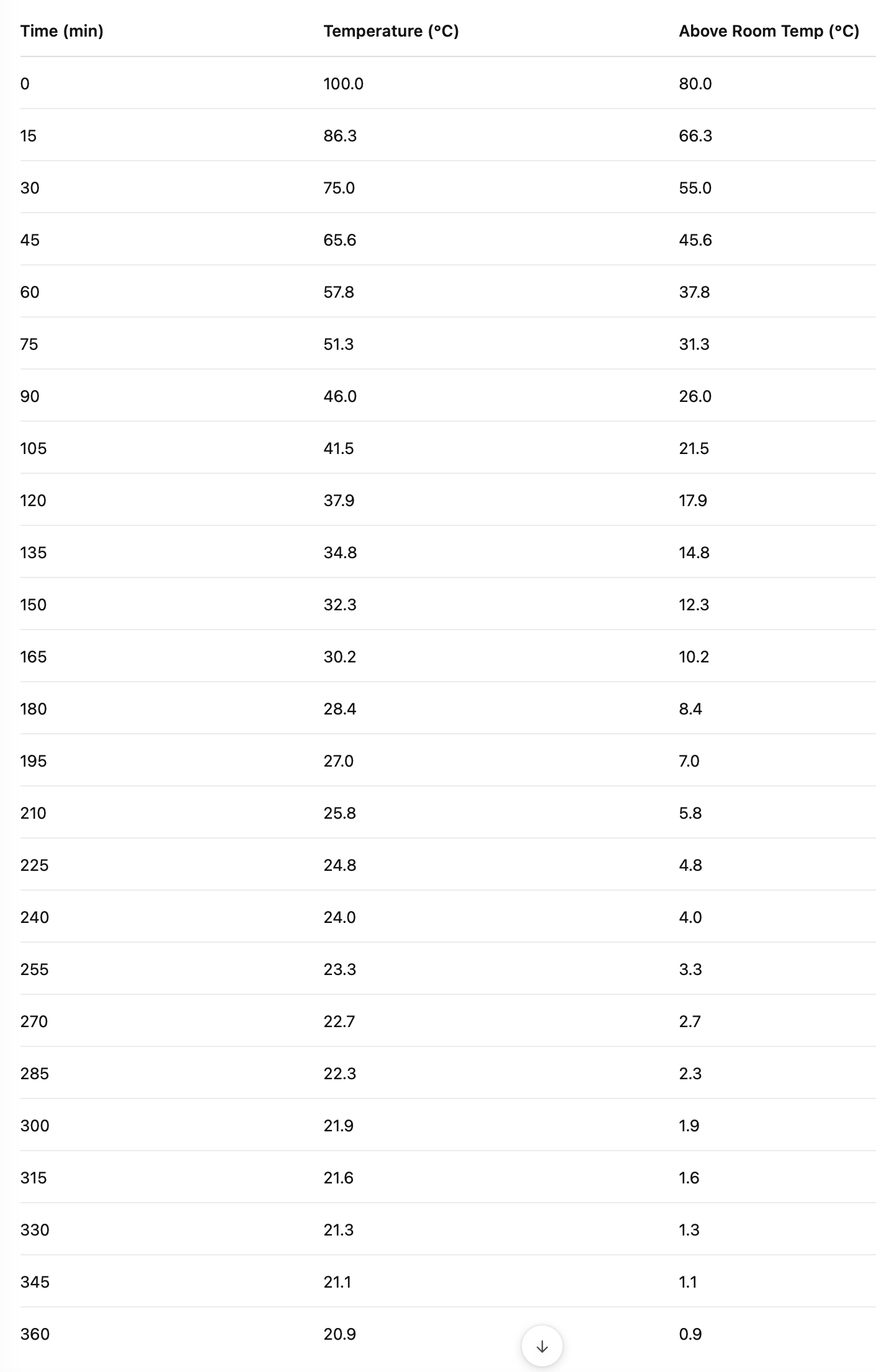
- about what is the half-life for this coffee?
- why do we need to use the third column instead of the middle one?
- graph the data