# Module 08: Response to disturbances

<span style="font-weight: bold;">Module 8: Response to disturbances</span>Recall negative feedback (stable ships, relationships): greater the disturbance, the greater the restoring force (pendulums too)<span style="font-weight: bold;">Resistance</span> is how hard it is to move the pendulum (ecosystem) away from center  
<span style="font-weight: bold;">Resilience</span> is how fast the pendulum (ecosystem) returns to normal

<span style="font-weight: bold;">Biodiversity and disturbances:</span>This is strange stuff:Rare disturbances = competition, so only a few species dominateCommon disturbances = only fast reproducers survive, so low biodiversityIntermediate disturbances = highest biodiversity  
<span style="font-weight: bold;">Watershed</span>: drainage basin usually leading to a large body of water (Chesapeake watershed is huge):[https://www.cbf.org/about-the-bay/chesapeake-bay-watershed-geography-and-facts.html](https://www.cbf.org/about-the-bay/chesapeake-bay-watershed-geography-and-facts.html)
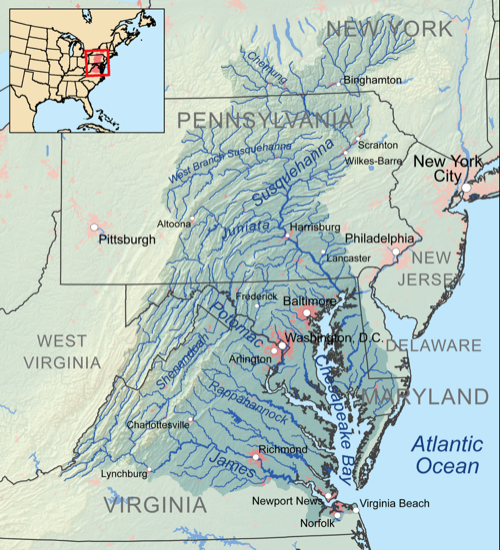
<div class="sandbox" id="bkmrk-"><div id="bkmrk--1"><div id="bkmrk--2"><div><div class="container"><div class="frontside"><div class="iframe">![](http://physics.hpa.edu/groups/apenvironmentalscience/weblog/c4221/images/__thumbs__/15ce7.png)</div></div></div></div></div></div></div>How do you think this impacts the water quality, phosphates, nitrates and silt in the Chesapeake bay?Why are we not allowed above the fences behind Pu'u La'e La'e?On Oahu, the watershed is guarded by a barbed wire fence-why?How are the Himalayas acting as a watershed?  
<span id="bkmrk-poisoned-waters%3A" style="font-weight: bold;">Poisoned waters:</span><span id="bkmrk-video" style="font-weight: bold;">Video</span>:[http://physics.hpa.edu/physics/apenvsci/videos/poisoned\_waters/POISONED\_WATERS.mp4](http://physics.hpa.edu/physics/apenvsci/videos/poisoned_waters/POISONED_WATERS.mp4)  
[http://physics.hpa.edu/physics/apenvsci/videos/poisoned\_waters/poisoned\_waters.m4v](http://physics.hpa.edu/physics/apenvsci/videos/poisoned_waters/poisoned_waters.m4v)  
<span id="bkmrk-weblog-page%3A" style="font-weight: bold;">Weblog page:</span>[http://physics.hpa.edu/groups/apenvironmentalscience/weblog/973c4/Poisoned\_Waters\_videoPBS.html](http://physics.hpa.edu/groups/apenvironmentalscience/weblog/973c4/Poisoned_Waters_videoPBS.html)  
  
On campus try these:[http://physics.local/physics/apenvsci/videos/poisoned\_waters/POISONED\_WATERS.mp4](http://physics.hpa.edu/physics/apenvsci/videos/poisoned_waters/POISONED_WATERS.mp4)  
[http://physics.local/physics/apenvsci/videos/poisoned\_waters/poisoned\_waters.m4v](http://physics.hpa.edu/physics/apenvsci/videos/poisoned_waters/poisoned_waters.m4v)[http://physics.local/groups/apenvironmentalscience/weblog/973c4/Poisoned\_Waters\_videoPBS.html](http://physics.local/groups/apenvironmentalscience/weblog/973c4/Poisoned_Waters_videoPBS.html)  
<span style="font-weight: bold;">quiz</span>

1. why is the soil on Kauai so poor, and how does it get its Potassium?
2. how does the size of the Cheseapeake watershed impact eutrophication in the Chesapeake bay?
3. what is the difference between resistance and resilience in natural systems?
4. why do rotting fish smell so bad?


<span id="bkmrk-summary-notes%3A" style="font-weight: bold;">Summary notes:</span>Systems

- systems are usually connected, exchange matter and/or energy
- main energy source is our sun, or past suns (e.g. uranium)
- feedback loops (again)
- spheres: litho=stone, bio=living, hydro=water, atmo=above
- geosphere: crust-mantle-core-inner core (spins, no way!)
- plates-who thought this up? need to understand convection
- where are oldest parts of crust? trick question
- subduction zones, mid atlantic ridges (atlantis?)
- eq: deep near subduction zones, shallow in transform faults
- mid atlantic ridge: how do we know this? submarines
- himalayas-how? matterhorn-what?
- water cycle: evaporation and transpiration (eTO)
- precipitation-condensation is first (condensation nuclei, e.g. vog)
- aquifers-underground lakes, low turnover rate (pesticides) Oglalla
- water can be ground water: aquifer, water table, water lens or surface water

<div id="bkmrk-cycles">Cycles</div><div id="bkmrk-conservation-of-matt">

- conservation of matter (neglect E=mc2)
- nutrient cycles: carbon, oxygen, phosphorus, nitrogen COPN
- primary producers-photosynthesis: CO2, water and light/heat
- create sugar as stored food, structural element
- consumers-eat primary producers, decomposers break down waste/detritus
- cellular respiration (flowers in hospitals) at night
- carbon also in HCO3- ion (seawater) and CaCO3 (seashells, limestone)
- greenhouse effect from CO2 captured as plants-&gt;oil/coal "carbon bank"
- phosphorus: rocks and water (stone and sea), erosion, very limited supply in biosphere (Waterloo bones)
- P only absorbed in aqueous form (aq)
- too much = eutrophication (also nitrogen) see dead zones
- eutrophication: too much of a good thing, when algae dies, decomposes, creates hypoxic zones
- aerobic vs. anaerobic bacteria-wounds
- nitrogen cycle-NPK
- N2 to life: lightning and bacteria (N2 to ammonia NH3 then to NO2 and NO3 (plants absorb NO3)
- denitrifying bacteria change NO2 back to N2 (gas)
- Haber process
- See figure 3.30-nitrogen uptake
- golf courses-Mauna Kea, iBoat

</div>  
---

<small>Migrated from Apple Server Wiki. Original page ID: 3674N12</small>