Module 11: Ocean currents
Mod 11 ocean currents
Check this out:
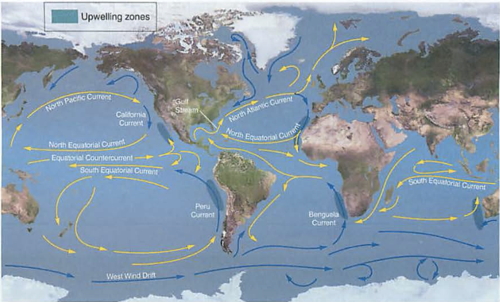
Verify on windy.com again:
https://www.windy.com/?20.002,-155.533,5
- Notice that the north pacific currents flow clockwise, south pacific counter clockwise. why?
- There are places with little forward current, so they become islands of debris, e.g. the so called "Pacific Gyre", which is about the size of Texas, and made up of floating trash.
- Gyres describe the circular flow, some refer to the islands of debris as gyres (not accurate), gyres are the circles, most equatorials move west (arrows match)
- Difference between flotsam and jetsam: one floats, the other is jettisoned from boats
- Thermohaline (thermo=heat, haline=saltwater) circulation:
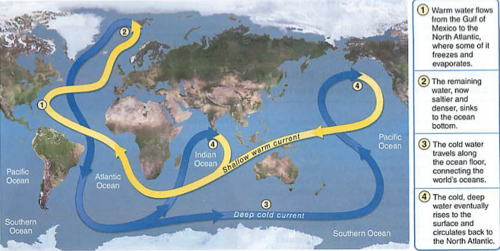
- This upwelling of 2000 year old water off the Kona coast is the bases for Koyo water near the airport (why is this water so precious?)
- Upwelling off the peruvian/chilean coast-Andean trench=great fishing when in normal conditions (not el niño)
- ENSO= el nino southern oscillation-a really big deal, reverses the normal ocean circulation, impacts weather around the planet
El niño and La niña (ENSO)
Note: top diagram has strong OFFSHORE wind, pulling up nutrients from below, note also that it is one big box from Peru to Indonesia, with a strong warm, dry subsidence around the coast of Peru (good for beach folks), known as La Niña, or the little girl,
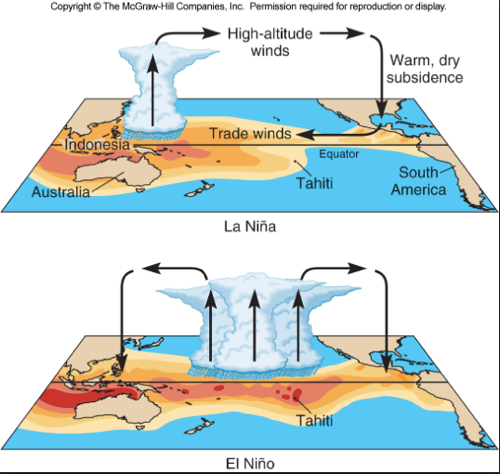
Note: lower diagram (El Niño) has main convection moving to the middle of the ocean basin, weakening the offshore wind around Peru, so sad fisher-folk. El Niño was often associated with Christmas, so the "little boy" reference.
Though ENSO is a single climate phenomenon, it has three states, or phases, it can be in. The two opposite phases, “El Niño” and “La Niña,” require certain changes in both the ocean and the atmosphere because ENSO is a coupled climate phenomenon. “Neutral” is in the middle of the continuum, also known as “La Nada” or “the nothing”.
- El Niño: A warming of the ocean surface, or above-average sea surface temperatures, in the central and eastern tropical Pacific Ocean. Over Indonesia, rainfall tends to become reduced while rainfall increases over the tropical Pacific Ocean. The low-level surface winds, which normally blow from east to west along the equator (“easterly winds”), instead weaken or, in some cases, start blowing the other direction (from west to east or “westerly winds”). This makes for sad fisher-people off the coast of Peru. Named for "the boy" or the Christmas child since it was first seen around December (winter solstice again).
- La Niña: A cooling of the ocean surface, or below-average sea surface temperatures, in the central and eastern tropical Pacific Ocean. Over Indonesia, rainfall tends to increase while rainfall decreases over the central tropical Pacific Ocean. The normal easterly winds along the equator become even stronger. Happy fisher-people off the coast of Peru due to nutrient upwelling from the Peruvian trench. Named after "the girl", just the opposite of "the boy".
- Neutral: Neither El Niño or La Niña. Often tropical Pacific sea surface temperatures are generally close to average. However, there are some instances when the ocean can look like it is in an El Niño or La Niña state, but the atmosphere is not playing along (or vice versa).
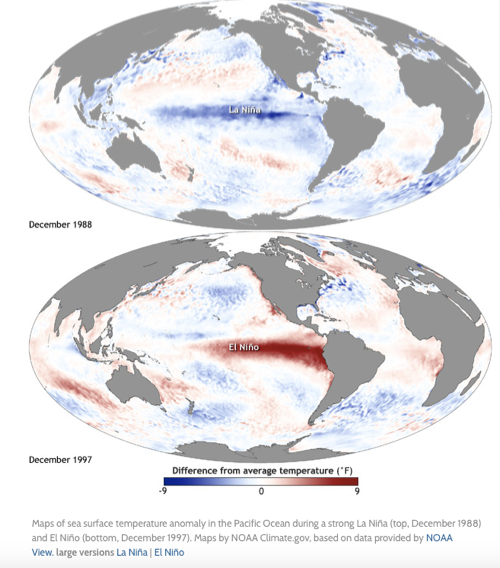
Figure 11.3 below——
Top: La Nada or La Niña: happy fisher-people off the coast of Peru (nutrient upwelling)
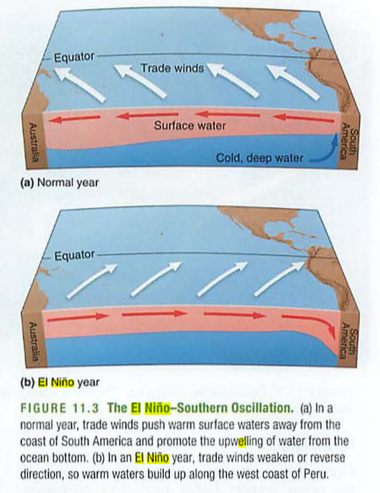
Bottom: El Niño: sad fisher-people off the coast of Peru
Migrated from Apple Server Wiki. Original page ID: H0L4K4N8n4