# Module 12: Land biomes

<span>Look:Here's what we learned so far:  
</span>

<div class="sandbox" id="bkmrk-"><div id="bkmrk--1"><div id="bkmrk--2"><div><div class="container"><div class="frontside"><div class="iframe">![](http://physics.hpa.edu/groups/apenvironmentalscience/weblog/e83e7/images/__thumbs__/cd6cd.png)</div></div></div></div></div></div></div>  
Now look at this map, and compare with your trusty globe:<div class="sandbox" id="bkmrk--4"><div id="bkmrk--5"><div id="bkmrk--6"><div><div class="container"><div class="frontside"><div class="iframe">![](http://physics.hpa.edu/groups/apenvironmentalscience/weblog/e83e7/images/__thumbs__/6a22f.png)</div></div></div></div></div></div></div>  
See the pattern?Pay close attention to cause and effect:

- onshore moist air from the Pacific ocean hits the mountains near Seattle=rainy there
- onshore moist air from the lower Atlantic ocean hits the amazon basin=rainy there
- dry air moving down from the Mediterranean moves over the Sahara Desert=dry there

  
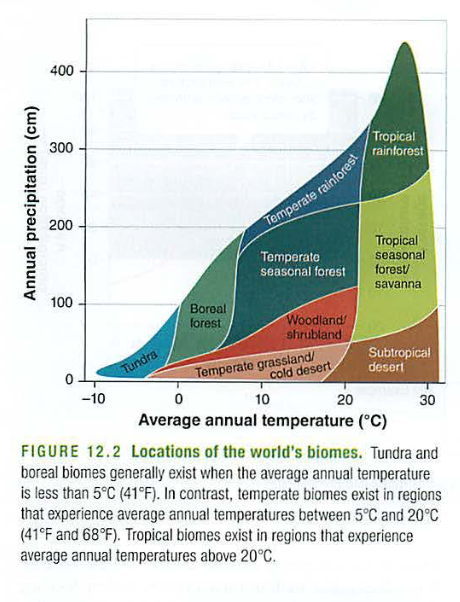
There are about 9 Biomes, usually defined by **precipitation** (rain, fog, others) and **temperature**. Big Island has 8 of the 9 biomes, or in the 12 biome model, we have 11/12, or 9 of 13, or 10 of 14 in another model. Many models...[https://www.hawaiimagazine.com/content/hawaii-has-10-worlds-14-climate-zones-explorers-guide-each-them](https://www.hawaiimagazine.com/content/hawaii-has-10-worlds-14-climate-zones-explorers-guide-each-them)Traveling up a mountain is like crossing biomes. Check this out:<div class="sandbox" id="bkmrk--9"><div id="bkmrk--10"><div id="bkmrk--11"><div><div class="container"><div class="frontside"><div class="iframe">![](http://physics.hpa.edu/groups/apenvironmentalscience/weblog/6f357/images/302cd.png "Screen Shot 2017-09-28 at 4.55.05 PM.png")</div></div></div></div></div></div></div>Imagine driving from Hamakua or Hilo up to the summit of Mauna Kea: tropical rain forest to temperate (mild) rain forest to boreal (north) forest to tundra. There is even a glacier up on Mauna Kea. Cool.This would be like starting in the upper right corner of the diagram and moving diagonally down and to the left.  
Now check out the planet again:  
<div class="sandbox" id="bkmrk--14"><div id="bkmrk--15"><div id="bkmrk--16"><div><div class="container"><div class="frontside"><div class="iframe">![](http://physics.hpa.edu/groups/apenvironmentalscience/weblog/6f357/images/__thumbs__/703d0.png)</div></div></div></div></div></div></div>  
Notice the horizontal bands. If you've read "Guns Germs and Steel" you know that humans migrated horizontally, so their crops and livestock would thrive in similar biomes. See? Migrating north to south is tough.How is this changing?[https://climate.nasa.gov/interactives/climate-time-machine](https://climate.nasa.gov/interactives/climate-time-machine)  
  
Now look at this:  
<div class="sandbox" id="bkmrk--21"><div id="bkmrk--22"><div id="bkmrk--23"><div><div class="container"><div class="frontside"><div class="iframe">![](http://physics.hpa.edu/groups/apenvironmentalscience/weblog/5bb84/images/__thumbs__/fce37.png)</div></div></div></div></div></div></div>  
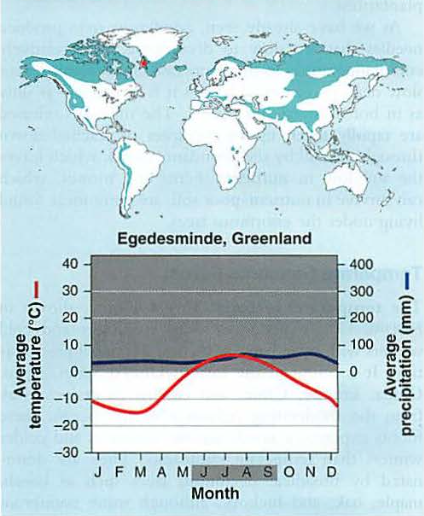
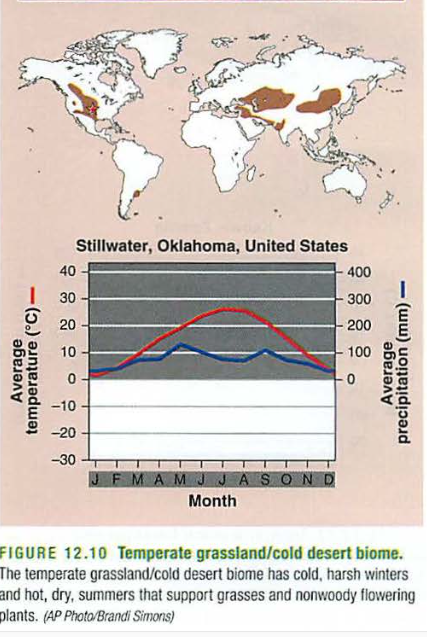
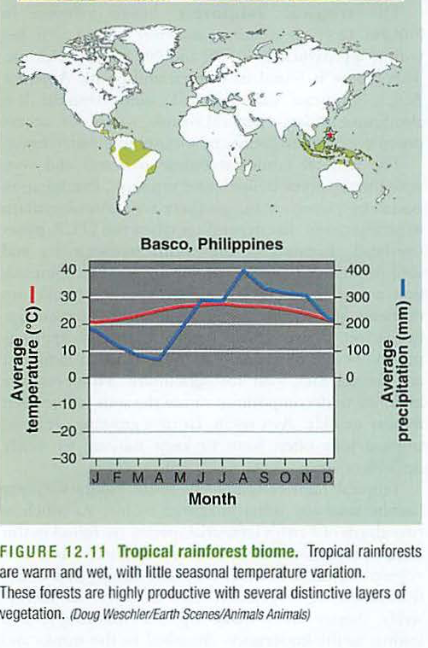
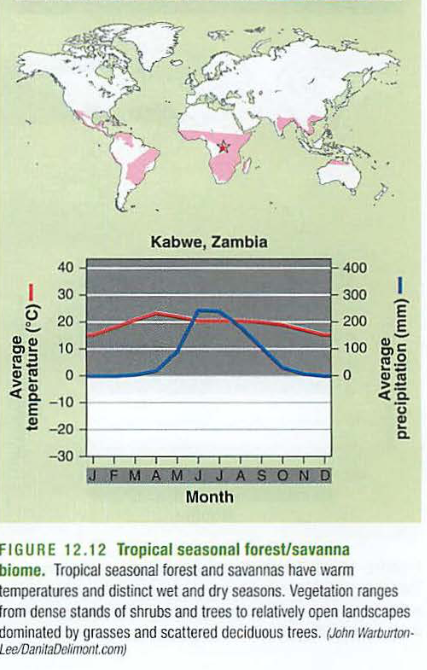
These diagrams are how climatologists describe biomes without a cool map. The blue line is the amount of rainfall, with units on the RIGHT side of the graph. The red line is the temperature, with units on the LEFT side of the graph. The shaded region in the months below (jfmamjjasond) is the growing season when temperatures are above freezing. When the precipitation line is above the temperature line, growth is limited by temperature (e.g. freezing). When the blue line is below the red line, growth is limited by precipitation (e.g. the desert).  
Start with the north: Tundra is what you'd see in Alaska. Permafrost is soon to be in the news. It is made of permanently frozen ground a few feet below the surface. Even roots cannot penetrate it, so some trees grow in a stunted fashion. It is also composed of frozen organic matter, which when it melts will decompose, releasing CO2 and CH4 (methane), which is 20x as powerful as CO2 as a greenhouse gas.  
**Tundra:**   
<div class="sandbox" id="bkmrk--28"><div id="bkmrk--29"><div id="bkmrk--30"><div><div class="container"><div class="frontside"><div class="iframe">![](http://physics.hpa.edu/groups/apenvironmentalscience/weblog/6f357/images/2879f.png "Screen Shot 2017-09-28 at 5.07.25 PM.png")</div></div></div></div></div></div></div>  
Note the cool temp, so growth is determined by temp, not rainfall. Lots of snow here, and little liquid water for plants, so yeah, mainly snow and glaciers.  
**Contrast that with the boreal (north) forest:**  
<div class="sandbox" id="bkmrk--34"><div id="bkmrk--35"><div id="bkmrk--36"><div><div class="container"><div class="frontside"><div class="iframe">![](http://physics.hpa.edu/groups/apenvironmentalscience/weblog/6f357/images/ea2c0.png "Screen Shot 2017-09-28 at 5.08.21 PM.png")</div></div></div></div></div></div></div>Note the short growing season. Any plants that survive usually have an oily sap (pine trees, evergreens) that does not freeze. Also note the serious cold in the winter-animals have to adapt to these (fur, hibernation, etc.)  
**Temperate (mild) forests** are nicer, longer growing season, and rarely freeze. They are usually near the ocean, so they do not freeze (ocean is a huge heat sink). The often have lots of rain (think of Seattle). You may recall these are places where the surface parts of Ferrell and Polar cells converge, bringing in clouds and as these clouds rise into the atmosphere, they release their water as precipitation.  
<div class="sandbox" id="bkmrk--39"><div id="bkmrk--40"><div id="bkmrk--41"><div><div class="container"><div class="frontside"><div class="iframe">![](http://physics.hpa.edu/groups/apenvironmentalscience/weblog/6f357/images/3e1cb.png "Screen Shot 2017-09-28 at 5.10.11 PM.png")</div></div></div></div></div></div></div>  
Temperate (mild) seasonal forest actually has seasons:<div class="sandbox" id="bkmrk--43"><div id="bkmrk--44"><div id="bkmrk--45"><div><div class="container"><div class="frontside"><div class="iframe">![](http://physics.hpa.edu/groups/apenvironmentalscience/weblog/6f357/images/8028b.png "Screen Shot 2017-09-28 at 5.12.07 PM.png")</div></div></div></div></div></div></div>Deciduous trees can live here, like maple and oak. It gets close to freezing, but no real dry season.  
**Woodland/shrubland** is like much of southern California, or the Mediterranean. Wine can grow here. It is also known as the mediterranean (medi=middle, terra=earth) biome.   
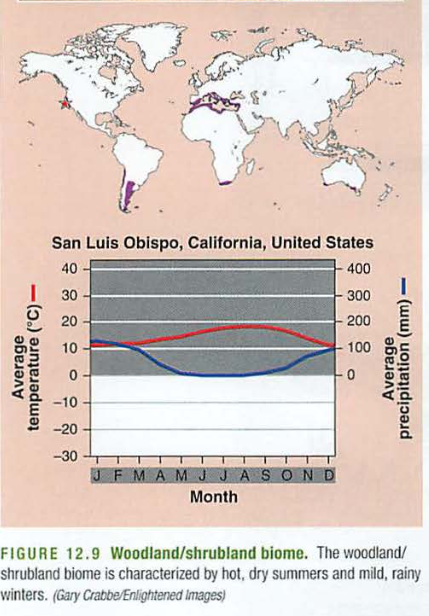
<div class="sandbox" id="bkmrk--48"><div id="bkmrk--49"><div id="bkmrk--50"><div><div class="container"><div class="frontside"><div class="iframe">![](http://physics.hpa.edu/groups/apenvironmentalscience/weblog/6f357/images/99264.png "Screen Shot 2017-09-28 at 5.14.09 PM.png")</div></div></div></div></div></div></div>Note it never really freezes, but growth is determined by precipitation (blue line is below the red line). This is also known as "chaparral" or the "fynbos" or "nice forest" in Afrikaans (South Africa). Look up the main wine regions of the world, they will fit this biome. Also consider how many Italians could start vineyards in northern California...  
**Temperate grassland/cold desert** is a dry, grassy area, like Oklahoma, although it does get very cold there, so think more of Texas, or the Gobi desert. Again, growth is rain limited: (you may recall these are near Hadley/Ferrel cell subsidence, so dry air from space falls here). These areas tend to be far from large bodies of water, so they have more extreme temperatures than similar latitudes near water (e.g. Italy, France, California)  
<div class="sandbox" id="bkmrk--53"><div id="bkmrk--54"><div id="bkmrk--55"><div><div class="container"><div class="frontside"><div class="iframe">![](http://physics.hpa.edu/groups/apenvironmentalscience/weblog/6f357/images/7e59f.png "Screen Shot 2017-09-28 at 5.16.59 PM.png")</div></div></div></div></div></div></div>  
**Tropical rainforest** is the rainiest of them all, and much of our island has this near the shore. Warm temperatures, and paradoxically poor soil nutrition (all of the nutrients are in the plants). On Mt. Waialeale on Kauai, the rainfall is 480 INCHES per year, 2.5 times as high as the high point on the chart below:  
<div class="sandbox" id="bkmrk--58"><div id="bkmrk--59"><div id="bkmrk--60"><div><div class="container"><div class="frontside"><div class="iframe">![](http://physics.hpa.edu/groups/apenvironmentalscience/weblog/6f357/images/4d9c8.png "Screen Shot 2017-09-28 at 5.20.21 PM.png")</div></div></div></div></div></div></div>  
Africa and Brazil hold the next biome: **Savanna or tropical seasonal forest**. Think of Madagascar (the film): not many large trees, room for animals to roam, lots of grass, happy lions, maybe a bossy penguin or two...Growth dependent on rainfall: (blue line below red one)  
<div class="sandbox" id="bkmrk--63"><div id="bkmrk--64"><div id="bkmrk--65"><div><div class="container"><div class="frontside"><div class="iframe">![](http://physics.hpa.edu/groups/apenvironmentalscience/weblog/6f357/images/95665.png "Screen Shot 2017-09-28 at 5.22.47 PM.png")</div></div></div></div></div></div></div>  
Finally, the **subtropical desert biome**, like what you'd see in the Sahara desert (another film), or most of Australia, the Atacama in Chile, the Mojave desert in California, and some of Mexico. Note the Gobi desert is not on this list-too cold. Again, note these areas are where dry air subsides (falls) from the Hadley and Ferrell cells.  
<div class="sandbox" id="bkmrk--68"><div id="bkmrk--69"><div id="bkmrk--70"><div><div class="container"><div class="frontside"><div class="iframe">![](http://physics.hpa.edu/groups/apenvironmentalscience/weblog/6f357/images/c48f1.png "Screen Shot 2017-09-28 at 5.24.43 PM.png")</div></div></div></div></div></div></div>  
## Biome Game:

Clues:  
<div class="sandbox" id="bkmrk--73"><div id="bkmrk--74"><div id="bkmrk--75"><div><div class="container"><div class="frontside"><div class="iframe">![](http://physics.hpa.edu/groups/apenvironmentalscience/weblog/8af8b/images/__thumbs__/cffbb.png)</div></div></div></div></div></div></div>**Find these places in the first three climatographs:** Philadelphia, PennsylvaniaSan Diego, CaliforniaBelem, Brazil  
  
<div class="sandbox" id="bkmrk--78"><div id="bkmrk--79"><div id="bkmrk--80"><div><div class="container"><div class="frontside"><div class="iframe">![](http://physics.hpa.edu/groups/apenvironmentalscience/weblog/8af8b/images/de227.png "Screen Shot 2018-09-25 at 11.53.45 AM.png")</div></div></div></div></div></div></div>  
  
<div class="sandbox" id="bkmrk--83"><div id="bkmrk--84"><div id="bkmrk--85"><div><div class="container"><div class="frontside"><div class="iframe">![](http://physics.hpa.edu/groups/apenvironmentalscience/weblog/8af8b/images/9139d.png "Screen Shot 2018-09-25 at 11.53.54 AM.png")</div></div></div></div></div></div></div>  
  
<div class="sandbox" id="bkmrk--88"><div id="bkmrk--89"><div id="bkmrk--90"><div><div class="container"><div class="frontside"><div class="iframe">![](http://physics.hpa.edu/groups/apenvironmentalscience/weblog/8af8b/images/86a5a.png "Screen Shot 2018-09-25 at 11.54.01 AM.png")</div></div></div></div></div></div></div>  
**Find these biomes below:**tropical rain forest

tropical savanna

desert

temperate grasslands

temperate deciduous forest

temperate rain forest

boreal forest

tundra

<div class="sandbox" id="bkmrk--94"><div id="bkmrk--95"><div id="bkmrk--96"><div><div class="container"><div class="frontside"><div class="iframe">![](http://physics.hpa.edu/groups/apenvironmentalscience/weblog/8af8b/images/c7c89.png "Screen Shot 2018-09-25 at 11.54.56 AM.png")</div></div></div></div></div></div></div>  
  
<div class="sandbox" id="bkmrk--99"><div id="bkmrk--100"><div id="bkmrk--101"><div><div class="container"><div class="frontside"><div class="iframe">![](http://physics.hpa.edu/groups/apenvironmentalscience/weblog/8af8b/images/94f94.png "Screen Shot 2018-09-25 at 11.55.10 AM.png")</div></div></div></div></div></div></div>  
  
<div class="sandbox" id="bkmrk--104"><div id="bkmrk--105"><div id="bkmrk--106"><div><div class="container"><div class="frontside"><div class="iframe">![](http://physics.hpa.edu/groups/apenvironmentalscience/weblog/8af8b/images/df978.png "Screen Shot 2018-09-25 at 11.55.23 AM.png")</div></div></div></div></div></div></div>  
  
<div class="sandbox" id="bkmrk--109"><div id="bkmrk--110"><div id="bkmrk--111"><div><div class="container"><div class="frontside"><div class="iframe">![](http://physics.hpa.edu/groups/apenvironmentalscience/weblog/8af8b/images/b206e.png "Screen Shot 2018-09-25 at 11.55.30 AM.png")</div></div></div></div></div></div></div>  
  
<div class="sandbox" id="bkmrk--114"><div id="bkmrk--115"><div id="bkmrk--116"><div><div class="container"><div class="frontside"><div class="iframe">![](http://physics.hpa.edu/groups/apenvironmentalscience/weblog/8af8b/images/21a8c.png "Screen Shot 2018-09-25 at 11.55.40 AM.png")</div></div></div></div></div></div></div>  
  
<div class="sandbox" id="bkmrk--119"><div id="bkmrk--120"><div id="bkmrk--121"><div><div class="container"><div class="frontside"><div class="iframe">![](http://physics.hpa.edu/groups/apenvironmentalscience/weblog/8af8b/images/3935d.png "Screen Shot 2018-09-25 at 11.55.49 AM.png")</div></div></div></div></div></div></div>  
  
<div class="sandbox" id="bkmrk--124"><div id="bkmrk--125"><div id="bkmrk--126"><div><div class="container"><div class="frontside"><div class="iframe">![](http://physics.hpa.edu/groups/apenvironmentalscience/weblog/8af8b/images/fcf80.png "Screen Shot 2018-09-25 at 11.55.55 AM.png")</div></div></div></div></div></div></div>  
  
<div class="sandbox" id="bkmrk--129"><div id="bkmrk--130"><div id="bkmrk--131"><div><div class="container"><div class="frontside"><div class="iframe">![](http://physics.hpa.edu/groups/apenvironmentalscience/weblog/8af8b/images/c659f.png "Screen Shot 2018-09-25 at 11.56.06 AM.png")</div></div></div></div></div></div></div>  
**Find these biomes:**Tropical Savanna

Temperate Grassland

Chaparral

Desert

Tundra

Taiga

Temperate Deciduous Forest

Tropical Rain Forest

<div class="sandbox" id="bkmrk--136"><div id="bkmrk--137"><div id="bkmrk--138"><div><div class="container"><div class="frontside"><div class="iframe">![](http://physics.hpa.edu/groups/apenvironmentalscience/weblog/43fe8/images/__thumbs__/467b3.png)</div></div></div></div></div></div></div><div class="sandbox" id="bkmrk--141"><div id="bkmrk--142"><div id="bkmrk--143"><div><div class="container"><div class="frontside"><div class="iframe">![](http://physics.hpa.edu/groups/apenvironmentalscience/weblog/43fe8/images/__thumbs__/62c39.png)</div></div></div></div></div></div></div>  
## LAB: Gambling with biomes


Gambling with biomes

1. Below is a list of locations around the world. Roll the dice and using your vast knowledge of biomes and the high tech globes on your desk, determine the biome and type of life you might find there.
2. In the next round reverse the process with the biome list below, determining the locations around the globe.

Locations:

1. Chile
2. Zambia
3. Philippines
4. Oklahoma
5. San Luis Obispo
6. Germany
7. Seattle
8. Greenland
9. Ontario Canada
10. Tunisia
11. North Pole
12. Kamuela

Biomes:

1. tundra
2. boreal forest
3. temperate rain forest
4. temperate seasonal forest
5. woodlands
6. temperate grassland
7. tropical rain forest
8. savannah
9. desert
10. cold desert
11. taiga
12. tropical seasonal forest

<div class="sandbox" id="bkmrk--150"><div id="bkmrk--151"><div id="bkmrk--152"><div><div class="container"><div class="frontside"><div class="iframe">![](http://physics.hpa.edu/groups/apenvironmentalscience/weblog/e83e7/images/__thumbs__/1b3bb.png)</div></div></div></div></div></div></div><span id="bkmrk--153"></span>  
---

<small>Migrated from Apple Server Wiki. Original page ID: J1r3A0n4</small>