# Module 13: Aquatic biomes
Recall terrestrial biomes are defined by temperature and precipitation (rain)Aquatic biomes are by definition underwater, so they are defined by
- Depth: how deep is the deepest part, how much photosynthesis is possible
- Distance from shore: shallow water has more life, more things to attach to, more biodiversity
We separate aquatic biomes into freshwater (lakes, rivers, streams) and saltwater (oceans, estuaries)
Freshwater biomes:Riparian=river Limnotic=lakesLakes:
- Shallow shore area=littoral (means shallow), see the "littoral Navy", photosynthesis here (shallow, light shines through)
- Open water area=limnetic zone, no rooted plants (too deep), phytoplankton here, only as deep as sunlight can penetrate
- Deep water=profundal ("profound") or deep zone: no light penetrates, bacterial decomposition.Bottom=benthic zone: mud, dark, cloudy
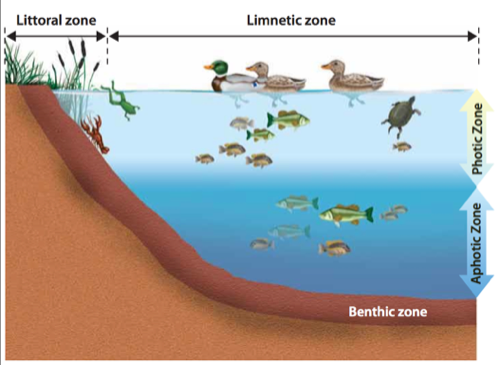
: note usually related to photosynthesis (plants)
- Oligo (few) trophic=low productivity
- Meso (middle) trophic=medium
- Eutrophic (eu=good trephien=food)=lots of productivity (sometimes too much, like in "Poisoned Waters")
Freshwater wetlands-submerged most of the time (swamps, marshes, bogs) this is the history of all coal and oil we now use
Salt marsh: usually connected to the sea, act as a coastal buffer for Hurricanes, very productive, many nutrients, lots of organic material
Mangrove swamp: special version of this in Tropical areas (e.g. Florida)
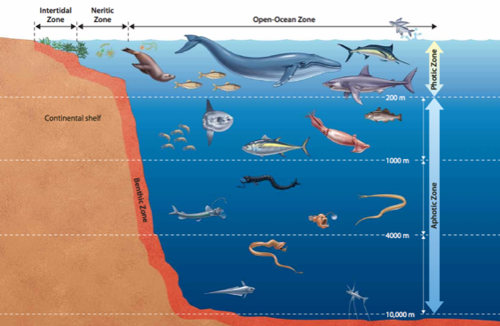
Intertidal zone: area between high and low tide or seasonal variations
Ocean zones:
- Coral reefs-see coral bleaching, pH, temperature and salinity sensitive (see Hamakua coast vs. Puako)
- Intertidal zone: between high and low tide
- Photic (light) zone-shallow, photosynthesis, kelp, others
- Aphotic (dark) zone-too dark for photosynthesis
- Chemosythesis/thermosynthesis: deepwater steam vents, based on Sulfur instead of Oxygen, bacteria generate energy with methane (CH4) and H2S (instead of H20)
- Benthic=deep ocean
- Pelagic=open ocean (think of big sailing ships, whales, stuff like that)
- Hadal zones: like Hades: deepest, darkest zones. Weird fish, no light...
Biodiversity next:[http://physics.hpa.edu/groups/apenvironmentalscience/weblog/542a8/Biodiversity\_and\_Extinction\_Ch\_5\_Mods\_1417.html](http://physics.hpa.edu/groups/apenvironmentalscience/weblog/8d560/Mod_14151617biodiversity_chapter_5.html)