# Module 23: Demographic transition
From the semester exam:
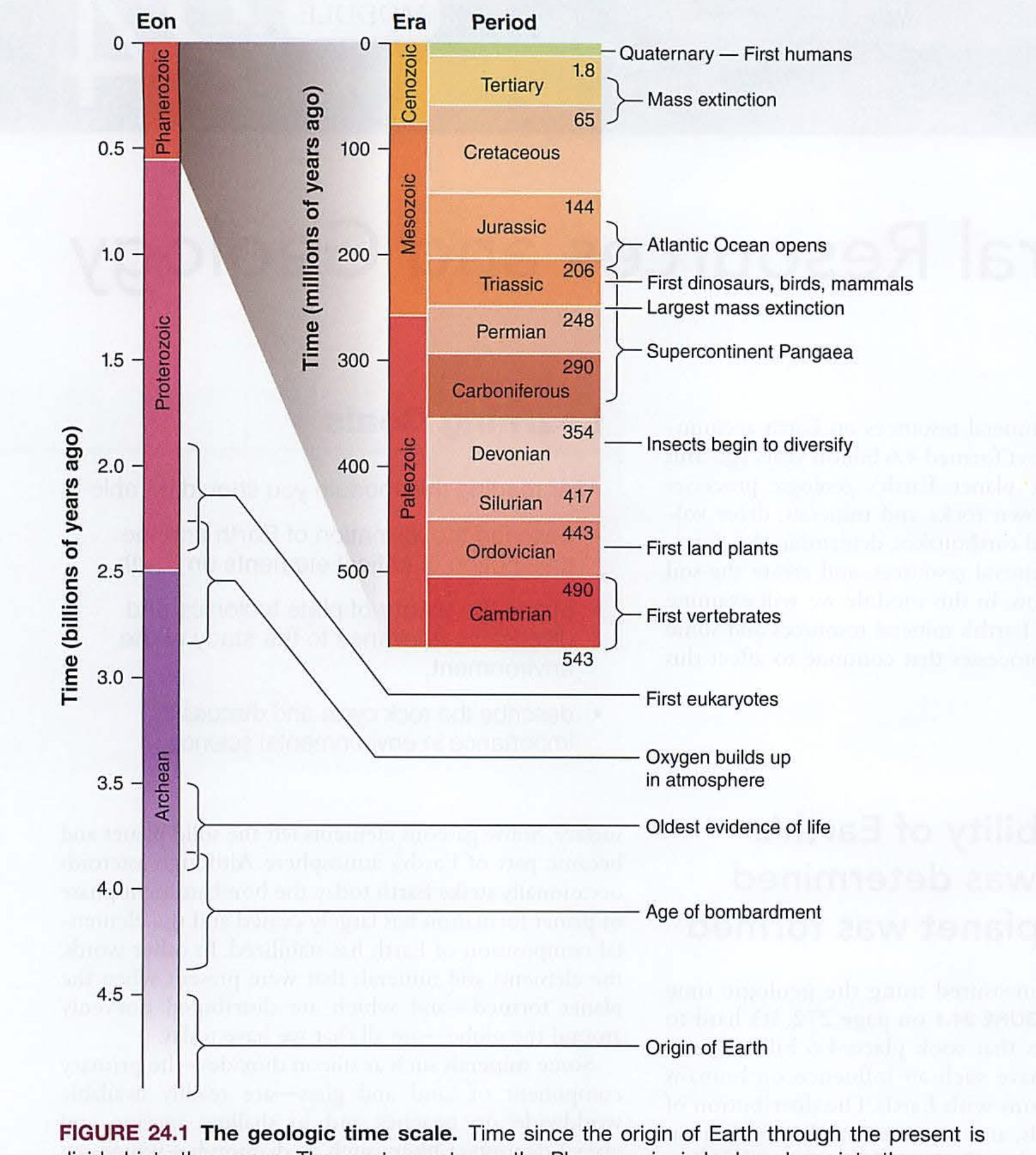eras.pngBack to Demographics...Demographics is the study of people
Check this out:
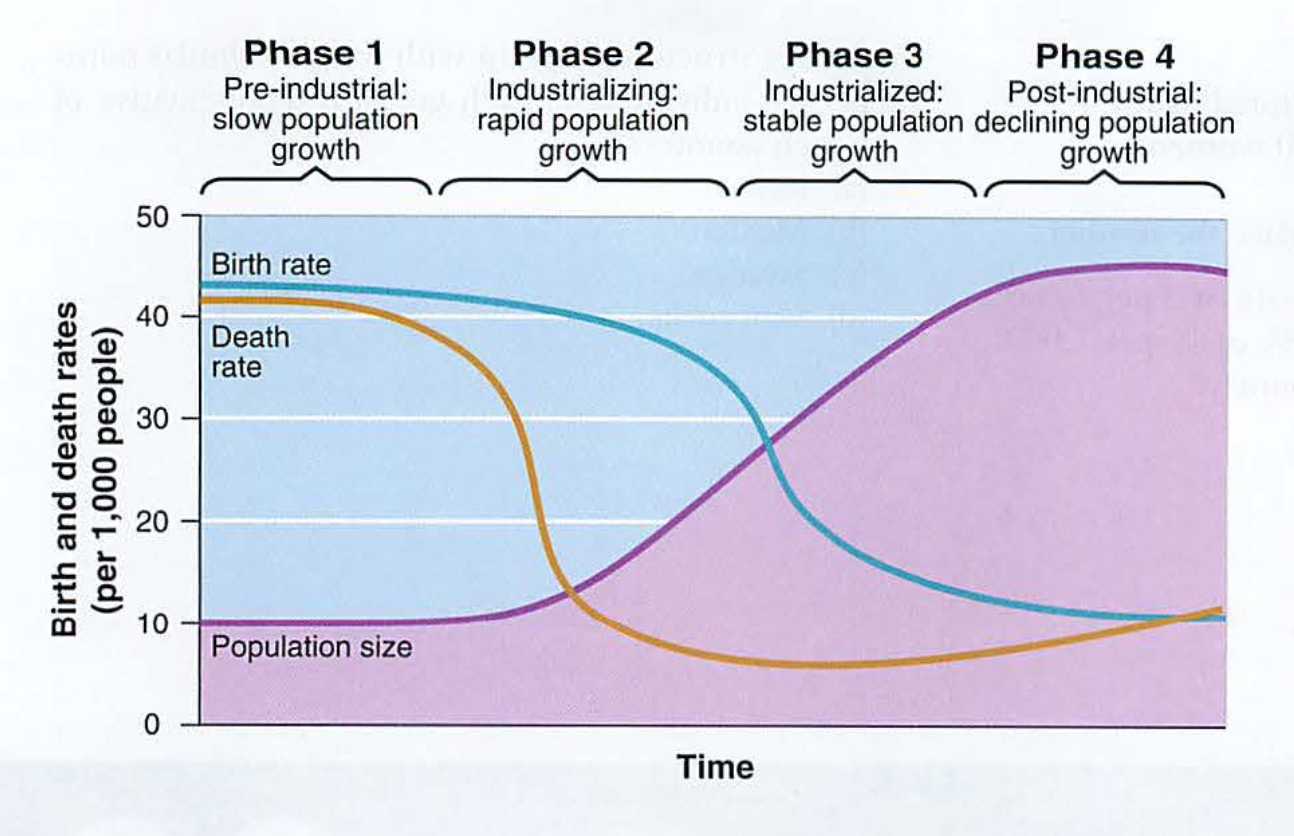Screen Shot 2022-10-23 at 7.24.03 AM.pngWhat does this mean?
Phase 1: many babies, most die, short lifespans=> low population (e.g. US and Britain before 1850, some places after war e.g. Gaza, Ukraine)
Phase 2: death rate drops (clean water, better food, lower infant mortality, longer lifespans)=> population grows (e.g. India)
Phase 3: education increases, women have better control over fertility, birth rate drops=> population stabilizes (e.g. US)
Phase 4: women enter the workforce, later babies, smaller families=> population decreases (e.g. Japan, Italy)
Another version:
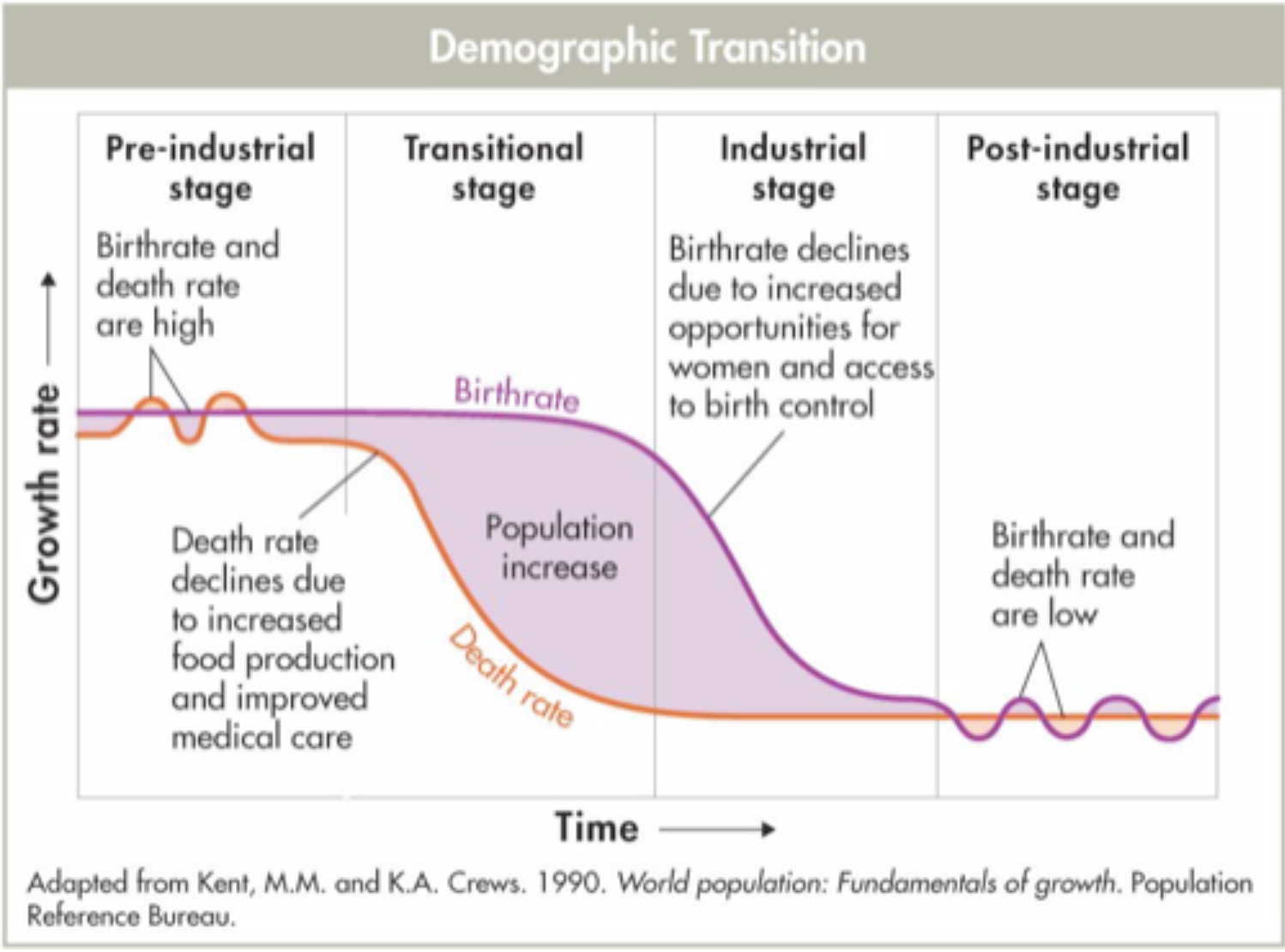Screen Shot 2022-10-23 at 7.30.40 AM.png
Note the wiggly bit on the right, looks like the carrying capacity from last chapter, right?
Things to notice:
1. in phase 1, lots of babies, lots of death (infant mortality and short lifespans), so population is low
2. as clean water, sanitation and health care improve, deaths drop, so population rises
3. as women gain reproductive rights and/or education, the birth rate drops (many factors here), while death rate stays low, so the population growth curve flattens a bit (hard to see on this diagram)
4. as industrialization includes more women, esp. as professionals, they may delay pregnancy later in life, so there is actually a population drop.
Examples are Italy, Japan and Germany, where the dependency ratio (number of people depending on social retirement divided by number of people in the workforce paying into the system) is greater than 1.0.
Question: how would you see this on a pyramid graph?
Make sure you can cite at least one example country for each...
1. Some places in sub-Saharan Africa, post-war, most of the world before the industrial revolution
2. Afghanistan
3. US
4. Japan
IPAT: Impact = Population x Affluence x Technology
Imagine two scenarios:
Case 1: A sustainable pacific island community, no phones, internet or electricity. Food sources are local, there is little affluence (tribal community), also less poverty, and a self-limiting population, limited by K, in this case food.
Case 2: Urban community, large population, lots of affluence (think NYC or SF), everyone has an iPhone or similar device, a computer, a car, a refrigerator, TV, and a wide selection of clothing, food and housing.
IPAT: the impact on an ecosystem = population x affluence x technology
Why is Apple using a robot ("Daisy") to take apart iPhones? How does this impact iPAT?[https://www.apple.com/newsroom/2018/04/apple-adds-earth-day-donations-to-trade-in-and-recycling-program/](https://www.apple.com/newsroom/2018/04/apple-adds-earth-day-donations-to-trade-in-and-recycling-program/)
Which parts of the iPAT formula does this impact, and in which ways?
Think also of electric vehicles: great for the environment, but use materials (Lithium, Neodymium, etc.) that need to be mined.
Gasoline/Diesel cars need steel, glass, plastic and some rare materials for electronics, but are much worse for the environment, both in production, use and disposal. More on this later.-------------------
GDP is global domestic product, or the sum of all goods and services delivered inside a country
This was the standard growth metric until recently...
GNP is the same thing, but includes multinational companies, or companies "off shore"
Urban areas, UGB (Portland)
[e2: Portland, sense of place](http://physics.hpa.edu/physics/apenvsci/videos/e2_videos/e2%20transport/5%20Portland-sense%20of%20place.m4v)
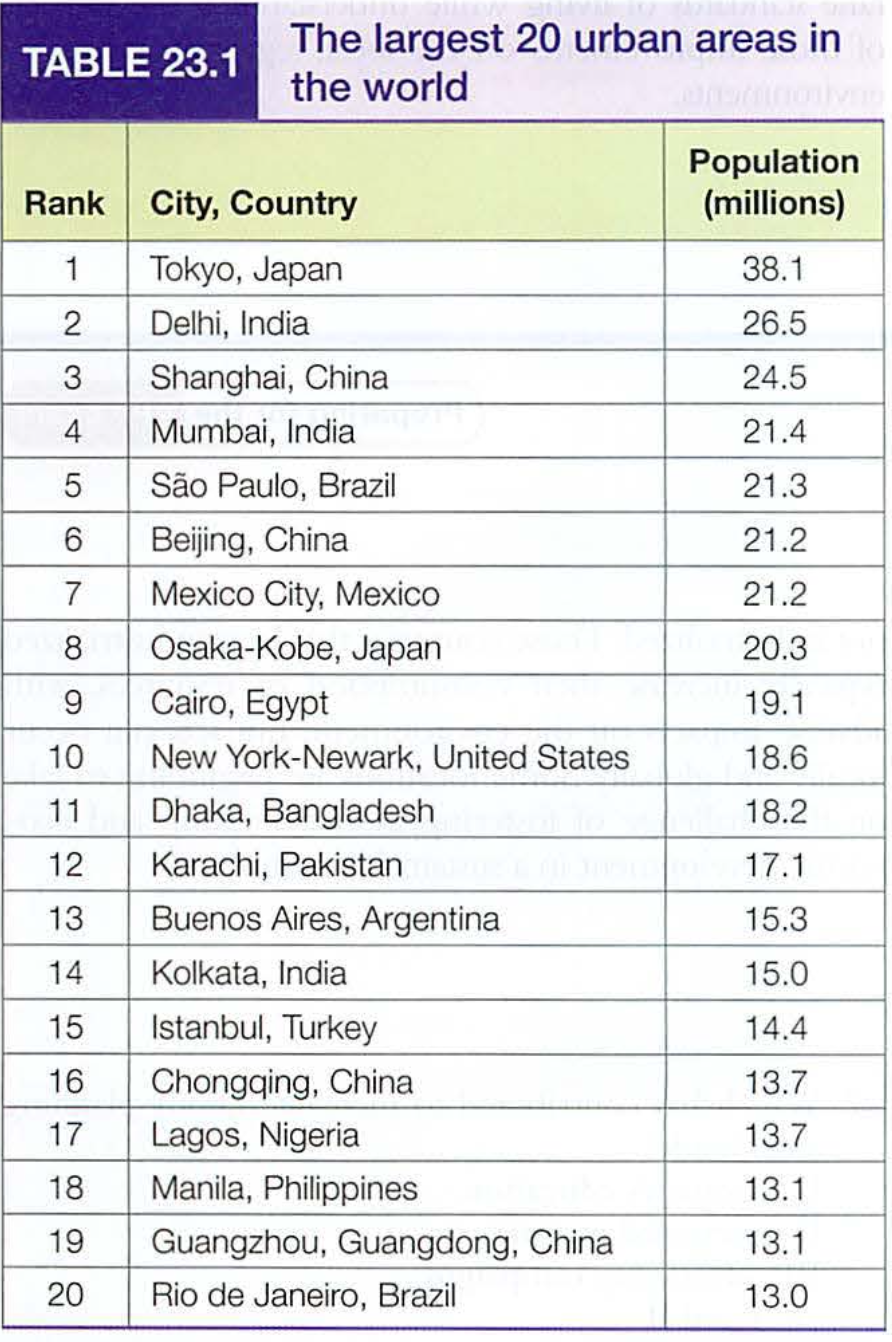Screen Shot 2022-10-23 at 7.37.29 AM.png
See also Ecological Footprint Calculator:
[http://www.footprintnetwork.org/resources/footprint-calculator/](http://www.footprintnetwork.org/resources/footprint-calculator/)
[https://www.ted.com/talks/hans\_rosling\_shows\_the\_best\_stats\_you\_ve\_ever\_seen](https://www.ted.com/talks/hans_rosling_shows_the_best_stats_you_ve_ever_seen)(9 minutes)
Play with these:
[https://www.gapminder.org/](https://www.gapminder.org/)
[https://www.gapminder.org/tools/#$chart-type=bubbles&url=v1](https://www.gapminder.org/tools/#_chart-type=bubbles)
[https://worldmapper.org/maps/?\_sft\_product\_cat=pollution](https://worldmapper.org/maps/?_sft_product_cat=pollution)
Rule of 70, er 69.3...The TRUTH!
We know that Nt =Noe^rt
When Nt/No = 2, this is the doubling time
ln (Nt/No) = ln (e^rt)ln(e^x) = x just like square root of x squared is x.
But wait! we saw 70, not .693...Growth rates are in percent (part/100) so the percents cancel out, meaning you can just use percent as a number, like 14%.
You will certainly see this on an AP exam, usually as a multiple or fraction of 70: 14, 28, 35, 7, 3.5...Rule of 70 rules! (or actually the rule of 69.3)....
Next: earth and soils:[https://www.youtube.com/watch?v=xzAOhyOtfqc](https://www.youtube.com/watch?v=xzAOhyOtfqc)
---
Migrated from Apple Server Wiki. Original page ID: F7j6g2e6