# Module 27: Humans and water
This module is all about controlling water:
- Primitive societies were often cited on rivers: Why?
- Levees are walls built to contain the rivers when they flood, particularly in flatter areas, fed by melting glaciers or snow melt.
- Most of the Netherlands (including the district called "Holland") is under sea level, very flat, and would be underwater without levees, which in their case don't follow a river, but block the sea, known as "Dikes"
- Dams are structures that block the flow of rivers, either to capture water for irrigation or to produce electricity by harnessing the flow of the water, usually from very deep water (this is why dams are often very high)
- Exceptions are the three gorges dam in China or the great Aswan dam in Egypt: long dams over a large area.
- Reservoirs are land based artificial lakes, often sealed at the bottom to hold the water. Evaporation is a key method of water loss in these.
- Fish ladders are gradual "backwards steps" to enable fish, usually salmon to travel upstream to lay their eggs.
- Aquaducts (from the Latin: aqua is water, duct is carry) are artificial rivers usually lined with concrete to carry water from one place to another without power, using the slope of the aquaduct. Invented by the Greeks, used by the Romans, as well as powerful forces in LA to bring water from northern California to LA (and Laguna Beach).
- Desalinization is the process of separating salt from water (usually ocean water) for irrigation and human use. Two methods are used: energy from heat boils salty water, and the freshwater condensate is then used. Reverse osmosis uses energy from high pressure to force water through a membrane. Both produce a toxic salty solution called brine, which can then be dumped into the sea, often causing environmental damage (e.g. Dubai)
Water, and therefore food is not universally available:
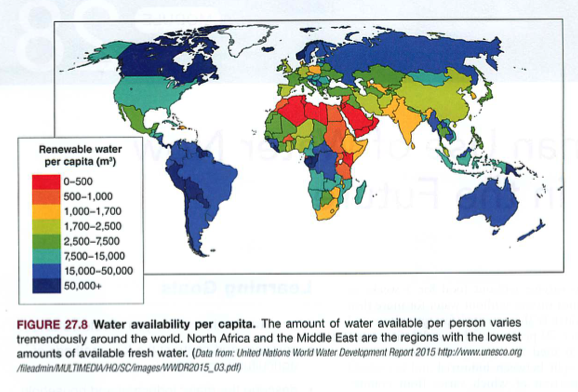Screen Shot 2022-11-26 at 2.15.35 PM.pngWhat this means is farming is limited to areas where there is freshwater, see next module on creative solutions to this...
---
Migrated from Apple Server Wiki. Original page ID: Z7g3M0z4