# Unit 9: Global Change: 4.56: Greenhouse effect
- First of all, if we had no greenhouse effect, the planet would be frozen (not like the movie)
- Second, while a greenhouse is made of glass, which holds in heat and reflects infrared radiation, gases in our atmosphere like water vapor, CO2 and others actually re-radiate infrared radiation back to the planet.
- This is a subtle difference, but one that is important if you want to understand how these gases interact with climate change
- Look at the hydroponics unit, for demo (outside)
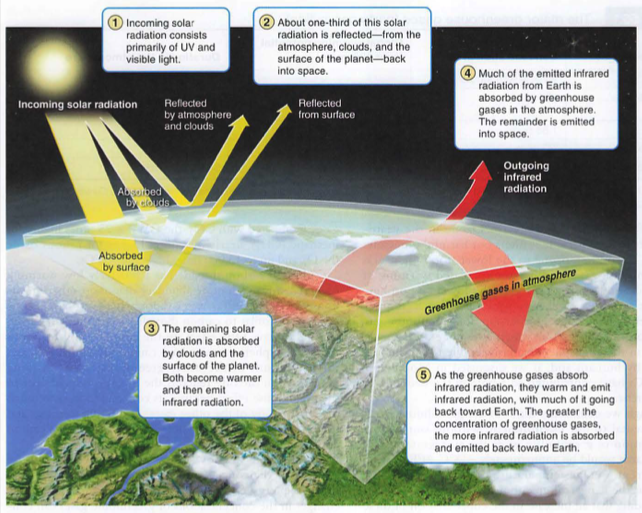Screen Shot 2023-04-02 at 4.12.16 PM.pngImportant:
If this were as simple as the dashboard on your car or a real greenhouse, the IR radiation would just reflect back from the glass. In the diagram above, you can see shorter wavelength visible light passing through the atmosphere (radiation) hitting the surface where it strikes the ground and is re-radiated back as lower wavelength infrared radiation (heat).
You recall we studied this when we discussed weather: radiation, conduction, convection
To be more accurate, imagine the glass windshield also radiating some heat back to the car (this is true if the glass is hot).
We determine the 100 year impact of greenhouse gases like water vapor, methane and CO2 by combining their impact by their lifespan called the greenhouse warming potential (GWP):
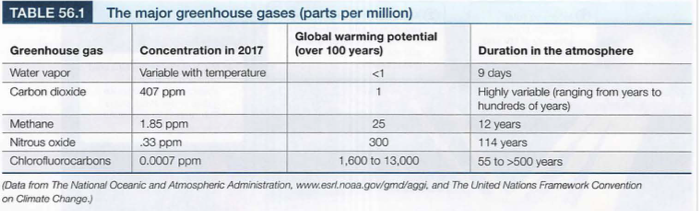Screen Shot 2023-04-02 at 4.15.56 PM.png
Note that while methane has a lifespan of 12 years, it is many times more effective at warming than CO2 (1.0)
This is also calculated as the annual greenhouse gas index (AGGI):
Note that they chose the CO2 level in 1990 as a benchmark of 1.00 (why then?)
- The AGGI in 2019 was 1.45, which means that we’ve turned up the warming influence by 45% since 1990.
- It took ~240 years for the AGGI to go from 0 to 1, i.e., to reach 100%, and 29 years for it to increase by another 45%.
- In terms of CO2 equivalents, the atmosphere in 2019 contained 500 ppm, of which 410 is CO2 alone. The rest comes from other gases.
- CO2 is by far the largest contributor to the AGGI in terms of both amount and rate of increase.
- Note: The IPCC suggests that a constant concentration of CO2 alone at 550 ppm would lead to an average increase in Earth’s temperature of ~3°C (5.4°F).
- What is the AGGI in the latest 2022 graph 3 years later (link above)
- What is the CO2 level today outside? [http://10.14.47.1/index.html](http://10.14.47.1/index.html)
Sources of greenhouse gases (this is interesting)
Volcanoes
- CO2 and water vapor
- also ash, which can block sunlight, cooling the earth
- check this out: [https://en.wikipedia.org/wiki/Mount\_Pinatubo](https://en.wikipedia.org/wiki/Mount_Pinatubo)
Decomposition:
- dead trees in the forest (lots of oxygen) create CO2
- if not enough O2, then methane (CH4) is produced, which is much more harmful
- the permafrost in the arctic is billions of tons of anaerobically decaying biomass which is frozen (like the movie) for now
- as the planet warms, this will melt and release much more methane
- digestion is also anaerobic (termites, cows) releasing methane
Denitrification
- wet soils and lake bottoms
- nitrate converts to nitrous oxide
Evaporation (water vapor)
- warmer planet means more water vapor in the atmosphere (latent heat)
- this is why storms are much more intense, also more rain and snowfall (global warming does make more snow, yes this is true)
Human fossil fuel burning: CO2 and methane
- coal is the worst: 100% as a CO2 benchmark for comparison
- oil is 85% of this
- natural gas is 56% of this (natural gas IS methane)
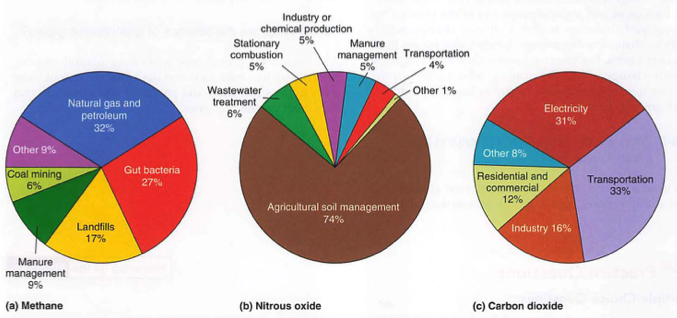Screen Shot 2023-04-02 at 4.30.40 PM.pngNASA simulation:
[https://climate.nasa.gov/interactives/climate-time-machine](https://climate.nasa.gov/interactives/climate-time-machine)
NASA Eyes simulation: look for "vital signs" then "carbon dioxide"
[https://eyes.jpl.nasa.gov/eyes-on-the-earth.html](https://eyes.jpl.nasa.gov/eyes-on-the-earth.html)
---
Migrated from Apple Server Wiki. Original page ID: 1155w4553