# Unit 9: Global Change: 4.58: ocean warming and acidification

<span style="font-weight: bold;">Two main ideas:</span>

1. Global warming is causing ocean water to expand, rising sea levels
2. Increased CO2 in the atmosphere is changing the pH of the oceans (ocean acidification)

<div id="bkmrk-some-lakes-%28confined">

- Some lakes (confined, smaller bodies of water) have increased by 2°C or more
- Oceans has warmed by 1.5-2°C
- 2.7°C in the top layers (!)
- Kyoto protocol: 5.2% decrease in greenhouse gases by 2012
- Paris climate Accord: 2°C max temp increase


</div><div id="bkmrk--1"></div><div id="bkmrk-result%3A%C2%A0"><span style="font-weight: bold;">Result: </span></div><div id="bkmrk-fish-migration%2C-nort">

- fish migration, northwards

- coral bleaching: mutualistic algae ([zooxanthellae](https://en.wikipedia.org/wiki/Zooxanthellae)) dies
- corals are sensitive to pH, temp, sedimentation, pollution, disease and salinity (few corals on windward shores of Hawaii due to freshwater runoff)
- some genetic researchers are trying to create heat resistant corals (CRISPR) and other variants of zoozanthellae (A-C)

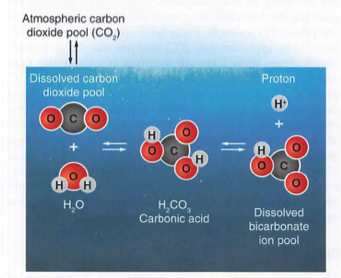
<div><span style="font-weight: bold;">Ocean acidification:</span></div></div>## CO2 + H2O &lt;--&gt; H2CO3 &lt;--&gt; HCO3-  + H+

## H2CO3 is carbonic acid

<div id="bkmrk-h%2B-joins-with-water-">H+ joins with water to become H3O+ known as the hydronium ion (basis for low pH)</div><div id="bkmrk-screen-shot-2023-04-"><figure>![Screen Shot 2023-04-08 at 4.02.29 PM.png](https://bookstack.kamuela.org/uploads/images/gallery/2026-09/4owan2krPemflJlh-screen-shot-2023-04-08-at-4-02-29-pm-vdrx00ql.png)<figcaption>Screen Shot 2023-04-08 at 4.02.29 PM.png</figcaption></figure></div><div id="bkmrk--2">  
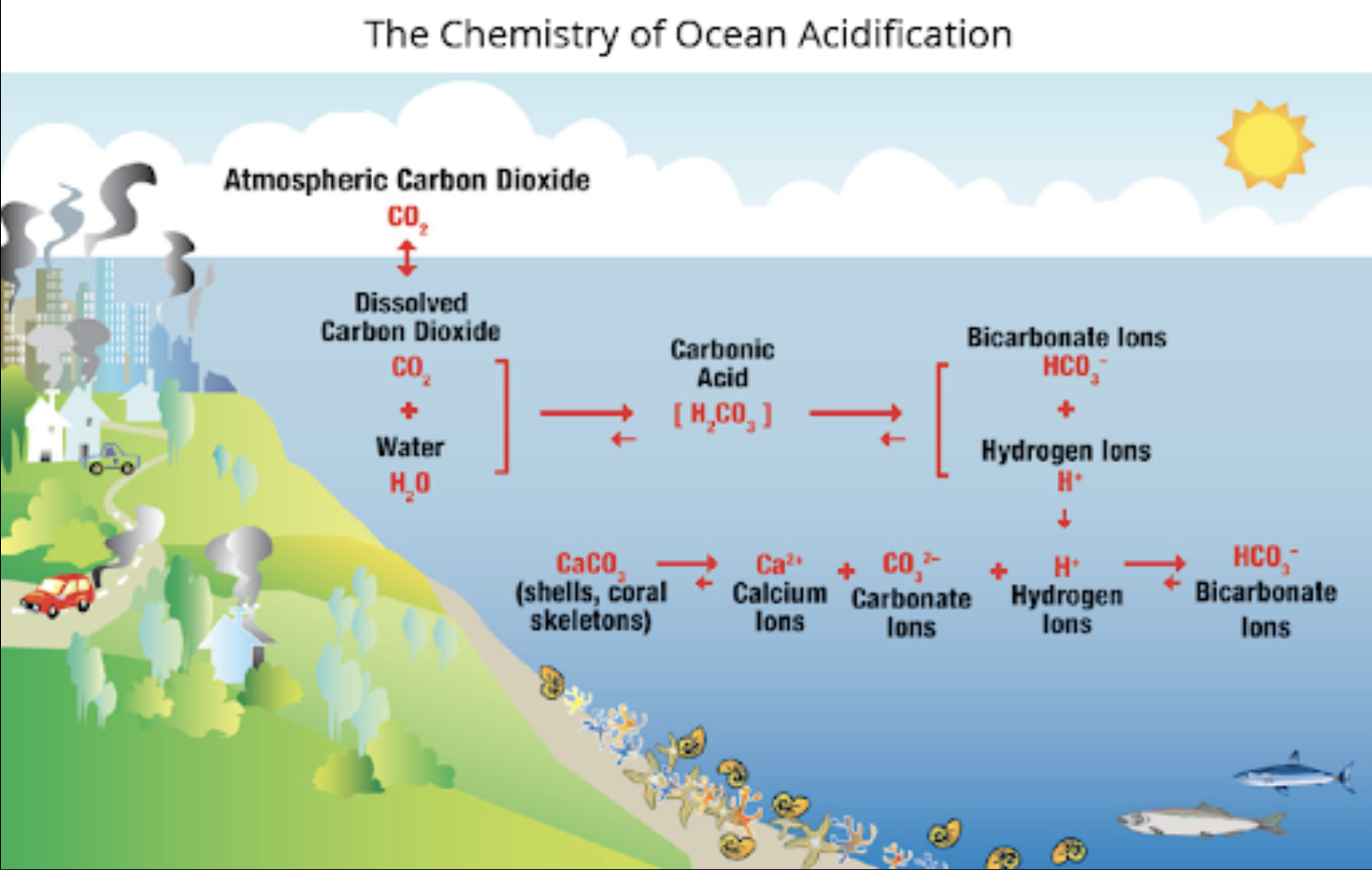
</div><div id="bkmrk-important%3A"><span style="font-weight: bold;">Important</span>:</div><div id="bkmrk-as-ph-decreases%2C-cac">As pH decreases, CaCO3 in corals dissolves (AP exam question last year) and creatures have a harder time absorbing calcium carbonate</div><div id="bkmrk--3">  
</div><div id="bkmrk-coral-bleaching%3A"><span style="font-weight: bold;">Coral Bleaching:</span></div><div id="bkmrk-screenshot-2025-04-2"><figure>![Screenshot 2025-04-25 at 4.59.45 AM.png](https://bookstack.kamuela.org/uploads/images/gallery/2026-09/uvgRMaZZK5wXDyQE-screenshot-2025-04-25-at-4-59-45-am-mbobpuuq.png)<figcaption>Screenshot 2025-04-25 at 4.59.45 AM.png</figcaption></figure></div><div id="bkmrk-here%E2%80%99s-how-to-read-t"><div><span style="font-weight: bold;">Here’s how to read this:</span>  
The top formula is what you know already:  
CO2 + H2O &lt;-&gt; H2CO3&lt;-&gt; H+  + HCO3-  
  
<span style="font-weight: bold;">The next bit is more complex:</span>  
Since there is lots of H+ in the ocean with acidification, it pulls CO3-- out of coral:  
  
<span style="font-weight: bold;">Follow coral from the left:</span>  
CaCO3—&gt;Ca++  + CO3-   
CO3--  + H+ —&gt; HCO3-  
  
This second part is what you may be asked about on the AP exam...</div><div>  
</div><div>Thanks to Sammy Sudin for these cool posters:</div><div>[Download Untitled\_Artwork-2.pdf (application/pdf, 1.8 MB)](https://bookstack.kamuela.org/attachments/251)

</div><figure>![ocean acidification.png](https://bookstack.kamuela.org/uploads/images/gallery/2026-09/XxkWK2474F9z5wde-5bc554a5-6e78-4494-bb40-c8404c1e7000.png)<figcaption>ocean acidification.png</figcaption></figure></div><div id="bkmrk--4">  
</div><div id="bkmrk-ocean-acidification-"><figure>![ocean acidification 1.png](https://bookstack.kamuela.org/uploads/images/gallery/2026-09/3UX9zVJKCTCeOmOK-3079db62-925b-4440-8677-768a88e52945.png)<figcaption>ocean acidification 1.png</figcaption></figure></div>---

<small>Migrated from Apple Server Wiki. Original page ID: d6o08293</small>