
001 Elements, water, energy
MigrationHelpful text: https://elab.hpa.edu/apes/texts/fr3e/fr3e_ch2.pdf
Review:
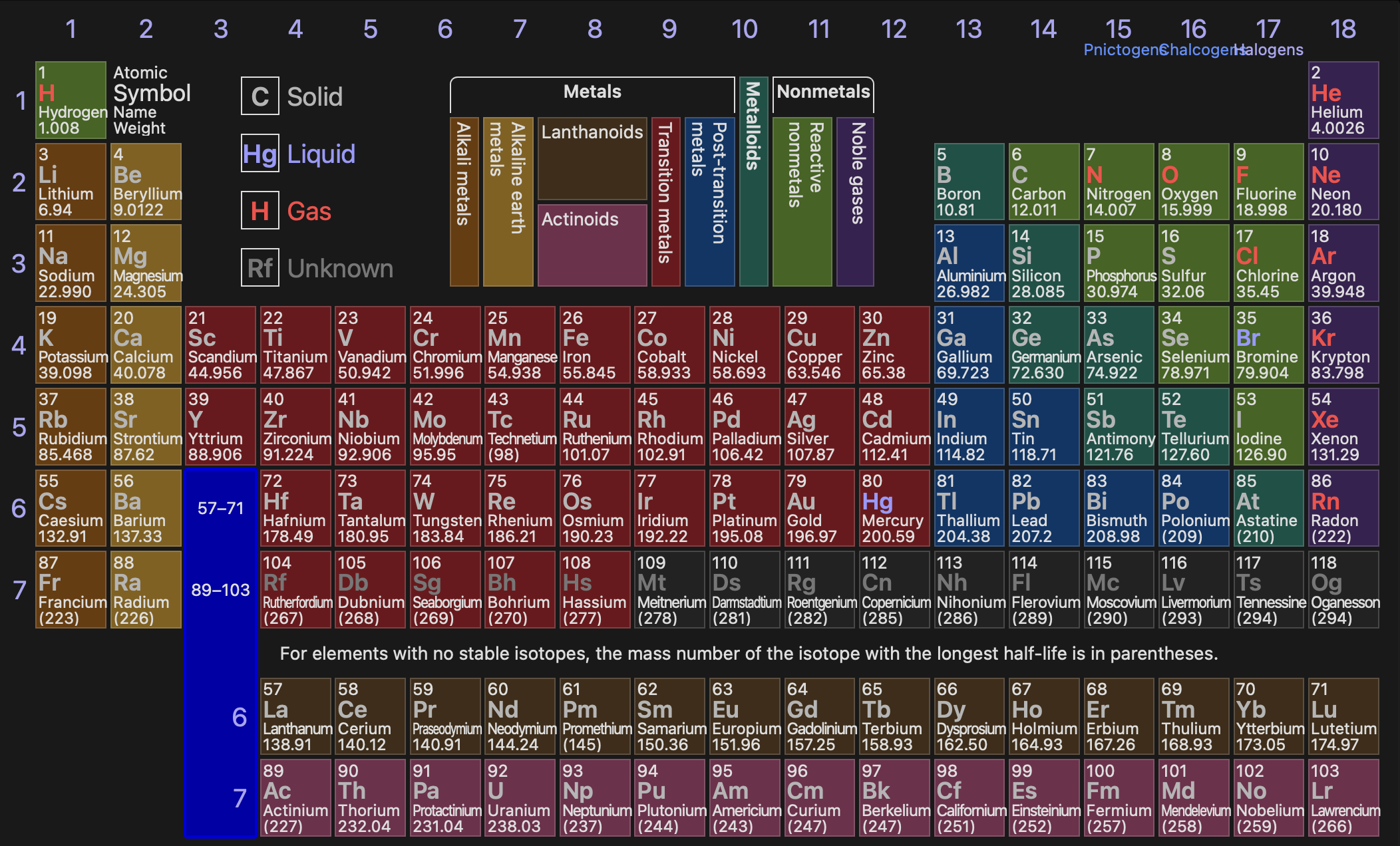
Periodic Table:
- The periodic table (here it is: https://ptable.com/?lang=en#Properties) is key to solving riddles in
progressAPES around pollution, toxins, and many other things: - columns are chemically similar, e.g. Cs 137 looks to the body like K
- column 1 elements want to lose an electron to look like a stable shell, e.g. Li+
- stable shells are 2 electrons per orbit in the first two columns, six electrons in the Boron-Neon columns (2 electrons, 3 shells = 6)
- noble gases have a full shell, don't mix with anyone
- F column (halogens) need an electron to look like Ne
- strongest bond: Ionic: Na loses an electron (Na+) and Cl gets an electron (Cl-) to form NaCl, high melting point
- covalent bond is weaker, sharing an electron, low melting point e.g. water
- Think of a pilot and co-pilot: both share the duties
- In a covalent bond, neither one is more positive or negative, they share an electron.
- Molecular Hydrogen (H2) and molecular oxygen (O2) are good examples
Atoms and molecules:
- atom: one nucleus with protons and neutrons, electrons around the nucleus
- element: one type of atom, defined by the number of protons (same as the letters)
- protons: positive charge, give the atom identity, found in the nucleus
- neutrons: neutral charge, gives the atom more mass, also found in the nucleus
- electrons: much smaller (1/1800), negative charge, gives the atom charge, "orbits" the nucleus
- atomic number: matches the letters, and if not charged, same as protons and electrons
- atomic mass: the mass of the things in the nucleus: protons + neutrons
- isotopes: same protons (symbol) but different neutrons
- Examples: see https://ptable.com/?lang=en#Properties
- many isotopes are radioactive
- half life is the time needed to lose half of the material, e.g. t1/2 of C14/6 is 5730 years so in about 15000 years, about 12.5% is left 15000/5000 = 3, 1/2 x 1/2 x 1/2
- three types of radiation, all based on atomic particles:
- alpha rays: Helium nucleus, charged, big, slow, stopped by paper (paper suits around radioactive waste)
- beta rays: fast electron, charged, small, fast, stopped by aluminum foil (e.g. hats)
- gamma rays: speed of light fast, charged photons, stopped by lead, can penetrate the skin and break DNA, causing cancers (why you wear a shield when working with these, like in an x-ray)
- neutrons: the worst ones: no charge, just fast bullets, breaks DNA and cells, lots of lead or 2m of concrete to stop these (why nuclear power plants have huge thick domes)
Water: physical
- bp of water is 100°C at 1 atm pressure
- raising the pressure holds the water in a liquid state (pressure cookers, geysers)
- lowering the pressure lowers the boiling point (everest, freeze dried coffee)
- melting point of water is 0°C at 1 atm pressure
- possible to melt ice with pressure (regelation, glaciers, ice skaters)
- gases can dissolve in liquid water (down phase) if the water is cool (carbonated water)
- warm water makes the dissolved gases escape (Dissolved Oxygen = DO, kills fish, dead zones)
- warm air can hold water (up phase) if warmer (hot and humid)
- cooler air can hold less water (cool cans, air conditioner, Waipio, hurricanes, all weather)
- water has adhesion (sticks to stuff) and cohesion (holds hands with other water molecules)=capillary action
- surface tension is at the water surface: all cohesion
- osmosis is when water follows salt through a membrane (urine kills roots, soaking sore feet)
Water: chemical
- one oxygen with two hydrogens
- can be seen as one H+ and an OH-
- weak covalent bond, but has a weak + end and a weak - end, so it is polar covalent
- universal solvent
- aqueous means "in water"
- acids have more H+ floating around, e.g. HNO3, HCl, H2SO4, H3PO4 (notice H and something on the right side of the table)
- bases have more OH- floating around, e.g. NaOH, KOH (note OH and stuff from the left side)
- exception: alcohols have an OH but are not basic, more on this later
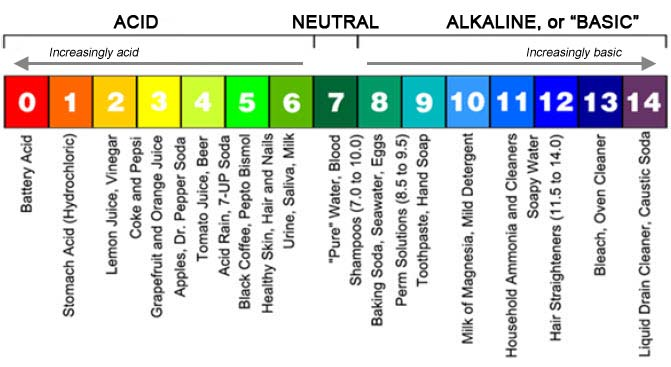
- acid rain is one form of H2SO4, sulfuric acid (Sulfur from methionine in fossil fuels + water)
- HCl is in your stomach, one reason bulemics have rotten teeth
- H3PO4 dissolves glass
- your skin is slightly acidic to kill germs
- when carbon dioxide dissolves in water, it forms carbonic acid H2CO3, ocean acidification
Calculating pH:
- pH means "Hydrogen potency" so it is pH not PH or Ph
- acids have more H+, so an acid might have an H+ concentration of 1ee-4
- bases have more OH- and less H+, so they might have an H+ concentration of 1ee-8
- trick question: which is larger?
- common problem: what is the pH of something with H+ concentration of 1ee-3?
- just look at the exponent and make it positive: pH = 3
- another question: how much stronger is pH3 as an acid than pH4? 10x
- pH3 to pH5? 100x
- here's the definition of pH: pH = -log10[H+]
- not so scary: all it says is take the log to the base 10 (usually the same as the power) and throw away the minus sign
- challenge: pick 8 acids and bases, and calculate the [H+]
- challenge: create 8 [H+] with a friend and ask them to calculate pH
- super challenge: find the pOH and [OH-] for each
Reactions:
- mass is conserved in CHEMICAL reactions
- mass is converted into energy in NUCLEAR reactions
- chemical reactions always involve electrons, never protons or neutrons
- nuclear reactions involve neutrons and protons, never electrons (much more energy)
- two forms of nuclear reactions:
- fission: splitting a big atom in to smaller ones, + energy (Uranium -> Kr + Ba + energy, nuclear bomb or power plant)
- fusion: joining two lighter atoms into one larger one (H + H = He + energy, sun, all stars
- all stars start by fusing Hydrogen, then Helium down the table until Iron, where they stop and either die (brown dwarfs) or explode (supernova) creating all elements on the table beyond Fe
- fission is used as a weapon and a power source, producing dead people (bombs) and radioactive waste
- fusion is much cleaner, and uses H2/1 called deuterium, 1/600 of ocean water
- challenge: draw a typical fission reaction, with the masses of each particle
- challenge: calculate the lost mass and where the energy goes
Organic chemistry
- organic = carbon based
- inorganic = not carbon based (e.g. rocks)
- three main classes of organic compounds for life:
- carbohydrates: carbon and water (hydrates), if long these are starches, if short they are sugars
- fats: same chemical elements as CHO, but in long chains (C-H) on an alcohol backbone (CHO), good at storing energy, insulation and storing fat soluble vitamins (ADEK), also called "lipids"
- proteins: CHO and N, basis for DNA and RNA, all tissues, Nitrogen dependent (amino acids)
- alcohols like the backbone in fats (glycerol) always end in "ol" e.g. ethanol (drunks) methanol (kills you) propanol (before shots) or butanol (stinky socks).
- hydrocarbons are made of C and H alone, like gasoline or motor oil
- many toxins are fat soluble like dioxin, a carcinogen (dead orcas are toxic waste, bioaccumulation)
- this is different from biomagnification, which is many animals up a food chain (e.g. DDT)
- challenge: look up the structure of 4 starches and 4 sugars, challenge a friend to match from a list
- challenge: draw a diagram of a typical fat, labeling the glycol backbone. what part of this structure is fat soluble and why?
- challenge: what are fats good for in the body, and why would an orca have more than a tuna?
- challenge: why is it possible to overdose on vitamins ADEK but not vitamin C?
- challenge: why are vitamins called vitamins?
- challenge: draw 4 proteins and ask a friend to match from a list
- challenge: athletes consume protein supplements before and after a workout-why?
- superchallenge: what is the "anabolic window"?
- challenge: draw the structure of alcohols with 1, 2, 3 and 4 carbons: what is common?
- challenge: how are fats different from gasoline, if they both store energy?
- challenge: why would an orca be toxic while tuna is something pregnant women should not eat?
- challenge: draw a 2 carbon alkane, alkene and alkyne, with their names-which is used to melt metal?
Energy
- energy always moves from high energy (e.g. hot) to low energy (cold), or ordered energy (banana) to disorder (heat)
- entropy is a measure of disorder, so ∆universe > 0 (everything moves to disorder, including your room or closet)
- energy cannot be created, but can be converted, like a banana (chemical energy) to heat and motion (you running around)
- nothing is 100% efficient, so your banana only turns about 33% of its energy in to motion, most of it is waste heat
- same for your car: 9$ of gasoline buys you 3$ of motion, and 6$ of heat
- EVs are more efficient as they are not heat engines (hot moving to cold), and they capture motion in batteries for starting up again (regenerative braking)
- three rules of thermo (heat) dynamics (movement):
- you can't win (nothing has > 100% efficiency)
- you can't break even (all reactions have an energy tax as heat)
- you can't get out of the game (all reactions tend towards disorder)
- energy moves in one of three ways:
- radiation (heat lamps, light) can be reflected (foil) or absorbed (hot pavement)
- conduction (contact) can be insulated (styrofoam) or conducted (copper pans)
- convection (movement) like a convection oven (air in motion) or all weather
- temperature is based on the velocity of molecules
- even if the molecules are going fast, there must be enough of them to conduct heat, so high altitude planes release steam (burning kerosene) which freezes (jet trails)
- positive feedback: radiation heats the polar ice (white) melting it (darker) which absorbs more energy and melts more
- negative feedback: you run, get hot, sweat, cool down
- energy and mass systems can be open (energy comes in) or closed (mass stays the same)
- where these are balanced it is a "steady state"
- all weather is based on these concepts:
- solar radiation heats the surface
- the surface conducts heat to the air
- warm air rises (less dense), along with water that has evaporated because of the heat energy
- as the warm air rises, it cannot hold water, so it rains
- cooler air descends to the surface to be heated again
- where air rises, it rains (e.g. Seattle)
- where air falls, it is a desert (e.g. Sahara)
- air motion on our planet is divided into three cells: Hadley, Ferrel, and Polar
- hurricanes are a good example of a heat engine
- shaped like a huge smokestack
- hot air rises, condensation forms rain
- as a small storm gets big (100km across) one part is closer to the equator (faster) then the other (slower, north in our hemisphere)
- coriolis is the spinning of the hurricane, ccw in our hemisphere cw in the southern hemisphere
- as the air rises it pulls in more air, like a skater pulling arms, spinning faster
- hurricane "eye" is smallest for dangerous hurricanes
- tornadoes also spin, but for smaller scale reasons, vertical updrafts and downdrafts in huge storms
- layers of the atmosphere
- all weather is in the troposphere
- jets fly in the stratosphere (jet trails are ice-why none in Hawaii?)
- mesosphere is the middle (like mesopotamia)
- thermosphere is hot, also called the ionosphere (ions, aurora)
- exosphere is where starlinks go to die
- Reaction rates:
- Every 10°C increase in temperature doubles the speed of any reaction
- Who cares?
- When you have a fever, you burn fuel much faster
- When explosives heat up, their blast is much more violent
Energy and power: https://elab.hpa.edu/wiki/pages/E5u117/240927_science_review_energy_and_power.htmlEnvironmental indicators: https://elab.hpa.edu/wiki/pages/22e8X678/240911_Environmental_indicators.html - Every 10°C increase in temperature doubles the speed of any reaction
Migrated from Apple WikiServer Wiki. Original page 23c4Q89.ID: 23c4Q89