
AP exam math review
MigrationMost common math concepts:
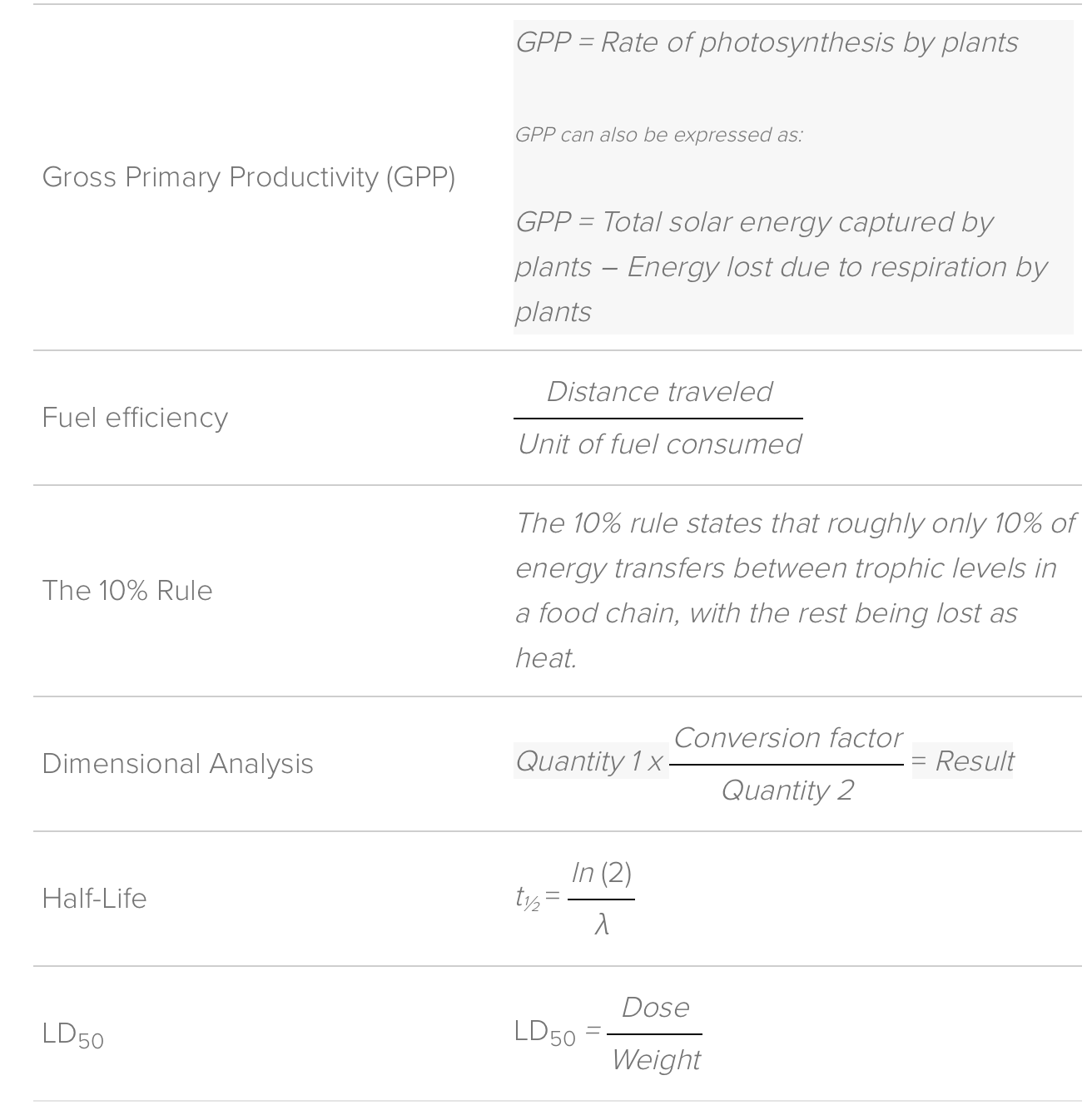
- Exponential decay: radioactive elements, A=Ao(1/2)^n where n is the number of half lives
- Isotopes: atomic number (protons) and atomic mass (p+n)
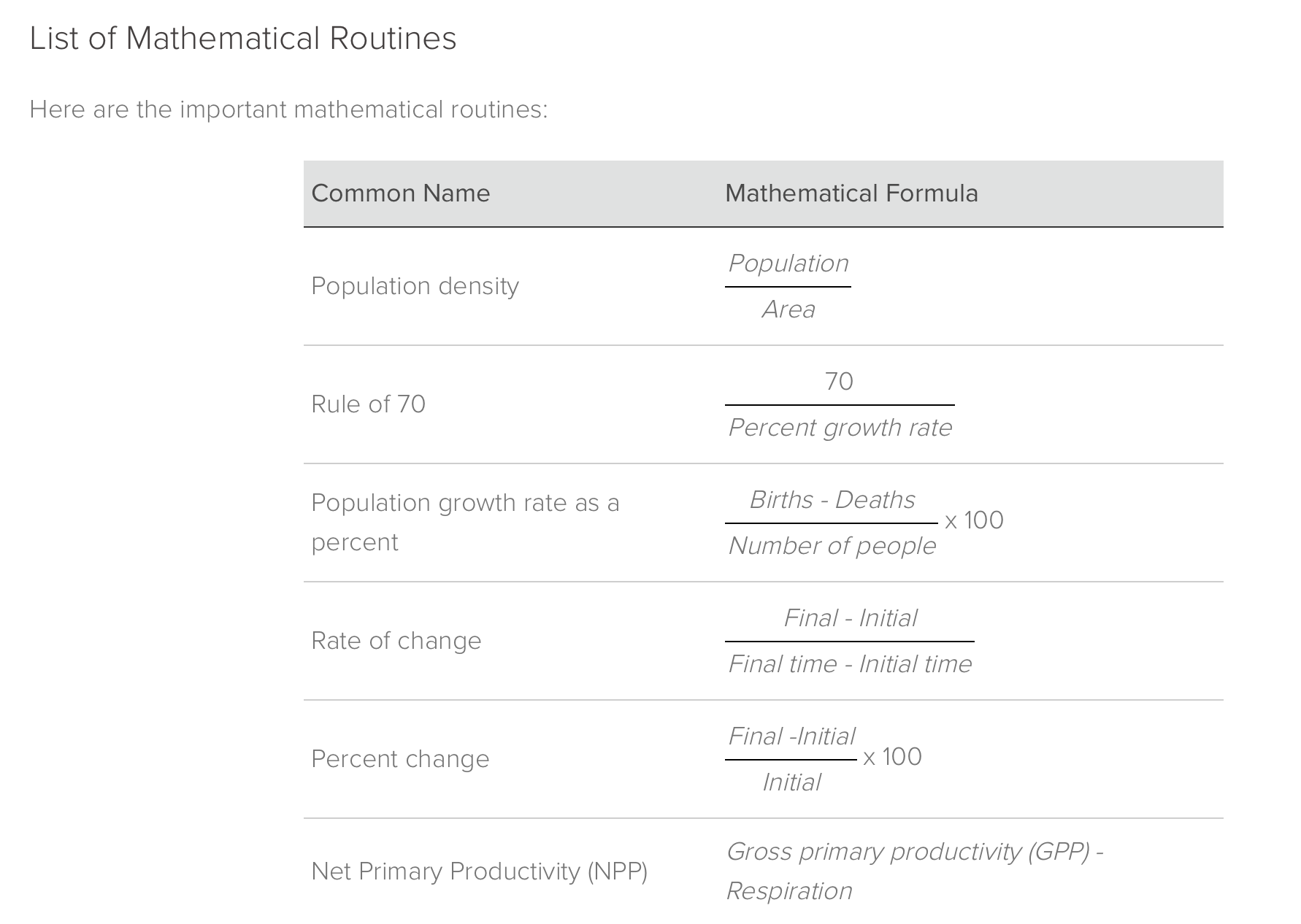
- Exponential growth: populations, rule of 70, 70/% = doubling time
- pH: log10 of [H+], 10x per pH value
- Trophic pyramids: 10% rule
- Energy vs. power: work is joules, joules/time = power, kW, kWh
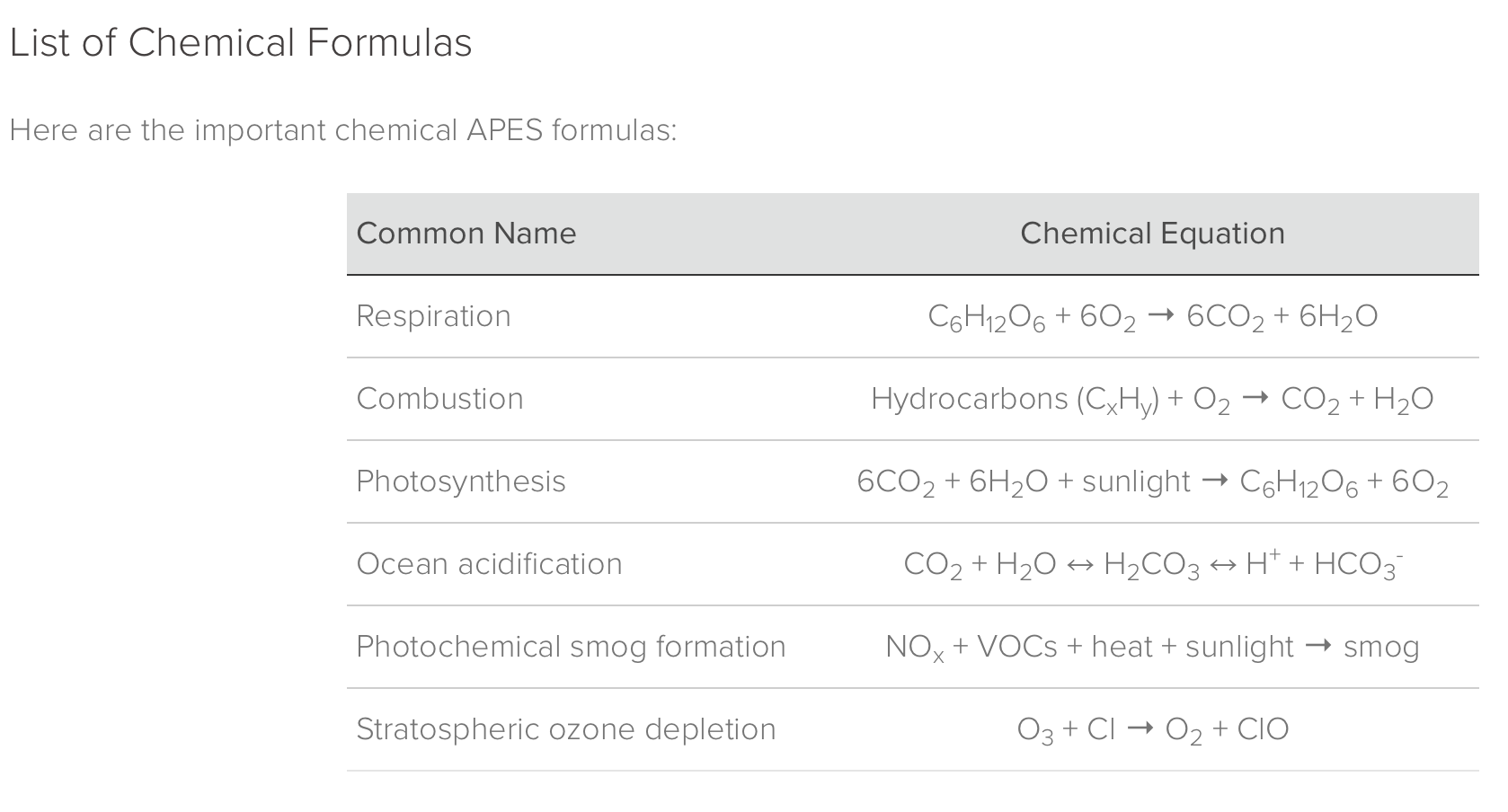
- Photosynthesis: follow carbon: CO2 + H2O-> sugars (carbohydrates)
- Ocean acidification: CO2 + H2O <-> H2CO3<->H+ + HCO3-
- Ozone depletion: track Chlorine
- Respiration and combustion
- Aerobic vs. anaerobic respiration
- Efficiency: work out/work in
progress(always less than 100%)
🔬 1. Exponential Decay (Radioactive Elements)
A scientist begins with 100 grams of a radioactive isotope with a half-life of 5 years.
How much of the substance remains after 15 years?
⚛ 2. Isotopes (Atomic Number and Mass)
Carbon-12 and Carbon-14 are both isotopes of carbon.
What do they have in common, and how are they different in terms of protons and neutrons?
📈 3. Exponential Growth (Rule of 70)
A country has a population growth rate of 2% per year.
Use the Rule of 70 to estimate how many years it will take for the population to double.
🧪 4. pH (Log Scale)
Lemon juice has a pH of 2. Tomato juice has a pH of 4.
How many times more acidic is lemon juice compared to tomato juice?
🐾 5. Trophic Pyramids (10% Rule)
If a plant produces 10,000 Joules of energy,
How much energy is available to a secondary consumer?
⚡ 6. Energy vs. Power
A microwave uses 1.2 kilowatts (kW) of power. If it runs for 30 minutes,
How much energy (in kilowatt-hours) does it use?
🌿 7. Photosynthesis (Tracking Carbon)
In the process of photosynthesis, carbon dioxide and water form glucose and oxygen.
Which molecule provides the carbon atoms found in glucose?
🌊 8. Ocean Acidification
Explain what happens to the pH of ocean water as more CO₂ is absorbed from the atmosphere.
Use the equation: CO₂ + H₂O ⇌ H₂CO₃ ⇌ H⁺ + HCO₃⁻
☁️ 9. Ozone Depletion (Tracking Chlorine)
One chlorine atom from CFCs can destroy thousands of ozone molecules.
How does chlorine act as a catalyst in ozone depletion?
🔥 10. Respiration and Combustion
Compare respiration and combustion in terms of energy release and byproducts.
💨 11. Aerobic vs. Anaerobic Respiration
During intense exercise, muscles may switch to anaerobic respiration.
What are the differences in energy output and waste products between aerobic and anaerobic respiration?
⚙️ 12. Efficiency (Work Out / Work In)
A motor receives 500 J of electrical energy and does 350 J of useful work.
What is the efficiency of the motor as a percentage?
✅ Answer Key
12.5 grams (100 → 50 → 25 → 12.5 over 3 half-lives)
Both have 6 protons (same atomic number); Carbon-12 has 6 neutrons, Carbon-14 has 8 neutrons (different atomic mass).
35 years (70 ÷ 2 = 35)
100 times more acidic (10^2)
100 Joules (10% of 1000, which is 10% of 10,000)
0.6 kWh (1.2 kW × 0.5 hr = 0.6 kWh)
CO₂ (carbon dioxide)
Ocean pH decreases (becomes more acidic) as H⁺ concentration increases due to carbonic acid dissociation.
Chlorine breaks ozone into O₂ and ClO, then regenerates to destroy more ozone (acts repeatedly).
Both release energy and CO₂; respiration is controlled, slow, uses glucose and O₂; combustion is fast, uses fuel and O₂.
Aerobic: more ATP, produces CO₂ + H₂O; Anaerobic: less ATP, produces lactic acid or ethanol.
70% efficiency (350 ÷ 500 × 100 = 70%)
Unmigrated media: Environmental_Science_Practice_Problems.pdf (application/pdf, 3.5 KB)
Unmigrated media: College_Level_Environmental_Science_All_in_One.pdf (application/pdf, 2.6 MB)
Fill in the blank version:Unmigrated media: College_Level_Environmental_Science_Fill_in_Blank.pdf (application/pdf, 2.6 MB)
Power and energy:
FRQ Reminders in AP Environmental Science
- Always write in complete sentences.
- Don’t write more than the question asks for.
- If the FRQ asks for two examples, only the first two examples that you write are graded.
- Introductory sentences or re-stating the question is not necessary. No points removed, but it can take precious time.
- Label each section: a. b. ci……. DO NOT write one giant paragraph and write on the lines.
- You can answer out of order—just make sure to label.
- If you write more, the graders will read them to check for contradictions, but you will not earn points. Contradictions will take away points.
FRQ Task Verbs
Identify, Provide or List: Simple answer with a complete sentence.
Describe: Needs additional information beyond a simple answer. 1-2 complex sentences.
Make a Claim: Make an assertion based on evidence or knowledge. Make sure you add “Because” or “Which leads to” in your answer to get full points
Justify: Provide evidence to support, qualify, or defend a claim and/or provide reasoning to explain HOW that evidence supports the claim.
Calculate: A math problem to solve. Show set-up and answer WITH UNITS. (Does not need complete sentence)
Explain: HOW or WHY something occurs.
- Use evidence and/or reasoning.
- Sometimes, it is a process requiring steps in order.
- Use “because” for “why” questions.
- It often requires 3 parts: This happens, which leads to, which results in.
Migrated from Apple WikiServer Wiki. Original page D9e7V5a.ID: D9e7V5a