
Chapter 4 outline: weather
Migration
APES notes atmosphere, weather
see also frog book 15.1 (atmosphere) and 6.1 (biomes)
Three ways heat energy moves:
- Radiation: no medium needed, e.g. light
- Conduction: contact
- Convection: matter in
progressmotion
Summary:
- Solar radiation passes through the atmosphere
- Radiation hits the earth surface, conducts to air
- Hot air rises, (convection) cooler air comes in to take its place
- This is the basis for wind (air along the surface) and weather (condensation and precipitation)
--------------n.b. (nota bene, "note well")--------------
- Tilt of the earth: Basis for seasons : tilt away=winter
- equinox=equal night, solstice=extremes
- Equator is hottest, so greatest convection there, also ocean less salty there (why?)
Three global convective cells, cause winds, climates and all weather:
Hadley, Ferrel, Polar
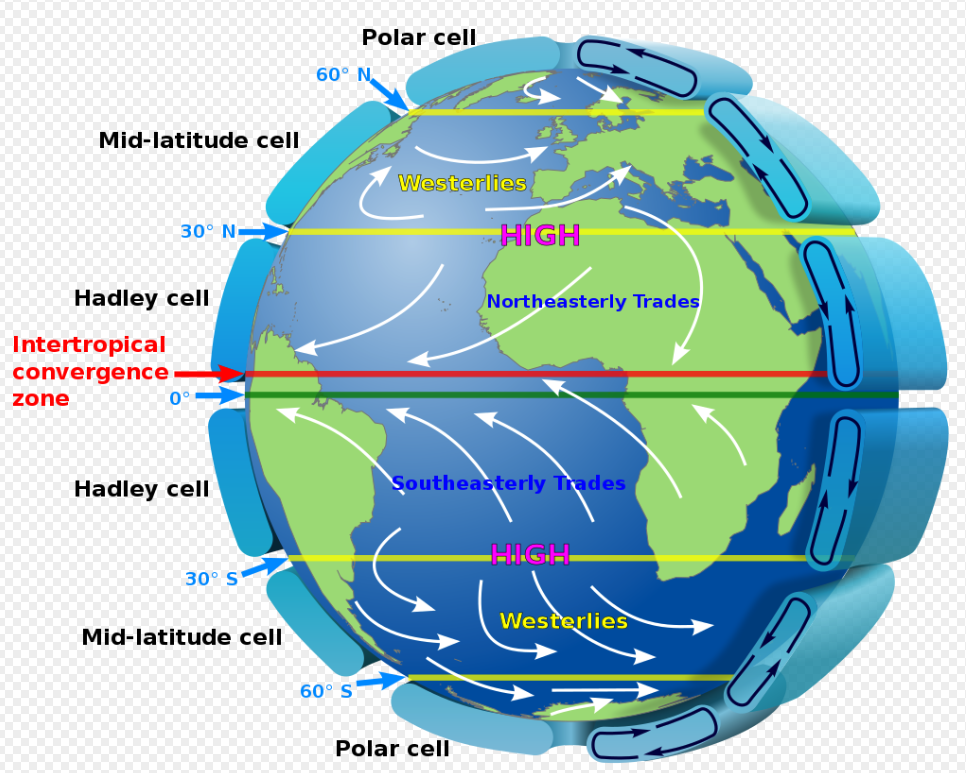
- Ocean currents follow the winds, clockwise in N hemisphere
- Cells converge at rainy spots, diverge at deserts
- Why? Clouds lift at convection spots, cooling them = rain
- Dry air dropping from space = warm, dry air (deserts)
Layers: spheres bottom to top
- tropo: at the surface, where all weather happens, conduction to air from surface, convection to other layers, albedo is how much energy it reflects (albus=white)
- strato: higher, drier air, cooler, air travel is here, also ozone layer (stops UV)
- meso: middle
- thermo: hot, charged particles, also ionosphere, bounces radio waves
- exo: outer
- magneto; even further, deflects solar wind, protects surface (none on Mars)
-----------------
Air stuff:
- compress air and it heats (bicycle pump)
- uncompress air (e.g. altitude) it cools (spray can too)
- warmer air holds more water (more energy to keep molecules in gas phase)
- cooler air holds less water
- humidity measures how much water in how much air
- relative humidity: compared to how much it can hold at that temp
- absolute humidity: total amount of water
- dew point: temp where water condenses
- rising air condenses (rain) “adiabatic cooling” rain carries the heat away
- falling air heats (e.g deserts) “adiabatic heating” absorbs energy from the surroundings
- rain shadows=dry areas after mountains
- moon shadow=a cool song by Cat Stevens
- saturated 100% RH air is fog, then rain or snow
Cells:
ITCZ: at the equator, inter-tropical-convergence-zone
Hadley cell: equator to 30°N or 30°S
Ferrel cell: 30-60°
Polar cell: 60-90°
- since earth is spinning, as air flows south, it also falls a bit west=tradewinds
- if air flows north, it also flows a bit east=westerlies (weather describes wind from source direction)
- this change of direction creates the coriolis effect
- Hurricanes are low pressure systems, rising air creates a counter-clockwise flow (L on the weather maps)
- High pressure systems create clockwise flow (H on the weather map)
Oceans:
- winds carry surface water along, so N hemisphere has clockwise currents (cool water off CA coast)
- a special current from Greenland melt flows to Hawaii, called the thermo (heat) haline (salt) current.
- ENSO is a big deal: normally winds carry water off-shore of chile, bringing up food from the deep ocean (happy fisherpeeps).
- El Niño reverses this, so sad fisherpeeps
- La nada is no flow at all
Migrated from Apple WikiServer Wiki. Original page K8x1N5i3.ID: K8x1N5i3