
Module 10: Air currents
MigrationModule 10 Air currents and Water stuff
- Relative humidity: the amount of water in
progressthe air at a certain temperature, relative to the maximum it could hold at that temperature (RH). - You can blow on the room sensor and see this rise.
- Absolute humidity: true amount of water in percent water in that parcel of air (AH)
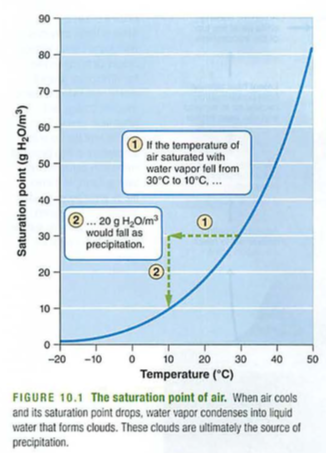
Saturation point: the max amount of water air can hold at that temp (rises with temperature, note how this compares with gases dissolved in liquids, like your dissolved oxygen (DO) lab. You may know this as fog.You may feel more comfortable with high temp and low humidity because your body can evaporate and cool more effectively. Conversely, humid, hot weather is ugly. Cold, humid air insulates poorly, so feels chilly, so running your air conditioner when it is humid and cool may actually make you feel warmer. Why?You can look this up, it is called the "comfort curve" or psychrometric chart:

Questions:
- You see a circular flow in the counter-clockwise direction in the Northern Hemisphere on windy.com. Is this low or high pressure?
- Why is the ocean less salty near the equator?
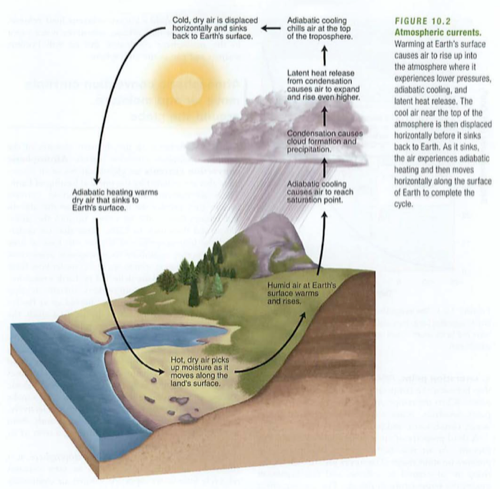
- As a parcel of air rises (like Waipio or the Himalayas), what happens to the absolute and relative humidity? What happens next?
- What level of the atmosphere has most of the weather and why?
- Adiabatic heating: reverse of this: think of Puako or Kawaihae: as air descends, it is compressed and gets hotter.
- Latent (hidden) heat release: when vapor condenses from gas to liquid, it releases energy. Opposite of evaporation or boiling, which both require energy.
- Convection: one of three means that energy moves from place to place:
- radiation (like light, can be reflected),
- conduction (contact),
- convection (movement of mass, usually air or water).
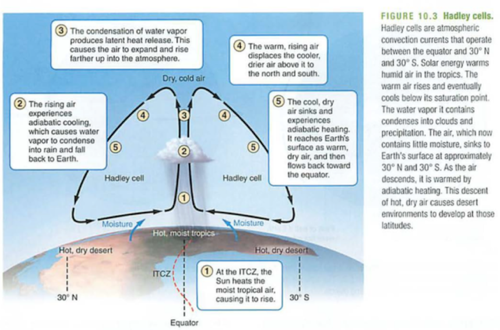
- Hadley cells: between 30N and 30S, convergence at the equator (hot air rises there), descends after shedding heat to space and water as it rises (rain), descending dry air forms deserts at 30N and 30S. Winds from the north to south at the surface, opposite in the stratosphere.
Check this out on windy.com:
https://www.windy.com/?20.002,-155.533,5
- ITCZ: intertropical convergence zone: the place near the equator where this convergence occurs, lower salinity in equatorial oceans (rains all the time, good AP question).
- Hadley Cells: Between the equator and 30N or 30S.
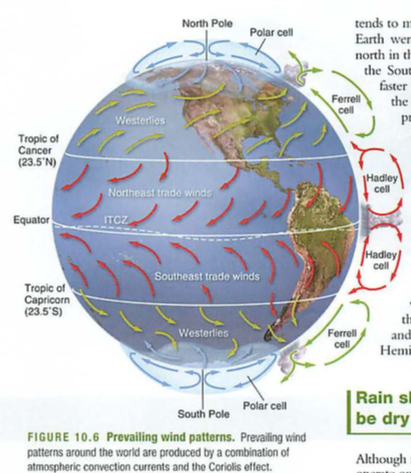
- Ferrell cells: between 30N and 60N, also on the southern hemisphere: deserts at the bottom, northward wind at the surface, opposite in space (stratosphere), which is why commercial flights usually have a headwind where they'd have a tailwind at the surface. Also why when trades are strong, mainland flights are faster/shorter.
- Polar cells: southward wind from 60N to 90N, creates dry desert at the north pole.
- Coriolis effect; spinning of earth makes air near the equator rotate faster around the axis than polar air. This difference creates hurricanes and ocean currents, therefore diagonal winds (see fig 10.6)
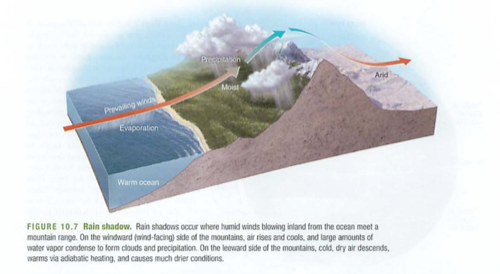
- Rain shadow: think of the coast near Mahukona or Lapakahi, between Kawaihae and Hawi: very dry as all moisture has been wrung out of the air by ascending above mount Kohala. Think also of Eastern Washington, or the Desert in Chile, where the Andes dry out the air. Many more-find some!
Migrated from Apple WikiServer Wiki. Original page F01259.ID: F01259