
Module 18: Abundance and distribution
MigrationModule 18-abundance and distribution
Start with this:
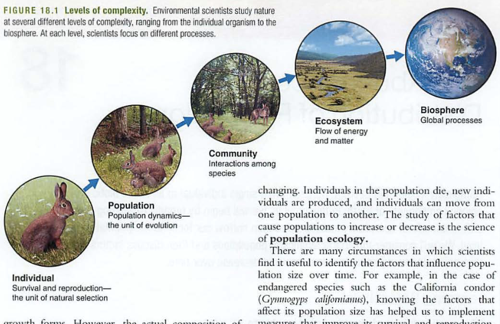
- individual-you
- population-HPA
- students community-HPA
- ecosystem-education
- biosphere-the world
or:
- some rabbit individual
- some of the rabbit's friends,
- a population of rabbits
- rabbits and the things they eat and eat them-community
- ecosystem-the plants that support both ends of this process
- biosphere-the planet
We covered ecosystem energy and matter a few weeks ago, this chapter is about population ecology.
--------------------
Population dynamics
Notation: Population size is represented as N (note not "n"): population size within a defined area at a specific time (brings in
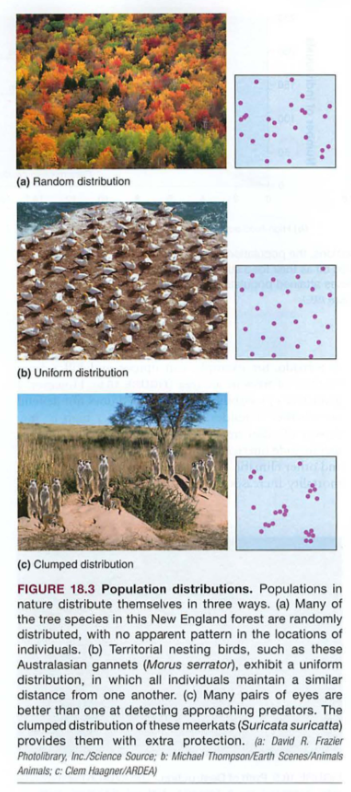
Check out the diagrams on population distribution: random, uniform and clumped. Important vis a vis biodiversityStructures: age and gender (sex)
- Density dependent factor: e.g. food or reproductive rate in rats (more rats, lower "fecundity" or birthrate)
- Something that influences reproduction or survival...
- Density independent factors: storms, disasters, fires (note density independent: one bambi or 100 bambi all perish in the same fire)
- Limiting resource: usually food, but could include space, nutrients, etc.
- Carrying capacity: K (note not "k"): how many individuals an environment can support
Migrated from Apple WikiServer Wiki. Original page s263q72.ID: s263q72