
Module 31: Food
MigrationRecall our main themes: energy->water->food->culture
Food!
Three main groups:
- Proteins: always include Nitrogen
- Carbohydrates: CHO in
progresschains (starches) or simple (sugars) - Fats: CHO again, but in a special branch structure (glycol backbone) that is good for energy storage and insulation (e.g. killer whales, eskimos)
Proteins: complex molecules of CHO and N.
- Look up amino acids, note the common structure.
- Now look up the amino acid methionine.
- What element does it contain as well?
- Why do rotten eggs, swamps (and Kilauea volcano) stink?
CHO=carbohydrates (clever name),
- usually in a chain, short chains are sugars (used for fuel),
- longer ones are starches and can be used for structures (e.g. cellulose in plants) or pasta...
- smallest: sugars, all end in -ose (glucose, sucrose) LOOK THESE UP, CHECK OUT THEIR MOLECULE SHAPE
- glucose is a "monosaccharide" created by photosynthesis
- longer chains: starches (rice, pasta) slowly digested (see diabetics, and glycemic index)
- structural CHO: cellulose-little boxes with goo inside, need enzymes to break these down (cows)
- ENZYMES ALL END IN -ASE
Fats/lipids: same chemical structure as CHO, but built along a glycol (alcohol) backbone.
- If the fats have long carbon chains with only single bonds, they are saturated (lots of Hydrogen atoms) and can hold together (e.g. animal fat)https://en.wikipedia.org/wiki/Saturated_fat
- If the long chains have double bonds and don't fit together, they melt easier (e.g. oils) and are called "unsaturated", usually better for your health.
- n.b. McDonalds® got into real hot water a while ago for frying all of their stuff in "supersaturated fats". Ugh...
Notes: Chapter 11 FR Overview:
- Frog 12.3 Agriculture
- Frog 12.4 Food Production
- Ch. 12 assessment
- FR ch. 11 feeding the world
- FR mod 31 nutritional needs
- FR mod 32 industrial ag-insecticides, GMO
- FR mod 33 sustainable farming
Big picture:
- Trophic pyramids in nature are sustainable
- Planet is nearing carrying capacity (K)
- Think of how many "earths" your global footprint represents
- To meet this food demand, current farming and fishing is industrial, not sustainable
Read the case study p. 373-how is this like a trophic pyramid in nature?
- Undernutrition: lack of calories
- Malnutrition: lack of critical part of diet, usually protein (Kwashiorkor)https://en.wikipedia.org/wiki/Kwashiorkor
- Food security: not just in lesser developed countries ("LDC"), also in the US"Food deserts"-what are these?
- Famine: one of these impacting a large group, often from crop failure, drought or war/displacement
- Overnutrition: common in the US, look up the US obesity rate-how is this determined? Why? Seen any food ads lately?
Look up US obesity rate-----
Meat diet: high in protein, also in fat (energy store) and cholesterol-these contribute to heart disease
- Wait-Eskimos eat lots of blubber, why don't they have heart disease?
- How is this different from Kalahari bush tribes?Climate
- Wait, wait-what happened to Japanese health care system when they moved from their traditional diet?
- What impact does this have globally?
- Diet for a small planet 1971: planet can sustain population using fewer calories while supplying protein, vitamins and calories. Not by relying on meat.Vitamins="vital amines"
Food energy subsidy (cost factor):
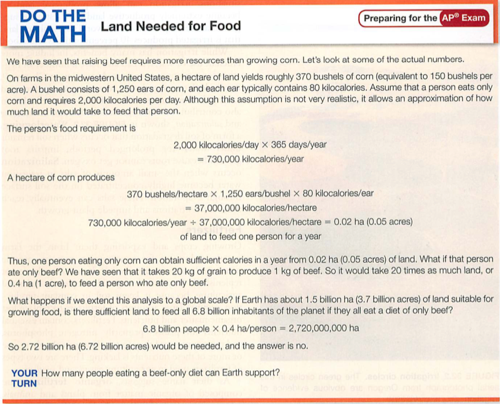
- 20 kg of grain to produce 1 kg of beef (20:1 factor, or subsidy factor 20x)
- 2.8 kg of grain to produce 1 kg of chicken (2.8:1 factor, or subsidy factor of 2.8)
- Better to eat beef, chicken, fish or tofu? (you need protein in some form)
Migrated from Apple WikiServer Wiki. Original page k6Q9C9e.ID: k6Q9C9e