
Solar thermal labs
MigrationPart I: Solar thermal energy harvesting: solar thermal panel
Part II: Thermal energy storage: Hot water heater tank
In these labs, you will be dealing with harvesting solar energy and storing it in progressan insulated hot water tank.
Some of the concepts you learn here will help you design your ideal green home, which is your next big project
Basic concepts:
- Solar radiation from the sun hits a dark metallic conductor (copper) which turns this visible radiation into heat (thermal energy)
- Water is passed through pipes in this conducting collector plate, and absorbs some of this thermal energy, warming the water
- The efficiency of this "flat plate collector" is determined by measuring the solar radiation in Watts/m2, the area of the plate, the temperature difference in the water in and out, and the rate of the water through the collector
- Once the water is heated, either by solar radiation or other means (gas, electrical power), the hot water is stored in an insulated hot water heater tank.
- The better this tank is insulated, the more thermal energy is available for use, and less is wasted
- The best measurement for insulating qualities is the decay rate or "k" which is determined by measuring the hot temperature of the tank, room temperature, then the temperature of the tank some time later "t" measured in seconds.
- This calculation is identical to the radioactive decay formula we used, as well as the population growth formula, with a negative exponent in front of k
Part I: Solar thermal panel
Data gathering:
- Area of panel in m2:
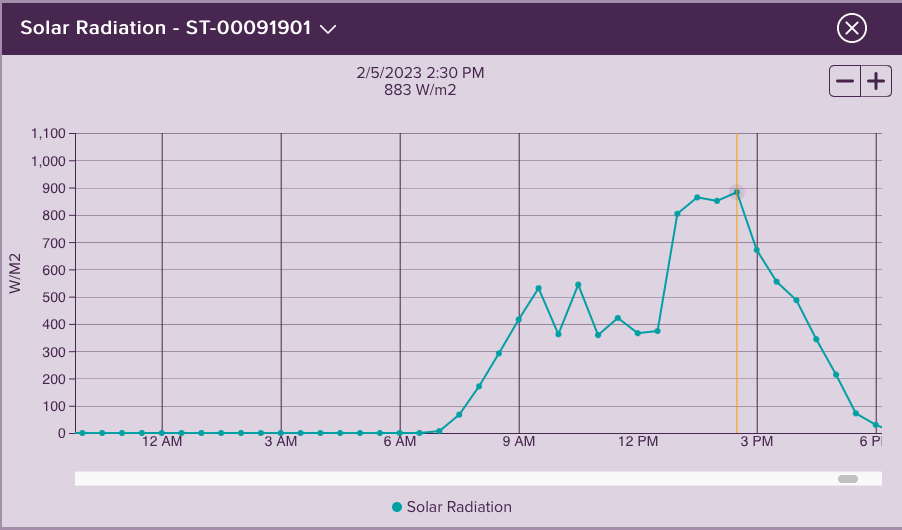
- Current solar radiation in W/m2 (look at elab.hpa.edu under "current weather")
- Watts available for collection:
- Temperature of incoming water (look at 10.14.8.62)
- Temperature of outgoing water (same place)
- Temp difference
- Time to fill a 1 liter container in seconds:
Calculations:
- W/m2 * m2 = Watts available
- ((temp difference °C)*4.18*1000g) / time to fill = joules/second = Watts collected
- Watts collected/Watts available = efficiency
- Watts/1000 = kW effective
Part II: Hot water heater
Data Gathering:
- Room temp
- Starting temp
- Starting time
- Ending temp
- Ending time
- Notes on container (insulated, covered, color, material)
- Notes on infrared camera observations
- Logger pro temp sensor set for 180 seconds, one or two samples per second
Calculations:
- Starting temp above room temp
- Ending temp above room temp
- Time in seconds
- Tt = Toe^-kt so (ln (Tt/To))/t = -k, drop the minus sign to get k
- Compare your k with others, make inferences about insulation, cover, color, material
Questions:
Solar thermal collector
- How do you think the rate of the water going through the collector might impact the efficiency?
- Is the collector more efficient with very cold water or very hot water?
- Why is the collector in a glass insulated case?
- What is the power of your collector in kW?
- Compare this with a normal electric water heater which is 4.5 kW
- Go to 10.14.4.5 and search for the word "thermal". Click on the "graph" boxes and then "graph". Change the starting time to 6 AM. What does this graph show you?
- How could a system like this help you optimize and/or automate your solar collection?
- How could such a system help you determine if your system is broken?
Hot water heater
- Why is the solar thermal collector in an insulated box with special glass cover?
- If houses use the k value to determine insulation, what other factors impact energy needed to keep a house warm in the winter or cool in the summer?
- In 1976 after the oil embargo, the speed limit was changed from 85 mph to 55 mph, and President Carter asked people to keep their thermostat at 68 in the winter and 75 in the summer. What part of this is related to your lab?
- If you are at Waimea coffee, Starbucks or Avo, what color are the cups? Why do they have tops? How could you keep your coffee warmer longer?
- Looking at the logger pro graphs, what do you see that verifies this?
- Detectives use this exact process to determine time of death. Why and how do they do this?
- If you could improve the heat lost in electric water heaters by 10% nationwide, you could save several billion dollars per year. Why is this promoted more in northern states and not in Hawaii?
- Why should it be promoted here in Hawaii?
- What is a trombe wall, and how is it similar to this hot water heater lab?
- How could what you've learned here help you with your ideal green home design?
- In a repeat of your lab, a white, covered styrofoam container (test A) is compared with an open glass container (test B). Both start at 100°C and room temp of 25°C. 30 minutes later, A is at 92°c and B is at 62°C. Calculate k for both of these.
- Thermal energy (heat) always travels from hot to cold, so if you are freezing, should you put a reflective blanket shiny side in or shiny side out?
- Heat travels from hot to cold by three methods: conduction (contact), radiation (light or heat rays) or convection (matter in motion, like the weather). Which of these were in action in your lab, and how could you improve on your system?
Alternate link for solar radiation at the elab: https://tempestwx.com/station/86658/grid
Sample solar thermal data:
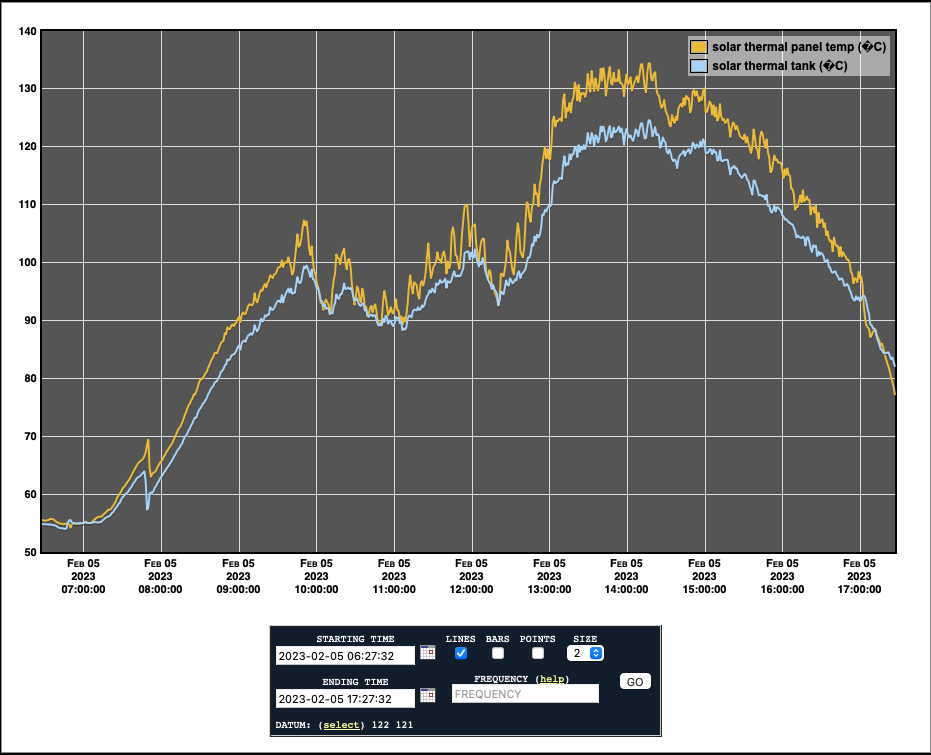
area of panel: 2.7 m2
rate of water: 25 seconds/1000g
delta t: 9°C
solar radiation: 883 W/m2
Solar energy available: 883 * 2.7 = 2384 Watts
Solar energy collected:
- ((temp difference °C)*4.18*1000g) / time to fill = joules/second = Watts collected
- 9 * 4.18 *1000/25 = 1508 Watts collected
- efficiency: 1508/2384 = 63%
Note: at 9 AM, when the panel was cooler, ∆t was 5°C and radiation was 400W/m2:
400*2.7 = 1080W available
5*4.18*1000/25= 836W collected
efficiency = 836/1080=77%
Why is this better?
Migrated from Apple WikiServer Wiki. Original page X2s7p16.ID: X2s7p16