
Unit 8: Pollution: module 4.42-4.44 Air Pollution
Migration
APES spring 2026
- air pollution, PM10, IAP, acid rain (42-44)
- health-toxicity, LD50
- eutrophication, biomag, POPs
- LD50, IDs
- ozone, greenhouse gases
- climate change
- AP practice
W7e:
- W 14: health, toxicology
- W 18: climate change
FR4e: (13 mods)
- mod 42: air pollution
- mod 43: PM10
- mod 44: IAP
- mod 45: reduction
- mod 46: acid rain, noise
- mod 47: health
- mod 48: eutrophication
- mod 49: biomag, POPs
- mod 53: LD50
- mod 54: ID
- mod 55: ozone
- mod 56: greenhouse
- mod 57: climate change
- mod 58: biodiversity
- Mod 42: criteria pollutants
- Mod 43: photochemical smog
- Mod 44: indoor air pollution
Module 4.42 (module 42, 4th edition text)
Big ideas: air is shared by everyone on the planet, crosses international borders without consent, impacts innocents with little power.
Contrast this with solid, toxic or radioactive waste: usually disposed of on your own land, or with rivers, which demonstrate "continuity downstream"
What is a "criteria"? good/bad
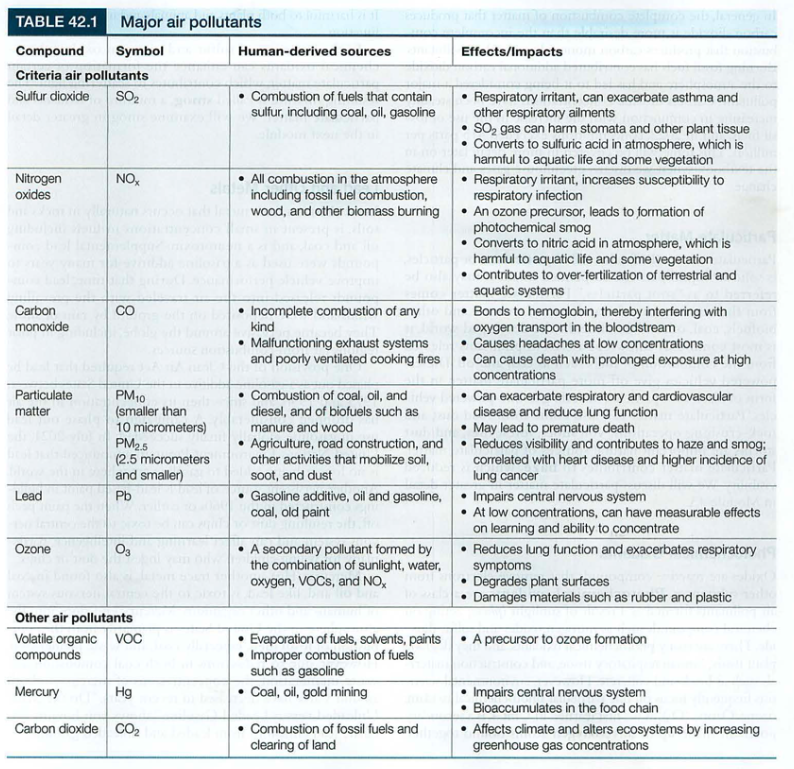
6 major pollutants: “criteria pollutants”
- Sulfur dioxide: SO2 (could also be SOx)
- Nitrogen oxides: NOx (could be NO, NO2, or NO3)
- Carbon monoxide: CO
- Particulate matter: PM (PM 2.5, PM 5, PM10)
- Ozone: O3
- Lead: Pb
Mnemonic: SOX/NOX, CO/O3, PM/Pb
Added in progress2007: CO2, VOC, Hg
From your text:
Context and relevance:
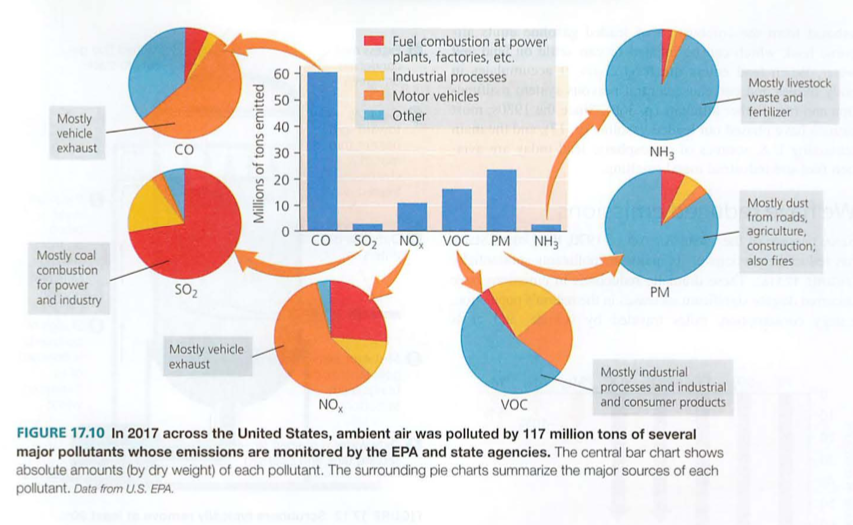
SOx: Sulfur Dioxide (SO2) and other SOx versions
- From Methionine (amino acid in living things) in fossil fuels (look up the structure of this)
- Combines with water in the air to make H2SO4 (sulfuric acid, acid rain)
- When you breathe it, it burns your lungs, stings your eyes
- May look like "yellow smog"
- One example is VOG: sulfur dioxide and ash (volcanic glass)
NOx: Nitric oxide (NO2) and other NOx versions
- Various forms of oxidized nitrogen, which alone is inert and makes up 78% of the atmosphere at sea level
- From high temperature combustion (e.g. auto engines, esp. high efficiency ones, which burn at higher temps)
- Also from decomposition of fertilizers (e.g. Ammonium Nitrate)
- Combines with water to make HNO3 (nitric acid) which also burns your lungs and eyes
CO: Carbon monoxide
- Emission from car exhaust, or other incomplete combustion: C + O2 —> CO2
- Many people die camping by burning stoves in their tent without enough oxygen, forming carbon monoxide
- If not enough O2, then CO forms, like in a closed space (tent, hut, cold house in Texas)
- Toxic, permanently attaches to your hemoglobin rendering it useless for respiration. (30 day life cycle for your hemoglobin)
- Imagine the town van, but nobody gets off. The bus still goes, but nobody goes to town.
- For 30 days (until your red blood cells are replaced) no seats on the bus, no oxygen.
Ozone
- Ozone is formed by sunlight, splitting O2 into O which then joins another O2 to make O3
- Ozone in stratosphere is good, in troposphere bad
- Ozone (O3) blocks UV radiation, while Oxygen (O2) does not
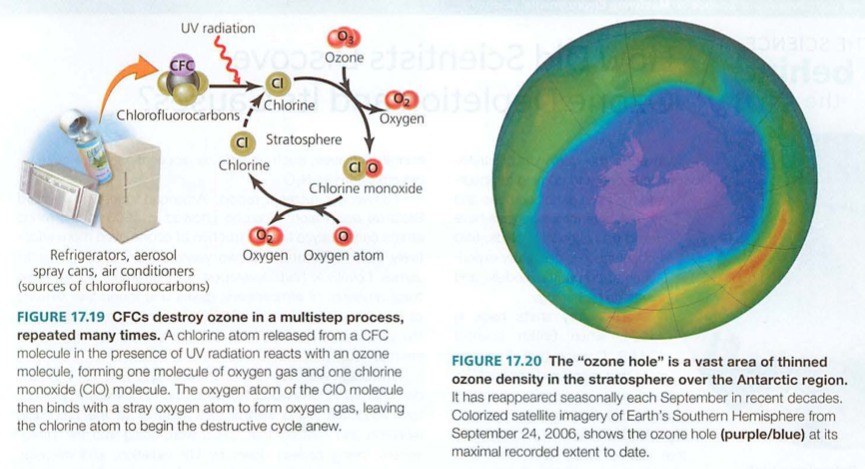
- Stratospheric ozone is necessary to filter UV radiation. CFC (chloro-fluro-carbons) destroy this layer
- This caused an ozone hole over Antarctica: Why there?
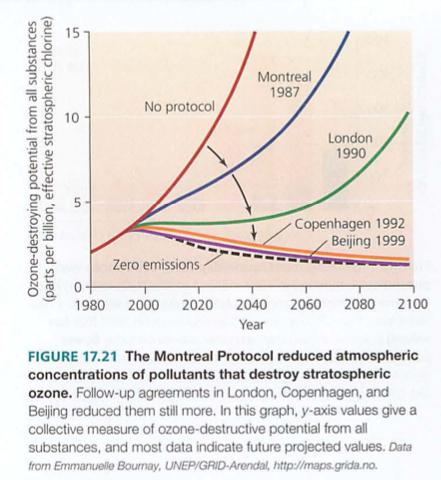
- How did we solve this? The 1987 Montreal Protocol:
- Tropospheric ozone causes lung and eye irritation, and is toxic to some organisms
- You may have heard of ozone generators used in hotel rooms to absorb smoke
PM: Particulate Matter
- Look up alveolus in your lungs
- Particulate Matter (PM) is basically soot (carbon)
- PM2.5 is 2.5 microns in size, PM10 is 10 microns in size (there is also PM5)
- PM2.5 is most dangerous, smaller particles lodge deep in the lungs, beyond ability of pulmonary cilia to flush out
- PM5, PM10 larger particles, get caught by cilia
- Main cause: coal fired power plants, diesel engines, oil fired power plants (carbon soot)
- See also vog: PM2.5 particles of ash (glass shards) with SO2 dissolved in water droplets (sulfuric acid): physical abrasive + corrosive acid = respiratory damage
- Fun fact: smokers get colds more often because tar in tobacco gums up the cilia, so they can't brush away germs and viruses.
Pb: Lead
- In the old days, there was leaded gasoline, and highly leaded gasoline (called "super" or "ethyl" because they used tetraethyl lead as an additive to improve power)
- Gasoline additive (tetraethyl lead improves octane rating cheaply), replaced by other worse carcinogenic (cancer causing) chemicals like MTBE: https://en.wikipedia.org/wiki/Methyl_tert-butyl_ether
- Decreases mental capacity (e.g. Roman insanity theory)
- Coal smoke contains lead, along with Mercury and other heavy metals. Sludge from mining is worse.
VOC: Volatile Organic Compounds
- Volatile organic compounds, e.g. gasoline vapors (why your gas cap must be on or you get a dashboard warning): https://en.wikipedia.org/wiki/Volatile_organic_compound
- Aerosol vaporizers are also VOC generators (indoor air pollution)
- Remember water striders sitting on water, due to surface tension?
- Your alveoli are surrounded by water (blood) so they need a surfactant (detergent) to break the surface tension so they can expand you can breathe.
- If you breathe in VOC's (siphoning gasoline, vaping, or in the case of premature babies), the surfactant is gone, and you cannot breathe.
- Vaping is a concentrated version of VOCs, dissolving the surfactant in your lungs, causing "chemical pneumonia", only seen before in anesthesia and people siphoning gasoline or premature babies.
Air Quality monitoring: Purple Air: note the PM 2.5 graphs
Check out other locations...
Vog forecast: http://weather.hawaii.edu/vmap/new/
============moved to new pages 2.11.26======================================
Module 43: Photochemical smog, thermal inversions, particulates
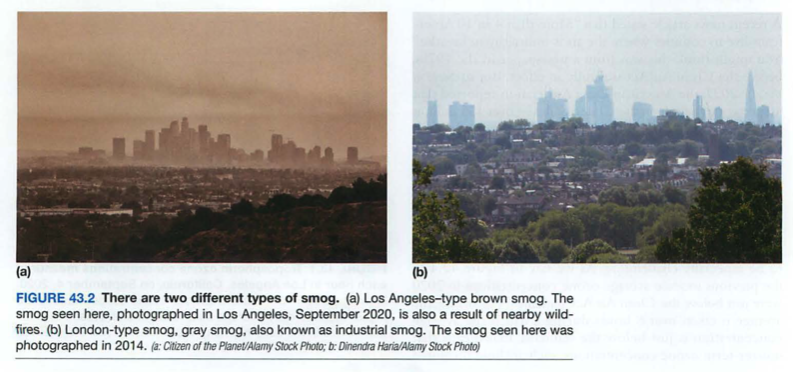
Two types:
- Photochemical smog: LA smog, brown smog, caused by surface ozone reactions
- Sulfurous smog: grey smog, VOG (includes bits of volcanic glass)
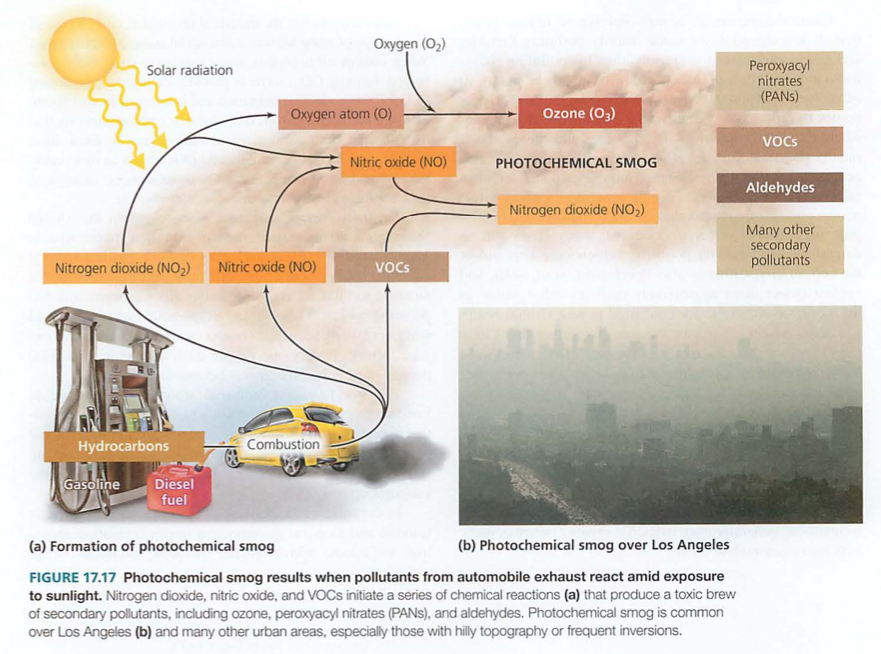
Smog and other photochemical reactions:
Primary and secondary pollutants:
- Secondary pollutants: need a chemical reaction (often energy from sunlight) to form (see figures above)
- Example: PhotoChemical Smog: Photo (light) Chemical (reaction) smog
- See PANs: Peroxyacyl nitrates: formed from VOCs, NOx https://en.wikipedia.org/wiki/Peroxyacyl_nitrates
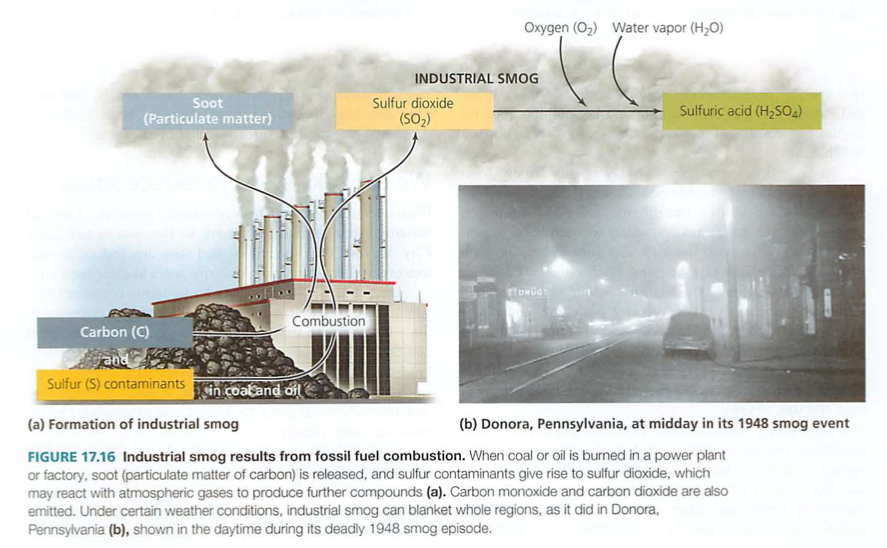
Thermal inversions: London fog, US, Donora, PA 1948 k.20, sick 7000
- 1952 London 4000-12,000 dead, three nights
- Mexico city 1996 300 dead, 400K sick
- How?
- Normally, the sun heats the surface, warming the air there, which rises. Cooler air aloft then falls to replace this rising air.
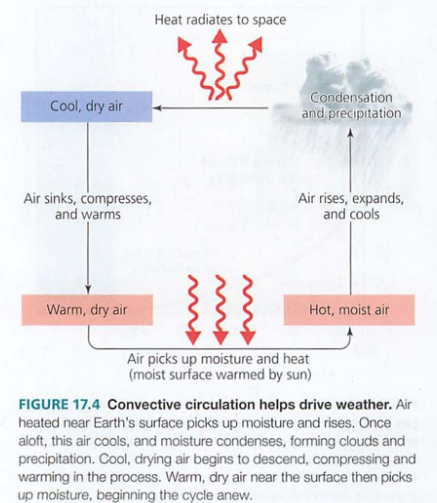
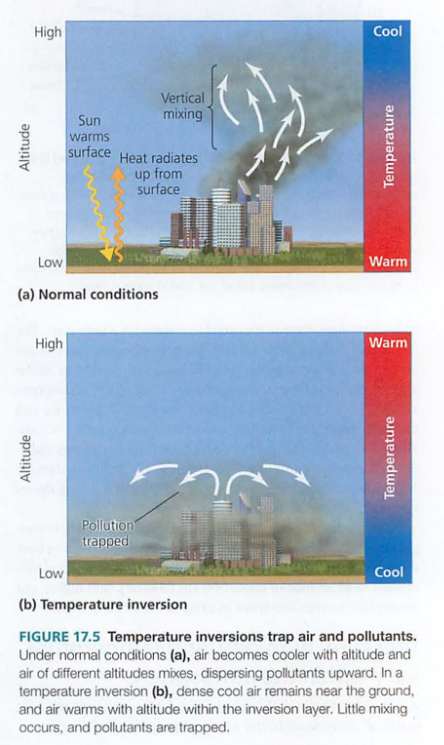
In an inversion, warmer air aloft traps the air at the surface (no temperature difference, so no convection), causing the pollution to be trapped in the lower levels. Most dangerous in valleys or bowl shaped cities (London, Mexico City, Denver, Donora).
Los Angeles has severe smog in the daytime, when hotter air draws in ocean air ("onshore breeze"), but the cycle reverses at night when the water is warmer than the land, so they have an "offshore breeze". Surfers like the first one.
Another diagram: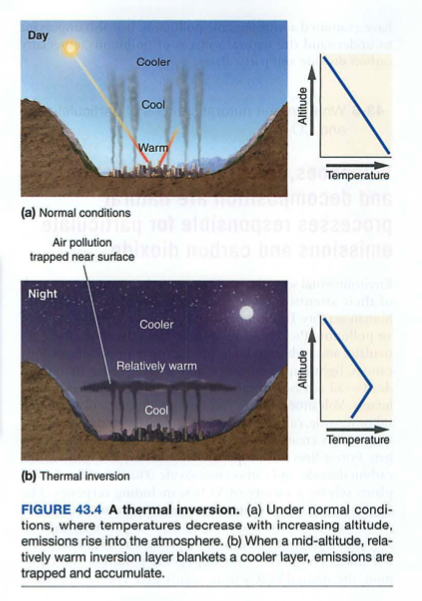
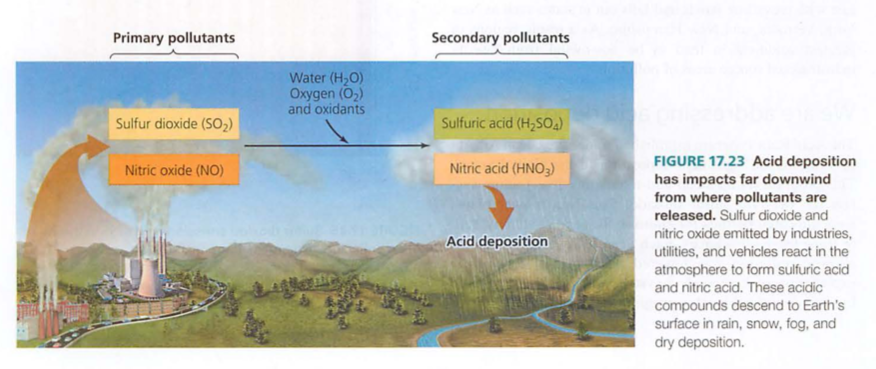
- SO2 + O2, water = H2SO4 (sulfuric acid)
- NO3 + O2, water = HNO3 (nitric acid)
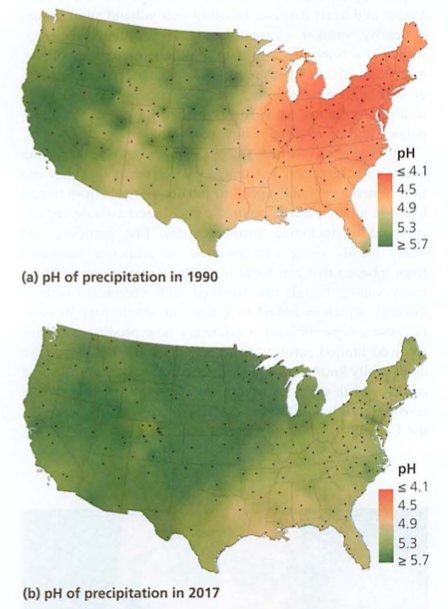
- “Acid snow” yes, acid snow...
- W. VA had rain more acidic than stomach acid in the 1970's
Important: Know how a power plant air scrubber works (just like the nuclear plant diagram)
Module 44: Indoor air pollution (IAP)
- Leading cause of death in LDC (women). LDC is the latest term for "Lesser Developed Countries"
- Burning manure for fuel, open pit fires, CO, PM10
- Sick building syndrome: formaldehyde, CO2, VOC
- Check out the Living Building Challenge and LEED Platinum in the elab hallway
Main culprits:
- VOC (paints, aerosols, vaporizers)
- CO (burning),
- Radon (radioactive rocks)
- Lead (paint, gasoline)
- Formaldehyde (adhesives, wood products, carpet glue)
- Asbestos (insulation, tiles, flooring)
- PM10 (soot from burning)
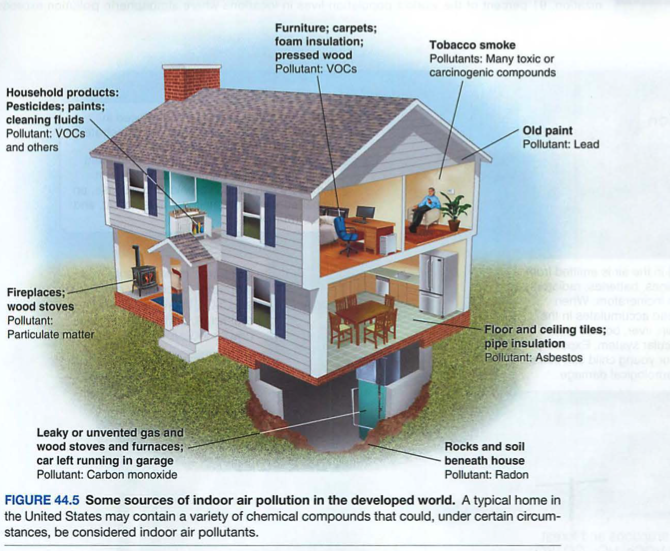
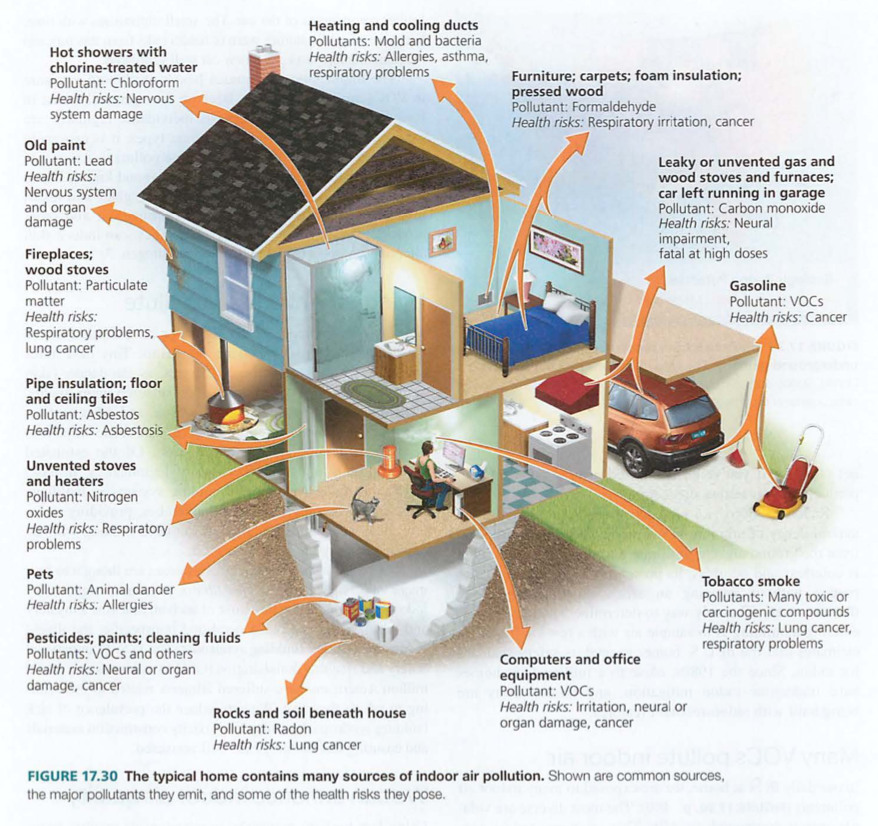
Asbestos-asbestosis, mesothelioma (like the ads on TV, usually aimed at Military folks or shipyard workers)
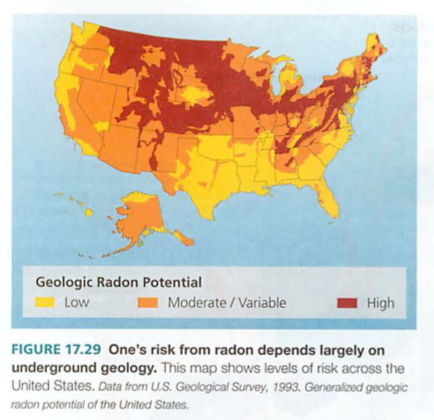
Radon 222-lung cancer (smoke demo-lungs)-#2 cause of lung cancer in the US (behind smoking of course)
Why?: Radon is very heavy gas, sits in lower lobes of your lungs, emits alpha particles (He nucleus) causing cancer
AIR QUALITY LABS-From the AP exam folks
• Air Quality: Air quality can be assessed using various methods.
• Particulates: Sticky paper can be used to collect air particulates from various sources, and then the paper can be examined under a microscope. It is
not possible to see the smallest particulates, but they do color the white paper.
• Ozone: In this lab, an ecobadge or a homemade potassium iodide gel sampler is hung or worn in
order to collect data on tropospheric ozone. The badge or KI sample changes color in the presence
of ozone and becomes more intensely colored as the amount of ozone increases.
• Carbon dioxide: In this lab, a commercial sampling device is used to determine the amount of carbon dioxide in an air sample. Car exhaust, burning tobacco, or other pollutants can also be sampled.
Pollution roundup:
Review for AP:
https://elab.hpa.edu/apes/ap_exam_prep/apes_princeton/ch08-pollution.pdf
https://elab.hpa.edu/apes/ap_exam_prep/apes%205%20steps%20to%20a%205/18-pollution.pdf
Old site links:
http://physics.hpa.edu/physics/apenvsci/apes_exam_prep/apes_princeton/ch08-pollution.pdf
Migrated from Apple Server Wiki. Original page U7n9N4P6g.ID: U7n9N4P6g