
FCC radio exam notes
FCC license prep
EMCOMM = emergency communications
EMCOMM-What if…
- There is a strong earthquake.
- First, you try to call home or your friends.
- They are all trying to reach you, to see if you are ok, “how strong was it?”
- Nothing works…
Why?In any emergency, cel phone companies may have generators that keep the system running for a while, but they are usually overloaded within seconds of any event.
Same for the internet, which may fail as well.
So...
Radios are the best alternate way for you to communicate with others.
With whom?
- Emergency folks to help you out: “my house is damaged, I need help”
- You can help emergency folks out: “my neighbor’s house is damaged, they need help”
If things get really serious, and all communications are out, you could use your radio skills to talk with people all around the world, to relay information (“we are safe”) or to ask for help (“send water and food”)
At HPA, if you are licensed, you can help our emergency folks protect and help your classmates, those in your community, or to let your family and friends know you are ok (or not).
Getting a radio license has two requirements:
- You have to have a basic understanding of how radios work, how to set them up, and how to keep them running.
- You have to be able to follow agreed upon rules in radio communications, regulated in our country by the FCC (Federal Communications Commission), which also coordinates with the ITU, (international telecommunications union)
Why do I have to do these?
- The first enables you to communicate
- The second ensures that you and others follow rules, to prevent chaos
Some radio basics to get started with the first one:
Frequencies:
- Line of sight: VHF and UHF (like wifi), short distances, LOS, small antennas and radios
- Longer range: HF (special case: NVIS), longer antennas, more powerful radios
Part I: Radio basics:
All radio uses electromagnetic radiation
- electro = electric field
- magnetic = magnetic field
- Light, X-rays, wifi, UHF, VHF, HF
- Electric field+magnetic field
So…
Anything that blocks or reflects E or B (magnetic) waves will reflect or block radio waves
(water, metal, charged particles)
Wavelength:
Velocity = frequency x wavelength
this formula works for ALL waves (sound, earthquakes, radio)
For light, X-rays, wifi and all radio:
Velocity = 3 ee 8 m/s
So?
If you want to create an antenna to resonate with any type of radiation, you match the wavelength of the signals to the length of the antenna
Example: 7 mHz is the 40 meter radio band. (megahertz means millions of cycles per second)
3 ee^8/7 ee^6 = 42.8 meters
Antennas:
Antennas are the key to all radio work:
Most antennas are in the form of two parts: a dipole
Think of a battery, one side is plus, one minus
In an antenna, this switches back and forth at the frequency of the radio
Essential electrical parts:
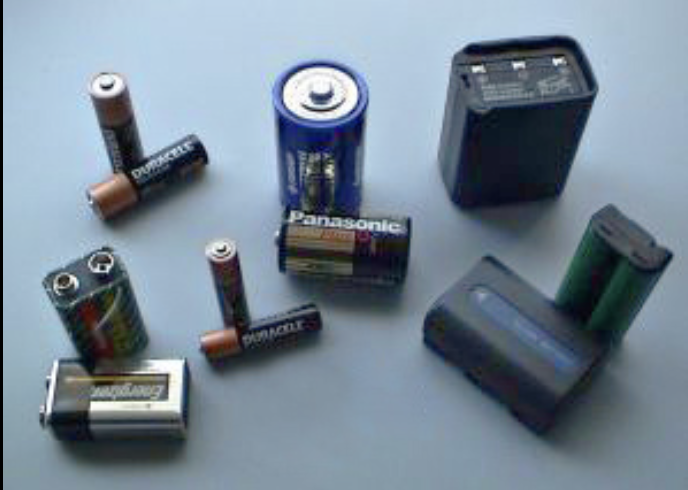
Battery: chemical source of electrical flow, plus goes to minus, measured in Volts
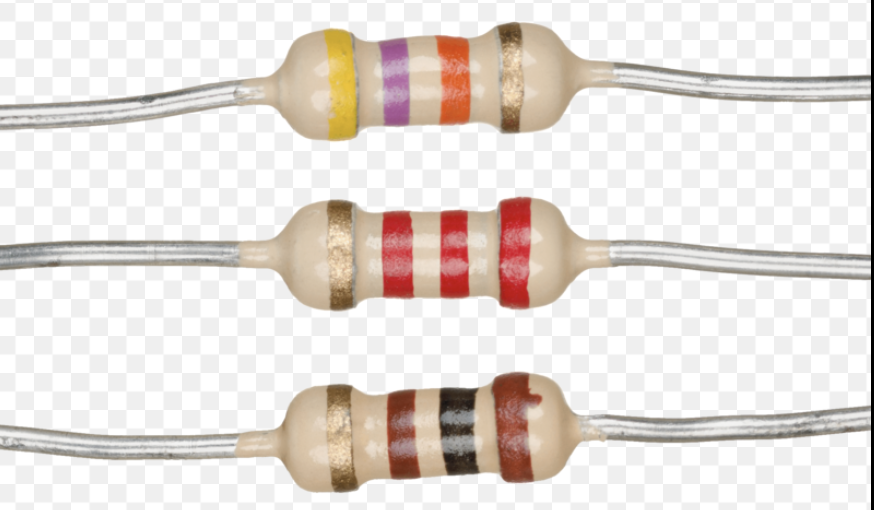
Resistor: converts electrical current into heat, like a toaster, measured in Ohms
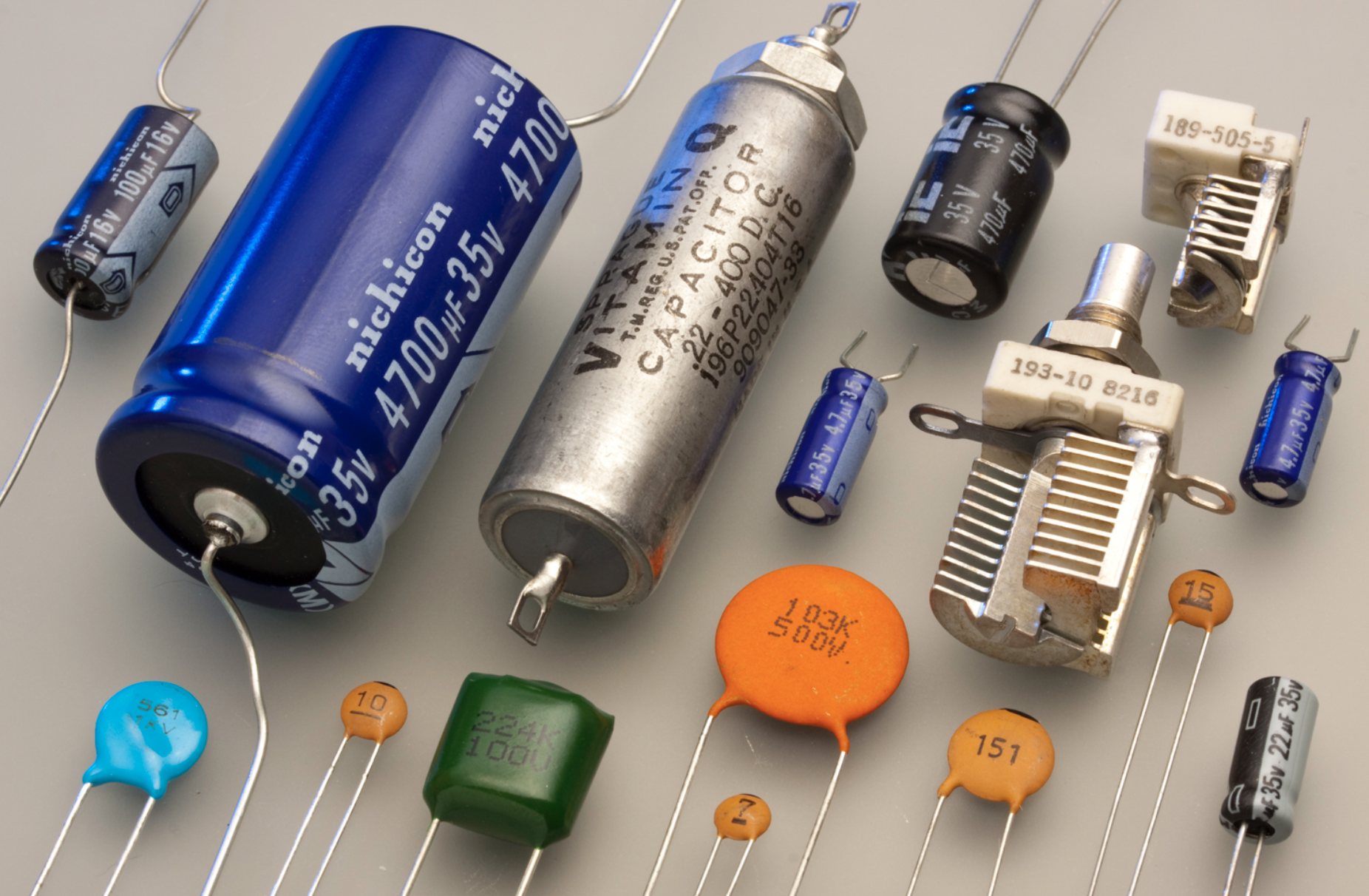
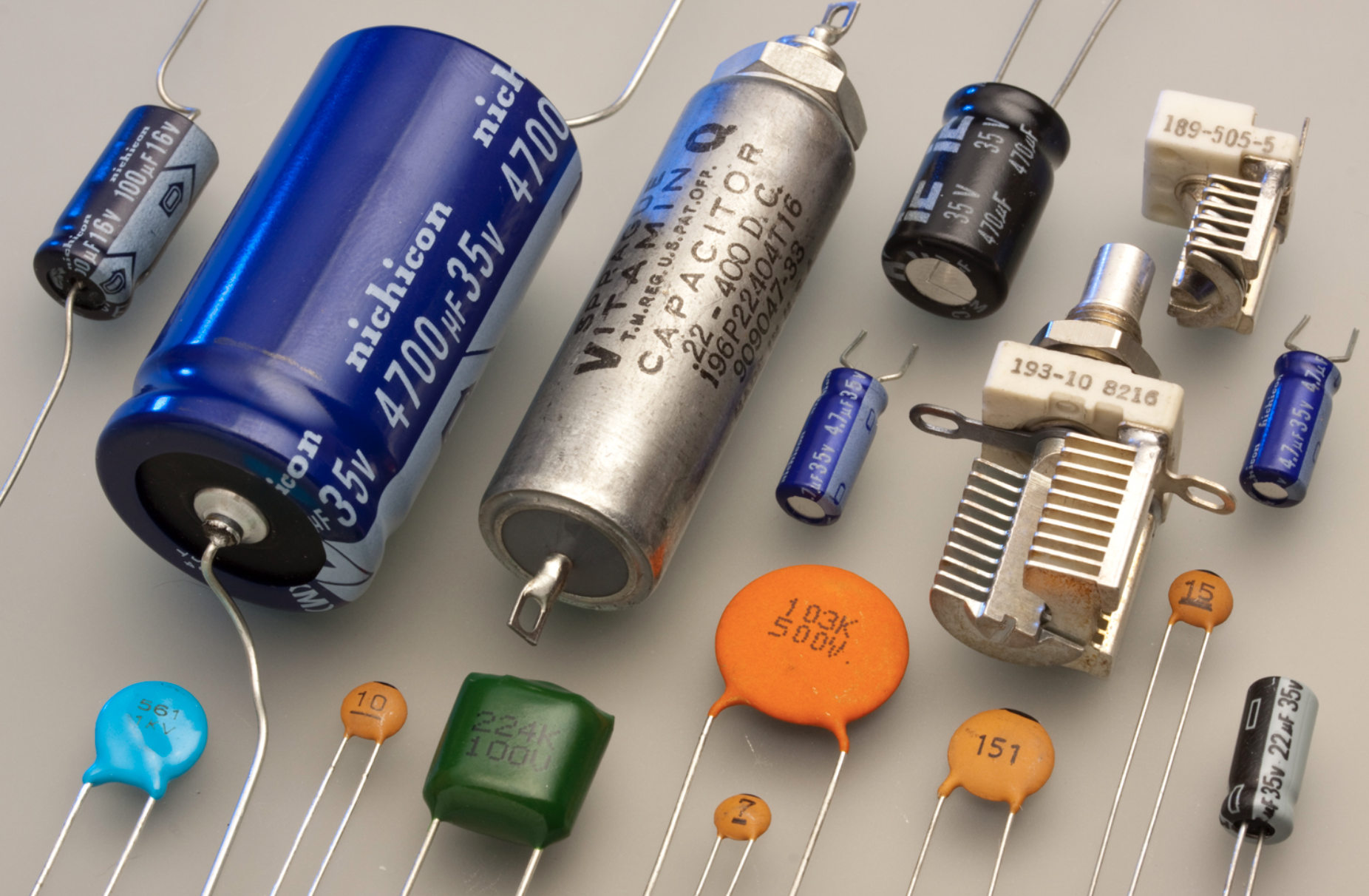
Capacitor: stores electrical flow as electrical charges, measured in Farads
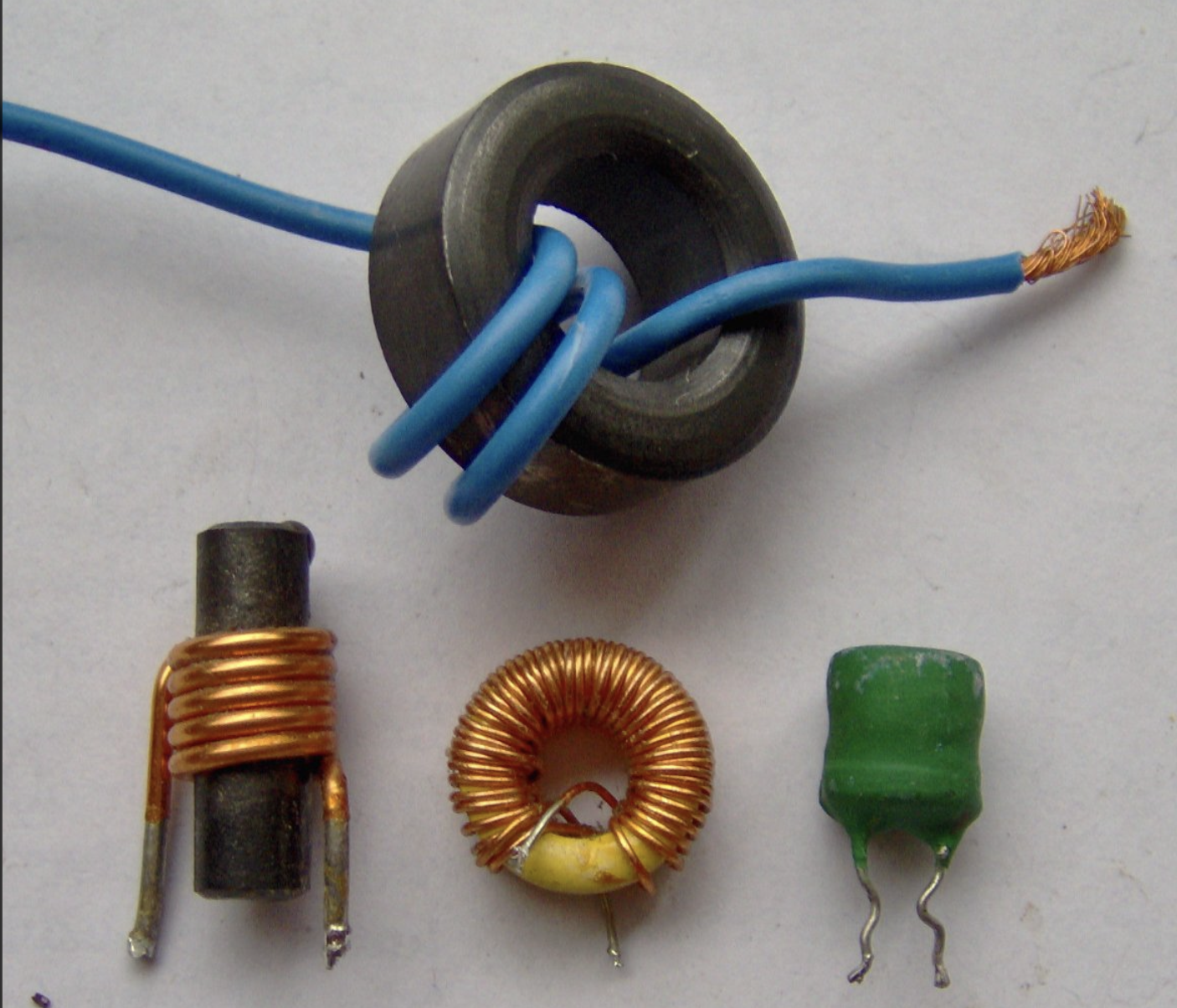
Inductor/coil: stores electrical flow as magnetic fields, measured in Henrys
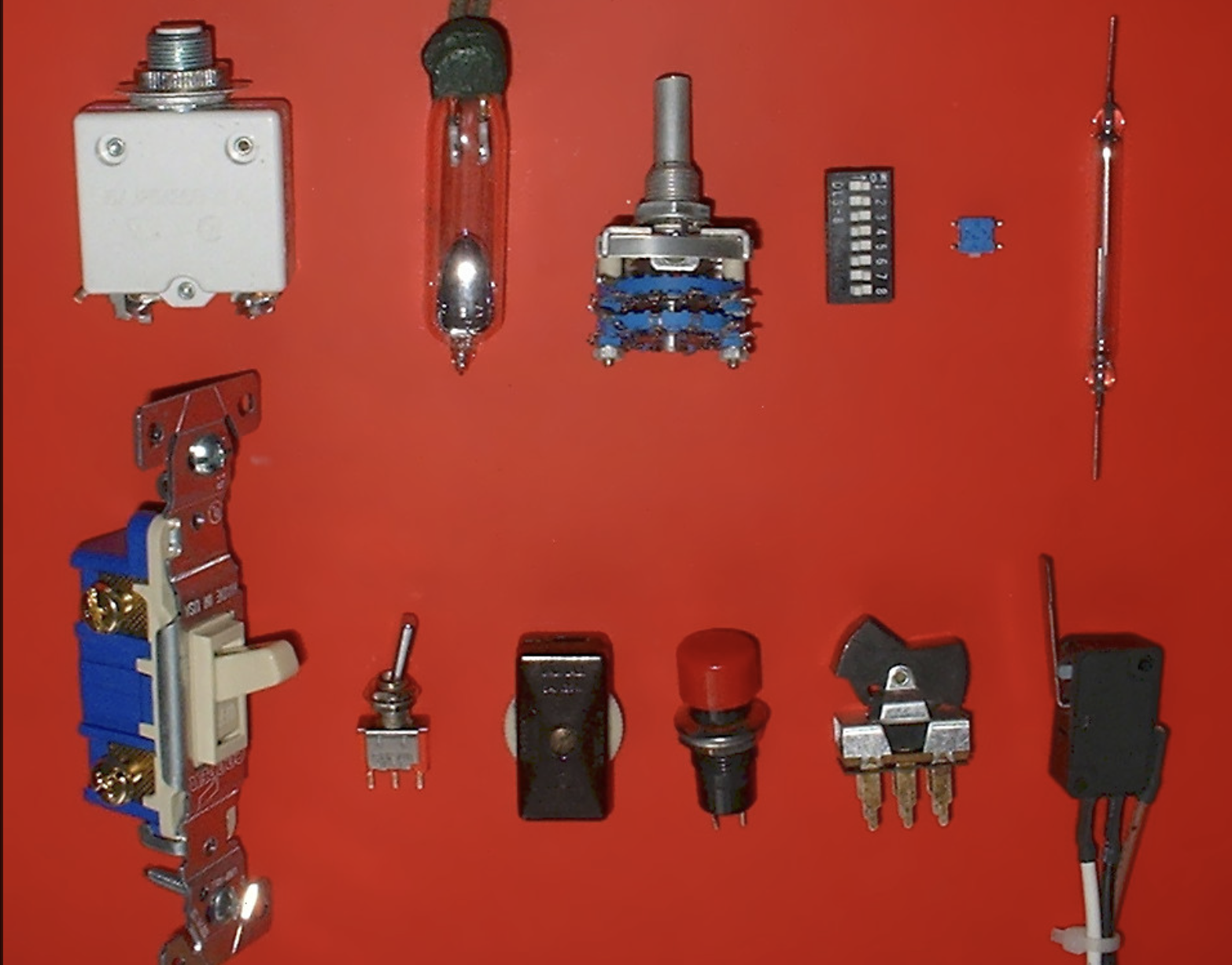
Switch: opens or closes a circuit, denoted by size, and polarity, like DPST (double pole, single throw)
Basic series circuit:
Battery-switch-resistor
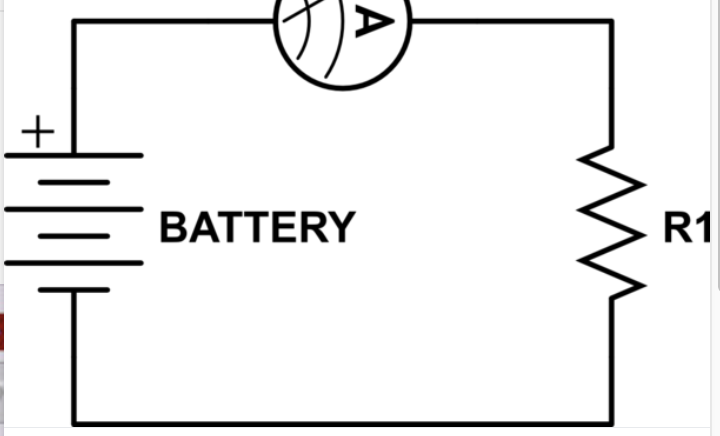
Voltage = current x resistance
Volts = Amps x Ohms
this is Ohm’s law
This circuit also creates heat, using a different formula:
Power = current^2 x resistance
Watts = Amps^2 x Ohms
this is Joule’s law
why? 1 Joule every second is one Watt
1 J/s = 1 W
Parallel circuits provide more than one path for current to flow.
Since flow can be divided, we have to invert Ohm’s law:
1/R = 1/R1 + 1/R2 + 1/R3
This comes from a really simple rule:
R = pL/A if you are interested
L is length
A is area
p is rho, the smoothness of the conductor
Why should you care?
- This is why the wires connecting your car battery are so thick (larger area, A)
- Also why power lines waste energy getting hot (long length, l)
---------------------
Basic battery and resistor circuits are fun, but radio is all about frequency.
Recall: Velocity = frequency x wavelength
Time is really important here, since period = 1/f
Capacitors store energy as an electric field
Inductors (coils) store energy as a magnetic field
Since radio is electromagnetic field:
Capacitors in parallel with Inductors resonate at only one frequency, trading electrical field energy and magnetic field energy
We use them to tune radios…
A “Tank” circuit is how we describe this, and it is the most simple radio:
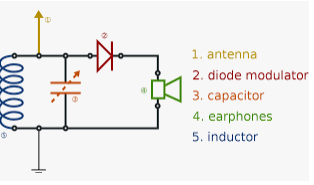
It is called a “tank” since it resembles a filled bathtub with water sloshing back and forth.
The water at the edges is the C part, the rushing water is the L part, back and forth…
You’ll notice the funny arrow with line thingy:
this is a diode, which functions like a heart valve:
current can only flow in the direction of the arrow, not backwards
Here’s why this is useful for AM radio:
AM radio is where we take voice waves and add them to a “carrier” wave, which then rises and falls with the waves of the voice.
If we only allow one direction to flow, we essentially take away the carrier, and the speaker will sound like the voice.
- AM radio means Amplitude Modulation
- FM radio is where we don’t mess with the amplitude, we use the voice to change the frequency of the carrier wave, so this is called "Frequency Modulation" or FM for short
An FM radio would look for the carrier, then subtract it from the radio signal, resulting in the voice information.
Who cares?
Noise can be seen as changes in amplitude, so AM is noisy
FM radio is therefore very quiet (think of your car radio)
Radio types:
HF, SSB: long range, larger antennas, lots of power, a version of AM radio
VHF/UHF: FM line of sight (you have to see each other)
simplex vs. duplex (radio to radio or radio-repeater-radio)
digital: HF, FM, DMR (radios + computers)
These are usually divided into distance needed to communicate:
HF can be around the planet, or bounced off of the atmosphere
VHF/UHF are generally line of sight
Part II: The Rules part:
As mentioned above, there are really two kinds of radio you could use in an emergency:
- VHF/UHF is short range, line of sight radio with small antennas and very high frequencies (see how frequency and wavelength determine antenna length?)
- HF is longer range, from hundreds of miles to around the planet, with longer antennas, higher power and bigger radios
FCC licenses are based on the range you could transmit, with the lowest level limited to VHF/UHF and the more advanced enabling longer range work, on more bands, with greater flexibility.
Why?
As you have the ability to impact more people, with great power comes great responsibility (credit to Spiderman).
There are three licenses that fit this idea:
- Technician class
- General class
- Advanced or Extra class
The test you would take for each one has increased technical skill required, but also more awareness of the rules.
Why?
If you are getting your driver’s license, you first have to be trained to NOT do things, like crossing double lines, hitting pedestrians and stopping for trains and school buses.
The FCC licenses administered by the ARRL (amateur radio relay league) follow similar requirements.
Technician class enables you to transmit short range, using VHF/UHF and some parts of the HF frequencies.
Recall: HF is longer range, with larger antennas, so lower frequencies.
Below is a colorful band chart, with T representing the technician licensed bands:
Download Band Chart.pdf (application/pdf, 187.5 KB)
Notice that the T bands are mostly to the right, the higher frequencies, with smaller hand held transmitters (HT) with small antennas and low power, from 5W-75W.
As you move up the license scheme, you are allowed more access, with more power, up to the maximum called the “legal limit” of 1500W, which is enough to reach anywhere on the planet, even bouncing radio waves off of the moon.
You can also get a nasty shock from antennas and equipment producing this much power, which we will cover in the safety part.
What’s also cool about this, is as you get more advanced licenses, you can talk with people who are more skilled and savvy about radios and communications.
For Emergency communications (EMCOMM) we usually need folks to communicate line of sight, or at the very most a few hundred miles, so the Technician license is enough for this basic purpose.
As folks get more into emergency response, they get certified with more advanced licenses, as well as special training for emergencies, like CERT (community emergency response teams).
If you see a disaster in the news, and see folks with special bright vests, these are often CERT members with special training to assist emergency personnel.
This could be you...
More about rules:
Every licensed operator has a call sign, like a phone number, that is shared with nobody on the planet.
Each country has certain designations, as do certain parts of each country, so VK may be one country, while KH may be another.
Here’s an example:
In the US, East of the Mississippi river, all radio and TV stations start with W
West of the Mississippi, they start with K.
In amateur radio, we followed a similar rule, until we ran out of letters and numbers, so we got creative:
WA6XY might be someone from the east coast.
KA6XYX might be someone from the west coast
AH6XY could be anywhere in the US
KH6HPA is a club station at HPA
KH6BI is the license for someone in Hawaii (me)
Notice how Hawaii folks have an H in their call sign, and notice that all callsigns start with a letter, a number, then more letters.
(fun fact: if you get an advanced license, you get to pick a two-letter callsign, sort of a badge of status)
You may notice that every commercial radio station has to announce their callsign every hour.
In amateur radio, you have to do this every 10 minutes, so others know who you are.
QRZ, QST, QRM…
Since radio was based on Morse code (invented by a guy named Morse), short abbreviations were created, like these:
Download Comm w Other Hams-Q Signals.pdf (application/pdf, 42.9 KB)
You’ll also notice the phonetic alphabet on the right.
This is internationally used, so that there is less confusion about letters, to KH6HPA would be
"Kilo hotel six, hotel papa alpha"
Sounds cool, right?
When you get your license, you’ll learn to repeat it in your sleep.
- Some amateurs or “hams” get creative where they really should not, so you might hear some guy AH6BY call himself “Alpha hotel six babbling yankee”
- This is a guy named Al who lives in Puna, part of our emergency network or “net” in Hawaii.
- The term “ham” comes from Morse code days as well, since someone who send code poorly was “ham-fisted”
- Hams have all sorts of slang terms for each other, like “lid” for a poor operator, “73” for goodbye, “XYL” for wife and “OM” for husband or “old man”.
- CQ is the international call sign for seeking contact, just like “mayday” is the international call for help (comes from the French: M’aider or “help me”)
- If you hear CQ DX this means calling all operators far away (DX means distance, just like WX means weather).
Radio operators aren’t just lazy, they come from a tradition where economy of communications was critical.
This is important in EMCOMM since you can’t just babble on in an emergency, you have to know the lingo, what needs to be said, to whom and how best to be clear.
You may also hear the term CW, which stands for continuous wave, or a fancy term for Morse code.
This used to be a requirement for the FCC license but it has since moved into a specialty realm with some hams getting deep into contests where they reach as many CW operators as they can.
More about rules can be found here:
- You touch the antenna when you are transmitting. This would be hard, unless you are working with others and they operate the transmitter when you are touching the antenna or cables connecting your radio to the antenna (called feedlines or coax, depending on the type).
- Your antenna touches something electrified, which could be a power line, or in rare cases, gets struck by lightning. While these are rare, you should always keep in mind that all antennas are made of conducting wire, so anything it touches while you are touching it could go through you to get to the ground. Since antennas can be long and exposed, be careful when around power lines, working on antennas, or during lighting storms.
Migrated from Apple Server Wiki. Original page ID: f6k3A2F3