
2022 summary
apes D T Th
- summarize your cause and effect projects for presentation in day 2 of the week
- begin exploration of cause and effect
- begin readings from fr text chapter 1 (link below)
energy->water->food->culture
- With energy you can move/purify water
- With water you can grow food
- With food you can maintain a culture
What is the "environment"?
- Front of ship fell off-https://www.youtube.com/watch?v=3m5qxZm_JqM
- "we towed it out into the environment"..."you mean into another environment"
Environment: Everything around us, including us
Climate change map-try this out:
Nebraska->Alberta by 2050
Module 1 -------------
Fracking-know what it is? Why is it controversial? How has it changed how we generate electricity in our country? At what cost? Why is this politically important? Why are the solvents they use secret? What is the impact of these solvents on water?
Bio=life, so biotic means living, abiotic means not living (druids had a neat view on this)
How systems are defined enables us to create models of cause and effect (favorite topic of physicists and historians as well)
Module 2 ---------------
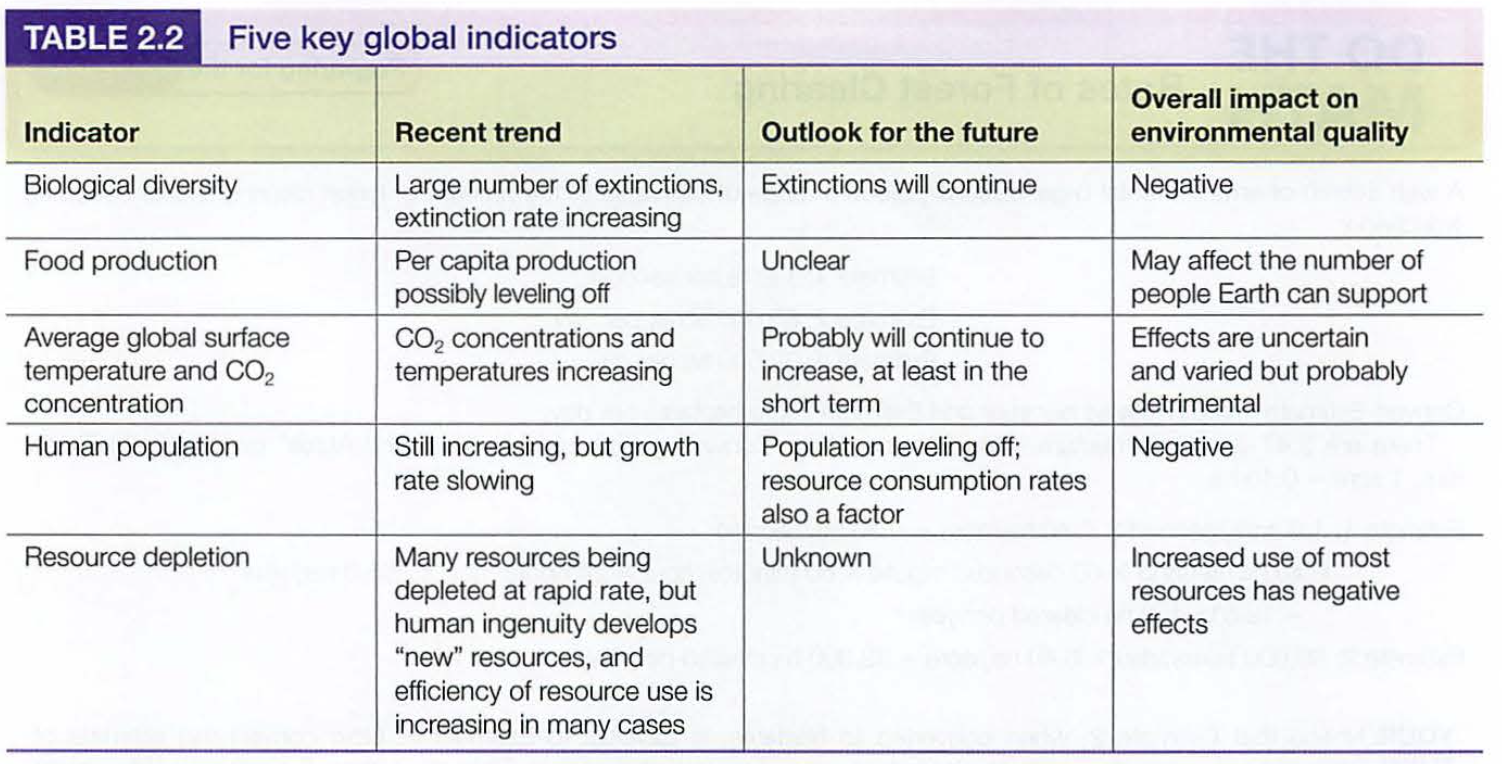
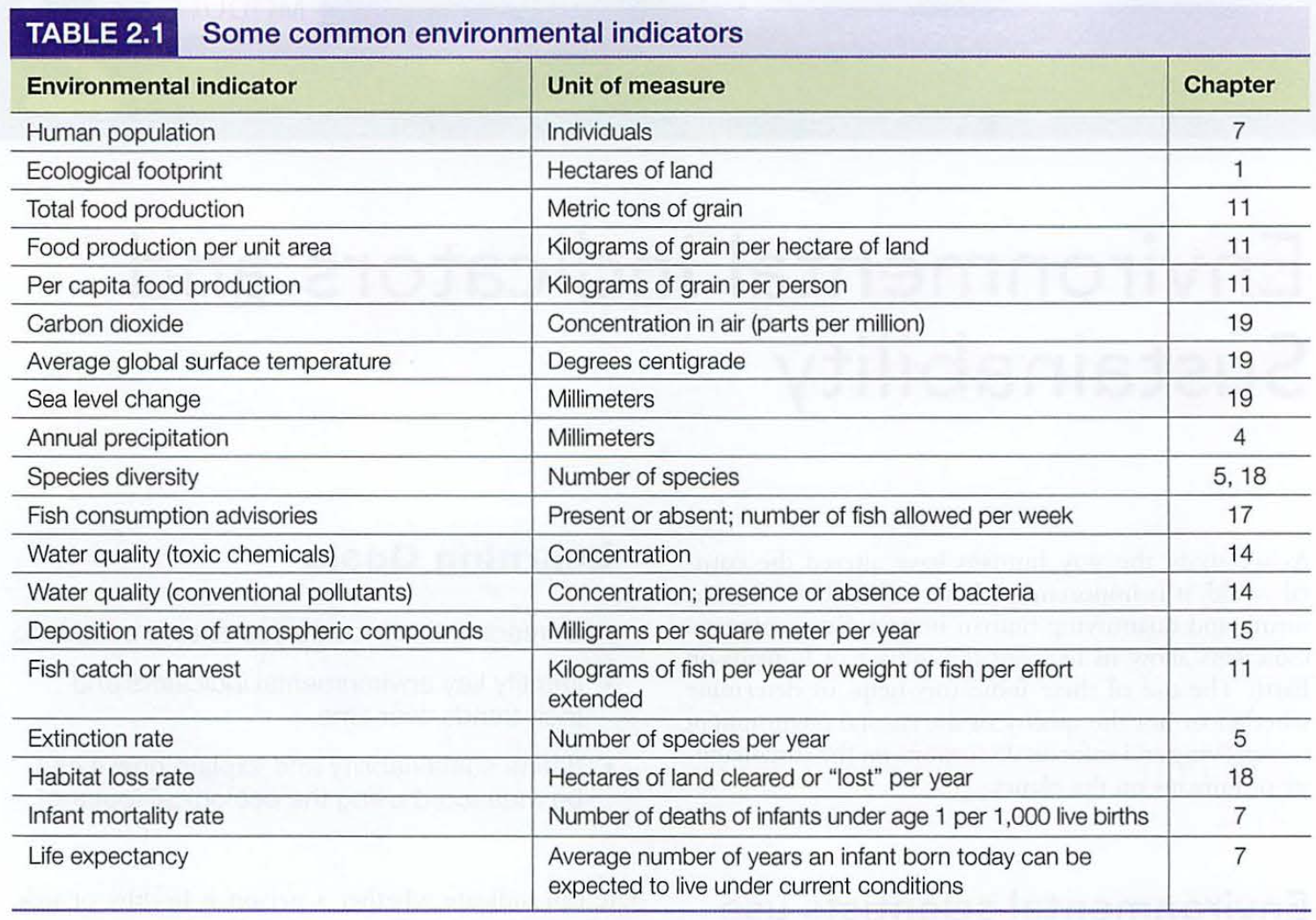
Environmental indicators: what we know and can observe that indicate the condition of a system
- Biodiversity
- Food production
- Global warming
- Human Population
- Resource depletion
Ecosystem services: can be economic, direct or cascading (fishing in the Gulf of Mexico impacted by offshore oil spills)
1. Biodiversity: biological diversity (more about this later)
- Robust systems (can be biological, racial, technological) all have strong diversity
- Genetic Diversity: genetic variation within a population (corn for example)
- Species: ducks vs. dogs
- Species diversity: variation of species in an ecosystem
- Speciation (more) vs. extinction (less)
- Background speciation rate (cosmic rays)
- Background extinction rate (before humans, much higher in the anthropocene era)
Evolution needs three things:
- some form of genetic variation
- some stress that favors this variation
- survivors have to reproduce and carry on the variation
- longer necks in some animals
- drought that kills all short neck creatures (just like in land before time)
- long neck animals survive to reproduce and carry on the variation
- There is a theory that the background rate of mutation/speciation was much higher long ago because our atmosphere was thinner, and enabled more cosmic rays to penetrate, causing much higher rates of mutation/speciation.
- In England, butterflies have adapted since 1850 to look more like soot from coal fires.
- In NYC, a species of "subway mosquitoes" have been found that feed on humans in a dark, cool place
- Huh.
Extinction is the opposite of speciation, where species die off (except in the film Jurassic Park)
There is such a thing as a "background rate of extinction", which we have surpassed by many times
Diversity is good: think of monoculture food crops: one pest kills everything
- grain variation and monoculture
- regional grain production (e.g. Pearl river delta)
- vegetarian vs. carnivores
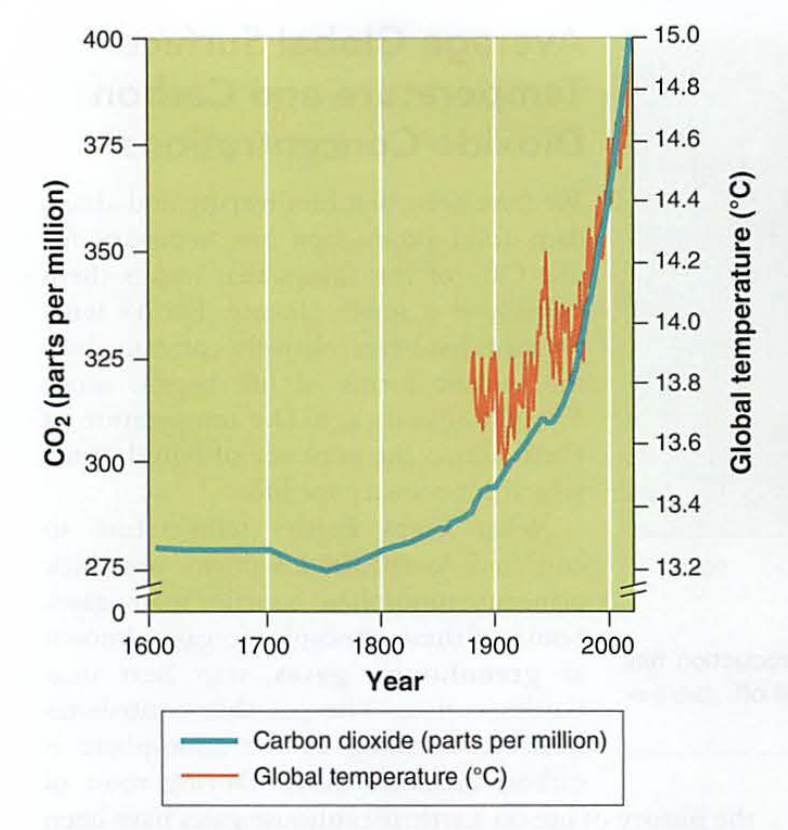
3. Global Warming
Man made, from burning fossil fuels (anything that was living, decayed capturing atmospheric carbon)
carbon dioxide was in the air, then captured as plants and animals
we burn their carbon with oxygen to make carbon dioxide
greenhouse gases: trap infrared radiation, warming the planet (cause and effect)
Not too many people know we need some CO2 to keep water above freezing-think of this as we search for exoplanets...
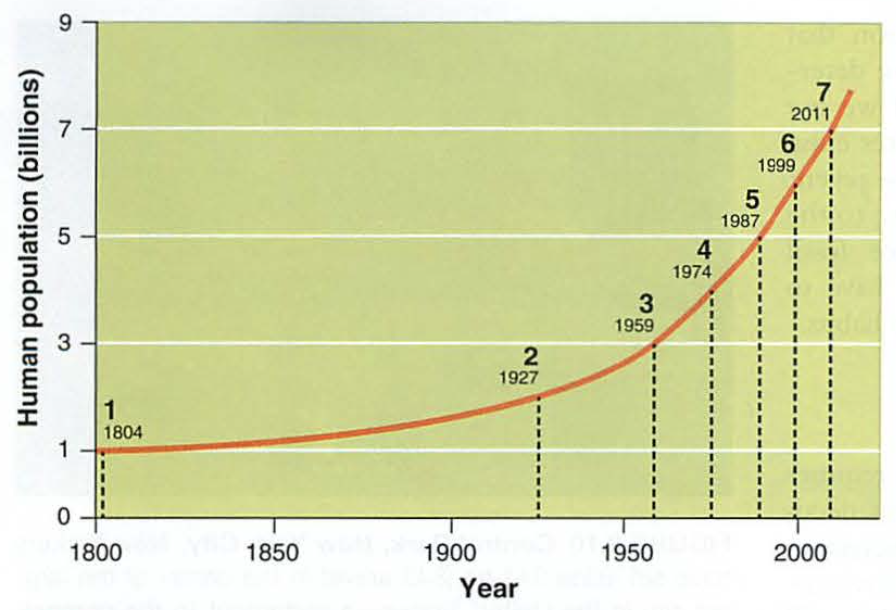
4. Human population
- growth rates
- dispersion
- access to water
- Why was China’s one child policy eventually a problem for China?
- education, reproductive rights and religion
- water is first
- Resource depletion is hard to grasp, but resource constraints are easier:
- If we had a major tsunami here that closed airports (all near the shore) and ports, how long would we have electricity?
- water? (pumped by electricity)
- food?
Sustainability: ability to sustain present conditions forever (not likely)
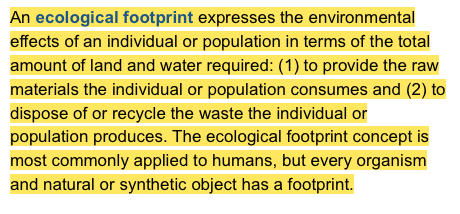
Ecological footprint: what you calculated
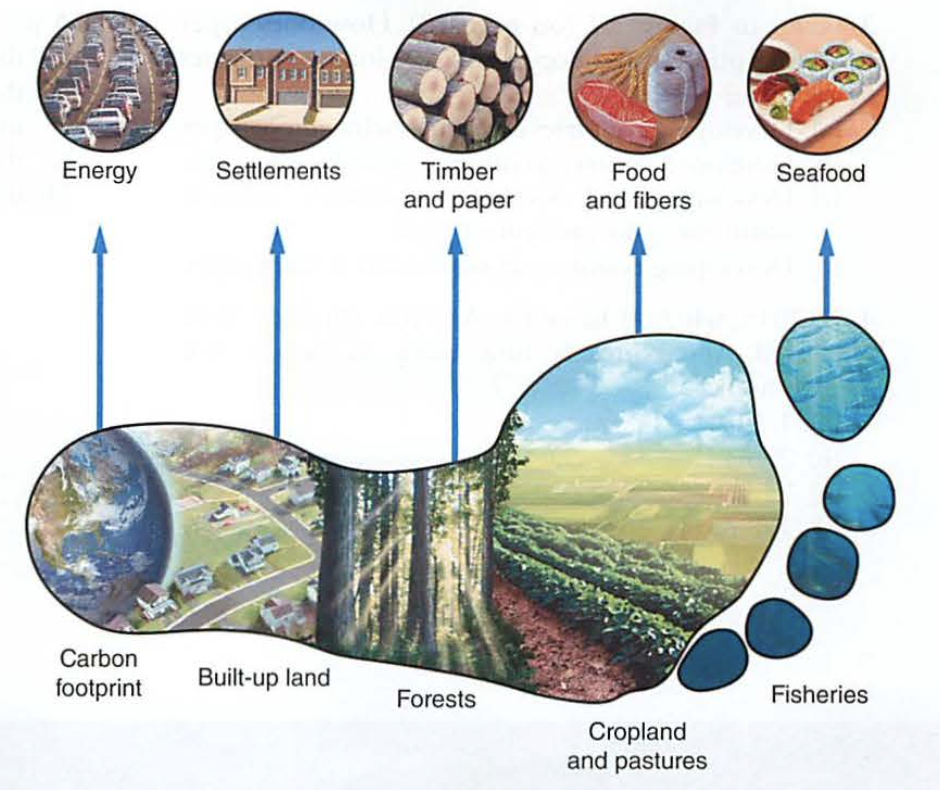
- Can you follow cause and effect?
- What is their logical path?
- Why do folks associate fossil fuels with global heating?
- Who might be against this line of reasoning and why?
- Fact: in ancient times, women were thrown into ponds to determine if they were witches. If the water "rejected them" they were possessed by the devil and therefore witches. If not, they just drowned. It is a wonder we made it this far.
- Another example: cold fusion (look this up) Ponds and Fleishmann claimed they could replicate the processes in the sun (1 million degrees C) in a cooler on a table.
- Science is built on replication: if a process cannot be replicated, it cannot become part of the scientific "pyramid" of understanding. No bad blocks allowed.
- Also key is taking notes (must be in pen, not pencil). Alfred Nobel invented dynamite. His brother's last words in his lab notebook, in pen were "I'm now going to compress the dynamite"
- Why is there no Nobel prize for Mathematics?
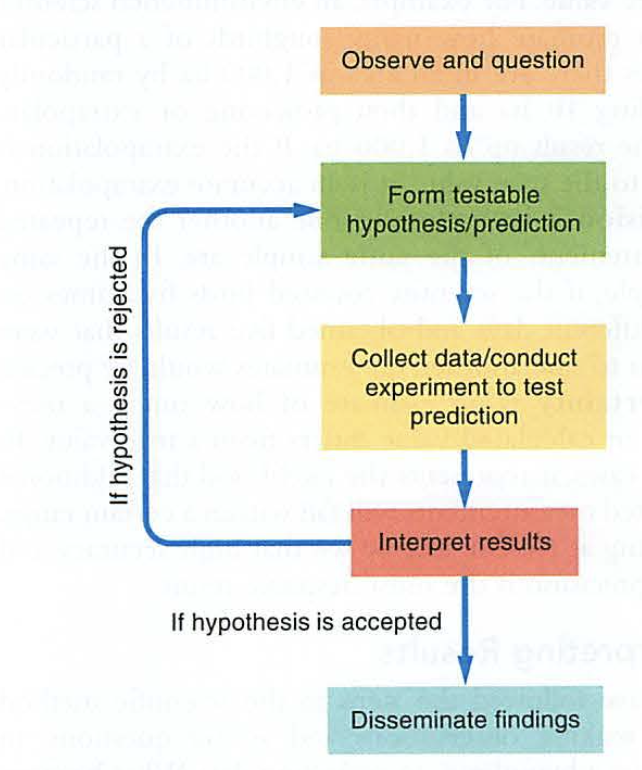
See also Korean claims of cloning humans (not sheep, we already did that-her name was Dolly)
Key idea: even wrong experiments are valuable: Edison: "I learned 800 ways not to make a light bulb"
- Variable: any difference, in a planned or "natural" experiment
- Independent variable: the part that does not change (like x in a graph)
- Dependent variable: the part that changes-or not
- Null hypothesis: proving something is NOT cause and effect (can sheep's bladders be used to predict earthquakes)
- Replication: everybody must be able to get the same results, using the same materials
- Sample size (n): must be large enough to be accurate
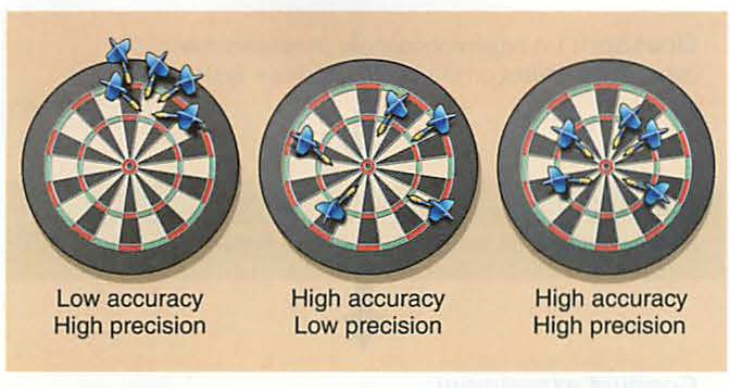
- Accuracy: close to truth or true value
- Precision: how close your results are to each other (gas pump is in 0.01liters, but your odometer is only in miles)
- Control group: those you DON'T mess with in the experiment (think of some drug test)
Natural experiment: variation not planned (Lahaina, COVID, Mount Pinatubo and cooling of the planet, etc.)
Frog book (iPad) chapter one:
Renewable vs. non-renewable resources (one politician recently tried to get nuclear energy classified as a renewable resource-it takes billions of years)
Renewable can be a forest, if used at a sustainable rate, otherwise not
Malthus again, Norman Borlaug again, and a new name: Paul Erlich (1968) "The Population Bomb"
In short: famine and conflict will arise from population growth.
In reality, it is much more complex, involving politics (e.g. Syria), economics (e.g. refugees from sub-Saharan Africa) and water rights (e.g. Palestine).
Jurgen Randers told me during the Elab opening that he thought in the next 50 years, China would invade Mongolia to the north, stating as a cause "religious instability" but the real cause would be access to water there.
If the Himalayan snowpack ceases to be a seasonal flow for the rivers of Asia, most of Western China would be in a drought, unable to produce food.
Ecological Footprint again:
Tragedy of the Commons:
Garrett Hardin, UCSB (look this up)
We will duplicate this with a fishing example:
- review iPad frog book
- review chapter 1 work
- move on to chapter 2 in FR3e
- begin quiz format
- Can you follow cause and effect?
- What is their logical path?
- Why do folks associate fossil fuels with global heating?
- Who might be against this line of reasoning and why?
- Fact: in ancient times, women were thrown into ponds to determine if they were witches. If the water "rejected them" they were possessed by the devil and therefore witches. If not, they just drowned. It is a wonder we made it this far.
- Another example: cold fusion (look this up) Pons and Fleishmann claimed they could replicate the processes in the sun (1 million degrees C) in a cooler on a table. Totally fake
- Science is built on replication: if a process cannot be replicated, it cannot become part of the scientific "pyramid" of understanding. No bad blocks allowed.
- Also key is taking notes (must be in pen, not pencil). Alfred Nobel invented dynamite. His brother's last words in his lab notebook, in pen were "I'm now going to compress the dynamite".
- Why is there no Nobel prize for Mathematics?
- if you have magic beans, and nobody can replicate your results, you are in trouble.
- See also Korean claims of cloning humans (not sheep, we already did that-her name was Dolly)
- Key idea: even wrong experiments are valuable: Edison: "I learned 800 ways not to make a light bulb"
- Variable: any difference, in a planned or "natural" experiment
- Independent variable: the part that does not change (like x in a graph)
- Dependent variable: the part that changes-or not
- Null hypothesis: proving something is NOT cause and effect (can sheep's bladders be used to predict earthquakes)
- Replication: everybody must be able to get the same results, using the same materials
- Sample size (n): must be large enough to be accurate
- Accuracy: close to truth or true value
- Precision: how close your results are to each other (gas pump is in 0.01liters, but your odometer is only in miles)
- Control group: those you DON'T mess with in the experiment (think of some drug test)
Natural experiment: variation not planned (Lahaina, COVID, Mount Pinatubo and cooling of the planet, etc.)
Frog book (iPad) chapter one: for reading over the weekend...
- Ozone hole example: compare and contrast with anthropogenic climate change-why different?
- Renewable vs. non-renewable resources (one politician recently tried to get nuclear energy classified as a renewable resource-it takes billions of years)
- Renewable can be a forest, if used at a sustainable rate, otherwise not
- Malthus again, Norman Borlaug again, and a new name: Paul Erlich (1968) "The Population Bomb"
- In short: famine and conflict will arise from population growth.
- In reality, it is much more complex, involving politics (e.g. Syria), economics (e.g. refugees from sub-Saharan Africa) and water rights (e.g. Palestine).
- JØrgen Randers told me during the Elab opening that he thought in the next 50 years, China would invade Mongolia to the north, stating as a cause "religious instability" but the real cause would be access to water there.
- He wrote Limits to Growth, along with Mathis Wackernagel, who created your 8 countries project for HPA.
- If the Himalayan snowpack ceases to be a seasonal flow for the rivers of Asia, most of Western China would be in a drought, unable to produce food.
Ecological Footprint again:
Main topics:
- elements: protons, neutrons, electrons
- atomic mass, isotopes
- isotopes vs. ions
- bonds: ionic and covalent
- periodic table: columns
- half lives
- pH and pOH
- melting and boiling points
- surface tension: adhesion and cohesion
- organic vs. inorganic substances
- proteins, fats, carbohydrates
- atom: one nucleus with protons and neutrons, electrons around the nucleus
- element: one type of atom, defined by the number of protons
- protons: positive charge, give the atom identity
- neutrons: neutral charge, gives the atom more mass
- electrons: much smaller (1/1800), negative charge, gives the atom charge
Carbon: C, 6 protons, 6 neutrons, 6 electrons
Each of these has the same number of protons (identity) but more neutrons
check: how many protons, neutrons and electrons in C14/6?
If you change the number of electrons from a match with protons (C6/12 has 6 electrons), we can add or take away electrons:
Na+ is Sodium missing an electron
Cl- is Chlorine with an extra electron
Why?
To get there, Na loses an electron to look like Neon, while Chlorine adds an electron to look like Argon (see for yourself)
- Ionic bonds have high melting points
- They conduct electricity, especially in water
In a covalent bond, neither one is more positive or negative, they share an electron.
Molecular Hydrogen (H2) and Molecular oxygen (O2) are good examples
so are plastics, water and other substances
Covalent bonds:
- Weak bonds
- Don't conduct electricity as well as ionic solutions
- low melting points (water, plastic, butter)
Look at the periodic table, find Strontium.
What is above it?
Calcium is part of your bones, so when you ingest Sr90/38, it is absorbed into your bones just like Calcium, since elements in the same column are chemically similar.
What sort of cancer would this cause?
Question: Cesium is a radioactive element, where would it go in your body?
A half life is the amount of time it takes something radioactive to decay into half of the amount it was before.
So, If you have 128 grams of Strontium 90/38, which has a half life of about 30 years, after 30 years you will have:
64 grams
Then 30 years later it will be all gone, right?
Nope: 32 grams
Then continue: 16, 8,4,2...
It never really goes completely away
We demonstrated this with M&Ms in class, and you saw an exponential decay graph
Why do we want to know how this works?
Easy: nuclear waste, radioactive fallout, caffeine and other drugs all follow exponential decay.
So, to find out how much is left of something, you can count the half-lives and divide each one by two over and over again:
1/2->1/4->1/8->1/16
You may also see this as percentages:
50%->25%->12.5%->6.25%
There is a simple formula for this if you want to use it:
Amount left = Amount starting (1/2)^n
At = Ao (1/2)^n. or At = Ao/2^n
where n is the number of half lives.
How much of a 200 gram sample will be left after 22,000 years?
Divide 22,000 by 5730, you get about 4
(1/2)^4 is 1/16, or 6.25% whichever you like using more
200 grams/16 = 12.5 grams left
This also works if you have something in between half lives, like if you repeated this problem for 18,000 years:
18,000/5730 = 3.14
(1/2)^3.14 = 1/8.8 or 0.113
0.113 * 200 = 2.26 grams left
In some rare cases, you will be see this situation in reverse:
The half life for Sr90/38 is about 30 years.
If 25 grams of a 100 gram sample remains, how old is it?
25/100 is about 1/4, 4 = 2^2 so two half lives, or 60 years.
- Alpha rays are Helium nuclei, +2 charge, very heavy, very slow, and can be stopped by skin or paper
- Beta rays are fast electrons, -1 charge, fast, light, and can be stopped by metal foil
- Gamma rays are light photons, no charge, can be stopped by lead
- Neutrons are fast neutrons, no charge, can be only stopped by lots of concrete or lead (slow ones are called "thermal" neutrons and are useful in nuclear power plants to make steam)
No problem if the gas is outside your body, your skin protects you.
If you breathe radon gas, is sits in the bottom of your lungs and alpha rays destroy your white blood cells: leukemia and other lung cancers result
Gamma rays split DNA and cause mutations, some cause cancer.
Neutron radiation dissolves membranes in animals, killing them in nasty ways...
In each of these cases, radiation is harmful, it depends on where you are exposed, for how long, and what protection you use.
Radon is the #2 cause of lung cancer in the US (!!!)
Be aware of this if your dorm room in college (or anywhere) is in the basement, and you are near the Rocky mountains.
Acids have more Hydrogen ions (H+) floating around
Bases have more hydroxide (OH-) ions floating around
Water is amphoteric (both) since it is really H-OH
Water has pH (potency of Hydrogen) of 7, in between 0 (acid) and 14 (totally base, dude)
First look at most solutions is a good guess:
NaOH base
HCl acid
See?
You try: KOH, HNO3, H2SO4, H3PO4
Which were acids and bases?
Clue: anything with an H alone is usually an acid, anything with an OH is usually a base
Exceptions: alcohols (see below) have an OH, but are not basic, they are organic compounds
Simply take the minus sign off the exponent and you have your answer: pH = 4
Another version of this would be:
How much stronger is an acid with pH 4 than pH 6?
This is a bit trickier: since each power of ten is one pH number, 10^2 is 100, so the answer is 100.
Try this: How much more acidic is water than NaOH solution with pH 12?
Since water is pH 7, 12-7 = 5, so 10^5 is 10,000x stronger.
Weird to think of water as an acid, but there it is.
You may also see something like "what is the pOH of something with a pH of 4?"
The answer is: pOH is just 14-pH, to the answer is 10.
There is a scary looking formula for pH:
pH = -log10[H+]
not so scary: all it says is take the log to the base 10 (usually the same as the power) and throw away the minus sign
Like in radioactive decay, you may see something that is not in the form 1 ee-4, in other words, the 1 may not be a 1.
In that case, you just use the scary formula...
As gases get cooler, they can hold less water, that's when it rains or condenses.
You know this: cool drinks form beads of water on the outside, since the drinks are cooler than the air.
It also means that warmer air can hold more water
Remember this: gases hold more water when warmer
This also explains why you may get a shock in cooler climates walking across a carpet: dry air is a better insulator, so can build up an electrical charge better.
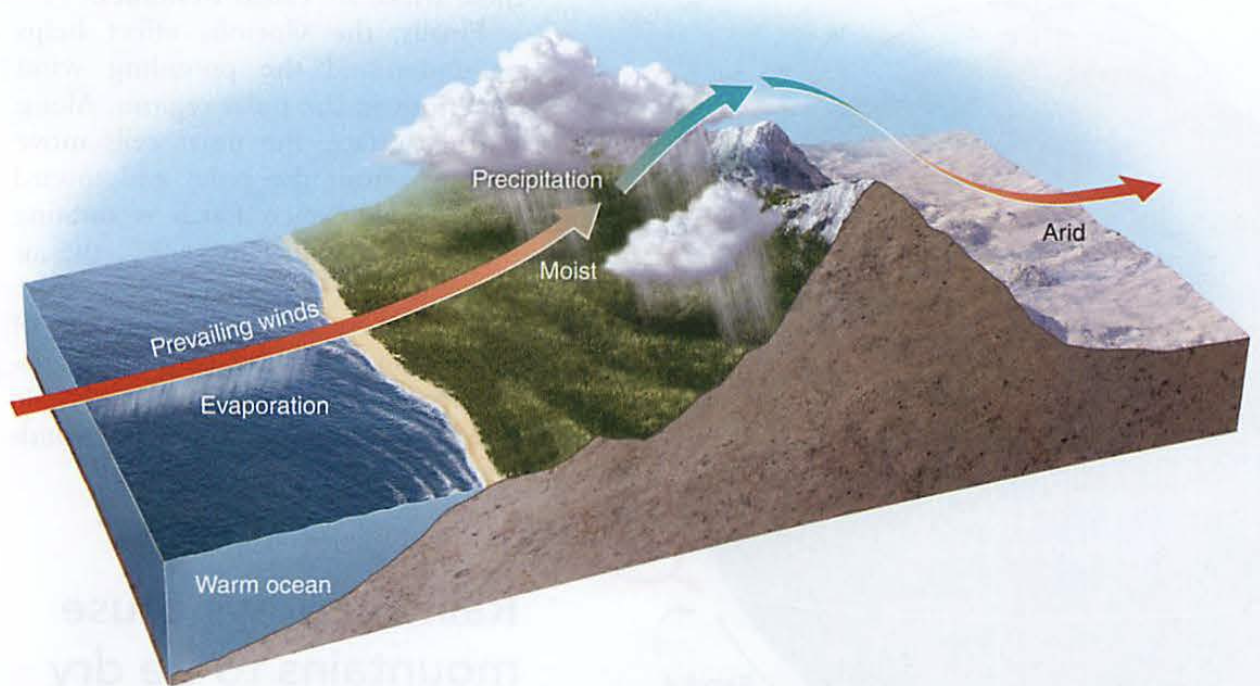
It also explains why it rains on the windward side of mountains: as the moist air rises, it gets cooler, and cooler air can hold less water.
It also explains why air coming in from the ocean is more humid: it has been warmed by the ocean.
Gases dissolve better in cooler water. Fishing folks know this, and go where the water is cooler, since fish breathe better there.
It also explains why the British are so nuts about when they boil water for tea: if you boil it too long it has no oxygen in it, and it tastes "flat".
You also know this that soda drinks lose their fizziness if you warm them up.
This is very important when we study dead zones and fish kills...
It also explains why you don't ever need to get ice in your carbonated drinks: to get the carbon dioxide to dissolve into the drinks they MUST cool the drinks down to inject the CO2.
This makes for interesting phenomena when the sides of a container are very close, like in roots or thin hair:
As the water molecules climb up the sides of the roots (adhesion) they stretch out the molecules in the middle (cohesion).
This is called surface tension
This make the curve stretch and then shorten, so water moves up the column (roots, long hair).
This is called capillary action, and is very important for all plants.
Surface tension is also how water striders "sit" on the water: their feet stretch the water molecules.
Soaps destroy the cohesion, making water "wetter", also making little bugs fall into the water...
All plants rely on capillary action to bring water to their leaves, so it is not a good idea to drop soap on the roots of plants.
Think of roots: many thin fibers next to each other-perfect for capillary action.
The melting and freezing point for water is 0°C at one atmosphere (very interesting stuff happens at other pressures, like ice hockey)
The boiling and condensation point for water at one atmosphere is 100°C (again, interesting things happen at other pressures like pressure cookers and freeze dried ice cream)
It turns out that anything added to water raises the melting and boiling points.
You may have heard to add salt when cooking pasta: this raises the boiling point a bit so the pasta cooks a bit faster.
It also explains why they add salt to ice to make ice cream, or pour salt on road to melt ice...
You can demonstrate changing pressure on melting by slowly chewing on an ice cube: pressure makes ice melt (ice hockey skates)
This also means that water boils at a lower temperature if there is less pressure, like on a mountain, or even here in Waimea, since we are at 800 meters elevation (about 3000')
Pressure melting of ice is how ice skaters move, if you look at their skates end-on, you will see an upside down U shape that traps the melted water from their weight pressing on the ice.
Heavier ice hockey players can use a thicker skate...
It also means that if the ice is too cold, this does not happen (ask Mr. McKenna about this where he skated in Canada)
Osmosis in simple form means that water always chases salt or other "solute"
When a solute like salt dissolves in a solution like water, it becomes salty.
If a membrane like skin or cell walls separate this salty solution from fresher water, the water will travel through the membrane to get to the salty solution.
Good use of this: if you have an injury with swelling, doctors may say "soak it in warm, salty water".
This draws the fluid from the injury, enabling healing.
Bad use of this: if you pee on plants, the Nitrogen in urine helps plants grow, but the salt in urine pulls water from the roots, killing the plant.
This also happens in areas where well water is used to irrigate crops: the minerals (salts) in the water accumulate in the soil, killing the roots of the plant.
EVEN MORE SCARY: As ocean levels rise, salty ocean water is penetrating into the water table in many fertile areas like the Mississippi delta, Florida and the Pearl river delta in Asia, killing crops. The Pearl river delta is where most of the rice for all of Asia is grown...
Anything without carbon is called inorganic, like salts, metals and minerals
These could be anything from the foods you eat (more on this later) to the gasoline you might put into your car.
Organic compounds can be water soluble, or not.
Hydrocarbons like gasoline and oil have only C-H bonds, so are insoluble in water (like greasy hands, or olive oil in salad dressing)
Alcohols are organic compounds with an OH molecule attached, so they can dissolve oils while also dissolving in water.
Some important alcohols:
- methanol CH3OH (toxic)
- ethanol C2H5OH (makes you drunk)
- propanol (C3H7OH) known as rubbing alcohol
Oddly, though, even your awesome body cannot repair tissues or grow new ones without proteins
Why?
Proteins are the only food source with Nitrogen, which is key to amino acids (amines means Nitrogen)
Proteins can be used as fuel for your body by "de-amination" meaning taking off the nitrogen
Fats and carbohydrates have similar chemical formula, but vastly different structures.
Fats all have an alcohol backbone, with little strands coming off made of C-H bonds (like a hydrocarbon)
This is why most fats do not mix with water...
Carbohydrates are C-H-O bonds (anything that ends in -ate means with oxygen)
Carbs can be long strings, like starches, or compact little hexagons or pentagons like sugars
Fun fact: sugar alcohols look like sugar to your body, but don't behave like sugars-used in drinks and candies...
Module 5 Energy flows, feedback
- energy terms: cal, kcal, Joule, kWh, BTU
- power terms: Watt, J/s, hp
- EM spectrum
- KE= 1/2mv^2 or 3/2kT
- PE = bonds or mgh
- ICE vs. hybrid vs. electric cars
- thermo 1: conservation
- thermo 2: efficiency
- thermo 3: entropy
- open and closed systems
- equilibrium, stability and steady states
- positive feedback loops
- negative feedback loops
Energy terms:
Energy is the ability to do work
You may have seen this in other science courses as force x distance, PE=mgh, or other descriptions
We use the following units for energy:
- calories: the energy used to heat 1 gram of water 1 degree C
- kcal: one thousand calories
- Cal: a single food calorie, equal to 1000 chemical calories
- Joule: the work needed to move something 1 meter against a 1 Newton force (note caps for dead people)
- 1 cal = 4.18 Joules (good to know)
- kWh = one kiloWatt of power used for 1 hour (heating tea for an hour, costs about $0.45 here)
- BTU: British thermal unit, most often seen in heating, ventilation and cooling (HVAC) systems
Power:
- Energy is the ability to do work, or to measure work that is done.
- Power is how FAST that work was done, measured in Watts (note caps again, another dead person)
- You could walk up a flight of stairs, doing some amount of work:
- 50 kg person, 10 m stairs, g = 10, equals 5000 Joules
- If you do this in 100 seconds, you have done this with 50 Watts of power
- If you did it in 10 seconds, you would be creating 500 Watts of power (that's a lot)
- 1 horsepower (hp) is 747 Watts
- Fun fact: some elite cyclists can create over 1000 Watts for many minutes-true animals
- Another fun fact: the electric company does not care how fast you use energy (kiloWatts), they only care how many hours you used this power (kWh)
Electromagnetic spectrum:
Spectrum means a spread of values, so a musical spectrum might mean the lowest and highest notes you could sing or hear.
The electromagnetic (EM) spectrum describes EM radiation, that includes in order of increasing energy:
- radio waves: (radios use these)
- heat (IR or infrared): snakes can see these
- visible light: you can see these
- UV (ultraviolet) light: bees can see these, they also burn your skin
- X-rays: film can see these, they go through your skin, but less so through your bones
- gamma rays: go through most stuff (remember?), mutate DNA
- and cosmic rays: mysterious stuff, comes from supernova explosions...
The visible spectrum includes the following colors, in order of energy:
- red
- orange
- yellow
- green
- blue
- indigo
- violet
You can now see why infrared is below red, and ultraviolet is above violet
Plant pigments have evolved to resonate with certain colors, like chlorophyll likes green light, others like reds and so on.
Fun fact: autumn leaves are red because the green is gone (winter, darker). The red was there all along.
Kinetic energy:
- When you ask a physicist (I am one, so I know) about Kinetic energy, they will drone on about moving objects, their mass and velocity...
- KE = 1/2mv^2
- This is incredibly fascinating you will agree (?) and it explains why car crashes at 80 mph are 4x more damaging than ones at 40 mph...
- In chemistry, we use KE to describe the energy of moving molecules: KE = 3/2kT, where T is the absolute temperature (Kelvin)
- This means that if you double the Kelvin temperature, you double the KE of a molecule.
- This changes for different molecule shapes (3 comes from x, y, z motion), which you may find interesting if you study physical chemistry (ask Dr. J)
- For our purposes, we need to know that increasing temperature increases the speed of molecules:
- 3/2kT = 1/2mv^2
- So, those physics guys were not crazy.
- This has huge implications on climate change, phase changes, rain, condensation, and many other things.
Potential energy:
- If you ask a physicist (what, again?) about potential energy, they will blather on about mass, gravity and height.
- While scintillating, this is useless in most chemical equations, which tend to happen at the same height.
- It does, however impact some weather phenomena, so let's let them have this one.
- If you ask a chemist about PE, they will often refer to chemical bonds, which represent energy stored.
- If you ask a nutritionist about PE, they will talk about Caloric content.
- If you ask a coach about PE, they will tell you about the untapped potential of an athlete...
- In APES, we mainly care about stored energy, usually in a phase change (latent heat of vaporization) or chemical bonds like in food.
ICE, hybrid and electric cars:
- ICE stands for internal combustion engine (e.g. normal cars, lots of heat, hot brakes etc.)
- hybrid cars capture the KE of motion and store it in batteries to accelerate the car, saving energy
- electric cars do this as well, but have no thermal engine parts like ICE or hybrid cars, so they are much more efficient
Thermodynamics: one two and three
Thermodynamics is the study of heat (thermo) in motion (dynamics)
There are three big laws of thermodynamics:
- you cannot create or destroy energy (you can't do this with mass either, more on this later)
- in any reaction, there is an energy "tax" you could think of as friction
- all reactions go naturally towards disorder
1. you can't win
2. you can't break even
3. you can't get out of the game
You can imagine a magical car that you put 1000J of energy in the tank and 2000J of work is done by the engine.
No
Way.
The most efficient Formula one racing car engine is about 45% efficient.
Where does the rest go?
Heat.
Your body is at most 33% efficient in turning M&Ms into work. The rest?
Heat.
One way of looking at disorder is entropy, a measure of disorder.
You can imagine a pool table, hitting the triangle of balls and then spreading across the table.
It is more likely to go in this direction (more disorder) than to have the balls spontaneously jump out of the pockets and form a perfect triangle.
Not to get depressing, but there is a formula that goes like this:
∆S for the universe is >0
so sad...
Open and closed systems:
This means different things to different folks, but you could imagine a system where mass and energy are contained in the system as closed.
You might also look at a system where certain nutrients are recycled as closed.
You could look at recycling paper as a closed system to a degree.
Most of our product cycles are open: we throw stuff away instead of recycling.
Much more on this later...
Equilibrium, stability and steady states:
Equilibrium means literally "equal freedom" , in this case equal freedom to move from one condition to another.
Imagine two fish tanks with a pipe connecting them.
Fish are free to move from one to the other.
Not the same fish, but about the same fish on each side.
This is equilibrium.
Stable systems are ones where equilibrium exists, and can recover from stresses (resilience)
Steady state systems are ones where the inputs equal the outputs, and are usually stable as well.
Unstable systems have nasty feedback loops (see below)
Positive feedback loops:
In a positive feedback loop, any change causes a greater change as a result
Boat example: if a large cruise ship tilts over, the mass of the people on the ship make the ship want to tilt more.
Climate change example: as the planet warms, ice sheets melt, changing from reflective ice to darker ocean water that absorbs more heat, melting more ice.
Permafrost example: as the planet warms, the permafrost melts, releasing methane gas, which is a greenhouse gas, causing more warming, and more methane...
Positive feedback loops exist in your body as well: massive blood loss and childbirth are two examples.
Negative feedback loops:
Where positive feedback tends towards instability, negative feedback loops restore stability, and naturally recover to initial conditions.
As you exercise, your body sweats, cooling the body.
This is a negative feedback loop.
Some coast guard rescue boats are created with negative feedback as well: the more they tip over, the more they want to come back to normal.
Psychologists often use these terms to describe personalities and relationships...
Modules 9-11: Heat Energy: air and water
(fun with globes)
Modules 9-11 FR 3e (also module 22 in FR 4e)
Heat
Heat energy always moves from hot to cold (high energy to lower energy)
Heat energy moves in three "modes":
- conduction: from the latin word for "contact", objects touching
- convection: matter in motion, like hot air or steam rising
- radiation: infrared radiation below visible light on the spectrum
Conduction:
Materials can be excellent conductors of heat like silver, aluminum, copper and gold
Fun fact: Materials that are good conductors of heat are also good conductors of electricity
Insulators are materials that do not conduct well: styrofoam, pink panther insulation, cloth, rubber
Think of this: to pick up something very hot, what would you hold it with?
Convection:
Hotter fluids are less dense than cooler ones, causing upward migration of hot material
Fun fact: everything in zero gravity needs a fan to cool (why?)
Convection can be blocked by covering hot objects, like the cover on your coffee or pot on the stove
You may have seen strange mirage like waves over something hot: this is convection of less dense air bending light
Radiation:
This is basically light, so can be reflected by foil, or any reflective material
Radiation is most effective at higher temperatures, one reason you can't see warm objects but can see red hot objects
This is also how snakes and other reptiles (or the alien in predator) see the tracks of their prey
This is one reason hot drinks are usually delivered in white cups: white reflects radiation better than black, which absorbs and re-radiates the energy (one part of the greenhouse effect)
Note that these are not the key ways your body cools during exercise: that is called "latent" (hidden) heat of vaporization
- When sweat evaporates, it takes with it lots of energy to do so, cooling you very efficiently
- Consider why some triathletes who come for the Kona Ironman (or others) have trouble here with the high humidity
- Higher humidity means less efficient evaporation.
- It also explains why 110°F in Phoenix might be tolerable if the humidity is very low
http://10.14.4.85:6875/books/ap-environmental-science/page/heat-transfer-lab
Module 9: Heating of the earth
Radiation from the sun hits the surface of the earth, which re-radiates this energy as longer wavelength infrared radiation.
(There is some heating of the atmosphere in both directions)
The atmosphere is divided into layers based on temperature, gases and density:
- Troposphere: at the surface, where all the action is
- ozone layer-blocks UV light
- Stratosphere: where planes fly: cooler
- Mesosphere: "middle" layer
- Thermosphere: "hot" layer, fast (3/2kT) molecules (from radiation), low pressure
- Exosphere: very low density, lots of radiation
(see layer diagram)
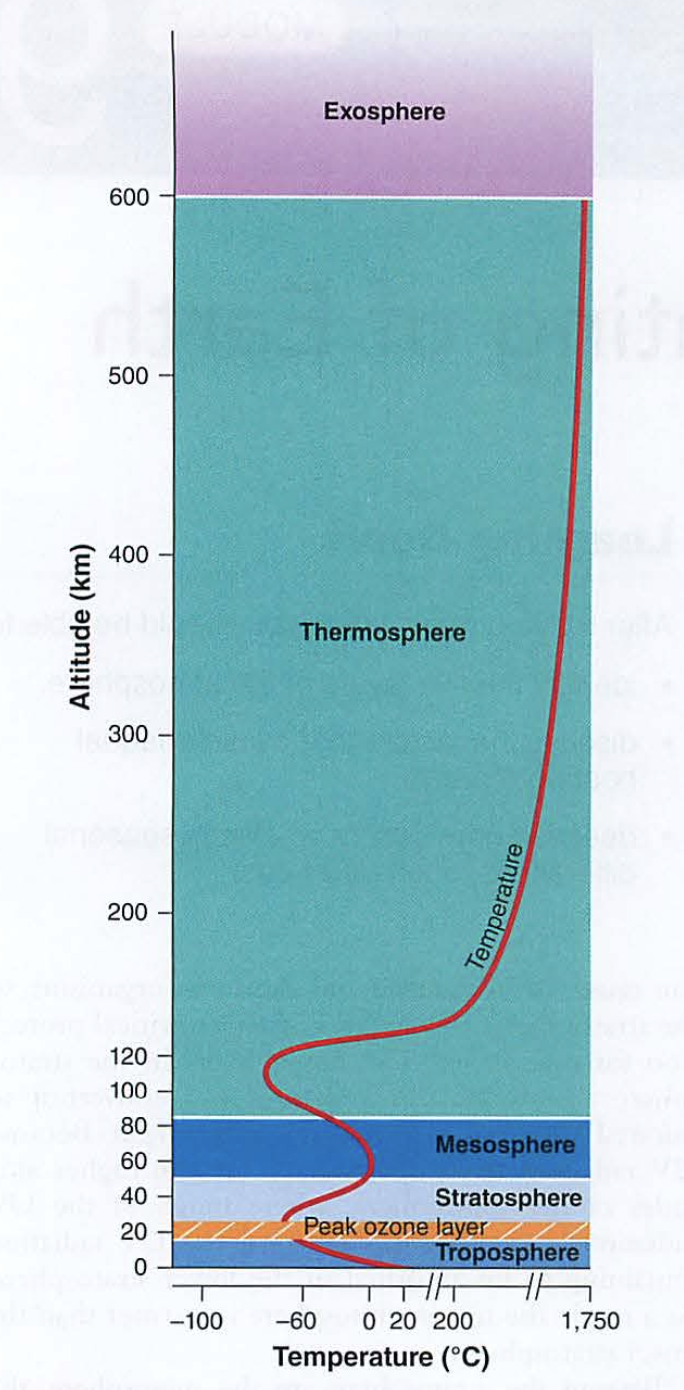
n.b. thermosphere is also known as the ionosphere (reflects radio waves), blocks nasty radiation from space, absorbs the energy from this radiation, gets hot
Now think of the three heat transfer modes:
Radiation: energy from the sun hitting the surface
Conduction: hot ground heats the air in contact with it
Convection: hot air rises, creating weather
Weather?
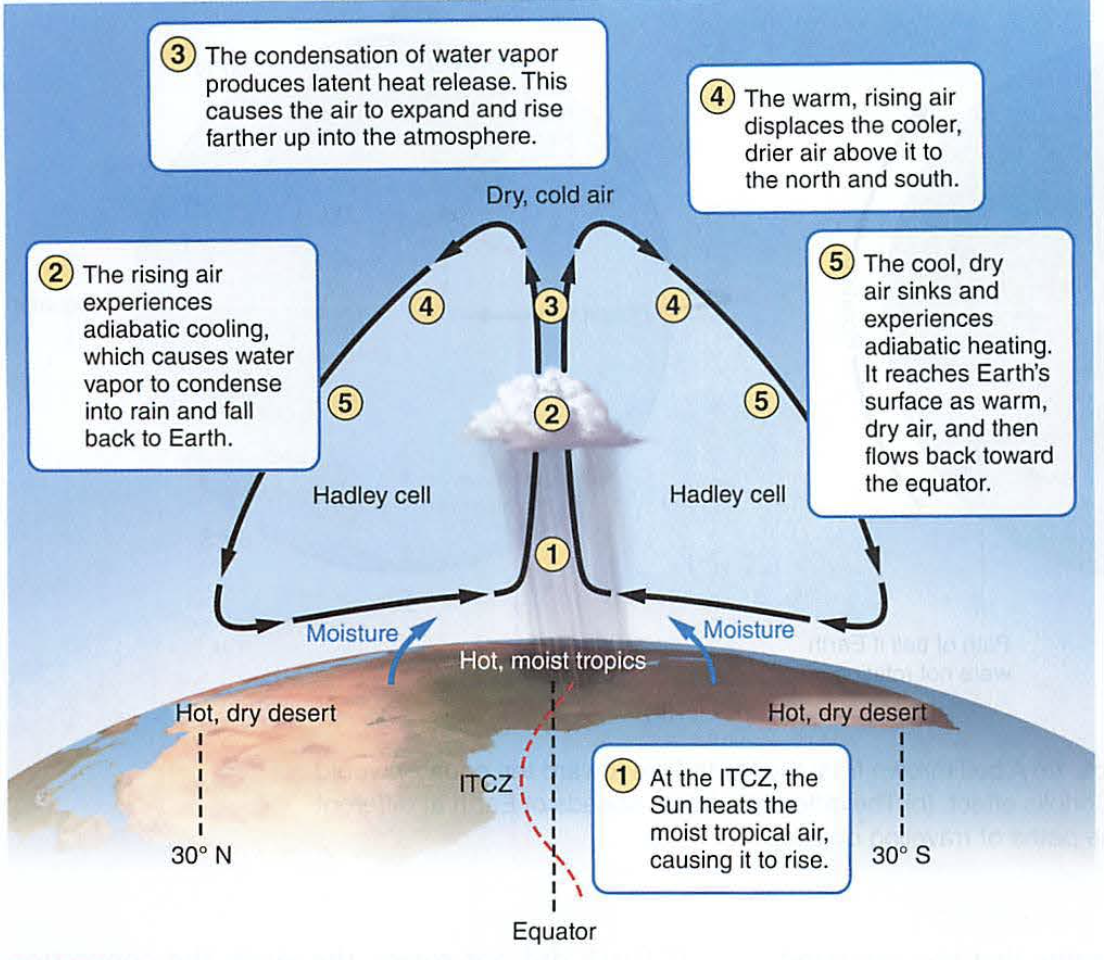
As air rises, it creates local low pressure areas, bringing in clouds and moisture (wind)
As this air rises, it cools, dropping moisture as rain or snow
This dry air circulates at high altitude until it transfers its heat to space (radiation and conduction) then descends as cooler, dry air
(see adiabatic cooling diagram)
This also happens if moist air is forced over a mountain range (remember the Waipio question?)
(see rain shadow diagram, module 22 FR4e)
The amount of heat the surface absorbs is based on reflectivity (recall radiation above)
Albedo is a measure of this reflectivity (think of Albus Dumbledore: white beard)
- Average albedo for the earth is about 30%
- Snow and ice are about 90%
- Water is about 35%
- Soil is about 15%
- Asphalt is about 5%
- Clouds vary in density from 10-90%
(see albedo diagram)
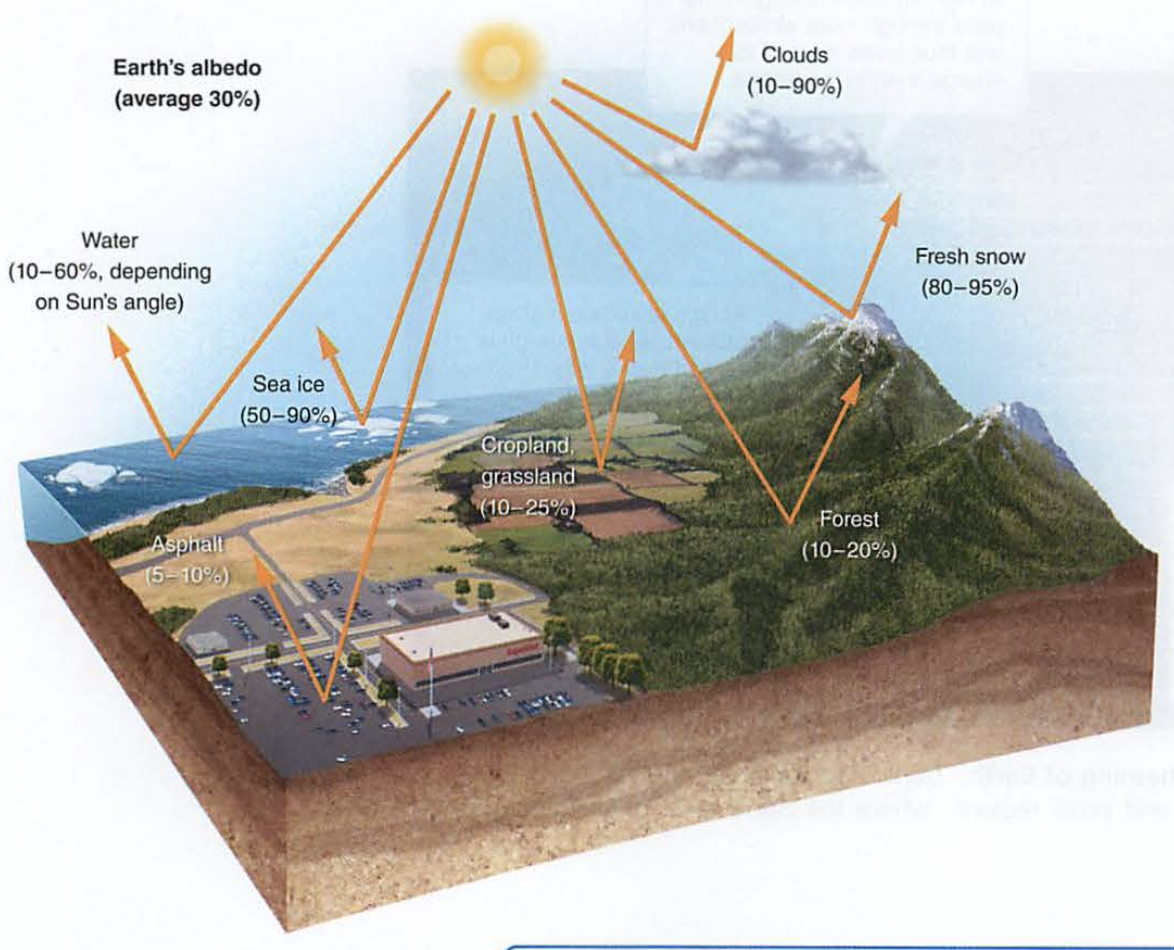
Fun fact: as global warming melts ice (high albedo) it turns into water (lower albedo), warming the planet more (positive feedback).
The place on the planet with the most average solar radiation is the equator, so air rises there (convection)
This creates the first of three cells: the Hadley cell
- As air moves towards the equator, it brings moisture (ITCZ)
- As this moist air rises, it cools and rain results
- The resulting dry air moves north and south away from the equator in the stratosphere
- This dry air descends creating deserts
Fun fact: on windy trade wind days your flight to the mainland is faster-why?
(see Hadley cell diagram)
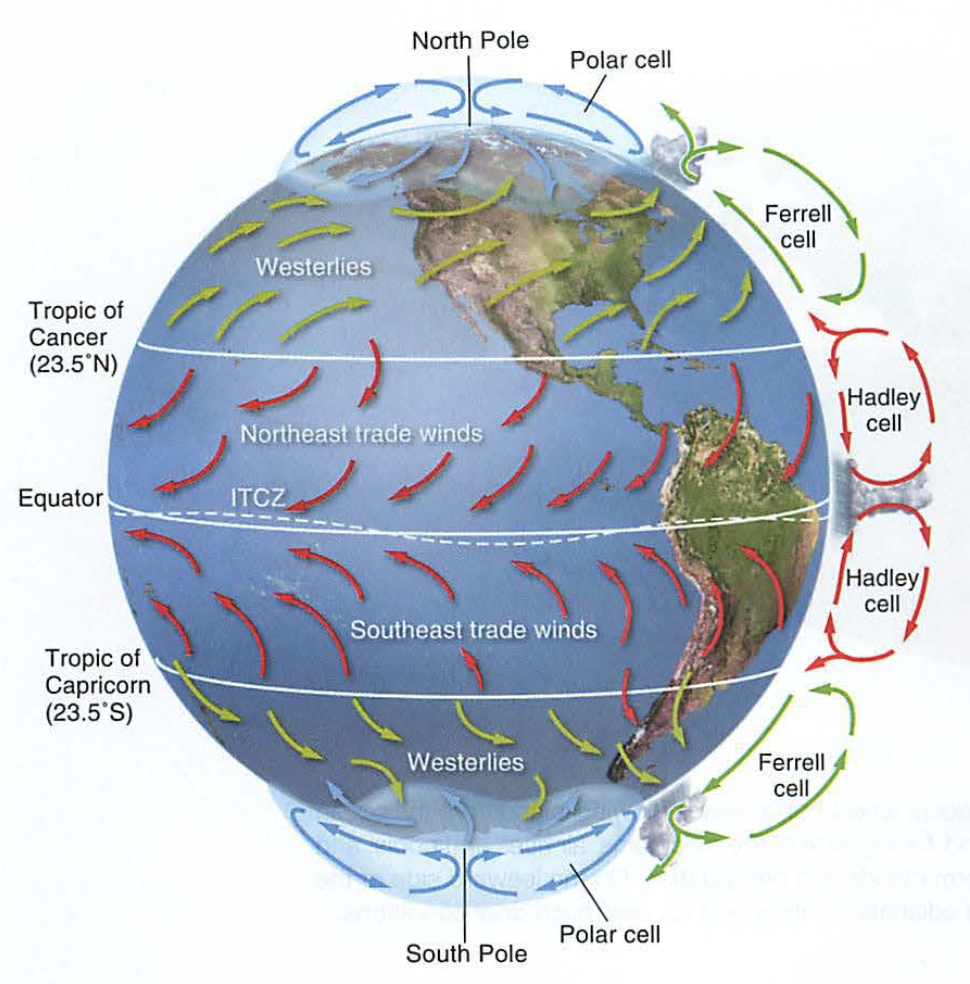
Primitive meteorologists (weather folks) detected three of these cells:
- Hadley
- Ferrell
- Polar
To draw these, remember that when cells touch, air moves in the same direction: up-up or down-down
Biome impact:
Seasons:
The earth is tilted on its axis about 23.5° (get over it, it changes every 20,000 years)
Because of this, each hemisphere gets more or less solar radiation at certain times of the year.
We divide this (almost)circular motion into 4 points:
- Summer solstice: June 21 (summer for N hemisphere)
- Autumnal equinox ("equal night"): September 21 (today!)
- Winter solstice: December 21 (winter for N hemisphere)
- Vernal or spring equinox: March 21 (pagan festivals, etc.)
Australians have Christmas in their summer. Santa arrives by surfboard (true fact)
Fun fact: Pagans feared each winter that the days would just keep getting shorter and total darkness would result, so when they calculated winter festivals, they waited a week after the darkest day (December 21) to make sure the sun would come back.
This is why Christmas is December 25, not 21.
(see season diagram)
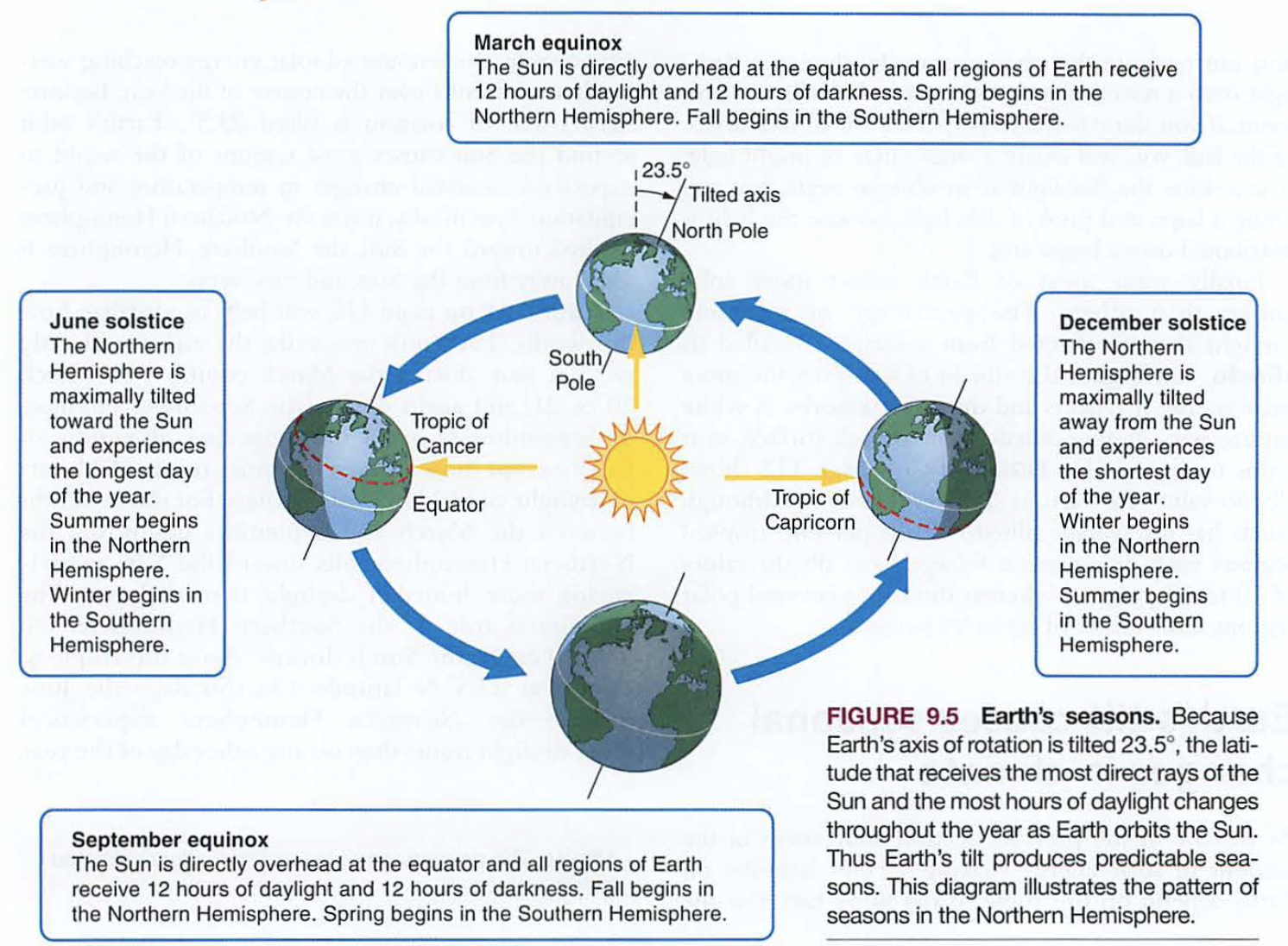
In Hawaii, we are below 23.5° latitude (find this on your globe), so for several months in our summer, the sun is actually NORTH of straight overhead. This is called "Lahaina noon".
Coriolis effect:
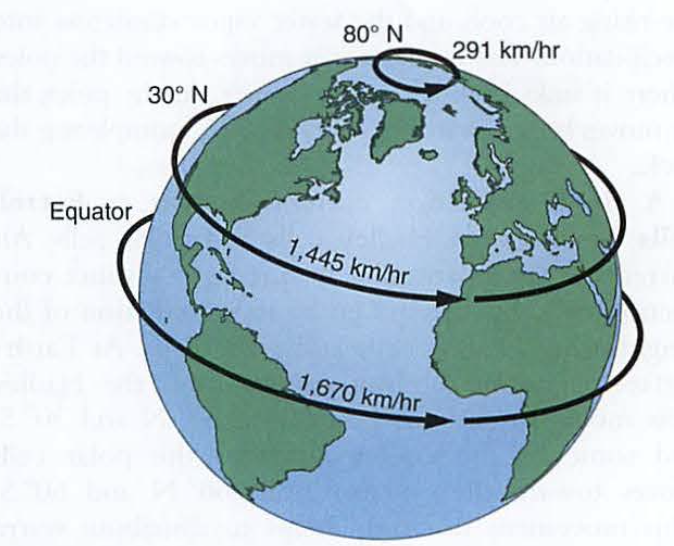
If you look at your globe from above (like some eskimo god), you will notice the radius at the equator is greater than at higher latitudes.
Actually, the tangential velocity (physics term) at the equator is about 1600 km/hr (1000 mph), while it is zero at the north pole.
As large storms stretch out with one end more south than the rest, it falls behind, creating the coriolis effect.
Demo: imagine dripping water (you, the eskimo god again) on the globe while it spins, which way would the water drip?
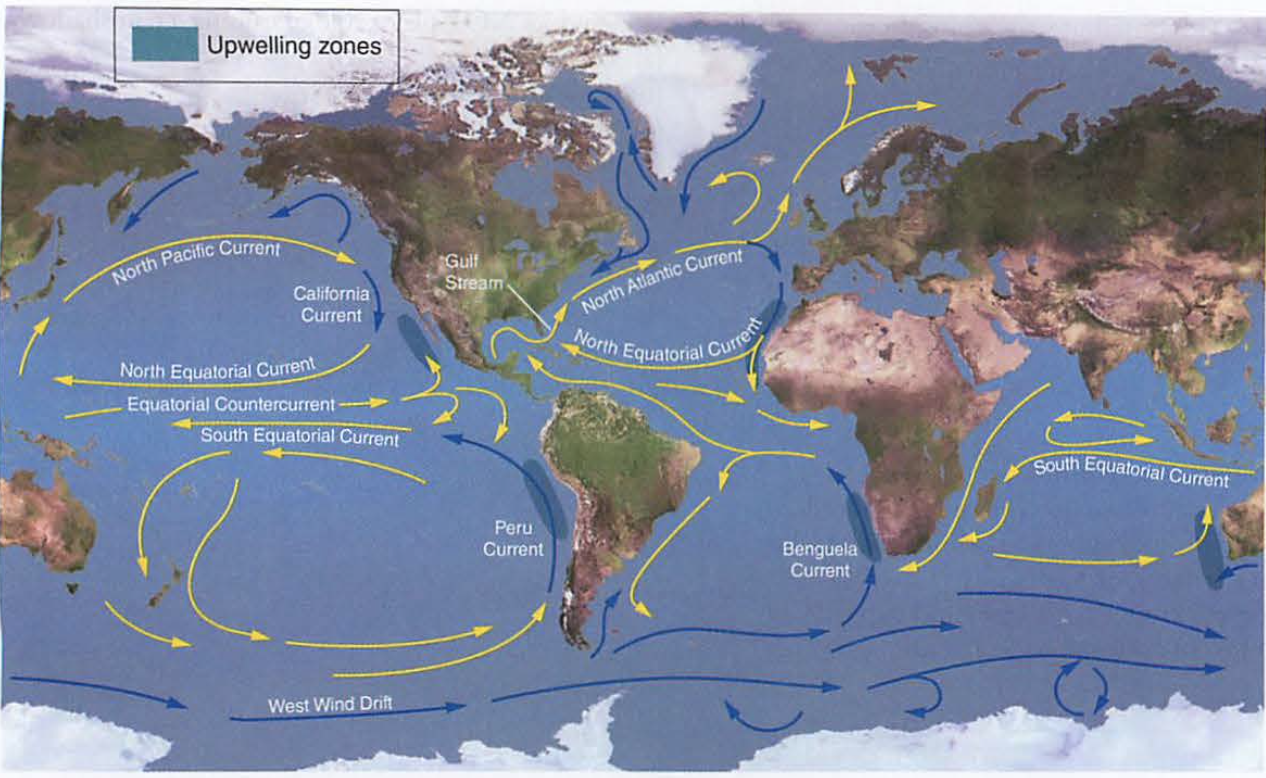
Oceans: wind and water
Surfers in California usually wear wetsuits.
Why?
Water along the California coast travels south from Alaska.
Remember this: oceans in the northern hemisphere travel clockwise
(opposite in the southern hemisphere)
Tough question: why are our trade winds from the NE not the North (Hadley cell)?
Verify on windy.com:
https://www.windy.com/?20.002,-155.533,5
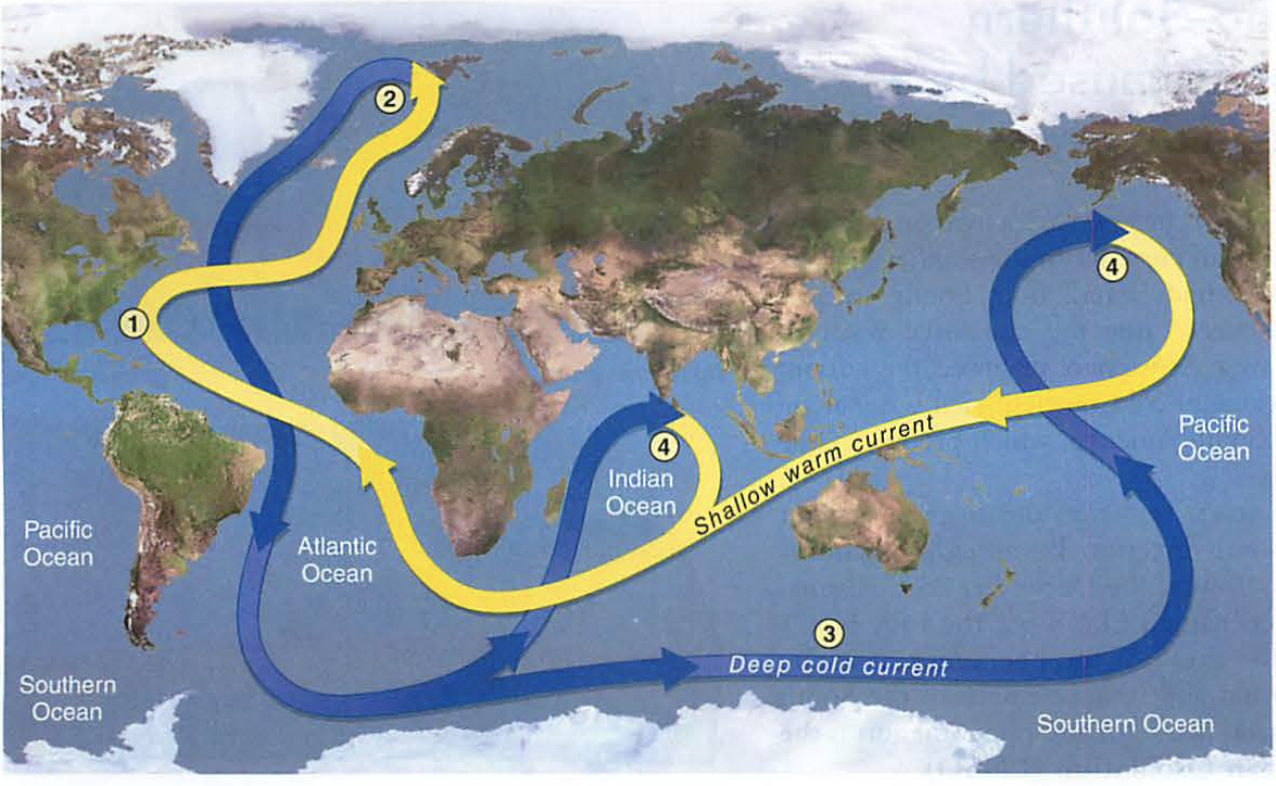
There is one very interesting deep ocean current called the "thermohaline" circulation:
thermo=heat, haline=salty
Also known as the NADW or North Atlantic Deep Water:
Melting ice sheets in Greenland create dense, cool water that flows south along the ocean floor, and emerges in two places on the planet: India and KONA!
Ocean circulation: Up and down
The Andes run north and south from Peru to Chile as a result of tectonic plates going under South America from the west (more on this soon).
As a result, there is a deep trench off the coast of Peru and Chile
Looked at sideways from the south, as water rises from this deep trench it brings with it decomposed ocean creatures (detritus) that surface fish love to eat: happy fisherpeople
For this to happen, an offshore wind has to be strong.
This condition is called La Niña, and is an indicator of weather all over the planet
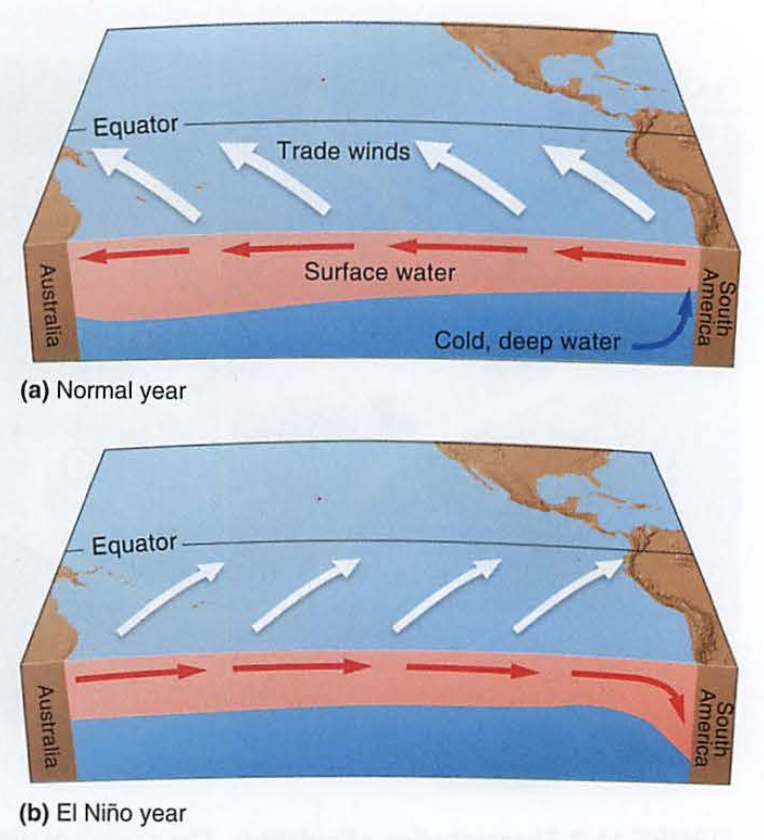
El Niño is when this wind becomes onshore, stopping the migration of fish food (sad fisherpeople)
(see sideways diagrams of La Niña and El Niño)
Better picture:
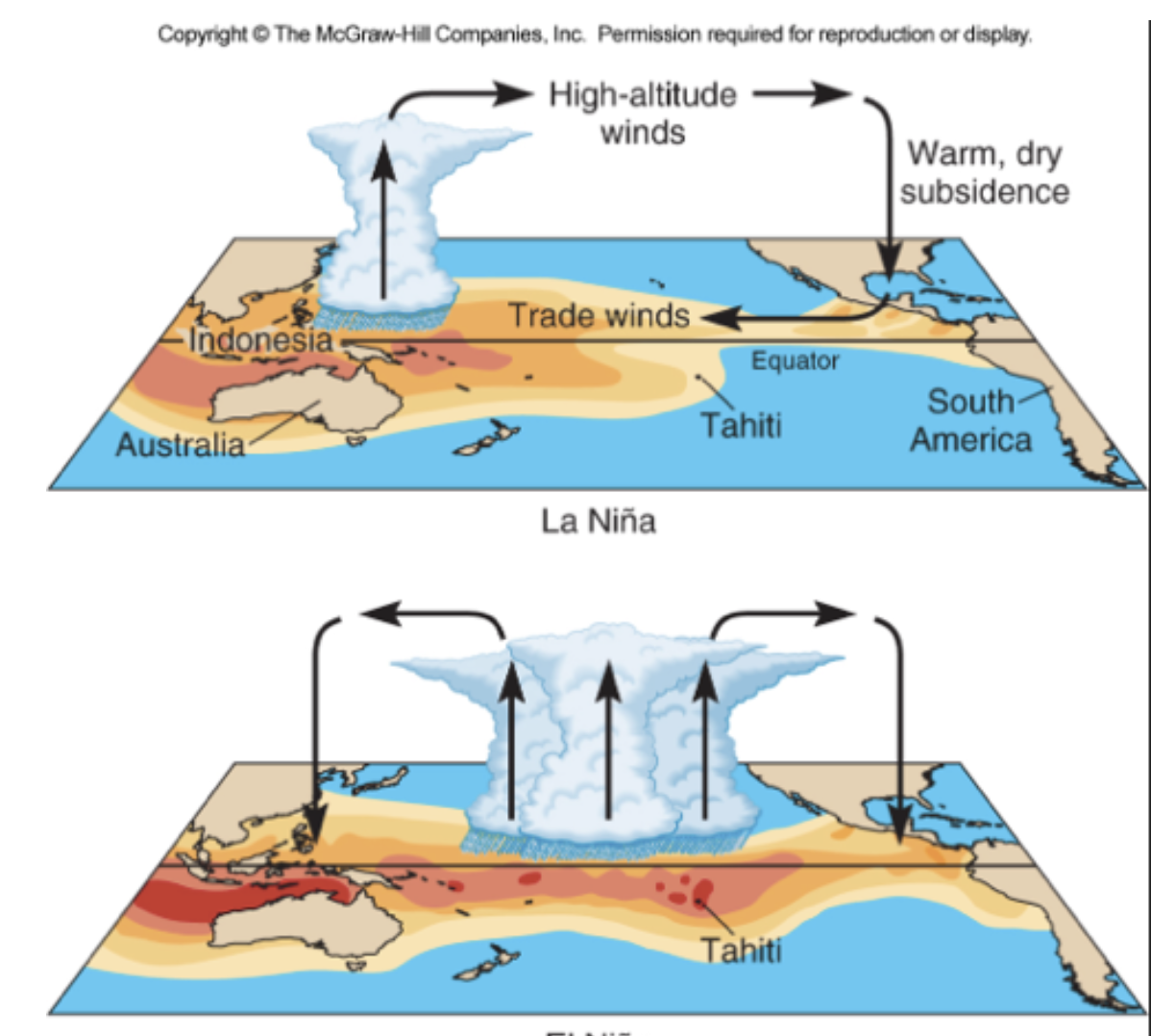
- Note that in the La Niña year, the "cell" is larger, stronger, and pulls more surface water away from Peru-Chile (happy fisherpeople)
- Look at the thermal image below, notice the cooler (deep) water coming off the coast of Chile in a La Niña year
- Note that in the El Niño year, the "cell" is smaller, weaker, and the offshore current is weaker (sad fisherpeople)
- Look at the thermal image for El Niño year: warmer (surface) water off the coast of Chile
- You might be interested in why there is a trench off the coast of Chile-it is the same reason the Andes mountains are in Chile...
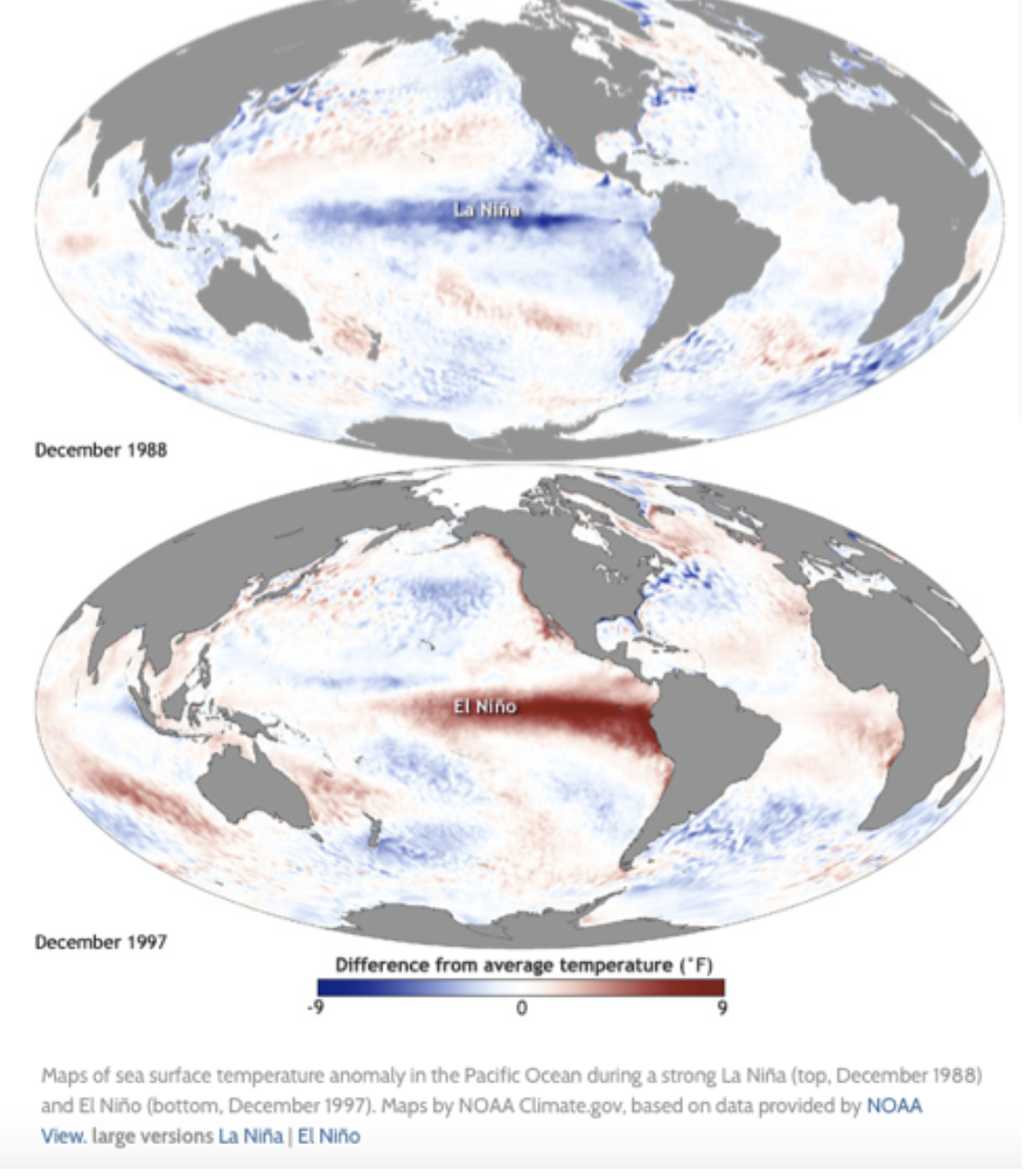
Look:Here's what we learned so far:
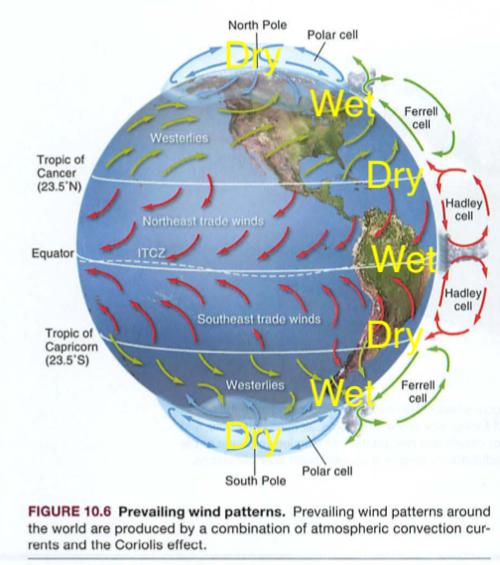
Now look at this map, and compare with your trusty globe:
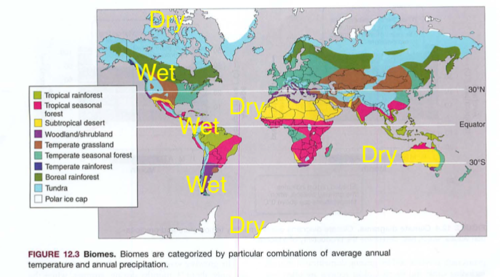
See the pattern?
- onshore moist air from the Pacific ocean hits the mountains near Seattle=rainy there
- onshore moist air from the lower Atlantic ocean hits the amazon basin=rainy there
- dry air moving down from the Mediterranean moves over the Sahara Desert=dry there
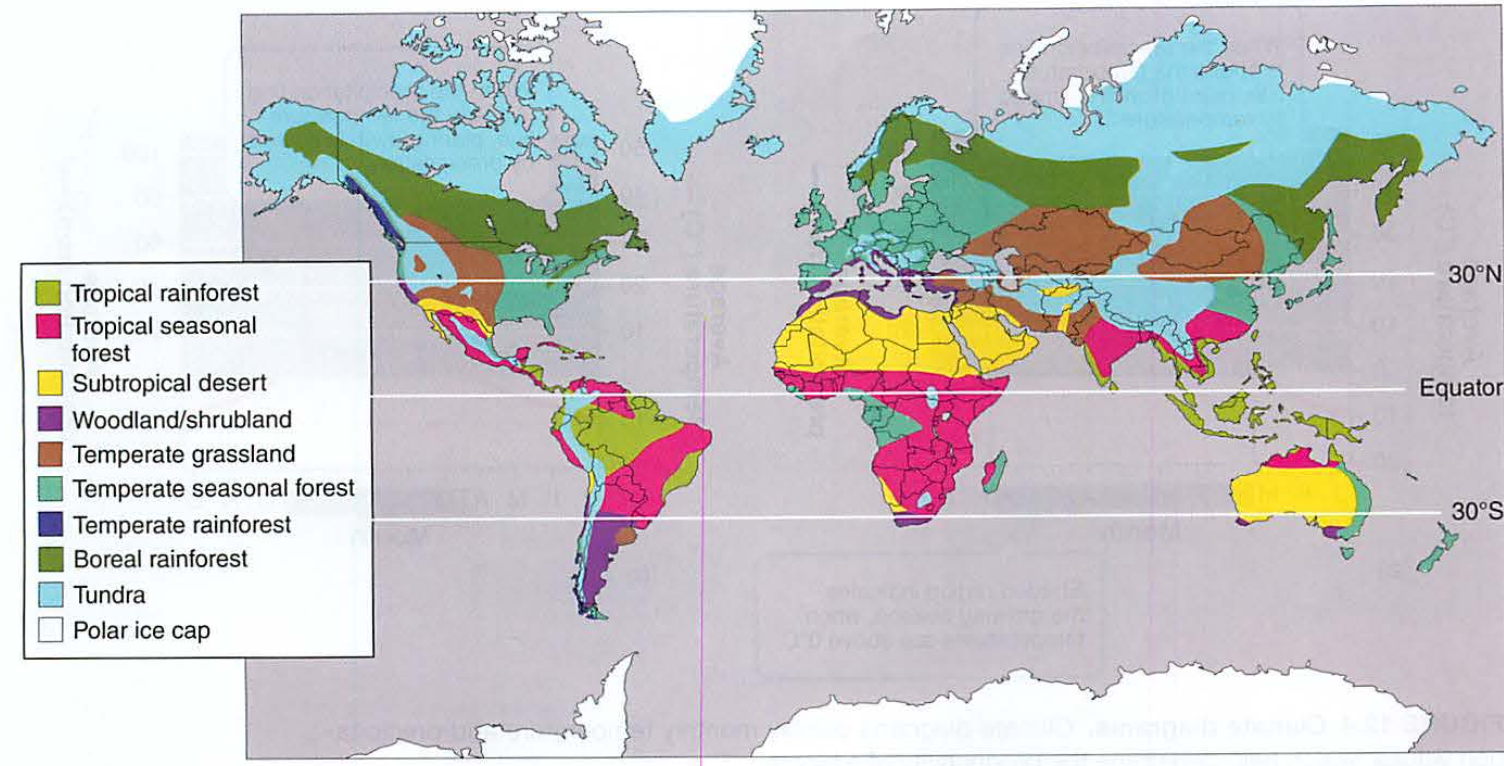
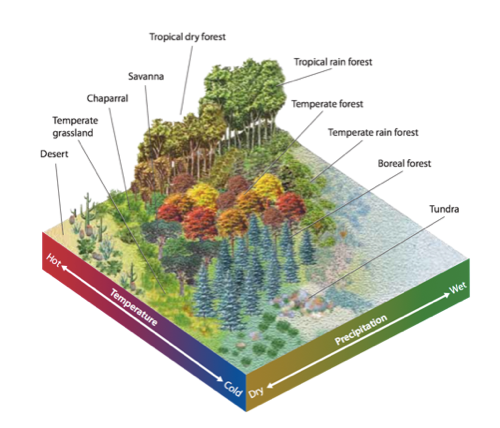
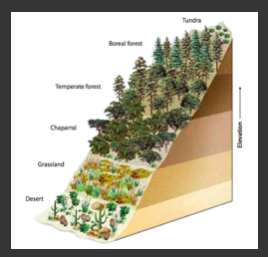
There are about 9 Biomes, usually defined by precipitation (rain, fog, others) and temperature.
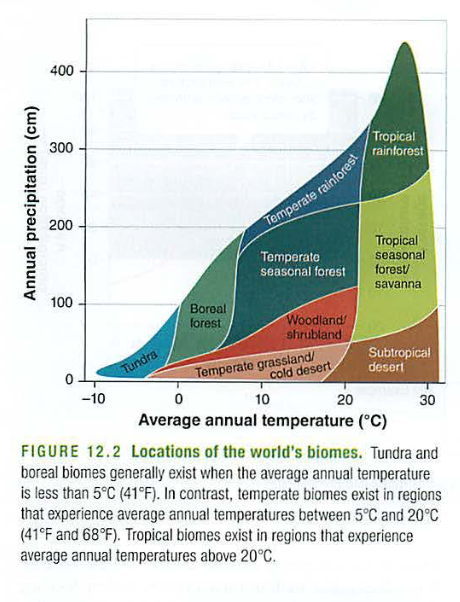
Tropical rain forest to temperate (mild) rain forest to boreal (north) forest to tundra.
There is even a glacier up on Mauna Kea. Cool.
This would be like starting in the upper right corner of the diagram and moving diagonally down and to the left.
Now check out the planet again:
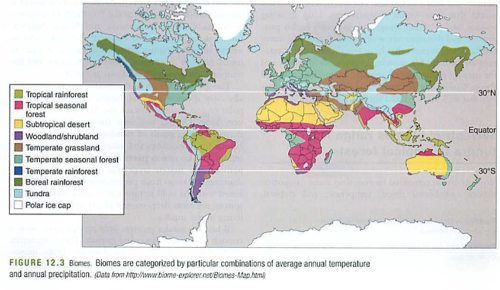
- Notice the horizontal bands. If you've read "Guns Germs and Steel" you know that humans migrated horizontally, so their crops and livestock would thrive in similar biomes. See?
- Migrating north to south is tough.
- How is this changing?https://climate.nasa.gov/interactives/climate-time-machine
Now look at this:

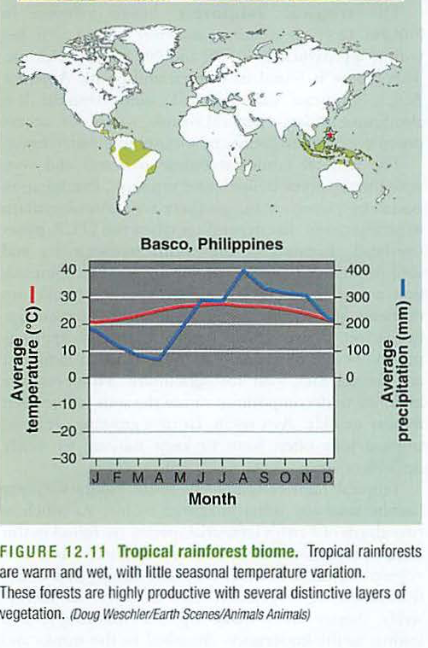
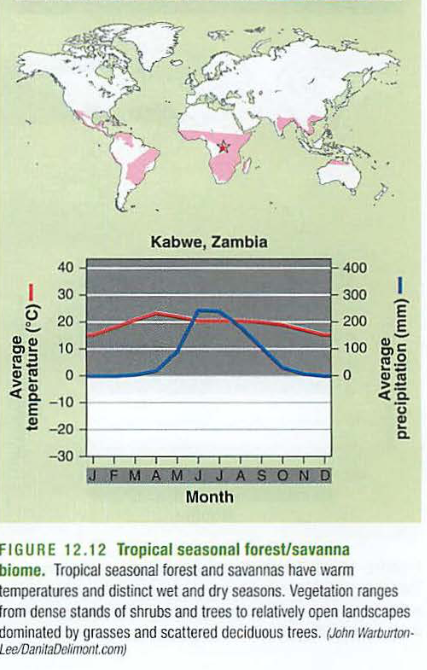
These diagrams are how climatologists describe biomes without a cool map.
- The blue line is the amount of rainfall, with units on the RIGHT side of the graph.
- The red line is the temperature, with units on the LEFT side of the graph.
- The shaded region in the months below (jfmamjjasond) is the growing season when temperatures are above freezing. When the precipitation line is above the temperature line, growth is limited by temperature (e.g. freezing).
- When the blue line is below the red line, growth is limited by precipitation (e.g. the desert).
Deductive process:
- Which hemisphere? North or South? (when is summer, when is winter?)
- How far from the equator? Hot or cold? (does it ever freeze?)
- How much rainfall? Wet or dry? (Hadley, Ferrel, Polar cells?)
- How long is the growing season? Short or long? When?
- Altitude: Waimea is a Mediterranean biome, but is cooler, as we are 800m above sea level
- Water: San Francisco Bay area should be much cooler, but is surrounded by water-rarely snows there
- Topography: strong consistent onshore breezes can impact rainfall (e.g. Seattle)
Start with the north:
- Permafrost is soon to be in the news (why?)
- It is made of permanently frozen ground a few feet below the surface. Even roots cannot penetrate it, so some trees grow in a stunted fashion.
- It is also composed of frozen organic matter, which when it melts will decompose, releasing CO2 and CH4 (methane), which is 20x as powerful as CO2 as a greenhouse gas.
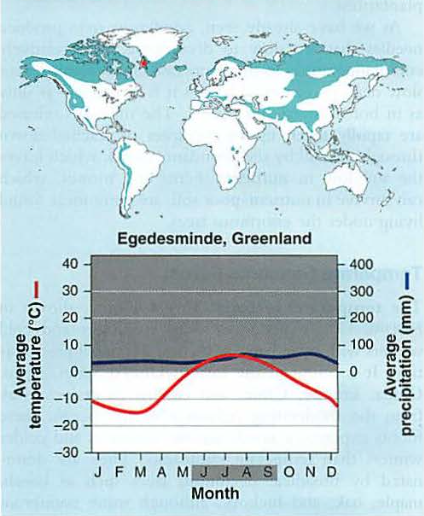
Note the cool temp, so growth is determined by temp, not rainfall. Lots of snow here, and little liquid water for plants, so yeah, mainly snow and glaciers.
Contrast that with the boreal (north) forest:

- Any plants that survive usually have an oily sap (pine trees, evergreens) that does not freeze.
- Also note the serious cold in the winter-animals have to adapt to these (fur, hibernation, etc.)
Temperate (mild) forests are nicer, longer growing season, and rarely freeze.
- They are usually near the ocean, so they do not freeze (ocean is a huge heat sink).
- The often have lots of rain (think of Seattle).
- You may recall these are places where the surface parts of Ferrell and Polar cells converge, bringing in clouds and as these clouds rise into the atmosphere, they release their water as precipitation.

Temperate (mild) seasonal forest actually has seasons:

- Deciduous trees can live here, like maple and oak.
- It gets close to freezing, but no real dry season.
Wine can grow here. It is also known as the mediterranean (medi=middle, terra=earth) biome.
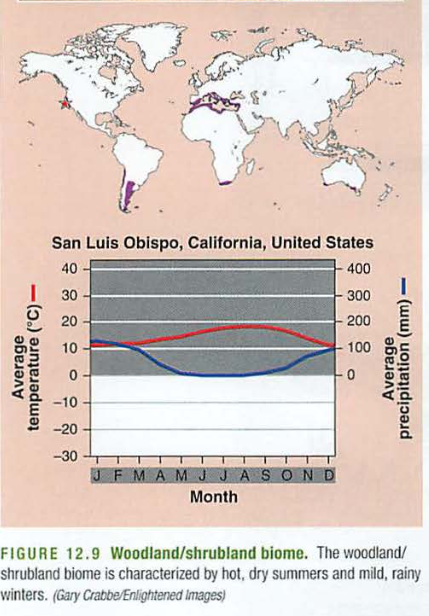
- Note it never really freezes, but growth is determined by precipitation (blue line is below the red line).
- This is also known as "chaparral" or the "fynbos" or "nice forest" in Afrikaans (South Africa).
- There is also a notable University there...
- Look up the main wine regions of the world, they will fit this biome. Also consider how many Italians could start vineyards in northern California...
Temperate grassland/cold desert is a dry, grassy area, like Oklahoma, although it does get very cold there, so think more of Texas, or the Gobi desert. Again, growth is rain limited: (you may recall these are near Hadley/Ferrel cell subsidence, so dry air from space falls here). These areas tend to be far from large bodies of water, so they have more extreme temperatures than similar latitudes near water (e.g. Italy, France, California)
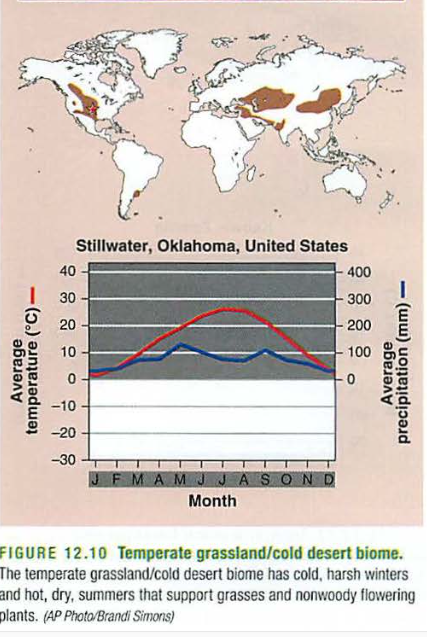
Tropical rainforest is the rainiest of them all, and much of our island has this near the shore.
- Warm temperatures, and paradoxically poor soil nutrition (all of the nutrients are in the plants).
- On Mt. Waialeale on Kauai, the rainfall is 480 INCHES per year, 2.5 times as high as the high point on the chart below:
Africa and Brazil hold the next biome: Savanna or tropical seasonal forest.
- Think of Madagascar (the film): not many large trees, room for animals to roam, lots of grass, happy lions, maybe a bossy penguin or two...Growth dependent on rainfall: (blue line below red one)
Finally, the subtropical desert biome, like what you'd see in the Sahara desert (another film), or most of Australia, the Atacama in Chile, the Mojave desert in California, and some of Mexico.
- Note the Gobi desert is not on this list-too cold. Again, note these areas are where dry air subsides (falls) from the Hadley and Ferrell cells.

Biome Game:
Clues: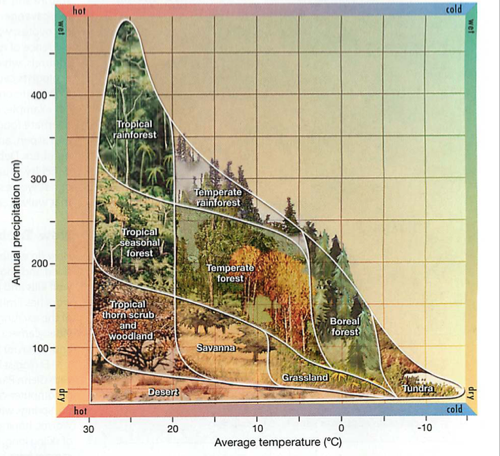
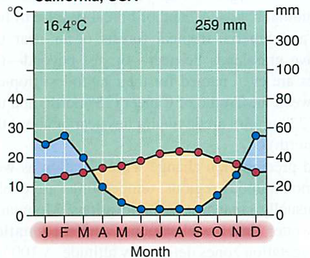
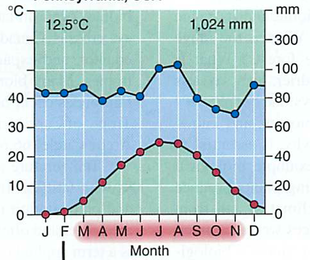
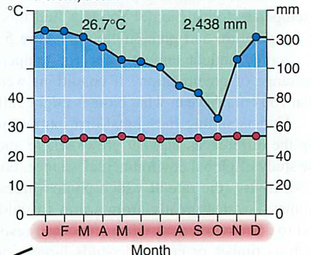
Find these biomes below:
- tropical rain forest
- tropical savanna
- desert
- temperate grasslands
- temperate deciduous forest
- temperate rain forest
- boreal forest
- tundra
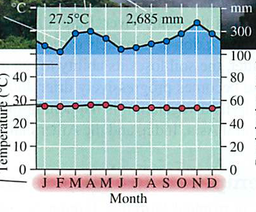
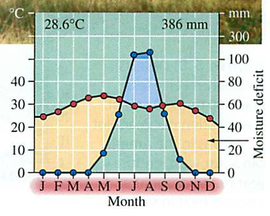
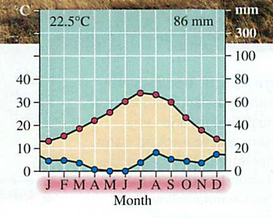
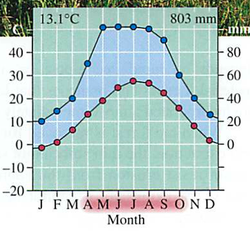
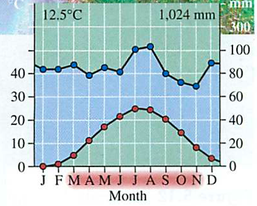
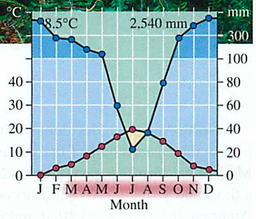
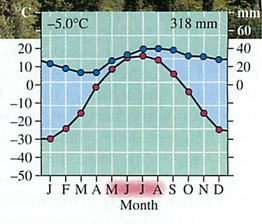

Find these biomes:
- Tropical Savanna
- Temperate Grassland
- Chaparral
- Desert
- Tundra
- Taiga
- Temperate Deciduous Forest
- Tropical Rain Forest
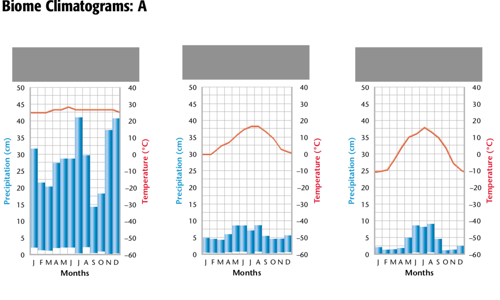
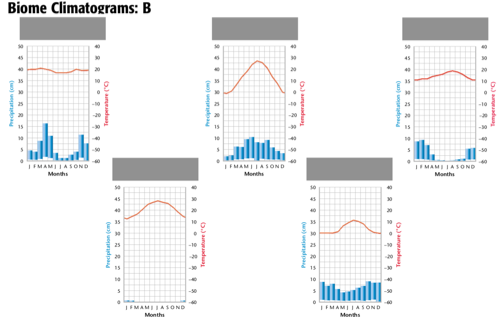
LAB: Gambling with biomes
Gambling with biomes
- Below is a list of locations around the world. Roll the dice and using your vast knowledge of biomes and the high tech globes on your desk, determine the biome and type of life you might find there.
- In the next round reverse the process with the biome list below, determining the locations around the globe.
Locations:
- Chile
- Zambia
- Philippines
- Oklahoma
- San Luis Obispo
- Germany
- Seattle
- Greenland
- Ontario Canada
- Tunisia
- North Pole
- Kamuela
Biomes:
- tundra
- boreal forest
- temperate rain forest
- temperate seasonal forest
- woodlands
- temperate grassland
- tropical rain forest
- savannah
- desert
- cold desert
- taiga
- tropical seasonal forest
Aquatic Biomes: Module 3 (fr4e)
Recall terrestrial biomes are defined by temperature and precipitation (usually rain)
Aquatic biomes are by definition underwater, so they are defined by
- Depth: how deep is the deepest part, how much photosynthesis is possible (deeper is darker)
- Distance from shore: shallow water has more life, more things to attach to, more biodiversity
Freshwater biomes:
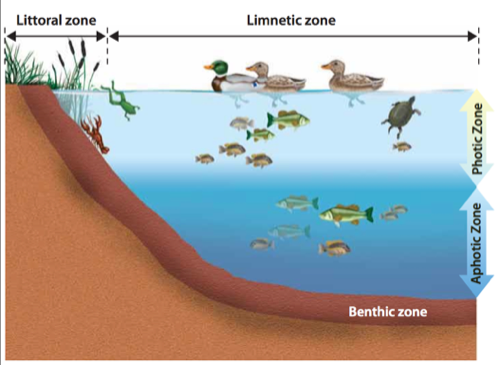
- Shallow shore area=littoral (means shallow), see the "littoral Navy", photosynthesis here (shallow, light shines through)
- Open water area=limnetic zone, no rooted plants (too deep), phytoplankton here, only as deep as sunlight can penetrate
- Deep water=profundal ("profound") or deep zone: no light penetrates, bacterial decomposition.Bottom=benthic zone: mud, dark, cloudy
Productivity: note usually related to photosynthesis (plants)
- Oligo (few) trophic=low productivity (think of an oligarchy, same root)
- Meso (middle) trophic=medium (think of mesoamerica, or central America, or mesopotamia: between 2 rivers)
- Eutrophic (eu=good trephien=food)=lots of productivity (sometimes too much, like in "Poisoned Waters")
- Freshwater wetlands-submerged most of the time (swamps, marshes, bogs) this is the history of all coal and oil we now use
- Salt marsh: usually connected to the sea, act as a coastal buffer for Hurricanes, very productive, many nutrients, lots of organic material
- Mangrove swamp: special version of this in Tropical areas (e.g. Florida)
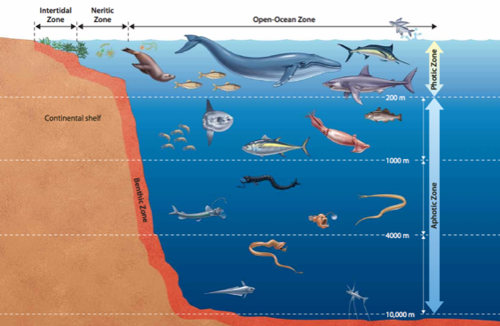
- Intertidal zone: area between high and low tide or seasonal variations
- Coral reefs-see coral bleaching, pH, temperature and salinity sensitive (see Hamakua coast vs. Puako)
- Intertidal zone: between high and low tide
- Photic (light) zone-shallow, photosynthesis, kelp, others
- Aphotic (dark) zone-too dark for photosynthesis
- Chemosythesis/thermosynthesis: deepwater steam vents, based on Sulfur instead of Oxygen, bacteria generate energy with methane (CH4) and H2S (instead of H20)
- Benthic=deep ocean
- Pelagic=open ocean (think of big sailing ships, whales, stuff like that)
- Hadal zones: like Hades: deepest, darkest zones. Weird fish, no light...
Frog book: Chapter 6 Biomes and aquatic systems
Fig 6.3
NPP: Net Primary Productivity= total amount of biomass after respiration and reproduction
(rate which primary producers convert energy to biomass)
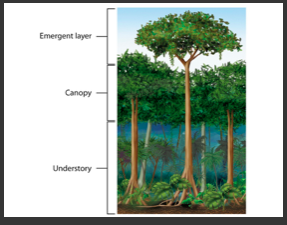
- shallow roots, big leaves, lots of rain
- pitcher plants-eat animals
- epiphytes-grow on other plants (e.g. orchids)
- air roots
- specialized animals
- deciduous forest: warm, but variable rain (e.g. monsoon)
- autumn leaves-loss to protect plant, changes in photosynthesis
- waxy leaves (e.g. pine needles) if over winter plants
- estivation: hibernation
- migration: birds (why birds and not other animals?)
- very dry, few trees, seasonal grasses, fires
- porous soils (like Kona), often coffee locations (s. america)
- waxy leaves, deep roots
- under 25 cm (250 mm) of water per year (10 inches)
- dry dry dry, so dramatic temp variations (opposite of ocean biomes)
- few plants, low nutrient levels in soil
- nocturnal animals (e.g. rats, snakes)
- succulents: store water (e.g. cacti)
- large, shallow roots, also taproots (160 ft. deep)
- not too warm, not too cold, just right
- rainy, warm, mossy, foresty (e.g. washington, oregon, BC)
- coniferous-have pine cones, conifers: oily needles (don’t freeze)
- lumber
- eastern US: oak etc. seasonal loss of leaves
- hibernating animals
- prairie, steppe (russia)
- moderate rain, but not enough for trees. grass only.
- grass grows from below, so can be eaten by cattle and still live
- roots capture moisture, hold soil together (kikuyu grass)
- California, mediterranean (middle of the earth, contrast with chinese translation of the word “china”: middle earth kingdom)
- dry, seasonal rain, drought (like now)
- taiga
- acidic soils (from conifers/pine needles as competition)
- very cold
- conifer shape sheds snow, preserves branches (christmas trees)
- when ground freezes, no water for roots, all water stored as sap in trees (oily compound, very sticky, makes retsina in Greece)
- russia, alaska, canada
- very cold-study the climatograph (-220 °C!) right….
- permafrost-permanently frozen ground, so only shallow roots
- not really a biome, but stuff lives there (aquatic mammals, fish, very small rocks, churches, mud, but no ducks)
- Notothenioids-antifreeze fish
- blubbery mammals-can concentrate fat soluble toxins like PCBs
- another non-biome, but look at this!
- salinity, depth, standing or flowing water
- salt water = 30-50 ppt (parts per thousand)
- concentration terms: ppt, ppm, ppb
- fresh water = 0.5 ppt
- in between 0.5-30 ppt = brackish (anchialine ponds in Kona)
- study the fishies in the pictures
- Depth is everything...determines amount of light, tf. photosynthesis
photic zone=light
aphotic=no light
benthic=really no light, never, ever ever. don’t even think about it.
- aquatic mammals must surface for air
- fishies don’t-gills
- DO dissolved oxygen (very important) depends on plants (so depth) and temp (cooler water can hold more O2)
- warm water has low O2 generally.
- best place to fish: cool water after a waterfall (why?)
- flowing water: rivers
- standing water: ponds
- lakes can become inland seas
- littoral=shore, limentic=away from shore benthic=botttom
- marshes, swamps, bogs and fens
- marshes marshes marshes!-tall grasses
- swamps-some trees
- bogs-acidic, poor decomposition, floating stuff
- fens-spring underneath, less acidic, better nutrients
- bogs decay slowly-ancient cheese story, peat moss
- rivers-oxbow lake and meander
- source, tributary (continuity concept), mouth (delta)
- slope exponential as distance from source
- deposition rates (rapids vs. plains)
- silt carrying capacity, turbidity
- estuaries-like deltas
- tidal estuary: hudson river: deeper than the body it serves
- 200 ft. of salt if all oceans evaporated
- oceans were red (iron) then ppt out (iron range in WI, MI) (see PBS Nova episode)
- salinity, wind and temperature determine flow
- upwelling (recall Peruvian fisherpersons)
- also downwelling
- intertidal zone-makes sense, between tides
- neritic zone-close to shore, less than 200 ft. deep (not in Hawaii, we have no continental shelf-boo hoo)
- open ocean (pelagic) zone
- kelp forests-e.g. california coast
- coral reefs-away from fresh water, coastal, photic
- open ocean-scary stuff
Module 19: Plate Tectonics
- First, there was the big bang (see the cute video here: https://www.youtube.com/watch?v=xzAOhyOtfqc)
- The only thing at first was Hydrogen, which is just a proton and an electron, sometimes a neutron making isotopes of Hydrogen
- Stars formed from this hydrogen, and through fusion created all of the elements up until Iron (Fe)
- Look this up on your periodic table------https://ptable.com/#Properties
- Eventually, these stars expanded and then collapsed...Smaller stars became neutron stars or various versions of these
- Huge ones (15x our sun size) exploded and created all of the elements after Fe (check the periodic table again)so,
- Any element in you below Fe on the table came from an exploding star cool...
- NASA and other folks are really interested in two things now: exoplanets (planets outside our solar system) and asteroids https://www.cnn.com/2020/10/23/world/asteroid-bennu-sample-update-scn-trnd/index.html
- Why?
- Well, if we know what asteroids are made of, we have a clue about what materials (e.g. water) that were around when the solar system formed.
- This is why capturing materials from Bennu last week was such a big deal...
- From this info, we can look for those elements in other solar systems, and look for life there.
This is how our solar system formed:
- Our earth was molten for a long time, then cooled to become solid-mostly.
- Since it is also made up of Uranium and other things that combine to create heat, our planet is still really hot deep down.
- A minister named Ussher (https://en.wikipedia.org/wiki/Ussher_chronology) worked backwards from the molten state to solid state of the earth to guess that the earth was created one Sunday afternoon in 4004 BC.
- We was not stupid, he just did not know about Uranium, and our molten core...
- Here's what we know the earth to look like (check this out on your globes too):
- Layers: (onion boy)
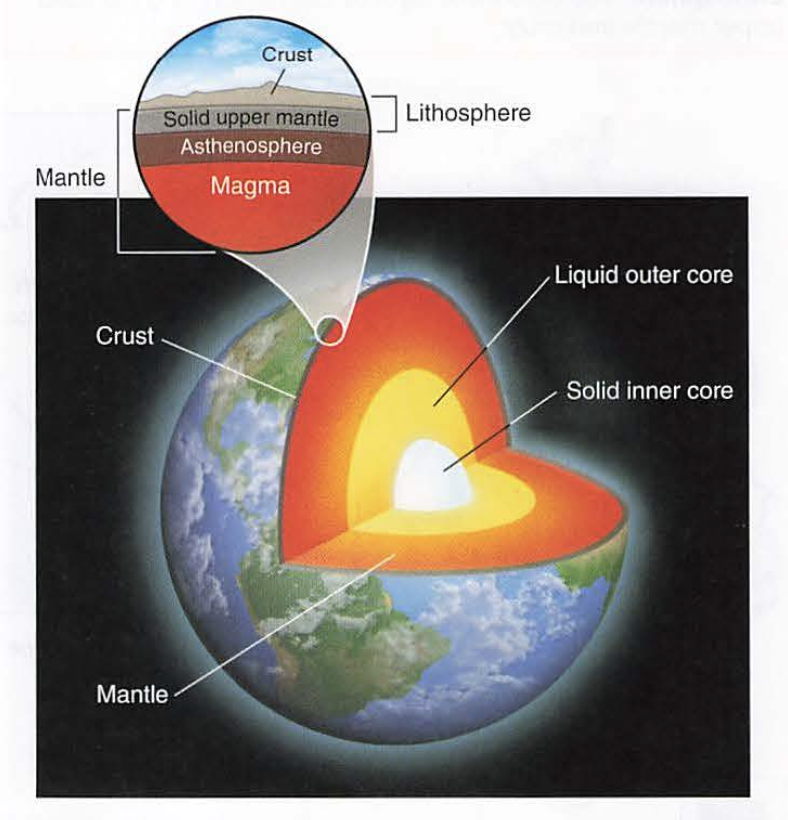
The Core:
- The core is actually two bits: solid inner iron and nickel, liquid outside that bit.
- It spins, giving us a weak magnetic field which switches direction every few thousand years.
- Remember this, it comes up later...
- How do we know this?
- Nuclear bomb testing and our global seismic sensor network.
- How?
- Two key clues about the earth came from military conflict: one from WWII and another from the cold war, when everyone was building bigger and bigger bombs.
You next need to know that there are two main types of earthquake wave:
P or "primary" waves which are compression waves. and S waves "secondary waves" that are transverse, like shaking a slinky.
P waves are faster, and go through solids or liquids, but at slightly different velocities.
S waves are slower, and can only travel through solids. So, here's what they saw:This data was found by spying on atomic bomb tests in the 1950s, not because we wanted to know about the guts of our planet...
Now, to the WWII part...
- Submarines like to hide underwater, so planes and ships can't find them.
- So, during WWII, our side tried dragging little magnetic sensing torpedo thingys from behind their ships, hoping to detect submarines. (they later used airplanes too).Here's what they found:
This might help:
Ok, let's break this down:
- Between England and the US, they found stripes of North then South weak magnetic fields.
- When they got to the middle of the Atlantic (about where Iceland is on the map above), the pattern reversed.
- Huh?
- That's what they said too...
- Remember the shifting magnetic field every few thousand years?
- As the magma came out of the earth in the molten state, it solidified in the magnetic field of that time, so the newest lava was along the center of the ocean (under Iceland too).
- Ok, now shift quickly to a meteorologist named Alfred Wegener. (look this guy up)
- ("Meteorologist" is a fancy name for a person who studies the weather)
- He cut out the continents on a map (like, with scissors) and noticed that South America and Africa fit nicely together.
- Try this on your globe----Everyone in the geology community told him he was nuts.
- Fossils from different places lined up:
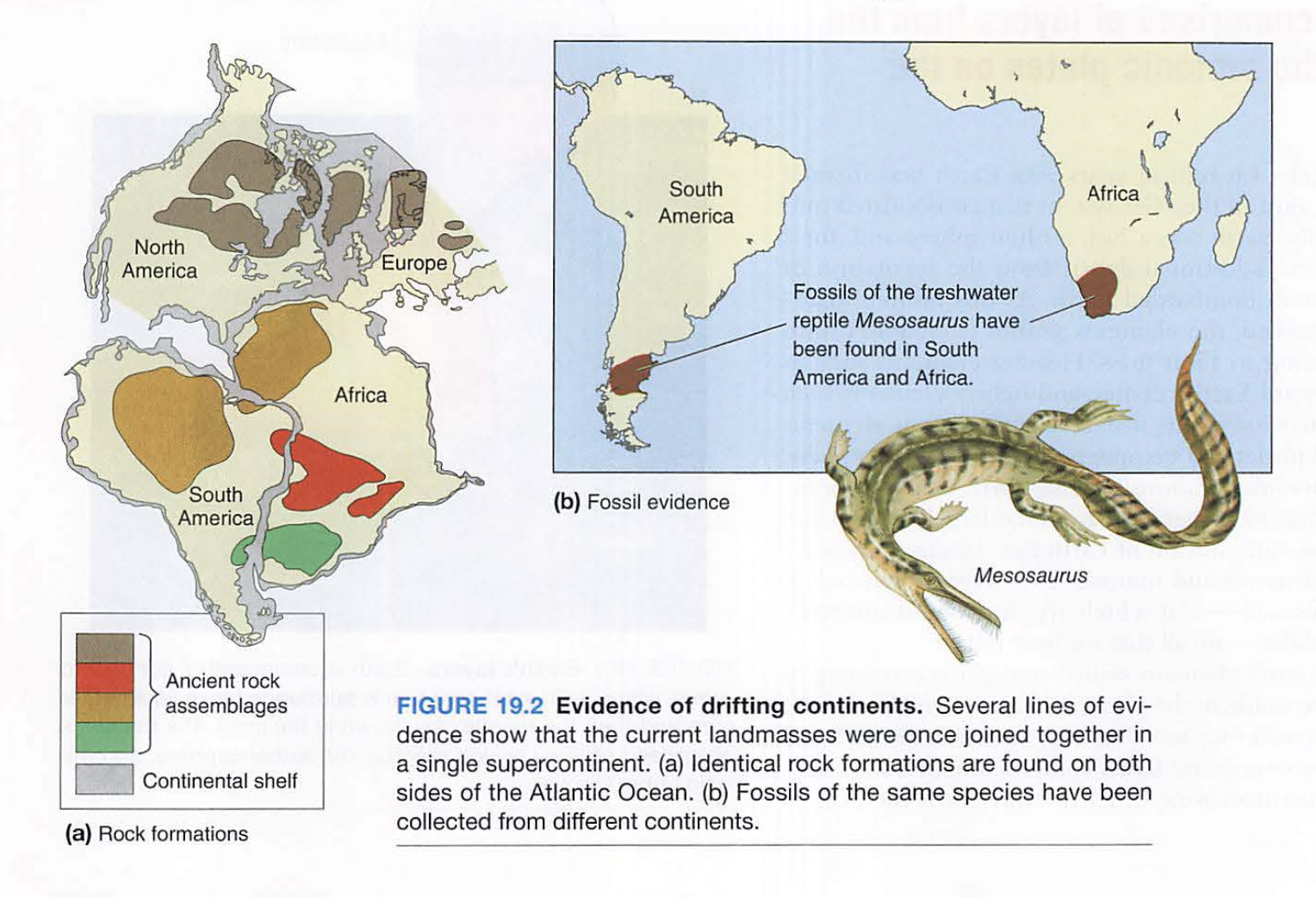
Then, these strange magnetic stripe thingys showed up from the ships dragging those magnetic torpedoes....and it proved he was RIGHT
- Ok, now remember convection, conduction and radiation?
- Remember how hot is was in the earth core?
- That heat rises to the surface as magma (say like Dr. Evil), just like the Hadley, Ferrel and Polar cells do
- Remember the earth's magnetic field changing?
A bigger image: Note the right side, that would be the Andes
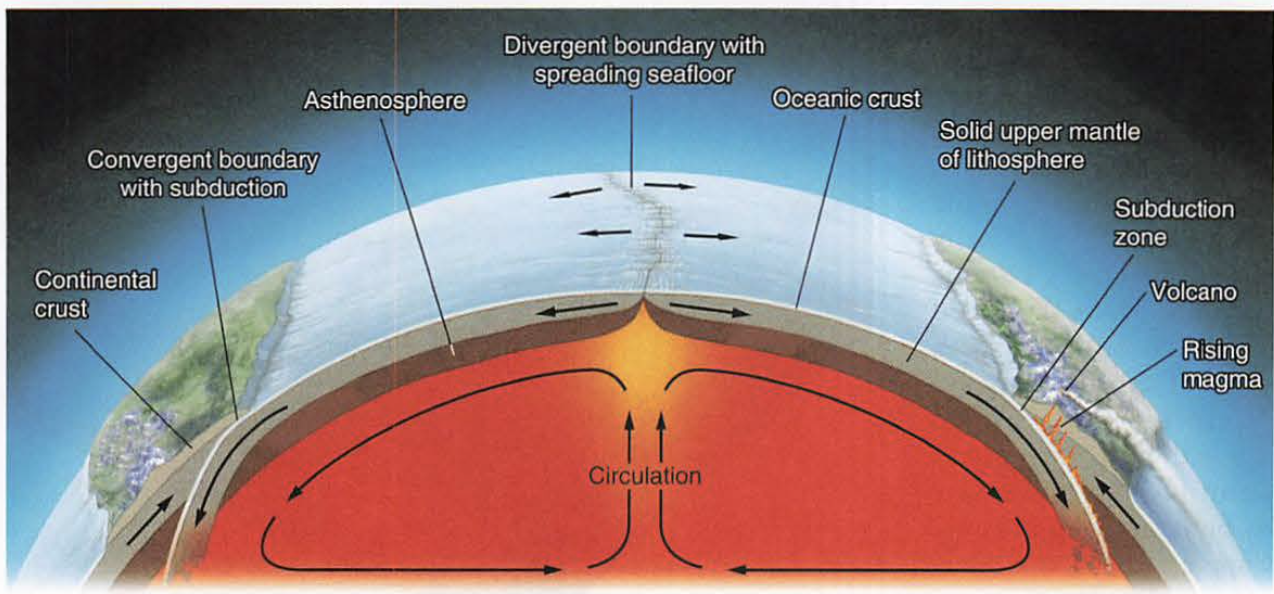
Check out this diagram: note the red cracks (spreading) and the blue arrows (subducting), esp. look at Chile---->
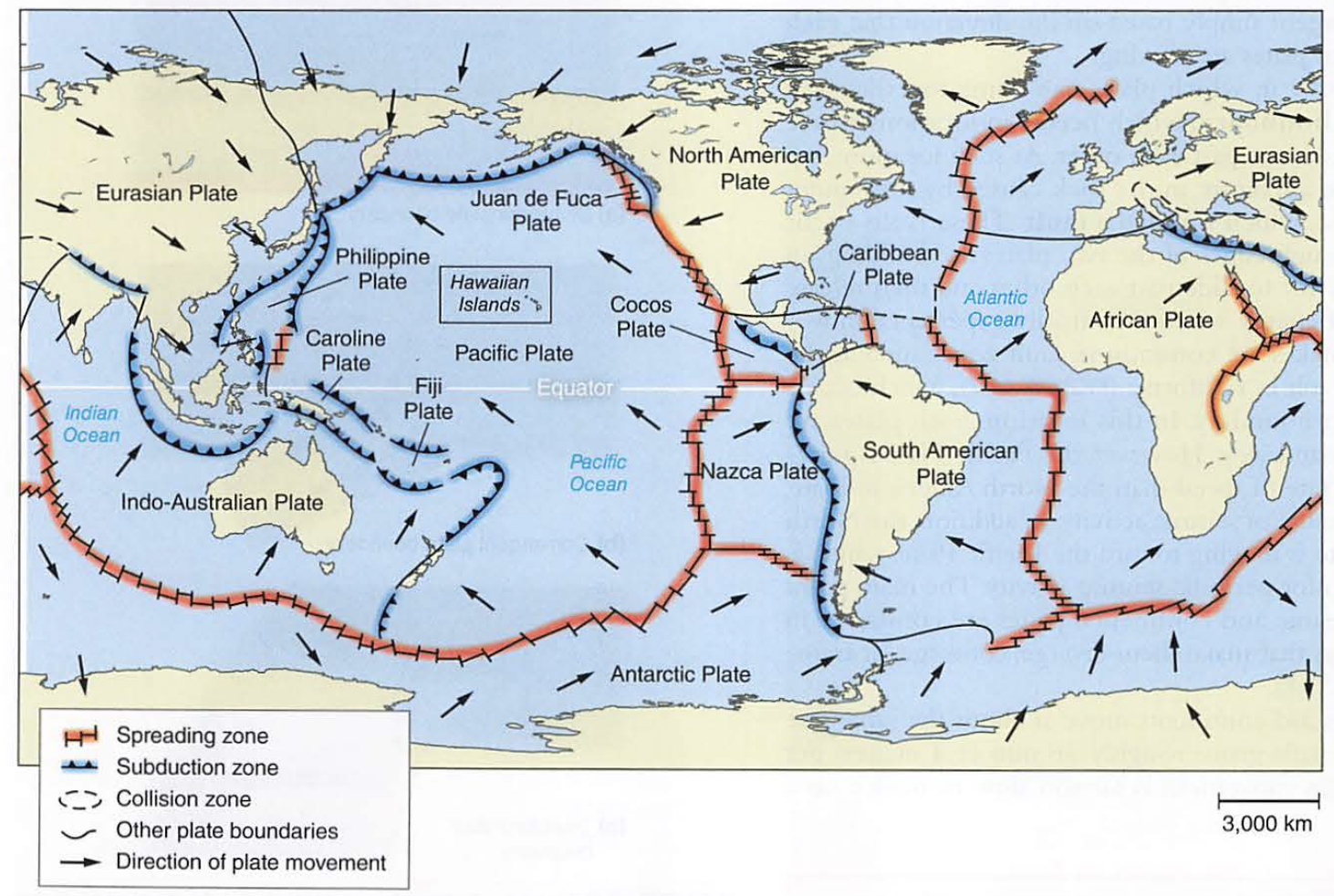
This is the key to the two types of volcanoes:
- Andesitic (pointy)
- Basaltic (runny, look out your window)
- Note the sticky stuff boiling up in red-this is why the Andesitic volcanoes are sticky, and always found near subduction zones (Andes, Cascades, Japan, Italy, etc.)
- Note also the trench where the subduction zone goes down: this is the origin of the Chilean/Peruvian trench we covered in the El Nino notes, as well as the deepest part of the ocean: the Marianas Trench, which is 7 MILES deep.
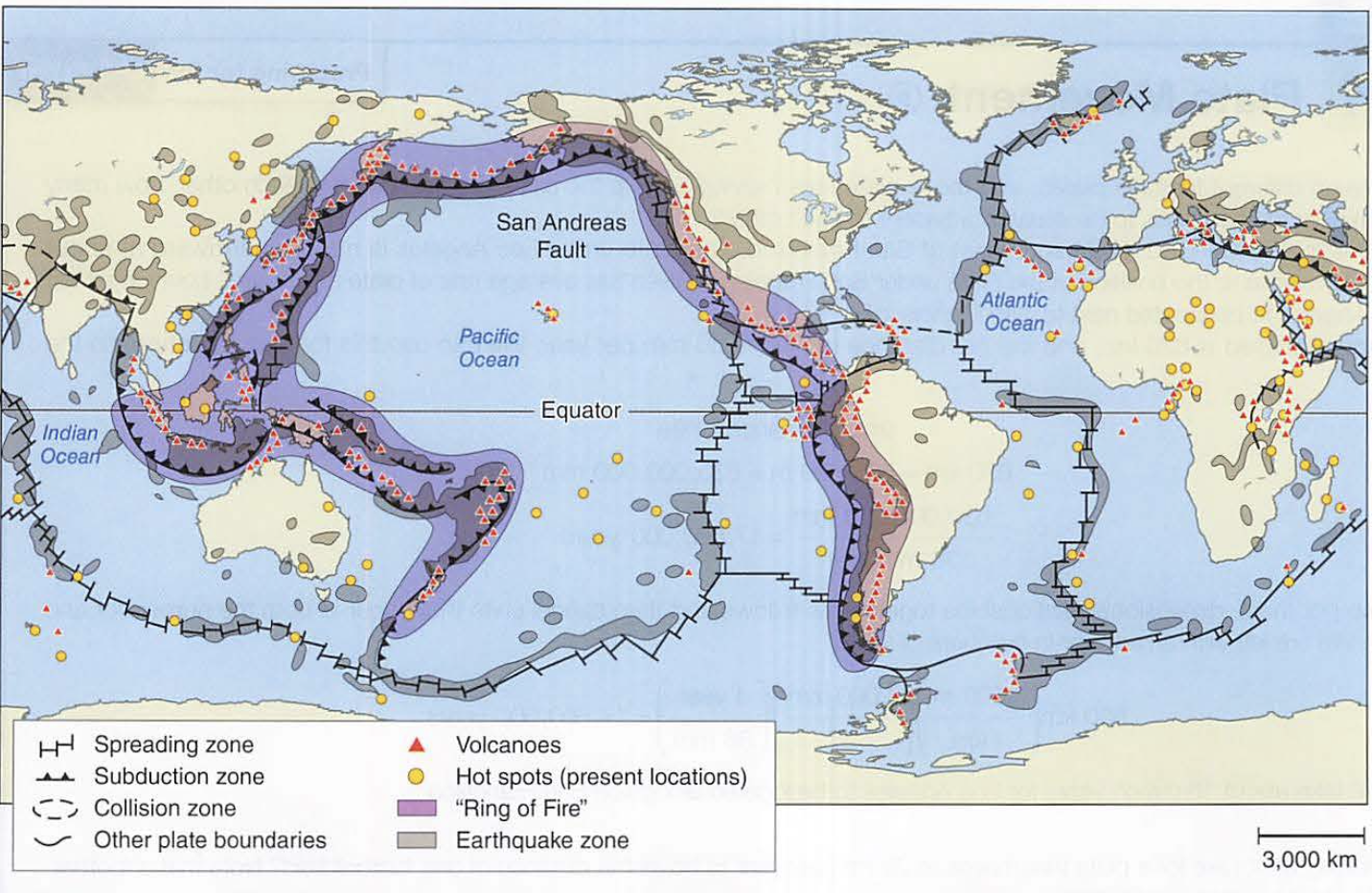
- Look at the red triangles (volcanoes)
- Which ones are andesitic and which are basaltic?
- (clue: hotspots)
- Magma-(Dr. Evil voice here: https://www.youtube.com/watch?v=yVo1S52xdpI)
- Asthenosphere-"sticky rock" (from Greek ἀσθενής asthenḗs 'weak' + "sphere")
- Lithosphere-floating rock (litho = stone) (Ancient Greek: λίθος [lithos] for "rocky", and σφαίρα [sphaira] for "sphere")
- Continents-even more floaty, made of lighter rock (granite) that formed from the interaction of magma with oceans
- Plates are large, float on the Asthenosphere (less dense, so they float)
- Continents are like rafts on the Asthenosphere, more buoyant than the plates
- The plates can slide under each other (subduction zones), crash into each other (Himalayas), next to each other (transform faults), and are formed at spreading zones (divergent boundaries)
Look at all of the earthquakes (red dots) as the plate subducts
Two things to take-away about subduction zones:
2. subduction zones create lots of deep-focus earthquakes.
We are lucky enough to live on an island with several active or dormant volcanoes.
We live on top of a "hot-spot":
Hot spots:
- Usually in the middle of an oceanic plate, but can also be mid-continent (e.g. Yellowstone supervolcano caldera)
- Hot spots are basalt-low silica content which melts easier (e.g. look out the window)
- Look at the Hawaii island chain on google earth (underwater version)
- While you are at it, look for the Nuuanu landslide that created a 4000' tsunami (!) 1.5 my ago
- You can also look at the Mauna Loa simulated tsunami on youtube...
Note the tracking of the pacific plate:
This is what happens to a shield volcano when it "calves" one side, in this case, the northeast side, in the Nuuanulandslide, one of the largest landslides on earth, causing a tsunami that deposited coral on the top of Mt. Kaala, 4055 ft. high...
More about earthquakes:Three types of fault boundaries:
- The San Andreas Fault in California is a strike slip fault
- The fault that caused the 2008 quake in Puako was a normal fault (actually a "waterbed fault")
- The epicenter is the place ON THE SURFACE above the hypocenter (true origin) or earthquake FOCUS.
- Deeper hypocentric quakes often feel "longer", while shallow hypocentric quakes feel "sharp".
- Since one wave (P wave) travels faster than the S wave, the farther away you are from the hypocenter, the greater the delay between the two:
How do we detect these?
- P waves travel by compression (comPression).
- These are longitudinal waves, like sound.
- They can travel through liquid or solid.
- S waves travel by shear (Shear).
- These are transverse waves, like a slinky.
- They can only travel through solids.
- Remember this?
Ok, back to earthquakes.Suppose you have a house on posts (called "post and pier" construction).
An earthquake happens some distance away.
First, your house moves back and forth (P wave, much faster at 8 km/sec).
After a time, your house bounces up and down from the S waves (slower at 3 km/second).
If you are far away, these are separated by different arrival times.If you are near the epicenter, they hit at the same time...up, over, down=your house is demolished
We use this difference to calculate distance from the epicenter (and hypocenter if you are interested) using delay times on the seismograph
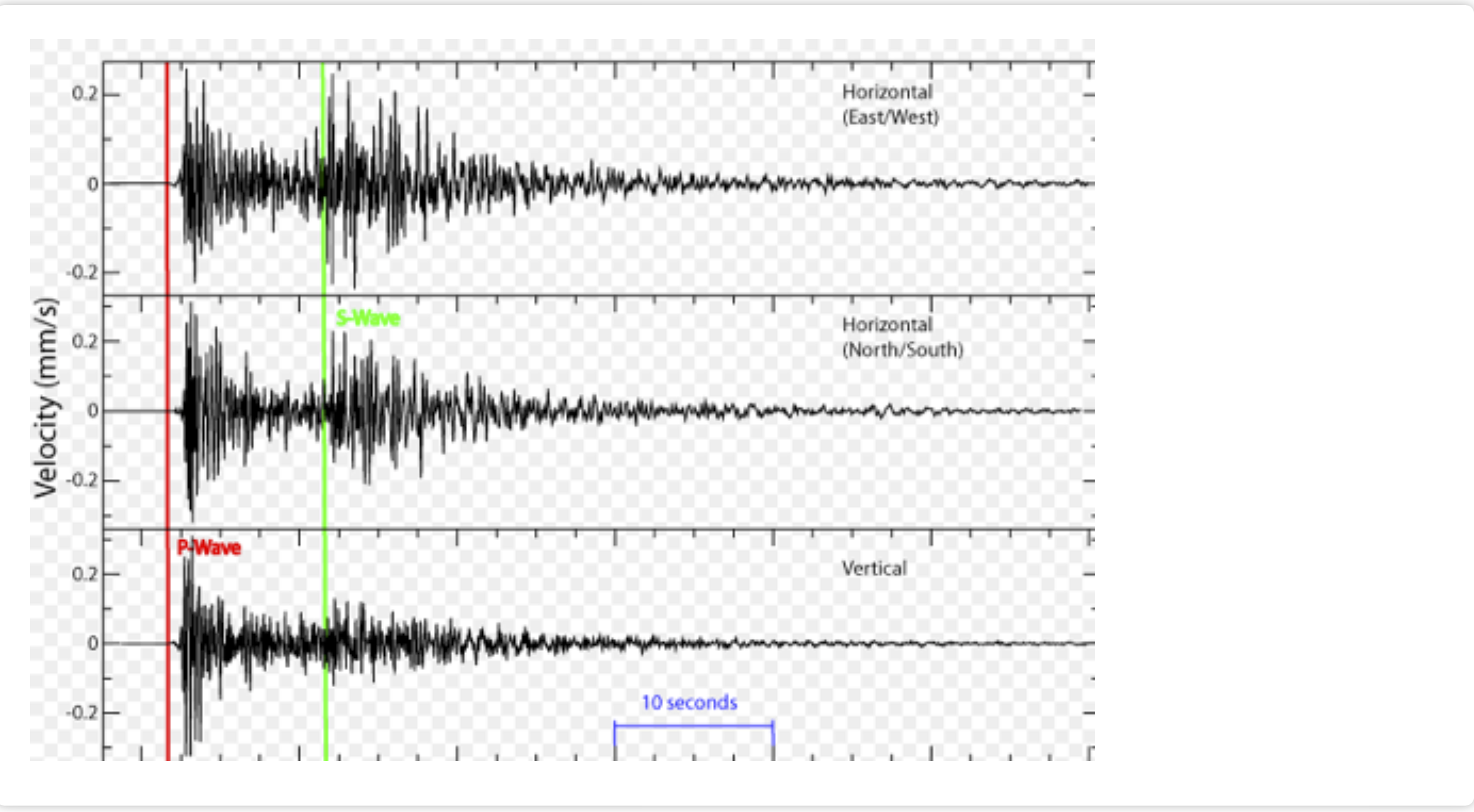
- Look at the HPA Pacific Tsunami Warning Center (PTWC) seismograph here:http://www.fdsn.org/networks/detail/PT/
- Our Elab quake network here: https://shakenet.raspberryshake.org/
- Hawaii quakes here:https://volcanoes.usgs.gov/observatories/hvo/hvo_earthquakes.html
Click on some earthquakes and note the depth and the seismic image.
Key points:
- All elements up to Iron on the periodic table came from the big bang
- Earth was formed from materials created by first generation stars going supernova
- The core of the earth is made up of a rotating solid core surrounded by a liquid core
- The inner core creates our magnetic field, which reverses periodically
- Layers: crust-mantle-outer core-inner core
- Uranium in the core produces heat that travels to the surface by convection
- Tectonic plates on the surface move on top of the sticky asthenosphere because of this convection
- Spreading zones are were these plates are created, subduction zones are where they dive under others
- Subduction zones create trenches in the ocean and andesitic volcanoes (sticky lava, pointy cones)
- Hot spots in the crust can create basaltic volcanic islands like the one we are on (runny lava, broad cones)
- Earthquakes include P (primary, compression) waves and S (secondary, shear) waves
- P waves are faster and go through solids and liquids, S waves only travel through solids
Module 20: soils
- Igneous (fire)
- Sedimentary (layers)
- Metamorphic (Kafka rocks, just kidding: changed by heat and pressure)
Igneous= directly from magma, and can be either basalt (low melting point, like our island or oceanic plates) or granite (lighter, what continents are made of)
Sedimentary= just like it sounds, from mud, sand, or dust, usually in layers.
Metamorphic= changed by heat and/or pressure (slate, marble, or coal)
Soil-formed by weathering (chemical or physical) of parent rock
Soil Horizons:
Our Soil Sieve has 4 filters, with 5 layers:
- mesh 5 = 4 mm
- mesh 10 = 2 mm
- mesh 60 = .25 mm
- mesh 230 = 0.063 mm
- la niña-trench (cutway)
- why a trench and mountains there?
- plate-subduction (cutaway)
- why does it move?
- convection-heat (flow)
- where does the heat come from?
- core-uranium (core)
- where does uranium come from?
- big bang-star-supernova-Fe+-uranium (periodic table)
- so the core is radioactive? yes
- how do we know?
- earthquakes-nuclear testing (P and S waves)
- how do we know the plates move?
- submarine detectors WWII (magnetic ridges)
- Plates are formed at ridges, subduction zones (mark on globe)
- what are hotspots then? weak spots in the plates (Hawaii)
- have they always moved? (yes, not always straight-Hawaii)
- yes-wegener-fossils (fossils)
- what was the supercontinent called? pangea (map)
- continents float on crust, crust moves (cutaway)
- plates go under continents, form Andesitic volcanoes (red cutaway)
- hotspots are pure magma from the core, Basaltic volcanoes (cutaway)
- where are these? (mark on globe)
- how does this impact wine? (biomes+volcanoes)
- why do we care? (agriculture=soils+water+temp)
- plates moving: fault lines
- two types: slip and transform
- slip causes massive land based earthquakes (san andreas, SF 1906)
- transform causes tsunamis (Bali quake, puako)
- earthquakes: P and S waves (P S earth again)
- epicenter vs. hypocenter (diagram)
- how calculated? (exercise)
- fracking and quakes (lubrication)
- prediction (radon emissions)
- tsunamis-transform faults or submarine landslides (diagram)
- 600 mph, rise only when close to shore CV-64
- tsunami=harbor+wave
- Mauna Loa, Nuuanu slide
Why a trench and mountains there?
What is a subduction zone?
Where does the heat come from?
Why is it still hot? (Ussher 4000 years)
Where does the Uranium come from?
Which ones are formed in first generation stars?
Anything after that on the periodic table comes from a supernova:
So the core is radioactive? Yes.
Nuclear bomb testing:
How do we know the plates move?
What are hotspots then?
Here's the whole picture:
Have they always moved in the same direction? No:
How did Wegener's idea get proven? Fossils (https://www.youtube.com/watch?v=jVMLaR4GC-w)
Super continent was called Pangea
Andesitic volcanoes form where plates go under continents:
Where are these on the planet?
How does this impact wine?
Agriculture = soils + water + temp (temperate biomes anyone?)
As plates move past each other, they create fault lines (cracks)
Three types: slip faults and transform faults (normal or thrusting)
Transform faults caused the San Andreas quake
Back to earthquakes:
- How much stronger is a magnitude 7 quake than a magnitude 6?
- 7 to 5?
- 7 to 4?
Nuuanu slide:
From our work on biomes, and next our work on plate tectonics, map the following on your globes:
- look up where wine is grown on our planet
- agriculture is based on what plants need and like: sunlight, temperature, water and soil
- wine grows best in soils that are volcanic in origin (Andesitic)
- wine also needs temperate zones and enough water
- explore where these things intersect
- challenge question: If you wanted to grow grapes for wine, knowing that climate change will move all biomes away from the equator, where would you buy land today?
Soils
Soils provide minerals, hold moisture, allow air to pass, create a space for living creatures and bacteria, and physically hold plants to the ground. Without soil, agriculture as a whole would fail (there are small exceptions, like hydroponics)
We'll cover two aspects of soil: physical and chemical
physical aspects:
All soil comes from three parent materials (rocks):
- Igneous rocks (fire)
- Sedimentary rocks (layers)
- Metamorphic rocks (Kafka rocks, just kidding: changed by heat and pressure)
Igneous Rocks:
- Comes directly from magma, and can be either basalt (low melting point, like our island or oceanic plates) or granite (lighter, what continents are made of)
- Granite breaks down into light-colored sand, makes for fertile soil.
- Basalt (like Hawaii) can make sand too, but less fertile (e.g. black sand beach).
- Fun fact: you can melt any rock on our island (not coral)
Sedimentary Rocks:
- just like it sounds, from mud, sand, or dust, usually in layers.
- you may have seen these in rock formations or cliffs
- often formed from layers of decaying stuff (plankton, diatoms)
Metamorphic Rocks
- changed by heat and/or pressure (slate, marble, or coal)
- Soil-formed by weathering (chemical or physical) of parent rock
- Erosion can be by water or air (wind)
- always read clockwise
- make sure to read each type (3)
- mesh 5 = 4 mm
- mesh 10 = 2 mm
- mesh 60 = .25 mm
- mesh 230 = 0.063 mm
- These physical aspects impact the ability for soil to hold water and allow air between the spaces
- Smaller particles hold water better (capillary action, remember?) but don't allow air to pass
- Larger particles drain faster, enabling air passage, but have lower nutrient values (because they are washed so much) and hold water less
- Organic particles (decaying plant matter) hold water like a sponge, making a perfect combination
- We measure these as:
- Water holding capacity: the amount of water held in the soil
- Permeability: the ability for water to transit through the soil
Chemical aspects:
- Clay soils have a negative charge, so they attract positive ions (cations)
- These cations can be released for use by the plants as nutrients
- We measure this as CEC or cation exchange capacity
- too much clay (>20%) makes the soil waterlogged (no air) so the roots die
- neutral pH is 7.0
- Ca, Mg, Na and K are all soil bases, as they can counteract Al and H+
- soil acids stop growth, soil bases promote health
- the amount of bases in a soil is called Base Saturation and can be measured with pH
- High base saturation and high CEC will be productive
- critical for plant growth
- can be added by fertilizers (NH4NO3, ammonium nitrate)
- petrochemical fertilizers use natural gas (CH4) with N2 from the air to form these
- fruits and roots
- needed for root crops to develop
- limiting nutrient, in excess can cause eutrophication in water bodies
- critical in plant immunity from disease and pests
- not a limiting nutrient per se, but critical to health of the plant
20% P
15% K
Organic fertilizers provide these and other trace elements (Ca, Mg, Na) slowly, as done in nature
Petrochemical fertilizers, usually derived from natural gas are much stronger, and impact the plants much quicker
Nitrogen and Phosphorus are growth limiting nutrients, very important when we discuss watersheds.
Some terms and concepts we need to understand first:
- gases can hold more water (liquids into gases) when hottoer
- liquids can hold more gas (gases into liquids) when cooler
- DO means dissolved oxygen, the measure of the oxygen dissolved in water
- High DO is good for fish
- Hot water lowers DO (thermal pollution from power plants)
- photosynthesis from plants raises DO
- cooler water or agitated (aerated) water raises DO
Process:
- fertilizers (N and P) cause algae in a body of water to grow very quickly
- this algal bloom then dies, falling to the bottom of the water body
- as it decays, it consumes all of the dissolved oxygen in the water, killing fish
What comes along with this drainage?
- sediments (makes water murky)
- nitrogen fertilizer (farm runoff)
- phosphorus fertilizer (farm runoff)
- animal waste: N and P in chicken manure
- thermal pollution (power plants)
- pathogens (animal waste)
- drugs, chemicals (from city water treatment plants)
- minerals (acid mine drainage)
- sediments: block sunlight from getting to plants in the water, lower dissolved oxygen
- nitrogen: causes algae blooms, then eutrophication
- phosphorus: major cause of eutrophication
- thermal pollution: lowers dissolved oxygen content in water
- pathogens: kill animals downstream
- drugs and chemicals: mutate creatures in the water body
- shallow (very warm)
- murky (little photosynthesis)
- phosphates (algal blooms)
- nitrogen (algal blooms)
- city water treatment (hormones, drugs)
- calm (no aeration)
- slow flow (no water changes)
- thermal pollution (power plants)
Module 5: phosphorus and water cycles
Module 6: Net Primary Productivity
Module 7: Trophic levels, food chains
- Bio-geo-chemical cycles: bio=life, geo=earth, chemical=chemical
- These are cycles as the go from some reservoir through the environment and back
- These are known as sources and sinks
- Often the reservoir will be the key to identifying the cycle
Carbon cycle:
Notice:
- fast processes involve living things (you eat sugar, exhale carbon dioxide)
- slow processes involve minerals, rocks and soil, hydrocarbons, and the oceans
- photosynthesis: light energy creates chemical energy (e.g. sugar)
- respiration: oxygen combines with sugar or other carbon fuel, releasing carbon dioxide and energy
- chemosynthesis: same process only using heat instead of light, sulfur instead of oxygen (look on periodic table)
- aerobic respiration: uses oxygen
- anaerobic respiration: uses carbon based fuels without oxygen, much less efficient
- carbon stored in the ocean as carbonate (H2CO3)
- carbon stored in corals as CaCO3
- carbon sediments can turn into fossil fuels (coal, oil, natural gas) with time, heat and pressure
- steady state: sources and sinks are equal
- fossil fuel extraction: combines with oxygen to form carbon dioxide and energy (reverse of photosynthesis)
- released CO2 increases the heating of the earth:
This has caused the planet to warm like a greenhouse, since fossil fuels were used as fuel (coal, then oil and natural gas):
Nitrogen cycle:
- Nitrogen is in the air as N2, a diatomic molecule
- We can't metabolize this as is, it needs to be incorporated into plants or animals we eat.
- Nitrogen goes through many changes to get from the air to food, usually involving oxygen
- Nitrogen fixation "fixes" nitrogen in the air into forms plants can use, either biotically (living things) or abiotically (not living things):
- nitrogen fixing bacteria (often along roots) fix nitrogen gas (N2) into ammonia (NH3)
- this is converted into ammonium (NH4) which plants can use
- lightning or fires have enough energy to combine N2 with O2, making NO3
- NO3 is carried to the ground with rain (the rain smell)
- can also be done using the Haber process for chemical nitrate synthesis
- ammonium (NH4) converts to nitrite (NO2)
- NO2 converts to NO3 (nitrate)
- commercial fertilizers are something with NO3, like NH4NO3, ammonium nitrate (a potent explosive: Beirut port explosion)
Summary:
- Nitrogen causes algae to bloom
- Algae dies, falling to the bottom of the water body
- As it decays, it consumes the Oxygen from the water: dead zones
Phosphorus cycle:
- Phosphorus is used as an energy molecule: AMP, ADP, ATP use P bonds to store energy
- P is also a key component in DNA and RNA
- P is a limiting nutrient for plants, along with Nitrogen
Trick AP question: which cycle has no gas phase component?
P is carried as dust from the Sahara to the US, and from the Gobi desert to Kauai (!)
Usually in the form of phosphate (PO4)
- assimilation
- mineralization
- sedimentation (like sedimentary rocks)
- uplift
- weathering (erosion)
Dead zone, from watershed:
Water (hydrologic) cycle:
- Transpiration: when water leaves plants through leaves (not the same as evaporation)
- Evaporation: when water changes from liquid to gas phase (vapor)
- Condensation: when vapor forms into drops (liquid)
- Precipitation: when water drops fall from the sky (rain)
- Evapotranspiration: a combination of sunlight, wind, humidity, temp, to increase transpiration from plants (known as EtO)
- Runoff is when water moves across land into other bodies of water
- percolation is when it flows through soil (like in your soil lab)
Note what drives this entire cycle is solar energy...
- Competition: one wins, one loses
- Could be energy, food, mates, money, whatever
- Competitive exclusion principle: only one winner (assumes a limited resource)
- This impacts evolution: if there is overlap between two competitors for a limited resource, natural selection will favor the ones that don't overlap, since they don't have to compete for those resources:
This is called Resource partitioning (biologists love words like this)
Predator-prey and other fun stuff:
- Predation: one lives, one dies, example lion eats a zebra
- Parasitism: one lives, other lives off of them (bad manners to kill the host), example worms
- Mutualism: both win, example Egrets on back of horses or cows: egrets eat bugs, horse protects the egrets from ground predators
- Commensalism: one wins, the other does not care, example orchids growing on branches
- Herbivory: only plants die (e.g. cows)
- Recall: troph = food
- Autotrophs make their own food (photosynthesis)
- Examples: plants
Trophic levels explain how energy (food) moves up through a food chain
Simple food chain:
- Consumers are known as heterotrophs (hetero=not same, troph = food)
- Herbivores (herb=plant, vore=eat) eat plants, and are primary consumers
- Consumers that eat other consumers are known as carnivores (carne=meat, vore=eat) or secondary consumers
- Tertiary consumers eat secondary consumers
- Apex predators have few predators for them, e.g. sharks, humans (cannibals don't count, and they don't eat clowns, they taste funny)
- Trophic levels are each stage up the food chain
- Only 10% of energy moves up each level (why?)
- reproduction
- metabolism (grazing etc.)
- avoiding predators
- romping with friends
- scavengers: eat dead animals, e.g. vultures
- detritivores: eat decaying matter, e.g. beetles (not the Beatles, that's something else)
- decomposers: break down decaying matter, e.g. bacteria
Back to the 10% rule:Just like Marty had to romp around, and in some cases run away from Alex, some energy was used for other things (reproduction is included, though Marty did not have kids that we know of...)
Make sure you understand this: just take one zero off for each level...
Also make sure you can duplicate a complex drama like this:
Or this wetter version:
- Review of Biogeochemical cycles:
- https://elab.hpa.edu/apes/videos/bozeman_science/Biogeochemical%20Cycles.mp4
- Ecosystem ecology:
- https://elab.hpa.edu/apes/videos/bozeman_science/Ecosystem%20Ecology.mp4
- Energy flow in ecosystems:
- https://elab.hpa.edu/apes/videos/bozeman_science/Energy%20Flow%20in%20Ecosystems.mp4
We are moving from the physical sciences elements of environmental science into the biological elements. We'll follow these with studies of energy, health and pollution, including climate change.
The Bio modules:
- mod 6 Net Primary Productivity
- mod 7 trophic levels
- mod 1 competition
- mod 8 biodiversity-M&Ms
- mod 9 ecosystem services
- mod 10 biogeography
- mod 11 ecological tolerance
- mod 12 disruptions
- mod 13 adaptation
- mod 14 ecological succession
- mod 15 population dynamics r, K
- mod 16 carrying capacity-lynx-hare
- mod 17 age distribution
- mod 18 human population
Net Primary Productivity: The rate of turning solar energy into organic materials
From last week: photosynthesis (water, CO2 based) or chemosynthesis (sulfur based) turn energy into organic compounds (light+water->sugar)
- Autotrophs= auto (self) troph (food)
- also known as Producers in the food chain
- GPP: gross primary productivity = all energy into all food
- NPP: net primary productivity = gross - energy of respiration
- Net is usually only 25-50% of gross (not much)
- Fun fact: your body is only about 33% efficient, the rest goes to heat
- Same with your gas powered car...
If this were a business, they would charge 20$ for a shirt, that cost them $12, so they only make $8 per shirt. Not good business.
This is most efficient where there is lots of solar radiation, biomass and water:
Net vs. Gross is easy to understand:
- If your business takes in money, this is your gross income, say 100$
- If your materials cost 20$, then your net income would be 80$
- Ecosystem services: processes by which clean water, timber, fisheries and ag crops are produced
- Provisions: goods humans can use: timber, food crops, plants
- Support systems: pollinators (bees), water filtration (soils)
- Cultural services: aesthetics (John Muir, Ansel Adams)
- Monetary value: lumber, fishing, tourism, ecotourism
Size of islands determines number of species on an island: bigger island=more species
Species-area curve:
Dependent on several factors:
- colonization: how many new species can make it to the island
- extinction: how many species die out
- distance from each other: greater separation=fewer species
All individuals have an ecological tolerance
Their best place is called a fundamental niche: a place where they not only survive, or survive and grow, but can reproduce:
- You can also see this as a "goldilocks zone" (same concept used to discover exoplanets that may host life)
- The actual place they live is a realized niche
- Climate change is causing animals which can migrate to meet their fundamental niche away from the equator
- This happens in plants, but since they cannot migrate this happens slower:
Changes beyond the organism tolerance can cause extinction (e.g. if they cannot migrate)
- Biggest was the Permian extinction about 250 my ago (see graph) likely caused by the Siberian Traps (PBS video I sent you)
- Next biggest was the K-T extinction about 65 my ago (dead dinos) caused by an asteroid the size of mount Everest hitting the Yucatan area (again, in the PBS video)
- Sixth mass extinction is the Anthropocene (human caused)
- PBS video: https://www.pbs.org/wgbh/nova/video/ancient-earth-humans/
Three varieties of ecosystem disruptions (non human)
- Periodic: cycles of day, month, year
- Episodic: 100 year floods, sunspot cycles
- Random: Hurricanes, volcanic eruptions
- Resistance: the ability to resist change in a stress (energy, matter, etc.)
- Resilience: the ability to recover after a stress: Stability
Implications of climate change:
Positive feedback: increased temp melts sea ice, reduces albedo, increased warming
Evolution: Natural selection (vs. artificial selection)
Needs three things, in order:
- genetic variation (e.g. longer neck giraffes)
- some stress that favors that variation (e.g. drought)
- survivors reproduce to carry on the new variation (longer necks)
- dogs, other pets for certain traits
- food crops, for greater yield, resistance to pests (GMO crops)
- humans in the future (?) also known as eugenics (Nazis played with this idea)
Usually dependent on soil, water, light energy or temperature
Primary Succession example: drive up from the coast: lava->fountain grass->small bushes->large shrubs->small trees->large trees->forest canopy
- Note that bare lava (or other rock) can only support lichens and mosses
- In our case, dust from wind and fires lodges in crevasses in the lava
- Moisture collects there, enabling seeds to survive (fountain grass)
- As the fountain grass dies, burns, or other cycle, biomass builds in the cracks, holding water through a season
- Small bushes can then survive through a drought
Climax community: tree canopy forest or mature pond with sediment
Indicator species: impact of changes show up first in these, demonstrating impact of change (e.g. frogs in the Potomac River)
Review:
- Generalists can survive in a wide range of conditions
- Specialists exist in a narrow range
- Niche refers to this range where they can exist and reproduce
- r selected (r means rate) species grow exponentially until they reach or exceed the carrying capacity of the ecosystem (fish, bacteria)
- K selected species grow slowly and reach the carrying capacity (humans, whales, elephants)
- Carrying capacity (K) refers to land, water, food or other biotic requirement for the species
- Biotic potential is the reproductive rate if there were no limits
We describe these r and K species also by their survivorship curves:
Simple version:
What does this mean?
- Dandelions have many offspring, most of them die, the survivors live on
- Whales have few offspring, take care of them, then live on
- Squirrels die randomly, same for birds, they crash into stuff, old or young
- Where would deer fit into this diagram? Hint: they are another different line
Some math to understand this:
At = Ao/2^n or At = Ao* (1/2^n) where n is the number of half-lives
Populations have doubling times, the time for the population to double, using the same formula:
At = Ao*2^n where n is the number of doubling times
Take a piece of paper, cut it in two, record your result on a table as you do this 6 times
What was your final total?
Now do this starting with several sheets of paper (be creative), do this 6 times and record on a table.
When you start with one sheet, Ao is one
When you start with several sheets, Ao is the number
r in this case was 0.693 (a very important number)
t is the number of times you tore the paper
Test this out with your calculator
Here's what this looks like, called J-shaped growth:
So simple J growth looks like this:
∆N/∆t = rN
∆t means change in time
r means reproductive rate
N means initial population
so, ∆N/∆t really means growth rate or slope of the growth curve
- Initial population (N)
- reproductive rate (r)
Examples: humans, whales and elephants
We use a different equation for this, but it is really the same equation:
∆N/∆t = rN(1-N/K)
K is the carrying capacity of an ecosystem:
Look at the formula:
∆N/∆t = rN(1-0) or ∆N/∆t = rN
(J shaped growth again)
As the population approaches K the value in the parentheses becomes 0 (no growth) then negative (die off or overshoot):
- Density dependent factors: food, water, land
- Density independent factors: disasters (flood, fire)
Try this formula with an island that can hold 100 rabbits, using the numbers above (50% growth rate).
Try this with 50 rabbits, 100 rabbits, 150 rabbits.
What is the value of ∆N/∆t in each case?
What does this mean about the slope of the growth curve?
From Wikipedia:
Predator prey simulators:
Interesting math stuff: (optional)


The differential equation is solved by direct integration:


- Carrying capacity for the earth: about 9 billion
- Malthus: exponential growth of population, linear growth of food supply (ignores innovation):
Population inputs:
- Immigration
- Births
- Aliens landing on earth
- Emigration
- Deaths
- People moving to Mars
- CBR: crude birth rate: births per 1000 people per year
- CDR: crude death rate: deaths per 1000 people per year
- Global population change: (CBR-CDR/10) notice that 1000/10 = 100 so it looks like a percent
National population % growth rate =
[(CBR +immigration)- (CDR+ emigration)]/10
- In words this says all things coming in, minus all things going out, divided by ten is the national growth rate in percent (per hundred)
- Births are easy to calculate (except in rural areas where some live, some don't and are rarely reported)
- Life expectancy: average number of years a newborn is expected to live
- Global: 73 years (70 men, 75 women)
- US: 79 years (76 men, 81 women)
Infant mortality: number of deaths for children under 1 year per 1000
- men on left, women on right
- kids at bottom, old people at top
- bulges are greatest populations
- look for:
- wars (on whose soil?)
- famine
- immigrant workers
- pyramids
If the replacement ratio for stable population is 2.1 kids per woman (why?) is a parallel age structure diagram stable or declining?
This is also known as "replacement level fertility"
Total fertility rate: TFR: total number of children each woman will have in her lifetime between 15 and 49 (does not count men, divorce, death of spouse)
Time to visit gapminder.org: https://www.gapminder.org/tools/?from=world#$chart-type=bubbles&url=v1
Millenium UN goals:
Look up the life expectancy of men and women your parents' age
Compare with someone born in 1900
How many were farmers then?
Now compare the life expectancy image with this one: (infant deaths before age 1, child deaths under age 5)
One reason the one year birthday is such a big deal here in Hawaii
- clean water
- health care
- food supply
- sanitation
- lower pollution
Sweden: 2.5
Why?
Not just about countries...
US: 5.8
African American: 12
Native Americans: 7.6
Caucasians: 5.3
Why?
Social, education, income, food supply, food deserts, diet
US: 15% over 65, CDR is 8/1000
Terms to know: Human Populations-----------------------------
Fecundity: the ability to reproduce
Fertility: production of offspring
CBR: crude birth rate: births per 1000 people
TFR: total fertility rate: total kids per woman in her lifetime (25-30!)
ZPG: zero population growth: 5+ where infant mortality is high, 2.1 is normal
China: was 6 -> 1.8 (below replacement level since 1979, one child policy)
China has a 140/100 male to female ratio: why?
Global TFR is 2.6
CDR: crude death rate: deaths per 1000
Why is there a life span? mitochondrial DNA...
1900 Indian man had life expectancy of 23! Trace this to now...
Not now, reasons: nutrition CLEAN WATER, sanitation, education
75 men, 85 women (testosterone, war, "hold my beer and watch this!", Darwin Awards)
Dependency ratio; baby boomers and your future: how many workers to retirees
imagine your life at your age in other countries...
Russia low TFR: alcoholism and antibiotic resistant Tuberculosis
Recall exponential growth:
- At = Aoe^rt where r is the reproductive rate in % and Ao is the original population
- We need to know how fast a population is growing better than just % growth rate
Here's how:
Here's why:
- When the population doubles, the ratio of At/Ao is 2
- If At/Ao = 2 = e^rt then ln 2 = rt = 0.693 (mysterious thing: look up the ln of 1/2 and 2, see?)
- so, 0.693 = rt, then t = 0.693/r
- since r is in percent, then 70/(growth rat in %) = time to double the population
IPAT: Impact = Population x Affluence x Technology
- An r-selected species has a growth rate of 12%. If the initial population is 200, what will be the population at year 5? (hint: use the Nt = Noe^rt formula)
- What is the doubling time for this population? (hint: use 70/% to get doubling time)
- If the carrying capacity of a separate K selected species is 100, what will the slope of the growth curve look like when the population is 95?
- What will it look like when the population is 120, and what do you call this?
Solution:
See also chapter 12 in Frog Book (iPad)
History of Agriculture:
- Hunter gatherer tribes 60,000 BCE: no fixed location, no cultivation, no domestication of animals
- First ag revolution 11,000 BCE: localization, cultivation of plants, domestication of animals (guns, germs, steel)
- Second ag revolution: 1600-1930: mechanization of planting, harvesting, storage, tractors, moved from subsistence farming (just for one family) to community farming
- Third ag revolution: 1940: Green revolution: used Nitrogen based petrochemical fertilizers (Haber process), petrochemical insecticides (nerve gases from WWII), irrigation and development of agribusiness:
Agribusiness:
- just what it sounds like, the larger conglomerates taking over instead of smaller privately owned family farms.
- Often use monoculture crops to increase profits (economy of scale), as well as patented seeds and herbicides (e.g. "roundup ready corn")
Hybrid crops vs. GMO crops:
Started as a good thing:
Hybrid crops"Selective breeding" works for animals (dogs, etc.) and crops called "hybrid crops" created by mixing pollen from one breed of plant (e.g. large kernel corn) with another breed of the same plant (e.g. short stalk corn) to form a "hybrid".
Green Revolution, Norman Borlaug-Mexican famine averted by development of hybrid (not GMO) wheat, called dwarf wheat (large kernel, short stalk).dwarf wheat
GMO crops:in the beginning were just to withstand frost, now into a larger patent issue with GMO seeds and "round up ready crops"What is the impact on lesser developed countries of this business model?
Genetically modified organisms (GMO) are different: they are done by splicing one part of a gene from an organism (like a frost resistant bacteria) into a totally different species (like a tomato) to make it frost resistant."IP" means intellectual property
- Monsanto spends money creating GMOs, so they patent the process, meaning using their seeds requires an IP license from them (just like software).If your farm has these seeds, intentionally or by accident, you have to pay them.
- You also cannot "re-use" seeds in the next season without paying for them.
- This is just like software in that you could buy the software or pay a monthly fee to use it.
- Which makes more money for the company?
- What is the impact on poorer countries?
Roundup ready corn: seeds genetically modified to resist roundup (a herbicide)
- Result: plant their seeds, spray their herbicide and save money on weeding, more crops, more money (to whom?)
- Issue: exposure to roundup (a carcinogen) and possible impacts of mutated food
- Labeling? Where is this done so far?
GMO from Food inc.
High Fructose Corn Syrup: HFCS
- Corn Lobby is very powerful (Iowa=presidential primaries)
- Corn: HFCS (food, meat, fish) and Corn Ethanol (energy, fuel)
- HFCS is in everything
- Corn is used to feed cattle, pork, poultry, even fish
- Cattle are not used to metabolizing corn, it makes them sick
- Bad for humans, increases incidence of diabetesHFCS from Food inc.
Main farming problems:
- Irrigation-desertification
- Pesticides-persistent organic pollutants (POPs)-like in your water hunt
- Fertilizers-eutrophication
Pesticides and herbicides:
- can be persistent or not (DDT, round up)
- Invented during WWII to kill humans (nerve gases, nazis), ("homicides")
- Modified to kill pests ("pesticides") or insects ("insecticides")
- Special cases include rodent poisons ("rodenticides") and others, like plants ("herbicides")
- Pesticide resistance-much like COVID: genetic variation in a rapidly multiplying pathogen will eventually overcome the stress (recall evolution) by replicating only those with immunity to the stress (vaccine, pesticide, drug resistant TB)
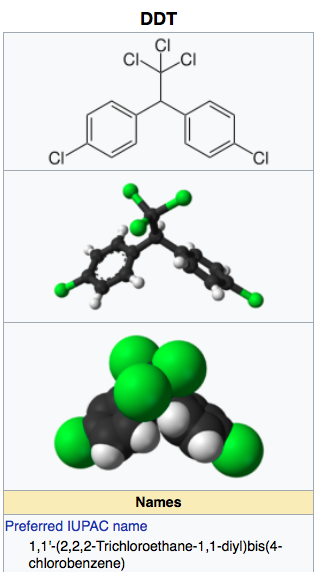
Haber process enabled nitrogen from the air to be chemically grouped with other compounds to form fertilizers like Ammonium nitrate: NH4NO3
This process uses huge amounts of petrochemicals, so these fertilizers are attached to the cost of oil (not coal)
Monocropping: large plantings of a specific variety (very low Shannon's index), so vulnerable to pests, diseases.
Energy Subsidy: amount of energy (including petrochemicals) needed to produce a kg of any food:
- Plowing: turning over soil, flipping soil horizons
- Tilling: stirring, digging, cultivating soil, moves organic matter deeper into the soil
- No-Till agriculture: leaving the topsoil intact, preserves microorganisms, roots, prevents erosion
- Slash and burn ag: Amazon rain forest, Indonesia oil trees
- Petrochemical fertilizers and insecticides: huge energy input, dependence on fossil fuels (oil, natural gas)
- Natural gas (methane, CH4) combined with N2 from the air to produce NH4 and others
See also Chapter 11 in the Frog Book (iPad)
Check out windy.com, zoom forward to Wednesday Nov. 29
Tragedy of the commons:
- First use of the term: 1833, village commons overgrazed (what is a commons?)
- Garret Harding 1968: modern use of the term to describe any public resource that is abused (no ownership)
- Think of places like this in your life: dorm commons, locker room, student union
- Basic premise: if nobody "owns" the resource, it eventually becomes abused
- Tragedy: nobody wins (fun fact: look up the Greek origin of this word)
- Is private ownership a solution? Lahaina fires were fed by neglected invasive grasses in the privately owned lands uphill...
- Possible solution: community ownership
- Externality: shedding financial responsibility for your impact the the whole
- If your company produces pollution, and expects the community or government to clean it up, it costs you nothing, you have "externalized" your cost (the cost is "external" to your business)
- This could also be used to refer to a resource you use without paying for it
- Think of places this happens in our community...
- Create an example here in class: someone makes money doing something, the community pays the price
From your frog book (iPad):
"Sustainability = thinking about forever"
Also: native peoples: "seventh son of seventh son"
In the US, we classify public lands as
- Rangelands-open range, enables some ranching with leases (like the series "Yellowstone")
- National forests-old growth and new growth, limited forestry
- National parks-national treasures, limits on visitors, infrastructure (e.g. Denali)
- National wildlife refuges-usually associated with an endangered species or transit/migration path (e.g. wolves)
- Wilderness areas-no development, often noise abatement as well (think of helicopters in Waipio or Haleakala)
We have several of these national parks here in Hawaii: https://www.nps.gov/state/hi/index.htm
- Kilauea Volcano (Madame Pele)
- Haleakala ("House of the sun")
- Kaloko-Honokohau ("City of Refuge")
- Pearl Harbor
- Pu'u Kohola (Whale Heiau)
- Papa hanau moku a kea-Northwest Hawai'ian Islands NWHI
- Ala Kahakai (shore trail on this island)
Federal lands: owned by the people, but can be leased to individuals
Two ethics are in competition:
- Resource conservation ethic-maximum use based on greatest good for everyone, usually preservation
- Multiple use lands-designated lands for grazing, timber, minerals, leased to individuals or companies for profit
USFS: Us Forest Service
FSC: Forest stewardship council:
- no clear cut
- no damage to land
- replanting
- selective cutting
- underbrush considerations
FSC wood-how different?
- USFS (US Forest Service) believes in regular forest fires to deplete the amount of underbrush (as in nature)
- See also California and Australia wildfires: drought, no regular fires, buildup of underbrush
- See Yellowstone fire of 1988-result of overgrowth of underbrush
- Also 2009 SoCal fires and 2000 Los Alamos fires accident
- https://www.northcountrypublicradio.org/news/npr/94114095/series-overview-yellowstone-s-evolution
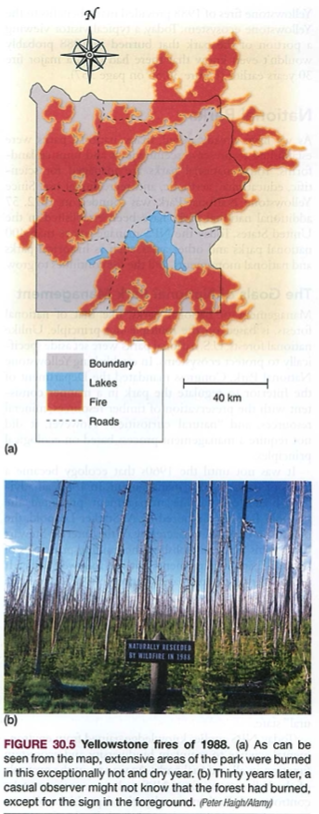
Also significant native peoples monuments (see above)
Know these:
- BLM: Bureau of Land Management
- USFS: US Forest Service
- NPS: National Park Service
- FWS: Fish and Wildlife Service
NEPA: National Environmental Policy Act 1969 (why then?)
- Mandates an EIS for all development
- EIS (environmental impact statements) are new standard for any project
- ESA endangered species act-often brought in where development could impact ES
Classifications: note recreation is part of each
- US Forest Service: timber, grazing, recreation
- National Park Service: recreation and conservation
- Fish and wildlife service: conservation, hunting, fishing, recreation
- Bureau of land management (BLM): grazing, mining, timber, recreation
- Land management, conservation ecology
- "Land Ethic": moral responsibility to protect nature (for all, including next generations)
- Compare with William McDonough: cradle to cradle: "How do we love all the children of all species for all time?” Not just our children. Not just our species. Not just now. All the children, of all species, for all time"
Henry David Thoreau-Walden "truth in nature and wilderness over the deceits of urban civilization". 1845https://en.wikipedia.org/wiki/Henry_David_Thoreau
Ansel Adams: Photographer championed the National Parks: 1920-1980
- "More than any other artist of the century, he would help transform the meaning of "wilderness" in America and change what people thought and felt about their own land"
- "It's a place that you step into, and you don't know what's going to happen, a place that can surprise you, it's a place where you are small, where being small is not a bad thing, where being small is actually a wonderful thing"-Carl Pope, Sierra Club
- "...The world is beautiful, that humanity is part of this larger world, that the concerns of the moment are part but not separate from a larger system of forces that that connect us to all of creation"Jonathan Spaulding, Biographer
Question: How did his photographs change the awareness of the public? People usually care about what they know...
Aldo Leopold-environmental ethics, wildlife management, conservation, Sand County Almanac (Wisconsin) https://en.wikipedia.org/wiki/Aldo_Leopold
John Muir-started the Sierra Club: "wilderness mirrors divinity, nourishes humanity and vivifies the spirit"
Rachel Carson-silent spring DDT (persistent pesticide, weakens bird egg shells), 1963:
- Rangeland: open dry grasslands for grazing
- Forests: land dominated by trees
- Clear-cutting: all trees, regrowth is all same age trees, promotes erosion, wildfires (litter)
- Selective cutting: older trees first
Recall our main themes: energy->water->food->culture
Food!
Three main groups:
- Proteins: always include Nitrogen
- Carbohydrates: CHO in chains (starches) or simple (sugars)
- Fats: CHO again, but in a special branch structure (glycol backbone) that is good for energy storage and insulation (e.g. killer whales, eskimos)
Proteins: complex molecules of CHO and N.
- Look up amino acids, note the common structure.
- Now look up the amino acid methionine.
- What element does it contain as well?
- Why do rotten eggs, swamps (and Kilauea volcano) stink?
CHO=carbohydrates (clever name),
- usually in a chain, short chains are sugars (used for fuel),
- longer ones are starches and can be used for structures (e.g. cellulose in plants) or pasta...
- smallest: sugars, all end in -ose (glucose, sucrose) LOOK THESE UP, CHECK OUT THEIR MOLECULE SHAPE
- glucose is a "monosaccharide" created by photosynthesis
- longer chains: starches (rice, pasta) slowly digested (see diabetics, and glycemic index)
- structural CHO: cellulose-little boxes with goo inside, need enzymes to break these down (cows)
- ENZYMES ALL END IN -ASE
Fats/lipids: same chemical structure as CHO, but built along a glycol (alcohol) backbone.
- If the fats have long carbon chains with only single bonds, they are saturated (lots of Hydrogen atoms) and can hold together (e.g. animal fat)https://en.wikipedia.org/wiki/Saturated_fat
- If the long chains have double bonds and don't fit together, they melt easier (e.g. oils) and are called "unsaturated", usually better for your health.
- n.b. McDonalds® got into real hot water a while ago for frying all of their stuff in "supersaturated fats". Ugh...
Notes: Frog book
- Frog 12.3 Agriculture
- Frog 12.4 Food Production
- Trophic pyramids in nature are sustainable
- Planet is nearing carrying capacity (K)
- Think of how many "earths" your global footprint represents
- To meet this food demand, current farming and fishing is industrial, not sustainable
- Undernutrition: lack of calories
- Malnutrition: lack of critical part of diet, usually protein (Kwashiorkor)https://en.wikipedia.org/wiki/Kwashiorkor
- Food security: not just in lesser developed countries ("LDC"), also in the US"Food deserts"-what are these?
- Famine: one of these impacting a large group, often from crop failure, drought or war/displacement
- Overnutrition: common in the US, look up the US obesity rate-how is this determined? Why? Seen any food ads lately?
- Wait-Eskimos eat lots of blubber, why don't they have heart disease?
- How is this different from Kalahari bush tribes?Climate
- Wait, wait-what happened to Japanese health care system when they moved from their traditional diet?
- What impact does this have globally?
- Diet for a small planet 1971: planet can sustain population using fewer calories while supplying protein, vitamins and calories. Not by relying on meat.Vitamins="vital amines"
2.8 kg of grain to produce 1 kg of chicken (2.8:1 factor, or subsidy factor of 2.8)
Better to eat beef, chicken, fish or tofu? (you need protein in some form)
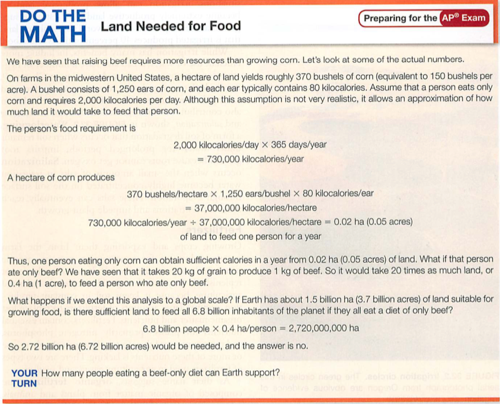
Industrial Farming (and fishing)
Agribusiness:
- Just what it sounds like, the larger conglomerates taking over instead of smaller privately owned family farms.
- Often use monoculture crops to increase profits (economy of scale), as well as patented seeds and herbicides (e.g. "roundup ready corn")
Hybrid crops vs. GMO crops:
Started as a good thing:
Hybrid crops"Selective breeding" works for animals (dogs, etc.) and crops called "hybrid crops" created by mixing pollen from one breed of plant (e.g. large kernel corn) with another breed of the same plant (e.g. short stalk corn) to form a "hybrid".
Green Revolution, Norman Borlaug-Mexican famine averted by development of hybrid (not GMO) wheat, called dwarf wheat (large kernel, short stalk).dwarf wheat
GMO crops:in the beginning were just to withstand frost, now into a larger patent issue with GMO seeds and "round up ready crops"What is the impact on lesser developed countries of this business model?
Genetically modified organisms (GMO) are different: they are done by splicing one part of a gene from an organism (like a frost resistant bacteria) into a totally different species (like a tomato) to make it frost resistant."IP" means intellectual property
- Monsanto spends money creating GMOs, so they patent the process, meaning using their seeds requires an IP license from them (just like software).If your farm has these seeds, intentionally or by accident, you have to pay them.
- You also cannot "re-use" seeds in the next season without paying for them.
- This is just like software in that you could buy the software or pay a monthly fee to use it.
- Which makes more money for the company?
- What is the impact on poorer countries?
Roundup ready corn: seeds genetically modified to resist roundup (a herbicide)
- Result: plant their seeds, spray their herbicide and save money on weeding, more crops, more money (to whom?)
- Issue: exposure to roundup (a carcinogen) and possible impacts of mutated food
- Labeling? Where is this done so far?
- Transgenic seeds?
- Can you patent life?
- GMO from Food inc.
Give examples...
Can also be used as a fuel: "gasahol" or E85 (85% ethanol, 15% gasoline)
Brazil: sugar cane->ethanol for cars
Iowa: corn->ethanol for cars
Iowa: corn needs petrochemical fertilizers, pesticides and GMO seeds
Net energy: 2 units of energy in for 1 unit of transportation fuel
Why?
"domestic energy supply"
Iowa primary (this week): no politician will ever go against corn or the corn lobby
Not really "domestic" if we use crude oil from Saudi Arabia to grow corn in Iowa.
Fun fact: "E-Free" gasoline (needed for small engines and all marine engines) has more power, better mileage and more energy per liter.
It is heavily taxed to promote E10 fuel (10% ethanol) or E85 (85% ethanol)
Why marine engines?
Ethanol dissolves fuel lines (ouch!)
- Corn Lobby is very powerful (Iowa=presidential primaries)
- Corn: HFCS (food, meat, fish) and Corn Ethanol (energy, fuel)
- HFCS is in everything
- Corn is used to feed cattle, pork, poultry, even fish
- Cattle are not used to metabolizing corn, it makes them sick
- Bad for humans, increases incidence of diabetes
- HFCS from Food inc.
Main farming problems:
- Irrigation-desertification
- Pesticides-persistent organic pollutants (POPs)
- Fertilizers-eutrophication
Pesticides and herbicides:
- Can be persistent or not (DDT, round up)
- Invented during WWII to kill humans (nerve gases, nazis), ("homicides")
- Modified to kill pests ("pesticides") or insects ("insecticides")
- Special cases include rodent poisons ("rodenticides") and others, like plants ("herbicides")
- Pesticide resistance-much like COVID: genetic variation in a rapidly multiplying pathogen will eventually overcome the stress (recall evolution) by replicating only those with immunity to the stress (vaccine, pesticide, drug resistant TB)
Haber process enabled nitrogen from the air (N2) to be chemically grouped with other compounds to form fertilizers like Ammonium nitrate: NH4NO3
This process uses huge amounts of petrochemicals, so these fertilizers are attached to the cost of oil and natural gas (not coal)
Fishing:
- Aquaculture means fish or other water animal farmed in the ocean
- Hydroponics means growing plants in a water/air medium
- Fisheries: population of fish, look up Atlantic Cod fisheries collapse in 1990
- Bycatch: unnecessary death of animals caught in fishing nets/traps (dolphins, sharks, etc.)
Mod 33: Sustainable agriculture (fishing too)
- Desertification (see above)
- intercropping vs. monocropping, see "the three sisters"
- Contour cropping: saves space, reduces runoff, preserves top soil (e.g. our garden, most of Asia)
- No-till ag: same idea, retains organic material in topsoil, reduces erosion by wind and water
- IPM: integrated pest management (see Lalamilo Farmers)
- Organic agriculture (also mentioned in Portlandia and Colin the Chicken)More than just N-P-K, also micronutrients, slower release time, low salinity
- CAFO: concentrated animal feed operation (e.g. chickens, pigs, cattle)Usually inorganic feed (purines), hormones and other drugs
- Methyl xanthines: caffeine, theobromine, theophyllineevolved plant poisons for insects:
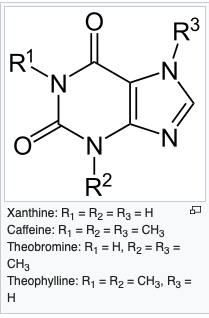
- Xanthine: group name
- Caffeine: energy drinks, coffee, soft drinks (to offset drowsiness from insulin spike)
- Theobromine: chocolate
- Theophylline: tea (also a bronchodilator-helps breathing)
- nicotine: tobacco
- caffeine: coffee, tea
- cocaine: coca plants
- Genetic Diversity: genetic variation among individuals in a population (e.g. redheads, blondes, black hair)
- Species Diversity: number of species in an ecosystem (moose, wolf, bear)
- Habitat Diversity: number of habitats in an ecosystem (forest, plains, swamp)
- Genetic variation occurs because reproduction is always a combination of factors: genetics, environment, even lifestyle (kinin potentiation: health impacts genetic variation)
- When a population suffers a massive reduction in population (e.g. whales being hunted) the total genetic variation in the remaining population is lower.
- This is called a Population bottleneck
- This makes them vulnerable to disease and threats that apply to that limited gene pool.
- A greater genetic variation, like ideas, makes for a richer population, able to survive and thrive in different challenging conditions.
- They are also able to diversify food sources, shelter and the ability to withstand environmental challenges.
- The opposite of this biodiversity has a perfect example: monocropping, where one threat can wipe out an entire group of crops (no diversity)
- Habitat diversity has two categories: specialists and generalists
- Specialists can only live in certain limited conditions, and tend to be located in niches
- Generalists can live in many conditions, and many invasive species tend to be generalists
- Species richness means many different species in an ecosystem
- Species evenness means no one species takes over
Migrated from Apple Server Wiki. Original page ID: o9Y8Y12