
25.08.20: science terms, method
Alternate resource: https://elab.hpa.edu/apes/texts/fr3e/friedland-relyea-3rd-edition.pdf
Scientific method:
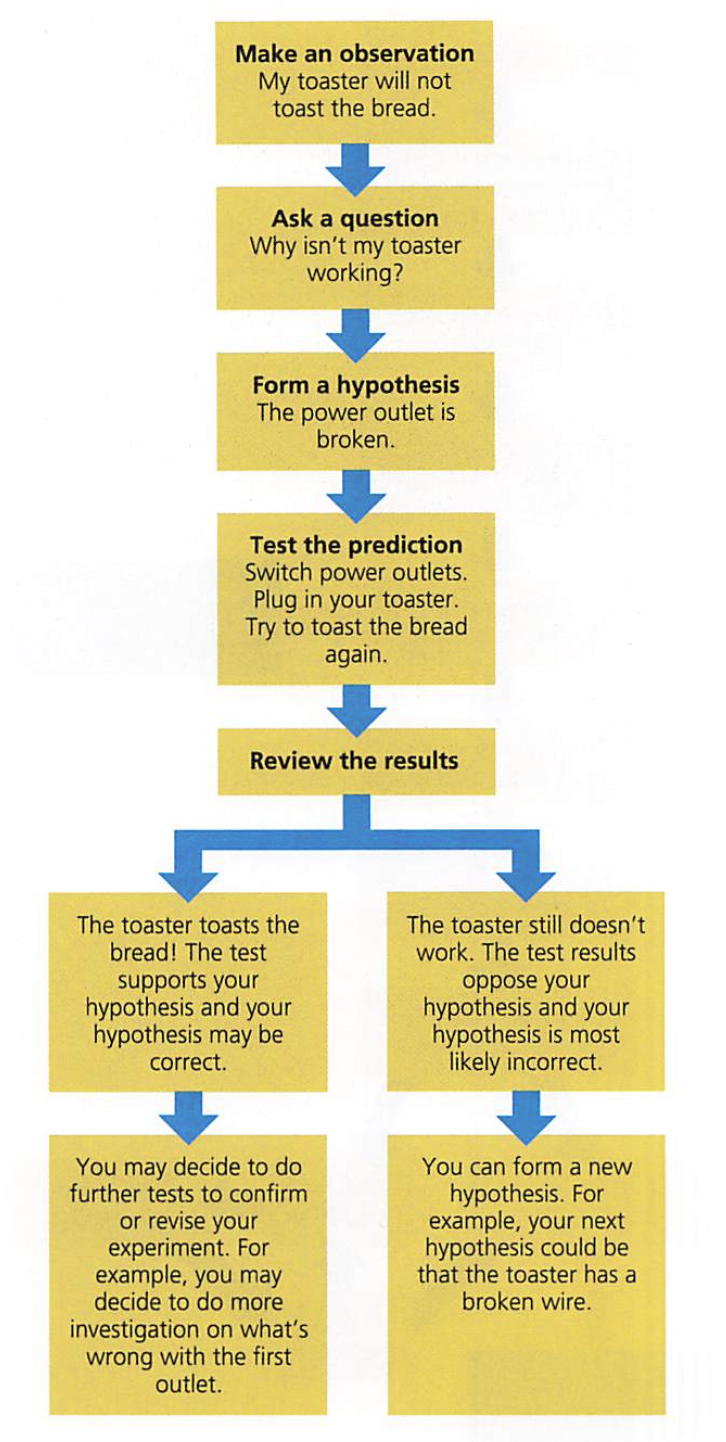
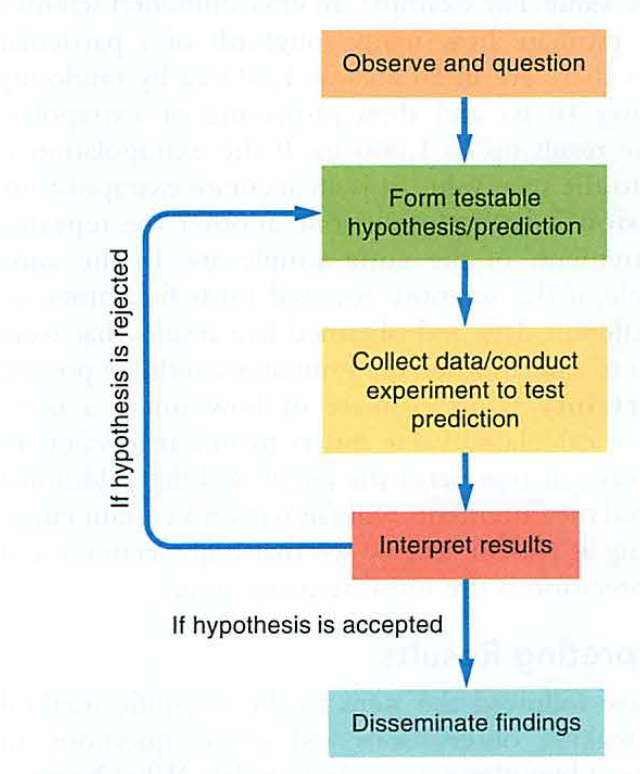
- Peer review: qualified folks who know the subject well review the process, data and interpretation
- Replication: once published in reputable media, the experiment must be able to be replicated using the same tools
- Pons and Fleschmann: no replication possible, same with the S. Korean human cloning guy
- Be skeptical about everything you read or hear.
- Evaluate evidence and hypotheses using inputs and opinions from a variety of reliable sources.
- Identify and evaluate your personal assumptions, biases, and beliefs and distinguish between facts and opinions before coming to a conclusion.
Law vs. theory: if verified and proven cause and effect, theory can become law: tentative, open to future data
Climate change example:
- Global temperatures are rising based on ice core data and recent measurements
- Carbon dioxide and other greenhouse gases follow the same pattern
- The dynamics of light, heat and gases is well known
- The impact is far greater than smaller variations (e.g. tilt of the earth)
- Carbon dioxide is a byproduct of human fossil fuel burning
- Human activity is linked to climate change
- Variable: any difference, in a planned or "natural" experiment
- Independent variable: the part that does not change (like x in a graph)
- Dependent variable: the part that changes-or not
- Null hypothesis: proving something is NOT cause and effect (can sheep's bladders be used to predict earthquakes)
- Replication: everybody must be able to get the same results, using the same materials
- Sample size (n): must be large enough to be accurate
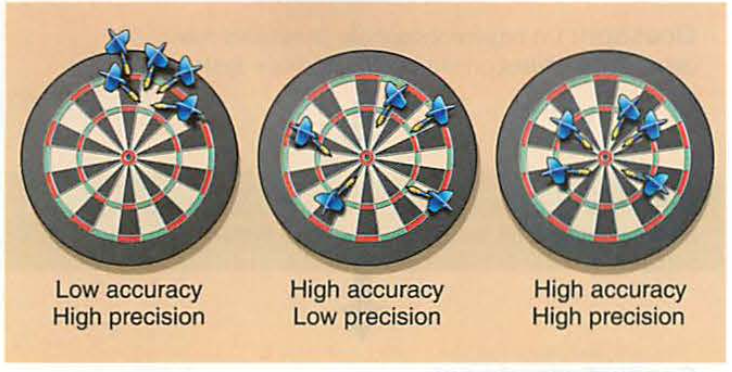
- Accuracy: close to truth or true value
- Precision: how close your results are to each other (gas pump is in 0.01liters, but your odometer is only in miles)
- Control group: those you DON'T mess with in the experiment (think of some drug test)
- Natural experiment: variation not planned (Lahaina, COVID, Mount Pinatubo and cooling of the planet, etc.)
Graphing:
X axis: independent variable
Y axis: dependent variable (the result)
question: in math, a function is something with only one dependent variable-why?
Units:
mks system is meters, kilograms, seconds
prefixes to know:
- kilo: thousand, 1000 or 10^3
- mega: million, 1000000 or 10^6
- giga: billion, 1000000000 or 10^9
- centi: 1/100 (like cents), 1 cm is about the width of your pinky
- milli: 1/1000, millimeter is 1/1000 meter, 1/10 of your pinky
- micro: 1/million
- nano: 1/billion
challenges:
- how many cm tall are you?
- How many mm to Kona (62 km)?
- How many kg do you weigh?
Temperature:
- Fahrenheit: only used by older civilizations, or the US (joke there), based on goofy science from long ago
- Centigrade: based on 0° for ice, 100° for steam
- Kelvin: bad guys in Star Trek, or based on molecular motion: absolute zero is 0°K, ice is 273°K, steam is 373°K
- Cool idea: at absolute zero, things could vanish (actually they would get very, very small) why?
Questions:
- how many nanometers tall are you?
- if you were weighted in grams, how many would that be?
- what is your body temperature in °C? In °K?
- an element has 3 protons and 4 neutrons, what is the symbol?
- what is the charge if it has 2 electrons?
- what do you call this?
- another element has 3 protons and 3 neutrons, how is this related to the element above?
- look up the periodic table and find this element, what column is it in?
- what else is in that column going up and down?
- why do we need a Kelvin scale and a Centigrade scale?
Look for chapter 2
- Primitive societies at one time would sacrifice food, animals or even people to ensure a good harvest, good weather, or other things. If the harvest was good, was this causation or correlation?
- How is the scientific method different from this?
- Look up Pons and Fleischmann and cold fusion. How did the rest of us know they were fake, and what part of the scientific method is relevant here?
- What is the difference between accuracy and precision when discussing data?
- Give an example of a dependent and independent variable in your life, and explain each
- Bud Tuggly does an experiment on caffeine and study ability with students, using only 3 students. What is wrong with this, and why is sample size important in any experiment?
- Create an imaginary experiment with a hypothesis, explain your result
- You are given the following data regarding caffeine and speed of a runner around a course:
- 1 cup of coffee: average speed 6 km/hr
- 2 cups of coffee: 6.5 km/hr
- 3 cups of coffee: 7 km/hr
- 4 cups of coffee: 6 km/hr
Graph these and label with the dependent and independent variable. (take a photo of your graph for the email)
9. what could also be impacting this experiment that we did not include?
10. In this experiment, what would be a control group?
11. In 1979 Mount St. Helens erupted, covering a huge area with ash. How was this a natural experiment, and why is it different from a normal experiment?
12. Ella Finoe wants to determine the efficiency of her car. She records the odometer when she fills the gas tank as 245.4 miles, and on the gas pump, 14.3 gallons. She then calculates her miles per gallon as 17.1608391608 mpg. What is wrong with this?
Migrated from Apple Server Wiki. Original page ID: e0c2X7w