
Unit 8: Pollution: module 4.42: Air pollution
Module 4.42 (module 42, 4th edition text)
Big ideas: air is shared by everyone on the planet, crosses international borders without consent, impacts innocents with little power.
Contrast this with solid, toxic or radioactive waste: usually disposed of on your own land, or with rivers, which demonstrate "continuity downstream"
What is a "criteria"? good/bad
6 major pollutants: “criteria pollutants”
- Sulfur dioxide: SO2 (could also be SOx)
- Nitrogen oxides: NOx (could be NO, NO2, or NO3)
- Carbon monoxide: CO
- Particulate matter: PM (PM 2.5, PM 5, PM10)
- Ozone: O3
- Lead: Pb
Mnemonic: SOX/NOX, CO/O3, PM/Pb
Added in 2007: CO2, VOC, Hg
From your text:
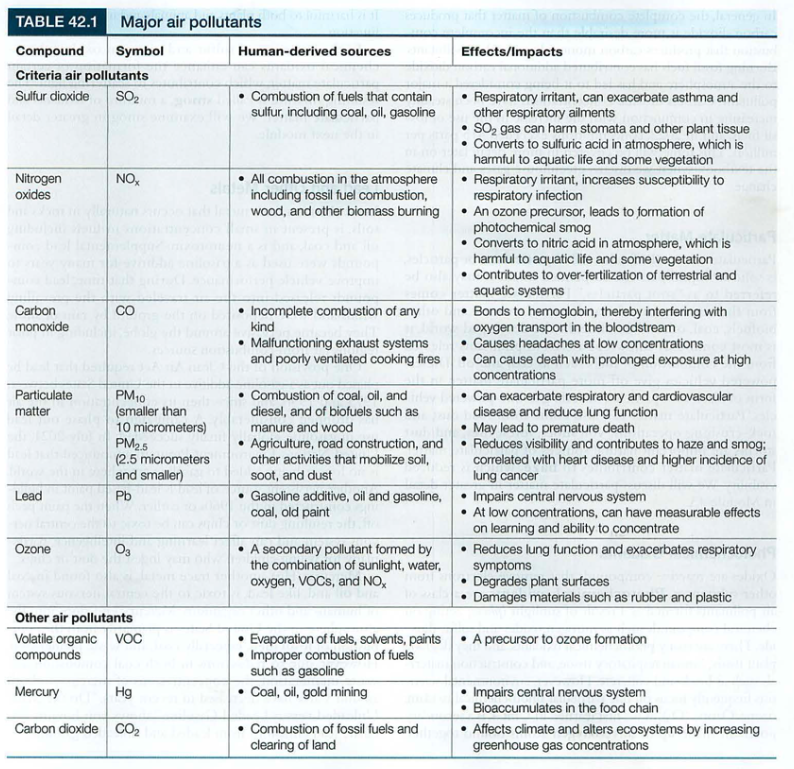
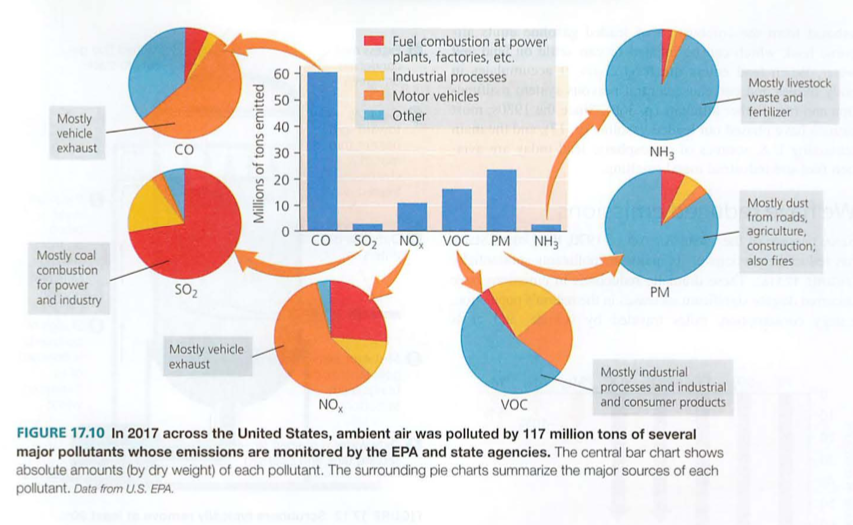
Context and relevance:
SOx: Sulfur Dioxide (SO2) and other SOx versions
- From Methionine (amino acid in living things) in fossil fuels (look up the structure of this)
- Combines with water in the air to make H2SO4 (sulfuric acid, acid rain)
- When you breathe it, it burns your lungs, stings your eyes
- May look like "yellow smog"
- One example is VOG: sulfur dioxide and ash (volcanic glass)
NOx: Nitric oxide (NO2) and other NOx versions
- Various forms of oxidized nitrogen, which alone is inert and makes up 78% of the atmosphere at sea level
- From high temperature combustion (e.g. auto engines, esp. high efficiency ones, which burn at higher temps)
- Also from decomposition of fertilizers (e.g. Ammonium Nitrate)
- Combines with water to make HNO3 (nitric acid) which also burns your lungs and eyes
CO: Carbon monoxide
- Emission from car exhaust, or other incomplete combustion: C + O2 —> CO2
- Many people die camping by burning stoves in their tent without enough oxygen, forming carbon monoxide
- If not enough O2, then CO forms, like in a closed space (tent, hut, cold house in Texas)
- Toxic, permanently attaches to your hemoglobin rendering it useless for respiration. (30 day life cycle for your hemoglobin)
- Imagine the town van, but nobody gets off. The bus still goes, but nobody goes to town.
- For 30 days (until your red blood cells are replaced) no seats on the bus, no oxygen.
Ozone
- Ozone is formed by sunlight, splitting O2 into O which then joins another O2 to make O3
- Ozone in stratosphere is good, in troposphere bad
- Ozone (O3) blocks UV radiation, while Oxygen (O2) does not
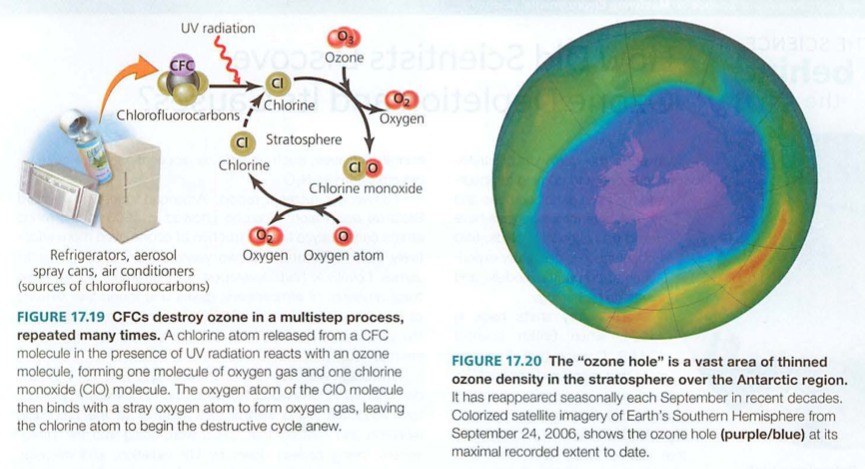
- Stratospheric ozone is necessary to filter UV radiation. CFC (chloro-fluro-carbons) destroy this layer
- This caused an ozone hole over Antarctica: Why there?
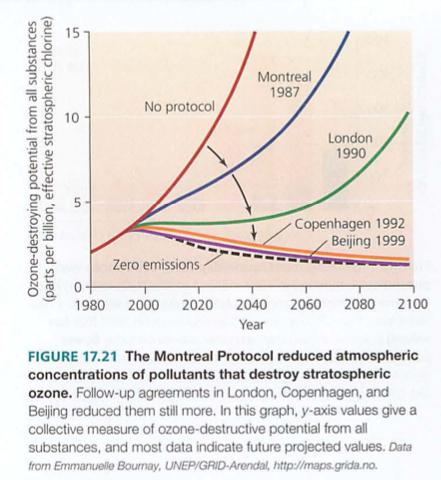
- How did we solve this? The 1987 Montreal Protocol:
- Tropospheric ozone causes lung and eye irritation, and is toxic to some organisms
- You may have heard of ozone generators used in hotel rooms to absorb smoke
PM: Particulate Matter
- Look up alveolus in your lungs
- Particulate Matter (PM) is basically soot (carbon)
- PM2.5 is 2.5 microns in size, PM10 is 10 microns in size (there is also PM5)
- PM2.5 is most dangerous, smaller particles lodge deep in the lungs, beyond ability of pulmonary cilia to flush out
- PM5, PM10 larger particles, get caught by cilia
- Main cause: coal fired power plants, diesel engines, oil fired power plants (carbon soot)
- See also vog: PM2.5 particles of ash (glass shards) with SO2 dissolved in water droplets (sulfuric acid): physical abrasive + corrosive acid = respiratory damage
- Fun fact: smokers get colds more often because tar in tobacco gums up the cilia, so they can't brush away germs and viruses.
Pb: Lead
- In the old days, there was leaded gasoline, and highly leaded gasoline (called "super" or "ethyl" because they used tetraethyl lead as an additive to improve power)
- Gasoline additive (tetraethyl lead improves octane rating cheaply), replaced by other worse carcinogenic (cancer causing) chemicals like MTBE: https://en.wikipedia.org/wiki/Methyl_tert-butyl_ether
- Decreases mental capacity (e.g. Roman insanity theory)
- Coal smoke contains lead, along with Mercury and other heavy metals. Sludge from mining is worse.
VOC: Volatile Organic Compounds
- Volatile organic compounds, e.g. gasoline vapors (why your gas cap must be on or you get a dashboard warning): https://en.wikipedia.org/wiki/Volatile_organic_compound
- Aerosol vaporizers are also VOC generators (indoor air pollution)
- Remember water striders sitting on water, due to surface tension?
- Your alveoli are surrounded by water (blood) so they need a surfactant (detergent) to break the surface tension so they can expand you can breathe.
- If you breathe in VOC's (siphoning gasoline, vaping, or in the case of premature babies), the surfactant is gone, and you cannot breathe.
- Vaping is a concentrated version of VOCs, dissolving the surfactant in your lungs, causing "chemical pneumonia", only seen before in anesthesia and people siphoning gasoline or premature babies.
Air Quality monitoring: Purple Air: note the PM 2.5 graphs
Check out other locations...
Vog forecast: http://weather.hawaii.edu/vmap/new/
Migrated from Apple Server Wiki. Original page ID: F9N8s0